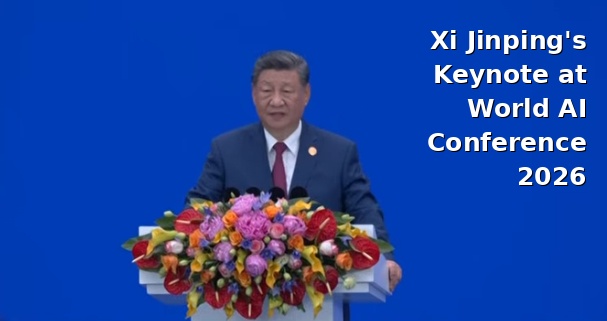
The following is the full transcript of Chinese President Xi Jinping’s keynote speech at the 2026 World Artificial Intelligence Conference (WAIC) in Shanghai, China, July 17, 2026.
Editor’s Note: At the 2026 World AI Conference in Shanghai, Xi Jinping delivered a keynote address emphasizing the necessity of guiding artificial intelligence toward “the positive, for good, and for humanity.” Reflecting on seven decades of AI history, he urged the international community to balance rapid technological innovation with responsible, adaptive governance to address emerging security and ethical challenges. The speech also outlined China’s commitment to fostering global cooperation, including new initiatives to support capacity building for developing nations.
Opening Remarks
PRESIDENT XI JINPING: Distinguished colleagues and guests, ladies and gentlemen, friends,
Seventy years ago, a group of young scholars proposed the concept of artificial intelligence for the first time at the Dartmouth workshop in New Hampshire of the United States. In the subsequent seventy years, AI scientists and researchers from around the world ventured into this unknown territory, forged ahead through twists and turns, and made breakthroughs with persistent hard work.
Seven decades later, today, amid the new wave of AI development, we are gathering by the Huangpu River to discuss how to promote AI globally for the positive, for good, and for humanity. All this makes our meeting highly important. On behalf of the Chinese government and people, I would like to extend a warm welcome to you all.
The Historical Context of Technological Revolutions
In the course of history, the invention of the steam engine heralded the industrial civilization. The widespread access to electricity brightened up modern society, and the birth of the Internet brought the entire world together. Each of these technological revolutions has profoundly reshaped our way of work and life and enabled a giant leap in economic and social development.
Today, major changes unseen in the century are accelerating across the world. The new round of technological revolution and industrial transformation is advancing at a faster pace, and the world has entered an unprecedented period of active innovation on AI technologies.
Intelligent connectivity, human-machine collaboration, cross-sector integration, joint creation and sharing, and other intelligent technologies are unleashing enormous power. All this carries within it great opportunities as well as challenges to governance.
Questions of Our Times
We human beings must answer the questions posed by our times. How to get along with thinking machines? How to ensure security when algorithm is part of decision making? How to tackle ethical challenges by technologies through adaptive governance? How to realize AI for all when the divide keeps widening?
These questions demand serious consideration and real answers from the whole international community. In China’s view, all countries should take a people-centered approach and develop AI for the positive and for good. We should ensure that AI is an important driver for shared prosperity and common security. We should join hands to build a just and equitable system for global AI governance.
Four Observations
To this end, I wish to share four observations.
First, we should adhere to the principle of openness and win-win, and boost innovation-driven development. As a new engine of world economic growth and an accelerator for the shift of growth drivers, AI is moving from the digital world into the physical world. We should seize this rare historic opportunity to encourage open source, openness, collaboration, and sharing. We should facilitate technological innovation, industrial development, and scenario-based application of AI.
We should make coordinated advances in the transformation and upgrade of traditional industries, the cultivation and growth of emerging industries, and forward-looking planning for future industries, so that all sectors and businesses can benefit from AI.
Second, we should strengthen risk awareness and ensure that AI is secure and controllable. AI should be a trusted tool for humanity. We should take seriously the various types of inherent and secondary risks that AI may trigger. We should put in place laws and regulations, technological monitoring, early warning, and emergency response systems in order to strengthen the line of security, prevent abuses and malicious use, and ensure that AI is always under human control.
In the meantime, we should jointly oppose overstretching the national security concept in the field of AI or placing one country’s security over that of others.
Third, we should encourage inclusiveness and promote mutual learning between civilizations. AI development and its application should not erode or undermine the diversity of world civilizations or the uniqueness of cultures of different countries. We must shape the values of AI with humanity’s common values, and make good use of AI technologies to increase understanding, tolerance, exchanges, and sharing among all civilizations. We should tend to the garden of civilizations with great care to ensure that the beauty of each civilization is appreciated and shared.
Fourth, we should advocate solidarity and improve global governance. AI is an invaluable asset that encapsulates humanity’s collective wisdom. We should practice true multilateralism and recognize the important role of the United Nations. We should enhance alignment and coordination on AI development strategies, governance rules, and technical standards so as to form a consensus-based global governance framework at an early date to make this frontier technology better benefit humanity.
We must carry out extensive international cooperation, and help Global South countries with capacity building to bridge the AI and digital divides, promote sustainable development, and prevent creating new historical injustice in AI.
China’s AI Development Progress
This year marks the start of China’s 15th Five-Year Plan. It maps out China’s economic and social development for the next five years and provides immense opportunities for the international community.
In recent years, China has embraced AI with open arms. We have promoted interplay between an efficient market and a well-functioning government, strengthened AI innovation, actively advanced the “AI Plus” initiative, and built a healthy ecosystem for all entities to thrive in together. The core smart economy industries are worth at least RMB1 trillion.
Smart devices in countless homes truly improve people’s livelihood.