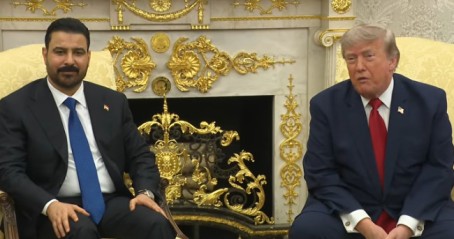
Editor’s Note: President Trump and the Prime Minister of Iraq met at the White House to discuss strengthening bilateral relations and fostering a new economic partnership between the two nations. The discussion highlighted a shared focus on future collaboration, including significant oil and energy investments, as well as the transition of security responsibilities within Iraq. President Trump emphasized the importance of this relationship, noting his support for the Prime Minister’s leadership and the potential for a long-term, prosperous alliance in the Middle East. (July 14, 2026)
Opening Remarks
PRESIDENT TRUMP: Well, thank you very much.
We’ve had already a good meeting. We’re going to decide to do a little lunch. It wasn’t scheduled but we are going to do it on the fly because we have a tremendous chemistry together. The prime minister of Iraq has been amazing. He won an election that a lot of people didn’t anticipate.
Could be won by anybody other than another person who was not, in my opinion, a good person, not good for America. I don’t think good for Iraq. And I played a role in — I mean, it was very important to me to have somebody get in there that can do the job and do it well. And we have a fantastic champion, a new champion. And he won the election very soundly, very conclusively, and he wasn’t favored.
But by the time they got to know him, he ended up winning. And he’s going to be there for a long time. So I just want to say it’s a great honor to have the prime minister of Iraq with us. He’s been a great fighter and he’s been a great fan of America. We’ll be discussing that a little bit with you.
They have tremendous oil reserves. They have tremendous potential wealth, they have tremendous wealth, not only potential. But he’s done — in a short period of time, he’s changed that country so much, especially toward their thinking about the United States. We have partnerships. Chris was just saying we have tremendous oil partnerships all of a sudden being formed over the last short period of time.
And I guess you’re going to be announcing them this week or next week. But massive, among the largest. So they have done a fantastic job over the last short period, in a very short period of time. But they have a great leader, the new prime minister, he’s a great leader. I think he’s going to be there for a long period of time, and it’s great to have you at the White House.
Thank you very much. Thank you. Thank you. He’s a young man. He’s young and he’s handsome, which I don’t like. I’m not happy about that.
Prime Minister Ali Al-Zaidi’s Opening Statement
PRIME MINISTER ALI AL-ZAIDI: Excellency of President Trump. This is my first visit to the United States of America. This visit was not just like a visit. Further, it’s an announcement of economic partnership. When I talk to his excellency, on the thirtieth of September, the US forces will be out of Iraq, while the US companies will be inside Iraq. While the social relations is about economy, not about military relations. I would convey my greetings from the oldest civilization in the world.
On US Military Presence and Iran
REPORTER: [QUESTION INAUDIBLE].
PRESIDENT TRUMP: Well, don’t think we need the military there anymore. It’s a very big operation. And what we do have is the oil companies are all going in now and they’re doing partnerships with Iraq and they’re getting along very well. The relationship is a whole big relationship where we don’t need the military there. We’re there to help them.
We’re there to protect them if need be, but we don’t think that’s going to be necessary. And their primary — I consider an opponent. They might have considered a friend, but I consider that an opponent — was Iran. Iran was a big burden on Iraq because they were the bully of the Middle East, as you know. And we were just talking about that, but they’re not going to have that problem anymore because Iran has been very much destabilized and really their military power is just a tiny fraction of what it was just four months ago. So they’re not going to have that problem.
I think it’s really, in a sense, it’s given them freedom to do what they have to do. And I think that’s one of the reasons that our oil companies are going in there at levels that have never been seen before.
On Restricting Weapons to the State
PRIME MINISTER ALI AL-ZAIDI: Thank you for your question. According to the program of the government, is to restrict the position of weapons to the state. And this is a basic point. And I have — and this is like a decision. It’s not an option. We received weapons by different factions. And he, whoever surrenders his weapon, turned into a political civilian. We will cooperate with them.
After the thirtieth of September, there’s no any need for the presence of any faction. Because factions is a need. It’s not a profession. Not any justification for their existence after the thirtieth of September. By the end of this year or by the beginning of the next year. The sovereignty conference is the biggest conference in the region. The Iraqi decision is made by the hand of the Iraqis only. And our security forces are capable of protecting their borders. So the thirtieth of September — except for any entity to carry weapons outside the control of the state. Okay? Thank you.
# On the Strait of Hormuz Fee
REPORTER: President Trump, I have two questions. I was wondering if you could explain your changing thinking on the Strait of Hormuz applying a twenty percent fee. How did you get to the decision you just announced?
PRESIDENT TRUMP: Yes.
So when I put that out yesterday, because we’ve been doing that for many, many years, it was never fair to me that we would be guarding the strait when we basically don’t need the oil at all. And it wasn’t important for us, it was important for allies. It was important for people that we get along with very well, including the major Gulf State countries.
So I put it out yesterday. I thought it was good. I was called by different people, different countries, kings and emirs and all of the people we all know and we all love. And they’ve been, frankly, they’ve been very strong partners. And they said we’d love to do it a different way.
We’d love to invest in the United States with billions and billions of dollars and continue our record setting — because we would — there’s never been a time like this with the United States with the factories, with the plants, with everything else. And we would like to invest tremendously in the United States as opposed to paying a fee. And I like that actually because I don’t think anybody should be able to charge a fee for the strait or for any other strait relationship in terms of other sections of the world. I don’t think anybody should be really in that position. But we were doing it as a reimbursement.
The Gulf States are going to invest a tremendous amount of money into the United States and that was very satisfactory to me. I think it’s actually much better.
# On Senator Graham’s Death
REPORTER: I could also ask, are you aware of why the FBI is looking into Senator Graham’s death? Have you gotten any updates on why they were at some?
PRESIDENT TRUMP: Well, I don’t know why because I think, you know, he had a problem. His father had a very similar problem, as you know. It’s very unique. At first, I heard it was clogged arteries because he did have clogged arteries. He had a problem with that. He was — I wish he took better care of himself. I say, you can see — you know, you can solve that problem.
But what happened is actually something that’s very hard to detect. It was not related to any blockage. It was a totally different thing. And supposedly — and I’ve watched all the medical reports. I’ve had the doctors from the White House come in and explain what happened. And this is something that is very almost undetectable. And if it happens, there’s not much you can do about it. It sounds unfortunate, but there’s not much you can do about it.
If you look at his — his father died of the same thing at about the same age. So there was not much. They say it’s almost undetectable. You can detect it by if you have a very bad back, that’s a sign. It’s a bad sign. So if anybody has a bad back, it’s a pretty rough thing to think about.
But the fact that that’s one of the primary signs — and he would tell me he had a bad back, but little did anyone realize it was for that. So when that bursts, which it did, it bursts, there’s not much. So I don’t see a lot of evil there. I don’t — I know there’s all sorts of conspiracy theories going along, and I don’t think the FBI — I think the FBI is wasting their time if they’re doing that.
# On Gulf State Investments
REPORTER: [QUESTION INAUDIBLE]
PRESIDENT TRUMP: No. I just told you — you have Saudi Arabia, UAE, Qatar, Bahrain, and Kuwait, primarily, and then others. I spoke to all of them, and they would love to invest more money in the United States at record amounts, and that would be very acceptable. And this way, there’s no fee. I don’t like the concept of a fee. But at the same time, it’s not fair that we’re protecting this strait for the entire world, for China and everyone.
I don’t mind protecting it for China. I don’t mind protecting it for anybody, but it’s unfair that we’re not somehow compensated. And we’ve been doing this for many years. It’s bothered me. Twenty-five years ago, it bothered me. During my first term, I was doing things like — you have to invest in the United States. And but by doing it that way, there’s no fee. They’re investing and they’re getting a return on their money and it’s good. But they’re going to be making massive investments into the United States and I like that much better.
# On Iraq and OPEC
REPORTER: I they might consider leaving — know, prime minister right here because here he is. Would you like to know about it? Are you considering, mister prime minister, leaving OPEC or are you pushing for changes? And mister president, would you support —
PRESIDENT TRUMP: Excuse me. I support him. For changes? You know, I support him very early in the — I endorsed him. Something I rarely do, but I’ve had great successes endorsing. You know, we just had Colombia, which was a big one. Argentina was a big one. We had many — I’ve endorsed — I think everybody I’ve endorsed from a foreign standpoint, they just win. Yeah.
And, you know, I’ve been hearing great things. I’m a student of a lot of history, and I do know a lot about the history of Iraq. And I watched what was happening in Iraq with the elections. And I put a very strong endorsement out because I was very unhappy with the man that was supposed to win the election. And this great gentleman, I think he’s going to end up being a great leader. He won. So I’m very happy about that. As far as OPEC, that’s his decision and you might ask him that question.
PRIME MINISTER ALI AL-ZAIDI: We are one of the countries that established OPEC. We need a fair share for Iraq. Iraq fought ISIS and terrorism at all, with the support of the United States of America. This fight with ISIS cost us huge amounts of money. Destroyed the Iraq infrastructure. Damage that really — what was against Iraq — is more than $400 billion. But till today, some Iraqi cities are totally destroyed. They’re living in camps. I have a plan to get them back to their homes. We need a fair share. We need a fair share.
PRESIDENT TRUMP: Publicity — as you probably heard. And I used to say, don’t go into Iraq. Don’t attack Iraq. Frankly, they attacked the wrong country, and they did a lot of damage. Yeah.
# On Iran and the Naval Blockade
REPORTER: Given how the Iranians have been behaving, do you have any regrets about lifting the naval blockade or giving the sanctions waivers?
PRESIDENT TRUMP: No. I gave them a chance. I wanted to give them a chance at making a deal. You know, we had a deal two days ago. It was done. And then all of a sudden, they couldn’t do it. They didn’t like something about the deal. They couldn’t do it. And they shot first, and that was a big mistake that they shot first because we have been knocking the hell out of them.
They’re very difficult people. Forty-seven years, we put up with it. The — go back all the way, thousands of people, thousands of Americans were killed. A lot of soldiers were killed. A lot of soldiers are walking around — or not walking around. I mean, they’ve been so badly injured. The arms, the legs, the face — with the Soleimani, with the bomb. They call it the roadside bomb. Most people call it the roadside bomb. It’s a disaster.
And I killed him in my first administration. Had I not, it might be a different story today. He was a mad genius. He was a mad — probably a madman, but he was a general, and he had total control over the country. And I actually think the leaders of Iran were afraid of Soleimani, but I killed him.
And, by the way, with him went a very bad person also. They happened to be meeting each other at the airport. And a very bad person from Iraq — happened to be a leader of Iraq — happened to be killed in that same incident. So I don’t know if I did you a favor or not. I’ve never asked you that question. You probably would know better than me. But no, I think that what we’ve done to Iran is we’ve taken away almost all of their military capability.
PRIME MINISTER ALI AL-ZAIDI: At the time, I was not in politics. In my visit, I’d like to talk about the future. Thank you, mister president.
# On Baghdad-Erbil Cooperation
REPORTER: Thank you for your time. Last year in May, the prime minister of Kurdistan region, Masrour Barzani, signed about $110 billion in energy deals with US companies here in Washington DC. Mister president, if Baghdad and Erbil work together better, that investment could grow, grow, grow. What is your message and advice to the leaders in Baghdad and Erbil to work together? Why I’m asking this question? Because you are our miracle makers, mister president.
PRESIDENT TRUMP: I love this question. It’s my favorite question so far by far. Thank you very much for the question.
Strengthening U.S.-Iraq Relations
PRESIDENT TRUMP: Look, Baghdad, I think, and I and this country, we’re going to make some tremendous music together. We haven’t been dealing very much over the last four or five years with the previous administration. Iraq has tremendous potential because of their oil and because of other things, but because of their oil. And we’re going to be doing a lot of deals. We’re going to create a lot of jobs for both countries, and we’re going to be taking out a lot of oil.
A lot of oil is coming out, and the American companies are doing it. Mostly American companies now, they don’t want to do business with others. They want to do business with America, and that’s good. And that’s one of the reasons that I felt so strongly that this was going to be a great prime minister, and I fought for that. And as the and as the prime minister. Go ahead.
REPORTER: Would you describe your relationship with Kurdistan Regional Government at this time? Because the prime minister yesterday had a statement and fully support you.
PRIME MINISTER ALI AL-ZAIDI: I look at Iraq as a body. Each part of Iraq is part of my own body. I would never distinguish between two, any organ. And I cannot cut off any part of any organ from my own body. It is such an important part of Iraq. No different than Basra and other provinces.
PRESIDENT TRUMP: But because such nice things were said about him, that means he likes the man that said those things. Right. Okay. Go ahead, please.
REPORTER: Have to say thank you so much, Mister President. I have a question for you and a question for the prime minister. The first question, Mister Prime Minister, why did you choose the United States as your first state visit? And what concrete steps do you take when you go back to Iraq to make sure that the agreements you are reaching in Washington D.C. are implemented?
PRIME MINISTER ALI AL-ZAIDI: I inherited such a heavy burden country. I have a master’s degree in finance. I analyzed the economic situation of the country. This burden, I need such a strategic partner to really lift this burden. Most important strategic partnership.
On Inflation and the Economy
PRESIDENT TRUMP: Yeah. Thank you. Will this trend hold now? I think so. I think inflation’s down. We inherited the worst inflation in the history of our country. They say forty-eight years. It was the worst in the history of our country from Biden. Sleepy Joe. He might have been sleepy, but boy, he could create inflation like nobody.
And I inherited that, and I got blamed for it. And it’s not my fault. We are putting it to sleep. And we’ve done a great job, Scott and Howard and Marco and even Pete because he’s watching his dollars. Right? But they’ve done a fantastic job. We’ve all done a fantastic job.
So we had the worst inflation in history and the history of our country. I mean, we had months where it was nine and ten percent. And now, we have a report that just came out. It was just released. And thank you for bringing it up. But the report was incredible. Inflation is way down. That means prices are coming way down, and we’re doing a great job.
And remember that for the midterms, I say to that camera. Remember that because nobody else could do it. Prices are way down. Prices are coming way down and we’re going to bring them much lower yet. Well, I’d rather save it. It will concern that subject, and we’ll have a couple of other things to say also. But I’d rather save it, but it’s really big news. It’s really, really big news.
And our country has to shape up. But that’s what we’re going to be talking about Thursday. It doesn’t get bigger because without free and fair elections, you don’t have a country. We’ll be discussing other things too.
On Iran Sanctions and the Middle East
REPORTER: Mister President, your administration pushed hard to shape Iraq’s leadership and tied U.S. support to disarming Iran-backed factions. With the September fifteenth —
PRESIDENT TRUMP: I think everything’s on schedule. We have a great — here we are. I mean, we’re right now. Even called for a lunch that wasn’t scheduled. Okay? So in that way — but now, we usually — I don’t think I’ve ever done that where we didn’t have lunch. I said, let’s have lunch. You know why? Because I like them. I like them. So I think that’s all going to work out very well.
REPORTER: Sir, you know this Russia sanctions bill — signed within the next week or two, and who do you sign?
PRESIDENT TRUMP: Well, know that Lindsey wanted it very badly. I think they may be adding Iran to it. They’re going to add Iran, which is a very big thing if they did that. They may add Hezbollah too. Just put them — maybe you do business with Hezbollah. So we’re looking at that. But they’re seriously thinking — this is in honor of Lindsey. This was his thing. He wanted this more than any other thing. You know how he felt. And there’s a good chance that it gets done. But they’d like to add Iran, and they’d like to add Hezbollah to it. That’s what I’m hearing.
REPORTER: And if that was secondary sanctions on China, India, Europe —
PRESIDENT TRUMP: But we’ll have to look. That hasn’t been discussed.
REPORTER: Kurdistan region and Iraq?
PRESIDENT TRUMP: I think everything is going to work out. I think people — the Middle East, believe it or not, is coming together. We’re getting rid of the bully of the Middle East. Iran was the bully of the Middle East. They bullied Iraq. They bullied every country. There was fear all over the Middle East with other countries. I understand that, but there was fear. But there’s no fear anymore because their military capability has been knocked to hell, and there’s no fear.
I think the Middle East is coming together like it’s never come together before. You can’t have a dominant factor like Iran that would kill fifty-two thousand protesters. You know, they killed — nobody likes talking about that. I don’t like talking about it. They killed fifty-two thousand protesters. So the bottom line, all regions, I believe, are coming together.
Closing Remarks
PRESIDENT TRUMP: And I think it’s going to be — this is going to be one of the great leaders right here. It’s going to be one of the great leaders in the Middle East. Go ahead, please.
And I think we can go into this for a long time. And the bottom line is that we have a fantastic relationship with many countries now. We just had a — I just came back from NATO. Many of you were there and you saw how that worked out. It was a phenomenal — it was a love fest, to be honest. And they love the United States. They even like me, but they love the United States. And we’re going to cut costs there by hundreds of billions of dollars maybe. But the NATO event was incredible. Today’s event is incredible.
This is a potentially really great country. And many people would say it’s a great country. We’re helping it. We want to help it. We have a fantastic relationship with the new prime minister. He’s a strong person. He’s a very brilliant guy. He’s very much acknowledged. Or he couldn’t have won that election. That was a competitive election, and he went out and won. And it’s a big story. I mean, it’s a big, big story.
And I just want to say that the United States has never done better. We’re doing well. And, you know, more people are working today in the United States than at any time in history. We have more things being built. Factories, plants, AI, automobile plants are being built at record numbers, more than we’ve ever had ever before. The tariffs have been used very judiciously and properly, and companies are pouring in and countries are pouring into this country to build factories because when they build them, they have no tariffs. And we have numbers — nineteen to nineteen point two trillion dollars. As an example, under Biden, it was less than one trillion for four years, with nineteen point two trillion for twelve months. Nobody’s ever seen anything like it.
The relationship with Iraq is — I would say it went from being not so good to being outstanding. And we’re going to have a long-term relationship with Iraq. We’re going to have a long-term relationship with a man that will be a great leader. You are — mark my words. I knew what I was doing. This man is going to be a great leader in the Middle East beyond Iraq. His influence is going to spread all throughout the Middle East, and we’re very happy about it. And we are very happy to have you with us. Thank you very much.
And I just want to — I don’t think there’s anything much else you can ask us. This is a very important meeting. It’s something I’ve never done before. No lunch was scheduled. I said, let’s have lunch. I’ve never done that before. Sometimes we have a lunch scheduled, but I’ve never done this. Right, Susie? This is a first. So I have no idea what we’re going to be eating, but it’ll be fine. But we’re doing it because we like the people that we’re with. Thank you very much.
Related Posts