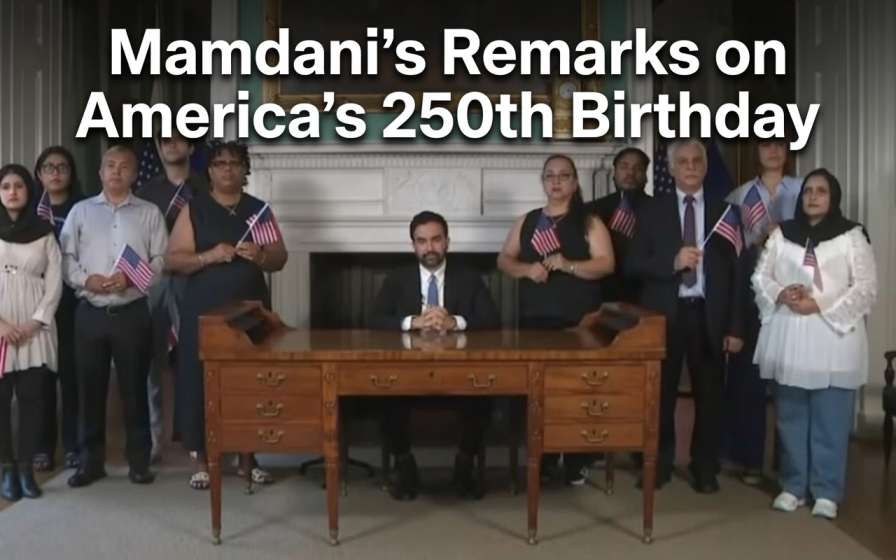
The following is the full transcript of Zohran Mamdani’s remarks on America’s 250th anniversary, July 3, 2026.
Editor’s Note: In this address marking America’s 250th anniversary, New York City Mayor Zohran Mamdani reflects on the nation’s history, from its founding ideals to its ongoing evolution as a country built by immigrants and diverse communities. The Mayor challenges conventional narratives of “American exceptionalism,” arguing that the nation’s true strength lies in its capacity for progress and the continuous, collective effort to fulfill the promise of democracy. By weaving together stories of resilience from New York’s past and present, the speech serves as a call to action for all Americans to participate in the ongoing work of making the nation more just and inclusive.
Listen to the audio version here:
Good Morning, My Fellow Americans
ZOHRAN MAMDANI: Good morning, my fellow Americans. Season after season, year after year, the tides have come in and out of New York Harbor. Long before the name New York had ever been spoken, Lenape dugouts crossed these currents. It was on these waters that tall masts crested the horizon, captained by explorers like Verrazano and Hudson, after whom we’ve named our bridges and rivers. And ever since, ships full of travelers weary from long journeys have passed through the narrows, the winds of the Atlantic at their backs.
When those passengers lifted their heads to glimpse what lies just beyond the waves, what did they see? They saw land, lush and teeming with life. They saw men waiting at the docks to take them into bondage. They saw tenements rife with squalor. They saw industry rumbling with activity, steam and smoke rising, a city on the move. They saw a towering monument to freedom, her torch glowing, worldwide welcome. They saw New York City. They saw America.
250 Years of a Grand Experiment
Tomorrow, our nation marks 250 years since we declared our independence, 250 years of a grand experiment in self-governance, an experiment so audacious that some in 1776 doubted it would last more than a few years, let alone a quarter of a millennium. From Lexington to Los Angeles, Selma to Seneca Falls, Mauritania to Midwood, Americans will come together for a day, just as we do each year. Families will gather around the grill, fireworks will fill the night sky.
This will be no ordinary day of celebration. Two hundred and fifty years presents a rare opportunity for more than 340 million people to turn together, both towards one another and towards ourselves, to take measure of who we are as a nation. When we look at America, what do we see?
Here at City Hall, as I sit behind George Washington’s desk alongside new Americans who came to this country, I cannot see all of America, but like so many who came before, I can see New York City.
The City Washington Once Knew
The city I see today looks very different than the one that greeted George Washington. In July of 1776, our city simmered under the yoke of oppression. The British had imposed a colonial rule so repressive that 250 years ago, 80 miles south, a small group of newspaper editors, farmers, and soldiers signed their names on a document declaring truths that feel self-evident now, but were revolutionary then, establishing the ideals our nation still strives to fulfill.
The British did not take it well. War broke out. And that August, as the largest battle of the Revolutionary War unfolded in Brooklyn, batteries on Governor’s Island took aim at British ships anchored just offshore. We were outgunned, we were outmanned, and we were soundly defeated. After only a few months, it appeared our fledgling attempt at democracy was on the precipice of collapse.
But that night, with the moon overhead, thousands of our soldiers silently climbed into ferries and flat-bottomed boats and escaped to Manhattan. The Continental Army survived to fight another day. Independence may have been declared in Philadelphia, but it was rescued in New York City.
An Opportunity to Begin Anew
George Washington was the last to leave Brooklyn. As he waited at the river’s edge, the sun beginning its rise, he would have looked out over New York City’s waters and seen what so many have seen in the 250 years since, an opportunity to begin anew. Those opportunities, like everything in New York City, are not given, they are won.
In 1838, 11 years after New York outlawed slavery, a recently emancipated black man by the name of James Weeks sought to begin anew as well, and to help hundreds of others do the same. He bought property in Brooklyn, won himself the right to vote, and sold lots to others newly freed. When they landed in New York Harbor, they knew they had something waiting for them that they had never had before, a home.
Weeksville still stands today, a living, breathing testament to what we know America to be, a place each of us has the power to make. The harbor was busy those years, as ships poured in from around the world.
A City Shaped by Those Who Were Told They Did Not Belong
Hundreds of thousands of Irish immigrants arrived with stomachs aching from a famine manufactured by imperial cruelty. Chinese sailors settled in what is today Chinatown. Millions more traveled under the Statue of Liberty and through Ellis Island, Jewish people escaping pogroms, Italians fleeing poverty, Syrians seeking economic opportunity.
Each of these new arrivals peered through portholes onto a city that was changing as fast as the nation. They saw merchants peddling their wares on the docks, streets being laid out on a grid, buildings rising into the clouds. They could not yet see the nativism they would face, the jobs they would be refused, the landlords who would not rent to them, and the abject labor and living conditions they would withstand. But no matter how much smog hung over the harbor, they still saw an opportunity to begin anew.
Over the years that followed, despite laws enacted by the federal government to bar their entry, despite sweatshop fires that killed hundreds of women, despite riots aimed at their very existence, immigrants made homes here in New York City, and they helped to make New York City.
The Promise of America, Carried Forward by Every Generation
That legacy of every generation of Americans insisting that the right to life, liberty, and the pursuit of happiness extends to them, too, is no relic of the past.
It carried millions of Black Americans north during the Great Migration. It drew hundreds of thousands of Puerto Ricans to New York City after the Second World War. It invited countless others from the West Indies and South Asia and West Africa and across the world. And it is what brought my family to this city when I was seven years old.
My family did not arrive by boat, although we saw the Statue of Liberty from the window of the plane. Even from the air, we could make out the promise of America, the promise of the beautiful patriotic work of rendering America, year after year, a little more faithful to its founding ideals.
What American Exceptionalism Really Means
There is a term so often used to describe our nation and those who have shaped it: American exceptionalism. American exceptionalism, the conventional wisdom tells us, makes our freedom a little more free, is how we dug the Erie Canal and irrigated the West, is why children in faraway lands grow up dreaming of one day moving here.
And yet the irony is that the story of America has so often been written by those who were told by others with power and influence and wealth that they were anything but exceptional.
For generation after generation, we have been told that when the world has sent its people to our shores, it has not sent its best. It sent Puritans and Sikhs and Quakers and Muslims and Jewish people who were banished for praying the wrong way, worshipping the wrong gods, angering the wrong people. It sent peasants and serfs from slums and shtetls who were treated as less because they hardly owned clothes, let alone land. It sent immigrants for whom power was something someone else had.
We are told that America is exceptional because we are richer, stronger, more powerful than everyone else. The truth, my friends, is that America is exceptional because here, nothing is fixed into place. The frontier may be closed, we may have walked on the moon, but the work of fulfilling the values first enshrined in the Declaration of Independence — that work endures and it belongs to us all.
A Message to Our Newest Americans
It belongs too to our newest Americans, those standing here with me today, all of whom were recently naturalized. Nearly a decade ago, I too felt what you feel, the joy of no longer being just a New Yorker, but an American too. You each hold a special power, the power to determine what America means.
The powerful have always known their answer. America, in their view, is an arena of supremacy, where only a select few are allowed freedom, where not all are created equal. America, if you ask them, becomes less the more people it welcomes. America, they will tell you, belongs only to those with the right accent or the right shade of skin.
Division and Progress: The Oldest Trick in Politics
The rest of us, they insist, should be grateful for merely being allowed to visit. How small they are, how weak, how unoriginal. At every moment in our past, those who led through exclusion and isolation have tried to win power and enrich themselves by turning us against one another. Division is the oldest trick in politics, and the cheapest. But time and again, including 250 years ago, those forces of division have been vanquished by the forces of progress.
As Thomas Paine once wrote, “This new world hath been the asylum for the persecuted lovers of civil and religious liberty, hither have they fled.” And yet today, too many of our leaders do not believe in a vision of this nation as an asylum for the persecuted, but rather as one that persecutes those seeking asylum.
A City of Contradictions Within a Nation of Contradictions
As we mark 250 years, what do we see? We see a city of contradictions within a nation of contradictions. We see the wealthiest country in the history of the world, one where children go to sleep hungry while the world’s first trillionaire hungers for more. We see monopolies that dominate every industry and oligarchs who buy elections. We see masked agents terrorizing our streets, eating food cooked by our undocumented neighbors before spiriting them away in unmarked vans.
We see a nation whose immense wealth has been built by those with calloused, dirt-streaked hands, those who toil on factory floors and chisel into stone. And we see a nation that has allowed so much of that wealth to be held instead in the soft hands of a precious few.
Yes, we see America in a health insurance industry that exploits the sick, but that is not all we see when we look for America. We see it, too, in the nurse who works a double shift and then stops on her way home to check on an ailing neighbor.
Yes, we see America in corporate landlords for whom negligence is a business model. We see it, too, in the father who tucks his children into bed beneath a ceiling stained with leaks, who wakes before dawn to go to work and still believes his country can do better by his family.
Yes, we see America when we spend our tax dollars on bombs and bailouts, when we sell our elections to the highest bidder. Yet we see it just as clearly in every American who still believes this country belongs to we, the people.
We see America each time neighbors link arms with neighbors, without asking how long they have lived here or what papers they have, as ICE invades our neighborhoods. We see America each time those young and old stand in the beating rain or the stifling heat to cast their ballots. We see America each time working people demand more, not just for themselves, but for their fellow Americans.
Patriotism Is Every Act of Righteous Dissent
There are some who respond to those who ask for more from America with a simple refrain. “Love it or leave it,” they say. But patriotism has never been about pretending our nation is without flaws. Patriotism is every act of righteous dissent. It is every march led under the heavy sun. It is every protest held a decade before its time. It is precisely because we love this nation that we will not leave it. After all, who loves America more than those who have sacrificed so much to make it free?
The Ninth of July: When the Declaration Arrived in New York
Today, I think not only of the Fourth of July. I think, too, of the Ninth of July. Five days after the Declaration of Independence was signed, it arrived here in our New York City. Redcoats had disembarked on Staten Island. More than a hundred British ships loomed just offshore. Across this city, the Continental Army prepared for an invasion. George Washington commanded his brigades to assemble just a few feet from this building. It was known then as the Commons. Today, we call it City Hall Park. There, within range of British guns, Washington ordered his generals to read the Declaration aloud.
America’s Enduring Ideals
And with the world’s mightiest empire poised to attack, Washington told the people of New York City what we will celebrate tomorrow, that we had declared our independence, that freedom was within reach.
That evening, danger loomed. Conflict was not a question, but a certainty. And yet when those early New Yorkers marched toward the statue of King George III that stood in the Bowling Green, a statue they would melt down into bullets for their young army, they walked in unison, grounded not in the pursuit of plunder, but an ideal that for the first time had a name, America.
Those ideals upon which our nation was built, they are strong enough to endure any authoritarian regime, but only if we reach for them. Ours is a nation working each day towards the perfection in which it was conceived, a nation striving each day to better itself. Therein lies the work of America, the striving, the bettering, the reaching towards perfection.
What a privilege each of us has to live in a nation that every one of its inhabitants can shape. What a responsibility each of us possesses to prove ourselves worthy of all those who came before. What power each of us holds to bring America ever closer to the greatness so many have seen when they looked upon these shores, the greatness that for 250 years has been America.
Thank you. God bless America. God bless New York City, and happy 4th of July.