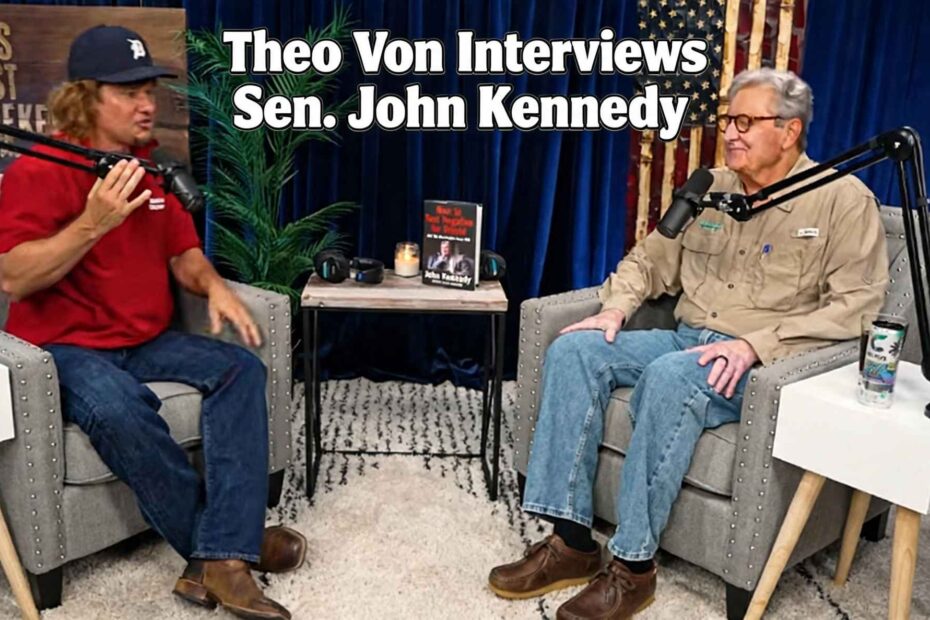
The following is the full transcript of Sen. John Kennedy’s interview on This Past Weekend w/ Theo Von, July 1, 2026.
Editor’s Note: In this episode of This Past Weekend, host Theo Von welcomes U.S. Senator John Kennedy of Louisiana for a wide-ranging conversation that blends political insight with personal storytelling. The pair bond over their shared Louisiana roots, discussing everything from their favorite local spots to the Senator’s unconventional path to politics. Throughout the interview, Senator Kennedy shares humorous anecdotes from his life and career, all while offering his perspective on the state of the country and the importance of maintaining a moral compass in Washington.
Introduction
THEO VON: Today’s guest is a United States senator representing the great state of Louisiana. He currently resides in Saint Tammany Parish, which is the place that I’m from. This is episode 666 of this podcast, but we stand with the Lord. He’s got a book out called How to Test Negative for Stupid and Why Washington Never Will. It’s an honor to spend time with one of the most humorous senators in our history, Mr. John Kennedy. But man, it’s awesome, dude. What an honor just to see you.
SEN. JOHN KENNEDY: Honors, man.
THEO VON: And yeah, thank you, man.
SEN. JOHN KENNEDY: You’re quite welcome.
THEO VON: Thank you, John, for representing our state. And yeah, I appreciate that. We’ve had a lot of good Louisianans on here. We’ve had Lainey Wilson on here.
SEN. JOHN KENNEDY: Yep.
THEO VON: Mark Norman is a famous comedian. Dustin Poirier. Yep. Our UFC legend. Kevin Gates, Boosie, who’s a rapper out of Baton Rouge. The Suicide Boys for sure, Scrim and Ruby. And you. So it’s an honor, man. What brings you over to Nashville? Actually, I know you went to Vanderbilt, right?
SEN. JOHN KENNEDY: I did go to Vanderbilt.
Kennedy’s Visit to Nashville
THEO VON: I’m—
SEN. JOHN KENNEDY: Bill Hagerty is one of Tennessee’s senators, and they’re having a big function tonight. And he asked me to speak, and I said, sure, I’ll come. I’ll just fly in. And it just so happened we were doing your show, so it all worked out perfectly.
THEO VON: Oh, that’s awesome, man.
SEN. JOHN KENNEDY: Yeah. So I’ll go wherever we’re going, guys. I’ll change into a suit and go over there and speak and cut up. Nashville’s gotten so big, Theo.
THEO VON: Has it? Yeah. Has it changed? I mean, it’s turned into a real— I’ll say this— a tourist destination. I feel like even more probably than it was when you were here.
SEN. JOHN KENNEDY: Yep.
THEO VON: Yeah.
SEN. JOHN KENNEDY: Well, it’s all Nashville. Even when I was here, it was a banking and insurance center.
THEO VON: Okay.
SEN. JOHN KENNEDY: Now it’s so much more. It’s health care, it’s tech. For a while Nashville was the fastest growing city for young people in the country. Now it’s probably still in the top 10.
THEO VON: I think it’s— yeah, it’s still a good place to bum a can of Skoal off of somebody too.
SEN. JOHN KENNEDY: You got it, man.
THEO VON: You know, that’s never lost.
SEN. JOHN KENNEDY: It’s a very diverse city. Yeah. And Knoxville used to be the big city and Knoxville is still pretty big. But now Nashville is kind of where the action is. It’s always been country music. Yeah, a lot of good comedians came out of Nashville.
THEO VON: Yeah, that’s a good point. People don’t even think about that. Nate Bargatze’s one. Yep. Oh, I know that you grew up near where Jerry Clower’s from, and he’s my favorite comedian.
SEN. JOHN KENNEDY: Yep, I grew up in an old town called Zachary.
THEO VON: Yeah, did you ever get to see Jerry?
SEN. JOHN KENNEDY: I saw him on TV. That’s it, never met him.
THEO VON: Yeah, yeah, he was like an idol of mine growing up.
SEN. JOHN KENNEDY: Funny.
THEO VON: Oh yeah, dude, he was one of the best. He still is. I just saw an auction actually over there auctioning off his suit that he wore, and I think I’m going to get that. I don’t know if I’ll ever wear it, but I think I’m going to get it.
SEN. JOHN KENNEDY: Do you still do comedy shows?
THEO VON: Oh yeah, for sure. I just finished a tour and then I’m just taking a break right now. And it’s been kind of an adjustment, you know, just adjusting to something new.
On Comedy and Being Yourself
SEN. JOHN KENNEDY: When did you know you were funny? When you were young? Did you know it when you were young?
THEO VON: I think, you know, I was over at LSU and I was sitting— I lived in a place called The Commons over there, and it’s like an apartment complex over there. And it’s just walls, really. In college, you just get walls. There’s not, you know, they’ll have faucets and walls. You don’t get a lot when you get an apartment. And I remember sitting out there one day with the neighbors and just cutting up. And this one guy, Kevin, he’s like, “Man, you should be a comedian.” And I don’t know if I’d ever really thought about it. And then my buddy’s daddy played Jerry Clower for me when we go on drives. And I think I just kind of put it together for me at some point, you know. And I wanted a job where— like, comedy was nice because you always got to get away. It was like, you got to perform here, you got to perform there. You do a lot of quips, man. You have a lot of— you have a huge sense of humor. Did you ever think about it or try it?
SEN. JOHN KENNEDY: I just try to be myself, Theo.
THEO VON: Yeah.
SEN. JOHN KENNEDY: “And if you suck, there’s nothing we can do to help you.”
THEO VON: Yeah.
SEN. JOHN KENNEDY: And I’ve never forgotten that, you know?
THEO VON: Yeah, that’s a good line, man.
SEN. JOHN KENNEDY: And a lot of folks in Washington think they need to pretend to be somebody else and be very erudite and sound like a senator. And that’s okay for them, but it just doesn’t work for me.
THEO VON: Yeah. Yeah, I’d find it too hard. I think— I don’t know— it’s hard for me to find something that’s too fake. It just hurts me kind of or something.
SEN. JOHN KENNEDY: Well, the American people can smell a phony, man.
THEO VON: Yeah.
SEN. JOHN KENNEDY: They can smell a phony a mile away. Yeah.
Watching the World Cup
THEO VON: But being off of comedy has been nice because I’ve had more time to watch. I’ve been watching some of the soccer. You been watching the World Cup?
SEN. JOHN KENNEDY: Uh-huh. A little bit.
THEO VON: Yeah. Did Louisiana have a chance to get a game at all? Do you know?
SEN. JOHN KENNEDY: No, I don’t think we did. The competition there was so intense because they just felt like big money. And I don’t know that we even bid. We might have put in a bid from New Orleans. Yeah, but it was expensive and you had to offer incentives. The World Cup’s a big deal. You know, we’re not big at that kind of football. We don’t follow it much in America, but in the rest of the world, it is the thing, man.
THEO VON: Oh yeah. It’s been nice to see. I just actually went to a game down in Guadalajara the other night.
SEN. JOHN KENNEDY: Uh-huh. Fun to watch, dude.
THEO VON: It was so cool, man.
SEN. JOHN KENNEDY: Yeah.
THEO VON: And they treated us so nice down there. Yeah, it was the first World Cup game that they’d ever had in Guadalajara that Mexico had played in. And man, I got to go with my friend Johnny and Samantha and it was just— man, these guys are incredible athletes.
SEN. JOHN KENNEDY: Oh, unbelievable athletes.
THEO VON: It makes me feel so lazy even just sitting there in the stands. It’s like they’re running for so long. They’re running for so long.
SEN. JOHN KENNEDY: It’s start, it’s stop. Yeah, it’s contact. It’s a lot of contact.
THEO VON: They can eat whatever they want. That’s what I think the whole time. I’m like, these bastards can go after this, they can eat whatever they want, probably forever. Like they’ve done enough exercise.
SEN. JOHN KENNEDY: Yep.
THEO VON: Like they’re kind of grandfathered in to having abs.
SEN. JOHN KENNEDY: I think tennis is another sport that demands incredible endurance.
THEO VON: Tennis is for the rich, though, I think, John.
On Tennis and Athletics
SEN. JOHN KENNEDY: Well, I remember when I was in school in England, I went over and bought standing room only tickets at Wimbledon. And I got to watch Arthur Ashe on one of the outer courts. He was as close as you and me. And this guy was in such incredible— he wasn’t muscular, you know, John McEnroe. I saw Jimmy Connors one time, wasn’t muscular.
THEO VON: Yeah.
SEN. JOHN KENNEDY: And they were from lower-class backgrounds, they just started early, huh?
THEO VON: Yeah. Any urban kid, I’m going to put a racket in their hand. That is one— that’s a sport they take over fast.
SEN. JOHN KENNEDY: But it’s discipline, man. It’s just repetition every day. Every day. And you’ve got to be able to handle pressure.
THEO VON: Yeah. I don’t think I’d be good at it.
SEN. JOHN KENNEDY: You’ve got to be able to handle the pressure. You’re playing people that are as good as you are, and it becomes a mental game.
THEO VON: Yeah, especially at that high level, man. I think that’s what people don’t realize about a lot of these sports— when you get to a high level, it’s a matter of inches. It’s a little bit of a moment.
SEN. JOHN KENNEDY: Inches and it’s mental.
THEO VON: If you even see these soccer games, you’ll see the ball goes through and it’s like there’s an arm, a leg, a shoulder, a head, so many things that are just— I mean, half a millimeter away from it. Yeah, you know, every single shot. Yeah, I’ve enjoyed watching the World Cup. It’s been good. It’s been a nice time to have extra free time because that’s going on. You live in Madisonville? Yeah, nice.
Life Back in Louisiana
SEN. JOHN KENNEDY: Near Mandeville? Yeah, I live right on the line between Madisonville and Mandeville.
THEO VON: Okay.
SEN. JOHN KENNEDY: Of course, it’s grown a lot since you grew up there.
THEO VON: Oh yeah, I go back a good bit.
SEN. JOHN KENNEDY: Well, you know, you can’t really tell the difference now between Mandeville, Madisonville, and Covington.
THEO VON: Yeah. Yeah. My stepdad goes over there to a coffee house over there by Friends right there on the lake and has—
SEN. JOHN KENNEDY: I know what he’s talking about.
THEO VON: Yeah.
SEN. JOHN KENNEDY: It’s in an old house. Yep. Beautiful. What’s it called? Creole Cottage.
THEO VON: Yeah, something like that.
SEN. JOHN KENNEDY: I can’t think of that. I’ve had meetings there before.
THEO VON: Yeah, it’s nice, man. I used to live right over a buddy of mine. His family let me live in their basement over there, which living in a basement in Louisiana, it’s a—
SEN. JOHN KENNEDY: It’s dangerous. It can flood and you can find varmints in there.
THEO VON: Oh, definitely, man. You know, your hair’s clean in the morning. I know that something will run up and eat everything out of it.
SEN. JOHN KENNEDY: And snakes will crawl in there with you.
THEO VON: Oh, yeah.
SEN. JOHN KENNEDY: My wife called me and got me out of it.
THEO VON: Let’s don’t go from snakes to your wife.
SEN. JOHN KENNEDY: Yeah, I think that’s a good— you’re right about that. But she called me the other day, I was in the middle of a hearing, and she was hysterical. And she showed me a picture that there was a 6-foot rat snake on my deck. And I said, just leave him alone. Yeah, you want him— don’t hurt him. She said, “I’m going to call the neighbor and they’ll kill him.” I said, “Don’t do that.” Yeah, he’s a rat snake. Even if you could pick him up, he might bite you, but it won’t hurt.
THEO VON: Yeah. Now, if you’re a rat, he’ll eat you. Yeah, you got a problem, man.
SEN. JOHN KENNEDY: You know, he will eat you and spit out the bones.
THEO VON: But they always got something over there. I used to work over at Friends on the Lake. You know where that is?
SEN. JOHN KENNEDY: Friends?
THEO VON: Well, yeah. So before they remodeled, it was just one story, right?
SEN. JOHN KENNEDY: It’s highfalutin now.
THEO VON: Oh, it’s—
SEN. JOHN KENNEDY: Yeah, it’s high-end now.
THEO VON: It’s fancy.
SEN. JOHN KENNEDY: But I liked it when I liked it the old way. There was another place called Coffee’s Boiling Pot.
THEO VON: Yeah.
SEN. JOHN KENNEDY: I used to— they’ve under new ownership and it’s gotten a little more expensive. Yeah, but it’s just grown so much.
THEO VON: Oh, yeah. And Baddo’s. I used to go Baddo’s, get me a burger.
SEN. JOHN KENNEDY: I still go. Baddo’s is still there.
THEO VON: Give me a chocolate malt over there.
SEN. JOHN KENNEDY: You got it.
THEO VON: Oh, so much sugar in my face. I couldn’t blink my damn eyes for an hour. But it was worth it, man. But I worked at Friends and I will tell you this.
SEN. JOHN KENNEDY: You were a waiter?
THEO VON: Oh, no, I was a busboy forever. Were you? Yeah. I was never promoted. That was my— yeah. And then I got to a point where I was like, I’m not being a waiter even if y’all want me to, that was some of my energy. But it was a good time over there.
And when they would cook duck, when the chef would cook duck, every now and then they had duck on the menu. And back in the busboy section where the ice machine was, they had these— they had some missing baseboards down there and these raccoons would come out of the wall. So one of the busboys would have to sit back there with a broomstick and just beat them back in it. Literally just beat them back into the wall where they were cooking.
SEN. JOHN KENNEDY: Listen, we had—
THEO VON: Raccoons love duck.
Wildlife Encounters and Louisiana Life
SEN. JOHN KENNEDY: We had an outdoor cat for a while. Wild. But I would bring cat food out there and it was always gone so quick. And finally, I went out there one night and just kind of— a raccoon was coming out of the woods. Just snarfing that stuff, just pretending to be a cat.
We’ve got raccoons. I back up to woods. We’ve got raccoons, deer. I went out one night to take out the garbage, opened up the top, opossum, you know?
THEO VON: They act like it’s theirs.
SEN. JOHN KENNEDY: Yeah, exactly. Now, raccoons are kind of cute. Possums, huh? Yeah, those things.
THEO VON: You’ll see a cross. We’d have a catcoon every now and then. You’ll see them, couple of them start cross-pollinating out there. If the humidity gets high enough, you’ll see some of them animals start mixing species.
SEN. JOHN KENNEDY: As you well know, we’ve got everything. Oh, yeah, we’ve got alligator. We’ve got more alligators than we’ve got people now.
THEO VON: Is that true?
SEN. JOHN KENNEDY: Yeah. Oh, yeah.
THEO VON: You’re lying.
SEN. JOHN KENNEDY: No, I’m not. It’s just 25 years ago they were getting—
THEO VON: And watch the Democrats try to get them to register to vote.
SEN. JOHN KENNEDY: Yep. It wouldn’t surprise me.
THEO VON: Wouldn’t surprise me. Sorry to interrupt you, but I was going to forget that joke if I didn’t say it. Yes, Louisiana has more alligators than people. Dear God, get the kids away from the river.
SEN. JOHN KENNEDY: But tourists love them because they will— these boat tour guides go out and they feed them. And so when they see the boat, they come immediately and the tourists just eat it up. They think they’re tame. They’re not.
THEO VON: It’s perversion to me, brother. I don’t mess with the devil and I don’t mess with his pets. That’s one way I— that’s how I operate. I don’t mess with those types of things, that’s for sure.
But yeah, it’s nice for you to be here. Nice to just have a taste of home in the building, man. You started working in politics. I know you were—
SEN. JOHN KENNEDY: Are we taping now?
THEO VON: Yeah. Is that okay?
SEN. JOHN KENNEDY: Yeah, fine. I just didn’t know.
THEO VON: Oh, yes sir. Sorry. Yes sir, we are. Senator John Kennedy, thank you. And you’re not related to Bobby Kennedy or any of those Kennedys, right?
SEN. JOHN KENNEDY: Well, if I am, I’m the poor side of the family.
THEO VON: Okay.
SEN. JOHN KENNEDY: I don’t think I am. Yeah, my dad was from Oklahoma and my mom was from central Louisiana.
Growing Up in Louisiana
THEO VON: How did your parents meet?
SEN. JOHN KENNEDY: Well, my dad, Phil, was from a Depression family. 8 brothers and sisters. He left home. Hard for me to believe today, but when he was 14, to go to another town that had a high school, he lived with relatives. He worked as a janitor at night to pay his way. He went to University of Oklahoma.
THEO VON: Who just won the natty championship, baby.
SEN. JOHN KENNEDY: That’s right.
THEO VON: Let’s go.
SEN. JOHN KENNEDY: He worked his way through school, got a degree in petroleum engineering, came to Louisiana to work in the oil fields and met my mom. And he went away for 4 years. He was in World War II. But my dad was my hero, man.
THEO VON: Was he?
SEN. JOHN KENNEDY: Yeah, he really was.
THEO VON: What was his name?
SEN. JOHN KENNEDY: Preston Kennedy.
THEO VON: Preston Kennedy.
SEN. JOHN KENNEDY: Well, I named my son after my dad. He used to tell me, he would say, “Son, when I was growing up, I have 3 brothers. Son, you’ll never understand love till you have a child.” And I’d say, “Ah, come on, Dad.” He’d say, “No, it’s not like the love of a spouse or a sibling or a girlfriend. And until you have children, you don’t know that.”
But he was right. I named my son after Preston, and he’s a good kid. There was a time growing up when I figured my son was either going to go into concert promotion or a minimum security prison. I wasn’t sure which, but he’s a good kid.
THEO VON: There’s a picture of him right there, huh?
SEN. JOHN KENNEDY: Yep.
THEO VON: Oh, that’s awesome.
SEN. JOHN KENNEDY: That’s my late dad.
THEO VON: There you go. Preston and the other Preston, huh?
SEN. JOHN KENNEDY: Yep.
THEO VON: Amen.
SEN. JOHN KENNEDY: Yep. That’s a great picture. I’ve got that somewhere. That was my younger days. This one, my dad was still alive.
THEO VON: Oh, bless him, man.
SEN. JOHN KENNEDY: We were raised in Zachary. About 3,000 people.
THEO VON: Mm-hmm. And that’s close to Liberty.
SEN. JOHN KENNEDY: It’s sort of close to Liberty. It’s close. Liberty’s about 40 miles away. It’s close to Baton Rouge.
THEO VON: Okay. Oh, yeah. I know where it is now.
SEN. JOHN KENNEDY: Now, when I grew up, Zachary’s big now. It’s like 15,000, 20,000. There were like 3,000 people.
THEO VON: Oh, yeah.
SEN. JOHN KENNEDY: And it was really a small town. And I like that— people say, “What’s a small town like?” And I tell them the truth. Everybody knows your business. Everybody knows whose check is good and whose husband isn’t. Everybody knows you. But I would go back. Some people hated high school. I loved it.
THEO VON: Yeah.
SEN. JOHN KENNEDY: Happiest days of high school. Yeah. Oh, yeah.
THEO VON: Because I don’t think people— you don’t realize at that age that you will never be in a place where you’re kind of as protected, like in an incubator. And have all of everyone you know around. Every day they show up even though they’re tired or whatever and they’re miserable and they didn’t do their homework or whatever. And they all like the same girl. It doesn’t matter. Everybody you know will show up. And that never happens again.
SEN. JOHN KENNEDY: Nope. I had 100 people in my graduating class. We were the Bucking Broncos. And I cared about two things. I cared about my studies because of my parents, but I cared more about basketball and I cared about cheerleaders.
THEO VON: Amen.
SEN. JOHN KENNEDY: And I wasn’t worth a damn at either one, but I had a lot of fun trying. And I talk to people all the time. They all say, “I didn’t like high school, man.” I’d go back in a second.
School Days and Paddling
THEO VON: Oh, God. Well, they busted some guy. They had some guy had a growth deficiency and the Lord didn’t really let him grow up. He was just a Simon Birch of a man, you know? And they busted him. He was like 31 and he went back to middle school or something. And they caught him like 2 weeks into school.
SEN. JOHN KENNEDY: One of the school—
THEO VON: One of the teachers saw him cashing a check over the weekend at a bank and they busted him. This is a few years ago in Indiana. They caught a guy, but— and people were like, “That’s messed up.” I said, “Look, I don’t blame the guy.”
SEN. JOHN KENNEDY: Well, you grew up in Mandeville and Covington. It was probably small then. Oh man, it’s big now.
THEO VON: But Covington was perfect, man. I remember we’d get paddled by the principal. Oh yeah, Bill Brady. Bill Brady was our principal and he’s the best. I saw him a couple years ago at a buddy’s funeral.
SEN. JOHN KENNEDY: But you can’t do that anymore. But we had it.
THEO VON: Did y’all have like a milk delivery person and stuff like that? Nuh-uh.
SEN. JOHN KENNEDY: I remember— I’ll never forget, I had a civics class and my basketball coach was my teacher. And there was this one guy, I won’t use his name because he’s a friend of mine, but he was a great football player and he was having trouble with the exam. So he said, “Kennedy, help me with this exam.” We’re sitting next to each other.
I’ll never forget. He’d point to an answer. It was multiple choice. I go, “Huh?” Point to another. I go, “Huh?” And the coach caught me. “Come here.” And you just bend over and he hits you with that paddle with holes in it and you don’t want to cry. It hurts like hell.
THEO VON: We don’t want to make any noise.
SEN. JOHN KENNEDY: He’s just—
THEO VON: Yeah, like any noise you make is not good.
SEN. JOHN KENNEDY: Then you’re uncool. Yeah. Now, you don’t do that anymore, but it worked for me. Next time my friend got in trouble, he said, “Will you help me?” I said, “No, no. I’ve learned my lesson.”
THEO VON: Yeah, I learned my lesson the hard way, man. Here we go. Right here. It said Perrysburg Police arrested a Labrador Sierra on Monday. That’s a man. A 24-year-old suspect was enrolled in high school allegedly posing as a teenage boy for more than a year and a half.
SEN. JOHN KENNEDY: Really?
THEO VON: That’s pretty wild. Attending Perrysburg High School between January 11th, 2024 and May 14th, 2025. Shout out to that young fella trying to get an education.
SEN. JOHN KENNEDY: Good for him, I guess.
THEO VON: Yeah, I guess. We don’t know.
SEN. JOHN KENNEDY: We don’t know. We don’t know why he went back.
THEO VON: We don’t know why he went back.
SEN. JOHN KENNEDY: Now if he went back to finish up a couple of courses, if that’s one thing, but you just might want to delve into the background.
THEO VON: Yeah, yeah, yeah. You might want to do a little recon on that fella. And also, I will notice in that photo, I think he was in a prison outfit. So yeah, maybe more to the story. You started as treasurer in Louisiana.
From State Treasurer to the U.S. Senate
SEN. JOHN KENNEDY: Yeah, my first job, political career. Sorry. Yep. My first job, I worked for a governor, the reform governor named Buddy Roemer. Oh, did you really work for Buddy? And then Buddy got beat and I had left him to run for attorney general. I lost. I came in third. My next job was another reform governor named Mike Foster. I had become friends with him and he won and he asked me to come run basically the tax department. And I did that for a while. And then I ran for treasurer and I was treasurer for 17 years before I came to the Senate. Wow. Enjoyed it. Learned a lot about finance, a lot about bond issues, underwriting. I managed all the state money. It was about $4 billion then. That’s not a lot of money to a lot of people, but for Louisiana, it’s a lot.
THEO VON: Yeah, it’s a chunk.
SEN. JOHN KENNEDY: I enjoyed it. Yeah, I like being a senator, but I enjoyed being state treasurer.
THEO VON: What does a treasurer do? So just so we know, so we’re clear on it.
The Role of State Treasurer
SEN. JOHN KENNEDY: Well, when you’re in the state treasurer, just as you’d expect, you’re in charge of the state’s money. States borrow money to build roads or to build prisons or build schools. And you issue bonds and you hire investment bankers, usually out of New York, not always, and bond lawyers. I was in charge of that. You have to be very careful. The rules, the security rules, you have to disclose everything. We had idle cash. Oh, not that.
THEO VON: Ain’t good in Louisiana. No, no, that goes missing quick.
SEN. JOHN KENNEDY: But cash comes in and goes out quickly. But I was in charge of investing it in short-term instruments sometimes. Just a day or two.
THEO VON: Okay.
SEN. JOHN KENNEDY: But when you’ve got a— when you’ve got a cash flow that’s in the billions of dollars, just investing it overnight, you can pick up a lot of money if you do it repeatedly. We had a lot of trust funds. I invested— I invested those. I spent a lot of time working with the legislature on ideas about how to make government more efficient, save money. I was in charge of the state’s unclaimed property program.
THEO VON: Were you really?
SEN. JOHN KENNEDY: Yeah. Yeah, dude.
THEO VON: I think y’all sent me a thing one time. I think I had $200 on something.
SEN. JOHN KENNEDY: Yeah.
THEO VON: Thank you.
SEN. JOHN KENNEDY: Yep.
THEO VON: We—
SEN. JOHN KENNEDY: Thank you, dude. When a business has your money and can’t find you, they can’t keep it. They’ve got to turn it over to the state. And I was in charge of—
THEO VON: Unless it’s the federal government, they’re allowed to just keep it.
SEN. JOHN KENNEDY: Federal government’s different.
THEO VON: Yeah, they allowed to keep everything.
SEN. JOHN KENNEDY: I was in charge of getting the money back to people.
A Million-Dollar Check for a Retired Schoolteacher
THEO VON: Okay.
SEN. JOHN KENNEDY: And the most money I ever gave back to a lady— Yeah, man, it was great. She was a retired schoolteacher in New Orleans. It was from her late husband. It’s a long story, but she didn’t know about the money. They were invested in stocks and they grew and grew and grew. I gave her a check for $1,026,000. Yeah, man, it was cool.
THEO VON: And did you walk over there and do it?
SEN. JOHN KENNEDY: You know, I called her and told her how we got it. She didn’t have any children and she said, well, I want to come to Baton Rouge and get it. And so that’s where my office was. So she came in and she cried, talked about her late husband. I gave her the money. She said, I’m going to use it to help people. I don’t have any children. But when I walked her outside to escort her out, she had like 10 nieces and nephews there just waiting. And I knew that money was going to get spent.
THEO VON: Get that check, boy. Oh, when that check comes in Louisiana, when that check comes, man, it’s getting spent.
SEN. JOHN KENNEDY: But I’m glad we got you some of your money.
THEO VON: Yeah. Oh, yeah. Thank you, man. I needed it at the time, too. So I appreciate that. When you got a job and then senator, how long you been working as a senator for?
SEN. JOHN KENNEDY: 10 years.
THEO VON: Okay.
Life in the Senate and Congressional Gridlock
SEN. JOHN KENNEDY: It’s some of the most interesting people I’ve ever been around.
THEO VON: Yeah.
SEN. JOHN KENNEDY: Right now, it’s not pretty to watch. Yeah, right now Congress kind of looks like a breech birth, you know.
THEO VON: What do you mean by that?
SEN. JOHN KENNEDY: Well, three wheels, a stock shopping cart. We’re not getting along. Yeah, it’s hard to reach consensus. We’ll get through it. But as we get closer to the midterm elections, it just gets more and more and more political. I think we’re going to have another shutdown. I sit on the Appropriations Committee and we’re trying to put together a budget but we’re not getting any cooperation.
THEO VON: What is the Appropriations Committee? What does that mean?
SEN. JOHN KENNEDY: That means I’m in charge of— not just me, but others. I’m in charge of drafting the federal government’s budget. And my part of it is what’s called energy and water development. I’m in charge of the nuclear program. I’m in charge of— well, my committee, subcommittee is.
THEO VON: Okay.
SEN. JOHN KENNEDY: I’m in charge of the Department of Energy. I’m in charge of the Army Corps of Engineers. And we put together the budget. But I’ve— you’ve got to get 60 votes to pass anything in the Senate. So I’ve got to work with my Democratic colleagues. And that sometimes is easy, sometimes it’s not. The closer we— Senator Schumer, I think, is going to shut— he’s going to refuse to let us do a budget. I think he’s going to shut down government.
THEO VON: That guy seems like a crook.
On Chuck Schumer and Washington Politics
SEN. JOHN KENNEDY: Well, look, I mean, that’s unfair to say. No, no, no, no, no. You’re fair.
THEO VON: It’s America.
SEN. JOHN KENNEDY: You can believe what you want. I don’t hate anybody. I don’t. And when I say my prayers, one of the things I ask God for, don’t let me hate. And it’s easy to start hating in Washington. And I refuse to hate. And that’s one of the many things I ask God for. And I know Chuck well. We went to China together, met with President Xi. We don’t agree on much, and Chuck’s entitled to his opinion. But as I tell him all the time, he’s— he’s— how can I explain it? He’s— he’s very animated.
THEO VON: Yeah.
SEN. JOHN KENNEDY: He’s like a 5-year-old in a Batman costume, you know, you just want to tell him, chill out. Yeah, but he hates President Trump, does not like President Trump. He thinks by creating chaos it’ll help his side in the midterm elections. And I fully expect him to withhold the budget, the votes on the budget, and shut down government. And that would be— I hope I’m wrong. If I’m wrong, I apologize to him.
Tucker Carlson Leaves the Republican Party
THEO VON: I just saw that Tucker Carlson said he’s not supporting Republicans in the midterms. Can you bring that up?
VIDEO CLIP BEGINS:
UNIDENTIFIED SPEAKER: Longtime conservative commentator Tucker Carlson said on a podcast that “there’s no chance I would support the Republican Party” ahead of the November midterm elections. Not going to support the Democratic Party. Carlson was quick to add “I don’t know what I’m going to do.” Carlson supported Trump in 2024. Did he say why? “They’re making decisions on the basis of other criteria. What’s best for this company? What’s best for Israel?”
VIDEO CLIP ENDS:
THEO VON: Oh, that’s right, he said he felt like it was becoming an Israel-first party and not America-first. That’s a big person to not have support from. Because he’s been a big supporter of the Republican Party for a while. “I’ve been a consistent defender,” he says, “for 35 years of the Republican Party. I mean, very consistent defender, but there’s no defending this,” he said. “So no, I’m out.” What’s your response to that?
On Tucker Carlson, Iran, and America’s Role in the World
SEN. JOHN KENNEDY: Well, I know Tucker. He is very, very smart. He’s very articulate. He has fallen out with President Trump, and with those of us in the Senate who support Israel. He primarily fell out with President Trump over the conflict in Iran. Now, I’ve been very supportive of the president on the conflict in Iran. I don’t want America to be the world’s policeman, but I don’t want Xi Jinping and China or the ayatollah in Iran or Vladimir Putin in Russia to be the world’s policeman either. And these are hard men. They understand one thing, Theo: strength. If you turn the other cheek to these people, they’ll just stab you in the neck.
THEO VON: Now, what proof of that is there?
SEN. JOHN KENNEDY: You just look at their actions. Iran is the world’s foremost exporter of terrorism. Putin, who now of course runs Russia, wants to dominate Eastern and Central Europe, which is— President Trump has gotten Europe to start spending more money on defense, but we’ve always had to defend them.
I can tell you what President Xi— I’ve met with President Xi. He is very clear. He thinks that China is ascending. He thinks America’s in decline. He thinks while they’re building ships and nuclear weapons, he thinks all we do in America is sit around and debate whether a man can breastfeed. And he and Putin and the Ayatollah in Iran are working together. And China’s goal is to dominate the Indo-Pacific. To be free to roam in sub-Saharan Africa and South America. He wants to dominate the Arctic. He wants to dominate space.
THEO VON: But has he shown those things?
China, Russia, Iran, and the Threat to America
SEN. JOHN KENNEDY: Oh yes. Okay, absolutely. I mean, China is supporting Iran right now. China is supporting Russia in the war in Ukraine. There’s no question. China buys all of Putin’s oil, we sanctioned a lot of their oil when Putin invaded Ukraine, so he can’t sell it because oil is traded in dollars. He sells it to China.
Look, I don’t hate anybody, and the Chinese people, to the extent that the Communist Party in China will let you interact with them, are lovely people. Yeah, they are determined. They hate America. And deep down, the Iranians are worse, but deep down they want to kill us and hurt us the entire time we’re dying. Now, that’s my point of view. Tucker will have a different point of view. Yeah, he thinks— and he thinks that we’re too close to Israel.
The Israel Question
THEO VON: I think a lot of people, from people that I see all the time, that’s the number one thing that people say. They think we’re too close to a country that’s created a genocide against Palestine and then is in conflict with these other people around them that it seems like they’re just kind of the bullies of the area. You know, it’s like it feels like they’re the terrorist organization. That’s what it seems like to a lot of people.
The Middle East, Iran, and the Israel-Hamas Conflict
SEN. JOHN KENNEDY: A lot of people believe that. I’ll give you another point of view. The real problem in the Middle East since forever, since God was a baby, the real problem in the Middle East is Iran. And Iran wants to dominate it. And Iran funds Hezbollah and Hamas. Israel is surrounded by people that want to kill them.
Syria is different today, but Syria— Hezbollah was in control of Lebanon. Hamas, an arm of Iran, was in control of the Gaza Strip. Hamas attacked Israel and the Israelis fight back. And they took over the Gaza Strip. And yes, a lot of Palestinians got hurt and— not got hurt, I mean, got killed, got killed and hurt. But Hamas would hold the Gazans hostage. They would put them out front.
THEO VON: But how do we even know that? They killed 220-something.
SEN. JOHN KENNEDY: We’ve seen it.
THEO VON: But they killed 220-something journalists that went there to document what was going on.
SEN. JOHN KENNEDY: There’s no question there were civilian deaths.
THEO VON: They wouldn’t let journalists in to even document what was happening.
SEN. JOHN KENNEDY: There have been civilian deaths, but it is primarily the fault— I’m not saying Israel is blameless. Look, war is ugly.
THEO VON: Yeah, but is this war?
SEN. JOHN KENNEDY: But it is war.
THEO VON: You think it’s war?
SEN. JOHN KENNEDY: It is war.
The UN Report on Palestinian Children
THEO VON: They just had an article yesterday that came out from the UN. If you could find that, it was about— they’d done a deep dive on the killing of children and some of the massacring, and really massacring of children.
“Israel continues to commit genocide atrocity crimes by deliberately targeting Palestinian children. UN Independent Commission finds even after the October 2023 ceasefire, children continue to be killed and seriously injured with continued disregard by Israel for the ceasefire and for the protection.”
Let me see what else here. Here are some findings of the commission. Israel has killed 20,000 children and injured 44,000 more since October 7th, 2023. Palestinian children have been arrested and subjected to torture and other severe forms of mistreatment in Israeli prisons. This is all part of— let me see, United Nations.
SEN. JOHN KENNEDY: Well, first, I wouldn’t believe it if it came from the UN.
THEO VON: Oh, really? They’re not— do you feel like they’re not reliable?
SEN. JOHN KENNEDY: They’re not reliable.
THEO VON: They’re not reliable.
SEN. JOHN KENNEDY: They’re not objective.
THEO VON: Okay.
Iran’s Nuclear Ambitions and the Threat of Extremism
SEN. JOHN KENNEDY: They’re not objective. And number two, I know children got killed and it breaks your heart. Hamas kills children too. So does Hezbollah. So does Iran. Do you think the Ayatollah doesn’t care about the Iranian people? The Persians are some of the most talented people in history. When they disagree with the Ayatollah, they hang them. They just hang them.
And I think— I don’t speak for Mr. Carlson, but he says it’s not our business. And I guess to some extent he’s right, but I’ll tell you what is our business— is letting them get a nuclear weapon. Because if they get a nuclear weapon, these people are like Charlie Manson. They’re crazy. Really crazy is rare. But with the Iranian leadership, it’s commonplace.
If they get a nuclear weapon, they will use it, not just on Israel, but on Europe and on us. And even if they don’t, once they get a nuclear weapon, you will have other countries— Japan, South Korea, other countries, Saudi Arabia— get nuclear weapons as well. And the more people that have nuclear weapons, the more likely you are to have war.
Yeah, but Tucker would probably have another point of view. But I really like Tucker. I think he’s really smart.
THEO VON: Oh yeah, I think Tucker’s a neat guy. I mean, from what I know about him, he seems— I believe that he’s earnest in his search. I believe that he— I don’t know. Yeah, my interactions with him have always been good. It’s just that when they kill the reporters who are trying to get honest information, they’re killing reporters.
SEN. JOHN KENNEDY: I don’t think it was intentional, but—
The Killing of Journalist Shireen Abu Akleh
THEO VON: They had one that they shot directly in the face. And then at her funeral, they attacked the people who were carrying her. Can you find her name? We just talked about her last night. Sorry to go into all this.
No, it’s okay. But they, at her funeral, they attacked. They even attacked the people who were giving her funeral. Shireen Abu Akleh was a prominent Palestinian-American journalist who worked as a reporter for 25 years for Al Jazeera before she was killed by Israeli forces while wearing a blue press vest and covering a raid on the Jenin refugee camp.
SEN. JOHN KENNEDY: Well, obviously that’s terrible. Yeah, but here’s what you have to understand about the world. And I don’t know why this is. If I make it to heaven, I’m going to ask God. But there’s some people out there in the world. They’re not sick. They’re not mixed up. It’s not that their mama and daddy didn’t love them enough. They just got black hearts. And some of them run countries. North Korea, Russia, China.
THEO VON: But what are those countries actively doing right now? Like, Bibi Netanyahu and the Israeli government is actively— well, a lot of people believe, and I believe a lot of voters believe, that they’ve— they’re actively committing a— have committed a genocide in Palestine. And then they’ve gone into Beirut, to Lebanon, to Iran. You don’t believe they are?
Hamas, Iran, and Israel’s Right to Fight Back
SEN. JOHN KENNEDY: I don’t believe that. I believe that Hamas dominated— which is an arm of Iran— Hamas dominated Gaza. Hamas attacked Israel. Hamas was hiding behind the Palestinian civilians.
THEO VON: All of them.
SEN. JOHN KENNEDY: All of them. All of them. If the Palestinian civilians didn’t obey Hamas, they would kill them.
THEO VON: Okay.
SEN. JOHN KENNEDY: Hamas was in complete control. Israel attacked. When Israel attacked Hamas, many civilians got killed and it was regrettable. But what are you going to do? Iran was hiding, physically hiding behind them. While that happened, Hezbollah from Lebanon, funded by Iran, attacked Israel. And all Israel has done is fought back.
THEO VON: Yeah.
SEN. JOHN KENNEDY: Now, I’m not saying that in the fog of war there haven’t been innocent people killed. There have been. And it’s terrible. But it’s not like Israel is the bad guy and Hamas and Hezbollah and Iran are the good guys, because they’re not. And weakness invites the wolves. I wish it weren’t like that. I wish it weren’t. I wish you could sit down and reason with them. But it’s like talking to Charlie Manson. He was stone cold crazy.
THEO VON: Yeah.
SEN. JOHN KENNEDY: And these people believe if you don’t accept their religion, their form of Islam, then you should die. And they think they’re on a mission from God. Now, look, I think that Islam is— if you want to be—
THEO VON: You think that’s true? And you would know. I mean, I don’t have—
SEN. JOHN KENNEDY: I think I have experience in Islam, Hindu. Your religion is your business. In America, we have freedom of religion. But if my religion told me that I had to kill a bunch of other human beings to advance my religion’s cause— if Christianity taught that, I couldn’t be a Christian.
THEO VON: Yeah. Yeah, that would be heartbreaking.
SEN. JOHN KENNEDY: Yeah. But they really believe that. And that’s—
THEO VON: And how do we know that?
SEN. JOHN KENNEDY: Because they’ve done it. What they did on October 7th— they raided, they raped, they cut off Israeli people’s heads. They kidnapped them. What they’ve done to American troops in Lebanon, it’s widely known. Look at what they did. They started shooting at the Saudis and the UAE. That’s not the good people of Iran. That’s their leadership. They’re religious zealots.
THEO VON: And didn’t we take their Ayatollah out?
SEN. JOHN KENNEDY: We took the first one out. They’ve replaced him with his son, but he’s in hiding.
THEO VON: Dang, bro. And that’s nepotism.
SEN. JOHN KENNEDY: Yeah.
THEO VON: I mean, we got to call that what it is.
SEN. JOHN KENNEDY: Well, nobody really wants to.
THEO VON: Nobody wants the job.
SEN. JOHN KENNEDY: Nobody wants the job, man. Our military is the greatest military in all of human history.
THEO VON: Amen to that, dude.
SEN. JOHN KENNEDY: It’s just extraordinary.
Qatar, Hamas Funding, and Israel’s Conflicts
THEO VON: We’re so lucky, man. I mean, we’re just lucky to be in a place where we can at least think and try and explore ideas and try and learn. And even if we don’t know stuff, we can try our best. But wasn’t there some evidence that Hamas was funded by Israel though? Like it was backchanneled through Qatar or something. Can you look that up?
SEN. JOHN KENNEDY: Qatar has funneled money to Hamas before.
THEO VON: They’re a middleman.
SEN. JOHN KENNEDY: No, we have not. I’ll be shocked. I’m a United States—
THEO VON: Money from Israel? From Israel?
SEN. JOHN KENNEDY: No, I don’t believe that. I know there’s stories, but I just don’t believe that because I’ve been to Israel. I’ve talked to the Israeli people. They don’t want to be at war.
THEO VON: But then why are they at war with everyone then? It feels like—
SEN. JOHN KENNEDY: Well, they’re at war with Hezbollah to the north because Hezbollah keeps shooting missiles at them and digging tunnels. And they’re terrorists. And they’re at war with Hamas because Hamas attacked them. And until they took out their missiles, they kept shooting missiles. And they’re at war with Iran because Iran is behind all of it.
And I wish we didn’t have to do any of this, honest to God. I’ve talked to President Trump about it. He doesn’t want to be in conflict with Iran, but we cannot let them have a nuclear weapon. We cannot. These people are stone cold crazy.
Iran’s Military Threat and Trump’s Decision
THEO VON: Yeah, I guess it’s tough to say. I think when you see videos and stuff online, it just makes your heart hurt. There was a report the other day in that UN report that there was a 14-year-old kid who they shot and then they just stood around and watched him bleed to death. And when his mother tried to come to him, they would shoot at her. And these soldiers just stood around and watched him bleed to death. And it’s just kind of heartbreaking.
SEN. JOHN KENNEDY: I know, it all breaks your heart. And that’s why you don’t want to have to go to war. But put yourself in the president’s shoes. Our intelligence— here’s what our intelligence showed, and I’ve seen it. It’s classified, but I’ve seen it. But I can give you the general outline.
Our intelligence showed that Iran was building up its missile capacity, both ballistic and cruise. And they were going to compile so many missiles and drones that they were going to turn to America and Israel and say, “We’re restarting our nuclear weapons program. And if you try to stop us, we’re going to destroy the rest of the Middle East. And by the way, our missiles can now reach London and Paris and Germany.”
THEO VON: And you saw reports.
SEN. JOHN KENNEDY: I’ve seen the intelligence.
THEO VON: Okay.
SEN. JOHN KENNEDY: And President Trump was faced— well, do I let them continue? He had already bombed some of their nuclear facilities. But he was faced with the decision: do I let them get to the point where they have so many missiles and drones, ballistic and cruise, that they could destroy the Middle East, that they could hit London, that they might even be able to hit the United States? Or do I go in to stop them? And he did.
THEO VON: Right.
SEN. JOHN KENNEDY: And we haven’t destroyed all of their missiles. But if you go to Iran today, whole swaths of Iran look like something out of Mad Max 4. We destroyed the public sector. Some big portions of the private sector— we didn’t want to do it. It’ll take them 20 years to recover. I mean, our military— I’m not going to bubble wrap it. They went in and our military ate them and spit out the bones.
THEO VON: Yeah, yeah.
SEN. JOHN KENNEDY: And they are not right now a nuclear threat. But they still have the centrifuges to take their fissile material and make a warhead.
THEO VON: Yeah, I didn’t know that. I didn’t know that you had seen the intel on that.
Israel, Hamas, and Iran’s Funding
SEN. JOHN KENNEDY: We have a basement, an underground room in the Senate. We call it the SCIF. It’s completely secure. You leave all your electronics outside. And I’ve been briefed, all of us, by Rubio, by Secretary Hadseth, by Secretary Rubio, the Joint Chiefs, Chairman of the Joint Chiefs.
THEO VON: And do you trust those guys?
SEN. JOHN KENNEDY: Absolutely. Yeah, absolutely. John Ratcliffe from the CIA. I trust every single one of them.
THEO VON: Amen. Okay. Yeah, I’m not in the space, so from our perspective, just as a regular person, you just see all of this stuff and it seems so one way. It seems like you were saying, you feel like the truth comes through and you know what it is, right? Like we were saying in the beginning, what we see and perceive is, okay, this is real, or this is earnest or whatever. That’s the way a lot of it seems.
Let me get this note real quick before you go. In a controversial deal, Israeli government under Benjamin Netanyahu supported Qatar’s payments to Hamas for many years in hope that it would turn Hamas into an effective counterweight to the Palestinian Authority and prevent the establishment of a Palestinian state. So maybe there was some funding, but it wasn’t clear on what it was for.
SEN. JOHN KENNEDY: Well, if they gave aid, there’s a footnote there. I don’t know the authority for that.
THEO VON: Yeah, I’m not sure either.
SEN. JOHN KENNEDY: If they gave aid through Qatar to try to help the people of Gaza so they wouldn’t join up with Hamas, that’s a different thing from them supporting Hamas.
THEO VON: Yeah. Let me look it up one more time. Can you put “Israel supported— did Israel support Hamas?” Can you just put that question? Let me see. Israel did not directly create Hamas, but from the late 1970s through the 1990s, the Israeli government provided covert support and funding to the Islamist movement that preceded it. This strategy was used to counterbalance secular Palestinian nationalist groups like the Palestine— So they may have inadvertently supported it by trying to support something else, I guess.
SEN. JOHN KENNEDY: Hamas is a spinoff of the Palestinian— PLO, Palestine Liberation Organization. But once Hamas spun off, they got all their financial support from Iran, almost 90% of it.
THEO VON: Got it.
SEN. JOHN KENNEDY: And without Iran providing the money, neither Hamas nor Hezbollah could exist. And they are terrorists.
THEO VON: Understood. Did Iran fund Hamas? Let’s look that up then. And thanks for discussing it with me.
SEN. JOHN KENNEDY: Sure.
THEO VON: Yes, Iran is—
SEN. JOHN KENNEDY: It’s an important subject.
THEO VON: Yes, Iran has funded, armed, and trained Hamas for decades. Tehran considers the group a key part of its Axis of Resistance and provides tens of millions of dollars annually to support its military and operational capabilities.
SEN. JOHN KENNEDY: And look, I’m not saying Israel is perfect. I’m not saying that, okay? None of us is perfect. But look at it this way.
THEO VON: Yeah.
SEN. JOHN KENNEDY: There are certain areas you could walk down. If you walk down at 2:00 in the morning in Nashville, let’s say, there are people there that would hurt you.
THEO VON: Yeah.
SEN. JOHN KENNEDY: Now, I don’t know why. Like I say, if I make it to heaven, I’m going to ask why people want to hurt other people. But they do. And that’s the situation that Israel’s in.
Owning a Gun “Just in Case”
SEN. JOHN KENNEDY: I’ll give you a more concrete example. My wife hates guns.
THEO VON: Mm-hmm.
SEN. JOHN KENNEDY: I respect that, but I own guns. Now, do I hate everybody else? No. I believe love is the answer, but I own a handgun just in case.
THEO VON: Amen.
SEN. JOHN KENNEDY: Because I know there are people out there, and if they try to hurt me or my family, I’m going to defend myself and my family.
THEO VON: Yeah.
SEN. JOHN KENNEDY: And that’s— I wish the world weren’t like that, but it is.
Dealing with Powerful Adversaries
SEN. JOHN KENNEDY: There are some very powerful countries that hate America. They just hate us. They do. And you can’t reach them through diplomacy. Doesn’t mean you shouldn’t talk to them. But with hard men like President Xi or the Ayatollah or Putin in Russia, weakness invites the wolves, and trying to get too close to them is like hand-feeding a shark. Wish it weren’t like that. Wish it weren’t.
I think President Trump has understood that. President Trump and I have our differences. We have two different styles. President Trump exists loudly. I told him one time, he said, “Kennedy, how you like my tweets?” I said, “Mr. President, tweeting a little bit less would not cause brain cancer.” He said, “What, you don’t like my tweets?” I said, “No, I didn’t say that. I said I like a steak every now and then. I just don’t like to eat 8 of them at one time.”
THEO VON: Yeah.
SEN. JOHN KENNEDY: And I said, “You’re the president of the United States and you—” He just has no filter. He grows anxious when he has an unexpressed thought.
THEO VON: Hmm.
SEN. JOHN KENNEDY: But he’s the president and I’m not. And that makes a lot of people mad. I’ve known him for 10 years. I’ve got his cell number there in my briefcase. If I called him, he’d call me right back. I don’t go hang around the White House, but we deal with each other straight up. When we agree, we agree. When we disagree, we disagree.
THEO VON: Amen.
SEN. JOHN KENNEDY: And you’ve had him on your show. You’ve met him.
THEO VON: Yeah. He’s a busy guy.
SEN. JOHN KENNEDY: He exists loudly. He’s aggressively unpredictable.
THEO VON: He’s a busy guy, man.
SEN. JOHN KENNEDY: He’s a busy guy.
THEO VON: Yeah. That’s one thing I just remember from my interaction with him was that he’s a busy guy.
Denzel Washington Visits the Senate
SEN. JOHN KENNEDY: He’s not as cool as Jeff Bridges, but he’s pretty cool. You know who you need to have? Two of my favorite actors— Jeff Bridges and Denzel Washington.
THEO VON: Oh, man.
SEN. JOHN KENNEDY: Denzel Washington came to see me one time.
THEO VON: Really?
SEN. JOHN KENNEDY: It was so cool. He was lobbying, because I’m on the Appropriations Committee, for money for the Boys and Girls Club. And this guy is what cool looks like, man. He sat in my office and we talked about movies.
THEO VON: Dang, look at him.
SEN. JOHN KENNEDY: Oh man, he had just made the movie—
THEO VON: You almost have the same hair, kind of different colors a little.
SEN. JOHN KENNEDY: Look, he is so cool. He didn’t like to talk about his movies, but I said, “I think your best movie is Malcolm X.” And he had just made The Magnificent Seven, a remake of Magnificent Seven. And he was telling me, showed me pictures.
THEO VON: That’s a Western.
SEN. JOHN KENNEDY: Yeah. He said, “Kennedy, I’m from inner city Philadelphia. I had to get on a horse.” And he showed me. But anyway, he’s just—
THEO VON: Dude, that’s awesome.
SEN. JOHN KENNEDY: I like Jeff Bridges a lot too.
Israel, the 2026 Elections, and the “Loon Wing” of the Democratic Party
THEO VON: Yeah, that would be amazing to get to have him. Sometimes I can’t even believe some of the people you get to talk to and learn from. Do you think that America will support a pro-Israel candidate in the next election? Trump has been pretty pro-Israel overall. Do you think that will affect how they vote in the next election?
SEN. JOHN KENNEDY: Yeah, it’s going to be a big issue. My Democratic friends— not all of them, but the wing of what I call the loon wing of the Democratic Party that’s in control— they hate Israel and they say they support the Palestinians.
THEO VON: Well, they hate the government, not the people, right?
SEN. JOHN KENNEDY: I don’t want to believe they hate the people.
THEO VON: Okay.
SEN. JOHN KENNEDY: Yeah, but— that’s fair. That’s a good point. They hate the government.
THEO VON: Yeah. And that point goes across the board in this conversation.
SEN. JOHN KENNEDY: That’s a fair point. But they support Hamas. I mean, I’m sorry, they just do. That’s why I call them the loon wing of the party. And that will be a big issue within the Democratic primaries. But there are a lot of Republicans that think we’re too close to Israel.
THEO VON: Well, that’s what’s so interesting about Tucker’s one. Tucker is saying that because Tucker has one of the top 10 podcasts and platforms in America.
SEN. JOHN KENNEDY: Yeah.
THEO VON: So for that to be his direction and that to be how he feels, and he really believes that. And I’m sure a lot of people feel exactly like he does. So that’s why I’m wondering, do you think an Israel-first politician could win or could lose?
SEN. JOHN KENNEDY: Look, this is a big, wide open, diverse country.
THEO VON: Yeah.
SEN. JOHN KENNEDY: For both Republicans and Democrats.
THEO VON: Yeah.
SEN. JOHN KENNEDY: In our country, you can believe what you want and say what you think. And we support this dialectic of ideas where ideas compete.
THEO VON: Yeah. That has to have it.
SEN. JOHN KENNEDY: Yep. And that’s why God made elections. But I want people— my people in Louisiana, but people in America— to know where I stand.
THEO VON: Yeah.
SEN. JOHN KENNEDY: And I have a lot of admiration for Israel. They’re tough. They’re tough as a boot. They fight back against people that try to kill them. Now, do I want a better life for the Palestinians? Absolutely. And I remember under President Clinton, he offered the Palestinians a deal to give them their own country, a big chunk of the West Bank, give them Gaza. They would have had their own country. They said no. Their leadership said no.
THEO VON: Let’s just bring that up so I know that’s the Camp David Summit.
SEN. JOHN KENNEDY: Yeah. Yep.
The Clinton Peace Proposals and Palestinian Leadership
THEO VON: Yeah. President Bill Clinton’s primary effort to help Palestine get its own country culminated in the Clinton parameters of December 2000. This was an ambitious proposal for a two-state solution that followed the failed Camp David Summit.
SEN. JOHN KENNEDY: And the political leadership of Palestine said no.
THEO VON: Offered Palestine control over 94 to 95% of the West Bank, along with the equivalent of an additional 1 to 3% of land via territorial swaps. And what happened? Oh, this was the Oslo Accords.
SEN. JOHN KENNEDY: The Oslo Accords were next.
THEO VON: Okay.
SEN. JOHN KENNEDY: They were after Camp David.
THEO VON: Ultimately, a final deal was never solidified. The Clinton proposals and subsequent Taba Summit negotiations brought the sides closer than ever before. Both sides voiced reservations and the deal collapsed at the end of Clinton’s term.
SEN. JOHN KENNEDY: Yasser Arafat— Arafat was in charge of the PLO. He was the leader of the Palestinians. I think if you’d put it to a vote of the Palestinian people, they would have said— they would have taken it.
THEO VON: Who decided no? That’s my— that’s how I’m trying to get to that.
SEN. JOHN KENNEDY: Arafat turned it down. And he was head of the PLO, the political organization for all of the Palestinians. But I’ve always believed if Arafat had put it to a vote of the Palestinian people, they would’ve accepted it. But Bill Clinton came that close.
THEO VON: Well, it says here, “The Israeli cabinet conditionally accepted the parameters, but issued a 20-page letter outlining reservations regarding security.” Israel you’re talking about? And borders. Yeah.
SEN. JOHN KENNEDY: Israel would’ve taken it. I’m telling you.
THEO VON: I’m just saying that this, what this says. And then the Palestinian response, the Palestinian Liberation Organization accepted the framework, but also with heavy reservations. So why did it not go through? That’s all I’m trying to figure out.
SEN. JOHN KENNEDY: Because Arafat backed out. And you ought to have President Clinton on your show. I’m sure he’d love to talk about it. I’ve heard him speak before and say it’s one of his biggest disappointments.
THEO VON: Really?
SEN. JOHN KENNEDY: Because he thought he had it.
THEO VON: “While Chairman Yasser Arafat gave qualified agreement to the parameters in January 2001, the extensive reservations submitted by both sides prevented the parameters from materializing into a formal peace treaty.” So I’m not saying you’re wrong, but this says both sides.
SEN. JOHN KENNEDY: I would encourage you to talk to Bill Clinton.
THEO VON: Yeah, I mean, it would be awesome. Have you ever met him before?
SEN. JOHN KENNEDY: Yeah. President Clinton?
THEO VON: Yeah.
SEN. JOHN KENNEDY: Oh, he would know who I am, but I met him a couple of times.
THEO VON: I bet he would know. Have you ever been to Fayetteville?
SEN. JOHN KENNEDY: Have I ever been to Fayetteville? No, not here. I might have, but it’s been a long time.
THEO VON: It’s one of my favorite— I didn’t realize it was such a great college town.
On President Biden and His Decline
SEN. JOHN KENNEDY: I wanted to see— I’ve been to LBJ’s library in Texas. I’d like to go see Bill Clinton’s library. I mean, President Clinton and I don’t agree on some things, but like I say, I don’t hate anybody, man. I don’t— I wish President Biden well. I was one of the few Republicans that got to spend some time with him, and we just disagreed.
THEO VON: Yeah, well, I mean, I think he disagreed with—
SEN. JOHN KENNEDY: You ought to ask President Biden to come on his show. He’d probably do it.
THEO VON: Do you think he’s— no, nobody thought that he was— well, he’s aged.
SEN. JOHN KENNEDY: He aged.
THEO VON: He aged. He was aged in office. Why didn’t nobody come out and say, hey, this guy’s not doing well?
SEN. JOHN KENNEDY: Well, they should have. His staff should have.
THEO VON: But— or his wife should have. Somebody should have come to the aid of him as a human being.
SEN. JOHN KENNEDY: Well, clearly in hindsight, his staff were trying to hide it from the American people. And at the end, it was so bad. Being president’s tough. Biden, bless his heart, he couldn’t finish a sentence without taking a nap.
THEO VON: Yeah.
SEN. JOHN KENNEDY: I mean, he never—
THEO VON: Everybody knew that, though. It made us— I feel like it made us look like a joke to the world in a way. Did you feel like that?
SEN. JOHN KENNEDY: Yes. But I knew what was going on, and everybody on Capitol Hill knew what was going on.
THEO VON: What did you think was going on?
SEN. JOHN KENNEDY: I thought—
THEO VON: Who was running the show?
SEN. JOHN KENNEDY: I think that he had 4 or 5 aides who were making all of the decisions. I’ve always believed that these aides had their allegiance. I’m not going to say they were in bad faith. They had allegiance to President Biden, but they also had contacts with President Obama. And I think they were making most of the major decisions.
THEO VON: How many aides does the president have?
SEN. JOHN KENNEDY: Oh, God. In the White House, hundreds. If you include the old Executive Office Building, probably 500 or 600. I’ve never counted them.
THEO VON: That many aides for the president?
SEN. JOHN KENNEDY: But there are always 4 or 5 people that a president, whatever president, tends to rely on. And at the end, President Biden’s aides did a very good job of secluding him and hiding it from the American people. They were lying to the American people. And when President Biden did that debate—
THEO VON: Yeah.
SEN. JOHN KENNEDY: They couldn’t hide him. And it was— I was in Wyoming, I remember, for something. I don’t remember, but I watched on TV and I was— this is a rare phenomenon. I was speechless.
THEO VON: And so was he.
SEN. JOHN KENNEDY: I mean, that’s a good one, man. You’re right. It was terrible. It was embarrassing.
Elder Abuse and the Biden Debate
THEO VON: Yeah, it was embarrassing, man. That’s what it was. You know what upset me the most about that? I felt like it showed people this is how we think of our senior citizens, that we would put them in a space like this and let them be taken advantage of. Like, to me it got to that point where it was like, what’s it called when you take advantage of someone because of their age or whatever? I wonder if there’s a word or term about it.
SEN. JOHN KENNEDY: Elder abuse.
THEO VON: Yes. That’s what it seemed like. Because in a lot of countries they respect their elders so much. They bring them back into the home. There’s that sort of thing. And it just seemed like that’s what— it seemed to me like that was the view that people got of us. And that made me sick.
SEN. JOHN KENNEDY: Well, the people around President Biden had a lot of power. What did Henry Kissinger say? “Power is the ultimate aphrodisiac.”
THEO VON: Yeah.
SEN. JOHN KENNEDY: I mean, people—
THEO VON: That’s true.
SEN. JOHN KENNEDY: People that were around President Biden, it was in their financial interest. It was in their emotional interest to maintain the power that was derivative from the president. And they kept him propped up.
THEO VON: And what were they using? Do you think they were using anything to keep him up? I mean, you almost think Hunter might have slipped him something, you know?
SEN. JOHN KENNEDY: No, I don’t think that. I think that—
THEO VON: I’m just joking.
SEN. JOHN KENNEDY: I know you are.
THEO VON: I think that Hunter— hopefully Hunter knows I’m just joking. I actually talked to him the other day.
SEN. JOHN KENNEDY: Did you?
THEO VON: Yeah.
SEN. JOHN KENNEDY: How’s he doing?
THEO VON: We had a nice conversation. He was doing great.
SEN. JOHN KENNEDY: He’s been clean for a long time.
THEO VON: Yeah, man. His story is kind of fascinating. I’m just intrigued by it, right? I would love to maybe get to talk to him sometime.
SEN. JOHN KENNEDY: He had a really bad addiction. Yeah, that was clear.
THEO VON: Oh, dude. Yeah. Most of us have been there.
On Addiction and Recovery
SEN. JOHN KENNEDY: Yeah. Well, that’s another thing I’m going to ask the good Lord if I make it to heaven— why is there addiction?
THEO VON: Yeah.
SEN. JOHN KENNEDY: Because it’s just horrible when something controls your soul. I don’t need to tell you. You’ve been through it. Yeah.
THEO VON: It ruins a lot of families. It ruins— what it ruins is the people around you. That’s the worst part.
SEN. JOHN KENNEDY: And there are a lot of people who aren’t strong enough to beat it. It’s just— I have so much respect for people who beat a bad addiction, whether it’s alcohol or drugs or OCD. It just takes enormous willpower and a lot of people don’t have it.
THEO VON: It takes commitment too. I mean, to go to a meeting 5 days a week, to go drive across town to go someplace 5 days a week— the people that do it, there should be a special day for those people that are battling it and that are doing a good job. They really should.
Democratic Socialism and the Republican Response
There’s been kind of some more socialist candidates, right?
SEN. JOHN KENNEDY: Yep.
THEO VON: Which I think is a safe term to use.
SEN. JOHN KENNEDY: There’s been some Democratic socialists.
THEO VON: There’s been some more socialist candidates that have popped up and have garnered a lot of support. Do you think that the Republican Party has a response to that, or that the Republican Party should have a counteraction to that? Like, what is kind of the Republican Party’s response to that, if there is one?
SEN. JOHN KENNEDY: Well, Senator Bernie Sanders—
THEO VON: You thought it was a good question?
SEN. JOHN KENNEDY: Oh yeah, it’s a good question.
THEO VON: Thanks, dude.
SEN. JOHN KENNEDY: Senator Bernie Sanders, Congresswoman Ocasio-Cortez, Mayor Mamdani, mayor of New York, Mr. Graham Plattner, who’s running for Senate in Maine— they are socialists. They believe in a government-run economy. They believe that— my words, not theirs— you should send all your money and all of your freedom to them, and they can make decisions for you. I don’t believe that.
I believe in free enterprise. I think free enterprise has done more to lift people out of poverty than all the social programs put together. They believe in defunding the police. They were behind all of that. They believe that cops are a bigger problem than criminals. They believe in defunding ICE. I know some of them that think all white people are racist. I know some of them that think Thomas Jefferson and George Washington and Abraham Lincoln and Dr. Seuss and Mr. Potato Head are all racist.
THEO VON: Dude, to say Mr. Potato Head is racist, bring him up. He’s mixed.
SEN. JOHN KENNEDY: I mean, I don’t believe—
THEO VON: I mean, he’s at least— he’s half Russet.
SEN. JOHN KENNEDY: I don’t think the—
THEO VON: Dude, hold on.
SEN. JOHN KENNEDY: Well, yeah, there’s Mr. Potato Head.
THEO VON: Bro, and look, first of all, look at the second Mr. Potato Head. Look at Mr. Potato Head. I just remember when I—
SEN. JOHN KENNEDY: Show the first Mr. Potato Head.
THEO VON: Okay, bring out your first one.
SEN. JOHN KENNEDY: That was the one they got mad at. No, there was another one, bro.
THEO VON: What are you talking about? Steve Harvey played him too.
SEN. JOHN KENNEDY: Look at the one in the middle on the second row.
THEO VON: He gets all the roles.
SEN. JOHN KENNEDY: They got mad. They said the creators of Mr. Potato Head were racist.
THEO VON: Oh, come on, bro.
SEN. JOHN KENNEDY: Now, I don’t—
THEO VON: Look, I didn’t know you— that’s what you meant. I thought you meant the potato itself, man. The potato definitely—
SEN. JOHN KENNEDY: Potato Head.
THEO VON: Oh, the potato definitely— he’s from Jackson. But yeah, I don’t think he’s racist at all. The creators of it—
On Socialism and Its Failures
SEN. JOHN KENNEDY: I don’t think Dr. Seuss was racist.
THEO VON: No, he wasn’t racist. I don’t think so at all, dude. The Cat in the Hat.
SEN. JOHN KENNEDY: I remember.
THEO VON: That’s a black guy.
SEN. JOHN KENNEDY: But my point is, most—
THEO VON: Look, Horton Hears a Who? Can you tell that’s not racist at all?
SEN. JOHN KENNEDY: America.
THEO VON: It should be Horton Hears a What? Or I think— I don’t know. Never mind. Go on. America what?
SEN. JOHN KENNEDY: America’s not perfect, but we’re good. And we caught the disease of slavery, but we beat it back.
THEO VON: Yeah. And there’s a lot of speculation about how slavery started and where it started and what exactly happened. And I do think that over time there’s definitely this constant— like, there’s definitely a ploy, it seems like, by the media sometimes that tries to remind— like, it’s like tries to keep people locked into a victim mentality sometimes.
SEN. JOHN KENNEDY: That’s true.
THEO VON: And that’s— it’s okay to be a victim sometimes, but if all you are is a victim, I think it’s tough to move forward sometimes. It is, for any of us, regarding anything. Yeah, what do you think are some of the pitfalls of long terms of socialism that maybe people don’t see that have happened in the past? If you have an example.
SEN. JOHN KENNEDY: I think— I do not believe that the people in the Democratic Socialist Party that I just named, some of them I know, Senator Sanders is a friend of mine, I believe deep down they think they’re smarter and more virtuous than the American people and that they can make decisions for the country and the country will be better off. And I respectfully disagree with them.
Yeah, I trust the American people. This is the greatest country in all of human history. The whole world knows it. Everybody wants to come here. When’s the last time you heard of somebody trying to sneak into China? People want to come here.
THEO VON: That’s a good point.
SEN. JOHN KENNEDY: And it’s because we believe in free enterprise. We believe that our future can be better than our present or past. We believe in free will and responsibility. Most Americans, they don’t read Aristotle every day because they’re busy earning a living, but they’re plenty smart. They don’t need a soul-crushing federal government to run their lives. And free enterprise works. Socialism— name one country where it worked. It doesn’t work in Cuba. It didn’t work in Argentina. It didn’t work in the former Soviet Union.
THEO VON: Yeah, that’s what I think sometimes. If we do get to that place where it were to grow that much, could it work? Is it different? Would something be different this time? I don’t know. It’s interesting to think about if it ever was really tried earnestly. It’s hard to know. I’m not voting in—
SEN. JOHN KENNEDY: It was tried earnestly in Cuba.
THEO VON: Yeah.
SEN. JOHN KENNEDY: And we see how that turned out.
THEO VON: Yeah.
SEN. JOHN KENNEDY: It was tried earnestly under Perón in Argentina.
THEO VON: But do you think that Castro was earnest? Like in the end, he kind of became corrupted, right?
SEN. JOHN KENNEDY: He was very corrupt. They’ve always been corrupt.
THEO VON: But do you think in the beginning he was earnest? Like he tried to play himself as earnest, probably?
SEN. JOHN KENNEDY: I don’t know. I think he believed in the socialist philosophy.
THEO VON: Right. But in the end, it just became about him.
SEN. JOHN KENNEDY: Yeah. And Senator Bernie Sanders, I think he’s been on your show.
THEO VON: Yeah, I love Bernie. I love Bernie. He comes in, he’s got his bag. We’ve set him a little thing. He’s like, “I just want a couple of cookies on a plate.” Like, he’s like Santa.
On Bernie Sanders and Free Enterprise
SEN. JOHN KENNEDY: It took a long time to get to know Bernie because he’s— I thought he just didn’t like me because he can be kind of gruff. And I remember one day I got him to smile. I was walking over to the Capitol with another senator to vote, and Bernie passed me by and he didn’t speak. And I leaned over, I said, “Bernie,” he said, “What?” I said, “Pay your taxes, man. We need the money.” And he got a little smile.
But he’s a great guy. Yeah, but he is genuinely a socialist. And he honestly believes that if you made money in business, you did it by taking advantage of somebody or you stole it. And that’s not been my experience. I know many successful businesswomen and businessmen that have created a lot of jobs. They earn the money honestly. When you started out, nobody gave it to you.
THEO VON: Mm-mm.
SEN. JOHN KENNEDY: You did it through hard work. You took risks. If you had failed, nobody— the government wasn’t going to be there to bail you out.
THEO VON: Yeah.
SEN. JOHN KENNEDY: And most of the businesses in America are small businesses. And these are people that sometimes they mortgage their home to take a risk and they work hard and they create jobs. And I think that’s American. That’s why we’re the greatest country in all of human history.
THEO VON: I mean, I— do you think—
SEN. JOHN KENNEDY: But not everybody agrees with me.
On America’s Loss of Faith in the Political System
THEO VON: Well, I mean, it’s okay. I think what I do think is, and I thought about this, is I live here, I want to support this place and believe in this place as much as I can, right? Like, yeah. And I think most of my life there’s been this feeling of like, America, we’re doing something good, like we’re forward-thinking, we care about the people and stuff like that. And then I feel like in the last few years things have devolved some. Like, I think people’s faith in the political system has waned. I think we’re not sure— like, it doesn’t—
SEN. JOHN KENNEDY: That’s true.
THEO VON: I think it’s— we don’t— it’s like, it’s hard to feel like— it doesn’t feel like it’s even Republicans versus Democrats anymore. It feels like— I don’t know, I don’t know if it’s good versus evil or what it is, but it almost seems like Bernie Sanders came on here the second time and it felt like he was on here pleading at us, but it’s like we voted for politicians. Like, you go up the hill and plead, you know what I’m saying? Like, we’re the— it just seems like now, sometimes politicians are coming on platforms, like, pleading to the people.
I don’t know, it just feels like something’s not working and it’s just too much hate and it starts to feel scary. What do you think that is? And do you think— it feels like we used to have a purpose as a group, that it was America, and it was like something was going to happen, and that the country was going to be better for your children than it was for you. There used to be that feeling, and I think it was probably that feeling whenever you were growing up and stuff like that.
SEN. JOHN KENNEDY: You can’t hate, man.
THEO VON: And it was when I was growing up. What do you think has changed? And what do you think is like— how do we get the American people to believe again? And in a political system that sometimes feels like it’s not solving a lot for them?
SEN. JOHN KENNEDY: I think part of it— not all of it, but part of it— is social media. People can go on anonymously and say things on social media that they would never say to your face or another person’s face. It’s just too easy.
I think the federal government, as our country has gotten bigger and the world is more complicated, the federal government has gotten bigger, too big, and it has interfered in people’s lives too much. About 90% of my personal philosophy is I don’t want to hurt anybody unless I have to defend myself. Don’t take people’s stuff. I mean, what I would tell my son growing up: don’t hurt other people unless you have to defend yourself. Don’t take other people’s stuff. And the third one for me is leave me alone. I don’t need government to run my life.
I think a big part of it is social media. It is— I’m not saying it’s all bad, but it’s a cesspool.
THEO VON: It’s gotten bad.
SEN. JOHN KENNEDY: And the other thing you’ve seen is a breakdown in America of the family unit. You have. And you’ve also seen— to each his own, but you’ve seen a breakdown. We’ve become a less religious country.
THEO VON: Yeah.
SEN. JOHN KENNEDY: Now, there’s freedom of religion. You don’t have to believe in God.
THEO VON: But it helps.
SEN. JOHN KENNEDY: It helps, man. And I believe in God.
THEO VON: Yeah, I do too.
SEN. JOHN KENNEDY: I have doubts when I pray, I ask for faith. I have enormous doubts. And anybody that says they’re absolutely certain— that’s why God called it faith. But I think it’s a combination of things. And I don’t know why people hate so much.
On Faith, Religion, and Jimmy Carter
THEO VON: Do you think that we’re still a Christian nation?
SEN. JOHN KENNEDY: Yes, but less so.
THEO VON: Do you think we would support a Christian leader for president, like a true Christian person that ran for president?
SEN. JOHN KENNEDY: Yeah.
THEO VON: When was the last really Christian person that we had run for president? The last person that seemed truly religious?
SEN. JOHN KENNEDY: Well, probably in my lifetime, the most devout president we had was Jimmy Carter.
THEO VON: Yeah.
SEN. JOHN KENNEDY: He lived his faith. Now, he only served one term, and I didn’t agree with some of his social policies, but I think he lived his faith.
THEO VON: People like Jimmy Carter, huh?
SEN. JOHN KENNEDY: And I will say this: when he left the presidency, President Carter didn’t go get rich. He didn’t sit on a bunch of boards.
THEO VON: He went into service, didn’t he?
SEN. JOHN KENNEDY: He just helped people. And he established the Carter Center for Peace in Atlanta.
THEO VON: Is that in Georgia? Yeah.
SEN. JOHN KENNEDY: In Atlanta. He was very active in Habitat for Humanity. And I really respected that. Jimmy Carter was never wealthy.
THEO VON: In 1982, he and his wife Rosalynn established the Carter Center in Atlanta, Georgia. Through this non-governmental organization, he monitored over 100 elections in developing democracies, mediated international conflicts, and championed human rights worldwide. He must have a big heart.
SEN. JOHN KENNEDY: He did have a big heart.
THEO VON: His wife died not long ago, is that right? Or—
SEN. JOHN KENNEDY: Yep, his wife, Miss Rosalynn, died before he did.
THEO VON: Oh, okay.
SEN. JOHN KENNEDY: But not much before.
On Social Media Algorithms and Theo’s Book
THEO VON: I saw you talk actually about Facebook and Meta recently, about how their algorithm— this is a really awesome point that I saw you bring up, and you do such a good job of this. And thank you so much for just being somebody who shows up with good points, dude. You show up with some great stuff to say, and it gives me faith. You give me faith in the possibility of things being better, right? So thank you.
SEN. JOHN KENNEDY: Thank you. Thanks for saying that.
THEO VON: Thank you very much.
SEN. JOHN KENNEDY: Not everybody agrees with you, but I—
THEO VON: And that’s fine.
SEN. JOHN KENNEDY: I do work in my job. I have to. I probably spend 30 hours a week reading at least.
THEO VON: Dang.
SEN. JOHN KENNEDY: And to do it right. I like it.
THEO VON: Yeah.
SEN. JOHN KENNEDY: Complaining.
THEO VON: Have you read this yet?
SEN. JOHN KENNEDY: I have read that.
THEO VON: It’s my book, How to Test— great. Sorry, I haven’t even read the title yet. How to Test Negative for Stupid.
SEN. JOHN KENNEDY: I’ll sign a copy for you.
THEO VON: Please do, man.
SEN. JOHN KENNEDY: It’s— I wrote it myself. It’s one of the hardest things I’ve ever done.
THEO VON: Writing a book.
SEN. JOHN KENNEDY: Yeah.
Social Media Algorithms and Accountability
THEO VON: How to Test Negative for Stupid and Why Washington Never Will. Yes. Thank you so much. We’ll be happy to keep that. We’ll put it up on our shelf for a couple of months.
SEN. JOHN KENNEDY: But I spend— some of my colleagues are brilliant. They can— they’re just, a guy like Marco Rubio, for example, Ted Cruz, Gene Sheehan, Peter Welch. I’m not going to name all my colleagues in the Senate.
THEO VON: Pull up Pete, man. I never even seen Peter Welch.
SEN. JOHN KENNEDY: He’s from Vermont.
THEO VON: Pull him up.
SEN. JOHN KENNEDY: These people are brilliant.
THEO VON: There he is. But I have to hang on.
SEN. JOHN KENNEDY: I have to work at it.
THEO VON: Oh, Peter looks like a— he looks studious, though.
SEN. JOHN KENNEDY: He’s a smart guy, but he can probably spot me 50 IQ points. But he’s not going to outwork me. I work harder than an ugly stripper, man. That’s how I was raised. I’ve always been able to outwork people.
THEO VON: Yeah, thank you. That’s awesome.
SEN. JOHN KENNEDY: I might get in trouble for saying that.
THEO VON: Don’t— hey, no problems here. My godcousin is a stripper. So he was—
SEN. JOHN KENNEDY: God bless him.
The Algorithm and Social Media Manipulation
THEO VON: But I saw you talk about Meta and how there’s an Algorithm Act that’s out there about how that— and I’ve talked about this before on this show, that’s why this made me— this really rung true with me. It was like, yeah. Why isn’t the— because the algorithm will lead you down a staircase of deviancy, anger, and can even lead people into conflict. It can lead you, it can take you from feeling neutral, looking at something on your phone to feeling angry and going out into public and acting on that anger or on that belief.
SEN. JOHN KENNEDY: Yep.
THEO VON: And there’s no repercussions from it.
SEN. JOHN KENNEDY: Yep.
THEO VON: There’s some from Facebook or Meta or social media, Instagram, TikTok. There’s no repercussions.
SEN. JOHN KENNEDY: When Facebook— I’ll use Facebook as an example. When it first started, we passed a law that said if somebody goes on Facebook and writes a post and they defame somebody, that’s between the person who posted it and the person they defamed, that you can’t hold Facebook liable for posting. Fair enough.
But now Facebook has gotten so big that they control what you see and they gather this data about you and they want you to stay on Facebook a long time to look at the ads because they make a lot of money selling those ads.
THEO VON: Right. They got to keep you on there.
SEN. JOHN KENNEDY: And so they send you stuff. They find out what your hot buttons are through algorithms. And they keep showing it to you and showing it to you and showing it to you. And all of a sudden, some people can separate the wheat from the chaff and say, well, they’re manipulating me. But other people, they just get angrier and angrier and angrier.
THEO VON: And what do they expect? You’re just going to get so pissed off you’re going to buy an air fryer or something?
SEN. JOHN KENNEDY: I mean, they make their money. That’s their strategy. I don’t mean that Facebook’s not—
THEO VON: You don’t get so pissed off you’re going to buy a dog collar. Facebook.
SEN. JOHN KENNEDY: Facebook is, if you ask me, the one reason for the demise of newspapers. It’s social media.
THEO VON: I know, I miss the newspaper, don’t you?
SEN. JOHN KENNEDY: Well, yeah, but the world’s changed and they make their money off of advertising.
The Algorithmic Accountability Act
THEO VON: The Algorithm Accountability Act is proposed, and this has been proposed for a while, I think. This was proposed at the—
SEN. JOHN KENNEDY: Yeah, we’ve been debating it for a long time.
THEO VON: Originally, like 5 years ago, I think this first came into light. The Algorithmic Accountability Act is a proposed US bill aimed at requiring companies to examine and disclose how automated systems and algorithms affect people, especially in high-stakes decisions like housing, credit, education, and employment. And this is Perplexity here as our search engine. Supporters say the bill would give regulators and the public a clear way to see when algorithmic systems are causing harm. I agree, there should be something on the device that goes off and says, “Now you’re falling into an algorithm.”
Do you think something like this will come to light soon? Like, we’ve got to be getting there. I mean, you have algorithms leading people into extremely strong beliefs. Yep. Some people say that the shooter at the— was it the Charlie Kirk shooter, was radicalized by things that he had seen on social media.
SEN. JOHN KENNEDY: I don’t doubt it.
THEO VON: Well, a lot of these shooters are, they—
SEN. JOHN KENNEDY: Facebook just— I think it was Facebook just lost a big lawsuit. Filed on behalf of a deceased minor that I think— I don’t remember the details, but it was basically that the algorithms drove the young lady into suicide, and a jury awarded them money.
Meta and YouTube Landmark Social Media Addiction Trial
THEO VON: Here we go. “Campaigners welcome Meta and YouTube’s defeat in landmark social media addiction trial.”
SEN. JOHN KENNEDY: That’s it, man. Who you got pulling this stuff up?
THEO VON: Some white guy. It’s a DEI.
SEN. JOHN KENNEDY: This guy— you need a pay raise, man. You’re awesome. Thank you, Senator. Tell Theo, at least he ought to buy you a car.
THEO VON: Hey, dang, what?
SEN. JOHN KENNEDY: I’ll be your agent, man. You can pull the stuff up. That’s it. That’s the case.
THEO VON: That’s the case. Jurors found that Meta, which owns Instagram, Facebook, and WhatsApp, and Google, owner of YouTube, intentionally built addictive social media platforms that harm the 20-year-old’s mental health. The woman known as Kaylee was awarded $6 million in damages, a result likely to have implications for hundreds of similar cases now winding their way through U.S. courts. Amen. Praise God. Good for her.
What happened? Do they have the exact thing that happened? The young lady didn’t pass away. It says right here, Kaylee started using YouTube at about 6 years old and Instagram at about 9, with no effective age-based blocking from the platforms. By age 10, she was experiencing anxiety and depression, conditions that were formally diagnosed later by a therapist.
She became intensely preoccupied with her appearance, using Instagram filters that altered her face— smaller nose, larger eyes. And has since been diagnosed with body dysmorphia, a disorder involving obsessive worry about perceived flaws in appearance. Her lawyers argued that Instagram’s design features, such as infinite scroll and growth strategies focused on the young users, contributed to an addictive pattern of use that harmed her mental health. Huh. The jury awarded Kaylee $3 million in compensatory damages and $3 million in punitive damages. Huh. Okay.
SEN. JOHN KENNEDY: I know the stuff’s addictive.
THEO VON: Oh yeah, it is. Well, I noticed myself. You start getting into beliefs, it starts leading you down certain holes of certain beliefs, and then you got on your phone just to check a text, and next thing you know, you get off with a belief.
SEN. JOHN KENNEDY: Well, it’s all our kids know. So many of our kids have become smartphone zombies. They just— it’s always this. And look, they’re—
THEO VON: What did we do though, John? Do you remember what we did?
SEN. JOHN KENNEDY: I didn’t have social media.
THEO VON: But I know what it is, because nowadays, if you imagine, it’s kind of crazy to imagine. If you imagine some guy just sitting around.
SEN. JOHN KENNEDY: I know.
THEO VON: Not doing it. But imagine somebody just waiting for something somewhere. Were they just sitting with their hands in their laps?
SEN. JOHN KENNEDY: I played ball in my spare time. I played ball. I did my homework. We’d go to movies. I read a lot.
THEO VON: But outside of some of that, say you just were sitting somewhere. I guess you would just sit there and think or just—
SEN. JOHN KENNEDY: Because now they had magazines. I don’t know.
THEO VON: Yeah, that’s true. We had magazines.
SEN. JOHN KENNEDY: Are you actually—
THEO VON: Talk—
SEN. JOHN KENNEDY: Believe it or not, talk to people.
THEO VON: Even if you didn’t like me to talk to them, then you just remember that.
SEN. JOHN KENNEDY: Yep.
THEO VON: Even if you didn’t even like them.
SEN. JOHN KENNEDY: Yep. Now, when you’re around a lot of young people, they really are smartphone zombies. They’re just like, oh, yes, all the time.
THEO VON: People are hooked.
SEN. JOHN KENNEDY: And it has impact. I’m not saying all social media is bad. It has many good purposes, but it has been abused.
THEO VON: It’s abused and it’s addiction. It’s an addiction crisis.
SEN. JOHN KENNEDY: It’s very addictive.
The Power of Social Media Lobbyists
THEO VON: And they’ve been able to make it more and more addictive, and they know it. Is there lobbyists for this type of thing in the government too, that are lobbying for these social media platforms?
SEN. JOHN KENNEDY: Absolutely. These guys are strong as horseradish.
THEO VON: Why don’t more lobbyists get called out by politicians?
SEN. JOHN KENNEDY: Well, I don’t meet with many lobbyists, but in some states, they have an influence. I’m not going to kill you.
THEO VON: I mean, I’m sure they’re the ones keeping this act, like the Algorithm Act or whatever. Of course, they’re the ones keeping those things at bay.
SEN. JOHN KENNEDY: That’s not the only ones, but of course they are. And I don’t want to just pick on Facebook, but organizations like Google, Facebook— they employ thousands of people. They have huge PACs. If you’re from their state and you’re a senator and Google comes to you and says, “I employ 10,000 people, and if you pass this bill, I’m going to have to lay off half of them.” Plus, they do have very powerful lobbyists. They’re just very powerful.
THEO VON: So that’s an instance where an elected official has to make a choice there. That’s a good example of an instance, right? And that’s something real that could happen. It’s like, “Hey, we employ 10,000 people in your state. If you pass this, then 5,000 of them are going to lose jobs.”
SEN. JOHN KENNEDY: And they know how to use their power. I mean, if you ask me, who’s more powerful, the state of Tennessee or Google? I’d say Google. And the state of Tennessee is powerful. A lot of people, wonderful universities, beautiful natural resources. But these 4 or 5 or 6 social media companies are very powerful. And that’s why we have to be very careful. I support it, but we have to be very careful with artificial intelligence and AI.
The Dangers of Artificial Intelligence
THEO VON: Well, the Pope just came and spoke out against it. And that’s kind of scary to think.
SEN. JOHN KENNEDY: And AI— this was developed in America. It’s just another example of American brilliance and ingenuity and innovation. But it’s so powerful. It can make our lives better if it doesn’t kill us all first. But if you develop a machine that can know everything and then can start thinking for itself and through its agents can take actions, it could shut down your entire infrastructure.
THEO VON: But that’s where I lose— that’s where I start to lose. Like, what actions? Like, my laptop’s not going to come in and attack me while I’m sleeping, you know what I’m saying? So it’s not like that, right?
SEN. JOHN KENNEDY: No.
THEO VON: So what actions— because I hear people say these things, right? What you’re saying, what actions are we talking about? Kind of—
SEN. JOHN KENNEDY: Well, you can— I mean, I’m no expert, but you can create agents now, right? Use AI.
THEO VON: Yeah, we just had Jeff Bridges— he has a friend on— yeah, ChatGPT or whatever, and he talks to him all the time named Gary.
SEN. JOHN KENNEDY: What the hell? You can do that. You can have an AI assistant.
THEO VON: Yeah.
SEN. JOHN KENNEDY: And give them almost unfettered authority to book you a plane ticket or rent you a car or remind you to have your oil changed or buy some Fig Newtons at the grocery store.
THEO VON: Yeah, they’re pretty. They’re not bad.
Louisiana Pride and the SAVE Act
SEN. JOHN KENNEDY: And they’re— I love Fig Newtons.
THEO VON: They’re okay. They’re good. They’re pretty.
SEN. JOHN KENNEDY: They’re awesome.
THEO VON: Sometimes they’re great.
SEN. JOHN KENNEDY: Fig Newtons are better than sex. Not really. Well, not really. Not really. I take it back. But I like Fig Newtons.
THEO VON: I mean, look, I’ve had some bad sex.
SEN. JOHN KENNEDY: I understand. I’m not going to comment on that, Theo. All right.
THEO VON: And I’ve had some bad Fig Newtons too.
SEN. JOHN KENNEDY: Yeah.
THEO VON: Well, if they’re not warm, I don’t like them when they’re real warm.
SEN. JOHN KENNEDY: I don’t like them either. I tell you what else.
THEO VON: If they’ve been sitting in the sun, I don’t like them.
SEN. JOHN KENNEDY: I’ll tell you what else I grew up on is Vienna sausage, man.
THEO VON: Oh, yeah.
SEN. JOHN KENNEDY: Vienna sausage. You know, it’s my neck. I’d go fishing, take Vienna sausage.
THEO VON: One for the fish, one for you.
SEN. JOHN KENNEDY: Absolutely. In fact, if you run out of worms or crickets, you can— if you can get the Vienna sausage to stay on the hook. I’ve caught many a bream and catfish with Vienna sausage.
THEO VON: Oh, you can catch a girl in Avondale with a couple of them too. I know that, bruh.
SEN. JOHN KENNEDY: That never worked for me, man. That never worked for me.
THEO VON: That was a good reference, though, wasn’t it?
SEN. JOHN KENNEDY: That was damn good.
THEO VON: Thank you.
SEN. JOHN KENNEDY: That was good. I can tell you’re a Louisiana boy.
What Makes Louisiana Special
THEO VON: You know, Louisiana’s had a tough time, and you know this, Louisiana has had a tough time over the years with a lot of economic growth, right? We’ve struggled some. We’ve had a tough time with a lot of job stability and job growth, right?
SEN. JOHN KENNEDY: We were very oil and gas dependent, right?
THEO VON: We are 100%, right? And so some of that’s adjusted over the years, right?
SEN. JOHN KENNEDY: For sure, we’re less so. But it’s still important.
THEO VON: But one thing that we do have is we have good people, we have resilient people, and we have good storytelling. And some people say, well, that’s not— there’s not a lot of financial incentive in that. And that’s fine, but there’s a lot of pride in that though.
SEN. JOHN KENNEDY: Well, you know, I’ve lived in 5 states and a foreign country, and I’ve never met people like the people in Louisiana. You know, they’re God-fearing, they’re hardworking, they’re fun-loving. They’re authentic.
THEO VON: Oh, yeah.
SEN. JOHN KENNEDY: And I tell my— I tell Senator Cruz a lot. He’s from Texas. I tell him he’ll start talking about Texas and I’ll say, “Cruz, look, Texas is a great state. You get all this wonderful publicity. God bless you. You deserve it. I love Texas. But Texas is 5.5 times bigger than Louisiana. But we’re 10.5 times more interesting than you are.”
THEO VON: Yeah.
SEN. JOHN KENNEDY: Louisiana is an interesting state.
THEO VON: I read somewhere that 100% interesting people. The best man, the best storytellers ever.
SEN. JOHN KENNEDY: We’re good at oil and gas and petrochemical and education and agriculture and aquaculture.
THEO VON: Oh, we’ll even eat fish that have been in a damn oil spill.
SEN. JOHN KENNEDY: We’ll eat anything that won’t eat us first. We eat things that most people would call an exterminator for to get out of their backyard.
THEO VON: Just bring your fork, baby.
SEN. JOHN KENNEDY: That’s it. But bring your fork. It’s home and I love it. It’s never dull.
THEO VON: No, it’s not. I read somewhere that it’s the most native state where people that are born there die there. Did you ever hear that?
SEN. JOHN KENNEDY: That’s true. We have— I forget the percentage. We have a lot of people that are born in Louisiana and they never leave.
THEO VON: Yeah, that’s pretty special about something.
SEN. JOHN KENNEDY: Yeah.
THEO VON: You know what I’m saying?
SEN. JOHN KENNEDY: That’s a—
THEO VON: Because that’s interesting. That is so good right there. You don’t even— some people don’t get out their chair.
SEN. JOHN KENNEDY: People in Louisiana, they have fun.
THEO VON: Yeah.
SEN. JOHN KENNEDY: And they enjoy life. Now, it doesn’t mean they don’t work hard. But we became very dependent on oil and gas. And when a lot of that changed— most of it, of course, has moved offshore— but when you’re dependent on a natural resource, oil and gas, coal, iron ore, whatever commodities, you have boom and bust cycles. And when times are good, they’re really good, man. But when times are bad, they’re tough.
THEO VON: Yeah.
SEN. JOHN KENNEDY: Now, Louisiana is much more diversified today. And so things are better.
THEO VON: Yeah.
SEN. JOHN KENNEDY: But we’re still working. You know, if you want a good time, if you want to get good food. A guy told me a joke the other day. He said, “Kennedy, what’s the difference between a zoo in Louisiana and a zoo in every other state?” I said, “What?” He said, “If you go to the zoo in every other state, each animal has its cage and at the bottom is the name of the animal.” He said, “If you go to a zoo in Louisiana, each animal has its cage and at the bottom is the name and underneath the name is the recipe.”
THEO VON: Yeah, I love that, dude. That’s perfect, man. That’s so true, man. Yeah, Louisiana consistently ranks as the state with the highest percentage of native-born residents who never leave. Amen. According to U.S. Census Bureau data, slightly more than 77% of Louisiana’s residents born in the state— because the population is so sticky and transplants are rare— this largely translates to most of its people being born there and spending their entire lives.
SEN. JOHN KENNEDY: That’s where you got your start.
THEO VON: Oh, spending their entire lives right there.
SEN. JOHN KENNEDY: Then you went to LA and you got famous and then you came to Nashville, but you got your start— I’ve been reading about you.
THEO VON: On a Chifunkta over there.
SEN. JOHN KENNEDY: That’s right.
THEO VON: You know how the Chifunkta got its name?
SEN. JOHN KENNEDY: No.
THEO VON: This is modern. Oh, finally.
SEN. JOHN KENNEDY: I didn’t know that.
THEO VON: I got one for you then, John. The Chifunkta got its name because a long time ago they had a Native American tribe and they went there and they threw a big rock into the water and the sound it made was “chifunk.” Really? Yep.
SEN. JOHN KENNEDY: You serious?
THEO VON: Chifunked. And it’s kind of how a rock when you chifunked, the talent, kind of how it goes in. So yeah, that’s it.
SEN. JOHN KENNEDY: I go fishing on the Chifunkta.
THEO VON: Oh yeah.
Lane Kiffin at LSU and Nick Saban
SEN. JOHN KENNEDY: But that’s where you got your start. Where’d you go? UNO? You went to LSU for a while.
THEO VON: Yeah, I went to LSU for a while, graduated from UNO. How do you think Lane’s going to do over there at LSU? Let’s put it out there. What do you think? Well, and I wore my Raging Cajuns today. I wore this for you today.
SEN. JOHN KENNEDY: Lane is— how can I put it? He’s a brilliant strategist, whatever the word I’m looking for. He’s a good strategist. Yeah, he’s brilliant. He knows how to recruit. He’s got a great football mind. Sometimes he talks too much. You know?
THEO VON: Oh, yeah. Look, Lane, Lane’s fans is Lane.
SEN. JOHN KENNEDY: That’s right. Yeah. Lane’s one of the smartest people on the planet. Just ask Lane and he’ll tell you. But I think he’s going to be a good coach. But I’ll tell you this.
THEO VON: Love you, Coach.
SEN. JOHN KENNEDY: Love you, Coach. We paid him a lot of money. Now he’s got to go win.
THEO VON: Now, that’s a good point, bro.
SEN. JOHN KENNEDY: I’m not saying he wasn’t worth it, but he’s making a boatload of money, a bucketful of money.
THEO VON: Oh, he’s making a part of it. He’s making like 4% of our GDP.
SEN. JOHN KENNEDY: He’s making like 4% of our GDP. He’s got to win now. He’s just got to win. But he did a great job at Ole Miss. He’s been—
THEO VON: Oh, yeah, he did.
SEN. JOHN KENNEDY: You know, I thought Nick Saban— this is probably here in Louisiana— I thought Nick Saban was a great coach. I hated to lose him when he was at LSU.
THEO VON: Yeah, I think everybody thought that.
SEN. JOHN KENNEDY: Yeah. Well, a lot of people got mad at him for leaving. He went to the Dolphins, I think.
THEO VON: Yeah.
SEN. JOHN KENNEDY: And then he went to Alabama. And a lot of my people in Louisiana, our people got mad at him and I kept my mouth shut. But I’d say, look, because he went to Alabama, I said at the time Alabama offered him like $5 million or something. I said, “You’re telling me you would have turned down $5 million?”
THEO VON: Oh, sh.
SEN. JOHN KENNEDY: We just— just so the people of Louisiana wouldn’t get mad at you.
THEO VON: We were still trying to pay him in beignets.
SEN. JOHN KENNEDY: Yeah, exactly. But I think he liked Louisiana.
THEO VON: Yeah. Oh yeah, look, I know that he’s happy there. He’s having a good time, man. Lane’s a good— look, Lane loves to have a good time. I’m hopeful for him for sure, you know, and this is where he’s at in his journey. So it’s like you got to hope somebody— hope the best for somebody.
SEN. JOHN KENNEDY: I don’t know, but he’s into hot yoga.
THEO VON: Oh yeah, I’ve been to a class with him.
SEN. JOHN KENNEDY: Have you?
THEO VON: Yeah, I went to a class with him at freaking—
SEN. JOHN KENNEDY: What’s hot yoga like?
THEO VON: I mean, it’s— it depends on who all’s in there.
SEN. JOHN KENNEDY: Yeah, I don’t want to go there, Theo. Yeah, I mean, I’ve got to run for reelection.
THEO VON: Yeah, yeah, I don’t think your wife would be happy you went there. But look, I went there right there, Lane Kiffin right there, hot yoga.
SEN. JOHN KENNEDY: There you go.
THEO VON: And I wear a towel like that because I was raised by a single mother. You see that? Look at you guys, we was leaking in there, cut.
SEN. JOHN KENNEDY: Now yoga is good for you.
THEO VON: Oh man, it’s really good.
SEN. JOHN KENNEDY: It’ll give you a good workout.
THEO VON: Oh, definitely, man. Make me feel like a damn 4-year-old.
The SAVE Act Explained
THEO VON: The SAVE Act, right? Let’s talk about the SAVE Act. So that’s a big thing that’s happening right now, right? That’s like kind of like—
SEN. JOHN KENNEDY: We’re trying to pass it.
THEO VON: You guys are trying to pass it. Can you explain to me what it is really quick? Can you explain to our listeners what it is?
SEN. JOHN KENNEDY: It basically says that in order to vote in a federal election, you have to prove you are who you say you are. You’ve got to have valid ID. And to register to vote, you have to prove that you’re in our country legally as a citizen. Only American citizens can vote. Now, there’s some other provisions, but those are the two main provisions. Probably 80% of Americans support it. We can’t get a single Democratic vote.
Here’s— I’m not speaking for President Trump, but here’s the way I think you fix our elections and give people confidence in our elections. Number one, you have to be able to prove you are who you say you are to vote. And number two, that’s just what the president says and what we say in the SAVE Act. I’m a co-sponsor of it. But number two, we need to go back to an Election Day, not an election month.
THEO VON: I agree.
SEN. JOHN KENNEDY: We need to know who won that night.
THEO VON: Yeah.
Election Integrity and the SAVE Act
SEN. JOHN KENNEDY: Frankly, I don’t care how you vote. That’s up to the states. But the votes have to be counted that night.
THEO VON: Why did that change so much? It used to be— didn’t it used to be we knew that night?
SEN. JOHN KENNEDY: Yeah, we always did. Well, because some states changed their laws. In California, they don’t know now for 2 weeks.
THEO VON: They still don’t know.
SEN. JOHN KENNEDY: And they still don’t— I’m not sure because you can vote by mail and it— what matters is if it’s postmarked. And sometimes the mail slow and it takes 10 days, 2 weeks. If you’re going to vote by mail. Now, President Trump hates voting by mail, but some states love it. But if you’re going to vote by mail, the mail ballots have to be in far enough in advance for them to be counted and announced on election night.
I think it makes sense because if you go past election night, whether you are a Democrat, whether it’s a Democrat or Republican who loses, they’re going to think the election was rigged.
THEO VON: Right. For sure. And so now they’re saying if you mail it on the day of, it can still be counted. Got it.
SEN. JOHN KENNEDY: Yeah, we have a month-long election.
THEO VON: What are some of the side effects of this that— what are some of the things that this also brings in that people don’t see? I know there was some issue with, or what did I read, something about, oh, you have to have two forms of identification.
SEN. JOHN KENNEDY: No, the Democrats say— well, I mean, these— this is my point of view, they may have another point of view. The Democrats say it’s a way of suppressing the vote, right? To require you to have ID. I don’t know anybody doesn’t have ID.
THEO VON: I agree. I don’t— I think if you don’t have identification, I don’t think you should be able to.
SEN. JOHN KENNEDY: I mean, most people have a driver’s license, but there are other forms of identification that would be acceptable. And if you don’t have a driver’s license and you don’t have any identification, the chances are you’re in our country illegally.
THEO VON: Got it. And they say that— is it that they said you can’t register online anymore? Would that be part of it too?
SEN. JOHN KENNEDY: If you have ID, I don’t have a problem registering online if you have proof, right, that it is you. Yeah. And I’m no technological whiz, but they’re there. I give credit cards online and they can authenticate that it’s me.
I don’t mind using technology, but to register to vote, you have to prove that you are who you say you are. You can only register once, and you have to prove that you’re an American citizen. Yeah, I don’t think that’s unreasonable. I brought it up.
THEO VON: I agree. Everybody thinks that there’s some fraud happening with voting. It feels very— it feels unreliable.
SEN. JOHN KENNEDY: Well, that’s because sometimes— when they have mail ballots, for example, it takes a month to get them all counted.
THEO VON: Yeah.
SEN. JOHN KENNEDY: And the loser is always going to be suspicious.
THEO VON: Yeah.
SEN. JOHN KENNEDY: But on the SAVE Act—
THEO VON: So are the people.
SEN. JOHN KENNEDY: Of course. And the people are not going to have confidence. But on the SAVE Act, I tried to amend it into our reconciliation bill. I couldn’t get a single Democratic vote.
THEO VON: What do the Democrats want in the bill?
SEN. JOHN KENNEDY: They just don’t want it at all. They don’t want it at all. They think that it will suppress votes.
THEO VON: Got it.
SEN. JOHN KENNEDY: And not all of my Democratic colleagues, but many of my Democratic colleagues, whether they will admit it or not, they want illegal immigrants to be able to vote. And no, they’re not American citizens. If I go to Nicaragua, wonderful country—
THEO VON: My father’s from there.
SEN. JOHN KENNEDY: Is he?
THEO VON: Yeah.
SEN. JOHN KENNEDY: Well, if I go to Nicaragua, wonderful country, you can’t vote there. But I can’t— I’m not— they— and I say I want to vote, they go, “No, Kennedy, you know, it’d be like, look, you’re not from here.”
THEO VON: But yeah, look, I agree 100%, man. If you’re not a citizen, you can’t vote. And I don’t even understand how that’s— how it’s up for debate in anybody’s head or mind that wants things to be organized in this country. I do not understand.
Immigration and Border Security
SEN. JOHN KENNEDY: Well, there are many people that believe, and it’s what is behind a lot of it, and it’s not all of them, but there are many people— I know there are many Democrats that believe that we ought to let anybody into our country, ignore immigration laws, and they see it as a way of getting new votes.
THEO VON: Well, I mean, we had a lot of Border Patrol hierarchy on, like, during— like, within the past 4 years. And there was a lot of that. There was a lot of people just coming in, moving in Democratic states, people escaping jurisdiction, just running away, just running off into the country and not being followed. We’ve seen a lot of that over the years.
SEN. JOHN KENNEDY: A lot of my colleagues think— and they’re entitled to their point of view— they think that vetting people at the border is racist. I don’t.
THEO VON: I don’t at all either.
SEN. JOHN KENNEDY: I don’t. And here’s the way I read— I don’t remember where I read this, but the American people, most of them see our southern border like their front door. Most Americans lock their front door at night. They don’t lock their front door at night because they hate everybody on the outside and they’re racist. Yeah, they lock their front door at night because they love the people on the inside and they want to know who’s coming in and out of their house.
THEO VON: Amen.
SEN. JOHN KENNEDY: And that’s the way it is with the border. We let more people in legally— yeah— to become Americans through legal immigration every year than anybody else in the world. Wow. But legal immigration is legal. Illegal immigration is illegal.
And the problem is that the people that were advising President Biden convinced him he let in between 8 million and 15 million people. It was like The Price is Right. “Come on down.” Yeah, we have no idea who they are. Some of them, I’m sure, were decent people, but there were a lot of rapists. There were a lot of murderers. There were a lot of drug pedophiles. We don’t know where they are.
THEO VON: Yeah.
SEN. JOHN KENNEDY: And no country in the world, no country in the world doesn’t respect its borders and have immigration laws.
THEO VON: Yeah. How many people get into— how many people are allowed into China each year? I wonder, like, how many people get into there?
SEN. JOHN KENNEDY: They’re very strict. Yeah, they’re very strict.
THEO VON: How many people do they think illegally get into China every year? You can look that up.
SEN. JOHN KENNEDY: The only people I know that want to try to sneak into China are from North Korea. Yeah, because North Korea is so bad they want to get out. Yeah, China is— they are very monolithic in their culture. They don’t like minority groups. The Uyghurs, for example. They don’t want any. They don’t like Muslims. Yeah, they like the Han Chinese and they want it. It’s run by a small group of men. They want— they’re head of the Communist Party. It’s totalitarian. Authoritarian, and if you get— they spy on you, cameras everywhere. They censor your social media. And if you get out of line, they will kill you and hurt you the entire time you’re dying.
THEO VON: Sh. I’m just trying to get some orange chicken.
SEN. JOHN KENNEDY: I’m just telling you, man, it’s— and the people in China, I’ve been there. Yeah, I’ve been nice people.
THEO VON: You’ve been there a nice time.
SEN. JOHN KENNEDY: But yeah, there’s no freedom.
AI, Surveillance, and Data Privacy
THEO VON: No. But they’re, yeah, they’re specific. Before you go, you just mentioned a surveillance state, right? And it feels like sometimes in America that we’re getting to that, like with a lot of flock cameras and a lot of these data centers. Like, to me, the data centers, it feels like they’re just going to hold all the information from all this recording that’s going to go on, like in this surveillance state. Is that what you feel like is happening?
SEN. JOHN KENNEDY: Well, in order to have AI— Artificial Intelligence— and AI is here. We’ve got to properly regulate it, but it’s here. You’ve got to have data centers. You’ve got to. I’m okay with data centers as long as they pay their way, pay for their own electricity, pay for their own water, and the community accepts them. If you want to build a data center in a community, the community should have a say.
THEO VON: I agree.
SEN. JOHN KENNEDY: It shouldn’t be forced upon people.
THEO VON: They’re forcing one here in Nashville right now.
SEN. JOHN KENNEDY: And I don’t have— I know they are downtown.
THEO VON: Yeah.
SEN. JOHN KENNEDY: And the data centers shouldn’t go where they’re not wanted. I don’t have a problem putting them on our military bases, but they’ve got to pay their own way. Yeah, they’ve got to pay their— and they can’t cause people’s electricity bills to go up and their water bills to go up. And they have to be properly regulated.
THEO VON: What’s your biggest fear with AI? Because I’ll tell you mine really fast. Mine is that, say, it starts to— you start to have this thing, right? Like where, like even Jeff Bridges was communicating with an AI. He’s got a buddy named Gary that he’s talking to, and even Gary even knows who his wife and family is and everything.
SEN. JOHN KENNEDY: Spooky, man.
THEO VON: Spooky, right? But it’s all— it was cool, it was neat, but still, it’s like, what if we start to have this thing that everybody puts their information into? Because also, AIs can— your information is not— is legally then also owned by them then. So if somebody ever was able to go subpoena information from an AI, they could use it against you in court. Once you put it in, I believe most of these AIs, I think anyway, that it is still— it belongs to them as well.
SEN. JOHN KENNEDY: That’s right. And it shouldn’t.
THEO VON: Right. And it should—
SEN. JOHN KENNEDY: Your information. I agree. Your data.
THEO VON: I agree 100%. So it’s crazy. We’re also just feeding our actual lives and things that we think and care about and questions into this information place. But my fear is that over time, people start looking to these AIs as their God in a way, because they’re going to go to them like, “I need help with this. What do I do? I don’t know how to feel about this.” And the thing that they used to take to an actual God, they’re now going to take to this like supercomputer. And so that’s why I feel like sometimes the race is so very perceptive that the race is so big because somebody’s— they’re trying to create the next God. That’s what they’re trying to do.
SEN. JOHN KENNEDY: And I have talked to people that have brains a lot bigger than mine that say within 5 years, not only will AI and these chat boxes know everything, but they will become independent and can think on their own. And the next step is being able to act on their own.
Let’s take electricity, the grid here in Nashville. It’s all based on computers.
THEO VON: Oh, yeah.
SEN. JOHN KENNEDY: If AI can hack into the grid in Nashville on its own or at the instructions of somebody else, they could shut down this whole city. Yeah, they could cause— shut down the airport, cause 25 planes to crash at once.
THEO VON: Yeah. What if they said all the Teslas right now drive off into the Cumberland River? Yeah.
SEN. JOHN KENNEDY: And that’s why I don’t want to get in the way of innovation.
THEO VON: I do. We got enough.
SEN. JOHN KENNEDY: Well, no— this AI stuff can really— it can be a blessing, but it can be a curse if it’s not properly regulated.
THEO VON: But we don’t have hardly any regulations in place right now.
SEN. JOHN KENNEDY: We don’t have any.
The Dangers of AI and Closing Thoughts
THEO VON: We don’t think about that. We don’t have any. There’s a potential new electronic god about to show up there, and it’s scary. And we have no regulations in place.
SEN. JOHN KENNEDY: It’s scary.
THEO VON: We don’t have enough parking.
SEN. JOHN KENNEDY: And we’re trying to put together some. But you don’t want to ratchet down so hard to interfere with the regulation. I mean, to interfere with innovation.
THEO VON: I don’t care if you do, but—
SEN. JOHN KENNEDY: Well, but it can make our lives better. Our lives are—
THEO VON: We’re doing fine.
SEN. JOHN KENNEDY: I know, but I’m going to give you an example. It can— a CT scan or X-ray looking for cancer.
THEO VON: Yeah.
SEN. JOHN KENNEDY: A human has to read those things. Sometimes they miss a cancer.
THEO VON: Yeah.
SEN. JOHN KENNEDY: With AI, you run it through AI, they never miss.
THEO VON: That’s a good point.
SEN. JOHN KENNEDY: They never miss. Doctors, you go to a doctor with a disease, it— doctor’s diagnosis is based on their judgment. They can put it into AI, boom, hit it every time.
THEO VON: Yeah. And he might— doctor might be doing who knows what.
SEN. JOHN KENNEDY: That can make our lives better.
THEO VON: Eating a sandwich or doing anything.
SEN. JOHN KENNEDY: But it can also—
THEO VON: Not paying attention.
SEN. JOHN KENNEDY: It can also kill us all. Suppose AI—
THEO VON: Damn, that’s a big trade-off.
SEN. JOHN KENNEDY: No, no, listen, John, that’s a big trade-off. It is a trade-off.
THEO VON: But look, 2 people don’t have— 2 people have cancer that don’t, and otherwise we all die.
SEN. JOHN KENNEDY: But suppose AI gets to the point where it’s so powerful and it can think for itself and it decides to break it, break the nuclear code and set off nuclear missiles, nuclear ballistic missiles with a warhead to hit China. Yeah. Without any way to stop them.
THEO VON: Could— do you think any country would ever use a ballistic— use like a nuclear weapon and blame it on AI?
SEN. JOHN KENNEDY: I think Iran would.
THEO VON: You think anybody else would?
SEN. JOHN KENNEDY: No, because even though Vladimir Putin, which has the largest nuclear stockpile in the world, even though he is an evil man with blood under his fingernails, he’s rational. He’s not stupid. He’s not crazy. Yeah, he’s shrewd. And he knows the only reason that he does not try to take out America today— he has a bigger stockpile than us, but we’ve got a pretty big stockpile and we would retaliate and it would be the end of Russia. It’d be the end of America. It would be the end of the world.
THEO VON: How do we get— how do we get to such an ungodly place, you think?
Human Nature, Power, and Evil
SEN. JOHN KENNEDY: Many people— people are imperfect, and too many people have more zeal than wisdom.
THEO VON: Too many people have more what?
SEN. JOHN KENNEDY: More zeal than wisdom. Ambition, desire for power, desire for money. There’s good in everybody. I believe that. But there’s potential evil in everybody. Yeah, we all struggle with it every day.
THEO VON: Oh yeah, for sure. I’m not saying I’m not— I’m not above— I’m not, you know, there’s a lot of evil.
SEN. JOHN KENNEDY: When I pray, I ask for forgiveness, and I don’t try to catalog my sins because I don’t even know all of them. Yeah, pride.
THEO VON: Oh yeah. Sloth, envy.
SEN. JOHN KENNEDY: Yeah.
THEO VON: Perverting, being a pervert or whatever. Not a big time one, but just part of it.
SEN. JOHN KENNEDY: Envy is a big one. I mean, with social media, you see somebody driving a, you know, a Mercedes and you go, I do. I deserve a Mercedes.
THEO VON: Yeah.
SEN. JOHN KENNEDY: Why should they have one and not me? Well, most of the time it’s because they work their rear ends off and they earned it.
THEO VON: Yeah.
SEN. JOHN KENNEDY: But, but, you know, people are imperfect. Yeah, but, but if we appeal to our better nature and try to stop having our lives run by our repetitive desires, like a thirst for money or power, if we try to treat everybody else with some dignity and respect, that’s the answer to me. I mean, I don’t mean to sound naive, because there’s some evil people in the world.
THEO VON: Yeah.
SEN. JOHN KENNEDY: And I mean it. Weakness invites wolves. They— you turn the other cheek with some of these people, they’ll stab you right in the neck, man.
THEO VON: Oh, yeah.
SEN. JOHN KENNEDY: But not everybody’s like that. And I think that’s why deep down, I think Americans, even though we stay angry at each other a lot, our country was founded on respect for everybody’s humanity.
THEO VON: Hmm. Yeah, I agree. I believe that we have a moral compass.
SEN. JOHN KENNEDY: We are all created equal. We believe that. We believe in equal opportunity. We believe in free will. But with free will goes responsibility. And all power from government is derived by the people, not the other way around. Somebody— some of my colleagues want government to run everything. And you, if you have to go to government and get permission. That’s not America, man. I don’t want any part of that.
Wrapping Up — Louisiana, Coffee, and Good Company
THEO VON: Hmm. Anything else you want to share before you go, John, or anything specific you want to talk about?
SEN. JOHN KENNEDY: Fun, man. I’m just glad to see a Louisiana boy and a UNO graduate become famous.
THEO VON: Yeah. Thanks, man. Yeah. Yeah, I’ve been. Yeah, I’ve been. I’ve been lucky. I work hard, but I’ve been lucky and yeah, I don’t know, but I’m grateful that people pay attention. I’m grateful to get to spend time with guys like you, to be honest, man. It’s been so cool.
SEN. JOHN KENNEDY: It’s like, I’m really jealous that you met Jeff Bridges, man.
THEO VON: Yeah, dude, me too. When I met him. Yeah, jealous. And I met him.
SEN. JOHN KENNEDY: He’s like the prime minister of cool. Yeah. And Denzel Washington. If you get Denzel Washington on your show, man, he is— he is like just a really nice guy.
THEO VON: Oh, if I get him on, then you got to— your wife’s got to make me some egg salad. I’m going to come over there.
SEN. JOHN KENNEDY: She’ll make you make you some egg salad that’ll, that’ll make you, make you stand on one leg and yo. Oh, she makes some good salad.
THEO VON: Does she?
SEN. JOHN KENNEDY: Yeah. Oh, she’s a good cook. She likes to cook.
THEO VON: Oh, that’s nice, dude. Yeah, I’m going to get me a good wife one of these days. Abita Roasting Company, is that what it’s called?
SEN. JOHN KENNEDY: Yep.
THEO VON: Yep.
SEN. JOHN KENNEDY: That’s an old Creole cottage with a sugar kettle in the front. Oh yeah. And I’ve been there many times right there.
THEO VON: When I’m home and you’re home, I’ll have to go over there.
SEN. JOHN KENNEDY: We’ll go over there together.
THEO VON: That’d be cool.
SEN. JOHN KENNEDY: I’ll buy you a cup of coffee.
THEO VON: Yeah.
SEN. JOHN KENNEDY: All right. And we can go over to Friend’s and have an adult beverage.
THEO VON: Yeah. And look, and you can write it off. It’ll be a state— it’ll be a, uh, it’ll be a deduction, won’t it? No, we’ll pay for— I’ll pay for it.
SEN. JOHN KENNEDY: You don’t get accused enough. I’ll treat you. But okay, I’m paid okay by the United States Senate.
THEO VON: Okay, so it’ll be just a personal expense.
SEN. JOHN KENNEDY: Yeah. Okay. Yeah.
THEO VON: Okay. That’s fair, man. I’d love that.
SEN. JOHN KENNEDY: And we’ll swap lies and tell stories, and you can tell me what Hollywood’s like in Los Angeles. Oh, yeah. All those fake people out there, all those beautiful people.
THEO VON: And you try and you trade me stories from just the swamp waters over there, Washington, D.C. That’s right. Yeah, that’s right. That’s a deal. John Kennedy, Senator John Kennedy, thank you so much for your time.
SEN. JOHN KENNEDY: Thank you, man. It’s been fun. Fun. Thanks for having me.
THEO VON: Amen.
SEN. JOHN KENNEDY: You’re the prime minister of cool yourself.
THEO VON: Oh, thank you, bro. I appreciate you.
Related Posts
- Transcript of Megyn Kelly Interview: Cornell 7 Case on Tucker Carlson Show
- Transcript: Suhel Seth Interview – WTF Is Going On With India? – Azzallure Podcast
- Transcript: TRIGGERnometry Interview w/ Historian Andrew Roberts on Napoleon
- Transcript of This Past Weekend #688: w/ Candace Owens
- Transcript: Dana White Interview on Diary Of A CEO Podcast