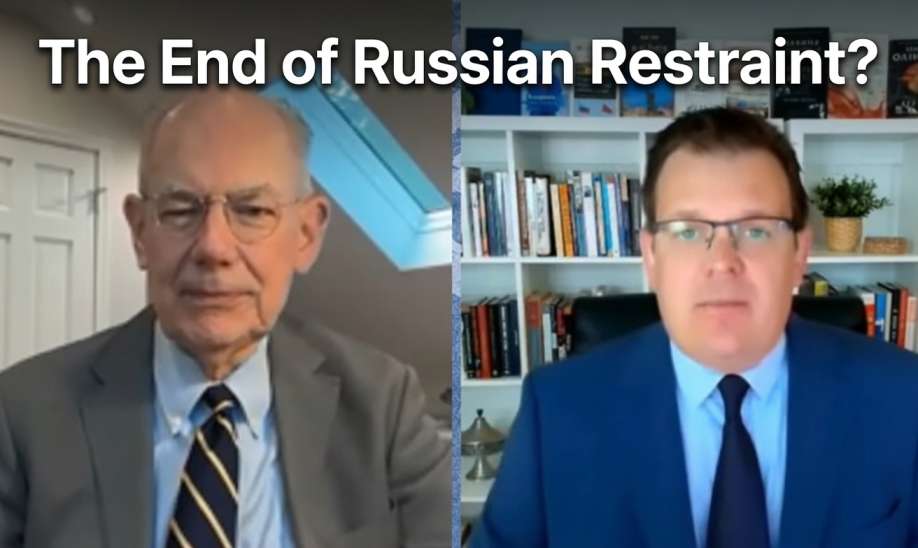
Read the full transcript of Professor John Mearsheimer’s interview on Greater Eurasia Podcast, July 3, 2026.
Editor’s Note: In this compelling interview, Professor John Mearsheimer joins Glenn Diesen to examine the escalating tensions between Russia and NATO and the dangerous realities of the ongoing conflict. The discussion critically analyzes how the war is presented to the public and challenges common narratives surrounding current geopolitical maneuvers. Ultimately, Mearsheimer argues for an urgent shift in American grand strategy to better align foreign policy with today’s complex international landscape.
Introduction
GLENN DIESEN: Welcome back. We’re joined again by Professor John Mearsheimer to discuss what’s happening in Ukraine, Iran, and of course, US grand strategy in an increasingly confusing time. So thank you for coming back on, John. It’s great to see you again.
JOHN MEARSHEIMER: You’re welcome, Glenn. I’m glad to be back.
The Bombing of Kyiv: A Reprisal or Business as Usual?
GLENN DIESEN: So I initially had intended a different topic, but as we see the bombing of Kyiv last night, which according to the mayor, Klitschko, he argued this was the worst bombing of Kyiv in the entire war. It begs the question, well, yeah, what does this mean? And also I’ve seen in other parts of the country airfields being bombed, military airfields, which again begs the question, why wait 4.5 years to go after these airfields? How are you assessing what the Russians are doing now?
JOHN MEARSHEIMER: Well, if you listen to a lot of the chatter surrounding this massive attack last night, it’s seen as a reprisal for all of these drone attacks, these Ukrainian drone attacks into Russia. And the argument is that the Russians are getting tough now.
When you hear that, and before you read about what the attacks looked like, you might think that what the Russians were going to do is go out and pound the civilian population, launch what might be called a classic punishment campaign. But it seems quite clear that that’s not the case, that the Russians went after military industrial targets. And they did not purposely attack civilians.
According to the Kyiv Independent, 20 Ukrainians were killed. This is surely regrettable, but it’s not a large number, and it does not represent a punishment campaign, a campaign designed to kill civilians. And what the Russians did was they launched a massive attack against — let’s call them strategic targets. And they’ve done this in the past. There’s not really that much new here. Yes, it was a massive attack, but as we know, there have been numerous occasions in the past where you’ve had massive attacks against military industrial targets.
So I don’t see how this could possibly represent a response to the drone attacks by the Ukrainians against the Russian heartland. It doesn’t sort of add up to me. I think the Russians are probably going to spin it that way for public relations purposes to convince their — Russian leaders will want to convince the domestic audience that they’re responding to these drone attacks. But in reality, this is just what you would expect from the Russians and what we have seen from the Russians in terms of bombing campaigns. So that would be my basic assessment of what is going on here.
NATO’s Involvement and the Risk of Direct Escalation
GLENN DIESEN: Yeah, I know the media reports point to the larger killing of civilians, but as you said, in the past, you would have like hundreds of drones and missiles, and you may have one or two deaths. This time it was more, relatively many more. But that being said, as you said, if you launch 500 missiles and drones, if the intention is to kill civilians, you’re doing a very poor job. So it doesn’t appear, as you said, this was aimed to target civilians. Again, doesn’t mean that the 20 deaths isn’t horrible, but again, I think the context is important.
But how do you see — because many assume that when the retaliation comes from Russia, that it might not be restricted to Ukraine. Again, the Russians keep pointing to European production facilities as legitimate targets, or any logistics centers. But it does beg the question, how involved is NATO here actually? Because this is something that’s very much — well, often disputed.
Although I’m not sure if you saw the news today, you had these two Russian pranksters, they had called the advisor to the Estonian president and essentially had him go on about how they had been offering coordinates in the attacks on St. Petersburg. This is quite significant. It would indicate — well, make it very clear that NATO countries are involved in attacks on Russia. Indeed, Maria Zakharova said this, that this is evidence of Estonian participation in terrorist attacks on Russia. So again, how do you see this? Because this is widely contested depending on where you get your news, but how involved do you see NATO being in these attacks?
JOHN MEARSHEIMER: Well, there’s no question that NATO is deeply involved, and I’ll talk about that in a second. But I would note, if you look at the declaration that came out after the G7 meeting in France — this was on June 17th when the declaration came out after the meetings were concluded — the G7 countries said that they were going to accelerate their support for the long-range bombing campaign by Ukraine into Russia. This is really quite remarkable. They said they were going to accelerate it.
And then furthermore, they said in this statement that was issued after the G7 meeting that they were going to ramp up the economic pressure on Russia. So if anybody in the Kremlin had any doubts about what the goals of the Europeans and the Americans are, they should have been dispelled as a result of what happened in France at this meeting.
And by the way, it seems quite clear from what happened at this meeting that Trump was convinced that what the Ukrainians are doing is really quite impressive.
Now, there’s no question that we in the West have been providing all sorts of intelligence to the Ukrainians and furthermore supporting them by giving them drones and helping them develop their own drones, and I would imagine even helping them plan a number of the drone offensives that have taken place.
Furthermore, as we well know, there have been all sorts of instances where Ukrainian drones flew over the Baltic States. And the Russians have not reacted to any of that. But they have made it clear that if any drones are launched from territory in the Baltic States, they will attack those launch sites. So that is, I think, at the moment, the most likely scenario for where you get a situation where Russia actually attacks a European — or to put it in more specific terms — a NATO member state. And I think for that reason, none of the Baltic states are willing to allow Ukraine to actually launch drones from their territory. But if that happens, I believe the Russians would axiomatically respond. They would be foolish not to.
The Karaganov Argument: Should Russia Strike Europe?
But let’s assume that that’s not going to happen. Then the question is, are the Russians going to retaliate at some point against Europe, given Europe’s and America’s assistance to the Ukrainians? Is it time for Russia to sort of throw down the gauntlet and actually attack targets in Eastern Europe?
And this, of course, is the Sergei Karaganov argument that the time has come to do that. And what we have to do — we meaning the Russians here — is we have to attack with conventional weapons first, and if that doesn’t get the Europeans and the Americans to stop helping with this drone war, then we have to turn to the nuclear weapons.
My view on this, Glenn — I’d be curious what you think — is that the Russians won’t do that right away. And I think there are sort of two reasons for that.
One is, I think they believe that they can parry those drone attacks quite well. Now that’s not to say they’ll be able to do that over the long term, because again, the G7 countries said they were going to accelerate their efforts to help Ukraine with this drone campaign. So it may reach the point where the Russians have no choice but to retaliate. But at this point, it looks like the Russians are doing a reasonably good job of parrying the attacks. And as long as that’s the case, I think the incentives for the Russians to attack into Europe are reduced significantly.
The other thing that I think really matters here is what happens on the battlefield. If you believe this rhetoric in the West that the Russians are stymied on the battlefield, and if anything, they’re losing on the battlefield and they’re suffering massive casualties, then you can spin out a story where it might make really good sense to pursue the Karaganov policy. But the fact is, that’s not what’s happening on the battlefield. The Russians are actually doing quite well. They’re not winning a quick victory. There’s no question about that. This is a steamroller that’s moving quite slowly. But nevertheless, the Russians are moving toward conquering all of Donbass. They don’t have much left to conquer before they control all of that real estate.
So given that the Russians are doing quite well on the battlefield, and given the fact that the Russians seem adept at parrying these drone attacks quite effectively — not perfectly, but quite effectively for the moment — I think the incentives for the Russians to go down the Karaganov road are not that great at the moment. But who knows how this is going to play itself out in the months ahead? So that’s kind of how I see it, and I’d be curious to know what you think of my analysis.
Western Escalation and the Limits of Russian Restraint
GLENN DIESEN: No, I think that probably sounds correct. I mean, that’s why I also have been a bit cautious about — or worried about — the way many Western leaders talk about the need to bring war to Russia or increase the pain on Russia. Because I think the main reason why Russia has been able to be restrained by not retaliating directly against any NATO country is exactly because the pain has been within the limit of being able to be absorbed and without having significant impact. So essentially being these pinpricks.
So then they essentially say, well, instead of going after the puppet masters within NATO, we’ll just take — will destroy and defeat their proxy. And I think this has been the main approach by the Kremlin.
The problem — which is why I’m very worried when the European leaders, now seemingly the Americans as well, are setting the objective of increasing the pain on Russia — is that luxury of simply absorbing the pain goes away. And then there’s more pressure of doing some direct strikes and risking a major war with the West.
And again, it’s speculation, but this would make sense because what else can Russia do then if it’s no longer sustainable, the attacks assisted by the West? What are they going to do? Are they going to stop the war, accept a ceasefire where the West begins to rearm Ukraine in preparation of another war? Are they going to leave Ukraine and have NATO march in thereafter? This is all capitulation, which would be an existential threat.
So if there is no peace and the Western escalations aren’t sustainable anymore — that is, they can’t absorb the pain — then I think they will, from their perspective, have to strike Germany or the Baltic states, essentially putting the world at a new Cuban Missile Crisis. That is, either we go all out in war or you guys back off. And I think this is often what would be required, because often you see in human history, we do go all the way to the edge. And then once we face disaster, that’s when these state leaders begin to change their minds.
Why Is the West So Open About Its Involvement?
Again, I could be wrong, but one thing I did want to ask you though — when you say at the G7, they come with these comments like, “We have to accelerate the drone and missile attacks deep inside Russia.” We saw NATO give some — or announce some — $250,000 reward for strategies for targeting Russian airfields. Why are they so open now? I mean, they’re less and less covert about this.
Is this to normalize attacks on Russia so the public won’t be fearful of retaliation? Do they want a war? Is it to keep the US inside Europe by proving to the Americans there’s nothing to fear? I mean, we could bomb the Kremlin tomorrow and the Russians would be too intimidated. It’s just the openness of the whole thing — it’s very strange for me to see.
The Psychology of Western War Narratives
JOHN MEARSHEIMER: I think, Glenn, the Western elites— and we’re talking here mainly about the European elites— have convinced themselves that Putin is the devil incarnate, that Russia has grandiose ambitions, and that we in the West are destined to fight a war with Russia at some point. Hard to say where. But for the time being, we’re in an intense security competition with the Russians.
This is why we have to keep Ukraine intact. It’s the battering ram. It’s our principal weapon against the Russians while we’re in the process of rearming for World War III. But you want to understand that that war is coming. It’s just inevitable because Putin is this congenital aggressor and he runs a country that has a rich history of aggression. So we really have no choice.
Now, you and I both believe this argument is ludicrous, and I think ludicrous is an accurate word here. I don’t understand where this story comes from, but that doesn’t matter. They have been telling this story for so long now that I think they believe it. And I think there are all sorts of motivated biases at play here that you were talking about. If you want to convince your public to support increased defense spending, this story fits perfectly. If you want to keep the Americans in, this story fits perfectly.
So it’s not, I think, like these people are saying, “What can we do to keep the Americans in? What can we do to keep or increase public support for our policies?” And then they come up with this particular strategy. I don’t think that’s what’s going on. I think it’s much more unconscious. And I think it all revolves around the fact that if you tell yourself these stories long enough, you really come to believe them.
I think you see this in the United States with regard to Iran. People have been talking about Iran as this incredibly dangerous threat for so long, even though it’s not a threat to the United States in any meaningful way, that nevertheless the elites believe and most Americans believe.
So, you and I have talked about this before. One of the downsides that we face of living in a world where facts and logic don’t matter very much is that you end up in situations like the one that we face in Europe, where the Europeans, not the Russians, are talking about the inevitability of World War III. And the Russians are put in a position where they have come to conclude, “Well, if the Europeans think that war is inevitable and they’re preparing for war against us, we have no choice but to prepare for that same war.”
And of course, once they do that, that provides ammunition for people in the West to say, “Oh, look at the Russians, they’re the ones who are preparing for World War III.” This is the classic security dilemma. Whatever the Russians do for defensive purposes looks offensive to people in the West and vice versa. So we’re in this spiral situation, which I don’t see any way out of at this point in time.
People like us try to talk sense in this discourse, but we’re small voices compared to the mainstream media. That’s the problem. So we have this situation where Western elites have convinced themselves that the Russians are truly dangerous and that we’re heading for a major conflict down the road.
Contradictions in Western Logic on Ukraine
GLENN DIESEN: Yeah, this lack of logic, I keep seeing it everywhere. For one, the main argument now is that Ukraine is winning, and when they show the evidence, it’s because the Russians are taking massive casualties and the Ukrainians are recapturing territory. But when you look at the repatriation of remains, or the exchange of dead soldiers, you see often the ratio being like 1 to 20, even 1 to 40. It’s just huge amounts of dead Ukrainian soldiers vis-à-vis relatively low numbers of Russians. And it doesn’t really make any sense. I mean, if there are higher casualties, you would assume that they would be reversed.
And you can make the argument that, well, if the Russians are moving forward, they’re the ones picking up the dead bodies. But again, they’re also saying that Ukraine is capturing territory. It doesn’t make much sense, but they get away with it.
And you also see that Putin is described as deeply irrational, yet at the same time, we feel comfortable participating in strikes against Russia knowing that he will be restrained. And we know that Ukraine has to join NATO because otherwise Russia would never dare to attack it. But we’re also saying that after Russia’s done with Ukraine, it will attack NATO. None of these things adds up.
And I’ve even seen— I think it was Merz, or von der Leyen— it was von der Leyen who made the point that Russia cut off Germany from gas, when all the record is there that it was the other way around. It’s just like saying we have to continue the war to force Russia to negotiate, while at the same time it’s the Europeans that refuse to pick up the phone and talk to the Russians for more than 4 years. It’s very confusing to follow this kind of logic.
That’s what I meant when you said the Europeans seem to believe this as well as the Americans. But is this deliberate to push a long war, or is it— I’m just wondering how much is ideological indoctrination and how much is deliberate strategy here.
The Casualty Numbers Debate
JOHN MEARSHEIMER: Well, let’s just talk a little bit about the casualty numbers. The New York Times had this piece on the relative balance of casualties— casualties meaning killed in action plus wounded. And then they also had numbers of soldiers killed on both sides. Apparently the New York Times article was based on a study that had been done by a think tank in Washington, D.C., the CSIS. And the argument was that roughly around 450,000 Russians had died and somewhere between 125,000 and 150,000 Ukrainians had died.
So let’s take the high-end number for the Ukrainians, which is 150,000. And again, the Russian number is 450,000. That’s a 3-to-1 ratio. That means that 3 Russians have died for every Ukrainian. This is simply unbelievable. This cannot be the case. I don’t understand where these numbers come from.
First of all, the main killer on the battlefield is artillery, and throughout most of the war, the estimates are that the Russians have had at least a 5-to-1, if not a 7-to-1 or 10-to-1 advantage in artillery. If you look at these smart bombs that are dropped from the air, the Russians have a huge inventory of smart bombs that they’ve been dropping on the Ukrainians. The Ukrainians have virtually no smart bombs that they’ve been dropping on the Russians.
You might say to yourself, “Well, it’s the Russians who have mainly been on the offensive.” Well, there are two problems there. One is that the Ukrainians have launched a large number of offensives. Remember the Kursk offensive? Remember the famous June 4th, 2023 offensive, the one that was going to result in a blitzkrieg that took the Ukrainians to the Sea of Azov and cut the Russian front lines in half? In 2022, the first year of the war, the Russians suffered two defeats because the Ukrainians launched major offensives in Kherson and Kharkiv. And then we hear about all these Ukrainian counterattacks these days. Those are offensive operations.
So the Ukrainians have been on the offensive for a good part of the war, and therefore you can’t make the argument that they’ve been on the defensive, and because the defense suffers less casualties than the offense does in almost all cases, we should not be surprised by that number that the New York Times uses. So you can’t justify those numbers that way. It just makes no sense at all.
And I think if anything, we’re going to find out that the Ukrainians have lost probably around a million men— and here when I say lost, I mean killed in action. I think the argument that they’ve lost 150,000 is ludicrous. It just makes no sense at all.
And nevertheless, this is reported as fact, and it is a set of facts that all sorts of people use to assess what the situation is between Russia and Ukraine and what we should do moving forward. And if you believe these numbers, which again I think are ridiculous, you can justify upping the ante and trying to help Ukraine really clobber the Russians and knock the Russians off as a great power, finish them off as a great power. And lots of people talk that way, and you just sort of say to yourself, “Are they making all of this up? Are they making these numbers up? Do you think the New York Times is making these numbers up?”
I don’t think they’re making them up. I think they really believed them. Again, there may be all sorts of motivated biases at play here that they are not aware of. But putting that aside, the fact is the elites have told themselves a story that they believe, and they continue to march forward based on these false narratives.
Narrative Enforcement and the Suppression of Reality
GLENN DIESEN: I just don’t understand the political debates anymore in the West. Building on what you said, if you go back to the 2023 counter-offensive of the Ukrainians, it was evident from pretty much the first day that this was going to end in disaster. Because the Russians had pulled back from Kherson and Kharkiv, they had tightened up the defensive lines, and it looked as if Ukraine was going to run into a brick wall.
But I noticed as soon as I made the point that this was going to end in disaster, it was condemned as, “Well, why would you take wind out of the sail of Ukraine? That’s a pro-Russian thing to say. Of course it’s going to be a success.” You saw the same with Kursk. I mean, I think most people knew this was going to be a horrible disaster. Why would you leave your defensive position, go out in the open within hostile territory? And they were slaughtered in horrible, horrible numbers. Yet everyone had to fall in line and pretend as if this was a good idea.
And you could say the same with Nord Stream. Everyone had to go around pretending that this was Russia, and now we see that everyone has to go and pretend that the Ukrainians are winning. We have to look away from all the available facts. It’s just very strange that this is where we are. Objective reality doesn’t have any value of its own. Everything seems to be only assessed by the extent to which you’re applauding the right team. And if you’re applauding the Ukrainians, then you have to pretend everything is a brilliant success and look away from the horrific defeats and horrible number of casualties. And otherwise, you’re supporting the Russians. It’s like we’re watching a football game. This is pretty much where we are.
Have you seen this before? I know there’s a lot of commonality between many wars. It’s the same with the sanctions— if you say the sanctions aren’t going to work, I noticed from the first day that was seen as being a pro-Russian statement because you undermine support for the sanctions. But are these social constructivists who want to just elevate or make people support the wars, or is there something else to this? Because it’s very hard to assess why reality means so little and why there’s this obligated adherence to narratives.
The Propaganda of War: From Vietnam to Ukraine
JOHN MEARSHEIMER: Well, a couple points. There’s a very famous book entitled Truth Is the First Casualty. And the argument is when a war breaks out, because the propaganda machines on both sides immediately go to work. The end result is that truth gets washed out of the picture and propaganda becomes of enormous importance.
The case I know best where you saw this was during the Vietnam War. And some of it revolved around casualty counts, or what were then called body counts. And there was tremendous pressure put on the American military to inflate body counts because you really needed an indicator of success. The American public was saying, what kind of progress are we making here? What are the indicators that we’re actually making progress?
And of course, President Johnson and his lieutenants as well put pressure on the American military to indicate that we were, or give indicators that we were making great progress against the Viet Cong and the NVA. So body counts became the principal instrument for convincing the upper echelons of the Johnson administration and the public that we were winning the war.
And you created this fantasy world where huge numbers of Vietnamese were dying. And therefore the story was, or the storyline was that we were winning the war. And in fact, everybody who was involved in the process fully understood that we were acting in extremely dishonest ways for the purpose of satisfying the commanders who wanted to be able to make the case that we were winning.
And if you look at a lot of the battles that took place during the war, we suffered enormous casualties. And in many of those cases, you could argue we won. But if we won, we barely won. But nevertheless, we described those battles as great victories. We went to great lengths to make it look like we were winning when we weren’t winning. And this is why we lost the war.
We were not making progress. If you actually look at what people like Johnson and others actually knew, and this even includes Westmoreland, what they actually knew about what was going on on the battlefield from ’65 on. Remember, we go in March ’65 in a big way. They understood that we were in deep trouble. And despite the fact that they kept spinning these stories that we were doing well, that the body counts prove that, they understood at the same time that we were not doing well. And they were constantly searching for the magic formula, which they could never find, and never did find. And therefore we lost the war.
But you just don’t want to underestimate the extent to which a national security establishment, when it goes to war, will pursue propaganda in really extreme ways.
Western Propaganda: More Sophisticated Than Ever
Now, I think there are two big differences between the Vietnam situation and the present situation. One is that we’ve just gotten much more sophisticated at it. It’s really quite amazing how good we are across the West at spinning out these stories that are really false narratives. We were not quite so good in the Vietnam War. We’ve gotten much better at it. The elites have really become quite skillful at propagandizing.
And the second big difference is I think that during the Vietnam War, and this was evident in the comments I made a few minutes ago, while people were spinning positive stories — and this included people like Westmoreland and the military chiefs, and it included, of course, LBJ and his lieutenants — well, they were spinning positive stories, at the same time they knew that we were in deep trouble. They were aware of the fact that they were distorting the truth to keep support for the war in place.
I think today, and this gets back to our earlier conversation, I think today most Western elites believe that we are actually doing very well in Ukraine and that the Ukrainians themselves are performing well on the battlefield. That the Russians have been at least stymied, and maybe even the tide has turned. And furthermore, when you look at these Russian casualties, you look at the disastrous state of the Russian economy, you look at the fact that so many people are interested in overthrowing Putin, really all we have to do is just keep pushing and we’re going to win a victory. It’s going to happen. And people believe that.
You and I think, again, that this is ludicrous, but we’re a minority voice here. All sorts of people believe this in the West.
And all of this tells you, by the way, Glenn, that the only thing that’s going to dispel all these foolish notions about what’s going on is a Russian victory on the battlefield. If the Russians roll up the Donbass, or once the Russians roll up the Donbass, Zaporizhzhia and Kherson, and then they begin to move on to other oblasts, assuming they do that, then it’ll be impossible to maintain this narrative.
What enables people in the West to sustain this narrative is the slow progress of the Russian army. The fact is the Russians have moved very slowly to roll up the Ukrainians.
And by the way, to go back to the previous subject, we were talking about casualties. One of the reasons I believe these Russian casualty numbers are simply wrong is that the Russians pursue their offensives in a very cautious way because they are interested in minimizing casualties. If you look carefully at Russian tactics on the battlefield and Russian strategy more generally, they go to enormous lengths to minimize the number of casualties.
So this is a case where huge numbers of Russians are not dying in mindless frontal attacks that fail, as many in the West would like you to believe. The Russians are very cautious. They’re suffering casualties for sure, especially because there are all those Ukrainian drones up in the sky, but the casualty numbers are not that high. And this, of course, is why that New York Times story is laughable.
GLENN DIESEN: Yeah, well, I think this is a key thing what you said about Vietnam, but that is that the lie to, well, essentially the lie about the war to buy time in order to find that magic formula you refer to. And I think that’s also what happened in Afghanistan. If you look at the Afghanistan papers, they knew things weren’t going well and they did cover it up. And again, why would you fight a losing war?
And I do think that the assumption is if you can just keep it going, something — hope, you cling on to hope something might turn up — the economy could collapse, the fronts could collapse, or worst case, gradually drain the enemy so they will end up weaker thereafter. I mean, I’m assuming we had other ideal outcomes for Libya, Syria, all of these countries, but, you know, best, worst case, one drains and destabilises an enemy.
But it’s also interesting what you said about how to measure success, because if you look at Ukraine, the best way or favourite way by the Western political media establishment has been to measure progress based on territorial shifts. But as you and I know, that doesn’t make much sense when you’re fighting a war of attrition, because you don’t spend all your forces fighting, well, storming well-fortified lines. You drain and weaken the adversary. And once the front line collapses, then you take the territories. I mean, once the front lines now collapse, the Russians can move faster and faster without the defensive lines as well. So measuring territory in a war of attrition doesn’t really make sense.
But that’s what I find interesting, because in the Iran War, they always appear to measure deaths. But that doesn’t really make much sense. That is, Trump always points to, well, look at the Navy, the Air Force, everything’s gone. But measuring death and destruction as success doesn’t really make much sense if the Iranians can hold on to the Strait of Hormuz with very cheap, simple drones. And also, they’re willing to absorb all this pain because it doesn’t matter how many of them you kill, they’re still going to be willing to fight, and they’re still going to be willing to produce the capabilities required to keep that strait closed.
So the, as you said, the KPIs or the indicators of success — it’s very strange, or perhaps deliberately so strange, how they measure success.
Body Counts, Casualty Ratios, and the Iran War
JOHN MEARSHEIMER: Can I just jump in here, Glenn? You know, we were just talking about casualty numbers in the Ukraine war and what the New York Times has been reporting. This is the same as body counts, right? This is a body count argument. This is just like Vietnam. Very important to understand that.
You pointed out quite correctly, of course, that in the West, we often talk about the failure of the Russians to capture territory. And you say that that’s not a good indicator when you’re in a war of attrition. And that, of course, is true. And in a war of attrition, what matters is the casualty exchange ratio. And the casualty exchange ratio is effectively the same as body counts. So what you see going on here with this New York Times piece is very similar to what you saw with body counts in Vietnam. And the body count process in Vietnam was fundamentally dishonest. Very important to understand that. And the body count process in Ukraine, as we discussed about the New York Times article, is fundamentally dishonest, and it’s exactly what you would expect.
I want to make another point. Very important to understand that the Vietnam War and the Ukraine War were ground wars, or are ground wars — or is a ground war in the Ukraine case and was a ground war in the Vietnam case. I have to get my tenses right here. They are ground wars, where armies were crashing into each other and huge numbers of people were dying. So body counts or casualty exchange ratios mattered.
In the Gulf, in the Iran War today, there’s no ground war. Remember that the initial part of the war, from February 28th to April 8th, was fought in the air. That was the air war. From February 28th to April 8th. Then the air war ended. The bombing effectively ended, except for two minor blips later on we could talk about. But the air war basically ended, and we segued to a blockade. It was April 13th when we moved to a blockade, and the blockade ended when we signed the Memorandum of Understanding. That was June 17th.
So we went from a bombing campaign to a blockade, and we never launched a ground offensive. And so there’s no body count argument at play in the Iran War. It’s a very different kind of conflict.
And to be more specific about the Iran case, as everybody said, if you really wanted to achieve the goals that the Israelis and the Americans set out for themselves on February 28th, you would need boots on the ground. There’s the ground option. And we were unwilling on February 28th and at any point since then to put boots on the ground, at least in any meaningful way. So we’ve never gone near that ground option.
Because when you go to the ground option, that’s when you really suffer serious casualties. And when you suffer really serious casualties, it becomes much more difficult to justify the war. And that’s why the body counts, the casualty exchange ratios attract so much attention.
GLENN DIESEN: So, no, I agree. But also, yeah, with Iran, you would have thought the US would have greater success though. That is, it did stay away from the ground war because as a naval power such as the United States — well, history suggests it should stay out of ground wars, be it Vietnam, Iraq, that this is not playing to America’s strength. But in Iran, you had naval power, air power, so it should, I guess, have assumed the greater success on the American side.
On the other hand, you can’t really win a war with air power alone either. But how do you measure success in the war against Iran on behalf of the Americans, that is? How would you measure progress? Because it’s a very unique kind of war. Is it the destruction of ballistic missiles, offensive capabilities, defensive capabilities? Is it removing proxies or allies, be it Lebanon, Iraq, or Yemen? How would we know if the United States would be winning the war against Iran?
The Goals of the War with Iran
JOHN MEARSHEIMER: A couple of points. One is we’re not going to win the war. We’re going to lose the war. But in the process of losing the war, we have two goals that we need to achieve. And if we come out of this in reasonably good shape, we will have achieved those two goals. But it is very important to understand that Iran has won this war. Iran is going to emerge from this war much more powerful relative to its neighbors than it was on February 27th. And America’s position in the Gulf is going to be greatly weakened as a result of this war.
But I want to get to your specific question because it is terribly important. We have two goals here. Putting aside the question whether we win or lose, we have two goals. Number one is to open the strait because we got to get oil flowing. And that can include, that will include Iranian oil, which we’re allowing to come out of the strait. And we’re allowing the Iranians to get paid in dollars for that oil, right? We’re giving them a good deal because we want to flood the market with oil so that the economy, the international economy doesn’t go off a cliff. So goal number one was to open the strait, get the oil flowing.
Goal number two is to get a nuclear deal. We have to get a nuclear deal. It’s obviously going to be some variant of the JCPOA. But there has to be some sort of deal that limits what Iran could do in terms of developing nuclear weapons moving forward. You mentioned missiles. There’s going to be no agreement on missiles. Some people might say, well, what about supporting Hezbollah, Hamas, and the Houthis? There’s going to be no agreement there. Regime change. That was another one of our goals. There’s not going to be regime change — not as an immediate result of this war, maybe in 2 or 3 or 4 years, who knows, but not now. The key issue is the nuclear issue.
Now, it’s very important to understand how the memorandum of understanding was structured. It was structured so that the shooting between, or the bombing between Iran and the United States would be shut down once the memorandum was signed, and number two, the strait would be opened and oil would flow out into world markets.
Now, with regard to the bombing, the bombing campaign stopped on April 8th. There was really nothing to stop. The bombing campaign ended and we went to a blockade and we can’t go back to a bombing campaign for a whole slew of different reasons. So that really didn’t matter that much, except maybe in Lebanon, but let’s leave Lebanon aside. The key issue to start with that we cared about was opening the strait. And the strait is now opened for all intents and purposes, not fully open, but it appears that it may be fully opened. And if it isn’t, we’re in real trouble, but that was the least difficult goal to achieve because the Iranians have a vested interest in selling their oil.
The Nuclear Deal and Economic Concessions
The big number two goal that’s sitting out there is the nuclear issue. And that is yet to be resolved. What you want to understand here is we now have to deal with the nuclear issue side by side with four big economic issues that would all be advantage Iran. One is reparations. Two is the frozen assets. Three is lifting the sanctions. And four is the question of the toll booth in the strait.
In other words, these issues have not been resolved. Just think about it. That $300 billion fund for reparations, not settled yet. Lifting all the sanctions, not settled yet. Releasing all the frozen assets — I guess they’re probably over $100 billion in frozen assets — unfreezing all of them. And then the toll booth issue. Okay, they have to be resolved, those issues, and the nuclear issue has to be resolved.
So we have solved the problem of opening the straits for the most part in the beginning, and now we have all those other big issues staring us in the face. And I would just say to you, if we don’t get a deal — we meaning the West, and here we’re talking mainly about the United States — we don’t get a deal on the nuclear issue, we’re going to be in real trouble because, as you well know, the Iranians have the capability to quite easily build a bomb. And if we don’t have something like a revised version of the JCPOA, what’s going to stop them from building a bomb?
So there’s going to be very powerful incentives on us to get that deal, which means that we’re likely to have to make major concessions to the Iranians on those four big economic issues that the Iranians care about. So there’s a lot of negotiation to be done. And it just seems to me, if we’re going to be successful, we’ve got to keep the strait open, number one. And number two, we got to get a nuclear deal.
GLENN DIESEN: Well, if those were the only two objectives, that is a nuclear deal and get the oil flowing, it would be achievable because, well, the Iranians weren’t pursuing nuclear weapons before this war, and oil was flowing before the war as well. But as you said, there’s new objectives now. Well, the MOU makes it very clear there’s no going back to the old status quo.
So the Iranians, I think they’re worried as well because on one hand, it’s hard to imagine the US implementing all the things it signed under with the MOU, that is, ending all sanctions, getting Congress on board, giving $300 billion in reparations, accepting the toll booth or fee or whatever one wants to refer to it. It’s very hard to see this being acceptable. At the same time, there’s no good military option unless Israel might be able to instigate a civil war in Lebanon, or the US could pressure the Iraqi government to shut down some Iranian militant groups. One could go after allies, but it doesn’t look like that’s a viable strategy for military success.
So what do you think the strategy is here? Will they take a horrible peace deal or will they take a non-existent military option? How are you assessing what’s likely, based on American strategy here, or how you see the strategy at least?
No Military Option — The Leverage of the Nuclear Issue
JOHN MEARSHEIMER: Well, this is a great question. Let’s just talk this through. First of all, there’s no military option, as you and I know. And one reason there’s no military option is that if you go back to bombing, the strait will be closed again. We can’t do anything that allows the strait to be closed again. We just got it open and we want to keep it open.
And for all these people talking about, let’s go back and finish the job — what are they talking about? We had a 40-day bombing campaign. It didn’t work. That’s why we ended it on April 8th. And furthermore, we were running out of munitions. And furthermore, the Iranians have a second strike capability. And furthermore, they can really crash the world economy. So what are people talking about? We don’t have a military option.
We got the strait open and now the question is, are we going to deal with the nuclear issue? You’re saying, Glenn, I think quite correctly — I’m not disagreeing with you — that it’s hard to imagine the Americans making those concessions that I described on what I called the four big economic issues. The whole question of the toll booth, releasing all those frozen assets, almost complete sanctions relief, and the $300 billion reparations fund. Can you really see the United States conceding on all those issues?
I mean, the end result would be that Iran would be in excellent shape moving forward. This is a country with 93 million people. You get its economy back on its feet, it’s in a position where it dominates the Persian Gulf, it controls the Strait of Hormuz — Iran would be really quite powerful. Is America going to let this happen? That’s the question you’re asking.
The counter to that, Glenn, is what about the nuclear issue? The Iranians are going to play hardball with us. We know that. They’re going to say, if you don’t dance to our tune on the economic issues, no nuclear deal. What are we going to do then? No nuclear deal? I don’t know about that. We got to get a nuclear deal, I think. But if we don’t get a nuclear deal, we’re going to be in real trouble because there is a really good chance that they’ll get nuclear weapons, or they’ll move in that direction. And this will cause the Israelis to think about using their nuclear weapons against Iran. So the potential for disaster here is enormous. We have a very powerful incentive to get a nuclear deal. Trump has a very powerful incentive to put this behind us.
Just to come at this from a slightly different angle — you understand that the Iranians wanted to deal with the nuclear issue up front. Remember, I described the memorandum of understanding as dealing first with opening the strait, ending the shooting, that’s one, and then later dealing with the nuclear issue and those big economic issues. The Iranians were smart. They put the nuclear issue at the rear end of the negotiations, because they knew it would give them huge leverage down the road.
If they negotiated the nuclear deal and the strait deal now, and then later moved to the economic issues, they’d have no leverage. The only thing that gives them leverage now — they no longer have leverage because they control the strait, because they’ve opened the strait — their leverage now rests with the nuclear issue. They were smart to keep the nuclear issue until the end. So they have a lot of leverage over us, and we have a vested interest in caving to them, fulfilling the various agreements that make up the memorandum of understanding. But maybe that won’t happen, and the end result is we won’t get a nuclear deal.
American Grand Strategy in a Changing World
GLENN DIESEN: Well, let me just ask one final question though. If we take a few steps backwards to get a larger picture — how would you define the American grand strategy now at this point in history? That is, during the Cold War, the grand strategy with one rival, one other centre of power with one competing ideology, it was the grand strategy of containment and all the other components. It set a clear goal which kind of brought more or less the whole political class together. All other strategies were kind of subordinated to this wider grand strategy.
What is it today? How is the United States dealing with the massive changes in the world and its own role in this world? That’s a large question for —
U.S. Grand Strategy: Priorities and Challenges
JOHN MEARSHEIMER: When my friends and I thought about grand strategy over the decades, we always used to argue that obviously the Western Hemisphere is the most important area of the world for the United States, but given that the United States is a regional hegemon, there’s no serious threats in the Western Hemisphere.
The question is, what are the areas outside of the United States that matter the most from a strategic point of view? Where are vital interests at play around the world? And I think most people in my circle agreed that the three areas that mattered the most were Europe, East Asia, because there were great powers in Europe and East Asia, and the Persian Gulf because oil was there. Those were the three key areas of the world outside of the Western Hemisphere.
During the Cold War, we focused mainly on Europe because the Soviet threat was centered in Europe. But the Soviet Union was, and Russia is, physically located in East Asia, as we both know. So we cared about containing the Soviets, not just in Europe, but in East Asia as well. And the Persian Gulf was the area where we had to do the least amount of work. The British did the heavy lifting in the Gulf up until 1968. And then after 1968 up to 1979, we depended on the Iranians. This is under the Shah, the Saudis, and we didn’t have any great threat.
After 1979, when the Soviets invaded Afghanistan and there was the revolution in Iran and Iran was no longer an ally, we built the rapid deployment force, which was an over-the-horizon capability. In other words, we were not physically located with military forces, or we didn’t have many military forces physically located in the Gulf. We had this rapid deployment force, which again was over the horizon. So you see that during the Cold War, we cared about Europe, we cared about East Asia, and we cared about the Gulf.
The Shift to a Multipolar World
Then comes the multipolar world that we’re now in. And China is the principal threat to the United States, and therefore we pivoted to Asia. And there was a lot of talk about pivoting away from Europe and minimizing our commitment to the Gulf because we didn’t see any great problem in the Gulf. We thought we had things under control. And with regard to the Western Hemisphere, things were pretty good. No serious threats to the United States.
Along comes the Trump administration, back into the White House, January 2025. What you see is that President Trump decides to make the Western Hemisphere a high priority, and we’re deeply involved in social engineering and military engagement in the Western Hemisphere. If you look at what’s happening in Venezuela, if you look at what’s happening with regard to Cuba, if you look at President Trump’s rhetoric about the Panama Canal, about Greenland, making Canada the 51st state, the United States is paying a lot of attention to the Western Hemisphere.
Which kind of befuddles me because I don’t think we face any serious threats at this point in time in the Western Hemisphere. But nevertheless, we are deeply involved in doing social engineering and even maybe acquiring territory in the Western Hemisphere. You want to remember that President Trump said at the time when we captured President Maduro of Venezuela, that the United States now — he now runs Venezuela. And he basically viewed Venezuelan oil as American oil. It’s really quite remarkable. So you can see that we’re on the march in certain ways in the Western Hemisphere.
Overextension Across All Regions
With regard to the Gulf, we’re now involved in a major conflict with Iran. It’s really quite amazing. One can make the argument, Glenn, that we will eventually leave the Gulf, that we can no longer maintain military bases there. Our alliance structure is in tatters. That may happen. But for the time being, if you look at American grand strategy, we are up to our eyeballs in alligators in the Persian Gulf.
And as I said, we’re deeply involved in the Western Hemisphere. With regard to Ukraine and Europe, as we talked about earlier in the show, it appears that President Trump is more or less re-engaging in Ukraine, getting more deeply involved. And one could argue, Glenn, as the tide turns against Ukraine, which you and I know is happening as we speak, that the Americans will feel compelled to move in and do everything possible to rescue Ukraine so as not to suffer a humiliating defeat.
And then there’s East Asia. That is what the Pentagon calls the pacing threat. So we’re not leaving East Asia. And if you look at what the Chinese are likely to do over time and what the Americans are likely to do over time, that’s a dangerous area of the world. I wouldn’t be surprised if 10 years from now, or even 5 years from now, when you and I are talking about all the problems in the world, that China is not at the top of the list.
So all of this is to say that the United States under President Trump has a remarkably ambitious grand strategy. Think about what I said about the Western Hemisphere. Think about where we are in the Gulf. Think about where we are vis-à-vis Ukraine and think about the pacing threat, China. We don’t seem to believe in the word prioritizing. The United States still labors under the illusion that it can be everywhere and do everything all the time. And I think that’s where American grand strategy is at the moment.
I think we could have a long conversation — and we should do this the next time we talk — about where American grand strategy is headed. Once these various conflicts are behind us or they sort themselves out, and here we’re talking about Ukraine, and Iran, and also to some extent places like Cuba and Greenland, then we can maybe get a clearer picture of American grand strategy. But I do think, Glenn, the United States is going to have to learn to prioritize. I think this idea that we can maintain this militarized state that’s involved in really deep-seated ways in all four of these regions is not workable over the long term.
The Difficulty of Adjusting to Multipolarity
GLENN DIESEN: That’s what I thought was the main challenge to the United States at this time in history, though — that is, as transition from unipolarity, where essentially it has final say in every corner of the world, to multipolarity. The grand strategy would have to include priorities. That is, you can’t be everywhere, then what comes first?
And I don’t want to belittle the politicians. I think this is a difficult thing to adjust to once you had a political culture over decades of being everywhere at the same time and embracing an ideology which makes it almost treasonous and uncaring not to be everywhere, because all our wars are of course sold as being about helping the disenfranchised and advancing liberal democracy. So it’s very difficult to make this shift.
But I thought that was the lesson from the Iran War though. That is, when all the weapons had been spent in Ukraine and then suddenly, how are we going to fight the Iranians? Then have to take the weapons from the Europeans, from the Ukrainians, from the East Asians, and send it all not just to the Middle East but Israel, because even the Gulf states were robbed of some of their air defences. So I thought this was the main lesson: if you prioritise everything, you’re not prioritising anything at all.
But again, it could be, huge shifts in the international distribution of power. It’s usually destabilising because politicians do need time to adjust to new realities, I think. Anyways, do you have any final thoughts before we end the video?
JOHN MEARSHEIMER: Yeah, let me make two quick points. One is the debt problem.
GLENN DIESEN: I’m sorry to interrupt, but I always look at the debtclock.org and I’m not even American and it’s still depressing to me. It’s horrific numbers. So yeah, sorry, go on.
The Debt Problem and the Weakened Industrial Base
JOHN MEARSHEIMER: No, no. You’re right. You sort of think the chickens are going to come home to roost on that problem at some point in time.
Second thing is, Glenn, if you look at the Ukraine war and you think about fighting a war against China, or you think about fighting a war anywhere, what’s very clear is that you need a large industrial base, and you need the capability to produce huge numbers of weapons. Again, just to go back to the Iran War, we had to quit after 40 days because we were basically running out of weaponry. It’s truly amazing the extent to which we have run down our inventories of Tomahawk missiles, Patriot missiles, THAAD missiles, air-to-ground smart bombs and so forth and so on. Really quite amazing. And it’s also quite amazing how long it’s going to take us to rebuild those inventories, which have been whittled down.
And what this tells you is that we are going to have to prioritize. If you’re going to plan for a war in Asia, and you’re thinking about how you deal with the Chinese in a war over Taiwan or the South China Sea — a war that’s going to go on for many months — now, let’s hope this never happens. I’m not saying this is likely or it’s going to happen, but the Americans are going to have to prepare for a long war. This is what the Ukraine war has taught us. And we don’t have the manufacturing base. When you look at how long it’s going to take us to replenish our depleted stocks from the Iran war, it’s really genuinely frightening from a security point of view. Really, it’s quite amazing.
So I think when you look at the debt problem and you look at the weakness of the American manufacturing base and the need to build a large-scale inventory of weapons and to have the ability to produce weapons once the conflict starts, we have a lot of work cut out for us. And that’s going to involve prioritizing.
So I think the events that have taken place since the Ukraine war started in 2022 up to the present day — this 4 or 5-year period — is a period in which we have learned a lot, and what we have learned should leave us deeply worried about our future. When I say our, I’m talking here about the US.
GLENN DIESEN: Well, until next time, I hope to be able to discuss some more grand strategy with you because the US has a fascinating history there. So thank you so much for your time and have a good one.
JOHN MEARSHEIMER: My pleasure, Glenn. Best to you.
Related Posts
- Scott Ritter: How NATO & Russia Came to the Edge of Nuclear War (Transcript)
- Transcript of Professor Jiang Interview on Danny Jones Podcast
- Transcript of Boris Johnson Interview: ET World Leaders Forum 2026
- Jeffrey Sachs: The War on Russia & Iran Is Breaking the West (Transcript)
- Transcript: Tucker Carlson Interviews Harvard Professor Stephen M. Walt