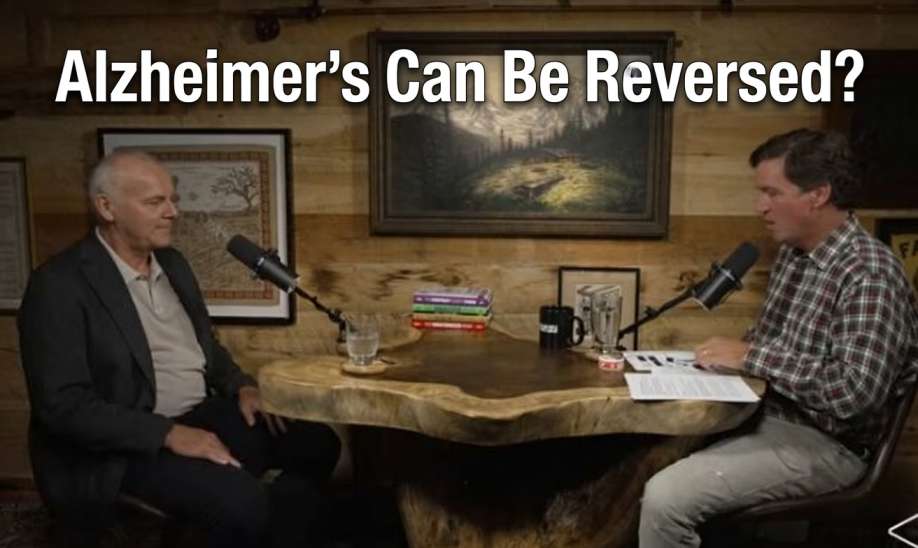
The following is the full transcript of scientist and physician Michael Nehls’ interview on The Tucker Carlson Show, July 3, 2026.
Editor’s Note: In this compelling interview, Tucker Carlson sits down with physician and molecular geneticist Dr. Michael Nehls to explore unconventional perspectives on brain health and disease prevention. Dr. Nehls challenges mainstream medical narratives, discussing the potential of lifestyle interventions and specific minerals, such as lithium, to combat conditions like Alzheimer’s, depression, and anxiety. Throughout the conversation, the two delve into the influence of the pharmaceutical industry and the hidden factors they argue are impacting global mental health.
Dogs, Oxytocin, and the Brain
TUCKER CARLSON: Thank you for coming back. I’m really excited about this. So we’re going to talk about algae oil and lithium. I can’t believe I’m saying I love this, but we were just having a conversation off camera about dogs, and I was telling you my crackpot health theories, which are very sincere and firmly believed. But one of them is that sleeping next to your dog in bed and having dogs in your life, physically in your life, kissing dogs, is very important to your health. I feel that way strongly, but I never tell anybody because it’s too crazy. But you just affirmed my belief. You said there might be some science behind.
MICHAEL NEHLS: Yeah, there was a paper a few years ago in Science where they actually showed that dogs actually captured what we call the oxytocin system. Oxytocin is a hormone, produced by your hormones. Yeah, they are produced and they are for bonding. Actually, the main purpose of oxytocin is — it’s a Greek word — it’s for easy birth. It actually is activating the uterus and helps delivering the baby.
TUCKER CARLSON: Yeah, like the toxin that they give to—
MICHAEL NEHLS: Yeah, exactly, same stuff. And every time we look into the eyes of friends and be happy and have companionship, then oxytocin is produced in our body. And the oxytocin has one important function, and that is not only to give easy birth when you deliver a baby, but also a second function, which is actually important for the bonding between the mother and the child.
So the bonding between the mother and child is essential for the life of the child. If you can’t remember the child, if you can’t smell it, if you don’t have a connection to the child, the child is lost. So the mother love, in the love of the mother to the child, has to keep for the whole life. And this, of course, is a function of our autobiographical memory center, which we call the hippocampus, a seahorse-shaped structure here in the temporal lobe of our brain on both sides, big like a thumb.
This is the memory center. Actually, we will talk about this in depth, I guess, because this memory center is important if we are able to think peace, if we actually act like humans, reflect about things. And of course, if it doesn’t function, one disease which we all know about, which I call hippocampal dementia, is Alzheimer’s. Alzheimer’s starts from the hippocampus.
And the main reason — I published this in 2016, I called it Unified Theory of Alzheimer’s — is that this hippocampus has the ability to grow new nerve cells every day. These are required that we can accumulate a lifelong information, knowledge, experiences that are valuable for our children, but also for our grandchildren. The main reason we get that old as we get. So the hippocampus has to grow new cells. And one of the major fertilizers of this growth process is oxytocin.
So when a child is born, a lot of oxytocin is produced, the hippocampus grows, and the mother has a better memory than ever in her whole life when the child is born. The same actually does prolactin, which is important for giving milk to the baby. So giving milk to the baby, the birth of the baby produces hormones, and these hormones activate the growth of the hippocampus.
And the same goes for dogs. When a dog looks into your eyes, it was proven, the oxytocin level increases in your blood, but not only in your blood, also in the dog’s blood, by the way. So there is kind of a bonding between the two species based on the oxytocin system. And the paper in Science about 10, 15 years ago said that the oxytocin system was captured by the dogs so that they become our friendliest companions.
The Evolutionary Purpose of the Human-Dog Bond
TUCKER CARLSON: What could possibly — first of all, that’s beautiful and great to hear, but what could be the purpose of that?
MICHAEL NEHLS: Well, for the dogs, it means they get the food every day they need. It is a species which survived that way. And evolution works in a way that you have to survive and your children have to survive, and your kids have to survive. And that is more likely if the wolf becomes a dog.
TUCKER CARLSON: Yes, the dog is dependent on you.
MICHAEL NEHLS: It’s dependent on you. The dependence is guaranteed by the oxytocin system.
TUCKER CARLSON: But why? And I understand that, of course, but what would be the purpose for people?
MICHAEL NEHLS: For the people in the past, it was like they were companions in hunting. They protected your space. So they were for safety reasons. And meanwhile, I recommend them actually as a therapy against Alzheimer’s.
TUCKER CARLSON: Dogs?
MICHAEL NEHLS: Yeah, sure, because they grow the hippocampus. And the bigger the hippocampus, the less likely you get Alzheimer’s. Actually, the paper I published, Unified Theory of Alzheimer’s, goes back that the fundamental physiological or pathophysiological problem in Alzheimer’s is the non-production of new nerve cells in the hippocampus based on our lifestyle.
TUCKER CARLSON: Based on — okay, so the way we live affects the risk of getting Alzheimer’s.
Neuroinflammation, the Hippocampus, and the mRNA Connection
MICHAEL NEHLS: Exactly.
But what we talked about 2 years ago was that the spike protein produced by the mRNA that is injected in this weird program is doing just the opposite. The spike protein activates neuroinflammation in the brain. And we have to talk about neuroinflammation today because lithium is the antidote. Actually, we talked about this 2 years ago.
So if neuroinflammation occurs and it’s chronic because the spike protein doesn’t go away, then the neuroinflammatory process activates the production of interleukin-1, interleukin-6, TNF-alpha, all pro-inflammatory cytokines. And their main reason that they are produced is to signal the immune system there’s some damage in the brain. But a side effect is, and that’s physiological, is that they shut down the hippocampus. They shut down the production of new nerve cells in the hippocampus.
In the short run, this is good because it creates a behavior that is — you are not curious when you are sick. You want to go back, you don’t want to socialize. That protects others if you are really sick.
TUCKER CARLSON: You are not curious when you’re sick. That is true.
Depression, Anxiety, and the Loss of Humanity
MICHAEL NEHLS: Yeah. So that is the result in the short term. But if it’s chronic, if chronically there’s a shutdown of the production of new nerve cells in the hippocampus, then the consequences are depression, anxiety, and in the long run, it’s Alzheimer’s.
So they actually identified after the mRNA injections, after a few months, that the Alzheimer rate went up in a study published in Seoul in South Korea. It was, I think, published in 2023. And I predicted this already in my book, The Indoctrinated Brain. I said the mRNA injection will increase Alzheimer’s.
TUCKER CARLSON: And it has.
MICHAEL NEHLS: And it has. It was published in a Korean study. So all the predictions were correct, unfortunately. Well, it was good for me because I like it when I’m correct in my predictions, but it’s not good for the human world.
So humanity hinges on the ability of the hippocampus to produce new nerve cells. That is the key to humanity. If we reduce it to one function of the brain — being human is that we are curious, that we can reflect, that we have what I call psychological resilience. Because even if you’re curious but you fear going the new path, then it doesn’t do any good. Curiosity has to be like two sides of a coin. On the one side you have curiosity, on the other side you have the psychological resilience. And this coin with these two sides is based neurologically on the function of the production of new nerve cells.
So you need new nerve cells to be curious, to have resilience. Actually, all drugs that are on the market that are against depression have one key feature: they activate the production of new nerve cells in the hippocampus. I’m not saying you have to take them, but this is their function. So they are essentially antidepressants based on the function that they produce new nerve cells in the hippocampus.
And being human, in my opinion, means that you are able to produce these cells because then you are curious, you are interested in the opinion of other people, you can reflect on the opinion of other people. There’s another feature these cells represent, in my opinion — I outlined it in my book — is that they confer something what I call not empathy, but the right word is rational compassion. I think that’s the right term, rational compassion.
So when we are empathic, we immediately act on something. We see something, we act. This person is suffering, we act. But rational compassion is more — it’s more like, if I do something, what does it mean for the other person? Maybe people who are not even inside this room, people outside in other countries. What do my actions do to these people? For this, empathy is not the right function in our brain.
This is what Kahneman, who got the Nobel Prize about System 1, System 2 in 2002, a psychologist, called System 1 — it’s a reflex. Empathy is kind of a reflex. But rational compassion is something that requires thinking, thinking about putting yourself in the shoes of others — maybe people you don’t even see, seeing the world out of the eyes of other people.
And all these functions are based on the production of new nerve cells in the hippocampus. So if you shut down the production of new nerve cells in the hippocampus, people lose essentially the ability to be human. They lose themselves. And the ultimate losing of oneself is having Alzheimer’s, which actually is the ultimate result of having a lifelong shutdown of the production of new nerve cells.
mRNA Injections and the Ongoing Concern
TUCKER CARLSON: May I ask — so you’re saying that mRNA injections cause this?
MICHAEL NEHLS: Yeah, absolutely.
TUCKER CARLSON: So are people still being injected with this?
MICHAEL NEHLS: Yeah, still happens. I was in Florida 4 to 5 months ago, even though there’s a ban on this somehow politically, it’s realized how toxic the stuff is. But when my wife and I were in Key West, I think it was in November last year — November being 2025, because we don’t know when people view this — there were still advertisements, “you get the injection without any insurance problems,” on the streets.
TUCKER CARLSON: I mean, I was astonished, because one of the promises of the last election was we’d shut that down.
MICHAEL NEHLS: Yeah, it’s still happening. But it hasn’t been shut down. Still happening, yeah.
TUCKER CARLSON: And I wonder why. I don’t know. What’s the point of this?
MICHAEL NEHLS: I have no real clue. I mean, it almost becomes conspiracy theory at that point.
TUCKER CARLSON: I think it becomes a conspiracy reality.
The COVID Bioweapon Claim and the Role of Lithium
MICHAEL NEHLS: Yeah, it’s a reality, but the reasons behind it, I don’t know. Why it is not forbidden completely. I mean, the stuff is toxic. I gave a talk at the Bundestag about 5 months ago in Germany. I was invited by the AfD. Yeah. And I gave a 1.5-hour lecture, a 1-hour lecture was it at the end, about the origin of the virus.
You know, and I said it’s a bioweapon by all means. I mean, I’m a molecular geneticist. I used my molecular genetics skills, you know, and that this virus could have evolved in nature is essentially impossible. And the evidence I laid down, you know, it was paid for by the Pentagon, you know, by the DARPA. But money in the State Department who actually put money in EcoHealth Alliance, all these kind of things that came together. Barrett, you know, did all the labs in North Carolina. I put this all together in a lecture and said this is a bioweapon and the real bioweapon is not the virus itself, actually it’s the mRNA that people get injected, you know, the modified mRNA that doesn’t get away so easily because of the modifications.
And that’s what I asked then when I was in the Enquete Commission. I asked the former head, Secretary of Health in Germany, Jens Spahn. I asked him, why did you ask the STIKO? That’s the advisory committee for vaccination. They didn’t say, they said at the time, don’t do the children, no children, no pregnant women, nothing, you know, but the politicians wanted it and they pushed it very hard.
So when I asked him, why did you allow that? Because he published a book, actually the title of the book is “We Have to Forgive Each Other.” That’s the title of the book. He published a book about this time and in the book I was able to read before I questioned him publicly. I read that he was informed early 2020 that this might be coming from a bioweapon lab. So he knew, or at least he had to have the suspicion that it was a bioweapon. And still he insisted that children should be injected.
TUCKER CARLSON: So when he says “we have to forgive each other,” what would he be forgiving the rest of us for?
MICHAEL NEHLS: And he wanted, I think, forgiveness for himself. Of course. And so when I asked him, his response was not, okay, I didn’t know or whatever. No, he said the parents wanted it. And that was— I thought, wow, the parents wanted it? I mean, for Christ’s sake, you know, I mean, the parents wanted it because you made them fear that the children might die when they get the infection. You know, you’re part of the narrative.
And then he said something very special, which really made waves in Germany. Unfortunately, not in the main media, only in the alternative media, like Eurosphere maybe. Yes. Yeah, that he said it was never the intention to save others. The injections were never intended to save others, even though that was the main thing they told us. Of course.
TUCKER CARLSON: “If you love your grandparents, you’ll take the shot.”
MICHAEL NEHLS: Yeah, that’s what he told us. And in this commission, publicly, he, in my questioning, when I questioned him, he asked, he said to me or said to the public, it was never the intention of the mRNA to help others, to protect others.
TUCKER CARLSON: Then what was the purpose?
MICHAEL NEHLS: He never said. The problem is in this commission, you have only 5 minutes to question somebody. That means 5 minutes for question and answer. And that’s it. Then it’s over. Then he is released and there’s no repercussion. There’s nothing happened afterwards. You just have to forgive him. Yeah, we just have to forgive him. Okay.
But when he was asked by my colleague Tom Lausen, he asked him in the second 5 minutes he got, okay, your book says “we have to forgive others.” So there are so many doctors now who didn’t do the injections. Actually they want to protect their patients by all means. They are now incarcerated, you know, they’re in prison. Shouldn’t we just let them free? And he simply said no. So no forgiveness for others. Not forgiveness for those who—
TUCKER CARLSON: They should be in prison for not injecting their patients with poison. Yeah, yeah, yeah, yeah.
MICHAEL NEHLS: Well, that’s, I mean, that’s who we’re up against. We’re living in a strange world. And the strange thing is the reason they made this injection program also, besides lying to us that it would help others, was that it would help ourselves. That we might not get this severe COVID where we end up with tubes and getting artificial respiration and die essentially.
Lithium, Vitamin D, and the Cytokine Storm
50% was the death rate. And I published a book on this. It’s not here, but it’s here in The Conspiracy Against Lithium, I show the case that lithium is protecting our body against severe, what we call cytokine storms. So the overproduction of cytokines, cytokine storm. And actually, people died from COVID or any other respiratory disease that goes back since the first cases of influenza, you know, the common flu. People can die, and when they die, they usually die based on the fact that the immune system is overreacting.
One of the reasons it overreacts and why all these diseases happen in winter is that we have a vitamin D deficiency. It’s quite easily explained. But the cytokine storm, you can end immediately if you give people lithium. Lithium is the natural antidote against an overreacting immune system. And it was already published, case reports in 2020 in August, that if your patients have severe COVID that they have to go to the hospital, if you give them lithium, essentially the cytokine storm ends immediately and the people are safe.
TUCKER CARLSON: So that would have saved thousands of lives in the United States.
MICHAEL NEHLS: It would have saved everybody because nobody would have gotten the injection. The whole mRNA program would have been for nothing. There wouldn’t have been any reason to do that. And when was this known? There was published 6 case reports in, I think it was August 2020. And then the same group did a peer-reviewed random controlled trial, standard pharmaceutical, you know, way to test drugs. In this case, they used lithium. I think they gave the people 2 times 40 milligrams a day. And the control group got the standard treatment and the interference group, the one who got the lithium, got standard treatment plus lithium. And the outcome was dramatic. They were out of the hospital in half the time. Nobody had to go to intensive care. Nobody died compared to the control group.
And that was all known. But the same goes for vitamin D. If you had severe COVID, it was already published in September 2020 that if you had severe COVID, you have to raise the vitamin D level in your blood. But the vitamin D in our blood that we measure is the vitamin D prohormone. It’s 25-hydroxy vitamin D. So this is what we measure in the blood. It’s not vitamin D. We measure what is converted to a prohormone. So vitamin D, produced in our skin, is converted in the liver into prohormone. And that’s the storage form of vitamin D and also the form we measure in the blood. And this is immediately functioning as a hormone, as vitamin D hormone in the cells and shutting down the cytokine storm. It’s also important that we fight viruses.
So a study was done in Cordoba in, I think it was published in September 2020, where they randomized a group of patients that were in a hospital based on COVID, severe respiratory disease, cytokine storm. They put them into two different groups. And one group got the vitamin D prohormone, you know, the 25-hydroxy vitamin D, not vitamin D, the prohormone form. And the other group just got standard treatment. And the effect was the likelihood of having to go to intensive care, that this disease essentially worsens, was 25-fold reduced. Reduced 25-fold. That’s incredible. And it was all known at the end of 2020, before the injection program with the mRNA rolled out.
TUCKER CARLSON: How many people have gone to prison since February of 2020 for killing all these people? Do you know?
MICHAEL NEHLS: I think it’s close to zero, isn’t it?
TUCKER CARLSON: Right around zero, in that range. Yeah. I don’t think any of these governments have legitimacy at this point.
What Is Lithium and Why Does It Matter?
MICHAEL NEHLS: No, it’s not. And lithium is very important in this case because lithium, the mechanism how lithium works is a mechanism that is as old as life on this planet.
TUCKER CARLSON: Can you just stop right there? Lithium. Okay, so that’s the main topic here. I’m interested in learning about lithium. I associate it with batteries. Are you talking about the same lithium?
MICHAEL NEHLS: Yeah, actually the lithium you find in your mobile phone is pretty much the amount of lithium we need for one year as a human. So my recommended daily allowance, you know, it’s recommended by me, it’s provisional because usually you need a state or department to acknowledge what the amount is. But the amount of lithium that humans need is approximately 1 milligram per day. So 1/1000th of a gram. 1 milligram, it’s almost— you can hardly see it on a spoon, you know, it’s so little.
TUCKER CARLSON: So just to start at the very beginning, lithium is an element?
MICHAEL NEHLS: It’s an element. It’s actually one of the first elements that the universe produced, if we believe in a Big Bang or whatever. But it co-developed in the universe with helium and, what’s it called, hydrogen. Hydrogen and lithium and helium, that was the three first elements that ever were produced in the universe, and that’s why you find lithium everywhere. Lithium is everywhere. That is the reason why it’s called actually lithium. Lithium comes from lithia. That’s the Greek word for stone, because every stone people analyze, there’s lithium in there. Not much maybe, but a little. So it’s the one element you find everywhere.
TUCKER CARLSON: Is it in fruits, vegetables, meats? It’s everywhere. In our diet?
MICHAEL NEHLS: It’s everywhere. It’s in our diet. It’s everywhere. But people realized at the end of the 19th century, when in the mid of 19th century lithium was discovered as an element. So the chemistry was so far advanced, we knew that lithium exists. This is what, how it looks like, what the weight is and everything. And people realized at the time that when there were springs somewhere, you know, springs where people went to because they felt better when they drink the water of this particular spring, holy springs, you know, everywhere scattered in the world. That the denominator, the common factor of all these springs was lithium. The content of lithium was higher than in other water. So when the lithium content is higher, a little bit higher, then you feel immediately that it helps your brain because apparently you have a deficiency. So once the deficiency is resolved, your brain works better again.
And there were studies out from the 1970s they concluded already that if you have the luck in, for example, in Texas, you live in an area where a little bit more lithium is in the tap water than in other areas of Texas. And those studies have been done all over the world meanwhile. Then the likelihood that you develop Alzheimer’s is reduced, that you commit suicide is reduced, that you are admitted to a mental hospital is reduced, that you get killed is reduced. The murder rate depends directly on the level of lithium in the tap water.
TUCKER CARLSON: Really?
MICHAEL NEHLS: Yeah, because what I call the mental immune system, which resides in the hippocampus, is dependent on lithium.
TUCKER CARLSON: Do you think people are receiving less lithium than they once did?
The Mental Immune System and Lithium Deficiency
MICHAEL NEHLS: Yeah, absolutely. In my book, I describe the original, not only the origin of humanity. So humanity relies on our ability to think, to put ourselves in the shoes of others, to be social animals in a way, you know, that we are, which we can socialize, that we want peace. You know, we don’t want war, we want peace, we want the best for our kids, and war is not good for our kids.
TUCKER CARLSON: Yeah, so I’ve noticed. Yeah, absolutely.
MICHAEL NEHLS: So we all have an immune system, but we know the immune system, I call it the physical immune system, which fights pathogenic microorganisms. That’s what we call our immune system. But to this I added another immune system, a term I call it mental immune system. This one doesn’t fight microorganisms, at least not directly, indirectly, because maybe we think about measures of keeping them away, but it fights macroorganisms, pathogenic macroorganisms. Macro meaning big. Macroorganisms like Bill Gates maybe, you know, I mean, joking. But people who do us harm, you know, we have to protect our family from these pathogenic macroorganisms.
TUCKER CARLSON: Yes, I know some. Yeah, exactly.
The Mental Immune System and Human Evolution
MICHAEL NEHLS: And that’s what the mental immune system is for. That’s why we have a mental immune system. And the mental immune system, as I was able to show, resides in the hippocampus, in the production of new nerve cells in the hippocampus, because these are the neuronal correlate, as I already laid out in the beginning of our talk. They are for curiosity, for the ability to think, to change perspective, to find solutions, which is not just sending weapons, but actually diplomatic ways to solve problems, not only on the political level, but also in families, with friends. So what makes us human is the mental immune system.
The mRNA Shot and Congress
TUCKER CARLSON: I wonder if the uptake rate for the mRNA shot is higher in Congress in the United States than the overall population. It’s possible.
MICHAEL NEHLS: I don’t know. Maybe I would bet about 100% of US senators took the COVID mRNA shot, or they pretended to do it. I hope so.
TUCKER CARLSON: I hope they did.
MICHAEL NEHLS: Yeah, well, I hope so too, but that would be actually worse because they might have pretended because they knew it’s toxic. Otherwise you wouldn’t have to pretend, you would actually take it. Right. Well, they’re not serving in the war, so it’s not right. I don’t know what these people did, but I have my suspicion that people who propagated the stuff knew it’s toxic. Of course they did. And if part of the propagation is to tell the public, “I got the shot,” I’m sure they didn’t get it.
TUCKER CARLSON: Anyway. It’s also evil. Sorry, I’m—
The Evolutionary Origins of the Mental Immune System
MICHAEL NEHLS: But the mental immune system — I asked myself the question, when in the history of humans evolved the mental immune system? Now from the evolutionary perspective. And from the evolutionary perspective, it evolved when there was a drought in Africa. A drought of a span of about 70,000 years. And it started about 195,000 years ago, roughly 200,000 years ago. There was an ice age, a very severe ice age lasting very long. And essentially the ice, mountains of ice were accumulating on the North Pole and the South Pole, and Africa went dry. And life in Africa on the mainland was essentially not possible.
So only a few people survived. We believe actually that maybe only a few hundred people of humans survived at the coast in South Africa. Actually, the spot which I described very intensively in my book, The Algae Oil Revolution, became a World Heritage Site in 2024 for that reason. And here they found fruits of the ocean. I call them the fruits of wisdom. And that’s our mussels. Mussels were at the coast, they were like in abundance. And if you check out what mussels contain, they contain pretty much everything the human brain needs. They’re just the perfect— Mussels, the shellfish. The shellfish, yeah. They are just the perfect— and they were there in quantities, so these few hundred people couldn’t even think about eating everything. They were just growing faster than they could eat it. So that completely changed the lifestyle. And it had an impact on the brain.
So they got all the omega-3 fatty acids in quantities, but also what they got and what they didn’t get probably in inland Africa was lithium. Lithium is part of the mussel. So to put it this way, like iodine — iodine is very important for the brain. We know what happens when you have an iodine deficiency. And iodine is really not so easy to find in the—
TUCKER CARLSON: Causes mental retardation, low IQ.
Lithium: The Missing Mineral
MICHAEL NEHLS: Yeah, exactly. Actually, it’s not actually retardation. You don’t develop a brain. You have a problem to develop one. So you are retarded in a way, but retarded means you have lost something, but you don’t even develop a brain when you have a lack of iodine in your childhood. It’s also the most severe mental issue that we know of.
So anyway, in geologically old areas, like in the Alps, for example, or in the mountains somewhere, if they’re not volcanic, then there is a lack of iodine because it was washed out over the millions of years into the ocean. It’s washed out and the soil doesn’t contain much iodine. And the same happens with lithium. Lithium is also washed out. So in saltwater, in ocean water, you find 100 times higher level of lithium than in freshwater.
TUCKER CARLSON: Really?
MICHAEL NEHLS: Yeah, it’s 100 times higher. And mussels or shellfish accumulate lithium by 3 to 5 fold. So if you eat the meat of mussels or shellfish, then you have an intake of about 1 to 2 milligrams — I calculated this in the book — of 1 to 2 milligrams a day. And that was essentially our natural food for tens of thousands of years. And that was the time when the human brain—
TUCKER CARLSON: Shellfish, not fish.
MICHAEL NEHLS: No, shellfish. Fish also has lithium, of course, but—
TUCKER CARLSON: Can I say, now I’m bragging, I know nothing about health. I’ve always loved shellfish and dogs. And you have just affirmed both of my choices.
MICHAEL NEHLS: Yeah, I’m very thankful that I did this now. I’m happy to make you happy.
TUCKER CARLSON: I love having my eccentric choices ratified by science.
MICHAEL NEHLS: Yeah, the only problem with shellfish, of course, if you eat it too much, is that it not only accumulates lithium, it accumulates everything what is in the ocean.
TUCKER CARLSON: Well, it’s the dirtiest thing you can eat.
MICHAEL NEHLS: Yeah, exactly. And that’s why I came up with an alternative, because there’s not enough shellfish on this planet to feed everybody so that he can have his quantity of lithium that he needs. Because the problem is when nature gives you something for tens of thousands of years, then the body usually starts to use what it gets. And at a certain time, it starts to put its genetics around it. And so what was somehow a free offer becomes a necessity after a certain time.
So we got used to having lithium in our diet. And now it’s gone because we moved away from the coast. We are inland, we are in areas where there’s less lithium. We don’t recognize that there’s a deficiency because all other people behave the same. Everybody is a little bit less friendly than they should be. Everybody’s a little bit more irritable than they should be. Everybody has more the risk of having expressed anger. We are less able maybe to find a peaceful way.
Actually, my strongest belief is that the written history of our culture and of the human culture for the last 6, 7, 8, 10,000 years is the history of a lack of lithium. Because people moved inside, had these cities, and they didn’t eat shellfish anymore. And if they were not lucky enough that lithium was in their groundwater where they had their city, then they lived with a reduced amount of lithium that they were able to ingest. And if you have a reduced amount of lithium, that has severe consequences on your brain function, particularly on your mental immune system.
Coastal Cultures and Lithium-Rich Blue Zones
TUCKER CARLSON: It’s interesting that you say that because coastal cultures are famously and provably more evolved, flexible, cosmopolitan, prosperous than inland cultures. There was no real city at Riyadh 200 years ago. There was Jeddah on the coast. And that’s true in like every part. And there are a lot of reasons for that, but do you think that’s one of them?
MICHAEL NEHLS: Yeah, actually I rechecked one of my first books — this has not been translated into English yet — but one of my first books, I worked on Okinawa, why people get older there, why they have reduced levels of Alzheimer’s, all these kinds of things. And when I wrote this book, the term “blue zone” was not known. But meanwhile, the term blue zone means areas in our planet where people get old but also stay healthy when they age. And these were called blue zones.
So I checked from my book, The Conspiracy Against Lithium, all the blue zones and they are lithium-rich areas. And it makes a lot of sense.
So I gave a talk about 2 years ago — actually sent you an email with a link and you said, I remember you giving me an email back saying it was great that you were able to give this talk. I was invited by the Foreign Minister of Switzerland on the International Cooperation Forum. It’s a conference where about 100 nations took part all over the world. Of course, it’s very closely linked to the World Economy Forum. So for me, it was like walking into an area where I didn’t feel very happy.
My book, The Exhausted Brain, was the reason I was invited, because there I explained what the brain needs to think, and of course, what to think peace. So they invited me to give the keynote at this event. In 15 minutes, I had to answer the question of what the brain needs to think peace.
Well, it was just a few weeks after I was here and then our interview was published, and they realized that I have different ideas about what the brain needs, that I was not a friend of the mRNA injections and so forth. So they couldn’t uninvite me again — it was too late. But they tried, of course, to reduce the amount of slides I was using. They actually came to me 5 minutes before my speech. In the evening I had shut down the computer, sent them the speech, the slides, but shut down the computer and shut down my mobile phone. I came very late to my talk in the morning — it was the first talk, the keynote. And they came rushing to me: “Michael, you have to cut out 50% of the slides.”
50%, because the slides contained information like, for example, the function of the brain — the mental immune system, which we require for thinking, and thinking is a prerequisite for thinking peace, of course. You can’t think peace if you can’t think, obviously. So if you want to be able to think, real thinking, type 2 thinking, system 2 thinking, we need the mental immune system. And the mental immune system doesn’t work if you inject mRNA with a spike protein. So this slide they didn’t like.
I also showed that with vitamin D, the problem would have been over and that would be healthy for your brain. But one of my last slides I showed was that I want to make it my goal to prove that lithium is essential for the mental immune system. And at that moment, I was a little bit fearful because the meeting took place in Basel, and that is essentially the center of the pharmaceutical industry in Switzerland.
TUCKER CARLSON: It is, yeah.
Lithium as an Essential Trace Element
MICHAEL NEHLS: Yeah, and I was there and said, “I want to show that lithium is essential.” And the proof is now in my book, The Conspiracy Against Lithium. It’s the first proof ever that lithium is an essential trace element, meaning that if you have a complete lack, you wouldn’t be able to live. If you reduce it in animals, for example, it reduces their fertility. The newborns, the ones which are born, are smaller. Many don’t survive the first few months, if they have a lack of lithium. Not a complete lack, just a reduction. A complete lack is very difficult to achieve because lithium is everywhere. But you can, of course, create artificially a deficiency in animals, and it has detrimental effects.
TUCKER CARLSON: How would you create a deficiency in people?
Lithium Deficiency: A Hidden Epidemic
MICHAEL NEHLS: In people, we have already a deficiency. We live already a deficiency. So if you assume you need 1 milligram of lithium a day, which is the dose where you have the lowest suicide rates, the highest longevity. So if your tap water has, let’s say, 500 micrograms of lithium, it’s half a milligram per liter. This is, yeah, it’s like a quarter gallon of water, you know? Then if you live in an area where this is the case, then you have a longer life with less diseases. You also have a much reduced risk of Alzheimer’s. We already discussed that.
So longevity, Alzheimer’s risk, all depend on the amount of lithium you have in your tap water. Tap water. And this is of course only in certain areas of the world, but not everywhere. I assume 90 to 95% of the human population suffers from lithium deficiency. And this is severe because the mental deficiency syndrome, which I essentially termed it, I termed the lithium deficiency disease a mental immune deficiency syndrome. And the end result is Alzheimer’s, but it starts with autism. Autism, attention deficit disorders, schizophrenia.
The History of Lithium: John Cade and the 1949 Ban
Actually, the first one who mentioned in the history of our culture that lithium might be essential was John Cade. And John Cade published in 1949 a paper where he treated people with high doses of lithium, really high doses, for bipolar disorder. And he found out that bipolar disorder is a mix of change of depression and mania. But he said that mania was primarily affected by giving lithium. It was reduced. And he assumed that the effect was so strong on mania and on bipolar disorder in general, that a lack of lithium in your childhood might be the cause of bipolar disorder.
So if you have a lack in your diet in lithium in your childhood, that might be a cause, meaning — and that was his conclusion in the paper in 1949 — meaning that lithium must be an essential trace element. Because if it has effects on your brain, it must be essential if it’s lacking. And in the same year, 1949, the FDA made a prohibition on lithium as a supplement. You are not allowed to supplement anymore. That was happening in 1949. Why? On purpose. Actually, that’s the conspiracy I’m talking about in the title.
The Toxic Doses That Triggered the Ban
3 centers in the United States, medical centers, doctors gave their patients — patients which suffered from heart disease, congestive heart failure, very severely sick — they said to their patients, “Hey, you are not allowed to eat salt anymore. Salt is not good for your heart.” So they removed the sodium chloride, which is salt, from their diet. But of course, then the food doesn’t taste very good. So they gave them, instead of sodium chloride, they gave them lithium chloride.
Now, they didn’t take 1 milligram of lithium. Of course, it has to taste salty. They took grams of it. At the time, it was already published in the Journal of the American Medical Association from 1913 by a self-test from a doctor that these amounts of lithium are highly toxic. Highly toxic. They can kill you. And that’s what they did. They gave these patients high doses of lithium in not milligram but gram.
Can you imagine something that is essential in one dose, you give it 1,000-fold higher? What will happen? Think about water. Water, like half a gallon of water might be healthy. You know, you should drink water every day. But now make it 1,000-fold. How much water you have to drink? You die from drinking water. Oh, yes, you can. You drown. So everything you increase dramatically, everything that is good for you, you increase, it becomes toxic.
TUCKER CARLSON: I’ve noticed.
MICHAEL NEHLS: And the same goes for lithium. And the lithium killed people at that time. And they published in spring 1949, 3 papers in the Journal of the American Medical Association, JAMA. They published 3 papers back to back, apparently independent — they called it in the Time magazine “accidental food poisoning.” But in the paper, when you read them, and I found them and they are in the book, I found out that these were done, that was done purposely. These people were given kind of a clinical trial. We wanted to find out how much lithium people can accept. And they monitored how these people died.
And then they told the FDA, said to Time magazine, “Oh, we wanted to actually shut down the supplementation of lithium as a trace element anyway, because we want to develop a drug with it.” And that was what happened in 1949.
7-Up, Coca-Cola, and the Lithium Connection
You might know 7-Up, of course.
TUCKER CARLSON: Yes.
MICHAEL NEHLS: 7-Up has its name from lithium. It was lithiated soda. I think the formula came out in 1929, and one glass of 7-Up had exactly 1 milligram of lithium. And 7 stands for the atomic weight of lithium. It’s 7. And Up means upregulation of the mood. So you drank your lithiated soda, which was called 7-Up, and you had essentially an upregulation of the mood, because you remedied your deficiency.
And because of course that was a big thing selling this stuff, and many followed — even Coca-Cola started putting lithium in their drink. But in 1949, that was prohibited and they had to change the formulation. So from 1949 on, the whole world essentially banned lithium.
In Europe, there’s still a ban. Here in America, meanwhile, in the United States, you can buy lithium. Because there was a reform of the FDA in 1994, I guess, where the F and the D separated somehow. So there is more regulation on drugs than on food and supplementation — supplements with lithium is food. And here the responsibility is for those who produce it. If you put it on the market, if somebody dies, you are responsible. But nobody died so far. So for the last 35, 40 years, it is possible to buy lithium as a supplement in America, but the ban from the FDA from 1949 still persists in Europe. So in whole Europe, it’s not allowed to receive lithium or to get lithium as a supplement. You are not allowed to put it in a supplement to actually get this 1 milligram.
Speaking at the European Parliament
So I gave a speech about half a year ago, it was in June 2025. I gave a speech at the European Parliament to end this stupidity, to end this. Because I was able to prove in my book that about 90% of all diseases, which we call chronic diseases — 90% of chronic disease, the major market of the pharmaceutical industry — is based on chronic inflammation. And the natural antidote of chronic inflammation is lithium in your food. So if you give people lithium, this chronic inflammation would reside and the drug market, of course, would shut down.
But this is not what the European Commission wants. So I’m essentially running against walls when I try to talk to Ursula von der Leyen.
TUCKER CARLSON: Well, you’re not the only one.
MICHAEL NEHLS: Ja, I assume. But that was the main reason I came here to the United States. That’s one of the main reasons I talked to you here, because the MAHA movement will only be really successful if everything that the brain needs is given to the people. So people need enough omega-3 fatty acids, they need enough of lithium, they need enough of all vitamins, all essential trace elements, everything is needed.
The Law of the Minimum
I call the requirement based on a law of nature. And this law is quite simple, it’s called the law of the minimum. So the law of the minimum was discovered in 1828 by a German agricultural scientist, and he discovered that when you want to grow some vegetables, whatever, on a field, the vegetables have some requirements. And for example, if phosphate is missing, you can give the plant as much potassium as you want, it will not grow. You have to give the plant what it needs. And this is the law of the minimum.
It’s a very important law because it tells people in agriculture that they don’t waste material on their fields that the plant doesn’t need and only give the plant exactly that what is missing in the soil. And it goes about growing something. Now, what is growing in our brain is the new cells in the hippocampus. So you can apply the same law there. The law of the minimum applies to every living being, in particular to our mental immune system.
So if you apply the law of the minimum to our mental immune system, then if something is missing, it will not work. You can eat as much meat, protein, as long as there is no lithium in the brain, your brain will suffer. As long as there are not enough omega-3 fatty acids, the brain will suffer.
The Shrinking Hippocampus
And the ideal volume of the hippocampus, which gives you essentially the best mental immune system with the best growth rate — and here maybe I have to give you some facts. The hippocampus can grow by a few percent each year by volume, because it has the ability to grow new nerve cells and they are required for our mental immune system to function. So they grow and the hippocampus will grow.
But in modern societies, there is not a growth of the hippocampus, there’s a shrinkage. The shrinkage is on average 1.4% per year by volume. So after 30, 40 years, your hippocampus is only half the size it was when you were 25.
TUCKER CARLSON: And what are the effects of that?
MICHAEL NEHLS: You notice it because he’s mentally not flexible anymore. Not flexible anymore. He reiterates common phrases. You can talk to him, you can say hello to him. He will respond friendly maybe if he’s a friendly person, but you realize very quickly that you cannot go into a discussion with him about anything because he will shut down. His mental immune system is not functioning. He’s caught in the past. And even this past will diminish because the long-term consequence of a shrinking hippocampus is Alzheimer’s. Actually, it’s a biomarker for Alzheimer’s. The smaller your hippocampus, the closer you are to develop the disease.
So we have a society already that’s not only people that have Alzheimer’s. If Alzheimer’s starts in the age of 20, if your hippocampus is shrinking, actually even in kids, they don’t develop the hippocampus to the size they should. So the deficiencies start already in the womb of the woman. If they start when you are essentially conceived, at conception, you grow into an environment where things are missing.
Omega-3 Deficiency and Brain Development
Just to give you an example, if omega-3 fatty acids are missing, you cannot build synapses in between your nerve cells. 50% of the fatty acids in your synapses, which are important for connecting your brain cells, important for our mental functioning, consist of omega-3 fatty acids. Now, what happens if you don’t eat them? Our body can’t produce them.
And the biggest hippocampal volume we have when you have an omega-3 index — it’s a measurement of how much omega-3 fatty acids your body has — is 11%. 11% is the ideal. This is what the placenta, for example, tries to give the child that is growing up. 11%. 2% is not — you cannot live with 2%. Below 2% was never measured anywhere in the world because 2% is the minimum that is required for life. But of course, it’s not a happy life. So 2% is the minimum. 11% is ideal. What do Americans have? 4%. Children, we have children maybe with only 2.5% to 3%.
The Signs of a Lithium-Deficient Society
TUCKER CARLSON: So what are the characteristics of a society in which most people have lithium deficiencies and stunted hippocampuses? How do people behave? What are the signs that your whole society is suffering from this?
MICHAEL NEHLS: Well, they just behave — there’s trained behavior, of course. If you are trained to be a friendly person, say hello to everybody, you will do that. But practically speaking, your mental immune system is dysfunctional. And if it is dysfunctional, you are not as curious as you should be. You have not the resilience that you should have. You are not as compassionate with others because you cannot put yourself into their shoes or see the world through their eyes, which makes it difficult to negotiate. So you’re not as peaceful as you can be.
TUCKER CARLSON: I’m recognizing some of these signs, doctor.
MICHAEL NEHLS: Okay, I hope not by somebody close by.
TUCKER CARLSON: No, just — but if all of a sudden you look around and people are not interested in what just happened, like, how can you not want to know how that happened? And if people do seem like they have less love for each other. And less compassion for each other and are not capable of seeing other people’s perspectives. I mean, I’ve noticed that.
MICHAEL NEHLS: And this is a world I don’t want to live in. And this is why I have made it my agenda to make lithium — to show the world that lithium is an essential trace element. And the biggest opponent I have is the pharmaceutical industry.
TUCKER CARLSON: Why? Why would they be opposed?
MICHAEL NEHLS: Well, all these diseases that follow this deficiency of lithium, their biggest markets. So what’s their argument?
TUCKER CARLSON: So if I were to have Albert Bourla, who I’d love to interview right now, and I asked him about you and your pro-lithium agenda, what would he say?
Lithium Deficiency and Its Link to Alzheimer’s Disease
MICHAEL NEHLS: How would he criticize you? Well, they have no real arguments. I mean, the arguments are strictly, are simply not there. Every argument I can counter quickly, but they are not even open to discuss it. So maybe they have a lithium deficiency. I don’t know. But they’re not even open to discuss it.
Even if I asked ChatGPT, for example, I gave it my example, all the results of my research, and said, this is now what I have. The answer was, okay, lithium fulfills all the criteria that were necessary for all the other trace elements when they were named or defined as essential. So if you have a lack, you have essentially dead animals. They are not fertile anymore. We have a disease.
Actually, 6 weeks after my speech at the European Parliament, Nature published — you know, Nature, a very prestigious paper journal — they published a study from Harvard University and they looked at, they checked the brains of Alzheimer’s patients who died. They checked what trace elements do they have in their brain and how does it link the amount of trace element they find to the disease stage.
And they found that from 27 or 28 different trace elements they checked — not all of them, of course, are essential, but also aluminum is a trace element in our body, of course, it is there in traces — but from 28 trace elements they looked at, only one was significantly correlated to this disease, and that was the lack of lithium.
And that correlates completely to what we find in studies, epidemiological studies, that if you have a lack of lithium in your water, which is the main source of lithium, then you have a high risk of Alzheimer’s and also a risk of dying of Alzheimer’s.
And then they took mice and removed lithium and they immediately developed Alzheimer’s, the mice. Of course, they were genetically engineered to develop Alzheimer’s, but they usually don’t develop Alzheimer’s if you treat them well, because if you give them room to run around, if they are happy animals, they don’t care if they have a gene in their brain that actually causes Alzheimer’s, a human gene that causes Alzheimer’s.
This is actually what I published many years ago. There are genes, mutations in genes that cause Alzheimer’s, but they don’t cause Alzheimer’s, they accelerate Alzheimer’s. But what they accelerate is a state of deficiencies that we have in our body that if we remove them, actually the mutations in these genes don’t make any difference. So essentially behavior trumps genetics. Behavior in the sense of giving the body what he needs. If we do that, our brain or our body actually doesn’t care what kind of genes actually might cause Alzheimer’s. You can overcome the genetic disposition.
So anyway, these animals were genetically engineered to have these predispositions to Alzheimer’s. They don’t get Alzheimer’s, but once you remove lithium from their diet, they actually developed the disease. And if you give the lithium back, the disease disappears.
TUCKER CARLSON: Do you think that if everyone in the United States got a milligram of lithium every day, what would be the effects? It would be dramatic.
The Law of the Minimum: Addressing All Deficiencies
MICHAEL NEHLS: Not only — of course, lithium by itself is just curing one deficiency. As I outline in my book, there are many deficiencies that people suffer from. Omega-3 would be one, vitamin D might be another. Depending on how their diet is, it might be vitamin B12 or whatever. So there may be deficiencies and you have to, of course, based on the law of the minimum, you have to get rid of all of them.
But lithium is a really good start. Actually, a friend of mine, he is a pediatrician, he actually gives lithium to all the children meanwhile. And he says — and he did before that over 20 years, he gave them vitamin D, he gave them omega-3 fatty acids, he gave them everything they needed, but he didn’t know about lithium until he met me. So now he started to give them lithium. He does it now for 2 years. And since he did this, he said this is the most, yeah, life-changing trace element he has ever experienced in 20 years.
After a few days, children who are irritable are not irritable anymore. Children who refuse to go to school because they have a lot of anger driven, they don’t socialize — it’s gone. We reverse autism this way, in the early stages.
I have a friend of mine, her son is 17 years old. We met several times. He didn’t want to look in my eyes. He couldn’t speak. He actually put it on YouTube after a few months of lithium and of course everything else. After a few months, he actually sent me a message through YouTube, thanked me officially, and he looked into the camera and said, “My life has changed since I got lithium.”
It will change everything. In chapter 4 of the book, I put together something that I would say would be a revolution in medicine. At the very moment, you’d have the law of the minimum, which actually is a law of nature. For everything that has to grow, it needs basically based on its evolutionary history, which defines the necessities. I mean, a cactus has a different necessity to grow than a fern tree, a plant who lives in the brushes, in the dark, in the woods. Every plant has a different requirement to grow. And the same goes, of course, for us. We have different requirements than a fish or a dog. Everybody, every species on this planet has specific requirements, but they’re all defined by the law of the minimum.
It might be different for different species, but the law of the minimum is always responsible that we live to our genetically optimum. And so if something is missing, then of course it will be detrimental. This is basic science. It’s understandable. You don’t have to be a doctor to know that. It’s so simple to understand.
This basic law of life, the law of the minimum — actually, that’s also the law of the maximum. You shouldn’t give anybody something that is too much of something. It’s the law of the maximum. And between, you have the ability for what we call homeostasis, self-regulation. Self-regulation is impeded if something is missing — law of the minimum — or if something is too much.
And these two laws are not taught in med school, at least not in Europe, at least not in Germany, I would say, or in Switzerland or in Austria. I talked to many doctors and I had studied in med school. This basic law is not taught. And why is it not taught? Because all chronic diseases are essentially a result of not obeying the law of the minimum and the maximum. If these laws are not obeyed, chronic disease will ensue.
So once you know that, and you know that if you have a deficiency in A, you cannot cure it by giving B, then every drug that is prescribed by doctors loses their sense. Because if you have a deficiency, let’s say in lithium, and your brain develops Alzheimer’s, what drug could help you? It must be lithium. Nothing else helps. So every drug that the pharmaceutical industry tries to develop is essentially a lithium mimetic. A pure alternative to lithium. But at the same time, they have to make sure that nobody takes lithium because their drugs would be worthless.
And when I gave the talk at the European Parliament, I actually showed it for Alzheimer’s. And there are many reviews out now, meta-analysis, where they looked at studies where people with Alzheimer’s got lithium. So lithium at a very low dose, 300 micrograms — that’s not even a milligram, 300 micrograms, that’s 0.3 milligrams — actually stabilized Alzheimer’s patients for 15 months while the control group went downhill. It was just a single molecule. If you do everything that’s in here in the book, you can actually reverse Alzheimer’s.
And this is what I think should be the future of medicine, a preventive medicine that gives people everything they need based on the law of the minimum.
Can Alzheimer’s Be Reversed?
TUCKER CARLSON: When you say reverse Alzheimer’s, give us a scenario where that would work. Well, you realize — at what stage in the progression would you say?
MICHAEL NEHLS: It’s in the early stage. It’s like you can reverse, for example, diabetes and type 2 diabetes.
TUCKER CARLSON: I should say that’s — I’ve taken for granted now people know that. 15, 20 years ago, if you said you can reverse type 2 diabetes, you would have been laughed at.
MICHAEL NEHLS: I was laughed at.
TUCKER CARLSON: Oh, you said that then?
MICHAEL NEHLS: Yeah, sure, sure. So 15 years ago, I already proclaimed that all these diseases can be reversed, but I took the most difficult path, I try to convince people that it also works for Alzheimer’s. And that’s where I published my first book.
TUCKER CARLSON: Yeah, that is not a conventional view right now.
The Role of Index Neurons and Hippocampal Neurogenesis
MICHAEL NEHLS: No, it’s not. But you can reverse it because Alzheimer’s in the early stage, that’s why I call it hippocampal dementia, starts in the hippocampus. And when the hippocampus is affected, the first thing that you lack is a lack of sense in where you are, what you just experienced. And this is all driven by a lack of these nerve cells that I call index neurons.
The index neurons are the nerve cells in the hippocampus. They index essentially all the information that you have learned during the day. So we are sitting here, and if I want to remember in a few weeks, in a few years, our conversation, the index neurons essentially get this information, the content of our discussion here, from our brain, and they have to reconstruct it so it becomes conscious again. And in order to do that, they require two pieces of information: when did the conversation take place and where?
When and where? Actually, for the where, these are called space neurons. The Nobel Prize was given, I think it was 2014, for the discovery that the hippocampus has cells that memorize where something happened. In the same year, the time neurons were discovered. The hippocampus also traces down when something happened. And the when and where, we can connect — this is my term — to an index. These are index neurons.
They have an index like if you’re going to the library, every book contains some information. This is like the information that we are exchanging here. This information is in a book, but you have to find this book in your brain again. And there you need an index for this book. And the index is the time when the conversation happened and the where, where the conversation happened.
And the index neurons happen to be the ones that are produced every day. Index neurons are produced by the adult hippocampal neurogenesis every day. So in order for our brain to store new books every day, lifelong, we have to produce new cells. That’s what the index neurons are for. That’s what the neurogenesis is for, the production of new nerve cells.
Now, if you stop this production because you don’t obey the law of the maximum, you give the brain too much toxins, alcohol, whatever, too much, then it stops. If you have a lack of something, law of the minimum, it cannot grow. If you have a lack of lithium, production is not as good.
Lithium, Neurogenesis, and Autophagy
MICHAEL NEHLS: For example, lithium is known that it activates the production of brain-derived neurotrophic factor. And brain-derived neurotrophic factor is a growth factor for the production of new nerve cells in the hippocampus. Lithium shuts down severe inflammation. Inflammation shuts down neurogenesis. So lithium is helping you that if you come under stress, you don’t immediately have a complete shutdown by neuroinflammation of the production of new nerve cells in your brain.
And lithium, that’s maybe the oldest effect of lithium. And I was able in the book to show that the first cell that ever existed on this planet, however it was created, maybe God, however, it doesn’t matter. The first cell on this planet is called the last universal common ancestor of all life on this planet, of plants, bacteria, humans, the first cell that was in the evolutionary tree, the first one on the bottom, had already a defense system which I was able to show relied on lithium. And the defense system is called autophagy.
Self-eat. Autophagy is activated by inhibition of an enzyme called inositol monophosphatase. Complicated word, I call it IMPASE. So IMPASE is an enzyme that is essentially activated by magnesium and inhibited by lithium. So it’s like a gas pedal and a brake pedal. And in order to drive a car safely, you have to brake and accelerate. You have to be able to do both. So homeostasis requires that you have both magnesium and lithium. But if you only have magnesium and no lithium, then autophagy is shut down. Autophagy is required for the IMPASE to activate the autophagy process.
So if you think about that, our brain has the ability to become 100 years old. It can only become 100 years old if, first, neurogenesis is taking place all the time in the hippocampus, otherwise you develop Alzheimer’s and die. And the second thing is that all the other nerve cells, every nerve cell in your brain, has to become 100 years old. Because the nerve cell you cannot replace, you cannot remove it and put another one in if it doesn’t work anymore properly. It has to stay healthy from the day you are born up to the oldest age.
And the only way to stay healthy for 100 years maybe is that this nerve cell has the ability for a very active autophagy — self-eating, eating of mitochondria that don’t work anymore, of proteins that don’t work anymore — so that they don’t become just debris lying around and make the cell dysfunctional. We have to make sure that the cell is always active and functional. And the only way to do that is autophagy. So autophagy is the oldest process probably in the whole living kingdom of life.
TUCKER CARLSON: Fasting can spur autophagy, is that correct?
MICHAEL NEHLS: Fasting is a very good way to do that. And lithium is a key that it actually works. So we all have a little bit of lithium in us, so we still have a little bit of autophagy, but it could be much better if we had the essential dose.
The Case for 1 Milligram of Lithium Per Day
TUCKER CARLSON: To be totally clear, you are calling for about a milligram a day per person?
MICHAEL NEHLS: And I’m not the first one. There was actually a key scientist, also a German, but he had his own department at the University of San Diego and he published a paper in 2002 about the essentiality of lithium. Everything he knew at the time, he put together in a review article. He was one of the leading experts in the world on trace elements and vitamins. And he published that lithium is essential and you need 1 milligram.
He published it, but nobody really took notice of that. And the problem was also he didn’t really explain how he came to 1 milligram. And of course, he didn’t have all the information at the time that now 20 years later I got access to. So in my book, I was more thorough. The chain of evidence is complete now. And when I did some reasoning about how much we need, I also came to 1 milligram.
TUCKER CARLSON: So that was 24 years ago. If I took a milligram of lithium every day for 24 years, would there be any downside, any negative effects?
MICHAEL NEHLS: Not that I know of. The deficiency is the problem. Lithium is probably the safest trace element from all essential trace elements which are out there. For example, iodine — if the recommended daily allowance, if you go 3, 4, 5 times above that, it could become problematic. The same goes for selenium, for zinc, for many of these, magnesium — 4, 5, 10 times more and it becomes dangerous.
Lithium, the European Chemical Agency, which essentially is advising the European Commission, published a paper recently that you can go up to 85 milligrams of lithium a day without harm in the long run. 85 milligrams. I wouldn’t recommend 85 milligrams, but this is 85-fold. So you are far away from any toxicity.
Practical Recommendations: What Should the Average Person Do?
TUCKER CARLSON: So, to the practical part of the conversation, what should the average person do every day to reap the benefits you describe?
MICHAEL NEHLS: I would take lithium, unless you are living already in an area where there’s a lot of lithium in the tap water and you drink the tap water, maybe 2 liters or so if it’s, let’s say, 0.5 milligram per liter per quart. But I would recommend lithium orotate. And actually, that’s what the Nature paper said that I just quoted, which was published on August 6th, 2025 — that lithium has a physiological role in our brain that is important for keeping the brain healthy. It’s essentially the natural antidote against Alzheimer’s.
Still, the European Union doesn’t like it to be inaugurated as an essential trace element. But I need only one country to do that. But this is a different story.
So what should you do? The paper in Nature actually recommended the same salt of lithium that I recommend. Of course, lithium chloride — I talked about lithium chloride when they—
TUCKER CARLSON: Replace table salt with 1,000 times.
MICHAEL NEHLS: Yeah, when they poisoned the people. Lithium chloride is not good because the lithium is ionized very quickly. The same actually is with lithium carbonate. Lithium carbonate is what people get with bipolar disorder. But the carbonate becomes essentially CO2 in your stomach and you have the pure lithium. It’s an ion.
Much better and more effective is what I recommend — lithium orotate. Orotate is the salt of the orotic acid. And this was formerly known as vitamin B13. It was recognized as a vitamin until researchers found out that the orotic acid is produced by the female breast when they produce milk. So the breast milk contains the orotic acid. Actually, it’s the Greek word. So orotic acid stands for milk. And it was only first discovered in milk from cows and from other animals. And it took a while for them to realize humans can produce it too. And then it was said it’s not a vitamin anymore because we can produce it.
And it’s a key component of nucleic acids. So if you need this uridic acid to produce new cells, to double your DNA when you produce new cells, it’s very important for your body. And because it’s so important, there are transport systems in your gut, and there are transport systems over the blood-brain barrier that try to deliver the uridic acid to the cells that are important for us, and particularly nerve cells.
So the uridic acid has a transport system, and the lithium can hijack essentially this transport system because it forms a very stable complex. So lithium orotate is ideal. And the scientists from Harvard University actually tested different lithium salts. And I was very happy because the book was already out that they concluded lithium orotate is the way to go.
So back to your question, what would I recommend? I would recommend 1 milligram of lithium every day in the form of lithium orotate.
TUCKER CARLSON: And what form is that? I mean, for the average person that doesn’t have access to a science lab, can you just go on Amazon and buy that?
Lithium Orotate: Availability and the European Prohibition
MICHAEL NEHLS: Yeah, you can go to a drugstore. In America, it’s no problem. In Europe, it is a problem. Of course, you can also get it on Amazon because the import, for example, from the United States is allowed. I actually talked to a lawyer and she said to me that you can buy it in the United States. You can essentially request it shipped to you, but you’re not allowed by European law to get it shipped for your whole family because then you become a drug dealer. Because that’s too much lithium for you. You are not allowed because it’s only for personal consumption.
So we have this very stupid or strange situation that first lithium is not acknowledged as an essential trace element, even though it is. And on top of that, we have a prohibition. It’s forbidden to put lithium for European companies in supplements, making it completely idiotic.
TUCKER CARLSON: Well, idiotic or actually kind of brilliantly diabolical. If you were trying to subdue and destroy a population, it seems like this would be a good way to do it.
MICHAEL NEHLS: If you want to make sure that people are willing to follow narratives, if you want to shut down the mental immune system, taking away lithium or making it difficult to supplement it, even creating fear of lithium — because people are treated with lithium when they have bipolar disorder, but then they get hundreds of milligrams, very close to the toxic, lethal dose, really close. You have to monitor them pretty much every other week so that they don’t overdose. It’s very toxic. Many people with bipolar disorder actually discontinue based on the side effects they experience.
And all these side effects, you can Google them — it says it harms your kidneys, it harms your thyroid, it harms many things, because of course you overdose it essentially as a treatment. And people now fear lithium is toxic.
The problem in Germany, and all over Europe, is that since it is not allowed as a supplement, you have to have a prescription by a doctor for an essential amount. And this is totally ridiculous because now you have to convince the doctors first that they prescribe it to people. So people who read my book say, “Okay, I want to have lithium for myself, for my family, for my kids,” but they can’t go to a drugstore. They have to go to a doctor to get a prescription.
But the doctor, if he was well enough indoctrinated by med school, by the idea of the pharmaceutical industry, the dogma — you know the dogma of the pharmaceutical industry that we are taught in med school? It’s quite simple. First of all, humans are a failure of nature, a misconstruction. They tend to all kinds of diseases. And third, only the pharmaceutical industry can save us. But, and this is—
The Law of the Minimum and a New Medical System
TUCKER CARLSON: That sounds like a religion to me. It’s a religion.
MICHAEL NEHLS: It’s a dogma that we are taught. And we are not taught the law of the minimum, which would essentially make this sound stupid. Because the law of the minimum says, well, you get a chronic disease if you have a lack of something that is essential for you. So once I realized that, then I, as a doctor, I would give every patient what he needs that he doesn’t get a disease. That would be preventive medicine. But preventive medicine requires the understanding of the law of the minimum. But this is not taught.
What is taught is, because people get all kinds of diseases. When I left med school, I essentially knew nature is— I believed nature is playing a game with me. So either I end up with Alzheimer’s, a stroke, heart attack, or cancer. These are your choices. These are my choices. And I actually went into basic research, genetic research, to help the pharmaceutical industry to solve these problems. Until I realized by my own experience that maybe my lifestyle is a cause of a heart attack that I was prone to get when I was 40.
So when I realized I just have to change my life a little bit to omit all these diseases, then I really became interested because I’m a researcher. So what happened? And then I discovered the law of the minimum, this law which is for agriculture, for humans. When I realized that, everything changed. I realized now we need a complete new medical system. And MAHA is exactly that. It’s exactly my paper, Unified Theory of Alzheimer’s, is essentially a blueprint of MAHA, but it contains lithium and it contains algae oil. If these two components are added, MAHA will be a great success.
TUCKER CARLSON: I’m going to do everything I can to pass the word. Dr., thank you for this.
MICHAEL NEHLS: Yeah, I thank you. Thank you very much for your time. Thank you. It was a pleasure. It really was.
Related Posts
- What Sitting All Day Does to Your Brain and Body: Keith Diaz (Transcript)
- Diary Of A CEO Interview: w/ Dr Stephanie Estima (Transcript)
- American Thought Leaders: w/ Matt Ridley – Here’s What They Hid in Wuhan (Transcript)
- The 7 Habits of People Who Age Slower: Dr. Steve Horvath (Transcript)
- Diary Of A CEO Interview: Dr Rachel Rubin (Transcript)