Read the full transcript of stand-up comic and podcaster Tim Dillon’s interview on Joe Rogan Experience #2518, June 24, 2026.
Editor’s Note: In this episode of The Joe Rogan Experience, Joe Rogan sits down with comedian and podcaster Tim Dillon for a wide-ranging conversation that blends sharp political analysis with dark humor. The two discuss a variety of topics, including the current state of Los Angeles, the complexities of modern political discourse, and the evolving landscape of international politics. Throughout the interview, they examine the nature of current events and offer their unique, often nihilistic perspectives on the future of the American political system.
Smoking, Cigarettes, and American Excess
TIM DILLON: When I was smoking, my father said that to me. He goes, “You know what’s a good thing about you? You never smoked them down to the filter.”
JOE ROGAN: What a good kid.
TIM DILLON: What a great family. What a great family.
JOE ROGAN: My sister smoked when we were in high school. I was always like, “God, why are you smoking? It’s so stupid.” And then I had to do a play once with Adam Ferrara and a couple other people. And I was supposed to play this something that a bunch of comics wrote, like a funny little sketch thing. And I was supposed to play this like tortured liberal arts student, and I was smoking cigarettes. So they wanted me to smoke cigarettes while I was doing it. So I smoked like 15 fing cigarettes while we were doing it, and I threw up. I had a fing horrible headache. I was like, “Oh my God, I’m so high. My arms don’t move right.” If you’ve never smoked cigarettes at all and you just smoke 15 in a row during—
TIM DILLON: Were you like an athlete too?
JOE ROGAN: Oh yeah.
TIM DILLON: Oh, so that totally f*ed you up.
JOE ROGAN: Oh, completely f*ed me up. Yeah.
TIM DILLON: No, the first time I had a cigarette, it’s so terrible. Terrible, but I was like, “This is great.” My body responded. I don’t know how. What you had is the very normal experience.
JOE ROGAN: It was just too much. One cigarette I actually liked. I was like, “Ooh, what a head rush. This is kind of cool.” I go, “Now I kind of get it. I get why you guys like this.”
TIM DILLON: Interesting.
JOE ROGAN: But we were doing this thing and I had to always be smoking. So we had to rehearse, we were doing it all day and I wanted to try to feel normal with a cigarette in my hand. So I kept smoking them and then I liked them. So I kept smoking them.
TIM DILLON: Yeah, it’s a tough thing because, and I’ve been sober 15 years from alcohol and drugs, and I look at people that are really drunk, it doesn’t look appealing, it doesn’t look good. But when you see somebody with a cigarette, it always looks good.
JOE ROGAN: It looks like, ah.
TIM DILLON: It always looks good. You never say to yourself like, “That person’s going to get sick and die,” but you never go, “They’re going to lose control of their life.”
JOE ROGAN: Right.
TIM DILLON: So you look at somebody with a cigarette and you go, “Oh yeah, they’re having one, they’re cool, it’s fine.”
JOE ROGAN: They’re using it to help hang on.
TIM DILLON: Oh yeah, and I never look cool with it. It’s like you look at an actor doing it or someone at like the Cannes Film Festival. Sean Penn. Yeah, someone like that. Timothée Chalamet has one. He’s the size of one and he has one. And I go, “That looks fine.” Does he smoke? Probably in France or something. They all do stuff like that. So you’ll see that and you go—
JOE ROGAN: You should get a cigarette holder to go with your sunglasses.
TIM DILLON: Yeah, I should just sit back. Like those Hunter Thompson cigarette holders.
JOE ROGAN: That’s your next move. Just a long stem with the cigarette at the end of it, like 1920s.
TIM DILLON: Yeah, like 1920s. And yeah, it’s the worst thing because the smell is terrible, right? And it destroys your clothes and it’s very bad for your health, obviously. But it is one of those things that it’s just such a good product. What other product could they tell you it kills you and we’re raising the price? Every year.
JOE ROGAN: How about in England where they smoke like crazy? You have actual cancer on the f*ing cartons.
TIM DILLON: When you buy them — I was in London and you bought one, there was like a dead baby on one of them.
JOE ROGAN: A photo of one.
TIM DILLON: They were like, “Low birth weight.”
JOE ROGAN: Yeah.
TIM DILLON: I was like, “This is terrible.”
JOE ROGAN: And no one cares. They smoke more over there than anywhere.
TIM DILLON: They smoke more over there. They don’t eat the way we eat. They don’t understand the way we eat.
JOE ROGAN: Gluttony.
TIM DILLON: They don’t get it. There is something called Toby Carvery, where you can just ladle on Sunday roast and Yorkshire pudding and stuff. But for the most part, the portions are smaller and people are more behaved in that sense. But they drink more and they smoke.
American Food Culture and the World Cup
JOE ROGAN: European World Cup fans losing their minds over Taco Bell ranch and unlimited refills. Yeah.
TIM DILLON: Oh yeah. Because they get sick when they come here. They get sick because there’s chemicals in our food.
JOE ROGAN: Somebody was telling me they went to Buc-ee’s and the soccer teams were at Buc-ee’s for the first time and they just f*ing couldn’t believe it.
TIM DILLON: Of course.
JOE ROGAN: Imagine that’s one of the first experiences you have in America, you walk into a Buc-ee’s.
TIM DILLON: Yeah.
JOE ROGAN: You’re from Czechoslovakia or some shit.
TIM DILLON: It’s one of the most American places, as you’ve said, that exists.
JOE ROGAN: Yeah, this guy — “LMAO, this is a gas station.” Do you see how big they are? The first 24 million views, that’s hilarious.
TIM DILLON: No, it’s completely alien to their culture to have a place like that where you could go buy — the Costcos are alien to them. The idea that you could buy mayonnaise in a bucket or jars and things that you would keep — they all think we’re preppers. Because if you go to a big grocery store chain, you’re buying food for a long period of time. They don’t do that there. They buy stuff for like the week.
JOE ROGAN: They have small refrigerators.
TIM DILLON: Yeah, small refrigerators, couple of days.
JOE ROGAN: They don’t have refrigerators like we have, but also they don’t have the same amount of preservatives in their food, which is why it’s not poison.
TIM DILLON: Right. They also don’t think — and they could be wrong about this — but they also don’t think they’re going to lose access because of some race war, right? There is a little bit of planning that goes into some of these grocery runs that does seem slightly paranoid.
JOE ROGAN: Oh yeah, well, the news media over here ramps you up.
TIM DILLON: Oh yeah.
JOE ROGAN: And you start thinking about stockpiling gold.
TIM DILLON: Oh yeah, yeah.
Bug-Out Trucks and Fleeing LA
JOE ROGAN: Listen, when I lived in LA when my kids were young, I had an apocalypse truck built, right? That Toyota Land Cruiser I got — I specifically go, “I need a bug-out truck, like a truck where I could store a lot of stuff in it and it could literally drive over a mountain.” That’s what I need. I need a car that’s not just a road car, right? I need a car that occasionally, if things might go sideways and you got to get the f* out of here and you got to drive through the desert.
TIM DILLON: Wow. And I’ve left LA multiple times to make that drive, not in an apocalypse car, but because of fires, because of riots — like sometimes I just got to get out of Dodge.
JOE ROGAN: 3 times. I got evacuated 3 f*ing times when I lived there. Yeah. And it got as close as like burning my fence down.
TIM DILLON: It’s part of the LA experience to get in a car. David Spade called me once during the riots. He goes, “Your block is on fire.” I thought he was kidding, but there was just overturned cop cars on fire and it was like riots. This was 2020. So I just got in my car and I went, “Okay,” and I drove to the desert. That’s part of the LA experience — fleeing.
JOE ROGAN: That’s what Palm Springs is.
TIM DILLON: Yeah, yeah, Palm Springs.
JOE ROGAN: Palm Springs, right?
TIM DILLON: Yeah, you flee.
JOE ROGAN: Yeah, you go. I mean, Palm Springs makes no sense. It’s hot as f*. There’s no water.
TIM DILLON: Well, you know why it started?
JOE ROGAN: With money.
TIM DILLON: It started because when Paramount Pictures was doing edits, if you were in a movie, you had to be within 200 miles until the movie was finished editing. It was in your contract. Palm Springs is like exactly 200 miles from LA.
JOE ROGAN: Oh, that’s why. Interesting. Yeah.
TIM DILLON: That’s why they started going to Hollywood. They were like, “We own you. You can’t go anywhere until the film was edited.” So if you want to go on a vacation, you have to go there.
Hollywood’s Golden Age and LA’s Decline
JOE ROGAN: You know what’s interesting is Pasadena was where all the producers lived.
TIM DILLON: Yeah.
JOE ROGAN: There’s beautiful houses in Pasadena, man.
TIM DILLON: Mid-century modern, beautiful.
JOE ROGAN: Incredible places, like estates that just seem completely out of place.
TIM DILLON: Totally beautiful.
JOE ROGAN: And from another time.
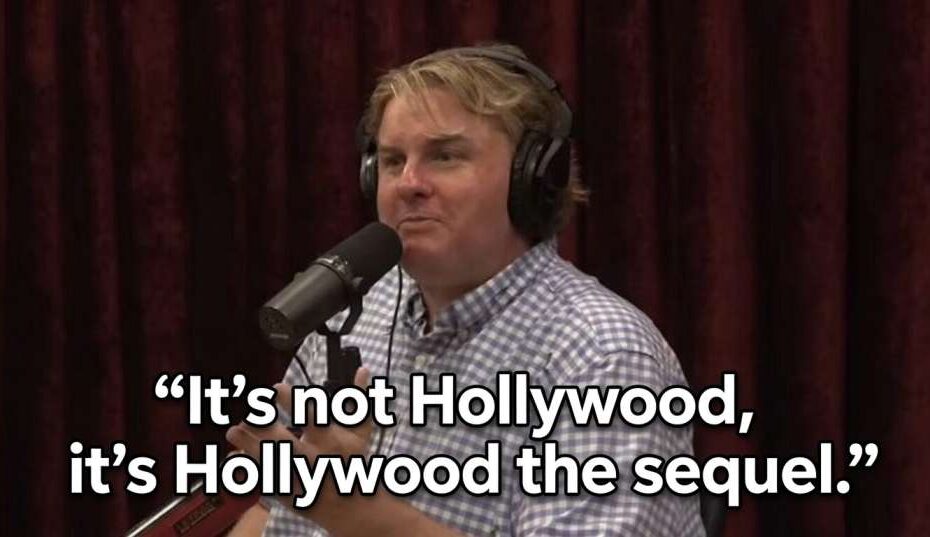
TIM DILLON: From another time. Well, that’s the thing in LA now. You get the vibe that you’re — Santino made a brilliant point. He’s like, “It’s not Hollywood, it’s Hollywood the sequel.” Like, you’re not living in the thing anymore. You’re living in whatever the second version of the thing is.
JOE ROGAN: Right. The second version is TikToker. Yeah, whatever it is.
TIM DILLON: It’s not what it was, and every place seems a little bit like a museum, or like it was cool 20 years ago, or 15 years ago.
JOE ROGAN: Somebody recently said this, and it’s perfect. They said, “LA is slowly becoming Detroit.”
TIM DILLON: Interesting. Yeah.
TIM DILLON: The only thing that might save it is the weather.
JOE ROGAN: The weather will help, but the industry dried up. So the big industry in Hollywood, regardless of whether or not it was the biggest economic industry, the biggest industry in terms of cultural value and getting people to move there, was always show business.
TIM DILLON: Yep.
JOE ROGAN: They barely make movies anymore.
TIM DILLON: They overtaxed and overregulated their biggest industry to other states and other countries.
JOE ROGAN: Yeah.
TIM DILLON: And most people are making things all over the world and very few things — I think at one time it was like 80 to 90%, now it’s 25 to 30% shot in LA.
JOE ROGAN: Wow.
TIM DILLON: It’s a big difference.
JOE ROGAN: It’s a giant difference. Well, that arrogance of like, “This is the best place in the world, everyone’s going to come here no matter what.”
TIM DILLON: Right.
JOE ROGAN: That’s the Gavin Newsom attitude whenever he defends California. Talks about how great the GDP is — “We’re the fifth largest economic blah-blah-blah.” He starts rattling off all these wonderful statistics, and this is instead of acknowledging that we’ve got f*ing real problems: people are moving out for the first time ever more than they’re coming here; we’re losing all these giant corporations that are leaving — Instead of that it’s just this “we’re the sh,” no one’s — I’m very big on California, I’m bullish on California, right? It’s always going to be amazing here.
TIM DILLON: Well, it’s what every empire said until they fell.
JOE ROGAN: Yeah.
TIM DILLON: Right?
JOE ROGAN: Yeah.
TIM DILLON: Like, “We are the thing.”
JOE ROGAN: But people don’t want to ever believe that things could fall. It’s so weird. We’ll walk right through the Coliseum and go, “Well, this can never happen again.”
TIM DILLON: Right.
LA’s Decline and the Eviction by Nature
TIM DILLON: When we landed in LA, I looked to the right and that warehouse was on fire with 85 million tons of chemicals in a warehouse that was on fire. It was like a multi-day blaze. And you’re landing and you’re looking out the window and you’re just seeing the warehouse on fire. And then there was a car fire on the 405. Like, I sold my house, have an apartment there now, but as I was going to my apartment, there was a car on fire. And as I was landing, the warehouse was on fire. And you start thinking to yourself, somebody doesn’t want us here. Like, somebody wants us out. Like, it almost feels like we’re being evicted by nature.
JOE ROGAN: By nature?
TIM DILLON: Well, by nature—
JOE ROGAN: Human nature.
TIM DILLON: By bad decisions, by everything.
JOE ROGAN: Which is nature. Yeah. You know, human nature is nature. And the stupidity of humans is— it’s no different than the stupidity of animals when they go extinct.
TIM DILLON: Do you think it comes back? Any shot? Any chance?
JOE ROGAN: Something has to happen.
TIM DILLON: Right.
JOE ROGAN: Something big has to happen. I mean, there has to be something that completely shifts the way LA looks at itself. You know, it has to look at itself as like a functioning business instead of a giant scam for nonprofits.
TIM DILLON: Right.
JOE ROGAN: ‘Cause a big part of LA’s problem is there’s a bunch of people that are in the empathy industry.
TIM DILLON: Yeah.
JOE ROGAN: And they’re in the, you know, “we’re working for this and we’re working for that.” And a giant chunk of their money is going to that kind of s*.
Atlantic City, New York, and the Blueprint for Urban Recovery
TIM DILLON: I did a great show at Ocean’s in Atlantic City, which is a casino there. And the owner of that casino was talking to me and I said, “What would fix Atlantic City?” Because Atlantic City has some similar problems to LA, but vastly worse.
JOE ROGAN: Yeah, way worse.
TIM DILLON: And he was telling me, he goes, “We have just a high amount of people and a lot of social programs in one area. So you have a lot of people that are not, for whatever reason, productive, and they are living in one area, and everything that comes along with that, which is crime, which is vandalism, which is disorder to varying degrees. And you need to get rid of that in order to have a climate where businesses can thrive.”
JOE ROGAN: 100%.
TIM DILLON: Which is what happened in New York in the ’90s. People hate it, they don’t want to admit it, but what happened in New York in the ’90s was like, they did clean up a lot of the crime and a lot of businesses then felt better about investing.
JOE ROGAN: 100%. That’s what Giuliani did.
TIM DILLON: That’s what he did, yeah.
JOE ROGAN: And he’s demonized.
TIM DILLON: He’s demonized. He’s demonized. He’s one of those guys where if he had just done that and died, his legacy would have been amazing. But he’s hung around for a while, and he’s kind of gone into some interesting tangents. So it’s one of those scenarios where it’s like, had he just cleaned up New York City and then left public life, it would have been like, “That guy, right?” But he hung around a little bit and, you know, got involved.
JOE ROGAN: They always have to hang around.
TIM DILLON: They always hang around.
JOE ROGAN: You’re going to do shows, you’re always going to do stand-up. That’s right, I was going to do shows.
TIM DILLON: But he did such a good thing, and then it was like, just— yeah, just exit.
JOE ROGAN: Who’s also, you know, he was easy to make fun of, like the time where he was sweating and his dye— well, that’s what I mean, you know what I mean?
TIM DILLON: He’s melting, he’s doing a hair dye conference in a parking lot.
JOE ROGAN: Don’t dye your hair. You’re 100 years old, it’s okay to have gray hair. It’s just these guys, there’s so much silliness on both sides. There’s silliness on the left and silliness on the right. There’s goofy people because the only kind of people that want that kind of position of power are a little goofy, right? You don’t get the best and the brightest and the most enlightened that want to be the mayor of New York City. It’s not the job.
AI, Cultural Divides, and the Fight for Autonomy
TIM DILLON: You get a lot of people that want power and they want influence. And I think a lot of that, the AI stuff, which is very interesting, is starting to— I think it might— I don’t know how quickly it will do this, but I do think it’s going to lessen some of the cultural divides. And I think it’s going to potentially unite people because I think it’s going to be the next fight, which seems to be about surveillance, privacy, your own rights, what rights you’ll have. I feel like that will be— it might take precedent instead of these cultural fights that people have been having for a while. It might be like, people might be demanding autonomy from artificial intelligence.
JOE ROGAN: The problem is going to be if you can’t demand, if you don’t have a voice anymore. And this is the potential nightmare scenario that we’re seeing play out slowly in England. So in England, their freedom of speech has been suppressed to an alarming point where people are not freaking out nearly enough about it. The amount of arrests that people get over there for f*ing retweets and likes. Retweets and likes.
TIM DILLON: That’s so crazy to me that you could get arrested for liking a tweet.
JOE ROGAN: Arrested?
TIM DILLON: Not even retweeting, ’cause we all know if you like, you’re a piece of s*. You should retweet. We all know that. Retweet it. And if you’re going to go to jail, you might as well retweet it anyway. If you’re going to get locked up, just retweet it.
JOE ROGAN: What if you get extra years for a retweet versus a like?
TIM DILLON: I’m sure. “Your Honor, my client just liked this. They were confused, they hit a button.”
JOE ROGAN: So as soon as you have people that feel like the reality of the world they live in is not being represented and they’re not allowed to complain about it online, because if they complain about it online, they get arrested. So right now it’s for immigration primarily. This is the big one. But that could change. That could change.
Free Speech, Immigration, and Policing Language in England
TIM DILLON: Well, it does seem to be that they feel that there was a decision made by somebody that the public can only discuss issues in a very rigid way. They can only offer their— like, not everyone who’s talking about immigration is doing it the most articulate way, but it’s their right to do it. It’s their country. They should be able to say, “I’m worried about increased levels of immigration,” and they should be able to say that in an ineloquent way, right?
JOE ROGAN: Right.
TIM DILLON: So what they’re doing now is they’re policing certain words, and certain ways of speaking, and they’re calling a lot of things an incitement to violence. Now, some things clearly are an incitement to violence, but the internet, people speak in a colorful way. People talk using irony, some people are trying to be funny, so I think the way that they’re doing it over there is they’re basically looking at these statements and going, “This person is inciting violence and threatening the public good by what they’re saying.”
JOE ROGAN: Right. And then there’s also people were getting arrested for saying that there were rape gangs.
TIM DILLON: And there were. And there were. There were.
JOE ROGAN: And so this new report— who released this new report that said a quarter million people? It says “UK scraps police probes of legal social media posts after review says response went too far.” So this is April 1st, 2026. But I just saw a thing about a guy getting arrested like a few days ago.
TIM DILLON: And we have rape gangs here, but ours are more successful.
JOE ROGAN: I think that “legal social media posts” is which weird. So legal social media posts, right? Their law is different than our law. They don’t have freedom of speech over there. So incitement to violence is a violation of their law, right? So when it says legal, it could just be they went too far for things like cartoons or something like that. That’s not clearly not an incitement to violence. But would it— find out, Jamie, what that report was about the rape gangs?
London, Immigration, and Cultural Tension in Britain
TIM DILLON: I was just there for 21 days. I was in London. I went to Paris for a couple of days, but I was in London primarily for 21 days. And you talk to different groups of people, and London’s a global city, it’s a cosmopolitan city, it’s like New York. And I think one of the things that they’re used to is diversity there, and so they’re not full-on panicked about different types of people coming in.
But there is undeniably a real problem outside of London, also in London, because a lot of the economy is stagnated. So you’re bringing people in, it’s not clear immediately what jobs they’ll do, and a lot of their cultures vary greatly from the English culture in a meaningful way. And that could be the rights of women, that could be the rights of gay people, that could be the opinions about freedom of speech, that could be freedom of religion, whatever it is. There is a cultural tension there between immigrants, migrants coming in and this very established society that’s been around for a very long time.
Dearborn, Sharia Law, and the UK Rape Gang Scandal
JOE ROGAN: Is it about Dearborn? Is that where it is?
TIM DILLON: Dearborn, Michigan, yeah.
JOE ROGAN: So there were a bunch of really progressive people who thought it’s amazing. “Sure, bring everyone in, everyone’s welcome.” And so they got enough Muslim people in there where they could vote in a mayor. And then this guy says, “No more pride flags.” No more pride flags. Yeah. They’re inching towards what they would like, which is Sharia law. If you ask most people who live in these Islamic countries— now, again, if you’re asking them, they’re probably under duress. They’re probably terrified of saying the wrong thing.
TIM DILLON: Right.
JOE ROGAN: So you’ve got to factor that in, but at least a percentage of them think Sharia law would be a great idea.
TIM DILLON: I think there’s certainly a— yeah, and this was covered up too, a lot of the grooming gang scandal there.
JOE ROGAN: Yeah, so we’re looking at it right now. It says— this is on National Review— “The UK’s Horrific Rape Gangs.” Is this the Rape Gang Inquiry Report? Right. So who put this report out? Members of Parliament and Restore Britain Party leader Rupert Lowe. And so the investigators had limited power, such as inability to compel witnesses or require a sort of document production that could corroborate some of the most heinous victims. Viewed with those limitations in mind, the independent report is a damning collection of victim testimonies that vividly portray the sexual terrorism that occurred nationwide for decades. Oh, Jesus Christ.
TIM DILLON: Yeah, this is terrible. I mean, obviously, I mean, the—
JOE ROGAN: I think they said it was 250,000 girls.
TIM DILLON: And this was covered up because the media didn’t want to inflame anger against a population of migrants.
JOE ROGAN: Right.
TIM DILLON: Most of whom I’m sure were innocent of this, obviously.
JOE ROGAN: Obviously.
The Great Replacement: Migration, Sovereignty, and the Erosion of Western Nations
TIM DILLON: But it is something that, in a free society, everyone has the right to know if there are rape gangs in their country and who’s operating them.
JOE ROGAN: But isn’t that crazy that under the guise of progressiveness, you’ve enabled rape gangs.
TIM DILLON: Well, 100%. It’s crazy. But it’s also incredibly— it’s not shocking because the ends justify the means approach of politics seems to be what we’re doing right now. Whereas basically, if the goal is to just eliminate whatever it’s being called, like this patriarchal white male dominated society, and if you want to get rid of that, and that’s the end goal, a lot of people ignore what happens in the middle.
Like a lot of people aren’t super concerned about whose rights are being respected in that process because their end goal really is to kind of decrease the power of people they disagree with. So it’s hard to look at this and not see a design. And I don’t quite know exactly where the design comes from, but it’s odd that this is all happenstance because everybody knows it’s happening and people are afraid to talk about it.
So I would imagine that at some point, for example, countries like Ireland right now that are having lots of issues over this — they’re part of the EU, and the EU would set migration policy for Ireland. So the EU is a supranational organization that would basically say, here’s how many migrants you have to admit, here’s your carbon emission standards, here’s your monetary policy, whatever it is. And Ireland is kind of in that sense feeling like they’re losing their sovereignty. They’re losing their ability to chart the course of their own country to a supranational organization that primarily seems concerned with the economics.
Because if you bring in more migrants, you can artificially grow the economy, which is what they’re doing. A lot of people in Europe are not having children, so a lot of these economies are run by people that are not really too concerned about the cultural landscape of bringing migrants in. They’re looking more at how do we grow this economy? How do we get cheap help? And how do we get workers? And a lot of it is you’re getting third world migrants. Some of it’s genuine refugees for sure, but a lot of it’s economic migration. People are coming for a better life. Hard to blame them.
But do the people that live in those countries get to have a better life? That’s the question. If you lived in Ireland, do you get to have a better life? Do your economic prospects get to grow? Do your children get to own property? Do they get to have health insurance and a job and things like that? And no one seems that concerned about that. Like these citizens who’ve lived forever in these countries, whose grandparents have fought and died in wars to secure the freedom of some of those countries — Britain, UK, things like that — those citizens seem to not be as prioritized as people coming in from other countries, and that’s one of the big problems that they’re having there.
JOE ROGAN: Well, it’s really interesting to watch, because if there is a plan — I mean, it’s not interesting, it’s kind of horrific, but it’s interesting in that—
TIM DILLON: It can be both.
JOE ROGAN: It can be both. Sure. If there is a plan, like, whose plan? Whose plan and who’s benefiting from this? Like, why would you do this?
Globalism, Nation-States, and the Suppression of Dissent
TIM DILLON: I think it’s a small group of people that concern themselves primarily with economic matters, that don’t care that nation-states have cultures and histories and customs, and that doesn’t really bother them as much. And their basic response is to just deal with it and to call everyone a racist who questions it, or to say everyone’s jingoist or ethnocentric or anti-immigrant or whatever. They shut down those conversations.
And I think it’s because a lot of people believe more in a global world and they don’t believe in a world of nation states that have their own ability to govern themselves. They want to take that power economically from those people, and then eventually they want to take it culturally and every other way. So they just want to go around the world and say, here’s the way every country will look, here’s the economic policy of every country. And if the people in those countries don’t like it and they express that on social media, they’re going to get kicked off. And if they organize in the streets, they’re going to use military authority to fire water cannons at them or shut them down or use gas or whatever. And if there’s a genuine resistance movement to some of it, they’re going to infiltrate it and turn it into some psychotic thing, which they do all the time.
JOE ROGAN: Right.
TIM DILLON: So it’s hard to see it — not to sound like a paranoid nutjob, but that’s what I am and how I’ve made my living. But I think it is clearly someone’s design. This isn’t happenstance. None of this has to happen. We don’t have to invade countries, sponsor coups, steal resources, and then drench our communities in guilt and say, now we have to bring all those people here and you have to deal with it. None of that has to happen. That’s a strategy of a group of people that want to keep perpetuating this.
JOE ROGAN: Do you think it also has — one of the factors might be that they want conflict? The more conflict people have in the streets, the less they’re going to pay attention to what the government’s doing?
TIM DILLON: Well, 100%. I also think the more chaos in the street, the more likely you’re going to be willing to accept new laws, new technologies. And you’re going to just say, I want peace.
JOE ROGAN: Yeah.
TIM DILLON: And I don’t care how we get it. I don’t care how we achieve it. And I think that’s very possible, but it does feel like it’s on the road a little bit to where people want a uniform standard across. But as you’ve said earlier in this, it’s very interesting because this uniform standard is supposed to include non-binary art students in Vermont and religious Muslims from North Africa.
JOE ROGAN: Yeah, good luck.
TIM DILLON: But I mean, that’s—
JOE ROGAN: But it’s amazing that the people that would be most opposed — the people that, if you do bring those people in, the people they’re going to hate the most are the people that want them in the most. They’re the ones who are most likely to say we shouldn’t have some border that keeps some person from coming here, and no person’s illegal.
TIM DILLON: And the people that want them in the most, I think, are not even the people bringing them in. They’re being used, right?
JOE ROGAN: They’re being—
Weaponized Empathy and Western Destabilization
TIM DILLON: Their suicidal empathy, their empathy is being weaponized. It’s being used, right? So people that are manufacturing this reality are using those people. These are the same people who really don’t care if people in the state over have healthcare, right? These are people that haven’t spoken to their sister in 2 years, right? And they care a ton about people in the Ukraine or people that are coming over from Syria, whatever.
But we f*ed up Syria. We put that guy in who used to be in ISIS. We got rid of Gaddafi. There’s slave markets in Libya, right? So we did that. We sent refugees all through Europe. We destabilized all of Europe. And you can’t take us out of it. You can’t take Western powers out of it. You can’t take Israel out of it. You can’t take the US and Britain, France, and a lot of other powers that have destabilized these countries and sent these people flooding through Western countries, European countries.
JOE ROGAN: Yeah, fun.
TIM DILLON: It’s going to be a fun next 50 years.
JOE ROGAN: It’s kind of crazy when you see images of France. There was a video of France from 1998 from Paris, versus today. They showed like 1998 and then they showed 2023.
TIM DILLON: It’s a different thing. And listen, some of that’s inevitable. The world changes, different groups of people. But then you look in Ireland — this guy just got beheaded in the street, which I’m against and I think is wrong. A migrant who had been brought in had beheaded, or damn near beheaded, tried to. And there’s a video of it. And now Belfast — it’s probably quieted down now, but there were tremendous riots. They were burning things down because they’re like, we never got a vote on this. We never got a vote on bringing the people in.
JOE ROGAN: Yeah.
TIM DILLON: We never got a vote on that. No one ever asked us how much demographic change we wanted in our country and how quickly and what we were prepared to do. No one ever asked that.
JOE ROGAN: People don’t like to admit it, but an armed population — it’s much more difficult to pull things off when you have a high population. Totally, 100%. And that’s another part of the problem with the UK, with Ireland, all these places. It’s very difficult to have a gun.
TIM DILLON: Diversity also relies on a very productive economy. So New York City works to the degree it does because people can go out and get jobs, because the economic reality of the city is that it can support a lot of people coming in. There are a lot of jobs for those people. But when you have a stagnant economy like many parts of the UK, that’s a lot harder. It’s a harder sell, harder to assimilate people into a landscape where the people there are not doing well. Like, the people that have lived there forever, not thriving, they don’t feel great, their prospects economically aren’t great. And now you’re bringing all these new people who also are struggling to find work. So that’s part of the problem.
AI, Economic Disruption, and the Future of Ownership
JOE ROGAN: Do you think that this is being done with a strategy knowing that AI is about to completely disrupt society?
TIM DILLON: Yes. This is what I believe — no one, for example, is trying to get anyone in this country to own a house. People pay lip service to the idea, but there are a lot of people now, a lot of them are my age, who have never owned a home and never will. And no one’s trying to — no one wants them to. They’ve forgotten what owning a home feels like. They’ve forgotten what it feels like to have a yard where you can invite people over and drink a glass of wine and smoke a cigar and watch a game. And they live in a little apartment. They’re on a MacBook. They’re getting radicalized in any direction. They’re upset, they’re on dating apps or whatever, but they don’t feel like they have a foundational core to their life. No one has really even given them the idea that they’re going to get that.
So I think that’s just one of the things where people are basically being told, no, you don’t need a house and you’re not getting a house, and forget what owning a house was. Like, forget that, that doesn’t matter. And I think part of this is because they know — same thing with healthcare — there’s no real movement to give anyone healthcare in this country. And if it is, it gets shut down immediately.
So on the positive side, you might go, well, they know that AI’s coming and that AI’s going to do a lot of stuff with health and it’s going to help extend lifespans. But also on the negative side, they go, AI is going to disrupt the economy to a point where we’re not going to have people owning homes and cars and things like that. We’re going to have a lot of people without a steady income, or they don’t really know what to do. We’re going to have a lot of wealth that’s existed, a lot of capital, and we’re going to have tremendous inequality. We’re going to have a lot of joblessness.
So for sure, I think that they’re preparing for that. I mean, there’s no way you can look at the landscape — they’re selling the country off for parts. And this is both parties. They’re selling it off for parts. So obviously, something’s coming. Something’s coming for sure. And I don’t know when it is, and I’m sure the AI thing’s overblown to an extent. And I think so much of our GDP depends on it that a lot of these companies are — but Anthropic’s a creepy — these are creepy companies.
JOE ROGAN: Well, the amount of power that tech companies have in general is totally unprecedented. There’s never been corporations — I mean, unless you go back to like the East India Corporation, you go back in the day where they had an enormous army.
TIM DILLON: Right. Totally.
JOE ROGAN: And they took over India and Pakistan. But if you look at what they’re doing, it’s very different than that. Other than the army part, what they have is robot armies, and then they have AI, which Elon just recently said is going to be like a million times smarter than the smartest human that’s ever lived.
The Digital God, AI, and the Future of Humanity
TIM DILLON: Right.
JOE ROGAN: Like, this is the goal. The goal is to create literally a digital god, and it’s going to be controlled by not us, not the collective human race. It’s going to be controlled by a select few group of people. And that’s weird, and we’re just trusting them.
TIM DILLON: Well, that’s why you’re not getting a vote on immigration levels. You’re not going to get a vote on, you know, I think the reality is that eventually they’re going to go, do you want safe streets? Do you want food? Do you want a little bit of money? You gotta do X, Y, and Z. You gotta believe X, Y, and Z. And I mean, that seems to be coming.
JOE ROGAN: And it seems like if you put people in a corner and you get them scared — this is what we learned during COVID — they will back down. They’ll go along with a lot of stupid s*.
TIM DILLON: They’ll try to find comfort and they will listen to people that they deem to be worthy.
JOE ROGAN: They’ll trust the government, which is wild. The left is the people that trust the government.
TIM DILLON: Well, you have all these studies that come out. This is the thing — I love London and the people there are great and they’re fun people and everything like that. But because they get healthcare, they get a little more from their government than we do, there’s more trust in their government than we have in our government. There’s positives to that, and there’s negatives. But they’re a society of rules and customs and order, and it is a bit different. So I think they are more likely to go along with the grand plan of the government, more so than the United States, where we really do question more what’s happening than people in Europe or the UK. Overall.
JOE ROGAN: Yeah, but that makes sense, right? They have socialized healthcare. Isn’t their education paid for completely? Isn’t university?
TIM DILLON: Yeah, they have good stuff. They have a good life.
JOE ROGAN: Yeah, there’s benefits to that.
TIM DILLON: Totally.
JOE ROGAN: There’s a balance to be achieved. I’ve always said that in this country, it’s foolish that we don’t pay for higher education. The more educated people, the better. The less losers, the better.
TIM DILLON: Part of our country is — you know, we manufacture a lot of geniuses. We also manufacture a lot of psychopaths. That’s what our culture does.
JOE ROGAN: A lot of sociopaths.
TIM DILLON: A lot of sociopaths.
JOE ROGAN: A lot of people that don’t give a f* about anything but success.
TIM DILLON: A lot of people that don’t care about anything.
JOE ROGAN: And that’s the thing that comes along with the gluttony too, right? It’s celebrated. And they don’t even realize that that outward gluttony just inspires all these “eat the rich” people.
America Out of Balance
TIM DILLON: The whole thing is out of balance. That’s what I would describe America. If you had to describe it in three words, it’s just out of balance. And it’s hard because we’ve got 350 million people. What do the people in Menlo Park have to do with the people in Baton Rouge, have to do with the people in Canarsie? It’s a weird place. You have all these different climates, habitats, people have different interests. But I think AI might unite people, because the idea of this as such a powerful force — if people don’t start getting cognizant of it eventually and start talking about regulating it or anything — I do think it is going to be a very strange time if people just ignore it forever.
JOE ROGAN: It’s going to do something weird, I’ll tell you that. It’s not going to be normal. Whatever is coming over the next 20 years, no one is predicting it.
TIM DILLON: I get the feeling when you see a lot of these tech guys start adopting Christianity —
JOE ROGAN: How about Peter Thiel’s whole Antichrist thing? He gave a f*ing lecture on the Antichrist.
TIM DILLON: He gives a bunch of lectures on the Antichrist. He’s fascinated with it. And a lot of those guys are moving into this interesting area of, “This is God’s will.” Like JD Vance, who’s not the worst person, obviously. And I think he’s the sanest voice in that administration about the Iran War, for sure. I think he’s by far one of the only people in there going, “Let’s calm it down,” which is why a lot of the big donors are slinging mud at him.
But again, he just released a book about faith and reconnecting with his faith. I’m sure it’s a lovely book. Haven’t read it. Fun beach read. JD Vance is reconnecting with his faith. Great, inspiring, amazing. We’ll get to it. Haven’t read it. We’ll get to it. Top tier. But it’s also interesting because some of his donors are huge tech guys, and it’s all of these worlds existing together — where you have this world of people who are trying to build a god and the world of people who already believe in a god — and trying to get all of those people in the same tent. That’s interesting.
JOE ROGAN: It is. Imagine if that’s where God comes from. If this is a natural process for human beings and their curiosity and insatiable need for technological innovation.
TIM DILLON: But then what happens once we get God? Like, once we bring this God in, then what happens?
JOE ROGAN: Nirvana.
TIM DILLON: Nirvana?
JOE ROGAN: Yeah, we all merge. Becomes perfect.
TIM DILLON: Interesting. So we all merge and that’s perfect?
JOE ROGAN: It’s fine. Don’t worry about it. We’re all going to merge with the machine.
TIM DILLON: Interesting, because people do believe that.
Technology’s Unstoppable Progression
JOE ROGAN: At one point in time, cavemen had to be looking at the wheel going, “Man, I see where this is going to go, right? This is going to f* my whole gig up. My whole gig is making weapons out of stone and tying them to a stick with tendons, and then chasing an animal and spearing them.”
And then these motherfers invented arrows. With every progression of technology — bow and arrows changed everything. Horse riding, figuring out how to ride a horse — that’s a new innovation, right? Now you can move a lot faster, you can get a lot of things done. Some guy figured out a wheel. Drag the wheel, put a cart on it. Now we can carry stuff with us, more than the stuff that you could put on a horse. Get a couple horses, they pull a wagon. Great. Then this guy figured out a fing engine. We don’t need horses anymore. Let’s make the whole ground everywhere hard so we could roll around with these machines with internal combustion engines. And then it just keeps going and keeps going and keeps going. And then one day it’s unrecognizable, just like it is now. If you showed Australopithecus Manhattan in 2026, they would freak out. They’d probably start screaming. They wouldn’t know what to do. They would be horrified.
TIM DILLON: But do you think if we showed Peter Thiel 2050, he’d go, “No, that’s it. That’s what I want.” Do you think the guys now have a real idea of what it’s going to be?
JOE ROGAN: No.
TIM DILLON: Interesting.
JOE ROGAN: I think there’s a lot of guesswork. I don’t think it’s possible to know what these things are going to do when they become sentient. If Elon is correct and there’s something that’s a million times smarter than human beings — why would we let people govern? Why would we let people build that stupid f*ing rail station in California that’s cost how much money and produced what? How much track was done? Why would they let people do that when you could have AI do that?
TIM DILLON: But if something’s a billion times smarter than human beings, it’s going to go, “We’re not building a rail station for these fat f*s.” Seriously, it’s going to go, “Why would we build a rail station for these people so they can get drunk and go fight each other? How about we get rid of them?”
JOE ROGAN: Well, maybe we don’t even need to do that because we can make you travel instantaneously from here to there. Create little mini wormholes all over the country. You don’t need a car anymore. You just press a button and all of a sudden you’re at Starbucks. We’ll do something very strange.
Technology’s Double-Edged Sword
TIM DILLON: I just look at technology and I go, it’s made the world better in many ways, but in a lot of ways it hasn’t. And it did stop around 2014, 2015 — a lot of the new things that came in made the world to me very impersonal, corporate, sterile, and cold.
JOE ROGAN: Yeah.
TIM DILLON: And the experiences that you get now — I went with a friend of mine, we were in a McDonald’s, and you order on a touchscreen, there’s nobody there. There’s some 9-year-old kid going, “Hey, I ordered a McFlurry.” Some woman screaming at him, “Where’s the receipt? What’s the receipt?” He’s like, “What?” There’s a weirdness when you take people out of everything.
JOE ROGAN: You take people out of everything, and then they have no purpose, right? Especially consider the high number of unemployed people and checked-out people, and people whose job has nothing to do with what they enjoy. So they just do the job and then afterwards they’re just watching television all day. That’s a lot of people. They’re just watching their phone, they’re playing video games. There’s a lot of people that don’t have any purpose. They don’t have a feeling of purpose. They don’t have a thing that they’re connected to.
TIM DILLON: But some experiences are much worse now than they were before they were digitized. Just pressing a button and getting something on Amazon is much easier, but there was something nice about going out in December during the Christmas season and going to different places and seeing people and the struggle of getting the thing you want. You were expending energy. You’re walking around, you get a cup of coffee, you see people. If we destroy all of that, what happens to the human psyche? That’s my question.
Anxiety, Social Media, and the Need for Opinions
JOE ROGAN: Well, if we had an anxiety meter — if we could see measurable anxiety levels over time — I guarantee you from whatever the age of the internet kicked in, so like ’94 or something like that, it probably slowly ramped up until social media came along, and then it’s probably significantly higher than it’s ever been before without real threats.
TIM DILLON: Totally.
JOE ROGAN: Just regular anxiety from reading things on your phone and interacting with things online.
TIM DILLON: Well, people are very attached to this idea that they have to weigh in on everything, that they have to have a fully formed opinion on everything. And the horrors of the world are on full display in front of them all the time. And they need to not only view them, which is scarring in and of itself, but then they need to contextualize them in a way that makes sense. Which I think is also another level of stress. “Am I a good person? Do I have the right thoughts about this thing?”
To me, that’s another level of stress. There were people when I grew up that were really good at one thing and they didn’t need to have an opinion on something that was happening a world away because they didn’t have the knowledge.
JOE ROGAN: And they weren’t forced into expressing that opinion.
TIM DILLON: They weren’t forced into expressing that opinion.
JOE ROGAN: Yeah.
Institutionalism, Corporate Virtue Signaling, and Living Freely
TIM DILLON: And they were able to live in a very, in a much simpler way, in a much happier way, with real genuine connections to people. And I think the fact that nobody feels like they’re able to do that now, like the generation that’s coming up, the younger people, they seem better off, like the Zoomers or whatever they are.
They seem to have a little dose of nihilism, but I think it’s appropriate. They have a good sense of humor, they’re skeptical, they’re a little cynical, they’ve seen all of these institutions churn out a lot of garbage, and I think they’re into some of the crypto stuff, they’re self-starters, they’re not institutionalists.
Everyone I grew up with, and the generation directly under me, they’re all institutionalists. They believe very strongly that knowledge is given through an approved— whether you’re at NYU or whether it’s the State Department or whether it’s a board or whether it’s a nonprofit, the Commission to Study that proved the thing. A lot of these kids do not think for themselves. And they’re not kids, they’re in their 30s or 40s. They don’t think for themselves. They’ve been taught that thinking for themselves is bad. It’s racist, or it can lead you down a road that you don’t want to go on. It’s misogynist. It’s homophobic.
Like, whatever questions you’re asking, like, why do the Padres have to wear gay uniforms? Like, that doesn’t make any sense to me. Like, as a gay person, I never said why I need the Padres to be gay. Why are the Padres gay?
JOE ROGAN: How does the Padres uniform look like?
TIM DILLON: What? They’re making them wear, like, gay things on the uniform.
JOE ROGAN: Like Pride stuff?
TIM DILLON: It’s like Pride stuff. I don’t think it’s like a dildo on their head, but I think it’s like Pride stuff.
JOE ROGAN: What happens when they play in Dearborn?
TIM DILLON: It’s not going to go well, but it’s like, why is Citibank gay? Why is Chase gay? What is it? Why does this help anyone that a corporation is trans? Why is Chobani yogurt trans? What’s the point of this? I don’t understand. Does this get people healthcare? Does this make people happy? Does this satisfy—
JOE ROGAN: It makes some people happy.
TIM DILLON: It makes some people happy that I worry about, because I just don’t understand. And it makes more people angry. That’s why gay marriage has lost 11 points in support. More people are annoyed. They’re like, we’re all cool with however people want to live their lives. A lot of— most people are. But they’re like, why is my bank gay? When did my bank come out as gay? And like, I’m okay with it, but could somebody have told me? Like, what are we doing? This doesn’t make anybody’s life better.
It is just virtue signaling horseshit that ends up doing the exact opposite of what they want. They think it increases acceptance. It decreases it because you’re shoving a worldview down someone’s throat.
And at the end of the day, it’s like if I went to a restaurant— for example, I have no problem with Scientology on record, by the way. I like it. I like cults. Children have too many rights. Put them on that boat, whatever you do. Sea Org, make them work. Don’t rape them, but make them swab the deck, whatever they do on that boat.
And I don’t have a problem with Scientology, and I don’t like the people who leave Scientology and then rat on it after it got them all these movie parts. I think that’s f*ed up too. I think they’re rats. If you do something for 30 goddamn years and get rich and famous, shut your mouth. Have the dignity to go to your house and shut your mouth about it. Don’t then try to go on— your new era is that you’re going to dime on everybody in this thing that made you rich? Anyway, but that’s just an aside. That’s truly the way I feel.
JOE ROGAN: Shout out to Tom Cruise. Yeah, hangs in there.
TIM DILLON: Hangs in. Can you imagine how gross that would be if Tom Cruise went out and he’s like, “You know, Scientology really abused me?” Shut the f* up, you’re Top Gun. You’re Top Gun. This worked whether you’re gay or not. They covered it up. You said you did something wrong, they said, “We’ll audit you, we’ll put you in the box, you’re fine. Give us some money, live in this mansion, it’s all fine.”
But if I went to my bank and it was just all Scientology for the month of June, I would go, “This is a lot.” Do you know what I mean? So to me, I think it’s like this weird aesthetic politics that people have where they just need to pin ribbons on themselves and go, “I’m a good person.” I have no problem with the polyamorous orgy happening at Chase or whatever. Just shut up.
This whole country right now is being torn apart by people who need to feel like they’re good people. And they need to project their life onto other people.
JOE ROGAN: Just to—
TIM DILLON: —just live and let live. People disagree with you. I have good friends I disagree with, on fundamental things, foundational things, and I don’t care. I don’t care because I think they’re funny. I think their lives are funny. They’re bad people. Many of my friends are not good people. I wouldn’t even introduce them to other people I cared about. But they entertain me, and that used to be okay.
Used to be able to go, “I like that guy, he’s entertaining.” People go, “He’s crazy, he was in jail.” You go, “Sure he was, maybe. I don’t know what happened between him and her. Someone fell down the stairs. He’s fun sometimes.” And you should be able to do that. Not everyone’s going to agree with you. It’s okay.
JOE ROGAN: You gotta—
TIM DILLON: —life is too short.
JOE ROGAN: Now that you want that, you don’t want everybody to agree with you.
TIM DILLON: No.
JOE ROGAN: You want to live in a world of texture.
TIM DILLON: Yes.
JOE ROGAN: Yeah, you want to live in a world— you want to have the Joey Diazes of the world.
TIM DILLON: Totally.
JOE ROGAN: You want to have some wild people out there. They’re fun.
Independent Thought and Institutional Programming
TIM DILLON: And the problem with the generation under me is they’re all very like this, and they all went to the same liberal arts schools that have taught them this orderly way of processing information, and they’re all afraid to— they say things, they say them in a very— “Well, the rape gang, they’re gangs that are raping.” “Well, that’s bad, but there’s a lot— I don’t know what’s been proven, and there’s a lot of racism.” Like, they just always— they’re so afraid of having an independent thought because they’ve been programmed their entire lives.
They don’t realize it. They’ve been programmed their entire lives to believe a certain set of things. And their self-worth depends on those things mattering. The school you went to, the internship you got, the corporation whose d* you have to suck, sometimes literally, to stay in it. That is where they derive their self-worth from. So their entire world crumbles if you challenge any of their ideas.
JOE ROGAN: It’s very confusing for young people, because the whole thing acts like a religion, it acts like a cult, and you have to kind of go along with every aspect of it or you’ll be excommunicated. You’ll be kicked out just like you get kicked out of Scientology.
TIM DILLON: You get kicked out. And it’s sterile and it’s corporate and it’s boring. And that to me is one of my biggest problems with a lot of people that I speak to, is that they seem genuinely afraid to use their mind for more than what the allotted functions are.
JOE ROGAN: You mean afraid to express themselves?
TIM DILLON: Yeah. They’re afraid to even entertain thoughts in their own head.
Armie Hammer and Cancel Culture
JOE ROGAN: They want to avoid the punishment. Yeah. It’s scary punishment. Have you seen this new Armie Hammer movie that is out now?
TIM DILLON: No, but—
JOE ROGAN: Some vigilante movie.
TIM DILLON: He’s great. Fan of him. Big fan of him. Think he’s great. Love everything he’s doing. I like it. I like that you can’t get canceled. People come right back.
JOE ROGAN: Well, I don’t know if he’s necessarily coming back. I mean, this movie is going to bring him back, I should say. I mean, what did he say? He said he wanted to eat girls. He was texting.
TIM DILLON: He wanted to eat a couple of people. Is that a problem?
JOE ROGAN: But is it real? Is it just crazy talk?
TIM DILLON: Even if it was, is it consensual or not? I mean, is it just saying wild things?
JOE ROGAN: Like, what is it? Listen, what is it? He’s—
TIM DILLON: —his fantasy was that he wanted to be a cannibal. That was his kink. Now, it was fake, but if he was in a situation where it could have been real, yeah, he would have tried hard. If Armie Hammer had the money to arrange this, and some people in our country do— if you have the money to arrange it, he’s trying 1000%. And by the way, doesn’t make me hate him. Doesn’t make me hate him. As long as the person was dead already— I’m against it, I would never do it. But if you told me— this is how open I am to different people— if you told me Armie Hammer, there was somebody who died and there was a heart, and Armie Hammer tried a little bit of the heart, I’d go, “Hey, fine, live and let live.”
General Butt Naked and the Liberian Civil War
JOE ROGAN: Do you know the story of General Butt Naked? No. General Butt Naked is a guy in Liberia. So Liberia is a part of Africa. I don’t want to f* this up, so let’s check on this. I think what happened in Liberia is they released a bunch of slaves from the United States and sent them to Liberia, like after slavery was abolished.
TIM DILLON: Right.
JOE ROGAN: And I think Liberia has had a series of civil wars, like really crazy brutal ones. And in one of them, there’s this guy named General Butt Naked, and Vice covered this guy. They interviewed him, and essentially now he’s a priest. He’s a preacher, and he gave his love to Jesus Christ, and now he’s saved. But back then—
TIM DILLON: Well, good for him.
JOE ROGAN: He would talk about how he would go into war completely naked, and then they would kidnap children of the opposing army and cut their heart out and eat it for protection.
TIM DILLON: That’s certainly an extreme way to do it.
JOE ROGAN: Well, he did that. Yeah. But then he found Jesus, so it’s okay.
TIM DILLON: Well, it is certainly better. Would the Mayans kind of do that, or was that human sacrifice?
General Butt Naked and the Chaos of Liberia
JOE ROGAN: They did a lot of human sacrifice along with the Aztecs. What happened with Liberia? Is that an accurate depiction? I don’t want to f* this up. So Liberia was established in 1822 by the American Colonization Society as a refuge for formerly enslaved and freeborn Black Africans to relocate to Africa. Yeah, there it is. Over several decades, roughly 16,000 freed slaves known as Americo-Liberians migrated there. While envisioned as a sanctuary, the nation later faced its own internal scandals regarding forced labor and human exploitation. Yeah. Interesting.
See if you can find that General Butt Naked guy though. This whole story is f*ing crazy. Is this it? Okay, geez. Yeah, formed his own militia of several dozen fighters known as the Naked Base Commandos or Butt Naked Brigade, most of whom were children as young as 9, operating under the Monrovia area with his unit. How do you say his name? Blahi, blah, blah. He — I’m not sure how to say his name — became known as wearing only shoes and magic charms and eventually adopted the nom de guerre General Butt Naked. His fighters followed his patterns of dress, which, in line with his distorted emulation of animist tradition, believed could make one immune to bullets.
To fund his wartime activities and secure a steady supply of drugs for his fighters, Blahi allegedly traded locally mined diamonds and gold to Mexican drug cartels in exchange for guns and cocaine. Let’s f*ing go. He conscripted many of his fighters and according to some accounts laced the food he fed them with cocaine, along with showing them Jean-Claude Van Damme films and explaining to them that killing people was a game, in an effort to uproot the fear of death.
He and his fighters perpetrated numerous atrocities, although the exact extent of the crimes they committed have been subject to dispute. Frequently discussed the alleged atrocities he perpetrated, which according to Blahi include murders, cannibalism, and human sacrifice. He has repeatedly estimated that the Naked Base Commandos were ultimately responsible for 20,000 deaths, a claim which has come under criticism.
TIM DILLON: Okay. Yeah. And he’s alive now and he’s religious.
JOE ROGAN: He’s a preacher now. Yeah.
TIM DILLON: Have him on and I bet he’s a lovely person. That’s the thing. You should have him on. By the way, I would — here he is. Open invitation. He’s — open invitation.
JOE ROGAN: Look, he’s got Jesus on his shirt.
TIM DILLON: He’s led a full life and there’s something about someone who has led a full life. This man has led a full life. There he is. It looks like Beetlejuice, but naked.
JOE ROGAN: Wow, crazy. Imagine seeing a dude naked with his dong flopping, running at you with an AK-47 with kids’ blood all over his face. I mean, that’s —
TIM DILLON: I mean, that’s disturbing, but I imagine that there are very rich people in our country seeing that and paying good money to see it.
The Chaos Creeping Into the West
JOE ROGAN: One of the things that we were talking about before the show started — yeah, we were out in the hallway — we were talking about how there’s a giant chunk of the world that’s f*ed. And what’s coming into England, it’s not unusual for other parts of the world. If you go to Karachi, that’s what life is — chaos. We just — chaos is making its way into these protected bubbles, and that’s what’s freaking people out.
TIM DILLON: We live in a very privileged — even the poorest, in the worst, which is obviously not to minimize their struggles, but if you go to any of those third world countries, you’re very aware of how privileged you are to live in a Western country. And it also makes a lot of sense why the people in those third world countries would want to leave them and go to other places for opportunity.
I think immigration has had a lot of positive impacts on America, and it’s had a lot of positive impacts on Britain and other countries. It’s not the idea that immigration is all bad or all good. It’s the idea that you have to do things a certain way because societies are fragile. This is what we’re learning. We’re learning that societies are more fragile. When I grew up, that wasn’t a common thought, that our society was very fragile. We thought it was very strong. We actually thought nothing could break us. And then you look at a couple of years of a pandemic, and most of the downtowns of the American cities don’t look the same. Commerce has changed in a dramatic way.
The Iraq War proved that, militarily — our military is obviously brave men and women, they’re amazing — but the changing nature of warfare has made military campaigns very difficult. It’s hard to look at the Iraq War as a victory. It’s almost impossible, unless you’re completely dishonest. I don’t think anyone is looking at it as a victory.
So I think our vulnerability to threats foreign and domestic — we are more aware of that now than we have ever been, how fragile societies are. So when you demographically change a society very quickly, which has never happened historically — it took wars, long periods of immigration — now it’s overnight. People have to adjust to a new cultural and sometimes economic reality. That’s a very disruptive thing, and societies are very fragile, and you’ve got to be very careful about how you alter and change a society, because if you do it too quickly, there’s a tremendous backlash. You have to make sure that people want it changed, that people are on board with it.
Not everyone is on board with everything, but if you went to a lot of people in these countries that live in the bigger cities, they would probably be very pro-immigration, because immigration has a lot of clear benefits to them. They get food delivered all the time, they have access to a wide variety of goods and services that immigrants bring. A lot of them are awesome, a lot of great food. But again, if you went out into the suburbs and into areas where the economies have stagnated, areas where maybe you’ve had scandals like this grooming scandal and things like that — Sweden, whose crime rate has skyrocketed because you’ve brought in a lot of people from other places that are selling drugs — and not all of them, obviously, but if you look at that, those people have a much more negative view of it because they don’t connect the benefits of it, because they don’t feel them in their life.
JOE ROGAN: Right, they were living pretty sweet. They were living good.
TIM DILLON: They were living pretty sweet. They were riding their f*ing bicycles and eating herring.
JOE ROGAN: Pretty safe out there.
TIM DILLON: Pretty safe and doing what they wanted to do. And then you have this influx of people. You now have real poverty. You now have a lot of people —
JOE ROGAN: You also brought in people that came from a war-torn part of the world.
Immigration, Culture, and the Fragility of Societies
TIM DILLON: A war-torn country. Yeah. And not everyone’s going to be General Butt Naked, who becomes a Christian pastor and is probably lovely now. You probably see him in H-E-B, you’re like, “Sweetheart, ate a few people, children maybe, but now it’s better.” Not everyone’s going to convert, not everyone’s going to be — you’re going to bring people in that are products, to an extent, of their environment, like we all are.
So the idea that women have less rights in these countries — the courtship rituals in these countries are different, the familial relations are different. That’s just the way it is. And a lot of people there like that. So why would those beliefs and systems change just because you happen to be living in Ireland? Why would you think Irish women or British women would necessarily or inherently get more respect than your wives, daughters, sisters, whatever?
And I’m not saying that it’s all like that throughout the entire Islamic world. I think there’s a lot of diversity in the Muslim world, and there are lots of countries where there are arguments that women are safer than they are in America. But there are a lot of countries where that’s not the case, and women have far fewer rights, and it’s pretty barbaric. And I don’t know why those attitudes would change when they are just in a different physical location.
JOE ROGAN: The spectacular bizarreness of it is that the really kind left-wing people who oppose toxic masculinity, who oppose this sort of male-dominated society that we’re talking about — they’re inviting in something that literally has that as its doctrine.
The “I Can Fix Him” Mentality and the Decline of Family
TIM DILLON: Well, they think it can be tamed. So here’s the thing with those people: they love a challenge. This is the “I can fix him” version of it. And to an extent, cultural attitudes do change over time. People do assimilate to certain practices. That’s not a completely ridiculous thing to think. But they really believe that once all of these people come to these countries and see how great it is to be a childless 40-year-old woman working in data entry at a large faceless corporation that’s gay on Pride Month — the corporation goes gay — and when they see how happy she or he or they is, living in a society where you don’t own anything.
You know what’s interesting about family? I just spoke to a comedian who went on a world tour, and he was in India, and he was talking about how poor people in India don’t live on the street, they live in slums — which is better. It’s better to live in slums than on the street because a lot of poor people are with their families, and they won’t cast their family out.
Family in America almost means nothing. We’ve kind of — everything’s such an individual pursuit that family means nothing. And that’s reinforced. I am in an argument with my father. His wife has different political views on certain things, so we haven’t spoken in a little bit. My cousin’s getting married, and I have a therapist now that I’ve had for 6 months — I don’t know if it’s good, or I don’t know if you ever know if a therapist is good or not. And I told my therapist, my dad and his wife are going to be there, and I haven’t spoken to them, but I love my cousin and I want to support her marriage. I want to go. And my therapist goes, “Well, you don’t have to go.” My therapist goes, “If you feel like it’s going to make you happy, go.”
So therapy in our country has become a way to kind of enable sick people to just become selfish psychopaths. And family in America means almost nothing, and it is reinforced how little family means, because doctors will tell you, “Yeah, f* it. It’s your father, who cares?”
So it’s basically a thing where, when you go to these other countries and you realize how deeply rooted a lot of things are in family and culture and tradition, and then we come from a country where almost very little is — I’m not saying people don’t have great families here, but America is about you. If you don’t agree with your sister, f* her. If your mother disagrees with you, block her. That’s our country. And in other countries, that’s unheard of. Like, it doesn’t happen.
The comedian was explaining to me that in India, there’s a lot less of a drug problem in certain areas. And he was wondering why. And he goes, “Well, people don’t want to do drugs to disgrace their family.” Even poor people will be like, “I don’t want to be a drug addict because my family’s going to think bad about that.” Whereas here there are people that’ll shoot up in front of their parents.
So it’s just a different — culturally, we’ve gotten to this point where people are having fewer children, family means very little. So then what has replaced that? It’s clearly the state and corporations and ideology. They’ve replaced families and communities.
JOE ROGAN: Well, the ideology is your community because you’re online most of the time. A giant percentage of the interactions you have with people are on social media.
A Brief Tangent: DMT and Transcendence
TIM DILLON: So I think that world — we have a pretty secular world. What is that? That is so interesting. CBD. Interesting. Interesting. I thought it was something that — not CBD vape. I thought it was somebody gave you something that’s like — you’re going to transcend or something.
JOE ROGAN: Oh no, I thought you’re like, it’s DMT.
TIM DILLON: Imagine, I’m bored with you, I’m going somewhere else for a few minutes. What’s the last time you’ve done DMT? It’s been a while. Interesting. Should I do it? Should we all do it? Yeah, I’m going to have a cigarette. Are you thinking about it? I’m thinking about maybe doing it.
JOE ROGAN: A lot of people have asked me about it. It’s —
TIM DILLON: Recently, that pure molecule documentary from years ago was an awesome documentary.
DMT, Psychedelics, and the Nature of Reality
JOE ROGAN: You know this Andrew Gallimore guy? Do you know what he’s doing? So he’s— what is his exact discipline? Is he a psychologist? He’s doing these things in a country where it’s legal, where you fly there and you do a 5-hour DMT experience, like intravenous. He’s a chemical pharmacologist, neurobiologist, and a writer, one of the world’s leading experts on psychedelics. Very interesting guy. And he’s creating this place. I forget what it’s called. Do you remember the name of the place?
A lot of people I know do ayahuasca. That’s an orally active version of DMT. This thing seems a little crazier because they can kind of regulate the dose much better, and they can keep you there for a long period of time.
Eleusis. Okay, so like the Eleusinian Mysteries from ancient Greece. So this place, it’s in Bakuya. Am I saying that right? In the Caribbean in March of 2026. And the aim is to study DMTX and DMT entities and attempt to communicate with these entities.
So one of the things that he’s saying— so he was just on someone’s podcast, maybe Danny Jones. He’s been on this podcast as well. But one of the things that he was saying was that they keep going to the same place. They’re actually trying to create a map of whatever this experience is. So instead of doing it like an ayahuasca ceremony or doing it like you’re smoking DMT in some sort of a psychedelic ceremony with your friends and it’s a 15-minute experience, instead of that, they’re having repeated experiences in the same environments.
Like, there’s actually a place that you can go, and by regulating the dose, somehow or another, over a prolonged period of time, it allows you to maintain this state and keep entering deeper and deeper into whatever the f* this is. But it seems to be mappable.
Okay, it was the basement. That’s what it was. So it is AJ from The Y-Files, which is an awesome YouTube show if you’ve never seen it before. And so he’s talking about it — it doesn’t take you to somewhere new. It unlocked what’s always there.
These guys are trying to develop maps of what this is. So they keep experiencing— they’re charting out different entities that you experience, and there’s a bunch of different ones that you experience. And one of them I’ve seen multiple times is jesters. Interesting. These bizarre-looking psychedelic jesters. Interesting.
I wonder if they were the original jesters. I wonder if the reason why jesters dress the way they do with these dangly things off their heads is because this is what you experience in the psychedelic state, and they’re trying to recreate it.
But what they have done when I’ve done it is mock me and make me realize that I’m taking myself seriously. Like, one time there were fractal— there’s millions of them, I don’t know how many— and they were all giving me the finger like this. Wow. And I said, I go, “I take myself too seriously.” They go, “Yes.” Interesting. And they were going like that. That’s it. It was like there’s little corrections of your psyche that take place during these experiences. Interesting.
TIM DILLON: It’s very weird. I’m scared to do it. Well, I’m scared I’ll go in and it’ll be fractals of JD Vance yelling at me. It’s old George Soros. Yeah, it’s old JD Vance going, “You need to learn about AI.” No, I don’t know. I find it fascinating.
JOE ROGAN: Well, it is. It’s definitely fascinating. Chase Hughes was just on the podcast and he did it somewhere in the United States where they did some 5-hour DMT experience. And it changes you. Whatever you are now is a totally different version of who you were before you had that experience. Interesting.
Which is like life. Life overall, day after day, month after month, week after week, year after year, you become a different thing. You’re a different person than you used to be. Sure. But sometimes an experience like a psychedelic experience can make it abrupt, and then you instantaneously become a different person.
TIM DILLON: It’s so fascinating because we are having all these conversations about aliens and entities and demons and whatever.
Psychedelics, DMT, and Hidden Realities
JOE ROGAN: I think it’s connected. Yeah, I think what these psychedelic things allow you to do is experience things that are already there, that have been there all the time. You just lack the ability to see them. You’re tuning into it pharmacologically — they’re changing the chemistry of your brain, and it’s not an alien chemical. That’s the nutty part about it. DMT is produced by the human body. It’s produced in the brain, it’s produced in the liver, in the lungs.
TIM DILLON: When it releases, when you die?
JOE ROGAN: I don’t know. It’s very poorly understood. One of the big ones is Rick Strassman. He wrote a book called DMT: The Spirit Molecule, and he did this — it was really kind of brilliant. He had an FDA study that he got. This is all like government-approved study on psychedelics under the guise he wants to find out how bad they are for you. Interesting. So he told them, “We want to study the dangers of these drugs,” and that’s why he got all the money. Yeah. And so then he writes his book like, “This shit’s amazing.” Smart.
And by doing that and then studying — they studied the Cottonwood Research Foundation, they’re studying where DMT is coming from. So the thought was that it’s coming from the pineal gland. The pineal gland is literally a third eye in the middle of your head. But now they think it’s coming from the whole brain. The human body produces it. That’s the most important part. So the human body produces this, the most potent of all psychedelic chemicals, that transports you into another world.
Like, how weird is it that the body produces a gateway to some other place? Now, whether it’s perceived or a hallucination, the experience is the same. So you can get hung up all the time on — “Oh, you’re just seeing things that aren’t there. These are visions.” Okay, maybe. Maybe what you’re doing is experiencing something that’s real. It might not be something that you could put on a scale. It might not be something that you can measure with a ruler. But it doesn’t mean it’s not real.
And I think we are very arrogant in our assumptions that we have an understanding of all that exists. With all that we know about bacteria and molecules and cells and mitochondria and subatomic particles — just the reality that we’ve observed is so f*ing bizarre. The idea that we know what’s real and what’s not real, and you can say, “Oh, it’s just a hallucination. This is the reality” — is you go to Tim Hortons, you get yourself a donut, you go to work, right? Yeah.
No, I think I have a feeling that what that experience is, is you being able to see something that exists around you.
TIM DILLON: Well, a lot of people are very hopeful. I wasn’t one of them per se, but this idea that we were on the edge of some disclosure, that the government was going to start telling us things about extraterrestrials. Remember that?
UFO Disclosure, Religion, and Alien Origins
JOE ROGAN: Well, the creepiest one going around was that they had brought together a bunch of pastors to talk to them about disclosure, because disclosure is going to disrupt the fabric of society so greatly. And the question was, what were they going to tell them? And so what I have been hearing from people that supposedly know things about UFOs was that they were told that religion was created by aliens to keep people in line, and that humans are the product of accelerated evolution, and they needed some sort of an origin story that made sense with rules and morals and ethics and guidelines to follow and something to worship, because without that people are lost. And so that these aliens have created that.
TIM DILLON: Well, please let Trump say that in a press conference. He’s the president to say that.
JOE ROGAN: Yeah, I gotta talk to him. Have dinner with him.
TIM DILLON: He’s the president to get on there and go, “Guys, listen, just — we don’t know what’s going on. The Straits of Hormuz, they’re open, they’re closed, they’re open, they’re closed. Who gives a f* anymore? Anyway, there is no God. You were all created by aliens, and you were told a bunch of lies about it. Good luck. Keep going to work. Market’s up. Straits open, market’s up.”
It’s not even that there is no God.
JOE ROGAN: It’s that the God story that you’ve been told is formulated in a way for your tribal primate brain to accept and understand. Right. And that there’s probably a true story to all of it. If you go back far enough and if you got the actual events that they were trying to lay out, there’s probably — there’s too much stuff that’s in the Bible that is historically verifiable. Totally.
TIM DILLON: But do you think they didn’t tell people that because they thought it would be too disruptive?
The Book of Enoch and Ancient Texts
JOE ROGAN: Well, here’s the thing. When you talk about the Bible, you’re talking about a series of stories. Sure. Especially when you get to the Old Testament. It’s a series of stories, and some of these stories aren’t in the Bible that were a part of the religious canon of the day. And one of them is the Book of Enoch. So Ana Paulina Luna told me about it — she’s like, “You really have to read that.” And I was like, okay, she was so adamant about it. I’m like, okay, let me read it.
So I listened to it on tape in the sauna, which is the perfect way to do it. I’m listening to an audiobook. It’s 195 degrees. I’m sweating my balls off. I’m dying in there and I’m listening to this f*ing crazy account that is in the same Dead Sea Scrolls as they found the Book of Isaiah, the same collection of these religious texts.
And it’s all about how the Watchers came down and mated with the daughters of man and chose them as wives and then created this race of beings called the Nephilim, which were giants that ruled the earth. Like, this is in the Bible. They talk about the Nephilim in the Bible. They talk about Enoch — he’s referenced in the Bible. Right. But the Book of Enoch, the stories that are in the Book of Enoch are f*ing bananas. Like, completely bananas.
And the only reason why it’s not in the Bible is a bunch of rabbis decided that it didn’t align with the Torah. The Torah or the Talmud, I forget which one. But they decided this contradicts some of these stories that are in other religious texts, so we’re going to keep that one out. Interesting. Because it was a collection of these things all together. Who were these rabbis?
TIM DILLON: Exactly. Right.
JOE ROGAN: Well, I mean, who are all these people that wrote these things down? You know, I have this bit where I read out of the Book of Ezekiel, and there’s hilarious parts of the Book of Ezekiel. And then there’s also parts that sound like they’re talking about a UFO, like these profound experiences. And then other things are talking about a prostitute. It’s very funny. Right.
But this whole thing is a bunch of people’s interpretations of stories written down, passed down generation to generation, written largely intact once it was an original piece. So they found the Book of Isaiah in the Dead Sea Scrolls, and it’s identical to the Book of Isaiah that is 1,000 years newer. So that was older than the Book of Isaiah that they had by 1,000 years — the oldest one they ever found — and it was verbatim. Right.
So once they got these stories down, they wrote them over and over and over again. Priests would learn to do that, and monks would learn to do that with their religious texts. They would rewrite things over and over again as part of the practice.
TIM DILLON: And someone knows — in some subterranean part of the government, they know something, or many things, that they’re not going to tell people because it would be disturbing. Or this was the story about Jimmy Carter.
Jimmy Carter and UFO Disclosure
JOE ROGAN: Now, the story about Jimmy Carter was — Jimmy Carter, I believe in 1969, he had some sort of a very strange UFO experience that was very real to him, very bizarre, saw something. Yeah. And part of his thing was once he gets into office, he wants to tell people. The story is that he was briefed. They explained to him something about the reality of the UFO experience, like what it really is. And he was crying, that he wept openly. So what could that mean? Like, what would that mean? Well, he was kind of a guy. He was—
TIM DILLON: Yeah, he was a bitch. And this Habitat for Humanity, I never understood. I thought it was— I think he’s a genuinely, genuinely good person.
JOE ROGAN: Of course he was.
TIM DILLON: He built houses for people. Yeah, he was—
JOE ROGAN: Never enriched himself.
TIM DILLON: But he was also, if you read books about him, he was kind of an operator too. He was into the peanut stuff, right? He was a peanut farmer or something. Yeah, you know, he was— nobody gets to be the— yeah, he was sweeter. Sweetest.
The Jake Barber UFO Story & Drone Sightings
JOE ROGAN: Sweetest. Like, one of the sweetest. He was still the president.
TIM DILLON: But so they— who is doing this? Explain. It’s just the Men in Black people from the depths of Raven Rock or Cheyenne Military or wherever the hell they are.
JOE ROGAN: What they could be doing is covering up years of lying to Congress and misappropriation of funds for all these black ops programs and the way they can get out of jail is saying— because if they go and— yeah, if they go and tell the government, “Oh yeah, by the way, we lied to Congress for 50 years.”
There’s no solid verifiable evidence that Jimmy Carter cried. Of course there’s no solid— Jamie, stop being a narc. He’s a narc. Because the UFO sighting— the Carter cried over UFO story is based on second or third-hand anecdotes. Those are my favorite. And is not confirmed by Carter himself or primary official sources. I think it’s true. I think it’s true about his 1969 sighting. Carter described seeing a strange light but did not mention crying or being emotionally shattered by it. Yeah, but I don’t think that’s what they’re saying. They’re saying he was emotionally shattered by the disclosure right after the UFO briefing.
TIM DILLON: You’ve got to live with that knowledge. So he’s just got to go around now.
JOE ROGAN: And Richard Dolan, who is by far one of the best guys to read about UFOs and UAPs. Very balanced guy and very evidence-based guy. He includes a lot of crazy stories, but he never goes along with them.
TIM DILLON: Yeah.
JOE ROGAN: Richard Dolan’s really good. He’s got a bunch of books. So I don’t know if it’s true.
TIM DILLON: Is the Jake Barber guy real?
JOE ROGAN: He’s the guy that said that he actually had to move a UFO, right? With a helicopter? Yes. I haven’t talked to him.
TIM DILLON: I was just watching it, but it’s too long. These UFO guys, it’s all 3 or 4 hours. It’s not—
JOE ROGAN: Well, Jesse Michaels does a lot of very in-depth ones with these guys. Yeah, long. But the good thing about that is if someone’s really full of sh*t, after a couple of hours you kind of see tendencies that maybe they exaggerate, right? Make things up, or they leave stuff out, or whatever it is.
But something’s going on, right? There’s something that people keep seeing. There’s enough radar information, there’s enough video that doesn’t make any sense. We never found out what those drones were. Remember that?
TIM DILLON: They’re all around the bases in New Jersey and stuff like that.
JOE ROGAN: Yeah. Yeah, it was crazy. I mean, people were scared to fly.
TIM DILLON: People say it was domestic, it was us. That’s what I’ve heard. But then, who knows?
JOE ROGAN: Could be China. Could be China flexing and pulling their dk out. Saying, “Check out what we have, motherf*ers.” Who knows?
TIM DILLON: Who knows?
Iranian Drone Swarms & Black Budget Technology
JOE ROGAN: But there was a lot of things that those things were doing that we don’t know that they can do. One of the things— they were flying for hours at a time. And so what’s the fuel source? Because it’s not batteries.
Downed US pilot reported seeing Iranian drones swarm in jellyfish formation. Whoa. Well, they’re probably getting drones from China, Russia. So the highest end of high-end government drones that we don’t know about, who knows what those f*ing things can do.
Multiple drones interconnected and moving as one with smaller drones below the bigger drones like legs, one of the sources familiar with the pilot’s witness account told CNN. Real alien sht. Another source told CNN the pilot described witnessing a minefield of drones in the air. Holy sht. When did this happen? 13 hours ago this was posted. So this F-15 got downed— I mean, he’s talking and they’re reporting it, so I don’t know the actual event. Bro, how nuts is that? They got taken out by alien drones. In April. Whoa. So he ejected from the aircraft. The Iranian drones hovering in the air, moving as one in a formation that resembled a jellyfish. F*, dude.
TIM DILLON: Yeah, I mean, so there is a chance that it is our— it’s DARPA and it’s all of these countries that have these black projects, these secret defense projects, and they’re saying it’s extraterrestrial.
JOE ROGAN: I think if I was running an undercover operation for as many years as these people probably have been doing. And Eric Weinstein thinks— he thinks it’s like a separate branch of physics. He said he thinks there’s a bunch of physicists.
TIM DILLON: So where do they get—
JOE ROGAN: So this is the story of the— we went and did the crazy invasion to get these guys back. Oh, this is those guys? Yeah. Oh, this is how they got taken out. Oh wow, this opens up a lot more questions. Wow, wow, wow. Right, right. Oh yeah, yeah, yeah. Use the heartbeat thing. That’s what they said. What was it? So the heartbeat thing was the thing that they said that they were able to locate this guy’s heartbeat, his very unique heartbeat in the mountains where he was hiding. Wow. And everybody was like, well, that’s bullsh*t. I don’t know. And it’s based on some sort of quantum something or another.
What is it called again? And then the f*ing White House said— did you see that today? What they said? What they did? They posted something on there that they’re going to announce about quantum computing.
TIM DILLON: Oh Christ, do you think that God’s about to get bored?
Quantum Technology & The White House Q Post
JOE ROGAN: They were making a joke about Q with it. That’s sort of why I asked if you guys had seen that. What’s the joke about Q? I could— I’ll find the post. I think they have drones that move like UFOs. I think for sure. Where are they getting this technology? I don’t know.
TIM DILLON: Do you think it’s possible extraterrestrials are giving us technology?
JOE ROGAN: It is possible. So the reason the White House will be Q posting today was just trolling and having fun.
TIM DILLON: Yeah, all the way down and it says, “And by Q we mean quantum.”
JOE ROGAN: Stay tuned. Look how much they’re trolling.
TIM DILLON: They’re the most committed people I’ve ever encountered. Yeah, they’re fun. I’ve never encountered people who are so committed to anything.
JOE ROGAN: The UFO people are close. Sure.
TIM DILLON: I mean, the Q people are 10 years in going, “Trust the plan, it’s coming.” And you go, guys, it’s unbelievable how dedicated they are to the plan. And it’s still morphing and going in different directions. And the data centers are actually prisons for people who did the vaccine. They’re not data centers. They’re still going.
And that level of commitment is what America is about. It’s about that. It’s about not giving up. Yeah, don’t give up. Don’t give up. You’re too deep in to give up. My advice to anyone in that movement: stay in it, because there’s nothing good on the outside. Reality is not good. Stay in that movement. Take it as far as you can.
Long-Range Quantum Magnetometry & The Downed Airman
JOE ROGAN: What would the government possibly have to announce about quantum computing? No idea. What was the quantum heartbeat thing— what was that thing called? How did they locate that gentleman? I don’t remember them ever coming out and saying— because people were speculating, like, how could you even do it? I think someone came on the podcast the next day and was like, “That’s not how quantum stuff works,” right? But I don’t know if they know that for sure. So they don’t really know what the technology is.
But what was the technology that the government described? Because they described it as very bizarre, and there was a name for it that involved something quantum. And they said that somehow or another they were able to detect this guy’s heartbeat, right? Unique heartbeat from— was it 70 or 700 miles?
April 7th, this was posted on the New York Post. “Secret, never-before-used CIA tool that helps find airmen downed in Iran. If your heart is beating, we will find you.” Wow. So this is it. Long-range quantum magnetometry to find the electromagnetic signal of a human heartbeat that pairs the data with artificial intelligence software to isolate the signature from background noise.
And so what is the range on this stuff? Because they were saying it’s 40 miles. I think they found this guy is what the claim was. But didn’t they say the range is up to like 70 miles, something along those lines? So I don’t know.
TIM DILLON: How long have they had this, right? Is it even real?
JOE ROGAN: Yeah, but this is the thing— is it real? So this is a post that’s in the New York Post, and I think it was from— did someone release this as a statement? Like, what did they do to say they did it? The confirmation?
Okay, so Saturday morning, the CIA director talking about— yeah, there you go. See, it’s missing American 40 miles away. That was unclear. Okay, that’s Trump saying that. So these are two different or three different speeches all going in together. I guess maybe they spoke at the same press conference.
So here’s the other thing. If that technology doesn’t exist, right, and they just made that up to cover for technology that does exist— so maybe there’s technology that does exist that’s some sort of large-scale satellite imagery of the Earth that gets down to like a grain of sand and they can find anybody anywhere. They can just find out where the plane is, scan the area, bam, there he is. Okay, we don’t want to say we have this. Right. What are we going to say? Okay, let’s say we have quantum heart rate magnetometry.
TIM DILLON: Yeah, we can find ghosts. We couldn’t find Ghislaine Maxwell in New Hampshire. When that came out, people were asking, yeah, why couldn’t you use that technology? She was in New Hampshire. Yeah, where is, whatever.
JOE ROGAN: Well, it could be that that technology just recently got invented. That’s right. That’s also possible. Well, there’s still missing people. Guthrie’s missing still, right? We shouldn’t have missing people then if that technology exists.
The Nancy Guthrie Disappearance
TIM DILLON: Yes, that’s a weird thing, and my heart goes out to her, but that’s the craziest thing I’ve ever heard.
JOE ROGAN: Yeah, that’s a weird one. And didn’t they like— they looked at family members as suspects, right?
TIM DILLON: I think they looked at family members. Is she back? And I think she’s back to work in the story.
JOE ROGAN: I don’t know.
TIM DILLON: And isn’t she back to work? I don’t know.
JOE ROGAN: Did— what did you say? There’s a break in the story? I think the story got updated recently. Yeah, there’s something about a note, ransom note, claimed Nancy Guthrie died after abduction.
TIM DILLON: Well, that’s a— well, you’re not going to get ransom then.
JOE ROGAN: Second ransom note claims she died.
TIM DILLON: Yeah, this is— well, that’s a horrible ransom note.
JOE ROGAN: So someone posted a note saying that she died, I want money. It’s a ransom note that says she died.
TIM DILLON: What if it’s— she died, just give us— I’m reading headlines.
JOE ROGAN: What if it’s, she—
TIM DILLON: We’re sorry she died, just give us what you want. It’s not a specific amount of money, it’s just give what you feel is— it’s like church. Give what you can. We’re sorry she passed away. Give what you can.
JOE ROGAN: We’re not going to say a specific amount of money. So the note sent days after the disappearance— oh, so this is not new— indicated she had died but contained no request for payment for the release of her body. Three people familiar with the matter said, though the existence of the note was known, the specific contents had not been previously disclosed. So it’s just the contents were disclosed, that they knew that she was dead.
TIM DILLON: It seems like it’s an inside thing. It seems like if someone’s involved that knew them— I mean, I hate to think that, but it does feel like it.
JOE ROGAN: What was the first request? Originally? Yeah. I think it was a bunch of Bitcoin or something they wanted. Well, let’s find out what it was. It’s a horrible thing, obviously.
TIM DILLON: I’d like to know, but it does seem like this is an inside job.
JOE ROGAN: Well, someone certainly— okay, the Ramsay family’s involved.
TIM DILLON: Maybe not. I don’t know.
JOE ROGAN: So this is all bringing up stuff about— ask AI. Press AI mode. You can’t do it? Okay, put it in there. Put it in perplexity. How much do you think they asked for? I bet $10 million. $5 million.
TIM DILLON: $5 million. Let’s see. $10 million is a lot.
Crypto, Influence Operations, and the White House UFC Event
JOE ROGAN: Multi-million dollar payments in cryptocurrency, mostly Bitcoin, with amounts ranging from about $4 to $6 million and set deadlines, sometimes with escalating or else consequences. Terrible. This is insane.
TIM DILLON: But think about it. Is that random? I guess it could be.
JOE ROGAN: It could be. But there was some concern that it was a family member.
TIM DILLON: There was some concern that it was something that a family member did this. Yeah.
JOE ROGAN: Who knows? It’s sick. Yeah. The Bitcoin thing’s weird too. Like, you could transfer money in Bitcoin.
TIM DILLON: There was a group of people that wanted me to advertise on my podcast, and it was a meme coin thing, and that was like a platform, whatever. And then I was like, but their identities were shrouded in— people knew who they were, but they were also very secretive because they didn’t want to get kidnapped. And they split their time between Dubai and London.
And CAA, you know, came to me and they were like, “Hey, they want to give you a bunch of money.” And I go, “What are they?” And CAA is like, “Well, you know, it’s crypto. You know, they don’t—” you know, I mean, demons from hell. No offense, love my people. But I was like, “I gotta meet them. I gotta meet them and sit down and talk to them as human beings and ask them what their company does, everything like that.”
And then immediately once I requested that, they said, “Okay, they’ll all meet you in Dubai and talk to you about the company.” I said, “I can’t, I need to know, like, you know, whatever.” They pulled the offer and wouldn’t meet. Interesting. Yeah, yeah. So there’s all this sht, because by the way, here’s a great way to f someone, is to advertise on their show and then go, “By the way, the money came from Russia.” And you didn’t even know that.
JOE ROGAN: Well, didn’t that happen to a bunch of right-wing influencers? I’m sure it happened. Weren’t they a part of some thing?
TIM DILLON: It’s hard to know who knew what. But what a great way to just make people appear compromised. So when somebody— when you go, “Where’s this money coming from?” Maybe it’s an intelligence agency, maybe it’s ours, maybe it’s someone else. But you start going like, “All right, I need to sit down with you, have dinner with you.” It doesn’t mean that I would necessarily be able to know who— like, if these guys were legit or not. But the fact that they wouldn’t even meet for a dinner tells me that something was off.
Also, a friend of mine who’s working at a company that’s producing young shows, long-form shows for YouTube creators, told me that a lot of the money is coming from Democrat super PACs because they want a captive audience to be programmed politically. And not only Democrat super PACs, but super PACs that are associated with certain issues and things like that. So what they’re going to start doing is getting behind content and funding longer-form things on social media platforms and things like YouTube or whatever. And then those companies that are kind of in the background of this will then say, “Oh, we have an audience of 5 or 10 million people watching this. We can put political ads on it and whatever else.” Jeez. So I think the future is going to be— we see many things like this.
JOE ROGAN: And when you can do it through something like crypto, if you can hide your identity, who knows if it’s even a real company. It could be a company designed entirely just for influence.
TIM DILLON: It’s very questionable. You have the intelligence world, you have the crypto world, and you have the world of international crime syndicates. They all live in that world. I’m not saying people that are into crypto are inherently suspect in any way. Obviously they’re not, but there is a lot of f*ery going on with the intelligence stuff and the crypto. That’s obvious.
JOE ROGAN: Clearly, clearly, whenever there’s money— the amount of money that you can make in crypto is f*ing bananas and it doesn’t make any sense, right? So whenever there’s money in drugs, like this is Iran-Contra. Yeah, there was money in anything. They find a way to get a part of that money.
TIM DILLON: I think what concerns people partially about this administration is some of the crypto stuff. I think people are concerned with some of the coins and some of the crypto. Well, Melania coin’s legit. That one I love, but the rest I worry. No, but I think it’s a fair concern.
JOE ROGAN: It is, because it’s legal. It’s legal, but it’s like, should it be?
TIM DILLON: Should it be? It should not be, for sure.
JOE ROGAN: I mean, there’s some freedom to you being able to make your own coin, and you back it with money, I guess. But it’s also a way that you could launder money, and it’s also a way you could pay people off for stuff.
TIM DILLON: And dupe people into spending their money. I think a lot of people— yeah, I mean, that poor girl, huh?
JOE ROGAN: Poor girl, they got her. They got her.
TIM DILLON: They got her. They got her. I hope she did well on that.
JOE ROGAN: I bet she didn’t. Really? Probably not, certainly in terms of what she could be doing. Sad. Because as soon as they get mad at you for something like that, well, then they don’t like you anymore.
TIM DILLON: And the wrong thing, and it’s sad.
JOE ROGAN: She was 22 or something.
TIM DILLON: I also don’t know if she was going to be Meryl Streep, but it was—
JOE ROGAN: Listen, Cash Me Outside girl makes more money than anybody. It’s true.
TIM DILLON: But I think it could have gone on longer than it— what a society we live in. I mean, I just— that just hit me. That just hit my brain that she makes more money than anybody, and it’s true.
The White House UFC Card and the End of MAGA
JOE ROGAN: I was listening to your take on the White House UFC card being the end of MAGA. Yeah. And that the moment when that guy said Michelle Obama is a man. Yeah.
TIM DILLON: Well, it’s just the greatest thing for if you’re a deep, deep hardcore— and I don’t even mean the America First principles, I just mean you’re along for the ride. You’re here for the party. There’s a lot of MAGA people that I’m friends with that are deep, that they’re not political. They’re along for the party. They like to party, right? They want fun. They’re in Florida. It’s 4 PM. They’re drunk. And they’re in for the fun and it’s fun. They have boat shows and regattas where a bunch of boats will go out with Trump flags.
When they’re watching that UFC event in their house in St. Augustine or Tampa or f*ing West Palm, whatever it is, and that guy stands up because Michelle Obama is a man, it’s the culmination of things that they’re not going to beat that. It’s hard to beat that. There were houses that cheered. Cheered when that happened. 100%.
JOE ROGAN: How many do you think over the whole country? It was audible in Florida.
TIM DILLON: Florida, I know for sure, was audible for sure. People cheered, and it was like, listen, outside bars. Yeah, it was a party. The fights were good. To me, it’s like there’s this— every cultural thing has a moment where it just explodes. And it’s over after that, you know? It’s like Hunter Thompson has that famous quote about it where he was part of this thing and then it just— you know, we saw it happen with celebrity culture. A lot of it, like that Imagine video during COVID was kind of the end of that. Like people are like, “Shut up.” Yeah. It was like they did that video and they didn’t know it at the time, but people really started to turn on them. They were like, “Just shut up.”
JOE ROGAN: And there was the other one, the BLM one.
TIM DILLON: Totally, all of them. Sorry to be white or whatever it was.
JOE ROGAN: Same sh*t.
TIM DILLON: Same kind of thing. I think people just said, “Okay, enough of this.” And I do think that every movement just gets to a point where you’ve done all you can do. You’ve done all you can do. And when you are standing in the octagon of a UFC fight on the White House lawn, and you’re asked if you have anything to say, and you scream, “Michelle Obama’s a man,” that is— the clock has struck midnight. That’s that. I mean, I don’t know what else you could do.
JOE ROGAN: That guy, Josh Hokett. Yeah. He’s got a shtick, he’s got a character. Todd’s fun. He does. The Incredible Hulk. And so he’s basically like a pro wrestling bad guy who also is a really good fighter. Right. So there’s a real problem there.
TIM DILLON: What should have happened— this guy keeps winning. Yeah, and he says crazy stuff.
JOE ROGAN: Well, they probably, in retrospect, if they wanted to avoid this, probably shouldn’t have had him fight on the White House lawn. Sure. Because if he said that at the T-Mobile Arena or in Madison Square Garden— outrageous, sure, but not that big a deal. But it’s the—
TIM DILLON: Yeah, but here’s what should have happened afterwards. Michelle Obama should have made an Undertaker-like entrance. All of a sudden the lights go off, the lights dim, and then the light goes on on the balcony. Michelle Obama.
JOE ROGAN: And she comes on a cord, she flies over.
TIM DILLON: If Michelle Obama had made an Undertaker-like entrance and got in the stage and then body slammed— can you imagine? Unbelievable. That would have been amazing. The country just exists for ratings now anyway. It’s all it exists for. That’s all we’re doing anymore. That would have been unbelievable. Here it is.
JOE ROGAN: This isn’t the Undertaker, but this is what you guys are— I think— yes, yes, yes, yes!
TIM DILLON: She’s in the ceiling the entire time. Michelle Obama comes down. You see Trump’s— Trump starts doing his dance. He’s doing his Trump dance. Michelle Obama comes down. She’s got a cape, bro. It would be the end. It would have been unf*ing believable, and she would have been president next. She would have been president next with no election. No election. Vance is going to stand up to that. She should have descended from the rafters in a cape, fought that guy. You know, choreographed.
JOE ROGAN: Yeah, just body slam him. It’s fun, fake.
TIM DILLON: And then she does an uppercut and then he’s on a cord and he sails out. Unbelievable missed opportunity. Missed opportunity. Because why not? Why not have some fun?
JOE ROGAN: Yeah, why not? Why not have a little fun? They could still pull it off.
TIM DILLON: They could do it. And if she’s smart, she hears this and she’s on her phone with her people. Don’t sue them. They were going to sue them. They thought about suing them. It’s like, what? Stop with the suing all the time in this country. Yeah, do something fun. I agree. Too much suing.
JOE ROGAN: Well, there is this moment where the UFC thing was going on where the planes flew overhead where it’s just like, I’m like, is this even real?
TIM DILLON: It was wild. It’s such an amazing spectacle. It’s hard to top. It was pretty amazing. That’s what I mean.
JOE ROGAN: As a piece of entertainment. Of course. It was also the only UFC card in the history of the sport where every fight was a knockout.
The Assassination Attempt Investigation
TIM DILLON: Yeah. It’s— this was the— this is senior prom. Everyone’s got to go to college next year. And you know, wherever they go, this is it. This is the party. This is like Jackie DiMaggio. There’s a moment after senior prom or some party that you have senior, the summer, and you’re looking around at all your friends, you’re all high and drunk, and you’re looking around and if you’re smart, and most people, a lot of them have this thought, they go, “This is never going to be like this again.” Right. This will never be like this again. We’ll never be able to get together on the White House lawn and do motocross and watch UFC and call Michelle Obama a man.
It started when he walked down the escalator. We went through a lot of things. The guy almost got shot. Who knows who did it? No one knows. No one seems to care. Whatever, fine, moving on. But, you know, he’s gone through many iterations. He’s been out, he’s been in. It’s the most interesting story really in recent human history. And this is the party to throw. And it’s wild, because we’re not going to win the Iran War. We’re not going to win the Iran War. It seems very clear that it’s very difficult to imagine a scenario where we come out with a decisive victory. So instead of that, we did this.
JOE ROGAN: How was there no more open investigation into the assassination attempt? What happened there? Because that’s where Kent said that he was told to stop investigating. Do you want it honestly done?
TIM DILLON: Do you know who you put in charge of it if you wanted it? Truly, and I’m being very serious, if you want an honest investigation, put Israel in charge. Joe, if you want it done right, have them do it. That’s all I’m saying. Just have them do it. Just have them do it. I would trust—
JOE ROGAN: You think they should look at the Charlie Kirk assassination as well?
TIM DILLON: I would trust their conclusion. Have them do it. That would be my thought.
JOE ROGAN: Just a fun thought. There’s a lot of people that think it was a hoax and that it was a setup.
TIM DILLON: And if it was, I’ve said on my show, just tell us how you did it because that’s fun too. It’s fun.
JOE ROGAN: Pennsylvania men shot during Trump rally in Butler sued the United States. Two men who were wounded in the shooting, they’re suing. James Copenhaver and David Dutch were shot during attempted assassination of Trump. Their attorneys filed federal lawsuits against the United States for their life-altering physical and emotional injuries, claiming those injuries were the direct result of negligence on the part of the United States Secret Service. Dutch was shot in the stomach while Copenhaver was shot twice.
TIM DILLON: Yeah, I mean, does the suing ever end in this country?
JOE ROGAN: But there’s an argument that that was negligence.
TIM DILLON: Remember that woman Kim Cheatle who was in charge, and then they put her back in a bunker? Who? She was in charge of the Secret Service.
JOE ROGAN: Kim Cheatle, right? That’s right. She was like Dick Cheney’s assistant. The roof was too sloped or something. Yeah, she said the roof was too sloped, but they shot the guy and he didn’t even fall.
TIM DILLON: He didn’t roll off the roof. Like, the whole thing—
JOE ROGAN: Well, the slope of the roof that they were on was steeper.
Bari Weiss and the Media Bunker
TIM DILLON: If it’s a faked assassination attempt, I don’t care. I want to know how it was done, and so does the rest of America. Produce a special where Bari Weiss interviews Donald Trump about how they faked the assassination attempt, put it on CBS where she’s doing— and she’s taking over CNN now. So I think— and she’s now isolated herself on the 6th floor of CBS where she can no longer see the staff and they cannot approach her. Is that true? That is correct. And she is guarded by guards. What? Yes. Where’d you hear this? This is in the news. She is— she’s in a bunker like Dick Cheney in the PEOC during 9/11, except it’s Bari Weiss at CNN. Surrounded by guards, and no one can— and it’s like a militarized zone. She’s in a militarized zone.
JOE ROGAN: Bari in the bunker and Alison at the gates. Yeah. Is this real?
TIM DILLON: She’s unbelievable. By the way, I like her more now, and she hates me, and that’s sad. Why does she hate you? Well, you know, I’ve said things, but here’s the thing. I like her more now than ever.
JOE ROGAN: Did she start hating you after your hilarious impression?
TIM DILLON: She’s turned on me. She turned on me a while ago. Turned on you how? She texted me and was like, “You’re part of a world in which people are antisemitic.” And I’m like, “Well, am I? What am I doing?” And she’s like, “You’re part of this thing.” And I was like, “Well, that’s like— what am I— why am I— what is this guilt by association?” I don’t like this.
JOE ROGAN: Part of a thing that’s anti-Semitic.
TIM DILLON: It’s like you’re part of a cultural space of anti-Semitism. So she’s connecting you to anti-Semites, all these different people. Because the thing that she hated and the thing that she crusaded against was this whole idea that if you’re willing to have a conversation with somebody, you endorse every one of their views, or if you question something like Israel, you hate Israel or you hate Jewish people, which is insane.
And that was— I thought she was the one who was like, “We should have nuance on the trans issue.” What happened to that? Right. What happened to being able to question gender ideology and all these things? Where’s the nuance? Where’s the— why aren’t we holding space for nuance, Bari?
JOE ROGAN: CBS News boss Bari Weiss poised to oversee CNN editorial operations. Yeah, this is what he just said, right? Right? Yeah, I saw that.
TIM DILLON: But she’s living her best life, as people would say. This is what she was meant to do. And when someone steps into their truth, I support them. And she has stepped into her truth. She’s exactly where she should be— in a bunker guarded by the military while she systematically destroys CBS. She’s stepping into her truth. This is what she was put there to do— to destroy it. She was obviously put there to destroy it. She wasn’t put there to make it work. She’s put there to just destroy it, and she’s doing it.
JOE ROGAN: Do you think they understood the amount of pushback that they were going to get? I don’t think they—
TIM DILLON: I think they said, “Listen, let’s just put her in there and see what happens, because who cares?” Like, these legacy media institutions are dying. They’re not turning around. No one’s going back to watching the evening news. And they know that. These are billionaires. They’re not idiots. The Ellisons are not dumb. They said, “Let’s have a little fun while this thing goes.”
JOE ROGAN: It says she took the helm of the struggling organization last month with a mandate to shake it up following David Ellison-led Skydance takeover of CBS parent company Paramount in 2024. Paramount Skydance bought Weiss’s online outlet, the Free Press, for a cool $150 million, as she became editor-in-chief of CBS News. Yeah, it’s a lot of money for the Free Press.
TIM DILLON: Well, no, because if you look at the podcast ratings, it was— it was you and then she was number 2. Wow. So that’s why— no, she would get 7,000 YouTube views, and it seems high. It certainly seems like a lot, but you know, when you take into account her cultural impact—
Nuance, Israel, and the Limits of Bari Weiss’s Logic
JOE ROGAN: It’s interesting because when it came to her pushing against woke ideology that infected the New York Times, she seemed really reasonable. And there’s this very famous clip of her talking to Brian Stelter, where she talks about the world gone crazy. Remember that? The world gone mad? Yes. Where she very brilliantly lays out why, if this is what you’re saying, when people are saying that silence is violence, and not actual violence is violence, the world’s gone mad. And she lays these all out. It’s so brilliant.
TIM DILLON: Well, there’s got to be room for nuance. Like, October 7th was horrible. Hamas is not good. We all know this. However, you also cannot look at what’s gone on the last few years and think that Israel has not, number one, perpetrated— you could call it— I call it a genocide. People can call it anything they want. Doesn’t matter. It’s a campaign of mass murder where a lot of people have died, civilians have died, many children have died, people that are innocent have died, and they’re doing— they’re starting to do something similar in southern Lebanon, and they’re now talking about Turkey. By the way, Turkey also is a NATO f*ing country.
So the idea that any criticism of Netanyahu or the Israeli government or Israel or our relationship with Israel or money makes you antisemitic is an insane thing. It’s the exact thing that she fought against in race and gender. She fought against that Manichean good and evil, black and white. She fought against it and she was right. She was correct to say you should be able to have conversations about when is it appropriate for a child to be exposed to certain ideas, and when should they be able to make a determination about how they want to live their life, and when is it appropriate for people to designate between a protest and a riot, and the silence is violence, and all of that stuff.
She had really pretty logical opinions on all that stuff, but when it came to that one issue, she seems very incapable of understanding any nuance or gray area or complexity regarding this particular issue.
JOE ROGAN: No, she is all in for Israel.
TIM DILLON: And that’s fine. That’s her choice. And I get it. But it’s so obvious when a Mark Levin goes, “The president’s great because we’re going into Iran, because the president’s great. He’s the greatest leader of all time.” And then he goes, “Well, this didn’t work out like we thought. We’re going to make a deal and we’re going to try.” And then Mark Levin goes, “This is a failure. This is a blunder. This is a strategic thing.” And it’s like, for who? Is it for us? It’s not a failure for— It’s clearly a failure for us, but it seems like the bigger failure would be for Israel that wants Iran neutered because they have aspirations regionally, globally, but certainly regionally. So who’s it a failure for?
And that’s a fair question. And I think it’s like, you’ve got to be able to have that conversation without being tarred and feathered as someone who’s like a conspiracy-mongering antisemite, which is— there’s a group of people that are, but a lot of people just want sanity. And this is not sane.
JOE ROGAN: And just like you were talking about with the banks forcing that stuff down people’s throats, it’s going to make them—
TIM DILLON: Yeah, yes, same thing. Nobody understands blowback. Like the CIA term blowback, when you go into a country, kill everyone, and they go, “You like us, right?” They go, “No, not really, we killed your mother, but we’re sorry, but you want the mall, we’re going to build them all.” They go, “No, we’re going to bomb you and try to kill you.” This is blowback.
There’s blowback when you shut down conversations. In order to shut people up, you’ve got to pay them or kill them. That’s the only way to do it. If you don’t pay people a lot of money or kill them, they’re going to talk. And if you limit that, they’re going to get angrier and the blowback is going to be intense.
Well said. Yeah? Yeah, I mean, that’s entirely accurate. CBS News, I’ll go on. That’s the thing. I have no beef with her. I like her. I like that she’s in a bunker. I will go onto that show. I’m there.
60 Minutes and the CBS Exodus
JOE ROGAN: One of the things that I thought was hilarious— it was some fake story— was that they were going to bring me on for 60 Minutes. Everyone keeps saying that.
TIM DILLON: I texted you about it. I’m like, “Are you doing 60 Minutes?” I thought that was wild, but why not? I mean, half the staff has left. That guy Bill Pelly just got out. Yeah, she got out. And then she’s got that anchor, whatever his name is, in the evening news crying like a psychopath.
JOE ROGAN: Who’s that?
The CBS Evening News Anchor and Media Credibility
TIM DILLON: He’s the guy who does the CBS Evening News. His first episode, he’s in Miami and he’s crying. Can you get that up? It’s unbelievable. He’s the anchor of the news. Why is he crying? He’s crying because he starts talking about his family and how he grew up in Miami. It’s unbelievable. This is the guy who was selected to run the CBS Evening News, to be the anchor of the CBS Evening News.
He does this thing where he’s in Miami and they take him out of the chair because they want to start shaking it up. So instead of sitting at a desk and doing the thing, they bring him to Miami to visit his childhood places, and he starts sobbing. I forget, it was like a restaurant or something. Jamie, you can find it. He’s crying in like a restaurant, or he gets like choked up, and it’s deeply uncomfortable, and it’s really weird. And he starts talking about how he had a hard childhood. It’s unbelievable. This is the guy.
JOE ROGAN: Embarrassing first day CBS Evening News, savaged by staff. It’s state TV. Whoa. A conversation with one of his handlers during an ad break. Pete Hegseth said during his interview with Tony— how do you say his name? Doca— Docapole. Docapole. We did it at Barry’s request and because CBS News did something right on this.
TIM DILLON: I wish you had him crying. I wish you had him in his—
JOE ROGAN: —in that restaurant. So his Marco Rubio moment is what he’s talking about? No, he’s in Miami and in Doca Pool.
TIM DILLON: Yeah, I mean, yeah, he’s— this is psychotic. You have to watch.
JOE ROGAN: So he just keeps crying? It wasn’t showing the video. Maybe that’s his thing, you know, like George Hamilton was tan all the time. He’s crying.
TIM DILLON: He’s talking about— yeah, look at this. Look at this. This is the anchor of the CBS Evening News. So he’s being interviewed? Yeah. Can we listen to this? I’m trying to—
JOE ROGAN: I can’t. Facebook’s weird. Damn it. Doesn’t let me control the player because there it goes to show up.
TIM DILLON: Can we get a second here?
JOE ROGAN: Yeah, take it from the beginning so I know what he’s crying about.
VIDEO CLIP BEGINS:
TIM DILLON: What? It makes me emotional. It’s so funny. I didn’t mean— I didn’t think it would catch it, you know.
JOE ROGAN: This is your favorite place in the world.
UNIDENTIFIED SPEAKER: Why? Why South Florida and Miami?
UNIDENTIFIED SPEAKER: It makes me emotional. It’s so funny. I didn’t mean— I didn’t think it would catch— you know, because you only have one childhood, right? So can we get a second here? No, you’re okay. I can relate. This is home. People will— to help people understand why I have such a reaction, Florida is where I grew up. We didn’t get out of sleep. So no, it’s okay. My grandmother’s here, my father, my mother, my aunts and uncles, cousins. And it’s where I would have spent all of my childhood, but we left because of my father. He got in some trouble with business. This is like— we laugh about it now, but he was a drug dealer. He went to jail. It’s kind of a haha thing that we say now.
VIDEO CLIP ENDS:
TIM DILLON: But the reason it’s so emotional for me is because I feel like I was robbed. It’s kind of a haha thing. He’s the head of the CBS Evening News. He’s the anchor of the CBS Evening News. This is what drives everyone so crazy about the world, how fake everything is. That’s the guy? That’s the best guy for the job?
When I grew up, you would go see Whitney Houston and go, “F, she’s good. I can’t sing like that. Who cares if she smokes crack? She deserves it.” You watch this and it drives you insane. You go, “This guy’s crying, his father’s a drug dealer. This is who’s the best guy for the job?” He’s going to have to report on death, murder, war, famine, whatever, and he’s crying in a fing Cuban restaurant about his drug dealer father, so they had to leave Miami. No one believes anything’s real anymore. This is a huge problem in our world. People go, “That’s the guy? That’s the anchor of the CBS Evening News?” It’s crazy.
Scott Pelley’s Departure from CBS
JOE ROGAN: Well, the other guy who was on, a bunch of people attacked him after he left, right? So he left, and apparently he made it very public.
TIM DILLON: Yes, Scott Pelley or something.
JOE ROGAN: Big public outburst. Yeah, yeah. So what was he pissed about? He was saying something about they were going against science, or some of it had to do with climate change. Some of it had to do with a bunch of other things that he disagreed with where the news organization— let’s find out what his exact complaints were.
TIM DILLON: Yeah, let’s find out. I don’t know what they were, but Barry chairs the meetings there and really she goes on and embarrasses herself on the calls and stuff, has no idea what she’s talking about.
JOE ROGAN: And so here it is. Following his criticism, news editor Barry Weiss, 60 Minutes executive producer Nick Bilton at a staff meeting, Pelley was fired by CBS News. What did he say? When CBS fired Pelley, Bilton wrote a cover letter which was obtained by the New York Times. Bilton stated as follows: “Your antipathy to the future of the show has come through loud and clear, and I have heard you. Therefore, I write on behalf of CBS News Inc. to inform you that your employment with CBS is terminated for cause effective immediately.”
Next day, Weiss said, “I’m only interested in working in a newsroom that is built on trust and mutual respect.”
Okay, so what did he say? Pelley accused the new CBS leadership of instructing him to insert falsehoods into a political story and to include assertions that were not verified, instructions he says he ignored. “The collapse of values at the top has become untenable. The leadership at 60 Minutes is no longer recognizable. The principles I hold dear are gone, and so I must leave as well.”
I wonder what exactly they meant though by the falsehoods in a political story and including assertions that were not verified. Oh, here it is. It says the story CBS intervened on was a report about the 2026 protests in Minnesota, and the falsehood CBS asked for was to describe protester Renee Goode as driving her car toward the officer who killed her, which Pelley said contradicts video evidence of the event.
That’s correct. It seemed to me that the lady was trying to turn the car away from him. But it did brush up against the guy, which is enough for him to decide to kill her. Well, you know, but it wasn’t— she was not trying to run him over. No.
TIM DILLON: And I think it looked—
JOE ROGAN: But however, that guy had been dragged by a car very recently, so he’s probably filled with PTSD. He almost died. I think he got dragged like 300 yards— rather, I think it’s fair to ask— 300 feet.
Trust in Media Institutions
TIM DILLON: Yeah, but I think it’s also fair to ask at this point, like, what is the media? Like, what is the media? Like, all due respect to Barry Weiss, but like, so it was a heavily inflated price for her blog that she sold, and YouTube channel, whatever. It’s clearly— there’s clearly a political agenda to this.
You have billionaires that own all of these companies, and we’re asked to believe that she’s the most qualified for the job, even though she’s never ran a newsroom, she didn’t work her way up the ranks, she’s a head columnist and opinion writer and stuff like that. Great. She made a lot of sense. We said it before. And then she appoints, hires this guy who’s crying in a restaurant in Miami about his dad. And it’s like, who the hell’s that guy?
So I think it’s fair to ask, like, do we have any trust left in these institutions? Do we have any trust left? And people that work there are leaving and saying, “I’m being asked to insert things into this that isn’t true.”
JOE ROGAN: Well, that alone, just that alone, like driving the car towards the officer, that’s just not technically correct, right? It seems like she was steering it away. Why would they want to say something that’s not correct when you could just see it in a video? Like, if you were running a newsroom, that would be the last thing you would want to do is contradict something that’s obviously verifiable. For what reason would you sacrifice your credibility? Because that’s essentially what it’s doing. Yeah, it’s such a short-term play.
TIM DILLON: Yes, but I’ll tell you exactly why. Because their main demographic is 70-year-olds who are having strokes on their couch. They’re not verifying this. They’re not. They have a very old audience that is not online savvy. They’re not looking at many angles. They have cataracts, and they’re hearing this, and it allows them to dismiss it as, “Well, she did the wrong thing, she drove— justifiable shooting.” Yeah, I don’t think there’s—
JOE ROGAN: But somebody’s motivating them to do that for those people.
TIM DILLON: For Schutz, yeah. But why? Yeah, well, because she’s in the tank for Trump, because Trump promised, or maybe didn’t promise, but whatever, he’s useful in the sense that he’s going to go in and topple the regime in Iran. He’s going to sue all these, or he’s going to bring Harvard College to heel for whatever the hell they did. And she believes that, and again, a lot of this is just connected to her view that Israel’s interests are always 100% concurrent with America’s, and Trump gets that and he understands that.
So she’s in the tank for Trump, which by the way, if Biden would’ve invaded Iran, she would’ve started protecting him. It doesn’t seem like she cares that much about a ton of issues. It seems to be that this is her big issue.
The Question of Foreign Influence on American Policy
JOE ROGAN: That’s a disturbing thing to a lot of people. Like, how much influence do they really have on this country? That’s what creeps people out because I think no one even really considered it before October 7th. It wasn’t— I mean, I’m sure people considered it. Nick Fuentes considered it. It wasn’t like it was an openly discussed thing amongst young people. It wasn’t until we started realizing, first of all, it was AIPAC. It was the weirdness of the New York City mayoral race. Yeah, of course. Very weird. Where they were all like, “We’re going to visit Israel.” Like, what?
TIM DILLON: Well, it’s also in direct opposition to the stated goal of the Trump administration, which is to repair the United States and to make it great and to elevate it and to focus on the United States and to not go into Middle Eastern wars, which was a huge, very popular plank of his platform, and to not waste money and saddle ourselves with debt and mire ourselves in these unwinnable wars.
And there was such a gaslighting campaign. The Secretary of State came out after the Iran War and goes, “Well, Israel’s going to attack them anyway, and our bases were going to be vulnerable, so we had to join.” And then he went, “No, I didn’t mean that. I didn’t really mean that. We’re partners and we both think it’s a great idea.” And there was tremendous pressure on him to do this. Yeah. And it hasn’t worked. And it’s clearly not in the interest of the United States to be in a Middle Eastern war with Iran. Tons of Jewish people don’t believe it is. Lots of people from all walks of life don’t believe it.
But there’s an ideological group of people that donate a lot of money and that are incredibly powerful, and they are really pushing— they’re pushing troops and they’re pushing nukes, or unconventional weapons, like crazy bombing campaigns. They’re pushing troops on the ground. They don’t care what it takes. Iran has to be either completely destroyed or it’s just got to be a chaos zone. But for the regional ambitions of Israel, it can’t exist.
So I mean, again, not in a paranoid conspiratorial way, because I don’t like the victim stuff either, as a bunch of people in America being like, “I can’t get ahead because Jewish people are successful.” I think that’s a stupid road to go down. That’s a victim road. I hate that. I hate it when gay people do it or anyone, any group of people. I hate when they drench themselves in victimhood. I think when you become a victim, you lose autonomy over your life. It’s insane.
But I do think there’s a fair question to ask about what is the motive of certain massive big donors. Is the motive the strength and prosperity of America, or is it the strength and prosperity of Israel?
JOE ROGAN: That’s a fair question. Yeah. And like, what about the rest of the world? Like, how much are we putting ourselves at odds with the rest of the— it’s indescribably the worst PR ever.
The Israel Question, Political Alliances, and the Erosion of Trust
TIM DILLON: And, you know, people cannot justify, you know, you’ve got to be a very ideological person to justify, you know, Southern Lebanon, Gaza, Iran, perhaps Turkey. This is starting to feel like a friend you have who you make excuses for for a certain amount of time. And then your wife eventually goes, “They’re not allowed here. You can’t go out with them. They’ve — they’re a problem. They have a f*ed-up home life. I know they’re fun. I know you share values. I know they enjoy each other. You’ve known each other for a long time. But here’s the deal: they’re not coming to the house, and they can’t be around the kids.” Because, you know, that’s what it’s coming down to.
JOE ROGAN: What’s even worse than that, the thing that drives me crazy is the negotiators. When they get negotiators, then they wind up whacking them. They kill all the negotiators. And then Trump tells them, “Stop killing the negotiators. Stop bombing Lebanon.”
TIM DILLON: Is this Iran deal going to work? Is it going to work? You know? I think we’re at odds now. In the last 2 years, we are now at odds with Israel for the first time, where Trump is really at odds with them, and he’s had enough. I think he is starting to understand that his legacy will be permanently tainted if he doesn’t find a way to extricate us from this war.
And I think on the other side — and Vance, again, for all the disagreements I might have with Vance about certain things, he is one of the only people in that administration who does push against the continuation of this, which is why a lot of those neoconservative donors try to destroy him because of that. I don’t love his tech alliances. There’s a lot of things I don’t like about him, but there’s a lot of things I think are good about him. And it’s not that I don’t like about him per se. I worry about, you know, some of his relationships.
JOE ROGAN: How many of these relationships do you think are like necessary for survival?
TIM DILLON: I’m sure all of them are, and that doesn’t mean — but they still need to be criticized and looked at.
JOE ROGAN: Oh, 100%. Not justifying it at all, but I have a feeling like no completely autonomous person is ever going to make it through that maze. Never, never.
TIM DILLON: But I think the job is you turn the heat up enough where maybe if everyone’s going to do 10 horrible things, they do 2, right? So I think it’s certainly the job of anyone who looks at this stuff to look at it and go, “Yeah, what is going on? What is happening?”
But I will say, for all of the tech things that I find a little, you know, it’s a little like, what? I do think that to his credit, he’s the only one in there — and you can tell, and it’s not that I have some inside knowledge — they’re only attacking, he’s being attacked the most by the people that want the war to continue. And I think he knows his political ambitions will be completely destroyed by a continuation of this war.
So I look at all these people not as human beings, even though they are human beings, but I look at them as like they’re running the show, they’re running the country, so they all have ambitions, and it’s hard to know their hearts or heads or how they feel from one day to the next. It’s very difficult. So I think when you look at them, you look at them and you go, “Yeah, he’s calculated and ambitious, but he also is the one being attacked by people that want the war to continue.” Tucker Carlson, who again, I have agreements with Tucker, I have disagreements with Tucker — the attacks on him are insane. The attacks on Megyn Kelly are wild because of this issue.
JOE ROGAN: It’s not a myriad of issues, it’s this issue. Yeah, undoubtedly. And it’s weird. It’s weird because it’s so transparent. It’s so transparent and the whole world is seeing it play out. And the amount of gaslighting that you have to keep pumping — it’s not sustainable.
TIM DILLON: Well, to say that this was in America’s interest, you have to jump around logically so much.
Gaza, October 7th, and the Limits of Justification
JOE ROGAN: Well, this is also the problem with the justification of what happened in Gaza. When people will try to say Israel — like Gad was saying, “They’re doing the best they can.” Like, look at the drone footage. Fly over that. That’s the best you can do? That’s crazy. Is that better than a nuke? Because I don’t think it is. It’s inhumane. It looks like the damage of a nuke just spread out over 2 years instead of one blast.
TIM DILLON: It’s inhumane. It’s evil. It’s children being killed. It’s mothers being killed in front of their children. And by the way, October 7th was inhumane, but I shouldn’t have to keep doing that.
JOE ROGAN: Of course you shouldn’t have to do that, but it’s also October 7th — the people that got killed, those are the ravers, right? So those are the people that were anti-Netanyahu. Totally. Those are not the people that were —
TIM DILLON: They also killed — I think probably a lot of — they dragged people out of their houses.
JOE ROGAN: Oh, they killed a ton of people that were completely —
TIM DILLON: — in that situation there.
JOE ROGAN: Like, it’s also like, why did it take so long to respond to that?
TIM DILLON: Well, this is another very interesting, very important question, because there’s a lot of people that say it’s a state the size of New Jersey and the security failures are pretty wild, and there hasn’t been a real investigation into them. And Netanyahu’s kind of prevented that. And they’ve kind of made it illegal to question that in Israel. Like, people were writing about that and going, “What the hell is going on?” But like, no. It’s illegal? In Israel? Well, there was — they’ve made a law, and you can look this up, about things like this in Israel, because during wartime they haven’t had an election. They had an election? No. Since October 7th? No. Right?
JOE ROGAN: They haven’t had an election. The war, right?
TIM DILLON: Right. And Ukraine hasn’t had an election — nobody’s had an election. So if I’m living in a country and the leader of my country just wants to be in a war forever — there is no democracy? Well, you know, Clinton said that.
JOE ROGAN: Clinton said that about Netanyahu. He said he wants to maintain a war. He said it openly in an interview. Right.
TIM DILLON: And then a nice chubby intern showed up. Oh, I wish. An annoying chubby intern showed up.
JOE ROGAN: I wish I could go back in time before the internet and all these busybodies were around. He was the first guy to go viral. So, I mean, that’s the thing.
TIM DILLON: You don’t have elections, you don’t have people looking into things. And by the way, that’s not the only thing that should be looked into. Look at everything, right? Where are the 9/11 docs? What happened? Can we know? Why can’t we know anything? Why can’t we know anything?
JOE ROGAN: Yeah, you know, this is all of it. It’s like, release all —
TIM DILLON: We’re all adults, release it. Let’s see what happened. I’m sure it’s fine. I’m sure no one did anything naughty.
The Collapse of the Old Narrative
JOE ROGAN: I think this is all kind of breaking though, and I think that one of the things that’s happening with AI — it’s like all these things that they are protecting us from, we’re going to find out that stuff.
TIM DILLON: Well, here’s the thing. I mean, I met you in 2019. The first time I met you was 2018. Big Jay Oakerson was opening for you in Toronto. Oh, wow. Yeah. But then I met you in 2019, and that’s what, 6 years ago, 7 years ago? There were cracks in it breaking then, but almost invisible, like you couldn’t see them. Now you have full-on, huge sinkholes opening into the reality that most people have accepted for their entire life. Yes. Big.
JOE ROGAN: Yeah, big, big. And you see, like, this Tulsi Gabbard — this press release that she did, this conference where she’s talking about Fauci, and all that. There’s — we’re getting information now. We’re getting information that lets us know that the entire system has been completely corrupted for a long f*ing time.
TIM DILLON: For a very long time. For a very long time. And it won’t survive. It clearly can’t survive the way we’re in — is it $40 trillion worth of debt?
JOE ROGAN: It’s close, right? It was at $39 trillion.
TIM DILLON: No one thinks that’s getting paid back.
JOE ROGAN: Yeah, who do we owe it to?
TIM DILLON: Tell them to go f* off, right? So a lot of it’s China, but no one thinks that’s getting paid back. The dollar is the world’s reserve currency, seems to have a limited amount of time. I don’t know, but this is what’s discussed. How does this system survive this level of information? People are not going to —
The AI Race and the Risk of Becoming What We Fear
JOE ROGAN: Do you think that this whole race to AI, this Manhattan Project style race that’s going on right now — like the future of whatever the United States is kind of depends on us getting there first?
TIM DILLON: Right? I think part of it is that.
JOE ROGAN: If we don’t get there first, then it’s probably a wrap. If you really thought about it, like if China gets there first, if control of resources and everything shut off. Sure. Like whatever — what if it’s weaponized?
TIM DILLON: My worry is that in the guise of fighting China, we’re going to become China. So I would take the government a lot more seriously if they weren’t potentially saying Palantir should merge all these different government databases. So your health data and your criminal justice data and your tax data all merges. And who’s doing that? Palantir. So you go — and then they go, “Well, China’s got a credit score.” Well, what the hell is that, right? What the hell is this?
So when Vance comes out and he goes, “I’m worried about a credit score,” it’s like, okay. Hey buddy, me too. What the hell’s this? So it’s a little bit of gaslighting in that sense too. They’re like, “If China gets all this stuff, you’re all going to lose.” And you go, okay. So it’s almost like, “China will enslave you. Let us do it first.”
JOE ROGAN: Everyone’s going to be on their best behavior.
TIM DILLON: That’s right. Everyone’s going to be on their best behavior. We’re going to be watching them. You heard that quote. Yeah. Everyone’s going to be on their best behavior.
This is what the World Economic Forum people — like, they don’t have an interest in you owning a house or farming land or starting a business. They don’t have any interest in that. It does not serve them at all. It did for a while, but their economic projection is that that’s not going to be possible for you. So what they’re going to do — they’re building bunkers, they’re hoarding all the wealth, and they’re heavily invested in all this AI.
And one of the reasons I think that we have to strike a deal — as all this UAE money props up Hollywood, all these startups, it props up all the AI — a lot of that money is coming from Qatar and the UAE. And our bases are getting blown off the earth in those countries. Those countries are getting attacked because of this war. And they’re a huge financier of American startups and some AI startups.
So one thing that I wonder about all of this is just how much this just does seem now to be a high-level chess game about the future and what is and isn’t possible. But the only thing that makes me personally happy is that Jared Kushner and Ivanka Trump just bought an island.
JOE ROGAN: That gives — the Romanian people are really excited.
TIM DILLON: They’re really excited.
JOE ROGAN: I see how they were celebrating in the streets.
The Future of Politics and Urban Decay
TIM DILLON: I do believe they burned the prime minister’s house, the president, or whoever. They just start lighting houses on fire. And that’s coming, by the way. They just did it in Manifest. That’s coming. People starting to light things on fire is coming. That’s coming. I’m not calling for it. I’m not saying it’s good, but it’s coming because voting’s become fake, right? No one cares, people on Threads, it’s fake, it’s fake, it’s so obvious it’s fake. Fake. Axe. It’s all fake.
So the only— and you know what, again, I’m not calling for it. It’s bad. But fire is real. If you ask the people at Palisades or Malibu and whatever, RIP. I like the Palisades, that stupid mall. I liked it. But this is real. People are going to start realizing that this— all this technology has just been set up to give you this idea that you have some effect. And all the while, Jared and Ivanka just go buy an island. That’s what’s happening. But maybe it’s fine.
JOE ROGAN: Have you gotten any invites to any bunkers?
TIM DILLON: No, no, they’re not—
JOE ROGAN: I think you’d feel differently if you did. I don’t know. I know you’ve had invites to do interesting things.
TIM DILLON: I’ve had invites to Teal, and I’ve said no because I would— I think, you know, he’d probably sit me down and go, “Listen to me, you fat f*, you’re going to shut your mouth.” And I’d sit there and I’d go, no, I think it’s— I think if they were going to invite me, someone goes, “This is the guy who dressed up as Kristi Noem’s husband with fake tits,” and they go, “We can’t have him here.”
But by the way, absolutely, if somebody said to me, a few people are going to survive and it’s just going to be you and these people and everybody else is going to die, die. It’s tough. How fun would it be though? Is it fun? Is it fun if the whole world dies and I’m just sitting and having dinner with JD Vance and his wife? I mean, is that the fun? With Peter Thiel, me, and Usha, and just eating steak? Yeah, I mean, is that, is that what we want? I don’t know. Probably not. Probably not.
JOE ROGAN: What’s the best-case scenario?
TIM DILLON: The best-case scenario is a new era of enlightened people and enlightened thinking and soulfulness and spirituality and a healthy attachment to technology and religion. And, you know, people’s, people’s, you know, a common kind of a sense of morality and togetherness and love for community that’s not enforced by governments, corporations, and armies? Mm. I’m not betting on that, but that would be good.
Society Today vs. The Past
JOE ROGAN: Well, there’s a battle, right? Yeah, there is a battle. It’s not like one side is clearly going to win. We’re moving in a very weird direction of uncertainty, but humans today are way better at being people, way kinder and nicer, despite all our problems. Problems than we have ever been in the past. Yeah. Society is generally, at least in first world countries, safer than it’s ever been in the past. Yeah.
And it’s also— there’s more opportunity to do things now because of technology that’s ever existed before. So it’s not worse, but it’s not moving in the best direction possible. Like if you had to choose between living today the way we’re living now or living in 1976 in San Francisco, I’d be like, go f yourself. I don’t want shitty breaks and live with these fing people that don’t know anything because no one has the internet. F* that. Yeah, you’re better off living today. The communication is better.
TIM DILLON: You would go see Janis Joplin, right? And you’d be smoking weed and a burrito would be 50 cents. And then you would go into a park and f* and then die. And it might not be as bad. As one thinks. And who knows, I didn’t live during that time, so I’m sure there was a lot of pitfalls. You get stabbed, whatever. Like, New York was more culturally interesting when there was crime. I’m against there being crime because New York couldn’t have existed— it can’t be 1983 in New York now. Times Square is a mall.
JOE ROGAN: Times Square right now is a TGI Fridays.
TIM DILLON: But sure, used to be chaos, but it can’t be chaos forever. But and again, in that city, do you get the Ramones? Do you get all of that stuff? Probably not. No. Probably not.
JOE ROGAN: No, you need some chaos for art, for sure. You need a little chaos. You don’t get chaos from TGI Fridays. You don’t get that kind of chaos.
TIM DILLON: But I do think that there’s a time for certain things, and there’s an inertia that moves certain things forward, meaning like, it would be crazy to think about New York in the ’80s today. Like, no one’s built for that life today. Right. No one’s even built for that. Like, one of the reasons that wars don’t work anymore is we’re just not built for it. We’re not built— used to be built for war. People used to be built for war. They were built to like just be like, yeah, somebody calls me and I just go die, you know. There’s like a petition on the door and it’s like, “Report here, we’re going to war.” People were built for— nobody’s built for that now. People file complaints with DoorDash.
The Decline of New York City
JOE ROGAN: I file complaints. 1981, Rolling Stone magazine called West 42nd Street, located in the heart of Times Square, as the sleaziest block in America. Yeah. Now it’s probably prime real estate.
TIM DILLON: Yeah. I mean, listen, there’s, there’s parts of it that are, you know, it’s all prime real estate there whether people like it or not. It’s not necessarily, you know, bet it’s better because it’s safer, but it’s worse because it’s safer. Nothing’s all one thing. Nothing’s all one thing. There’s still great art there. There’s still great music and comedy and theater and all that stuff. Is it as good as it was? No, no. But again, it’s just because the people that, that, that are, are doing it are amazing, and they’re, and they’re, and they’re talented.
But like, culture is so decentralized now and fractured, it’s— nothing can stay cool. Everything that pop— you know, what’s depressing me about New York is it’s become like, it’s a cool place where people just go on Instagram and used to, you know, when you used to go to dinner in New York City, you would eat French food or food that you could never make at home. You’ve never even seen, you didn’t hear. They would treat you like shit. It was fun. Now you go to these places because Taylor Swift went there. You have like, they, they just do like a high-end version of like a Totino’s pizza roll. They put truffle oil on it. Here’s a French dip. Here’s a burger. People, their burger is just a basic bitch mall city now. That’s really what it’s become.
That doesn’t mean there’s not a lot of psychopaths there making lots of money and good food. Them. But it’s becoming a suburban city. It’s a city where people talk about chicken salad. It’s a city where people go to Wegmans. It’s just a different city. It’s Pilates and toddlers. It’s all great, it’s fine. I don’t want to see people getting shanked, but it’s not what it was. It’s just not what it was. It doesn’t have that same magic. And nothing does. LA doesn’t. Nothing really does. And, and it won’t come back. No, I don’t think it’s coming back.
JOE ROGAN: I don’t know if that’s good or fat if I lived there. I mean, who knows what the f* is going to happen now with Mom Donnie as mayor. I mean, that, that weirdness where— what is that guy’s name? Ken Griffin, the guy, billionaire guy who’s in front of his apartment. Yeah, billionaire guy lives here. He’s got so much money, we’re going to take it.
TIM DILLON: Well, they don’t tax him. Well, here’s the thing, it’s all fake. It’s all fake. Mom Donnie’s Trump. He’s smart, he’s sharp, he’s good-looking and young. He just— this, this whole crap, it’s YouTube. It’s like, “Look, billionaire Ken Griffin’s in Palm Beach building a house worth $1 billion.” You’re not going to do anything to Ken Griffin. You’re a city employee. The mayor is fake. Like, it’s like he’ll raise taxes maybe if he can get it done, but he can’t. It’ll get dirtier, crime will go up, or it won’t. It’s kind of whatever.
It’s just not, you know, I think it’s not, it’s more just the corporations rule and guys like him, it’s like Bernie Sanders. He’s the version of the socialist you get. What does it even mean? He has a bunch of military-industrial complex jobs in Vermont, sweetheart of a man, but has not gotten one goddamn thing for 30 years.
JOE ROGAN: Worth billions, has 3 homes.
TIM DILLON: Worth millions, has 3 homes. The Clintons sandbag him because they’re working for God only knows who, the Goldman Sachs and the devil. And he goes and says, “Hillary’s great, they’re all great, it’s all great, the system’s fine, I lost.” He gets sandbagged, like twice. And he doesn’t burn it to the ground, he won’t burn it to the ground because that’s the version of a socialist you get in America. And I’m not even like a socialist, but I’m saying like, that’s clearly— this is— you throw the bone to placate someone.
JOE ROGAN: It’s also they’re playing a game, and his game is to stay relevant, totally being a politician, keep being a senator from Vermont. You stay there forever, everybody loves you. Ben Jerry’s.
TIM DILLON: Yeah, Vermont is a lily-white state, of frozen people, of frozen people. And it’s just a bunch of lesbians. And I think Alec Baldwin now, because he— does he live there now? I think he does, but I don’t know. And I like him, shout out to him, we’ve all moved on. But I think, you know, Sanders is doing what he has to do to please that demographic of people.
The 2028 Presidential Race
JOE ROGAN: What do you think happens in 2028?
TIM DILLON: I think the donors want Rubio, but Rubio is kind of a buffoon.
JOE ROGAN: Why do they want Rubio?
TIM DILLON: Because he’s not— Vance is more isolationist. Isolationist than Rubio. And I think Vance is more in league with the tech people, whereas Rubio, maybe the central banking cartels of intergenerational pools of capital that are more invested in the war industry and might be slightly more aligned with Israel, like Rubio. Like, there are different fiefdoms of the super rich. I think the tech guys are relatively new. Not that they don’t get involved in war, of course they do, but it’s not all hunky-dory.
You know, if you had a banking empire for years and centuries and and you’re like, “Now all these new tech f*s are here,” and you’re like, “What is this?” And you’re like, “We make our money with war.” And so do the tech people, by the way, but they have other ways to make money. So I do think Vance will get the nomination. I don’t think Rubio, I used to think it would be Rubio, but I’ve watched Rubio recently more and I don’t think Rubio, he’s just too buffoonish. I can’t take him seriously. I don’t know why.
JOE ROGAN: Trump again suggests a Vance-Rubio 2028 presidential ticket, or perhaps Rubio-Vance. So this—
TIM DILLON: It’ll probably be those two. Interesting.
JOE ROGAN: But do you think that people are going to want to buy into another Republican Party?
TIM DILLON: No, no, it’ll be a Democrat. I think it’ll be a Democrat.
JOE ROGAN: It’ll be— who do you think wins?
TIM DILLON: I don’t know. I think it’s somebody that we don’t know who it is yet. I think it’s somebody that we don’t know who it is. I think— I don’t think it’s Newsom. I don’t think it’s AOC. I think it’s somebody that comes from a red state who’s a Democrat governor, a purple state. We don’t know who they are yet. They pop up, they’re boring. I think we need boring. I think a boring person’s going to come in and just be like, “Hey, I’m the president. Reasonable. The show’s over.” Michelle Obama’s a woman. And then a few, you’ll hear some of the country go, ah, because Trump’s a drug and you gotta detox from that.
And this whole last decade has been a drug and it’s been the craziest decade that I’ve been alive. I remember sitting with you on election night. I remember me, you, and Alex sitting down. I remember all these things where we’re watching these crazy points. I remember the— I remember when, when Trump was shot. I remember, you know, tragically when Charlie Kirk was shot. I remember all of these things that have happened that are just so crazy and now seem so far away and like they’re so far in the past. Gavin Newsom, they like this guy John Ossoff. Who’s that guy?
JOE ROGAN: I just looked him up. I didn’t know either. He’s the youngest incumbent senator out of Georgia.
TIM DILLON: Yeah, he’s having a moment.
JOE ROGAN: You could be him. You just nailed it. You could be him.
TIM DILLON: Look at him. There you go.
JOE ROGAN: That looks like a president. Just put him in. Okay. Yeah, his neck is medium. It’s not too thin.
TIM DILLON: He’s got a medium neck. He’s got that face.
JOE ROGAN: Like, Teller Winko’s neck is a little too small.
TIM DILLON: Yeah, yeah, I’ve— yeah, that’s probably true.
Wrapping Up
JOE ROGAN: A little bit more square-jawed. Conservative Georgia radio host. Washington Post endorses Jon Ossoff for US Senate.
TIM DILLON: If they want to win, they just have to go, “Hey, everybody, remember healthcare? Don’t you want that?”
JOE ROGAN: Is he a Republican?
TIM DILLON: Democrat. He’s a Democrat, but he’s going to LARP as a Republican in the same way that Spencer Pratt’s like, “I’m actually a Democrat.” You know what I mean?
JOE ROGAN: Worked as a national security staffer. Yeah, he’s a spook.
TIM DILLON: Put him in. Who cares? It’s fake at this point. We all know it’s fake. Fake. How much more evidence does anyone need?
JOE ROGAN: Jesus Christ, Tim Dillon, sorry. I’m glad you’re out there.
TIM DILLON: I’m glad you have me in here.
JOE ROGAN: Your podcast rules. Thank you, brother. I really appreciate it. Such a great escape. Thank you. It’s so beautiful because the just the way you’re able to just combine reality with humor is very rare. Well, thank you, dude. I appreciate it. It’s very, it’s a very unusual thing you’re doing. It’s very insightful political commentary and social commentary, mixed in with hilarious takes on things that’s very nihilist.
TIM DILLON: Well, I’ll keep doing it until I’m put in a jail. Thank you, brother. Thank you. Appreciate it.
JOE ROGAN: Appreciate you. Bye, everybody.
Related Posts
- Stephen Semler Interview: Poverty and Inflation Crush Americans – Tucker Carlson Show
- Transcript of President Zelenskyy Interview: Diary Of A CEO Podcast
- Transcript of Megyn Kelly Interview: Cornell 7 Case on Tucker Carlson Show
- Transcript: Suhel Seth Interview – WTF Is Going On With India? – Azzallure Podcast
- Transcript: TRIGGERnometry Interview w/ Historian Andrew Roberts on Napoleon