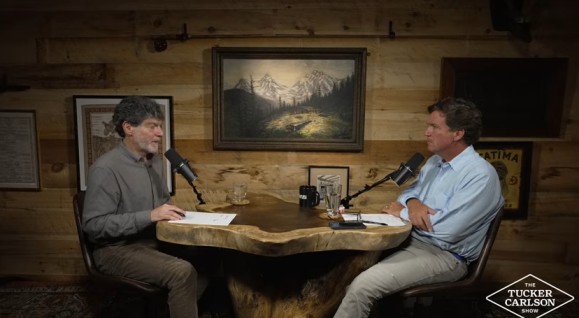
Editor’s Notes: In this insightful interview, Tucker Carlson sits down with biologist and cultural critic Bret Weinstein to dissect the escalating conflict in Iran and its broader implications for American foreign policy. The conversation explores the strategic significance of global energy routes like the Strait of Hormuz while addressing the influence of propaganda and what they term the “Great American Betrayal.” They also examine the complex relationship between the U.S. and Israel, focusing on Benjamin Netanyahu’s impact on domestic politics and the critical need for honest discourse. This deep dive offers a provocative look at the intersection of biology and geopolitics in an era of increasing media censorship. (Mar 12, 2026)
TRANSCRIPT:
Introduction
TUCKER CARLSON: In just a minute, we’re going to play you an interview we just completed with our friend Bret Weinstein about the war in Iran, why it started, what it means, how it may end, and when. And we should say at the outset why we did this interview. Bret Weinstein is not an expert on military tactics or strategy. He’s not a diplomat. He’s not a Farsi speaker. He is instead a biologist. He’s a close observer of living things and of the systems they occupy and create.
But why speak to Bret Weinstein really honestly? One reason, because he’s honest. He’s an honest man. He’s a scientist. And the first requirement of science is, of course, honesty. Report what you know. But we know that he’s honest because we’ve known him for almost 10 years now and watched him evolve in some ways from a liberal college professor at Evergreen to a Trump voter and promoter during the last campaign of Donald Trump.
And unlike a lot of people you see in the political sphere evolve, Bret Weinstein kept the rest of us apprised of his evolution as it was in progress. He didn’t pretend. “I’ve always thought this.” He told us that he had changed his mind and why. So on the deepest level, he is an honest man. Honest about the things he sees around him, what he thinks are behind those things, and honest, most important and most telling of all, about himself.
The Challenge of Finding Truth in a Censored Information Environment
So it’s important to get an honest analysis of what’s happening now, because the dishonesty is so overwhelming, it’s hard to separate it from the true. So if you’re following this, attempting to follow it in this incredibly censored moment we’re living in online, you’re seeing all kinds of things that seem true that aren’t. You’re seeing true things suppressed, the most basic things.
How many people have been killed on all sides, how many have been injured. You keep reading that Israeli Cabinet Minister Ben Gvir died, again and again — he’s dead — while he was in Jerusalem a couple hours ago issuing decrees. So, not dead. Et cetera, et cetera, et cetera. Basic facts like what’s the physical damage to all of these countries sucked into this conflict — you can’t find, because that information has been censored by those countries, countries in which it took place, and by American social media companies. So it’s really, really hard to know what’s true.
Everybody involved in this conflict has a strong incentive to lie and to spin. But at some point, all of that lying becomes irrelevant. Rhetoric itself, propaganda itself becomes irrelevant in the face of war. Because war changes physical things. Not just words and minds, but physical realities like borders and populations of countries and control over resources. Those decisions are settled by armed conflict a lot of the time. They certainly will be in the case of this war.
And so in the end, it kind of doesn’t matter what you say. Somebody’s going to win and somebody’s going to lose, and the world’s going to be very different. And the rest of us can assess those differences unencumbered or impeded by your lying, by your propaganda.
The Administration’s Unusual Candor
And that may be why, actually, for a war, there’s been relatively little propaganda around this. The current administration hasn’t even really tried to explain why we’re doing this. Not very hard, anyway. And in some ways, we should be grateful for that. It’s a sign of respect not to lie to people too aggressively.
The President today said on camera we’re thinking about using nukes against Iran. He said we could eliminate Iran, make it uninhabitable forever in an hour. We have weapons that can do that. Well, those are nuclear weapons. The President saying out loud, if this gets more intense, we could nuke them. Now, you can support that or disagree with that, however you feel about that. It’s not often that people are that blunt about what could happen.
And again, there’s been very little attempt to convince you that we did this in America’s national interest. The Secretary of State just came out and said we did it because Israel forced our hand. So they’ve been pretty direct, actually, about what is going on here and what the stakes potentially are. The President of the United States threatening nuclear weapons. Okay, well, that’s on the table.
The War Propagandists and the Grievance Narrative
The propagandists for the war, the people who really, more than anyone else in this country, pushed us to where we are now, are weirdly, unaccountably, even angrier than ever. You got what you wanted, but you’re madder than ever. That’s been true since the very first hours — the second the first barrage was unleashed against Iran, and then the counterattacks from Iran against the Gulf and American interests there. These people have been enraged. Very interesting. A licensed psychiatrist should study that someday. Why are they so mad, since they got what they wanted?
But the nature of their propaganda hasn’t really changed. There’s been no effort to convince you, as an American citizen or citizen of any country, that it’s good for you.
And you kind of got to wonder what this is other than an obvious attempt to divide American society into neocons and non-neocons. Why would you want to do that? Neocons are a tiny percentage of the American population, but clearly they’re trying. But it’s interesting to watch it.
We haven’t played a lot of this, don’t plan to, but there’s one clip from Ben Shapiro — a recent clip — that kind of sums up the arguments in favor of this war. And here’s Ben Shapiro.
VIDEO CLIP BEGINS:
BEN SHAPIRO: Sadly, younger Republicans have become similarly prone to conspiratorial thinking. According to the Manhattan Institute, 54% of young Republican men under 50 believe the Holocaust didn’t happen as historians describe. 53% of Republicans under 50 believe in 9/11 conspiracy theories. 51% believe the moon landing was faked. These people too have bought into a grievance-based distrust of the system, and it’s showing in their embrace of psychotic figures and disconnected politics. America is a force for good in the world. Radical Islamists are evil. American allies who demonstrate strength are an asset for us. Terrorists are bad.
Members of the Grievance Party are losing their mind over this, and now they’ve been relegated to basically rooting for Iran to win. So members of the Grievance Party — meaning Democrats and members of that horseshoe right — have decided that after paying lip service to the horrors of the mullahs, the true horror is American interventionism and destruction.
VIDEO CLIP ENDS:
Israel’s Strategic Goals and the Risk of Nuclear Escalation
America must be undermined. So if you have questions about this war, whether it’s in your interest, your country’s interests or not, and that’s never a question that’s occurred to Ben Shapiro, is this good for America? It’s really not under consideration. But if it’s under your consideration, if you’ve raised that question, you are tantamount to a Holocaust denier. You’re insane. You’re a crazy person. You probably think the moon landing was fake and 9/11 was fake.
By the way, there’s a pretty easy way to settle any debate about 9/11, which is by declassifying the millions of pages of classified documents that might explain what 9/11 was. But that’s never under consideration. We could end this debate right now. We won’t, of course, but you’re a bad person. And above all, you are a disloyal person. Disloyal to the United States. You are, quote, “rooting for Iran to win.” You’re part of the Grievance party. How dare you complain? How dare you have grievances.
It’s pretty weak going for a guy who literally knows nothing about the rest of the world at all. You can get annoyed by it at some point, especially if Iran wins. People like that will double their calls to arrest anyone on the other side. They’re already calling for it. These people should be investigated. Anyone who’s against this should be investigated on a ferret charge. They should go to jail. Their ideological opponents should go to jail. Who’s this totalitarian here?
And you’ll hear a lot more of that, but you will not see people pay a ton of attention to yelping, childish yelping like that, totally uninformed screaming like that ever again. Because, again, this conflict has entered what the military refers to euphemistically as the kinetic stage. People are actually firing munitions at each other. So it kind of doesn’t matter what people on the sidelines say at this point.
This is a hot war and it will be decided by force. One of the reasons you don’t want to get into a hot war. In other words, we’ve exited the part of the exchange where it’s two guys in the parking lot saying, “I’ll mess you up,” and we’ve gotten to the part where one guy just punches the other guy in the face and keeps going unless he’s stopped. So that’s exactly where we are. So it doesn’t kind of matter what you said before the punching started, not that Ben Shapiro has any experience of that, but it’s just true that once people start hurting each other, words matter less. And the dominant party will emerge victorious. That’s exactly where we are.
Who Wins, and What Does Victory Look Like?
So who is going to win this, and what does it mean to win? Well, the most obvious and often repeated observation about this conflict is totally true. Iran’s threshold for victory is very low. It just needs to survive. The regime has to remain intact.
Now, in order to change the regime, everyone pretty much agrees you would need ground forces, you need troops, boots on the ground, American boots on the ground in order to do that. And there is zero appetite for that in this administration, much less in the country. Israel would like us to commit ground troops, obviously, but it would take a lot to get us to do that. It would take some sort of terror attack in the United States, probably like 9/11, in order for us to do that. But that hasn’t happened yet. We pray it never happens.
So at this point, we’re not going to commit ground troops, which does sort of put the whole exercise in perspective. If Iran’s burgeoning nuclear program was really a threat to our core national security interests, then of course we would commit ground troops because any threat to our core national security interests merits committing ground troops. But this one didn’t.
And the people who decided this were told or believed somehow that we could affect regime change from the air because Iran was in a pre-revolutionary stage and all we needed to do was topple the head figure. Like dominoes cascading. That would set off a chain reaction that installed a pro-Western government in Tehran. That was the argument. These arguments always seem ludicrous in retrospect. You always laugh at them. Really? Did you really think that? Well, apparently we really did.
But almost two weeks in, that has not happened, by the way. That would be a great outcome because it would end the war immediately. A pro-American government in Tehran — why is that so hard? Well, it is hard and the US has never really been able to do it, despite trying a lot with these so-called regime change wars.
So if we don’t succeed in doing that, if in the end the United States decides, well, we can’t do this, what happens then? That is the question. In other words, what does an Iranian victory look like?
The Straits of Hormuz: The Real Prize
An Iranian victory does not look like Iranian forces invading the Gulf and controlling Dubai or something, or setting up a new satellite capital in Jerusalem. That’s not going to happen. What an Iranian victory looks like is really simple. It’s control of the Straits of Hormuz. It’s exactly what it looks like, which, if you hadn’t looked at a map recently, is only about 20 miles wide. And it’s the choke point through which 20% of the world’s energy flows — 20% of oil and liquefied natural gas, on which many countries, including American allies, are totally dependent. Europe, South Korea, Japan, not to mention India and China. They need it. They need energy.
As conservatives are often fond of pointing out, energy creates civilization. Without it, things grind to a halt. That’s just true. And renewables cannot take up the slack. Sorry.
So if that strait, that choke point — and again, if you haven’t looked at it on a map, it’s on the eastern end of the Persian Gulf, the Arabian Gulf, whatever you want to call it — that body of water through which energy flows by ship, whoever controls that has a lot of power.
Now, as of today, or as of two weeks ago anyway, the United States effectively controlled it. That was one of the reasons we had all those military bases in the Persian Gulf. Another was to protect Israel, our only real ally in the Gulf. But a competing reason, maybe the primary reason — hard to know, certainly a big reason — was to protect the flow of energy through the Straits of Hormuz.
And now the US has been, unfortunately, tragically unable to guarantee the passage of energy through that strait. Now let’s hope that changes. But if the Iranian regime is not toppled in this conflict, there’s a pretty good chance that they will have control. Who else would? American bases have been degraded, in some cases destroyed. This war is so expensive, even now, less than two weeks in, it’s hard to see how we could afford to expand our presence there. And then on a political level, how much will is there for that? “We got to send more troops to the Persian Gulf.”
Israel’s Regional Ambitions and America’s Diminishing Power
So as noted right after this broke out, one of the whole purposes, one of the goals of this exercise from the perspective of Israel, was to get the United States out of the Middle East so Israel could be the dominant regional power, the hegemon, so it could expand its territory without getting hassled by the US State Department, without asking permission from the US president. And so Israel could control it because Israel sees itself, and is actually just factually, an emerging power. It’s a nuclear-armed power. And from their perspective, why wouldn’t they control the region? And so that’s their goal.
But one impediment to that is Iran, which is opposed to Israel’s existence and has been funding proxies to fight against Israel, most notably Hezbollah in Lebanon, but also Hamas, the Houthis in Yemen, etc. So you’ve got to get rid of the Iranian leadership, probably just turn the country into a chaotic civil war, because that suits Israel’s purposes, and you’ve got to get the US out.
So they’ve already done a lot to achieve the second goal — get the US out. It’s hard to see how the United States can guarantee safe passage of shipping through the Straits of Hormuz after this. We can’t now. And if the Iranian regime remains, they’re the ones the rest of the world is going to have to negotiate with.
So just to be totally clear, Japan, South Korea, China, India, the European nations — 40% of the heat in British homes comes from LNG, from Qatar, moved by boat. So big countries, some of them allies, some of them rivals, have a structural interest in this region and it’s not going away.
So in the end, it seems possible, if not likely, that a resolution to the core economic question here, which is shipping, will be resolved by those countries directly talking to Iran. So China, India come in and they negotiate with Iran to open the straits. Think about that for a second. Does that diminish or enhance Iran’s power? Well, you’re negotiating directly with China, India, South Korea, Japan, Europe. You’re more powerful than you were when this started.
And that’s a huge embarrassment to the United States. It’s a huge reduction in American power. We were not able to force our will on this critical part of the world. We couldn’t keep the peace. In fact, we shattered the peace and we weren’t able to restore order once we did. And guess who did? Our other global rivals. That seems very likely.
The Threat to Israel and the Nuclear Taboo
But from a regional perspective, this is a huge deal to the Gulf states, which have just been bombed for 12 days and really damaged in some cases by Iran. But the biggest problem this poses is for Israel because Iran is a sincere opponent of Israel at this point, more so than ever. It has been for a long time. They say it openly. They’re one of the few countries in the world that opposes Israel’s so-called right to exist. Israel has every reason to regard Iran as an enemy. Iran is an enemy of Israel, and again, now more than ever.
So if Iran emerges with its leadership intact, with a leadership that might be even more anti-Israel than it was three weeks ago — why wouldn’t it be? We just killed their leader, their 86-year-old religious leader and his family. How does Israel live with that? And if Israel doesn’t live with that, what are its options? If you sort of think about this for about two minutes, it gets bracing, gets a little scary.
It’s hard to know exactly how much damage the IRGC, the Iranians, have done to Israel because there’s so much censorship. But we can conclude fairly confidently from available information that the port of Haifa, which is the most important port in Israel, controlled by the Chinese, actually — interesting — and Tel Aviv, the second biggest city in Israel, have been hammered. And there has been widespread infrastructure destruction and there’s been loss of life of some kind. We don’t know. But the video that seems real — they’re hurting.
And the Israelis have been dealing with this kind of stuff for a long time. It’s not the first time their cities have been shelled. They’ve been shelled a lot over the years. And so their tolerance for this kind of stuff is much higher than it would be in the United States. If you shelled Chicago, people here have no experience of that and understandably they’d be completely freaked out by it. Israel has a little stronger immune system for this kind of stuff, because they’re already fighting a seven-front war.
On the other hand, there’s only so much that any country can take, particularly a small country that is riven by all kinds of internal divisions. Israel is not a united country at all. And its leader, while he’s very popular with Ben Shapiro, is not universally loved in Israel at all. So Israel is not entirely stable internally, and it’s absorbing a lot of punishment for a small country.
But let’s say that punishment accelerates. Let’s say the Iranians decide, “We’re going to really hurt Israel, and we’re not going to limit it to Haifa and Tel Aviv. We’re going to hit Jerusalem where the holy sites are.” Now, they’re not apparently doing that right now, at least that we know of. It’s hard to know exactly what’s going on because of the censorship, but it doesn’t seem like they’re pounding Jerusalem. But they could.
And at that point, what happens? What if Israel and its main protector in the world, the United States, starts running low on advanced munitions and critically on missile defense? Well, that’s entirely possible. There have been widespread reports that the United States, as it backstopped Israel, its main protector, is running low on those munitions.
Now, why is that? Well, because we expended a lot of them, both advanced munitions and missile defense, in the last conflict that we backstopped Israel in in June. And we were already low then because we sent a lot of munitions to Ukraine. Now, why did we do that? What was our critical interest in Ukraine? Well, at the time, they told us we have to do this because it is totally immoral and a violation of our sacred norms when a larger country just grabs the territory of a smaller country. Post-Venezuela, it’s kind of harder to make that case with a straight face.
So looking back, you’ve got to expect a lot of the cheerleaders for the war against Russia might feel a little bit silly, might feel like the moral case they were standing on was kicked out from underneath them, because it was. But whatever you think about why we were there and the wisdom of it, the truth is, at the demand of the very same people who told us we had to get into this Iran war, those very same people demanded — you may recall, four years ago — that we get into the war against Russia and that we expend hundreds of billions of dollars in critical munitions we could use to defend ourselves in the fight against Vladimir Putin because he was Hitler.
Again, things look very different right now, but at the time, everybody in DC, in both parties, bought that story. The Democrats were all for it, the Republicans were all for it. This isn’t the first bipartisan regime change war we’ve tried to fight. It’s one of many. And in the course of that war, we expended a lot of critical munitions that we might have been able to use to guarantee Israel’s safety with now. But it looks like, from all available reports, we’re running low. In fact, we’re getting some apparently anti-drone technology from Ukraine. Savor that irony for a moment, if you would.
So whatever the cause — and there’ll be, one hopes, time enough for finger-pointing and blame and reverse engineering in an attempt to understand what we just went through — the fact remains it seems unlikely that the United States will be able to guarantee the safety of Israel. We can’t guarantee it now, despite a real effort to.
So what does that mean? Well, it means that at some stage it is possible that Israel will feel it has no choice. You hope they feel they have no choice, not doing it for fun. But in any case, they might have to resort to a nuclear strike on Iran, which would be a tragedy for the people of Iran, most of whom have nothing to do with any of this, who would get vaporized. It would be a tragedy for the region, which would be poisoned by radioactive fallout. And it would be a tragedy for the world because the last taboo would be shattered.
Truly the last taboo. You can literally castrate yourself and call yourself a woman and get applauded. There are very few taboos left. Using nuclear weapons is the last remaining big taboo. And once that is gone, we know from the elimination of other taboos that things change really fast. “Oh, it already happened. I think I’ll try it.” And you could very easily see, either quickly or over time, a series of nuclear exchanges that kill most people on earth.
So that would be a huge deal. For the first time in 80 years, a nuclear weapon would be used. And it’s, by the way, not an attack on Israel to note this, though they have been very eager to threaten it in the past. Their threshold is much lower than most people’s. But still, you can kind of understand it. If Israel gets targeted for destruction by Iran and the United States isn’t there to reliably protect Israeli cities, they could use nukes. And then we could see truly the destruction of a lot of the world. So you don’t want that to happen. In fact, you have to stop that from happening. You have to decelerate. But how do you do that?
The Case for Diplomacy — and Its Obstacles
And again, without too much gloating, because this is no time to gloat or say “I told you so” — this is actually one of the reasons that some people argued against this conflict in the first place, because like all wars, it’s much easier to get in than to get out.
So there are reports today which, again, could be lies — probably, again, everyone lies in war, everyone has incentive to — but there are reports that don’t seem totally crazy that envoys from the United States have suggested that our country might be open to some kind of ceasefire. Like, “Hey, let’s settle down for a second.” And the Iranians, whether they’re telling the truth or not — but the fact that you can go to the trouble of lying about this tells you something — have said, “No, we’re not doing that. Why would we agree to a ceasefire when your previous diplomatic efforts were clearly dishonest and didn’t work? In any case, we couldn’t trust you.”
Is
The Mystery of Trump’s Decision
BRET WEINSTEIN: Glad to be here.
TUCKER CARLSON: This is one of those moments it’s hard to understand what’s happening. But here’s what I believe to be true. The president had deep reservations about doing this. He promised repeatedly as he campaigned for this job that he wouldn’t do this. This war with Iran, he made fun of people who suggested he do it. I don’t think many of his actual employed advisors were eager to do this. That’s my impression, based on the reporting.
And the only people who wanted to do it were a group of informal advisors on the outside who were calling in, saying you’ve got to do it. Mark Thiessen of the Washington Post and other people whose opinions are hard to imagine taking seriously. But whatever, they wanted it, and Benjamin Netanyahu wanted it. The country did not want it at all, as expressed in polling. But we did it anyway. And it’s turned out to be, I think it will turn out to be, unfortunately, kind of a pivot in our history. Why did we do this? What was the point? Do you have any sense?
BRET WEINSTEIN: Well, I’ve spent a lot of time thinking about that question, and I will say I find Trump himself a fascinating and mysterious character. He is highly unusual, and therefore it’s a little hard to understand.
TUCKER CARLSON: Do you find him more mysterious now than you did 10 years ago when you first started watching, when we all first started watching?
BRET WEINSTEIN: Well, I understand him a lot better than I did because, of course, I now have so much evidence of how he behaves under different circumstances, for both better and worse. But in thinking about this move, it seems like such an obvious mistake, both from the point of view of the nation and the danger of a quagmire, which I think is substantial, and the danger of a terrible outcome, which I think will likely be avoided. But I do worry about the role that nuclear weapons could play here.
But the thing that really causes me to think there’s something I can’t see, is that the mistake that Trump has made here is a political mistake. If you picked one realm where I would expect Trump not to make an obvious mistake, it would be the political. I literally think we are dealing with a political genius. If nothing else, this person has understood the American electorate in a way such that he could be relied upon not to make a blunder of this scale, especially as his presidency hangs in the balance, which it clearly does. Because if the Democrats take the Senate in addition to the House, then not only will he be impeached, which I think is highly likely with the House alone, but he will be convicted, and that will be the end of his presidency. It will also be his legacy.
So why would a man who understands politics better than any of us, a guy who did what I would have told you was impossible — he beat the duopoly, both sides of it, took over the Republican Party, defeated the Democratic Party soundly — why would that person make a move that seems like a childish blunder? And it leaves me with a very unsettling hypothesis. I don’t have high confidence in it, but my concern is that this is evidence that he is not in control. He is not in control as commander in chief of his own armed forces, and that he is, in fact, having to rationalize decisions that he would not have made and promised not to make on the campaign trail.
I don’t quite know what to do with that. It’s a very unsettling thought. I don’t see the win here, and I don’t see a win in a short enough time period that this could put him ahead in the midterms. It’s very hard for me to imagine that.
Political Fallout and the Question of Control
TUCKER CARLSON: Well, I think that’s the least bad outcome from the perspective of the Trump administration. If Republicans get stomped in the midterms, but then somehow recover a workable majority of voters, I think they’ll be thrilled. But I think the potential consequences, unless the party is to find a leader who represents its voters — because it’s really that simple. Over time, are you addressing the concerns of your voters? If so, you probably get elected, and if you’re not, you probably won’t.
I mean, Gavin Newsom is going to be president if this continues on its current course. So the question is, how do you restore confidence in the government after the government just admitted they got Americans killed on behalf of another country? Which is what they’ve admitted and what they did?
BRET WEINSTEIN: Well, I will tell you, I don’t think I was naive going into the last election. I have long viewed the duopoly as unbeatable and Trump as capable of a political feat in that realm that others weren’t. But in terms of how compromised our governmental structures are by corruption, there was always the question as to whether there was enough power left in American elections to actually change our trajectory as a country.
And in the aftermath of the attack on Iran, I’m shaken. I don’t know. I think the answer I just got is, it didn’t matter who you voted for. The neocons had moved over to the Democratic Party. I think an attack on Iran was on their agenda for decades. I tweeted before this happened, “We’re going to attack Iran and we’re not going to be given a choice about it.” And that feels like what has occurred.
But I do want to say the hypothesis that the President is not in control is one of two. The alternative hypothesis, as far as I can see it, is that he is being shown a very compelling false rendition of the world that has led him to act in a way that would be politically advantageous and would be in the interests of the nation — if what he was seeing was true, but that it isn’t. That’s also a very unsettling possibility: that he is surrounded by people who are wittingly or not showing him a picture that is unrealistic, so that he would, in fact, put our military in harm’s way and destabilize Iran, not understanding what the likely consequences were.
TUCKER CARLSON: Well, I don’t think there’s any question about that. And the people who are calling to influence him are unwise, but also ignorant and have a track record of bad calls, and possess maximum aggression. So there’s no question that his fact picture was totally distorted, and it still is. I mean, the overwhelming majority of Iranian signal intelligence that we receive has been translated by Israel. So it’s been filtered — maybe honestly, maybe not. But he’s not seeing the whole picture. Of course, no president does. But he’s also, as you just suggested, overriding his own instincts.
He has amazing political instincts. People zig, he zags. He turns out to be right. He attacked the Iraq war when that was totally verboten in the Republican Party in the primaries in 2016. And it turned out to be the most resonant thing — finally, someone’s saying it. Only he knew that, only he understood that. So his instincts are at the highest level, and he ignored them.
A Pay-for-Play System and Foreign Influence
BRET WEINSTEIN: Well, I think we need to know the answer to that question. And I think we Americans have to have a conversation with ourselves about not only how broken our system is and what it is resulting in us doing, but how does it actually work? What is it that is actually driving us to do what we do?
We can see parts of it. We can see lobbying, for example. It’s the loophole in our system — a pay-for-play system that is used day in and day out by corporations to get us to do things that are bad for our health, bad for our long-term financial well-being, bad in every regard. But obviously our adversaries abroad will have noticed that we have a pay-for-play system, and if they aren’t taking advantage of it, that would be surprising. I would like to know why they would have missed the opportunity. So presumably they are. And that also applies to our allies, unfortunately.
That is to say, anytime somebody has an interest that is in conflict with the interest that we Americans actually have, they are in a position to nudge us in their direction, and we are undoubtedly being nudged. Undoubtedly. On the other hand, I don’t think that can be the sum total of it. And I will tell you, I don’t like saying any of this. I don’t want to be doing it.
TUCKER CARLSON: But tell me about it.
The Epstein Phenomenon and Hidden Power Structures
BRET WEINSTEIN: The Epstein phenomenon, whatever it was, is so important because it suggests a hidden power structure that was there for leverage. It is unfortunate that in the version we have been shown, we don’t have conclusive evidence of who, what they were after, or even how the leverage worked. All we can see is strong evidence that there was something. Logically, it is implied that it was connected to intelligence services — ours, likely Israel’s, who knows who else.
But when you see your government, your president, functioning in ways that do not add up, it’s like watching a planet behave oddly because of the gravity of some object you haven’t found yet. There’s the implication that there’s something with power in this system that is undeclared. As far as we know, it’s unnamed. And the central question is, what is it? How does it work? And how much effect is it having on what we do?
I tried in my own way to raise this issue publicly. I believe we are in the midst not only of a constitutional crisis, which arguably has been ongoing since 2001, maybe much longer, maybe 1963, around November 22nd.
TUCKER CARLSON: In that range of 1963.
BRET WEINSTEIN: Yeah, exactly. Well, that’s the question — was that a lone gun nut or was that a coup? And if it was a coup, did the thing that took power ever relinquish it? I don’t know the answer to that question.
TUCKER CARLSON: I’ll just put it this way. If the US Government ever goes bankrupt and disability payments stop, Social Security payments stop, all payments stop, medical research stops — the CIA will still be well funded.
Rogue Agencies and the Limits of Accountability
BRET WEINSTEIN: Well, the CIA — I used to say “black budget” because obviously there are black budgets. But then I realized I was using the wrong term. A black budget is a budget that is opaque to the outside world, but it still comes from somewhere. The real problem is the ability to fund your own agency. And if you have superior information about the world — you know what’s going to happen because you’re in part responsible, or you’re listening into things that are responsible — then you are in a perfect position to create a budget that is under no one’s control. And I’m afraid we have rogue agencies that are independent of any structure that was imagined by our founders.
TUCKER CARLSON: They’re their own countries, and there’s no one who’s not afraid of them.
BRET WEINSTEIN: No one who’s not afraid of them.
TUCKER CARLSON: So there’s literally — I’ve never met anyone — the more knowledgeable someone is about the workings of government, the more afraid he is of the CIA. I’m not saying the CIA is running around killing people, but they can. I mean, to some extent they are, but I don’t think they’re murdering thousands of Americans every year. But they’ll trip you up hard if you mess with them. That’s just true. Everyone knows that.
BRET WEINSTEIN: They’ll gaslight you into functional insanity. They’ll eliminate you.
TUCKER CARLSON: Leak your texts to the New York Times. For sure.
BRET WEINSTEIN: Yeah, these things can happen. So I guess my point is, not only are we in an ongoing constitutional crisis — it’s just clear that we are, and what the start date is can be debated — we are also in the midst of an acute national security crisis.
TUCKER CARLSON: Yes.
The End Game: Power, Control, and the Decay of American Society
BRET WEINSTEIN: Something has control within our governmental structures that does not have our interests at heart. And I don’t know what we do about that, but I know that there.
TUCKER CARLSON: Why do you say whatever this control mechanism is, this force doesn’t have our interests at heart?
BRET WEINSTEIN: Well, I think that’s evident from what we do. Most of our activity is actually negative with respect to its impact on Americans. I mean, in fact, if we simply took the resources at our disposal and pointed them at the problems that people care about, we could be vastly better off. We wouldn’t live in a country with huge numbers of fentanyl zombies in every city with onerous taxation and cruddy services.
The point is, we are simultaneously being drained on the one hand of our resources and on the other hand receiving the worst conceivable service for it. I would be perfectly comfortable paying high taxes if they were making society better.
TUCKER CARLSON: Oh, yes, definitely.
BRET WEINSTEIN: But I’m not comfortable with paying high taxes that are used to punish me and surveil me and all of that. Of course, who would be? So all I’m saying is that if I look at the activity of government, it is hostile to the interests of the American people.
TUCKER CARLSON: That’s right.
BRET WEINSTEIN: Almost always. Almost always. It’s like point for point. During COVID, if you looked at what the CDC asked you to do, every single thing was the inverse of what you should have done just to maintain your own health. It’s like that — you are getting a program in which everything that you’re being fed is poison rather than nutrition.
So when your government behaves like that, it is about something. The fact that our founders understood the hazard of conflicts of interest was top of mind for them, and they wrote about it extensively. They had tried to build a system that was immune to it by virtue of the fact that as people detected that their government was not acting in their interest, they had the ability to replace it bloodlessly.
And what I think has happened is something has overwhelmed the thinking of the founders. It’s not surprising — they didn’t understand what a world with the Internet or AI or any of these other modern influences would allow. But somehow we exist under a form of government that has a kind of democratic theater to it. But that’s not how it works.
And I guarantee you it works some way — it’s a functional system in a manner of speaking. The lights remain on, but it is not acting in our interest. It’s basically catering to our interests exactly enough to keep us from revolting. That’s about what it is.
The End Game Dynamic: Are We Being Played?
TUCKER CARLSON: You know, that’s a very depressing scenario that you’ve just sketched out. However, it’s better than civil war.
BRET WEINSTEIN: Yep.
TUCKER CARLSON: And people don’t appreciate how difficult violence is to control and just how costly it is to people, because they’ve never seen it, because they don’t know anything, actually — never been anywhere. But anyone who’s been around that is like, oh, don’t want that.
However, I think that the current system is going to be pretty hard to maintain with this level of transparency, by which I mean, while a billion federal documents remain classified, the deep architecture of power, as you just said, is now sort of visible. It’s kind of peeking beneath the surface in certain places. And you’re like, well, that clearly is what’s running it. I have no control over that. Whatever it is, clearly hates me and my children.
It’s tough when this much is disclosed all at once, and it makes society unstable and it makes people frankly revolutionary and radical. Well, or does it?
BRET WEINSTEIN: No, it does. Which is another thing that’s been worrying me. So part of what I do is I think about game theory, which is a little understood quadrant of logic, but a very important one. And there’s a difference between an iterated game — where each round is played with the knowledge that you’re going to have to play the next round — and the last round of the game, where you know you don’t have to play another round. So you’re willing to do all sorts of things that you wouldn’t if you knew you had to keep playing. You’ll burn properties that you wouldn’t have burned otherwise and put it all on the last hand.
So what I feel — and I can’t defend it as a matter of it being an obvious logical conclusion — but what I feel is that there has been a shift into an end game dynamic where something is going for broke. It’s not expecting to preserve this system, it’s not expecting to have to maintain it. And therefore, how much does it matter that we can see a lot in the Epstein files but prove nothing?
How much does that really matter if we know? In fact, maybe it’s even a feature, not a bug. It kind of makes us feel like we’re making some kind of progress, like we’ve scored a big win, when in fact — is it going to change how we are able to govern ourselves? Did our power go up in knowing these things, or was it just simply a kind of catharsis that was delivered? “Fine, you can have it. What are you going to do about it?” That’s where I think we are.
Stoking Division: The Manipulation of Religious Conflict
TUCKER CARLSON: I have that same sense, a strong sense. Just, it doesn’t matter. Shed the husk. We’re moving on. And I see it in a lot of different ways.
In the most obvious practical way, in our use of anti-missile defense — we burned through it. And so there’s no sort of backup in case something else happened around the world with a peer power. We’re in trouble. You wouldn’t do that if you cared about the future. You wouldn’t do any of this if you cared about the future.
But I see it in the explicit efforts to stoke religious conflict inside our borders. And I see it with this “all Muslims are bad” narrative. I never thought in my wildest nightmares that I would be the guy defending Muslims, since I’m not a Muslim. And I’m also on the record attacking Muslims many times over the years — foolishly, probably.
But I do know that American citizens have to be treated equally regardless of their religion, period. And that attacking people on the basis of their religion in my country is the recipe for disaster. It’s a recipe for a country that I don’t want my grandkids to grow up in. And I don’t know why anyone would do that. And I’m not going to stand by for it — not because I’m a devotee of Allah or whatever. I’m a Protestant Christian. I do love a lot of Muslims, but that’s not why I don’t want to live in a country like that. Why would someone try and stoke that? What is that? What’s the game here?
BRET WEINSTEIN: Well, this is again that haunting sense that this is about somebody’s interest that has not been publicly shared, and that we are being steered as pawns on a chessboard.
TUCKER CARLSON: How can a country this big and powerful get manipulated by anybody?
The Corruption of a Nation: From Freedom to Tyranny
BRET WEINSTEIN: Well, unfortunately, the answer to that is in game theory also, which is that the personal incentives of those who are supposed to be doing our bidding in government are obviously wildly perverse. And so you can get a lot of people who are either too cowardly to do what they know is right, or too corrupt to care about what’s right.
But I was on the beach in Clearwater a couple of nights ago, watching the sunset. Very diverse crowd of mostly Americans there on the beach — families playing in the surf, people just enjoying the grandeur of the sun going down. Nobody thinking about politics except me. But I was talking to people as I often do. I love to just strike up a conversation. It’s amazing how decent most people are, how they want the same things, how they’re willing to bond with you — somebody they’ve never met — just because you’re standing on the same beach in a country in which you’re more or less free.
And I was thinking about how it used to be — the ’60s, ’70s, ’80s, ’90s. And the fact is, this was never a fair country. People start out with disadvantages. But we knew that it was supposed to be. We knew that that was the better direction to go in. And frankly, people liked it. There’s a reason — as dumb as the Colors of Benetton campaign was — there’s a reason that ad campaign resonated with people. It is kind of cool to have friends from all sorts of different backgrounds and to feel like we’ve put those animosities aside for something better.
And the better thing is the modern West. It’s the alternative to unthinkably bad systems that have characterized all of history until the last couple hundred years.
So I texted while I was on the beach to Heather a thought that she would understand because of every conversation we’ve had about our predicament. Something to the effect of: “These people are very broken, but within two generations, they could be pretty okay if we just stopped poisoning their bodies and their minds. We stopped lying to them, and we started telling them, ‘Hey, here’s how you can live so that you’ll be healthier and happier.'” And if we simply confessed what we knew about how things actually work, these people aren’t so far from being able to go back to not caring about what color your skin is or what book your family worships. We liked that. It was good.
And frankly, it was so good that for a brief period, it was contagious. Anybody who saw how dynamic this country was — that people could be simultaneously free and wildly productive and innovative like no other country ever — once you see that, the only answer is, “Well, how can I get in on that? Can I come to your country and participate in it? Can I reproduce that magic in my country?” People wanted it.
And somebody upended it. Somebody decided that our freedom didn’t matter, and they decided that they had plans — plans to corral us so that more of our wealth could end up in their pockets. And at first, the corruption was mundane, but it has now totalized. It has taken over the entire country and it has left us with what looks like the theater of democracy and liberty, and some kind of cryptic but omnipresent tyranny.
It’s tragic. And most people don’t realize how tragic it is because they don’t know what the world looks like when you don’t have the West functioning. They don’t understand what it is like to live in a world where the question is, “How are we going to exterminate those people so that they don’t exterminate us?” That’s not a world you want to live in. And I’m afraid that we are being dragged back into that world, which is frankly so much more fundamental — that if the West breaks down, that’s where we naturally go.
TUCKER CARLSON: There’s nothing, there’s no other alternative.
BRET WEINSTEIN: Yeah. And the question is really at what scale will you see that? Is it going to be at the scale of your neighborhood or at the scale of nations? But either way, it is an intolerable loss compared to repairing what we have, as broken as we find it.
The Degradation of the American People
TUCKER CARLSON: I mean, if you just measure the well-being of Americans by the obvious measures — including life expectancy, physical vigor and health — there’s no question that the population, down to the individual, has been degraded measurably over the past 40 years.
BRET WEINSTEIN: Visibly.
TUCKER CARLSON: Visibly. Visibly. And it’s shocking. This is so banal I’m not even going to repeat it, but yes, visibly. That is exactly right. And it’s super sad. It’s not an opportunity to heap scorn on people — the weakest among us — “you’re fat” or whatever. It’s an invitation to empathy and uplift. It’s an invitation for us to help and make this better.
And also it’s a question: how did it go so wrong? And it does seem like you couldn’t get this condition without leaders who really wanted to hurt you. It doesn’t seem accidental.
The Banality of Evil and Economic Indifference
BRET WEINSTEIN: Well, I mean, I will be one tick more generous. I think people do not intuit what it would be like for someone to be completely indifferent to your well being.
TUCKER CARLSON: Right.
BRET WEINSTEIN: When we look at what pharma has done to us —
TUCKER CARLSON: Let me just say I’m sorry that I said that. No, because it doesn’t require mal intent, it just requires indifference.
BRET WEINSTEIN: Yes. And I’m not saying there isn’t a whole lot of —
TUCKER CARLSON: No, but you’re right. You’re absolutely right. And I shouldn’t have said that.
BRET WEINSTEIN: But we all have to understand this. And I think the way to do it is to find it in yourself first, right? The reality is if you tapped into the suffering that is taking place at this instant around the globe, you melt down, right? If you just had one instant of feeling it all, that’d be it. So you don’t. You’re built not to. You’re built to care about things in some kind of proximity to you, right?
You care about your family. You might care about your neighbors. You might care about Charlie Kirk. You may never have met him, but you saw him, you liked the way he sounded. He felt like a kindred spirit. So we pay attention in some way that is biological, right? That is built not to overwhelm us, so that we have empathy where it has a utility.
And then something breaks out in Sudan and you may know about it, but you don’t feel it in the same way. You are functionally indifferent to it. Right? You know, something is going on and you go to Starbucks and you buy an expensive coffee anyway. Right. So we all have that capability. And it’s not that we are bad people for it, it’s that we are functional people because of it.
But once you know that that exists, that you can be indifferent to somebody’s profound suffering if it’s far enough away from you, all you need to understand is there are people who seem close to you who feel that exact way about you. You might as well be an animal on a feedlot somewhere as far as they’re concerned. Right? You are a source of wealth or meat or whatever.
And once you get that, once you just make eye contact with that thought, it is not hard to understand how pharma works. Right? Totally. Yeah. So, would somebody really withhold the cure to some disease that worries us all? Because if that cure comes out, they’re going to lose billions of dollars. Yeah, there are people who would do that. And you’ll never guess where you’ll find them.
TUCKER CARLSON: Right.
Increasing the Pie vs. Destroying Wealth
BRET WEINSTEIN: So, the point is, look, we need — there aren’t very many adults. Maybe there are none. Some of us are struggling to be adult in a world that misinforms us and misleads us and tries to infantilize us, but we are trapped in a system in which other people’s — the slice of the pie that they have access to is their full time preoccupation. They’re trying to enlarge their slice of the pie.
The way that’s supposed to work, if our system functioned really well, you would increase your slice of the pie by increasing the overall size of the pie. Right. That’s what it says effectively on the brochure of free market democracy. Right. If you create wealth, you get rich. Nothing wrong with that. I want to live in that system. I want people who figure out how to make us all wealthier to live in really good places and enjoy the finer things in life. That’s something that makes us all better off.
But there’s this other way to do it. You can increase your slice of the pie by destroying wealth. And if you don’t find a way to systematically rule that out, then that’s what you’re going to see, because it’s vastly easier to do that. It’s vastly easier to get wealthy at the expense of everyone else than it is to figure out how to make the pie that we all enjoy bigger. So we are suffering because a lot of people are behaving in their narrow self interest, completely indifferent to our well being. And that now extends deeply into the political.
TUCKER CARLSON: It’s almost the banality of evil, you might say.
BRET WEINSTEIN: It is a decidedly economic version of the banality of evil.
Who Benefits from the War?
TUCKER CARLSON: So, you hate to say it because there’s no sense that I can see in which the current war benefits the United States. I just don’t see it. But, theories are welcome. No one’s ever called me to tell me how — I hope someone will. But I see a ton of ways in which individuals are becoming enriched by this war.
BRET WEINSTEIN: Every time. I mean, it’s ever present.
TUCKER CARLSON: It’s hard to believe that’s real though.
BRET WEINSTEIN: Well, yes, it’s hard to believe it’s real because we depend — in order to just live your daily life and interact with the people that you actually meet, you have to take that mindset off the table. Right. You can’t work in your daily life with your co-workers and imagine that they’re scheming behind your back. Oh, it’s so true in this way. And in general they’re not.
It’s just that there are enough people who are capable of this, and the system selects for them and it tends to utilize them, that our overall system does not — it’s not a scaled up version of your neighborhood. It’s the inverse of your neighborhood. It’s people behaving in exactly the opposite way that normal people do in regular interactions. And it’s something you have to learn, because your daily experience won’t teach it to you.
How Is This Resolved?
TUCKER CARLSON: Okay, how is this resolved? That is a question. Let’s take the military engagement off the table, because that’s hard to — hard to know. As noted earlier, it’s difficult politically. It’s almost as difficult to see where this goes, because I think there are so many people who voted for the current administration as a last resort. Someone please listen to me, hear me. I’ve got problems. Pay attention. And we wound up with this. So, how is that fixed?
BRET WEINSTEIN: Well, all right, here’s where my naivete is going to come out. We need somebody who is in a position of real power and influence, somebody who has better information than we on the outside do.
TUCKER CARLSON: Right.
BRET WEINSTEIN: To step up and take the risk — and it is a profound risk — of telling us exactly what they know.
Now, I will say I’m very upset with President Trump at the moment. I feel personally burned as somebody who worked to get him elected. Yep, I did it for a reason. And frankly, if given the same choice today, I would have to make the same vote, because I think what the Democratic Party offered was anti-constitutional, right. We had a demented president who they pretended wasn’t, and then we had somebody who hadn’t won a primary installed by the party. This is not the consent of the governed. So I would have to vote for Trump again just because he’s at least a qualified person who was the nominee of his party through a lawful process.
But I’m angry at him because I voted for no new wars. And when I voted for no new wars, Iran was top of mind for me because I knew that it was on the agenda of the neocons. So I expected somebody to try to force this to happen.
However, whatever the explanation is for what President Trump has done, one can imagine him coming to the podium and telling us what’s really going on across the board. What happened to our country? What happens when somebody who truly is independent of the system gets to that top job?
Now, I assume there are reasons he can’t do that, and I can come up with many reasons that it would not be his instinct to do that. But I think that we in the public need to consider whether the right thing to do is to say, what are our actual interests here? Our actual interests involve getting our country back and putting it on a track that functions right. Going back to being the west and ignoring race and religion and trying to prosper through innovation. Right. We are not going to get there if we continue to play the same dumb political game.
President Trump, I believe, was a true renegade who broke through the system, even though it was built to prevent that at all costs. That is a major accomplishment. Having done so, he now knows how the system works, what it’s built to do, and how it functions. And I feel like the right deal to make is to forgive him for whatever it is that he’s participated in, in exchange for giving us the information that we need to put the country back on track. Now, maybe that’s naive.
TUCKER CARLSON: Maybe — I’d take that deal.
BRET WEINSTEIN: Ridiculous. Yeah.
The Power of Truth
TUCKER CARLSON: Take that deal any day. I think saying the truth out loud has a supernatural effect. Well, it has an effect, whether it’s supernatural or not, in that it clarifies, but it also elevates. Like, when you’re arguing about the right things, because you’re arguing on the basis of truth rather than deception.
And I think even if a leader — Trump or anyone else — offered no prescription for improving things, telling the truth about what’s actually happening, how things work, who’s in charge, why do we do that, what’s the truth about that — let’s just start with the Kennedy assassination. I mean, they won’t even do that. So I think that would be a massive improvement.
BRET WEINSTEIN: It would be, but the problem is we would have to live up to our side of that bargain. We would have to protect him, and nobody can protect him fully. But the point is, that would be a very risky thing to do, because you’re talking about forces powerful enough to have effectively captured our government, and them facing an existential threat to their power. So everything’s on the table with respect to what might be done to prevent someone like President Trump from telling us that.
TUCKER CARLSON: But don’t you think a prerequisite for leadership of anything — the family included — is the willingness to die for the people you lead?
BRET WEINSTEIN: Yes. And in fact, that was one of the things that I think endeared President Trump to a lot of voters. They saw him stand up to an assassination attempt. And he’s not a young man, and frankly, his entire legacy is at stake. I assume his fortune isn’t, but his legacy is at stake here.
And so if there was ever a moment for a person to be looking at the sum total of what they’ve accomplished in life and to be saying, “This is the last chapter, what is the right thing to do,” I think this would be it. In his shoes, I think it’s what I would do. But it’s a hard one to wrap your mind around. And presumably, if he were to entertain the thought, then all those around him that he might consult will have whatever reaction it is that prevents such things from ever unfolding.
So, it would be a hell of a moment in American history if we finally got an answer to what’s been going on since 1963 and what it has to do with our entanglements abroad and our dysfunctional policy at home. But look, the thing about Trump was he was the surprising element that you couldn’t have predicted.
TUCKER CARLSON: Right.
BRET WEINSTEIN: So the question is, maybe it’s time for the surprising Trump to surprise us once more and to give us the insight that we won’t be able to gain through any other mechanism. And it would be the most worthy of accomplishments.
TUCKER CARLSON: It’d be the greatest thing — it’d be the greatest gift you could give the country, because the truth does set you free, actually. No matter what your religious views, I think every religion, I hope, is based on the idea that there’s an absolute truth that’s knowable, or at least it’s approachable, and that telling it is liberation.
BRET WEINSTEIN: Yep.
TUCKER CARLSON: And that would be true for him, too.
BRET WEINSTEIN: I would think so.
Disappointment Among Trump Voters
TUCKER CARLSON: You said you’re gravely disappointed. You circulate in a world full of people like you — a lot of liberals who voted for Trump, who saw him as a way to fix long standing problems. How many of them feel disappointed now?
BRET WEINSTEIN: Well, the funny thing is I have now several times said unforgivable things out loud on a series of different topics since 2017.
TUCKER CARLSON: So you have no friends left?
The Painful Upgrade: Losing Friends, Finding Better Ones
BRET WEINSTEIN: No, I have the greatest crop of friends ever. But the way I came by them is an important piece of the puzzle. So each time that I have stood up and said the right thing, I lose a whole group of people. They turn on me, they go silent, all sorts of things happen. And then I meet another group of people that I didn’t know existed, who replaced them as my friends. And I call this the painful upgrade. I’m constantly losing people, but the quality of my friend group goes up and up each time this happens.
And I will tell you, I think our discussion today, this one and the one that we had on Dark Horse just before, which I hope people will go listen to, because there’s a lot in there that I don’t think you’re going to hear anywhere else. But our discussions today, I expect, are going to be very costly to me. I’m hoping that the painful upgrade works and that I discover new people who are capable of replacing the ones who aren’t.
TUCKER CARLSON: Costly in what way? I don’t think I’ve been involved in both conversations. I don’t think you’ve said a single radical, irrational, hateful thing.
BRET WEINSTEIN: Yeah, I haven’t. But —
TUCKER CARLSON: That’s what causes the problem, really — being reasonable.
BRET WEINSTEIN: Yeah. Not to put too fine a point on it, but let’s put it this way. If I’m frank about what the pattern really is, there are lots of people who are perfectly decent and reasonable across the board to a point, and then you get to their issue, and they will absolutely turn on you for doing the exact same thing that they loved you for the last time. And I don’t know what to do about that. But at some level, I’m going to keep doing this, and I’m going to find the tiny number of people who don’t have an issue like that. That’s what I’m going to be left with.
TUCKER CARLSON: I never knew anybody had issues like that up until Covid. Trump. Really? Yeah.
BRET WEINSTEIN: Trump and Covid both do it. But the woke stuff, if you were embedded in the liberal world as I was, it functioned the same way.
TUCKER CARLSON: So what do you think you said in the course of our conversations that crosses some people’s line?
Speaking Out: The Cost of Moral Clarity
BRET WEINSTEIN: I think that I am acting out of the very high quality moral training that I got inside a Jewish home. I think I’m doing the job that I am supposed to be doing. But many who are aligned with the Israeli regime at this moment view what I am saying as traitorous. I’ve been accused of all kinds of vile things, including, ironically enough, trying to save my own hide by switching teams, which is preposterous — because someone said that —
TUCKER CARLSON: To you out loud?
BRET WEINSTEIN: People have said a lot of things.
TUCKER CARLSON: That’s a very low blow.
BRET WEINSTEIN: The lowest. And it came from very close quarters, actually. So that’s the world I’m living in. And I will tell you, maybe I’m nuts. And the peril, the actual peril to my life that I feel for speaking my mind on this topic is not the result of an actual threat, but I feel a threat. I am speaking in spite of it because I think it’s the right thing to do.
TUCKER CARLSON: Really? You do feel a threat?
BRET WEINSTEIN: Yes.
TUCKER CARLSON: You can feel threats. That’s a real thing.
BRET WEINSTEIN: Well, let me just flesh that out, because I think to a lot of people, especially people who don’t follow me or know me well, that may seem like, “Oh, come on, Bret. You think anybody’s paying attention to you? You really think you’re that important?”
I think it’s not the size of my audience. I don’t think the size of my audience is enough to create that problem. Size of your audience is. And here I am. So there’s that. But it is the fact that I try very hard to be reasonable, that I am Jewish and therefore trying to be reasonable, coming out somewhere where most Jews are not at the moment is striking. In other words, maybe if I’m saying, “Hey, I don’t think what we’re doing is in the interests of the Israeli people, I don’t think it’s in the interest of diaspora Jews. I think it is creating the conditions that do result in pogroms and genocides.”
TUCKER CARLSON: Definitely.
BRET WEINSTEIN: If I say all those things and I’m not hot-headed, that counts. And it potentially gets people’s attention who are otherwise not going to pay attention to it. So I think that that will be perceived as very threatening to some people I don’t trust at all. And who are they? Well, whatever the forces are that just pushed us into a war — either strange timing or pushed us into a war outright — those people have interests of a scale I can’t even conceive of.
TUCKER CARLSON: It’s true.
BRET WEINSTEIN: So what might they do to somebody who speaks out of turn? I don’t know. But I’m just going to say it. We don’t have an FBI. We know that. Because things that need to be thoroughly investigated obviously aren’t — whether that’s the assassination attempt in Butler, whether it’s the Zorro Ranch that never got searched that Epstein had, or the Charlie Kirk assassination.
TUCKER CARLSON: Yep.
The Charlie Kirk Question
BRET WEINSTEIN: Now, all I know about the Charlie Kirk assassination is that I’ve been handed a story that doesn’t add up. I don’t know why it doesn’t add up, but the fact that we didn’t get to the bottom of it in some way, that we got a compelling explanation to what happened, worries me for the following reason.
Now, I didn’t know Charlie well. We were becoming friends and I feel confident that that would have continued and progressed rapidly. But I didn’t know him all that well. But we were teamed up on a project to essentially compel the President of the danger of the mRNA shots. But that meant that I had contact with him and I knew something of what he thought.
I know you knew him well. Even his public-facing side was very clear about his concerns about an attack on Iran. He was not only very clear about his concerns, but he was very knowledgeable about the hazards. He would have been a formidable voice. At this moment, I don’t know how we ended up in this conflict in Iran. It’s a head-scratcher to me. It seems, as I’ve said to you, like such a mind-blowing political error that it is hard to imagine that President Trump would have made it.
But if I try to rerun the tape of how we got here, and I imagine that not only did President Trump have you in his ear, but he had Charlie in his ear, and you were both saying, “Hey, this doesn’t make any sense. It’s not a political win, it’s terrible for the country. And here are a spectrum of downsides that could come from this that will have impacts for generations.” I don’t know what effect that would have had.
But I do know, and I’ve been concerned about it, and I’ve been vocal about it for a very long time, that we had a policy unfolding under our collective banner as Americans, where we were toppling regimes across the Middle East. And Iran has been on that list from the beginning. We didn’t get to Iran in the War on Terror. Why? Because the quagmire in Iraq caused an analog for what used to be called Vietnam Syndrome.
Vietnam Syndrome was the unwillingness of the American public to commit troops in foreign engagements after they were traumatized by the quagmire in Vietnam. George Bush Senior famously proclaimed with glee that during the first Gulf War, which was a very easy war for us to win, that we had finally broken Vietnam Syndrome. I don’t know if you remember that very well. So he said we had broken Vietnam Syndrome. And what that meant was, “We’ve got license to start making war again.” A very ominous chapter in American history.
The War on Terror resulted in ill-conceived adventures in the Middle East that ended badly. Iraq was so bad and so publicly so that the public again was traumatized by the idea of these engagements. And what that did is it put Iran on hold. The neocons didn’t give it up, but it went on the back burner.
I feel — and I cannot say for sure — but I feel that something was watching and it felt the clock ticking and its opportunity to finally bring about this war, which I think Netanyahu said he’s been dreaming of for 40 years.
TUCKER CARLSON: He did say that.
BRET WEINSTEIN: So something wanted this war to happen. And there was the perception that the opportunity, the window was closing. So it had to be brought about quickly. Given how public Charlie was on this topic, I can’t help but wonder.
Now, obviously that will sound crazy to many people — that something would have even considered such a thing. But I will say that after Charlie was killed, Benjamin Netanyahu very quickly denied responsibility for it. I was shocked by this. It did not seem natural. Now, I’m not saying that that means that anything in that quadrant was responsible for the murder. All I know is that we didn’t get a decent investigation.
But I did feel — and maybe I hope you will tell me that I’m imagining this — I did feel that that denial by Netanyahu was effectively a Rorschach test, and maybe designed to be one. That I was supposed to feel alarmed by this, and a normal person was supposed to think, “That is batshit crazy. He said they didn’t do it. Obviously they didn’t do it.”
So anyway, I’m not telling you that I see the evidence that somebody did it. But what I am telling you is we’ve just found ourselves in a war that Charlie would have been opposed to. We know that from his public and private statements, and that he would have been a formidable force in opposition. So what am I to think? At least we should have an investigation that tells us for sure that we know who committed the crime and that there wasn’t something larger about it. But look, now I’ve said unforgivable things. It’s done.
TUCKER CARLSON: I don’t know why that’s unforgivable. I mean, this is an American citizen, someone you knew. You’re not accusing anyone of anything. And I do think, leaving aside Charlie’s murder and the question of who did it, for a foreign leader to weigh in immediately and hog all the attention and make it all about himself and start issuing all these statements about how Charlie lived and died for Israel is totally unforgivable. I say this as his friend. I just think it’s — if someone did that to me after my death, I think my family would be outraged. It’s not about you.
BRET WEINSTEIN: Right.
TUCKER CARLSON: BB — so that was disgusting behavior from someone with a track record of disgusting behavior. But at the very least, we could say that’s just wrong. That’s not how you behave in the wake of a young man’s murder. And I’ve never alleged — I don’t even talk about this topic. And I’m not going to now, other than to say I think everything you’ve said is entirely reasonable and it’s not an insult to the living — to want to know what happened to the dead.
BRET WEINSTEIN: Yes, of course. And let’s put it this way. If we had a healthy public discussion in which we could air crazy ideas, dismiss them because they don’t stand up logically, that would be fine. But we don’t have that.
And you’ve been on a lonely mission to convince the President not to engage in war in Iran and to get him to back out as quickly as possible, declare victory and go home. It hasn’t gone well.
TUCKER CARLSON: No, it’s been an abject failure.
BRET WEINSTEIN: What do you think Charlie would have been doing if he had lived?
The Need for Transparency and Open Discourse
TUCKER CARLSON: I think he’d be doing the same. Of course. If there’s one topic I talk to him a lot about, it is this. No, of course. And his motive was pure. I sincerely believe that his only interest was in the United States. And he certainly wasn’t opposed to Israel. He loved Israel. He often said that. He didn’t love Bibi, that’s for sure. Sorry, that’s a — anyone who claims otherwise is lying or doesn’t know. But he did love Israel, both as a biblical concept and as a current reality, went there and liked it. But he was totally opposed to this work. He said that many times.
I do think his murder and all that has happened subsequently, whether or not they’re connected, I can’t say, but they’ve had the cumulative effect of intimidating the hell out of everybody. No one wants to pipe up. And I was already all in. I’ve been against a war in Iran for 10 years and doing whatever in my limited power to persuade decision makers not to do it, because I don’t think it’s good for America. I’m not for Iran. Okay, like, stop. I just don’t think it’s good for the United States. And I’ve said that many, many times.
And this time I found that no one else wanted to say that in public because the costs seem really high. And I’m not whining. I hope I don’t come off as self-pitying, but that’s just a fact. And so I don’t know. I think we need to re-engineer this whole thing when it’s over, hopefully soon, to see how it happened. Like, how was a country of 350 million people hijacked by a determined minority of ideologues whose interest is not in that country? Like, how did that happen?
And I don’t think it’s a matter of stoking conspiracy theories against the Jews or anything like that. In fact, I don’t want that at all. In fact, one of the reasons I want full disclosure is so everyone can settle down and stop muttering darkly. I don’t like dark mutterings at all. I like sunlight, to quote Justice Brandeis. And so I hope we can do that. And I hope that there’s not more deception and obfuscation and hiding of the facts, because that just makes people hate each other.
BRET WEINSTEIN: Right. That’s it. I want to find out that my darkest concerns are wrong in an open enough public conversation that it becomes —
TUCKER CARLSON: Or even if they’re right, let’s just get it over with. Like, get it over with, whatever it is. I mean, I went last week to an AA meeting. I don’t go to AA meetings, but one of my — I don’t drink, but I went with a really close friend of mine who does go a lot. And if you’ve never been — I know you’re not an alcoholic, but you should play one for a weekend and go. Because the freedom that comes from admitting your deepest sins, your most profound weaknesses, the true liberation that comes from that is like — it’s like nothing else. There’s no liberation like that. And the freedom of that.
BRET WEINSTEIN: Yep.
TUCKER CARLSON: Yep. I did it. I did it.
BRET WEINSTEIN: Well, that’s it. We need — there’s so much burden from what we can’t discuss.
TUCKER CARLSON: Yes.
BRET WEINSTEIN: And don’t know that clearing the decks and getting it all in the open and some kind of reset would be a wise thing for us.
TUCKER CARLSON: Yes. This is like Christmas dinner at the Episcopalian house, where it’s just a lot of silence and unspoken grudges and everyone’s mad, but no one will say so. It’s like, what? That’s not healthy.
The Stakes of Iran and the Right to Challenge Policy
BRET WEINSTEIN: I want to say one other thing about the unforgivable things that I’ve now said about Charlie Kirk and my concerns. I don’t think it’s logical to regard those concerns as preposterous if you also regard the stakes in Iran as existential for Israel. In other words, what will people do if they think their interests are all bound up in a policy that has to happen right now and that people are standing in the way and therefore putting them in jeopardy of elimination?
TUCKER CARLSON: Them and their children and their children’s children and their nation. I mean, put yourself in the position of other people. Try to see the world through their eyes just for a second, and you can understand the dynamics of it. People risk their lives to rob liquor stores.
BRET WEINSTEIN: Right. Right. And people will do anything to protect themselves and their children from a threat that they perceive. Of course. And my concern is that we are not allowed — somehow, as Americans, we have lost our right to challenge the policy on its merits. You speak logically about the likely outcome of war in Iran and the response that comes back is about your morality. That’s a non sequitur.
We can talk about two different things. What are our moral obligations, and what is the logical context in which we are being asked to participate in this? Those are both worthy conversations. But when you come back at me for my logical point about this military engagement with an accusation about my character, then something has gone awry. That’s not how we behave. We have a right to air our grievances and the marketplace of ideas can sort out which ones are right.
And frankly, there’s only one metric that really matters in the end. That’s predictive power. Who is it who has deployed their model and said what they think is going to happen and has actually been insightful? In the end, in science, in politics, that’s the way you know who knows what’s going on — somebody who says something that has some relationship to what actually occurs.
TUCKER CARLSON: And I think the opposite is also true. People with a long track record of failure shouldn’t be consulted as experts.
BRET WEINSTEIN: Right.
TUCKER CARLSON: If you’ve been married eight times, I’m not going to marriage counseling with you.
BRET WEINSTEIN: If you have a record of failure, then we should ignore you. And it doesn’t matter what degree you have or what office you hold, you’re not a credible source.
I guess I would also — I’m feeling a little defensive about this because —
TUCKER CARLSON: About the Charlie Kirk thing?
BRET WEINSTEIN: Well, yeah, about all of it really. About the fact that my character is in question by virtue of beliefs that I think I’ve arrived at honestly. But others will imagine something else. But I will also point out there’s — there’s something —
TUCKER CARLSON: I’m obviously too close to this. I should say we’re the same age, from the same part of the country. We grew up in the same world despite differences. Your family was Jewish and atheist, mine was agnostic and Christian. But whatever, we grew up in the same world. And so what you’re saying to me is so self-evidently true and reasonable and moderate and sensible and logical and impressive, and this is how we should think, that I can’t even conceive of how you could be attacked for saying anything you’ve said. That’s not flattery. I’m being sincere. I agree with every word you said.
BRET WEINSTEIN: I get it. In a normal world, it would be fine. But we don’t live in a normal world. And in fact, we live in a world in which you have been painted as a bigot in order that your opinion — that what I just said is normal — doesn’t register. So that’s what I’m concerned about.
TUCKER CARLSON: On the merits of it, how could anything you just said — I’m not even defending myself, I’m defending you. Like, how could that be construed as unreasonable, crazy, hateful? I just don’t see how anyone who listened to the last hour could come away like, “Man, Bret Weinstein, that guy — nutcase, hater.”
BRET WEINSTEIN: Oh, well, if you think that’s not coming back, man, you’re watching a different movie.
TUCKER CARLSON: Well, that’s an indictment on the people who make those claims.
Symbolism, Threats, and the Golden Pager
BRET WEINSTEIN: It certainly should be in a fair fight. But let me also just point out we’re dealing with what appears to me to be a holy war being waged by secularists, which is confusing, but there’s an awful lot of symbolism — some of it utterly deliberate — in the prosecution of this war in the whole context. The symbolism is important.
And there’s another feature that doesn’t have to do with Charlie that strikes me as in the same vein. The golden pager that was given to President Trump strikes me as another Rorschach test. Just like Netanyahu’s statement after Charlie Kirk’s murder. I mean, obviously the pager operation is no joke. I understand the predicament that Israel is in, and I don’t underrate the danger of being in the neighborhood that Israel is in. The danger of the dynamics of the region being about lineage versus lineage violence. And therefore I can have my high-minded Western view of their predicament. But I don’t understand what it is like to live under threat from people who truly wanted —
TUCKER CARLSON: Yeah, Hezbollah is determined to crush Israel. That’s a fact.
BRET WEINSTEIN: So I get it. And I think I’m an adult when it comes to understanding what one has to do to survive under such circumstances. On the other hand, what am I to make of the fact that you have these exploding pagers used to kill terrorists? Obviously, that’s not the only people who were killed, but nonetheless, that was their purpose. And then one is delivered to Trump. You can read it in two totally different ways.
The normal way to read it is that this was maybe a tasteless celebration of a successful operation, and yada, yada, yada. On the other hand, it can obviously be read as a threat.
TUCKER CARLSON: And —
BRET WEINSTEIN: It’s hard for me to imagine — I can imagine the meeting in which somebody says, “Hey, maybe we should send President Trump a golden pager after our successful operation.” Somebody should immediately shoot that idea down and say, “No, we can’t do that because it could be read in another way.” So anyway, as we are struggling to understand what is taking place in our —
TUCKER CARLSON: Country. Why it was received that way too.
BRET WEINSTEIN: You do?
TUCKER CARLSON: I do.
BRET WEINSTEIN: Well, you’re not making me feel better.
TUCKER CARLSON: I mean, come on now, come on. Yeah. What was that? Totally agree. I thought that at the time.
BRET WEINSTEIN: And then to have Netanyahu — I broke my rule, incidentally. I don’t call him Bibi, and I did earlier. Sorry. Netanyahu then later delivers a speech in a totally separate context, of course, could mean nothing, where he’s bragging that every cell phone of everybody in the room has Israeli technology in it. Whoa. That makes you think.
And mind you, I’m not telling you that there’s a threat there or technology to be carried out. What I’m telling you is that feels like it is designed to divide us, where some of us will hear that in one way and others will hear it in a different way, and we will become unintelligible to each other.
TUCKER CARLSON: Let’s just depoliticize it for a second and certainly deracialize it, which — that’s the core sin, is conflating global Jewry with the state of Israel or Bibi Netanyahu. It’s just insane. I will never accept that it’s true. Obviously, you’re living proof it’s not true. But just take all of that away.
Here you have a guy who brags about fighting a seven-front war. I don’t think it’s ever happened in history. Has any country ever fought a seven-front war? Whatever that is, it’s one of the most violent things in the world. So any allusion to violence has to be taken seriously, including gifts of pagers. I don’t know, it’s like you need to experience the world on a literal level first before you start interpreting. What is that? Yeah, how about a basket of olives or some dates, which are some of the best in the world. Israel produces amazing dates, I can say firsthand, and a lot of other things. But why a pager?
Closing Thoughts and Final Words
BRET WEINSTEIN: Yeah, well, it reminds me of the — I don’t know who said it first, but you know, “a gentleman is someone who is never rude by accident.” This strikes me as messages. We are talking about sophisticated people who are sending ambiguous messages with a dark interpretation. And, you know, the more generous interpretation is that, okay, there’s some leverage in people feeling uncertain. And, you know, maybe that’s what it was.
But in a world where people are, in their own minds, fending off existential threats by shaping policy, I don’t know that anything’s off the table. We’re talking about people who, day in and day out, whether we’re talking about Netanyahu or the Mossad or the IDF, we’re talking about people who think in terms of who needs to die for us to persist. And the only question is who’s off the table for such considerations? That’s what I want to know.
Some of us should be. I’m an American. I don’t owe any allegiance to Benjamin Netanyahu. He can think what he wants. He’s perfectly free to say what he wants. But I have a right to speak my mind, crazy or not. As an American, that is actually my right. And I don’t want to have to feel jeopardy over doing it. And I do feel jeopardy, because I think the world we live in is one where people are removed who cannot be silenced.
TUCKER CARLSON: I hope that when our generation dies, we’re not the last generation to have the assumptions that you have, which are the most American of all assumptions. And I hope that if you’re attacked for doing this interview, you will not call me to defend you, because that’ll just make it worse. But I’m grateful you did it. Thank you, Bret. Thank you very much.
BRET WEINSTEIN: All right. Can I ask a favor before we go?
TUCKER CARLSON: Anything.
BRET WEINSTEIN: Okay. We did a discussion before this one for Dark Horse. I wouldn’t ordinarily deliver a plug, but I actually hope you will.
TUCKER CARLSON: I’m proud of that conversation.
BRET WEINSTEIN: Yeah, I am, too. And I think — I’m hoping that even people, maybe especially people who disagree with us, will go listen to it with an open mind. I think it’s a good, quality conversation, and you will at least get insight into how honest brokers arrive at a very different conclusion than maybe you have. I hope people inside of Israel will watch it. And anyway, I think it’s also probably protective if you’ll watch it and sign up for the channel, it makes it harder to ignore.
TUCKER CARLSON: Amen. Thank you. I hope people will also.
BRET WEINSTEIN: Thank you, Tucker. Good to see you. Good to see you.
TUCKER CARLSON: Thanks for joining us tonight. We’ll be back. Well, next Wednesday live. See you then.
Related Posts
- Transcript: World’s First AI Actress Interview on Piers Morgan Show: ft. Tom Conti, Tom Bilyeu & Prof Jiang
- In Vivo Podcast: w/ Cathy Tie and Prof. Jiang on Editing Embryos (Transcript)
- Transcript of Evy Poumpouras Interview: Read People, Spot Lies & More – FO563 Raj Shamani
- DOAC AI Emergency Debate: ft. Ed Zitron, Andrew McAfee, Nate Soares & Roman Yampolskiy (Transcript)
- Transcript of Norman Finkelstein Interview: Tucker Carlson Show