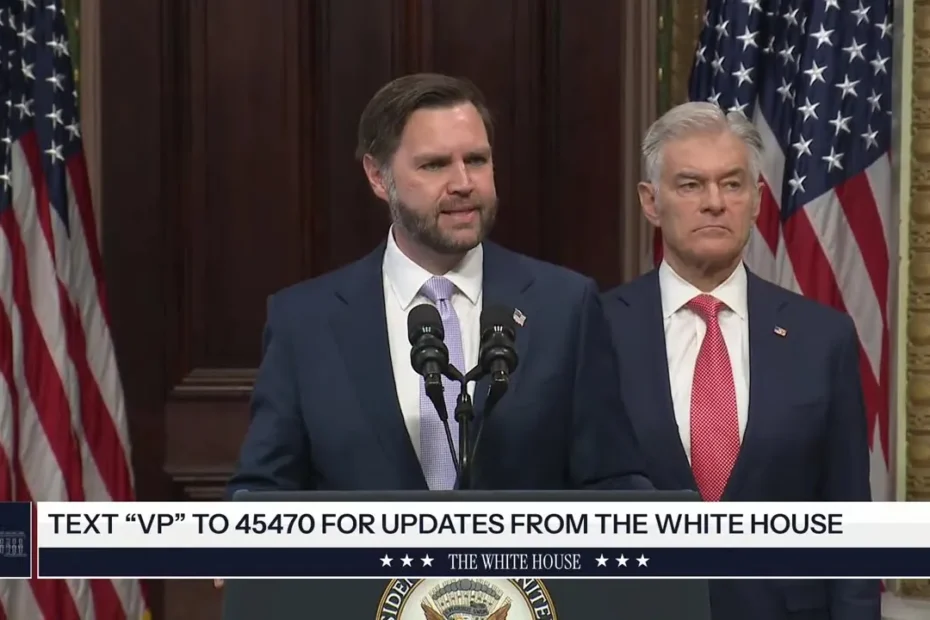
Editor’s Notes: Vice President JD Vance recently held a press conference at the White House to detail the administration’s latest anti-fraud initiatives. The event focused on new strategic measures aimed at safeguarding federal resources and protecting American citizens from financial exploitation. During his remarks, the Vice President highlighted the importance of inter-agency cooperation and technological advancements in identifying and eliminating fraudulent activity. This briefing serves as a key update on the executive branch’s commitment to maintaining fiscal integrity and government transparency. (May 13, 2026)
TRANSCRIPT:
Opening Remarks
JD VANCE: Good afternoon, everybody. How are we doing? Good. Good to see you all. So, as you know, the President just landed in China a few hours ago. You may know that because of Secret Service protocols that I don’t travel outside of the country with the President of the United States. So, on days like today, I sometimes feel like Macaulay Culkin in Home Alone. I walk into the White House, and it’s very quiet, and no one’s there, and it takes me a second to realize exactly what’s going on.
But we’ve got a very big announcement today, actually, a number of big announcements, and looking forward to hearing from Andrew and Dr. Oz and Kim about that.
Protecting Programs for Those Who Need Them
But let me just say that we’ve been hard at work over the last several months trying to make sure that we take care of the people’s money and trying to make sure that the services that exist for the betterment of our fellow citizens, whether they’re low-income kids who need access to food resources, whether they’re low-income families who need access to medical benefits, that those programs are protected for the people who actually need them, that they don’t exist to enrich fraudsters, but they exist for the American people for whom Congress has said they’re entitled. And that’s exactly what this Fraud Task Force is about.
One of the things that I thought going into it, but that I’ve learned about fraud is that it always has two fundamental victims. The first victim is the American taxpayer, who has generously paid into these programs in an effort to give their fellow citizens a leg up, but it also has, as its victims, the people who are meant to benefit from these programs who are not able to benefit or maybe are benefiting less because of what a disaster some of the fraud has wrought in these programs.
Deferring $1.3 Billion in Medicaid Reimbursements from California
And let me just give you a few concrete examples of what we’re worried about, of what we’re targeting, and also what we’re going to do to solve some of these problems. So, first we’re announcing that the federal government is deferring $1.3 billion in Medicaid reimbursements from the state of California. And the simple reason is because the state of California has not taken fraud very seriously, and because of that, we see a lot of the consequences that I just referenced.
And again, let me highlight the fact that this really is two separate victims. So there are California taxpayers and American taxpayers who are being defrauded because California isn’t taking its program seriously, but also you have people who’ve been prescribed medications that they don’t even need. Sometimes they’ve had drugs put into their bodies that they don’t need because fraudsters have actually encouraged false prescriptions and false administration of medications.
So think about this. You’re just a person trying to go see a doctor. You assume that your doctor is doing the right thing, but these fraudulent health care providers are getting rich by giving people medications they don’t even need. It’s a defrauding of the American taxpayer, but it’s a violation of the trust that should exist between every American and the people who prescribe the medications. That’s one thing that we’re targeting, and this is why we’re taking this action, is because we want California to get serious about this fraud.
Encouraging States to Take Medicaid Fraud More Seriously
The second thing I want to talk about, and it requires a little bit of background explanation, is that we are going to very aggressively encourage the states to take Medicaid fraud more seriously. So I think a lot of you understand, but for those of you watching at home who don’t appreciate this, the Medicaid system that exists in the United States is really 50 separate systems. The federal government pays most of the Medicaid money, but then each of the individual states actually administers the Medicaid program.
Now, we have red states and blue states that go after fraud aggressively, but we also unfortunately have some states, mostly blue states unfortunately, that do not take Medicaid fraud very seriously. So you have what’s called Medicaid Fraud Control Units, or MFCUs.
Medicaid Fraud Control Units: A Failing System
These Medicaid fraud, these anti-fraud units within the Medicaid program, we generously, meaning the federal government generously gives these fraud control units many, many billions of dollars across the United States of America so that they can take Medicaid fraud seriously.
But let me just give you an example to highlight how absurd some of these Medicaid fraud programs are, because they’re not actually being used at all. This is a tool. This is a tool that we want the states to use, but unfortunately a lot of states aren’t using these tools at all.
Hawaii: Zero Indictments, Zero Convictions
Let me highlight this with just a couple of separate statistics. The Hawaii Medicaid program has received billions and billions of dollars from the federal taxpayers, and of course, Hawaii taxpayers have paid in a lot of money into this program over the last years as well. Guess how many convictions or indictments Hawaii has had over the last few years in its Medicaid fraud program? The answer is zero.
Not a single indictment, not a single conviction, because the administrators of the Hawaii program just don’t take it seriously.
So what does that mean? That means that if you’re committing fraud in Medicaid in Hawaii, at least up until now, hopefully now they’re going to take it seriously, you have had effectively free reign from the government of Hawaii to commit as much fraud as you want. That is a complete disgrace.
New York vs. Indiana: A Stark Contrast
In New York, which does a little bit better, but not by much, New York has had nine indictments over the last year. Nine indictments. That’s a $100 billion Medicaid program just in New York, and you’ve had nine indictments.
Indiana, which has about a third of the population of the state of New York, has had more than four times as many indictments over the same period. So do we think, does anybody here seriously think that the good people of Indiana are 12 times more likely to commit fraud than the people of New York? No, of course not. That’s absurd.
What is happening is that the leadership in New York are just not taking the fraud issue seriously. They’re not using these anti-fraud control units to actually investigate and indict the fraud.
Federal Action: Letters Sent to All 50 Medicaid Programs
So what are we going to do to fix that? Today, we are sending across 50 Medicaid programs, we are sending letters that will require them to show that they are effectively and aggressively prosecuting Medicaid fraud in their states. And if they do not, if they do not aggressively prosecute Medicaid fraud, we are going to turn off the money that goes to these anti-fraud units.
And I want to say a couple of things about this. You may think, obviously, this is a Republican administration, we’re all proud Republicans up here. You may think that this is purely a red state or blue state issue. That’s actually not true.
We see Medicaid fraud issues in Ohio, the state that I used to represent in the United States Senate. We also see Medicaid fraud issues in a state like Maryland, which is obviously a very blue state. But both Ohio and Maryland have worked with us to take this issue seriously. They’ve worked with the guys behind me, they’ve worked with our entire team to make sure that they take fraud seriously.
Again, this does not have to be a red state or a blue state issue. This is just basic good government. However, states like California, states like Hawaii, states like New York have completely not taken the fraud issue seriously in the Medicaid program.
And so, for those states that refuse to get serious about fraud, we are going to turn off that anti-fraud money. And if we continue to find problems, we can turn off other resources within their state Medicaid programs as well. Our goal here is not to do that. We don’t want to turn off any money.
Protecting Medicaid and Medicare from Fraudsters
VICE PRESIDENT VANCE: What we want to do is ensure that people are taking fraud seriously. We want to protect Medicaid. We want to protect Medicare. But we can’t do that if the states that are administering those programs are allowing those programs to be fleeced by fraudsters. So we encourage, whether it’s California and New York or Maryland or Ohio, we encourage people to work with us. We want to help you use technology and other tools to get rid of the fraud, to get to the root of the fraud. We want to help you.
But we can only help these state programs if those state programs are willing to help themselves. So these letters are the first step, the first effort to try to force these states to get serious about prosecuting fraud. And that’s exactly what we’re doing.
Fraud in Home Health Care and Hospice Care
Let me just talk about one final issue here. We see a lot of fraud in the home health care and in the hospice care system. I think Dr. Oz will probably talk a little bit more about that. But again, you have to appreciate that this fraud issue is fundamentally theft from the taxpayer, but also theft from people who need these programs.
Just last month, a California psychotherapist, a woman who had spent 40 years treating patients, helping patients, helping people deal with problems, found out that her Medicare program had been turned off, that she did not have access to the resources that she had been paying into for her entire life. Why? Because a fraudster had stolen her identity and signed her up for health care services that she didn’t need, and so she had been turned off of the health care services that she did need.
This happens way too much in the United States of America, and it happens because until recently, we did not have a government or an administration that actually took the fraud program and took anti-fraud prevention seriously.
Why Anti-Fraud Efforts Are Happening Now
So let me just close with one final observation here. First of all, why are we doing this now? Why weren’t we doing this two years ago? And the simple answer is because we didn’t have a president and we didn’t have an administration who took fraud seriously. So I want to thank the President of the United States. I know he’s busy in China. All of these efforts, all of these things that we’re finding are because we have a president who has told us, take the fraud issue seriously, get to the root of it, and turn off the money when we find out that money is going to fraudsters. So that’s exactly what we’re doing.
A Personal Commitment to Fighting Fraud
But I just want to say that for me, and I think for a lot of people who are involved in this effort, this is very personal because I’m not just the Vice President of the United States. I come from a family and I grew up in a family where we sometimes benefited from these programs.
The generosity of the American people is one of the most amazing things about our country. I think all of us, of course, just passed tax day. None of us like paying our taxes, but we do it. And why do we do it? Because we know that it goes to give a bite to a low-income family that can’t afford food. We know that it goes to pay the military who keep us safe. We know that it goes to some essential services.
But that trust, that trust in our government, that trust in our institution, it depends on us taking that trust seriously. How long are people going to pay into programs if they know that that money doesn’t go to a low-income kid who needs health care, but that money goes into a fraudster getting rich? This doesn’t work and this doesn’t make sense unless we take fraud seriously.
So I’m proud to be part of an effort in our government. I’m proud to lead the effort in our government to finally take fraud seriously. We want to protect these programs for the kids and the families who need them.
Vice President Vance Commends Anti-Fraud Task Force Members
We want to ensure that the American taxpayer isn’t getting fleeced. And I’d say just a few months into it, gentlemen, we have done a very, very good job. Let’s keep it up. So let me turn it over now to Andrew Ferguson, who’s the Executive Director of our Anti-Fraud Task Force. Andrew has done an amazing job, but I have to give a special shout-out, not just because she’s my fellow Ohioan, to Kim, who has probably found more fraud and has saved the American taxpayer more money than any single official within the government over the last three months. Kim, you have been an all-star. We’re proud to have you on the team. Thank you, guys.
Andrew Ferguson Credits President Trump and the Vice President
ANDREW FERGUSON: Well, I couldn’t have put it better than the Vice President did. The only reason that what happened today happened is because President Donald Trump took this issue seriously that has plagued this country for decades and is committed to an all-of-government approach. And so to him is to who the credit goes. But the Vice President deserves tremendous credit here. It’s hard to get the whole machinery of government moving. You need someone with the Vice President’s abilities, with his gravitas, and with his determination to drive at these issues. That’s the other reason we’re here today.
And while I’m at it, I want to thank Dr. Oz and Kim Brant. A lot of the fraud problems are at HHS, and these two have committed countless hours, night and day, their staffs, their resources, to getting at these problems and fixing it. And where the states are unwilling to do their jobs and fix these problems, Dr. Oz and Kim have stepped up to take care of it.
I also, he’s not up here today, but I want to thank March Bell as well. He’s the Inspector General of HHS. A lot of the work we’re going to have to do to get the states back in line and stopping fraud is going to go through March’s office. You’ll see his signature on the letter that went to the state Medicaid control units today. There’s going to be a lot of work happening in the IG’s office, and we’re really pleased to partner with him.
Decades of Corruption in Blue States Called Out
It’s a shame we have to be up here at all, and with all due respect to the press, with this room full of reporters. It should not have taken a brave kid with a cell phone camera to point the American people at this issue. This is the result of decades of corruption, particularly in blue states like Hawaii, like the Vice President was just explaining, California, Minnesota, and New York, that have taken tens of billions of dollars to pay lawyers to go after Medicaid fraud that just simply have not done it at all.
That’s the whole point of these programs. If we have these cooperative federalism programs, we love federalism, we want to partner with states, we love subsidiarity, but if the states are going to participate in this, they have to protect their own citizens when they get access to these dollars.
States Failing to Combat Elder Abuse Through Medicaid Fraud Units
And not only are these dollars supposed to go to fight Medicaid fraud, I want to shine a light on the real human dimension of the complete negligence and malfeasance of some of these states here. One of the things they are obliged by law to do is stop elder abuse. That is one of the express commands that Medicaid fraud control units are given, is you are supposed to police Medicaid abuse and elder abuse in the Medicare system too, where so many of America’s elderly citizens receive care.
And so when the states just take this money and turn it into a jobs program for blue state lawyers, they are effectively participating in the elder abuse in those states, because the American people turned over their money to these state programs to protect their parents and their grandparents from elder abuse. And if you aren’t doing it, you are effectively participating in that process.
Identity Theft in Benefits Programs: The Real Cost to Real Families
The Vice President highlighted this problem that we have in Medicaid, which is if a fraudster takes your identity, signs you up for benefits, when you go to try to get the actual benefits you need, you can be denied them. This is a problem we have found all over the federal government in benefits programs.
I mean, imagine, we have examples of this. A mother on SNAP benefits going to the grocery store and trying to scan her EBT card to get groceries for her children, and some gang somewhere in California took her identity, maxed out her EBT card, and so her children are going to go hungry because of fraud that no one in the states is policing. And that is why what we are doing today is so important.
States Must Cooperate or Lose Federal Funds
The states should be our partners with this. We want to partner with the states. But what we aren’t going to do, as stewards of the American taxpayer dollar, is to send those dollars, billions of them, to the states to line the pockets of state attorneys general who don’t want to participate in protecting our benefits programs so that the people who really need them, the people that the American people have agreed to part with their hard-earned dollars to help, to defend, to protect, and to get through hard times, actually get the money.
And if the states don’t want to cooperate, for the first time, HHS, the Fraud Task Force, the Vice President, and the rest of the federal government are going to tell you, cooperate or lose your funds and we will do the job for you. Because at the end of the day, if the states won’t protect American citizens, the President of the United States and the Vice President will.
And that is why I am so honored to be able to participate in this process. Because this is ultimately about making sure, not only that we aren’t stolen from as taxpayers, but the American people who are entitled to this. For Medicaid and for Medicare, people who have paid into these programs their entire lives, actually get the benefits that they are entitled to. And with that, I’m going to turn it over to Dr. Oz to talk about all of the efforts at HHS.
Dr. Oz: Health Care Fraud Is the Largest Driver of Federal Waste
DR. OZ: Thank you, Andrew. Mr. Vice President, thank you for the leadership, the spirited desire to harness a group of stallions. They’re back there, by the way, if you want to see the men and women who are leading the task force, they’re at the back of the room. But they’ve done all the work that allowed us to come up here.
In February, we had the largest anti-fraud announcement from CMS, the day after the State of the Union address in which the President created this task force and appointed the Vice President to lead it. Today’s effort is larger. It’s much larger. And there’s a reason for that.
Half of the fraud, we believe, in the federal government could be coming out of health care services. We’re a large rhino that can be stabbed effortlessly by foreign governments, syndicated criminal entities, and smaller-time operators who can take advantage of the system with, as Andrew pointed out, as little as a Medicare beneficiary number, which is basically a credit card to defraud this system. Unfortunately, that results in about $100 billion of estimated theft just from Medicare and Medicaid.
Eliminating Fraud Could Double the Life of the Medicare Trust Fund
That’s just to put it in the context of affordability, which is a very important subtext of this discussion. We would be able to double the life expectancy of the Medicare Trust Fund if we could deal with the fraud issues just in Medicare. So anyone who’s out there working their tail off, hoping Medicare will be there with them and for them, and we know many young Americans don’t think that’s going to be the case, it will be the case. If we take the fraud out, it will be there for you and your children as well.
And stopping this as a means of extending the Medicare Trust Fund is a noble purpose, but as pointed out by the Vice President and Mr. Ferguson…
Five Major Anti-Fraud Actions: California Medicaid Deferral
It is about the human cost, because if these fraudsters are willing to take your money, they will definitely steal your life and take your health along the way. So let’s transition to the five major actions. I’m going to go through them in order. I’ll share them with Kim. Her nickname is Killer Kim. Mr. Vice President, you’ll learn why in a second. She is unstoppable, and you want federal employees like Kim out there like bulldogs going after this fraud. It’s right there for us to find, and if we have partnership with the states, it will help a lot.
VANCE: We need a better nickname for her. She’s going to work in health care.
DR. OZ: She’s a Buckeye. She’s a Buckeye, so I gave her a choice. Is that a typical name in Ohio? I don’t know.
California Medicaid deferral that the Vice President mentioned is $1.34 billion. Their submissions of Medicare records and the backup estimates are generating major red flags for us, and we have looked carefully at these records. We are allowed to audit, looking back, for a quarter. Dan Brillman and Caprice Knapp, who lead the Medicaid program, spearheaded this effort and with a great team. We’ve discovered $630 million in billing from the folks who are egregiously the top 5% of outliers in billing. This is numbers so big you can’t imagine anyone billing for these numbers of patients and that much for each patient, and so we’re asking California to clarify for us how it got there.
California’s Spending Growth in Personal Care Services
Second big area of observation is when you bill within a state, you should be comparable to the states around you, but in California, that’s not been the case. In California, the growth of spending in personal care services, in-home services, is twice the rate of the average of the rest of the country. Let me say that again. The rest of the country is one number. California is twice that number in its growth rate. We estimate there’s $500 million that could be at risk, taken from federal taxpayers. That means people in New Mexico, which is a blue state, are paying extra taxes so that Californians can get away with something that they can’t defend. So there’s $500 million there we’re going to defer to. They can show us more convincingly why that’s the case.
And there’s another $200 million that we’re stopping in questionable expenditures. Much of that is linked to immigration-related costs. Folks are undocumented and we’re not sure why we’re paying for this. And as you know from the Working Families Tax Cut legislation, which I’m going to emphasize is a program that saved Medicaid. The President and Congress saved Medicaid with that bill. That became legislation. There’s another $200 million at risk there. Add it together, $1.34 billion. It’s the largest deferral we’ve ever made. We’re making it for a good reason. We’d like the state to at least come to the table and explain to us how these outlier payments have been generated.
Home Health Care Fraud and Hospice Fraud
Second major issue is home health care fraud and hospice fraud. So let’s just clear this up. Hospice, end of life, designed 40 years ago, a beautiful program that’s designed to take care of you because you have cancer and you’re not going to survive more than six months. To do that, the federal government says we’re going to trade your Medicare benefit for hospice benefit. So you give up Medicare because why would you want to have coverage for things you’re never going to use? You’re dying. You want to die with dignity and grace. It’s a beautiful program.
Unfortunately, in California and other states, fraudsters have stolen your Medicare number, taken it, and given you hospice you didn’t want, which means if you get sick and go to the ER, you’re not getting care. And you can’t even find out what happened because you weren’t in the mix of this.
Hospice Fraud in Los Angeles: Staggering Numbers
There have been a lot of people complaining about this over the years, including people that should have been listened to, like the Auditor General of California, who in 2022 raised this issue to the current governor, and for some reason they have not taken action.
Unfortunately, we have a reality that, again, we’ve got to face, a third of all hospices, a third of all these programs in the entire country are in Los Angeles. Ask yourself, how is that possible? It’s not. There are not that many people dying in Los Angeles. We’re not talking about California, just Los Angeles.
So Kim and the team, with Jeneen Iwugo and a bunch of other great folks, went through the list of all the people, and we believe that at least half of the hospices in the entire area around Los Angeles are fraudulent. And today we announced 800 of those hospices have been suspended. That’s getting us close to where we think we should be. 800 hospices that last year charged the federal taxpayer $1.4 billion will no longer be paid.
800 Hospices Shut Down — And Barely Anyone Called
Mr. Vice President, if your core business was shut down by the federal government, would you call? You would call. Crickets. We have less than 20 who have complained. We’re not even sure those are legitimate. 800 hospices shut down, and we’re not hearing much. It’s crickets out there. So we believe we’re on the right path here.
Nationwide Moratorium on New Hospice and Home Health Care
Next is a nationwide moratorium on all new hospice and home health care. Why is that possible? Because when we squeeze the balloon in California and slow their growth of hospice and now take away 800, the payments to 800 hospices, we know what those fraudsters do. They move to nearby Nevada. Next door to Nevada has a seven-fold increase in hospice already. Arizona, Texas, they’re moving across the country.
So we’re today announcing a moratorium nationally. There will be no new hospices or home health care open in this country. If you have the program now, you can keep it. You can go to ones that already exist. We’re not taking away any services, but there will be no new ones, licenses granted, until we can figure out a better way of working across government.
A Powerful Fist Across Government Agencies
Let me highlight this, because when Andrew is leading and the Vice President is chairing this task force, it’s very simple. You have CMS. You have OIG, March Bell, sitting over there. You have the Department of Justice. You have the FBI. You have Treasury. You put those things together, you make a powerful fist, and that’s the fist we’re going to punch through, bureaucracies and realities that are stopping our ability to protect the American people.
States Respond to Revalidation Request
I’m going to leave you one last thought, and then I’m going to ask Kim to cover some of the issues around the MFCUs and the Medicaid war room that she’s creating. It is a reality that states are all over the place in their desire to partner with the Vice President and his task force.
There was a letter sent out two weeks ago asking every single state to respond within 10 days to whether or not they would be willing to revalidate their providers. What that means is if you’re providing home health care services, which are unlicensed people, providing services in undocumented areas that are unverifiable right now in many instances, basically you’re having your kids carry the groceries upstairs for you. These are services your family used to provide for you.
We asked all the states to work with us to validate if these are legitimate services from legitimate providers. Every single state responded. So contrary to the narrative around red and blue, every state wants to protect their citizens. Some are just more competent or brave enough to actually make those steps.
And for some reasons, as you heard today, California has been lax in this endeavor. We hope this wake-up call will be heard loudly across the beautiful state of California, whose people we’re trying to protect, sometimes from their own leaders. Kim?
The Medicare Fraud War Room: Stopping Payments Before They Go Out the Door
KIM: So when we took office a little over a year ago, we were looking at the fraud and abuse issue and saw that it was all pay and chase. We were going after the money after it was already out the door, and so we thought there surely has to be a better way. So we created the Medicare Fraud War Room, where we looked at claims in real time, before they were paid, so that we could determine were they legitimate, were there the outliers that we’ve heard examples of today, and how could we stop it.
Over the past year, since the Medicare War Room started on March 31st of last year, we have stopped over $2 billion from going out the door just by targeting those high-risk providers.
Expanding the Fight: The Medicaid War Room
Recently, a couple of weeks ago, we’ve decided to take it a step further, and we’re now doing a Medicaid War Room. And what’s unique about this is it’s the first time that we’ve ever partnered across the board with our law enforcement partners, the HHS-OIG, DOJ, the states, the MFCUs, the Medicare Fraud Control Units, all working together for the first time to look at Medicaid claims in real time, and be able to determine how we can stop those payments from going out the door, to stop the instances of an 89-year-old woman who had over 5,000 skin substitutes, or to stop the types of things that are just really aberrantly ridiculous.
So what we’ve done is we have data analysts, we have forensic auditors, we have law enforcement people all coming together in a virtual room. It’s not an actual room like you think of, like on TV, but they’re all in a virtual room where they are looking at this in real time and then making determinations about how we can shut those bad guys down and how we can take action.
And what has happened is we are now using our administrative authorities, payment suspensions, overpayments, civil monetary penalties, and the HHS-OIG exclusion authority to really be able to take action against these people and make it so that we can hopefully bring that money back where it needs to and never let it go out the door. But the key is we want to keep it so that it can provide the services for the people who most need it and who most benefit from it and stop the bad actors from getting all the benefit. Thank you.
800 Fraudulent Providers Removed — Fewer Than 20 Contested It
JD VANCE: Thank you, Kim. So, Dr. Oz, I want to make sure I understand this well. So you’re saying that we kicked off 800 fraudulent health care providers off of the Medicare system and not a single one of them called the government and said, “Hey, you made a mistake.”
DR. OZ: We’ve had a handful of calls. We’re not sure they’re legitimate yet, but it’s less than 20 out of 800, and we’re auditing them.
JD VANCE: Unbelievable. So at least 780 are not even trying to claim that they’re not fraudulent. And, again, those are businesses that we were giving hundreds of millions, in some cases billions of dollars to, not to provide services, but to make a fraudster rich. It’s just completely insane. Drives home the scale and scope of the problem. Okay, we’ll take a few questions. I will say the ground rules are I will take the easy questions. Any hard questions are for Dr. Oz.
Questions from the Press
REPORTER: Monica Alba with NBC News. I want to ask you first on the issue of fraud. As you’re saying, if the administration is calling to specifically withhold Medicaid payments, why should the people who rely on those payments suffer the consequences for a state’s failure to go after bad actors? And I have another question for you.
JD VANCE: So I want to be clear here. We’re talking about withholding the Medicaid fraud enforcement payments that go to the state bureaucrats. We’re not talking about withholding people’s benefits. We’re talking about turning off the resources that the state government should be using to police fraud. And then instead we’re going to use those resources ourselves because we’re actually taking the fraud issue very seriously.
Defending the Medicaid Program from Fraud
But I do think it raises a very important issue. There are going to be some, I’m sure, some politicians who say what you’re doing here is harming the Medicaid program. We’re trying to save the Medicaid program from dysfunctional state bureaucrats. If you allow hundreds of millions, billions, even more money to go out the door, not to health care services for low-income families, but to fraudsters, you eventually are going to destroy the Medicaid program.
So this is why we say red state, blue state, this does not need to be a political or a partisan issue. We want to work with you to eliminate fraud and make these programs last longer for the people who truly need them.
On Iran and Nuclear Proliferation
REPORTER: Thank you. Can I ask you, Mr. Vice President, when approaching the war with Iran, do you agree with the President’s position that Americans’ financial situations should not be a consideration in that decision-making process?
VICE PRESIDENT VANCE: Well, I don’t think the President said that. I think that’s a misrepresentation of what the President said. But, look, I agree with the President that Iran should not have a nuclear weapon. We’re obviously engaged in a very aggressive and very engaged diplomatic process to try to ensure that that doesn’t happen. And the President has a lot of options, as he said repeatedly. There are options diplomatically. There are options on the military side. But the fundamental goal here is the President wants to make the world safe, but particularly the American people safe from Iran having a nuclear weapon.
And one final point I’ll say on that is that nuclear proliferation is one of those challenges that people don’t realize it’s the biggest threat to America’s national security, and it’s not obvious until it is. Because what happens if Iran gets a nuclear weapon? Then multiple Gulf Arab countries are going to want to get a nuclear weapon. Then multiple countries from there are going to want to get a nuclear weapon. The goal of preventing nuclear proliferation is probably the single most important thing that we can do to keep our people safe for the long term.
It’s absolutely a worthy goal, but of course the President and I and the entire team, we care about the American people’s financial situations. It’s one of the reasons why we passed the Working Families Tax Cut. It’s one of the reasons why we’re so focused on fraud. We care about how the American people are doing economically. We’ve also got a number of other challenges. Of course, the President has to confront all these challenges simultaneously.
Impact of Fraud Savings on the Federal Deficit
REPORTER: On fraud, the savings that you find among all of these states, what impact would that have on a federal deficit?
VICE PRESIDENT VANCE: Well, I think it’d have a very big impact, but a lot of it does depend on how well the states work with us. We think we’re going to be much more effective if we’re working with California as opposed to fighting California over every billion dollars of Medicaid fraud that exists in their system. And there could be tens of billions, hundreds of billions of fraudulent payments within the California system. If you count what’s going to illegal aliens, if you count what’s going to people, fraudulent businesses, if you count what’s not going to the people who actually need it, but going to fraudsters, we would find that money a lot easier if California was working with us, which is why we’ve taken some of these steps.
And the letters fundamentally are outreach. We’re going to the states and saying, here are the things that we can do to work on this issue together. And of course, if they don’t work with us, there are going to be penalties. We don’t want to get there. We want to work with these guys.
You heard Dr. Oz say this earlier. I’ve looked at the numbers myself. It’s true. If you just deal with the fraud issue, you can prolong the Medicare and Medicaid trust funds well into the future. So it does have a significant budgetary impact, whether that’s hundreds of billions of dollars or maybe even more.
Fraud in Ohio and State Cooperation
REPORTER: Mr. Vice President, Reagan Reese with the Daily Caller. What’s your reaction to the alleged home health fraud in Ohio? And why do you think this is happening in a red state? And just a question of clarification. You mentioned that some states aren’t cooperating. What does that look like? Are they not responding to your calls? Are they stonewalling you guys? If you could expand on that.
VICE PRESIDENT JD VANCE: We’re not going to know until we do the work, but we’re going to do the work. Yeah, if I could on China. Let’s do one question from each person. Go ahead. We can do both of you guys. You guys can fight for who goes first. Sure.
So I’ll let Dr. Oz go into the details a little bit, but on the Ohioans in particular, look, this happens everywhere. We’re a big country. Hundreds of billions of dollars goes out the door every single month from the federal government, and inevitably you’re going to have people who try to take advantage of it.
What bothers me is not that you have a few fraudsters out there. It’s that the government hasn’t taken seriously pushing it back. You’re always going to have bad people. You’re always going to have a few bad apples try to take advantage of the system. What’s so unique about this country until recently is that we didn’t take that seriously. We didn’t try to push back against the fraud, and that’s what’s changed.
When I talk about cooperating with these various states, and again we’ve had some good cooperation with both red states and blue states, it’s very context-specific. But for example, let’s say that we know we have a number of fraudulent Medicare or Medicaid providers. Working with the federal government to identify who those are to kick them off the roll so that when those companies, those fraudulent companies, submit a reimbursement, they don’t actually get any money in return.
Now sometimes the federal government has a better perspective on that. Sometimes the states do, but that’s one example of ensuring that local providers that are fraudulent are not able to get reimbursed or not able to get access to the resources. That’s just one example. Dr. Oz, I’m sure you probably have a hundred more in that brain of yours.
Minnesota, California, and the Hospice Fraud Crisis
DR. OZ: Very succinctly, Minnesota, which we announced the deferment there when the Vice President and I were in this room several months ago, sued us. And we’re trying to get them to wake up to a problem. The amount that we deferred was a small percentage of their rainy day fund. They sued us and sought a temporary restraining order. That’s not what a partner does. The judge did not give them a temporary restraining order.
We’re going to California now in part because we couldn’t get them to respond on things that we think they should have taken proactive steps on. If they’ve been warned for at least four years by their own Auditor General that there’s a massive problem with hospice and they don’t deal with it, it pollutes the entire ecosystem. It creates corruption that rots the foundation of who we are.
So on the 19th of December, after it had gone through all the different processes, the State Department of Health in California was going to mandate by the first of the year that you cannot have more than one hospice per provider. This is a red flag issue. Why would a doctor need to have 20 hospices? You have one hospice, do it right. They do 20 hospices because they’re taking bribes, they’re selling their license and their soul.
For reasons we don’t understand, and I’d love to pose that right here to the State of California, someone very senior in their government pulled down that rule, never let it issue, and we never got help from them. That’s why we went out the first week of January to say what’s going on here? And we find out that, as the Vice President mentioned, the Medicare Fraud Detection Unit sometimes are not being enabled to do their jobs.
On Medicaid Fraud: A Feature or a Flaw?
These are the kinds of behaviors that people take when they’re trying to hide the ball. And a question I’d love to ask the media to opine amongst yourselves, we’re debating it as a task force, is do the governors always feel that fraud in Medicaid is a flaw? Or are there sometimes some reasons why it might be a benefit, might be a feature of the way they’re running Medicaid?
The same way we have to stop legalized money laundering through state-directed payments and provider taxes in the Working Families Tax Cut legislation, we are concerned that some governors see these programs as jobs programs and their downstream impact of that that resembles political patronage that we’re very serious about.
Question on the Trump-Vance-Rubio Ticket Speculation
REPORTER: Mr. Vice President, thank you so much. Leonardo Feldman with Newsweek. Can you tell me a little bit about the President has been toying with this idea of a joint ticket between you and Rubio. What do you think about that?
JD VANCE: Oh man, what I think is, there are a few topics that I want to talk about less than what office I’m going to run for years down the road when I’m having a good time and trying to do good work in the job that the American people already elected me to do.
Look, I’ve answered this question probably in any number of ways. I love Marco. I think he’s a great Secretary of State. He’s become a very, very dear friend, but I think both of us are very much focused on accomplishing the American people’s business right now.
If I was the American people, there are a few things that I would hate more than a person who’s barely been in one office for a year and a half is angling for a job two and a half years down the road. Let’s do a good job now. We are. We just got to keep at it.
On President Trump’s Comments About Succession
REPORTER: I have a broad question. This is Kit with CNN. It’s not us who are bringing this up. A couple days ago, Trump made this statement to people in the Rose Garden. Why do you think he does that? Do you think it’s a little bit of toying with you both over your succession? Why do you think he brings that up?
JD VANCE: Well, I just don’t think it sounds like the President of the United States to have a televised competition for who would succeed him as his apprentice. I just think that’s not at all what you would expect the President to do.
But no, look, I think the President, he’s always been fascinated by politics. If you talk to him, he was fascinated by politics 30 years before we ever ran for office. So I think it’s natural for him to joke around with us a little bit, to play around with the idea, but I can tell you the President is as focused as any of us on making sure we do as good of a job now for the American people.
On Working With the Governor of Maine
Yeah, there’s been some back-and-forth. We’d love to have a better conversation, a better relationship, and work very deliberately on this question of fraud and certainly have an open hand, have an open heart in this White House to working with anybody, including the Governor of Maine.
I’m not going to tell you everything I’m going to say tomorrow in Maine, because if I did that, why would I go to Maine tomorrow? But I’m looking forward to it. It’s a beautiful time of year to be in the state of Maine. We’re going to campaign a little bit with Paula Page and talk about the fraud efforts that we have going on and talk about a few other things as well.
Question on the Optional Practical Training Program and Fraud
REPORTER: Thank you. This is Elizabeth Mitchell with the Daily Signal. The Fraud Task Force and ICE identified more than 10,000 alleged cases of fraud in the Optional Practical Training Program. Some Republicans have been calling for this program to end. In light of this, is the Trump administration looking into changes to this program in light of the fraud?
On the Optional Practical Training Program
REPORTER: Sorry, changes to which program in particular?
REPORTER: The Optional Practical Training Program.
VP JD VANCE: Yeah, so we’re looking into a lot of this stuff and, you know, the fundamental question obviously is we want to save the American people money, but we’re also trying to preserve programs that exist for the benefit of the American people. We’re also trying to make sure that we do this in a way that’s defensible, that’s not going to get challenged in a court, or if it does get challenged in a court, where we can defend things. So, Dr. Oz, you want to say anything about that particular program?
DR. OZ: We’re going to keep, we’re looking at everything.
The Scale of Fraud in the Federal Government
VP JD VANCE: I will tell you that once a week I get an update from Andrew and from the team on the number of things that we found in the Anti-Fraud Task Force and it’s kind of shocking. You know, people, I go on the road and talk to, you know, a lot of folks out there. I was in Iowa last week and one of the most common questions I got was, “Is the anti-fraud thing, is it hard?” And I’m almost confused by the question because unfortunately there’s so much fraud in the federal government.
There was so much that we allowed to accumulate over the four years of the Biden administration and frankly probably over 40 years of bad American governance. There is so much fraud for us to go after. What we’re trying to do is go after the highest value targets and the things that preserve these programs for the American people.
On Bureaucrats Potentially Complicit in Fraud
REPORTER: Yes, sir. Thank you. You said that administrators, they don’t care or that they’re neglectful with the funding, but does your team think that there are bureaucrats in federal or state governments who are actually complicit in helping fraudsters?
VP JD VANCE: Well, we think it’s possible. Right, I don’t want to prejudge these things, but we’ve certainly seen reports of, for example, Gavin Newsom in California or Tim Walz in Minnesota getting these reports that there were fraudulent activities happening in their states and then looking the other way. Whether that rises to the level of criminal conduct, I don’t know, but we’re certainly looking into it.
Because as much as we care about protecting these programs, we also care about ensuring that federal and state officers aren’t violating the law. And if they are violating the law, then of course we have to prosecute them. That’s an important part of equal justice under law. So we’re looking into this stuff, but I can’t commit to it. Because unlike the last administration, we tend to only prosecute people when they’ve actually violated the law, not just because they have the wrong political affiliation.
Dead Americans on Food Stamps
REPORTER: Yeah, go ahead. Dead Americans on food stamps. I’ll take it, I’ll do this again. Dead Americans on food stamps, you mentioned the other day. 186,000 dead Americans, to your knowledge, are receiving food stamps. Are you confident that you can get that number down to zero?
VP JD VANCE: Well, I want to be clear, I don’t actually think 186,000 dead Americans are receiving food stamps because that would be impossible. I don’t think that we have 186,000 ghosts walking into the grocery store and achieving benefits. I think that we have people who are claiming that they are getting food stamp benefits. They’re using the identity of a dead person. So it’s very much a living person. It’s a living fraudster who’s stealing the identity of a dead American. I just want to be very clear about that.
But look, we know this is happening. We think that it’s costing the American people hundreds of billions of dollars. By the way, another hidden cost of fraud is that it drives up the cost of goods for everybody. Because if you’ve got hundreds of billions of dollars chasing food that is going to dead Americans, living fraudsters, that’s going to raise costs for everybody. So it actually is one of these things that has multiple, multiple victims, including the fact that it’s driving up the cost of goods for other Americans.
REPORTER: And on the China Summit, sir.
State Cooperation and Anti-Fraud Guardrails
REPORTER: Yes, all the way in the back. On the China Summit, one question on the China Summit.
VICE PRESIDENT JD VANCE: No, sorry man, you got two, I think. I really like your jacket, but still only one question. I’m going to stick to my role here.
REPORTER: Thank you, Mr. Vice President. Daniel Baldwin, One American News. You spoke a little bit about states cooperating. And that was a big theme the first time you and Dr. Oz came here and spoke to us about the Minnesota Medicaid payments. You referenced Maryland as a blue state that’s cooperating. You mentioned red states that were cooperating. Have you guys been successful in putting up any guardrails with states that have cooperated thus far? And what do those guardrails look like?
VICE PRESIDENT JD VANCE: Well, the biggest guardrail is the one that we announced today, which is that if you have all of this money that’s going for Medicare fraud prevention or Medicaid fraud prevention, and you’re not actually using it, we’re going to take that money back and use it with our prosecutors and our investigators to ensure that we’re actually looking at fraud. And then what that would do eventually is that it would allow us to actually engage in some other enforcement actions. If they’re not taking the anti-fraud stuff seriously, then there are some additional steps that we can take beyond that.
I think the approach that we’ve tried to take really has been collaborative. We’ve tried to identify with the states, here are some examples of some very bad fraud. Here are some things that you can do to fix it. Here are some ways that we’re willing to use our resources to help you. And again, most states have been pretty good.
There have been a few, unfortunately, very large states that collect a lot of money in federal revenue. And I think a lot of us know why that is. You have political leadership that doesn’t like the idea of cooperating with a Republican administration, even though it’s a very common sense, good government principle. I think you have some people who know that a lot of their constituencies, maybe some of their donors are getting rich from fraud.
But regardless, red state or blue state, we’re going to go after it. We have to, this is so important. We are not going to have a generous country if Americans think that they’re paying their taxes not to needy people, but to fraudsters. That’s fundamentally what we’re trying to fix is rebuilding America’s trust that when you pay your taxes, when you send money to a program, it’s actually going to the people it’s supposed to go to. It’s a fundamental principle of good governance. It shouldn’t be anything Republican or Democrat. It’s just good government.
On Partisan Concerns and the President’s Remarks
VICE PRESIDENT JD VANCE: Yep. Go ahead.
REPORTER: Taylor with Spectrum. Good to see you. You’ve emphasized a lot how you want this not to be partisan and you want, you’re going to look at red and blue states. The president, when he posted about you becoming the fraud czar last month, he wrote, “The focus will be everywhere, but primarily in those blue states where crooked Democrat politicians have had a free for all.” I’m curious, as you guys have been trying to interact with these states, do you worry that the president’s remarks like that undercut the efforts for this not to be partisan and that could lead to resistance?
VICE PRESIDENT JD VANCE: No, I don’t worry about that because he’s talking about crooked governors. And of course, if you have a crooked governor, they’re not going to work with us and we’re going to have to use other tools to ensure that they do. But I think there are a lot of governors, Democrat and Republican, who recognize that this is a very serious problem, that we’re offering resources to try to help solve that problem. And I think a lot of them recognize that, yeah, they’ve got maybe a few crazy people in very far left states, but most people, most Americans want to solve this problem. And I’ve actually been gratified by the fact that we’ve gotten a lot of cooperation from across the political spectrum.
On Congressional Cooperation and the Fraud Task Force
JD VANCE: One other point about cooperation, we’re not there yet, but one of the things we’re going to do on the Fraud Task Force is, look, we’re learning. We’re learning a lot about the way the government operates. I mean, Andrew is, I almost feel bad for him sometimes because he comes to me once a week and says, here’s this bureaucratic hurdle, or here’s a wall that I’m running into that I would have never known even existed until we started to take this fraud stuff very seriously.
So we’ve learned a lot over the last six months. We are eventually going to realize that there are tools that we do not have, that there are things that we need to do that Congress is going to have to step in and cooperate on us. I think that’s going to be a big question of bipartisanship and common sense is when we identify some tools that we need to more fully go after the fraud problem, is Congress willing to play ball? Are they going to fight us every step of the way? I hope they play ball. Partisanship is crazy in this town, but again, this is such a common sense thing that I would hope that everybody would want to protect the American taxpayer’s money.
On Iran Nuclear Negotiations
Go ahead. Jennifer Jacobs, CBS News.
REPORTER: On Iran, can you tell us where negotiations stand? The president, before he left for Beijing, called the latest proposal unacceptable. So is the US even talking to the Iranians right now or where are things at this point?
JD VANCE: Yeah, so look, obviously these negotiations are very sensitive. I’m not going to tell you everything because we’re trying to have a productive conversation. I spent a good amount of time on the phone with both Jared Kushner and Steve Woodcoff this morning, a number of our friends in the Arab world this morning.
Look, I think that we are making progress. The fundamental question is do we make enough progress that we satisfy the president’s red line? And the red line is very simple. He needs to feel confident that we’ve put a number of protections in place such that Iran will never have a nuclear weapon, right? That is the question. Do we meet that threshold or not?
I think that we’ve made a lot of progress since we left Pakistan. I thought we made some progress in Pakistan, but we’ve made more since then. But that is fundamentally what we’re negotiating towards is we want to be able to look the American people in the eye and say with confidence that you are not going to have to worry about this very, very dangerous regime having access to the most dangerous weapons in the world. That’s the goal that we’re focused on.
Again, there’s a lot of ways to accomplish that goal. The president has set us off on the diplomatic pathway for now and that’s what I’m focused on.
On the White House Security Infrastructure Project
Yep. He’s got it. We’ll do a couple more here.
REPORTER: Thanks a lot. There was pushback from Senate Republicans yesterday in the Congress meeting about the cost of the ballroom, which has ballooned to about a billion dollars for the security aspect. Is there an IG either for GSA or the Treasury who would or should be eyeballing that project? And how do we make sure it doesn’t balloon like some of these other government spending, building projects?
JD VANCE: Well, I’m sure because of the nature of the project, you’re going to have inspector generals who look at this, who look at the auditing, who look at the accounting, who make sure that this is done in a good way. I will say the president of the United States is a very good builder. And the reason why this is expensive is not because of the ballroom. The reason this is expensive is because of the security precautions necessary, things that have nothing to do with the ballroom itself, but have to do with the actual security infrastructure on the White House.
On National Security and Protecting the President
VICE PRESIDENT VANCE: We saw a couple of weeks ago what can happen when you gather the president of the United States and a number of people who are in the line of succession in the same room. We almost had something very terrible happen. And thanks to the Secret Service and their incredibly quick response, we didn’t have a terrible thing happen.
But one of the things that’s taught us is that we’ve got to update. And there are things, frankly, I wouldn’t even talk about in a public forum. There are parts of, sorry, there are parts of our national security. And there are parts of the international sort of world that are very, very dangerous. And the president needs to be protected. The senior officials in our government need to be protected.
And that’s fundamentally what this is all about — is ensuring that on the White House grounds, we have what’s necessary to protect the president, whether he’s engaged in a state dinner, which, of course, is an important part of the president’s functions, or whether he’s engaged in the day-to-day functions of being president of the United States. Go ahead.
On Inflation and the Economy
REPORTER: Thank you, Mr. Vice President. My question is, what’s your message to Americans as the Iran war continues to impact the economy, especially after yesterday’s inflation report?
VICE PRESIDENT VANCE: Well, I guess my message to Americans is we know that we have a lot of work to do in order to deliver on the prosperity that the American people deserve. The president is hyper-aware of this. I’m hyper-aware of this. We talk about it all the time.
We know that the American people inherited a very bad inflation crisis. Yes, the inflation number last month was not great. But take it back to May of 2023 in the Biden administration, or take it back even further, we’re not seeing anything like what we saw under the Biden administration. And that’s a problem in and of itself because what it means is that a lot of Americans saw their wages eaten away under the Biden administration. They saw the values of their paycheck eaten away during the Biden administration. And one of the things we were elected to do, of course, was to fix that problem. And I promise you the president is laser-focused every day on fixing that problem.
Now, what I will also say is that whether it’s the working families tax cuts, putting more money in the pockets of the American people, whether it’s bringing a lot of investment into the United States so that we can build the factories and the jobs of the future, the president’s laser focused. This stuff does take time. In the same way that the Biden administration’s inflation crisis ate away at workers’ paychecks for four years, it’s going to take us a little bit of time before we get workers in a position where we feel like we can look them in the eye and say, you are much, much better off. But that’s what we’re trying to do. We’re going to keep on working at it.
I think we’ve made a lot of progress. If you look at the average household wage increase since Donald Trump became president, it’s gone up, but we came from a pretty deep hole — meaning a pretty deep hole, the Biden administration — we’re digging ourselves out of it. And what I want is for us to completely dig out of that hole and then to build a brighter and better and more prosperous future for the American people. That’s what they elected us to do. And that’s very much what we’re focused on, sir.
On Quantifying Fraud Linked to Illegal Immigration
REPORTER: Thank you, Mr. Vice President. Can we quantify the amount of fraud that’s related to illegal immigrants? And what are the asks of California and these other states? What can they do to claw back some of this money that’s being deferred?
VICE PRESIDENT VANCE: You know, I don’t know that you can quantify it because it’s so hard to keep track of all of the criminal migrants who are taking advantage of our system.
The Cost of Illegal Immigration to American Taxpayers
VICE PRESIDENT JD VANCE: I mean, they’re taken advantage by, you know, the average criminal migrant that we have in an American prison is costing us $60,000 to $120,000 a year, depending on the location. They’re collecting health care benefits. A couple of states, California, New York in particular, they actually allow illegal aliens to benefit from the American people’s health care programs, which is just a disgrace and just a travesty.
I mean, if you go into an emergency room, you should know that you’re waiting in line with other American citizens, not with people who have been placed to the front of the line by a fraudulent Medicaid program in California. But that’s what’s happening. We know this is what’s happening. And again, it’s driving up costs for everybody. It’s making it harder to access health care, and it’s absolutely fleecing the American taxpayer. It is a lose-lose-lose proposition.
America First: Protecting Federal Programs for Americans
You know, I’ve seen efforts to try to quantify this. I think the answer is hundreds of billions of dollars a year, whether it’s $300 or $600 billion. It is a lot of money between Medicare, Medicaid, food stamps, prison fees, everything that goes into the criminal migrant problem in the United States of America. It’s a lot of money.
And again, I talk about the American people. We’re a generous country. We’re a generous people. I love that about this country. But part of that generosity is that it extends to our fellow Americans. We cannot give Medicare and Medicaid benefits to everybody all over the world. It’s going to bankrupt those programs. They ought to belong to Americans first.
And that, to me, is the fundamental meaning of America first, is that all of us take a look at our programs, take a look at the fraud, and we say, how do we ensure that the federal government works for the American people first? That’s what we’re doing every single day, and we’re going to keep at it. Thank you, guys.
Related Posts
- Alex Bruesewitz Interview: Tucker Carlson Show (Transcript)
- Transcript: Trump Remarks at the Faith & Freedom Coalition’s 2026 Policy Conference
- Yalda Hakim Interviews Tucker Carlson (Transcript)
- Modern Wisdom: Ezra Klein Interview – Collapse of American Politics (Transcript)
- Transcript: President Trump Signs Executive Orders – Jun. 22, 2026