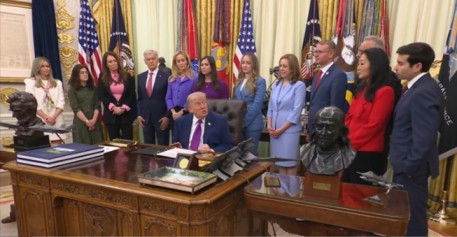
Editor’s Notes: On May 11, 2026, President Trump hosts a landmark Maternal Healthcare Event at the White House to announce groundbreaking initiatives aimed at supporting American families and mothers. Alongside leaders like Senator Katie Britt and Secretary Robert F. Kennedy Jr., the President unveils new fertility benefit options for employees and the launch of Moms.gov, a comprehensive resource for prenatal and postpartum care. The event highlights the success of the Trump RX program in drastically lowering prescription drug costs while outlining strategic investments in rural healthcare and childcare reform. The event concludes with the President addressing critical national security updates and international relations regarding Iran.
TRANSCRIPT:
President Trump Announces New Fertility Benefit Option
PRESIDENT TRUMP: Well, thank you very much everybody. This is very important. A lot of important things happening in our country right now, but we’re doing very well. Most health care plans do not cover these benefits, but today I’m pleased to announce that the Department of Labor is issuing a new rule to formally create a fertility benefit option for employers that can be offered to all employees outside of their normal health insurance plans.
It’s a big deal. They were not properly taken care of. Katie Britt knows that better than anybody else, who called me and said, I must say, I shouldn’t admit this, but the first time I really heard about the fertility was through Katie. She said, “Sir, we have to do something,” and I’m a quick study, so I learned everything there is to learn in about three or four minutes, and I became the father of fertility.
Now it just made a lot of sense to me. She explained it well, and I hope you tell that story, what happened to you, that you were virtually attacked with a bad ruling from a court. They gave a very bad ruling, as you remember, in Alabama. We had to step down and save the day and make sure that we had nationwide access to IVF, and it’s done so much since then, and we are so grateful. We had something passed within two days after that, so it’s really pretty amazing. You don’t see that happen very often.
Fertility Coverage as a Supplemental Benefit
But this will be a supplemental option available to those who need it, much like vision or dental insurance, so we’re bringing it right down into the mainstream. By offering coverage for care at every step, the fertility journey is a very interesting one, very complex. It was, and we’re making it much simpler. This will hopefully reduce the number of couples who ultimately need to resort to IVF because challenges can be identified and addressed very early in the process.
This is a new benefit. This is a benefit that so many people have called me about. I mean, it’s incredible. Oz and Bobby, I can tell you, we speak about it a lot. So many people have called me about, we have to do this. They’ve been waiting for it for a long time. But this is a new benefit or an option that will be a major help for millions of American moms that will result in more beautiful American babies. We like that.
Most Favored Nation Agreements and Drug Price Reductions
To further reduce the cost of fertility care, my administration has negotiated unprecedented most favored nation agreements with all of the world’s leading pharmaceutical companies and nations. You think that was easy? That was not easy. The nations in particular, I’d say, and I challenged them with tariffs. “You don’t want to give us what you want. I’m putting tariffs on your nation.” “Sir, we’ll give it to you immediately.” Actually, you think Biden could do that? I don’t think so. Nor did he try, Bobby, right? They didn’t even try. They never tried anything.
One drug commonly used in IVF has gone from, as an example, nine hundred and sixty six dollars to one hundred and sixty eight dollars, a difference of five hundred percent. This is the most incredible thing. It’s not talked about by the fake news. It’s sad because it’s the biggest thing to happen. I think we’re getting drug prices, prescription drug prices down by four or five hundred percent or depending on the way you want to phrase the question. You could say four or five, six hundred percent. And you could also say 80 percent, 70 percent, et cetera. It all depends on the way you phrase the question. I like the five hundred better.
And since we launched that website just a few months ago, it’s called TrumpRx.gov. It’s through the roof. Is that a correct statement? And if I were you, Tom, that was your idea to call TrumpRx.
TOM: That wasn’t my — the president did not propose that thing. But everyone else thought it was a great idea.
Most Favored Nation Drug Pricing
It is working spectacularly well, incredibly effective at so many things that there’s not an American around buying medication. You should not check TrumpRx.gov.
First, we propose, Mr. President is going to save us six hundred billion dollars over the next decade because of savings we can achieve from the most favored nation drug pricing that Secretary Kennedy organized.
TRUMP: And the media doesn’t write about it. If a Democrat proposed it, it would be front page news every day for the rest of your life. The media, they don’t want to write about it.
Think of it. We’re reducing drug prices by 500, 600 percent or 80 percent or 75 percent. Anyway, it’s all about the phrasing of the question. And the media doesn’t write about it. It’s amazing. It’s so sad. It’s so biased.
And that’s why the media, their approval rating went down just today. Twelve percent. You’re twelve percent. That’s why I got elected with 97 percent bad stories. I won in a landslide because you have no credibility.
It’s probably the biggest story. Certainly, it’s got to be maybe the biggest story in medicine, if you think. I mean, when you get drug reduction prices of 60, 70, 80 percent, a pill that costs ten dollars in Germany costs in New York City 130, 140 dollars. Now, the pill is going to go to 20 dollars in Germany and 20 dollars for us. So we’re going to have the lowest prices anywhere in the world. And I think we can’t get a story about it. They won’t write it. It’s the biggest medical story there is that we cannot get a story about.
I think I’m going to ask Walmart for a little help. I think if you can explain the trick, let me know.
Fertility Medicine Savings and Economic Projections
But since we launched the website just a few months ago, over 19,000 Americans have used those fertility medicines and discounts and saved more than 15 million dollars just in a short period of time, a matter of weeks. The Council of Economic Advisers projects that the number will rise to four point six billion dollars over a fairly small number of years. Nobody’s ever seen anything like this.
And we had to get the countries first. We had to get the companies and the companies were pretty good, but they knew I couldn’t get the countries. So they didn’t care that much. I think when we got the countries, I think they said, “What’s going on?” And yet they’ve done fine. They do more business and they made it up in volume. Right. They made it up in volume as the old story went.
Supporting Moms, Women, and Working Families
There are many other ways our administration is supporting moms and women. We passed the largest working family tax cuts in American history. By far, we passed the largest tax cuts, not only for women, for everybody, but for women. So many working women. We passed the largest tax cuts in history.
We also made a historic investment in rural health with 50 billion dollars distributed across all 50 states. And that gives each state a lot of money over the next five years. Ten billion dollars has already been distributed. And you see the results all over the rural part of the United States, which I’m proud to say I won by about 80 percent of the vote. And many states are investing in improving maternal health care.
Every Democrat in Congress voted against this historic funding. The Democrats — well, they suffer from Trump Derangement Syndrome. They don’t even know what they’re looking at. They can’t even see straight. But I have a new way out. I’m going to propose something the opposite of what I want, and we will have massive amounts of legislation. We will not build the wall. I’m going to go the opposite. Whatever is bad, I’m going to go for it. They’ll approve what’s good.
Finally, they got serious Trump Derangement Syndrome, which actually is a disease. I’m hearing it is actually a disease.
Child Care Reforms and New Federal Initiatives
It’s an honor. Today, we’re also enacting groundbreaking child care reforms to improve federal child care programs, including Head Start and Child Care Development Fund that goes to each state. It’s big stuff. These reforms will give states more flexible, lower costs, increase options and empower parents to choose what care works best for them.
There’s a lot of options that you’re going to have under this plan. You have, I think, pretty much maximum, highly, I think, maximum options. And that’s what we’re looking for. Maximum options at the lowest cost. And you’ve got a cost that if you were here a year ago or if you were here like during the last administration, you’re talking about a cost that would be eight to 10 times more expensive than what we’re doing. And same exact, same exact prescriptions, same exact medicine, same care at 10 percent.
It will also free up child care funding for hundreds of thousands of additional children to support stay-at-home parents.
Launching Moms.gov
In recognition of this ambitious agenda to support American mothers, Today, we’re announcing a new website that is online right now. It’s Moms.gov. Moms.gov. You couldn’t have put that in the Trump deal? You had to give me a new one in the competition? This guy. He wants to make me work so hard. So explain Moms.gov, would you please, Dr. Ross?
SPEAKER: Well, we’re going to have a whole discussion about it, sir, a little bit later. We want Katie to speak a bit about the first issue you mentioned. But Moms.gov is a beautiful site. Folks want to check it right now while we’re talking.
KATIE BRITT: Yeah, you really should. And it’s pretty incredible, something that Senator Rubio and I tried to do, sir. You’re the one who actually did it.
TRUMP: Well, I like TrumpRx.gov. All right. I love moms, but I like TrumpRx.gov. All right. I got to make sure we see competition. Now you want to work at. We’re only kidding. I have to say we’re kidding. Otherwise, they’ll do Trump and I said a major… Bobby broke him up. Terrible, terrible.
These people — I encourage every mom to visit this new page where they will find helpful information about addressing clinical care, pregnancy, resources, nutrition, tips, Trump Rx, and Trump accounts.
Trump Accounts and Supporting American Families
Trump accounts has been amazing for the kids. It’s Michael and Susan Dell. They put in six billion, two hundred and fifty million dollars to start it. And that’s another one that’s gone through the Trump accounts. These are young kids. They turn 18 or 20 or 21. They feel like — they feel like a billionaire. Used to say a millionaire. Now you say a billionaire, but they certainly feel rich as opposed to having absolutely nothing.
It’s so popular. So many people — we have people in one case took over the entire state of Ohio. It’s putting up the money for every kid in the state of Ohio.
Introducing Senator Katie Britt
Supporting the journey of American moms at every stage is so important to the success of our nation. Now, I’d like to ask Senator Katie Britt. She’s the one that got me into this. I have to tell you, I hope she always remains loyal to me so I can continue to support her. I would hate to go against you. That will never happen, Katie. Right.
KATIE: That’s right.
TRUMP: But just say just a few words. She’s really a fantastic woman. She’s a great senator. And I got lucky. I was supporting somebody else. And then I realized that somebody else wasn’t very good. And I said, “Who’s that young woman I met? I was so impressed.” They say her name is Katie. I said, “Let me talk to her.” I talked to her. I endorse you. She won in a landslide. And you’ve been winning in landslides ever since. So you’ve been doing a great job, Katie. Thank you very much.
I thought I should explain it. Say a few words. Katie’s going to say, and followed by Monique Pruitt, and then Olivia Walton, then Dr. Oz, and Dr. Dorothy Fink, and Dr. Alex Adams.
Promises Made, Promises Kept: Expanding Access to IVF and Fertility Treatment
And you’ll speak not too long because I am being waited on by a large group of generals. And that’s also important, you know, having to do with the absolutely lovely country of Iran. That’s the way they pronounce it. We will get started then.
KATIE BRITT: Mr. President, thank you for your work. And we are here, guys. This is another example of promises made, promises kept. I mean, we’ve looked at what President Trump did when we dealt with this issue in Alabama. He stepped up to the plate immediately to make sure that we had nationwide access to IVF, to making sure that we had comprehensive fertility treatment, so that men and women, couples who were longing for their child, could continue to have that hope and also have that reality.
Today doubles down on that yet again. I mean, we see the savings that have happened across the country, and I’ve had more and more people come up to me and tell me a story about what it has saved them. But we also know that there was opportunity for continued growth. President Trump saw that, and he acted on it. So now more people are going to have access through their employer, just like they would with dental or vision insurance. And there are people right now who this is out of reach because of affordability, and President Trump is bringing that back in.
Supporting Mothers at Every Stage: The Launch of Moms.gov
When you look at the comprehensive nature of what we’re doing today and coming on the heels of Mother’s Day, I mean, we are thrilled to support mothers everywhere, whether it’s that mom that is getting to experience growing life for the very first time, or the one chasing toddlers or wrangling teenagers, or being there when their adult child calls for advice. Moms are the heartbeats of our families, our communities, and our country.
President Trump knows that, and he’s made sure we’ve created a comprehensive culture of life. And that’s what you see right now with Moms.gov. Moms.gov was something that then-Senator Rubio and I talked about doing with Senator Kramer and now Senator Schmidt, but of course, President Trump is actually going to put it into action. It supports moms through the prenatal, postpartum, and early childhood development stages of motherhood.
Addressing Maternal Care Deserts and Maternal Mortality
Also, as we tackle rural health, look, I stand up here in front of you not only as a mom of two, but also as someone who lives in the great state of Alabama, where about 28% of women live in a current maternal care desert. The work that we did in the Working Families Tax Cuts, guys, that hits it head-on. We have an opportunity now to reach those who haven’t been reached.
When we look at maternal mortality rates, we continue to invest both in the research that will help us resolve that issue, but also in the women that deal with so many issues during their pregnancy. We want them to be supported.
Making Child Care More Affordable and Accessible for American Families
And then, in addition to all of that, child care. So we know, last year alone, you had about 455,000 women leave the workforce due to affordability and accessibility of child care. We’ve often said, and the President and I have talked about this, if you have or want the opportunity to stay home, we want that for you. But if you want or need the opportunity to re-enter the workforce and want to be a part of building back America, like President Trump is doing, we don’t want affordability or accessibility to be an impediment to that.
So not only in his direction, and I was proud to lead the effort in the Working Families Tax Cuts to modernize the tax code to make sure that child care was front and center for the first time since Ronald Reagan, sir, you’re the first one to do it. But today, that comprehensive nature of whether you’re staying home or you’re in a faith-based provider or you have a child care center that you lovingly send your child to during the day as you work to provide for your family, today that is easier as a result.
On Child Care Costs and Endorsements
And we are proud of what that means for the economy. We know 24 percent of young families are – young families spend about 24 percent of their annual income on child care. So, Mr. President, thank you for all that you’ve done creating a comprehensive culture of life. This is really groundbreaking.
TRUMP: So do you see now why I endorsed her so easily? Yes. Yes. And always will. I’m afraid not to. She also is married to the largest human being I’ve ever met. It’s right there. Her husband is great. He’s an 11-year player in the NFL and an all-star and one of the greatest college football players ever at what he does. And he’s a fantastic person. Both two really fantastic people.
Monique Speaks About TrumpRx
MONIQUE: Yes, sir. Well, thank you, Mr. President and Senator Britt, for all the work and the teams that have done so much around this. This is a very important topic, so glad to be here. I personally use TrumpRx, and I’ve saved thousands of dollars on my medication. As President Trump mentioned, a lot of insurances did not cover this. Looks like they will be now, so that’s wonderful. Thank you.
Even so, some don’t cover the medication portion. That can be a separate pharmaceutical cost. So TrumpRx has brought a lot of the prices of medications down. For me personally, Gonal-F has been one of the main medicines that people use for egg retrievals, and that I could not find it anywhere on any other website or for cheaper. So thank you so much to you guys for doing all the work. We really appreciate it from the IVF community.
President Trump on Drug Price Reductions
PRESIDENT TRUMP: It’s been amazing, hasn’t it, the difference in cost? It’s just incredible. I mean, you’re talking about something where it goes down five, six, seven times. And I tell this story often. I was so proud. My first term, one-eighth of one percent. I reduced drug costs during my third year. One-eighth of one percent. And that’s the first time in 28 years that prices went down. And I was so proud to have reduced drug prices. Remember that?
I’d like to just say that prices have gone down one-eighth of one percent, which is the first time in 28 years that prices have gone down for prescription drug prices. I was so proud of that. And now I reduced them by 500 percent.
Perhaps that’s experience. I always knew that, you know, we were being just absolutely decimated. But, you know, I was hunted. I was the hunter. You know, I was the hunter then, and I had to devote a lot of time to that. Otherwise, I wouldn’t have been too effective. If I was out of office, I wouldn’t have been. I was hunted by some very bad people. Now I’m the hunter. I’m the hunter. It’s much better when you’re the hunter.
But these are bad people, and they’ll give you no support at all, no matter how good it is. I mean, as an example, I don’t know what the numbers are, but if we go to Congress to get something approved, which we get, but you can say that we’re going to reduce drug prices by 80 percent, and we won’t get one Democrat vote. I don’t know how they get away with it. That’s why we call them the Democrats. They’re Democrats because they’re dumb. They’re dumb people, and they just can’t do it. I’ve been waiting so long for them to change, but they just keep losing, and they’re going to keep losing with their policies. But we’ll reduce prices by 70, 80 percent, and it’s such a big deal.
Introducing Olivia Walton on Maternal Health Care
I’d like to ask Olivia Walton, who’s here with her very handsome husband, Tom. Thank you, Tom, for being here. Thank you very much. And you’re going to speak about maternal health care.
UNIDENTIFIED SPEAKER: Mr. President, I’m going to introduce Olivia if you’re all okay with it. Before you leave the last topic, the leader of EMD Toronto, which makes one of the most important fertility drugs, is here.
America’s Fertility Crisis and Rural Maternal Healthcare
Just to remind you, because you’ve been giving different percentages, Monique’s price of getting a product is one-tenth of what it used to be. So one-tenth. Forget about percentages. It’s an easy number to remember. That we were paying 10 times more for that same drug in America is embarrassing. It changed under the president and presidents have known it for a long time but it takes guts to take on important lobbies.
So why didn’t they get it done? Well the main reason is they were intimidated, they’re scared. Or incompetent. Or incompetent, but I’ve had plenty of conversations with the president when he says he doesn’t care, he wants to do the right thing and this is a good example. Absolutely.
TRUMP: Excuse me, Katie Britt’s husband’s here. I just spotted this very large handsome man. He’s a great guy. Okay, go ahead.
The Under-Babied Crisis in America
UNIDENTIFIED SPEAKER: So let me speak a little bit about the reality that one in three Americans are under-babied. What does under-babied mean? That means that you either don’t have any children or you have less children than you would normally want to have. And to Katie’s point, we have a crisis that’s causing our fertility rate to drop below 1.5, the replacement rate is 2.1. So we’re way below what we need just to replace the people that we have in America.
And one of the challenges is that rural America, where there’s 60 million people, have a mortality rate, maternal mortality rate when they have babies that’s about 30% higher than if you live in an urban area.
The Working Families Tax Cut and Rural Healthcare Investment
One of the ways the president wanted to address this was creating something in the Working Families Tax Cut legislation, which is I think the most ambitious, fantastic program ever written to fix the healthcare system. The president saved Medicaid in the Working Families Tax Cut legislation. He also invested with Congress’ help, and Senator Britt and her colleagues voted for this, or the House, to put in $50 billion into rural healthcare. That’s $10 billion a year for the next five years.
All the money went out the door on time and is being used for incredibly beneficial advances to help Americans living in rural America have babies safely. Your zip code should not determine your mortality rate if you’re having a baby. That is going to change.
Innovation in Lower Alabama and Telehealth Solutions
There’s a great program in southern Alabama, they call it LA, Lower Alabama. And that is allowing us to use these new ultrasound probes now if you don’t have an obstetrician in your county, because in many counties in LA, which is Lower Alabama, that is the case.
We have states, and all the governors are embraced on this, investing a lot of money training more people to work in rural America, and we’re also using telehealth tools so you have big, sophisticated urban centers adopting smaller facilities and clinics so they can help moms deliver babies wherever they may live. You don’t have to drive across state to get there.
Bipartisan Support and the Role of MAHA
Now, as great as this all is, and as fantastic as it has been to have 50 governors, in this case, Mr. President, even the Democratic governors are on board. It’s such a good offer, it’s such a beautiful way of keeping your people healthy that everyone’s embraced this program.
We still can’t do it by ourselves. We have to invest in the American people, we have to have governors and private sector partners that make this happen, as well as, and I hope the Secretary can speak to this in a moment, because MAHA is probably vital to this effort. You have to get moms healthy enough to do the most creative thing the universe knows, which is making babies.
So maybe you can take the message around the private sector involvement, how you and your family have gotten involved in this, and led the way, and maybe we can talk about MAHA afterwards.
OLIVIA WALTON: Sure, I would love to. And first, thank you so much, Mr. President, thank you, Dr. Oz, and thank you, Secretary Kennedy.
Healthy Moms, Healthy Babies America: A National Campaign
Thank you to all of you for making maternal health really a national priority. It’s an honor to be here today with all of you. This $50 billion in rural health funds, this really represents a transformative opportunity to invest in maternal health care. And in fact, it’s what’s given us the confidence to launch Healthy Moms, Healthy Babies America, which is our campaign, is bipartisan, Dr. Oz is right. Democratic governors across the country are also very interested in doing this.
We have a simple goal, we want to cut the U.S. maternal death rate in half in five years. That sounds audacious, but I am confident we can do it. I am confident because we have the federal leadership, because President Trump wants to make America the best place to have a baby. I’m confident because we now have this $50 billion, money that’s already going out to the states, that we can actually leverage to pay for some of this. And I’m confident because, honestly, we know how to fix this. The vast majority of infant and maternal death is preventable. We know the solutions.
Maternal Health Is Rural Health
Maternal health is rural health. You heard the numbers from Dr. Oz. I’m here today as a mother from Arkansas, I have three young kids, I live in a very rural state, and I’m thrilled to say Governor Sanders is taking maternal health head-on and has made some incredible progress.
But in rural America, it is hard to have a baby right now, it is hard to get care. We have moms driving for hours to get to the OB. Most moms don’t have the time to do that, and a lot of moms don’t have the money to do that either. And then after they have the baby, they’re not going back for any kind of checkup.
For those of you who know, who’ve had a baby, what’s the standard of care? They say, “Come back in six weeks.” It’s not a good idea. You all know how precarious those precious few weeks are. You need help sooner than that. And by the way, not all this care has to be done by an OB. It can be done with doulas, and nurses, and midwives, folks in your community. They can work with a doctor, as Dr. Oz says. There is virtual care. The solutions really do exist, and now is the time to get serious about this stuff and scale it.
So we are uniting business leaders with policy makers, health care providers, faith leaders. We believe there’s a great opportunity for faith leaders to play a bigger role in taking care of babies postpartum. And I’m just grateful to be here. I really believe, I know you’re meeting with the General, so we appreciate you keeping our country safe. Investing in maternal health care is the most strategic investment we can make in the future of American prosperity. So thank you.
President Trump’s Remarks Following the Presentation
PRESIDENT TRUMP: Hey, Tom, she did very well. I’d give her a 10, maybe a 12. I’ll give her a 12 out of 10. So when is she running for office? You know, the nice thing, I just love, as Olivia would say, she’s so respected. And she doesn’t need this. She doesn’t need to come here and go. And she goes around and checks hospitals and does things. She really doesn’t need it at all. She could be doing anything she wants. Anything. And I think it’s fantastic. And thank you very much. Thank you very much.
OLIVIA WALTON: Thank you, sir.
PRESIDENT TRUMP: Really beautiful. Thank you. Okay, we have Dr. Fink. Hello, yes. Right here. Hi, Dr. Fink. How are you? So good to see you. Go ahead.
DR. FINK: Well, thank you, Mr. President, for your ongoing support of maternal and infant health.
Perinatal Improvement Collaborative: Reducing Maternal Mortality
We recognize that the health of women and mothers are so deeply interconnected. That’s why we launched the Perinatal Improvement Collaborative during the first Trump administration, an effort that has continued to this day to improve health outcomes for moms and babies. Through this nationwide network of hospitals, we are using real data and proven clinical practices to protect mothers and newborns.
In the Perinatal Improvement Collaborative hospitals, we have reduced maternal mortality by 41.5%, which is truly incredible. And this is compared with the 5.9% decline in benchmark hospitals over the same period of time. Our goal is to have every hospital in America doing this, and we’re thrilled to be partnering with Heartland Forward to make this happen. We really want every woman to have a healthy delivery and a healthy baby, and to make the United States the healthiest place in the world to give birth.
Moms.gov: A Historic Resource for American Mothers and Families
Yes. And I’ll also add in that you all and the Trump administration have taken historic steps to really strengthen support for American mothers and families. With the launch of Moms.gov, we’re highlighting all of the policy achievements that both you, President Trump, and Secretary Kennedy have advanced to support moms and babies. Moms.gov is the first of its kind resource that offers all sorts of guidance and information to support the health and well-being of mothers and their families.
Moms.gov also really helps support expecting parents who are navigating difficult or unexpected pregnancies. We are committed to supporting women’s health throughout motherhood and at every stage of life. Supporting women’s health is not just a policy, it’s a promise. We know that healthy mothers help build healthy families, and that healthy families build a healthy America. So I want to thank you, Mr. President, Secretary Kennedy, and everyone here for your support of women’s health.
TRUMP: Thank you, Doctor. Very much. Very well. Thank you. Well done. It’s well done. Dr. Adams, please, about childcare.
Childcare Reform: Putting Parents Back in Charge
DR. ADAMS: Thank you, Mr. President. This Mother’s Day, we recognize the reality for millions of Americans that childcare has become too expensive, too difficult to find, and too disconnected from the needs of working families. For years, Washington’s answer has always been the same. More bureaucracy, more mandates. President Trump, you are taking a different approach. Under your leadership, we’re advancing a childcare reform package that puts parents back in charge.
We’re going to do three primary things. First, we’re restoring parental choice. That means bringing faith-based providers back to the table, and it means recognizing the vital role played by home-based providers, relatives, and parents who choose to stay home during the earliest years of their children’s lives.
Second, we’re cutting unnecessary red tape. Red tape that forced providers to close, limited access to care, and made it harder for working families to find the support they needed. We’re moving away from one-size-fits-all federal mandates and instead empowering parents to meet their child’s unique needs.
And third, we’re strengthening accountability to ensure taxpayer dollars are protected from fraudsters. Under the Biden administration, they essentially backed the Brinks truck up to states and sent the security on. We think Americans deserve better. We will ensure that these funds go to families who truly need support.
Our goal is simple. More affordable options, more providers, more choices for parents, and more accountability for taxpayers. Mr. President, your pro-family agenda recognizes a simple truth. Strong families build a strong nation.
And if I could just add on a personal note, Mr. President, I want to thank you for your leadership, and everybody up here for their leadership on fertility issues. My beautiful baby girl, Emerson, is a product of IVF, and I thank you for your leadership on that issue and sharing the joy of parenthood with many, many more American families. Thank you, sir.
Moms.gov: A Win for the MAHA Movement
PRESIDENT TRUMP: Well, thank you very much, Doctor. It’s great to know it’s been really successful under this administration. And again, Katie, you were so helpful. Bobby, do you have something to say?
ROBERT F. KENNEDY JR.: Very, very briefly, Mr. President. I just wanted to stress how what a huge win for the MAHA movement and for the pro-life movement, the Moms.gov is.
America’s Fertility Crisis and the Need for Action
It is one-stop shopping for IVF, for prenatal care, for postnatal care, for nutrition, for baby formula, and, of course, for Trump Rx. We have, as Dr. Oz pointed out, a fertility crisis in this country right now. We just found out that we’ve dropped out of 1.57 percent. The replacement rate is 2.1. A hundred years ago, we were at 3.27, so more than double what we are today. We are approaching the cataclysmic rates that Japan and China are now experiencing that is threatening their economy. It’s a threat not only to our economy, to our national security. It’s a direct threat to our Social Security Trust Fund, to the Medicare Trust Fund.
President Trump has directed my agency to find out the cause of the fertility crisis, and as part of this program, we’re looking at the impact of metabolic challenges, which directly affect fertility, of obesity, which affects fertility, of endocrine disruptors, of pesticides, of this toxic soup that our young women are walking around today trying to figure out. The fertility crisis for women began in 2007. For men, in 1970, men had twice the sperm count as our teenagers do today. This is an existential crisis for our country. We had a series of presidents that were trying to discourage childbirth and motherhood in this country. We now have a president that is trying to encourage it, and I want to thank you again for your leadership.
President Trump on Autism, Payment Schedules, and Medical Priorities
PRESIDENT TRUMP: Thank you very much, Bobby. And there’s another word, autism, that we’re very much involved with. And I have my own ideas, but Oz and Bobby and everybody, they’re really focused on it very hard. I think in a certain way, you know, I would like you to look at the payment schedules, Bobby, because I think it’s very skewed because of the payment schedules. You understand what I mean?
I think it has to be. I think it’s crazy. I think that’s what’s happening. You can’t pay more for that to a doctor. I mean, every person around is going to have autism. That’s what’s happening. So, I really believe that that’s very badly skewed. But more importantly, Frank, I would like that done immediately. But more importantly, I think that some great progress has been made as to why, you know, what is this thing that’s happening all over the world, but here, what is it? What’s going on? And there has to be something because, you know, it’s spiked so much over the last 10 years. It’s spiked over the last 15 years. It’s gone up many, many times. And I think it’s a very important thing to mention. I mention it all the time having to do with other subjects and then I bring in autism. Anything having to do with medical, I always bring in autism.
On another topic, we’re looking very seriously at natural 7-OH and getting that approved, natural 7-OH. And we’ll take a look at that very strongly. I think us and everybody, we’re looking to see if we can do something there. A lot of people are asking for it. And thank you very much for the work on that. And with that, do you have any questions?
President Trump on Iran: No Deal, No Nuclear Weapon
REPORTER: You mentioned that you were at the meeting with the generals on Iran. You rejected a deal from Iran over the weekend. Can you tell us anything about that proposal? And what, if any, happened to break the deal?
PRESIDENT TRUMP: It was just unacceptable. You know, a lot of people said, “Well, does he have a plan?” Yeah, of course I do. I have the best plan ever. Iran has been defeated militarily, totally. They have a little left. They probably built up during this period of time. We’ll knock that out in about a day. But I have a plan. You know, it is a very simple plan. I don’t know why you don’t say it like it is. Iran cannot have a nuclear weapon. They’re very dangerous. They’re very volatile. It’s a terrible thing that’s happened.
On Iran: “They Cannot Have a Nuclear Weapon”
They’ve killed 42,000 people in the last two months. Forty-two thousand. At least, that’s what we know of. Forty-two thousand people. They killed numerous people over the last week. But they killed 42,000 people a month ago, a month and a half ago. They were unarmed protesters, not at all violent protesters. And they started taking them out, shooting them. So, we’re not going to let them.
That’s the plan. You know, people say, what’s the plan? The plan is very simple. The blockade, first of all, was a part of military genius, just like Venezuela was military genius. We have the greatest military in the world, by far. And we’re stocked up with great ammunition. We have much better stuff than we did two months ago when we first did the attack, which knocked them for a loop.
But very simple. Iran cannot have a nuclear weapon. Can’t have it. And if they did have it, the Middle East would be gone, Israel would be gone, and they’d hit Europe probably next. We’re doing a service to the world. And this has gone on for 47 years. Other presidents and leaders of other countries that have the power should have done it, but they didn’t do it. But it’s a very simple plan. Iran cannot have a nuclear weapon, and they won’t have a nuclear weapon.
And they didn’t want to go that far. If you can believe it, they didn’t. How stupid. Are they stupid, people? They didn’t want to believe it. They think that, well, I’ll get tired of this, or I’ll get bored, or I’ll have some pressure. But there’s no pressure. There’s no pressure at all. We’re going to have a complete victory.
Assessing Iran’s Military Capabilities
We’ve already, in theory, had a complete victory from the military standpoint. The military — look, their navy is dead. They had 159 ships. Right now, they have zero, other than the little speedboats that go around that got taken out eight a day by us. They have no Air Force. They have no anti-aircraft. Now, they probably put the shoulder jobs on — into service over the last three weeks, probably. But essentially, they have no anti-aircraft. They have no radar. And, frankly, their leaders have been killed at the first level, second level, and half at the third level.
And then they come back, and they want to negotiate. And they give us a stupid — it’s a stupid proposal. And nobody would take it. Although Obama would have taken it, Biden would have taken it. What they took was far worse.
Terminating the Iran Nuclear Deal
So we stopped them twice. We stopped them when they terminated the worst deal probably ever made in the history of our country in terms of defense. That was the Iran nuclear deal by Barack — penned by Barack Hussein Obama — that would have given Iran a nuclear weapon within a year. They would have had it years ago. I terminated that in my first term.
And then, when that beautiful plane right there hit them hard, we really hit them hard. And they told me — I want to just tell you this because they like to say, oh, well, maybe it wasn’t that hard a hit. Iran told me very strongly because they intend to give us the nuclear dust, as I call it. It’s easier than talking about other terms because it’s a term everyone likes.
But the nuclear dust, which is what we hit. And they told me, number one, you’re getting it, but you’re going to have to take it out because the site was so obliterated that there’s only one or two countries in the world that could get it. It’s so deep and got hit so hard that there’s no way they have the equipment to move it. You and China are the only two countries in the world that could take it out. So, we talked about it. They say, you’ll have to take it out because we don’t have the capability of doing it.
The Strike on Iran: Precision and Results
PRESIDENT TRUMP: So, for those people that like to say that those great pilots and those great planes — well, we just ordered 22 more of them, new and improved — that those great pilots didn’t do their job, they did their job. One o’clock in the morning with no moon, no light, no nothing, every single bomb hit its targets.
And then, as you know, we shot some incredible things. It’s things that nobody else has. Nobody has in the military like we have. We shot the Tomahawks from a submarine 200 miles away, and that went on top of it. But every one of those — including the Tomahawks — every one of those weapons and shots hit perfectly.
And they said to me, just to put it on the record, they said to me, there are only two countries in the entire world that could ever get that stuff out of there because we don’t have the equipment and nobody else. They said, China and the United States.
So, I just want to let you know, those pilots did an unbelievable job, very dangerous job, at one o’clock in the morning. Think of it. No moon, no nothing. We had no light, purposely. And every single one of those bombs were right down an air chute in a granite mountain and exploded. And they are unable to get it, even if they wanted to. But we’re not going to take a chance. So, that’s part of the deal.
Iran’s Enriched Uranium: A Deal That Keeps Changing
REPORTER: So, did they agree to allow the removal of all their enriched ammunition?
PRESIDENT TRUMP: Well, they did two days ago. They didn’t, okay. Two days ago, they said, you’re going to have to take it. We were going to go with them. But they changed their mind because they didn’t put it in the paper. So when they sent us this document that we waited four days for, that should have taken 10 minutes to do, it looked very simple. We get that. They guarantee no nuclear weapons for a very long period of time, and a couple of other minor things, but they just can’t get there. So they agree with us, and then they take it back.
They said to us that it was so badly obliterated. It was the word they actually used. That was my original word. Then it got challenged by some of the fake news. And it wasn’t challenged with any knowledge. It was just challenged like they were hoping that this wouldn’t have been so successful. No, it was obliterated.
We have the greatest military in the world. I built it largely in my first term, and I didn’t know I’d be using it quite this much in my second term. But very simply, when they say, does he have a plan? Yeah, I have a plan. The plan is very simple. You know, in war, you have to change. You have to be flexible. You have a lot of plans, but you have to do different plans in different days. But I have a great plan. But the plan is that they cannot have a nuclear weapon. And they didn’t say that in their letter.
Iran’s Leadership: Moderates vs. Lunatics
REPORTER: Mr. President, in the leadership changes that you’ve talked about in Iran, is this still a leadership that you believe you can negotiate with and ultimately reach a peace deal with?
PRESIDENT TRUMP: Well, you have two. You have the moderates and you have the lunatics. And I think the moderates are more respected. The lunatics want to fight till the end. It’ll be a very quick fight. But I call them. You have, just like our country, we have lunatics too. We have. I call them lunatics. I call them stupid people too. But in Iran, they have the moderates and dying to make a deal. And then you have the lunatics. And I guess they’re a little bit afraid of the lunatics. But and why not? The level of ferocity for protests, you know, the people are watching that they want to go out on the streets. They have no weapons. They have no guns.
On the Ceasefire and Its Fragile Status
PRESIDENT TRUMP: We thought the Kurds were going to give us weapons, but the Kurds disappointed us. The Kurds take, take, take. They have a great reputation in Congress. Congress says, “Oh, they fight so hard now.” They fight hard when they get paid. So I’m very disappointed in the Kurds.
But they were given. I said it wasn’t going to work, by the way. I just have to say it. I disagreed with what they did. They gave it. I said they’ll never get there. And I was right. I like to be right. In this case, too bad. But we sent some guns with ammunition and they were supposed to be delivered, but they kept it. I said they’re going to keep it. But what do I know? I’ve only been doing this. What do I know?
It’s unbelievably weak. After reading that piece of garbage, they said I didn’t even finish reading it. They said I’m going to waste my time reading it. I would say it’s one of the weakest right now. It’s on life support. They understand — these are all medical people. Dr. Oz, life support is not a good thing. Do you agree? I would say the ceasefire is on massive life support where the doctor walks in and says, “Sir, your loved one has approximately a 1 percent chance of living.”
Reporter Question on Most Favored Nation Drug Deals
PRESIDENT TRUMP: Daniel, go ahead.
REPORTER: One of the best reporters in Washington. Thank you, sir. Dr. Oz referenced this a little early. Two questions on health care, if I can. The Council of Economic Advisers released a report saying that the most favored nation drug deals will generate about five hundred and twenty nine billion dollars in domestic savings over the next 10 years across all markets. How transformative are these deals for millions of Americans? And do you believe that the most favored nation drug deals are the Republicans’ golden ticket to the midterms?
PRESIDENT TRUMP: I think the Republicans should walk away with the midterms. Now, typically, whoever is president, they vote the other way. Nobody knows this. Do we have a psychiatrist in the group? Nobody knows why, because I think we’ve had the best president. A lot of people say — even some radical left lunatics have said — that we’ve had the best presidency, the best first year of any president. Look, I stopped eight wars, got the largest tax cuts in history, the largest regulation cuts in history, all the things we’ve done — so many — and all of this that we’ve medically done so much.
The Right to Try Legislation
PRESIDENT TRUMP: You know, we did a thing called Right to Try. In my first term, I could never understand it when I was a civilian, which wasn’t so long ago. I haven’t been doing it that long. But I always used to marvel at the fact that if they had a great drug and it had to go through the FDA and the FDA guarded it and said, “You can’t use it” — and if a person was terminally ill and the drug was showing great promise, the person severely ill — they wouldn’t give it to the person because they didn’t want to hurt the person.
And I said, “Well, we need something.” And it was very important to me. And I had no idea it would be so hard to get. But we got it in total. We got it in full. It’s called Right to Try — that if you’re terminally ill, you have the right to try a drug that has not gone even anywhere near final, if it shows even a little promise. And we’ve saved thousands of lives.
It’s very hard to get because the insurance companies didn’t want it. The doctors didn’t want it because the doctors didn’t want to be blamed. The drug companies didn’t want it because if it didn’t work, they didn’t want it on their records. So what we did is we said, “We’re not going to count it on your record.”
Right to Try: Saving Lives and Accelerating Drug Discovery
If somebody is terminally ill and they take the drug, it doesn’t work. We’re not going to count on you. We’ll have another record, you know, a little smaller one that not a lot of people look at, but we’re not going to count it on your record. So right to try has been one of the great successes. Again, nobody talks about it — we’ve saved thousands of lives.
But you know what is maybe even more important? We’ve learned very quickly that some drugs work and some drugs don’t. In other words, some drugs take a person who is terminally ill. And there were numerous cases. And without waiting seven years, ten years — we would, by the way, we think we’ve done it in half, but you do need a period of time — without waiting many, many years, we know the drug works because we’ve taken people that were dead.
We had a person given the last rites. God, the kids are crying, and they started them on this drug. And the person became better. It works, you know, and some don’t work. But you learn really fast. It’s called the ultimate test, I think, right? You know, they test all these things. They use animals all over the place. They use everything to test.
A person is going to die. So they didn’t want it because they didn’t want to be sued — the drug companies didn’t want to be sued if it didn’t work. The country didn’t want to be sued. So I got everybody into a room and I said, we’re going to do this. But if anybody uses it, they have to sign a document. They signed a very strong document that they’re not going to sue the doctor. They’re not going to sue the country. They’re not going to sue the manufacturer, the pharmaceutical company. They’re not going to sue anybody. But we’re going to give it a shot.
Right to try has been so successful. It’s been amazing. Nobody talks about it, but everyone knows how successful it has been.
Most Favored Nation Drug Pricing and Its Impact on Americans
TOM: Mr. President, there was a young man that we visited — actually in Los Angeles — who was taking advantage of the program. He actually spoke to you by phone. He’s from Alabama. He reached out to you directly, and this is the same program that benefited him.
And just to put numbers on it — the Council of Economic Advisers estimated between $500 million and $30 million — whatever it was — and $700 billion in savings. So we estimated $600 billion in total savings. And the impact on the American people, Mr. President, is one in three Americans leave a drugstore without their medication because they can’t afford it. Even though they got a doctor’s prescription, they know it can make a difference in their lives. That will no longer happen with the most favored nation drug pricing.
And we’re giving drugs like the — as you call it — the fat shots, the weight loss drugs, to all beneficiaries of Medicare. Every senior in America can get them for $50 starting on July 1st. These are just inconceivably good prices, and they’re so good, in fact, that we actually saved the taxpayer money by reducing the downstream effects of obesity, diabetes, and hypertension.
Mr. President, all possible because you took brave action. And again, the question we should be asking ourselves is why didn’t this happen a decade ago?
A Family’s Hope Restored
Katie, what do you think about that young man?
KATIE: He has a new lease on hope, and it’s because of you. I talked to his parents, and they said, “We feel so good about our country that we literally have the President and Dr. Oz and Secretary Kennedy doing everything possible to give our son a fighting chance.” They said before, you know, no one was listening, but you, Mr. President, took action.
And Will Roberts — he is such a great young man. He’s fighting so hard.
TRUMP: Nobody talks about the thousands of people, but it’s also like this incredible laboratory of people that are finished — they’re terminally ill.
They’re not going to live. And we weren’t given, and this went on for years. You know, this went on, Madam Secretary, you’re doing such a good job with prices, agriculture. How’s the beef doing? We got to get the beef down. We’re working on it. It’s the only thing, we got to get the beef down.
But this was so incredible because I marveled at it for 30 years. I’d say, why, I’d have friends that were terminally ill. You’d meet people that were really in bad shape. They weren’t going to make it. And they couldn’t get a drug that looked like it was going to work. They couldn’t get it. They asked me to get it, your contacts, could you get it? Couldn’t get it. You go to jail and they’re going to die. They’d die three weeks later, four weeks later.
And we’re saving a lot of people that were gone, that were terminally ill. And what we’re doing is producing almost immediately, you know, you can almost immediately approve these drugs. But it was very, you know, look, legally, it was a disaster because everybody would be sued. The problem is somebody would die, and then they blame the drug, and then the drug company gets sued, the doctors, the country gets sued. You know, a member of the family goes crazy, and you’re settling for millions of dollars because you killed somebody that was going to be dead in two weeks. So I did that, and I’m very proud of it.
On Drug Pricing: The Same Box, a Fraction of the Cost
The other day, a doctor mentioned the fat drug. So think of it, $87 it would sell in London and $1,300 in New York for the exact same box made, I won’t name the company, made by the same company in the same facility. $87 in London, $87 in Heidelberg, $87 in Paris, $1,370 in New York. And this went on for a long time.
And I want to say, you know, he could be a famous guy. He’s begging me not to release his name. He’s a very highly neurotic, very fat, sort of a fat slob, I would call him. But he’s a brilliant man. We know many of those people. He’s a brilliant guy, actually.
But he said, “President, what the hell’s going on here?” He didn’t need the money. He’s rich as hell. But he just couldn’t understand why you had to pay so little in London. He went to London, and he couldn’t understand it. He said, “This is crazy.”
And it actually motivated me in a certain way, because he was very smart. He did a study. He actually sent his people. And he traced this medicine. And he found out it was the box here. It’s the same box as he had in New York. It was made in the same plant. And it cost, you know, 10 times more here than it did in London. And there are worse stories than that. And I said, that’s it. It’s over. We’re going to do it. That got me really motivated.
He’s begging me not to release his name because he is a well-known person. And I so destroyed his reputation in terms of his physicality. And he just doesn’t want me. I said, you know, you’ve had a big impact on medicine because you got to be better than any normal person could have, you know. He said, “No, I don’t want to.”
On the Summit in China and Relations with President Xi
REPORTER: What do you hope to get out of the summit in China? And how much has the war in Iran changed the agenda?
TRUMP: Look, I have a great relationship with President Xi. We’re doing a lot of business, but it’s a smart business. We used to be taken advantage of for years with our previous presidents. And now we’re doing great with China. We make a lot of money with China. I have a great relationship with President Xi. And I think you can see that with the fact that in Hormuz, they get a big percentage, 40 percent of their oil from Hormuz.
On Iran and Nuclear Weapons
PRESIDENT TRUMP: There’s been no ships coming in, no nasty ships coming in that we end up in skirmishes with. He’d like to see it get done. He doesn’t want to see. I’ll tell you what. Look, I respect him a lot. And hopefully he respects me. He didn’t respect our previous government. That I can tell you. The guy couldn’t talk. It was ridiculous how that ever happened. Our country has hurt so badly the last four years.
You know, I say it all the time. It was the king of Saudi Arabia, but everybody says we were a dead country a year and a half ago. And now we’re the hottest country anywhere in the world. And you know that better than anybody. You know, you see that. Olivia sees that. You see it in the numbers. Look at the numbers. Look at the stock market. The stock market is now higher than it was when this war started.
So I thought that would go down 20, 25 percent. I was — it was fine. You know, I’m willing to — it’s a terrible expression — take a bullet. It’s a terrible expression, especially when it’s used by me. But I am. I’m willing to take a bullet for the country. And I said, look, the stock market is going to go down. But we’re going to have a threat of lunatics having a nuclear weapon.
I deal with them. I deal with them. I say it to them. I say, “You people are crazy.” I deal with them. They talk differently. I say, “You’re crazy. You’re crazy people. You’re nuts. You’re not having a nuclear weapon.” They think they can talk me into it. And they don’t do very well with it. But they know how I feel. They can’t have a nuclear weapon. They would use it within an hour after getting it.
If the Obama deal wasn’t terminated by me, they would have had it six years ago and they would have used it immediately on Israel and also the rest of the Middle East. You saw that when they started shooting rockets. Nobody thought Saudi Arabia, Qatar, Kuwait, Bahrain were going to get hit. It was a tremendous strategic mistake. And they wasted those missiles. We have the Patriots that knocked them down every time.
One Hundred and Eleven Missiles Knocked Down
You know, we have — I told the story — we have one of our great assets. It happened to be a ship, a great ship. One hundred and eleven missiles going at very high rates of speed, sophisticated equipment. And, you know, that’s all they did — missiles, thousands of missiles. Who does this except for people that are looking for trouble?
We had one hundred and eleven shot at one of our ships over a very short period of time. Out of one hundred and eleven missiles going at three thousand miles an hour, all one hundred and eleven missiles were knocked down into the ocean, long prior to arriving at the target.
And the cool guys — the coolest guys — are the guys that do this. They’re not brawn, they’re brain. They sit. A missile is shot. You can see it happening. Missiles coming. They’ve got like about 13 seconds to make a decision. It’s not like, “Gee, let’s figure it out.” They make a wrong calculation, you know, you lose them — a lot of men and a lot of billion dollars times 10 ships.
But there’s a level of coolness. Missile shot — they’d look — Bob, Bob, Bob, Bob. And, you know, they’re going heading forty-seven degrees north, thirteen hundred feet, going three thousand miles an hour. OK, we have it in our sights. Fire. Ten seconds — that’s it. Let me tell you, they need smart people. These people are smart, and they’re so smart that they’re cool.
You know, under the calculations, something that’s very tough for other people — not so tough for these guys. You know, about 1 percent. It’s not too many. It’s not too many people around like that.
On Planned Parenthood and the Big Beautiful Bill
I call a lot of times — I’ll call these gunners because they’re phenomenal geniuses. You know, where did you go to school? I went to MIT. Where did you go to school? I went to the best schools. Smart. Got to be smart. We have the greatest military in the world.
OK, I’m back to motherhood. You’re one big, beautiful — I like this. This is about motherhood, not about the beautiful country of Ireland. Thank you all for being here.
REPORTER: You’re one big, beautiful bill. Defunded Planned Parenthood for one year. But that expires on this July 4th. Would you like Congress to use recognition to see what happens?
TRUMP: Congress is now negotiating. We’ve been very good for the people that want it, for the people that are here. And we’ll see how that goes. It’s been a very thorny — to put it mildly — it’s been a very thorny issue. It’s hard. It’s all under negotiation right now.
On the Hanta Virus and Withdrawing from the WHO
REPORTER: Yes, sir. Thank you, Mr. President. What do you think about the handling of the Hanta virus by the U.S.? Do you regret withdrawing from the WHO?
PRESIDENT TRUMP: No, I’m glad. So we were paying the World Health Organization $500 million a year. Look, it’s a lot of money, but in the overall scope, it’s not that much, but it’s a lot of money. And we weren’t being treated well. And they were making the wrong diagnoses.
I was the one that said it came from Wuhan. They didn’t say that. They refused to say that because they were totally owned by China. So I was saying it came from Wuhan. They didn’t want to say that. Now it’s turned out — I think it’s been conclusive — that it came from Wuhan. But I said that on the first day because I saw satellite pictures with body bags all over Wuhan, literally all over Wuhan.
So I said that they lied to me or they didn’t know. So we were paying for, let’s say, 350 million people. We were paying $500 million a year to the World Health Organization. That’s a lot of money. What the hell are they going to do with that kind of money? And China was paying $39 million a year for 1.4 billion people. So I said, you know, you got your story wrong because we should be paying about $10 million, not $500 million.
And they were willing to negotiate. But it was so popular when I pulled out. They gave us all wrong information on COVID. They were totally wrong. And I looked today and I saw the same doctor that was there. He’s a good politician. I don’t know how the hell he kept his job, but he was there telling us about this.
Now, the one thing with this one is that it’s much harder to catch. And we’ve had it for a long time. It’s been around for a long time. People are very familiar with it. So, you know, I hope it’s fine. All I can do is everything that a president can do, which is somewhat — which is actually somewhat limited. But it seems like it is not easy to spread. In fact, it’s, in certain ways, very hard to spread. It’s been — we’ve lived with it for years, many years. And we think we’re in very good shape. We’re very careful. And Nebraska has done a fantastic job. They have a place there that — those doctors are unbelievable, the job they’ve done.
On Suspending the Federal Gas Tax and Oil Prices
REPORTER: Are you going to suspend the federal gas tax?
PRESIDENT TRUMP: Yeah, I’m going to reduce — let me tell you, as soon as this is over with Iran, as soon as it’s over, you’re going to see gasoline and oil drop like a rock. Going to be dropping down like a rock. I mean, already, look, just on the basis of — you know, things have happened. When it first came about, 20 percent of the oil came out of Hormuz. That’s a lot. But, you know, with time, it’s like they go into Texas, they go into Louisiana, they go into Alaska. A lot of Alaska.
Oil Markets, Iran, and Bringing Americans Home
PRESIDENT TRUMP: Alaska is, you know, sort of — it seems like very far away from the — from Asia. But it’s actually a relatively short trip by comparison to other locations they have to go to to get oil. And they go into Alaska. In fact, our big problem is we’re building bigger docks — docking, you know, to fill up. But we have — we’ve become very big on the filling station. We’re a big filling station.
And what’s happening is, when this first — when people heard about losing Hormuz, they said, oh, this is — it’s genius. They’re finding other locations. And some of those people — I spoke to them — companies and countries. Some of those people are going to continue to go to Texas. They like it better. They said it’s an extra 45 minutes. They like it better. And it’s sort of amazing, you know, it found its way.
So a lot of people thought oil would go to $250, $300. It’s not. I mean, today it’s at less than $100. Think of that. Now, when this ends, you’re going to see it drop like a rock.
REPORTER: How long are you going to suspend that tax for?
PRESIDENT TRUMP: Till it’s appropriate. Yeah, till it’s appropriate. It’s a — it’s a — you know, it’s a small percentage. But it’s — you know, it’s still money.
REPORTER: Do you still believe a diplomatic solution is possible with Iran, or do you only have military options like that?
PRESIDENT TRUMP: No, I think it’s very possible. Look, I’ve had to deal with them four or five times. They change your mind. They’re very dishonorable people. The leadership. Don’t forget, it’s the third level. The first level is God. They were unreasonable. The second level was more reasonable. The third level, nobody wants to be President, you know? They say, who wants to be President? There’s nobody who raises their hands.
But they just — they change their mind. I’ve had that in business many times. The mind changers, you call them. These people that — you make a deal, and then the next day they send you a document that takes five days to get there, when it should have been there in 20 minutes. You know, it’s a pretty simple document. They will never have a nuclear weapon, yeah.
Bringing Americans Home — Jimmy Lye and Others
REPORTER: Thank you, sir. I was speaking with Claire Lai this morning. She’s the daughter of Jimmy Lai, and she told me that she’s been praying and hoping that you’ll be the one that brings her dad home. She says, of any administration, she thinks you’re the one that could do it. Do you think you can? Jimmy Lai’s daughter.
PRESIDENT TRUMP: And there’s another gentleman, a minister, pastor, as you know, over there. I’ll bring them both up. I brought it up before. Jimmy Lai, I brought up. The other one I just heard about this morning, actually. And I do bring that up.
You know, we’ve gotten — I don’t know if you’ve been reading. John Cole, who’s a great lawyer. He was a tobacco lawyer. He’s a great, great guy. I won’t say he’s an older guy because he may be offended by that, but he is. He’s a little older. He’s a little older. And he’s a wise man, actually. Made a fortune with the tobacco. He did the first tobacco lawsuit. And he’s a great man.
And he’s brought back hundreds of people out of various — Belarus, you know, you read about that. And the leader has been fantastic. But somebody has to ask him. Biden never asked. We asked. And we’re getting hundreds of people out of confinement and prisons that shouldn’t be there. And hundreds — and many of them aren’t even citizens of the United States. They’re people that have been captured in some form — ministers and people that are really innocent people. And they’re being held captive.
And I bring up Jimmy Lai. Now, Jimmy Lai, you know, caused a lot of headlam. I don’t know.
On Jimmy Lai and Taiwan
PRESIDENT TRUMP: It’s like saying to me, if Comey ever went to jail, would you let him out? That’s — it might be a hard one for me. Does that make sense? It might be a hard one for me, you know, because he’s a dirty cop. But Jimmy Lai isn’t that way. But Jimmy Lai, he caused lots of turmoil for China. He tried to do the right thing. He wasn’t successful. Went to jail. And people would like him out. And I’d like to see him get out too. So I’ll bring him up again. I have brought him up. And there’s another gentleman, a pastor, as you know, with a beautiful daughter and son-in-law that would like to see him get out. I’m going to bring his name up.
REPORTER: Mr. President, what about Taiwan? Do you expect Taiwan to come over here?
PRESIDENT TRUMP: Yeah, it always comes up. Yeah, it always comes up. I used to say Ukraine would — you know, four years, you never even heard the word Ukraine. It was never going to happen. And it was handled so badly, Ukraine. Ukraine should have never come up. They lost, last month, 25,000 soldiers, both sides. Twenty-five thousand. They’re losing, on average, 25,000 soldiers. It’s like a meat grinder. It’s horrible what’s happening. That would have never happened had the election not been rigged. That would have never happened. And Putin and I would talk about it, but there was never any — he would have never done it.
Taiwan — I equated a little bit to that. If you have the right President, I don’t think it’ll happen. I think we’ll be fine. I have a very good relationship with President Xi. He knows I don’t want that to happen. Very far away. Very, very far away. We’re just at 9,500 miles. You know, we’re 9,500 miles. He’s 67 miles. It’s a little bit of a difference. But, you know, there’s a lot of — there’s a lot of support for Taiwan from Japan and from countries from that area.
REPORTER: Do you think we should still be selling them weapons? The United States should still be selling them weapons?
PRESIDENT TRUMP: Well, I’m going to have that discussion with President Xi. President Xi would like us not to. And I’ll have that discussion. That’s one of the many things I’ll be talking about. We’ll have a — you know, he and I have gotten along well. Other than with COVID, I — you know, I was not — I was just not accepting of what happened with COVID. But other than that, he and I have had a — he’s a great gentleman. I find him to be an amazing — an amazing man. And when I say that, the press always says, “Oh, that’s terrible that he called it a —” you know, he runs 1.4 billion people with a pretty iron fist. He loves his country, I can tell you that.
President Xi, I look forward to being there. And if he talked anything, we wouldn’t — we wouldn’t be doing it. But a lot of good things can happen. Now, we’ll be talking about — I mean, he’ll bring up Taiwan, I think, more than I will. But I think that a discussion will be a little bit about — a little bit about energy and about the very beautiful country of Iran. And, by the way, Iran is a beautiful country, but it’s got people running it now that shouldn’t be there, perhaps.
On IVF Access and Affordability
REPORTER: Mr. President, just a couple of questions. Outside of these amazing benefits from employers for IVF, there are a lot of women out there who either they work part-time or they self-pay for health insurance. Is there an option for cheaper IVF for those women?
PRESIDENT TRUMP: And what would you like to know? For IVF, bring it down to the cost that’s associated — I don’t know. Bolivia, could you answer that question, please? We’re trying to make — We’re putting her through a little training here, Tom. Let’s see whether or not she’s got it.
IVF Access, Affordability, and Reaching All Americans
I have no doubt she does. Just a softball from the President. And healthy moms, healthy babies, America. Let’s give this one to Olivia. We are focused on making America the safest and best place to have a baby. The IVF question, I think, would probably be better hit by Senator Britt and Dr. Fink and others.
Yeah, so what we’re trying to do is, obviously, make sure that people have greater access and that the affordability goes down. We did that, obviously, with what you saw from the President last year in the two different announcements he made. We’ve seen over — gosh, I mean, thousands of people have more access with regards to affordability. I think we’ve saved about $15 billion, but we know that this is going to go up to the tiniest of billions of dollars with what we’re doing here.
With being able to allow employers to do this, we think it will ultimately drive down to each and every person. So that is the point. The more that people are able — we want to get — as Secretary Kennedy said, we want to get to root causes as well. So we want to make sure that we are treating the entire issue, not just putting a Band-Aid on it and moving on. We want people who want to bring life into the world to have that opportunity. We do believe that this will do that.
So a combination of allowing this to be available, but then also the affordability element. I think it’s down — as he said, I mean, some of these drugs down 80 percent from a year ago, some down 40 percent every year ago. So it’s a really exciting time, and we do think that this will ultimately be able to reach all Americans.
But a lot of people don’t realize it’s available. I spoke to people. They don’t know about the Trump, and they don’t know about about any of these things that, you know, where you’re saving so much money, where they can actually afford it. You know, when you can price it down to just a tiny fraction of what they used to be, that’s one of the reasons, I don’t need it for myself, I get enough publicity. But I need it to inform the public.
A lot of people, like your question’s a good question, but a lot of people don’t know IVF and so many other things that could help them, that they assume it’s so expensive it’s not within their price range and they’re not going to be able to afford it or even think about it. And then they hear about these numbers and in addition there’s some help that we give them beyond even a low number.
TrumpRx.gov and the Push for Price Transparency
Mr. President, only one in three Americans know what TrumpRx.gov does. It would be a great service, I know he kids you a lot about this not getting reported on appropriately, but there is no excuse to buy a drug in America and not check TrumpRx.gov, just to make sure you’re getting the best price. Think of it as a transparency site.
And sir, we’ve got tens of millions of people who are going to it, there’s hundreds of millions of Americans. So we have got to get Americans to realize you mentioned fertility. Fertility drugs are probably a third of the cost of the entire process. For those to drop by 90%, dramatically changes the equation. And there are private companies who are now taking advantage of the whole group of individuals who can get access to fertility medications and there’s treatments that go with them. And as the services get better, we make them more affordable, we’ll have more Trump babies.
Yeah, and we hope that that lays the groundwork there so that anyone has the ability to receive these. And also remember, this is all on moms.gov as well. I mean, that’s one thing we’re trying to do is make sure that we are pushing people to all of these resources.
Because when you either want to have a child or you find out you have a child, you know, sometimes that’s a very exciting thing. Sometimes, you know, you’re a little overwhelmed. We want all of those resources to be in one spot so that we can help these women in their journey to motherhood. And when people hear how inexpensive it is, rather, you know, they can’t even think about it. Now all of a sudden they say, “I can afford that.” And they get help also in affording it. There are ways of getting help to afford even those low prices.
Questions on Hantavirus Preparedness
REPORTER: How about one more last question, please? Thank you, Mr. President. What do you say to infectious diseases experts who say they’re worried the country may not be prepared to deal with something like Hantavirus because of all the HHS, you know, funding and staffing cuts?
PRESIDENT TRUMP: Well, I think we take care of that. Do you want to answer that?
UNIDENTIFIED SPEAKER: It’s just not true. Jay Bhattacharya has taken this task on. Secretary Kennedy is involved with them. You can speak to perhaps even better than I can — best in the room. But the country is prepared and the CDC is focused on it. And the agency is well aware of the opportunities to actually treat this problem, not just try to prevent it in the future, but treat it if it happens now.
PRESIDENT TRUMP: Secretary?
UNIDENTIFIED SPEAKER: Yeah, I mean, we’ve had CDC teams on it from day one. I was speaking with the University of Nebraska since the second day of the outbreak. I was speaking with Governor Bill in Nebraska. We had a CDC team at Tenerife. We had airplanes ready to take the patients, the 17 patients off the vessel and transport. Two of them went to Atlanta. One of those was symptomatic. They’re in a biocontainment lab in Atlanta. The other 16 are now in Nebraska. One of them is symptomatic. He is in the biocontainment lab. The other ones are being tested and supervised, given plans are going home. We have this under control, and we’re not worried about it.
REPORTER: But the CDC took four days after the WHO issued its, you know, alert. Why was it? Why did it take the U.S. four days to issue an alert?
UNIDENTIFIED SPEAKER: It’s not true. As soon as we determined that the virus was out there, we issued an alert.
UNIDENTIFIED SPEAKER: The alert means nothing. They acted very quickly.
PRESIDENT TRUMP: I saw the alert, too. Give me a break. They acted very, very quickly. And it looks like — and I can’t bet anybody’s life on it — but it looks like it’s just a disease that we’ve had around in a very small way for a long time. Not a good one to catch because, you know, it’s a very severe disease if you catch it, but it’s very hard to catch.
moms.gov and Support for Young Parents
PRESIDENT TRUMP: Daniel, did you have a question?
REPORTER: One last one. Senator Britt mentioned the website moms.gov, one of the policies that’s on there. Other Trump accounts, right? They’re getting ready to go live this summer. When you speak to young parents, this is one of the policies they repeatedly bring up about how impactful it will be for them. Can you just talk about why Americans need to know about this and how important it is for younger parents to give their kids a heads-up?
PRESIDENT TRUMP: We’ve done more for young parents — I guess it’s the way you could say it. It’s a great, beautiful term. But we’ve done more for young parents than any administration ever in history, and we’re going to continue to do so. This is — look at the people up here. They’re all, like, brilliant. I’m one of the young ones. You know, I’m a similar age to all of you. It’s very similar. I feel the same as them. I actually feel more so. You know, I don’t know if this is — I feel the same as I did 50 years ago. It’s crazy. Someday there’ll be a day when that won’t happen. I’ll let Bobby and Oz know, you know? It’s not quite the same. But I feel literally the same.
I don’t know why. I’m not — it’s not because I eat the best foods. Maybe they are the best foods. Who knows what the best foods are?
Maybe junk food is good, and the other food is no good. I know people that eat the best food. They go to a restaurant, they have celery, and I don’t look — and I’ll have steak and everything else. And I say, how are you doing?
Well, it’s over for me at a young age. And all they do is watch it. I know many, many people that all they do is watch their weight, their this, their that. And they kick the bucket, and here we are.
I feel great. Thank you, Daniel. Thank you very much, everybody. Have a good time.
Related Posts
- Diary Of A CEO Interview w/ Robert Pape – 8 Dangerous Weeks Ahead (Transcript)
- Victor Davis Hanson: What the Democratic Midterm Sweep Means for 2028 (Transcript)
- Max Blumenthal Interview: Can Trump Salvage His Presidency? (Transcript)
- Douglas Macgregor: Midterms & Revolution in Europe – The Cost of Strategic Failure (Transcript)
- Judge Napolitano: Midterms Fallout & the Great Unraveling of Trump and America First (Transcript)