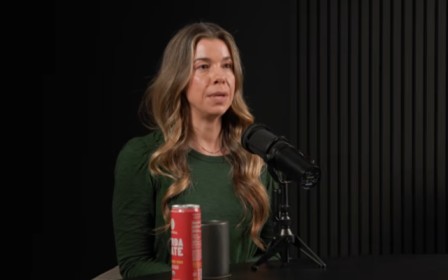
Read the full transcript of biomedical scientist Dr. Rhonda Patrick’s interview on Huberman Lab Podcast, March 23, 2026.
Editor’s Notes: In this masterclass on health and longevity, Dr. Andrew Huberman welcomes back biomedical scientist Dr. Rhonda Patrick to discuss the latest science-based protocols for optimizing vitality and avoiding disease. They explore highly effective “exercise snacks,” such as three-minute bursts of movement that can significantly reduce all-cause mortality, alongside detailed strategies for resistance training and HIIT. The conversation also covers precise nutrition and supplementation guidelines, including the benefits of omega-3s, vitamin D, and various forms of magnesium for cognitive and physical health. From managing visceral fat to the physiological impacts of heat and cold exposure, this episode provides a comprehensive toolkit for anyone looking to refine their daily health practices.
Introduction
DR. ANDREW HUBERMAN: Welcome to the Huberman Lab Podcast, where we discuss science and science-based tools for everyday life. I’m Andrew Huberman, and I’m a professor of neurobiology and ophthalmology at Stanford School of Medicine.
My guest today is Dr. Rhonda Patrick, a biomedical scientist and leading public health educator. For over a decade, Rhonda has been one of the most trusted voices in building science-based health protocols.
Today we discuss what the latest and best research says we should all be doing to improve our health and vitality and avoid disease. Rhonda shares with us her exact exercise, nutrition, supplementation, and sauna protocols, and we get really detailed about the mechanisms and logic behind each one.
We also discuss the things that science say you can do to significantly reduce your cancer and cardiovascular risk, including how to reduce visceral fat and arterial plaque. Today’s discussion truly leaves no stone unturned. We discuss how eating can increase inflammation, believe it or not, ways to support your gut health, creatine, vitamin D, why broad vitamin and mineral and fiber support is crucial, as well as the different forms of magnesium and each of their unique effects.
We also discuss omega-3s and why prescription sources of omega-3s may be the cleanest and most cost-efficient way to obtain sufficient omega-3 intake. We also discuss the importance of prioritizing regular resistance training and HIIT workouts over protein. You still need protein, but emphasizing the exercise component is crucial. And we discuss fiber, micronutrients, and why short-term fasting can be beneficial.
Dr. Rhonda Patrick is a true wealth of knowledge, and today she generously provides us a masterclass on how you can design and adjust the exact health protocols to meet your specific needs.
Before we begin, I’d like to emphasize that this podcast is separate from my teaching and research roles at Stanford. It is, however, part of my desire and effort to bring zero-cost-to-consumer information about science and science-related tools to the general public. And now for my discussion with Dr. Rhonda Patrick. Welcome back, Dr. Rhonda Patrick.
DR. RHONDA PATRICK: Excited to be here.
Rhonda Patrick’s Background as a Competitive Athlete
DR. ANDREW HUBERMAN: It’s been a while. I’m so excited. There’s so much to go into. And I’ll start off the same way I started last time because it’s even more true. Thank you for being first person into this public science health education business. I don’t know if everyone’s aware of it, but you were the first person in, which is why I didn’t say first man in, because the first person in was and is a woman. And you’ve done a marvelous job of educating people on science, how to parse papers and data, health practices, and the rest of us are just trying to follow in your wake. So thank you very much. I just want to thank you for being first.
DR. RHONDA PATRICK: Oh man, thank you so much for that. And also thank you for doing what you do. I mean, you really do a great service for science communication, education, helping people love science and get healthier.
DR. ANDREW HUBERMAN: Thank you. Well, you’re the pioneer. It’s not always easy being a pioneer, but we all benefit. So let’s jump in at exercise because lately you’ve actually been posting your workouts, which is awesome, and you’re clearly very fit. I learned before talking to you today that you were a competitive athlete. You were a long jumper or triple jumper?
DR. RHONDA PATRICK: I was a long jumper, but I would say my real competitive athlete-ness comes from my jump roping. I was on a professional jump roping team.
DR. ANDREW HUBERMAN: Professional?
DR. RHONDA PATRICK: Yes. Yeah, my friend and I started the team when we were in second grade, and it was called the San Diego Sandskippers. It was part of the International Rope Skipping Organization, which was actually started by her uncle. But there’s jump rope teams all around the world, and now I think there’s a new name, but it got taken over by the Universal Jump Rope Team or something like that. I don’t know exactly what it is.
So I was on a team, and every year we would compete in Boulder, Colorado. There’s competitions for all kinds of, you know, jumping rope, and I would perform and start jump rope teams around different schools in San Diego. So I used to get out of school — a get out of school free card — and my partner and I would go and do workshops at other schools and help them start jump rope teams. And the idea was cardiovascular health, healthy heart. So that’s really, I would say, my roots with being a competitive athlete.
DR. ANDREW HUBERMAN: Awesome. I love skipping rope. Is it okay to say skipping rope or jumping rope?
DR. RHONDA PATRICK: Skipping rope, jumping rope.
The Benefits of Jump Rope and Non-Linear Movement
DR. ANDREW HUBERMAN: And actually, it’s a great opportunity for me to ask you what your thoughts are about exercise that isn’t just linear. I know real jump ropers can do crossovers.
DR. RHONDA PATRICK: Sure. I mean, I wouldn’t be the expert to be able to give you a good answer on that, but I do think that jumping rope in general has unique benefits. In addition to, obviously, it’s a great cardiovascular exercise, you’re getting the weight-bearing aspects as well for building bone density.
And I think that earlier, for me, I was doing it as a young girl. So important, right? Because you’re kind of banking that bone density early on, which is important, because at some point menopause will hit and estrogen goes down, and so you start to lose more bone. But yeah, I’m sure there’s a lot of benefits to jumping rope beyond what I’m describing as cardiovascular benefits and bone benefits that someone else could answer.
DR. ANDREW HUBERMAN: Well, I’m certainly going to get back to jumping rope now that we’ve resurrected it in this conversation. And I have to say, bone density measurements aside, you have awesome posture. I notice people’s posture.
DR. RHONDA PATRICK: Oh, really?
DR. ANDREW HUBERMAN: Yeah, I didn’t mean to put you on the spot here. But yeah, when I walked in, I was like — if you ever interacted with Rhonda in person, which I have, you have amazing posture. And these days, good posture is rare. So who knows, maybe the things are related. I imagine they probably are — bone health and posture and so forth.
Rhonda Patrick’s Weekly Exercise Routine
DR. ANDREW HUBERMAN: In terms of the sorts of exercise that people are more familiar with, what does your routine look like? And what sorts of things in your routine are non-negotiables? And where’s the place for experimentation and kind of what you’re exploring now?
DR. RHONDA PATRICK: So for me, exercise is part of my personal hygiene, as you and I were discussing. It really is a non-negotiable. I absolutely have to do exercise, just like I have to brush my teeth. And I kind of got that from Dr. Ben Levine, who’s probably one of the world-leading cardiovascular exercise physiologists. He’s at UT Southwestern in Dallas. Just want to shout out his name because I’ve really learned a lot from him.
But the non-negotiables for me really are getting cardiovascular exercise and getting my resistance training — so building muscle, maintaining muscle strength as well. My routine, I work out probably about 5 to 6 hours a week. Those workouts, I largely am doing a combination of high-intensity interval training that’s not necessarily like the Norwegian 4×4, where I’m going as hard as I can for 4 minutes and then recovering for 3 minutes and doing that 4 times. The Norwegian 4×4 is a hard workout. It’s really good for improving your cardiorespiratory fitness, which I think is one of the best markers for longevity. We can talk about that.
I do a lot of — it’s a mixture of doing rowing machine, getting on the Assault Bike, and then mixing it in with lifting weights, doing some deadlifts, doing squats. So it’s really a non-negotiable for me to do my vigorous intensity exercise, as I would call it. So you’re really kind of getting your heart rate up to 80% max heart rate at points, not always, but especially during the intervals. I would say that’s a non-negotiable for me.
DR. ANDREW HUBERMAN: How many days a week are you doing that?
DR. RHONDA PATRICK: I do my longer HIIT workouts — I have 4 days a week where I’m doing at least an hour. So 2 of those sessions are more of a CrossFit type of training where the first 30 minutes will be strength training. So I’ll just be lifting heavier with fewer reps.
DR. ANDREW HUBERMAN: What’s the rest between sets? Sorry to get granular, but people will wonder.
DR. RHONDA PATRICK: What’s funny is I typically rest about 2 minutes between my sets. I recover pretty quick and I do it with a coach, and my coach usually tells me that I’m spot on. I’m ready to go and it’s been about 2 minutes. So that’s my recovery time.
The first 30 minutes is strength training — that’ll be deadlifts, squats, cleans, front squats. Sometimes I do barbell or back squats. It’s a mixture of different types of strength training. And then the last 30 minutes is more of a high-intensity interval training session. So it’ll be where I’m getting my heart rate up. I’m mixing in the rowing machine and then maybe doing cleans, but they’re lighter — more reps, but lighter load. I do that twice a week, and each is an hour session.
And then I also do twice a week, about an hour and 20 minutes — it’s also more high intensity, but I have more recovery time because I’m doing it with my girlfriends and we kind of chitchat a little bit. It’s a very similar setup — we do rowing machine, assault bikes, we do the skier — Rogue has that skier — and then we mix it in with chest presses, assisted pull-ups, and lighter squats with more reps. So that’s another 2 hours a week. So I have 4 hours a week of just doing a lot of that sort of CrossFit, HIIT type of training.
And then I mix that in with my runs, which I would say are still considered vigorous intensity — they’re just not quite as high intensity. I run like maybe 6 miles a week. These days I’m mostly running probably 4 miles a week. Those runs tend to be like, sometimes they’re 2 miles, sometimes they’re 3 miles.
DR. ANDREW HUBERMAN: Do you enjoy running?
DR. RHONDA PATRICK: I do, I do. And I think it’s important as well. Sometimes I’ll run with my husband and we just kind of chill out and talk, and it’s a nice time for me as well, just to kind of do that with him. And then on weekends, I’ll probably do like a hike with my family. Sometimes we’ll do like a sprint up the hill, but it’s more just enjoyable time in nature. I’m still moving, but it’s kind of family time too.
DR. ANDREW HUBERMAN: Weight vests on the run or hike?
DR. RHONDA PATRICK: No, I don’t. I mean, I’m kind of wanting to experiment with that, but not really. Sometimes we bring our puppy, so it’s more about the experience, I think, than anything else. I get a lot of workout throughout the week.
DR. ANDREW HUBERMAN: Sure.
The Importance of Daily Movement and Exercise Protocols
DR. RHONDA PATRICK: But it’s like you said, it’s non-negotiable for me. And times when I’m like, today, I had a long drive and so I got on my Peloton and I did a 10-minute Tabata back to back. So it was like 2 back-to-back Tabatas, right? So it ended up being 10 minutes. It was like 30-second recovery in between the 2 Tabata sessions, 2:1 ratio, 20 seconds on, 10 seconds off.
But I have to do something every day. And if I’m traveling or I have like an early podcast or something, I’ll just jump on the bike and I have to get that blood flow. Sometimes I’m in my hotel room and I don’t have time, and I just in my room, I do the air squats, I’ll do high knees, jumping jacks, and I repeat for 10 minutes. I’m getting my heart rate up and I’ve got sweat on my brow. It’s not like the most intense workout, but it’s so important for me.
There’s a variety of brain benefits that have been shown with even just 10 minutes of this vigorous type of intensity of workout you do. You probably have seen this data where it’s like just 10 minutes of this vigorous type of exercise, you’re immediately increasing neuronal connections. There’s been studies showing that you have an improvement in executive function by like 14%, which is pretty big. I think it was like a 50 millisecond improvement processing speed or something, which doesn’t sound a lot, but actually it translates to a big improvement in executive function. So my brain works better, I feel better, better mood.
There’s even studies that have compared impulse control after various types of intensity of workout. So there’s one study that compared a more low intensity, versus moderate intensity versus high intensity. So you’re talking about like walking versus maybe jogging slowly where you can still have a conversation versus like you’re doing a HIIT workout, right? You’re on, when you’re on, you’re not really talking because you’re going as hard as you can during that interval.
And it was the high intensity, vigorous intensity exercise that really increased plasma serotonin, which has been shown to associate with brain serotonin. The studies have been done. And serotonin is very important for, as you know, for impulse control. A lot of people think about serotonin with respect to mood, because we have these selective serotonin reuptake inhibitors, SSRIs, that are used to treat depression, major depressive disorder. But serotonin, as you know, does so much more than that. And impulse control is one of the big things that serotonin plays a role in.
And so those studies show that plasma serotonin increased in the higher intensity group, and that correlated with improved impulse control. So of course, for us now in the modern-day society that we live in, we’re constantly being bombarded with social media and all these things, and you have to be able to kind of filter that out and not just go with the impulse, like check my social media, and how many likes did I get or whatever. You need to just be able to focus. And so serotonin is important. And so I like to get that vigorous intensity exercise as well.
Phones, Focus, and Compartmentalizing Workouts
DR. ANDREW HUBERMAN: I love that you mentioned other functions of serotonin because as you point out, it is so heavily associated with this mood aspect and certainly has a role there. But the impulse control piece is, I think, a non-trivial aspect to the effects of exercise. And just generally, I’m curious, do you bring your phone or feel compelled to check your phone during workouts? Are you able to just say, I’m compartmentalizing now, this is the workout? You might put on music or maybe text here or there if you need to, but are you able to compartmentalize, or do you struggle with the phone during workouts?
DR. RHONDA PATRICK: Oh, I don’t bring my phone to my workout at all. Now, I do have a watch that I wear that, if there’s like an emergency, I’ll get a text message. Oftentimes I put it on silent, on no notifications, because I don’t want to be bothered. But I don’t really check my phone. I don’t really like checking things like social media. For me, it’s just a distraction. And frankly, I think it’s terrible for people’s brains, even though my business kind of depends on it somewhat. I think social media is not really good for people, to be honest. So I don’t really check my phone or bring my phone to my workouts. My workouts are, I like to chat with my friends when I’m working out with them and that’s fun.
DR. ANDREW HUBERMAN: That’s in real life.
DR. RHONDA PATRICK: Yes. IRL, as the kids say. That’s in real life. And yeah, phones for me are not something that I bring to my workout.
DR. ANDREW HUBERMAN: Great. Yeah, I’ve been experimenting with not allowing the phone in my gym and just the workouts go so much better. And I find that the mental and physical resetting aspect of working out just seems to be enhanced. But sounds like you were already there and I’m just arriving.
So I have a couple other specific questions about your workouts because for my own interest and I know many people will wonder, for the dedicated weight workouts, are these whole body workouts? And you said low reps. Maybe you could just tell us what low reps is for you and then the, seems like the ever-present question is to failure, close to failure. Just to round out that portion of the workout picture.
Strength Training Structure: Reps, Sets, and Exercises
DR. RHONDA PATRICK: The workouts that I’m doing with my strength training workouts with my coach, it really depends. Most of those workouts are multi-joint workouts. So I am most of the time doing some either front squat, back squat, or I’m cleaning it as well, right? Which obviously the weight goes down if I’m cleaning it, because it’s hard to clean. It’s also the thing that I hate doing the most.
DR. ANDREW HUBERMAN: Cleans.
DR. RHONDA PATRICK: Oh yeah, cleans with front squat because it’s really hard. And for me, I mean, for others who’ve been doing it for years, I’m sure it’s like they love it. But for me, it’s very hard. I’ve only been doing cleans since February 2024. So I’m pretty new to it. And so it’s mentally, I have to overcome that challenge, which by the way, once I started doing all this sort of weight training, I’ve always been an endurance junkie. I used to like to go long runs and races and stuff like that. So for me, that’s like my safe spot, right? That’s what comes easy to me. Weight training and resistance training, strength training, definitely not something that I’ve done my whole life. I’m so glad that I started doing it, but very, very challenging for me.
And so I would say the biggest effect was on my brain and the ability to handle stress better. Where it was like unbelievable because it was so hard and I just didn’t want to do these cleans and these front squats. And then the rest of my day was not as hard. And that to me was like the biggest surprise for this type of training.
But anyway, so I do a variety of, if I’m going heavier, then it depends. Sometimes I’ll start off, it’s like, okay, we start off, we do 5 reps and then we go down to 4 and then we go down to 3 and then we go down to 1.
DR. ANDREW HUBERMAN: Oh, you’re doing singles?
DR. RHONDA PATRICK: We do. Yeah, yeah. And that’s the hardest. It’s the hardest. But then my coach will be like, it’s just one, it’s just one. Sometimes we’ll do like 6, 5, and then we do 4 twice, and then we do 3 twice, right? And so it all depends, also on the day. There’s some days where I’m just like, can we do lower reps and lighter weight, right? Where I’m just like, this is the day for me. I’m stressed, I’m not here. So you kind of have to modify your workout according to how you feel that day.
But I would say that the majority of my strength training workouts are deadlifting. I love deadlifting. I think I’m pretty good at pulling that weight up, lifting that weight up.
DR. ANDREW HUBERMAN: Straight bar, hex bar?
DR. RHONDA PATRICK: I do a straight bar.
DR. ANDREW HUBERMAN: Mixed grip? There’s so many variables.
DR. RHONDA PATRICK: Straight bar. It’s the same deal with that. Most of the time with strength training, we’ll do, we start off at like 5 or 6 and then work our way down. And then I usually do a drop set after any of those sessions where I’ll do 10 and then it’s a lot lighter, right? So those are typically my strength training sessions, multi-joint. Sometimes I’ll do accessory sessions, where I’m working, I do the dips, or the Bulgarian split squats. Just the accessory stuff that you’re working, the smaller stabilization muscles and stuff like that.
Strength Training for Women: Breaking the Mold
DR. ANDREW HUBERMAN: I love that you call Bulgarian split squats accessory smaller muscles. For a lot of people, that’s the compound work, which is just— I have to say, I am inside just so delighted because weight training is something that’s caught on broadly for men and women now, but I don’t know many women, and I know they’re out there, but I don’t know many women who are working down to singles on multi-joint, like real multi-joint, like deadlifts, cleans. I know they’re out there, but it’s not that common to see in gyms.
And this is going to no doubt spark a debate because some of the older, slightly ornery but very credentialed strength training folks have been online recently saying that people past 35 shouldn’t do squats, that they shouldn’t do deadlifts, and certainly shouldn’t do them heavy. Because of this whole thing of, you can do higher reps and you go to failure and still get hypertrophy. But what I love is that you’re not necessarily talking about hypertrophy, maybe some hypertrophy, but this is about strength. This is about building more strength and triples and doubles and singles. That’s awesome.
DR. RHONDA PATRICK: It’s hard.
DR. ANDREW HUBERMAN: It’s awesome.
The Mental Challenge of Strength Training
DR. RHONDA PATRICK: It’s so hard. And it’s the part that I’m all about, the last 30 minutes where it’s hit. And that’s hard. It’s a different kind of hard. But for me, the strength training is the hardest. And there’s definitely a mental component, right? Where I do not want to do it. It’s like you talk about with cold plunging, right? It’s so unpleasant and you don’t want to do it. And you do it and it’s like that mental toughness that you’re building, right? That’s what I experience when I’m doing these strength training exercises. And I don’t know if it’s going to get easier, maybe it will. It hasn’t yet. I still dread it, but I do it and I’m proud of myself for doing it. But it is definitely hard and I am getting stronger, I think mentally and obviously physically as well. But I have to add in the aerobic as well though. I think that’s really important.
DR. ANDREW HUBERMAN: That’s your base. Yeah, you love it.
DR. RHONDA PATRICK: I love it. And I do think cardiorespiratory fitness is very important.
DR. ANDREW HUBERMAN: Sure.
DR. RHONDA PATRICK: For long-term health, as well as obviously building muscle and strength.
The Anterior Midcingulate Cortex and Doing Hard Things
DR. ANDREW HUBERMAN: Well, on the one hand, I want for you as a friend for you to hate the heavy work less. On the other hand, I don’t, because of this literature. I’m sure you’re familiar with it, but the anterior midcingulate cortex, this brain area that is hyperplastic throughout the lifespan, which is rare for a brain area, and it enlarges when we do things we don’t want to do. I mean, it’s so clear it’s not just about doing hard things — it’s about doing the hard thing you hate. And for you, that sounds like the heavy compound movements. For me, I don’t like the cold plunge, which is why I do it. I don’t think it’s magic. I just think it’s a surefire stimulus that I hate to get mentally stronger. And I think having something that you really despise that you know is good for you seems to keep this anterior insular cortex volume either increasing or the same. And that’s actually the thing in these so-called super agers that is the strongest anatomical correlate that we have. So on the one hand, I hope it gets easier. On the other hand, for your sake, I hope it doesn’t get easier. Because it’s going to be so much more beneficial.
DR. RHONDA PATRICK: I have a coach who can tell when it’s getting easier, and she will definitely up the weight. I mean, it keeps going up. And so it gets easier in a sense, but it doesn’t, right? I think that’s the whole point — you’re building strength and you keep making it heavier and it becomes harder again because now it’s heavier.
DR. ANDREW HUBERMAN: Awesome.
DR. RHONDA PATRICK: But I haven’t gotten injured, so that’s also, knock on wood.
DR. ANDREW HUBERMAN: Yeah, knock on wood. Thank you for rounding out that picture. It’s super inspiring for men and women.
DR. RHONDA PATRICK: It’s not easy to post on social media because obviously I’m a newbie. So I have all sorts of ways I can improve. But I’m posting it.
Protein Intake and Training
DR. ANDREW HUBERMAN: Well, the fact that you’re working down into triples, doubles, and singles, I think, is something that I’m trying to do more of. And this notion that you can get hypertrophy with higher reps if you take it to failure — sure, I totally agree. Read the studies, totally agree with the data. But not everything is about hypertrophy. I think that’s what people forget. It’s not all about growing muscle and VO2 max, which is great, but it’s just not all about the top contour. And what I love about the way you approach everything is you go through multiple layers of the health status, as it were.
This is probably a good opportunity to talk about protein because I have a very specific question about protein. We all hear 1 gram of quality protein per pound of body weight or lean body weight. That’s sort of what’s thrown at us. By doing the heavier weight training, do you notice that your protein appetite has increased? Like appetite specifically for protein foods?
DR. RHONDA PATRICK: I don’t know that I have. Interestingly, I have been doing a little bit more intermittent fasting, which people think about as just one thing, one intervention. I think it’s two. There’s a behavioral aspect to it where it’s a tool to sort of lower the amount of calories you’re taking in. The other one would be this metabolic switch.
So I’ve actually, since maybe last September of 2025, been doing more intermittent fasting. And what I mean by this is just really eating less. The reason for that is because I noticed that everything that I was doing — eating healthy, exercising a lot — and yet I was sort of gaining more fat in the belly section, right? The visceral fat. And the only thing that really helped me stop that, put the brakes on, was getting more in a caloric deficit. So maybe my drive to do that is skewing whether or not my appetite for protein would go up. But I personally am on the scale of 1.2 to 1.6 grams per kilogram body weight, which is—
DR. ANDREW HUBERMAN: Per kilogram, okay.
DR. RHONDA PATRICK: Per kilogram, which is probably a little bit less than the pound.
DR. ANDREW HUBERMAN: It’s kind of a throwaway statement.
DR. RHONDA PATRICK: A gram per pound.
DR. ANDREW HUBERMAN: A gram of quality protein, as defined as something with lots of the essential amino acids and so forth, per pound or per lean pound of body mass. Just something I think I and many other people shoot for, but I’m curious how religious you are about getting a certain protein amount per meal.
DR. RHONDA PATRICK: Basically, it wasn’t working for me. I was really trying to aim for the higher end — for me, 1.6 grams per kilogram body weight, or even a little bit above that. And what I found was that I was actually gaining more weight because I think I was consuming more calories at the same time. If you’re getting it from whole foods, right? That’s just kind of naturally going to happen. And so I had to slide down, but I’m still getting within that range of probably on average maybe 1.3, 1.4 grams per kilogram body weight. And it’s really worked well for me, but people are different and you have different goals, right?
Like I’m gaining muscle mass and I feel like all my training is the most important thing. And I think that generally speaking, people should become more obsessed with training and less obsessed with protein. The protein will complement the training. And as you mentioned, if you’re training, perhaps your appetite for protein will increase. And so you’ll start to eat more protein and less refined carbohydrates. I already wasn’t eating a lot of refined carbs or ultra-processed foods in the first place. Probably not the answer you were expecting, but for me, focusing on getting more protein was not working for my body. But then again, I’m 47 years old, in that perimenopause phase — very different than someone who’s 37.
DR. ANDREW HUBERMAN: Maybe I don’t know the answer to that. I do hear from more and more people these days that they are having a hard time getting that 1 gram of protein per pound of body weight. It feels like a lot to them is what they’re saying. They feel like they’re kind of forcing themselves to do it.
DR. RHONDA PATRICK: You shouldn’t feel that way.
DR. ANDREW HUBERMAN: Exactly. So I’m actually really pleased with your answer, not because I have an agenda here, but because I and many other people seem to feel like unless there’s a lot of resistance training or tremendous demands like hiking while backpacking, where you burn tons of calories, you’re carrying weight, you’re basically rocking like 9 hours a day — they have a hard time getting that much protein down. And I think that’s also the case if people are eating starches. Like, I eat rice and oatmeal and some breads and things like that. Not a lot of bread, but it sounds like you eat starches.
Diet and Food Choices
DR. RHONDA PATRICK: I do eat oatmeal too. It does satiate you. These days I’m really kind of more focused on — I did want to calorically restrict somewhat without being unhealthy. Obviously, you can take every stressor to a bad, unhealthy place, right? You don’t want to starve yourself. You don’t want to not eat enough food. But my meals are mostly healthy protein. So I have homemade turkey burgers, I eat a lot of those. And then I eat chicken — pasture-raised chicken. I do still eat wild Alaskan salmon. And then I’ll also mix in some filet mignon, like grass-fed steak as well.
DR. ANDREW HUBERMAN: Yum.
DR. RHONDA PATRICK: Those are my protein sources. And I always pair it with greens, or some sort of vegetable. Most of the time it’s greens because they’re the most micronutrient dense. So these days I’m eating a lot of sautéed collard greens that are pre-prepared, with garlic and onion, and I’ll have that with my meal. Or I’ll have some sautéed kale. Sometimes I’ll have a salad with it, but the portions are smaller. And like I said, I also do a little bit of intermittent fasting. We can talk about that as well. But that’s kind of what I’m doing for my meals these days. Sometimes I’ll eat the high protein oats. They have those high protein oats — have you seen those? They’re pretty good.
DR. ANDREW HUBERMAN: I eat oatmeal, but I like protein foods. I like vegetables. I like fruit. I feel very lucky to like those foods mainly.
DR. RHONDA PATRICK: Yeah.
DR. ANDREW HUBERMAN: And then the starch for me has to be very clean. I like oatmeal, rice, homemade pastas. If I go out, sometimes I’ll have homemade pasta or a sourdough bread or something. But I find that most starches that are out there in the world have a bunch of other junk in them and I just feel lousy, get kind of sleepy afterwards. So it sounds like we eat pretty similarly, although I probably eat more starches than you do.
Processed Carbohydrates, Inflammation, and LPS
DR. RHONDA PATRICK: It’s the more processed types of carbohydrates that, as you mentioned, you typically don’t feel good after you eat them. And part of that’s the postprandial inflammatory response, because some of those foods are a little more inflammatory. A lot of additives and stuff that are affecting the gut, gut permeabilization. You’re leaking lipopolysaccharide into the bloodstream, right? That’s activating the immune system.
DR. ANDREW HUBERMAN: We used to inject — I don’t do any animal experiments anymore, and I’m actually grateful to not do them. I didn’t like working on animals, but it was what we did until I decided to work on humans. But we used to inject LPS to stimulate an inflammatory response, to kind of prime a regeneration response that you could get through macrophages and things like that. And so LPS is a very potent way to generate local or even systemic inflammation. Hearing that some starches will stimulate LPS, that’s interesting.
DR. RHONDA PATRICK: Well, let me clarify.
DR. ANDREW HUBERMAN: Squares with my experience.
DR. RHONDA PATRICK: Let me clarify.
DR. ANDREW HUBERMAN: I’m not challenging. No, no, no, I’m not challenging. It squares with my experience. I’m one of these — I never get stomachaches, I never get headaches. If I do, something’s badly wrong with my stomach or my head. But if I eat certain starches, I’ll be like, ugh, I feel lousy. And I’m wondering if it’s this.
Gut Health, LPS, and Inflammation
DR. RHONDA PATRICK: So we have about a gram of LPS in our gut. On average, because lipopolysaccharide is the outer component of the cell membrane of gram-negative bacteria, right? Yeast. We have a lot of bacteria in our gut, gram-negative bacteria, right? Trillions of bacteria in our gut.
So when we eat food, typically, our gut epithelial cells, we have a tight junction that’s holding them together. When we eat food, they transiently open and then close. It’s kind of a normal response, right? I would say the opposite end of the spectrum of that would be like celiac, where they eat gluten or something, it opens up, and stays open, and so you get a ton of LPS leakage into the system, which causes massive inflammation.
It just happens with meals in general. You do get somewhat of an LPS response from a meal. Now, the type of meal does matter. So when I say refined carbohydrates, it’s not necessarily like healthy carbohydrates like vegetables. It’s like you’re eating something that is refined sugar, typically with saturated fat. So those types of foods really cause an LPS response. It’s inflammation, it’s bad, it’s hard on the gut.
But the postprandial inflammatory response essentially is that LPS getting into the system, activating the immune system, which draws the energy. It’s very energy consuming to activate your immune system, right? Which is why, when you’re sick, you’re so sleepy too, right? Well, there’s also cytokines that are somnogenic and promoting sleep, but activating your immune system requires a ton of energy. And so when you’re constantly activating the immune system, that’s an energy sink, right? And so you do feel tired, and that’s why a lot of times after a meal, you’re feeling kind of lethargic.
DR. ANDREW HUBERMAN: Do protein foods of the sort that you listed off before, do they cause less opening of the tight junctions of the gut?
DR. RHONDA PATRICK: I think that the big deal with the opening of the tight junctions in the gut is, eating a big meal will do it, eating a very ultra-processed food meal will do it. Interestingly enough, just eating a bunch of saturated fat without a fiber matrix. So like butter, you’re just eating butter. Don’t ever do that. But if you just eat butter, that’s been shown.
DR. ANDREW HUBERMAN: My niece, when she was little, now she’s all grown up, but when she was little, I taught her how to eat a little bit of Kerrygold butter and she loved it. So then we would do this thing where we’d do that. We won’t do that anymore.
DR. RHONDA PATRICK: I mean, a little bit’s fine, but there are studies showing that saturated fat is hard on the gut.
DR. ANDREW HUBERMAN: Yeah.
DR. RHONDA PATRICK: Like I said, it’s a sliding scale. Meals in general do it, but it’s like you would think. The healthier foods that you’re eating, like whole foods, you’re getting less of that LPS response. And then of course there’s gluten and that complicates the whole story, especially for people that are celiac, right?
DR. ANDREW HUBERMAN: Which is a small percentage of people are actually celiac, right? But a lot of people seem to believe, and I believe them, that when they eat gluten, they feel worse than when they don’t eat gluten.
The Nocebo Effect and Gluten Sensitivity
DR. RHONDA PATRICK: I’m sure there’s some people that are sensitive to gluten that do feel worse. And then I’m sure some of that’s the nocebo effect, right? That’s been shown with gluten in particular.
Have you seen that study where people— so there were people that think they’re gluten sensitive. And so they were enrolled in this study and these individuals were separated into two groups. One group was given the bread with gluten, and the other group was given the bread without gluten. And the people that were given the bread without gluten had terrible abdominal symptoms — they were bloated, they felt terrible. And there was no gluten in the actual bread, but they thought there was.
So it was thought that there’s a nocebo effect where it’s like the opposite of a placebo effect where you’ve got that phenotype where you think negative things are going to happen. And you can make them happen. You can change your immune system, you can change your brain signaling. So probably a combination of both with that regard.
LPS, Mood, and Depression
In addition to the lethargy — so I was talking about in the context, that’s why it sparked my interest — you were talking about feeling tired after a meal. And I do think that is part of that reason for feeling sleepy.
But what’s interesting about LPS, you talked about injecting it to mice, and I’ve also done experiments injecting LPS into mice. There have been studies where people have been injected with an amount of LPS that is similar to what you would find your gut releasing into your bloodstream, or a placebo control, which in this case was saline. And individuals that were injected with the LPS had high amounts of inflammatory markers like TNF-alpha — we’re talking up to a 50% increase over baseline, right? So high amounts of inflammation, which makes sense. LPS is activating the immune system. It’s like there’s a foreign invader, right? It’s not a foreign invader, it’s just the food you ate that caused transient gut permeability.
And those individuals also feel depressive symptoms and feelings of social withdrawal. So the inflammation is affecting the brain, right? These inflammatory factors are getting in the brain, crossing the blood-brain barrier, and affecting the way we feel. And we know now that inflammation plays a big role in major depressive disorder and depression — not in all cases, but there’s a subset where it really does seem to play a big role.
In fact, interestingly, there have been some studies showing that people that don’t respond to SSRIs have very high amounts of C-reactive protein. So this was the classical biomarker for inflammation. I would argue it’s not that sensitive, but nonetheless, it is a biomarker for inflammation. And so people that don’t respond to SSRIs have high amounts of inflammation, which kind of raises this question of, is there a subset of depression that’s really inflammatory driven, right?
So the LPS is affecting not only our energy levels, but also our mood.
LPS, LDL, and Cardiovascular Health
And then there’s also evidence that LPS binds to LDL particles through lipid-lipid interactions. And in fact, it’s kind of part of the adaptive response. It’s why you don’t want to ever get your cholesterol measured right after you’re sick or had a very stressful event, something that causes inflammation, because VLDL production increases and LDL production increases, and it’s sort of an adaptive response to bind that LPS to prevent it from causing more damage.
And so it actually binds to LDL particles on the ApoB protein. So ApoB is a protein that is on these lipoproteins, and it’s a very important protein because that is what’s used by the LDL receptors present on our liver to recycle LDL particles. And so what happens is these LPS particles are now bound to our lipoproteins, and our lipoproteins are still doing their function, right? They’re going around and giving triglycerides and fatty acids, and to some degree cholesterol, to our cells that need it, right? We’re constantly making new cells and repairing, and our cells need that.
As they donate triglycerides and fatty acids, they get smaller in size — the lipoproteins. You’ve probably heard of small dense LDL, right? That’s a very dangerous type of LDL particle. That’s one that’s kind of been donating along, getting rid of triglycerides and whatever. If you think about a train with cargo, it’s dropping off the cargo.
And so when it’s time to get recycled back into the liver, the ApoB protein is obscured by that LPS and it’s not recycled. And so it gets lodged into the arterial wall. And because LPS is bound to this small dense LDL particle, macrophages — which are the first line of defense against something like a bacterial invader — come and try to chew it up, right? Get rid of the problem.
So macrophages come in because they’re seeing this signal of LPS and think it’s a foreign invader, when it’s actually just a small dense LDL particle bound to LPS that came from the gut. They try to engulf it, but they can’t because it’s not bacteria. And you get the macrophage stuck to that lipoprotein-LPS complex, and you get the formation of a foam cell. You’ve probably heard of a foam cell. It’s the beginning of atherosclerosis.
And so this is where gut health and the food we eat is linked to cardiovascular health, right? Gut permeability, getting that LPS into our circulation is actually not a very good thing because you’re basically slow dripping in that inflammation, that inflammatory signal, and it’s wreaking havoc in our arteries and on our brain.
The Gut-Brain Connection and Neuroinflammation
DR. ANDREW HUBERMAN: Thank you for explaining that so clearly, because I don’t think anyone has ever explained how exactly gut health is signaling cardiovascular health, or pushing or pulling down on or raising cardiovascular health. As a neuro guy, I think about the vagus nerve as the primary conduit between gut and brain. And I was recalling that LPS injected into the gut is how you actually experimentally induce a fever, because if you cut the vagus, no fever. So there seems to be something about the way that the gut communicates with the brain and other organs that is critically dependent on some threshold level of LPS.
And thank you also for reminding us that LPS is present in the gut because we have yeast in our gut, some amount of yeast. You mentioned tight junctions, and the way I think about tight junctions — please correct me because I’m going to get some or all of this wrong — is that essentially they form like a cellular fence in the gut, and that transient opening or partial opening of these is a normal process. But it sounds like after a meal, some bacteria — when you say leaks out into our system, it’s literally going into the bloodstream. So now we have bacteria circulating, and if some of that is small enough to get across the blood-brain barrier, that’s another way that bacteria can start to cause inflammation at the brain level.
DR. RHONDA PATRICK: It’s LPS, which is like the outer component of bacteria that have died. Actual live bacteria getting in, I don’t know as much about that, perhaps as well, but I know that the LPS is getting in, and I do know that the LPS activating the immune system and the resident glial cells in the brain does break down the blood-brain barrier.
It’s like the early — we know neuroinflammation is really some of the early parts of the breaking down of the blood-brain barrier, which is the early stages of neurodegenerative disease. It is how gut health is linked to the brain and to neurodegenerative disease as well.
Inflammaging: The Core Driver of Aging
So it’s the inflammation, I think, that’s really powerful in terms of being a driver of the aging process in general. This inflammation — inflammaging, you’ve heard of inflammaging. I think now it’s pretty clear to me that if you’re thinking about the molecular events that are leading to these hallmarks of aging, which lead to the phenotypes and frailty and the diseases — like type 2 diabetes, cancer, Alzheimer’s disease — go upstream of that, and the inflammation is at the core of it.
And so we hear this word inflammation a lot, and it’s like, what does it mean? It means a lot of things. It’s not just the gut. The gut is a component of it, but there’s other things as well, right? I mean, you can have stress, any emotional stress, that can lead to inflammation. Not getting enough sleep, right? There’s a lot of things that can lead to inflammation. And so it is kind of an important point to think about — really trying to have your inflammation low, right? And how do you do that?
L-Glutamine: Gut Health and Immune Support
DR. ANDREW HUBERMAN: I’m going to take 3 different jumping off points here, all related to what you said. So don’t think I’m a random subject generator here. We will get back to fasting, I promise.
Lately, you’ve posted a bit about glutamine as a potential tool to perhaps buffer the immune system under times of stress. I’ve also been interested in L-glutamine as a way to reinforce tight junctions in the gut. I don’t know if that literature is robust or not.
I have to say, I started taking L-glutamine years ago in times when I was working a lot and not sleeping enough because someone told me it would help me not get sick. And indeed, I didn’t get sick as much as the imaginary control experiment that I never got to do. Meaning I don’t know if it helped or not, but I continue to take L-glutamine when I’m feeling run down. I take a couple of other things too, but could you tell us about how or if or how L-glutamine is important for gut health and if and how L-glutamine might be helpful for reinforcing the immune system?
DR. RHONDA PATRICK: There’s not a ton of evidence in terms of what’s in the scientific literature supporting these statements, but there is some, and it’s enough to kind of go, well, I’m going to try to maybe experiment with it.
So I first became interested in glutamine because when I was doing my graduate research, I was doing a lot of cancer metabolism studies and I would do nutrient withdrawal and I would remove glucose from cancer cells and see what would happen. I would remove glucose from lymphoma cancer cells in the Petri dish and a lot of them would die, but they wouldn’t all die. And I was like, why aren’t they all dying? Turns out, they had glutamine there. So glutamine was enough to sustain them.
And so glutamine can be converted into many things. Glutamine can be an amino acid, right? It’s an amino acid. Glutamine can be converted into the Krebs cycle. So it can be converted into intermediates that are used to make energy by the mitochondria. And glutamine can be converted into glutamate, right? Neurotransmitter, right? So there’s a lot of pathways and different fates for glutamine.
So I became interested in that because it was like, oh, glutamine’s important for the survival of these cancer cells. Then I was doing a lot of activating immune cell studies. As you know, my graduate advisor is an immunologist by training, and so I was also doing that. Turns out glutamine was essential for the activation of immune cells. So that was kind of always in the background of my mind.
And then in my postdoc, I did my postdoc with Dr. Bruce Ames, and my colleague, Dr. Mark Shigenaga, was doing a lot of gut work. And this is why I know a lot about the LPS and the gut. It’s from him. Brilliant guy. He’s now a photographer, not in science at all, but brilliant guy and did a lot of really amazing experiments looking at gut permeability and things that can help buffer gut permeability. And one of those things was glutamine. So glutamine can get converted into these intermediates that are used by mitochondria in the gut epithelial cells. And so that’s an easy source of energy as well for the gut.
Now these are all animal studies, right? So take it with a grain of salt, because at some point, in my opinion, animal studies are really important for understanding the mechanism behind why things work. And we need human studies as well. Looking at the totality of evidence is important. It’s the human studies that we’re lacking. There’s not a ton of them there.
The ones that I have found more compelling, with respect to glutamine in human studies, was the immune system. And this is where I started connecting the dots, right? Where I started coming across this literature of these endurance athletes who do get a higher amount of respiratory tract infections. When I mean endurance athletes, I mean these guys that are like out running marathons all year, like they’re just constantly training for a marathon, right? And so they’re really putting a lot of demand, right? Energetic expenditure is happening at a really high rate. So they’re more prone to respiratory infections.
And there’s a few studies out there showing that if these athletes take a higher dose of glutamine, I think it’s like 30 grams or something high like that, that they had a lower incidence of respiratory tract infections than the ones that weren’t doing it. And then I went back to my, oh, I know that glutamine’s really important for T-cell activation.
And I was like, I’m going to take this because being a mom and having a child that’s bringing everything home like a vector, you’re like desperate. And I never used to get sick ever. Like I would never get sick. And then all of a sudden I was getting sick like 3 times a year. And I was like, do I have cancer? Like what’s going on? Like I literally was worried. And then I started taking glutamine. Now I take it just, I only take 5 grams on a daily basis. But if my son’s sick, if there’s any exposure, if it’s during the season, if I’m traveling, I go up to 15, I go up to 20.
DR. ANDREW HUBERMAN: All at once? Because it can be a little hard on the gut, right?
DR. RHONDA PATRICK: No, not all at once. Grams, not all at once. I usually do it in fives. So I do 5 grams, 5 grams, 5 grams. And I have to, with a caveat, I do that, but I also take a lot of creatine as well. And so I don’t know which one or both, but I really don’t get sick. I’m not getting sick. And even if it’s brought home in my house, I’m not getting sick. And maybe it’s a placebo. And you know what? I am a-okay with that because placebo effect is real as long as I’m not getting sick.
So I do think, with the glutamine, it’s not something that I would feel comfortable saying that there’s a lot of evidence, it’s overwhelming, and with confidence that it’s improving gut health and it’s improving immune— that it’s going to help give your immune cells energy, particularly if they need to be activated upon exposure to any pathogen. But I feel like it’s worth experimenting with.
Perhaps maybe if someone has colon cancer, that would be more of a concern because I did mention that cancer cells love everything, anything that’s good for you. Right? Folate— I mean, if you don’t have enough folate, you can cause double-stranded breaks to your DNA, which lead to mutations that lead to cancer. But if you have cancer and you take a bunch of folate, you need folate to make new DNA. And so they like the folate, right?
DR. ANDREW HUBERMAN: So it’s like, it’s an abnormal growth. So anything that’s associated with drugs— I saw the recent study on taurine, which scared a lot of people because taurine’s in a lot of energy drinks, but that was an in vitro study. Is there increased cancer risk if you’re supplementing with glutamine because cancer cells like glutamine?
DR. RHONDA PATRICK: So my personal opinion, I’m obviously not a medical physician. This is not a prescription. It’s just my opinion. I personally am not scared of getting cancer from taking glutamine. If I had a colon tumor, a tumor in my colon, the first site that the glutamine is seeing, maybe the liver as well, since that’s also the next step. But barring having a tumor already in my liver or in my colon, those would be the only types of situations that I would be worried about taking glutamine. I don’t think it’s going to cause cancer right now. I guess the question is like, what if you don’t know you have?
NAC (N-Acetylcysteine): Immune Defense and Antioxidant Concerns
DR. ANDREW HUBERMAN: Well, hopefully the cost will come down on whole body MRIs. Actually, the cost is coming down on whole body MRIs so that hopefully more people are able to get those. It’s not just such a high-end exclusive thing in the near future, kind of like blood draws. Used to be like panels of blood testing. You only got them if you really needed them. Now the cost of blood draws is really low, right? So hopefully people will be more aware.
I will take a tablespoon of glutamine once or twice or 3 times a day if I’m feeling run down. You mentioned being exposed to pathogens from vectors of different sorts. Before we went on mic, we were talking about NAC and acetylcysteine. I take it once a day consistently, but I’ll take it 3 times a day if I’m traveling a lot because I’m around sick people when I travel, especially in winter, or if I feel like I’m getting run down.
And there the data are pretty interesting. There’s at least one study showing that it reduced flu transmission where people were deliberately exposed to flu. I think it took the number of people that contracted flu compared to the placebo group somewhere from the high 70% area— I don’t remember the exact number now, we’ll put a link to the study— down to maybe high 20s, which is pretty impressive. And then another doc came on this podcast, Roger Schwelt, who said he was a big proponent of N-acetylcysteine for people that are around sick people. Do you take NAC?
DR. RHONDA PATRICK: So my only concern with taking it on a daily basis is it is a pretty powerful antioxidant, and I think that we need to understand antioxidants and the opposite, which is generating oxidation, right? It’s not like oxidation is bad. It’s bad when it’s constant slow drip oxidation that’s damaging other parts of our body, DNA, proteins, lipids. Some oxidation you want, like if you’re exercising, right?
DR. ANDREW HUBERMAN: Sure.
DR. RHONDA PATRICK: There’s a burst of oxidation.
DR. ANDREW HUBERMAN: To get the adaptations.
DR. RHONDA PATRICK: To get the adaptations. And so my concern would be, for one, maybe timing it around your exercise. So not taking it close to when you’re exercising. And these studies come out of studies that have been done with high dose vitamin E plus vitamin C. I haven’t seen a lot of vitamin C studies alone that are blunting exercise adaptations. There’s maybe one at a high dose. Most of the time it’s vitamin C and vitamin E, vitamin E alpha-tocopherol. When I say high dose, usually it’s 400 IUs. Just to give you a reference point, the RDA is like 24 IUs or something. So we’re talking—
DR. ANDREW HUBERMAN: But a supplement can be 200 to 800, so it wouldn’t be hard to blunt that exercise effect by accidentally— yeah, I don’t take vitamin E. It spiked my prostate-specific antigen, which I was told is a known effect. The Urologist Select trial was done.
DR. RHONDA PATRICK: So the Select trial was looking at selenium and vitamin E and if it could slow the progression of prostate cancer. And it turned out that the opposite was found, and it was really kind of due to this high dose of alpha-tocopherol, which also has other effects of lowering another type of vitamin E in the body called gamma-tocopherol, which is anti-inflammatory. And I think that has something to do with inflammation, which can actually increase the PSA, right? So anyways, the point here is that with NAC, my only concern would be blunting the oxidation that you’re getting from beneficial— because I know you’re highly active.
DR. ANDREW HUBERMAN: I’m training hard. I don’t want my training to be short-circuited from NAC. I’m perfectly happy to only take NAC if I’m feeling run down or exposed to illnesses around me, or I feel like—
Starches, Sleep, and Cortisol
DR. RHONDA PATRICK: So that’s when I take it, but it’s mostly because I wasn’t familiar with the flu, influenza data. That’s interesting. I was just, it’s good for lung health too. Although if smokers take it, I think it has the opposite effect where again, it’s like the precancerous cells are using it to their benefit.
We used to think antioxidants, oh, it’s so good, just more, more, more. And it turns out it’s not the case. And that’s why a lot of these other types of hormetic stressors or plant phytochemicals, they’re actually generating an antioxidant response endogenously in our body. By activating these antioxidant pathways, which are so much more powerful than what you would get from an antioxidant.
So it’s not like you don’t want some antioxidants, it’s just like you don’t want to overdose on taking too much NAC and too much vitamin C and too much vitamin E because there’s also something called reductive stress. So we know about oxidative stress. Oxidative stress is when you’re causing these reactive oxygen species to damage things like your DNA, for example. And over time, eventually that happens in a part of the gene that can be oncogenic and lead to cancer.
Well, reductive stress is like the opposite of that. So it’s like too much of the reducing equivalents, like the NADH, the NADPH. And it also has negative effects. So you kind of don’t want to go too far on either ends of the spectrum. But also, instead of having this slow leaking effect of these pro-oxidants that are happening from eating a bad diet, from inflammation, things like that, you want it to be a short burst where you switch it on, you have the adaptation, it’s off. And the adaptation happens in the recovery period. If you exercise, that’s a big burst of reactive oxygen species that is beneficial and you want it. And you don’t want to blunt those adaptations. So that’s my concern with daily dosing of NAC.
DR. ANDREW HUBERMAN: Great. I don’t cold plunge in the 6 to 8 hours after resistance training for exactly the reason you’re talking about. I want the inflammation, I want the increased blood flow. I don’t want to short circuit that. I’m perfectly happy to only take NAC under conditions where I’m a bit run down. And that’s also when I’ll take glutamine. If you take L-glutamine regularly, I personally observe that I get stronger. At a steady state of starch intake. And I don’t like dropping starches too low because I get weak.
DR. RHONDA PATRICK: Yeah.
DR. ANDREW HUBERMAN: And I also can’t sleep as well if my starches are too low. I just am too wired.
DR. RHONDA PATRICK: Yeah, there was a new study on eating starches and improving sleep.
DR. ANDREW HUBERMAN: Yeah. And I’m so grateful for that because for several years I talked about that on the podcast and people said, oh, he’s gorging himself with pasta and then passing out, and that’s the worst time. I wasn’t saying that. I’m saying that if you’re running like crazy, I’ll hear from marathoners and ultra people, and people are doing a million things, they’ll say, I’m not sleeping well, and they’re exercising like crazy. It’s like, well, when was the last time you had a bowl of pasta? Like, oh no, I don’t eat pasta. And then they’ll have some rice or some pasta, like, oh, I slept like a baby. And they were having it at lunch.
DR. RHONDA PATRICK: Yeah.
DR. ANDREW HUBERMAN: And I just think that the brain doesn’t shut down well when you have high levels of cortisol. And the cortisol-starch thing is an interesting one.
Stopping Eating 3 Hours Before Bed
DR. RHONDA PATRICK: I’m so glad you brought this up because I think this is something I did want to talk about, really, and it has to do with stop eating 3 hours before bed for that very reason. There was even a new study, but there’s been several studies now really showing that this is important for that cardiovascular reset. Your parasympathetic activity is supposed to go higher. You’re in your rest and recovery phase. When you’re eating food, that’s the sympathetic activity — that’s activating the sympathetic nervous system.
DR. ANDREW HUBERMAN: As you’re eating. Yeah, yeah, yeah.
DR. RHONDA PATRICK: And even as you’re digesting, so you have to think about it, like you digest and it takes like 5 or so hours to fully finish.
DR. ANDREW HUBERMAN: Yeah, depending on the meal.
DR. RHONDA PATRICK: Yeah, depending on the meal. So if you’re eating right before you go to bed, you are not in that parasympathetic activity part of the cycle that you want to be in.
There was a new study that I shared, like a couple days ago even, showing that if you stop eating 3 hours before bed — so these people were actually, it’s interesting, they had their blood pressure measured starting in the mid-afternoon all the way throughout the night. This is the first study that really not just one endpoint looking at blood pressure, but just measuring it continuously. I don’t know if it was every 15 minutes or something like that, but it was found that during sleep, if they had stopped eating 3 hours before bed versus the group that did not stop eating 3 hours before bed, their blood pressure dipped lower. So you get that baroreflex dipping, which is part of the parasympathetic activation. Heart rate went down much, much lower. And that reset is so, so important for cardiovascular health.
I think what was found was it translated to like 20% lower risk of cardiovascular events, like heart attacks. So it’s really pretty significant. And it really is an easy thing to do, to think about stopping eating 3 hours before you go to bed. That’s something I think is not that hard to implement, and it will improve your sleep as well as your cardiovascular health.
Although I think in that study, sleep was subjective, and I don’t think it really was improved more. But other studies have found that as well, that sleep does improve. I know Satchin Panda — he’s been on my podcast, your podcast — he’s had studies showing that stopping eating 3 hours before bed really does seem to improve sleep. But this parasympathetic activation, you don’t want to have a meal right before bed because you want to be in the rest and recovery part.
DR. ANDREW HUBERMAN: I think people hear, and I understand why, the nomenclature and the buzzwords of fight or flight for sympathetic and rest and digest for parasympathetic. But the evidence shows eating stimulates the sympathetic nervous system. It’s not a stress event, but it requires energy. Anything that requires energy raises body temperature and your body’s doing work.
DR. RHONDA PATRICK: It’s an awake event.
DR. ANDREW HUBERMAN: An awake event.
DR. RHONDA PATRICK: It’s an awake event — you don’t do this while you’re sleeping.
DR. ANDREW HUBERMAN: Yeah. And that’s why these phrases, while I don’t demonize anyone for creating the fight or flight — I mean, there are ways that you want your sympathetic nervous system activated that are not about fight or flight. I actually think if people just got the first hour of their day more active and energized — bright light, exercise, caffeine if you’re me, and Lord knows I’m grateful that caffeine exists — in the first hour of the day, or first hours if you can’t manage that because of schedule, and then the last hour of the day was strongly parasympathetic, everything would get better without having to think a ton about exactly how you’re doing that, because on a given day, you just do what you can.
Cortisol: The Misunderstood Hormone
DR. RHONDA PATRICK: And that’s what you want. So cortisol is circadian dependent, as you know. In the early hours of the morning, that’s when you want it to peak. Part of the awakening response — you want it to go up. And it’s interesting, the reason I’m going on this is it’s a little bit of a soapbox for me.
With the cortisol activation, people don’t realize this — obviously it’s a hormone and it’s binding to two different receptors. There’s the glucocorticoid receptor and then there’s the mineralocorticoid receptor, and both of those, when cortisol binds to it, they go into the nucleus of the cell and they’re changing the expression. So they’re activating genes and deactivating genes — like 20% of the human genome. It’s a large percentage. And this is on multiple different organs. So cortisol has a very important role. You want that peak, you want that spike. And then you want it to shut off.
There are things that can activate it, obviously, like in the morning, going out, bright light exposure — that’s very important for that cortisol awakening response. But you can also, like, intense exercise can switch it on. And so can intermittent fasting.
What’s interesting is there are studies from Mark Mattson’s lab showing that the types of stressors that are beneficial — these hormetic stressors like exercise, like intermittent fasting, perhaps even cold exposure — these types of exposures change the receptor density of the receptors.
If you look at what activates cortisol in a negative way — chronic stress, let’s say emotional, financial, psychological, chronic sleep deprivation — that bad type of stress, you’re not getting a big spike, you’re getting a slow drip of it. And so what happens is when you have that type of stress, you’re increasing the glucocorticoid receptors and you’re decreasing the mineralocorticoid receptors. There’s a different biological response in the brain, in the hypothalamus, but also in other organs as well.
When you’re activating cortisol through a beneficial type of stress — the hormetic stressors, like intermittent fasting, like exercise, like deliberate cold exposure — it’s a different biological response. And also if you think about it, you actually want cortisol to do its function. You want it to change the expression of genes. That’s what it’s supposed to do.
The problem is when you have that slow drift, not only are you changing the receptor activation, but they also become resistant to the cortisol. And so you’re not getting the benefits. Cortisol represses inflammation, it suppresses the immune system. So you’re not getting that anti-inflammatory effect from cortisol. It’s being dysregulated. And that’s what you don’t want. You don’t want cortisol to be dysregulated in terms of the genes that it’s supposed to activate or deactivate. You want it to be doing what it’s supposed to. We’re supposed to have the cortisol activation response.
So anyways, that’s something that I kind of want to clear in people’s minds because I feel like a lot of people get worried about, oh my gosh, I’m doing HIIT and it’s activating my cortisol. Well, that’s fine. I mean, if you do too much HIIT, you can always take something to the extreme — with that caveat, obviously I’m not talking about that. But you do want your body to be able to turn it on and then turn it off and have the adaptation, have the response. And like I said, it’s a different biological response than the chronic type of cortisol activation that you get with the bad types of stress.
Intermittent Fasting and the Cortisol Conversation
DR. ANDREW HUBERMAN: Yeah, I guess same goes for intermittent fasting. And maybe you could share with us what your intermittent fasting protocol is. I know that recently cortisol has been increasingly demonized as “the stress hormone,” and people saw pictures of people with Cushing’s disease, which is a drastically elevated cortisol, and the moon face and the excessive visceral fat. And this sort of fearmongering around cortisol was particularly directed toward women.
This entered the health fitness space because — I’ll just be very direct here — in a very appropriate way that I appreciate, Dr. Stacy Sims came on the podcast and she said, listen, some women shouldn’t train fasted because they don’t feel well when they train fasted and their cortisol is too high and so forth. That captured a lot of people’s experience. A lot of women in particular, but some men certainly were like, yes, oh my God, thank you, thank you, thank you, thank you. But then the message got contorted, as it does.
DR. RHONDA PATRICK: Yes.
Training Fasted and Body Composition
DR. ANDREW HUBERMAN: And then it became women shouldn’t train fasted. And then we had Lauren Kolenzo-Semple on this podcast who’s a trained PhD. She has a background in nutrition, physiology, strength training coach, etc. And she said, no, listen, you can train fasted or not fasted as a woman or a man. It’s kind of your preference. But that we don’t need to fear these cortisol spikes.
And forgive me for going long here, but I think it is important that people hear this again, which is there’s also this idea that deliberate cold exposure increases cortisol. But when you look at the data, it definitely increases adrenaline. And peripheral dopamine. And probably— I’ll go on record here— probably central dopamine, although we don’t have as good evidence for that yet. But the evidence points to the fact that deliberate cold exposure lowers cortisol.
So this then, because— and again, I think Stacy appropriately said a lot of women who want to use cold shouldn’t go as cold. But the message got contorted and it became women shouldn’t do deliberate cold exposure because of the cortisol increase. And so part of the reason I’m going long here is I’m trying to correct the narrative on her behalf. She said, do what works for you, right? And that’s what Lauren’s saying, and I’m guessing that’s what you’ll say as well. But I just need to get that out there because the message has gotten totally pretzel twisted up. And cortisol is neither good nor bad. You want it high in the morning, you want it low at night. In general, it sounds like you train fasted.
DR. RHONDA PATRICK: I listen to how I feel. That’s exactly what I do. So what your podcast guests and the researchers are talking about is exactly— there are times when I wake up in the morning and I’m like, I need to eat something before I work out, and I do. But I oftentimes do train fasted, for one, because I am practicing intermittent fasting again, but I do it, I’m not like starving myself.
And like I said, the reason— there are multiple reasons I do it. One reason is because it really did help me lose the belly fat, which is the visceral fat, which is like the worst kind of fat you can have. And we can talk more about that. But the second reason is I love the cognitive benefits I have in the morning with it. And it’s the main reason I do it.
And so there are many times when I do train fasted, but I am not out running 15 miles. Most of my sessions are about an hour long. And am I taking a little bit of a performance hit with the high intensity? Probably yes, but it’s not much to matter for me. And you do burn a little bit more fat if you train fasted. I mean, that’s known. You will, if it is a longer session, you will take an important performance enhancement hit, that is also known, right?
So I think it really does come down to what is your goal? How do you feel? And then you kind of go with that. And I completely agree. Like there are times when I’m on my cycle and I feel fine and I’m working out just fine. And there are other times that I’m like, I don’t feel good. I’m going to take it easier, but I still train. You listen to your body. And that’s a pretty easy rule of thumb. Sometimes people like to complicate things, I don’t need to get into that.
DR. ANDREW HUBERMAN: I have theories, yeah, I have theories, but they’re not important right now.
Visceral Fat, Hormones, and Metabolic Health
DR. RHONDA PATRICK: No, it’s not important, yeah. So yeah, I do train fasted and it is, for me, it has helped me tremendously change my body composition. Like I said, I’m in a different part of my life than perhaps a 30-year-old woman is, right? So when I was 30, I didn’t have to train fasted, it was easy to keep the belly fat, the visceral fat lower. Hormonal changes do play a role in the way your body stores fat.
So estrogen plays a role in telling your body how to store fat. So subcutaneous fat would be the kind of fat that you can just like pinch, right? The fat that we see. The visceral fat, that’s that deep fat that’s lining your organs. It’s often belly fat, and it’s lining the intestines, the liver. It’s almost like an endocrine organ, because it is secreting hormones, it’s secreting inflammatory factors, it’s metabolically active, it’s constantly breaking down triglycerides. It’s associated with double the risk of early death. People that have high visceral fat have a 44% higher chance of having cancer, many different types of cancers. Wow. It’s huge, it’s huge. And of course insulin resistance is the number one problem with visceral fat, right? And I’d love to talk about that.
DR. ANDREW HUBERMAN: Please do.
DR. RHONDA PATRICK: Yeah, so with the visceral fat— and like I said, visceral fat is something if you really directly want to measure it, you do a DEXA scan. But for the average person that isn’t going to go out and do a DEXA scan, waist circumference is a proxy. It’s used in a lot of studies. So women that have a waist circumference of 35 inches or above are considered to have a higher amount of visceral fat. Men that have a waist circumference of 40 inches or above are considered to have a higher amount of visceral fat. It’s also that belly fat, you just know, right?
Interestingly, 70% of women over the age of 50 have high visceral fat. 50% of men over the age of 50 do. Again, coming down to women going through menopause— estrogen plays an important role in telling the body to store the fat subcutaneously rather than viscerally deep around organs. And so as women transition to perimenopause, the years before menopause and menopause, their estrogen goes down, and that does change the way the body stores fat. And any woman that’s going through either of those stages knows it. And it’s also why you see often women over the age of 50 with more belly fat. I mean, that’s something that I think it’s hard to deny.
But it’s one of the reasons why I kind of went back to practicing intermittent fasting because there are a couple of ways that you can really powerfully lose visceral fat. And one of them is doing aerobic exercise. High-intensity interval training also really powerfully can do it, but also being in a caloric deficit. And I think when you start to get the combination of both, that’s what really worked for me.
Insulin Resistance and the Visceral Fat Cycle
DR. RHONDA PATRICK: It’s crazy how quickly you can gain it based on your diet as well. So it is different from the subcutaneous fat in many ways. I’ve mentioned it’s secreting these inflammatory molecules, hormones, but it’s also constantly breaking down triglycerides into free fatty acids. And the location of it is very dangerous because it’s right surrounding the liver. It’s this deep organ fat, and that’s very close to the portal vein. And so you’re constantly getting this sort of mainlining free fatty acids to the liver.
And visceral fat is very different from subcutaneous fat because it doesn’t respond to insulin like subcutaneous fat does. In other words, when you have a meal, you eat a carbohydrate meal, your body increases insulin to help take up glucose into your liver, muscle, adipose tissue. Lipolysis shuts down, right? It’s like, okay, no longer am I going to break down these fats, it’s time to use this energy, right? Visceral fat doesn’t respond to insulin, so it just keeps going. And these free fatty acids, because they’re going right to the liver, it’s essentially antagonizing the insulin receptors. So it causes insulin receptors to become more resistant to insulin.
And this is part of why people with high visceral fat— by the way, you can gain visceral fat without gaining a pound, and we can talk about those studies. People can be skinny and have high amounts of visceral fat. You’ve heard of metabolically unhealthy but lean individuals. Those people exist. And so you can have a high amount of visceral fat, but not really look like you do.
So obviously the insulin resistance is a problem for many reasons, but it also plays a role in those energy crashes that you experience. And that’s kind of like some of the first signs of insulin resistance— they actually have to do with what you’re feeling. So we talked about lethargy, right? The inflammation that’s being generated from this visceral fat constantly making these pro-inflammatory compounds is an energy sink. So you do constantly feel tired. But also because your cells are becoming insulin resistant, when you have a high glucose meal and you’re not responding, the body kind of overcompensates and produces more insulin. It’s like, we’ve got to get this blood glucose out of our system, right? It can cause a lot of damage if it sits around there. And so you make more insulin. And then what happens is your blood glucose goes way low because it was like this overcompensation, right? And then you feel a crash. And that signals to the hypothalamus part of the brain, “I need energy.” So then you get those cravings for those calorically dense foods.
What I’m talking about is the experience of insulin resistance. And what’s interesting is that you can cause someone to gain visceral fat and their brain can become insulin resistant. So we think a lot about insulin resistance in the muscle and liver. Your brain also can become insulin resistant quite quickly, actually.
Insulin is very important in the brain for a lot of reasons, as you know. But a couple of the things relevant to what we’re talking about would be: one, it does act on the hypothalamus and help tell it to basically stop eating, be satiated. Like, I took a meal in, okay, I’m going to be satiated. But it also plays a role in energy storage and telling the body how to store the energy. And so when your brain becomes insulin resistant, it’s not doing that. And so you’re not being satiated, so you eat more, and you’re storing the fat more viscerally.
The 5-Day Ultra-Processed Food Study
DR. RHONDA PATRICK: And there was a study that was published actually quite recently. I covered this in a recent newsletter. It was a really interesting study because it was healthy young men and researchers put them on a little bit of a calorically dense diet. So it was like they were eating 1,200 to 1,500 more calories a day. And it was high saturated fat, high sugar. So it was the processed foods, ultra-processed foods, like the ultimate, right?
DR. ANDREW HUBERMAN: That’s a lot of extra calories.
DR. RHONDA PATRICK: It’s a lot of extra calories over 5 days. It is. But what happened was they did cause their brain to become insulin resistant and they didn’t gain weight, but they gained visceral fat and they started gaining fat around their liver. And that’s something that happens as well because visceral fat is surrounding the liver. You’re getting a lot of free fatty acids and they’re going right to the liver. So the liver has to store it, right? So you get this non-alcoholic fatty liver. And that happened after 5 days. I mean, without gaining—
DR. ANDREW HUBERMAN: In otherwise young, healthy—
DR. RHONDA PATRICK: Yeah. But they were eating a lot of extra calories.
DR. ANDREW HUBERMAN: Yeah, that’s like 1,200— that’s like a half a pizza extra above your maintenance calories.
DR. RHONDA PATRICK: And that’s probably what they were doing. They were eating lots of saturated fat and refined sugar.
DR. ANDREW HUBERMAN: Burritos and french fries.
DR. RHONDA PATRICK: Yeah, I mean, obviously if you’re going to do the study, you want to kind of do it to a degree where you’re going to see some change, right? So maybe it’s not going to happen in 5 days if you’re only eating 500 more calories a day. But over time, you will be gaining visceral fat, right? So it’s not going to be the same degree. It’s something to be concerned about. It’s something to think about. And also because you can gain it and not really even know it, without gaining a pound.
And there are other things that cause it, not just eating too many calories or diet composition. I mean, you mentioned cortisol. Chronic elevated cortisol makes you store the fat viscerally. Sleep loss. I mean, there are also studies showing that you take healthy men, sleep deprive them for a couple of weeks— I think they’re getting 4 hours of sleep a night— they can start gaining visceral fat pretty rapidly, with only gaining a pound of weight. So again, it’s not necessarily something that you’re going to see on the scale, but it’s happening. And it’s affecting your short-term mood, how you feel, your energy. It’s affecting the way you’re eating. It’s a vicious cycle because you start to eat more calories, and then it just becomes this vicious cycle where you start to gain more visceral fat.
The Importance of Sleep, Cortisol, and Intermittent Fasting
DR. ANDREW HUBERMAN: Such an important point that you can either not be gaining much or not gaining any total body weight, but gaining visceral fat. I think that’s the first time I’ve heard that, and it’s a vital message for people to hear because this visceral fat sounds like one of the major health hazards we need to worry about.
You mentioned elevated— chronically elevated cortisol. Sleep deprivation will increase visceral fat. And once again, I know I’m beating a drum here, almost to death, but having high cortisol early in the day and low cortisol in the evening is the definition of not chronically high cortisol. The definition of chronically high cortisol is somewhat elevated or elevated cortisol in the morning, but especially in the hours before sleep.
I actually have a theory that is not a stretch, that one of the main reasons why it’s so detrimental to our mental and physical health in the short and long term is because of the ways it disrupts sleep. And we can’t tease those apart. No, you can’t do a study where you spike cortisol late in the day. Even if you can fall asleep just fine after the end of a really stressful day, the sleep is different.
And people say, well, life has stress, and I totally agree. Lord knows I’ve experienced— life has stress. But getting that last hour of the day, doing things to push down on cortisol, push down on stress, lower heart rate, not eating in that— certainly that last hour before sleep, ideally 3 hours— I feel like that small change can make an outsized positive difference.
DR. RHONDA PATRICK: That’s interesting. The correlation between the high cortisol affecting your sleep— maybe they’re related. And so the sleep loss really does make you— we know from the researchers that have done those studies on sleep loss and affecting appetite, right?
DR. ANDREW HUBERMAN: Everything gets dysregulated. I don’t want to take us off course, but I think you might find it interesting that there’s a beautiful study where they measured metabolism during sleep. They basically had people breathe into a tube during sleep. They had a mask on. And it turns out that the brain cycles through all the different forms of metabolism during sleep. There’s a phase of sleep where you’re essentially running on sugar. Then there’s almost what looks like somebody’s ketogenic at one point. Basically, the middle of the night when you’re sleeping is a kind of a test run of all the systems, but they get recalibrated. And it’s so important.
I actually think most of the negative effects of alcohol that people talk about— yes, it’s a poison. It’s a Class 1 carcinogen, as classified by the World Health Organization. I think most of the negative effects of drinking are because of the negative effects of alcohol on sleep. I’m not telling people to drink in the morning, but I think that if you get your sleep right, you’re not 90% of the way there, but you’re halfway there. I really do believe that. And then getting your sleep right makes you do a bunch of other things, right?
DR. RHONDA PATRICK: You’re more motivated to exercise, for one.
DR. ANDREW HUBERMAN: More motivated to exercise, your food choices— and on and on. The problem with talking about how important sleep is, is that people will get sleep anxiety. So we tap dance around this like, “Oh, we don’t want people stressed.” Learn how to fall asleep. Learn how to fall back asleep. No one gets it perfect. Yes, you’ll survive without one poor night’s sleep or an all-nighter. You’re not going to die. Just get good at it on average, right? That’s what I’d say.
Intermittent Fasting: Structure and the Metabolic Switch
Could you tell us what the structure of the intermittent fasting is for you? Does that mean skipping breakfast, skipping lunch, skipping dinner? Because I know a number of people are sort of getting drawn back to intermittent fasting after a couple of years of it getting beat up on— like, “It’s not the best way to lose fat.” I think it’s a terrific way to do the sorts of things that you’re describing, and I’m learning today more about the positive things it can do for insulin sensitivity and so forth. If you’re on a bout of intermittent fasting, are you doing it by the clock? Are you doing it by feel? What does it look like?
DR. RHONDA PATRICK: For me, it really does depend on the day, and I really do try to stop eating 3 hours before I go to bed. It doesn’t always happen with family obligations, social obligations, but it’s the habit that’s important, right?
Intermittent fasting is more than just one intervention. As I mentioned, it’s a behavioral tool that you can use to limit your calorie intake without actually having to count all the calories, which some people like to do, some people don’t. So it’s a tool, but also it’s really important for a metabolic switch, as you mentioned— insulin sensitivity. And the metabolic switch is something that Dr. Mark Mattson coined, and I love it because thinking about intermittent fasting in that way makes it a little more clear as to the benefits of it.
It depends on the meal you have and how much exercise you do, right? But on average, let’s say 11 to 12 hours to deplete your liver glycogen levels. And once that happens, you do start to burn fat and use fatty acids as fuel and make ketone bodies. So you go into ketogenesis. And that’s a metabolic switch— metabolic flexibility. You’re going from using carbohydrates as fuel to using fatty acids and making ketone bodies as fuel.
And that’s something that throughout human evolution was ingrained, right? We didn’t always have access to Uber Eats and Instacart where at a swipe you get food. There were many times when people had to not eat because they couldn’t forage their foods— maybe the time of year, or they couldn’t hunt their food because they didn’t get a win, or whatever. So this metabolic flexibility is something that’s really ingrained in our DNA in a sense.
One of the reasons I like to do that is the ketone production. Ketones are really clean— a clean way to burn energy. They generate less oxidative stress, less oxidative products, but they’re also energetically favorable in that it takes less energy to use them to make energy than glucose does. It takes more energy to use glucose as energy than it does ketones.
But they’re also a signaling molecule. It’s a way for the body to signal to other parts of the body like, “Hey, this is a stressful time, there’s no food, I’m in ketosis— let’s make you stronger.” Because that’s kind of what evolution wants. If you’re not able to find or eat food, you have to be stronger to be able to do it. And so that’s kind of at the core of this metabolic switch and why it’s important.
I really like Mark Mattson being the pioneer in this. As a neuroscientist, he’s really looked at the benefits in the brain as well. These ketones like beta-hydroxybutyrate are activating growth factors like brain-derived neurotrophic factor in the brain. As you know, it’s very important for learning, memory, synapse formation, and neuroplasticity. So it’s activating beneficial compounds like that. And it’s not going to happen if you’re never going into this metabolic switch.
There are other ways to get there, right? You can limit your food and go into ketosis where you’re basically depleting your liver glycogen, or you can exercise a lot so your energy expenditure goes up. There are different ways to get to this metabolic switch. It doesn’t necessarily have to be intermittent fasting.
I’m telling you this because I want to tell you why I’m sort of back on the intermittent fasting. And by the way, it’s not for everyone. You can find other ways to get this metabolic switch. For me, intermittent fasting works. What I do typically is most of the time my workouts will be fasted— not all the time. It does depend on how I feel.
DR. ANDREW HUBERMAN: What time do you typically wake up?
DR. RHONDA PATRICK: I wake up between 6 and 7. And if I didn’t have a family— getting my son ready— I would probably work out right away, but I don’t end up working out until like 8:30.
DR. ANDREW HUBERMAN: It’s still pretty early. What time do you go to sleep, if you don’t mind me asking?
DR. RHONDA PATRICK: I’m asleep by 10:00. I’m usually in bed at 9:00. Takes an hour of just hanging out.
DR. ANDREW HUBERMAN: Sure.
DR. RHONDA PATRICK: Yeah, or 9:30 sometimes, but usually 10 o’clock is when I’m sleeping. That’s my bedtime. And so I do try to stop eating by 7:00 PM. But typically my first meal— it depends on the day— will usually be around 11:00, maybe sometimes 12:00. If I’m doing a podcast, it’ll be later.
Cognitive Benefits of Fasting and Ketones
I do like to be fasted in the morning because the cognitive benefits are really what I’m interested in with that metabolic switch. And it does come down to ketones. Mark Mattson has talked a lot about this. I had him on my podcast a few years ago— I learned so much. But the ketones like beta-hydroxybutyrate are increasing GABA. They’re balancing the glutamate, the excitatory neurotransmitter, with the inhibitory one, GABA. And I think the increase in GABA is what helps me the most because it does help quiet down some of the chitter chatter in my brain and help me focus. The GABA is calming in a way. I don’t know exactly— you could probably describe it better than I can. All I know is that I really like it.
So in the mornings, I like to be fasted. I like to be cognitively aware. That’s when I get most of my productive work done and I feel smarter. That’s why I typically like to shift my breakfast to later.
Now, some days I do only eat 2 meals where I am honestly skipping the so-called breakfast. But some days I do have 3 meals, and oftentimes they’re like different size meals. Usually if I do have 3 meals, the one in between the first meal and the second meal will be like a very— like a half or 3/4 of a turkey burger or something. So it’s mostly protein and it’s not heavy.
I would say I’m usually eating my meals between 11 and 7 most days. Some days I fast for a shorter period of time. Some days I wake up in the morning because I stopped eating like 4 or 5 hours before bed and I’m like, “I need to eat.” And I eat and then I work out. You kind of just listen to what your body’s doing.
Actually, Mark Mattson just published a study very recently. I think he was doing a 5:2 intermittent fasting protocol where 2 days you’re getting pretty severe caloric restriction— you’re eating one meal, but it’s like 500 calories for the day, twice a week. The other five days you’re eating normal. And they compared that to eating a healthy diet where they were somewhat calorie restricted, but not quite as much as the people doing the fasting. The fasting group had massive cognitive benefits— like a 20% improvement in a battery of tests that were done.
Intermittent Fasting, the Metabolic Switch, and Autophagy
DR. ANDREW HUBERMAN: He attributes that to the ketones and the effect of ketones on GABA.
DR. RHONDA PATRICK: He attributes it to the ketones. Can you get that to some degree with caloric restriction? Probably, especially the more severe caloric restriction you do, you can. If we’re talking about weight loss, caloric restriction is key, right? You have to have that. If we’re talking about the cardiovascular reset, like caloric restriction, if you’re eating meals right before bed, you’re not going to get that.
Those studies have been done. Courtney Peterson was one of the first ones to really show that effect on blood pressure, really significant. In fact, if you do early time-restricted eating, and stop eating, maybe 6:00 PM, maybe 8:00 PM, there was like a blood pressure drop that was like 10 points, millimeters of mercury.
DR. ANDREW HUBERMAN: Significant.
DR. RHONDA PATRICK: Yeah, yeah. So that’s very significant. It’s on the magnitude of what you’d see with some of the first-line drugs that are used to treat hypertension. I would never say for someone to do that, but I’m just saying it’s significant. And that’s not something that you typically see if you’re eating fewer calories, but you’re eating constantly throughout the day.
So I do think there are special benefits that can be had, but again, it’s also a tool that people use. I use it as a tool as well. I don’t like to count calories. Some people do and that’s fine. But I like it for the metabolic switch as well. If I were an endurance athlete running 10, 14 miles a day, I wouldn’t have to do this. That would be my metabolic switch.
And it’s not that I’m not metabolically flexible. Training itself, to some degree, does help with metabolic flexibility, right? The ability to switch between burning glucose and carbohydrates and then using fat and fatty acids as your energy source. It’s that I really want that real switch to be on and I want it to be on for a little bit of time and then I want to turn it off by eating. I’m not starving myself, and I think you can go too far with exercise and with fasting.
The problems with fasting — the people that are like, “Oh, fasting’s terrible for you” — it comes down to, one, they were all about, it’s like the weight loss is not just due to intermittent fasting itself, it’s due to calorie restriction. Guess what? They were right. They were right. Number two, they’re afraid of losing muscle. And I think we have enough data now that if you’re training, if you’re doing resistance training, you’re not going to be losing muscle. Now, maybe you won’t gain as much as if you were eating more protein, but you could just eat more protein within the window that you’re eating and be fine, right?
So I think that’s the other thing that people are worried about is muscle loss, including myself. And I train so much now and it just works well for me and I feel good. And it’s like this clean feeling. You feel cognitively sharp. And it works. And I think that the metabolic switch is something to not be scared of as long as you’re not, again, going to the extreme, right?
And if you don’t want to train while you’re fasted, don’t train while you’re fasted. You don’t have to. I think there’s a little bit of an added benefit that works for me in terms of burning fat, particularly visceral fat. And to me, that’s what works well. But if you’re training hard and a lot, and really fasting, maybe that’s too much of a stress. So you have to kind of figure it out for yourself.
Fasting, Cognitive Function, and Finding What Works for You
DR. ANDREW HUBERMAN: Yeah, the known increase in adrenaline from being slightly fasted is awesome for cognitive function. I think it allows people to ingest fewer stimulants in the form of caffeine. You don’t need as much caffeine when you’re doing some fasting.
What you describe is similar to what I do, although I noticed these days I’m waking up hungrier and hungrier, and I attribute that actually to my last bite of food coming a little bit earlier in the day and further from sleep. And also that thermogenic effect of eating raises core body temperature, and to fall asleep you want your body temperature dropping.
What I think is very exciting to me is that for a few years there, it seemed like there were just so many things, so many protocols, so many studies, but when I think about cortisol high in the morning, low in the evening, bracketing the day — what works best for sleep — but what you’re describing, certainly today you really, in addition to many other things, really clarified the relationship between gut and inflammation and brain and other tissues. Things start to fall into bins that, like all of biology, are so beautifully organized that it doesn’t mean long lists of things for people to do.
I love the idea that while it sounds like you’re just saying, “Oh, if I wake up and I’m hungry, I eat, and if I’m not, and I think I can train fasted, I like to train fasted,” that might seem like an obvious thing to some, but I think it’s so critical because the mechanism that you’re chasing in both cases is the same. You’re trying to get great sleep, great workouts, but you’re not trying to optimize the workout to the point where you disrupt your sleep or you insist on doing something like eating or fasting, whatever it is.
So the “find out what works for you” thing is so crucial because it’s about feel. That fits into a logic. And I have to say, that’s initially what drew me to your work — there’s a logic. You’re not just saying, “Okay, this study said this, so I’m going to do this.” It fits into a broader logic that comes from your training. So that’s just a point of gratitude. And I hope it will frame in people’s minds that, yes, do what you feel, do what works for you, but try and frame it in a certain logic. Because that’s actually what gives you flexibility over time. Like, oh, you’re traveling, you have to eat a little later. Okay, the next morning, maybe train fasted or vice versa.
DR. RHONDA PATRICK: Yeah, it’s about the habit. Exactly, it’s about the habit. And there are days when I just can’t train fasted, or there are days I wake up and I have to eat. And there are nights when I’m eating later because of social obligations, and I don’t freak out about it because it’s about the habit.
The Metabolic Switch: One Per Day
DR. ANDREW HUBERMAN: I like the idea of one metabolic switch per day. You said you could get it from exercise, and I thought, I can really imagine that in 5 years there’s a concept of health that hopefully everyone understands — find a way to generate the metabolic switch once per day. Maybe you fast and exercise, maybe you just exercise, maybe you just fast because you can’t exercise because people’s schedules are constrained. But the notion of the metabolic switch — here’s where it fits in exactly. The logic is you want the metabolic switch.
DR. RHONDA PATRICK: You do, and there are other components to this metabolic switch that we haven’t even discussed, which is that when you’re in that fasted state, when you’re in the ketosis, that’s also repair mode for your body, right? So there’s the fed state — the grow, anabolic — and of course we’re all obsessed with anabolic now because it’s associated with muscle growth, right? But there’s also the repair and recovery state. And so you don’t always want the growth on, right? You want to repair damage, and repairing damage can be damage to DNA. A lot of these genes are activated when you’re in a nutrient-deprived state, when you’re in that metabolic switch.
And autophagy — that’s another one that people, it’s a buzzword now, but it is something that is activated. First of all, we have a basal amount of autophagy going on at any point. Like, that’s happening.
DR. ANDREW HUBERMAN: You don’t have to fast to do that.
DR. RHONDA PATRICK: You don’t have to fast.
DR. ANDREW HUBERMAN: Or be in a caloric deficit, which will also — exacerbate it.
DR. RHONDA PATRICK: Right. You do have fasted-activated autophagy and certain tissues are more sensitive, like the liver and the brain, actually. We don’t have a lot of human data on that in terms of fasting. Exercise also activates it. We don’t have a lot of great quality human data. And that’s for a lot of reasons. One is the tissues that are most responsive to fasting-induced autophagy are not blood cells. Blood cells are pretty restricted in their response to fasting-induced autophagy, but that’s the easiest cell to access if you’re going to measure autophagy in humans, right?
Muscle biopsies have been done. The muscle is also responsive to fasting-induced autophagy. It’s responsive to exercise-induced autophagy. By the way, exercise, again, is increasing energy expenditure. So at the end of the day, you’re getting into that sort of ketosis, that metabolic switch. So there are studies showing that there’s a signal there, but for some people it’s not enough. Well, it’s not enough — we don’t really know, and you can’t go off the animal data.
I think to some degree it’s going to be hard to go get a liver. Maybe we’ll have some tools soon that we can easily access a liver biopsy, and that’d be great for many reasons, not just looking at autophagy. But I think that to some degree, you kind of just have to know that autophagy is happening right now in our cells. We know that it’s activated by fasting, by exercise, by these types of stress. So why wouldn’t it be increased somewhat?
And when I say autophagy, I’m talking about clearing out gunk that’s built up in your cell throughout the day. We’re talking about pieces of DNA, fragments of DNA. We’re talking about protein aggregates that didn’t get properly folded, or they’re not being degraded, right? All sorts of stuff. And it’s important. This is a cleanup process. It’s important.
And so again, that’s another part of the metabolic switch that I think is important to think about because we are really obsessed with anabolic, anabolic. Is it anabolic? It’s great. You do want to grow muscle, right? You do want to grow new brain cells and stuff too, but you also want to repair and you want to have recovery. And that’s the yin and the yang, right? You kind of want both. So I think that’s important to think about as well.
Practical Fasting Guidelines and Meal Timing
DR. RHONDA PATRICK: Fasting, intermittent fasting — I do like the daily metabolic switch. It may not be for everyone. I do think that you can find other ways to get there, exercise being the big one. Some people do caloric restriction, some people don’t need to. Caloric restriction is something that helps if you’re trying to lose weight. It helps if you’re trying to lose visceral fat. It’s one of the main ways you can do it — intermittent fasting, calorie restriction, exercise, aerobic exercise — that helps lose visceral fat.
But obviously we don’t always want to be in a caloric deficit, but we also don’t always want to be constantly eating either. And that’s why it comes down to, I think, the simple rule for people — if they’re going to do some sort of metabolic switch, some sort of intermittent fast, it would be like, okay, let’s try to at least stop eating 3 hours before bed because then you’re at least going to be extending that fast somewhat by 3 hours, right? Plus you’re getting the cardiovascular benefits that really seem to be important. And then not eating at night.
So there are all these studies that have come out of Israel. I think it’s Jacobitz and Froy — they’re two researchers. Sachin Panda, I remember years ago, showed me one of the studies. It was published in Science showing that if you have the same exact meal, same calorie intake, same composition, same macronutrient composition in the morning, the afternoon, in the evening, the insulin response is different. You’re the most insulin sensitive early in the morning. As you start to go towards the evening, and particularly 3 hours before your natural bedtime, your melatonin levels naturally rise, right?
And as you know, melatonin is important for the onset of sleep and preparing the body for sleep, but it’s also preparing the other organs for rest and recovery, including the pancreas, which is making insulin. And so you’re not making as much insulin when it’s closer to your natural bedtime because of the melatonin levels that are rising. And so you don’t want to be eating a particularly carbohydrate-rich meal — you’re not going to be as insulin sensitive in the last 3 hours before sleep, when you’re starting to get into that melatonin-rising phase of your cycle.
Exercise, Sleep, and Insulin Sensitivity
DR. ANDREW HUBERMAN: Yeah, it’s interesting. I think when people hear, “Okay, you’re most insulin sensitive in the morning. That would be the time to eat your biggest meal.” But then people say, “Wait, but then I’m trying to fast before and I’m trying to exercise and how do I do this?” I think that’s where for them the confusion comes in.
And to me it’s very simple. Just because your insulin sensitivity is highest first thing in the morning doesn’t mean you have to eat right away. I mean, it just means avoid eating too close to bedtime, right? Sometime during the day. And also if you exercise fasted or after a small snack. It was kind of interesting what Stacy Sims said. Not everyone should exercise fasted. She said especially a lot of women don’t like to do that. She didn’t say eat a meal. She said like have a scoop of whey protein with some— I think she said with like some almond milk in it.
And you couldn’t believe the response on the internet. It was like vindication, right? And I get it. It was like it vindicated people’s experience, like, “Oh, thank you, thank you.” And it told me something really important about the kind of sociology of what we do, which is when something validates people’s experience, they love it. But it doesn’t mean that the things that work for other people don’t work. And I think that that’s the part that gets lost.
And so if a study shows that insulin sensitivity is highest in the morning, but you can only exercise first thing in the morning, what do you do? You know, so you do the best you can, right? I think is what it comes down to.
In fact, I meant to ask you earlier, and this is a good time to talk about this. You’ve described that if you are slightly sleep deprived, so not 4 hours per night or an all-nighter, but if you’ve only slept 5, or let’s say you’re getting an hour or two less than your normal ration of sleep, there’s some pretty significant inflammation that occurs that’s not good. But I’ve heard you cover that exercising can actually offset some of that inflammation. This answers an important and common question, which is if I have to pick between sleep and exercise, what do I do? And it sounds like if it’s one night poor sleep, exercise, but you don’t want to make it a habit. Do I have that right?
DR. RHONDA PATRICK: Yeah, I mean, so this data, a lot of it actually comes from— you can cause even acute insulin resistance after like a night of sleep deprivation, certainly after 2 to 3 nights of sleep deprivation. And again, a lot of that’s coming down to some of the things we’ve already talked about. But exercise can help basically negate a lot of that.
And I learned that firsthand through experience when I was wearing a continuous glucose monitor. And when I was a new parent, of course, you’re not getting enough sleep. And so I learned it before I actually dove into the science about it. I learned about it through my own data where I wasn’t exercising as much. And particularly in the first month, really, like you’re kind of in a cave as a new mom. You’re not really exercising much at all.
DR. ANDREW HUBERMAN: Evolution. Skin wants the baby to survive.
DR. RHONDA PATRICK: You’re recovering too. I mean, childbirth is a very traumatic process on your body. And so I noticed that my glucose response was like, it was like pre-diabetic and I was like, “What is going on?” And that’s when I started looking into the literature and it happened to be around the same time when I was then starting up my— at the time I was doing spin classes. And then it was very clear to me, it was like, I do these high intensity interval training classes even just twice a week, and it was like almost completely negating what I had seen previously of my glucose being— my fasting glucose being really high, and also my postprandial glucose being higher than usual.
And so I looked into the studies and there’s now, you can find many studies out there, and it really— I mean, obviously exercise is one of the best things you can do to improve insulin sensitivity and to also bring glucose into your cells, right? And so that’s part of what you were talking about with, “Oh, you’re more insulin sensitive during the morning, least during the evening.” And I also mentioned that, but guess what? There’s levers you can pull that change the equation. And exercise is a big one, right? If you’re exercising, you are becoming more insulin sensitive, you’re increasing more glucose transporters on your muscle that’s causing glucose to go in easier, right? So there’s lots of ways around some of these rules that we hear about.
But with the sleep loss, it really is interesting because people, when they don’t get sleep, the last thing they want to do is work out. And obviously you don’t want to do the hardest thing, especially if you’re really sleep deprived a lot. But it really does help negate the inflammation and the insulin insensitivity that can happen after even just a single night of sleep. And there’s studies out there showing that.
Sleep, Exercise, and All-Cause Mortality
And then there’s also these longitudinal studies that have been done looking at people. So obviously, poor sleep is a problem in the United States. I mean, a lot of people are sleeping fewer than 7 hours a night. But there’s studies out that have looked at people that sleep either shorter, so fewer than 7 hours a night, or they’re sleeping more than 10, right? So you don’t want to be on either end of the spectrum. And usually sleeping long, there’s other disease states associated with it, right?
But so people that are not getting enough sleep, they have a higher all-cause mortality than people that are getting at least 7 to 9 hours of sleep, and the same for more than 10. They have a higher all-cause mortality than people getting between 7 and 9. But if people exercise, if they’re meeting the physical activity guidelines right now, which is 75 minutes of vigorous intensity exercise and 150 minutes a week of moderate intensity exercise, right?
DR. ANDREW HUBERMAN: Well, because the guidelines are helpful, but they’re just guidelines. Because I mean, doing the sort of workout that you’re doing, working up to doubles and triples and singles on compound lifts and then doing cardio, like getting your heart rate elevated and then doing addition to that and then you’re hiking. I mean, it’s just, I think the guidelines are a good jumping off place for people to think about.
DR. RHONDA PATRICK: Well, we can talk about that because there’s a new study that kind of throws that on its head. But the point is, is that if people were exercising within the guideline range, that they basically— if they weren’t getting enough sleep, if they were getting fewer than 7 hours of sleep per night— they basically had the same mortality rate as people that were getting enough sleep. So it’s offsetting some of that unhealthy stuff, the insulin resistance, the inflammation that we know can lead to diseases and early mortality.
DR. ANDREW HUBERMAN: So find the time to exercise. Yes. But of course, periods of time like after a new child or a new job or a particularly stressful time— I don’t know any human being, I don’t care how driven— okay, there’s probably David Goggins and Cam Haines being probably exceptions and a few others, I don’t want to forget Ken Rideout and a few others— but people who, everybody else seems to have periods of time where they need to just back off a bit. I know I certainly do. I feel like I’m doing pretty well for myself despite, and I think that it’s important that people not hold themselves to a standard that is going to make them sick or injured or miserable. You also want to continue to enjoy health-promoting activities, right?
DR. RHONDA PATRICK: Right, I mean, you gotta see what’s your goal. Your goal is to be healthy, to be happy. If you’re taking it to this extreme where you’re trying to just go to the extreme, like go hard or go home, and you’re sacrificing your happiness too, I mean, then that’s a problem, right? Because that’s part of the equation. Happiness is part of that healthy equation.
DR. ANDREW HUBERMAN: Health is a daily and lifelong thing, but sometimes it means taking a day off. I think that’s what people don’t say. And I think it’s in a time when perhaps a lot of people aren’t exercising enough. So promoting that “no days off” thing can be helpful. But for those that are already, you know, forward center of mass, coming off the accelerator can be really useful.
Vigorous Intermittent Lifestyle Physical Activity (VILPA)
DR. RHONDA PATRICK: Well, I also want to just mention, because we talked about my— I work out a lot and I am sort of addicted to it, but not everyone has the time and motivation to go spend an hour block of time working out. And this is where I think people can sigh a sigh of relief because there’s now so much emerging data that have been coming out over the last decade on these short bursts of physical activity that add up. They add up and people aren’t really thinking about them, counting towards adding up to their physical activity requirements for the week.
And so there’s a lot of studies now on something called vigorous intermittent lifestyle physical activity, VILPA studies. Have you heard of those?
DR. ANDREW HUBERMAN: Are these the exercise snacks?
DR. RHONDA PATRICK: They’re unstructured. They’re unstructured, and not everyone likes the word “exercise snacks.” I mean, I kind of like it, but the unstructured exercise— they’re the moments in your life where you’re taking advantage of everyday situations to get your heart rate up, to move. And so that could be, I’m playing with my new puppy and I’m sprinting around with my new puppy. I’m chasing my grandkid around and playing tag, or my child. I’m sprinting up the stairs to get to my office, I’m running to catch the bus, I’m moving, right?
And so researchers— and there have been several studies on this now— researchers use accelerometers rather than just relying on these questionnaires, which are, as you know, extremely unreliable. I mean, it’s very hard for people to remember how much exercise— sitting here asking me about my exercise, I mean, there’s always so much that you can be accurate when you’re trying to recall that. So these accelerometers are worn on people’s wrists and they’re measuring fast movement, the movement, right?
And so hundreds of thousands of participants, there’s lots of data now showing that people that are doing these short bursts at least a minute long, but up to 3 minutes, right? Where they’re moving— I’m saying they’re getting their heart rate up. They’re actually not measuring the heart rate in these studies. They’re moving faster with intent, right? They’re jogging, they’re not, of course, there’s the cases where they’re actually exercising, but the short bursts of it— they’re doing the things that I just mentioned— and it’s having outsized effects on health outcomes.
So for example, individuals that do on the high end, so they’re doing 3 minutes of this short burst of an unstructured type of exercise snack, and they do it 3 times a day. So it’s a total of 9 minutes a day, okay. This type of activity— and it’s considered more vigorous because the intent to move is more vigorous, even though they’re not measuring heart rate— that’s associated with a 40% reduction in all-cause mortality, a 40% reduction in cancer-related mortality, a 50% reduction in cardiovascular-related mortality.
DR. ANDREW HUBERMAN: Wow.
Exercise Snacks and Cardiorespiratory Fitness
DR. RHONDA PATRICK: 9 minutes a day. And this is even in people that don’t identify as exercisers, so they’re not the kind of people like you and I that go and intentionally set out time to go — the people that just, they’re doing those things, right? They’re playing with their grandkids or their kids, their puppies or whatever. And so these moments, they add up.
And I’m citing one study, but it was a dose-dependent effect, even doing 3 minutes a day. There’s a study in women showing 3.5 minutes a day — I mean, they were having pretty profound benefits on all-cause mortality and cancer-related mortality as well. And multiple studies now have shown this. I mean, this is like one study after another, after another. It is undeniable that these short moments of getting physically active do add up.
And structured exercise snacks can be part of that. Like maybe you don’t have a puppy, maybe you don’t have a kid yet, maybe you work from home — maybe your situation’s different than what I described, but you can take these moments to do exercise snacks. And that can be a minute long. There are studies showing — two studies, and I’ll talk about one — showing that getting up and doing 10 bodyweight squats every 45 minutes over a 7.5-hour workday is better at regulating blood glucose levels than a 30-minute walk. So you get up and you do 10 bodyweight squats. Pretty easy.
It’s also very good to break up that sedentary time. Being sedentary means you’re not moving. That also is an independent risk factor, even if you do exercise, for things like cancer being a big one. Although I would say if you’re doing a lot of exercise, you’re doing pretty good. But I just like to mention that as well. I would say being sedentary is a disease, actually. That’s something —
DR. ANDREW HUBERMAN: I mean, people aren’t thinking about it, but even in the absence of what Layne Norton calls energy toxicity — like even if somebody is at maintenance or below maintenance calories, if they’re sedentary, that’s problematic.
DR. RHONDA PATRICK: We do have data for measuring cardiorespiratory fitness, which is a marker of cardiovascular health, being physically fit. Obviously, the gold standard of that would be measuring VO2 max, your maximal oxygen uptake during maximal exercise. A lot of studies do not actually directly measure VO2 max. They’ll do maybe a submaximal treadmill test, or they’ll estimate it. There’s a calculation out there you can do — if you wear like an Apple Watch or some sort of fitness tracker, what they do is look at the distance that you run and the amount of time it takes. A 12-minute run would be an example. People do that. You run as fast as you can and maintain that pace for 12 minutes. You’re not going all out, obviously.
DR. ANDREW HUBERMAN: You see how far you can go.
DR. RHONDA PATRICK: Yeah. And there’s a calculation out there that’s done to kind of estimate your VO2 max. So some studies, or a lot of studies, are actually doing sort of an estimation of cardiorespiratory fitness.
Cardiorespiratory fitness is really important, I think, for marking your health and longevity. And if you have a low cardiorespiratory fitness, most of the time you are not physically active. There are studies showing that if you don’t have any diagnosable diseases — so you’re not insulin resistant, you don’t have cardiovascular disease, you don’t have cancer, you’re not obese — but you have a low cardiorespiratory fitness, it is as bad or worse in terms of your all-cause mortality, your predicting mortality, than having cardiovascular disease or smoking or having hypertension or these things that we know are really bad for health.
So being sedentary — as I’m saying, it’s low cardiorespiratory fitness — I guess it’s not exactly correct, I’m stretching it a little bit, but cardiorespiratory fitness is a marker of fitness. And that’s why I think being sedentary is a disease. People with a low cardiorespiratory fitness — if you go anywhere above that, from low to like low normal, that’s associated with a 2-year increase in life expectancy. If you go from low to high normal, that’s like almost a 3-year increase in life expectancy. And if you go up to high, then you’re talking about a 5-year increase in life expectancy compared to where you were at before.
But again, I’m not talking about VO2 max, I’m talking about cardiorespiratory fitness. And it’s really important. Here’s another reason why I think it’s really bad. Cardiorespiratory fitness is improved by aerobic exercise in general — that’s great. And if you add in high-intensity interval training in the mix, that also really helps, because there are some people that don’t respond necessarily to just doing steady cardio. About 40% of people don’t respond. So mixing in the high intensity is good.
If you’re physically active and doing that, that’s great. If you’re doing these short bursts of physical activity, also good, because it’s a little bit of a high-intensity exercise. A minute running around chasing your grandkid or your puppy or your child — that’s a hit.
The Value of Incidental Movement
DR. ANDREW HUBERMAN: Taking the stairs — that’s amazing. I was traveling with my team, sprinting up the stairs. Or if you’re carrying a lot of luggage in the airport, going up the stairs or down the stairs. It’s wild when you go to the airport — nobody takes the stairs, down or up. The escalators are there, and I’m always like, oh, there’s a great opportunity to get some extra steps and some extra work.
And if you’re in DC ever, they have these long stairwells that go up from the public transport, and that’s a workout carrying your luggage. I’m always like, oh, free workout, get it in my day. I mean, it sucks to arrive a little bit more sweaty than you would otherwise, but I just think if this were an experiment and we were looking at mice and we were videotaping from above — I always think to myself, like, which mouse am I going to be? All the mice are going up the automatic elevator. It makes sense why they would want to do that. But these opportunities for exercise are clearly there.
I feel like I would be remiss if I didn’t do a quick shout out to Steve Magnus. Do you ever see his content?
DR. RHONDA PATRICK: I’ve interacted with him.
DR. ANDREW HUBERMAN: Yeah.
DR. RHONDA PATRICK: Yeah.
DR. ANDREW HUBERMAN: I’ve never met him, but people should — on Twitter.
DR. RHONDA PATRICK: Interact with him on X.
DR. ANDREW HUBERMAN: Yeah, people should give him a follow. He’s a very accomplished runner in his past, a running coach I believe as well, and a scientist. And I think he has the best take on sort of measuring VO2 max. It’s kind of interesting — he has a theory which I think is strongly backed that most measures of VO2 max are not measures of VO2 max at all. But one of the best measures of cardiorespiratory fitness is how fast can you run a mile. And he says people are generally surprised how easy the easy stuff should feel and how hard the hard stuff should feel.
So I just want to credit Steve for saying that. I try and keep that in mind around my cardio and do some high-intensity interval training, Tabata type stuff, and then a lot of walks, a lot of hikes.
DR. RHONDA PATRICK: Yeah.
DR. ANDREW HUBERMAN: And I haven’t formally measured my VO2 max in a while, but I think he just nails it with that. Because I think people think the 30-minute jog on the treadmill where you get sweaty — like, that’s accomplishing what you want. But actually, there’s a much easier path to better health, which is what you do and more or less what Steve is describing as well.
DR. RHONDA PATRICK: Yeah.
DR. ANDREW HUBERMAN: Does that square with your experience?
DR. RHONDA PATRICK: Yeah, I think so. I mean, I do mix in quite a bit of — probably more high-intensity interval training. But if I didn’t feel good, I would toggle down the pedal, I wouldn’t keep going on it. So I think you have to, again, just listen to your body. You don’t want to overdo things. There are people out there that are really like endurance athletes — that’s not me. I’m a committed exerciser. I’m not necessarily an athlete. So there are different levels here, and Steve is obviously an athlete.
DR. ANDREW HUBERMAN: Anyway, I’ve learned from him around this topic. It’s been helpful.
Creatine: Benefits, Dosing, and the Loading Phase
DR. ANDREW HUBERMAN: I want to ask you about creatine. I’m 50. I started taking weight training and running when I was like 16, maybe. And I started taking creatine because back then I was skinny and I wanted to put on muscle. I think creatine was sort of first discussed or released back then when I was maybe 18 or something like that. So I’ve been taking it a long, long time — 5 to 10 grams.
But the original protocol, which nobody does anymore, but I confess I still do it because I enjoy it, was to take 5 grams 3 to 5 times per day. There was this loading phase, and you would mix it with a little bit of grape juice because the idea was you were supposed to spike your insulin and then get more into the muscles. And then you had a maintenance dose which was 5 grams per day. The idea back then was that you needed to do a washout every 20 weeks or so where you stop taking it, you urinate out a bunch of water, and then you re-reload.
And I confess, I’ve continued to do this minus the grape juice — but occasionally I’ll do the grape juice thing. I don’t think there’s any real merit to the loading phase, maintenance phase idea, but back then and still now, I feel like creatine has made me feel great, stronger. I wasn’t aware of the cognitive benefits.
DR. RHONDA PATRICK: They weren’t being studied back then.
DR. ANDREW HUBERMAN: They weren’t being studied back then. But what are your thoughts on why creatine has suddenly become this banner supplement? It’s like supplement of the year. We should start a supplement of the year thing, right? For a while, I think vitamin D and melatonin came first. Then I feel like creatine got supplement of the year — even though it’s been around for a long, long time. What do you think happened?
DR. RHONDA PATRICK: Well, first I want to talk about your loading phase — and that was really for the studies that were being done. Because if you’re taking 5 grams a day of creatine, it takes about 3 to 4 weeks for your muscle creatine stores to become saturated. And researchers aren’t going to do a study where they wait that long. So the loading phase really was just —
Creatine: Benefits for Muscle and Brain
DR. ANDREW HUBERMAN: Oh, so that’s what inspired it.
DR. RHONDA PATRICK: Yeah, it’s in this isolated bubble of in the experimental protocol, clinical protocol, but in the real world you have 3 weeks. Or if you’re an athlete and you hadn’t taken the creatine, you don’t have your creatine stores up and you have to quickly rapidly—
DR. ANDREW HUBERMAN: Got it. I was just amazed at how quickly it worked. I might be a hyper-responder, but I legitimately put on— I realized some of it was water, or most of it was water, but somewhere between probably 4 and 8 pounds of water in the muscle mass. I don’t want to call it lean mass because it’s water in the muscle. But I just was— I was like, “Oh my goodness, this is crazy.” And then people thought maybe it was a steroid. It’s not a steroid. Maybe it’s bad for your kidneys. Turns out it’s safe for your kidneys and most everyone. Pretty remarkable molecule.
DR. RHONDA PATRICK: Yeah, obviously creatine is stored as creatine phosphate in our cells. We make, to some degree, between 1 to 3 grams of creatine a day, our liver. Our brain also makes it. It’s used to make energy. And so your muscles, if you’re working out, you’re really consuming a lot of energy, right? It’s very energetically demanding. So having the creatine stores higher in your muscle is beneficial because, one, you’re going to be able to increase your training volume, right?
So it’s not like creatine is anabolic in the sense that protein or amino acids are, right? It’s not directly affecting muscle protein synthesis. It’s just helping you train more, getting more reps in, whatever it is, your training volume’s going up. And because your training volume’s going up, then you’re obviously putting more stress on your muscles, which is going to lead to increased muscle protein synthesis. And obviously there’s water probably as well.
That said, you asked me what happened. So I got interested in creatine back in ’20 when I started basically weight training. And obviously I’d heard about it forever, never took it. And as I started to get into resistance training, I was like, “I better start taking this. I’m in this world now,” and started doing some research and taking it. So I was taking the 5 grams a day because that’s really what most of the studies show. Creatine monohydrate, that’s the most well-researched form of creatine. And I was taking 5 grams a day because I was interested in improving my training volume and getting the benefits of it, right?
And then I had Darren Kando on the podcast. That was in 2024, I think it was. And once I had started getting into the creatine research, the brain stuff has been coming out over the past few years. And that’s, for me, become very interesting. I remember the first time I heard about it years ago, I was like, “Oh, it’s helping improve cognitive function in older people.”
Creatine and Brain Health
DR. ANDREW HUBERMAN: Yeah, the phosphocreatine system seems to be somewhat biased towards forebrain structures. Obviously it’s in lots of brain areas, but there might be a heavier reliance on it for brain areas that are associated with strategic planning and working memory. And yeah, if you were to sort of just map the sort of density of usage of the phosphocreatine system, you’d see a frontal bias for sure.
DR. RHONDA PATRICK: Yeah. Well, anyways, that’s kind of where my interest in diving deeper— anything that’s helping the brain is interesting to me, as I know it is to you as well. And so I learned a lot from this podcast I did with Darren Kandau. He researches creatine and collaborates with a lot of different researchers that are doing research on the brain and muscle and lots of the bone. It turns out it’s beneficial for the bone as well.
But the brain— it’s interesting that we also make creatine in the brain, but it’s kind of like the muscle, right? You’re not just going to, if you take creatine and you don’t work out, you’re not going to get any increase in lean mass, right? It’s not going to do much of anything because you’re not putting in the work. I think the same goes with the brain as well, where researchers started to find out that you can’t just take creatine and it’s going to enhance cognitive function. It’s in the background of stressing the brain, right? You’re stressing your muscles by working out, same goes for the brain.
It’s like in these situations of stress, whether that’s sleep deprivation, whether it’s a traumatic brain injury— I mean, I would argue there’s a lot of psychological stress, depression, constantly using your brain. Like you and I right now in this conversation, we’re learning, we’re thinking, it is stressful on the brain, right? So I’m obviously speculating here and extrapolating, right? I’m not saying that there’s studies showing that. It does seem as though that’s when creatine seems to shine in the brain.
And you might go, “Well, your brain makes it.” And it’s true, your brain does make, again, I think between 1 to 3 grams or something. I’m not exactly sure how much, but it makes its own creatine. And it’s kind of resistant to taking up the creatine that you’re supplementing with, particularly because the muscle is very greedy. So when you’re getting to that 5-gram range, muscles are really consuming it, if you’re working out in particular, right?
And there have now been, I think, a handful of studies showing that when you start to get above that— there was a study out of Germany showing this, and it’s a small study, this needs to be replicated. This is all new, emerging data. But that study showed that once you start to get to 10 grams, then if you look by MRI, you can start to see that creatine levels are increasing in certain brain regions, perhaps in the brain regions that you were talking about, and they’re going higher than what you would get from just your brain normally making its own creatine.
So the 10 grams of creatine a day, which is now what my baseline is, is based off of that. But there’s studies now showing that if you are in this sort of stressed state, your brain is stressed— like for sleep deprivation, for example, you’re sleep deprived for 21 hours and your brain’s not working very good after not sleeping for 21 hours, right? And that’s obviously when I have a— when I travel internationally, I’d never really sleep good on an international flight. And so if you were to come find me after that flight, I’d be not working very good, right?
DR. ANDREW HUBERMAN: Cognitively. You and everybody else.
DR. RHONDA PATRICK: Right.
DR. ANDREW HUBERMAN: Yeah.
High-Dose Creatine for Sleep Deprivation and Cognitive Stress
DR. RHONDA PATRICK: Well, some people can sleep great on a plane, but I’m not one of those people. So there have now been at least one study showing that if you give someone something like 0.35 grams per kilogram body weight of creatine, which comes out to a lot— it’s like 20, 25, it depends on your body weight, right? Like 20, 25 grams, perhaps even more.
DR. ANDREW HUBERMAN: I mean, I’m 100 kilograms. Yeah, so it would be a lot.
DR. RHONDA PATRICK: So for me, it’s more like 20, 25 grams, right? But if you give individuals that high dose in that sleep-deprived state, they’re cognitively not only performing normal, but they’re performing better than their baseline. And that, of course, generated a lot of interest.
There have been studies coming out since then showing that if you give older adults with mild cognitive impairment, perhaps mild, early-stage Alzheimer’s disease, again in the 20-gram range of creatine, it’s improving their cognitive function. Why is that? Well, creatine is important to make energy. And when your brain cells are stressed out, energetic demand goes up, and if you have more creatine, it’s going to make things easier. There’s also some inflammation that’s being generated in that stress state, and it seems as though creatine is also having both an indirect and direct effect on inflammatory processes as well.
This is all early, early data. More needs to be done, but I think that there’s enough safety data out there now where it’s like, well, it’s really not harmful to take 10 grams a day. I take 10 grams a day every day.
DR. ANDREW HUBERMAN: You spread it out?
DR. RHONDA PATRICK: I do it in 2 doses. Some people are very sensitive to a 10-gram dose where they might get a GI irritation effect.
DR. ANDREW HUBERMAN: It can give some people diarrhea.
DR. RHONDA PATRICK: Diarrhea, exactly. Yeah. So the very scientific way of putting it. But I do spread it out and I take it— I don’t take it at night. I like to take mine in the morning.
And I don’t know, Andrew, this might be a placebo. I feel like I’m constantly in a stress— my brain is under a lot of stress. I’m constantly learning, I’m reading papers. And like I said, I’m extrapolating here. This isn’t sleep deprivation. That’s obviously a much more extreme type of stress. But I have noticed that taking my 10 grams, going from 5 to 10, really does seem to affect my brain functioning later in the day, where I seem to keep going better, where I’m not getting as tired. And it could be placebo, which is fine. I am fine with placebo effects as long as what I’m ingesting is not actually bad for you. Placebo’s fine with me. But it is working for me.
When I travel— when I’m going to the East Coast, I mean, I’m on the West Coast, so when I go anywhere and I have to give a talk early in the morning and I never sleep good in a hotel, I’m always sleep deprived. I’m going to start traveling with my pillow like you do, because that’s brilliant. That’s one of my problems. But there’s many problems in hotel rooms that lead to me not sleeping as good, right? So I take 20, sometimes 25 grams of creatine in those situations. It’s not all the time, but it seems to help me. And like I said, I’m okay with placebo, which is fine, but we do have some evidence that it might.
And I think this is kind of where people are already interested in creatine. And so when you start to go, “Well, maybe it’s going to be beneficial for the brain, if it’s going to improve cognitive function,” that’s really something that people are interested in. Right now, again, I don’t know that it’s like if you’re just some young, healthy person that gets all their— you’re sleeping well, you’re exercising, everything’s great. Alzheimer’s disease on the extreme end, TBI also on the extreme end, that’s real-time aging, right? And there’s some evidence that may be helpful for that as well. There’s been some studies with children looking at creatine supplementation after a TBI, and it seems to help with their recovery. I am probably experiencing brain aging. So I’m just kind of—
Cognitive Trajectory in Biologists and Scientists
DR. ANDREW HUBERMAN: I’m going to interrupt there. I don’t think so. I’m not trying to just be complimentary. I paid close attention to the data, and it seems like in certain fields like math and physics, people tend to peak with their contributions early. There’s a reason why the Fields Medal is only given to people— I think it’s 40 or younger. My dad’s a physicist, so he can check me on this one.
But biologists, at least the ones I know that took good care of themselves, they’re known to make great discoveries, be cognitively sharp, intellectually strong, well into their 70s and 80s. I mean, Torsten Wiesel, who co-received the Nobel Prize for brain plasticity and vision, he’s still alive, and he was— I think he still runs. He’s in his late 90s, and he paints, and he’s sharp.
So I just— I made a point to only interrupt here. People can check the data on the previous portions of the podcast. But just to say, I actually think that cognitively— I’m using biologists as an example— it’s possible in aspects of life where you’re building a base of data to pull from, which is what biology really is, just an example here, that to get cognitively stronger and stronger with age.
DR. RHONDA PATRICK: Right.
DR. ANDREW HUBERMAN: There’s a theory, but I see you as that. And again, I’m not just saying it to be complimentary, although it is a compliment. It seems like you’re picking up steam. You’re thinking about things. You’re not forgetting things from way back when. You’re building on the concepts and knowledge from way back when. So I find it reassuring that you— biologists in particular— seem to have this up and to the right trajectory for cognition.
Creatine, Omega-3, and the Experimental vs. Control Group Framework
DR. RHONDA PATRICK: It’s interesting. My late mentor, Dr. Bruce Ames, was every bit of that. I mean, he passed away a little over a year ago when he was 96. But some of his most— he claims some of his best work was done in his late 80s.
DR. ANDREW HUBERMAN: You know, you don’t see that in math or physics.
DR. RHONDA PATRICK: Yeah, so that’s interesting. And I don’t know exactly the difference. I mean, I don’t know how much learning goes into math and physics as you’re— I just don’t know. But with biology, we’re constantly learning new things and reading new papers. And then I think even just the novelty of learning new things— that’s brain-derived neurotrophic factor, right? That’s like you’re increasing synaptic connections and neuroplasticity, and you’re keeping your brain younger in that way too, right?
So I think the learning process is super important, whether it’s biology or whatever you’re passionate about, right? Like, you learn new languages— the learning process itself is something that is so important for brain aging as well.
And yeah, I would agree with you that brain aging in general— I’m obviously chronologically aging, and there is some degree of aging going on in the brain. But that’s, I think, where the creatine craze has come from, is the interest in— and I’ve definitely played a role in some of this, by talking about my experience and being super interested in it because it’s felt good for me.
And I’ve noticed this experience, and this is completely anecdotal again, but in addition with the small studies— and they are small. I don’t know if you’ve looked at them, but the subject numbers are small and you can poke holes in them, and you would be completely okay poking holes because they’re small sample sizes. But it is kind of a consistent trend line where we’re seeing more studies come out and show the same thing, same thing. And it’s like, okay, to a certain point, maybe there’s something here. I think that more research is going to come out on it and I feel great doing it. And even to the point where if I don’t have my 10 grams and it’s only 5, I’ll notice.
DR. ANDREW HUBERMAN: Oh yeah?
DR. RHONDA PATRICK: Yeah, but again, it could be that placebo, nocebo thing— who knows? But let’s just say it is real. For me, I gotta have my 10 grams of creatine for my brain. Who knows, I may in 5 years be like, I was wrong. We’ll see new data come out, but I don’t think so. I think we’re going to have a lot of people doing creatine research, which is the new thing. There’s been a lot of work on exercise physiology and training, and now this is the next frontier.
DR. ANDREW HUBERMAN: The safety data are there, so it’s not like they have to get a lot of human subjects clearance.
DR. RHONDA PATRICK: The safety data is there. It’s one of the most well-studied supplements out there. Like you said, you were taking it when you were 18 and it was studied back then. And it’s just been studied for all the years that you’ve been taking it. So if it was unsafe, we really would know. And I don’t want to get into all the data on the safety, but I think it’s pretty solid that it’s— now, of course, if you’re going to go like mainline 50 grams a day, I mean, that’s a little much.
DR. ANDREW HUBERMAN: Someone on the internet, there’s always—
DR. RHONDA PATRICK: Yeah, there’s always—
DR. ANDREW HUBERMAN: What are they, dry scooping? I mean, people have died dry scooping energy drinks. There’s always a moron or two out there that are going to take things to the extreme and harm themselves doing something that no one else is dumb enough to do. But I think we look at the center of mass for things.
As we’re talking about creatine, I want to talk about some other supplements. But it occurs to me that if there’s some data, ideally from animal studies and humans, and something is safe, I think the question nowadays— because of how broadly health and supplement and other kinds of information goes in the world— the question that everyone should ask themselves is, okay, do I want to be in the experimental or the control group? That’s how I think about it.
So if there’s a study about creatine, or some new molecule— I’m going to ask you about magnesium in a moment— I look at the safety margins on magnesium. I’m comfortable with those safety margins. So that should always be question number one. And then it’s, do I want to be in the experimental or the control group?
And I think that these days, people who are against supplements or against something will say, well, the effect isn’t nearly as big as you get from exercise. Totally, absolutely. But that’s not really what we’re talking about. People love this in the cannabis and alcohol thing. Whenever I make a point about alcohol or cannabis, they’ll say, well, alcohol is worse. And these are two separate entities.
So I think that people should just ask themselves, what are the safety margins? And do you want to be in the experimental or the control group? And then of course there’s the, can I afford to be in the experimental group? But those are really the only questions. There’s no one saying that creatine is better than anything else or worse than anything else.
DR. RHONDA PATRICK: Right.
DR. ANDREW HUBERMAN: But somehow the messaging gets all messed up and then all these news articles get generated about what creatine is and isn’t. And I find it kind of frustrating because the issue is not whether or not creatine is better than exercise and good sleep. The question is, do you want to be in the experimental or the control group? And can you afford to be in the experimental group?
DR. RHONDA PATRICK: Right. I like that framework, especially if we know it’s safe. Okay, so I can potentially be in the experimental group because that’s question number one. You have to have that answer first, at least in my book.
But yeah, there are flaws with all sorts of studies, and creatine studies included. And people make all sorts of claims about it, and you gotta tone it down a little bit. I mean, it’s not like the best performance enhancer ever. But it seems pretty good at improving exercise volume and recovery as well— that’s also something that’s been shown— and then helping with the stressed out brain.
Omega-3s, Vitamin D, and Epigenetic Aging
DR. ANDREW HUBERMAN: On the basis of our last conversation some years ago on this podcast, I started taking Lovaza, which is, as you know, a prescription omega-3. A very high concentration omega-3, because I was getting it from standard sources. And I thought, well, I’m hitting 50 and I want clean omega-3. I don’t want it contaminated with mercury and other things. So I’ll take omega-3s in the form of Lovaza. It’s available in generic form now, so it’s pretty inexpensive. And I have to say, my blood profiles were pretty good, but they improved pretty dramatically when I started taking Lovaza. So I’m grateful to you for encouraging the omega-3 path.
DR. RHONDA PATRICK: Have you ever had an omega-3 index test done?
DR. ANDREW HUBERMAN: No.
DR. RHONDA PATRICK: To measure the—
DR. ANDREW HUBERMAN: Oh, if it’s on the Function test, then it would be—
DR. RHONDA PATRICK: I think it is.
DR. ANDREW HUBERMAN: That’s in normal range. I know it wasn’t flagged, but I don’t recall what the level was.
DR. RHONDA PATRICK: Yeah, you want to be in the high index, not the low, right? Well, obviously if you’re taking it, you’re not going to be in the low. Usually it’s around 2 grams a day to get you from low to high. And I do think that’s one of the low-hanging fruits in terms of something powerful and having an outsized effect on your health that people can do that’s not that much effort. It’s not like exercise effort.
DR. ANDREW HUBERMAN: Or eating salmon. I don’t like fish.
DR. RHONDA PATRICK: No, yeah, and a lot of people don’t like fish. And also there’s now microplastic contamination in our seafood sources. There’s the heavy metals, PCBs, contaminants. I mean, I still eat salmon, but it’s not like it used to be. So there are other cleaner ways to get your omega-3 levels higher.
And omega-3 is very important for cardiovascular health. It’s one of the most important— I would say the most powerful naturally occurring dietary compounds for suppressing inflammation, and resolving inflammation would be a better way of putting it, right? And that’s again at the core of aging. And if you look at any sort of measure of aging, whether it’s even these epigenetic aging clocks, they’re very sensitive to inflammation. And that’s why there are so many studies coming out now showing omega-3 can slow biological aging as measured by these epigenetic aging clocks— even in randomized controlled trials showing this.
And that leads to functional outcomes as well. So even if you’re only slowing the clock by 3 months, you’re still having outcomes like, for example, 3 months slowing the epigenetic aging clock by omega-3 only is going to get you like 16% lower pre-frailty. Or if you add in vitamin D and resistance training— because the study showed a synergy between the three— then you’re talking about lowering the chance of invasive cancer by 66%, even though you’re only getting—
DR. ANDREW HUBERMAN: 66%.
DR. RHONDA PATRICK: Yeah, even though you’re only getting that small clock reduction.
DR. ANDREW HUBERMAN: So vitamin D, resistance training, and omega-3.
DR. RHONDA PATRICK: Yeah, and this trial was actually out of Switzerland, I believe, and it looked at omega-3, vitamin D alone, or resistance training alone. And the only thing that actually slowed the aging of the clocks was omega-3. Now I’ll say that with a caveat— the baseline exercise in this Switzerland group was that 88% of these people were physically active, like doing exercise. So adding 30 minutes, 3 times a week of resistance training on top of that didn’t slow the clock more. And I wouldn’t expect it to, to be honest, when you’re already physically active and that’s your baseline.
Clearly they weren’t eating enough omega-3, because that did slow the epigenetic aging clock. Other studies have shown if you’re vitamin D deficient— severely vitamin D deficient, like African Americans, for example, who are obese or overweight— if they add in vitamin D and supplement with 4,000 IUs a day for 6 weeks, they can actually reverse their epigenetic aging as well. So I think it’s all about what you’re starting from.
But the point is that the omega-3 alone did slow the aging of these clocks. And you add in the resistance training and vitamin D— those alone didn’t do it. But when you add them with the omega-3, there was synergy. So it kept going down. And when the three combined, it slowed the epigenetic aging by like 3.8 months, but that translated to like 66% less likely to get invasive cancer. And then the pre-frailty was the omega-3 alone. And there was another marker— I can’t remember, I covered this in the newsletter a while back— but this isn’t the first study to show this with omega-3. Omega-3s are really— I went on this tangent, I’m sorry, Andrew, you got me on one of my favorite topics.
DR. ANDREW HUBERMAN: I’m excited because I take Lovaza. I take vitamin D3. I take a lot— I take 5,000 to 8,000 IUs per day, and I get sunlight. People actually ask me— this is just a quick window into the messaging around sunlight— some people will say, if I take vitamin D, do I still need sunlight? And a big part of my messaging is trying to tell people that sunlight does a bunch of other things. But I take vitamin D at that level, I take the Lovaza, and of course I resistance train. And the Lovaza move— and actually increasing the vitamin D was on the basis of, yes, blood work, but also our prior conversation. I feel much better. Much better.
DR. RHONDA PATRICK: I take about 5,000 IUs a day as well, and I do get sunlight. And I agree with you— sunlight is important, and vitamin D production is not the only thing that sunlight is doing, obviously. You’ve talked in great depth about that.
Omega-3 Fatty Acids: Benefits and Mechanisms
DR. ANDREW HUBERMAN: I’m going to go into the grave. I actually want a little window over my grave. It’ll be a little morbid, so I can get morning sunlight. I’m just kidding, folks. When I’m in the ground, I’m in the ground.
No, I think the omega-3 literature has been greatly assisted by your messaging around it because it got pretty confusing out there for a while. There was the usual pushback that comes after supplement of the year is released — it’s a joke, folks — the, “Oh no, it’s actually bad for us.” There’s always a few of those, and then we eventually arrive at sanity again and you go, “No, the bulk of studies point in the direction of this being healthy.”
DR. RHONDA PATRICK: Right, randomized controlled trials showing it improves cardiovascular health, lowers the incidence of cardiovascular events, including heart attacks and strokes — these are the gold standard. We’ve got the observational data. We have now, looking at the molecular events, like epigenetic aging. We know that it’s really good at resolving inflammation, because you want your immune system to be active, but you don’t want it to be overactive. You want it to be active and then turn off.
And so the omega-3 fatty acids like DHA and EPA, which are in Lovaza, when they’re metabolized, they’re forming these molecules — resolvins, protectins. These things are resolving inflammation. And so I think it’s just one of the easiest ways that you can increase your anti-inflammatory response. Exercise obviously being another very powerful one, but the omega-3s — it’s always easier to take a supplement. I have my parents taking it, anyone that I care about. Easy, done. Take your 2 grams a day.
I say 2 grams a day because Lovaza is prescribed at 4 grams a day, so 2 grams is pretty on the conservative side. And that’s really what’s been shown by Dr. Bill Harris and some of his colleagues — that you can take someone from a low omega-3 index of 4% up to a high omega-3 index of 8% by supplementing with about 2 grams a day.
And by the way, there’s all sorts of data on that front with the omega-3 index. I think we talked about this last time, but you’re talking about a 5-year increased life expectancy if you’re on the high end. You’re talking about a 90% reduction in sudden cardiac death.
DR. ANDREW HUBERMAN: Brain weight in children if pregnant women are taking.
DR. RHONDA PATRICK: Yeah, it’s important throughout the lifespan — from in utero development throughout childhood all the way through adult life and into old age. These omega-3 fatty acids — I’m talking about the resolving inflammation, but they’re also very important because they are incorporated into our cell membranes, DHA and to some degree EPA. And that has a very important role in the fluidity of our cell membranes.
This is important — if you think about our endothelial cells lining our vascular system, our arteries, you want them to be fluid and more flexible. That’s very important for being able to respond to a stressful situation. In fact, the stiffening of our heart with age, the collagen that surrounds our pericardium and our myocardium — that increases the risk of a heart attack, a cardiovascular event. You want your cells to be more flexible. So that’s what these omega-3s are also doing, and that’s why they’re also really important for cardiovascular health.
And the brain as well — all of our transporters, all of our receptors, they’re embedded in the cell membrane, and the fluidity of that membrane is important for the structure and function of these things. That’s why omega-3s affect dopamine, serotonin. It’s not the only reason — inflammation is also — but part of the reason is because it’s changing the way our cell is structurally composed.
And if you think about trans fats, they do the opposite — they stiffen the cell membranes. And that’s why eating a bunch of trans fats is one of the worst things you could do for your cardiovascular health. Trans fats, smoking — smoking’s terrible for your cardiovascular health.
Trans Fats and Cell Membrane Health
DR. ANDREW HUBERMAN: Do people still eat trans fats?
DR. RHONDA PATRICK: No.
DR. ANDREW HUBERMAN: I feel like trans fats got executed — when was it that trans fats got executed?
DR. RHONDA PATRICK: I think it was 2018, when they all became—
DR. ANDREW HUBERMAN: Yeah, they were sentenced to death.
DR. RHONDA PATRICK: The point is that we all know trans fats are bad for our heart, but we don’t think about why. They’re stiffening your endothelial cells.
DR. ANDREW HUBERMAN: Well, donuts, right? If you go get a donut, doesn’t a donut have a bunch of fried food?
DR. RHONDA PATRICK: There’s probably some amount of trans fat that’s like below the threshold of being—
DR. ANDREW HUBERMAN: It’s the only bad food I miss. The late night donut.
DR. RHONDA PATRICK: I had so much margarine as a kid. My mom used to buy it by the tub. I remember she used to go to Costco and get this big yellow tub of margarine. Everything was cooked in it — on our toast.
DR. ANDREW HUBERMAN: This was a battle in my home, actually. I’m going to resurrect some family battles — the butter-margarine battle was a battle.
DR. RHONDA PATRICK: Yeah.
DR. ANDREW HUBERMAN: Butter won.
DR. RHONDA PATRICK: Yeah, it doesn’t taste the same, but that was the craze. It was the low-fat thing — fat was bad, butter was bad, and margarine was good. And it turns out, nope, trans fats are really bad. But the point I was trying to make was to help contrast for people to understand. Sometimes when I talk cell fluidity, people are like—
DR. ANDREW HUBERMAN: I think it’s very important that people understand some of the cellular molecular underpinnings of protocols, because I strongly believe that understanding mechanism, even just a little bit, or striving to understand it, embeds the information for people, makes it more likely that they’ll do the behaviors, and gives them a logic to work from when they have to make choices — because life isn’t perfect. I know that to be certain.
DR. RHONDA PATRICK: I completely agree with you. It’s certainly true for me, but that is also my hope. I think that if people kind of understand somewhat of the why, it’s motivating to try to adopt the healthy habit. But also, I think it helps them remember why it’s important.
DR. ANDREW HUBERMAN: It’s how the brain learns. The secret is context. The way to remember something is context. People always say it’s story — no, it’s context. And you and I know that to be true from our background.
Magnesium: Forms, Functions, and Sleep Benefits
If I may, I’d like to ask about magnesium. I’m very bullish on magnesium, in particular magnesium L-threonate before sleep. For sleep, I take AG1 because I help them build it — it just has a bunch of things like magnesium L-threonate and saffron and tart cherry, things that have either been shown or are gradually amassing research data to support that they can facilitate either transition to sleep or sleep.
But magnesium L-threonate and magnesium bisglycinate to me are interchangeable with respect to sleep. Magnesium L-threonate — I’m aware there are some studies suggesting there may be some cognitive benefits. So magnesium obviously could be split into a number of things, but maybe we just start there with threonate and bisglycinate. I have a feeling that you’re aware of some additional differences between them, and I’d like to know what you prefer for sleep or for cognitive benefits, and then maybe we get into the other magnesiums.
DR. RHONDA PATRICK: If we’re comparing magnesium bisglycinate or magnesium glycinate — depending on how many molecules of glycine are attached to the magnesium — compared to magnesium L-threonate, the main difference here, and this is based on a very limited amount of data, a lot of it animal data with respect to the magnesium L-threonate, is that that form of magnesium is supposed to get into and cross the blood-brain barrier more readily and get into the brain better. And in the brain, it’s helping facilitate neurotransmission, helping improve cognitive function.
Whereas with magnesium glycinate or bisglycinate, you’re having the magnesium attached to the glycine — glycine also is great to take for sleep. So I like to take magnesium bisglycinate or glycinate for sleep. I would say, if you’re interested in more the cognition aspect—
DR. ANDREW HUBERMAN: Well, the studies — I think you’re referring to Guo Songlu’s data — show some, in mice, cognitive enhancement, or at least some offsetting of cognitive decline. Those are different but related, obviously.
In anticipation of today’s discussion, I was able to find one study — seems okay, it’s not a huge sample size — showing positive reports on sleep quality after magnesium L-threonate. So the studies are starting to show up, but there aren’t a lot of studies on magnesium for specific outcomes in humans. And I think it’s because it hits like 3,000+ pathways.
DR. RHONDA PATRICK: There are a lot of pathways. Yeah, it’s a cofactor for many enzymes.
DR. ANDREW HUBERMAN: So if you’re taking bisglycinate before sleep, are you taking it a half hour or 60 minutes before sleep?
DR. RHONDA PATRICK: I’m usually taking it a couple hours before bed. Sometimes I add a little bit more magnesium in the mix, depending on the day and if I exercise more, because you do sweat out magnesium. And so if you’re pretty athletic, your requirements can go up by even as much as 20%.
But the magnesium L-threonate — it’s interesting, I very recently got interested in experimenting with it. There’s a little bit of human evidence as well that it improves cognition, not strong, but again, we just don’t have a lot of people researching it. We have the animal data — the animal data is a little stronger. We don’t have a lot of human data, but it seems to signal it might help with cognition. And so I got interested in experimenting with the magnesium L-threonate, which I haven’t used before. It’s a new thing for me. I’ve been doing magnesium glycinate for a while.
DR. ANDREW HUBERMAN: I think the study actually looked at Magtein versus — I have no financial relationship to Magtein, I want to be very clear. I just mentioned that because that’s a common one out there. And as far as I know — I’ll double-check — they weren’t paid by Magtein.
DR. RHONDA PATRICK: But I think Magtein did fund the study.
DR. ANDREW HUBERMAN: Oh, they did?
DR. RHONDA PATRICK: Yeah.
DR. ANDREW HUBERMAN: Okay. All right, we’ll put a link to it.
DR. RHONDA PATRICK: Doesn’t discredit it unless there’s some bad things going on, which I like to think not.
DR. ANDREW HUBERMAN: When they pay for a group to do — by law they’re supposed to blind the data and not bias the outcomes. One hopes that’s what they do.
Magnesium: Forms, Functions, and Deficiency
DR. RHONDA PATRICK: And I think for the most part, you’re probably okay, but it is something to consider if there’s a potential COI, right? But yeah, so I don’t know. So that was the first part of your question was the difference between the glycinate and the ethylene. And then the concern that I might have, which might be something you’re not thinking about is, okay, well, I need to fulfill my magnesium requirements, right?
And so our daily magnesium requirements, again, based on our gender and our physical activity, it’s a range, it’s a sliding scale. So women, 300, 350 milligrams a day, men, 350, 400 milligrams a day, really depending on how physically active you are. And this is just your daily requirements to have enough magnesium to run, you know, repairing DNA damage, to run, you need magnesium to make energy, to utilize energy. You need it for neurotransmission. There are so many different important functions in our body that require magnesium to work, to convert vitamin D3 into the active steroid hormone.
And this, to me, is like, to some degree, vindicating, but also I’m super annoyed by it because we have all these different studies out there on vitamin D supplementation and does it— is it important? And there’s so many negative data out there. Well, it doesn’t do what we thought, it’s not doing anything. But half the US population doesn’t get enough magnesium. And so those enzymes that are important for converting the D3 that you’re taking into the active steroid hormone are not working properly. So anyways, I’m not going to go on that tangent, but I’m just saying magnesium is doing a lot of things.
So if you are taking the magnesium threonate and let’s say it is getting into the blood, sorry, the brain more readily, then the concern would be, well, that not enough of it is around for DNA repair and other organs and stuff. And so you might want to get another source of magnesium. It’s all theoretical, right? And there’s no data on that. So just mostly because no one’s looking at it, no one’s investigating.
DR. ANDREW HUBERMAN: It’s not a lot of incentive. It’s funny when people will always say, well, there’s no incentive because the drug companies can’t make a lot of money on it. And sometimes that’s true, but I have to chuckle because as scientists, I will tell you folks, the reason there’s no studies on BPC-157, the reason there’s no RCTs, no randomized control on different forms of magnesium and large sample sizes, is because we barely have enough money to fund the current research.
I’m not trying to make this political. We just had a 1% increase in the NIH budget, but there isn’t an infinite amount of money to run studies. And so scientists, if they already work on magnesium, or it becomes interesting to them because it came up in a screen of pathways, they’re not a lot of scientists sitting around going, oh, maybe I should compare magnesium malate, bisglycinate, threonate in sleep in 2,000 subjects, male, female, pregnant and perimenopausal. No, there’s no money to do it.
So that’s where I get back to, is it safe? Do you want to be in the experimental or the control group? Can you afford to be in the experimental or the control group? I feel like that’s all we’ve got. And I’m chuckling out of a sort of laughter of pain because I get where people are coming from. But the drug companies are not like avoiding studying magnesium because there’s no money to make. I don’t know, what would that even look like? What endpoint? What disease? Anyway, forgive me for editorializing.
DR. RHONDA PATRICK: Yeah, you’re not going to cure cardiovascular disease or cancer by taking a magnesium supplement. I mean, these nutraceuticals, these vitamins and minerals, they’re about prevention, really, and giving your body the right nutrients that it needs to function properly, whether that is getting enough sleep, when you’re stressed, when your cortisol goes up chronically, you’re depleting magnesium. Magnesium is being used to deal with that stress, right?
So there’s a reason that we need things like magnesium and vitamin D. It gets converted into a steroid hormone changing 5% of our genome. So yeah, it’s different. It’s not like a pharmaceutical where you don’t have— I don’t need this to function optimally. It’s the whole like, okay, I’m sick and now I need this, or I’m overweight, right? We got the GLP-1s, right? I’m fat, I’m obese, and I need to help fix that. And so that’s kind of a different paradigm.
DR. ANDREW HUBERMAN: Specific endpoint type stuff.
DR. RHONDA PATRICK: Yeah, exactly.
DR. ANDREW HUBERMAN: Yeah, I think that’s super important for people to hear that. Oh, by the way, I should just say for your sake and for the listeners, I divide supplements into basically 4 categories: food replacement, like whey protein or a protein bar, obvious sort of general support, specific effects, and then experimental, maybe.
DR. RHONDA PATRICK: Yeah.
DR. ANDREW HUBERMAN: And so I think what we’re talking about here with magnesium is kind of a combination of maybe helps with sleep, some specific effects that you’re aware of, like required, and you’re trying to top off, you’re trying to make sure that you’re covering a deficiency.
DR. RHONDA PATRICK: Yes.
DR. ANDREW HUBERMAN: Okay.
DR. RHONDA PATRICK: Yes. Trying to make sure you’re getting enough of the magnesium, exactly.
Other Supplements: Multivitamins, CoQ10, and More
DR. ANDREW HUBERMAN: Are there any other things that you take that are just trying to make sure that you’re not deficient anywhere or for specific reasons? We’ve talked about a few along the way here, glutamine, vitamin D, omega-3s, creatine.
DR. RHONDA PATRICK: I take a multivitamin and that is to cover my bases because there’s a lot of things in a multivitamin. You have to find, obviously, a good quality one. And anyone that tells you that multivitamins are useless, they’re wrong. I’m going to tell you that. They’re wrong. Because I think now we have pretty strong data, 3 very large randomized controlled trials, part of the COSMOS trials. Have you heard of these studies?
And it’s really pretty clear that in these studies, older adults, we’re talking 65 years and older, that are taking a multivitamin supplement for, I think it was a year, it could be 2, but I think it was a year. And it was, by the way, Centrum Silver. It was like your standard, anyone could afford to get it at Walmart type of vitamin. And after a year of taking this multivitamin, it globally reduced brain aging by about 2.1 years. I mean, 3 trials, globally reduced brain aging by 2.1 years, battery of tests that are done, right? I’m just talking about general here. And it also reduced episodic brain aging by 4.9 years.
So that would be, as people probably are already familiar with that listen to this podcast, episodic memory, that’s the part of memory that’s involved in remembering events and people and experiences, am I right? I mean, it’s part of like, not as much a concept.
DR. ANDREW HUBERMAN: A sequence of things, yeah.
DR. RHONDA PATRICK: Sequence of things, yeah. And so that’s a big effect. For just a daily multivitamin. And so for that reason, I mean, I’ve been taking it before these studies came out, but my parents, anyone that’s an older adult should be taking a multivitamin. So that’s another one that I take, and I take it to cover my bases as well. I’m obviously not an older adult, and who knows, it might not have the same effect on me, but it’s one of those that it’s not harmful. It’s a little bit of an expensive urine, fine, but it is covering some of my bases in terms of some of the micronutrients in it, right?
The other ones that I take besides the ones that you mentioned, which is vitamin D, omega-3, I do creatine, magnesium. I do magnesium glycinate. I should look into the bisglycinate because I definitely would like another molecule of glycine for my sleep. But I also sometimes take another form of magnesium which is a mixture of magnesium malate and tarate, I think, and glycinate is also in that. But sometimes I take that for sleep. And then I take ubiquinol for mitochondrial health.
DR. ANDREW HUBERMAN: You like the data on that, obviously, if you’re taking it.
DR. RHONDA PATRICK: There’s stronger data, I think, on ubiquinone, which is the oxidized form. It’s more stable. There’s just, when I say stronger, I mean more data.
DR. ANDREW HUBERMAN: Do you take coenzyme Q10?
DR. RHONDA PATRICK: So CoQ10 is ubiquinol.
DR. ANDREW HUBERMAN: Okay.
DR. RHONDA PATRICK: Yeah. And so I’m taking the reduced form of it, which is ubiquinol. The more stable form would be ubiquinone.
DR. ANDREW HUBERMAN: Are those trademark names? Because I take Coenzyme Q10.
DR. RHONDA PATRICK: Yeah, you’re taking—
DR. ANDREW HUBERMAN: I’m guessing if I took a closer look at the bottle, I’d see the ubiquinone.
DR. RHONDA PATRICK: It’s ubiquinone.
DR. ANDREW HUBERMAN: Yeah. Ubiquinone.
DR. RHONDA PATRICK: The ubiquinol is a little bit more bioavailable, but yeah. So I’m pretty convinced that that helps with mitochondrial function. It’s not like you could always have more data, right? So we’ll just leave it at that.
Urolithin A and Mitophagy
DR. RHONDA PATRICK: The other one I take is, now I’m taking urolithin A in the form of Mitopure. By the way, I have nothing to do with these companies. But I’ve just been over the years increasingly interested. So urolithin A is something that is formed from a type of polyphenol that’s found in some fruits, like pomegranate being the main one, I think, and raspberries may also have some. I think walnuts also. But it’s ellagitannin is the polyphenol, and these ellagitannins get metabolized by the gut microbiome. And the metabolites that are formed, one of them is called urolithin A.
And so urolithin A is a compound that seems to stimulate the process of mitophagy, which is a very specific form of autophagy that’s only for mitochondria. And that’s been shown in randomized controlled trials in humans. It does stimulate mitophagy, blood cells as well as muscle biopsy. But that’s an important cleanup process for how our mitochondria repair themselves. There’s no repair enzymes, right? Part of that repair process is mitophagy where they’re getting rid of, selectively can get rid of parts of mitochondria that are damaged. So it’s really a rejuvenation.
And some of the clinical data, I would say, is emerging, more needs to be done, but it seems to, in some cases, improve endurance performance, which makes sense because they rely heavily on mitochondria, but even also help with the immune system and this whole inflammaging. So it helps keep immune cells, it seems like it’s helping keeping immune cells, quote unquote, younger. So again, emerging data, but I’m in the experiment group. It seems to be safe. I’m not taking too high of a dose. So that’s another one that I’m supplementing with.
Sulforaphane and the NRF2 Pathway
DR. RHONDA PATRICK: The other one that I’m taking also is a form of, I’m going to call it sulforaphane, but it’s not sulforaphane, it’s the precursor to sulforaphane, glucoraphanin, because that’s more stable. And so I take something called Avmacol, which the reason I take that one is because there’s— oh, it’s 13 now, a new study just came out, 13 studies using that form.
And sulforaphane is also one of those plant phytochemicals. It’s found in cruciferous vegetables. As you know, we’ve talked about this before, so I’ll try to make it brief. But glucoraphanin is in these cruciferous vegetables like broccoli. Broccoli sprouts are really, really a great source of it. And when the plant is crushed, like when you eat broccoli or chew it, an enzyme is activated that converts glucoraphanin into sulforaphane.
The reason I take it is because I’ve been now convinced by, I would say, the limited number of human studies, clinical studies, but also the totality of evidence looking at cruciferous vegetables in general, and then also animal data, that it’s really important. It’s probably the best naturally occurring dietary activator of a stress response pathway that is important for detoxification. And that pathway is the NRF2 pathway. I’m sure you’ve heard of that pathway. Sulforaphane is a very, very powerful activator of that pathway.
And what I mean by pathway is that gene is turning on and turning off many, many other genes. What we know about it is that it’s very important for activating the detoxification genes that are involved in detoxifying things that are harmful to us. And so the classic studies that have been done, some of them, most of them in China where air pollution is very high, is that if you take this broccoli sprout sulforaphane extract, you can start to excrete compounds that are found in air pollution like benzene that are carcinogenic, right? And you can start to excrete it after 24 hours by like 60%.
DR. ANDREW HUBERMAN: Great, what about plastics?
Sulforaphane, BPA, and Detoxification
DR. RHONDA PATRICK: So that’s my thing. That’s why I’m taking it, my whole family, because the same enzymes that are activated by the sulforaphane that detoxify benzene. So basically you’re detoxifying it. What I mean is you’re basically making it water soluble so you can excrete it through urine.
The same ones— that’s exactly what those enzymes do to BPA. They make it water soluble and help you excrete it through urine. There’s no human data showing this yet. I want someone to do the study. But we do have animal evidence where animals are given a high dose of BPA and sulforaphane and it protects against the toxicity.
I basically think that someone’s going to show it and it’s going to be clear because the enzymes that are involved are activated by sulforaphane. And that’s been shown with benzene and acrolein excretion, right? So why wouldn’t it be BPA? Never know.
DR. ANDREW HUBERMAN: Mechanistic logic.
DR. RHONDA PATRICK: Yeah, exactly. So that’s another reason why. Also, it increases— it’s been shown in human studies to very powerfully increase glutathione in both the plasma and the brain. And that’s also through the Nrf2 pathways. It activates the powerful antioxidant pathway. It also deactivates phase 1 biotransformation enzymes. Those are involved in turning a procarcinogen into a carcinogen. So those are things like you’re eating, you know, you’re grilling your meat at a high temperature and you’re getting heterocyclic amines, right? These things can be harmful, but our body can deal with it.
DR. ANDREW HUBERMAN: Yeah, we had a cancer doc on here recently, and I was scared to ask him the question because I didn’t want the answer, but I did want the answer of the char on meat.
DR. RHONDA PATRICK: Yeah.
DR. ANDREW HUBERMAN: And he’s like, it’s pretty serious carcinogen. That’s real. I mean, the occasional thing isn’t going to be a problem. You’ll be relieved to know, and this is not a promotional, that the can that you’re drinking out of, these are intentionally BPA, BPS, and PFAS-free. We’ve had that tested, might be happy to send you the results.
DR. RHONDA PATRICK: I already know.
BPA, Microplastics, and Environmental Concerns
DR. ANDREW HUBERMAN: Yeah, because I know that you and I are both— I am wary of the BPAs and the rest. I think it’s wild that 10 years ago people like Charles Poliquin were saying don’t handle receipts, and everyone was like, this is really kooky. Or actually, back then, no one even heard what he was saying. It was such a niche thing. Then people were very, I think, disparaging of people saying be wary of receipts. Now I think the microplastics and the BPA/BPS, PFAS concern is really taking hold more broadly. And I think the tables have turned.
DR. RHONDA PATRICK: Yeah. And really, obviously, you can’t eliminate them completely. They’re everywhere.
DR. ANDREW HUBERMAN: Yeah.
DR. RHONDA PATRICK: They’re everywhere. I mean, we’re—
DR. ANDREW HUBERMAN: Clothing, I heard, is the main—
DR. RHONDA PATRICK: It’s the main source of microplastics in the ocean, right? Because we’re washing our clothes and there’s this cute shirt that I’m wearing, I mean, it’s got microplastics in it for sure. And so every time you’re washing your clothes, all the microplastics are coming out and getting into the ocean. And also then when you put your clothes in the dryer and if your dryer is ventilating anywhere in your house, you’re breathing those in— the microplastics.
DR. ANDREW HUBERMAN: They sell these traps. When I did the episode on microplastics, I found out that they’re online. You can— I think it costs— it’s not cheap cheap, but considering they last a while, I think they’re somewhere in the neighborhood of $70 with refills. But it supposedly traps the microplastics in the washing machine. And in Europe, I think this is actually built in or is required in a number of countries. Like, they’re way ahead. Yeah, they’re way ahead of us on a number of things. I mean, a few things that really— they’re far behind, I must say, with respect to health. But on many things, they are way ahead of us.
DR. RHONDA PATRICK: Yeah. Well, clearly with the people in Switzerland being 88% of them physically active, they’re way ahead of us on that.
Evaluating Risk: How to Think About Emerging Supplements
DR. ANDREW HUBERMAN: What is your threshold for you and what do you think is kind of reasonable levels of what’s actionable for you? Like, how do you set that? I think it will help people kind of understand how you’re approaching stuff.
DR. RHONDA PATRICK: What’s actionable in terms of improving what I’m interested in improving— my health?
DR. ANDREW HUBERMAN: Like, yeah, I mean, without picking any specific example, like, when you look at the literature and you see, let’s say, let’s take BPC-157. It’s kind of a fun one because everyone’s excited about this now except the physicians who don’t like working with peptides besides GLP-1. Or other FDA-approved peptides, they’re freaking out online.
Compounding pharmacies just got the green light that they’re going to be able to do basically whatever, except sell retatrutide, which is under patent. There are many, many animal studies on BPC-157 showing accelerated cartilage growth, nerve growth after injury, and on and on, and angiogenesis. So there’s some potential cancer risk there, right? But basically zero human data. There’s one study, a weak study, self-report. There’s actually a clinical trial where they— I’m not making this up, folks— is BPC enemas, very high dosage, for some sort of bowel disease or bowel inflammation. And the study was like— I don’t think the study was completed or something like that. No, I’m not making this up. But that’s pretty much the only human data that I’m aware of. But tons of people injecting and swallowing BPC and saying, yeah, it helped me recover, heal more quickly. How do you think about something like that? Like that current condition?
DR. RHONDA PATRICK: First of all, if you’re not doing it, you’re not going to be doing this every day forever, right? Like this is a short defined period of time where you’re going to do your injections. Ideal, really? Okay.
DR. ANDREW HUBERMAN: I know, I know. I mean, I don’t know what people do. Unfortunately, I think some people— I don’t like to take it every day, but let’s assume 2 months maximum to work around an injury or through an injury.
DR. RHONDA PATRICK: Yeah, for the people that I know that have experimented with it, it’s been like 3 months and a period of time, and they did have improvements and they could have been through placebo, which I will say is possible.
But for me, it really comes down to, is it safe? If it’s safe, you obviously have to get the good source because if it’s all these pharmacies now, I mean, that’s a problem because we do know that that’s a big area of concern with any sort of nutraceutical sort of thing. And I would put this into that category— people are putting things in the products that are not necessarily what’s supposed to be in there, and they’re not really paying attention to quality because it’s not regulated, right?
So if you can get a good source of it and you trust the source of it and you have maybe someone who is qualified to prescribe it to you— naturopaths and stuff like that, functional medicine practitioners.
DR. ANDREW HUBERMAN: There are people that are prescribing them, and some MDs, some board-certified MDs did their residency, did all the things. I know because I’m friends with some of them, and a lot of doctors are happy to prescribe peptides off-label, like sermorelin, for purposes other than what it was FDA approved for.
I mean, I’m not taking it, as I mentioned earlier, but you’ve tried it? It very quickly spiked my PSA and nuked my REM sleep and increased my deep sleep. So I was like, I don’t want to— I’m not interested in those effects. And I do worry about tickling the growth hormone pathway too much or too long because, hopefully I don’t have any tumors sitting around, but if I do, I don’t want to vascularize them or grow them, right?
Experimenting Cautiously: NMN, NR, and Longevity Supplements
DR. RHONDA PATRICK: Yeah. So for me, I mean, I’m always more on the cautious side to be honest. And so for me, the safety thing has to be checked first. And then at that point, if I can check the safety thing, then it’s like you said, I mean, I’ll try it.
Like, I’m doing some of these supplements— Mitopure for one, like the urolithin A, and there’s not like tons and tons of data on it, but it seems to be safe. And I’m experimenting with it. I’m also experimenting with a lot of other things. So it’s hard to know what’s working. Nicotinamide riboside is another one I take. Back on to what I take— that’s for a longevity effect.
DR. ANDREW HUBERMAN: I mean, I take sublingual NMN. No relationship to any company that sells NMN, at least the one I take is from— they hate it when I do this, but from Renew by Science. It’s the cheapest version. That’s not why I take it. I just like the powder put under my tongue. I like the energy effect.
I will say this, and I’ve done the control experiment on myself and I have family members who’ve done it too. It makes my hair grow crazy fast. I know it’s because if I stop, that halts. Those aren’t really effects I’m looking for. And it worries me a little bit because what else is it making grow crazy fast? Again, I don’t think I have a tumor, but if I have like a polyp or something, is it making that grow crazy fast? I don’t know.
DR. RHONDA PATRICK: I asked that question to Dr. Charles Brenner when I had him on the podcast because there was a study on NMN in mice where the mice had tumors and then they gave them, I think they injected them with NMN or maybe it was oral gavage. I don’t remember which way it was, but it accelerated the growth of those rare type of pancreatic cancer cells. And so obviously, energy— yes, cancer cells love energy too, right?
DR. ANDREW HUBERMAN: Right, who doesn’t like NMN? And I will take NR sometimes. I do take true niacin.
DR. RHONDA PATRICK: Well, it doesn’t matter either way. So the same endpoint here, we’re increasing NAD, right? So the question is then, okay, well, should I be worried about cancer? And he pointed me to some study out of Australia where I think it was— maybe it might have been nicotinamide— that basically prevented some kind of, it wasn’t melanoma, but it was another type of skin cancer. And so I was like, okay, well, that seems sort of the point here.
I am experimenting with it. Why? First of all, I became interested in it because of the effects on mitochondrial health, there were effects on fertility, energy recovery when I started. And then again, you can find a couple of studies where maybe you’re not as insulin sensitive and who knows, there’s not enough data there. So I would say I’m cautiously experimenting with it, but so far I love it. And again, you never know what’s placebo here.
DR. ANDREW HUBERMAN: So I do take, and they don’t pay me, I buy it. I do take Tru Niagen. NR.
DR. RHONDA PATRICK: That’s what I take.
NAD Precursors, L-Carnitine, and Mitochondrial Health
DR. ANDREW HUBERMAN: NR. And on the data sheet, they include some human studies. I have a family member— I’ll just say my sister takes it. She loves it. Yeah, she’s convinced. Now, that could be placebo, but she is so convinced. She texts me about it. “I feel so much better. I have so much energy.” She has no idea if it’s placebo. But Brenner is a very good scientist. I will say he’s what we call in our business, you and me, a serious scientist. I just don’t think any of that’s going to make me have a direct effect on living longer.
DR. RHONDA PATRICK: I don’t know that it is. It’s not one of my, if I had to shrink down to my core supplements, it wouldn’t be in there. And there’s many other things that are important, I think, before.
DR. ANDREW HUBERMAN: So if you were budget limited, it wouldn’t get above the threshold? Like, if someone out there had just $100 or $200 to spend on supplements— which is a lot for a lot of people—
DR. RHONDA PATRICK: I don’t know that it’s going to help you live longer either. Now, it might help with your exercise recovery a bit, right? It might help improve mitochondrial function. Maybe it’s going to help with repleting some of the NAD stores. If you can improve mitochondrial health, you’re improving things on a small scale, right? Mitochondrial health is at the core of everything. So that’s something to consider. But yeah, I’m not convinced it’s the end-all be-all either, but I do take it and it is something I’m experimenting with. I think it seems to be safe and there’s a lot of emerging data that caught my interest. Omega-3 is the top, right? There’s nothing— NAD, the nicotinamide riboside, or NMN, if you can find a good source of it, that’s not comparable in my books.
DR. ANDREW HUBERMAN: Have you experimented with L-carnitine because of the mitochondrial effects? Because I was able to find some good studies on sperm and egg quality, which are thought to be downstream of mitochondrial health, right?
DR. RHONDA PATRICK: If you can improve mitochondrial health, fertility— which is why NR is now involved with fertility. It seems to be improving fertility. If you can improve mitochondrial health, then you’re going to improve fertility, sperm health, egg health, right? Yeah, L-carnitine— a lot of those studies came out of my mentor’s lab, Bruce Ames. So he looked at the combination of L-carnitine and alpha-lipoic acid improving mitochondrial health and came up with the supplement that’s called Juvenon now, but it’s L-carnitine with alpha-lipoic acid.
DR. ANDREW HUBERMAN: It’s a supplement, yeah.
DR. RHONDA PATRICK: And so, yes, I have experimented with that. And in fact, my husband takes it, but I just can’t take so many supplements.
DR. ANDREW HUBERMAN: Yeah, I was just curious.
DR. RHONDA PATRICK: We have our— yeah, but you can find evidence that it improves mitochondrial health. It’s just a matter of, again, what are you looking for? I feel like I’m doing a lot of high-intensity interval training too, and I’m taking the urolithin A. That’s a lot. I’m doing a lot of stuff to optimize mitochondrial health. At some point you can’t do everything there is.
DR. ANDREW HUBERMAN: Sure, of course not. And then it’s budget limited too.
DR. RHONDA PATRICK: But maybe I should add the L-carnitine in.
DR. ANDREW HUBERMAN: Oh no, I’m not saying that.
DR. RHONDA PATRICK: It’s possible, right?
DR. ANDREW HUBERMAN: I’ve started experimenting with it, but I take it in injectable form.
DR. RHONDA PATRICK: Really?
DR. ANDREW HUBERMAN: It’s going to shock some people. You can get away with taking much lower milligram count. Otherwise you have to take a lot of it because a lot of it just isn’t absorbed if you take it orally. And then I was told that if you take it orally, you also have to do something to offset the increase in TMAO, and that worried me. So I figured needles don’t scare me, I’ll just inject it.
DR. RHONDA PATRICK: Interesting. Yeah, the TMAO thing. It depends on your gut bacteria whether or not you’re metabolizing the L-carnitine into TMAO. There’s actually a lot of complexity involved in that whole thing, but you can get your TMAO measured. So if you were supplementing with it— the same goes for choline, like if you’re worried, choline can be converted into—
Alpha-GPC, Focus, and Cognitive Enhancement
DR. ANDREW HUBERMAN: Yeah, I’ll take Alpha-GPC before a workout sometimes, or if I need to focus late in the day. I don’t want caffeine because it impedes my sleep, but I’ll take Alpha-GPC because this is kind of a cool effect. Alpha-GPC actually will improve your REM sleep. It’s not a huge effect, but you’ll notice you’ll get more REM sleep. So it’s one of the few things I found that can increase energy late in the day, do a workout or work if I have to work later into the day— I still sleep just fine and actually sleep better.
DR. RHONDA PATRICK: What does work later into the day mean for you? Like working until 8, 9 o’clock?
DR. ANDREW HUBERMAN: Yeah, well, I do that often, but I don’t like to work out after 2 PM because I like caffeine before I work out. But I’ll do some cardio in the afternoon or something. If I really have to push, push, push, or if I’ve traveled and I really need exercise and I want to get a 6 PM workout, but I also want to fall asleep at 10:30, I’ll take some Alpha-GPC.
DR. RHONDA PATRICK: I used to take that— I don’t know, it’s been maybe 10 years— but it’s interesting. I might try experimenting with that again. I’m always looking for things that I find a little bit safer. Like, I don’t do the nicotine, as you know.
DR. ANDREW HUBERMAN: It is shocking how many young people are taking nicotine.
DR. RHONDA PATRICK: I know. Yeah, I’ve never tried it.
DR. ANDREW HUBERMAN: First of all, it’s highly addictive. Forget the blood pressure and the vasoconstriction. That’s all bad, right? I think the big issue is that if I take it, I start getting the spasming in my throat when I don’t take it. And that’s because of its— I have a friend who works on these pathways, and it’s because of the activation of the muscarinic receptors. So on smooth muscle, you start getting a tick and kind of a clearing of your throat, and then you take more nicotine, you feel fine. So I didn’t want to become dependent on it. I don’t like it. I think it’s a bad habit that a lot of people are going to be seeking to quit later.
DR. RHONDA PATRICK: A lot of young people.
DR. ANDREW HUBERMAN: Older people might benefit from it because of the cognitive enhancement, but that’s a whole other story. Well, maybe the Alpha-GPC creatine.
DR. RHONDA PATRICK: Yeah. Magnesium L-threonate. Yeah.
DR. ANDREW HUBERMAN: Alpha-GPC is very helpful if you need to really lock in for a few hours and do something physically. How much? I take 600 milligrams. You can take up to 900, but I do just fine on 600. I just take it in pure form in capsule. Any of them out there that come from a reputable brand is going to work.
DR. RHONDA PATRICK: What about before a podcast or something like that? Does it have any effect?
DR. ANDREW HUBERMAN: Oh yeah. Yeah, it’ll put you into heightened focus. But I rely on water, caffeine, electrolytes, and good sleep.
There’s this wild study— I don’t want to take us too far off track here— but there’s a study out of WashU recently from a really talented researcher. I want to bring him on this podcast. He does brain imaging. And he compared essentially the effects of drugs for ADHD versus a good night’s sleep and basically found that there’s no focus enhancement supplement of Adderall, Vyvanse, Ritalin-type drugs. They mainly looked at Ritalin. All it’s doing is increasing alertness to the level that you would get after a good night’s sleep. It may be that these drugs just increase alertness, which allows you to dial in focus. But if you’re sleeping well and enough, you make up the gap. And people with ADHD might just be having some serious sleep defects, right?
So it speaks to this thing— I don’t know that there’s a single drug that can actually increase cognition and focus. Most of them probably just get you in the plane of alertness that allows you to dial in your focus. Some people will be like, “That’s BS, they take modafinil,” but this is just another form of increasing alertness.
GABA, Ketosis, and the Alert-but-Calm State
DR. RHONDA PATRICK: Well, reducing anxiety— I think things that are anxiolytic help with that as well. And I think one of the reasons why I also like that metabolic switch with the ketosis and the beta-hydroxybutyrate— and sometimes I’ll take exogenous ketones, although if you take them in a fasted state, it kind of shuts down the lipolysis— is because it increases GABA. The beta-hydroxybutyrate increases GABA. And for me, it’s beneficial because I am the phenotype where I can have other things going on in my mind. It’s not anxiety, but it’s more of that anxious phenotype, if that makes sense. And so the increase in GABA really does help me with focus because it’s quieting down.
DR. ANDREW HUBERMAN: I actually think that a lot of people who are very intellectually engaged— which clearly you are over many, many years— and very physically active and healthy, there’s a lot of capacity there. And unless there’s something to really absorb all that capacity, you can get multiple tracks going. And we sometimes think of that as anxiety, or even ADHD. I don’t necessarily think it’s that, but it’s an uncomfortable state to be in, right? It’s so pleasurable to be where all one’s resources, physical or cognitive or both, are harnessed. It’s a very pleasant state.
Earlier you were saying the GABA increase from the ketosis. I think more and more we’re just realizing that people have differing levels of excitatory to inhibitory balance in the brain. And so some people like things that bring GABA up, some people like things that bring glutamate up, broadly speaking. And finding that sweet spot is where you go, “Oh, I’m alert but calm.” And that’s what it does for me.
DR. RHONDA PATRICK: Alert, awesome, but calm.
DR. ANDREW HUBERMAN: Great.
DR. RHONDA PATRICK: And for me, I noticed that a few years ago I really experimented with a ketogenic diet. I just can’t do that type of diet, but I did experiment with it. And that was one of the main things that I noticed— I’m alert but calm. And I liked it.
DR. ANDREW HUBERMAN: Well, then don’t take nicotine, because the reason people like nicotine is it’s a stimulant that calms you down. I do think that one of the reasons it’s so habit-forming is because I know of nothing else that puts you in that plane of focus— alert but calm— that is reasonably low cost and legal. I’ve never— I’ll come clean— I’ve never done amphetamine or cocaine, and I wouldn’t want to. And clearly that’s a path to destruction. So the reason so many young people are taking it is because it gets them right in that plane of alert but calm, but it has all these negative effects that go with it.
DR. RHONDA PATRICK: Yeah, and that’s why I have stayed away from it, because I know I probably love it.
DR. ANDREW HUBERMAN: I’ve asked some young folks who ask me about nicotine, “How many milligrams are you taking?” They’ll say 9 milligrams. I’ll say, “How many times per day?” They’ll say 8 times per day. I’m like, oh my God, that’s crazy.
DR. RHONDA PATRICK: But they didn’t start there.
DR. ANDREW HUBERMAN: You just quickly get there.
DR. RHONDA PATRICK: You adapt.
DR. ANDREW HUBERMAN: Yeah. I don’t want to sound like that curmudgeon that’s like, “Don’t drink and don’t take nicotine,” but it’s a slippery slope.
DR. RHONDA PATRICK: Right, yeah. I mean, there’s other things that you can do that maybe it’s not going to be as potent, but—
DR. ANDREW HUBERMAN: Alpha-GPC.
DR. RHONDA PATRICK: Alpha-GPC. And for me, I like doing my metabolic switch and my ketones.
DR. ANDREW HUBERMAN: Nice. Well, I’d be curious to hear how you feel on the Alpha-GPC.
Rapid-Fire Q&A
DR. RHONDA PATRICK: I remember liking it. I don’t know why. I think I stopped taking it because I got pregnant is probably what it was. And then I just—
DR. ANDREW HUBERMAN: That’s a good reason.
DR. RHONDA PATRICK: It’s one of those things where you just forget. You go back to the basics and then the—
DR. ANDREW HUBERMAN: A different experiment.
DR. RHONDA PATRICK: Yeah.
DR. ANDREW HUBERMAN: Before I came on here, I did put out a call for some questions to the world. Okay, rapid-fire Q&A from the land of X and Instagram. Oh, this is— these are the students of the class, of your class. And this way I think about it, actually, I wanted to ask about this, so I’m so grateful that this person asked about nattokinase for improving blood lipid profiles. Is it something you’re interested in or have experimented with?
DR. RHONDA PATRICK: It’s not something that I’ve experimented with, and I’ve been more interested in natto, the nattokinase. I know some, I really would have to say I don’t have enough data to really have an opinion on it.
DR. ANDREW HUBERMAN: Okay, well, I don’t have enough data to have an opinion on it, but I take it anyway. A lot of questions about things we already talked about, so cold plunge, et cetera, but an exceptional number of questions about microplastics, and I know we touched into it, but on a scale of 1 to 10, 10 being like you’re really concerned, how concerned are you about microplastics for mental and physical health, longevity, just broadly speaking?
Microplastics: How Concerned Should We Be?
DR. RHONDA PATRICK: I would say I am less concerned about microplastics than I am about not getting the right nutrients and micronutrients from our foods, because our body can detoxify at least some of the chemicals associated with them, the microplastics themselves. I mean, we don’t really know what they’re going to do long-term, but I’m concerned enough to try to limit my exposure to them as much as possible.
DR. ANDREW HUBERMAN: So you don’t drink out of plastic water bottles?
DR. RHONDA PATRICK: I mean, I try not to as much as possible. I mean, I definitely have to at some points, but I try not to, yes. And when I do, I just realize it’s the habit. And you kind of have to let go. I mean, I know some people that don’t drink, and they’re going to get their water from their food, their fruits, while they’re traveling. Pretty extreme.
DR. ANDREW HUBERMAN: Yeah, that’s—
DR. RHONDA PATRICK: Yeah, but I think mental health is important. So I mean, it’s like, is the stress of avoiding the microplastics worse than the actual little bit of microplastics you’re being exposed to? It might be.
DR. ANDREW HUBERMAN: TSA is going to hate me, but I lost a bet 2 days ago to a member of our podcast team. He bet me— we bet that— I said one couldn’t bring a Mountain Valley spring water bottle through security at the airport. And he said that you absolutely can. And I said, there’s no way. So I made him a bet and I lost. He brought it through full of water. Full of water. You tell them it’s for medical reasons. You don’t have to state what they are. They open the cap, they take a sample out, they test it. So there’s a time constraint and it’s going to create more jobs for TSA. Sorry, that was sort of a joke, sort of not a joke. TSA has been in tricky circumstances lately. And he showed up at the gate with it and was like, “Here’s your water.” You absolutely can bring water through in glass vessels or whatever vessel, but they’re going to test it. And it helps if it’s a commercial vessel. It’s not like your own glass water bottle.
DR. RHONDA PATRICK: Can I pause for a minute? Because you mentioned a specific brand, which I also— when I— when I—
DR. ANDREW HUBERMAN: I don’t make money from it.
DR. RHONDA PATRICK: Same. I drink when I’m traveling, that’s the brand that I go to. And there was a study that came out showing that there’s actually a larger volume of microplastics within this study from glass bottles versus plastic bottles, which was a very shocking finding. So there’s more microplastic number coming from the glass bottles.
It turns out this was a study out of France. There was a study out of France and also in the US. I guess it’s the paint on the lids. You mentioned the lid, and so it’s the paint on the lid that’s contaminating, getting contaminated in the bottling of the whole bottling of this water that is getting into the water.
But I do want to mention that the size was shown to be larger from the glass bottles versus the plastic. So the microplastic size was larger. And as you probably know, larger microplastics are not well absorbed through the gut epithelial cells. So when you’re taking them in, in the gut, they’re coming out, they’re being excreted through your feces and less likely to be taken up into your gut and then get into your body. And that’s actually well known.
So I’m actually more concerned about the size of microplastics. And it wasn’t like the huge orders of magnitude difference between the water from glass versus the plastic. It’s so counterintuitive. You think, “Wait, what? Why is it?” So it’s the paint that’s on the lids. But anyways, I just want to mention that I still drink when I’m traveling. I still go for the glass, not the plastic, because of the size of the microplastics. And knowing, because the size was much bigger, that I would say more data is going to come out on this, but I would be surprised if you’re absorbing more of the larger particles because it’s known that you absorb the smaller ones.
DR. ANDREW HUBERMAN: Thank you for that. And if you want, you can now take your glass bottle through security full.
The Seed Oil Debate
DR. ANDREW HUBERMAN: Seed oils, the dreaded seed oil debate. Where do you land on this?
DR. RHONDA PATRICK: I try to avoid them mostly because, one, if you’re avoiding seed oils, you’re going to avoid a lot of the processed packaged foods that they come in, which I know are terrible for you. Two, because I think that cooking them or heating them is more of my concern because they are polyunsaturated fatty acids, which are very prone to oxidation. And when you’re heating something that’s prone to oxidation, you’re accelerating that whole process. I don’t want to consume oxidized lipids.
I’ve looked into that literature and the last time I looked into it was I think 2024. At that time, I was pretty convinced that if you are heating and reheating oils like they do in fast food, for sure, you’re increasing inflammatory markers. That’s been shown. And I think also when you’re really having a higher level of omega-6s and stuff around, I’m not as concerned because I’m getting a lot of omega-3, but it does also increase your vitamin E requirement, supplements as well, because of the oxidation of these polyunsaturated fatty acids.
So do I think it’s like the worst ever? I mean, you can find all this data out there showing that if you replace saturated fat with some of these seed oils, there’s improvements in lipid profiles. But at the end of the day, the question is really, what if you had olive oil instead or avocado oil instead? Would it be even better? I think possibly. So if you’re really trying to go for the optimal, I avoid them as much as I can for that reason. But I think there’s a little bit more hype when it comes to the seed oil. That’s my take.
DR. ANDREW HUBERMAN: Makes sense to me. For what it’s worth, I stick to olive oil and small amounts of butter, and that’s because I also think seed oils taste terrible. How come no one talks about that? But anyway, olive oil and butter are delicious.
DR. RHONDA PATRICK: It’s been so long since I’ve actually, I mean, you know, seed oil.
DR. ANDREW HUBERMAN: Yeah, and no one can convince me that they don’t taste bad to me, so then the debate just kind of falls away.
Sauna and Hot Tub Protocol
DR. ANDREW HUBERMAN: How often are you doing the sauna nowadays, and what does the top contour of that protocol look like?
DR. RHONDA PATRICK: So I’ve taken a little pause on the sauna right now, but typically I’m doing— I was doing it like, I would say, 5 nights a week, and I say nights because I was usually doing them at night. And it was a mixture between either getting in the sauna or hot tub. So I like getting in the hot tub, head out under the stars there with my husband. It’s like our time. So yeah, usually it’s like 20 minutes and temperature-wise, I don’t go that hot. I honestly, I’m like 180.
DR. ANDREW HUBERMAN: 5 nights a week is great. I need to get back on a 5-night-a-week sauna or hot tub protocol.
DR. RHONDA PATRICK: I do like the hot tub especially. I don’t know, there’s something about being in the hot tub being outside, and I think now there’s evidence that the benefits are really like the same. It’s the deliberate heat exposure, right? You’re getting that through the hot tub or through the sauna.
Creatine for Kids
DR. ANDREW HUBERMAN: Creatine for kids, like young kids, like younger than 16, any data and/or ideas about this, good or bad?
DR. RHONDA PATRICK: Yeah, so there is data in the literature showing that if you give younger children that are doing, for example, sports like soccer, it does seem to improve their agility. And it seems to be safe. I do give my son 2.5 grams of creatine a day.
DR. ANDREW HUBERMAN: Cool.
DR. RHONDA PATRICK: So that’s how I feel.
DR. ANDREW HUBERMAN: There’s no better indication of how one feels than what they’re willing to deliberately give their kids. I don’t know where this stems from, and we can cut it if you want, but someone asked, “Why did you single-handedly ruin bananas for this person?”
Why You Shouldn’t Mix Bananas and Blueberries
DR. RHONDA PATRICK: Yes.
DR. ANDREW HUBERMAN: Did you ruin bananas?
DR. RHONDA PATRICK: So I used to put bananas in my smoothies, and there’s an enzyme that is produced in bananas that break down polyphenols, particularly ones that are found in blueberries. And the reason I was getting my smoothies was one, for the greens, but two, for the blueberries, because the polyphenol has been shown to improve cognition.
DR. ANDREW HUBERMAN: Love blueberries.
DR. RHONDA PATRICK: Love blueberries. So sorry, don’t mix the blueberry with the banana smoothie because it has been shown to decrease the polyphenols, which are important.
DR. ANDREW HUBERMAN: Yeah, yeah. Well, the alcohol industry will come for me someday, and the banana industry will come for you, and I think we’re safe for a while. Should we ignore studies that have less than X number of subjects? I think that’s a really good question. Like, obviously it depends, but when we’re talking about human studies, where’s the line for small study versus large meaningful study for you? Obviously, how strongly it’s powered. But how do you think about that?
How to Evaluate Small Studies
DR. RHONDA PATRICK: Well, I’ll tell you, when I was first looking at the sauna literature, all the studies that I was looking at were like n of 10 or smaller. And it’s really the aggregate of those studies and then looking at animal data, and then you start to look at observational data and the totality of evidence, and you put together this picture.
I don’t think you should ignore studies that are small. I think it’s part of the story. I think we’re getting a little too caught up in, it’s got to be the randomized placebo-controlled trial, it’s got to have lots of participants. And I mean, that’s great if we have that data, but we don’t always have that data. And I don’t know that we will always have that data with everything that we’re interested in understanding, right?
So the way I look at it is, if it’s just one study with an N of 10, okay, interesting. Like with the creatine, right? I mean, these studies have been small sample sizes. Now there’s more than one, but at the end of the day, it’s still very much in this pilot study phase, right? We have just small studies. So I do not ignore them, but I also don’t hedge all my bets on them either.
I do know that there were a lot of people that were criticizing me on my sauna. I mean, back in 2014, I published an article on Tim Ferriss’s blog, went on Joe Rogan’s podcast and talked about the benefits of sauna. And I had people that were going, “Your studies, your sample sizes are too small.” And now we have so much data that have come out since then, really kind of validating everything and showing even more benefits.
You kind of have to look at the totality of evidence and what endpoints are you looking at, and how can you gather data from different sources, whether it’s clinical studies or observational studies or animal studies, and try to come up with the bigger picture, right? But then also don’t be too confident in your supplements.
Closing Remarks and Gratitude
DR. ANDREW HUBERMAN: I’m very gratified to know that pretty much every other question you addressed the answer to en route to where we are now in the podcast, truly. And I’ll leave them up so you can see them later if you choose. Cold plunges, vitamin D, exercise in all its contour specificity, fasting, magnesium, lots of questions about supplements which we covered, creatine, lots of questions about inflammation, longevity.
And so I just have to say, first of all, on behalf of everybody, thank you so much. This was really an incredible tutorial, and so much of it is actionable. And as you are known for, it was incredibly thorough in terms of setting the context within mechanisms of what we know, what we still don’t know.
I also personally want to thank you because when you speak, I learn. And when you speak, I also learn things that change my behavior. And that’s a whole other level. Since our last conversation, I can think of at least 4 and probably as many as a dozen things that I do on a daily basis as a consequence of that conversation. And just the gut inflammation, health, brain-body axis conversation that we had earlier, I’m going to listen to this again and take notes because there’s just so much there. And the metabolic flexibility thing as an input that can come from multiple sources, just on and on. Marathon.
So thank you for doing what you do. Thank you for being you, for being first in and still going and doing things with such rigor and really so much grace. It’s just awesome. People love you. I certainly do and appreciate you. And it’s just a wonderful thing for me to have a colleague like you. And you really set the standard. So thank you so much for coming here and doing this marathon. And can’t wait to do it again.
DR. RHONDA PATRICK: Thank you so much, Andrew. It’s really been great. I learned so much from you as well and appreciate everything.
Subscribe, Follow, and Stay Connected
DR. ANDREW HUBERMAN: Thank you for joining me for today’s discussion with Dr. Rhonda Patrick. To learn more about her work, please see the links in the show note captions. If you’re learning from and/or enjoying this podcast, please subscribe to our YouTube channel. That’s a terrific zero-cost way to support us. In addition, please follow the podcast by clicking the follow button on both Spotify and Apple. And on both Spotify and Apple, you can leave us up to a 5-star review, and you can now leave us comments at both Spotify and Apple.
For those of you that haven’t heard, I have a new book coming out. It’s my very first book. It’s entitled Protocols: An Operating Manual for the Human Body. This is a book that I’ve been working on for more than 5 years, and that’s based on more than 30 years of research and experience, and it covers protocols for everything from sleep to exercise to stress control, protocols related to focus and motivation. And of course, I provide the scientific substantiation for the protocols that are included. The book is now available by presale at protocolsbook.com. There you can find links to various vendors. You can pick the one that you like best. Again, the book is called Protocols: An Operating Manual for the Human Body.
If you’re not already following me on social media, I am Huberman Lab on all social media platforms. So that’s Instagram, X, Threads, Facebook, and LinkedIn. And on all those platforms, I discuss science and science-related tools, some of which overlaps with the content of the Huberman Lab podcast, but much of which is distinct from the information on the Huberman Lab podcast. Again, it’s Huberman Lab on all social media platforms.
And if you haven’t already subscribed to our Neural Network newsletter, the Neural Network newsletter is a zero-cost monthly newsletter that includes podcast summaries as well as what we call protocols in the form of 1 to 3 page PDFs that cover everything from how to optimize your sleep, how to optimize dopamine, deliberate cold exposure. We have a foundational fitness protocol that covers cardiovascular training and resistance training. All of that is available completely zero cost. You simply go to hubermanlab.com, go to the menu tab in the top right corner, scroll down to newsletter, and enter your email. And I should emphasize that we do not share your email with anybody.
Thank you once again for joining me for today’s discussion with Dr. Rhonda Patrick. And last but certainly not least, thank you for your interest in science.
Related Posts
- Diary Of A CEO Interview: Neurologist Dr. Stasha Gominak (Transcript)
- Dr Stephen Porges Interview on Polyvagal Theory: Why You Feel So Anxious All The Time (Transcript)
- Transcript: Activate Your Ultimate Inner Doctor – Dr. B M Hegde
- Thomas Seyfried Interview on Cancer Origins: Diary Of A CEO (Transcript)
- Making Sense #485: w/ Siddhartha Mukherjee – The New Science of Cancer (Transcript)