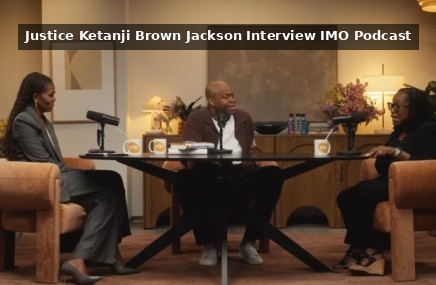
Editor’s Notes: In this episode of IMO, Michelle Obama and her brother Craig Robinson welcome Supreme Court Justice Ketanji Brown Jackson for a thoughtful conversation about the experiences that shaped her path to becoming the first Black woman to serve on the United States Supreme Court. Justice Jackson reflects on growing up in a family of public servants, building confidence as a young student, and the mentors who encouraged her to dream big, while also sharing the story of her decades-long love with her husband and the challenges of balancing demanding careers with raising a family. Drawing from her memoir, she discusses the lessons she hopes young people will take away, breaks down how the judicial system works, and explains why an independent judiciary is essential to a free society. The episode also includes practical advice on finding mentors and navigating difficult professional relationships. (July 29, 2026)
Read the full transcript of the interview below:
Welcome and Introductions
MICHELLE OBAMA: Hi, Craig.
CRAIG ROBINSON: Nice suit.
MICHELLE OBAMA: We have a special guest, so I wanted to kind of show up like— I mean, business.
CRAIG ROBINSON: And make me feel underdressed.
MICHELLE OBAMA: I know I should have called you.
CRAIG ROBINSON: You should have let me know.
MICHELLE OBAMA: And been like, boy, put on a jacket. But that’s cute. That’s very non—
CRAIG ROBINSON: Yeah, that’s just what I want to be in front of a Supreme Court justice is cute.
MICHELLE OBAMA: Just very cute.
CRAIG ROBINSON: Yeah.
MICHELLE OBAMA: Yeah. But you know, you did your best. How’s it going? How’s life?
CRAIG ROBINSON: Life’s good. Life is really good. Yeah.
MICHELLE OBAMA: Where are you staying?
CRAIG ROBINSON: I’m staying in the Hollywood Hills. So not far from here.
MICHELLE OBAMA: Okay.
CRAIG ROBINSON: I have a real nice Airbnb. What I like about this one, it’s got a lot of outdoor family space. I mean, really, there are balconies off of almost every room and then it’s got a huge sort of patio.
MICHELLE OBAMA: Oh, that’s cool.
CRAIG ROBINSON: It’s really neat.
MICHELLE OBAMA: Yeah. So you’re not rambling around there lonely.
CRAIG ROBINSON: Hearing an echo because I’m the only one in a 4-bedroom place. So it’s really nice and it’s in a really good neighborhood. It just reminded me of why people, a good reason why people open their homes up and have them on Airbnb, so that you can show off your neighborhood and walk around the Hollywood Hills.
MICHELLE OBAMA: Is that what you think the family that owns this house wants you to know?
CRAIG ROBINSON: Well, I think they want a little extra cash.
MICHELLE OBAMA: Yeah, that’s what I was wondering.
CRAIG ROBINSON: It’s in a really cool—
MICHELLE OBAMA: I think that’s the real reason.
CRAIG ROBINSON: It’s in a really cool neighborhood. And I’m not in the steep part, so I can walk around.
MICHELLE OBAMA: Did you go for a walk?
CRAIG ROBINSON: Not yet. Not yet.
MICHELLE OBAMA: Okay.
CRAIG ROBINSON: I’ve been working.
MICHELLE OBAMA: You woke up this morning—
CRAIG ROBINSON: Well, I had a meeting this morning, so I was up early. But if I didn’t have a meeting, it’s close enough to Laurel Canyon Road where you can walk down there and then you’re back in civilization.
MICHELLE OBAMA: So with shops, and if you wanted to walk and get your morning coffee, you could?
CRAIG ROBINSON: Yeah, I could.
MICHELLE OBAMA: I think you should do that tomorrow and tell me all about it.
CRAIG ROBINSON: I might do that.
Introducing Justice Ketanji Brown Jackson
MICHELLE OBAMA: Well, I think we should get to it. It feels like we’re becoming a big girl and boy podcast.
CRAIG ROBINSON: I know. This is—
MICHELLE OBAMA: With our guest today. It’s like we’re elevating ourselves.
CRAIG ROBINSON: You know, you have probably met Justice Ketanji Brown Jackson, but I have never met her. And she doesn’t seem like a Supreme Court justice. She’s so delightful.
MICHELLE OBAMA: That’s a big diss to the others that you don’t know.
CRAIG ROBINSON: Well, I haven’t met any. So this is the first one. But I was—
MICHELLE OBAMA: But she gives you an air of delight unlike the others.
CRAIG ROBINSON: Well, no, I wasn’t going to say that. But you see how— see, that’s what Misha does. She puts words in my mouth. And then I end up being scolded on social media. No, but I’m really excited about our discussion because I just can’t wait to talk about her life.
MICHELLE OBAMA: Yeah, it’s not often that people get access to a sitting Supreme Court justice.
CRAIG ROBINSON: I know. How did you get so lucky?
MICHELLE OBAMA: Oh, man. I don’t know. Just born that way.
CRAIG ROBINSON: Yeah.
MICHELLE OBAMA: Well, let’s give her a proper introduction and let’s get this conversation started.
CRAIG ROBINSON: So Justice Ketanji Brown Jackson is an Associate Justice of the Supreme Court of the United States, confirmed in 2022 as the first African American woman to serve on the court. And she is the author of The Lonely One— which we have here— The Lovely One. See, I’m so nervous.
MICHELLE OBAMA: Yeah, just settle down.
CRAIG ROBINSON: I mean, you’re shaking a little bit. I know, I know. I’m really excited.
MICHELLE OBAMA: Justice Jackson, you guys.
CRAIG ROBINSON: Justice Jackson, please come join us before I—
MICHELLE OBAMA: You got my brother all shook. It is so good.
JUSTICE KETANJI BROWN JACKSON: So great to see you. Thank you.
CRAIG ROBINSON: Thank you so much for being here.
MICHELLE OBAMA: Welcome to IMO.
JUSTICE KETANJI BROWN JACKSON: This is wonderful. Yes, I’m perfect.
MICHELLE OBAMA: Oh my goodness. Well, it is really, really an honor. You know, just for our listeners and viewers, we’ve met on several occasions, but we have never had the real time to just check in and be.
JUSTICE KETANJI BROWN JACKSON: And I am so proud of it, being able to give a younger audience a chance to check in with my story. I think it will be great.
Growing Up Driven: Debate, Competition, and Early Ambitions
CRAIG ROBINSON: What I get out of your memoir is that at a young age, you were really— should I say competitive, driven? I mean, it comes out.
JUSTICE KETANJI BROWN JACKSON: Well, I do think that I saw that pretty early on. I mentioned that my parents were public school teachers. But when I was 3 years old, my dad decided to go to law school. And that’s not something that happens every day, that someone who has a small kid decides to go to school.
Some of my earliest memories are of sitting at the kitchen table on the University of Miami campus, which is where my dad went to law school. My dad has his law books all stacked up, and I have my coloring books all stacked up. And we worked together. And so from that young, I knew I wanted to be a lawyer because I thought that’s what you did. But watching him study, watching him strive and say, “This is something that I want to do,” I think really formed me early on as someone who was going to continue to try to improve myself through education and be a lawyer and maybe even become a judge. Those sorts of ideas, I think, were planted very early.
And then I had the really wonderful opportunity to go to a big public high school in South Florida. But we had a fabulous debate team. And my debate coach was an extraordinary mentor for me. And she just believed in me. She just believed in me. And doing speech and debate, I think, was really the beginning of my, you say, competitive spirit, because it was a competitive event.
And I tell people now, if you want your kids to be resilient, to understand how to deal with failure, to develop the kind of spirit of perseverance that it’s going to take to be really successful, you should have them do something competitive when they’re young. Get them into some kind of— whether it’s sports or a debate or something. It’s very helpful, in my opinion, to form the right mindset to succeed later on.
CRAIG ROBINSON: In my opinion, too. I know.
JUSTICE KETANJI BROWN JACKSON: You’re a big sports guy.
Being the Smart Kid: Loneliness and First Love
MICHELLE OBAMA: One thing I wanted to ask, what was it like being the smart kid in your family and in your community?
JUSTICE KETANJI BROWN JACKSON: Very lonely. I mean, I was president of my high school class. Big class, 750 kids. And on the debate team, very, very successful. So I was popular, but just not— in the way that resulted in any dates or prom invitations. And so it was lonely in that sense. And that was something that I had to overcome. And actually played itself out in my eventual courtship and dating my husband because he actually was my first boyfriend.
MICHELLE OBAMA: Yeah. We going to talk about that.
JUSTICE KETANJI BROWN JACKSON: Oh, OK. We going to talk about that. We met at college. That was really my very first time dating anyone.
CRAIG ROBINSON: Your first date was in college?
JUSTICE KETANJI BROWN JACKSON: Yes, sir.
CRAIG ROBINSON: I thought I was bad.
JUSTICE KETANJI BROWN JACKSON: Yes, sir.
Finding Community at Harvard
MICHELLE OBAMA: Well, he was always in the gym. But this is— I mean, like you, and I want to talk about your Harvard experience. One of the reasons I got through Princeton, he was there, and he was good ballast for me. But we were there only 2 years. But it was because of that community of kids who were like me.
JUSTICE KETANJI BROWN JACKSON: Absolutely.
MICHELLE OBAMA: Right?
JUSTICE KETANJI BROWN JACKSON: Absolutely.
MICHELLE OBAMA: And I always try to make this point. It’s like, you don’t do kids of color service by plucking them out and making them one of a few and then scattering them about the campus.
JUSTICE KETANJI BROWN JACKSON: I think that’s absolutely right. And it describes more of my high school experience, even though I was popular, than it did my college experience, which I loved. Because at the time that I went to Harvard, which we’re contemporaries in terms of the timing of it, there was a sizable Black community on campus. And it was like I found my people, in a sense— the people who had similar life experiences and backgrounds that I had, where you could feel totally comfortable being yourself.
And my roommates and I— and I talk a lot in the book about them— I roomed with 5 Black women. Other Black women. And there were 6 of us on campus. And then we were within this larger community. And it was just amazing. It was amazing.
Adjusting to Elite Academia: Imposter Syndrome and Early Wins
MICHELLE OBAMA: Because you experienced homesickness. As smart of a student as you were, leaving home and going to a college setting in Harvard and Princeton, these schools, these elite schools, with systems of education that are still somewhat different— it takes a minute to adjust to living on your own. I got to Princeton and I realized that I’m going to school with a bunch of kids who went to college preparatory schools. The Choates and the Exeters of the world. And I’m like, oh, wow, you did this already. You’ve been living this life for the last 3, 4 years. And I’m just showing up, and you already took this course. You read these books. You did this thing that I didn’t get in my little public high school on the South Side of Chicago. And it was very sobering.
JUSTICE KETANJI BROWN JACKSON: Sobering thought. I came from Florida, very different cultural environment anyway. And then to meet the kinds of students that you’re talking about who were in some ways that much farther ahead because they had not only grown up or been in the New England environment, so had already adjusted to that way of being, but also had a prep school kind of background, was very daunting, especially at the beginning.
And I think the thing that really saved me was a couple of things. I certainly tried to keep, and did keep, the connection to home. My mother and my aunt, they used to write me letters. So I’d get these letters from home in a way that was very important. And also doing well in my very first set of classes.
MICHELLE OBAMA: Oh my God, I had the same experience.
JUSTICE KETANJI BROWN JACKSON: Did you have that?
MICHELLE OBAMA: Really? No, please talk. We can’t hear.
JUSTICE KETANJI BROWN JACKSON: Yes, yes, yes. Once you get there and you are able to show and demonstrate to yourself that you have the ability, even though there are others who have different advantages than you do, I think that is a really important, significant step. And so my first semester, I took a class called Justice, which I loved. And it was on legal and political philosophy. Very interesting, big class. It was in the large theater. And I was always too intimidated to say anything.
MICHELLE OBAMA: Oh my God. Yeah.
Finding Their Footing: First-Year Experiences at Harvard and Princeton
JUSTICE KETANJI BROWN JACKSON: The professor asked for classroom participation. I never spoke. But I took notes, and I talked to the teaching fellows, and I really loved the class. And I had to write a paper in my expository writing class about an experience as a first year on campus. And what I wrote about was the experience of being in justice in this big class. And so I reflected on the class, and then I did well in the class. And I think that was really the launching pad for me. I said, okay, I’m from this big public high school in a totally different place, but look, I did well in this class, and it really made me feel.
MICHELLE OBAMA: So, what about you? What was your class? I mean, it was the same thing. I mean, I had my brother, but he was a big jock. He was the big man on campus, star basketball player. What are you about to say, Gilbert?
CRAIG ROBINSON: No, I wasn’t gonna say anything.
MICHELLE OBAMA: You were about to deny it?
CRAIG ROBINSON: No, I was not.
MICHELLE OBAMA: Craig Robinson’s little sister. So, you know, I knew that, you know, at least I had him to say, you know, he— I was always the more focused student than he was.
CRAIG ROBINSON: She was a better student than I was.
MICHELLE OBAMA: You know? But he— yeah, he got into Princeton. You did not get into Princeton on athletics.
JUSTICE KETANJI BROWN JACKSON: Of course.
MICHELLE OBAMA: Of course. You had to get in there on academics. Of course. But when you see your brother, you know, there’s a part of me that’s like, I’m pretty sure I can do this.
CRAIG ROBINSON: She’s being really nice. She’s being really nice. Meesh knew how to study from a young, young age. I did. I did well taking tests. That’s how I got into everything. I knew how to— I just had a knack for taking tests, but I didn’t study.
So my first experience— I’m hijacking your story, but my first experience at Princeton, I took the wrong courses. I took chemistry, physics, economics.
JUSTICE KETANJI BROWN JACKSON: At the beginning?
CRAIG ROBINSON: At the beginning? Yes. Chemistry, physics, economics, and calculus. Because I was going to be an engineer, but I wasn’t prepared.
MICHELLE OBAMA: And he was on the varsity team.
CRAIG ROBINSON: And I was playing basketball.
MICHELLE OBAMA: He was a freshman. You were on varsity as a freshman.
CRAIG ROBINSON: Yeah, I was. And I almost failed out of school.
JUSTICE KETANJI BROWN JACKSON: I remember this.
CRAIG ROBINSON: And I called my dad.
MICHELLE OBAMA: And there were no undergrad-level courses at Princeton for these, like in math and science.
CRAIG ROBINSON: It was bad counseling. And I forgive my counselor for this, for putting me in these courses.
MICHELLE OBAMA: I mean, that’s really great because that’s part of the experience I had.
JUSTICE KETANJI BROWN JACKSON: Yes.
MICHELLE OBAMA: Not knowing what courses to take. Yeah.
CRAIG ROBINSON: It was malpractice. And so end of my first semester, I got 2 Cs, a D, and an F. Those were the lowest grades I’ve ever gotten in my whole life. And I call my dad. In tears.
JUSTICE KETANJI BROWN JACKSON: Yes.
CRAIG ROBINSON: I’m in over my head. I shouldn’t have come here.
JUSTICE KETANJI BROWN JACKSON: Oh no.
CRAIG ROBINSON: I gotta get outta here. I’m gonna fail.
JUSTICE KETANJI BROWN JACKSON: Oh no.
CRAIG ROBINSON: And this is a guy who did not go to college, has MS, working for the city of Chicago. And he is like, whoa, whoa, whoa. Relax, relax, relax. Now tell me about this again. And what courses are you taking? And he goes through this whole thing and I’m like, he doesn’t know what he’s doing. Right.
And the final thing he said, “How many people are in that school?” And I said, 4,000. But what does that have to do with it? I’m like, through tears. And he said, “Well, that means there’s 1,000 people in the class.” And he said, “Okay, we’ve figured out you’re not going to be number 1 in the class, but you’re not going to be number 1,000.” And it hit me as like, there’s no way I’m going to be number 1,000. He’s like, just— get out of those courses. Take something that you’re interested in.
And to your point, as soon as I did that and had some academic success, I felt intellectually able to compete.
MICHELLE OBAMA: Yes.
JUSTICE KETANJI BROWN JACKSON: Yes.
CRAIG ROBINSON: And it changed my whole view of the whole process.
MICHELLE OBAMA: Yes.
CRAIG ROBINSON: And it made me a better everything, better person, better player.
MICHELLE OBAMA: Yes.
CRAIG ROBINSON: But a better combatant in the classroom.
MICHELLE OBAMA: Right.
JUSTICE KETANJI BROWN JACKSON: Because you believed in yourself at that point.
CRAIG ROBINSON: You can do it. And I was just on the wrong path.
Dreaming of the Bench: Constance Baker Motley and the Road to the Supreme Court
CRAIG ROBINSON: So when was it that you were thinking in your mind, not that I’m just gonna be an attorney or a lawyer, but I’m gonna be a judge?
JUSTICE KETANJI BROWN JACKSON: Oh, I remember. Thinking that when I got introduced to Constance Baker Motley. And I don’t mean introduced in person. I mean, I was in middle school, and I learned about her because, of all things, we share a birthday. We were both born on September 14th, 49 years to the day apart.
And I was reading some article, probably in one of the few magazines that my parents allowed— Jet or Ebony or Essence, right? About, you know, famous people with birthdays in September. And I said, this woman has my birthday.
MICHELLE OBAMA: And she—
JUSTICE KETANJI BROWN JACKSON: Constance Baker Motley was the first African American woman to be appointed to the federal bench. And she had been one of Justice Thurgood Marshall’s— when he was a lawyer— one of his protégés and in his group of counsel. And she was a civil rights lawyer who had argued cases all through the South and in the Supreme Court. She was the first Black woman to argue in the Supreme Court. And she argued something like 10 cases, and she won 9 of them. And she was extraordinary. And President Johnson put her on the bench in the mid-1960s.
So when I’m in middle school, there’s this Black woman who is a federal judge. And I had wanted to be a lawyer, but she shared my birthday, and I figured maybe I can be a judge. And then around at the same time, Justice O’Connor gets appointed to the Supreme Court. And I remember that. It was a huge deal to have a woman appointed to the Supreme Court. So it was like then that I had this idea that I wanted to be on the Supreme Court.
And when I applied to college, I wrote in my essay to Harvard that “you really have to accept me because I would like to be— I think it will help me with my dream of being the first Black female Supreme Court Justice to appear on a Broadway stage.” That was the line. That’s crazy.
MICHELLE OBAMA: It was crazy.
JUSTICE KETANJI BROWN JACKSON: But they were compelled, apparently.
MICHELLE OBAMA: Well, this is different. She stands out.
CRAIG ROBINSON: Way to make yourself stand out.
JUSTICE KETANJI BROWN JACKSON: Yes. And so it’s happened.
MICHELLE OBAMA: It has happened. Yes.
JUSTICE KETANJI BROWN JACKSON: Get on the court.
MICHELLE OBAMA: Talk about manifestation, young people.
JUSTICE KETANJI BROWN JACKSON: You can do anything you want. You know, I got on the court. And the producers of a Broadway show— I put this in the book. And they read the book. And they called me up. And they said, “You’ve done the first part. We can help you with the second part. Do you want to be in our show?” And I said, “Sure.”
Better Than Matt Damon: Theater, Talent, and the Road Not Taken
MICHELLE OBAMA: And you know, and just to make us all mad, in addition to being so smart and accomplished, you can sing. You have a beautiful voice.
JUSTICE KETANJI BROWN JACKSON: I can sing.
MICHELLE OBAMA: I mean, very happy. That doesn’t seem fair.
JUSTICE KETANJI BROWN JACKSON: Well, I will tell you, I am very grateful for all the many talents. And it’s so much fun.
MICHELLE OBAMA: Yeah. Did you do theater? I can’t remember in the book. Did you do it at Harvard?
JUSTICE KETANJI BROWN JACKSON: So I did it at Harvard. Yeah. So there were some events in speech and debate. I was on the speech side of speech and debate. Oratory was my primary event in high school, which is where you write your own speech and deliver it. And then in college, I shifted completely from speech and debate and just did theater.
And I did— I guess you say I sing. My big moment in college was I played Billie Holiday in a cabaret about her life. And I’d practiced her intonations, and it was fabulous. It was so fun.
MICHELLE OBAMA: And you said you were in a production with Matt Damon?
JUSTICE KETANJI BROWN JACKSON: I was not in a production. I was in a class. I was in a class with Matt Damon. So he— at that point, he was already into community theater. He was kind of known on campus as someone who wanted to be an actor. So I took a drama class, just a regular credit class, and he happened to be in it. And then for one scene, the professor paired me with him. And it was something like Waiting for Godot. It was like a boring play. But we did this scene. And at the end, the professor was like, “Ketanji, you were so good. Matt, we’ll talk.” And I was like, I was better than Matt Damon.
MICHELLE OBAMA: I was better than Matt Damon. Have you ever, Ezi, heard that story?
CRAIG ROBINSON: I don’t know.
MICHELLE OBAMA: I told him about it. Make sure he hears that. Because you were better than him. And I bet he’ll never hear that from Justice Roberts. “Matt Damon, you were better than Justice Jackson.”
JUSTICE KETANJI BROWN JACKSON: No, it was so funny.
MICHELLE OBAMA: Justice Jackson, you had all the chops. You’re an actor, you know, great orator, beautiful voice.
CRAIG ROBINSON: Why?
MICHELLE OBAMA: Why on earth?
JUSTICE KETANJI BROWN JACKSON: Did I pick a path?
MICHELLE OBAMA: Did you go to law school?
A Calling to Public Service
JUSTICE KETANJI BROWN JACKSON: You know, I had always, always wanted to be a lawyer. I thought it was the highest and best use of my time and talent. My parents raised me to be a public servant. They were public servants. My dad, as I said, went to law school, but then he ended his career as the school board attorney for the Miami-Dade County School Board. So they were always— my mother was a principal for the School for the Arts. Public service in our blood.
I never really thought of doing something professionally other than going to law school, being in a position to make the arguments and do the things that I thought were necessary to advance our country with all of the issues that we are facing.
CRAIG ROBINSON: Okay.
MICHELLE OBAMA: That sounds noble and true.
JUSTICE KETANJI BROWN JACKSON: But I still have fun. I still have fun.
MICHELLE OBAMA: Yeah, yeah, yeah, yeah. We’ll get to that. You have fun, and you had love.
JUSTICE KETANJI BROWN JACKSON: I had love.
Meeting Patrick: A Harvard Love Story
CRAIG ROBINSON: So you met your husband at Harvard.
MICHELLE OBAMA: You met Patrick, and he’s— I met Patrick. First of all, let me just say, he’s cute. Oh, thank you. He’s super sweet. He’s super sweet, yeah. Oh, and your love story is just so— I mean, it’s like, way to have the best story, love story, and not have had a boyfriend.
JUSTICE KETANJI BROWN JACKSON: It was extraordinary.
MICHELLE OBAMA: God just said— You need a good one.
JUSTICE KETANJI BROWN JACKSON: And he gave me one. I mean, I honestly had decided after high school that I probably would not find anyone. I probably would not marry, that it was going to be enough for me to just be professionally successful in doing what I’m doing. So I was not looking for any kind of—
MICHELLE OBAMA: You weren’t manifesting. No. You didn’t put that in your college essay.
JUSTICE KETANJI BROWN JACKSON: No, I did not. I did not. And I went to this class. Patrick— We met in college, and he is a year ahead of me. And so he was a junior, and I was a sophomore. And he was a sociology major, even though he was pre-med. So he had to take the core courses around that.
MICHELLE OBAMA: You were a sociology major.
CRAIG ROBINSON: Yeah, so we both were.
JUSTICE KETANJI BROWN JACKSON: He loved sociology. And there was this sociology core basic course called The Changing Concept of Race in America. And so I took it. A lot of Black people took it. Patrick, my husband, who is not Black, took it.
MICHELLE OBAMA: White boy in the class. Like, look down there.
JUSTICE KETANJI BROWN JACKSON: What do you know?
MICHELLE OBAMA: Was he raising his hand? Did he have things to say?
JUSTICE KETANJI BROWN JACKSON: He was not raising his hand. He was sitting behind me, tapping on my shoulder, trying to talk to me.
CRAIG ROBINSON: Okay, player. Okay, player.
JUSTICE KETANJI BROWN JACKSON: He was trying to talk to me. So I would look back, and I was like, who is this guy? Why is he doing that? And I didn’t know what it looked like to have somebody flirt with you and like you. I honestly did not. So I just thought, this is kind of weird. But I thought he was kind of cute, and I did like him.
So after about maybe 2 or 3 weeks of the class, I notice that he is very talkative in this way and very flirty in this class. Like, 3 days a week, we had this class. And then I would see him on the other days— you know, we had this class Monday, Wednesday, Friday. On Tuesday and Thursday, I would see him in a government class because I was a government major, and he wouldn’t talk to me at all.
MICHELLE OBAMA: It’s like, oh no, you did not.
JUSTICE KETANJI BROWN JACKSON: Not at all.
MICHELLE OBAMA: Don’t be talking to me in the Black class. See me outside of the Black class and you don’t know me, you tapping on my shoulder.
JUSTICE KETANJI BROWN JACKSON: And my roommates, I raised this with them and they’re like, leave him alone. Yeah, crazy.
CRAIG ROBINSON: Yeah, don’t have anything to do with it.
MICHELLE OBAMA: This is the Black girl posture, by the way.
JUSTICE KETANJI BROWN JACKSON: They were like, okay, no, like, no. So I said, you know what? I’m going to confront him on one of the friendly days.
MICHELLE OBAMA: Way to go.
The Identical Twin Twist
JUSTICE KETANJI BROWN JACKSON: On the friendly day. So one of the days where he’s talking to me, I said, listen, why don’t you talk to me in our government class? And he says, I’m not taking a government class. And I said, yes, you are. I see you in this class. I try to wave to you. You don’t say anything. And he says, “Oh, you must be talking about my identical twin brother.”
MICHELLE OBAMA: That’s crazy.
CRAIG ROBINSON: That’s so—
JUSTICE KETANJI BROWN JACKSON: Because he has an identical twin.
CRAIG ROBINSON: That should have come to his mind first.
MICHELLE OBAMA: It should have. Really.
JUSTICE KETANJI BROWN JACKSON: I will give you these cues.
MICHELLE OBAMA: And why didn’t his brother kind of say—
JUSTICE KETANJI BROWN JACKSON: Here’s the reason. It’s so interesting. We talked about the prep school kids. They grew up in Boston. They went to separate prep schools and private schools from when they were in kindergarten.
MICHELLE OBAMA: Oh, okay. So they weren’t used to being together.
JUSTICE KETANJI BROWN JACKSON: They went to separate boarding schools all through and just were not used to— they had their separate friends and separate, and no one ever mixed them up. And Harvard was the first time, when they came back since kindergarten, that they were in the same school environment. So people would mix them up all the time. People would mix them up all the time, and they would not think—
CRAIG ROBINSON: They would not think to say.
JUSTICE KETANJI BROWN JACKSON: And so once we cleared that up, which was a little something at the beginning, we were off to the races.
The Cape House Date
JUSTICE KETANJI BROWN JACKSON: This was at the beginning of my sophomore year. We didn’t start dating until the last day of my sophomore year. But we were friends. And he, in fact, dated another girl during this time. And then that really solidified for me that he did not like me. We were just friends. And then they broke up. He was from the Boston area, and his family has a house on the Cape.
CRAIG ROBINSON: Okay.
MICHELLE OBAMA: They’re rich. I’m just— I’m just helping the story along.
JUSTICE KETANJI BROWN JACKSON: He is a Boston Brahmin.
MICHELLE OBAMA: Brahmin.
CRAIG ROBINSON: Wait, what’s a Brahmin?
JUSTICE KETANJI BROWN JACKSON: A Brahmin is like this group of people who have been here since the Mayflower.
MICHELLE OBAMA: They were the Pilgrims.
JUSTICE KETANJI BROWN JACKSON: Traced their families back to that time. So he’s 6th or 7th generation Harvard.
MICHELLE OBAMA: He’s one of them.
CRAIG ROBINSON: Holy smokes.
JUSTICE KETANJI BROWN JACKSON: But really cool.
CRAIG ROBINSON: Really cool.
JUSTICE KETANJI BROWN JACKSON: He’s in the sociology class. Clearly.
MICHELLE OBAMA: He’s cool.
CRAIG ROBINSON: We gonna give him that.
JUSTICE KETANJI BROWN JACKSON: So he says to me the day before the last day— I’m about to go home to Florida for the summer. He says, “You know, do you want to go to the Cape and see my family’s Cape house that I’ve been telling you all about?” And I said, “Okay, sure.” And he goes to his family’s house. He gets the car. He picks me up. And we’re driving. And I remember sitting in the car going, is this a date? I wonder if this is a date.
CRAIG ROBINSON: I don’t know if this is a date.
MICHELLE OBAMA: Right. So Justice Jackson is like, I’ve never been on one. I’ve never been on a date. So I don’t know. I don’t know if this is how it goes. You just get in the car with the guy.
JUSTICE KETANJI BROWN JACKSON: I hoped so because he was cute. And he invited me. So we go to this Cape house and it’s closed because it hasn’t opened yet for the summer. It’s kind of cold.
MICHELLE OBAMA: Because you learn that about summer houses too. We don’t know about that.
JUSTICE KETANJI BROWN JACKSON: I don’t know anything about it.
MICHELLE OBAMA: And it’s like, you got another house and it’s not open yet?
CRAIG ROBINSON: Why wouldn’t the door be closed?
MICHELLE OBAMA: It was closed.
JUSTICE KETANJI BROWN JACKSON: Exactly. So we go to this house and we’re walking around and he’s showing me, and the house is actually on a private island. It’s like a whole thing.
MICHELLE OBAMA: Did you have to take a ferry to get there?
JUSTICE KETANJI BROWN JACKSON: There’s a one-lane little bridge that goes over, but there’s 7 houses on this island.
MICHELLE OBAMA: You didn’t have any of that, get out.
CRAIG ROBINSON: No!
JUSTICE KETANJI BROWN JACKSON: No, not at the time. Don’t go over the bridge! No, but so we’re walking around, and he’s showing me. We’re down by the water, and it’s all great. Nothing happens. He doesn’t try to hold my hand. He doesn’t try to— we’re by ourselves the whole day. By the end of it, I am furious.
MICHELLE OBAMA: Furious. It’s like, you wasted my time.
JUSTICE KETANJI BROWN JACKSON: I was like, I thought this was a date. I thought you liked me. Obviously, you don’t. I just want to go home. And he says, “My family lives in Dedham, which is not too far from Cambridge. Why don’t I take you there, and I’ll make dinner, and then I’ll take you back to the dorm, and you can finish packing?” I say, whatever, because I’m, like, furious.
So we go to his house, and his parents are there, and they’re very lovely. And he makes spaghetti or something for dinner. And then he says, “Well, why don’t we watch a movie? And then after the movie, I’ll take you home.” And I was like, fine. So we go to the den and we sit down. And I’m just thinking, I just— I’m so humiliated.
MICHELLE OBAMA: What was the movie?
JUSTICE KETANJI BROWN JACKSON: The movie was Al Pacino’s Sea of Love. And we’re sitting there and he turns off the lights and we’re sitting and I’m just very, very annoyed. And he does one of these things. Okay.
MICHELLE OBAMA: And I’m like, Patrick making a move.
JUSTICE KETANJI BROWN JACKSON: I jump up and I say no, because I had convinced myself that he did not like me.
CRAIG ROBINSON: Oh, you didn’t say that to him. It was saying that in your head.
JUSTICE KETANJI BROWN JACKSON: No, I said no to him.
CRAIG ROBINSON: No, but all the— she was mad.
JUSTICE KETANJI BROWN JACKSON: You were having mad—
MICHELLE OBAMA: Yeah.
Love, Marriage, and Building a Life Together
JUSTICE KETANJI BROWN JACKSON: The mad stuff was in my head because I figured he had a whole day to show some affection. He had not done so. And so he was now just trying to take advantage of me as far as I was concerned.
CRAIG ROBINSON: I was like, this is crazy.
MICHELLE OBAMA: Yes.
JUSTICE KETANJI BROWN JACKSON: So I jumped up and I said, no. And he said, what’s wrong? And he stood up. And I said, I just don’t want to be hurt. And he said, “Ketanji, I will never hurt you. I love you.”
MICHELLE OBAMA: Whoa. I know.
JUSTICE KETANJI BROWN JACKSON: And I was like—
MICHELLE OBAMA: And the crowd goes silent. And there are tears.
JUSTICE KETANJI BROWN JACKSON: I was like— And then the music plays. I was— I mean, it was— I was shocked because I really— I’d never had a relationship. I didn’t think he liked me. I liked him so much, but this was a disaster. And then he told me he loved me. And it was—
CRAIG ROBINSON: On your first date?
JUSTICE KETANJI BROWN JACKSON: On our first date. So from that day—
MICHELLE OBAMA: But they had been friends.
JUSTICE KETANJI BROWN JACKSON: So from that point until we got married, 6 and a half years, through his medical school, through my law school, we dated and then got engaged.
MICHELLE OBAMA: He’s a doctor too, y’all.
JUSTICE KETANJI BROWN JACKSON: He’s a doctor. So we got married 6 and a half— and we’ve been married now— in October, it will be 30 years.
MICHELLE OBAMA: Oh, wow. 30 years. It’s such a beautiful, beautiful story. That’s amazing.
CRAIG ROBINSON: That’s almost as good as our story.
Meeting the Family
MICHELLE OBAMA: So one of the big brother moves— so what did your brother and your dad say?
JUSTICE KETANJI BROWN JACKSON: I bring him home.
MICHELLE OBAMA: Ooh, OK.
JUSTICE KETANJI BROWN JACKSON: The summer after he graduates.
MICHELLE OBAMA: Guess who’s coming to dinner?
JUSTICE KETANJI BROWN JACKSON: No. And my brother was a little eyebrows up, like, what? Who is this person? He talks— my brother talks about how he thought, this is strange that my daughter is— dating this guy. But he learned very quickly how devoted he was to me, and my dad as well.
You know, when we got married, Patrick, he comes from a very traditional family. I come from a very traditional family. So he actually made arrangements to fly down to Florida to ask my parents for my hand in marriage and did so without my knowledge. I didn’t know he was doing this.
And so he tells a story about how— he sat down with them in the den and said, “I’ve been dating your daughter for 6 years, as you know, and I’m really interested in asking her to marry me.” And my dad was like, “Well, you know, back when I was in the Black Power movement, you would not have been caught dead in my house. Not to mention, you know, asking for my daughter’s hand.”
MICHELLE OBAMA: My one and only.
JUSTICE KETANJI BROWN JACKSON: He said, “But I see how you have treated her. I know that you love her.” And my mother said, “I have 2 questions. 2 questions. Do you believe in God? And do you love my daughter?” And he answered both of them in the affirmative. And she said, “You have my blessing.” And he—
CRAIG ROBINSON: What about your brother?
JUSTICE KETANJI BROWN JACKSON: My brother— my brother was on board by this time. My brother was on board.
MICHELLE OBAMA: And your families have blended. You know, you write about how well received his family has been of you and supportive in the same way.
JUSTICE KETANJI BROWN JACKSON: Absolutely. Very wonderful.
MICHELLE OBAMA: You know, just want to get that on the record too.
JUSTICE KETANJI BROWN JACKSON: They’re wonderful.
Two Ambitious Careers, One Marriage
MICHELLE OBAMA: But so here you guys are, 2 hard drivers. You are going to be the first Black Supreme Court Justice, and he’s going to be some neurosurgeon, you know?
JUSTICE KETANJI BROWN JACKSON: General surgeon.
MICHELLE OBAMA: General surgeon.
JUSTICE KETANJI BROWN JACKSON: General surgeon, which means the structures of the abdomen. People don’t know that. All the other—
MICHELLE OBAMA: I didn’t know that.
JUSTICE KETANJI BROWN JACKSON: All the other sort of specialties are parts of the body. And when you say, I’m a general surgeon, it means the gut, essentially.
MICHELLE OBAMA: Oh my goodness.
JUSTICE KETANJI BROWN JACKSON: So he does a lot of those operations.
MICHELLE OBAMA: But he’s cutting people open and doing really hard things in life, which requires focus and attention, right? So how— talk about how you two together have managed building a family with the stresses, the absences that had to occur. I mean, you know, probably like me and Barack, you know, Barack’s running for office. He’s in state Senate. He’s in the US Senate. You know, we’re building a family at a time when we’re basically commuting, and I’ve got my career and he’s got his. And how do you weave those paths together? Can you talk about the good and the bad times of it all?
JUSTICE KETANJI BROWN JACKSON: Well, it was very, very challenging. I cover some of it in the memoir. I think one thing that was helpful for us is that we met in college. We were with each other through our respective graduate schools. So we both knew that our careers and our professions were very important to us. And I think that helped me to be patient when he was on call, which was a lot.
You know, going through residency, the medical training program, especially for surgery, is very long and very intense. He trained at the Mass General, which is one of the top surgical programs in the country, and a very demanding one. And he was there when we had our first daughter.
So I had to actually— I clerked for the Supreme Court. He had taken some time off to come down to DC while I was clerking. And then I basically went back to Boston because he had to finish his residency at the Mass General. And had our first child. And I’m in a law firm, and he is a resident, and we have an infant. And it was very tough early on.
I think we managed it in part because we tried to take turns with whose career needed the most attention at the time. So when he was a resident, I just went into a regular law firm, even though I knew I wasn’t going to do law firm work long-term.
MICHELLE OBAMA: Oh my God. And the way you talk about law firm work. Yes. I was like, girl, I so get— I’m sorry, Justice Jackson. You remember this. You remember this. I remember this. The way you describe the hardship and the culture.
JUSTICE KETANJI BROWN JACKSON: Yes.
MICHELLE OBAMA: And billable hours.
JUSTICE KETANJI BROWN JACKSON: Billable hours.
The Hardship of Early Motherhood
MICHELLE OBAMA: And trying to breastfeed and keep up with your billable hours— talk more about that.
JUSTICE KETANJI BROWN JACKSON: No, it was so challenging. I had an infant. My husband was a surgical resident, so he was basically absent. We had to have a nanny, obviously, in order to manage childcare during this time. And I remember that because my husband’s hours were so unpredictable, he could never relieve the nanny. And the stress of that, because the nanny is working on hours— she’s there for 8 hours max. You don’t want your nanny working for more than that because she’s caring for your child. And so you have to really be on top of it.
But that meant I was the one who, at 5 o’clock every day, had to say to whatever partner I was working with or whatever, “I’m so sorry, but I need to go because I have to take the train to where my car is and take my car.” It was like a 45-minute commute to get home. And I had to relieve the nanny by 6 o’clock because my husband would never do that.
And the pressure on me as someone who had really prided myself in being the hardest worker, in being available to do whatever my boss wanted me to do— all of those things collided because I couldn’t be there. And we’re talking about a time where there were not cell phones and the ability to take work home. This was not an internet age where you could work— right now, I understand that you can have an infant, and then you leave at 5 o’clock, but you’re back online by 7. That was not the world at that time. So when you were out of the office, you were done, not billing those hours. And I had to go every day. And the stress— I mean, it was just excruciating.
MICHELLE OBAMA: How did you talk to Patrick about it? I mean, and you’re also probably trying not to put stress on him.
JUSTICE KETANJI BROWN JACKSON: Well, that was the hardest part. Because when he was home, he used to do a schedule when he was a resident that had him sleeping in the hospital every other night. So the night that he was home, he actually had to get sleep. So the question was, who was waking up in the middle of the night with the baby? He’s not there at all because he’s at the hospital. So it’s me. And when he’s there, he really has to sleep. So it’s me.
So the time with our infant daughter in Boston for the first 2 years of her life was probably the most difficult time— both in my marriage and in my professional life. Because I was doing everything. And I didn’t want to make him feel guilty or put stress on him.
So much so that when he got an extra year— his surgical residency was 5 years long. And they asked him at the end of it to stay for another year and be like a junior attending to supervise. It’s a huge honor to do this. And he really wanted to do it. And I said, yes, but what we’ll need to do is I’m going to take my daughter and the nanny and move down to Washington, DC, because I wanted to start my career at a law firm in Washington, DC.
And I said, “This is going to be good for you because you don’t have to feel the guilt of having to rush home, having to be with us. You can do this position, which is going to be extraordinarily time intensive, without worrying about us. We’re going to go down.” So I took the nanny, paid her, hired her to live with me and the baby so that he could have this experience without the worry. And it was good in that sense. I mean, he could just put his all into that, and we were fine. But it was very stressful this time.
CRAIG ROBINSON: And that was for a year.
JUSTICE KETANJI BROWN JACKSON: That was for a year, for about a year. Yeah, we were—
CRAIG ROBINSON: How often did you guys see each other during that time?
JUSTICE KETANJI BROWN JACKSON: He probably came home 3 or 4 times during that time. But I mean, he was doing— he was running a part of the Mass General’s trauma intake service. So I don’t— I don’t watch The Pit, but I hear it’s really good. He was like the— running the whole thing. And the hours were insane. And he wanted that experience, and it made him a better surgeon. And because I knew how important the career— I never wanted him to feel resentful, to miss out on an opportunity because he had to give it up in this way.
Navigating Ambition Together
MICHELLE OBAMA: You know, we all have these periods. It’s almost guaranteed, especially if you’ve got 2 people who have ambition and have dreams or hopes. There are going to be periods of really, really hard stuff.
JUSTICE KETANJI BROWN JACKSON: That’s one of the reasons why I wrote about this period, because I wanted people to see that you can go through hard things, and if you stick with it, it’ll be worth it in the end. That other successful people have faced similar challenges. I wanted to be honest about that part of my life.
MICHELLE OBAMA: And you never had to put your foot on the brake of your career.
JUSTICE KETANJI BROWN JACKSON: Right.
MICHELLE OBAMA: But you did have to let up off the gas. Absolutely. You had to set different expectations for yourself. You had to be OK with not being perfect.
JUSTICE KETANJI BROWN JACKSON: Yes. Yes, absolutely. Which is not easy. It is not. For someone who has gotten to a certain level in your career, you’re used to working a certain way and producing at a certain level. And at times, you need to say, I’m going to take this job or do this thing that may not be—
MICHELLE OBAMA: And I’m not going to do it— I’m not going to be the best at it.
JUSTICE KETANJI BROWN JACKSON: Exactly.
MICHELLE OBAMA: You know, I’m not going to be number one, but I’m not going to be the last one.
JUSTICE KETANJI BROWN JACKSON: Exactly.
The Path to the Supreme Court
CRAIG ROBINSON: Has the job met your expectation?
JUSTICE KETANJI BROWN JACKSON: Oh, you know, I don’t know that I had a whole lot of expectations. It was such a blur getting to this position, going through the process of being confirmed, getting there. Because I had clerked at the Supreme Court, I think I had a good sense of what it was going to be like, but it’s so much more. I mean, it’s just extraordinary. I’m so privileged to do this work, to serve the American people in this way, to be in the room, the room where it happens. It’s really— I’m so grateful for it. And I think in that way, it has absolutely surpassed any expectation that I had.
CRAIG ROBINSON: Well, we’re fortunate to have you.
MICHELLE OBAMA: Well, I want folks to really get an understanding of the path. Yes, the career path that is required. I mean, being a lawyer and being— I mean, I understand what clerkships are and the order of choices and acceptances you have to get in order to even be qualified to be a candidate for the Supreme Court. Can you walk our listeners through that process? Which starts with—
CRAIG ROBINSON: because I don’t know—
MICHELLE OBAMA: which starts with being at the top of your Harvard Law School class and being on the Harvard Law Review.
JUSTICE KETANJI BROWN JACKSON: Law Review, right? Yes, yes. Being on something like Law Review is an important training ground if you want to be a judge. Because it helps you to think about the law in a very academic way, systematic way. You are getting a lot of exposure to legal writing, which is what judges ultimately do.
I then went on to clerk, that is become an assistant in chambers to judges. And I actually had the great good fortune of clerking for 3 different judges, at the 3 different levels of the federal system. So, in our federal criminal justice system, we have the trial level, the court of appeals level, and the Supreme Court.
MICHELLE OBAMA: Talk about the levels too, because district court, how is that different from the appellate court? That’s different from the Supreme Court? And I really just want to educate people on it.
JUSTICE KETANJI BROWN JACKSON: So, the first level, the trial level, is called the district court in the federal system. And at that level, that is when people who have a dispute and they say, “We’re gonna file a lawsuit,” you start by filing it before a single judge in the district court. So each judge sits on their own. They each have their own courtroom. And the real goal at that level is to establish the facts of a case. This is where trials happen. This is where people who are accused of crimes, you have the prosecutor filing charges, and they pick a jury. All of that is happening at the trial level. So you really, as a young lawyer working with a judge in that environment, you learn so much about meeting people and interacting with the real people and developing the facts in a case.
The Court of Appeals level is the next level, and the person who loses at the trial level has the ability to appeal. And that is basically to challenge what happened in the trial and say that there was something wrong legally with the process that led to their loss. The court of appeals level is 3 judges who are on panels, and they are interacting mostly with the lawyers. Because when you have an appeal, you hire a lawyer who will take your case to these 3 judges.
MICHELLE OBAMA: ‘Cause the facts are established.
JUSTICE KETANJI BROWN JACKSON: Exactly. The facts have already been established, and the appellate judges are supposed to take those facts and really just review the legal aspects and whether the law was properly applied below. And they read the transcripts, basically, of the lower court proceedings.
I had the great good fortune of having a lot of different jobs in this early period before I became a judge, but I did clerk for judges at all 3 levels, and I ended up being appointed as a judge at all 3 levels. So, my first judicial appointment was actually made by your husband. I was appointed to the District Court in Washington, D.C., and did that trial-level work for about 7 and a half years before President Biden appointed me to the Appellate Court in Washington, D.C., where I did the 3-judge panel legal reviews. And then I was appointed to the Supreme Court. So it’s been quite a journey.
Why Judges Matter
MICHELLE OBAMA: Highly, highly qualified. Can you talk a bit about why judges are important? You know, I run into this all the time. You know, people, you get your ballot, assuming you’re voting, and there’s the long list of judges, right, at the state level, right? And you’re checking them off, and a lot of people are like, what?
JUSTICE KETANJI BROWN JACKSON: You know, I gotta go through that.
MICHELLE OBAMA: And why is it important? Does it even matter who is a judge? Can you talk a bit about why people should be informed, aware, and care who their judges are?
JUSTICE KETANJI BROWN JACKSON: So I will just say, and you’re right that I encounter this a fair amount, people who really don’t understand the significance. Judges are important to democracy and to liberty for every single person who lives in our society. And I say that because in order for us all, with all of our different backgrounds and all of our different views and feelings about how things should happen, all of the disputes that arise just from being people living together in society, you have to have a forum to resolve those disputes peacefully. So we don’t have people at each other’s throats all the time or taking it upon themselves to resolve disputes.
You have to agree to take this to court if it’s something that you are truly at odds over, which is going to happen when you just have a free society. So, in order to agree, we all have to believe that there is a judicial system that is gonna be fair, that is gonna be neutral, that when you bring your dispute to the court, that judge doesn’t have any preexisting stake in the particular issue, that they’re listening to both sides and fairly reviewing the evidence, and coming up with a decision that is a just one. Somebody’s gonna win, somebody’s gonna lose, but we have to have that forum so that we can live together peacefully in our society. So it’s really— I mean, it’s crucial.
Life as a Supreme Court Justice
CRAIG ROBINSON: So, Mish made the obvious point that you’re well qualified for this, and you’ve had some experiences in the whole levels, all the levels.
MICHELLE OBAMA: Yes.
CRAIG ROBINSON: Has the job met your expectation?
MICHELLE OBAMA: Can you talk about how life has changed? We talked a little bit about our shared bubble experiences. Do you feel comfortable just talking about what, you know, how being a life-appointed Supreme Court Justice affects your day-to-day? And what are the limits? And how are your kids managing? And what are the highs? And what are some of the lows?
JUSTICE KETANJI BROWN JACKSON: Well, it is a big, big change. It’s a big commitment. I think the thing that has been most startling in a way is the need for security in a way that you didn’t have before, that I had never experienced. I was on the lower courts, but they don’t have the same level of security or security needs as the justices do. And so it has meant really having to adjust my life. I can’t just go out in any meaningful way as I used to. And that can be a downside, just not being able to live a normal life. I know you know what it’s like to feel confined. But again, I mean, it’s certainly a privilege to do the work and to have the platform.
MICHELLE OBAMA: That goes without saying, you know. But it’s also okay to acknowledge those changes. And I know how you feel. I mean, you never want to come off as not grateful for service, especially people like us who were raised to be public servants.
JUSTICE KETANJI BROWN JACKSON: Yes, absolutely.
MICHELLE OBAMA: You also have to watch your exposure to things so that there isn’t a bias.
JUSTICE KETANJI BROWN JACKSON: That’s exactly right.
MICHELLE OBAMA: And what does that mean for you in terms of reading the paper and listening to the news? And how do you get your information? And what do you have to be careful about? And how are you dealing with the potential conflicts so that you do stay above board?
JUSTICE KETANJI BROWN JACKSON: No, you really have to be focused on that. There are employees in the court— in the legal office of the court, in the public information office of the court, who are assisting us in that way. When I get invitations to do things, I always have them screened by the legal office, the public information office, just to make sure that there are no ethical conflicts, that this is not a fundraiser. You know, there are lots of limits on what judges can do. And I try to be very, very mindful and scrupulous with respect to that because, as you say, our obligation is to be unbiased in our approach. And so you have to then navigate all the sources that could make for an appearance of partiality, which you want to avoid. So there are lots of things that I end up not accepting for that reason.
News sources, I think, you know, I don’t have a lot of time, unfortunately, but I do, you know, the normal general media sources are made available. And I think it’s harder when you’re talking about— there’s so much social media now.
MICHELLE OBAMA: This is a whole different—
JUSTICE KETANJI BROWN JACKSON: It’s a whole different world, and not everything is reliable. And the hardest part for judges is that we really cannot participate.
MICHELLE OBAMA: Probably saving you some brain cells.
JUSTICE KETANJI BROWN JACKSON: Exactly.
MICHELLE OBAMA: We need you focused on your opinions.
JUSTICE KETANJI BROWN JACKSON: Yes.
Listener Question: Finding Your Voice at Work
CRAIG ROBINSON: Now, we actually have a listener question to answer.
JUSTICE KETANJI BROWN JACKSON: We do.
MICHELLE OBAMA: We do.
JUSTICE KETANJI BROWN JACKSON: Okay.
CRAIG ROBINSON: You’ve been so gracious with your time, generous and thorough with your time.
MICHELLE OBAMA: Thank you.
CRAIG ROBINSON: But we want to help some folks out.
JUSTICE KETANJI BROWN JACKSON: Sure.
MICHELLE OBAMA: One last bit of advice from our listener.
CRAIG ROBINSON: From our listener, who’s Lisa from San Diego.
MICHELLE OBAMA: “I am an entry-level professional working under a new boss who has a very specific way of communicating and executing work.
JUSTICE KETANJI BROWN JACKSON: I know that it’s important to develop mentors in an early career position, but I have struggled to connect with her.
MICHELLE OBAMA: I’ve noticed that even small deviations in language or approach are met with strong criticism.
JUSTICE KETANJI BROWN JACKSON: And I’m finding it difficult to balance staying true to my own working style while meeting her expectations.
MICHELLE OBAMA: How can I adapt without feeling like I’m losing my voice or confidence at work? And how do I make sure I find people who really have my back and help me grow my career?”
JUSTICE KETANJI BROWN JACKSON: That’s an excellent question. I mean, mentors are very important in terms of professional development. That’s what I have seen. I wonder whether Lisa has had occasion to talk with her boss and potential mentor, because it’s possible that this person is not aware of the difficulty that Lisa is having.
And if she were to say something like, “You know, I really want to develop our relationship, I would love to have you as my mentor in this work, and how can I communicate in a way that will be most productive? Because I want this to be a good working relationship.” If she expresses an interest in the boss’s views of this, I think that she might find a receptive audience. And if she doesn’t, then she knows that this might not be the right fit for her professionally.
But I would give it a chance by really just being open and coming from a perspective of, “I really want this to work, and I’m open to feedback and wanting to know how we can improve.”
Finding Mentors Beyond Your Direct Supervisor
MICHELLE OBAMA: Yeah, yeah. I mean, I am surprised as somebody who’s led and managed, I think people who work with you don’t realize that sometimes your boss is just not focused. Not because they don’t care, but because the assumption is that there’s the mission that sometimes takes precedent over, “How you doing? And is this working out?” And that doesn’t necessarily indicate lack of intent to mentor, but sometimes you lose track.
And I think it’s true, like, giving your boss the benefit of the doubt and at least making an effort to communicate. And that’s a scary thing. Very scary. It doesn’t happen a lot because it feels scary. You want to make sure you don’t overstep or misstep.
Another thing that I would suggest for Lisa, if the conversation is had and it isn’t as productive as she’d hoped, to think about whether there are other people who are not her direct supervisor within her work environment that can be kind of a mentor or a sounding board. I found this to be true when I was practicing at Sidley, my firm. I mean, I enjoyed all the partners that I worked with, but I also made it a point to meet with senior associates. Some of those partners, particularly the women, were the people that I could talk to. And oftentimes, I would go to them in confidence. After you understood that they could hold your confidence and that you had established that relationship, I found them to be better mentors, right? Because they could also commiserate. They could give me a perspective on where that partner was. Sometimes they knew what was going on, and I got some of my best advice in the law firm from other partners who I wasn’t working with.
JUSTICE KETANJI BROWN JACKSON: Who you weren’t working with, but went to. Yeah, went to. No, that’s fantastic. And especially you can find those people as well, even if they’re doing the kind of work that you’re interested in, sometimes that could develop into a working relationship. But at least going to them and asking for advice, for lunch, the opportunity to talk informally and being humble in a way always helps. You know, when you go to anybody who is more senior than you.
CRAIG ROBINSON: That’s great advice. I don’t have too much to add, but I’ve always felt that being a direct boss doesn’t necessarily make you a good mentor.
MICHELLE OBAMA: Oh, for sure.
CRAIG ROBINSON: That is true. And so you hit on my point — find a mentor who’s not your direct supervisor without going over that person’s head. Right.
MICHELLE OBAMA: And also, not everybody’s going to be a great boss. That’s true.
CRAIG ROBINSON: Or a great mentor.
MICHELLE OBAMA: Or a great mentor. Not every boss will be a great mentor, as you said. And sometimes there’s learning in that. You just have to develop the skin to know the difference. It’s like sometimes you’re gonna have a difficult situation and it’s difficult and it’s not you. So how do you make sure you get through that whole, right? And if you don’t think you can get through it whole, then the question becomes maybe it’s time to move on. But I always caution people, especially in this economy, keep your job until you — don’t walk out now.
JUSTICE KETANJI BROWN JACKSON: Well, and you know what, the other thing I always say is, don’t burn bridges. When you walk out, assuming you have something else lined up, it is super important to have the people you leave behind have a good sense of you and not feel that you have slighted them in any way. Because you never know when you’re going to have to cross that bridge again. And you want them to be out there saying good things about you, even though you don’t work there anymore.
CRAIG ROBINSON: That’s right.
Closing Remarks
MICHELLE OBAMA: Well, hopefully that helps Lisa. Justice Jackson, you have given us a lot of time. I’m delighted. We really appreciate it. Thank you for coming to IMO.
CRAIG ROBINSON: Thanks for being here.
MICHELLE OBAMA: Thank you.
JUSTICE KETANJI BROWN JACKSON: Thank you for giving me this chance. It’s been delightful.
MICHELLE OBAMA: Oh my goodness.
CRAIG ROBINSON: Like I said, delightful.
MICHELLE OBAMA: And the lovely one, the young adults version is out there in the world. But you still gotta read the original adult version. It’s a beautiful story. It really is. Thank you so much. And thank you for sharing with us.
JUSTICE KETANJI BROWN JACKSON: Appreciate it.
Related Posts
- Transcript: World’s First AI Actress Interview on Piers Morgan Show: ft. Tom Conti, Tom Bilyeu & Prof Jiang
- In Vivo Podcast: w/ Cathy Tie and Prof. Jiang on Editing Embryos (Transcript)
- Transcript of Evy Poumpouras Interview: Read People, Spot Lies & More – FO563 Raj Shamani
- DOAC AI Emergency Debate: ft. Ed Zitron, Andrew McAfee, Nate Soares & Roman Yampolskiy (Transcript)
- Transcript of Norman Finkelstein Interview: Tucker Carlson Show