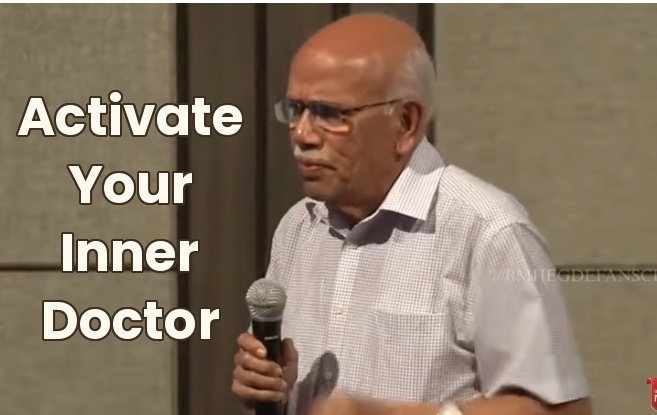
Editor’s Note: In this thought-provoking lecture, Dr. B. M. Hegde challenges conventional modern medicine by arguing that true health largely exists outside the domain of hospitals, doctors, and pharmaceutical treatments. He discusses how the human body is equipped with an “ultimate inner doctor” capable of profound self-healing through the power of mindset, mindfulness, and a positive outlook. Blending ancient philosophies with modern quantum physics, Dr. Hegde emphasizes that well-being comes from reducing stress, practicing compassion, and understanding that the mind and body are deeply intertwined.
TRANSCRIPT:
Health Is Outside the Domain of Doctors
DR. B. M. HEGDE: Health is completely outside the domain of doctors, hospitals, nurses, and things like that. Actually, a 14-country industrialized countries study showed where there are more doctors per capita, more hospitals, and more specialists, there’s more death, less health, and less longevity. I’m not joking. I’m seriously telling you. This 14-country study is a very exhaustive study.
The WHO Study in Thailand
And there is a study done by the WHO in Thailand years ago. I think about forty years ago, where they in Thailand, Bangkok, they took. There are about five systems of medicine concurrently working. Pure Western medicine, as we call as medicine, then pure Chinese medicine, integrated Chinese Western medicine, then some of our system where the father tells the son when he is dying as to how he should treat his patients, and it goes on generation wise. And the last is of quackery.
And they did a study prospectively for five years, very well controlled study. We showed collectively at the end that all systems of medicine, mark my words, all systems of medicine were equally effective on society. This was forty years ago. People were nonplussed. People said, oh, something wrong.
No. Now we know everything is right. Actually, it is very, very right.
When Doctors Went on Strike
You will be surprised to know doctors went on strike in several countries over the last twenty-five years. Different times. Saskatchewan in Canada for three months, twenty-five years ago. Bogota in Colombia for three months, about twenty years ago. Los Angeles County, fifteen years ago. Israel, recently, about two years ago. And Dublin, it’s about five years ago.
Each one of these places, now audit shows in retrospect, when doctors went on strike and nurses ran the hospital, death rate almost fell down precipitously. I’m not joking. I’m serious to tell you.
The Problem with Reductionist Science
Whatever I say here, even a word is not outside the realm of what you think is science. I don’t think that is science, but you think it is science. So I’m telling you scientific “quote unquote” evidence. In reductionist science, that’s our science today. Our evidence is very interesting.
I had a slide — I wish I had the slide. Now, warming, right? Scientifically global warming. Yes? 1972, I was for about six months or so, I was in London for some — I had to stand in for someone. My boss was going somewhere, so I had to go there. And that winter was one month longer. 1972, as recent as that. And there was sleet for about four months on the ground.
Nothing grew, not a blade of grass grew. And there’s so much of human cry saying that we are in for an ice age very soon. It continued for ten years. Suddenly, ice age gave way to warming. And we have called evidence.
Ultimately, then the evidence is not correct. They say, “Well, I did not look at the data. My secretary collected the data and the data was wrong,” or something like that. That is the explanation you give. But we do not say reductionist science does not have evidence. We say evidence-based science. What is the evidence?
That is why I have got a nice slide. All our evidence is surrogate evidence. If you want to say the world is warming, I can get you a slide to show how the ladies’ underwear has been becoming smaller and smaller and smaller and smaller in the last two hundred years. Have you seen that? Eighteenth-century England, if you see, the underwear used to come up to this. And it’s come now almost invisible. That stage has come. Naturally, the world is warming, very, very hot. So this is the kind of evidence we have.
What Cancer Really Is
Supposing, let us say, God forbid, one of us has cancer. We go to the doctor. What do they do? They do a biopsy of that cancer, right? And then take the cells, put in the glass slide, smear them correctly, squeeze them out, and then poison with hemotoxin and eosin, and then completely kill the cell. And look under the electron microscope, this microscope, that microscope. What is it looking at? Tombstone of the dead cells.
Albert Szent-Györgyi, a brilliant Nobel laureate biologist, wrote a book way back in the 1960s called Introduction to Sub-Molecular Biology. I don’t know how many of you read that book. It’s a fascinating book, almost an epoch-making book, where he says, “I quote, I don’t know what cancer is.” I’m not saying that. Albert Szent-Györgyi was saying that in 1960. “I don’t know what cancer is, because cancer cells are working like normal cells, absolutely normal cells. And I can’t say what the cancer does by looking at the tombstone of the cell.”
They may look like abnormal cells because they are squeezed out and distorted and stained and all kinds of things happen. But they are normal cells. They work like normal cells, and I don’t know how to kill them without killing the other normal cells.
Now, I give you an analogy to students. Supposing a bird comes in here, let us say. Bhushan was telling me sparrows are very few in Pune. Supposing a sparrow comes in here, you wonder why did the sparrow come here, where did it come from, where it intends to go in future, and what is it here for.
Do you know what cancer is by looking at that biopsy bit? No. Do you know what will happen to the cancer by looking at the biopsy bit? But we have been predicting the unpredictable future of man. Every day, we have been doing it.
Predicting the Unpredictable
You want to know exactly how bad the science is? Any curious student here? Write down, I will give you the reference. The author’s name is Firth, W. J. — William John Firth — F-I-R-T-H. It is called Predicting the Unpredictable Future of Patients. The journal’s name is British Medical Journal, BMJ. Then Vancouver style, 1991, semicolon, 303, colon, 1565. Please read this article. It’s about five, six pages, very tough physics, but at the end of it, you will realize how foolish we have been.
A patient comes to me, let us say. He has some fever. I’ll simplify it. And he wants to know, tomorrow he has got to go for a lecture in Bhushan’s laboratory. So he asked the doctor, “Doctor, will I be alright tomorrow for the lecture?” Doctor says, “Yeah. Take this tablet three times a day, and you will be okay.” The doctor doesn’t know what the fever is. Of course, he very pontificates like his physician. “This is a viral fever.” He has not seen the virus.
But if you told the doctor in the olden days, when I was a child, which is, “Smallpox is the wrath of the goddess.” And today, say, “Hey, the old fellows didn’t know anything.” They were also rational. There is a cause, there is an effect. Today’s professor comes around and says, “Oh, this is viral fever?” “Yes.” Student is saying, “Yes sir, yes sir.” Nobody sees the virus.
The H1N1 Medical Scare
Now, all of you say H1N1 virus, right? Pune, it came, it came here, there. This is called the medical scare system. The minute you say H1N1, you piss in your pants. Because you see, people die. They created this scare in 2009 to sell a drug which was not selling. It is called Zidovudine. So, what did they — Tamiflu, they call it Tamiflu.
This company which was manufacturing Tamiflu and had the world right for marketing it is a company which made this test, which is called the H1N1 test. You go to the laboratory and get a test done. It has not been authenticated by any independent agency. It has not come from anybody. It has come from the company. So, the specificity and sensitivity of the test is less than 50%, which means whether it is positive or negative, it does not mean anything at all.
Actually, you’ll be surprised. In 2009, everybody put on their mask and all. If you put on a mask and go, it is bad for you, not for the others anyway. Others, nothing happens because flu doesn’t jump like that. You catch a cold. You catch a virus. It goes by this handle. Your mobile phone is the most dangerous, or bus handle, door handle, door knobs. But if you have a brass knob, it’s good because the virus doesn’t live long there. Brass knob kills the virus so fast. Or if you have coconut oil in your hands, the virus dies in seconds.
So, these viruses are caught. So, you don’t have to put on all these masks. I said to someone on the plane, “What are you? Are you having some bad disease? You don’t want to give it to us?” “No. No. I’m protecting myself from flu.” I said, “You are not protecting yourself from flu. You’re protecting yourself from good oxygen around you. You are re-breathing the same air that you’re taking. So after some time, you’ll have carbon dioxide intoxication. That is all what happens.”
A lot of these policemen — of course, the road is different. In the screening area in the airport, you must see that CISF fellow also has one. I tell those girls, “Please don’t do that. Breathe normally. Nothing happens.”
The Real Numbers Behind Flu Deaths
Now, coming down to that, in New Zealand, on an average every year, in the flu season, fifteen to seventeen thousand people die. This is normal. Every flu season. In America, about thirty-six thousand people die. In India, we don’t have statistics. Our people die in the village, they’re not accounted for. Only people who die in the hospital are accounted for. So that’s not reliable statistics.
But that particular year, because everybody washed hands — remember that you don’t want to catch a virus, wash your hands. Never touch your nose, your mouth, your eyes, or any part of your body where it’s liable to get virus infection without washing your hands, because shaking hands is the worst thing that can happen.
Ours is such a healthy system. Namaskaram. So nice. Two things happen. One, your humility shows. When they say, “Namaskaram.” Humility is a sign of virtue and great education. Then number two, you don’t touch another person’s hands. The dirtiest part of the body is the hand.
And the WHO taught us a very nice thing. You do this, and hold this. And then that has millions of germs — you would just shake hands. No. You do this. It comes here. Nobody touches there, and it doesn’t touch anyone. Why? By evening, it is dead. Three, four hours, the virus is dead. So the best thing is whenever you have to sneeze, whenever you have to cough, that is it.
Anyway, New Zealand that year, because everybody washed hands, only three thousand people died. So, this scare of the so-called non-existent H1N1 virus saved fifteen thousand lives in one year in a small country whose population will be a little bigger than Pune, the whole country’s population. And that was the scare that we produced.
Doctor Flu and the Pandemic Myth
Anyway, the doctor who assisted the drug company to say that there is H1N1 virus, his name is Doctor Osterhaus, a Swedish doctor who is now in jail. He is called “Doctor Flu.” He took $10,000 to create this myth called H1N1 virus. And the company made the thing and everything was done.
And the WHO chairman, or the chief of WHO, connived with the drug company because she declared it is a pandemic. When once you declare it is a pandemic, every government has to buy nearly $750 million for drugs per force. And there are no criteria of pandemic at all. Pandemic means at a time twenty thousand, twenty-five thousand people should die. Nothing has happened.
Anyway, they have these periodic things to frighten us. That is why I have called it the medical scare system.
Genes, Environment, and Evolution
You go to the doctor, the first thing they’ll say is, “Is your father diabetic?” “Yes, doctor.” When he says that, it means you are half dead. You and your father have nothing in common with the two of you. You are not your father’s child. That is again Indian philosophy. It says, “Children do not belong to you. They have come through you.” Absolutely right scientifically.
Because you are the children of germs. We are all children of germs. For every genome, for 23,000 human genes, you have got two and a half trillion germ genes, which means the contribution of parents — 23,000 divided by two and a half trillion. My mathematics is not good. It will not be one in a million.
You may have some features of your father or mother or something like that, but what is evolution is environment. If you live like your father, you follow what your father did, you smoke like your father, you eat like a pig like your father, and drink like a fish — what the fish drinks — you will certainly get what the father had. In short, evolution is environmental and not genetic.
The Power of the Mind Over Genes
Let’s forget the genes for a minute. Today, we know with your mind, you can change your genes also. You just do real meditation, you can even increase the size of the telomere at the end of the chromosome, which is a sign of your aging. When you age, the telomere becomes smaller and smaller and smaller and smaller. With meditation, it becomes bigger and bigger and bigger and bigger. And you can change.
Bhushan was talking about lifestyle diseases. Lifestyle diseases are lifestyle diseases. I will tell you what happens. We were hunter-gatherers in the forest some ten thousand years ago before we came to Pune. And what were we doing there? We had to protect ourselves from tigers and lions, snakes, all kinds of things. Nature said, let people survive there also. So nature gave us an autonomic nervous system. If I said God, all of you will be angry. You don’t believe in God.
The Autonomic Nervous System and the Fight-or-Flight Response
And once you go to BSc level, you forget God. But do you know what Max Planck, the greatest physicist, said about God? He said, “Science ends in God, religion starts with God.” That’s all the difference. For religion, you must start with God.
Otherwise, people don’t follow you. For science, you go on science, science, science, science. You come to quantum physics. Then you say, without God, nothing happens here. It doesn’t run like a clock, what Newton and Einstein said.
That’s a different world altogether. Newton’s world and Einstein’s world is different from the real, what is called the quantum world view. I’ll come to that later.
Now anyway, so what did nature do? Gave you an autonomic nervous system to protect you. So, the sympathetic system and this parasympathetic system. Now when you saw a tiger and you want to run away from the tiger to survive, so to run, you require glucose. To run, you require your blood pressure to go up. To run, you require your heart rate to go up. To run, you require energy.
All this comes from the stimulation of the sympathetic system, you get adrenaline coming. When the adrenaline comes to the liver, nature has kept gunny bags of sugar in the liver called glycogen. So, it stimulates the liver and neo glucogenesis, new sugar comes out. So, you see the tiger there, your sugar goes up. Then you see the tiger, want to run, your blood pressure goes up because of adrenaline.
Your heart rate goes up, chronotrophicity, everything goes up. And then you run. Run for your life. And if you survive, all these things come down.
Modern-Day Tigers: Stress in Society
Now we have transplanted ourselves into society in the last ten thousand years, but our physiology is the same. We have same tigers now in the form of human beings. It may be your boss who is a tiger. It may be your wife who is a tiger. It may be your husband who is a tiger.
It may be your junior colleague who is a tiger. It may be the peer in the principal’s office who is a tiger. Now when you see that tiger, the same reaction occurs inside, but you can’t run away from the tiger. Supposing you are a wife with a tiger, how can you run away from the wife? So your blood pressure goes up, and you stand there and watch there, and your blood pressure goes up and up and up.
After some time, it is up. That is what is called high blood pressure. Your sugar is up, that is called diabetes. Your cholesterol is up, because cholesterol is not a disease. Cholesterol has to go up because cholesterol is the base of all of the steroids that are needed for your stress.
So, all these are diseases.
The Problem with Reductionist Medicine
Now, what do we do in reductionist science? I give you a pill, a chemical poison. I tell you what these are. And then what happens? You are happy. I have taken the pill. I have taken it from Doctor Bhushan, he is a very good doctor. Your blood pressure comes down. Why does the blood pressure come down?
One scientist tried to find out. What did he do? He had a chip made. It is called the MIT chip, mitochondrial chip. And this chip can track the drug if you tag it on. Wherever the drug goes, it tags it. So he gives the drug, tags it onto the chip, and then follows it.
And he found that every reductionist chemical drug that he used was accepted first, goes into the stomach. The body’s wisdom says, “Oh, this is how I have not seen it. My forefathers have not seen it. My generation has not seen it. It must be a poison, so it must be eliminated,” goes to the liver. So every drug that you take from A to Z first goes to the liver, and the liver tries to destroy it. That is why after every drug, twenty four hours to forty eight hours later, treat your liver function test, it’s altered.
Then, sometimes the liver cannot destroy the whole thing. Some of it comes out, which is called first pass effect. This first pass effect was known to us even when I was a pharmacology student, but our professors didn’t know what first pass effect is. Now we know what it is.
Now then what we do, that is not enough. So we now know pharmacokinetics, pharmacodynamics. So, we give more dose, more dose, more drug, and all these do what is called adverse drug reactions, ADR.
There Is an Ill Following Every Pill
So, mind you, every drug has an adverse drug reaction. Every drug may not be useful to you, but every drug has an adverse drug reaction. That’s why I coined the phrase, “While there is no pill for every ill, there is an ill following every pill.” It’s absolutely true. It’s out of experience.
Long experience I have said, for every pill, there is an ill. So, I tell doctors, tell the patient before you give a tablet two things: A, NNT, B, ADR. NNT is number needed to treat, because all our drugs are statistically significant, not useful for everybody that you give.
Supposing I give you a drug like statin, let us say. The NNT is three hundred, which means one in three hundred people whom I prescribe statin will get benefit. So, some of us, you know, our fanatics will say, “Okay, one in three hundred chance I will get benefit out of statin,” will take it. Then tell him what is the ADR risk, five percent. That means two hundred and ninety nine people who take the drug unnecessarily have five percent risk of almost dying.
So, now look at the whole balance. One patient gets benefit, two hundred and ninety nine don’t get benefit. About seventeen people die. So in the balance, I have given statin to 300 people, and I can be very certain of benefit for one person. And I am absolutely certain of harm to seventeen people. Nice, isn’t it?
Now, the largest study of antihypertensive drugs, what is called the MRC, Mild to Moderate Hypertension Study, which is published in 1985, showed NNT for antihypertensive drugs is eight hundred and fifty to benefit one patient with the fond hope of stroke or heart attack avoidance in the next five years. I am harming eight hundred and fifty people unnecessarily. And there, of course, ADR risk is two percent, which means sixteen people will die in the next five years. One man might be saved, might be saved. What is the balance?
If you know all these, will you take these drugs?
The Mitochondrial Study: A Key Reference
Now, you can study this MIT study, mitochondrial study, write down. Mitochondria — “chi” means energy, mitochondria as chi, C-H-I, in Chinese language is energy. And the man’s name is Wallace, W-A-L-L-A-C-E, Douglas C. Wallace. He is a professor of genetics at Washington University.
And the article is in the journal called Genetics. Year is 2008. Volume is 179 and page is 727. Please read this. All these articles are free on the Internet. Read that and go and read it. It’s a 10 page article. It will take at least two days to understand it with very complicated genetics in it.
And the very interesting message is the Ayurvedic drugs which he tried — not from India, the Tibetan drugs, herbal drugs he tried — they were not having any one of these reactions. It goes inside and tags and gets digested, goes into the system, does good or does not do good, but does not harm, and does not go to the liver.
The Epidemic of Fatty Liver
So the liver — today we have an epidemic of what is called non-alcoholic cirrhosis, which I have never heard when I was a student in the fifties. Only alcoholics used to get cirrhosis. Now ordinary people, anybody goes to the doctor and says, “Slight touch of fatty liver.” My god, I get about a hundred and fifty consultations, free consultations, they email every day. Half of it is fatty liver. “I went for a checkup. I have a fatty liver.”
And for a change today, I had a Delhi University professor, senior professor who wrote to me. “Professor Hegde, I am coming to 65. I have not seen a doctor so far. My wife pesters me every day, must have a checkup. Do you think I must have a checkup?”
I was so happy. I said, “Don’t have a checkup. You are 65 because you didn’t see a doctor, and you will be 100 if you are destined to be 100. If you go to a doctor, there is a good possibility that you will not see your 66th birthday.”
Delhi University professor, senior professor. He said, “I have kept my records roughly from the age of five, remember, till today. I might have spent about 100 rupees with the doctor.” Can you believe that? Delhi University professor, senior professor. I was so happy for a change. After a number of years, I am getting this.
Everybody says, “I have not had a checkup. I have not had a checkup.” Somebody asked, “Did you have a checkup?” I said, “I have not had a checkup.” But I don’t tell them that, you know, because I always believe in Ayurveda.
Ayurveda’s Definition of Health
The Ayurveda has a beautiful definition of health. What is the definition of health in western medicine? 1947, Alma Mater definition. Absence of physical, mental, spiritual, emotional, environmental, this, that, disease, disease, disease — which means it’s a business definition. It was done with a business purpose. If you want to know you are healthy or not, you must go to the doctor. It means you must go for a checkup. It’s a good business, isn’t it?
See, checkup is the biggest business. You do not know that? Read this editorial in the BMJ called “The Screening Industry.” Screening industry, written by the editor himself, Richard Smith. You say Richard Smith, BMJ, screening industry, it will come up.
And the fascinating article very clearly shows that screening is very simple. You are all mathematicians, Pune, intelligent people. We do not have anything called normal in the human body. We do not know what is normal in the human body. We know average. Average, everybody knows. But normal, we don’t know.
So, how do we arrive at the average? Thousand people measure, let us say height. Thousand people. Put a curve, Gaussian distribution like a bell. And we put the mean plus two standard deviation. It means mean. And that mean is transferred automatically to normal.
What is the normal height of Indian male? Five point four plus minus two. Four point five is also normal. Six point two is also normal. But they automatically become abnormal. It is called false positive. So, for every one measure that you do, you get about 25 to 50 false positives.
Supposing you go for a checkup today, total body scanner, 500 parameters checked, 500 into 5%, that is 2,500, isn’t it? 100 people go for a checkup, 2,500 patients come out.
Who Is a Patient?
Based on this, a very intelligent professor of medicine at Yale University asked one of our students, “Who is a patient?” Good. Fantastic. The student gave the same answer. “A man or a woman who goes to the doctor becomes a patient.” The professor was shocked. She was a good girl, 52, and she had done her studies very well. And she got shocked.
Then she asked the doctor, “When does he become a man or woman again?” Do you know what the student said? “Rarely ever, if ever.”
Because today, go to a doctor, he says, “Take this pill.” Said, “Doctor, I am alright, I can—” “No, no, no, no. Don’t stop it. Blood pressure will go to the sky. Take it every day for the rest of your life.” Finished. Who is finished? Patient is finished. Drug company benefits. This is our practice of medicine. It’s called reductionist science.
A Word of Caution
Please, before I forget, none of you go home and stop your medicines. I am giving this is not a prescription, it’s only a story. If you want to stop your medicine and if you feel you are fine, please go back to your own doctor who has prescribed the medicine and discuss with him. No harm done. Ask your doctor two questions.
“Doctor, this pill you have given, what is the NNT of this pill?” If your doctor knows the NNT, then you can talk to him. If he does not know, if he has not heard of the NNT, then there is no point talking to him. You ask him, “What is the NNT, doctor, and what is the ADR?” Two things only you are asking. Every tablet that he prescribes, there is an NNT, there is an ADR. And if you do not know, do not worry about it. But nobody stops at home.
There is one fellow who wrote to me the other day. “I heard your lecture in Bombay, and I have stopped my — my blood pressure is normal. I stopped my blood pressure pill and I am continuing to measure it. It is normal. But when I went to my doctor, he shouted at you and me together and he said both of us are fools.”
I said, “For no fault of yours, you got one more enemy.” So, because I did not know who this man is. He heard my lecture somewhere. So after that, I am warning all the people. I am not — this is not a prescription. This is only information. I am not your doctor. You are not my patient. Did you understand that? Okay.
The Placebo Effect: Why We Feel Better
Come back to what we were saying. Now what happens? You may wonder, what is this fellow talking about? We all get benefit when we go to the doctor, don’t we? Whether he gives the drug rightly or wrongly also, you get benefit. Then investigations happened as to why this happens.
Four universities came into the picture. There’s a professor of medicine in Oxford, very bright young man like Bhushan. He almost looks like Bhushan. His name is Professor Bingle.
The Power of Belief and Pain Relief
He had four universities, Oxford, Cambridge, Munich, and one more university. So, four of these universities did a study on tablets, drug effect on patients. What they did was, they took volunteers, produced severe pain in them. You can produce pain very easily.
What is the best treatment for pain? Best pain, all are killers. They are not pain killers. What? No, no. Best conventional treatment.
Morphine. Morphine. Paracetamol won’t kill the pain. Aspirin. Aspirin doesn’t kill the pain. Aspirin kills the man. Morphine. Morphine, you agree? Anybody doesn’t agree? Everybody agrees?
No. They gave a morphine drip to the patient, but told the patient, “This is not morphine. This is a new vitamin we have found out, vitamin B17, Laetrile, which will cure your disease, may not take your pain out.” Would you believe eighty-eight percent of the people with the morphine running intravenously did not have pain relief? Did you mark my words?
Then they crossed over, same patient took the other side, produced the pain, started a saline drip, and told the patient, “This is the latest saltomorphine. Very, very effective. Your pain should go like that,” and everybody’s pain went. Did you get that?
Then the researchers were nonplussed. What is happening? Then did a concurrent fMRI and repeated the whole study again. Do you know what it showed? When the patient believed, when the patient believed his doctor and had faith in the doctor, their brain slept. Nothing happened. Pain didn’t go.
When the patient believed the doctor, their forebrain started functioning so powerfully that it produced very powerful opioids, which killed the pain. In short, your pain relief or your disease relief comes from your own body. That is what Bhushan said a little while ago. Your own body treats your own disease.
That is why you are made like that with a wonderful doctor built into you. He has no degree, but he is built into you, so that you are not made and sent here thinking that the doctors will come, Pune will have so many, this clinic, that clinic, five star hospital, all corporate monstrosities, but you are sent here to say that you live as long as you live unless something adverse happens. So, your own immune system keeps you going. Did you understand that?
The Placebo Effect and Quantum Healing
Now, read this article. The placebo effect. Placebo in Latin means “I please.” When once you are pleased, are you okay?
The first author’s name is Bingel, B-I-N-G-E-L. Bingel et al. And a very prestigious journal, Science Translational Medicine, STM it is called, STM, 2011, volume three, page 70. Please read this. It is a fascinating work and it shows you how your body has a fantastic capacity to heal itself.
Now this we know in quantum physics. It’s called quantum healing. I want all of you to read this beautiful book written by a brilliant Indian quantum physicist who teaches quantum physics in the University of Irvine. His name is Amit Goswami. Amit is a Bengali, very brilliant Bengali, a good physicist, and he is one of the top quantum physicists in America. The three people who originally started the CERN reactor, he is one of them.
Of course, he now thinks CERN is a waste. But then, you know, it goes on because once you start the research, they don’t want to stop it because research is the thing that gets their money. So CERN goes on, and every ten years, the research guarantee is coming back. They say, “We have almost found the god particle.” Almost.
I wrote to them, “Why 99%? Why not 100%?” Very soon, the 99% disappeared because energy dissipated. Entropy. The whole world is on entropy.
Entropy, Negative Entropy, and the Power of Love
So, energy dissipated. That’s what happens to human beings. We also follow entropy. And then you say when you are 50, “I can’t walk. I am just too old. I am tired.” And if you think like that, you are tired. And by another two years, you are in bed.
You should be able to see human beings can get over entropy because there is another kind of entropy called negative entropy. Have you heard that? We evolve. We live on sun’s energy. We live on food. We live on so many things, and we live on love.
You know love is the best food. Did you know that? We live on love. Love does not have the spelling of L-U-S-T. That is not the love. The love I am talking about is the spelling of C-O-M-P-A-S-S-I-O-N. Okay? That is the love. And that really keeps you going.
So, all of us must develop what is called negative entropy to counteract the normal entropy in this world. You know, anything is normal. Say an ice cube you keep, it entropy disappears after some time. Anything you keep, it goes away. But man should not happen like that. We are given the power.
That’s what Bhushan was talking about — yoga, pranayama, meditation, etcetera, etcetera. This gives you that energy plus universal compassion.
Redefining Health
So for which, we have now changed the definition of health. And the IOM, Institute of Medicine, which is the highest audit body in America, has accepted our definition. And the definition is enthusiasm to work.
You get up in the morning and ask yourself, “Do I want to go to work or do I have to go to work?” If the answer is the second one, you are not healthy. You had a check-up already. Did you understand that? That’s the best checkup.
But if you say, “I want to go to work. I want to go to work.” Fine. Enthusiasm to be compassionate. “Do I have to do something for someone?”
And most of you think doing something for someone is their benefit, not my benefit. No. Helping others is your benefit. Did you know what’s happiness? Happiness is not buying a big car, building a ten-bedroom house. Because ten bedrooms, you can’t sleep in all the ten bedrooms at a given time. You can sleep in only one bedroom, isn’t it?
Buying a big car — what is a car for? Taking you from point A to point B. What does it matter whether it’s a Maruti 800 or a Porsche? The difference is your ego.
I was in Pune about months ago for some lecture. One very rich man in Pune took me for dinner in his car, a big car. Then after some time he said, “Oh, look at these people now. They are manufacturing cheaper varieties of this car. After all, why do you own this car like this? You want that exclusivity. I only can own this car. Now, every riffraff has the same car. You know they are making it for very 13 lakhs, 40 lakhs. So, everybody buys. I want it to be only 90 lakhs, 1.01 crore car. Only PM Agde can own it. That means he is singled out.”
I was feeling sorry for the man. I said, not you know, he doesn’t have an enlightenment at all. Is enlightenment really? You have to be humble, humble and humble.
Humility, Compassion, and True Happiness
There is a beautiful Kannada couplet. I will tell that in Kannada and then translate it. Sun rises in the morning fighting darkness. And as he comes up, he becomes smaller and smaller and smaller and smaller, proclaiming to the world that higher you go, the humbler you should be. What a beautiful thing. Fantastic thing. These poets, you know, are fantastic people sometimes.
That is exactly what Christina wrote about this, giving compassion. She said, “If love is what you give away, love is what comes back each day.” What a beautiful thought. I have slightly changed it. “If compassion is what you give away, compassion is what comes back each day. If happiness is what you give away, happiness comes back.”
So, simple formula to be happy is — forget about “I, I, I want to be happy.” The two things are preventing your happiness: I and want. Now, remove I, want happy, want happy. Take off want, happy — you are happy anyway. So, what is preventing it? I and want.
So, two things: reduce your wants and then remove your I. I is what? I, illness. Convert it to we, wellness. As simple as that.
So we, we belong to a fraternity. We belong to a family. In the good old days, we used to have large families. When I was a small child in my father’s house, we were about 66 people in the house. 66 people. And I still remember morning sometimes the idli is lesser, idli doesn’t come out well. So one idli is cut into four pieces or eight pieces, and then three pieces are put. Then you are told, “You have three idlis.” Three idlis means three-fourths of an idli, but it’s three idlis. But psychologically, you’re happy because everybody has three idlis.
See, when you are unhappy, somebody gets four idlis and you get one idli, you’re unhappy. Everybody gets the same three-fourths of an idli, you’re happy.
Supposing I told you, “Poor tomorrow, Pune is going to have an earthquake, and all of you die,” you are not worried. You go home and sleep. Supposing I single out one of you and say, “Tomorrow you are going to die,” you will never sleep because you are jealous of others living. This is the problem with us.
Happiness is in yourself and you can destroy the happiness. So, all this means health is simply enthusiasm to work and enthusiasm to compassion, which has nothing to do with physical illness.
Enthusiasm — God Within
For the simple reason, if you think for a minute, that Stephen Hawking, who has a disease which according to my textbooks — bullshit — he should be dead in two years after diagnosis, called amyotrophic lateral sclerosis. Forty-two years, forty-two years, this man is working as a professor of physics in Cambridge. Of course, he has got a lot of devices to help him. That is a different story. But he must have that enthusiasm — enthusiasm to work.
What a beautiful word. En in Latin means inside. Theos means god. God sits inside and provokes you. Enthusiasm. Om you say. Ultimately what it is. “God provoke me to do.” That’s the prayer. That’s the same prayer — enthusiasm. No difference. And a fascinating word.
So that is the health and not that health of absence of this, that disease. British Medical Journal’s editor wrote an editorial about the health definition of alma mater. He said, “I seriously think about this definition. It can be attained only under two circumstances. A, after death, when you have no disease at all, you are dead. Second is at the height of human orgasm, which doesn’t even last for a fraction of a second, beyond which this health cannot be attained. So why that definition? Because you want to fatten the purse of the industry.” That’s all. So, it is for the industry.
Your Health Is in Your Own Hands
So, now you know your health is in your hands, your own hands. I will give an example. People get relief if they went to Shirdi or if they went to Lourdes. You know, a lot of people go to Lourdes. I am talking to the West with the water. A lot of them get a benefit. Do you know how it happens? Quantum healing.
The minute you think you are cured, you just have to think seriously, believe in it. Not just say, “I will think because VMAK has asked me to think.” No, no. You must believe in it that if I went to Shirdi, I will be cured. You must believe in it. And then what happens is the quantum healing starts.
What is in quantum physics? Your body is not your body. Your body is energy. Energy is matter, matter is energy, which is called a duality in quantum physics.
Matter Is Not Made Out of Matter
The man who found out, Hans Peter Dürr, who was till recently my co-editor in our journal, fascinating old man. He was 89, so enthusiastic. He does not carry a cell phone because he believes nuclear energy is very bad. He is a nuclear scientist. And he goes all over the world and his wife does not know where he is. So, she will occasionally call me, “Do you know where Peter is? I have lost him. Two months he is not there. He said he is going to China and now they say he is with you. Where is he?” She does not know. Such a nice girl, tell you, his wife.
So, this fellow ultimately when he died, he had cancer. Fifteen years he had cancer. He never took any treatment and he was going about it, didn’t care at all, and he will sleep at 2:00, 3:00 and get up at 4:00 and again work. Such a fascinating man.
He wrote in his paper — write down — “Matter is not made out of matter.” It is a very good paper for lay people to read. You will understand quantum physics if you read the paper. Matter is not made out of matter. His name is Hans, H-A-N-S, Peter, P-E-T-E-R, Dürr, D-U-R-R.
I quote what he wrote: “I am a nuclear physicist. My job is to look at matter at a surplus level, surplus level, surplus level. I have trained for my PhD with Edward Teller, the father of the hydrogen bomb. And when I found out he was doing hydrogen bomb, I left him and came back to Germany and joined Einstein and others in the Max Planck Institute. Ever since that time, that was in 1955, I have been a nuclear scientist looking at matter. And one fine day, I see there is no matter at all. Was I worried? No, I was expecting it,” he says. “And I call this as a duality, duality. No duality between matter and energy. But who am I in front of the Indian sages of yore who called it as Advaitha?”
What a beautiful thing. Who is saying that? Hans Peter Dürr, who can’t even speak English fluently, but can really speak Sanskrit. And he quotes in his speeches the Bhagavad Gita, from the Upanishads to the Bhagavad Gita. “It is inside and outside of everything. It is moving. Your energy is moving, but you look solid. It is Maya.” Shankar’s Maya he calls it. He calls it — in German it means Maya, drama. You know drama. The whole world is a drama. Now you all exist here.
The Quantum World and Indian Philosophy
Do you really exist here? I do not know. If I close my eyes, you do not exist here. It is my perception that you exist here. So, you are virtually maybe here, maybe not be here, potentially here, but you exist when I see you.
If I close my eyes, you do not exist. The whole world is like that. So, it is a Maya. What a beautiful thought. It is so subtle that no Vidjana in future also can see it. In 2017, people have not seen an electron.
So many people got Nobel Prize describing an electron, they are not seeing it. But they tell you in the physics class in BSc, if you have not seen God, God does not exist, right. But you have not seen electron, electron exists because he believes in it. That is all the difference.
One fellow, JJ Thomson in 1907, who was a Cavendish institute director said, electrons are particles, Nobel Prize. Thirty years later, his own son, George Thompson said, their waves, again, Nobel Prize. So, everybody got Nobel Prize. Ultimately, the one boy who really did it was Werner Heisenberg. He said uncertainty principle.
You don’t know what it is. You can’t know where it is. What is. What is where? Where is what?
And this boy says, I understood it after understanding Indian philosophy. Werner Heisenberg says, I understood my quantum physics. One of the top quantum physics, Nobel laureate quantum physics says, I understood quantum physics only after understanding Indian philosophy. Can you believe that? You and I don’t because we don’t believe in Indian philosophy.
India’s Intellectual Heritage and the RNI Mindset
We don’t think India exists. We think only the British gave it to us. And because even after independence for over seventy years, we had RNIs as our leaders. RNI, you know, resident non Indians. You don’t know that?
You know NRIs? No. But we have most RNIs here, resident non Indians. They are not Indians. They live here with their mind in America or England or Europe.
And we had those RNIs as our chief. So they condemned India for everything. Even today, are people who condemn India. They say, what is this rubbish? But these people say, Werner Heisenberg says, I understood quantum physics.
Of course, Jeff Capra has written a book for all of you. The Tao of Physics where he says, I understood quantum physics when I was sleeping in the sands of that was that Konark on the beach. When this hot sand, the vibration was going up, then I knew the dance of Shiva. That’s the dance of the electron. But, Werner Heisenberg saying is something fantastic.
And who is saying that? Again, Max Planck. Max Planck says, Indian philosophy is quantum physics. Whole quantum world view is Indian. You can comprehend much more than what you can grasp.
The Fishnet Hypothesis
What is science, western science do you know? Fishnet hypothesis. Have you heard of fishnet hypothesis? Who has heard of fishnet? Who are BSc students here? MSc students here? Fishnet hypothesis.
Sir Arthur Stanley Eddington, a Nobel laureate physicist in England. Echthyologists, Echthyologists means fish specialists, wanted to study fish. So, went to the sea, caught fish, took their laboratories and used the vernier caliper, this that and measured the fish up and down, down below, produced evidence to say that all sea fish should be more than two inches in length.
Why? Their net had that hole. So, after ten years, another group of ichthyologists went to the sea with a different net, a smaller hole that caught even half an inch fish. So, they said all sea fish is half an inch. That is another hypothesis.
This is called fish net hypothesis. So, western reductionist science is so reductionist, it does not know what is happening on the other side of the room. And that is called fishnet hypothesis. It is a very important hypothesis in science.
And Arthur Stanley Eddington is a big man. He got the Nobel Prize, thanks to our friend. Who is that? Einstein. He was Einstein’s friend. Because Einstein’s theories are all proved wrong by 16 experiments.
But only this fellow said, no, no, am going to repeat that experiment. And he alone did the experiment, said Einstein is right, Newton is wrong. So, Einstein said, okay, this fellow must get a Nobel Prize. So that’s the story of our friend, Stanley Arthur Eddington, who said science is after all fishnet hypothesis.
The Quantum World View and the Bhagavad Gita
So friends, in the quantum world view, you see this whole world not as a reality, but as haps, happenings. So beautifully described by Krishna to Arjuna. When Arjuna says, who am I fighting? I cannot, don’t I want to fight. Who am I fighting? My own brothers, my own cousins, my own uncles, my own teacher, my own guru.
How can I kill them? So he puts the Gandiva down. What does Krishna tell him? You are not an Arya. That means you are not authentic. You are not a good human being. You promised something to your brother that you will fight on the strength of which he came to the war. Now in the war field, you say I am not going to fight. You will not get. You will not go to. So don’t do that. You fail because you are not killing them.
They are all dead. In quantum physics, they are dead. You are only. I am not joking. This is exactly what Hans Peter Dieu says, haps. Haps is happenings. They just happen.
Time does not move. You know, it is 06:00, 05:00, all this is our conception that movements happen. At 05:00, we were in the Ferguson Road. At 06:00, I am inside this hall. That is how time has changed. But time is the same. My grandmother’s time also, the same time happened, same thing happened.
But we think time is moving. Then of course, ordinary physicist is right. Time and this and that, and then write books and stories, nice stories, you all read and pay money. But real thing is time does not change, we change. That is called entropy. And we should stop that entropy by what is called negative entropy, by evolution. And that can be beautifully done by meditation, yoga and pranayama.
Pranayama and the Meaning of Prana
What a beautiful thought. Pranayama, movement of prana, the rife energy. And I saw a beautiful book in one of the American schools of yoga. There are about 43 schools. One school I happened to go for a lecture and saw a book written by the owner of the school, and she has written Ushayoga. Ushay is her name. So Ushayoga.
All kinds of yogas are there. Here also, people have their names. And then she has written prana plus yama. Pranayama. So I told her, don’t bring yama into this. You know, change the book. Don’t bring Yama because, of course, Yama is alright for we doctors. You don’t know that?
You are Yama’s brother. It’s a compliment. Yama is the only god who is very ethical. He kills the dog or the king the same way. Whereas, all of us, you know, king, the separate death and dog is a different death. No. Yama same. It’s a compliment. But the next one is Yama only takes life. You take life and money both.
How Money Corrupted Science
It is money that has spoiled science. Up until many money came into this world, science was pure. Science had compassion. Science had some love. Science had an aim to try and understand this world. But after money came, science became money because money spoils everything. You did not know that. You did not know?
Before money came into the world, this world was so happy that nobody had any disease. When money came, disease came.
Now, recently two months ago, there is a beautiful study published in the most prestigious journal called The Lancet. This study studied an aboriginal race called Siamene. These are, this is spelled as t s I a m n e, Siamene. And the Siamene are a tribe in the deep down Amazon forest on the Bolivian side, on Brazilian side.
And these people lived up to one hundred years. They do not even wear any dress. They are stark naked. And they know what to do and what treatment to take for any disease. And they are very happy and contented, absolutely contented.
Now, this study was done and the western science interpreter study as saying that, see they were working very hard, they were using 17,000 feet walking and we, our exercise is only 10,000, so they are better. And they are eating good food because they are eating the same food. But one thing they have never understood, what is their mind?
Where Is the Mind?
A very interesting study of the mind. Where is the mind? Where is the mind? Never mind. Where is the mind, younger generation? All over the body. All over the body. All over the body. Nobody wants to buy mind is in the brain.
Man who said mind is in the brain got the Nobel Prize, man. You may also get a Nobel Prize. Wilder Penfield was a Canadian neurosurgeon who said mind is in the brain in the fifties. Of course, the seventies, said I am sorry, mind cannot be in an organ like the brain. Mind is such a vast thing.
Mind is whole universe, consciousness. Your whole consciousness is called your mind. And you are a part of this universal mind. So, your mind and my mind are so closely connected. That is why I called you in the beginning, brothers and sisters of Pune, because you are closer to me than my sister if I had one.
I do not have one. But if I had one, you are closer than to me because you are closer now. My sister is not here. So, my mind and your mind, my body, your body is very close. We are brothers, sisters.
So, this concept of the mind, mind is the body. Remember that? Mind is simply the illusion which you see as a human body, which means if you have a pain in the neck, you are not having a pain in the neck, you are a pain in the neck. Did you understand that? Once you understand that, you can very easily get rid of the pain.
Candace Pert and the Molecules of Emotion
There was this girl who should have got the Nobel Prize because she did some fantastic work in the NIH. Her name is Candace Pert. And she, for the first time, found out there are opiate receptors outside the brain. And this, she took so much of time, but her boss wanted to steal the data. He is a big man, Saul Schneider, NIH chief.
NIH is a palace in science in America, and he was a chief. So he stole her data when she was on holiday, and quickly went and published it and got the Luskar award and published it for the Nobel Prize, which was picked up. This girl came and found out the thing, went to the Nobel committee, fought. Some of these girls can fight, real fighter. Fought and saw that the noble committee canceled his noble prize.
And she also didn’t get a noble prize, the bargain. And what happened was she was dismissed from her job. Saul Schneider said, who are you to complain against me? You know, this is how it happens in big institutes. Boss is very boss is a tiger.
So her blood pressure started going up. So she was thrown out, but she wrote this book called molecules of emotion. Write down, molecules of emotion. Fascinating, where she writes in one chapter, when you get a headache, you do not reach to the tablet cupboard. You simply sit in a quiet room and sit and meditate.
And ten minutes, your own body releases such powerful opioids that your headache simply disappears. Time has come, she said, to meditate and elevate our consciousness. What a beautiful thought. Who writes that? Candace Pert writes in the beautiful book called, molecules of emotion.
Yoga, the Mind, and Chitta Vritti Nirodha
So, this is the basis of Indian yoga system. Yoga is not husti. You know what you see in the television? Chiram Sukham Asam, that’s asanas for Siro Sukha, just constant ease. Really the chitta vrtti nirodha yoga.
Chitta is that level of mind where ego gets in. You look at the child, manas, very happy child. Everybody smiles, not this big child, but small child. You know? If you have a small child, it smiles at everyone, whether it is BMA, Doshi or Joshi or Pandey or everybody smiles.
And that has got a beautiful heart which moves with the breathing. It is called sinus arrhythmia. Child breathes in, heart runs fast. Child breathes out, it runs slow. We thought in western medicine, it’s arrhythmia. Arrhythmia is arrhythmia. Health is arrhythmia. Rhythmia is annulled. Death is arrhythmia. Only Rhythm occurs only after death.
Your blood sugar is steady, your blood pressure is steady, your cholesterol is steady after you die. Otherwise, second it is going up and down. It is called rarerhythmia.
Now what happens? The child goes to school. Alexis Carle wrote, every newborn child is a genius. It is scientifically true because their consciousness comes to you on the day you are made in your mother’s womb. It is the universe, the same thing, everybody. Only to be converted and an idiot in school. It is absolutely true.
So, he goes to the school, what happens? Buddhi. There you are told, this is BMAG, that’s what were done, this is Doshi, that’s Yoshi and things like that. Then the child learns, then it smiles only at BMAG if he likes it or it it was pronounced at and then the heart rate becomes regular and regular and regular.
Then you still go, Harhaydhirap, from Buddhi, you come to Chitta. Chitta is when you are little old, you are a teenager, then you say, I, I, you know. Then you put on those tight pants and know skirts above the bottom and things like that. That is the time you get, I, at that stage, I do not like push and patvarden. I don’t like b m a day. That’s where the problem starts.
That’s the chitta level, vritti starts. So Patanjali said, chitta, vritti, nirodha, yoga. Then you go to the next level. What is the next level? Purusha. And you say, okay, alright. You don’t like BMI day. Forget about him. Let him go to docs. What does it matter?
The Power of a Child’s Mind
You are okay for temporarily, but not fully okay. To be fully okay, Purusha, Sreshta, Ishwara, the fifth level of mind. Ishwara, one with the surrounding. So he says he goes out to help. He sees BMI there.
He says, “Oh, poor man. It’s 07:00. He’s come from Anglo whether he’s had food or not. Let me go out, get him in, get him a cup of coffee.” That level if you reach, I tell you, you have no disease whatsoever.
The Inno Community Study
Now come back to the mind of the Simane, Simane tribe. Absolutely child’s mind. They love everyone, laugh at everyone, live together, and share together. They are absolutely like a child. There is another study called the Inno community study.
And this was done long back in 1950s. And Inno’s are a aboriginal race off coast of Saskatchewan. They are not touch with reality at all. And then return documents, they said no disease, no common cold to cancer, nothing. They lived hundred years or died because of predation.
Now, ’32, a Canadian company came there called Williams company. No, Hudson Bay company. Hudson Bay company came and started a barter trade. He said, “You give your height to us, we will give you biscuit, we will give you soap, we will give you scent, etcetera etcetera.” Started, problems. Cut the long story short, today, every Inno is a Canadian citizen and every Inno has got every disease which a Canadian Caucasian gets ten years before.
The Canadian Caucasians get heart attack in the fifth decade, these people get fourth decade. What has changed for them? Money and their lifestyle change. So now, put these two things together and see what has changed. Mind has changed.
The Rat Race and Its Consequences
You sold your soul with money to the devil and you hate everyone in this world. You want to be one up. “I’m having a Mercedes car. You must have a what’s that? Jaguar car.” “I’m having a Jaguar car.” You want to have a for a something bigger than that. This goes on in this world. It’s a rat race and we don’t love one another.
So, the whole study which showed in the Lancet that they were not better off because they were walking more or they were running more or they were not having clothes. They were better off because their mind was like a child’s mind. Inno’s mind was like a child’s mind. And if you are a child’s mind, you don’t get a heart attack at all.
Pranayama and the Healing Power of Love
I have done lot of studies on these hearts which are bad. We give them pranayama and get them back HRV, and they are fine. They are fine. And pranayama, you start loving people. The minute you start loving people, your heart improves so much, I tell you. So I always tell people, love the world. You live forever.
Of course, that ever doesn’t mean you will be here forever. That, of in a doctor’s dilemma, this Varanashya has written, “Never try to live here forever. You will never succeed.” If you have to die, nature’s thing is you have to die. But you can always postpone that to the maximum extent possible.
The Queue of Life and Death
But in India, what happens? We are always good in jumping queue. You always join the queue when you are born, queue of death. Some of us jump the queue and go a little faster, but others, you know, go in the same queue at the back and they continue, they juggle and on and on.
So, what is ultimately important is the mind is a boss. And where is the mind? Never mind. But you must know your mind and try to control the mind.
Related Posts
- Thomas Seyfried Interview on Cancer Origins: Diary Of A CEO (Transcript)
- Making Sense #485: w/ Siddhartha Mukherjee – The New Science of Cancer (Transcript)
- Tucker Carlson Show: w/ Michael Nehls on Alzheimer’s, Depression, Anxiety (Transcript)
- What Sitting All Day Does to Your Brain and Body: Keith Diaz (Transcript)
- Diary Of A CEO Interview: w/ Dr Stephanie Estima (Transcript)