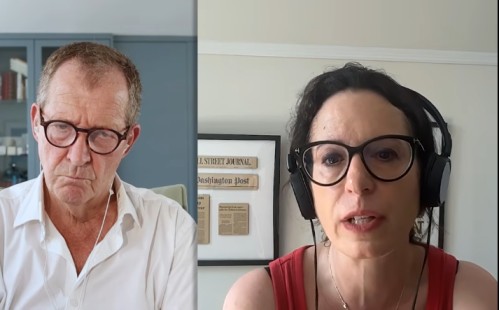
Editor’s Note: In this episode of The Rest Is Politics: Leading, Alastair Campbell is joined by New York Times journalists Maggie Haberman and Jonathan Swan to discuss their bestselling new book, Regime Change. The conversation offers an unprecedented look inside Donald Trump’s second-term White House, detailing the chaotic decision-making process behind major policies like the U.S.-Israeli strikes on Iran. Together, they explore Trump’s evolving worldview, his transactional approach to foreign leaders, and what it’s really like covering a uniquely unpredictable presidency.
Introduction: Inside Trump’s Imperial Presidency
ALASTAIR CAMPBELL: How does Donald Trump’s imperial presidency really work? Well, to help us answer that question, I’m joined today by 2 very, very good journalists, Maggie Haberman and Jonathan Swan of the New York Times. And they’ve written a book, Regime Change, which is already the fastest-selling nonfiction book of 2026 in the USA. They’ve done more than 1,000 interviews with people attached to the Trump presidency. Their book, which I’ve read now twice, really does give you a sense of life inside Trump world, from the Oval Office to the Situation Room. And it also gives you an extraordinary insight into the decision-making process surrounding the US-Israeli attacks on Iran. So I hope you enjoy listening to me talking to them as much as I enjoyed talking to them.
So I wanted to focus on the things that really kind of leapt out at me. And one of those came close to the end, page 193, 194. And I want to kick off with this and then we’ll kind of dip in and out as we go working backwards.
“Netanyahu and his team outlined conditions they portrayed as pointing to near-certain victory. This is about Iran. Iran’s ballistic missile program could be destroyed within weeks. Iran would be so weakened that it could not choke off the Strait of Hormuz. The likelihood that Iran would land blows against US interests was minimal. Besides, Mossad indicated that protests inside Iran would begin again. And with the Israeli spy agency helping to ferment riots and rebellion, and an intense bombing campaign could create the conditions for the Iranian opposition to overthrow the regime. The Israelis also raised the prospect of Iranian Kurdish fighters crossing the border from Iraq to open a ground front in the northwest, further stretching the regime forces and accelerating its collapse. Netanyahu delivered his presentation in a confident monotone. It sounded compelling and well-prepared, at least to Trump.”
And I thought, wow, that just puts together the process, it seems to me, by which Trump agreed to do what he then did, and which has plunged the entire world economy into a form of chaos.
What does that single passage tell us about the way that Trump’s term 2 White House works?
Netanyahu’s Situation Room Briefing and Trump’s Decision on Iran
MAGGIE HABERMAN: A couple of things. And the scene that you laid out was this incredible moment in the White House Situation Room where Netanyahu is delivering not just the conditions that you just described, but he plays this video for Trump of possible regime change scenarios of who could take over. The US officials really saw it as pretty farcical, Trump aside, and never really believed in what that could be. But we couldn’t find another example of a foreign leader briefing a US president in the Situation Room this way — number one. And it speaks to the relationship and just how this White House operates.
Yes, Netanyahu had been selling Trump on a regime change war for some time. There’s no question about that. But the “sounded compelling” piece — and it was very clear, and we write this, to the US officials in the room that Trump was pretty taken by this presentation. But it’s not because Netanyahu is marionetting Trump, contrary to the narrative that he just sort of made Trump his meat puppet.
Trump is much more hawkish on Iran than most of his advisors in either term, but particularly this one. And so he got more radicalized during the 4-year interregnum when he would face 2 assassination attempts, neither of which has been tied to Iran. But around the same time, a man was indicted in the US in connection with an alleged Iranian-backed murder-for-hire plot. And so all of this helped fuse the conditions for what happened.
Plus, this is a president in his second term who is operating so much on pure gut. And he had a good feeling about this. He told advisors he believed that the Iranian regime was a paper tiger, that this would go quickly. That obviously did not come to pass. But it is not because Trump did not have warnings from his own team. He listened to both, and he knew where he wanted to go.
The Chaos and Method of Trump’s Decision-Making Process
ALASTAIR CAMPBELL: What strikes me through various parts of the book and some of the decisions that are made is you have this wonderful phrase, which I’ve never heard before — “rolling ball sessions” — where meetings just kind of morph from one subject into the next, and you’re never quite sure who’s in the room, and it feels very chaotic in terms of a decision-making process. Jonathan, is it chaotic, or is there a method to the madness?
JONATHAN SWAN: It’s both. So you have these rolling meetings that are sort of one meeting, really. There’s no delineation between them. So the Oval Office is the epicenter. If you’re not in the room you just don’t even know about the decision.
The notion of an orderly interagency process where you have a proper National Security Council process of all the voices, everyone developing an idea — like the George W. Bush administration, very much consensus building up. You know this from your time in government. Bush wanted to have everyone agreeing, and then it was presented to him and he was the decider.
Sometimes you have these guests kind of rolling in and it can be almost farcical. We have a scene in the book where they’re discussing a highly classified defense program and this sort of salt-of-the-earth-looking country kind of guy strolls in with stone samples and he says, “I’ve got these stone samples for the Rose Garden that Trump was wanting to pave over.” And Trump immediately gets up off his chair and goes off, and they’re looking out the window, he’s on the phone. Meanwhile, they run out of time, the meeting ends.
So you have all this stuff, and it is chaotic. Let’s just be real, it is chaotic. At the same time, when there are certain issues when they really want to keep a secret, they’re very, very secretive. So the lead-up to the Iran War is a very good example, which we document in this book. It was so secretive that the Treasury Secretary and the Energy Secretary — they weren’t in the room. They were not involved in any of the planning meetings. The 2 people who would have to manage the fallout from the biggest global energy shock in history, they just learn about this the day of, basically.
So it’s both. And it’s also not total chaos because you also have people like Stephen Miller who had a long-range plan in the interregnum period. We interviewed Stephen Miller, for example, in 2023 — a long interview we did with him about the immigration plan for the second term. He laid out in fine detail everything that we’re seeing now. So he had a vision. You had people like Russ Vought, the budget director, who had a vision for trying to dismantle what they would call the deep state, the administrative state — mass firings.
So it’s not just a total circus chaos. It’s all things at once. And that’s why what we try to do in the book is show a nuanced picture. As crazy as it can seem, it’s more textured.
The Trump Interview: Gary Player, Historians, and Delusions of Grandeur
ALASTAIR CAMPBELL: The book sort of goes through very, very detailed accounts of all the big issues that you’re dealing with. And then you have this kind of quite strange interview at the end with Donald Trump. First of all, why did he do it? Why did he want to do the interview?
And it’s interesting to read because you’re proper old-fashioned journalists who want to check facts and you want to put things to people. But you’re not able to do that properly because he’s just going in all the directions that he does.
But the thing that really leapt out at me — I said I wanted to put to you the things that really leapt at me — was this story that he told you about Gary Player, the golfer, who was a big part of my childhood. He was the guy who famously used to do 100 press-ups and people thought, “Why did golfers have to keep fit?” And he revolutionized the way you think about golf.
Anyway, Trump goes to see him on his 90th birthday. And Trump tells you that Gary Player has this friend who’s a historian. So this guy tells Trump — or the paper that this historian wrote for Gary Player said — “Trump’s the most powerful person who’s ever lived.” Trump also happily showed this to you where he was being compared with Alexander the Great, Genghis Khan, Attila the Hun, Hitler, Mao Zedong, and Joseph Stalin. And he seemed to kind of quite like being in that company.
JONATHAN SWAN: Was that—
ALASTAIR CAMPBELL: What was he trying to tell you with that story? And by the way, it turns out the guy’s not a historian — he’s a caddy.
MAGGIE HABERMAN: I don’t know why he sat down with us other than the fact that it was something his advisors told him not to do. We had been asking for an interview for many, many weeks because he’s the subject of our book. We needed to give him the opportunity to talk. There are certain things that we needed to take directly to him. So that was one piece.
We were getting nowhere going through the front door of the White House Press Office. So we eventually messaged him directly on his cell phone. And it took multiple times of doing that before he instructed his staff to set up an interview.
ALASTAIR CAMPBELL: Is this true, by the way, that most of you guys in the White House press corps have his number?
MAGGIE HABERMAN: Yeah, entirely true. It’s the most known and used cell phone number of a high-power person that I’ve ever known of.
JONATHAN SWAN: I’m not sure there’s anyone who doesn’t have his number.
MAGGIE HABERMAN: No. And you can go really down the list. It’s not just the White House press corps. It’s Washington and parts of New York — and of course, foreign leaders.
In any event, why he did it, I assume, is just because he believes he is his own best comms director and spokesman, and because he’s had a lifelong ethos that he used to tell his own children, which was always take the call from reporters.
So we go in — and Jonathan and I don’t — yes, we both have his cell phone number, but just to be clear to your listeners, we don’t really use it. When we have engaged with him in the course of the last year and a half, it’s been in the course of our White House reporting when we’re on duty or in the pool or on Air Force One. There are reporters who have gotten news out of calling him, and some of it’s been instructive, but oftentimes he just dictates the terms of the call and it’s 2 and a half minutes long. It’s not useful for what we do.
So we didn’t want to do it that way. We wanted a sit-down in person where we could do rigorous fact-checking. We were very clear about that. We got through like a fraction of the questions we had in the hour we had. But one of our questions — and we’re sitting in this jewel box Oval Office that we had not been in since he started gilding it—
ALASTAIR CAMPBELL: Put in the gold. Yeah.
JONATHAN SWAN: Yeah.
Inside the Oval Office: Trump’s Power and the World Beyond
MAGGIE HABERMAN: We have this remarkable scene. I mean, he put up like— the only thing that I remember were a few family pictures in term one. And the first thing that went up was a picture of his father, Fred Trump, behind him on the credenza. Now, like, you can’t find a square inch. And if he does, he puts, you know, challenge coin medallions all over.
Anyway, we had not been in since he started doing this. And we walk in, it’s day 17 of the war. In Iran. And you’d think there would be maps or documents or, you know, he used to keep classified documents on his desk when reporters would come in and turn one. This time he picks up pictures and it’s maple trees. And he says, “I’m buying trees for the White House.” I’m paraphrasing, but “I picked good trees.” Underneath that were plans for his ballroom and the types of columns that they were going to use. And we were talking about the size and the variation, Athens versus Rome.
And then I think it was our second question to him was about presidential power because we knew he had been telling people that he was the most powerful US president that had ever been. And so we asked him a variation of that question to see what he would say. And in response, he had his ever-present aide, Natalie Harp, who sits along the wall in nearly every Oval Office meeting, “Natalie, go get the printouts from the historian.” And so she brings us these sheets of paper.
And the first paragraph was essentially Donald Trump is the most powerful person who’s ever walked the face of the earth. And then it goes through this list of what he describes as the top 10, which is history’s conquerors and monsters. Hitler, Mao, Stalin, Napoleon, Tamerlane, the Caesars, Alexander the Great, Attila the Hun, Genghis Khan. I’m missing someone. It’s fine. You get the point. The point that he wanted us to understand was that they had power, he had more. And then the other piece that this historian, supposed historian wrote was that Trump was willing to use it. Which was clearly part of what he was describing to us about the Iran War, not openly, but that was part of what we were supposed to take.
We asked him about his partnership with Bibi Netanyahu, and he said, you know, because they’ve obviously had a very complicated relationship, and he described him as a good wartime partner because, quote, “he’s not afraid of war.”
And sitting there while Trump was describing his own power and his understanding of his own power and his desire to leave his imprint on not just Washington, but the world, and reshape global order in the post-World War II dynamics, just gone. The whole idea of the most powerful person ever aside, but it really was the premise of our book being read back to us about somebody who was so radically changing the US presidency through expanded power. But it was among the most remarkable moments that either of us have ever had with him.
The Four-Year Interregnum: How Biden Transformed Trump
ALASTAIR CAMPBELL: But the other extraordinary observation that came through that is that I think in the introduction of the book, you essentially are talking about the— it seems to me that you’re saying it might have been better in terms of the sort of levels of power that he now assumed if actually he had beaten Joe Biden and done the 2 terms and gone. And he seems to think that as well, that actually it’s only because he had the 4-year interregnum with Biden that he’s had the time and then the will to become— to use power, and in my view abuse power, in the way that he’s done in the first year of this term, with 3 to go, with more to come.
JONATHAN SWAN: I don’t even think that’s a disputable premise. The counterfactual: if he had won the 2020 election, he would have had to deal with COVID was still raging, there was global inflation, every developed economy in the world was suffering global inflation. He was already pretty unpopular. He was on an expedited timeline to withdraw from Afghanistan, every likelihood it would have been just as chaotic as the Biden withdrawal. He would have hobbled potentially. You can never know for certain what would have happened, but a very good chance he would have hobbled through that term, reacting to events, unpopular, not being able to really marshal things together.
Instead, he has 4 years where he gets built up as this almost mythological figure through surviving 4 indictments, becoming a martyr, the 2 assassination attempts. Biden was the biggest gift you could ever imagine to Donald Trump. And his team, people like Stephen Miller, had 4 years to really think through how they would do things differently. He had 4 years to think through, who would I bring in that’s different? And when he came back in, the way they’re governing— I mean, Maggie and I covered the first term. It’s not recognizable. It’s not recognizable. Every aspect of it. His character is the same, but the way he’s using the office and the way he’s thinking about the office is completely different. And the team is just radically different. So, yeah, I mean, I just don’t think it’s a disputable premise.
MAGGIE HABERMAN: The other piece, too, that I do think, just to add to what Jonathan just said about Biden being the biggest gift— I think that for all of the anger on the flanks of both parties, the elections are binaries. And so when voters had a choice in 2024, it was very clear they were not going to choose Joe Biden long before he dropped out just because he was struggling so much. And it wasn’t just the age factor. There were all kinds of other issues.
I don’t think we fully understand the impact that the post-COVID period had on politics, certainly in this country. I can’t speak to the rest of the world. And the last time a lot of voters felt good about their lives in this country was 2019, and Donald Trump was in office. And so the fact that Biden came in with this immense promise and lost credibility fairly quickly after the withdrawal from Afghanistan, and then proceeded to tell voters that actually they should feel fine about their financial situation, that was all just ripe for Trump.
“If I Lose, I Am F*ed”: Trump’s Legal Jeopardy and the Drive to Win
ALASTAIR CAMPBELL: Interesting. Yeah, there’s a passage where you quote him as saying in a meeting with his kind of intimates before the election, “If I lose, I am f*ed.” Did he mean by that that he thought he was going to go to prison?
MAGGIE HABERMAN: Or something. But yes, I mean, certainly he thought that he was going to potentially go to prison, that he would face additional indictments, that he would face a ton of lawsuits. There are various factors that went into why he ran again. And we talk about that in the introduction of the book, about the fusing of his legal challenges with his political situation.
He declared his presidential campaign in a story broken by my colleague when he was not my colleague yet, incredibly early. I can’t remember a presidential candidate beginning their candidacy that early, November of the 2 years out, right after the midterms. But the fact that he was facing prison and his advisors all believed they all were too— we write about in the book about how right after one of the federal indictments, one of his advisors said to us, “He has to win.” I mean, that was the emphasis. “He has to win.” And then followed by, “I wouldn’t want to be the people who did this to him,” meaning if he came back into office.
And all of that has driven their anxiety and their belief in him and their radicalization because they all believed— and I’m not endorsing this view, I’m just saying that’s how they see it— they all felt chased. They received subpoenas. Some of them were indicted. Many of them spent thousands and thousands of dollars on their own legal bills, although most of them had them paid by Trump’s donors. That was what they were facing, and that was what Trump was facing, including the prospect of financial ruin because he still had that New York Attorney General civil fraud judgment hanging over him. Now, that one has gotten more complicated since. Who knows what that would have looked like if he had not won?
Does Europe Matter? Trump’s Transactional View of the World
ALASTAIR CAMPBELL: You two cover the White House, but of course, Trump, whether we like it or not, is a truly international political figure. But apart from the Middle East, Ukraine, Venezuela, there’s very little sense of a world outside the US. In fact, not only have I read the book twice, I’ve read the index. G7, the other 6 leaders of the G7 countries get 3 mentions between them in this book. Starmer gets 2, one of which is for Donald Trump offering his valet services to take the creases out of his trousers. The other one is “we’ve got to deal with this Epstein stuff” before Starmer arrives for the press, and the press come in. And the Macron mention is when Trump phones him up to ask how big the Arc de Triomphe is because he wants to build a bigger one. No mention of Mark Carney, no mention of Merz, Meloni, Takaichi, Milei, Lula, von der Leyen, Guterres of the UN, Mark Rutte of NATO. Is this because you are White House correspondents or because actually we don’t matter anymore? In his mind, in his mind.
JONATHAN SWAN: I would say 2 things. One is that, as I’m sure you’ve gathered, Alastair, the group of people around Trump, including Donald Trump, have utter contempt for Europe, deep contempt for Europe. They view Europe as a civilization in decline. They view Britain as weak, ungovernable, fragmented, almost pathetic.
You hear, depending on who you talk to— I don’t want to universalize this, there are some who don’t have quite the strong views— but there’s this conversation that’s constantly happening whenever I talk to diplomats: what’s the best way to deal with Trump? It’s a clichéd, tiresome conversation. And the correct answer is the best way to deal with Trump is basically you need to have the power of China, and then you can tell him to f off. Because the person who’s dealt with Trump the best is Xi Jinping. Trump completely got spooked last April when China refused to back down and just went tariff for tariff with him. He got up to 145%. We show in the book he just says, “Holy s,” and then sends Scott Bessant off to Geneva to de-escalate. Ever since then, Trump has been in full-on appeasement mode with China. How can we soften everything? How do we get a nice deal, a nice way of doing— he watered down the national defense strategy, taking out more hawkish references to China.
ALASTAIR CAMPBELL: But there is only one China. There is only one China.
JONATHAN SWAN: That’s my point. No, that’s my— this is my whole point, Alastair.
ALASTAIR CAMPBELL: So we don’t matter in a sense.
JONATHAN SWAN: If you are a small or a middle power, you’re only good for flattery, you know, come give him the embossed card, come see the king, this and that. And the thing I find so interesting about the UK— again, I don’t pretend to understand your politics particularly well, I read and listen and try to educate myself from afar— is the only way the UK can actually deal with Trump in a way that will get his attention and not just be this sort of pat on the head. Can you imagine a more humiliating thing that he could have done to what he did to Keir Starmer recently before, you know, Trump basically pre-announces this with like a couple of complete lies about the whole thing.
ALASTAIR CAMPBELL: You’re fired.
JONATHAN SWAN: Yeah, yeah, exactly. It’s only as Europe that it comes with the financial power and the leverage and whatever. And the UK has obviously done Brexit, and we’re now sort of 10 years later. I don’t know, is it the 7th prime minister now? What are we up to? Is it 7?
So, from the Trump perspective, it’s about leverage. It’s just not that complicated. He doesn’t see things in terms of the history of the relationship or NATO, or there’s no sort of long credit in the bank that goes back for all these things. It’s completely transactional and completely leverage-based. So yes, you can get small situational wins by sucking up to him, but it doesn’t have any long-term— it’s not a durable strategy.
ALASTAIR CAMPBELL: Even Mark Carney, who made that speech in Davos that most people in the world of politics kind of know about, that was interesting. And since when that relationship, I don’t know, it’s stayed quite spiky. But it’s just really interesting to me that in terms of you guys putting together this, you know, pretty sizable book, an account of that year, that even Mark Carney doesn’t figure at all.
MAGGIE HABERMAN: I understand what you’re saying. I think just to jump in here and Jonathan, you know, feel free to disagree, but I don’t think you do. Number one, we had a lot of reporting that— 99% of the reporting that we had for this book ended up on the cutting room floor, both from the 2 years leading up to the election and then a bunch in the first year, that included a fair amount of reporting about the aftermath of his blowup, plural blowups with Zelensky, the aftermath of the utterly bizarre Alaska summit and the back and forth about what was actually agreed to. But what we didn’t have was anything that would have changed a reader’s understanding of those events. And we had choices to make or this was going to be a 1,500-page book, which would not have been an international or any kind of bestseller.
ALASTAIR CAMPBELL: 4 volumes. Good work.
Trump’s View of Europe and the International Order
MAGGIE HABERMAN: Sure. It could— someone will do a Robert Caro-like miniseries dive at one point. It won’t be us. But regardless, it is partly because the negotiations related to Europe just don’t matter as much to him. It is because he believes that he has conquered, frankly, Europe, that he has both beaten the EU and he has beaten the NATO alliance. And you can see that in public in a way that you really could not in term one the same way. But what I was thinking about when you were talking and you said, you know, does he just hate us or something? Whatever you said at the beginning of this.
ALASTAIR CAMPBELL: We don’t matter, right?
MAGGIE HABERMAN: Okay, well, so my version is going to be a little harsher. He said something in a briefing to his advisors in term one, toward the end of that term, which was that everything they, just meaning Europe broadly, do is to hurt us. And that is his view. And so he just viewed— to Jonathan’s point about leverage, he sees European nations as leeches. He sees them as, you know, they need us, we don’t need them. Not endorsing that view, I’m just saying that’s his view. And so consequently, his efforts with other people, and strongmen and people who rule their countries in ways that he admires, matters more.
JONATHAN SWAN: The other thing I’ll just say on that, Alastair, is to me the more interesting reporting, which is not our specialty on these questions, would actually be inside on the Europe end and on the Canadian end where they’re trying to grapple with how do we manage the United States, what’s our long-term strategy. We have to manage these great powers, none of whom we can trust anymore.
We were covering it from inside the White House perspective, and the amount of mental bandwidth that Mark Carney takes up is very small, compared to Iran, Venezuela, Russia, China. When you’re doing a book that is compressed into 400 pages that covers the sweep of domestic and foreign policy, you have to make judgment calls.
We do write in the book about how, in our judgment, we’ve moved from very clearly a post-World War II order to the US being a sort of regional power. The interesting thing about the whole Trump era, this Trump era, is he talks in such grand terms, you know, wants to be Alexander the Great. It’s actually a fundamentally small vision, really. The US has sort of given up this position as the leader of the free world, you know, NATO, whatever, to be essentially a regional power controlling the Western Hemisphere, menacing, you know, Venezuela as the 51st state and Cuba and what have you, bringing the Navy back in.
And then, you know, we have a scene in the book of Trump holding up a little teaspoon to represent Taiwan, basically saying, who gives a f* about Taiwan? Despite not formally changing US policy there, he’s made very clear that he’s quite comfortable with the concept of China controlling its sphere of influence and, you know, to some extent Russia as well. So I think we lay that out in the book. We just don’t have original unique reporting, I think, that will deepen people like your understanding.
Trump and the Collapse of the International System
ALASTAIR CAMPBELL: But it’s interesting, we’ll come back to the CADDIE. You say in the epilogue, “There was another dimension to Trump’s power that the CADDIE’s document didn’t capture, but was no less significant. Trump was the first modern president to govern as though the international system simply did not exist.” And I guess that’s why people like Antonio Guterres, he just doesn’t— he’s not even in his head when he’s doing Iran. He doesn’t think, I wonder what Guterres thinks. Not even on his radar.
That’s a big change. You mentioned George W. Bush. I can remember there were situations where we would find out subsequently of Bush saying to his team, find out what the Brits think, you know, speak to Blair— we’ve got to speak to him. And he did eventually take the thing down the United Nations route. But I get the feeling that if a British Prime Minister at the moment went to Trump and said, think about taking this down the UN route, you know, he would look at them like it was completely insane.
JONATHAN SWAN: I was going to say, can you even imagine, you know, Colin Powell goes to the UN and— can you even imagine? It’s just like, it’s not even— it’s such a preposterous notion that they would feel the need to justify something in front of the United Nations.
Trump’s Psychological Conversion on AI
ALASTAIR CAMPBELL: I’ll tell you another passage that really kind of jumped out at me. And unlike my co-presenter Rory, who is obsessed with AI, I’m not a kind of AI expert at all. But I found your passage on Trump’s seeming psychological conversion on AI absolutely fascinating because it struck me that these AI guys, and particularly Jensen Huang from Nvidia, that they worked him. They really worked him and they got him to change his mind and they did it in such a Trumpian way, showing him an executive order and showing him how you could put the executive order in and then come out with every sentence beginning with the letter A and then turn it into a poem. And Trump liked the poem. And then suddenly he is, as I think you say, suddenly he’s kind of all in for AI. I found that fascinating.
JONATHAN SWAN: What’s interesting actually is the postscript to that, you know, which comes after our book is closed, which is he’s now in the process of reversing. They’re now like, oh crap, this is kind of dangerous and maybe we need to regulate this thing. It speaks to what I was talking about to you before. If you’re dealing with Trump, there are no permanent victories. You can have short-term success until the next compelling— like, he’s not a long-range thinker. He doesn’t have a long-range strategy. He’s not rooted in principle. And there’s not really a serious, deep policy process. So he’s prone to have these very rapid reversals. And actually, AI policy is a perfect example. He was sort of bewitched by this, ensorcelled by this amazing technology and was just like, get rid of all the regulations, all the roadblocks, open season. And now we’re seeing the 180.
MAGGIE HABERMAN: There was a related piece too, which is that, yes, he was bewitched by this demonstration by the OpenAI guys during the campaign. And so many of the people who were fawning over him were these tech leaders, some of whom he brought into his government. I mean, you had David Sacks, who has interests as the AIs are. And so it wasn’t just, you know, let’s get rid of regulations. It was also let’s put these people in charge of this who have serious interests in seeing it go a different way and not be moderated.
Those people are now gone. And now you are seeing what we understand that, again, this came after the reporting for our book, after it closed, but primarily led by Scott Bessant because there are not many people around Trump right now who actually understand AI.
ALASTAIR CAMPBELL: Following the AI debate from here, it’s felt to me like Trump has made a shift. And then you’ve got these other people, and quite a lot of them the MAGA, the big MAGA people who don’t like this, and they’re trying to move him back. But you’re saying that actually he has moved back.
MAGGIE HABERMAN: He has moved back more from internal forces within the government. I know there is this perception that, you know, we got asked this recently, is this because Steve Bannon is telling him? And it’s definitely true that Bannon has a view, and obviously Trump is aware of that view and it filters to him, but that’s really not the driver here. It’s much more internal forces.
The White House Press Corps and the Challenge of Covering Trump
ALASTAIR CAMPBELL: Now listen, you two have done something quite interesting. You’re working journalists, you’re covering stuff all the time, you’re writing stories all the time, but you’re also writing this book. And the New York Times, let’s be honest, is one of the last remaining bastions of what people consider to be proper journalism, as it were.
But I’ve been struck from this side of the Atlantic — Trump just has to sort of fart and it gets covered all around the world. And yet the White House press corps generally, it seems to me, have lost the battle of how to cover this guy. I’m always struck when he attacks people, when he goes after particularly women. And when they’re doing those kind of pool sprays and what have you, when he lies, when he says ridiculous things like last week when he said, “I know more about sport than anybody,” but he didn’t know that you had to have a one-match ban if you got a red card in the World Cup. And it’s crazy to let his son do it. None of the journalists kind of just go and confront that head-on. “You’re lying. That’s not true. Why are you saying that now when you said this before?” It feels like he’s treated almost like a commentator. He can say what he wants. And I just wondered if that’s a fair assessment of the White House press corps.
MAGGIE HABERMAN: I think it’s complicated. I don’t want to paint— number one, I think a lot of our colleagues do an admirable job in a very difficult situation. And a number of them are in the pool much more than the New York Times is, for two reasons. We have a very big White House team, very big, the biggest actually, I think, in Times history. And also the White House has taken control of the pool. So it’s not what the system used to be, which is that it was self-run by the White House Correspondents Association. They pick the outlets. They have diluted the pool so that they can try to have fewer mainstream journalists in there.
Jonathan and I are both all for independent outlets being able to have access, but while the White House says that’s what they’re doing, that isn’t quite the motive. It’s about making sure that there is a negating factor there. There are a few people who consistently try to ask him rigorous questions. And again, the TV pool tends to be more consistent, but they have no backup. So it used to be that you would ask something and the other reporter would ask something and people would have conversations beforehand about what was on their minds. It’s just fundamentally different now.
He also— I understand what you’re saying. I think that it is difficult in moments when he is just filibustering to get him to stop talking. It is not because people don’t try. And more often than not, he’ll do things like— I mean, he attacked our colleague David Sanger on Air Force One, on the old Air Force One, not that long ago, accused him of being treasonous for asking a question. It’s obviously not treasonous. But when he goes straight to that, I think what the Trump era has shown more broadly, both the first term and certainly this one, is the limits of what daily journalism can do. Which is not to say the limits of what our aims are, but we hear this a lot of, you know, why doesn’t someone do something?
Look, to be clear, I admire UK reporters a great deal. There are things that Trump does that reporters in other countries look at, and I get asked the same question. But when the White House is taking control of the pool, it really does make things much more difficult. And then making this show of transparency of, look, he takes everyone’s calls, you know, he talks for 2 minutes, and as I said earlier, he will just dictate what he wants. He’s pretty equal opportunity offender, frankly, at this point for male and female journalists. It’s not limited.
ALASTAIR CAMPBELL: I just feel, for example, that when he goes for somebody because he doesn’t like the question, says, “You’re a really bad person, you’re a disgrace, I’m going to speak to your bosses,” all that stuff. I just wish that somebody next to that person would say, “Excuse me, can you apologize for that?”
JONATHAN SWAN: The equivalent would be if Tony Blair is giving a press conference and there was a really sharp question and Tony Blair says, “You’re a little scumbag piece of s*,” and the person standing next to him is Alastair Campbell. If it’s someone who is essentially a fan of the president, but who’s standing there as a reporter, but is actually a fan. And really the follow-up question is, well, sir, you know—
MAGGIE HABERMAN: Why are you so great?
JONATHAN SWAN: You’re so well endowed.
MAGGIE HABERMAN: Yes, exactly. Sir, your hair looks perfect today.
ALASTAIR CAMPBELL: Maybe leave the whole thing. Maybe just leave it all be. Maybe say—
MAGGIE HABERMAN: No, I don’t think so, because Jonathan and I have talked about this a lot. I would much rather that we have a place there asking questions, or our colleagues at the New York Times, or the Post or the Journal and so forth.
ALASTAIR CAMPBELL: But the guys at the Pentagon didn’t, didn’t they?
The Role of Advisors and the Nature of Trump’s Power
JONATHAN SWAN: No, sorry, that was very different. The Pentagon were — they had to sign a form saying we’re not going to publish any. Like, we haven’t signed any. I haven’t signed any form. And by the way, I’m not sure if I’ve even been in the pool so far this whole presidency. So maybe once, maybe one time. So it’s not like Maggie and I are constantly there, like in the pool.
ALASTAIR CAMPBELL: My complaint is not just with journalists. I mean, for example, Keir Starmer, as we know, doesn’t get many mentions of the book. But when Trump came over here, and he — it was a horrible scene for me as a sort of Brit and a Scot — Trump looks like he’s hosting Keir Starmer, our Prime Minister, up at one of his golf clubs. And Trump just launches this horrible attack on Sadiq Khan, the Mayor of London. Keir sort of says, “Oh, he’s a friend of mine.” But I’d have liked him to have said, “Excuse me, you’re in my country now and he’s the mayor of my capital city and he’s a member of my party and he’s a very good friend of mine. I’m not going to come to America and attack your mayors.”
I think it’s not just the journalists. I think there’s too much of everybody — the law firms, the academia — everybody just thinking because this guy’s a bully, nobody should stand up to him. That’s what I find very difficult to deal with.
MAGGIE HABERMAN: Yeah, I understand what you’re saying. I also just think that for journalists, I think it’s a different calculation, at least for me. I don’t want to speak for every reporter. I don’t want to speak for Jonathan here, but I don’t really want to become the story. And he counts on that. He counts on the idea that that’s then going to become the story. I’d much rather hear him answer a question that I’m asking. But anyway, that’s just me.
JONATHAN SWAN: I also don’t think you need to give speeches to him. I interviewed him in 2020.
ALASTAIR CAMPBELL: I remember it. It was great.
JONATHAN SWAN: I didn’t say, “Sir, how dare you? You’re destroying the world.” No, I just asked sharp follow-ups and forced him to explain himself. And that’s what I think we should be doing. The public already has almost no faith in journalists — 10%, whatever approval rate — we don’t need to become actors who are sort of making speeches at him. I think we need to be asking sharp, serious follow-up questions and being journalists and reporters. And that’s the way I view it. I didn’t give him any lectures or speeches during that interview.
ALASTAIR CAMPBELL: But in a way, the fact that I can remember that interview is because there haven’t been that many. There haven’t been that many interviews where he’s properly held to account.
MAGGIE HABERMAN: Jonathan did, bar none, the best interview — the TV interview that has been done with Trump. It’s not even a close call.
Trump’s Narcissism and the Aftermath of the Charlie Kirk Assassination
ALASTAIR CAMPBELL: If any of his people are listening, we’d love to have him on the rest of his politics, but I fear he’ll join Nigel Farage in refusing to come on. Listen, the other stuff — I found some of the passages around the aftermath of the Charlie Kirk assassination really quite interesting and telling as well. Because that felt to me — and this is my definition of this kind of far-right populism that I really think has done so much damage to the world — I know there were people there who were very close to him and they would see him as a personal friend and all that stuff. But it felt to me like you had people from Trump down who thought, “This is an opportunity, and we’re going to seize it.”
JONATHAN SWAN: There’s no question. It was both very emotionally traumatic, as we show, for the inner circle. But someone like Stephen Miller immediately saw that this was an opening to crush the left, to use the Justice Department to investigate progressive groups. You saw J.D. Vance start talking about the Ford Foundation, which has no link whatsoever to this young disturbed guy who apparently killed Charlie Kirk.
And this is what always happens when you see some kind of — the most common example is immigrant crime. Of course, when there’s a murder or something by an illegal immigrant, that’s the opening for Stephen Miller to say we need to send in troops to this city or that city or what have you. And we document that in the book.
It hasn’t actually gone anywhere, interestingly, so far. It’s possible there’s stuff going on behind the scenes that we’re not aware of, but it sort of seems to peter out. But at that moment, it looked like they were going to try to dismantle the infrastructure of the left. We’ve seen a little bit with the Southern Poverty Law Center investigations — they would like to break apart the left’s financial infrastructure, use the DOJ to do that. So we could see more of that this year, but that was a real moment for the opportunists in that sense.
ALASTAIR CAMPBELL: Because I’m a committed believer that Trump has the condition known as narcissistic personality disorder, I’m always on the lookout for good examples of his narcissism. There were a couple that really struck me. One was actually to do with Kirk. This was like just after the guy’s been killed, and he said, “Such a good guy, helped me into 2024, got the youth vote out.” Me, me, me, me. This is the guy, by the way, who said when the Queen died, “She was a great lady, she really liked me.”
And the other one was when he’s touring the Museum of African American History — he stopped in front of an exhibit of Dutch involvement in the slave trade and he says, “You know, they love me in the Netherlands.”
MAGGIE HABERMAN: I don’t think you have to look much further than what you said at the top of this, Alastair. You said you’re always on the lookout for examples of him seeing the world as a refracted lens for himself. I think there’s a lot. And I think — the one thing that I would observe is that that has gotten more frequent and more open in this term, but it’s not like it was lacking before. And in fact, the one you just mentioned — the one you just mentioned was term 1.
ALASTAIR CAMPBELL: Okay, but the one was definitely term 2, was in your interview. He seemed very, very excited about his 339 billion views of his TikTok videos.
JONATHAN SWAN: And one of his aides said they’ve been — the operation has made it even better. So basically the subtext was that the Iran war was very good for engagement online. They were putting out lots of these videos of the strikes cut to music and video games.
Rubio, Vance, and the Question of Influence in Trump’s Inner Circle
ALASTAIR CAMPBELL: There’s a phrase that you use about Marco Rubio — you describe him in Trump’s eyes as “first among equals.” And I get the feeling through the book, even though I was quite impressed by your account of how J.D. Vance did try to put a very different position in relation to Iran — and then once it was happening, he signed up and supported him but had put a different position — I get the feeling that J.D. Vance is in the room quite a lot, but in terms of the kind of real power, feeling a lot less peripheral than I imagined he was from watching. It’s hard to argue with that in one sense, in that the biggest arguments he’s made, particularly on Iran, he lost the argument, right?
JONATHAN SWAN: He was the only one who really vocalized a case against going to war, even though everyone in the inner circle just about was very skeptical. But I think one thing that people are overstating right now is the prospect that Rubio will be the nominee in 2028 and that Trump will bless him. It’s not to say it’s impossible, but our reporting indicates that Vance is still very much in pole position to be the nominee, and Rubio is making no efforts right now to challenge him or anything like that.
The bigger question is, does anyone really influence Trump on his staff? At times, yes, but really this term has been an expression of, as Bannon says, “pure Trump.” It’s him trying things that he’s wanted to try, going on his gut, in many cases ignoring the analysis from the intelligence community and just trying things, taking huge risks that he wouldn’t take in the first term, and being quite unconcerned about domestic politics and polls in a way that’s very, very different from the first term.
So there’s a lot of coverage or commentary about Trump which is sort of like, “There’s this faction and there’s this faction and this person does—” it’s not really the way it works in there. They’re a pretty tight-knit group. There are some disagreements, but they’re just there. They’re in the room. They can have their say. But no one’s like, “Oh, this guy’s the key advisor who he’s listening to.” It’s just not how it works.
MAGGIE HABERMAN: There are significant disagreements — and we lay them out in the book — like over the Insurrection Act, and whether to invoke that at various points. There are disagreements about some of the massive questionable expansions of power that Stephen Miller wanted to do, like suspending habeas corpus for migrants, which is still an episode that we’re both a little obsessed with. It became a white whale in our reporting.
But they’re all rowing in the same general direction. It’s not Jared Kushner’s globalist view, Gary Cohn’s globalist view versus Steve Bannon, as you saw in term one. It’s not John Kelly viewing Trump’s worldview as detestable, or James Mattis viewing it that way too. This is just different. It’s iterative. And some of it’s personality based.
Closing Thoughts
ALASTAIR CAMPBELL: And also, if I’m right that he is a sort of full-on complete narcissist, most narcissists don’t want their successor to succeed, because they want people to say it was all down to him. Anyway, listen, as I say, I’ve listened to it and I’ve read it and I’ve read the index and I felt so sorry for the European leaders as I did so. But it’s a very, very good — it’s a proper — like a lot of stuff you’ve done with and for your paper, it’s what we call a proper piece of journalism. And that’s why it sold 300,000 copies in the first week.
JONATHAN SWAN: I was just being deliberately obnoxious and provocative while I was sweating.
ALASTAIR CAMPBELL: We’re in the middle of a “drill baby drill” heat wave. We’re all sweating. I’m sweating here, which is why I’m wearing a white shirt that doesn’t show the sweat patches. Listen, it’s great to talk to you both. Thank you so much. And I do honestly think you’ve got an international bestseller on your hands.
JONATHAN SWAN: Well, thanks for having us.
MAGGIE HABERMAN: Thank you so much.
JONATHAN SWAN: We really appreciate it.
ALASTAIR CAMPBELL: Thank you.
Related Posts
- Transcript: President Trump Addresses the 81st Session UN General Assembly
- Maggie Haberman: Trump’s ‘Unreality Bubble’ Meets the Midterms (Transcript)
- Transcript: President Trump Remarks on Healthcare, Sep. 18, 2026
- Transcript: Jonathan Swan’s Dive into Trump’s Reality: The Weekly Show
- Transcript: President Trump Remarks in Dublin, Ireland – Sep 12, 2026