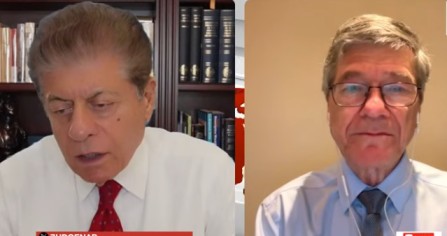
Read the full transcript of Professor Jeffrey Sachs’ interview on Judging Freedom Podcast, July 20, 2026.
Editor’s Note: In this interview on Judging Freedom, host Judge Andrew Napolitano is joined by Professor Jeffrey Sachs to examine the mechanics of American foreign policy and perpetual warfare. Sachs critiques how successive U.S. administrations have utilized geopolitical “pivot states” like Ukraine and Iran to maintain global primacy and feed the military-industrial complex. They also discuss the heavy influence of corporate and intelligence oligarchies on government actions, alongside the unfolding geopolitical challenges surrounding Israel.
Introduction
JUDGE ANDREW NAPOLITANO: Hi everyone, Judge Andrew Napolitano here for Judging Freedom. Today is Monday, July 20th, 2026. I’m happy to be back in this seat in front of this camera. One of the people I miss the most is my guest right now, Professor Jeffrey Sachs. Professor Sachs, a pleasure, my dear friend.
I know you’re on the other side of the globe and it’s the middle of the night, and thank you very much for accommodating my schedule. I very much wanted to have you on on our first day back because there’s so much I want to talk to you about. I want to talk to you about the collapsing Greater Israel project, but before we get there, you’ve written something very recently that tantalized me.
So before we get to the collapsing project and before we get to Prime Minister Netanyahu’s fears of what’s coming his way at election time in Israel, why have the last 6 U.S. presidents, from George H.W. Bush to Donald Trump, the last of them after promising he would never do it, been using NATO or Ukraine as a battering ram against Russia.
The Deep State and Perpetual War
PROFESSOR JEFFREY SACHS: Yeah, the point is our presidents don’t really determine foreign policy. Our public opinion, what you and I believe and what the American people believe, has very little influence, at least over a period of many years. People are absolutely against the wars that the United States is waging. Trump won an election on that basis, but it didn’t change anything. In fact, he just launched more wars.
What the American state, the American government runs, just as your opening each segment tells us, undeclared wars, unconstitutional, but based on a system of a deep state guided very heavily by the intelligence agencies because they have the advantage, in quotation marks, that they operate in secret. They’re not accountable to anybody. They do what they want. The presidents, by and large, are part of this machine, they don’t really change much.
And my point in my writing about this is that from Clinton onward, we’ve been engaged in a particular series of nearly perpetual wars that Clinton, Bush Jr., Obama, Trump 1, Biden, and now Trump 2 have all pursued. The American people are not really told anything about the true objectives of these wars, but the purposes have been spelled out if you know where to look rather clearly.
One of my go-to places is a quite remarkable book, awful in a sense, but remarkable, written by Zbigniew Brzezinski, the major Democratic Party strategist.
JUDGE ANDREW NAPOLITANO: Oh, the word “chessboard” is in the title, am I right?
Brzezinski’s Grand Chessboard
PROFESSOR JEFFREY SACHS: His book in 1997 is called The Grand Chessboard, and the idea is riffing on the Great Game that Britain and Russia supposedly played in Central Asia in the 19th century. But the idea is the world’s a game. It’s like a video game. You bomb here, you slap there, you send your drones here. None of these leaders is at risk. They don’t tell the public what all of this is about. They don’t actually ask us to pay any taxes to fund these wars because the public’s completely against them. And so no one asks. It all goes into the debt.
But Brzezinski in 1997, in a kind of didactic textbook that he says he wrote for his students, explains what this grand chessboard looks like from the point of view of Washington. And the idea of the book is very simple, a little crazy, except, if you’re playing a board game, it would make sense. But it’s about American primacy. The idea is that the United States has to be the biggest and baddest and toughest and can beat anybody in the world anywhere. And that’s the idea, that there should be no resistance to American demands anywhere and that the United States should basically be intervening everywhere in order to prevent any other countries from getting powerful enough or aligning so that they can resist American demands. America as number one bully of the world.
And Brzezinski lays out how this should be done. Remember, in the 1990s, the Soviet Union had just collapsed and the idea was everywhere in Clinton’s mouth and in Madeleine Albright, Secretary of State’s words, that the US is the indispensable nation that looks farther than any other nation in the world. And we had the Project for the New American Century, which is basically, “We’ll beat the s* out of anyone that opposes the United States.” We had it called the end of history. We had it called the unipolar moment.
The Concept of Geopolitical Pivot States
And what Brzezinski explains is how we’re going to play this chessboard, this worldwide chessboard. And the most fascinating aspect of Brzezinski’s analysis is he’s like a chess teacher explaining how to move the pieces. And he has a concept which is very important for everybody to understand how crazy our government is, and the concept is a geopolitical pivot state.
What is a geopolitical pivot state? Brzezinski tells us it’s a place we don’t care about except that it can annoy the hell out of another major power. In other words, it’s a place we can use.
And Brzezinski’s core idea in this book is the United States needs to achieve its primacy and maintain its primacy, being the biggest and the baddest in Eurasia, the great landmass of Europe and Asia that joins together into really one supercontinent where about 70% of the world’s population lives and about 70% of the world economy.
And of course, it includes China, it includes Russia, it includes India, it includes Europe, and the United States needs to dominate all of this.
And Brzezinski nicely tells us that Europe, well, they’re vassal states. We’re the empire, they’re vassals, they’ll do what we say. Pretty much true. And then there are the pivot states, the geopolitical pivots.
Ukraine and Iran as Geopolitical Pivots
Number one geopolitical pivot, he tells us in 1997, is Ukraine. If we control Ukraine, Russia ceases to be a major power because Russia’s blocked from its entry into the Eastern Mediterranean. Russia can’t project its power. And so Ukraine is a geopolitical pivot state.
And in 1997, in this book and in another article that Brzezinski writes called “A Grand Strategy for Eurasia” for Foreign Affairs — and Brzezinski is not just some run-of-the-mill guy, he’s one of the major strategists of our country, telling us how it works and how Washington thinks — he says we need to control Ukraine, so we need to push NATO to Ukraine and push American power to the Russian border.
Incidentally, Mark Rutte, who is the Secretary General of NATO and a really despicable character, by the way, and maybe that just goes with the turf of being Secretary General of NATO, said a few days ago that NATO’s purpose is — it’s not defense against the Soviet Union, it’s the projection of American power. Basically, or I should say exactly, what Brzezinski was telling us in 1997.
And what Brzezinski says is we need to take Ukraine. We need to take the other geopolitical pivots. Ah, what’s number 2 on his list? Iran. Oh, fancy that. What a coincidence. We need to bother China in East Asia by bulking up the military in Korea, where we have been for 80 years, for God’s sake. 80 years stationed there since the Korean War, and bulking up the military in Japan and bothering China in every other possible way, because these are the geopolitical pivots. We need to use these places to annoy, to weaken, to divide, to subvert, maybe even to overthrow the governments of our big adversaries.
And Brzezinski writes it all out in a long tome, and basically everything he says is wrong except that it explains everything that we have done and continue to do until now. Because until today, whether it’s Clinton or Bush or Obama, or Trump 1 or Biden or Trump 2, doesn’t matter. The name of the game in Washington is we’re number one. The military-industrial complex will be fed fully, gluttonously, to the maximum extent to keep that dominant power, that primacy, and will fight anyone, will subvert any government, will use any geopolitical pivot to do that.
The Kissinger Adage and the Ukraine Coup
And we get all these countries into horrific trouble. We prove the famous adage of Henry Kissinger, his famous quip, which is a tragic truth, that “to be an enemy of the United States is dangerous, but to be a friend is fatal.”
And so in Ukraine, we pushed, we pushed, we backed a coup that would bring in a government that didn’t want neutrality but agreed with the American idea of NATO membership, because Ukraine was deeply divided. The president back in 2010 to 2014, Viktor Yanukovych, said we should be neutral. “This is very dangerous. We’re looking at where we are geographically. We’re right next to Russia. We’re between Russia and Europe. We got the United States meddling. We just want to be neutral.” But of course, the United States doesn’t believe in that. This is a geopolitical pivot. We need to take Ukraine.
So we sent all of these minions — my current colleague Victoria Nuland at Columbia University — to hand out cookies in the demonstrations, but she handed out vast sums of money to the Ukrainian backers of a coup which took place on February 22nd, 2014. And the idea is, okay, we’re going to bring Ukraine into the American power projection. That’s what Brzezinski tells us, and he tells us that Russia can’t resist this. America’s all-powerful. We have the technological dominance. No one can resist us. We have the biggest economy in the world. We have the biggest financial system in the world. We are so powerful that Russia will have no choice but to give in to these American demands. He writes that in a whole chapter.
Brzezinski’s Fatal Miscalculations
And what he also says is we’re going to annoy the hell out of Russia, out of Iran, out of China, but no American president, no American government is going to be so stupid to allow those 3 to get together.
Okay, Brzezinski was wrong on every single thing he wrote. Of course, Russia has resisted, and it resisted to the extent of war. Same with Iran. It doesn’t just give in in one day because the United States bombs it and kills its leadership. And China did not collapse and succumb to all the trade wars of Trump 1 and Biden and now Trump 2 and all the threats and so many things that were on a checklist that was written 10 years ago by another former colleague of mine, Robert Blackwill, in an article also for the Council on Foreign Relations, who explained, “Here’s how we bother China, how we weaken China, how we contain China.”
Well, none of it has worked, but in the process, of course, the United States has created enemies everywhere.
The Military-Industrial Complex and Government Corruption
And none of it’s going to work. But the point that I’m making is that this is so deeply seated. Our government is so corrupt, top to bottom. The money-making from the wars, the involvement of big tech — Palantir and all the rest — in all of the drone warfare of Ukraine and in Gaza, and the AI systems that Silicon Valley’s selling to the Pentagon, and the hundreds of billions of dollars that are being spent in our name that we have no say about and that’s adding to this massive debt. This is all continuing. Doesn’t really matter who’s president.
Every president, I’ve said in the last decades — God, they’re the worst. And then the next one along, they’re the worst. Then the next one comes along.
JUDGE ANDREW NAPOLITANO: And all of this will be paid for by, as Generation says, yet unborn.
A Financial Bubble Built on War
PROFESSOR JEFFREY SACHS: Because what’s happening by borrowed money, it not only is it debt stacked up on debt stacked up on debt, but what we’ve done in this kind of info war is we’ve also created probably the biggest financial bubble in history. Our stock market is so inflated right now in value. These big tech companies, all of which drink from the trough of the Pentagon among other things, are so wildly overvalued. Our exaggeration of American dominance is so weird.
As you know, I’m on a long trip through Europe and Asia in recent weeks. Today, I was at a major Chinese company at one of their advanced factories that is really unbelievable. We have no sense of how the rest of the world is moving on, building things, deepening their infrastructure, improving their technologies, where we’re fighting these wars and bragging how great we are and how this stock market boom proves everything.
What we’re setting up is a phenomenal financial crisis in the future. I don’t know when. Nobody can predict such things. But we’re way out on a limb in all these wars that we can’t win. Trump doesn’t know how to stop anyway. It would take an extraordinary president of great capacity to actually end these wars, and Trump is obviously not a person of any capacity.
He is, as I say, the perfect channeling of the greed and corruption of the military-industrial complex. So he’s in a way the perfect emblem of all of this. And we’re just building up a massive bubble, a massive amount of debt, unwinnable wars, and no sense and truth about what’s happening, because exactly as your opening says, these are undeclared wars. We are not told anything about the motivations that have contributed to this for 30 years. And this is where we are, Judge. It’s quite remarkable.
The War on Iran and Netanyahu’s Future
JUDGE ANDREW NAPOLITANO: The undeclared war on Iran, which the Secretary of State has himself in an unguarded moment said was initiated because we have to protect Israel, will this bring about the demise of the Netanyahu government?
The Military-Industrial Complex and the Illusion of American Dominance
PROFESSOR JEFFREY SACHS: If the Netanyahu government falls, nothing better is going to replace it. I think Netanyahu, one way or another, is probably reaching his end. He’s one of the great disasters of politics of the last 30 years. He’s done what Trump actually said about him a few weeks ago, which is, “everybody hates you,” Trump told Netanyahu. “And everybody hates Israel.” That’s pretty accurate. Israel behaves despicably. It’s the worst of the worst around the world.
Netanyahu is a thug leading a thuggish regime that has multiple arrest warrants by the International Criminal Court. Which of course the United States then sanctions the court rather than respecting the fact that Israel is led by genocidaires, people who commit genocide, with our complete complicity.
Will Netanyahu finally fall? Yeah, probably. Will the replacement be any better? It doesn’t look like it. I don’t hear anything in Israeli politics that says, “Hey, we shouldn’t commit genocide. Hey, there are 8 million Palestinian people. We should live together in peace with them. Hey, maybe it isn’t the right idea to go assassinate the leader of Iran.” I don’t hear a word like that anywhere, nor do I hear anything much in Washington either about— I mean, we have opposition in Washington to some of this, so I don’t want to denigrate people who are speaking out, but basically the war machine continues in the United States.
Wall Street, Big Oil, and the War Machine
Because, as has been true for decades, our politics are controlled by the military-industrial complex. The presidents come and go, but the underlying idea is that we need to feed the war machine so that America can kick the ass of any country in the world and thereby enrich— and I should have emphasized this— the ultimate goal is the enrichment of Wall Street, the enrichment of Big Oil, the enrichment of Silicon Valley, the enrichment of our billionaire class.
It’s pretty straightforward and pretty basic, but the point is it’s so deep-seated that we had Jeanette Sheehan, the Democratic Party senator from New Hampshire. I saw a clip. I hope I’m not misquoting her, but she was complaining that Zelensky fired a particular defense minister, Fedorov. First of all, what is an American senator doing intervening in the choice of the defense minister? Well, it’s obvious. Sheehan sits on the Armed Services Committee. She’s deeply funded by the military-industrial complex. That’s American corruption up the wazoo, and that’s how this whole system works.
It’s just too big a business, and Wall Street depends on these prerogatives. Big Oil depends on these prerogatives. The military industry itself depends on these prerogatives. Silicon Valley and its financial bubble that it is living on depends on the image of America being able to take on anybody and defeat anybody. And it’s a complete hubristic delusion that we’re living in right now. And it just gets more and more murderous and more and more dangerous because it’s so mistaken and wrongheaded.
And maybe I’ll stop the rant by just saying none of these wars has any deep reason. None of them involves American security in the least. None of them is impervious to solution through straightforward diplomacy. We don’t want peace, or Washington doesn’t want peace. It wants dominance. That it can’t have, but it could have peace, and the American people could have security, and we could actually save some trillions of dollars that we have squandered and continue to waste if we had just a modicum of understanding and transparency and accountability of our rogue government.
Is the Greater Israel Project Collapsing?
JUDGE ANDREW NAPOLITANO: Last question: is the Greater Israel project collapsing?
PROFESSOR JEFFREY SACHS: Yes, in the sense that the American primacy project is collapsing. Israel claims that it controls 8 million Palestinians, that it can kill them with impunity, that it can ethnically cleanse them. Right now, these absolute murderers in the West Bank in Israel are going in and they’re burning down Palestinian homes. They’re killing flocks of animals of Palestinian farmers. They’re acting with complete impunity. And the United States is, “Yeah, Israel, that’s great, what a democracy,” so forth.
And Israel thinks that it can get away with operating the world’s most fascistic government right now, the most murderous and blatantly illegal from the point of view of every international standard of any government. But it depends entirely on the United States, entirely. Israel can’t do this one day on its own.
And Israel has had the stalwart support of the American public for decades, but it’s lost that. Now the American public is sick of what Israel is doing. That’s both Jewish public and non-Jewish public. It’s across the board, especially the young people in America. They’re really disgusted with American support for this kind of murderous state, and the United States can’t back Israel in this.
The Weakness of American Leadership
That’s proved by the complete failure and debacle of this war on Iran, which Trump will continue because he’s too much of a— because he’s weak to the pressures imposed upon him by the oligarchs who fund him. That is the point. The oligarchs and this deep state. He’s inconsequential. He loves to dominate, but he doesn’t dominate anything. He goes along and he fights the wars of the geopolitical pivots that have been set in train decades ago, and he doesn’t know how to stop any of this. But none of it’s working. None of it can work.
You know, when does it end? Well, unfortunately, and we just have to acknowledge this, in a world of nuclear weapons, it’s just always possible that this imbecility ends up with something far more catastrophic and horrific than we can really fathom in our normal conversations and normal life. Any of this could escalate by accident, by mistake, by depravity to something completely catastrophic for humanity. That’s the main reason why we should stop it all today.
But even aside from the catastrophic possibilities, none of this works. Israel is not going to be “Greater Israel.” Israel is not going to rule over millions of Palestinian people in some kind of genocidal state. This is coming to an end because the publics in the United States hate this. The European publics, where their leaders are complicit as well, they’re disgusted.
Public Disgust and the Unsustainable Status Quo
You look at what’s happening in politics in Germany right now, the so-called far right AfD, they’re saying every day, “We need to stop the war now.” That’s the far right. This is what is happening all through Europe. It’s what’s happening in American politics. The military-industrial complex calls the shots. The intelligence agencies continue the wars. The presidents and the prime ministers continue their theatrics, but the publics are completely disgusted with all of this.
And so to my mind, I don’t know how and when and who’s going to come and change this, but this is not sustainable. The bubble’s going to burst. I hope not through catastrophe, but through somehow normal decency and understanding finally prevailing on this corrupted political system of ours. And stopping these undeclared wars.
JUDGE ANDREW NAPOLITANO: Professor Sachs, you’re on a roll. God bless you. Thank you very much for that. As I said, I know you’re on the other side of the earth and it’s the middle of the night, but you’re as tenacious, brilliant, and fearless as ever. Much appreciated, Jeff. All the best. Safe travels.
PROFESSOR JEFFREY SACHS: Great to be together with you. We’ll see you next week.
JUDGE ANDREW NAPOLITANO: You got it. Thank you. Coming up later today at 1:15 this afternoon, if you’re watching us live in an hour and 15 minutes, Scott Ritter at 2 o’clock, Max Blumenthal. Judge Napolitano for Judging Freedom.
Related Posts