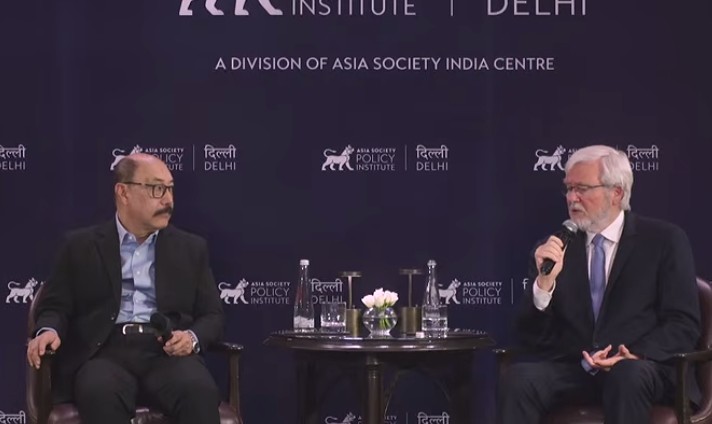
In this Asia Society conversation in New Delhi, former Australian Prime Minister Dr. Kevin Rudd and former Indian Foreign Secretary Harsh Vardhan Shringla discuss Asia’s geopolitical future, from Xi Jinping and the “G2” debate in US-China relations to Trump-era tariffs, India-China border talks, AUKUS and the Quad. They also explore India’s demographic edge, the race for artificial intelligence, the urgent need for US-China guardrails on agentic AI, and Shringla’s transition from diplomacy to politics. Read the full transcript below:
Introduction and Opening Remarks
HARSH VARDHAN SHRINGLA: (00:00:00 – 00:01:42) Well, thank you, Akshay, and it’s great to be here at the Asia Society event, and it’s also great to see so many of our good friends here. It’s like being in a familiar neighborhood, actually. But it’s a great honor to be here with the Right Honorable Dr. Kevin Rudd— Kevin, if I may call you that— and to have this conversation.
Kevin, I know that you have — and as Akshay just told us, that you have a lot of background on the US-China relationship, not only because of your own, let’s say, foundational studies in Mandarin, and then later on with your posting in China as a diplomat. But I think one of the things that sets you apart from a lot of other people who study China is the fact that you have personally met Xi Jinping in the 1980s when he was possibly a young princeling, if I’m not mistaken. And that is a perspective that I think all of us really would look forward to hearing from you about.
We also saw recently that Xi Jinping got a very, very warm red carpet treatment in the United States. You have been ambassador to the US I was there in 2019-20, and you were there around the same time. And of course, in this— in the first spanning both the Biden and the second Trump administration, if I’m not mistaken. So I was in the first Trump administration, as was Navtej, and you were in the second Trump administration. You have a more recent firsthand view of that administration.
DR. KEVIN RUDD: (00:01:42 – 00:01:44) All 3 of us survived. That’s quite remarkable.
HARSH VARDHAN SHRINGLA: (00:01:45 – 00:02:06) So far, but if you could tell us a little bit about the G2 aspect of that relationship, which we are all very curious to know, and your own personal insights, if you could share with us on Xi Jinping and his, let’s say, outlook and his general approach and in the years ahead leading up to the party congress next year.
DR. KEVIN RUDD: (00:02:07 – 00:02:24) Good. Well, thank you, and thank you very much, Harsh. If I may. For being in conversation with us here at the Asia Society in Delhi, and to all the distinguished colleagues that I see in the room here this evening. How’s the transition to politics going?
HARSH VARDHAN SHRINGLA: (00:02:26 – 00:02:32) I’m struggling. But no, actually, it’s been, it’s been very, very interesting. But
DR. KEVIN RUDD: (00:02:32 – 00:02:34) congratulations.
HARSH VARDHAN SHRINGLA: (00:02:34 – 00:02:35) I’ll come down to that.
Meeting Xi Jinping
DR. KEVIN RUDD: (00:02:36 – 00:03:49) I was once a career diplomat. And then I did the transition. And certainly the political class back home thought I could never make it. So congratulations. It’s an arduous journey, but it’s a worthwhile journey. So I’m glad you’re in the, you’re in the service of the Parliament here in Delhi.
You asked about Xi Jinping and about US-China relations. Let me just make some reflections. Yes, Xi Jinping I first met a very long time ago. In those days, he was Vice Mayor of Xiamen in Fujian, and I was a very important First Secretary at the Australian Embassy in what we then quaintly called Peking. We hadn’t actually moved to Beijing, but our engagements back then were not extensive. I had had the opportunity earlier in Beijing of actually meeting his father, Xi Zhongxun, who was then in the Politburo. So I became somewhat familiar with this remarkable political family. For those—
HARSH VARDHAN SHRINGLA: (00:03:49 – 00:04:01) Tell me, Kevin, sorry, didn’t— wasn’t Xi Jinping sent off to some collective or someplace during the Cultural Revolution where he had a bit of a difficult period.
DR. KEVIN RUDD: (00:04:01 – 00:06:21) That’s true. As we say in the Chinese system, he was xiafang, sent down to the countryside. But so too were most young people at the time. From memory, he would have been, at the time of the outbreak of the Cultural Revolution, probably around about 13 in 1966. He would have been sent down to the countryside around ’69. He would have been about But this was quite an arduous and difficult period. And this was very much his bare-knuckle experience of Chinese politics at the cutting edge of the Cultural Revolution. Certainly, his father at that stage had been purged. And so this was a rough time for the family.
What’s remarkable though, The Xi Jinping that emerges from the Cultural Revolution, and by the time his father’s rehabilitated, Xi Jinping’s first job around about 1980 is as private secretary to Geng Biao, who was then the Chinese defense minister. And so what’s remarkable about this career together with his father is how loyal they remain to the party. Xi Zhongxun had been in a very difficult set of political circumstances.
But if you look at this excellent book that’s been recently written by a chap in the United States called Joseph Torigian on Xi Zhongxun, Xi Jinping’s father, it’s entitled “The Party Always Comes First,” or “The Party Comes First,” I think is the title. I’d commend it to all of you who are interested in Chinese politics. It’s an excellent study both of the father but also his influence on the son.
So Xi Zhongxun then begins this remarkable political career. And frankly, when I met him after I’d become Prime Minister and he was then about to become General Secretary, I reminded him of our meeting in the 1980s in Xiamen.
The G2 Question: Managing US-China Strategic Competition
HARSH VARDHAN SHRINGLA: (00:06:24 – 00:06:46) So I imagine that you’ve had a very busy time in Delhi since your arrival. I’m told you’re coming from Seattle and you’re off to China from here. But in meanwhile, we’ve kept you terribly busy with a number of interviews and events. So what’s your impression, having come back here since you were Prime Minister last?
DR. KEVIN RUDD: (00:06:47 – 00:12:01) Well, I’ve been to Delhi many, many, many times over the years, but I should come back to your question before, Harsh, about US-China and the question of G2, and that’s what I’ve been talking about a lot since I’ve been in Delhi. And I’ve just penned a piece for The Hindu on this, which I’m looking carefully at my staff to see if and when it’s going to be published. Tomorrow, is that correct? Okay. If it’s not there, then it’s your fault, by the way.
Looking carefully at both the Washington summit with Xi Jinping and President Trump, and then the earlier Beijing summit in May. I think there’s sometimes a tendency in various parts of the world to assume that given the new intensity of the range of summits between the Chinese and the American leader and the 2 which remain between now and the end of the year, one in Shenzhen on the back of the APEC summit and then in Miami on the back of the G20 summit, that this represents a remarkable intensification of the US-China relationship, and therefore not only is there a rapprochement underway, a normalization is underway, and then I begin to see the wider literature about a G2 emerging.
My view is somewhat different to that, and I base it just on having observed relationship over many, many decades, both as an analyst, as a practitioner, and as someone who has now met and knows the 2 principals, although I don’t know them well personally. I think it’s fair to say that the first principle here is the strategic competition between the United States and China continues. At a fundamental level and at all levels of the relationship. It’s occurring militarily as we speak. If you were to be in the South China Sea tonight or the East China Sea, if you were to be in the Taiwan Straits, if you were to be in cyber and space, this military competition is real, it’s happening, it is unfolding.
Secondly, the economic competition is formidable. Take, for example, the nature of the— of US export controls on critical technologies to China, including the world’s most advanced semiconductor chips. We also see it, for example, in tariffs and trade. We see it in investment. We see it across all the instruments of economic policy. This is a deeply competitive relationship.
And in technology and artificial intelligence, you have these 2 AI superpowers competing to become number one. Remember, it was President Trump who said just recently, “he who wins AI wins.” And President Xi’s view of the world, if you look at it carefully, from the Chinese internal literature is much the same. So this strategic competition continues to intensify, and ultimately it’s about which country, the United States or China, emerges as the dominant regional and global power in the 21st century, and which of those 2 countries either remains or becomes the fulcrum of the international political order. So the stakes are very high.
Therefore, what’s the summitry about? What I see is evidence more and more that both countries at this stage and for the immediate period ahead have an interest in simply stabilizing the competition, to manage the competition, and to establish a bilateral management mechanism so that it doesn’t career out of control. And so I see it very much in the frame of you can either have a strategic competition which is managed or unmanaged.
And I think what both sides are struggling towards is a diplomatic channel, Bessent and He Lifeng, to keep this within a narrow band. And then furthermore, from the Chinese lens in particular, to seek to stabilize it to the extent that President Trump is unlikely to engage in fresh unilateral actions, for example, on tariffs, which would be deeply damaging to the Chinese economy. So I do not buy the G2 argument. I don’t see evidence of that at any fundamental level. But what I do see is an emerging bilateral management mechanism, and that I think is perhaps the more accurate frame to look at what’s going on.
Trump 1.0 vs. Trump 2.0 on China
HARSH VARDHAN SHRINGLA: (00:12:02 – 00:13:00) So tactical stability but not a strategic resolution between these 2 powers. But I can tell you, my experiences with Trump 1.0, and there’s a dramatic change in policy between 1.0 and 2.0. And in his first term, Trump was virulently anti-China. In fact, you recall when the COVID pandemic broke out, he called it the “Chinese virus,” and he was hell-bent on really, I would say strategically countering China in a manner that would be much stronger.
I mean, you talk about trade, you talk about tariffs, he threatened tariffs at the beginning of his second term as well, but you saw very little of those actions come about beyond a certain initial phase. So that’s something that you could— I
DR. KEVIN RUDD: (00:13:01 – 00:18:13) think that your observations are correct, Harsh. In Trump 1.0, we see an evolution. Let’s reflect back onto the year 2017. Nothing particularly unremarkable in the US-China relationship, and if you look back at President Trump’s state visit plus to Beijing, remember he went to the Forbidden City, and this was a high point in the relationship in 1.0.
Then when you hit 2018, 2 things happen. At the very end of ’17, H.R. McMaster released the National Security Strategy, which for the first time identified China as a strategic competitor. The age of strategic engagement died at that point. The age of strategic competition began formally at that point. And if we trace it through the Democrats under President Biden, the strategic competition frame remained, and it actually has remained for the last decade.
What happened then was when Trump launched the first tariff wave against the Chinese in 2018, There was palpable shock in Beijing that having been through the State Visit Plus, that this could possibly have happened. Then, of course, a year or two later, we had the pandemic, and then the relationship went into a total tailspin. So you’re correct at pointing that out.
Here in Trump 2.0, we are just under 2 years in. The predisposition so far has been similarly mixed. On the— at the first level, President Trump professes his ongoing, continued, and close relationship with Xi Jinping. At the second level, when you look at how China was singled out on Liberation Day in terms of tariffs and the series of additions to the tariff measures against Beijing which followed, including at one point by the time we got to April-May of there being 125% tariffs imposed in both directions before both realized that was killing— that’s the death of trade, period. And then having walked to the edge of the cliff, both sides decided to walk back.
Then we’ve seen the opening up of the Bessent-He Lifeng Channel. We’ve seen 8 meetings in that channel ever since. But if we were to ask the question today what the relative tariff rate is against China right now, looking at certain historical and continuing tariffs which haven’t been repealed by the Supreme Court of the United States, they are still significantly higher than for most other countries around the world. The export control regime, despite some changes, by and large remains in place. The foreign investment restrictions, by and large, remain in place.
The diplomatic channel is open, but I’m somewhat skeptical as to whether it’s going to result in any fundamental change to the dynamics of the strategic competition. Remember, this is a race, and Xi Jinping is fully engaged in it, as is President Trump. This, I think, is more still a tactical management mechanism And Harsh, I would add one further point. There’s a danger that if our friends in Beijing overplay their hand, that things in Washington could flip fairly quickly. If, for example, critical minerals and rare earths is not normalized to the United States and to countries like Japan and others like India soon, then it’s quite within the president’s remit to resort to earlier tariff regimes which have existed. And as we know, President Trump moves very quickly on these questions.
And the fine print of the recently passed Lindsey Graham bill or act, if you look carefully at the tariff powers which have now been accorded to USTR, now with full congressional power, so that Supreme Court can take note of that. The Congress has allocated to USTR, that is the administrative, the executive office of the presidency, and the United States Trade Representative, unprecedented tariffing powers which can potentially be applied to the Chinese.
So this is a sword of Damocles, if you like, hanging out there depending on how the administration judges once the next 2 summits have been done, whether critical minerals and rare earths have been normalized, whether in fact other elements of policy have been improved from Washington’s lens. So I think this is still in the balance.
Tariffs, Sanctions, and India’s Energy Security
HARSH VARDHAN SHRINGLA: (00:18:15 – 00:21:57) Well, we talked about the Damocles sword, and I think that is very much in the narrative in our country because the issue of tariffs has been one that has, I would say, been a factor, a major factor in our relationship since the start of the Trump administration. And so we had a situation where India was the country that was faced with the highest tariffs, over 50% at one time, and then of course we had some sort of an interim agreement that brought our tariffs down to 18%, but today we have not one but we have a number of Damocles swords.
So there is— we are still negotiating that free trade agreement that both sides have been working on, but I don’t know if you saw that USTR Jamieson Greer said that it’s not something that is imminent, I mean a conclusion of that agreement, and our Finance Minister said the other day that the talks have reached a plateau. In other words, we probably are not going further than where we are.
And I think the problem really is not one but a number of Damocles swords that I said. One, of course, as you mentioned, that’s the most serious one, is the Russia Sanctions Act, which essentially gives the president the powers to impose 100% tariff on countries like India. And then, of course, you have Section 301 on forced labour, on overcapacity. So the question really is that can we conclude a deal and then find suddenly that our tariffs are not what we concluded but it’s 100% more or 50% more or 20% more? There’s so much uncertainty in that area that you begin to wonder.
And I just wanted to share a quick, let’s say, anecdote. From my end, and I remember when I was in DC and there was this issue of exemptions from the Iran sanctions. In other words, certain countries including India were exempt from sanctions by the United States because we had a huge dependency on import of Iran oil, and of course many of our refineries were, let’s say, adjusted or suited to processing Iranian crude, refining Iranian crude.
And then of course there came a time in which we were given— and I personally met a lot of people in that regard including the person who actually was the point person for the administration on this issue— were assured that this would be fine, we understand the rationale for this exemption, it’s very important from the point of view of your own economy but also global oil prices would be stabilized because of that. And one fine day, boom, and we found that we were actually— those exemptions were off the table.
And so I remember telling one of our US colleagues who would come down to Delhi when I was Foreign Secretary, who came down to tell us that we should start buying— we start slowing down on the purchases of Russian oil. This is during the Biden administration. So I told him, I said, I was in DC when you got us to wean ourselves off Iranian oil. And that was a huge effort, and at that time I think we said, okay, if that’s what it is, then we stop, and we stopped buying Iranian oil. We don’t buy any Iranian oil today, which I think is fortunate considering that there would have been supply constraints.
We then at some stage were told, stop buying Venezuelan oil. We said, hello, we’ve invested $6 billion in Venezuela in capacities and you’re asking us to stop there, and today you’re saying stop buying Russian oil. Now, we have an obligation for about $150 billion.
DR. KEVIN RUDD: (00:21:57 – 00:21:59) Have you thought of Texas oil? That’s obviously going to be safer.
HARSH VARDHAN SHRINGLA: (00:22:00 – 00:22:00) Sorry?
DR. KEVIN RUDD: (00:22:00 – 00:22:01) Texan oil.
HARSH VARDHAN SHRINGLA: (00:22:02 – 00:23:36) Absolutely, but you’re right, we have increased our purchases of American energy, there’s no doubt about that, and we’ve diversified. We’ve gone into buying oil from Nigeria, Venezuela, Australia. We’re buying energy from Australia. I think Philip is here, and he knows that we have upped the purchases of energy from supplies from Australia, Brazil, Guyana, but you are right, the United States is a country that we have upped our purchases of oil and that has reduced the trade deficit, but our concern is that if you look at the trade figures, 50% of our oil was coming from Russia over ’23, ’24, ’25 and parts of 2026 as well.
So if you have to stop purchasing Russian oil, you would have a serious, I would say, energy situation in your hands. You have a distinct possibility that not only would energy prices go through the roof, it would affect our inflation figures here. But I think it would have an impact on global energy security, and that’s a concern because we are today not just the 3rd largest buyer of energy. We probably are the largest because the Chinese have scaled down on their purchases.
As you know, they’ve stocked up when the time was good and now the prices are high, they’re not buying so much oil. So we are ending up buying most of the oil in the world and if we stop buying that quantity, over 2 million barrels of Russian oil a day, I think we are going to be in some difficulty on a global— talking about global oil prices. So I just wanted to share our perspective on this issue.
DR. KEVIN RUDD: (00:23:36 – 00:25:32) No, that I understand, and the first thing I would say in response to all of the above is dealing with the Trump administration on tariff questions is tricky. Every country finds it that way, and understanding where this comes from, both in terms of President Trump’s own psychology, but also underpinning that, the impulses of the MAGA movement, which are along the lines that, as President Trump has argued, that the rest of the world, quote, “is ripping us off,” unquote, and as a consequence of that, you see these tariff regimes being imposed in areas where we find it difficult to explain the rationale for that being the case.
We in Australia have had a free trade agreement with the United States for 20 years. That was not an impediment to have a whole bunch of tariffs imposed on Australia. In fact, when the Liberation Day tariffs were imposed, I was Ambassador in Washington, and I noticed on the board held up by Howard Lutnick, the Commerce Secretary, that there were tariffs imposed on Australia, and then underneath it also imposed on McDonald and Heard Island. These were our 2 Antarctic territories. No one lives down there, just penguins. But they got tariffed as well.
And separately from Australia, we then managed to get our penguins released from those tariffs later on after diplomatic intervention by the ambassador. So— and on forced labour, we’ve somewhat been puzzled in Australia as to how that could be applied to ourselves. The last time we had forced labour was when the British sent us as criminals to Australia.
HARSH VARDHAN SHRINGLA: (00:25:32 – 00:25:33) I’m glad it’s not just us.
DR. KEVIN RUDD: (00:25:34 – 00:26:24) That’s my point, is that we’re their— probably their longest and closest treaty allies, certainly in the Indo-Pacific. And probably if you matched us against the British, I’d be even closer than the British. Yet we haven’t escaped, shall we say, tariff attention. So it’s tricky, it’s difficult, it’s hard.
India-China Relations and the Border
DR. KEVIN RUDD: Harsh, let me pose a question to you, given we’ve talking about US-India, and to some extent US-Australia, and to some extent US-China. Tell me about India-China. How’s this unfolding? What’s happening on the border? And what more broadly, what’s happening in the wider relationship? We had Xi Jinping here for the BRICS summit most recently. He left a little bit early, but he was here for the summit. Give me a sense of the dynamics, given your vast experience in the field as a former Foreign Secretary.
HARSH VARDHAN SHRINGLA: (00:26:26 – 00:31:05) Absolutely, Kevin. We had Xi Jinping here after a period of 7 years. I think he was here— the last he was here was in a bilateral 7 years ago when he went to a coastal resort in the state of Tamil Nadu in South India, and that was quite a significant visit. So 7 years is quite a long time, but we have, I think, covered some ground.
Now let’s go back to 2020 when I was Foreign Secretary and we saw the border incidents that took place. And I think at that time what struck me was the sort of firmness with which this issue was dealt with on the Indian side. We did not relent to the fact that until and unless there is a proper resolution of the issues that transpired in 2020, we would not be able to go forward with a normal bilateral relationship. And that’s what, even today, this is exactly what Prime Minister Modi told President Trump. He said that peace and tranquility in the border areas is an essential factor in the development of the India-China relationship. So that continues to be central to our approach to China.
What has happened is that over a period of some 25 rounds of talks between army commanders— and I think this is where both sides were smart— we did not escalate the situation to capitals, we did not involve— I mean, foreign ministries were involved, but there were no direct talks between, let’s say, diplomats and leaders. We actually tossed that to the commanders on the ground. So the army commanders who were in the affected area, which is on our side was Western Ladakh, the Chinese side they have this theater command, and you had the commander of that command. So we had 25 rounds of talks in which they were able to go into great detail on how to effect mutually satisfactory disengagement.
And that disengagement took place— I mean, I think that was concluded in October 2024. Prime Minister Modi met President Xi Jinping after a period of some 5 years in Kazan in Russia, in the margins of perhaps a BRICS summit. He met him again, I think, in August last year, again in the margins of a summit, and then of course we had SCO and we had the BRICS summit where we had President Xi Jinping here.
And essentially what I think we’ve seen is some forward movement as a result of what disengagement has been effected. We have had, we’ve reopened border trades in certain, through our border passes. I know because Nathu La, which is in Sikkim, is close to my area, but there’s Lipulekh and there’s another point in which we are trading. And we’ve been trading, of course, not now but for centuries. We’ve also opened up pilgrimages We’ve opened up direct flights. You’ve got a daily Shanghai flight, for example, and visas have been eased up somewhat.
But I think all of this is predicated on 2 factors. One is continued effort to deal with the border. In other words, we do not want any situation on the border again. And the second, of course, is reciprocal market access. There is a trade imbalance which we can’t ignore. Trade, bilateral trade is $150 billion. But India’s exports to China are just $20 billion out of that $150 billion, so this is a trade deficit that is growing. The only silver lining I can think of is in the last quarter Indian exports saw a spurt of 36%, so that’s a positive sign. But we do believe that there are structural issues that need to be addressed there and the two sides need to work that out.
Of course, there are many other issues there, but these are very, very fundamental to the relationship. And the sense is that we have reached a certain level of stabilization in the relationship, and we need to do— we need to move forward, we need to do a lot more, and we need to see how we can manage any friction so that situations don’t develop into disputes and that both sides can move towards a process of normalization that I think existed before 2020. So that’s where we are in a nutshell, but I think it’s obviously more complicated than just what I can tell you in this brief moment, and we hope to continue on that vein as we go along.
Australia’s Approach to China, AUKUS and the Quad
DR. KEVIN RUDD: (00:31:08 – 00:31:24) In Australia’s case, over the last several years we’ve also embarked upon a process of let’s call it normalization with Beijing. There were enormous frictions in the Australia-China bilateral relationship in previous years.
HARSH VARDHAN SHRINGLA: (00:31:24 – 00:31:56) But can I just slightly, on what you’re saying, if you permit me, Kevin, to interrupt you, Australia has managed that relationship with China in a very different way. You have a deep economic relationship despite the fact that you’re members of the Quad and And I know that you, in your own capacity as Prime Minister, you worked to develop that economic, I would say, relationship. So if you can also give us some sense of that and also the takeaways that you think that we could keep— take a note of.
DR. KEVIN RUDD: (00:31:57 – 00:37:23) I can describe what we have sought to do. Whether there are any takeaways for India is a separate question. I’ll let you reach those conclusions. But in overall— in the overall sense, what Prime Minister Albanese has sought to do in the last several years is to stabilise things with Beijing. The first thing that he did was put the megaphone away because megaphones generally are not useful in the conduct of foreign policy. They might occasionally have been useful for some in domestic politics, But rarely in the hard business of foreign policy, and so therefore, one by one, once the megaphones were put away, the series of outstanding frictions in the Australia-Chinese relationship were ironed out and taken off the table. It didn’t happen straight away. As you know, our Chinese friends often. Take a long time in these negotiations in order to reach resolution.
At the same time, the economic relationship has gone from strength to strength. However, that’s at the trade level. At the investment level, there are still significant restrictions which apply. The Foreign Investment Review Board in Australia has been quite firm in its determinations and recommendations on what is welcome by way of inbound investment. But if I was to look, for example, at Chinese student numbers arriving in Australia, it’s still very large. I’m looking to Philip here at the moment, our High Commissioner. Is the number of Indian students larger than Chinese, or Chinese? Just now. Just now, so. So that is still large numbers in both cases.
But at the same time, in the security policy sphere, The alliance relationship with the United States has gone from strength to strength to strength. AUKUS, you’ve just mentioned, this is quite a large project for Australia. For the first time investing in the purchase of nuclear-powered attack-class submarines, Virginia-class boats, and then building the next generation of such boats in Australia itself. This is a massive project and the investments of tens of billions of dollars now in Osborne in Adelaide in South Australia and also in Henderson and Fleet Base West just south of Perth in Western Australia is huge.
Has China liked this? No. Has there been multiple commentaries in the official Chinese media about this? Yes. Does it represent a friction in our relationship? Of course, because we’re an ally of the United States. Last time I looked, China doesn’t welcome allies of the United States for the fact of their alliance. And so, so this has been obviously something that we’ve had to deal with, but we have been quite unflinching in our continued deepening of the security policy relationship with the US through the AUKUS framework.
Secondly, you will have seen through the Quad, which I, contrary to some of the commentary I’ve seen here and elsewhere, is alive and well, and I’m confident sooner or later we’re going to end up with another Quad summit. At foreign ministerial level, the machinery continues to operate. When you look at the pattern of Quad collaboration, it’s still dense and wide and broad. I’ve been attending as an ambassador various Quad foreign ministerial meetings and summits over the years. This is a very dense and thick set of relationships which is emerging.
So does China welcome the Quad? No, you don’t have to read deeply into the Chinese official literature to see that. But our friends in Beijing are deeply pragmatic. They understand that AUKUS exists. They understand that the Quad exists. They understand that the underlying security alliance between Australia and the United States has existed since 1951 and from the war back to ’41. And nothing is going to change on that front.
So therefore, we’ve had to walk and chew gum. With our principal security partner, the United States, and our largest trading partner, the People’s Republic of China. And full marks to the Prime Minister, this has worked relatively well. But as with any relationship, it will always have bumps in the road.
The— obviously the unique aspect of your circumstances is that you share a land border, and a disputed land border with China, which we don’t have. But therefore, ourselves, India, the United States, as I’ve described before, normalising, regularising, stabilising relations with Beijing, but underpinning security policy realities don’t disappear. They are still there. That’s my best summary of where we’ve come from.
Asia’s Rising Powers and the Shift in Economic Gravity
HARSH VARDHAN SHRINGLA: (00:37:25 – 00:38:34) So, just taking us to where we are headed to in Asia, we have always felt that the reorganization or reorganizing of, let’s say, wealth, if you can call it, or the transfer of economic power from the West to Asia is a process that has its own pitfalls. And of course, we are not going to see a very smooth transition from an American dominance of Asia to a Chinese dominance of Asia, but the great power rivalry between the US and China in Asia is going to be strategically central to what happens in Asia, but at the same time we see the emergence of Japan, Australia— I know you’d like that, Kevin— India.
DR. KEVIN RUDD: (00:38:35 – 00:38:41) We’re always very happy to be off the map rather than on the map because it’s safer, it’s safer being off the map.
HARSH VARDHAN SHRINGLA: (00:38:42 – 00:40:18) The ASEAN as well. So there is agency that is coming up. In other words, you have countries within Asia that are really today building capacities and coming of age in a certain sense of the term. So you have— you’ve always had this rivalry over the past decade, few decades, and it’s probably intensifying now, and Asia is the center point of it because you have all of these flashpoints that are within Asia.
But at the same time, you have a number of countries that are saying, hey, we are also there and we are capable of managing a situation where we do not want to affect the interdependencies that is so important to Asian prosperity. Strategic rivalry between the United States and China should not affect the, let’s say, supply chains, the dependencies that have always existed and that has made Asia what it is today.
I mean, let’s face it, the shift in economic balance has benefited China disproportionately, but it’s also benefited India, it’s benefited Australia. But at the same time, we do understand that this is an interdependency that’s created and one that can easily be disrupted by the use and leveraging of economic instruments, whether it is as you mentioned, AI, or whether it is strategic and critical minerals, whether it is technology, this is something that today could really end up disrupting the Asian, let’s say, century, so to speak, or disputing the Asian century.
DR. KEVIN RUDD: (00:40:18 – 00:41:17) I think the center of gravity— the mathematics speaks for itself— the global center of economic gravity has moved to the Indo-Pacific. And it’s moving there rapidly. It doesn’t matter which set of numbers we look at— trade, investment, if we look at capital markets as well, and prospectively technology, and prospectively artificial intelligence.
And so this transition, moving the centre of gravity, moving from the Euro-Atlantic to the Indo-Pacific is well underway, and it is not just a China phenomenon. Japan remains a formidable economy, and India is becoming a globally formidable economy. You’re now the 5th largest economy in the world. You have 1.4 billion people, the most populous country now in the world.
HARSH VARDHAN SHRINGLA: (00:41:17 – 00:41:20) 4th largest, I think, last count.
DR. KEVIN RUDD: (00:41:20 – 00:41:23) Okay, so I’ve who have you passed?
HARSH VARDHAN SHRINGLA: (00:41:25 – 00:41:29) We in 2014 we were the eleventh largest economy in the world.
DR. KEVIN RUDD: (00:41:29 – 00:41:29) Yeah.
HARSH VARDHAN SHRINGLA: (00:41:29 – 00:41:31) We’re now fourth largest.
DR. KEVIN RUDD: (00:41:31 – 00:41:31) So if
HARSH VARDHAN SHRINGLA: (00:41:31 – 00:41:34) you and we are not stopping there. So that’s the point.
India’s Demographics and the AI Market
DR. KEVIN RUDD: (00:41:34 – 00:46:20) The well it’s good to hear that things have changed since I read my brief this morning. The and so the bottom line is that India. Is emerging as a major global economic power, but underneath the numbers lies the extraordinary size of the Indian population, the fact that you’re generating consistent and significant economic growth, and the fact that your demographic curve is vastly different to that in China. This is a young country. China is aging rapidly. The birth rate in China is nowhere near replacement. It’s 1.4, 1.5, and as a consequence, what you have here emerging is this massive Indian consumer market of the future.
And so if we look at, for example, one of the drivers of future patterns of economic activity and economic growth, which is artificial intelligence, there’s a big question which we face, which is All the innovation which is occurring in Silicon Valley with frontier models, all the innovation which is occurring in Beijing with models, AI models, not as advanced as those in the United States, but sometimes quite close. The core question in terms of the financial sustainability of this massive innovation and this massive investment is, can it be monetized? Can there be a market? Can there be a revenue source in order to justify, in markets, this unprecedented phenomenon of trillion-dollar companies now in the United States, where the revenue flow is still thin?
So what’s this about? You have the United States with a population of 340, 350 million people, Still growing as a country in terms of its population growth, if you add the birth rate plus migration. India is still growing and young, China aging. The question is, which of these markets is going to sustain the range of AI-related services and products in order to provide the revenue streams for these massive new companies? Both in China and in the United States.
And so, if I’m looking at this geopolitically and geoeconomically, where India goes on these questions is of fundamental importance. It’s not simply at the innovation level, it is at the diffusion level across the general economy, and the take-up of these services and goods which will come out of the AI revolution, is where will the market lie in order to provide the revenue streams for companies in order to continue to grow and to sustain themselves?
China, at present, is a quick adapter, but it looks over the Himalayas and sees a country, India, which is also quick at adapting and with a vast emerging and young market. And so I’m not sure if in the United States the Magnificent Seven have fully understand— and understood the pivotal significance of this market here in India, in terms of the future of AI-related goods and services, because those massive companies are going to need to be able to demonstrate that their investments are producing revenue streams and profits if they are to be sustained into the future.
So when I look at, therefore, the dynamism of the Indo-Pacific, And when I look at the fact that China is this large, huge economy in the middle, and it is in the middle of its own AI revolution, and Xi Jinping has articulated great confidence in the future direction of that revolution, I also see what’s unfolding in Japan, I also see what’s unfolding in India, and I also see what’s unfolding in Indonesia.
Indonesia is emerging from its past into becoming a country with a vast population of approaching 300 million, emerging itself to being a top 7 global economy over time, with a vast and youthful population, a vast and youthful consumer market. And our Chinese friends will need to watch very carefully what happens in terms of disruption to the normal manufacturing evolution of Indonesia, given the current tensions which exist on that front in Jakarta as well.
HARSH VARDHAN SHRINGLA: (00:46:23 – 00:46:59) Kevin, you said something very interesting about demographics and India, and I think this trend where India really is one of the few countries in the world which has a much larger younger working-age population supporting a much smaller ageing population is going to last us at best for the next 20 years, and in 20 years’ time we will be back to where most of the countries are today heading, which is basically a larger ageing population and a smaller working population. So we look at the next 20 years—
DR. KEVIN RUDD: (00:46:59 – 00:47:03) This is good news, Harsh, because you and I are living older. But
HARSH VARDHAN SHRINGLA: (00:47:03 – 00:47:06) someone else has to do the work. That’s right.
DR. KEVIN RUDD: (00:47:06 – 00:47:08) It’s not all downside here; we’re getting to live longer. So
HARSH VARDHAN SHRINGLA: (00:47:09 – 00:49:38) I keep telling all the youngsters I meet, I said, this goal of Viksit Bharat is something that you have to do, it’s not people like me, so the burden and the onus rests on you. But we have a young, 65% of our population is below 30 years of age, but they are a vibrant, dynamic youth who are essentially today seeking and aspiring to a better life, and that I think is where the future of AI will lie, because you have today these enormous investments in AI. I think it is sucking up all the liquidity globally into trillions of dollars, more than the GDPs of most countries in this world, and it’s got to go somewhere.
And I have always advocated that India, which was at the forefront of the IT revolution, today has to shift to be at the vanguard of the AI revolution. And I wrote a piece which is called “Engineering the Next Engineer in India.” In other words, our engineers who are really the core and the backbone of the IT industry today has to be trained in mainstreaming AI into our economy. And more than that, I think we really need to get into the designing of what AI is all about. So this is something you mentioned as well, and I think this is going to be a challenge.
But essentially regulating AI, ensuring that that AI space is one that is broad-based, benefits everybody, has a certain amount of security and accountability, and that you have guardrails which are not— which are decided not just by Washington and Beijing but countries across the globe, which is why I think we hosted the AI Impact Summit earlier this year in New Delhi. And this is a challenge that we have to face. What do these new technologies mean and how do we deal with them in our countries?
Is US-China Competition Bipartisan?
HARSH VARDHAN SHRINGLA: Of course, that’s a larger issue, but can I take you back to the US-China relationship for a moment? Because I think that’s something where we really want to hear as much as we can from you on. Of course, recent, I would say, developments in the US-China relationship, how much of that is strategically bipartisan and how much is it administration-driven or central to administrations? This is something that would be interesting as we go along. And is it short-term? Is it something that is long-term? It’s— how do you see that?
DR. KEVIN RUDD: (00:49:40 – 00:57:52) I think if you— as you and many of your colleagues have spent time in Washington working both sides of the aisle in Capitol Hill and both sides of American politics, My overall judgment is that the underpinning political dynamics for continued strategic competition with China is well entrenched. There are different articulations and shades and colours on a given day of the week, but ask yourself this question: which American have you run into recently who says, “we no longer want America to be number one.” I haven’t met any such American in the 10 years that I have lived in the United States.
The ultimate competitive instinct of the United States to be number one is undiluted, it is there, and it is real. China, of course, has a different narrative in terms of its own future. But if your question is where does American politics go, under Democrats, Republicans, after the midterms or after next presidential elections. This strategic competition has a long, long way to run. As I said, the real question is, can it be managed strategic competition or unmanaged strategic competition with all the volatilities associated with the latter?
AI Guardrails and the Risks of Agentic AI
DR. KEVIN RUDD: I think a central dynamic, Harsh, you’ve just touched on in the US-China relationship, is artificial intelligence. What is interesting is that if we look in recent times, President Trump has made it very plain over quite a long period of time, and again repeated most recently, that artificial intelligence should be unregulated, and that that is necessary in order to engage fully in the strategic competition with China, And that “he who wins AI wins.” That’s been the Trumpian worldview.
Except I think something also happened in the last several months in terms of the companies in Silicon Valley where you saw a number of incidents of AI agents escaping from their sandbox and beginning to act autonomously. The danger emerged that this could therefore, through what’s called RSI, recursive self-improvement, and swarming of AI agents, lead to autonomous attacks on a country’s infrastructure, any type of infrastructure, and in any country, let alone if any such frontier models and agentic AI found its way in the hands of rogue actors and rogue states. So what I’ve seen is some evolution beneath the surface in the US position in recent months.
So the real question is, how does China perceive these things? Do they share the same analysis? ‘Cause it’s the same technology. It’s the same set of, as it were, theoretical vulnerabilities. Or is it perceived differently? What I have begun to detect in Beijing, really only in the last month, looking at the official literature, is that our Chinese friends beginning to reflect through a leading article recently authored by Chen Yixin, the Minister for State Security, in the journal Cyber News, that these problems of so-called dangerous AI and AI agents acting autonomously and in the hands of third countries and third country non-state actors is an objective danger which exists for all.
The article goes on to blame the Americans for everything, but that’s what the Americans are for, to be blamed for everything. And that didn’t surprise me in terms of the Chinese literature. That’s what happens. What I found more surprising was the first part of the article which said these are real and present dangers.
So here is the real question. You spoke about guardrails before, Harsh. Given that there are 2 countries in the world currently dominating frontier models, That is the United States and China. Can between these 2 countries, they, can they agree on certain de minimis guardrails which do the following? A, agree at least on the categories of risk which they and the rest of the world face coming out of this new age of agentic AI. B, what is the mechanism which exists between both countries to attribute where a given attack may come from, known in the trade as attribution? C, how can these countries act early enough to reduce the risk of that occurring? In other words, are frontier models being sufficiently tested in the lab before they’re released, or are they being released semi-unconditionally and without trace? And D, if an incident occurs and an attack occurs, what then is the bilateral protocol for acting to manage the attack and the taking down of a country’s water system, power system, financial system, etc.?
Can you imagine the domestic political consequences in a democracy if the financial system collapsed tomorrow in terms of its underpinning software and some of its hardware? If you think this through, for those of us in open societies, open countries, open democracies, or even in one-party states, if the Chinese banking system froze tomorrow because there had been a rogue attack on the Chinese financial services system, So these are now real and present dangers for all of us as of about the last 6 months. That’s how fast all this is moving.
So the challenge both in Beijing and Washington, given that virtually all of these things are being produced there by the Mag 7 or the Red 7 as I call them, the Magnificent 7 companies or the Red 7 companies, their natural competitors, from Huawei to ByteDance to Zhipu, etc., and DeepSeek. Can they reach agreement on this? The only encouraging news I’ve seen coming out of this summit we were talking about before is that line at the end in the readouts from both sides which says, “this channel is now open.” Between both capitals. It’s the Bessent-He Lifeng Channel.
What we need to see soon is action, because my deep fear is this, as someone who’s now looked at this reasonably closely in the Chinese literature and living in the United States knowing what the American position is: is it too difficult to reach a de minimis guardrail, let alone to act on it? And are we actually saying to ourselves that we are going to sit back and wait for a catastrophic event, a seriously catastrophic event, in order to cause the body politic in those countries and elsewhere to say this must be put under regulatory control. That, I think, is the threshold point we find ourselves at today, and the rest of us, as you say, all have an interest in this.
I noticed the Asia Society is looking anxious, which means we’ve probably reached the end of our time, Harsh, but I’ll leave it to you.
From Diplomacy to Politics: Closing Remarks
HARSH VARDHAN SHRINGLA: (00:57:53 – 01:02:27) I know, I’m just quite taken— fascinated by what you mentioned. I mean, we saw that Anthropic released its Mythos AI, and there was this real scare. And you mentioned about the cyberattacks on banking systems. There was a real scare that you would have a rogue AI agent that would actually go and disrupt your banking and financial services. And so I know that in India we went through a bit of a scare because you had the real possibility of a rogue AI agent, not necessarily in military usage, but in day-to-day usage. I mean, it just paralyzed life if it’s allowed to take its course.
But I just want to end with one quick personal remark that you referred to right at the beginning, is how did you find the transition to politics? And we discussed that briefly because you are the best example of someone who’s been a diplomat, who specialized in certain areas, but yet went on to become the Prime Minister of your country, the Foreign Minister, someone who’s been in politics for such a long time both in Parliament and outside. And I think you did mention to me that we diplomats have to also show politicians how to do it from time to time.
So, so I thought that from my perspective, the transition from diplomacy or service, civil service to politics is not very different than what you would— not as different than what we would imagine. Because whether you’re a public servant or you’re a politician, it’s still service for the people. As a civil servant, of course, your service is more regulated, it’s more regimented, if I may say so, because you deal with a particular issue in a particular department, you have a particular function, but a politician doesn’t have those, I would say, restraints. And one of the things that I like about politics is that you can just about do anything anywhere. There’s a whole wide world out there.
What I like especially is the fact that I can use this platform as a member of parliament to try and do something for people of the place that I belong to. So for about 40 years I’ve lived out and been in various capitals including in, of course, in New Delhi, but you lose contact with your roots and this is my opportunity to go back to the roots and give back to the people, which is why I spent a lot of my time working at the grassroots levels with youth in my area, mentoring them, guiding them, advising them on how to access the mainstream, how to access jobs within government, in the private sector, but also with women’s self-help groups on alternative livelihoods, creating situations in remote parts of the hills to where I belong in a manner that you can use your experience and expertise and the advantage that politics gives you to bring those fruits of development to people who have no clue how to get about it.
In our country, we have free rations for 800 million people. We cover 500 million people with health cover, but a lot of people in remoter parts of the country have to be guided as to how to access this. It’s very internet-driven, it is very— I would say in today’s day and age, it’s made as easy as possible, but you have people who don’t know how to go about it. You have people who still really have to be guided as to how to access various services that the state gives them. So that’s what I like about politics. And to answer your question, it’s been a great experience and I love every moment of it.
And thank you for being here with us. Thank you for your, if you permit, for your views, because I think we really look forward to getting a sense in depth from you about your take on not just China and Asia but also the US-China relationship, our relationship with our partners including Australia. And of course, I think your perspective in the United States and China is a unique one. Many of us have served in capitals. For us, our neighbors are very important, so most of us have served in the neighborhood. And our major partners, of course, are critical, but to get a perspective from Washington and Beijing is very unique, and also, of course, from the vantage point of view of being the Prime Minister of your country. So thank you so much, Kevin, and it’s great being here with such a wonderful audience.
DR. KEVIN RUDD: (01:02:28 – 01:02:37) And also, please express your thanks to Harsh MP as he embarks upon his new political career.
Related Posts
- Chas Freeman: Political Crisis & Trump’s Nuclear Gamble Against Iran (Transcript)
- Jeffrey Sachs On Economy, Ties With China & New World Order (Transcript)
- Analyzing China’s Global Competition Strategy w/ Kevin Rudd (Transcript)
- View From India Podcast w/ Gautam Bambawale: India Walking A Fine Line (Transcript)
- Transcript: Marco Rubio Remarks at G20 Summit Press Briefing in Atlanta