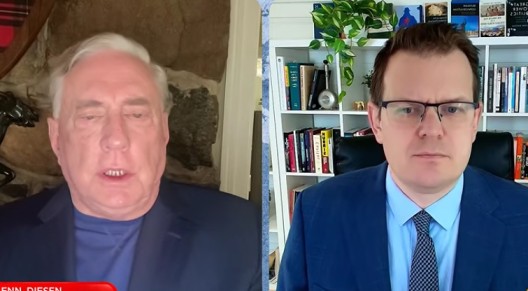
In this interview, Glenn Diesen talks with retired Colonel Douglas Macgregor about the US midterms, Europe’s crisis of political legitimacy, and the rise of the AfD in Germany under Chancellor Merz’s unpopular government. Macgregor explains why he expects revolutionary upheaval across Europe, how Washington’s pursuit of the unipolar moment and a war with Iran risks financial collapse, and why Turkey and Iran, backed by Beijing, may shape the future of the Middle East. Read the full transcript of this interview below:
Introduction
GLENN DIESEN (00:00:00 – 00:00:12): Welcome back, everyone. We are joined today by Colonel Douglas Macgregor, a former advisor to the US Secretary of Defense, a decorated combat veteran, and also an excellent author. Thank you for coming back on the program.
DOUGLAS MACGREGOR (00:00:13 – 00:00:14): Good to be with you, Glenn.
Germany, the AfD and Europe’s Crisis of Legitimacy
GLENN DIESEN (00:00:17 – 00:01:30): So in the United States, you have the midterms now with the obvious discussions about political disruptions. Obviously, we have the same in Europe. We have a, well, I would argue a crisis of political legitimacy. We have a political elite which has begun to, well, show that it can’t be— we can’t really choose or change that many policies anymore at the ballot box. When J.D. Vance went to Europe last year, he made a lot of comments about what they did in terms of reversing the election outcome in Romania. But again, you have a lot of problems building up from France to Germany, and Poland, of course. We have a massive constitutional crisis in Poland.
But I wanted to start off with your views on what’s happening in Germany, because as the incumbent Chancellor Merz becomes ever more unpopular, we see now that the AfD emerges as the main opponent. But it doesn’t appear that they’re prepared or willing to let this anti-war party take over. So I was wondering, how do you see what’s happening in Europe?
DOUGLAS MACGREGOR (00:01:32 – 00:06:49): Well, it’s tough for Americans to always understand Europe. We have a view of Europe that imputes a degree of importance and power to countries like France and Great Britain that are not justified. And Americans, even though there’s no hostility to Germany, as you find some places, there really isn’t to Germany. No hostility at all to Germans in the United States, except from some minorities. That’s always going to be with you, but for the most part. But there is not an understanding that Germany is really the once and future king of Europe. And it really has been since the fall of the Roman Empire. And that’s something that very few people ever bother to point out.
Germany today is in a struggle to disengage from its past. I’m not just talking about the Nazi business. I’m talking about a past that has sort of lingered into the present for 80 years. Germany, and I think Germans increasingly want to be an independent sovereign state. Germany has not really been independent and sovereign since 1945. And the funny part of this is this coincides with this terribly destructive war in Poland, or excuse me, in Ukraine, and Russia’s role in trying to end this war and also restore its relationship with Europe, but Germany in particular.
And the same is true for Germany. The Germans want an end to this war. I think they’ve come around to understanding that this was never some grand plan hatched in the mind of President Putin by any means. On the contrary, this is something forced on the Russians. I think the Germans collectively have begun to understand that, and they also understand what happened.
I think somebody was telling me, I guess it was 1,000 cubic meters of natural gas before the war when Nord Stream was open was caused— cost about €150. And now 1,000 cubic meters is costing €1,500, something along those lines. I don’t have the exact figures in front of me, but the point is that the German economy is being destroyed. It’s being hollowed out. It’s being deindustrialized. Factories are closing. Every conceivable disaster that could visit the German people short of war has been inflicted on them by the globalist community in Europe.
And I say globalist community because these are people that run Europe and the United States, not simply Germany. Merz just happens to be a prominent representative, the man from BlackRock, the man who came in with the goal of finishing off the German people, its identity, culture, nationhood. I think that’s become increasingly clear.
Now, how do you get rid of Merz and the globalists? Can you vote them out of office? That’s the question that confronts the German electorate. And I think more and more Germans are beginning to wonder if it’s even possible. And now we could sit here and spend hours talking about all the various means and ways, parliamentary procedures and tricks that can be employed to keep the AfD out of government. But I think the German people are going to get to the point where that’s unacceptable. And I just don’t know how soon that occurs, but it’s coming.
Now, the other interesting part, of course, is Wagenknecht, along with Alice Weidel. Wagenknecht, of course, is a leftist, practically a communist for all intents and purposes. She is willing to ally with AfD probably because of reasons involving her own ideology and believing that somehow or another will weaken the hold that the traditional right has, who knows? But the point is, they have their own reasons for opposing these globalists. It’s not going to be enough for Alice Weidel to gain control. It helps, but it’s not enough. This uneasy coalition between the remaining parties and their sick and destructive agenda, these things have to be exposed and broken. So it’s not going to happen right away.
Now, the next part of this is to understand that Alice Weidel, if by some miracle she or one of her colleagues becomes chancellor, it’s not going to solve Germany’s problems.
Germany’s problems, much like the problems that afflict France and our own country, the United States, are too great to be solved through an election. So we’re all collectively in for a long struggle to regain control of ourselves and our own countries.
But I think the good news is that Germany is now seriously in the race for freedom and independence and sovereignty, and that is a good thing. The Germans are going to stop apologizing for things with which they had nothing to do 80 years ago and restore the sense of national consciousness and dignity that they deserve.
The CIA and Europe’s Nationalist Movements
GLENN DIESEN (00:06:52 – 00:08:11): But I— how do you see— do you see the AfD essentially leading a wider European movement away from the current structures that is organized around the EU and NATO? Because we do see opposition in many countries, but I have a hard time imagining Le Pen being able to not just lead France but also larger parts of Europe, or Britain for that matter. It seems like you do need— you did need Germany to kind of change course in order to pull the rest of the continent with it.
But will, yeah, to what extent would they be allowed to do so though? Because I know Trump, or the United States in its security strategy of last year, it did envision Europe taking a different route indeed. And I know you criticized that it didn’t read much as a strategy, the US National Security Strategy, but it did almost refer to encouraging regime change to get the people like Merz away or his ilk and have them more or less replaced with the people like AfD. But do you see this being something that the US would actually do or would they prevent it?
DOUGLAS MACGREGOR (00:08:13 – 00:13:24): Well, let’s first take, just talk about France. France, interestingly enough, though it is part of the larger maelstrom of change in Europe, and France has a habit of being usually first in line when it comes to revolutionary change, France is really isolated in terms of its political movements and operations in France from the rest of the continent. That is not true for Germany. It’s not true for Poland. It’s not true for Austria or Hungary or the Czech Republic. It’s not true for Sweden.
If you begin to look at the so-called nationalists, and I see these people as nationalists in the most patriotic sense, people who are about preserving and sustaining their countries, their cultures, their identities, and so forth. Across Europe, once you move past France, all of those entities are connected. They are connected to each other to varying degrees. They are optimistic or pessimistic, depending upon where you are. But right now, nationalists in Poland, nationalists in Germany, nationalists in Hungary and Austria and Czech Republic, they’re talking to each other. And in Sweden, all of them, they all share a similar agenda. They all want to get out from underneath the globalist problem.
Now, when you go back to the United States, and this is an important point, quite frankly, the strategic document you’re referring to is totally irrelevant to what we’re discussing because you have this organization known as the Central Intelligence Agency, which, for reasons that we can’t go into here, we don’t have time, is essentially on its own. It’s a rogue organization. It is in many cases self-funding. It goes and does what it wants when it wants to, regardless of what it’s told. That has to be borne in mind.
This has been going on for a long time. Eisenhower dealt with the problem. He did everything he could to bring it under control. Kennedy confronted it after he became president. He lost a grip on it. I don’t think after Kennedy anybody really sought to go after it and bring it back under control of the chief executive, really until Nixon. He was not successful. Carter made modest changes, meant well, didn’t work. Since then, I don’t think anybody has systematically stepped forward to challenge the CIA as an entity.
The CIA is heavily engaged in Europe to stop change along the lines that we’re discussing. They are there to sustain the globalists in power. There are CIA agents working hard with great quantities of money, understanding, and knowledge inside Germany, for instance, to keep the globalist government under Merz in power. We have to understand that.
The reason I wanted to make that point is that you have this notion that there are so-called Russian trolls running all over the place trying to help AfD. I gotta be frank with you. The Russians are pretty good at many things, not as good as you would hope in terms of understanding the internal politics and structures and movements and people in Western Europe, and certainly not in the United States. No doubt there is some of that, but not on the scale of what you see the CIA engaged in, or the front organizations that still exist like the National Endowment for Democracy and so forth.
These entities are committed to the globalist cause and the globalist agenda, something that I oppose and something that millions and millions of Europeans are increasingly opposed to. But they have money and they have influence, and it’s going to be a fight. And I don’t think it’s going to be won easily. I don’t think it can just be won at the ballot box, unfortunately.
So I do expect, and I’ve said this before, something on the scale of the 1848 revolutions. But the key difference is that the current European governments do not have the control over the armed forces and the ex— to the extent that was the case in 1848. The King of Prussia, the Emperor of Austria, whoever it happened to be, the Tsar of Russia could turn to the armies, which were absolutely unambiguously loyal to the crown and say, “Suppress it, stop it.” And it ended. That doesn’t exist right now.
That doesn’t mean that the people at the top are not sympathetic to the globalists that promoted them into power. I’m talking about general officers in the various military establishments, but the rest of the military establishment, no. So we’re in for a rough ride. It’s only just beginning. And I certainly wish people like Alice Weidel the best, but I think we have to understand that she is just the first wave. There are going to be multiple waves that will sweep over Europe in the years ahead to reverse the damage and destruction that the globalists have brought to the European continent.
Why Europe Was Never United
GLENN DIESEN (00:13:27 – 00:14:30): Yeah, that’s— well, the reason I’m a bit pessimistic about the ability to, well, see any real change is because well, there are problems building up, be it economic, security issues, political, social, and they’re all connected. But you would have to solve this at the state level, and I mean for the nation-state. But a lot of them are unable to do anything even if they would want to because a lot of the competencies have been hollowed out. The EU has essentially too much authority now, and as we see, even with elections going, well, the wrong way for the EU, they can always be reversed.
But beyond this though, what do you see as being a possible model for the Europeans moving ahead? Because the US has, well, it’s not just Trump, the US has good reasons for wanting to deprioritize Europe. And without the United States, it looks as if that Europe will fragment quite easily.
DOUGLAS MACGREGOR (00:14:31 – 00:21:28): Well, Europe is fragmented. When has it ever been united? It’s never really been united as a continent. After the fall of the Roman Empire, one of the few things on which the people that took over the subsequent governments of the various parts of the Roman Empire could agree on is that they didn’t want another universal empire. And so the first man who becomes the, what is it, the emperor of the Holy Roman Empire of the German nation, once he dies, that breaks up. And so you break into all these different countries that had different cultures and different languages and different people.
We forget that no, nothing, no political reality can exist inside any country that is not rooted in the history, culture, and DNA of the population. We have been pretending now, certainly since the ’60s, that religion, language, culture, and race don’t matter. That man is a purely economic animal. That he responds to financial stimulus and not much else. This, of course, is the Marxist materialist view. It’s the globalist view. It wants to treat humanity as mindless consumers who could be herded in whatever direction the globalist leadership wants them to move. It’s very similar to Bolshevism. That was ultimately the goal in 1918, 19, 20, 21.
Now, my point is simply this, that won’t work. The very things that they have set out to destroy and eliminate and eradicate are coming back to life. They are roaring back into the environment.
Reminds me of a friend who was in Moscow when the Soviet Union fell apart. And I talked to him a few months later in 1992. And I said, “Well, what happened?” And he told me. And I said, “Well, what happened to the Soviet man? Don’t you remember the Soviet man who was going to emerge from these unwashed masses superseding any sort of national dinger?” And he started burst out laughing. He said, “As soon as the Soviet Union fell apart, we had Russians, Ukrainians, Lithuanians, Latvians, Estonians, Kazakhs, Kyrgyz, Turkmen—” I mean, just down the list. In other words, this whole dream of sort of suppressing all of that, destroying it, forcibly merging it into an amorphous mass had failed. Well, that’s what’s happened in Europe.
When I was in Vienna to attend one of these OSCE meetings about— This is in 1998. It comes over and they were about what was going to happen over Kosovo. And I had to dutifully go down there and brief and then sit and listen and pretend as though we were still looking for some sort of solution and did not simply want to bomb the Serbs. But of course, we were interested in bombing the Serbs. It was very uncomfortable for me, but I learned a great deal.
And I remember sitting in a table afterwards with various representatives. Russian was there. I’ve forgotten all the others. Germans, Austrians, Finns, Hungarians, somebody else. I think the Swedes. And we were all sort of sitting around having lunch together and somebody brought up this new European currency, the euro. And we’re going to all live in the eurozone and Europe is going to become the United States of Europe, much like America.
And I sat there and listened. People expressed their views and they got around to me and they said, “What do you think?” I said, “I see no future for this at all.” They said, “Well, why not? You’re an American. You should think this is what we want.” I said, “No, I don’t think it is.” I said, “Because the Italians have one view of monetary policy and the Dutch a different one. The Germans view monetary policy in one way. The French and the Norwegians think differently. So I don’t see how you can force these people into a union and then get all these governments on the same sheet of music when they think very differently.”
And ultimately, the funny part was that the only people that agreed with me at the time were the, as I recollect, was the Russian and the Hungarian. Everybody else said, “Well, it’s very backward. You don’t understand. Europe has changed.” I said, “Well, we’ll see.”
Listen, this is nonsense. Europe is regional. It has to be regional. It’s always been regional based upon the populations that live in the areas. If you’re in Stockholm and you look east towards Moscow or Berlin, you look towards Warsaw and Moscow, your view of the world is not a great deal different from what it was over the last 300 or 400 years. At the same time, if you’re sitting in Rome and you look south to North Africa, or you look east towards Turkey, your view of the world is different. In other words, you have to accept the fact that in these various European capitals, the strategic outlooks are not the same.
So what it has always suggested to me is that you’re going to end up with various security zones, zones in which a collection of people in North Central Europe are going to see things in a similar way. The people that live down in Southern Europe and Southeastern Europe or Southwestern Europe, they’re going to see things a different way. I don’t see that as a bad thing. I think it’s realistic.
But we have the same problem in the United States insofar as we don’t want to touch on anything that makes someone uncomfortable. So instead of addressing the real issues at hand, we dance around them and there’s no solution. Well, I think Europe now is in a position where it’s going to have to reach some solutions. I think you’re ahead of us. You are where we will be in several months. In other words, what you’ve seen happen in France is going to spread. Won’t be exactly the same in every city. The issues will be similar. We’re going to face some of the same things.
No one in the— there are 2 words in the English language in Washington that no one ever mentions. The words are “cut spending.” Which happens, absolutely has to happen. It won’t. And so we’ll go under financially. You’ll see the kind of chaos that you see in France, but eventually we’ll get around to it. So I think all the issues that we’re sort of glossing over will come to the fore.
But in the meantime, Russia is going to win the war in Ukraine and Ukraine is going to be settled largely by the Russians in, I think, cooperation with the people that border Ukraine. Romania, Slovakia, Hungary, Moldova, Poland, Lithuania. Those countries will have a say in what happens in Ukraine, just like Belarus and Russia. But I don’t think we in the United States or Paris or London are going to have much to do with it.
The Midterms and Washington’s Diplomacy
GLENN DIESEN (00:21:32 – 00:22:08): In terms of, yeah, you say Russia will win the war, but there is this ongoing efforts by Trump apparently to restart diplomacy. How do you, what do you think might be the outcome of the midterms on this? I mean, how would the midterm affect, midterm impact this diplomatic round? ‘Cause it looks like the Democrats will, if they want to, well, at least it will strengthen their position. Do you see this as making it more difficult for Trump to make peace or wasn’t he really going for serious diplomacy anyways?
DOUGLAS MACGREGOR (00:22:09 – 00:25:49): Diplomacy is a word that doesn’t even exist in Washington’s vocabulary. This is the big problem. We used to have this thing we called, and it still exists, although it’s falling apart, this rules-based liberal international order, which was always nonsense because you have to ask the question, well, wait a minute, rules-based, who makes the rules? And you start sort of poking around, you discover, well, it’s Washington that makes the rules. Well, why does Washington make the rules? Well, because Washington in 1991 was the one with the military power and the financial influence and power and the economic foundation.
Well, what’s changed? Well, we’ve hollowed out our economy. You start talking about our GDP in the United States is twice the size of Russia’s. Gross domestic product. Well, we can’t fight a war because how much of our gross domestic product is a function of financial services? Who gives a damn about financial services when you have to produce steel? You had to produce weapons. You had to produce missiles and rockets. You had to be able to mobilize a relatively homogenous population in behind your goals and objectives. We can’t do any of that, but the Russians can. So what does this nominal GDP really mean anymore?
I think these are things that have to be confronted and what you’re going to see happen in the United States. It doesn’t make any difference who comes out on top. Obviously the so-called Democrats or left, which are, we could talk about that separately. They’re going to come out on top. Are they going to sweep the Senate as well as the House? I don’t know. We’ll see. It could happen.
What are they going to do? Well, what have they done so far? The only thing they’ve ever been interested in doing is opening our borders, flooding the United States with millions of people who are not Europeans. That’s the critical goal. And make them voters. And then number 2, suspend the rule of law for all intents and purposes and empty prisons, allowing people to spread out across the country who are criminals. Well, that’s a hell of an achievement.
Have they stood up and said, “We absolutely demand a halt to the war, we are not going to fund it”? Are we going to see the House of Representatives and the various committees step forward and say, “We’re not going to fund anything anymore”? That’s what happened ultimately in the 1970s in Vietnam. The Congress would not fund the war. Are we going to see that? I don’t know.
I mean, you can find just as many people on the so-called Democratic left as you can on the Republican right who are going to support the, whatever you promise to do to Iran, even if it’s the annihilation of the Iranian people and their society. You’ve got people that are going to support anything you want to undertake against Russia. And it, so where are you going to get this dramatic change?
The only thing. But I think we could point to is the long-term trend is that we are going to increasingly turn inward. In other words, we’re eventually going to say, “Wait a minute, we can’t afford any of this nonsense overseas. None of it really matters. What really counts is what happens here.” And that’s when the real struggle begins. When everybody figures out that it’s what happens here that counts and everybody focuses on what’s happening inside our country. Then you’re going to see a real conflict inside the United States. It’s going to look a lot like what you’re seeing happen today in France.
Chasing the Unipolar Moment
GLENN DIESEN (00:25:52 – 00:27:15): Rand Paul, in one interview, I think it was 2 or 3 years ago, I thought it was really excellent because he was making a point that the US, in his opinion, had the option of either scaling back the empire voluntarily or it would go bust and it would happen in a very disorganized manner. And I thought, yeah, Trump was kind of recognized the dire economic situation. Indeed, that seemed to be the what he shared with Musk, that is a concern for the lack of fiscal discipline. But of course Trump has switched a bit.
But beyond economics, there’s been a wider geopolitical shift as well. That is, at the beginning of last year when Trump took office, he was talking a lot about, well, Marco Rubio gave us an interview with Megyn Kelly where he was arguing for the unipolar moment. It was a historical anomaly, it wasn’t going to last, it’s over now. And but if you forward to today, he’s talking in the language of wanting to restore it. So there seems to be some change of heart. Do you think that Trump is, or Washington in general is no longer considering scaling back the empire? Because that kind of impacts how it, well, what it wants out of the war against Russia and Iran.
DOUGLAS MACGREGOR (00:27:17 – 00:34:50): I think Rubio is speaking for a lot of people on the Hill as well as privately Donald Trump. I think they decided that the war we are fighting against the Iranians is a war to regain the unipolar moment. And again, go back to the— what was the unipolar moment? Very simply, it was this point in time where there was no competitor. We were alone on the world stage. We were the last man standing, if you will. That’s what they want, but you’re not going to get it.
Let me give you a quick example. Somebody said to me, I think it was yesterday, “What we really need to do, Doug, is bring back Paul Volcker.” Paul Volcker was this giant of a man, about 6’4. He was the Fed chairman in the late ’70s and the early ’80s. Man of great integrity, high intelligence, and he fiercely raised interest rates. Just said, “We’re going to kill this inflation and we’re going to raise interest rates, and yes, people are going to be unhappy, but we’re going to win this battle.” Well, he was right. He won. And we came out of the ’80s in a very strong position, financially, economically.
So he said, “Well, that’s what we need to do.” And I said, “Yeah, but there was a big difference.” When he was the chairman of the Federal Reserve, our debt to GDP ratio was something in the neighborhood of 23%. Our debt was minuscule, almost negligible. Could have been retired depending upon what you wanted to do. Overnight. We can’t do that. The $40 trillion debt that we’re saddled with right now is an instrumental, insurmountable problem. So you can’t simply raise interest rates and everything get, we’ll suffer a little while and then we’ll come out of it. No. In fact, if you raise interest rates too much, you could bring down the entire economy, destroy it. So we’re in a very fragile position.
And I think that’s a huge difference between then and now, but Rubio and his friends don’t seem to understand that. And so they think that if we build enough bombs and missiles, we build some more ships, even though the ships we have right now are not necessarily the ones we need today or in the future. In other words, we refinance, refurbish the old scientific industrial base and the old armed forces, industrial age armed forces that we’ve had since the end of the Second World War, that everything will be just fine. It’s not going to work like that.
The lesson that we have to learn right now is it for a fraction of the money that we have spent? If you look at our trillion-dollar budget for the military, which is effectively what you’ve got right now, trillion plus, and then look at what the Chinese spend. Chinese spend a few hundred, a couple of hundred billion. The Russians don’t spend that much. Yet both the Russians and the Chinese and now their friends, the Iranians, have achieved dramatic success. With what? A different set of forces, a different set of technologies organized differently.
In other words, now with the benefit of space-based surveillance, vast improvements in electronic warfare that allow you to jam GPS systems and space-based systems as needed, and then linking all these space-based and terrestrial unmanned systems that give you persistent surveillance over the battle space to hundreds of different weapons and weapons platforms, you can defeat anybody that comes along, but you’re defending yourself. In other words, we’re seeing the defense reassert its dominance in warfare.
We are built for offense. When do we fight? We don’t fight at home. We fight 6,000 miles from home. And we’re very heavily dependent upon air and naval power. We are not a land power in the Eastern Hemisphere. So now we’re up against land powers. China, Russia, Iran, potentially Turkey. These are all great land powers. Now, do they have naval power? Of course they have, but not on the scale that we do. Do they have vast air forces? No, they do have some air forces, but you don’t need thousands of manned planes anymore. You live in the age of precision-guided missiles and munitions and aircraft and so forth, unmanned.
My point is that the nature of warfare has changed. We haven’t. And we’re about to watch over the next few days this old military establishment, which was designed on the basis of an experience that ended 80 years ago, go back into action against a fortress. Fortress Iran, surrounded by mountains and impassable deserts, thousands of miles away from us, and we’re assuming that if we just do more of what we did before, they’re going to capitulate.
And now there’s talk of potentially the use of tactical nuclear weapons, which, if you want to regain that unipolar moment and you’re Marco Rubio, that’s very appealing. “Yes, that’s how we do it. We get our unipolar moment back by showing our willingness and our resolve to use a nuclear weapon.” Insane. The wrong answer for the wrong war in the wrong place at the wrong time.
But if you’re committed to achieving military hegemony, which was really the basis more than anything else for our, what is it, rules-based liberal international order, but you don’t have the military and financial military power to, or financial power to achieve your hegemony, what happens? Well, the price of precious metals and gold goes through the roof. Your currency is debased. Your financial system collapses. That’s where we’re headed. That’s the problem.
And nobody wants to go there right now. Nobody wants to stand up and say, “Well, what we really need to do is disengage from this disastrous war. Stop spending money on this. It’s just sending inflation through the roof.” War and inflation are old twins. They go together. Stop the war. Put an end to the inflation. “No, no, we can’t give that up. Then we’re giving up the unipolar moment.” The hell with the unipolar moment. We don’t need it. It’s not necessary. We don’t need to rule the world with military or financial power. What we need to do is get control of our own country. And the problems that we confront.
Nobody wants to go there, but the intelligent thing is to cut the current defense budget by 50%. Go after it with a scalpel and start cutting out things we don’t need and start over. We need to do the same thing with all of these entitlements and Social Security, but nobody wants to go there because of the baby boomers, my generation of people who control almost 80% of the wealth. They’re the ones benefiting the most from this structure. And they’re not going to vote for it. And if you force it on them, they’re going to be very unhappy because, well, they’re the ones that benefit most of all from the Social Security system.
So all of these things, we, it’s nothing new in history. Great powers have always faced these things and they almost always make the wrong choice. And we’re about to make the wrong choice. We’re about to go after Iran with a vengeance one more time. When there is no need to do so, none whatsoever. But that’s what we’re going to do, and we’re going to do it because the financial elites that are tied to Israel and control the White House want that.
Nuclear Weapons and the War on Iran
GLENN DIESEN (00:34:52 – 00:35:53): The academic literature on the offense-defense, it’s, many of those scholars tie it to technologies, as you suggested. That is, when you build castles, I mean, this would have benefits to defense. So then you have a period of stability. When you have the era of mechanized armored vehicles giving more advantage to offense, then you’re going to have, yeah, more likely wars. But I can understand why it would be frustrating though for, yeah, a lot of the military planners in the United States to essentially, yeah, they no longer have that option on the table, or at least trying to regain it.
But just on that note, I did want to ask, because you mentioned the nuclear weapons, and I heard Tucker Carlson make this point that he thinks it’s likely that Trump would use nuclear weapons. You see people like Elbridge Colby essentially advocating for a limited nuclear war. How likely do you think that is, that Trump would use nuclear weapons against Iran?
DOUGLAS MACGREGOR (00:35:54 – 00:40:15): Well, we need to keep in mind that there are people in the senior ranks of the Air Force in particular and also the senior ranks of the Navy, for whom the use of a tactical nuclear weapon has always been an attractive option. Now, why would that be? Well, you’re dropping it on someone else from 30,000 feet, or you’re firing it against someone else and you’re miles and miles away. The people that are least enthusiastic about any tactical nuclear weapon are inevitably in the Army because they’re a ground force. There’s nowhere to hide if you’re on the ground somewhere in an area where nuclear weapons are going to be used. Now that’s kind of a given. That’s just the nature of the service structure.
Now, how many of the senior officers support this idea? It’s hard to tell. I don’t know. I haven’t taken a poll and they’re not going to fess up and tell us, but I think there are several there that probably subscribe to it.
And I think that Elbridge Colby is not somebody I would have ever picked to do anything. But he’s someone who was privately deeply offended that Donald Trump did not want transgender operations for soldiers at American taxpayer expense and didn’t want to burden the armed forces with cross-dressing transgender types. Gosh, isn’t that nasty and mean? At least Trump at that point had some appreciation for what it takes to hold a military establishment together in terms of cohesion, discipline. Obviously, Colby doesn’t, but Colby’s another guy who’s thinking in lofty terms. And he’s only recently backed down from some of his arguments for war with China.
And anybody that looks at what’s happened with Ansar Allah or what has happened with Iran needs to take a long, hard look at China and give up on the idea of any sort of war. It’s a dumb idea. There is no military solution to any dispute with China. None. Forget it. Anybody who thinks there is should be introduced to the nearest lunatic asylum. And I think that probably applies to some people at the top of the Department of Defense. Now, I don’t know who they are, how many of them are there, but I think that’s a serious problem.
This is not the time to bet the future of the United States as a great power on a war with Iran. Iran presents no existential threat to the United States. It is not the supreme sponsor of terrorism in the world. It’s all crap. These are Netanyahu Israeli Zionist Jewish talking points that have no relation to reality. None.
And I’ve told my friends in Israel this before, and I’ve said it to people who would listen to me here in the United States. We’ve got to get out of this because it doesn’t make any sense. There’s never been any rationale for this war other than this is what Israel and its agents in the United States want. That’s crazy. We have too much at stake here at home to put everything at risk overseas on a war that’s of no value strategically or importance to us at all.
The only thing we’ve achieved thus far is that we’ve achieved the destruction of the status quo in the Middle East. We achieved the destruction of all the statelets, the oil protectorates that the British set up, whom we inherited after the British Empire departed. And this has been a cornerstone in our petrodollar system, which is now dead. It’s been a key feature of our security and the dollar. All of that’s gone now. We’re not going to see those things return as they once were. And this next round of warfare should finish it all off.
And the question is, who determines what the rest of the region looks like in the future? It’s not going to be us. It’s probably going to be Iran. And I suspect their partners, the Turks, because those are the 2 real great powers in the region. And then you ask the question, well, that’s fine. How do they finance the rebuilding of anything? And I think that answer is clear and unambiguous. It’s called Beijing. So the thing we have already achieved is that we have successfully expelled ourselves from the region. As a major player for at least 100 years. We’ve just destroyed 80 years of dominance since the Second World War unnecessarily.
Turkey, Israel and the Future of the Middle East
GLENN DIESEN (00:40:18 – 00:40:32): Just as a last question on Turkey, do you— you’ve been a bit pessimistic about the developments and the relations between Turkey and Israel especially. Do you see any new developments there that give you any reason for optimism?
DOUGLAS MACGREGOR (00:40:33 – 00:43:11): No, I don’t. I think Mr. Netanyahu is going to prevail in this election ultimately. He’s going to remain prime minister. The coalition that supports him may change a little bit, but remember that most of the Israeli population still supports his broader regional goals. We have to understand that his genocidal enthusiasm is not limited to him and his little cabal. The hatred there between the Israelis and the people that surround them is just staggering. It’s unfortunate. It’s a reality. Might as well accept it.
The Turks have sat on the sidelines now since when? The 1920s. And the Turks, at least as far as we’re concerned, have been very good allies of the United States, even when they disagreed with us strongly. They showed up and fought shoulder to shoulder with us in Korea under very difficult circumstances and performed. And now they didn’t go to Vietnam, but then again, neither did the British nor the French, and they were smart to stay out because that was a huge waste of time, money, and resources.
So the question is, what are they going to do now? Well, we are clearly on the way out. We have shot ourselves in the foot. The Turks begged us in 1991 not to go into Iraq and disassemble the state. We could have gone in and removed Saddam and replaced him with somebody else if we wanted to after that war, or we could have said, “Okay, Saddam, these are the terms. You do these, work with us, you can stay. If you don’t work with us, we’ll come back and you’ll be out of a job.” We didn’t do that. We did nothing. We just backed off and left everything as it was. So it festered. It worsened.
We decided to go back in and fix it. And of course, we made a huge mess of it because we occupied it because we were convinced that we could turn Muslim Arabs into Anglo-Saxon Democrats. You can’t make this stuff up. Everybody must have been on crack cocaine. I don’t think they were, but unfortunately, they might as well have been, because that never had any chance of happening at all. Perhaps it was all just a phony cover to justify destroying Iraq, thinking that that was in the interest of Greater Israel. I have no idea.
But the point is, we made every mistake that you can possibly make. We’re out of the region. It’s done. We’re finished. What comes next, I think, is Turkish and Iranian or Persian with Beijing’s backing. Will that be any better? Well, if they certainly can’t get any worse, I suppose it could, but it may not. At least they have stake, real stakes in the region. At least they live there. We don’t live in the Middle East.
Related Posts