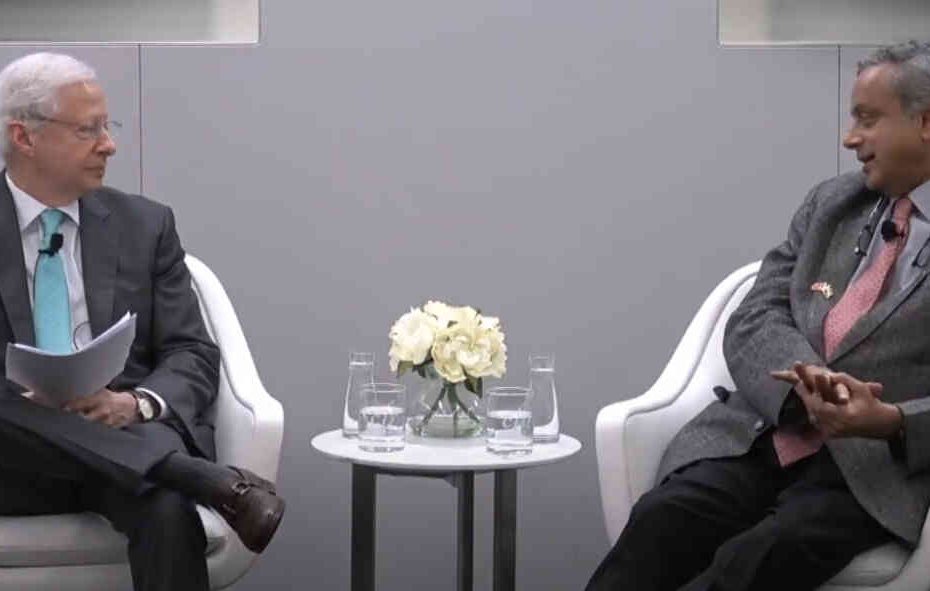
Read the full transcript of Congress MP and Parliamentary Standing Committee Chairman Dr. Shashi Tharoor in conversation with Former U.S. Ambassador to India Kenneth I. Juster on the Pahalgam attack, the launch and objectives of Operation Sindoor, and the subsequent political and security developments arising from these events. (June 5, 2025)
The interview starts here:
Introduction
KENNETH I. JUSTER: Welcome to today’s Council on Foreign Relations meeting with Dr. Shashi Tharoor. My name is Ken Juster. I’m a fellow with the Council on Foreign Relations and I’ll be presiding over this morning’s discussion. Due to some scheduling changes for Dr. Tharoor, our meeting is going to be a bit abbreviated ending at 09:40. I’m going to engage in a question period with him for about twenty minutes, then we’ll open up to the floor for questions.
It’s truly a pleasure to have you with us here this morning. Good to see you again, Shashi. He is one of India’s leading statesmen in addition to being a prolific author, commentator, and former international diplomat at the United Nations. You have his bio. I just want to add to it that he is currently the leader of the all-party team that has traveled to the United States. They were in New York earlier, to Panama, to Guyana, to Brazil and to Colombia to really rally support for India’s war on terrorism emanating from Pakistan. So again, welcome, Shashi.
Purpose of the Diplomatic Mission
KENNETH I. JUSTER: Let me begin by asking you what the purpose was of your delegation, what messages you’ve been giving to others and how you’ve been received in the countries you’ve been at.
DR. SHASHI THAROOR: Thank you, Ken. Well, first of all, good to see you all here. Good morning. I have the privilege of leading this. We can’t really call it an all-party delegation, but a multi-party delegation because we have 41 parties in our lower house of parliament and five of them are represented in my delegation. We also have our former ambassador in Washington with us.
We have been going to these countries as part of a group of delegations. There are seven going to different regions. Our region was the countries you mentioned, Guyana, Panama, Colombia, Brazil and the U.S. In that order, with, in fact, when we first landed in New York, we went to the 9/11 Memorial. And that, I think, set the tone for the trip because we wanted to situate this problem right there in solidarity with victims of terrorism from around the world. As you remember in 9/11, a lot of nationalities lost their lives. And for us, that became then a sort of leitmotif of our travels.
Our message everywhere, and three of the countries I mentioned to you are Security Council members, either current or approximate next year. Panama, Guyana, Colombia being next year. Panama and Brazil and Guyana already on it. And then for us, the message was very simply to enhance their understanding and appreciation for what we had just been through and to seek their solidarity in our fight against terrorism.
And there I can tell you, Ken, we got literally everywhere an enormously positive response. The one country where there had been—setback is too dramatic a word—but there had been an unfortunate statement issued during our operation against the terror attacks was Colombia, which had surprised everybody by issuing a statement of heartfelt condolences for the Pakistani victims.
When we situated matters in context and explained exactly what had happened, and in particular, the fact that our initial strike was purely retribution and we didn’t touch a single civilian target, government target, even a Pakistani military target. We just hit terror camps of designated terrorist organizations whose addresses are known, whose names are on the UN list as well as the State Department’s terrorist wanted terrorist designated list. When we explained all of that, they withdrew their statement. And that, I think, in the end was a useful win for us.
But that small little wrinkle apart, it’s been, I must say, very positively smooth sailing everywhere else. We’ve been meeting everywhere, the executive branch, government officials, legislators, think tanks and policy wonks, media and through the media, the general public. There’s a public diplomacy element to this as well. And everybody, I mean, right across the board has been supportive. Our team is multi-partisan, as I said, but so has been the response. We’ve had people in government and opposition in all of these countries saying to us how much they appreciate what India is doing and how much they support India’s right to defend itself against terror.
Historical Context of India’s Diplomatic Outreach
KENNETH I. JUSTER: Has India done this sort of outreach in the past? And how is this similar or different from that?
DR. SHASHI THAROOR: Well, there was a similar outreach conducted under Prime Minister Manmohan Singh after the 2008 Mumbai terrorist attack. And that really was, as you remember, horrendous. 170 people killed in a protracted terrorist assault over three days in five locations in Mumbai. That was a terrible, terrible terrorist attack and we went around the world.
I can’t say “we” because I wasn’t in that, but the all-party delegations did the same thing. There had been a couple of other precedents for the sort of demonstration of national unity and resolve where just as my own delegation has five political parties, seven states or eight states represented in its eight members, three religions, I mean we really showcased, if you like, the unity in diversity of India.
I would say that very similarly, in the past too, governments have sought to convey through opposition voices their national resolve on issues. Indira Gandhi in the 1971 war sent out some of our foremost critics, what became the 1971 war ahead of the war to explain India’s concerns about the Bangladeshi refugees in India. In 2008, I mentioned, in between, in 1994, our then Prime Minister invited the leader of the opposition to lead the Indian delegation to the UN debate on Kashmir of the Human Rights Commission in Geneva.
So we’ve had such precedents before, and I would say that in many ways, it’s a good reflection on Indian democracy.
That old line about your political differences stop at the water’s edge is true for us too.
Once we cross our borders, we are one. We have our quarrels with the other side, and we’ll settle them at home. We don’t need to—that doesn’t affect our perception of national interest and national security.The Pahalgam Attack and India’s Response
KENNETH I. JUSTER: To what degree did your discussions focus primarily on the terrorist incident or also on the responses and the quick escalation of the fighting? Because I want to get into that with you as well, but I’m curious whether that was a problem.
DR. SHASHI THAROOR: Well, I mean, the terrorist incident speaks for itself. It was a horrific incident. An atrocity that many of you must have read about in detail where these terrorists came, innocent holiday makers on a tourist trip, they asked people their religion, shot them in cold blood between the eyes, the men—killing them in front of their wives and children and when one desperate woman screamed out in despair, “shoot me too,” she was told “no, you go and tell them back in Delhi.” That was sort of “go and tell Modi,” I think was the line. That’s the sort of cold bloodedness and cynicism behind this terrorist assault. It was not some sort of random terrorist incident. It was meticulously planned and absolutely cruelly executed.
So with all of that, the anger in India was palpable. I myself—and I, as you know, I chair the Foreign Affairs Committee of Parliament, but I wrote in my personal capacity an op-ed urging that this time India had to hit hard but hit smart. And I think that’s exactly what the government did. It decided, it took a couple of weeks, it took aim at nine terror sites as I mentioned a little earlier. These sites were so precisely chosen and attacked that there was no collateral damage, but even then they also did it at 01:05 to 01:30 at night, so there wouldn’t even be the slightest risk of civilians around if there was anything going awry.
They then sent a signal to the world, the very next morning press briefing, and also to the Pakistanis, “as far as we’re concerned, we’re done. We just wanted retribution against the terrorists. We’ve avoided any of your sites. We haven’t tried to hit you or your country. So as far as we’re concerned, we’re done. But if you hit back, we will have no choice but to retaliate.” In other words, the burden of escalation was entirely left to the Pakistanis. We had absolutely no desire to have this seen as the opening salvo in a protracted war. We weren’t interested.
I mean, you know, Ken, you’ve been ambassador in India. We’re focused on our development, on our growth story, on investment, on IT, on pharma, all of this stuff is what’s occupying our minds and our mind space, we really don’t have time to be distracted by war and conflict. But we felt in this particular instance we had no choice. We had to exercise our right to self defense or they believed they could just walk across the border, kill people with impunity and go back again. So we really had to show them there would be a price to pay. That was the logic of what we did.
Escalation of Conflict
Pakistan chose to retaliate and rather irresponsibly, that is they had indiscriminate artillery shelling across the line of control and across the border. They killed unfortunately people in a Sikh temple or Gurdwara. They killed nuns and worshippers in the convent of the Carmelites for Mother Mary. They ended up hitting people at their homes on the streets, nineteen killed, fifty-nine in hospital with grievous injuries. So India again said, “you hit us, we’re going to hit you back” and we hit back as well. And this went on for eighty-eight hours.
I don’t want to tell the whole story, but at the very end of it, on the final night, which was the night of May—our first attack was the night of May—so at the end of eighty-eight hours, we ended up hitting 11 Pakistani military sites. These were military airfields. And there are sort of publicly available satellite pictures, not Indian, but from any commercial satellite, showing craters on the runways, buildings damaged and subsequently demolished by the Pakistanis because they couldn’t be rendered operational anymore. So extensive damage was done.
And at the end of all of that, the Director General of Military Operations from Pakistan reached out to his Indian counterpart and said, “we are ready to call it off.” And we said, “we’ve been telling you every day, you stop, we stop. You hit, we hit. It’s as simple as that. You’re stopping, we’ll stop.” And that was the end of that, eighty-eight hours, very, very sad, frustrating. We didn’t want this. We didn’t want a conflict, but terrorism has to stop.
And so our message wherever we went, was to tell people, this is what happened. This is what we did in response. We hope you understand. And unanimously, it’s been, “yes, we understand.”
Nuclear Concerns and Future Relations
KENNETH I. JUSTER: But the fact that the fighting escalated so quickly and there was some concern about nuclear exchange potentially taking place. Is this the new normal? Are we going to be stuck in an endless cycle of sort of attacks and responses? Will this help deter future attacks or do we have nuclear brinksmanship coming up more and more?
DR. SHASHI THAROOR: I think what happened was so far short of anything remotely approaching a nuclear threshold that the proposition frankly is laughable. Our Pakistani friends, I think, like to dangle this nuclear bogey to get all of you excited and anxious. But I mean, if we’ve got a nuclear power engaged in the war right now for two and a half years in Europe and no one has talked about nukes yet, I mean, would two and a half days in India suddenly lead to fears of nuclear escalation?
And when you think about conflicts between India and Pakistan, there have been four wars. And though this is a frustrating and unavoidable incident, it isn’t anything like the wars we are talking about in the past. There has been one war since both countries were nuclear, the Kargil War of 1999, and that went on for a month almost and nobody talked about nukes.
This nuclear thing is a bogeyman and I would urge people not to worry because I mean why would anyone assume that the first option—India by the way has already decreed a policy of no first use. So India in any case would never brandish a nuclear threat. Pakistan has not declared any such policy. In fact, they have implied the opposite. But we will have to really wait for them to start seriously threatening this before anyone takes them seriously. And I honestly, on this particular point, nothing we did was an existential threat to Pakistan. It started off as calibrated retribution and it ended up with some punitive actions against their misbehavior, but nothing more than that.
KENNETH I. JUSTER: But they did want to elevate that. And according to the press reports, that’s what got the United States and some other countries more energized to try to facilitate a cease fire.
DR. SHASHI THAROOR: Well, I think that if anyone needed persuading to stop, it was the Pakistanis. And so I mean, I’m not privy to what happened between the U.S. and Pakistan. But I wouldn’t be surprised if some of the messaging from here resulted in precisely what you’re suggesting.
We didn’t need persuading because from the very first day—and this is on the record because I’m not talking about anything classified here, it was right there from the very first briefing given after the initial strikes. Our message was all throughout, we are not interested in a conflict. We are just showing the terrorists and their handlers, their bases, their launch pads what’s what. This is the price you’re going to have to pay.
Honestly, every single day to anyone who asked, and we had—if you look at our foreign ministers’ Twitter timeline, you’ll see so many foreign ministers calling him and so on, message exactly the same throughout. If they stop, we stop. And so the moment they signal they’ll stop, maybe thanks to the U.S, in which case, many thanks, we stopped.
KENNETH I. JUSTER: It has been widely reported that Pakistan used some of its newly obtained Chinese technology in terms of jet fighters and missiles, and that India used Israeli drones. It had its S-400 air defenses, provided by Russia that had use of its BrahMos missiles. Were there lessons learned in terms of the capabilities of these technologies? The Pakistanis claimed to have shot down some Indian Rafale planes and to have damaged or destroyed one S-400 system. And is there any concern that China is learning lessons from the use of its own technology against India?
DR. SHASHI THAROOR: I mean, you’re quite right about the last part of your question that the Chinese have supplied 81% of Pakistan’s defense systems—defense is the wrong word, offense systems in many ways. And that 81% is pretty much everything sort of at the cutting edge that Pakistan possesses. I’m not privy to the military analyses of everything that went on. I’m sure, to answer the beginning of your question, that there is a serious amount of assessment taking place. But I think the way the conflict ended speaks for itself.
That is that if there were initial strikes from the other side, clearly India was able to breach Pakistan’s air defenses and hit their own military fields and what is more do so, one of them, the Chaklala or Air Marshal Nur Khan airbase is 1.5 kilometers away from their general headquarters of the army in Rawalpindi. So we are talking about an exposure of Pakistani vulnerability that may well have provoked them to come and offer that truce.
I mean, think when you look at the way it evolved, I suspect that our people were quicker to learn lessons while the conflict was going on than the other side and the results I think are pretty clear. In fact, recently the Pakistan Prime Minister made a statement revealing the fact that Indian strikes had gone much farther than Pakistan had anticipated. There were apparently attacks on places as far apart as Hyderabad in the South of Pakistan and Peshawar in the Northwest.
So you’re looking at a pretty impressive demonstration of Indian military capability. Beyond that, I just don’t know what the military is talking to each other about.
KENNETH I. JUSTER: Let me ask one last question and then I’ll open up to the floor. Throughout the crisis, the media in both countries provided diametrically opposed assessments of what was going on. Some of it was highly exaggerated, and this was done even without the use of artificial intelligence.
And perhaps those different messages enabled each side to claim victory and move forward. But it also raises the question of crisis communications and whether there needs to be enhanced efforts by both India and Pakistan to be able to communicate what’s really happening to each other rather than having the media control the narrative. And is this an issue that the two countries are discussing? Is it left to the back channel between the director generals for multi operations? But what more can be done to have preventive measures, from having an escalation continue uncontrollably?
DR. SHASHI THAROOR: Difficult in democracies, Ken, as you know, because we saw much less of artificial intelligence than we saw of natural stupidity. I mean, you follow some of the social media accounts, there were you know, we had bombed Karachi. We had taken Islamabad. God knows what else people were claiming on social media, and I believe that the Pakistanis were no better. There was a lot of nonsense going around.
It’s partially sort of hyper excitement in the middle of a conflict, partially I think the fog of war, but what was good on the Indian part, and I speak only for the Indian side because I wasn’t aware of what’s going on the other side, was there were regular systematic briefings conducted by our foreign secretary, the senior civil servant in the foreign ministry, and two military officers. And when necessary, more senior military officers, two military officers, by the way, were both women. And one of them was a Muslim, just to make it very clear, this is not India Pakistan, Hindu Muslim, any of this nonsense. It is United India against terror, and that message came across very well as well.
But just to say that at the bottom line, India did what it could to put out an official version and sensible people relied on that. I mean, I personally didn’t watch anything else except what was officially coming out because that’s at least reliable, verified and we know that it’s true. Crisis communications for us, DGMO is the hotline. We do have sort of residual high commissions in both countries, so diplomatic messages can be passed if necessary. But at this point, frankly, when you’re fighting and you’re actually shooting at each other, the best thing is to leave open the hotline and leave everything else off the table.
Q&A Session with the Audience
KENNETH I. JUSTER: Let me open it up now to members of the council. Remember, we’re on the record. And if you could state your name and your affiliation and ask your question. Nelson?
AUDIENCE QUESTION: Good morning, and thank you for being here. Nelson Cunningham, formerly with the State Department, formerly with McCarty Associates. Good to see you again. Immediately after the first attack by the terrorists, the United States signaled that, well, that was somebody else’s set of issues, we’d stay out of it. And within, I think, about twenty-four hours, the US was in fact trying to mediate. And the vice president was both the one who said, no, it’s not our issue, and also the one who came in and waited and did. Is it helpful from the Indian perspective, from the other country perspective, is it helpful to have the United States available as a mediator, as a broker, as a transmitter of signals? Or should we just stay the heck out of it and let the rest of the world sort things out?
DR. SHASHI THAROOR: I would never presume to tell the US to stay the heck out of anything it wants to get involved in, but mediation is not a term that we are particularly willing to entertain. I’ll tell you why, Nelson. I mean, the fact is that this implies even when you say things like broker or whatever, you’re implying an equivalence which simply doesn’t exist. There is no equivalence between terrorists and their victims. There is no equivalence between a country that provides safe haven to terrorism and a country that’s a flourishing multi-party democracy that’s trying to get on with its business.
There is no equivalence between a state that is a status quo power that just wants to be left alone by its neighbors where the neighbors don’t agree with us and a revisionist power that wants to accept the geopolitical arrangements that have existed for the last three quarters of a century. There is no equivalence possible in these cases. And in these circumstances, to suggest that you can mediate between two unequals is not possible.
AUDIENCE QUESTION: Then how would you characterize the American rule and was it useful and helpful?
DR. SHASHI THAROOR: I’m guessing to some degree, Nelson, that the American rule would have been, first of all, to keep themselves informed with conversations of both sides and certainly my government received a number of calls at high levels from the U.S. Government and we appreciated their concern and their interest. At the same time, they must have been making similar calls at the highest levels to the Pakistan side and our assumption is that’s where because that’s the side that needed persuading to stop this process, that may well have been where their messages really had the greatest effect. But that’s guesswork on my part. I don’t know what they said to the Pakistanis.
AUDIENCE QUESTION: It’s good to see you again. Dov Zakheim. Question for you. You mentioned actually, I think it was Ken who mentioned the drones. Given what Ukraine just did to Russia, is there any sense in India that there may be a need for a different way to think about strategic posture?
DR. SHASHI THAROOR: So, again, as I said, these are things the military is thinking about. I mean, all I can say is that the world of warfare has been changing dramatically since the beginning of the Ukraine Conflict. And increasingly, the use of drones, for example, it’s striking that neither country actually crossed over into the other’s airspace at any stage of these four days. Everything is being done from a distance now—drones, missiles, technologies have moved quite significantly.
What was old fashioned and awful and tragic was the indiscriminate Pakistani artillery shelling, which should never have been done in the manner it was. I mean, but you can understand why. We hit terror bases. There are no terror bases in India to hit. There are no terrorist organizations in India listed in the UN or the State Department anywhere else.
So what do you hit? You hit civilians. You hit innocent people. That is the asymmetry of this particular conflict. We have tried not just to be precise and calibrated in our response, but we have tried systematically to signal we are not interested in war with Pakistan. We are not interested in attacking Pakistani civilians, ordinary people. This is about India versus terrorism.
And as far as we are concerned, situating the problem where it belongs is if you don’t want places in your territory to be hit because they are housing terrorists, why don’t you shut down the safe havens? Why don’t you arrest these leaders? Why don’t you close their bank accounts? Why don’t you disband these organizations or call them illegal? If you’re not prepared to do any of that, then I’m afraid this is the only way we can deal with it because we are not going to sit back at our homes and be hit at your convenience. That’s not going to happen.
AUDIENCE QUESTION: Puneet Talwar, most recently, U.S. Ambassador to Morocco. And I wanted to ask you, you mentioned that during the engagement, the military engagement that China’s technology was at the top level was provided to Pakistan. So they had cutting edge technology. You managed to penetrate that. So I want to just press you a little bit more on that. Is the sense in the strategic community and top level politicians like yourself that India stacks up just fine against Chinese technology? Or is there some sense of concern or reassessment going on at a serious in a serious way about where this leaves India relative to China?
DR. SHASHI THAROOR: Puneet, I think, frankly, the reassessment took place while the fighting was going on. In other words, when we saw what the Pakistanis were attempting to do using, as you say, Chinese technology, there’s supposed to be something called a kill chain that the Chinese specialize in where the radar, GPS, planes and missiles are all linked together and they react instantly. All this is stuff I’m reading in public military analyses. It’s not something I’ve got from any classified source.
But when we saw that we simply did things in a different way, otherwise we wouldn’t have been able to hit the 11 airfields and we wouldn’t have been able to breach the Chinese supplied air defenses. So it’s clear that assessments were taking place while the fighting was happening and we were recalibrating our strategies in order to end as effectively as we were able to end. So that I think is the short answer.
The longer answer, I’m afraid only the military can provide. You and I have been at various ends of the policy spectrum in your country and in mine, but we haven’t really been sitting in military headquarters. So I’ll take a pass on how much further we can go on that.
By the way, on the Chinese technology, I may have slightly misspoken because my understanding is, for example, the aircraft given is the Chinese J-10, whereas the Chinese themselves have a J-20, which is apparently one or half a generation newer. And who knows if they’ll supply that. I mean the fact is China has immense stakes in Pakistan. The largest single project of the Belt and Road Initiative is the one in Pakistan, the China Pakistan Economic Corridor. So we have no illusions about the degree of commitment that China may well be feeling towards Pakistan.
AUDIENCE QUESTION: Sameer Lalwani from CSBA. I wanted to ask a question. Leaving aside motives, the question is about effects. So you said that we had to show them that they had to pay a price. My question is what is your sense of whether Pakistan believes they paid a price, whether the military, the politicians, the civilians, the population? And I ask that in light of the fact that the military army chief received a fifth star. There seems to be a lot of triumphalism. So did they actually feel that price? And does that affect their behavior in the future?
DR. SHASHI THAROOR: I think one of the principal motives for this horrific terror attack, which was signaled by the way a few days earlier by a speech by the Pakistani military chief in which he made the astonishingly bigoted assertion that Muslims could not live in a non-Muslim majority country, which is kind of a bizarre thing to say given the number of non-Muslim majority countries in which Muslims can be found, including the fact that we have 200 million Muslims in India who are living in peace with their neighbors. And one of them is a member of my delegation and my daddy is sitting right here.
So I just want to say I’m surprised I’m not sitting right there. I just say this simply because one of the objectives was clearly to shore up the Pakistani army in a situation where they were deeply unpopular with the most popular leader in Pakistan sitting in jail for the last couple of years and the economy stagnant and the government that they have been running or manipulating, not doing very well in public opinion. And clearly, whatever happened in the conflict that was bound to ensue after the terrorist strike, they were going to declare victory for the army. So there was a lot of chuckling in Delhi when the failed general became a field marshal.
KENNETH I. JUSTER: But, I mean, that’s the sort of thing that by promoting himself, as you said, with that extra star, because that was definitely going to be the army’s gain from this fight with India. They wanted once again to show themselves as the savior of the nation in the face of attacks by a bigger power. The fact is that they provoked those attacks. We were very happy leaving them alone. We had no desire to stop this, but when they provoked these attacks by the terrorist strike, we gave them, if you like, a ready-made opportunity to come up with a narrative they’d already pre-decided they wanted.
DR. SHASHI THAROOR: And so that’s all right. That’s what happened. We have no particular complaints or regrets. If that makes them feel that they can stop fighting, it saves us the bother of continuing this unnecessary fight. Remember, for India, this war is a distraction.
For the Pakistani military, it’s fundamental to its sense of importance, its sense of success in its own society. You know, some of you here must have read Voltaire on Prussia. In India, the state has an army. In Pakistan, the army has a state. And the army is going to do always what’s in its best interest.
That’s essentially what we saw happening. But I do want to stress that as far as India is concerned, we don’t care what they say to their public. We know what’s happened and frankly, the satellite pictures are not Indian pictures. There is absolutely no evidence that Pakistan has been able to advance in support of its claim to have inflicted magnificent victories and great damage on India and so on, absolutely no evidence. Two videos came out on social media, both turned out to be from other conflicts in other years, nothing to do with this one.
So all I’ll say is more power to the Pakistani military then take it anyway, but that’s what this is all about in terms of their narrative.
Regional Dynamics in South Asia
AUDIENCE QUESTION: Maureen Ahmed from State Department. I’ve covered South Asia and India in the past, asking a question in personal capacity. Lots of Pakistan stuff, stepping back a bit on the South Asia region writ large, lots of different changes on political landscapes in Bangladesh, Sri Lanka, Nepal. You know, India’s had strong relationships in the past, but how is it going to handle these changing landscapes, especially as these countries have more of a lean now towards China? How are they recalculating this calculus, especially in Bangladesh, Sri Lanka nearby? I would love to hear your perspective.
DR. SHASHI THAROOR: That’s a vast subject, young lady. I think we’ll really have to do an entire seminar on that, but I mean, I’ll start off with one simple proposition that we have the sort of same kind of big country in the neighborhood problem that the U.S. has had for ages. I don’t know how many of you remember the Mexican President Porfirio Diaz saying, “My poor Mexico, so far from God and so close to the United States.” I mean, many small countries in our neighborhood are bound to have the sort of feeling about being so far from wherever and so close to India. So China does come in and play a role.
I mean, there’s no doubt about that. They’ve all reached out. China can be a fairly munificent supplier of funds. Very often, they are loans and not grants and some of them involve unsustainable debt obligations on the part of the recipients. And so yes, I mean, you implied there are certain issues we need to address, we will, but it will take too long to give you a short answer other than to say that the neighborhood is of great importance to us.
We as a country have always appreciated the fact that when we sit around the table with our neighbors, we account for 70% of the land mass and 80% of the GDP. I mean, we have a responsibility to care for the well-being of our neighbors, and we are conscious of that. In fact, we were trying to make a go of the South Asian Association for Regional Cooperation, but Pakistan obstructed that on the grounds that they could not have these relationships blossoming as long as they had a grouse with India. And unfortunately, the South Asian Association worked on consensus and so nothing could get done.
India still has now revived another subregional organization called BIMSTEC, the Bay of Bengal initiative, which does not include Pakistan and sadly doesn’t include the Maldives either because they’re to the West of the Bay of Bengal, but all the countries from the East, including Thailand and Myanmar are part of this initiative.
So it’s not that we are in any way backing off from regional cooperation. We want it, but there are specific challenges and we’ll take too long to discuss them, but we can go country by country at some point. I’m sure my colleagues at Indian Embassy will be happy to help a State Department person on that.
Evidence of Pakistan’s Involvement in the Pahalgam Attack
AUDIENCE QUESTION: Ishaan Tharoor, The Washington Post. Definitely asking a question in personal capacity and mostly to say hi before you go off to your next engagement. I’m curious though, on this tour you’ve been on various countries in the Western Hemisphere, had any of your government interlocutors asked you to show evidence of Pakistan’s culpability in the initial attack? And what do you say to the repeated Pakistani denials of having any hand in the initial attack?
DR. SHASHI THAROOR: Okay. Well, I’m very glad you raised this, Ishaan, though I didn’t plant it, I promise you. This guy does this to his dad.
Very simply, no one had any doubt and we were not asked for evidence, but media have asked. And so you are speaking for your tribe in that in two or three places media asked this question. Let me say very clearly that India would not have done this without convincing evidence, but there were three particular reasons I want to draw your attention to all of you.
The first is that we’ve had a thirty-seven year pattern of repeated terror attacks from Pakistan accompanied by repeated denials. I mean, Americans haven’t forgotten that Pakistan didn’t know allegedly where Osama bin Laden was until he was found in a Pakistani safe house right next to an army camp in a cantonment city.
That’s Pakistan. Mumbai attacks, they denied having anything to do with it. One of the terrorists was captured alive. His name, his identity, his address in Pakistan. Everything was revealed.
Under interrogation, he told us where he was trained, what was done. The US Intelligence as well as ours recorded the chilling voice of the Pakistani handler giving minute by minute instructions to the killers in Mumbai, telling them where to go. They were monitoring Indian TV and saying there are people hiding on the Third Floor of that hotel. Go and shoot them there. This kind of thing is going on.
Your sources recorded this too. So we know what Pakistan’s all about. They will dispatch terrorists. They will deny they did so until they’re actually caught with red hands. That’s the first.
So I agree you’re going to say, that’s circumstantial. Sure. Second point, the moment this happened, within forty-five minutes or so of this happening, the terrorist attack, a group called the Resistance Front claimed credit. Who are the Resistance Front? They’re a well-known proxy front of the Lashkar-e-Taiba, a banned organization listed by the United Nations, listed by the US State Department, enjoys safe haven in the town of Muridke in Pakistan.
The evidence about the Resistance Front and its doings was presented by India to the UN Committee on Terrorism in December 2023 and repeatedly again in 2024. But the problem was, of course, Pakistan too is a member of that committee. The Resistance Front was not listed by the UN, but its identity was known and publicized. These people then claimed credit within a time span. There were no media present when these killings took place.
Most of the world hadn’t even learned about this when they claimed credit. So that was itself a smoking gun. They repeated that claim twenty-four hours later. And having repeated that claim twenty-four hours later, then their handlers must have woken up to the gravity of this and told them to take it off their site. So they did.
But the fact is the credit claim was on record and the world has seen it. Third, when the first strikes happened on the terrorist camps, funerals were conducted, including for members of some of the key organization, the Jaish-e-Mohammad in particular and the Lashkar-e-Taiba. The funerals were conducted and photographs have emerged on social media showing Pakistani generals and police officers in uniform attending these funerals, being conducted by relatives of these terrorists.
So we’re looking at three concrete pieces of evidence as far as India is concerned. But finally, I can add to the mix, we also have intelligence services. They have been studying very carefully these terrorist attacks. They have identified at least four of the five perpetrators and they know who they are. In fact, I’m told and I don’t have access to the direct intelligence information, but I’ve been reliably informed they know that two of them are Pakistanis and the other two were locals who had exfiltrated as the term goes out to Pakistan for training ten years ago and clearly were sent back for this mission this time.
So it’s on the basis of all of this put together that we said we know who did this and we will take action. And that’s exactly what we did. I can assure you India is not the kind of country that would undertake a military operation without very solid basis for doing so.
This was not some random terror attack. I must say our government counts 24 terrorist attacks in the course of last year emanating from Pakistan, but none of them required this kind of response. We dealt with them. We either got the terrorists or killed them, minimal damage, very little loss of life. We dealt with it.
This showed all the hallmarks of a sophisticated, planned, deliberate operation with reconnaissance, with intelligence work, with a modus operandi, worked out this cynical exercise of asking people their religion, shooting them between the eyes. This is not an ordinary terrorist, some bearded fanatic blowing himself up outside a supermarket. This is not that. This is a serious quasi-military style operation, and it required a military response.
KENNETH I. JUSTER: As I mentioned, we have a hard stop at this time and I regret we can’t have more questions, but I want to thank very much our speaker, Dr. Tharoor and thank all of you. There will be a posting on the council website of the transcript and video of today’s meeting. So thank you again, Shashi. It’s great.
DR. SHASHI THAROOR: Thank you very much.
Related Posts