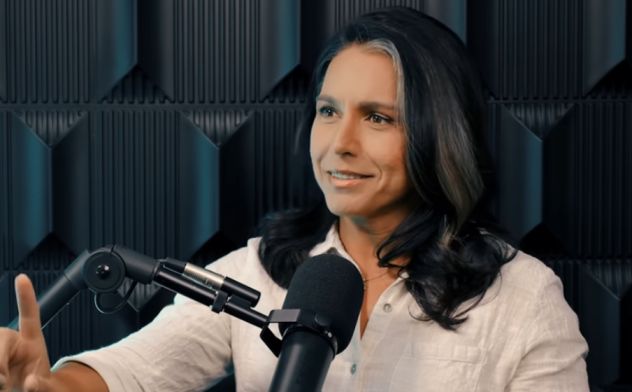
Editor’s Notes: In this episode of Modern Wisdom, Tulsi Gabbard joins Chris Williamson to discuss her perspective on the “puppet masters” she believes are truly running the U.S. government. Gabbard details the influence of the military-industrial complex and the administrative state, arguing that unelected elites often call the shots regardless of who holds the presidency. She also shares her critiques of current political leadership, the potential risks of a Kamala Harris presidency, and her ongoing commitment to a life of service outside of traditional party lines. (August 5, 2024)
TRANSCRIPT:
Who Really Runs the Government?
CHRIS WILLIAMSON: Who actually runs the government in your experience?
TULSI GABBARD: Not who you think it is. And in many cases, especially recently, the troubling part about all this is it’s not even people who we vote for.
When you look at what happened when President Biden had that infamous debate with President Trump, it exposed the reality that many of us have known for a long time, which is that President Biden has not been the guy calling the shots. He has not been the guy making the decisions, nor has it been Kamala Harris for that matter, nor will it be if she is elected president.
It is this cabal of the Democrat elite, the woke warmongers made up of the likes of Hillary Clinton and Barack Obama and Tony Blinken and Jake Sullivan and people who are in the military-industrial complex, people who profit from us being in a constant state of war. It is those in the administrative state and the national security state who derive more authorities and ability to take away our liberty when we are in a heightened state of crisis or war. It is their friends and billionaires and people in media who all derive their power from being able to have a figurehead that essentially they can control.
And the most troubling part about — there’s so many things wrong with this, of course, but really at the most fundamental level, you look at our country is the oldest democracy in the world, but the reality of a truly functioning and thriving democracy that has brought to life the vision that our founders had for us, that we really have a government of, by, and for the people, and that we have the ability and responsibility for that matter to ensure that the government we have only exists with the consent of the governed. That becomes very hard to do, to hold people accountable when the person that you voted for is certainly not the one making the decisions.
The Inflection Point
CHRIS WILLIAMSON: How long has that been the case? Was it ever the case that the president ran the country? When was the inflection point?
TULSI GABBARD: I don’t know that there’s one specific. I mean, there has been personalities come in and shift here and there. I would say the answer to that has probably changed, but in the election that we are facing here very shortly in the United States, it’s our opportunity to hit the reset button.
And however people feel about the choices and the options that we have, and they’ve changed a little bit recently, but really it’s only the faces that have changed. The stakes have not changed. And the choices between the Democrat elite — and I’ve been saying this for months, like, hey guys, don’t — because it’s like, oh, is Biden going to stay or is he going to go? And who are they going to replace him with? Is it Gavin? Is it all of these different theories? They make for good chatter, I guess, on cable news.
But I’ve been telling people all along, don’t be distracted. You take one horse out, you put another horse in, you’ve got the same people who are running the show. And it is between the Democrat elite — will be Kamala Harris on the ballot — and those calling the shots behind the scenes continuing to remain in power, versus Donald Trump, who has a record of — I mean, the reason why they’re doing all they can to destroy him is because he won’t bend the knee to this Washington establishment, which is made up of people in both political parties, by the way.
Would a Trump Presidency Be Any Different?
CHRIS WILLIAMSON: What makes you think that a Trump presidency would be any more inoculated against this nefarious behind-the-scenes control than the one that we have at the moment? Surely, if the people out front don’t make any difference because it’s people behind the scenes that are changing, then what makes Trump any better than what we’ve got at the moment?
TULSI GABBARD: It’s not that anyone who’s put out front doesn’t make a difference. It is specific to this world that we’re living in now, specific to President Biden and Vice President Kamala Harris.
And the reason why they’ve been doing all they can to try to keep Trump off the ballot in over 32 states, all of the court cases and lawsuits and everything that the media is throwing at him — the reason why they’re doing that is because you may agree or disagree with his decisions or his policies or the way that he talks about things, but he is not beholden to those same establishment interests that so many of these establishment politicians are.
And so he’s not going in and saying, “Oh gosh, well, I’ve got to do what this person says,” or, “I’ve got to do what that person says.” I think oftentimes even his own staff doesn’t know what decision he’s going to make or what position he’ll put forward. And that is, to me, the clear choice.
You have a choice between those who believe that government knows better for us than we do, that their power is more important than our freedom, that their power in many cases derives from being in a constant state of war that undermines our national security.
How Deep Does the Problem Go?
CHRIS WILLIAMSON: If that’s correct, if it is the case that this sort of limp, flaccid Democratic Party has permitted people behind the scenes to come and basically puppeteer the people that are out front — that’s happened very quickly, because it was not that long ago that we had the very guy that you’re saying will sanitize this thing in office. So is it going to then take a long time for that to be cleaned up? And also, how do we know that some of this didn’t already exist?
TULSI GABBARD: It did already exist.
CHRIS WILLIAMSON: Okay.
TULSI GABBARD: It did already exist. Because the party elite itself has been very powerful for a long time. So that hasn’t come around very quickly. And I think one of the problems when President Trump was elected last time was — and he’s talked about this himself — he came in and he never worked in Washington before, and he ended up with a bunch of people around him who were a part of this establishment, this Washington establishment.
CHRIS WILLIAMSON: Do you think he didn’t really have that much of a plan? Do you think it was a surprise to him that he got in, in some ways?
TULSI GABBARD: I don’t know for sure, but it certainly seems that way. Yeah. And there were — and it was interesting because the conversations that I’m hearing coming from even establishment Republicans right now are very similar to the ones that I heard in 2016 when Trump was elected. Which was, okay, we’ve got to balance the scales, in their words, by surrounding Trump with people who hold completely opposing views than he does, to try to mitigate what they view as the quote-unquote threat that he poses — not to the country.
The Neocon Warmongers Within the Republican Party
CHRIS WILLIAMSON: Who is it that’s saying that we need to surround him?
TULSI GABBARD: It’s basically the neocon warmongers even within the Republican Party.
CHRIS WILLIAMSON: And what do they see as the position he holds that they’re trying to counterbalance?
TULSI GABBARD: That he — and he’s been pretty vocal about this — like, he’s like, no, we’re not going to wage more stupid wars, and we’re going to put America first, in his words. And we will achieve that through peace through strength.
Who Wants War and Why?
CHRIS WILLIAMSON: Who wants war and why?
TULSI GABBARD: They would be shocked by how many people do, and they won’t say, “I want war,” or “I like to see more people dead.” Of course they won’t use those words, but there are politicians who are beholden to the big defense contractors who are making billions and trillions of dollars, and they are their political donors and their supporters and their friends.
And ultimately, it’s those politicians whose knee-jerk reaction to any challenge or situation in the world — instead of choosing diplomacy and seeing war as the last resort once you’ve exhausted all other means, understanding how costly it is both in lives and in taxpayer dollars — it’s just, hey, we’ve got to go and punish this bad guy, topple this regime, wage this modern-day siege through economic sanctions and warfare, all of the tools that they have at their disposal. Without thinking through what the cost and consequences of those actions and policies are.
CHRIS WILLIAMSON: Presumably on the ground and also economically, domestically too.
TULSI GABBARD: Both. And it’s, by the way, not reflective of — I think, especially over these last 20-plus years — the vast majority of Americans, regardless of political party, are sick and tired of this. So their view is not reflective. They’re not just like, oh, well, this is what the quote-unquote people want. It ultimately goes back to this kind of cabal of power that they’re trying to hold on to.
Are These People Evil or Just Misguided?
CHRIS WILLIAMSON: Do you think that those people — I struggle to find or meet people that are genuinely evil. There’s people that have got goals and then they’re kind of risky and frivolous en route toward getting those goals. And you think, ah, this is just collateral damage. Who really cares? I’m getting my backhander from Raytheon or whoever the f*, but it seems surprising to me that someone would think, “I want to go to war.”
So do you think that these people that are pushing for it genuinely believe that it’s in the best interests of the country? Have they been able to gaslight themselves, this Stockholm syndrome from whoever is sort of continuing to fund them? Or is it something a little bit more malicious? Are they actually trying to land grab, or is this some odd power game that I imagine it feels powerful for you to be America and to have a foothold here and have a foothold there? Have you got any idea what kind of motivates these people?
TULSI GABBARD: I think they tell themselves whatever they need to tell themselves to sleep at night. But as someone who still serves in the Army today, who has been deployed to war zones in different parts of the world, seeing and experiencing firsthand the harsh ugliness and realities of war and the costs — the people who are so quick to go to war and see that as the first response rather than the last, number one, they don’t have any excuse.
I don’t believe it’s mandatory for everybody to serve. I don’t advocate for that. But if you are in a position to make these decisions about war and peace, you need to be very responsible and do your due diligence to actually truly understand what the consequences of those decisions will be.
CHRIS WILLIAMSON: Might be worth a quick visit to the front lines, maybe.
TULSI GABBARD: They do those all the time for photo ops. I saw this while I was deployed, and I’ve seen a bunch even when I was in Congress for 8 years, where they’ll go and they’ll do like, we’ll stop here in this war zone for 12 hours and hop off the private plane and take some quick photos and wear your flak vest and the helmet for the picture.
CHRIS WILLIAMSON: It’s visually impressive, but realistically unimpressive.
TULSI GABBARD: Yeah. I mean, it looks really goofy to me, but for them, it tells a good story. I’ve heard things like, “I’ve been to Iraq 27 times.”
CHRIS WILLIAMSON: It’s like, okay, the air-conditioned jet wasn’t —
TULSI GABBARD: And yet, even those who are saying this are some of the very same people who are saying, we should just go bomb this country to smithereens. Like, okay, there’s maybe a real big problem that we’re dealing with here, but is that really the right answer? Is that the best answer? What happens as the second and third and fourth order of effects after we do what you’re proposing? What will the cost and consequences be, again, in human lives and economy and in all of these other ramifications that a responsible leader should be considering before you go and advocate for such a serious thing?
Nikki Haley and the Neocon Faction
CHRIS WILLIAMSON: So it seems like you’ve got the Democratic Party not happy with Trump generally, and some factions of the Republican Party not happy with Trump.
TULSI GABBARD: Nikki Haley, just to put a name to it, is one of the figureheads of that faction within the Republican Party.
CHRIS WILLIAMSON: So Nikki Haley is driving forward this neocon warmongering. How come she’s still there?
TULSI GABBARD: Because there are people with a lot of money who make money from that position or supporting that position. And they see — again, I don’t know what they tell themselves to be able to sleep at night and be comfortable with what they’re doing. But they have convinced themselves that this is the way things should be.
The Puppet Masters and Political Manipulation
CHRIS WILLIAMSON: That’s what makes me think that it is self-conviction as opposed to leading this sort of double life where you know that it’s wrong and then you go out front because the level of certainty that you need to be able to step out in front of the camera, “We should do this, we need to do that,” you go home and you drink yourself into a hole. Because there would be, for me, just straight up multiple personality disorder that I’d have to go through would break my brain in half. I don’t think that—
TULSI GABBARD: Because you’re a good person.
CHRIS WILLIAMSON: Well, other people would disagree. But yeah, I know what you mean. Like, it’s just—
TULSI GABBARD: But it’s like, okay, well, I get what you’re driving at. And, you know, like, okay, well, how do you define someone who was evil or driven by evil intent? I would argue that even if there’s not like some Jekyll and Hyde situation going on, I would define that evil intent as someone who cares more about their position, their political position, or their power or their influence.
And definitely in certain cases, and this is why Kamala Harris would be so dangerous as president and commander-in-chief, because I have no doubt in my mind she would immediately feel the need to exert strength. And to assert her position and prove that she is a truly strong and powerful commander-in-chief of the United States of America’s military. And what better way to do that, what more effective way to do that, than to actually use our military and go out and commit an act of war?
CHRIS WILLIAMSON: So that sort of need to prove yourself makes you quite easy to manipulate in some ways. It makes you fragile.
TULSI GABBARD: Yes, especially when you have so many interests. And this is not new. You heard Eisenhower warned about the military-industrial complex and their influence and their cozy relationship with members of Congress. You go back to President John F. Kennedy and his brother Bobby Kennedy, who were battling against even four-star generals and civilians who were beating the war drums, saying, go to war, go to war, go to war.
President Kennedy’s compelling speech at American University about peace and the hard work that it takes towards peace, was the pushback against that. And that is not— that doesn’t only exist today, it’s far more powerful today than even it was back then.
Biden’s Decline: What Everyone Knew But Wouldn’t Say
CHRIS WILLIAMSON: Going back to what you mentioned before, which was the fact that everybody knew behind the scenes but nobody was talking about out front, which was the declining mental health of Biden.
TULSI GABBARD: Yeah.
CHRIS WILLIAMSON: Just how widespread was that internally, do you think?
TULSI GABBARD: I mean, it was impossible to ignore.
CHRIS WILLIAMSON: But if you compartmentalize him, keep him away, we don’t let him out front, that’s a cheap fake edit, that’s a whatever.
TULSI GABBARD: I think that’s the challenge though, is even as they did all of that, it wasn’t enough to try to hide his, you know, both physical and mental decline. I was with him on the debate stage in 2020 when I was running for president, I’ve known Joe Biden for a very long time, was friends with his son who also served in the Army National Guard.
And people have asked me, like, did you see signs of this back in 2020? No. I mean, it was the same Joe Biden that I’d known for many, many years. And I think recently someone did a side-by-side of his performance on the debate stage in 2020 versus now and how significant that difference is. So even hearing Kamala Harris and the people around him and Morning Joe on MSNBC say, oh, he’s never been sharper and he’s in the best form he’s ever been in his life. Like, anybody who knows him now and certainly has known him over the years knew that that was all crap.
CHRIS WILLIAMSON: We’ve all seen those photos of before term and after term. I mean, even Obama entered as this sort of vibrant, handsome Black guy. And he comes out and you go, that’s 2 decades in 8 years. Congratulations. Of course it is.
TULSI GABBARD: Every president, every president that served. So obviously when you’re in your late 70s, just imagine the toll.
The Twilight of Biden’s Career
CHRIS WILLIAMSON: Ruthless. So this is something about to make one of the most unpopular cases that the internet’s going to hear this year. Every time that I’ve seen this sort of commentary around Biden’s decline, it’s made me feel sad, made me feel uncomfortable as I watch this. And for two reasons.
First one is the one that everybody kind of agrees with, which is it’s an older man who’s sort of being forced by this organization to be the tip of the spear when he’s evidently not capable of doing it and blah, blah, blah. But the other side is this is the twilight of his career.
TULSI GABBARD: Yeah.
CHRIS WILLIAMSON: And people remember the thing that you left them with. Their lasting impression is often the one that kind of continues through. You can make whatever criticisms you want about what he’s actually done or said throughout his career. I don’t really know that much, but I know the way that people socially interpret signals from others. And to think that you’ve got this guy, how long has he been, like 5 decades or something? He’s been in forever.
TULSI GABBARD: I think he was the youngest US senator ever elected when he got elected to the US Senate.
CHRIS WILLIAMSON: Right. And now he’s the oldest president ever. This guy’s like the parentheses of US government. Yes. Right. You know, the alpha and the f*ing omega.
TULSI GABBARD: Yeah.
CHRIS WILLIAMSON: And to think, you know, doesn’t matter what you say, that was a very, very long career culminating in you getting to the pinnacle of this and that being this sort of really awful lingering aftertaste that everybody gets. Oh my God, that makes me sad. That makes me feel sad for somebody.
TULSI GABBARD: I don’t think that’s unpopular at all. I think it’s just, I mean, as humans who have empathy.
CHRIS WILLIAMSON: Not much of that in political discourse.
TULSI GABBARD: Sadly not. And that has been one of the sad things that I’ve seen is all of the different clips and the footage that’s out there that gets replayed over and over and over again and just the mocking and the ridicule. It is unfortunate that that is where today’s political discourse has gotten rather than just recognizing exactly what you’ve said. Like, this is— it is sad to see any person in this state, especially on a global stage.
The thing is, Joe Biden’s run for president a few times before he got elected. It’s what he’s always wanted. This is the pinnacle of what he has always wanted to be, to achieve that title, to be the president of the United States. And so, ultimately, he’s the guy who made the decision to run. I have no doubt in my mind that he firmly, firmly, even against other people maybe telling him he shouldn’t run for reelection, Joe Biden is well known to be a very stubborn man, a very stubborn man. So the fact that he chose to run, he chose to stay, and he chose to run for reelection, I’m sure there are people, I know there are people around him who benefited from him staying, but that was his decision.
CHRIS WILLIAMSON: That’s why so few people are going to give him any sympathy for what’s happened because you go, you already know that you’re in decline. You already know. And if this is true, if it is the case that he wants to run it, it’s not Jill marionetting him.
TULSI GABBARD: I’m sure she’s got a role to play in it as well.
CHRIS WILLIAMSON: Marionetting him behind the scenes or whatever, that he is continuing even now. And then you actually get yourself into a much more awful conversation, which is, is he cognizant of exactly what he’s potentially trying to sign himself up for? Like, are we talking about someone who’s really, really detached? I have no idea. But yeah, what an absolute—
TULSI GABBARD: It—
CHRIS WILLIAMSON: The fact that the Joe Biden, Hunter Biden, Jill Biden story makes Trump’s reality TV campaign actually just look like one smooth arc between it all. You know, stuff behind the scenes and stories and what’s going on in Ukraine, and there’s this deal, and there was a backhander, and all of these photos, and there was a laptop thing. You go, like, this country is mental. Like, this country is crazy.
TULSI GABBARD: And the worst thing— I mean, all of this is deeply troubling, but when you really look at it, who’s forgotten along the way in this whole narrative? It’s the everyday working man and woman who’s struggling to get by. It’s the fact that we have more and more kids graduating from high school functionally illiterate, a failing education system, open borders and everything that’s happening because of that. The real issues that are actually affecting everyday Americans’ lives are too often lost or go unheard. Their voices go unheard because of all of this other stuff.
Tulsi’s Independent Path: From the DNC to CPAC
CHRIS WILLIAMSON: Well, there’s lots of stuff to distract us from it. You know, if there were fewer stories to talk about, we wouldn’t be talking about them. So yeah, is it the chicken or the egg? I think one of the most interesting things is you were vice president of the DNC, and then 11 years later spoke at CPAC, still as a Democrat. Yeah, slightly non-typical trajectory.
TULSI GABBARD: My whole life has been non-typical.
CHRIS WILLIAMSON: Can you explain that?
TULSI GABBARD: Yeah, yeah. I’ve always been a very fiercely independent-minded person, even in, you know, I served as a state representative in Hawaii for one term. I served as a member of the Honolulu City Council, had a district with over about 100,000 people and dealing with literally things like potholes and sewers and parks and public safety. And then I served in Congress for 8 years, and throughout that entire period, I was a Democrat and always a very independent-minded one. I was asked to serve as vice chair of the DNC roughly 2 weeks after I was sworn in as a member of Congress.
CHRIS WILLIAMSON: The freshest of freshmen.
From the DNC to CPAC: Crossing Political Lines
TULSI GABBARD: Yes. And literally when I got the call, it was an evening. I was sitting in the back — I’m pretty sure there was Uber back then, I don’t know — I was sitting in the back of a taxi or something, and I got a call saying, “Would you serve as vice chair of the DNC?” And my response literally was like, “What is a vice chair of the DNC? What are you — what are you really asking me? What do you want me to do?”
But I agreed to do it. I believe in taking advantage of opportunities and seeing, hey, how and where can I make a positive impact? And I ended up resigning from that position in 2016 when I saw a couple of pretty problematic things in that election.
Number one, how completely — not only the chairwoman of the Democratic Party at that time was rigging the primaries for Hillary Clinton and against any other candidate — and how both in the party as well as across the mainstream media, they were universally touting Hillary Clinton as the most qualified person ever to run for president in our nation’s history. And no one qualified that with — they read off her litany of titles, but they never qualified it with her actual record. What did she do in these positions? She has had a lot of fancy titles in her life, but what did she actually do when she was in these positions?
And again, as a soldier, as an American, I felt it was my responsibility to try to speak the truth about her record. She is the queen of warmongers. There’s never been a war that she hasn’t liked and hasn’t advocated for, been the architect of, in all of these different positions.
So I resigned as vice chair. You’re not supposed to take sides as an officer of the party, even though people clearly were. I resigned as vice chair of the DNC. I endorsed Bernie Sanders at that time, specifically around this singular issue of war and peace and foreign policy, seeing how starkly different Hillary and Bernie were on that issue, and used that platform as an opportunity to be a voice of truth, so at least Democrat voters would know who they were voting for and what kind of president and commander-in-chief they would be.
If you go from that election in 2016 to — I think it was 2022 — yeah, it was I think the summer of 2022 that I spoke at CPAC. The message that I delivered there would have been very similar to a message I would have delivered in 2016 about freedom, about civil liberties, and about ensuring our security and keeping us out of counterproductive, costly regime change wars.
It’s funny because the organizers of CPAC at that time, they were too afraid to call me directly to invite me, so they went through a friend who tested the waters, like, “Would you be open?” I was like, “Yeah, sure, I’ll go talk to anybody. Why not?”
I had some Republican friends of mine, even after I said yes, call me and say, “What are you doing? I won’t even go and speak at that crowd.” When I got there, the organizers — and I was about to go out and speak — they’re like, “We’re going to walk you on the stage.” I was like, “I can walk. I’m good.” “Well, we just don’t know what—” I was like, “Are you afraid people are going to throw food at me or what?” “Maybe. We really don’t know. It’s a lively crowd.”
But anyway, they walked me out and I gave my speech and I got a standing applause. Afterward, I went out and was kind of walking around and talking to people. And I was really moved by how many people — some strong Trump supporters, others wearing the red hat and everything, and others, I don’t know, maybe not — just people saying that the message I delivered was very unifying and one that resonates with everybody regardless of your political leanings, or should resonate with everyone regardless of your political leanings or affiliation.
CHRIS WILLIAMSON: And you were a Democrat still at this time?
TULSI GABBARD: I was. I ended up leaving the Democrat Party and announcing my departure from the Democratic Party later that year, but it wasn’t something that I even was planning at that time that I gave that speech.
Why Conservatives Connect With Tulsi
CHRIS WILLIAMSON: Why do you think that you are so popular with conservatives? Given Bernie — as far left as left goes — only a couple of minutes ago, to CPAC, standing round of applause. What is it?
TULSI GABBARD: I think it’s because — well, first of all, going back to 2016, after Bernie Sanders endorsed Hillary Clinton in that election, there were a lot of Bernie supporters that voted for Donald Trump. People who were driven by a more populist message of working people and peace and investing in our communities and our societies and so forth.
I think the Democratic Party has gone so far away from its roots to the point now where someone like me, if I say I love my country and we should defend the right to free speech for everyone, we should uphold the Constitution, we should ensure we actually do have a true thriving democracy — that you may say something that I find to be abhorrent, I will defend your right to say that — these are all things that are completely unpopular in today’s Democratic Party. And that is something that has radically changed.
I think a lot of it started in 2016 when Trump got elected, and the Democratic Party took a rapid shift away from the party that I joined over 20 years ago. It’s unrecognizable.
CHRIS WILLIAMSON: How does that explain your particular sort of acceptance and attraction of conservative people?
TULSI GABBARD: Because the thing that I think the Republican Party or conservatives — maybe not the Republican Party as a whole, but I would say those who call themselves conservatives — are very much rooted in those fundamental principles of the Constitution and freedom and limited government and “go live your own life,” that once existed as those traditional liberal values in the Democratic Party.
And so I hear conservatives all the time saying, “We miss those traditional liberal values that President John F. Kennedy held.” And imagine how quickly he would be drummed out of the Democratic Party of today for the things that he stood for.
I think it goes back to the basics. It goes back to the foundations. It goes back to the Constitution and how conservatives are very much rooted in that, whereas the Democratic Party has not only gone so far away from it. You’re seeing now the news of the day — as we’re sitting here — is how President Biden and Kamala Harris and the Democrats are trying to reshape the third co-equal branch of government in the Supreme Court and to exert control over it.
The Democrats and the Supreme Court
CHRIS WILLIAMSON: What is that? I don’t understand.
TULSI GABBARD: We have the executive branch, which is the presidency — the president leads, and all of the federal agencies that fall under the executive. You have the legislative branch, which is Congress, House and the Senate. And then the third co-equal branch is the judicial system, the pinnacle of which is the Supreme Court.
Democrats don’t like a lot of the decisions that are coming out of this Supreme Court lately. One of which, by the way, was a unanimous decision that came a few months ago saying no state is allowed to remove President Trump or any candidate from a ballot — that needs to be decided by the American people. The Democrats hated that decision. They are trying to institute term limits — I think it was 14 years or 16 years or something like that they’re putting out there. And there are like 5 different things that the Democrats want to put in place that would —
CHRIS WILLIAMSON: Crazy that a 14 or 16-year term limit is like — just speaks to how long these people are in. Like, oh my God, we can’t have it only 14 years. What am I going to do in my late 90s? You know?
TULSI GABBARD: Well, you have some judges who’ve been appointed in their late 40s. I think the underlying issue here is, we know that if the Supreme Court was more aligned with decisions and policies that the Democrat elite support, they would not be introducing any of these so-called “reforms.” And it just — it again goes back to the Constitution, and the legislative branch and executive branch trying to exert power and control over this system that exists to serve as a check and balance, so no single one of these overextends itself over the other.
RFK Jr. and the Challenge of Running as an Independent
CHRIS WILLIAMSON: And you’re an independent now.
TULSI GABBARD: Yes.
CHRIS WILLIAMSON: Why did RFK not get the momentum that he should have done? He’s an independent — I’m aware that that covers a broad range of sins — but what did you make of his campaign? Why did he not catch perhaps the winds that people were thinking he might do?
TULSI GABBARD: I think there’s a lot of reasons that go into it. The fact that he started running for president in the Democratic primary — I mean, I don’t know actually if he still calls himself a Democrat or not. I actually don’t know that. I know he’s running as an independent. But Bernie is an independent who ran as a Democrat, so whatever, these are labels.
He switched strategies pretty late in the game, number one. Number two, the two-party system is completely bought in and trying to prevent a viable third party from challenging either one of them. We’ve seen that play out already. So in order to — obviously we haven’t seen it done successfully in our country — but in order to even have a shot at it, in my view, you would have had to have started and had a very strong strategy to do that much longer before he did. Have a lot more money. You’d need a ton of money, because you’re not only battling the Republican Party and the Democrat Party, you’re battling the entire mainstream media machine. And having to — you’ve got to have the money to be able to break through all of that. It’s a huge feat and it’s a huge task.
And what to speak of getting on the ballot — RFK is not on the ballot in all 50 states. I don’t know what his current count is, but even states that had previously accepted his signatures and said, “Okay, you’re going to be on the ballot,” he’s fighting legal challenges and lawsuits in many of those states. When are those going to be resolved? I don’t know. It’s a very tough situation.
Principles Over Party: Tulsi’s Political Journey
CHRIS WILLIAMSON: Yeah, talking of those sort of swings and moves, it does, I think, create just confusion. People like an easy, simple narrative. So given that you’ve had some pretty big swings over the last decade or so, how do people know that that is coming from a place of principles and motivation and not a desire for power and just more attention?
TULSI GABBARD: My foundation and principles haven’t shifted. They have always been rooted in — for me, the reason why I ran is, how can I best be of service to the American people? Rooted in those principles of freedom and liberty, peace and security.
My challenging even leaders of my own party — President Obama was the president, he had just gotten reelected the year that I was elected to Congress. He was the president from my home state of Hawaii originally. And I think the first example or sign to the leaders of the Democratic Party, when I was elected to Congress, that I wasn’t just going to be a follower, toe the party line, go along, get along — that whole thing — it came within the first 6 months of my being in Congress.
When President Obama said he was going to come seek authorization from Congress to go and start a new regime change war in Syria, I was sitting on the Foreign Affairs Committee and did all my due diligence — briefings and hearings and all of these things — and ultimately concluded that this would be a very bad idea that could end up in disaster, and said so publicly.
I mean, this was why I ran for Congress — to actually be in a position to at least influence, impact, or make those decisions, to prevent us from making those costly mistakes of the past that had taken the lives of people that I served with.
I was the first Democrat to speak out against President Obama’s request, and within 24 hours got a call from the White House — not saying, “Hey, Tulsi, can you just explain to us your thought process? Why are you coming out in such strong opposition? What are we not sharing?” There was none of that. It was just, “How dare you go against your president, period. Why are you not a team player?” It was a betrayal of the party. They viewed it as a betrayal of the party and a betrayal of President Obama, rather than seeing it for what it was — which was a very serious disagreement on the policy that he was putting forward.
CHRIS WILLIAMSON: Very tribal internally.
TULSI GABBARD: Very much so.
CHRIS WILLIAMSON: Do you miss it?
TULSI GABBARD: Which part?
CHRIS WILLIAMSON: All the— well, I don’t know what the daily routine of—
TULSI GABBARD: I don’t miss that, and then this is— I didn’t run for reelection that last year that I was in Congress. I don’t miss how dysfunctional it has become, and it’s gotten vastly more dysfunctional in those later years, but especially now, even when I was there.
When I was there, I passed my first piece of legislation very quickly under— as a freshman Democrat, and a Republican couldn’t control Congress because at that time you could still build relationships and get things done, like actually solve problems. That’s a rare, very rare thing to see these days.
I think that there are many people who are just not interested in it. They’re more interested in the talking point or fighting the so-called fight instead of saying, hey, let’s figure this out and put our heads together. There are some who are afraid of being criticized for working with someone from the other party. There’s a lot of different factors downstream from a lot of this tribalism.
CHRIS WILLIAMSON: Again, this sort of inability or unpreparedness.
TULSI GABBARD: And at its core, what does it come down to? It comes down to people who are putting their own self-interest or their political interests ahead of the interest of the country and the American people, which is really the whole reason why you should be there. And so for those reasons, I don’t miss it.
What I do miss, and there’s been a couple of situations over this past little almost 4 years since I’ve left, the withdrawal from Afghanistan and the disastrous and tragic fires that happened in Maui and Hawaii. In those two situations, as I saw either inaction or lack of true accountability, I thought, man, if I could only be on that Armed Services Committee questioning those general officers and the Secretary of Defense about all that they did wrong in that withdrawal. And the fact that even still there hasn’t been any kind of true accountability or oversight over the multiple layers of failures that occurred for people who I served when I was in Congress for 8 years in Hawaii.
The Accelerating Pace of Political Chaos
CHRIS WILLIAMSON: It seems like the pace of everything is ramping up at the moment, whether it’s the sort of vitriol and tribalism that’s happening internally, whether it’s the inflammatory rhetoric of just normal people online, whether it’s the pace that memes move at. Just think for a second that in the last 6 weeks we went from “hawk to a girl” to—
TULSI GABBARD: Which there’s been this weird intersection between the “hawk to a girl” and political memes, by the way.
CHRIS WILLIAMSON: Oh yeah, it’s one and the same. Straight into the Biden senile look at the debate thing, straight into Trump gets shot in the ear. Straight back into JD Vance, into Biden steps down, Kamala now is about like in.
TULSI GABBARD: And now, by the way, the latest one of today and yesterday is if you type in Donald Trump assassination attempt, nothing comes up in the Google algorithm.
CHRIS WILLIAMSON: Yeah, they put out a statement about that. The AI had mislabeled something and mischaracterized something like that. I don’t know whether that was Gemini re-racing the Founding Fathers. There was that. Did you see Trump talking about how Christians will never have to vote again?
TULSI GABBARD: I saw a clip. I didn’t see the speech or the context, but I saw a clip.
CHRIS WILLIAMSON: Okay, so there is a section of a Trump speech where he says, “In 4 years, you don’t have to vote again.” And many, many clips stop there. The next sentence is, “We’ll have it fixed so good you won’t have to vote again.” So in a world of cheap fakes and stuff like that.
But it just seems to me that on top of that as well, we also had— who was the guy that called out Elon Musk recently? It was Gavin Newsom said that he wanted legislation to stop AI-manipulated speech going on. Well, selective editing is able to achieve the same outcome. Is there something that’s particularly special about chopping together words that somebody did say versus actually creating from an AI GPT something that somebody didn’t say?
TULSI GABBARD: Yeah.
CHRIS WILLIAMSON: It just doesn’t surprise me that the general public are becoming kind of despondent. And I think one of the things that you get is not people really being convinced by any one narrative, but just sort of holding their hands up and going, “I just don’t trust anything now. I’m just confused and kind of a bit nihilistic and I’m disengaged.”
And I think that you’re seeing, especially I know that this is the fact, young men, specifically Gen Z men, are more likely to say that no particular political pursuit, no particular political issue is of great importance to them, than ever before. So they’re just very, very sort of stepped back. We’re also— this is coinciding with a movement away from left-leaning beliefs amongst men that are Gen Z as well. I had the guy that did the original research on that and did the original analysis of all of the data. I had him come on the show. Fascinating. Fascinating look.
Political Disengagement and Gen Z
TULSI GABBARD: I have a few thoughts on some of the things that you’re saying. First of all, you really cannot blame people for feeling that way. I completely, completely understand it. I feel that way sometimes. Every day is just having to look at all of this stuff that’s going on.
I think it’s a positive step for people to be generally distrusting of everything that’s being thrown at them. I think that is actually a positive step versus people blindly believing, “Oh, I saw this on TV, therefore it must be true.” Even though that still happens, the more we have people knowing that they have to be critical thinkers and exercise some kind of analysis, whatever they’re being told by whatever side, is a positive step.
The thing about Gen Z men in particular not finding resonance with any political issue, I think this is where there’s work that has to be done. I have a lot of friends who are like, “I hate politics, I don’t want to have anything to do with politics.” But there’s for some reason a disconnect between quote-unquote politics versus the things that affect you in your everyday life that actually are very much directly connected to what kind of people we are electing into office, either by voting for or against, or by just staying home.
Staying home and not voting is a political action in and of itself. And so, of course, at the basic level, it’s taxes. At the basic level, it’s the health and well-being of our communities and our schools. A lot of parents and families have been activated over these last few years around the whole, you know, boys playing against girls in girls’ sports.
CHRIS WILLIAMSON: And you see that there’s two boxers in the Olympics this morning.
TULSI GABBARD: Unreal. Unreal. Exhibit A.
CHRIS WILLIAMSON: It’s just— look, I think—
TULSI GABBARD: And anyone who has an open mind can see that insanity for what it is.
Biological Males in Female Sports
CHRIS WILLIAMSON: I think that it’s going to take a little bit of time to overcome the conceptual inertia of what, there’s people that are biologically male competing in female sports? That’s strange. Like, actually legislating against this across each different sporting body is going to take a long time and that’s just going to play catch up. But if there was a frontline, if there was a vanguard of sports, it would be the ones that involve punching each other in the face.
TULSI GABBARD: You would think.
CHRIS WILLIAMSON: Like that should be— I mean swimming did the thing at 13 years old, whatever it is, median stage 3, if you get past whatever, something of puberty, you can’t do it. I’m like, “Right, okay, well that—” But yes, good to get all sports on board with that. But let’s prioritize the one where you punch each other with your hands. That seems like— and yeah, these two athletes failed gender tests, I think it was called, or sex tests. Only within the last couple of years. And then because the IOC don’t abide by the same type of testing protocol or the same procedures, I saw one of them f* up a girl earlier on today.
TULSI GABBARD: And something like that, especially in this age of even the corporate cancel culture, something like that will only change if enough people actually speak up and criticize it and call it out for what it is and how dangerous it actually is. I think the change that we saw in swimming happened specifically because of that. There were female swimmers who were the tip of the spear and who are the tip of the spear in actually vocalizing it in order to force that change.
The TikTok Bill and Free Speech
CHRIS WILLIAMSON: Talk to me about this TikTok bill.
TULSI GABBARD: At its core, it was being sold as a lot of things. Obviously, it passed the House and the Senate with bipartisan support. It’s been signed into law by President Biden. So it is now law of the land.
At its core, the thing that you would have only heard people like Ron Paul say, or Thomas Massie in the House of Representatives, or Rand Paul in the U.S. Senate, is actually something that even the ACLU was focused on, which is at its core, it is an anti-free speech bill. And anytime you give the government the power, in this case the President of the United States, the power to decide what platform you and I are allowed to both exercise our right to free speech on and what platforms we are allowed to gather information from, at its core, that’s a violation of free speech.
The other issue that was tied to the usual— usually the most egregious violations of our liberties occur in the name of national security, keeping us safe.
CHRIS WILLIAMSON: Patriot Act, correct. And this was no different.
The TikTok Ban and the Threat to Civil Liberties
TULSI GABBARD: And Ron Paul, as usual, was very powerful and very correct on this. And his statement that this was the most egregious violation of civil liberties since the Patriot Act was passed.
But basically, in a nutshell, again, the proponents for this legislation naturally didn’t highlight this provision that was in the bill. It’s a very small provision, but it basically says that the President of the United States alone has the power to designate a firm or a business as being — and this is not the exact verbiage — but basically an agent of a foreign adversary. Period.
And while there are a few different examples of countries that they are calling out as foreign adversaries, in theory, let’s say President Biden is there, Elon Musk and X are the only platform that are not playing ball with the White House and taking their direction on who they want censored or what words or phrases or narratives they want censored. In theory, let’s say President Biden says, okay, well, Elon Musk is doing business with this country that we deem as a foreign adversary — and I think, I don’t know what the percentage of the business interest was, but it was a quite low bar — and therefore his platform needs to be shut down because I as president deem his association, I deem him to be an agent of a foreign adversary. Period.
There’s no way to appeal that. There’s no recourse from that for a guy like Elon Musk, for example. And obviously he’s the most prominent example now, and something that he even spoke out about in warning about the consequences of this legislation.
And those are the two primary major problems with that legislation that again go back to the fundamentals and the foundations. And very often it’s like, “Oh, well, we need to protect kids,” or “We need to protect people from disinformation,” or “We need to protect our security” — all of these arguments that were at the forefront of those who are proponents of this bill, again, from both sides.
But even those who had good intentions, if you’re not making those decisions that are rooted in these fundamental freedoms that make us who we are in this country and that are the pillars of the founding of our country, this is how we continually find ourselves in positions, just as with the Patriot Act. Again, many people with good intentions voted for that. But we find ourselves in these situations where increasingly our freedoms and liberties are taken away, and very often in the name of, “Well, we have to do this to protect you,” that we find ourselves in a place where we are not in the free country that we thought we had.
TikTok’s Influence and the Dilemma of Foreign-Owned Platforms
CHRIS WILLIAMSON: TikTok’s very dangerous, I think, and a lot of people have problems with it. I’m not a fan of it. I think that it’s almost certainly trying to craft a narrative that makes people in the West hate the West. I know that there is a Chinese sort of kale version of it that’s restricted at certain times, and the sorts of stuff that’s pushed through the algorithm isn’t shown in the same kind of a way.
So given the fact that you are stuck between a rock and a hard place — which is we have a foreign power that definitely does not have the West’s interests at heart owning the fastest growing social media, which most young people use and get their news from and get their insights from and all of the rest of it. Data, facial mapping, microexpression detection to really, really ramp up the limbic hijack of how this algorithm works. You have all of that, which presumably you’re not that much of a fan of in and of itself, even though you might support it principally. And then you have the other side, which is this bill, which contravenes and sets precedents that you’re worried about. What do you —
TULSI GABBARD: I choose freedom. I choose freedom. Because then where do you draw the line? If you have a government that says you are only allowed to get information from these sources and not any other sources, then they are taking away our free will and our own faculty to get information for ourselves and make decisions for ourselves.
So in this environment of information warfare, the answer is — the answer to speech in situations that you don’t like is always more speech. Anytime, because, okay, well, today they’re talking about TikTok in China. What is it going to be tomorrow? What country or what entity or what platform or what business is it going to be?
CHRIS WILLIAMSON: I understand how it’s a difficult precedent. I think that we have such a unique pipeline at the moment of saying that countering bad speech with good speech is a good idea. But when particular types of speech get algorithmically suppressed, that leads to a world in which the good speech is essentially nonexistent speech.
TULSI GABBARD: Which again goes back to — okay, so we have X as the one social media platform that is not playing that game. This legislation has put the power into the hands of the president to essentially be able to take that platform away.
So we assume — and this is the danger, and this is the difference between a free society versus an authoritarian society — when you put this kind of power into the hands of government, you would hope that they would do the right thing. But in every situation that we’ve seen, there are people in positions of power in our own government here in the United States who choose to do the wrong thing and weaponize those authorities that have been put into law to serve their own political interests, to serve their own financial interests, to serve their own interests of remaining in power. And ultimately, in doing so, taking away our freedom. What would you do?
Protecting Kids Online Without Expanding Government Power
CHRIS WILLIAMSON: Let’s say that this didn’t get passed, repealed, whatever. There are a lot of people that have concerns about TikTok, especially parents. And what it’s doing to their kids. What would you suggest? Okay, we don’t do this. People do have to, or they’re going to be exposed to it. I think that the comparison with X is kind of fair, but on the other side, anybody that’s looked at X and looked at TikTok knows one of them is way harder to swipe off, and it’s TikTok. It’s this permanent endless feed of stuff, and it’s all designed — and that’s where —
TULSI GABBARD: And this is one where I think there was and there still is, there should be opportunity to get bipartisan support in dealing with all of these different social media companies that ultimately are all finding ways to profit off of our attention and selling our attention and interest to improve their bottom line.
And kids often — and there’ve been multiple studies done about how this is affecting them. The Social Dilemma documentary was very, very powerful. And so I think there is an opportunity to look there, especially as we look at how these algorithms and these platforms are affecting young people and kids. I don’t know what exactly that looks like in the end, but that’s a very real conversation I think that can and should be had, both from the standpoint of how this impacts kids and also just from the standpoint of basic privacy.
That if I’m going to go and use a social media platform, I should have the right to know how my information and my attention and the things that I’m choosing to spend time looking at is being monetized. And frankly, how even an American company is taking that information and selling it to the highest bidder of any other country in the world that may or may not have our nation’s best interests at heart.
CHRIS WILLIAMSON: It’s such a difficult one because I really can see both sides. And it seems like a lot of people, maybe sort of center-right, working class — “I don’t like what my kids are being fed on this Chinese social media thing. And I also don’t like increased state ability to stop me.” So they’re kind of like, yeah, split their brain in half.
TULSI GABBARD: But I think again, this is where it’s important to have as a central point of this conversation, especially as it comes to kids — government shouldn’t be the end-all be-all answer. And some parents are taking action and working with their schools, taking phones away from kids while they’re at school. But ultimately it’s like, okay, if you’re a parent, you’ve placed this phone into the hands of your child, and there’s responsibility that goes with those decisions.
The Trump Assassination Attempt and the Role of X
CHRIS WILLIAMSON: It would be so interesting to see a full phone ban in schools. I know that there are certain schools that are sort of putting that out now, that basically you cross the threshold, maybe it has to go into a locker or once you get past a particular threshold or whatever. I think it would be massive.
Well, the difference is, or the choice at the moment apparently is between kids either using their phones or vaping. There are “no vaping in class” signs because that’s apparently a sufficiently big deal that it needs to be legislated by the schools. So odd.
So here was the other thing, and I’ve been thinking about this quite a lot, especially given that everyone’s over the fact that the former president got shot in the head only 3 weeks ago — shot in the head by an actual gun with an actual bullet in it. X during that time was — it was the first time, the town square, and it’s very important for people to have this opportunity and free speech and blah, blah. And I was like, yeah, I know, but there are other areas that you can get your information.
And that was one day where I thought, “Oh, this serves the most unique purpose,” because I wasn’t going to Instagram, I wasn’t going to Facebook, I wasn’t going to get it on Threads, I wasn’t going to get it on TikTok. I was for 8 hours checking every 20 minutes on X to find out what had happened. And that was the place I went. Oh, okay. That’s that. It serves a very unique purpose in that way.
TULSI GABBARD: And even in this specific example, that was where I first saw and learned about it, and it came from videos — iPhone videos that people were posting — and seeing how that information was relayed in real time and how different it was from the headlines, the very first headlines that we saw coming out of CNN, MSNBC, even AP, and a lot of these mainstream news outlets.
It was so stark to see the difference. Like, clearly, if you have heard shots fired before — I know that sound. And as soon as I saw a video with sound, it’s like, oh, there are multiple shots fired. And then to flip over to CNN and be like, “President Trump fell to the ground and popping sounds were heard.” It took several hours before they would even issue one headline that said there was an assassination attempt, or even just that there were shots fired at a Trump rally.
CHRIS WILLIAMSON: So I understand that that was the headline. Some people would say that prudence during a time when you’re uncertain, not wanting to cause too much public panic, all the rest of it, would maybe be a good strategy. What is the — why would they do that? What’s the strawman case for? What’s the nefarious case for why they would —
TULSI GABBARD: Trying to make Trump look silly at a time where Fox News had been making Biden look silly for falling down on a stage, and drawing some kind of parallel to make Trump look weak.
CHRIS WILLIAMSON: But it’s so short-sighted. I mean, I agree. My God, I agree. Because you’re going to have to change the headline at some point, and you know that Jack Posobiec or someone else is going to screenshot it and put it —
Christopher Wray’s Testimony and the Integrity of the FBI
TULSI GABBARD: Here’s the interesting thing though — you saw that happening just after the shooting occurred and for several hours after. And then you see Christopher Wray, the FBI director, in front of Congress saying, “Well, we still don’t know if he was actually hit by a bullet. Maybe it could have been a glass shard, or maybe it could have been shrapnel, or it could have been this or that.” And this was just in the last 72 hours, several days after the shooting had occurred.
Everyone agreed that the shots were fired. Unfortunately, someone was killed, others seriously injured. How incredibly irresponsible it was for the director of the FBI — all he had to — if he still wasn’t sure at this point, which I find shockingly hard to believe, why wouldn’t he just say, “I can’t comment on this,” or “We are still investigating this,” or whatever the case may be?
I think that these things — this was not an unforced error on his part. It was an attempt to cast doubt on President Trump’s integrity and to make light of the seriousness of what had just occurred.
The Assassination Attempt and Political Conspiracy Theories
CHRIS WILLIAMSON: Because the difference between actually being hit by a bullet and being hit by a piece of glass that was first hit by a bullet meant to hit you is symbolically important.
TULSI GABBARD: Well, you look at the narratives, right? You look at President Trump in his nomination acceptance speech at the Republican convention, I believe he said something like, “I took a bullet for democracy,” something along those lines. And it was after several days after that, that you have the director of the FBI and many others, by the way, on MSNBC and Joy Reid, she’s like, “Well, we still don’t know if he was actually shot,” calling into question and making it appear that this was some— it was fueling something that I saw a dramatically high number of Democrats. I don’t know, it was like 30-something percent believe that President Trump staged the whole thing. So it all feeds into that.
CHRIS WILLIAMSON: I think we’re sufficiently far away from the blast radius of that event for me to put up my— this is even more of an unpopular opinion. Okay. The internet’s not mad at me enough already. So about a third of Democrats did or still do believe that this was staged, that it was kind of a false flag type event in order to bolster Trump’s machismo and his positive standing with the electorate and everybody that got to see that.
One of the ironic things a more critical person than me might say is odd for people on the right to have a problem with knee-jerk conspiracy theories around presidential assassinations, because there has been a little bit of a culture, some would say, over large events like that, maybe being knee-jerked by people on the right to say, “Well, how do we know that this was actually the case?” And so on and so forth.
So the pearl clutching that I saw— “How could you? He was shot in the ear by a crazy incel with a gun. How could you say that?” I thought, hey, look, I don’t think that that should ever be the thing that’s said, but it does feel a little bit rich coming from the side that quite often is a little bit fast and loose with throwing conspiracy theories, whether it’s the basement of a pizza company that’s holding children hostage or, you know, pick your favorite one of choice. It did seem a little— I found that interesting, the sort of like, oh, you know, I think maybe we’ve switched.
TULSI GABBARD: Yeah, I understand the point. The exception I would make to that is, you know, one turn of a head and we would be talking about the now deceased President Trump. And the seriousness, the seriousness of what obviously played out.
CHRIS WILLIAMSON: Oh yeah, I mean, it was—
TULSI GABBARD: And that— you know, I get it. Yeah, there are theories about everything under the sun these days. This one is one that I believe sufficiently cut and dry that— well, it’s sufficiently cut and dry, but also is one— and you heard people from across the spectrum, Democrats and Republicans, talking about the seriousness of this. And, you know, that’s a whole other conversation about people who are increasingly divisive and violent rhetoric now saying there’s no place for political violence. And so that’s a whole other thing, but yeah, in these moments— I mean, look, if this had happened to President Biden, there should have been the same immediate response of recognizing the seriousness of what had occurred.
CHRIS WILLIAMSON: Thoughts and prayers for literally Hitler is an interesting juxtaposition.
TULSI GABBARD: That is an interesting point. Thoughts and prayers for literally—
CHRIS WILLIAMSON: I hadn’t thought of that. For literally Hitler yesterday.
TULSI GABBARD: For the guy that they called Hitler yesterday. Yeah.
What If Trump Had Actually Been Hit?
CHRIS WILLIAMSON: Can we just try and imagine for a second what would have happened had Trump’s head been 1 centimeter, maybe an inch to the left? Because that would have been the most— by far the best videoed assassination in history. There’s never been any— you look at how many Zapruder film type thing you have of JFK. Absolutely not.
TULSI GABBARD: No, I mean, iPhone cameras everywhere in every direction.
CHRIS WILLIAMSON: And what do you think would have happened if Trump had actually been hit?
TULSI GABBARD: I don’t know. I don’t know. And I think in this environment, I know that I would like to have seen, in the sense of a coming together as Americans after such a tragic situation. But honestly, it’s hard to say.
CHRIS WILLIAMSON: It’s hard to say. And we’re just on with whatever the next meme is now. People have moved on. It blows my mind how quickly people have moved on from the fact that Trump got shot in the head. Yeah, and it’s just new— so it’s coconut. We’re all coconut pilled. It’s coconut season, you know, like, don’t worry.
TULSI GABBARD: I just go, you’ve got a few new zingers here that I have not heard.
CHRIS WILLIAMSON: That’s a good one. Coconut pilled. Yeah, I’m tapped into the Gen Z.
TULSI GABBARD: Is that— I’m assuming that’s a connection to Kamala Harris and the coconuts, correct?
CHRIS WILLIAMSON: Okay, yeah, it’s making sure— coconut pilled. Is this a thing now? Apparently. I don’t know. There was that thing, Charli XCX, something about Brat Summer. Yeah, I did see that one. I don’t know what Brat means.
TULSI GABBARD: I still don’t know what it means. But it’s supposedly good, like cool.
CHRIS WILLIAMSON: Yeah, like cool.
TULSI GABBARD: Yeah, I mean, anyone that’s ever seen that woman, and it’s green. Everything has to be green. Why? If you’re Brat.
CHRIS WILLIAMSON: Okay. All right. I don’t know. Yeah, I mean, it just— the pace is absurd. At the start of this year, Rogan mentioned, he said sort of a basically prepare yourself for the next. This is the first time that I’ve been at this level leading up to a presidential election.
TULSI GABBARD: Right in the belly of the beast. F* me.
CHRIS WILLIAMSON: I mean, this is, you want to talk about front lines, this is the front lines right here doing two emergency episodes back to back. That was doing the front lines.
The Left’s Strained Relationship with God and Faith
CHRIS WILLIAMSON: So one of the other things that we saw— was it divine intervention that sort of saved Trump? Was it something else that was going on? Certainly an interesting angle, I think, to the political discourse at the moment is the strained relationship that people on the left have with God and faith, and this almost antagonistic relationship with religion and belief, but certain religions. What do you make of that?
TULSI GABBARD: I have a whole chapter in my book on this, exactly. And in that, I talk about how and refer to once again the history of the Democratic Party and how it really has grown as of late, where it was once a party that there was no aversion to mention of God. And this was the party that I joined. It was a more inclusive party, welcomed people from all different religious backgrounds and faiths and different beliefs, to now fast forward— and it was something that happened over time.
I mean, Jimmy Carter was an evangelical Christian, and even when he was elected president, there were some people around him who were just like, “Oh, I don’t know if this is like too much.” And this is something that has increased over time to where in the last Democratic convention that was held— obviously was held virtually during the whole COVID thing— but even saying the Pledge of Allegiance, they made a big show of eliminating saying “one nation,” awkward silence, refused to say “under God.” Even as they said the Pledge of Allegiance. Over Zoom.
So, seeing how today’s Democratic Party is— they are targeting Catholics and Christians primarily, trying to eliminate God, really any mention of God from every facet of public life. You had Kamala Harris when she was a senator on the Judiciary Committee going after and attacking and ultimately opposing a nominee for a judgeship specifically because he was an observant and devout Catholic and a member of the Knights of Columbus. Is that the Knights of Columbus? It is, it is an all-male organization. I don’t think it’s governed by the Catholic Church, but it is a Catholic organization. Knights of Columbus.
CHRIS WILLIAMSON: And it does sound way cooler than me and my friends.
TULSI GABBARD: But it’s a community, like, service-oriented organization. They go and do good things in the community, essentially. But it is centered around a very Catholic system.
CHRIS WILLIAMSON: Give it a less intimidating name. It sounds Masonic and dangerous and, you know, spooky.
TULSI GABBARD: They did the same thing with Amy Coney Barrett, who’s now on the Supreme Court, with now since passed away, but Senator Dianne Feinstein warned against her when she went for confirmation before the same Judiciary Committee, saying, “I’m concerned the dogma lives loudly within you.”
All of these things going against our Constitution, which says there shall be no religious test to serve in any public office, period. And it’s just— it unfortunately goes against kind of the whole concept of freedom of religion, where you can have your beliefs, you can be atheist, agnostic, Christian, Buddhist, Hindu, whatever your choice is. That is literally the concept of freedom— it’s not that you’re not allowed to practice your religion in public and it’s got to be just a private thing. You can do what you want.
CHRIS WILLIAMSON: Where’s this come from? Is this a contamination zone from trying to maybe upend some of the history of the United States? Is it that the sort of love of country and patriotism is right-coded and so is maybe religious participation right-coded? And if we’re not that, then— I don’t understand, given that there’s so many Americans who are religious, Christian. It just seems like shooting yourself in the foot and the face. Why would you—
Power, Authority, and the War on Belief
TULSI GABBARD: A lot of the things that they’re pushing fall into that category because they don’t make sense and they’re so insanely radical that there are very negative consequences to those policies just at a basic human level. We talked about some of them already.
Ultimately at its heart— and again, I don’t find any logic or rationale to the actual reasonings that they’re giving— but at its heart, when you have a party that is controlled by people who don’t believe in objective truth, that there are, for example, biological differences between men and women, that they want to be the authority that tells us what is true and what is not true. They want to be the authority that tells us what is acceptable information, what is not— misinformation, disinformation, hate speech, violent speech, acceptable speech, whatever the case may be. They see themselves as that authority.
And they recognize that those who believe in a higher power, whatever that may be, are not going to buy into them being that higher power or that authority and the ultimate influencer that people should be concerned with. And so at its core, that is where this is coming from. It comes back to power and them seeing those who believe in God or who are following their particular spiritual path or faith as not being willing to bend the knee to the power of the Democrat elite and the positions that they hold in our government.
The Illusion of Competence in Power
CHRIS WILLIAMSON: So there’s a story about William Tyndale, who was a scholar and linguist. He was the first person to translate the Bible into common English from the original Hebrew and Greek. And what you had when you went to mass was a conduit between you and the priest. So if you as a common— me and you, a common peasant and we go on Sunday to church service, our relationship with God is mediated through the priest. And because the Bible is not written in the common language, we have to go. So they’ve kind of centralized power in this one forcing point in the middle, which is the one person that can actually read it.
And William Tyndale was persecuted for doing that because then the relationship had become completely decentralized. It was totally accessible to everybody. And it doesn’t feel too— if what you’re saying is right, it doesn’t feel like that’s too dissimilar, that if you are able to get your meaning and your trust from somebody— through a direct personal relationship with God versus— that is not daddy government, then maybe you don’t need us so much.
And it’s so, if this stuff’s true, and I’m too green behind the ears in this country to actually be able to sort of contextualize much of it, it’s so unsophisticated and infantile. Like, it’s so unimpressive that the people that run the forefront of culture, the country that’s behind the economic engine and all the rest of this stuff— America coughs, everyone else catches a cold, all of this— that these people are actually really unsophisticated and stupid, and they don’t understand second or third order consequences. They don’t, do they?
TULSI GABBARD: They’re not even trying. Which makes it even worse in my view, right? You know, if you’ve got someone—
CHRIS WILLIAMSON: Give us the respect to be—
TULSI GABBARD: Exactly, to just try, do the work, try to figure this out. And look, if we’re all human, you might make a mistake, you might make a wrong decision, got it. But these are people who aren’t even— they don’t care enough. And this is the most disheartening and the most dangerous part. They don’t even care enough to make that effort.
The Yogurt Lid Moment
CHRIS WILLIAMSON: So I’m not sure that you could see it as disheartening that, oh my God, look at the f*ing idiots in charge. But I find it oddly actually quite reassuring that the bar is set so low to kind of clean house. Now I know that the dynamics that are in there and the incentives are much stronger than the individuals. And you sort of take the whole reason that this system works is that you pluck one person out, plug another in, and the incentives warp what would be a maybe honest, competent person into a useless liar. Like, I get that.
But I do get the sense that it is salvageable. Maybe this is just my sort of blind white pill Michael Malice hope here. But I just think, God, look at how useless these people are. And that’s one of the enlightening things I think I’ve realized over the last 3 years as I’ve climbed up through the echelon of being degenerate micro niche influencer to wherever I am now and been exposed to people that are really rich or powerful or highly regarded or whatever, and realize that it’s actually idiots all the way up. No one really knows what they’re doing. That much.
There’s people that are doing it with goodwill and potential and trying to do their best, but everybody’s figuring it out as they go along for the most part. Hopefully not in the army, but that’s reassuring to me because I think, oh God, well, I have friends that I think would make unbelievable heads of state or they could be a leader of a great business or do whatever. And you think, oh, but who are they to be able to compete with it? And you go, well, actually I can compare them like for like. There isn’t a secret sauce hiding behind. And the veil kind of falls from your eyes a little bit.
I’ve got this idea called a yogurt lid moment that a friend taught me about. So a friend was interviewing a famous atheist in the UK, and as his camera guy is setting all of the different bits and pieces up, the guy that he’s speaking to says, “I’m a little bit hungry. Would you mind if I went and got a yogurt?” He said, “It’s your house, your yogurt, please crack on.” So my friend’s still there, sort of revering this unbelievable titan of podcasting and speaking in literature and stuff. And he goes over and watches this guy get a yogurt out of the fridge. He comes back down and he sits down, takes the lid off the yogurt, looks at it, and then licks the lid of the yogurt. He’s like, “In that moment, the veil fell from my eyes and I saw him for who he truly was.”
So we talk about a yogurt lid moment, which is when you kind of see the fallibility and normalness of someone that you used to think was godly. And I think that basically the last 2 and a half years for me has just been a permanent conveyor belt of yogurt lid moments, as I’ve gone like, okay, well, still very impressive but not untouchable, still very impressive but not infallible, still very impressive but not always perfect.
The Barriers to Public Office Are Lower Than You Think
TULSI GABBARD: Yeah, I agree. And this is and should be a cause for hope. No, all is not lost. Absolutely not. Recognizing that fact of what you’ve just laid out. And when people come and tell me like, “Hey, I want to run for office,” or “I really want to— I see what’s wrong and I want to find a way to be a part of the solution.” But either saying, “I don’t know how,” or saying what you’re saying, like, “It just seems impossible. Like, I’m not them. I didn’t come up through Yale or Harvard or some fancy Ivy League. I don’t have money. I haven’t served in office for 20 years. I don’t have what they have.”
And my answer to them is always the same, which is the most important quality, the most important qualification that any of us should seek from someone who wants to serve in public office is your motivation and the principles and sense of purpose that you are grounded in. You may be a stay-at-home mom. You may be a small business owner. You may be a high school teacher. You may be a multibillionaire CEO of a major startup, or anything in between. What matters— every one of these experiences are lived experiences of people across the country. Maybe the multibillionaire CEO is a little more rare.
But ultimately, in business or education or healthcare or all sectors of our society, the one thing that matters is, are you motivated by this singular sense of purpose to serve, to do what is necessary to get the information, to be that independent critical thinker, to make the best decision you can possibly make towards that end of solving problems that serve the interests of your community, the state, or country.
And the barriers to access that you believe are there aren’t actually— there’s not, like you said, there’s not some magical checklist that one must go down and check before they’re allowed to run for office. And that’s the beauty of the vision that our founders had for our country. Look at the qualifications. What are the qualifications to run for president? Be a citizen of the United States and be 35 years old. That’s it. You don’t have to have a college degree. You don’t have to be a multimillionaire. Those are the qualifications.
And this is where, okay, well, the barriers to access that are real that exist— as I saw and experienced in 2020, the media, mainstream media worked very closely with the Democrat Party leadership and they pick and choose which candidates they want to feature and what are the narratives and all of that. And so, yeah, okay, well, these are realities you got to fight against, but this is the beauty of an increasingly small-d democratized system of information and access to information. Even as, again, going back to more people just becoming critical thinkers and more cynical of the information they’re getting off of the traditional legacy platforms.
And you have many people turning to podcasts like yours and Rogan’s and so many others to just listen and to learn and to kind of satisfy that curiosity so that they can make better informed decisions. And that right there is the answer to, okay, well, what do we do in this situation that we are in? Number one, get informed. Number two, make sure that you vote. Make sure that you vote. Almost half the country still doesn’t vote in these most important elections. And again, people are like, “Oh, well, it won’t make a difference.” Well, if you don’t vote, it certainly won’t make a difference.
But that is the only way that we can bring about the kind of change that we need to see. At the board of education in your local community, with your mayor or your state representative or your governor, your member of Congress, senator, and the president of the United States. That’s it. So if you don’t like what’s happening now, we have to fulfill the responsibility that comes with being citizens of the United States of America and bring about that change in our leadership that we want to see.
Should Voting Be Mandatory?
CHRIS WILLIAMSON: Do you know how it works in Australia with the elections? Are you mandated to vote? I think it’s an obligation for you to vote.
TULSI GABBARD: I believe that’s true.
CHRIS WILLIAMSON: What do you think about that as a policy?
TULSI GABBARD: I don’t think that it would result in a better outcome. You mean a more accurate representation of the populace? Correct. If you’re forced— I don’t know what the penalty is there if you don’t vote actually.
CHRIS WILLIAMSON: No, it works. I think you can go in and I think you can even sort of scan and put an X off the side of a box. You can sort of just graffiti the piece of paper and submit it. But I think you have to go in. I’m going to get torn apart by this, I guess.
TULSI GABBARD: I’m a big believer in free will and making the case for why you should care enough even about just yourself and your home and your livelihood and how much taxes you pay and your healthcare. Even if you don’t care about anybody else in the world, at least care enough about yourself to get informed and be a part of the solution.
CHRIS WILLIAMSON: Wouldn’t it be fascinating to see what it would do? I’d love to be able to just run another universe in which we have whatever the result in November is, and then you do another one where you had to get all 335 million Americans to go and do that. I would love to know, because it’s kind of like YouTube comment sections in a way. You don’t know what it is that compels people to comment, and not everybody comments the same thing. Lots of people comment opposite things and they have arguments in diametrically opposed ways. But there is a single motivator, or there are multiple motivators that bring together all commenters, right? Even if they hold differing points of view. So there are some threads. You’ve picked a cohort out of a bigger group and okay, what’s in this sample? It would be so interesting to just see what we’re missing. How many people vote? Like 100 million? How many votes do we get overall?
TULSI GABBARD: I think it’s a little bit more than that. I think it hovers around 50%. Sometimes it’s 55, sometimes it’s a little bit less, but I think it hovers around half. I think it hovers around half of registered voters, not all eligible voters. That number would be significantly higher than those that actually turn out to vote. The concern that I have is if people aren’t self-motivated enough now just to get out and vote and you mandate it, what flippant—
CHRIS WILLIAMSON: Just to put an accent—
TULSI GABBARD: Yeah, I’ll go and throw the X on the cardboard box, you know what I mean? Like, I don’t— maybe I could be proved wrong by an example in another country, but to me, that motivation has to come from within if you want a different outcome that can only come about with a more informed voter.
The Importance of Physical Effort in Voting
CHRIS WILLIAMSON: Rory Sutherland had this response. I was talking to him. He’s a behavioral economist, amazing advertiser, phenomenal mind. And I was talking to him in the wake of the stipulated last election, the debated whether or not it was accurate or not. And I said, well, look, we’ve got blockchain technology now. We could do all of this stuff on chain. It can be in a ledger that is never manipulated and blah, blah, blah. And he said, I thought, ’cause he’s very pro-technology, I thought he would be all up for it. And he says, “I think when deciding the future leader of your country, it’s the sort of choice that requires a f*ing walk.” Like his point was that it’s the sort of thing.
TULSI GABBARD: So the vote’s not enough. You have to make the physical effort to walk in the rain.
CHRIS WILLIAMSON: He thinks that it’s the sort of thing where you need to go to the local tennis court, which is 15 minutes away. ‘It needs a f*ing walk’ was his. I thought actually that’s a really, that’s a genuinely good insight. The line, I’ve seen these lines. The lines are insane. To go and do it, you pay a high price as a— Time.
TULSI GABBARD: There’s nothing more valuable than time.
Credentialed Incompetence and the Problem with Power
CHRIS WILLIAMSON: Yeah. So I think just going back to what you were saying before about the credentials and competence of the people in power and lack thereof, I think that’s why people have such a bad taste in their mouth about the fast-track person who was legacy graduated, applied into some fancy university, and then kind of gets nepotism into whatever area of government.
Because there is this sense deep down everybody has that that space of a credentialed incompetent person with poor morals has taken the spot of an uncredentialed competent person who would do the right thing. And it does seem a little bit strange to me that a lot of the people in power are kind of out front about how much they really, really care about equity and really wanting everybody to have the same chance. Meanwhile, I go, well, you’re shit at your job. I can see that you’re shit at your job. So if you cared that much, leave for someone better to come in. Oh, hang on. No, it’s sort of rules for thee and not for me. It does seem oddly ironic.
TULSI GABBARD: It’s completely true. And I think this is becoming even more and more highlighted and the sunshine is forcing the exposure. There’s nowhere to hide.
CHRIS WILLIAMSON: There’s nowhere to hide now.
Democratic Primaries and the Coronation Problem
TULSI GABBARD: They canceled— going back to Bobby Kennedy and I think Dean Phillips was on the show. The fact that even in a Democratic primary, they wouldn’t allow other candidates simply to go out and say, hey, “Here’s why I feel I am better qualified or will do a better job than Joe Biden can do in this reelection campaign.” And that’s where there’s been a lot of noise on Fox News and some of these other platforms, like, “Oh, it’s a Kamala Harris coronation.” Like, yeah, it is, but why are you surprised? Because they’ve been doing this for a long time.
This goes back to, again, 2016 with Hillary Clinton, and then in 2020 we experienced the same thing, and then in 2024, here we are again, the same thing over and over again. This is not some shocking situation that all of a sudden they are rolling out the red carpet for the candidate of their choosing.
CHRIS WILLIAMSON: I wonder whether because each time that an election comes around, the level of visibility, not necessarily transparency, but certainly exposure increases more and more and more as people are more online. There’s a new social media. I don’t think TikTok was even around. It would have been Musical.ly. Back in 2016, it would’ve been the sort of proto-TikTok thing that ByteDance, the Chinese parent company, owned.
So you have a changing media landscape, which brings with it this real pivot of visibility, technology, access to the internet, so on and so forth. So I wonder if each time that the same thing occurs, it is displayed so much more transparently, so much more plainly that it almost feels novel. And you go, how could this happen? You go, it happened before, but it didn’t. That’s a fair point. Point failed to sort of map the level of exposure, mode of delivery. Yeah, the delivery mechanism has changed so much that it actually feels different and how all-pervasive that method of delivery has become. F*ing everywhere.
The Derogation of Family and Parental Rights
CHRIS WILLIAMSON: One other thing that I guess intersects something you’re interested in, something that I’ve thought about a lot recently, which is this sort of derogation of family, family unit, that seems to be a big deal, which is even more surprising than the religious thing to me. What do you make of the criticizing of family culture, the nuclear family at the moment?
TULSI GABBARD: It comes from the same place in the government taking control over raising of children or decisions that parents should be making for their kids, and ultimately again, them wanting to be the ones who are dictating to us either how we live our lives or the things that we are not allowed to do.
And specifically, obviously, there are a lot of different examples when it comes to parents and families, even at the basic level of education. I was homeschooled all the way through high school, and this was a choice that my parents made with us. It was way back in the day before homeschool was as popularized as it is today. There’s a lot more resources and opportunities available for kids these days, but even poll after poll after poll shows that approximately an increasing number, but these days it’s about 75 to 80% of parents across all party lines, all racial lines, support parents’ right to choose what kind of education is best for their kids, whether it be homeschool or charter school or private school or a religious school or public school. Parents should simply have the right to choose what mode of education will work best for their kids. And yet this is a pillar of the Democratic Party to oppose that.
And so there’s a whole lot of rhetoric that they throw at this decision. But ultimately, when you look at that decision, you look at Gavin Newsom’s recent law that he signed in California saying that the government will decide, if your child wants to go through some kind of— they call it gender-affirming care, I would call it gender mutilation surgery or child mutilation surgery, that the parents don’t even get to have a say in that in the state of California anymore.
It comes from that same place that we were talking about. When you’re talking about God, it comes down to people really believing that they— and I know that they really do believe that. They really believe that they know what’s best for these kids more than their own parents do. And they’re willing to not just believe that but turn that into law. And what comes with the passage of a law? It’s the power of enforcement of that law. And one of the ways that in this example they’re enforcing it is threatening parents that if you don’t follow this law, we’re going to take your child away from you.
CHRIS WILLIAMSON: It seems absurd that any parent would support this. Any parent that says, I trust the government to marshal and guardian my child more than I trust me to. I understand in some ways if you are so young that you haven’t had kids or you decided or bad lucked out of not being able to have them, that you’re kind of stood on the sidelines hurling abuse at players on a pitch. So you’ve got no skin in the game. Any parent that says, yeah, the government should be able to tell me what to do with my children. I don’t have kids yet, but I imagine when that system comes online, wow, a very fierce level of defense, I think, over your household.
TULSI GABBARD: Well, yeah, I would say so. But that framing, in my experience, is not what goes through their mind. What goes through their mind is, well, I am a good parent and I know how to raise my child. And that aligns with, if my child, my little boy says, well, I’m actually a girl, then of course I will do the right thing and make sure that that child goes through that quote unquote gender-affirming care, irreversible surgery at the age of 3 or 5 or 10 or whatever it is.
We need the government to protect these kids from those bad parents who aren’t raising their children properly and who are causing harm to their children because they are not pushing their children towards these irreversible surgeries. So again, it goes back to that mindset of, well, we need to protect kids from these horrible parents who clearly don’t care about them, and that that should be the role of government.
Project 2025: Boogeyman or Blueprint?
CHRIS WILLIAMSON: Very, very strange and very scary. What— so we spoke earlier on about how maybe in 2016 it came as a shock to everybody, not least Donald Trump, that he became president and maybe didn’t quite have as much stuff set up and ready to go to be able to really hit the ground running. Project 2025. How much truth’s in this? What is it? Is it the boogeyman that everybody’s saying it is? I’ve seen a little bit of it. Apparently it’s nearly 1,000 pages and basically nobody’s ever read it.
TULSI GABBARD: I haven’t either. So I don’t have much to say on this because I haven’t read it. And I won’t talk about something that I don’t know much about.
CHRIS WILLIAMSON: You’ve got 1,000 pages to get through.
TULSI GABBARD: Yeah. Chop, chop. What I’ve— I guess what I can comment on is just the response that I’ve seen. And so I’ve heard from President Trump, he made his own statement on it. He’s like, “I don’t know what’s in there, I don’t have anything to do with this.” He made his statement on it. I have heard from people who have read it and conservatives who say this reflects my values and my views, and the media is completely pushing a narrative that is not true, that it’s 100% false.
On the Democrat side, you see it being used and weaponized to foment fear that if you vote for Trump, this is the game plan, and this is what’s going to be executed, and it’s going to take away women’s right to vote and all this other stuff. And people who are interested in it should read it and make up their own minds for themselves.
CHRIS WILLIAMSON: Ultimately, I’m sure they’ll be thrilled. Don’t fall—
TULSI GABBARD: I would just say be a critical thinker. If you want to know more about Project 2025, I’m pretty sure it’s probably online. You can probably read it for yourself, or at least search through it and see the things that you care about.
Staying Impartial: Cutting Through Political Spin
CHRIS WILLIAMSON: Do you find it difficult when you’re presented with stories and narratives to be impartial when looking at what conservatives and Democrats are saying about it? Because it’s kind of a little bit like just leaving a football team that you’ve been with your entire life, or getting out of a relationship with someone. You’re naturally going to have a little bit more vitriol toward the person, the group that you used to be a part of. Do you see that in yourself?
TULSI GABBARD: No, because what we’re talking about now is what I did throughout all of my time in Congress. I knew enough to know not to accept anything at face value. And even through the staff, my congressional staff, every day that we had votes, the Democrats put out, here’s the vote recommendation list, here’s the bills that we’re voting on. Democrats, we recommend that you vote yes on this and no on that. And then Republicans put out their own version of that sheet of paper every single day there’s votes, telling Republicans you should vote yes on this and vote no on that.
And so what I would do is have my staff gather both for me so I could take a look at what are these guys saying and what are those guys saying. And too often it was like you would think they were voting on two different pieces of legislation. And so it just required more work to actually look into what is this legislation actually going to do.
This is something that I’ve done for a very long time, and it’s something that I still do in not taking what people who represent one side or another are saying at face value, but actually going and doing my best to try to find, okay, well, where are the facts? Where are the facts buried in this narrative? And the spin that’s coming from this side or the spin that may be coming from that side before I draw my own conclusion or make my own statement on it.
What Does Tulsi Think of Kamala Harris?
CHRIS WILLIAMSON: What do you think of Kamala? You bodied her only a couple of years ago. What do you think of her?
Kamala Harris: Unfit for the Presidency
TULSI GABBARD: The same thing that I thought of her back then is — and this is what I warned people against in 2019 — she is incapable and unfit to be president and commander-in-chief. She would be very dangerous in that position, not only because she will be easily manipulated and controlled by those unelected powers that be that we talked about, but also, as we discussed, would immediately feel like she needs to exert and show strength, and that would come at an incredibly high cost to our men and women, my brothers and sisters in uniform, to our country, and quite frankly to the world, especially given the situation that we are facing today where we’re on the brink of war with Russia and China, Iran, North Korea, just to name a few.
Oh, and also by the way, we are closer to the brink of nuclear war now than ever before, certainly in our lifetimes. And so in any one of these examples, it takes one spark for any one of these situations to quite literally blow up.
She has demonstrated through her time as vice president, through her time as a U.S. senator, through her time as the attorney general in California, district attorney of San Francisco, in every opportunity, every position that she held, where she had the opportunity to put the interests of the people she was supposed to be serving first. She put her own political interests first and clearly does not believe in the Constitution and fundamental freedom.
So she’s not alone in this, obviously, but she is now — not officially, but will be very soon — the Democratic nominee for president. And we as voters should not allow the political food fight that’s going to go on to get in the way of actually knowing the facts of her record and her failed record and how dangerous she would be in that position. Is she smart? I would not say so. I don’t know if smart’s the right word. Intelligent? No, she is a very calculating person, and so perhaps smart in her calculations that have gotten her to this point.
Who Should Replace Kamala?
CHRIS WILLIAMSON: If there is a big problem with the potential of Kamala being the Democratic nominee, you can wave a wand, you could be God, who would you want to see instead?
TULSI GABBARD: Well, I ran for president on the Democratic ticket.
CHRIS WILLIAMSON: And who would you put as a VP?
TULSI GABBARD: I don’t — and I’m speaking in today’s context — I don’t know. And here’s why. The Democratic Party is vastly different even today than it was 4 years ago, vastly different 4 years from 8 years, and so on.
But the fact that not a single Democrat in the House of Representatives or the U.S. Senate, not a single one, has had the courage to stand up and call out the insanity of this whole, you know, boys can be girls if they say they’re girls. Not a single one. Not a single one stood up against Joe Biden’s and his administration’s complete destruction of Title IX. Which is the law that says women and girls should have a level playing field in education and sports with boys and men, period. It’s been in place over 50 or something years. Democrats celebrated it for decades, completely obliterated now to the point where you have sports, girls’ sports teams, half of them are biological boys in high school and middle school.
Not a single Democrat leader in the House or Senate in Washington, D.C. has had the courage to stand up and say, this is wrong and you’re hurting women and girls by doing this. So it’s hard for me to pick someone up out of those who exist in the country. I can’t think of a Democrat governor of a state that’s had the courage to stand up and say this. So I don’t have an answer for you because we are at a time where I personally don’t think that every one of them really believes that this is the right thing to do.
CHRIS WILLIAMSON: They’re sufficiently cowardly to go along with it. Exactly.
TULSI GABBARD: And so what kind of leadership is that? It’s not. It’s the opposite. They’re followers. And worse yet, care more about their political positioning that they’re willing to remain silent on something that is just the most fundamentally objectively true thing that exists.
CHRIS WILLIAMSON: Yeah, that is not exactly a glowing comment on the squad that you’ve got to pick from.
TULSI GABBARD: No, the literal squad and the broader squad. Correct, that is correct.
What’s Next for Tulsi Gabbard?
CHRIS WILLIAMSON: What are you going to do over the next foreseeable future? Have you got plans? What are you thinking of working on?
TULSI GABBARD: I want to be in a position of impact. That’s always been — I’ve never seen my involvement in politics as a “career.” I chose very early on in life to follow a path of service, and it’s taken me both into politics and out of politics at different times. I don’t know exactly what’s next.
For these next few months, I’m going to continue to try to be a voice of truth and facts and common sense and help inspire, hopefully inspire more people to recognize the power that we have through our own votes to help course correct in our country, reset and get us back on track, rooted in those foundational principles of our country’s founding. What happens beyond, I don’t exactly know. I will continue to try to find those places where I feel I can best be of service and make that maximum impact.
CHRIS WILLIAMSON: Heck yeah. Let’s bring this one home. Tulsi, I really appreciate you. Thank you.
TULSI GABBARD: Great to finally meet you. And you.
Related Posts
- Transcript: President Trump Hosts a Cabinet Meeting, Jul. 31, 2026
- Transcript: President Trump’s Remarks at Sen. Lindsey Graham’s Funeral
- Transcript: Trump’s Michigan Rally Speech Ahead of Midterm Elections
- Transcript of Nick Fuentes Interview ft. Hunter Biden – Channel 5
- Transcript: Trump Remarks at White House Correspondents’ Association Dinner