Share & Care!
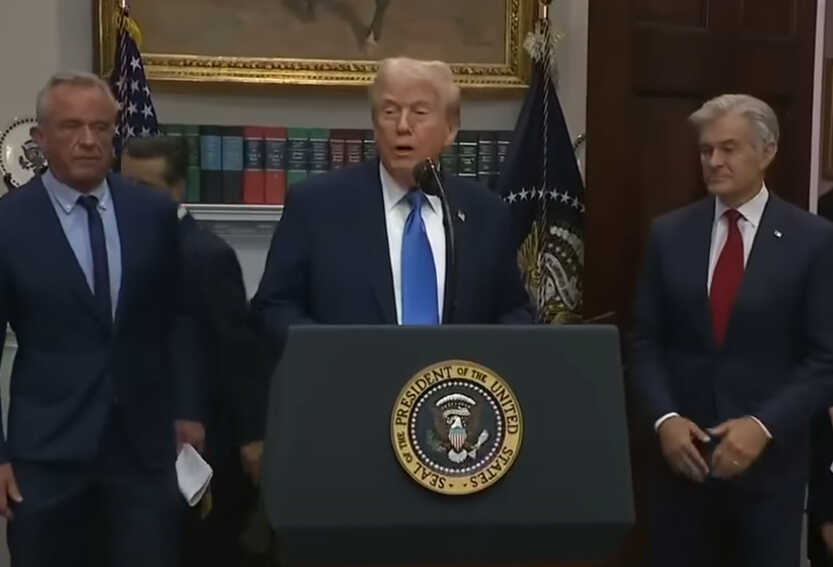
Read the full transcript of President Trump’s remarks on Autism at a press conference along with members of his administration Robert Kennedy Jr. and Mehmet Oz, September 22, 2025.
Trump Administration Announces Historic Steps to Address Autism Crisis
PRESIDENT TRUMP: So I’ve been waiting for this meeting for 20 years, actually. And it’s not that everything’s 100% understood or known, but I think we’ve made a lot of strides. I wish it was done a long time ago.
Today, we’re delighted to be joined by America’s top medical and public health professionals as we announce historic steps to confront the crisis of autism. Horrible, horrible crisis.
I want to thank the man who brought this issue to the forefront of American politics along with me. And we actually met in my office, is it like 20 years ago, Bobby? It’s probably 20 years ago in New York. I was a developer, as you probably heard, and I always had very strong feelings about autism and how it happened and where it came from. And he and I, I don’t know, the word got out. And I wouldn’t say that people were very understanding of where we were, but it’s turning out that we understood a lot more than a lot of people who studied it, we think. And I say we think because I don’t think they were really letting the public know what they knew.
Thanks as well to the director of the National Institute of Health, Dr. Jay Bhattacharya, FDA commissioner, Dr. Marty Makary. These are great people. Administrator of the Centers for Medicine and Medicaid Services, Dr. Mehmet Oz, and acting assistant secretary of HHS, Dr. Dorothy Fink. So thank you all. Thank you, Dorothy, very much.
The Alarming Rise in Autism Rates
The meteoric rise in autism is among the most alarming public health developments in history. There’s never been anything like this. Just a few decades ago, one in 10,000 children had autism. So that’s not a long time. And I’ve always heard, you know, they say a few, but I think it’s a lot less time than that. It used to be one in 20,000, then one in 10,000. And I would say that’s probably 18 years ago. And now it’s one in 31. But in some areas, it’s much worse than that, if you can believe it.
One in 31. And I gave numbers yesterday for boys. It’s one in 12. I was told that’s in California where they have, for some reason, a more severe problem. But whether it’s one in 12 or one in 31, can you imagine? That’s down from one in 20,000, then one in 10,000. And now we’re at the level of one in 12, in some cases, for boys. One in 31 overall.
So since 2000, autism rates have surged by much more than 400%. Instead of attacking those who ask questions, everyone should be grateful for those who are trying to get the answers to this complex situation. And the first day all of these great doctors behind me were there, I told them, “this is what we got to, we have to find out.” Because when you go from 20,000 to 10,000, and then you go to 12, you know there’s something artificial. They’re taking something.
And by the way, I think I can say that there are certain groups of people that don’t take vaccines and don’t take any pills that have no autism. That have no autism. Does that tell you something? That’s currently. Is that a correct statement, by the way?
RFK JR.: There are some studies that suggest that, yeah, with the Amish, for example.
PRESIDENT TRUMP: The Amish, yeah, virtually. I heard none. See, Bobby wants to be very careful with what he says, and he should, but I’m not so careful with what I say. But you have certain groups. The Amish, as an example, they have essentially no autism.
FDA Warning on Acetaminophen Use During Pregnancy
First, effective immediately, the FDA will be notifying physicians that the use of, well, let’s see how we say that. Acetaminophen. Acetaminophen. Is that okay? Which is basically, commonly known as Tylenol. Can be associated with a very increased risk of autism. So taking Tylenol is not good. I’ll say it, it’s not good.
For this reason, they are strongly recommending that women limit Tylenol use during pregnancy unless medically necessary. That’s, for instance, in cases of extremely high fever, that you feel you can’t tough it out, you can’t do it. I guess there’s that. It’s a small number of cases, I think. But if you can’t tough it out, if you can’t do it, that’s what you’re going to have to do. You’ll take a Tylenol, but it’ll be very sparingly. It can be something that’s very dangerous to the woman’s health. In other words, a fever that’s very, very dangerous and ideally a doctor’s decision.
Because I think you shouldn’t take it. And you shouldn’t take it during the entire pregnancy. They may tell you that toward the end of the pregnancy, you shouldn’t take it during the entire. And you shouldn’t give the child the Tylenol every time he goes. He’s born, he goes and has a shot. You shouldn’t give a Tylenol to that child. All pregnant women should talk to their doctors for more information about limiting the use of this medication while pregnant. So ideally, you don’t take it at all. But if you have to, if you can’t tough it out, if there’s a problem, you’re going to end up doing it.
Vaccine Administration and Spacing
The other thing that I can tell you that I’ll say that they will maybe say at a little bit later date. But I think when you go for the shot, you do it over a five-time period. Take it over five times or four times. But you take it in smaller doses. And you spread it out over a period of years.
So ideally, a woman won’t take Tylenol. And on the vaccines, it would be good instead of one visit where they pump the baby, load it up with stuff, you do it over a period of four times or five times. I was, I mean, I’ve been so into this issue for so many years, just because I couldn’t understand how a thing like this could happen. And you know it’s artificially induced. It’s not like something that, when you go from all of those, you know, healthy babies to a point where, I don’t even know structurally if a country can afford it. And that’s the least of the problems, to have families destroyed over this. It’s just so, so terrible.
Vaccine Components and Recommendations
I also, and we’ve already done this, we want no mercury in the vaccine. We want no aluminum in the vaccine. The MMR, I think, should be taken separately. This is based on what I feel, the mumps, measles. And the three should be taken separately. And it seems to be that when you mix them, there could be a problem. So there’s no downside in taking them separately. In fact, they think it’s better. So let it be separate.
The chickenpox is already separate. Because when that got mixed in, I guess they made it four for a while, it really was bad. So they make chickenpox. Individually, they’re okay. When you mix them, something maybe happens. So there’s no downside in doing it. It’s not like, oh, if you do it, bad things. No, it’s only good. And it may not have that much of an impact, but it may have a big impact. So let those be taken separately.
And then Hepatitis B is sexually transmitted. There’s no reason to give a baby that’s almost just born Hepatitis B. So I would say wait till the baby is 12 years old and formed and take Hepatitis B. And I think if you do those things, it’s going to be a whole different, it’s going to be a revolution in a positive sense in the country.
Treatment Advances and Research Funding
The FDA will be updating the label of an existing drug to reflect potential benefits in reducing some autism symptoms. This gives hope to the many parents with autistic children that it may be possible to improve their lives. That’s one of the things that I’m very, very happy about. I mean, this was mostly going to be on how not to have the child affected. But we’ve learned some pretty good things about certain elements of genius that can be given to a baby and the baby can get better. And in some cases, maybe substantially better. Not going to be easy, but it’d be a lot easier if it didn’t happen in the first place.
These great parents fully understand, right? They fully understand. I feel so terribly for them. I have so many friends with autistic children. It’s just, it’s a tough situation. Finally, to help reach the ultimate goal of ending the autism fever, the NIH will be announcing 13 major grant awards from the Autism Data Science Initiatives. And to be honest with you, to me, that’s the least important. It’s not even a money thing at this point. There’s so much money, but they have to do, and they have to move quickly.
When the alternative is that nothing bad can happen, let’s do it now. I was just saying to Bobby and the group, let’s do it now. Nothing bad can happen. It can only good happen. But with Tylenol, don’t take it. Don’t take it. And if you can’t live, if your fever is so bad, you have to take one, because there’s no alternative to that.
Stanley, first question. What can you take instead? It’s actually, there’s not an alternative to that. And as you know, other of the medicines are absolutely proven bad. I mean, they’ve been proven bad with the aspirins and the Advils and others, right? And they’ve been proven bad.
So I’d like to ask Bobby to get up to the podium and say a few words, and then Dr. Bhattacharya and Dr. McCary, Dr. Oz, and Dr. Fink, followed by two incredible mothers that have experienced firsthand what this country is going through, what parts of the world are going through.
And I will say there are parts of the world that don’t take Tylenol. I mean, there’s a rumor, and I don’t know if it’s so or not, that Cuba, they don’t have Tylenol because they don’t have the money to put Tylenol. And they have virtually no autism, okay? Tell me about that one. And there are other parts of the world where they don’t have Tylenol, where they don’t have autism. That tells you a lot.
And I want to say it right now. And you know, the way I look at it, don’t take it, don’t take it. There’s no downside in not taking it. So I’d like to ask Bobby to come up and say a few words. I hope I didn’t ruin his day, but that’s the way I feel. I’ve been very strong on this subject for a long time. You know, life is common sense too. And there’s a lot of common sense in this. And I wish things like this were brought up. And this group has worked so hard on it.
But I’d like to be a little bit more, a little speedier in the process of a recommendation because there’s no harm in going quicker. There’s absolutely no harm. At worst, there’s no harm. Thank you very much. Bobby, please.
RFK Jr. Announces HHS Investigation Into Autism Causes
RFK JR.: Thank you, Mr. President. To meet the President’s challenge, I ordered HHS to launch unprecedented all agency effort to identify all cause of autism, including toxic and pharmaceutical exposures. President Trump’s urging NIH, FDA, CDC, and CMS are turning over every stone to identify the ideology of the autism epidemic and how patients and parents can prevent and reverse this alarming trend.
We have broken down the traditional silos that have long separated these agencies, and we have fast-tracked research and guidance. Historically, NIH has focused almost solely on politically safe and entirely fruitless research about the genetic drivers to autism. And that would be like studying the genetic drivers of lung cancer without looking at cigarettes. And that’s what NIH has been doing for 20 years. As a result, we don’t have an answer to this critical question.
Despite the cataclysmic impact of the epidemic on our nation’s children, we are now replacing the institutional culture of politicized science and corruption with evidence-based medicine. NIH research teams are currently testing multiple hypotheses with no area off limits. We promise transparency as we uncover the potential causes and treatments, and we will notify the public regularly of our progress.
FDA to Issue Warning on Acetaminophen During Pregnancy
Today, we are announcing two important findings from our autism work that are vital for parents to know as they make these decisions. First, HHS will act on acetaminophen. The FDA is responding to clinical and laboratory studies and suggests a potential association between acetaminophen used during pregnancy and adverse neurodevelopmental outcomes, including later diagnosis for ADHD and autism.
Scientists have proposed biological mechanisms linking prenatal acetaminophen exposure to altered brain development. We have also evaluated the contrary studies that show no association. Today, the FDA will issue a physician’s notice about the risk of acetaminophen during pregnancy and begin the process to initiate a safety label change. HHS will launch a nationwide public service campaign to inform families and protect public health.
FDA also recognized that acetaminophen is often the only tool for fevers and pain in pregnancy, as other alternatives have well-documented adverse effects. HHS wants, therefore, to encourage clinicians to exercise their best judgment in the use of acetaminophen for fevers and pain in pregnancy by prescribing the lowest effective dose of the shortest necessary duration and only when treatment is required.
Furthermore, thanks also to the politicization of science, the safety of acetaminophen against the risk of neurodevelopmental disorders in young children has never been validated.
Prudent medicine, therefore, suggests caution in acetaminophen use of young children, especially since strong evidence also has associated it with liver toxicity. Some studies have also found the use of acetaminophen in children can potentially prolong viral illnesses. FDA will drive new research to safeguard mothers, children, and families.
In addition to a possible acetaminophen connection to autism for pregnant women, infants, and toddlers, our research has revealed that folate deficiency in a child’s brain can lead to autism. We have also identified an exciting therapy that may benefit larger numbers of children who suffer from autism. Peer-reviewed literature has documented that up to 60% of folate-deficient children with ASD can have improved verbal communications if given Leucoforin. I have instructed NIH, FDA, and CMS to help doctors treat children appropriately.
The FDA will help tell that story, which started with sound science, the kind that restores faith in government. The announcement, or this announcement, also represents a historic collaboration between NIH, FDA, CDC, and CMS. We expect this to be the first of many announcements over the coming years that deliver actionable information to parents on the underlying cause of autism and the potential paths for prevention and reversal.
Investigating All Potential Causes Including Vaccines
Finally, autism is a complex disorder with multifactorial etiology. We are continuing to investigate a gate of multiplicity of potential causes with no areas of taboo. One area that we are closely examining, as the president mentioned, is vaccines. Some 40 to 70% of mothers who have children with autism believe that their child was injured by a vaccine. President Trump believes that we should be listening to these mothers instead of gaslighting and marginalizing them like prior administrations.
Some of our friends like to say we should believe all women. But some of these same people have been silencing and demonizing these mothers for three decades because research on the potential link between autism and vaccines has been actively suppressed in the past. It will take time for an honest look at this topic by scientists. But I want to reassure the people in the autism community that we will be uncompromising and relentless in our search for answers. We will perform the studies that should have been performed 25 years ago. Whatever the answer is, we will tell you what we find.
We are researching this issue to all three agencies. Jay will discuss one of our research initiatives at NIH. This model of unleashing unbiased, depoliticized, gold standard scientific research and academic freedom to deliver actionable information to prevent and reverse disease will be a model for the framework to deliver similar results from any other chronic conditions that plague Americans, Jay.
NIH Launches $50 Million Autism Data Science Initiative
DR. OZ: Thank you, Secretary Kennedy. And thank you, President Trump. Thank you very much. I’m proud to announce today that the NIH has launched the Autism Data Science Initiative to turbocharge autism research, devoting an additional $50 million to the cause of studying autism.
Nearly 250 research teams from across the country applied, sent in their applications, and were peer reviewed by the NIH review panel. The NIH peer reviewers chose the 13 best projects focused on root causes and therapies with replication and validation studies to guarantee gold standard science.
The studies feature a new kind of science called exposomics, where scientists consider environmental and medical factors, nutrition, events during pregnancy, in combination with biology and genetics to answer vital questions about autism. Science like this, conducted in partnership with families and physicians, is the best way to arrest and reverse the autism epidemic.
Autism spectrum disorder encompasses a very wide range of symptoms, ranging from mild difficulties with social interactions to profoundly autistic children who experience severe disabilities in speech and behavior. Given this wide range of symptoms across the spectrum, it seems certain that there will be a wide range of biological contributors to explaining the cause.
The great thing about the new NIH initiative on autism is that scientists will use rigorous advanced methods in causal inference, machine learning, organoids, and other fresh approaches to the problem. The sharp rise in the prevalence of autism deserves an urgent response by the scientific community.
As Bobby said, the NIH has invested a lot of money to study autism over the years, but the research has not produced the answers that families and parents of autistic children deserve, and autistic children themselves deserve. For too long, it’s been taboo to ask some questions for fear that scientific work might reveal a politically incorrect answer. Because of this restricted focus in scientific investigations, the answers for families have been similarly restricted, often pointing families to behavioral therapies that don’t work for every kid, or suggest non-modifiable genetic factors as the cause.
But genetics alone can’t explain such a sharp rise in autism prevalence over just a few decades, as the President said. In coming months and years, as NIH scientists learn more that can help autistic children and their families, we won’t delay. Like scientists often like to do, I can say as a scientist myself, it’s really tempting to delay, but in the face of a problem like this, you have to move fast. We will not delay before telling American people what we find, and we will win the public trust with transparency and rigor.
Already, our broadened focus on autism research has pointed to two items that will help families prevent and treat some cases of autism. I’ll leave the good news on these two items to my close friends and colleagues, Dr. McCary and Dr. Ross. We’ve been working together closely on this problem for the past six months, and our cooperation represents an unprecedented collaboration with Secretary Kennedy’s Department of Health and Human Services, and with President Trump. I’m delighted to introduce Dr. Marty McCary, Commissioner of the Food and Drug Administration, who will tell you about these announcements of practical help for families with autism.
DR. MARTY MCCARY: Great, thank you, Dr. Bhattacharya. Mr. President, this is the start of a historic shift in medical culture. This administration is working together to ask big questions about why our nation’s children are getting sick so fast. Too often, medicine is doing small little studies, giving us answers we already knew. But we’ve got to make a difference. You’ve given us the charge to identify root causes, and we’re not going to stop so that we can end the suffering we are watching.
And if you’ve seen a kid with autism, with severe autism, it’s hard to watch. Kids get frustrated, they get angry, they can be crying because they want to speak and they can’t speak. It’s hard to watch, and it may be entirely preventable. For an epidemiologist, that child is an expanding statistic. But for a child, it can be brutal to have autism.
FDA Takes Action on Acetaminophen Warnings
Today, the FDA is taking action to update the label on acetaminophen, and sending a letter to all U.S. doctors letting them know about the risks in pregnancy. We now have data we cannot ignore. There’s a very large study, the Boston Birth Cohort, with researchers from Johns Hopkins, my former institution, and Boston University, found “consistent associations” between acetaminophen in pregnancy and autism.
And the Nurses’ Health Study, with researchers from Yale, Columbia, and Harvard, looking at 9,000 kids, found that acetaminophen use in pregnancy was associated with neurodevelopmental disorders. And four weeks ago, a Mount Sinai Harvard study reviewed all the existing literature, and found the overwhelming body of evidence points to an association. Sure, you’ll be able to find a study to the contrary, that’s how science works.
But to quote the Dean of the Harvard School of Public Health, there is a causal relationship between prenatal acetaminophen use and neurodevelopmental disorders of ADHD and autism spectrum disorder. We cannot wait any longer. And honestly, there’s been this perfunctory, reactionary, mindless practice in medicine. I learned it in medical school and residency, just treat all fevers, low-grade fevers, treat them with acetaminophen. Why? What are we doing?
A study out of Hopkins actually showed that treating a fever can prolong the duration of illness in a young kid. Maybe that’s because a fever is a body’s natural way of ridding an infection. When my wife was pregnant and delivered our son a few months ago, they pushed her to take acetaminophen for a low-grade fever. She said no, and then they looked to me and I said, absolutely no.
New Treatment Option for Children with Autism
I’m also here to announce good news. Today the FDA is filing a federal register notice to change the label on an exciting treatment called prescription Leukoborin so that it can be available to children with autism. You know, autism may also be due to an autoimmune reaction to a folate receptor on the brain, not allowing that important vitamin to get into the brain cells. It’s a fairly established, mature pathway. Again, we have a duty to let doctors and the public know we are going to change the label to make it available.
Hundreds of thousands of kids, in my opinion, will benefit. One study found that with kids with autism and chronic folate deficiency, two-thirds of kids with autism symptoms had improvement, and some marked improvement. Mr. President, you told us to do what’s medically right, to go bold, and not worry about the corporations and the lobbyists, so that’s what we’re here doing today. Thank you, Mr. President.
TRUMP: Thanks Marty. I think you all appreciate the passion in the President’s voice.
We’ve been hearing that since the inauguration. In fact, even before the inauguration, the President was upset about what he spoke to today, and so together with Secretary Kennedy, who’s made his life’s work to address some of these challenges with autism, they challenged us. In fact, they were harsher than that. They wanted no silos to break down what the NIH would do, what the FDA would do, what CMS would do. They insisted that the physician leaders bust through the clutter because their agencies had the power, if we didn’t do what every other prior administration had done, which is to let people function within their siloed environments.
Because of that, in historic fashion, in a very accelerated manner, we have a response today to the autism crisis. It is the first of several chapters, but this is breaking news. You’ve heard some of it. The response to the autism crisis is going to continue to come to you under Secretary Kennedy’s leadership, and the President wouldn’t have it any other way, as you’ve heard.
FDA Approves Prescription Leucovorin for Autism Treatment
The FDA, based on NIH research, is approving prescription Leucovorin for treatment of autistic children. Now, if you’re following the script, there should be two questions that you have, two questions that should come to your mind. The first is, how will patients and parents get access to the treatment? I’ll tell you how.
Over half of American children are covered by Medicaid and CHIP, government health insurance, over half. Therefore, because they’re covered in Medicaid and CHIP, upon this label change by Marty, state Medicaid programs, in partnership with CMS, will cover prescription Leucovorin around the country. It’s yours, but you have to go to a doctor to get a prescription, because they know your child, they know you, and they know the medication.
States will also have tools to monitor its use and ensure appropriate utilization. That’s important for a bunch of reasons, because you want the right kids getting the right prescription medications. We believe private insurance companies will rapidly follow our lead if they have not already done so. And again, to make sure that this is safe and effective treatment, you need a physician to prescribe the medication, because it’s on prescription.
Second big question, how are we going to collect clinical data to answer the big questions that the President is asking and Secretary insists that we offer? CMS is also issuing guidance to convene states and existing research networks to support NIH and FDA in their research efforts on prescription Leucovorin, while also maintaining the privacy of all patients, all health information of our beneficiaries.
Collecting real-world data, which is what many of you have been asking us to do in the community is fast, it is life-saving, and we’ll get answers based on what happens over the next few months with this approach. The aggressive approach, and it is aggressive, demanded by the President and by the Secretary, have already identified risk factors and opened the door for the first FDA-recognized treatment pathway for autism. It is the first of its kind, and it wouldn’t have happened without the leadership of the President and the Secretary.
The five-fold increased prevalence of autism over the past 25 years demands a rapid response. The average clinician, researcher, we spoke to many, thought it would take five years to get this data. Parents are unwilling to wait five years. The President is unwilling to wait five years for these results. So the President and the Secretary are acting today with this tri-agency move.
The administration’s bold actions, investing in groundbreaking research, follow the science, they restore trust, which has been lacking, and they will change the trajectory for millions of American families. Mr. President, God bless you for being brave. Let me introduce Dr. Fink, Acting Administrator, and after that Dr. Fink, we’ve got some wonderful women, Jackie and Amanda. I know it’s going to be tough, but if you can make some comments about this historic day, God bless you.
Dr. Fink on Acetaminophen During Pregnancy
DR. FINK: Thank you, Mr. President, for this opportunity to speak with all of you today. As a pediatrician and mom, I am here today to talk about what this announcement means for the millions of moms and dads who are faced with the choice of whether to take acetaminophen during pregnancy.
It’s hard to hear information that challenges the status quo. We are sharing this information not to confuse, but to empower parents to make the best choices when taking medications during pregnancy. We are all concerned about the rising rates of neurodevelopmental disorders, including autism. President Trump and Secretary Kennedy are dedicated to radical transparency so that patients have the best, most up-to-date information.
We are also sharing this information with our nation’s doctors, and we encourage you, as always, to consult with your doctor to make the best decision for you. All too often, it’s easy to think that medicines we buy without a prescription pose little to no risk for the mom or the baby. As you heard today, pregnant women who need high fever or pain reduction during pregnancy should take the lowest effective dose of acetaminophen for the shortest possible duration. Most women will not meet these indications during their pregnancies.
I am encouraged by these developments today because it is another example of our commitment to the American people to leave no stone unturned in improving the health of our nation’s children. Next, I’m going to turn it over to some incredible mothers who are going to share more about their stories, and we’re so grateful to have you here today. Thank you.
Mother’s Testimony: Living with Profound Autism
UNIDENTIFIED SPEAKER: Thank you, Mr. President and team, for all your work. This is a historic day, and I’m thankful to be here. I have a son who’s five who is profoundly autistic, and you’ve probably heard if you’ve met one autistic child, you’ve met one autistic child. It’s a spectrum, which I don’t think the spectrum is helpful, but that’s another conversation.
He is an amazing little boy, a blessing from God. He’s marvelous. He can count to a thousand. He knows all of his letters and the sounds they make, and a word for each one, but he also has a lot of obstacles. He is nonverbal. He can say those numbers and letters, but there’s no communication.
Unless you’ve lived with profound autism, you have no idea. You have no idea. He, like you said, he will get frustrated because he can’t speak. It’s not even that he can’t speak. Sometimes he just doesn’t understand what I’m saying. He understands the word no, but he doesn’t understand the why behind the no, and that’s a huge part of discipline. That’s the discipline. It’s very hard to discipline a child with autism so you have these behaviors.
It’s a very hopeless feeling. It’s very isolating being a parent with a profound autistic child. Even just taking them over to your friend’s house is something we just don’t do because, again, they’re going to be met with no, no, no, and no understanding of why. Then there’s a meltdown. Then you’re in a situation where you’re just helpless and you’re just trying to protect your kid. It’s just better not to do it. You learn your limits. It’s been really hard.
This is amazing that we’re here today. No one has been able to point to anything and say, this is what caused it, and you can’t point to that and say it didn’t cause it. I have no idea. I’m completely open. I’m not blaming anything, but I’m open to the discussion and the fact that there’s work being done to find answers. I’m very grateful.
I was already excited to vote for Mr. Trump anyway as president, but when we got word of R.K. doing his work, I was ecstatic. I could not wait for this work to be done. Somebody would try to find us some answers. I’m just very grateful. I pray for my son every day and hope that he can get the help that he needs. Thank you.
TRUMP: Thank you. Thank you very much. Thank you.
Another Mother’s Journey: From Nonverbal to High-Functioning
UNIDENTIFIED SPEAKER: Hi, my name is Jackie. I’m also extremely grateful for the opportunity to be here and share my son’s story. My son is Eddie. He’s 11. He’s on the opposite end of the spectrum from what Amanda just explained. He’s considered high-functioning. He was not always high-functioning. He was nonverbal until the age of four. We’ve had quite a hard time to get to the place where we are today.
I am just so grateful to President Trump and the entire administration for finally listening to moms who have been crying out for help, for answers for years. I’ve met so many other moms with children on the spectrum in the nine years since my son’s diagnosis. They all have very similar stories. They’ve all just wanted somebody to listen, to not ridicule them or look at them like they were the crazy people.
It’s hard when you don’t have doctors that take the time to really listen and find out when the change happened and what change happened. I’ve been praying for this day for nine years. I’m so thankful to God for bringing the administration into our lives. I’m speechless. This day is a day I never thought would happen. I thought that we would never have an administration that was courageous enough to look into things that no prior administration had.
I’m just here to express my gratitude. I am looking forward to what comes from this. Hopefully, we just get more answers. Thank you.
I just want to say acetaminophen is basically Tylenol, essentially, because I noticed that term is used throughout this conference. It’s essentially Tylenol. I just recommend strongly that you don’t use Tylenol. This is absolutely necessary. I understand it’s maybe 10% of the women that are pregnant would perhaps be forced to use it. That would mean you just can’t tough it out. No matter what you do, you can’t tough it out. That’s up to you and your doctor. This is a very strong recommendation. Maybe stronger for me than for the group because they’re waiting for certain studies. I just want to say it like it is. Don’t take Tylenol. Don’t take it. If you just can’t fight like hell not to take it, there may be a point where you have to. You have to work out with yourself. Don’t take Tylenol.
Vaccine Schedule Recommendations
Other things that we recommend, or certainly I do anyway, and it’s so important to me, to see the doctor four times or five times for a vaccine. Don’t let them pump your baby up with the largest pile of stuff you’ve ever seen in your life going into the delicate little body of a baby. Even if it’s two years, three years, four years, you just break it up into, I would say five, but let’s say four visits to the doctor instead of one. Certain things I think you should do.
We’ve already taken out, and are in the process of taking out mercury and aluminum now. You know what mercury is. You know what aluminum is. Who the hell wants that pumped into a body? And there were rumors about both of them for a long time, but we’re having them taken out. We’re having them taken out of the vaccines.
Hepatitis B again, that’s sexually transmitted, and we think you should wait. I think you should wait until 12. You know, I’m just making these statements from me. I’m not making them from these doctors, because when they talk about different results, different studies, I talk about a lot of common sense, and they have that too. They have that too, a lot. But I recommend the hepatitis B. Take it at 12. It’s sexually transmitted. You don’t have to give it to the baby when the baby’s two years old, and there are a lot of theories on that, but not when they’re 12. It’s not, doesn’t seem to be a problem at all.
The MMR and the chicken pox. Chicken pox has already been broken out. It’s a singular shot, but the MMR is not, and I’ve heard for years that there’s a problem with it, but they say that there’s no problem if you do each shot separately, not put together. So an MMR, go out and do it separately.
Don’t take Tylenol. Don’t give Tylenol to the baby. Don’t give Tylenol to the baby after the baby’s born every time the baby gets a shot. They say take a couple of Tylenol. I’ve heard that for years take Tylenol. Don’t take Tylenol. Don’t have your baby take Tylenol.
Now Tylenol is fine for people that aren’t pregnant that aren’t in this situation that we’re talking about one very specific situation. If you’re pregnant don’t take Tylenol. When you have your baby don’t give your baby Tylenol at all unless it’s absolutely necessary. Don’t do it break up your visits to the doctors break them up do it in five if you can now it’s inconvenient. It’s inconvenient. Oh, you’re going to have to go back another year later. You’re going to go back each year for four years five years three years. Just break it up. Break it up because it’s too much liquid too many different things are going into that baby at too big a number.
The size of this thing when you look at it. It’s like 80 different vaccines and beyond vaccines and 80. Then you give that to a little kid. I mean I can tell you that I had a woman who worked for me a beautiful wonderful woman worked in Trump Tower and she had the most perfect child beautiful just perfect, and I remember this little blonde-haired boy running around the lobby of Trump Tower so healthy and so vibrant. And I said, that’s great one day. I came in and she was crying her eyes out behind the counter. She was she worked at the front desk. She was crying her eyes out.
I’ve never — as much as I’ve ever seen anyone distraught, she was. I said, “Are you okay? What happened?” “My boy, my boy! I’ve lost my boy.” “What does that mean, your boy?” “My boy, you know sir, you’ve seen him grow up. He was so beautiful, and I took him for a vaccine, sir. And he developed this unbelievable — I think she said a hundred and seven, hundred and eight.” You know, it goes — well, beyond when this happens, it goes up to a hundred and six, hundred and seven, hundred and eight. You know, we hear a hundred and five and you’re in trouble. But it just goes up to a level that you never hear about, but it goes up very high. And they get — it’s fried. They get fried.
She said, “I took him and he developed an unbelievable temperature and I’ve lost him, sir. He’s gone.” And then I saw the boy. It was a whole — it was so tragic to see. That was the following day. That was the following day after the vaccine. And I’ve seen it two other times, and I think three other times. But two other times where they go to the doctor and they get the vaccine, they get the shot, the kid is — you know, badly hurt, let’s be nice — badly hurt.
Breaking Up Vaccine Schedules
And just do it — break it up into five, break it up into four, break it up into three if you have to — but go to the doctor four times instead of once, or five times instead of once. And for some reason they insist that you put it all into the body, and maybe that’s the drug companies. They make more money that way. Maybe it’s the doctors because they don’t want to be — you know, doing this so much. Maybe it was — maybe it’s the doctors, they get maybe more money. Who the hell knows what it is? Don’t do it. Get them broken into four or five visits. Do it four or five — that means you have 20%, 25% what you’re putting into the baby’s body. It can only help, can only help.
Tylenol Warning
And the other things I told you about — just the word “tough it out.” You know, it’s easy for me to say tough it out, but sometimes in life with a lot of other things you have to tough it out. Also, don’t take Tylenol. Don’t give Tylenol to the baby when the baby’s born. They throw it at you — “Here, throw — give them a couple of Tylenol.” They give me a shot. They give them a vaccine. And every time they give them a vaccine, they’re throwing Tylenol, and some of these babies — they, you know, they’re long-born and all of a sudden they’re gone.
And it doesn’t hurt not to do it. It doesn’t hurt. There’s no downside. There’s no downside at all. And break up MMR — break it up. It’s practically a known fact that if you break it up, you’re not going to have a problem. But for years we’ve been hearing how bad MMR is as a combination, and I’m very happy that you broke out chicken pox because that was really a problem.
And there are other things — it’s interesting because there are other things, other — we were talking about other different drugs, pills that you take that we know are so bad. And they don’t take them anymore, but for some reason with this they keep taking it. Don’t take Tylenol. There’s no downside. Don’t take it. You’ll be uncomfortable. It won’t be as easy, maybe, but don’t take it if you’re pregnant. Don’t take Tylenol. And don’t give it to the baby after the baby is born.
Administration Priorities
And you know what? We have more than three years left, and I told Bobby and the doctors behind me — and they are so committed to this — I told them that this is the number one thing I want to do from you. And you know, we have something else called favored nations where I’m going to be reducing drug prices by a thousand percent, by nine hundred, six hundred, five hundred, 1,200 — we’re going to be reducing drug prices at levels never seen. It’s called favored nations. We’re going to be paying what the — right now we’re like the garbage can for the rest of the world that we have been for forever. We pay much higher for drugs than the rest of the world. We subsidize the rest of the world. We’re not doing that anymore, and that’s a big thing. That’s a big thing.
That’s bigger than anything. I told the story the other night that I was so proud of my first term that for the final year drug prices went down one quarter of 1%. And I was so proud I said, “I’m the first one to do it.” I think it was 28 years they said where drug prices went down from the beginning of the term to the end. Then I was so proud I called a news conference. I said, “You know, drug prices have gone down first time. It’s happened in 28 years.” You know what it was? One quarter of 1%. I was so proud.
Now we’re going to have them go down from $100 a pill to $9 a pill, from $1,300 for a shot of like the epic, or the fat pill or the fat drug. Sometimes it works. I guess for people the ones I’ve seen it hasn’t worked so well. I got a lot of friends in fat and they said, “Yeah, I lost some weight.” I said, “You don’t look it to me,” but they paid $1,300, $1,200 and they go to London and they pay $88 and they call me. They go, “What’s this all about?” We’re subsidizing the rest of the world stupidly because there’s a lot of stupid people in this country running things.
And how big is that? But to me, that’s nothing compared to autism. I see that gorgeous boy. I have a big present for him in the back. You know you bring him back. We’re going to bring him into the Oval Office. I have the best present he’s ever going to get, okay? A big one. I saved it for you, okay? Because I heard you were coming. Look how beautiful he is.
Key Recommendations on Tylenol and Vaccines
So that’s it. There’s nothing much to say. Don’t take Tylenol if you’re pregnant and don’t give Tylenol to your child when he’s born or she’s born. Don’t give it. Just don’t give it.
And we’re going to have, I think really if you do all the things that I say, break it up. Just break it up. Break up the shots with the doctor. MMRs as I told you, separate, separate, separate. Chicken pox already separate. You do these things I’m telling you.
I want it when I leave office. I don’t want to have it’s going to be the kind of number that we’re hearing where it’s 1 in 32 or 1 in 10 because I’ve heard 1 in 10 also. Then in California, it’s really bad. I want it to be let’s get it back to maybe 1 in 10,000 or 1 in 20,000 or maybe none in 20,000. And the only way you’re going to do that because this is artificially induced. This is induced by something, you know? Go from 1 in 20,000 to 1 in 10,000 then to 1 in 10. That means you’re taking something and something’s wrong.
And I feel very uncertain and I know I’ll be criticized. Someday they’ll look back and they’ll say well it wasn’t, but I think it will. I think we’re going to have a tremendous… I want this is one of the most, this is the most important that there’s nothing more important than me. We cured inflation that Biden gave us. He gave us so much inflation, the biggest ever in history. We got inflation done. We brought prices down. We gave you the largest tax cuts. All that stuff. It doesn’t mean a thing compared to what we’re doing today. This means everything.
So we’re going to save a lot of children from a tough life, a really tough life. We’re going to save a lot of parents from a tough life.
Questions from Reporters
TRUMP: Okay, how about a few questions? Let’s just make it on this subject. This is so beyond as the subject that I’d rather not talk about, you know, some nonsense on the economy. And I will say this, the economy is unbelievable. The stock market just hit another record high and all that stuff. This means more to me. Yeah, please.
REPORTER: I’ve won on your announcement on a vaccine. That’s also really… Why do you think we haven’t heard more previously about the tie to autism and acetaminophen?
TRUMP: Nobody knows. I don’t know. Not only that, when you say it, you get attacked. I was saying something similar, not as strongly, because now facts are on our side. But I was saying it with Bobby 20 years ago, and I was attacked. I said, “Whoa, what was that all about?” I had no idea. You get attacked. You know, the medical community, the drug companies, doctors, I don’t know what it is.
All I want to do, I don’t care about being attacked, it doesn’t matter to me. I believe that the numbers at the end of our term or shortly thereafter could be really phenomenal. I want it to go up, just like it came down to this horrible level, 1 in 10, 1 in 12. I was told 1 in 10, I was told 1 in 12. I heard 1 in 31 if you add the girls and the boys together. It’s crazy. And it was 1 in 10,000 and 1 in 20,000. It’s not even sustainable for a country, you want to know the truth. And there are other places that don’t have it. And they have things in common. And that’s called medical research. Yeah, please.
Questions About Causation vs. Better Diagnosis
REPORTER: I’m curious, as you look at the trend lines, how much of this is the causation of acetaminophen and how much is sort of better diagnosis, doctors, researchers having a better understanding of what is on the autism spectrum?
RFK JR.: That’s one of the canards that has been promoted by the industry for many years. But it’s changed diagnostic criteria or better recognition. But there’s been study after study done of that that completely debunks that. One of them by the MIND Institute at UC Davis, University of California. But also it’s just common sense. Because you’re only seeing this in people who are under 50 years of age. If it were better recognition or diagnosis, you’d see it in 70-year-old men. I’ve never seen this happening in people my age. I’ve never seen a case of full-blown autism, and that means profound autism, I want to be very careful, head-banging, stimming, toe-walking, non-verbal, non-toilet train. I’ve never in my life seen a 70-year-old man who looks like that. You’re only seeing it in kids. It’s an epidemic.
Addressing Medical Establishment Guidance
REPORTER: Mr. President, I was hoping that you could clear up confusion for moms and dads across America, many of whom voted for you. There’s a statement that was put out by the American College of Obstetricians and Gynecologists. In their statement, they write, asking me to think remains a safe, trusted option for pain relief during pregnancy. And that’s at odds with what you said and with what many of the experts think. How do you clear up the confusion?
TRUMP: That’s the establishment. They’re funded by lots of different groups. And you know what? Maybe. They’re right. I don’t think they are, because I don’t think the facts bear it out at all. They’re fighting for something that, in my opinion, they shouldn’t be fighting for. But here’s the thing. There’s no downside to doing, other than a mother will have to, as I say, tough it out a little bit. There’s no downside to doing this. It’s not like, oh, if you do this, you’re going to die. There’s no downside. There’s no downside to going over a four-year or a five-year period or a three-year period. Or even if you space them out for six months, you space it out. There’s no downside. And that’s why I will say the gentleman behind me, they have very strong views, and they feel that we’re right. But they’ll have more research done over the next two months. I said, well, two months is a long time. A lot of people could be saved. And there’s no downside to doing it. Everything I said, there’s no downside to doing it. It can only be good. And I think you’re going to see very good results. That’s establishment stuff. And we’ve been reading that about a lot of things for years. And you know what’s happened? We’ve gone from 1 in 20,000 to 1 in 10,000 to 1 in 32 to 1 in 10. Think of it. 1 in 10 or 12 or 1 in 31. Think of it. 1 in 31 people, young kids, get autism? What is the issue?
REPORTER: My question is about mucobarin. You mentioned that as part of your plan. That is also a chemotherapy treatment. Have you been in touch with the drug companies to increase the effectiveness of that? I’m going to throw in my follow-up at the same time. Dr. Oz mentioned that this will be available with CHIP and children who are on CHIP. But the big, beautiful bill reduced funding for CHIP and Medicaid by a trillion dollars over the next 10 years. Are you concerned that that will impact your ability to get this drug? I’ll explain this to you in a second, but please go ahead.
DR. OZ: Thank you. Thank you. Mucobarin is a drug. It’s a drug that’s used to treat autism. It’s a drug that’s used to treat autism. It’s a drug that’s used to treat autism. It’s a drug that’s used to treat autism.
It’s a drug that’s used to treat autism. I think, in my opinion, the biggest reason that this is happening is because so many doctors are probably seeing so much clinical improvement on kids with Mucobarin.
REPORTER: Are you going to increase production?
TRUMP: Yeah, we’ve been in touch with the companies and they are prepared to ramp up production. We actually talked to them about a month ago.
On your second part of your nasty question, the number is that the great big beautiful bill, which is the greatest, one of the best things ever passed in the history with the tax cuts and regulation cuts and all of the things it does, no tax on tips, no tax on social security, no tax on overtime, all of it does, it also gives $200 million, as just explained by Dr. Oz, and I’d like you to explain that to exactly what you’re saying.
DR. OZ: The big beautiful bill actually increases Medicaid spending projected over the next 10 years by $200 billion. There’s also a $50 billion Rural Health Transformation Fund, which will allow a lot of these programs to get in the rural parts of the country that the President and Congress are handing to governors to start distributing those grants that have already gone out. The money will be allocated by the end of this calendar year.
And I want to point out that the ability of NIH to do research that feeds and hands the ball to the FDA, which they can change labeling to allow Medicaid programs in states to fund this program, will ensure that the things that President Trump and Secretary Kennedy desire are financially affordable for the families around America.
REPORTER: You mentioned CHIP, sir, that’s why I asked that question, you mentioned that CHIP would fund this for children.
DR. OZ: Most of the kids are on Medicaid, probably 43% on Medicaid, another 8-10% on CHIP, and all the programs in general are being evaluated. Most of what the one big beautiful bill was seeking to do was to remove fraud, waste, and abuse. But the programs themselves should stay financially intact for the people for whom they were designed, in this case for children. And the only thing we cut, so that’s $200 billion positive, the only thing we cut was for fraud, waste, and abuse, of which there was a lot in this country. And nobody minds that.
TRUMP: Yeah, please.
REPORTER: Mr. President, you said that there was no reason to give newborn babies hepatitis B vaccines. But hepatitis B can be contracted, not just for sexually transmitted diseases, needle, to open wounds. So when you say you feel, you know, is that appropriate to be telling?
TRUMP: I think it’s absolutely appropriate. I think they should wait till they’re 12 years old. Yes, please.
REPORTER: Mr. President, thank you all for being here. You’ve been talking about reducing autism by spacing out vaccines. Would you like other combined vaccine babies received to be spaced out, like MMRV?
TRUMP: What is this? Again. You’ve been talking… Speak up, please.
REPORTER: You’ve been talking about reducing autism by spacing out vaccines. Would you like the other combined vaccine babies received to be spaced out, like MMRV?
TRUMP: I would say yes, but that just is, for me, it’s a lot of common sense involved in this. It’s a process. But we’re looking, but it should at least be given separately. Now, it’s possible that you can reduce them and give them in small doses, but it’s possible maybe in that particular case, the MMR wouldn’t work in small doses, but you can certainly give them a separate shots.
It’s been proven to be very safe when you give them in separate shots instead of mixing. So I don’t think there’s any reason to do that. Do you agree with it? I’m not a doctor, but I’m giving my opinion. I don’t think there’s any reason to do that. So it’s been proven to be safe when you break them up, but MMR by itself, I’ve heard bad things about it for many years. Yes, please.
REPORTER: Is the spectrum too broad, in your opinion, for research purposes? You are dealing with a population of children who might have social boundary difficulties, and then you have children who are, you know, going to grow up to be adults.
TRUMP: We don’t know how broad the spectrum is. We don’t know exactly where it starts and where it ends, but we do know what we’re going through.
We’re going through some very serious trouble and we know autism. I mean, it could be bigger, it could be small, a little bit smaller, but the number is unacceptable. And the number, the way it’s come down, the way, because the spectrum’s remained the same, the number of the way it’s come down is just unacceptable, meaning come down to that level of one in 10, one in 12, one in 31.
REPORTER: Mr. President, Mr. President, medical professional. Go ahead in the back. This question is more directed towards Secretary Kennedy. It was talked about that we’re just kind of finding out about the fact that babies are affected this way. Is there a concern that information being suppressed right now within HHS and create investigation, perhaps be launched seeing.
ROBERT KENNEDY JR.: Well, I think information has been really not given out very freely over the years, absolutely. And I think that’s by drug companies and maybe doctors, but I certainly think that over the years, I think this is a different group. We have a lot of information and that information, I mean, it’s the information that we have that we’re making these statements.
TRUMP: And I’m making them out front and I’m making them loud and I’m making them strongly not to take Tylenol, not to take it, just don’t take it. This is absolutely necessary and there’s not too many cases where that will be the case. And again, what’s the worst? The worst is nothing can happen. It’s very positive, that’s a positive thing. But I don’t actually believe that’s possible. I think the results are going to be amazing. I want to see amazing results by the time I leave this beautiful building.
And I will consider this, I believe, with the wars I’ve stopped, seven different wars, I’ve saved millions of lives, I’ve done a lot of things. This will be as important as any single thing I’ve done because I know beautiful ladies just like this that are going through the same thing and it’s not easy. And I admire you for being able to do it, but I admire him too. I wish I had a face that looked like that. If I looked like him, I would have been president a long time ago.
REPORTER: I know Tylenol is widely used in other countries too. As you make this announcement, do you expect your decision may affect other countries?
TRUMP: I hope they follow it, yeah. I hope they follow it, yeah. Other countries sell Tylenol, some countries don’t. I mean, I hear Cuba, now again, you’ll have to check this down, but I hear Cuba doesn’t have it because it’s very expensive. And they don’t have the money to have it or they don’t want to spend the money to have it. They don’t have Tylenol. And I hear they have essentially no autism. So you’ll have to check it out.
REPORTER: Mr. President.
TRUMP: Yeah, right. Go ahead. Medical professionals have war for decades. No, not you. You’re CNN, you fake news. Go ahead, Brian.
REPORTER: Thank you, Mr. President. I want to go back to the Amish community if I can just for a second. I recently saw a man from Minnesota, an Amish man from Minnesota on a podcast. And the host asked him what the rates were for like ADHD and autism. And he had no idea about ADHD. Didn’t know that existed and certainly didn’t know of any cases. What are the-
TRUMP: It doesn’t exist with the Amish community and they don’t take all of this junk. It doesn’t exist. That tells you, doesn’t that tell you? That’s like, you know, that’s like certain countries where it doesn’t exist and they don’t take it. Would you like to make a comment about that, Mark?
DR. OZ: The Amish population are very mixed groups. There’s a subset that take vaccines, a subset that does not. And we know they have very low rates of chronic disease all across the board.
TRUMP: Good.
REPORTER: Thank you, Mr. President. Thank you, Mr. President. Should the establishment media show at least some openness to, you know, trying to figure out what the causes of autism are?
TRUMP: I wish they would, yeah.
REPORTER: Why are they so closed-minded?
TRUMP: Well, they do. Look, it’s not only the media, in all fairness. It’s some people. When you talk about vaccines, they go crazy. And, you know, I’m a big supporter of vaccines. I got a certain vaccine approved in nine months that would have taken from five to 12 years. I’m very proud of it. A lot of people think it was one of the greatest things I’ve done, and some people think, mostly Republicans, actually.
I’ll tell you, the Democrats think it was, they think Operation Warp Speed was one of the greatest things any president has done, any president. It’s, you know, we’re very proud of what happened. We got hit with something that came from a place that shouldn’t have happened, but it did happen. You know, those things take place, and you’re very unpleasantly surprised.
But, no, I’m a big believer in vaccines, the polio vaccine. Big, big believer in vaccines. I know Bobby and you guys have it out a little bit, but he’s a believer in vaccines, too. But I’ve seen how great vaccines can be, how incredible they can be. So I’m a believer, yeah. Thank you very much, sir. Yeah, please.
REPORTER: You’re talking about MMR and hepatitis C, and you said those were your suggestions. Have you spoken to Secretary Kennedy about actually making those changes?
TRUMP: I have, yeah, I have. I’ve spoken to all the doctors about it, and doctors that are not here right now. I’ve spoken to many doctors about all of, everything we’re talking about. And, you know, the Tylenol has started to be spoken of over the last period of time, but we’ve been doing the research. A lot of what they’ve been speaking about comes from right here, by research done by these people.
Final Message on Tylenol and Vaccine Spacing
TRUMP: And I just say it again. Don’t take Tylenol. Don’t take it. And don’t give it to your child after your child is born. And do all those other things, little things, just spread out your visits, et cetera, et cetera, on the vaccine. And I want to thank everybody. This is a very important day. Thank you very much. Thank you.
All right, you’re just listening in there, President Trump wrapping up this meeting there, talking about this major.
Related Posts
- Transcript: Jonathan Swan’s Dive into Trump’s Reality: The Weekly Show
- Transcript: President Trump Remarks in Dublin, Ireland – Sep 12, 2026
- Transcript: President Trump Remarks at the Republican Midterm Convention – Sept 9, 2026
- Transcript: President Trump Signs Executive Orders, Sep. 4, 2026
- Transcript of Senator Ted Cruz Interview: PBD Podcast #851