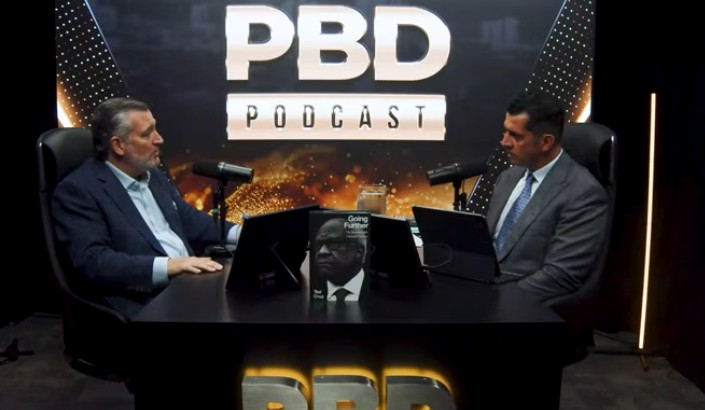
EDITOR’S NOTE: Senator Ted Cruz joined Patrick Bet-David on PBD Podcast Episode #851 for a wide-ranging conversation covering a potential 2028 presidential run, his 2016 primary battle against Donald Trump, the widening rift between the Trump wing of the GOP and Tucker Carlson, and behind-the-scenes stories from the Senate and the Oval Office. Cruz also discussed the legislative provisions he authored in the “One Big Beautiful Bill,” his family’s journey from Cuba and Ireland to Texas, and the new biography he has written about Justice Clarence Thomas, Just and Unflinching: The Incomparable Clarence Thomas. This episode was premiered September 2, 2026.
TRANSCRIPT:
Opening and 2028 Speculation
PATRICK BET-DAVID: Okay, so it’s great to be sitting down with a podcaster, here very famous podcast. He happens to be a senator as well, Senator Ted Cruz, but he’s the only guy that’s also a podcaster. So it’s, it’s great to have you on.
SENATOR TED CRUZ: Pat, thanks for having me. I’m thrilled to be here.
PATRICK BET-DAVID: Yes, likewise. I’m looking forward to the conversation. For the folks that are watching, I know you just came out with a book, going further, I think August 25th, The Incomparable Clarence Thomas, already number one on Amazon. If you haven’t ordered it, we’re going to put the link below. There’s also a great interview with him, which maybe we put down as well at the end if you want to go learn more about him. I thought the interview was great. So I want to start off with some tough questions at first, and then we go to the easy ones.
SENATOR TED CRUZ: Okay, good.
PATRICK BET-DAVID: Let’s go into it. You’ve been visiting Ohio, Iowa, you’ve been visiting some of the earlier states, you’ve been making endorsements, you’ve been kind of playing around with the stuff that’s going on for 2028. I’m not going to ask if you’re going to be running or not. I think if I’m a betting man, I’m guesstimating you’re going to be running for 2028. But if I were to hire you as a consultant — I’m going to run for office in 2028 — I hire Cruz Consulting, give me 3 to 5 issues to be running on in 2028. What do you think those issues should be?
SENATOR TED CRUZ: The fact that it starts with sitting down and talking to a little old lady who looks you in the eyes and says, “Are you telling me the truth or are you lying to me?” I don’t want to hear talking points. I want to know who you are. I want to understand what kind of man you are. That process is really important.
Look, in Iowa when I ran the last time, corn is kind of a big deal in Iowa, and I am against subsidies, I’m against mandates. I think that’s a bad idea for the federal government to do. So I am opposed to the ethanol mandate. Now there’s a whole big lobby in Iowa that is really strongly in favor of the ethanol mandate, and I remain to this day the only person in history to ever win Iowa opposed to the ethanol mandate.
And the way I did it — and I had a lot of those Iowa corn farmers who ended up, when they listened to what I had to say, they ended up supporting me. And I said, look, we shouldn’t have subsidies across the board. There’s an exchange, you can actually find it I think still on the internet, it’s about a 7-minute exchange, where this big old farmer, I think in overalls, comes up to me and he says something like, “I really hate you and I hate what you stand for.” I said, “Well, sir, I’m sorry about that. I’m happy to talk with you about it if you’d like.” He said, “All right.” He was a corn farmer and he was mad that I was against the mandate. I said, “Well, sir, if you give me a minute, I’ll explain to you why.” What’s interesting is after that, about that 8-minute exchange where the guy started off saying, “I hate you,” that’s how the conversation began, at the end of it, he kind of nods and looks at me and says, “Well, that makes sense. I really like what you’re saying.” And it was — that’s — I think that’s what politics should be, is listening to the voters and having a conversation, not changing what you say or do based on just today’s poll.
Comparing 2028 to the 2016 Primary
PATRICK BET-DAVID: Okay, so then question would be, you won Iowa against Trump, right? You won — I don’t know how many states — 13, 14, 15 states. You won quite a few states. 12 states. Utah, Wisconsin, Texas was massive lead, and then it was Indiana, and then from there on it was, you know, he became the candidate. You had 551 delegates. I think you had 3 times what Marco Rubio had at the time. But that’s 2015-2016. You guys went up against somebody that’s an anomaly, one of one. You will maybe never have a guy like that ever again. Disrupted the whole thing. I went back and watched some of the debates with you and him just to kind of mentally get where you guys were at that time. How different is 2028 going to be? Because I think it’s a free agency election.
SENATOR TED CRUZ: Absolutely.
PATRICK BET-DAVID: The big guy’s out. How different is the approach going to be in 2028 than 2015?
SENATOR TED CRUZ: I think massively different. Donald Trump is a black swan event. There is simply nobody like him. I don’t think there’s ever been anyone like him that I’m aware of in history. And I don’t think we’re going to get another Donald Trump. I just think he’s one of a kind and he broke the mold.
Going forward, I think debates are always, and elections are always a debate about the future, about what do we believe?
PATRICK BET-DAVID: Really? Why both of us?
SENATOR TED CRUZ: [continuing] Why not you?
PATRICK BET-DAVID: Why not you?
SENATOR TED CRUZ: Because I was a brand new senator, I was at 1 or 2%. At the end of the day, the single best predictor of what would happen in that election was blue-collar voters. If you looked at the polling of blue-collar voters, truck drivers, steelworkers, cops, firefighters, waiters, waitresses, blue-collar voters in almost every single state, either Trump was 1 and I was 2, or I was one and he was two.
PATRICK BET-DAVID: But not Marco.
SENATOR TED CRUZ: Marco couldn’t compete with blue-collar voters.
PATRICK BET-DAVID: Why do you think?
SENATOR TED CRUZ: Well, remember, he had been very vocal in support of the Gang of Eight amnesty, and amnesty is a great policy if you want to impress the Republican donors, because Republican donors love amnesty. They view illegal immigrants as cheap labor. And Marco’s strategy — he had joined up with the Democrats in the Gang of Eight to propose massive amnesty. I’d led the fight against the Gang of Eight. He made amnesty. It was terrible. That’s why all the donors liked Marco. But the actual people whose jobs are being lost to illegal immigrants, they were pissed at him for it.
And if you look at how that shook out, the states where I was 1 and Trump was 2 with blue-collar voters are the 12 states I won. The states where he was 1 and I was 2 are the 24 states he won, and no other Republican won more than a single state. Kasich won Ohio, Rubio won Minnesota, and Trump and I won every other state in the country. And it was blue-collar voters.
And then you fast forward to the general. I had had a million conversations where people say, okay, how do you win the general? How do you beat Hillary? And at the time, people thought Hillary was this unbeatable juggernaut. And my answer was twofold. I said, number one, blue-collar voters, and number two, evangelical voters. In 2008 and 2012, both of them stayed home. When John McCain was the candidate, when Mitt Romney was the candidate, evangelicals and blue-collar voters, they didn’t vote for Barack Obama, they just stayed home. They didn’t like the candidates, they weren’t inspired, they weren’t energized, they didn’t come out and vote. And my view was, if you turn them out, if you energize them, if you give them a reason to be excited, that’s how you win.
People would ask me, what states can you win in ’16 that McCain and Romney lost? And I would say Ohio, Iowa, Michigan, Wisconsin, Pennsylvania, right up and down the Rust Belt. Those states — I remember on Election Day 2016, November 2016, so I’m out of it, I’ve been beaten, but we’re having an election night party in Houston and I’m sitting there with my team and we’re watching the results. And as Trump’s general election results come in, those are exactly the states he’s winning. And it just goes right down, right down the list. And my wife, Heidi, who is my best friend on planet Earth, as it’s happening, she looks at me and she goes, “I’ll be damned.” And I’m like, “What?” And she said, “I’ve sat next to you 1,000 times while you’ve told people, here’s how you win the general, you win these states. I never knew you were right.”
PATRICK BET-DAVID: What you were saying is — she’s telling you she never knew you were right.
SENATOR TED CRUZ: Yeah. Look, I mean —
PATRICK BET-DAVID: I totally get it.
SENATOR TED CRUZ: You’re married, your wife, you say something, your wife’s trying to be nice. She nods, maybe, but I don’t know.
PATRICK BET-DAVID: So this is election night while they’re announcing him winning the states, and she’s realizing you were right about the states.
SENATOR TED CRUZ: Yeah.
PATRICK BET-DAVID: So let me ask you, are you saying this to me because if you would have gone up against Hillary, you think you would have beaten her?
SENATOR TED CRUZ: Absolutely.
PATRICK BET-DAVID: You think you would have beaten her worse than Trump beat Hillary?
SENATOR TED CRUZ: I don’t know. I will say this. Look, if you look at how the party has shifted in the last decade, the most consequential shift has been a socioeconomic shift. The old conventional wisdom was that Republicans are the party of the rich and Democrats are the party of the poor and the working class. Now, I don’t know if that was ever true, but if it was, it is totally flipped today. Today, the Democrats are the party of rich coastal elites. They’re the party of billionaire hedge fund managers and billionaire tech leaders and Hollywood and academics. And today the Republican Party is a blue-collar party. That’s something Trump accelerated profoundly. That’s something I’ve been fighting for from the day I got there. My base from the very first day I ran has always been blue-collar workers. Those have always been my peeps. And the elites, the establishment have fought like crazy against me from day one.
That shift, I think, is really, really significant. I want us to be the party of workers, the party of jobs, and here’s the path that is unbeatable. So blue-collar voters moving right has made states that used to be purple more red. You take a state like Ohio. Ohio back in the Bush years was perennially purple. It was like right on the edge. Missouri was another purple state, the Show-Me State. Both of them, at least prior to this cycle — and they’re getting more purple this cycle, but let’s take ’24, the last presidential — both of them were bright red. Trump won them by a big margin. That’s because they have a heavy blue-collar population, and that dynamic moved them more right.
There is a countercutting demographic move, which is suburban voters, particularly suburban women, have moved left significantly. And it’s a lot of suburban women are not fans of President Trump. And you’ve seen that in states like Georgia and Arizona and Texas. So Georgia, one of the most suburban states in America, most of the population are in the suburbs surrounding Atlanta. Georgia a few years ago had 2 Republican senators. Today it has 2 Democrat senators. Arizona, most of the population is the suburbs around Phoenix, Maricopa County. Arizona a few years ago had 2 Republican senators. Today it has 2 Democrat senators.
That dynamic, whether we win a state, depends on the intersection of those 2 vectors. If the blue-collar voters moving right outweighs the suburban women moving left, we win. But I’ll say this, the killer general election coalition is if you can turn blue-collar voters out but do it in a way that doesn’t scare suburban women away from you. If you can bring some of those suburban women back, that’s an unbeatable general election.
The Road Not Taken With Marco Rubio
PATRICK BET-DAVID: Okay, so 2 questions for you. One, when you go back — you know how, anytime I go and I’m doing a deal and I lose the deal, we do a debrief and we say, you know, what could we have done and blah blah blah blah blah. Do you think there’s anything you could have done to beat a guy like Donald Trump? Anything?
SENATOR TED CRUZ: Trump generated an excitement and ended up being seen as an even bigger disruptor than I was. That was one piece that was unanticipated, and I don’t know that we could have anticipated that.
There was a second component, which is the free media in that election. So in the 2016 election, my campaign raised $92 million of hard money. That is still the most money any Republican has ever raised in the history of presidential primaries. What I did not anticipate is the free media that the media would give Trump. Trump received over $3 billion, with a B, in free media. They just covered him constantly. And it ultimately, in the last 30 days of the election before I dropped out, Trump had $500 million of free media, 90% of which was positive. And that proved to be a tsunami that you could not overcome.
PATRICK BET-DAVID: Do you think the Democrats at the time were thinking, you know, there’s no way Trump’s going to win. Let’s give him so much because they’re going to take out Cruz. And Cruz, you think — and then it backfired on them?
SENATOR TED CRUZ: So we actually know that because if you look at the WikiLeaks from the Hillary campaign, the Hillary campaign talking to ABC, NBC, CBS, CNN said elevate Trump because he’s the worst candidate and we can beat Trump. So push Trump. And they did. And at the same time, Fox made the decision to go all in behind Trump. And so it ended up — $92 million is a lot of money unless you have $3 billion on the other side. And that proved too much to stop.
Now, that being said, when you asked about what could have been done differently, there was a moment in the campaign that when I lay in bed and think back about the road not taken, I think of as the most consequential road, which is coming into the Florida primary. We were getting ready for the Florida presidential debate, and the day before the Florida presidential debate, my team did some polling. And we polled in particular what happens if Marco Rubio and I join forces, if we run as a ticket with him as my VP.
PATRICK BET-DAVID: Marco doesn’t know you guys are speaking. You haven’t approached him yet.
SENATOR TED CRUZ: First, we just do the poll to see what the numbers are. So we do the poll, and the numbers are compelling. I mean, remember Trump at the time was winning states with a plurality, with 28, 30, 32 points. So you had 70% who were not voting for him. And Marco and I running as a ticket, what it did is it unified the non-Trump vote.
PATRICK BET-DAVID: You get the other 60.
SENATOR TED CRUZ: And so what happened, we looked particularly — our campaigns have always been intensely data-driven. We looked at the numbers. If Marco and I had joined together, we would not have won Florida. We would’ve won it on Election Day, but there were already enough early votes that were banked that Trump would’ve won Florida regardless. But at the same time, we would’ve won North Carolina, Missouri, and Illinois by double digits. I mean, the effect on the numbers was massive.
So I did the natural thing. We saw the poll and my team delivered it to Marco. And I said, “Hey, we’ve got to sit down and talk.” And Pat, it was very cloak and dagger. It was the day before the Florida debate. And we were both in Miami. We were both staying at hotels. We picked this like little motel halfway between our hotels. And the plan was to come and meet and talk. The day of the meeting, Marco cancels the meeting, just says, “I’m not coming.”
PATRICK BET-DAVID: No explanation.
SENATOR TED CRUZ: No explanation, just, “I’m not coming,” which was frustrating.
PATRICK BET-DAVID: Is this public information?
SENATOR TED CRUZ: Yeah, I’ve told the story since then, but it was frustrating. And actually, Mike Lee, the senator from Utah — Mike is my closest friend in the Senate. I love Mike like a brother. Mike is also very good friends with Marco. In fact, they used to be roommates. They rented a house together. Mike had deliberately stayed out of the presidential. He hadn’t endorsed anyone because Mike said, look, there’s going to come a time when he felt he needed to broker the peace between me and Marco. And so Mike had stayed out. Mike flew down to Miami to be there in that meeting. So Mike was just going to be there when Marco and I talked.
And listen, I don’t want to overstate it. I did not offer the VP slot to Marco, ’cause we never had the conversation, but it wasn’t rocket science. You looked at the polling and the results just leapt off the page. I think it changes the entire outcome of the race.
PATRICK BET-DAVID: Have you ever confronted Marco on this?
SENATOR TED CRUZ: After Trump won, when we were back in 2017, I asked Marco to go out to dinner and I just said, “Hey man, why’d you never come to the meeting? Why did we never have the conversation?” And his response, he said, “Well, I just think Trump was unbeatable, that nothing would beat him and there was nothing we could do to change that.”
PATRICK BET-DAVID: Has he said this publicly?
SENATOR TED CRUZ: If he has, I have not seen him say it.
PATRICK BET-DAVID: Okay, so he thought Trump was — so in his eyes, Trump is unbeatable. In your eyes, collectively, we could have beaten him.
SENATOR TED CRUZ: You know, you could speculate that Marco’s team told him, look, if Trump’s the nominee, Hillary will crush him. Because that’s what they believed, that Hillary was the inevitable. Hillary will be president, and then in 4 years, Marco, you’ll come back as the golden child and be the nominee 4 years from now. That’s what I imagine his team told him, but it sure would have been nice to have had that conversation.
Likability, Fear, and the Trump Effect
PATRICK BET-DAVID: So he would have been the VP, you would have been the president, and that’s kind of how you guys would have gone? That would have been very formidable. That would have been very interesting. And if the announcement was made earlier — now let me ask the question maybe in a different way. So when I think about leaders, I put them in 4 different categories. I give them a likability score, I give them a respect score, fear score, and a love score. Trump is feared because Trump will attack you hardcore.
SENATOR TED CRUZ: Oh yeah.
PATRICK BET-DAVID: So Trump’s got you and Marco beat in fear. You guys can’t compete against him in the fear side. He will come for your throat and use any words possible. We’re not accustomed to this as a president talking like that. This never happened.
SENATOR TED CRUZ: No president has spoken like him.
PATRICK BET-DAVID: No president has spoken like him. So that naturally, you and Marco tried to talk like him, you guys feel you can’t talk like him. That’s his world. Is that a fair assessment?
SENATOR TED CRUZ: Because I would tweak it slightly. I think Marco tried to talk like it, like for example, he came and said Trump had little hands and tried to insult him. I don’t think I went down that road. I decided not to emulate Trump. And we actually talked about, like, his nicknames were very effective. We talked about as a team, do you come up with a nickname for Trump? And we came up with a whole bunch of different ones. And I said, “You know what? This is not real.”
PATRICK BET-DAVID: What was the best one?
SENATOR TED CRUZ: Oh, you know —
PATRICK BET-DAVID: Give me one of them.
SENATOR TED CRUZ: It’s not worth going into it.
PATRICK BET-DAVID: You’ve got to — you cannot leave the audience hanging with this.
SENATOR TED CRUZ: Listen, we went through things like “Crooked Donald.”
PATRICK BET-DAVID: Oh, like the “Crooked Hillary” similar thing as well?
SENATOR TED CRUZ: Before he’d done “Crooked Hillary.”
PATRICK BET-DAVID: Oh, you were going to do “Crooked” before he did it?
SENATOR TED CRUZ: We batted around some insult name ’cause he’d come up with “Lyin’ Ted,” which by the way, look, Trump has a marketing genius. That is instinctual. And if you look at that race, my number one strength is that voters trusted me, that they believed I would do what I said, that I was telling the truth. It’s what made “Lyin’ Ted” true genius, because it was literally going right at the biggest strength of your opponent and undermining it. And it did real damage. We went through lots of insults for Trump and brainstormed, and I said, “You know what, it’s just not me.” I’m not someone that stands up there and insults, and I think voters can tell if you’re not.
PATRICK BET-DAVID: But is it fair to say if you guys go pound for pound in, you know, rage-baiting comments, you’re not going to beat Trump? Is that a fair assessment right now?
SENATOR TED CRUZ: Absolutely. And I don’t — I never intend to go —
PATRICK BET-DAVID: Great.
SENATOR TED CRUZ: But what I did do is I went head-to-head with him in debates on issues and substance. And if you look at in that campaign, after every debate, my numbers went up.
PATRICK BET-DAVID: But likability — where would you score yourself, or the importance of being likable as a candidate to win the presidency?
SENATOR TED CRUZ: Look, likability certainly matters. I will say there is a differential that is a partisan differential, because the way the American people perceive candidates comes through the lens of the media filter. And the media filter is massively different if you’re a Republican or if you’re a Democrat. So in the media world, every Republican is one of two things: you’re either stupid or you’re evil. And they put them into those two categories. So stupid, in their telling, George W. Bush was stupid. Dan Quayle was stupid. Ronald Reagan was stupid.
PATRICK BET-DAVID: Got it.
SENATOR TED CRUZ: Evil, Dick Cheney was evil. Richard Nixon was evil. Trump is evil. By the way, between the two, stupid is better. Historically, stupid has been less damaging, but they put you in one of the two categories.
PATRICK BET-DAVID: Which one do they put you in?
SENATOR TED CRUZ: They put me in evil. Yeah, yeah.
PATRICK BET-DAVID: Everybody knows you’re not stupid.
SENATOR TED CRUZ: Those are the only 2 categories. So what I would say on the question of likability, because they’ve driven the whole narrative — by the way, they say just about every Republican is unlikable. That’s part of their evil game. I don’t know if I agree with that.
PATRICK BET-DAVID: I’ll push back a little bit. I don’t know if I — like, to me, I would say Marco Rubio comes across very likable.
SENATOR TED CRUZ: Marco is very charming.
PATRICK BET-DAVID: Yeah.
SENATOR TED CRUZ: Give me a second.
PATRICK BET-DAVID: I’m actually curious to know where you’re going with this.
SENATOR TED CRUZ: Give me a second example, though.
PATRICK BET-DAVID: Give you a second example of likability?
SENATOR TED CRUZ: Yeah.
PATRICK BET-DAVID: Um, I think there’s a part of President Trump that’s very likable.
SENATOR TED CRUZ: Not according to the media. Look, I like —
PATRICK BET-DAVID: No, not according to the media. So if I went based on media, there’s a lot of things I would be believing that’s different. No, I think let’s even talk to Republican voters. Just take Republicans, independents, the 12% that maybe matters. I think people would say Trump is likable when you’re with them. There is a —
SENATOR TED CRUZ: I think Trump is hysterical. I like him a lot, right? But you know what? I know him. You know him if you know him. I’m saying the media narrative that they devote millions of barrels of ink —
PATRICK BET-DAVID: I think it’s a very different world today, Senator, respectfully. I think today he went on Theo Von and you’re like, “I freaking like this guy.” He went on a bunch of these jokes, you know, that he does with Rogan and these — you’ll like him. He went on Schultz, you’ll like him. There’s a certain level of likability.
SENATOR TED CRUZ: You’re right. And the insight — I’m agreeing with you, but the insight you’re having is if you want to get through to the people you have to go around the gatekeepers, around the media that are trying to portray one specific image. And I think Trump did a very good job. Look, it’s one of the reasons why I do a podcast every week, and I’ve got millions of people who listen to my podcast. It’s one of the reasons I do podcasts like yours, because you can actually get around the gatekeepers and talk to people.
PATRICK BET-DAVID: How do you view yourself when it comes down to likability for 2028?
SENATOR TED CRUZ: Look, my job is to communicate who I am and what I believe. I can tell you that when I go give a speech, when I go sit down with people one-on-one or in a group or breakfast or lunch or dinner and I talk to them, some of the most frequent comments I get is, “Holy crap, you’re nothing like I thought you would be. You’re supposed to be this crazy bomb thrower with dynamite strapped to your chest.” I like to laugh. I like to cut up. I’m on social media a lot. I am a complete smartass on Twitter.
By the way, there’s a general principle. So I do have a social media team. The social media team has the authority. They send tweets for me. If there’s a tweet that is, say, right up the fairway — if there’s a tweet, “we should secure our border,” that’s probably my team. They know what I believe and they send them. If there’s a tweet that’s just smartass and getting in trouble, that is almost certainly me on my phone typing it in. So like a couple of years ago, when the whole Eric Swalwell thing broke, I sat down and I said, “Look, I can’t count how many times I’ve said screw the Chinese Communists.” Little did I know how closely Eric Swalwell was listening to me. See that?
PATRICK BET-DAVID: You’re very good with that though. You see, that’s the thing though, you have the — and I don’t mind it — you’re witty, you’re sarcastic, you have that — like, I can already picture what you were like at 20 years old, at 16 years old. I see that childlike side of yours, right? But I don’t know if I’ve seen you go in and sit down with podcasts that may be a little bit edgier, get into it in front of a new audience. Maybe that’s going to be the strategy in ’27, ’28. I don’t know. Maybe you’re going to go and sit down and talk to those guys. But I think the game plan — okay, so now let’s go to 2028. If we go into 2028, what are the “it factors”? I wrote a few things down. I wasn’t even prepared for this. Number one, I want to ask you how much you think this matters. Number 1 is Trump’s endorsement, okay? Number 2 is money. Number 3 is likability. Number 4 is how bad the president is doing at that time, because, you know, if the economy’s bad, the endorsement doesn’t mean that much. You know how that works out? It’s just kind of how it is, you know? So where do you put Trump’s endorsement in whoever’s going to be the next president in 2028?
Trump’s Endorsement and the 2028 Field
SENATOR TED CRUZ: Look, there is no question that President Trump’s endorsement is enormously consequential. It carries a great deal of weight. I don’t think it will be decisive in the presidential race. It carries weight, but I think the voters are going to make their own determination. And I think it is one thing President Trump has — is very effective when he’s on the ballot making the case for voting for Donald Trump. The simple reality is none of us are Donald Trump, and the voters don’t think any of us are Donald Trump. And to be clear, this is not going to be an election where it’s a “Never Trump” election. I think there is no Never Trump lane in the Republican Party. Look, maybe it’s Liz Cheney and 6 people, but it’s not — there’s no lane that matters that is a Never Trump lane.
PATRICK BET-DAVID: So the chances of a Massie-Tucker ticket, where do you put that?
SENATOR TED CRUZ: Might they run? Sure. I think they have no prospect for success. And I think, look, Tucker and Massie, they just hate Donald Trump and they want to burn it all down.
PATRICK BET-DAVID: Why though? You have to know. You’re in D.C. It’s confusing to me. Why is that? I have my own speculations, but I want to hear from you.
The Break With Tucker Carlson
SENATOR TED CRUZ: Yeah, look, I don’t know why. If you look at Tucker — and I have been very, very outspoken on Tucker — I think Tucker is the single most dangerous demagogue in America. I think he is doing enormous damage. And I think he has made a decision to go to a very dark place where Tucker right now is almost indistinguishable from Ilhan Omar. If you look at what he is saying, almost every show he does is attacking Israel and attacking the Jews. His answer for everything wrong in life is the Jews did it, the Jews did it, the Jews did it. Half the shows he’s done are attacking Donald Trump. He now says Donald Trump is the Antichrist. He hates Donald Trump.
One of the reasons this is so dangerous is that I believe antisemitism is the gateway drug to anti-capitalism and anti-Americanism, that it quickly leads to all 3. And you see that with Tucker. Look, you see that with Comrade Mamdani in New York, where the Marxists and Islamists, the green-red alliance, they come together because they hate the same people. You have Tucker who’s now done shows praising Comrade Mamdani. He’s done shows praising Nicolas Maduro. He’s done shows praising Putin repeatedly. He’s done shows with the president of Iran that were basically a love fest. He’s done shows defending Sharia law. That is a lot of things, but that ain’t conservative and that ain’t American.
And the problem is Tucker — a lot of young people listen to him, and there’s a whole cloud of influencers that are around him that are Candace and Matt Gaetz and Marjorie Taylor Greene, and now Massie has jumped into it — that are telling young people that they hate Israel, they hate Trump, and they’re very quickly getting to, and they hate America too. I think that’s dangerous as hell. And so I made a decision about a year ago that I’m going to stand up and fight this because I don’t want that to be my party and I don’t want that to be my country.
And I will say in the Senate, most of my colleagues, the Republican colleagues in the Senate have told me privately, “Ted, you’re exactly right. I agree with you.” And yet almost none of them are willing to say it because he’s got one hell of a megaphone. Look, if you pull up my Twitter right now, I have — if I tweet “good morning,” I will get hundreds of antisemitic responses. It unleashes a constant barrage. Most politicians are scared of criticism, so they don’t do something that results in criticism. Because they’re scared of their own shadow. I’m a big believer in Occam’s razor, that the simplest explanation is usually the best. I’m a very easy guy to understand. I actually believe this. Maybe I’m wrong, but I believe it with all my heart. And so standing up against what they’re doing, I think, matters enormously.
PATRICK BET-DAVID: Have you ever had dinner with Tucker?
SENATOR TED CRUZ: Have I had dinner with Tucker? No, I have not had dinner with Tucker.
PATRICK BET-DAVID: Have you guys broke bread? Have you guys had one-on-one, couple hours sitting down at his place, at your place? Has there ever been a relationship between the two of you?
SENATOR TED CRUZ: So I have known Tucker for 25 years. We’ve never been terribly friendly. We haven’t been overtly antagonistic. When he had his Fox show — and by the way, I’ve reached out, I’ve invited him, and he’s not had a whole lot of interest in getting to know me. He has never been a fan of mine. I’ve done his Fox show a number of times. Inevitably, when you do his Fox show you would know that he would come at me, and he would come at me trying to paint me as insufficiently conservative, trying to attack me as being — and I did the show periodically knowing that he was going to be more hostile than Meet the Press was going to be. He was going to be more hostile than CNN. But I would do it anyway, and he typically failed in trying to prove that I wasn’t really a conservative because I am a conservative.
Tucker changed. He had had 2 rather odd shows that, at the time, I thought were just a weird aberration, and they were both defending Nazis. So he had one crackpot professor on who said there’s a good argument that Winston Churchill is the villain of World War II, and Tucker kind of oohed and aahed when that happened. And then he had a different crackpot professor on who said there’s a very good argument the United States should have intervened in World War II on behalf of the Nazis and we should have supported Adolf Hitler. And again, Tucker nodded. And those were kind of weird outliers, but he did not have this obsession with “Israel, Israel, Israel” that he now has. I think the show exists to attack.
PATRICK BET-DAVID: What happened though?
SENATOR TED CRUZ: What —
PATRICK BET-DAVID: Like, you have friends that know him. What happened with that?
SENATOR TED CRUZ: I don’t know. I will say following the interview with me, which by the way was both unhinged going after Israel and also utterly fact-free — so listen, Tucker does a show where facts don’t matter. So at one point I said, “Well, the Ayatollah is actively trying to kill Donald Trump.” He’s like, “No, is it? No, he’s not. That’s not true. That’s simply not true.” And I frankly wasn’t prepared for an engaged person in public policy to just lie. It is true. There are 2 different instances of hit squads that the Ayatollah had hired to murder Trump. The IRGC put out a video that they made, an animated video of a drone coming and attacking Trump at Mar-a-Lago, and they put it out in their own language. And by the way, we now have at least one person convicted and in jail for being an Iranian hitman hired by the nation of Iran to kill Trump.
Well, Tucker just insists it’s not true. “It’s not true. You’re just lying. It just didn’t happen.” And then bizarrely he said, “And if it was true, well then we should nuke Iran.” I’m like, “Okay, no, that’s stupid.” It is true, but no, the right answer is not to nuke Iran. No one’s saying that. And like 2 weeks later, he had the president of Iran on. Complete love fest. You know what he didn’t ask him once? Why are you trying to murder President Trump? Facts did not matter.
So what happened? I don’t know. But I will say the most common explanation I hear is that almost everyone I know believes he’s being paid by Qatar, and he’s being paid tens of millions, if not hundreds of millions of dollars. I don’t have any proof of that.
PATRICK BET-DAVID: I know Anna Paulina Luna — you know, something came out 2 days ago where she is working on influencers that are getting paid by foreign nations.
SENATOR TED CRUZ: Great idea. Yes, this looks really interesting because I don’t think he’s the only person being paid. Listen, we know Qatar — Qatar is the number one foreign funder of universities in this country. They spend about $7.6 billion.
PATRICK BET-DAVID: Second is China, but Qatar’s ahead. Most people think it’s China, but China —
SENATOR TED CRUZ: Qatar’s number one.
PATRICK BET-DAVID: Yeah.
SENATOR TED CRUZ: And look, the anti-Semitic protests on college campuses, Qatar and China are both funding those.
PATRICK BET-DAVID: Again, how do you know? Is that factual?
SENATOR TED CRUZ: I think there are reasonable inferences. Can I point to documentary evidence to show you that? No. And there’s a combination of Qatar and China and Iran and then also Soros and the Bill and Melinda Gates Foundation. The latter is documented. I can show the latter.
PATRICK BET-DAVID: Is there any way you guys can — because that would put an end to everything — can you find a way to show proof 100% that Qatar and China were behind the anti-Semitic, you know, the whole movement? Is there anywhere that you can find that out?
SENATOR TED CRUZ: You should be able to. I will tell you, I’ve had this conversation with the Attorney General, the head of the FBI, 50 times from the beginning of Trump 2, and I’ve said the number one thing you should do is follow the money. It’s one thing to arrest some punk who’s violent and threatening people, that’s fine. But I’m not the only person who noticed that, at the anti-Semitic protests, the tents all matched. There was clearly organized funding. Actually, your team pulled up Neville Roy Singham. There’s no doubt Neville Roy Singham is an American billionaire, sold a tech company for $800 million. He is a communist, he is a Marxist. He’s moved to Hong Kong, he lives in China now. He is clearly funding some of this. We know that he is funding the anti-AI movement, a Chinese communist who wants America not to build data centers so that we are reliant on China and China can win the race for AI.
PATRICK BET-DAVID: That’s proven.
SENATOR TED CRUZ: Yes.
PATRICK BET-DAVID: That he is funding the anti-AI data center movement in the U.S.
SENATOR TED CRUZ: Yes. And there’s a report the House of Representatives put out that detailed it. I did a whole podcast walking through that report, so I can send you that particular —
PATRICK BET-DAVID: Okay, so if you could — you’re a heavyweight in the Senate — if you could go find out who is getting paid by foreign countries, foreign players, how would you go about doing it?
SENATOR TED CRUZ: The biggest thing you would do is you would have the FBI and DOJ begin examining it, begin following the money. And look, I serve in the Senate. The Senate is a legislative body. I don’t control executive authority. I don’t control subpoena power. I don’t have subpoena power. I don’t control the ability to surveil, to get subpoenas for bank records, for example. And so it’s got to be an executive and law enforcement function. And Pam Bondi, Todd Blanche, I know them both very well. Kash Patel, I know very well. I’ve probably urged them to follow the money 50 times. I don’t know the extent to which they’re doing so. I wish they were doing more on this because I think it is absolutely critical.
PATRICK BET-DAVID: It’s dividing the nation. It’s dividing the Republican — it’s confusing a lot of the kids is what it’s doing.
Foreign Policy: The “Non-Interventionist Hawk”
SENATOR TED CRUZ: And on the Tucker side, look, if you look back to Tucker, you and I are both old enough to remember when George W. Bush was president and the Iraq War was happening. And Tucker at the time had a bow tie on and he was on TV basically as a cheerleader, just about with pom-poms, cheering on the Iraq War. He was a big interventionist and loved the Iraq War.
I think the Iraq War was a mistake, and I will say this, this is one thing that I think is important to clarify. Sometimes in political decisions people simplify, and so in foreign policy they think of Republican foreign policy that there are just 2 camps, it’s bipolar. You are either an interventionist and your solution to every problem is send the Marines, or you’re an isolationist and you just want to withdraw from the world and engage in nothing. Interventionists include people — I think John McCain would be a very typical interventionist. Lindsey Graham would have said he was an interventionist. Rand Paul and Ron Paul are both isolationists.
I have long believed that both camps are wrong. I disagree with both strongly, and I’ve described myself as a third point on the triangle, that what I consider myself to be is a non-interventionist hawk. Now, what does that mean? Because that’s a little abstract. It means that we should be very reluctant to use U.S. military force, and the sole touchstone for if and when we do should be protecting the vital national security interests of the United States.
So where we went off track is doing other things, engaging in nation-building. Look, Iraq — you look at that 2016 presidential campaign, there were 17 of us on that stage. Set Rand Paul aside as his views being somewhat fringe. Of the 16 who remained, there were 2, and only 2, who opposed the Iraq War. Donald Trump and me. Both of us thought it was a mistake. The other 14 all said it was a great idea. The reason the Iraq War was a mistake is we were not acting to defend our national security interests. Instead, we were engaged in nation-building. There was this idea that we could go turn Iraq into a democratic utopia. We could turn it into Switzerland. I think the military is terrible at that, and that’s not their job. Their job is to protect America and to kill our enemies.
Now, I also strongly disagree with the isolationists, and where the difference is, is Iran is qualitatively different. When the Ayatollah says “death to America,” I believe him. And I think Iran getting a nuclear weapon, the odds are unacceptably high Iran would use that nuclear weapon against the United States or against our allies. And so I strongly support what President Trump has done striking Iran to prevent that. I would not support if someone had a proposal, “Let’s send 400,000 troops, ground troops on the ground, to invade Iran and try to turn it into Switzerland.” I’d be like, no, that’s a very bad idea.
By the way, I also think where I am on foreign policy is exactly where Donald Trump is. And it is also where Ronald Reagan was. What Ronald Reagan referred to that as is peace through strength. In 8 years, the biggest country Reagan ever invaded was Grenada. But at the same time, he rebuilt the military, he won the Cold War without firing a shot, and he defeated the Soviet Union, which collapsed because he was so strong that he didn’t have to go to war.
PATRICK BET-DAVID: So you just said — this is kind of how I heard what you broke down. Republican has 2 sides: big government, small government. Then foreign, you said isolationist, and you have your own hybrid model, but somebody that is more, you know, intervening. Okay, so if I’m reading this correctly, big government, small government — you’re saying you’re a small government and you’re painting Marco as a big government guy. Let me finish and he can correct me. And on the foreign side, I’m assuming you’re putting in isolationist as JD, and you being the opposite. Is that a fair assessment?
SENATOR TED CRUZ: Look, where Marco is, he’ll have to decide. I will say, if you look at — all right, let’s take isolationism. JD on foreign policy has disagreed with President Trump on almost every decision Trump has made this second term. JD negotiated the MOU with Iran. That was a terrible deal. And I was the first, and for a long time the only Republican senator to say that and say it publicly, that it was a terrible deal. That MOU envisioned flowing $300 billion to the Ayatollah and the IRGC. That would have been staggeringly foolish. And what I said publicly is, look, history has shown that giving billions of dollars to theocratic lunatics who want to murder us is a really, really bad idea.
Joe Biden and Kamala Harris, in an act of colossal stupidity, flowed $100 billion to the Ayatollah, and that $100 billion they used to fund terrorism across the globe. For 47 years, Iran has been the leading state sponsor of terrorism. And in particular to fund October 7th, to fund the death squads that murdered 1,200 innocent people and that raped women and girls. That’s what $100 billion produced. And the MOU proposed, let’s triple that to $300 billion. I think it was a very foolish idea.
I spend a lot of time talking to President Trump. I talk to President Trump every week, sometimes every day. And on foreign policy, I will say he has listened to me the vast majority of the time. Not all the time, but a great deal of time. The MOU thankfully collapsed. Had the MOU gone into effect, Americans would have died. That money would have been used by Iranian terrorists to murder Americans. So I’m glad we’re not sending them the money, but I do think it was a very serious policy mistake.
PATRICK BET-DAVID: Who supports you on the Republican side that doesn’t — that Trump doesn’t have?
SENATOR TED CRUZ: So, so look, I will say this, Pat.
PATRICK BET-DAVID: Do you know why I’m asking that question? Do you want me to give you the reason why I’m asking the question?
SENATOR TED CRUZ: Sure.
School Choice and the Trump Accounts
PATRICK BET-DAVID: The reason why I’m asking that question is because, you know, you have to look at what — like, you covered earlier, you know, suburban women. You were kind of talking about some of the stuff earlier on where they’re at and what they’re going to be voting for. Trump was able to get an audience that the others didn’t have. You kind of talk about a little bit blue collar, all that, you know, to get that audience. But if going in 2028, we know AOC — I’ve been saying AOC is going to be running for 18 months and people thought I was crazy. Now finally it’s showing up.
SENATOR TED CRUZ: You’re absolutely right.
PATRICK BET-DAVID: She’s going to be running.
SENATOR TED CRUZ: AOC is running 100%.
PATRICK BET-DAVID: She’s running and she could even be the —
SENATOR TED CRUZ: I think AOC and Gavin Newsom are the top 2 front-runners on the Democratic side.
PATRICK BET-DAVID: I think Newsom every day is just flip-flopping. Make up your mind what you are and don’t just go be a socialist just to say you have the social — I think his strategy is horrible, horrible. No backbone. He can’t stand up for anything. I think that’s going to backfire on him. So the conservatives, and let’s just say the common sense guys, even some of the people that are center-leftists who are like, “Look, there’s no way I’m supporting men competing in women’s sports. Yeah, but I’m pro-choice,” or some of those guys, they know if they give their vote to the wrong person, a socialist could be president in 2028. So then I have to choose between who — a handful of names. You’re going to be one of them. JD, some are saying Rubio may not run. I hope DeSantis runs. I actually hope he’s working behind closed doors to want to run. I think there’s going to be a couple wild cards that no one’s even thinking about right now, that behind closed doors, some kind of a Trump’s going to get in there that no one is expecting, and suddenly he goes. But a betting man who’s protecting his vote has to sit there and say, who do you have that the others don’t have? And a part of it is, does JD already have the endorsement from Trump? Because Trump behind closed doors is going and saying, “Hey, you think JD is going to be the guy?” JD is going to be the guy. And almost saying JD and Rubio need to run together as a — on a ticket. So what is different from Ted Cruz than the other 2?
SENATOR TED CRUZ: So listen, I’ll say that as we said at the beginning, I don’t have an announcement about ’28. I am right now not running for ’28. My focus politically is on the midterms.
PATRICK BET-DAVID: You went to Iowa, you’ve gone to all the states, you’re making endorsements. These are all signs that you’re running. And if you don’t run, it’s a fail. You have to run. It’s free agency. My opinion. You don’t have to make the announcement, but that’s my opinion.
SENATOR TED CRUZ: Look, as a voter, I get frustrated out of my mind with people who say they’re conservative and they go to office and they turn into jellyfish. And so if I’m deciding whom to endorse, I’m looking for, show me your record, show me when you stood up and fought for conservative principles, show me when you bled, show me what you’ve accomplished. This is serious stuff, so I’m not interested in tilting at windmills.
PATRICK BET-DAVID: Respectfully, that didn’t answer my question. My question to you was, what is the difference between you, JD, and Marco Rubio?
SENATOR TED CRUZ: So if that race happens, that’ll be a decision the voters will make. I’m not laying that out right now. So I get what you want me to say.
PATRICK BET-DAVID: No, I don’t want you to know — that’s not what I’m asking. All I’m saying is, you ask me a question right now, “What is the difference between me and Tucker, or me and some of the other podcasts?” I’ll give you what the difference is for me. I’m asking you, what is the difference? Forget running. On what issues do you, JD, and Rubio differ, and who do you have that they don’t have? What audience?
SENATOR TED CRUZ: So what I’ve said is a couple of things. Number one, I think the election is going to be a divide economically. What do we believe? Small government or big government? And foreign policy, what do we believe? Isolationist or American leadership? I think there are real and meaningful differences on those fronts.
Okay, let me say another thing, which is I think this next election is going to be a debate about who is best prepared to continue Trump’s legacy, to continue winning victories and moving forward. What is the best thing about Donald Trump? The man has cast-iron balls in a way that is epic, in a way that we have never seen in the world.
PATRICK BET-DAVID: This is documented. This is proven.
SENATOR TED CRUZ: He is fearless. And Trump is willing to stand and endure criticism and heat in a way we’ve never seen anyone do. There is a reason that I’ve spent 10 years as Donald Trump’s strongest ally in the Senate. And when it comes to fighting side by side, we have won massive victories.
Now, I think you’re also going to have a conversation about what any candidate’s record has been. And if you look at my record of fighting for conservative victories and winning conservative victories year after year after year, leading — you look at the One Big Beautiful Bill that passed last year, also called the Working Families Tax Cut, huge portions of that bill I wrote. And in fact, there are 2 provisions in particular that I think are the 2 most important parts of that bill.
Let me take you back to April of last year. So April of last year, we have a retreat of all the Senate Republicans, and we’re talking about what do we want to put in the big reconciliation bill. And I stood up at the time, I said, look, there are lots of things in this bill that are really important that we all care about. Securing the border, yes. Rebuilding the military, absolutely. Cutting taxes, passing the biggest tax cut in American history, absolutely. But I said to my colleagues, I said, look, at the same time, we ought to stop and take a minute and think about legacy. Think about what in this bill will make a difference in 10, 20, 30 years. And I said, if I could, I would like to humbly suggest 2 things. Number one, school choice, which I think is the civil rights issue of the 21st century. And number 2, what are today called the Trump accounts. Now, both of those provisions I wrote. Both of those provisions are in the bill.
What do they mean? Let me talk a little bit about it because a lot of people don’t know the details of these, and I think it’s enormously consequential. On school choice, what we passed, it starts next year. So it hadn’t kicked in yet, so people have not yet seen the benefits in their own lives. They will starting next year. Starting next year, every taxpayer in America can give up to $1,700 to a scholarship-granting organization in the states. If you do so, you get a dollar-for-dollar tax credit for doing so. Not a deduction, a credit. That means if you write a check for $1,700 to a scholarship-granting organization here in Florida, you owe $1,700 less to Uncle Sam. So from your perspective, it’s free money. It costs you nothing. You’re sending the money one way or the other. Do you send it to the IRS or do you send it to a scholarship-granting organization?
Secondly, the Trump accounts. On July 4th, the Trump accounts launched. Every child in America, all 70 million, will have an individual Trump account open for them, an investment account. Newborn children will have it seeded with $1,000. Parents, family, employers can all put up to $5,000 a year in a tax-advantaged account. And this is the critical piece: all of that is invested in the S&P 500. It’s invested in the stock market in a broad-based equity index.
Now there are 2 massive advantages to this. Number one, something you understand exquisitely, every child in America is going to experience the miracle of compound growth. Roughly half of Americans don’t own a single stock or bond. That’s going to change for our kids. A little girl born this year, she gets a Trump account open, $1,000 is seeded automatically. If her parents or family or an employer puts $5,000 a year in that account, if you assume the historical rate of growth of the S&P 500, which is 7% a year after inflation, by the time she’s 18, she’ll have $170,000 in that account. And if she keeps contributing, by the time she’s 35, she will have more than $700,000 in that account. And that’s not just the kids of rich people. That’s the kids of a single mom waiting tables. That changes this country.
But here’s the second advantage of Trump accounts that, Pat, makes me really excited. It’s why I was proud to champion and author this provision. We are going to be creating an entirely new generation of capitalists. All of us have seen the young people who say they’re losing faith in free enterprise. They think socialism’s a good idea. Our kids now — 10 years from now, a little boy’s going to pull out his phone and look at his app, and instead of being told corporations are big, mean, nasty things, he’s going to say, “I own $100 of Apple, I own $50 of Boeing, or $75 of McDonald’s.”
PATRICK BET-DAVID: You know, it’s when I size you up and I watch you, and I watch you very closely because I used to come and watch you and Mike Lee in D.C. I would sit there and just watch you do your thing. I’m like, this guy’s freaking good.
SENATOR TED CRUZ: I love Mike.
PATRICK BET-DAVID: 10 years ago was something like that, 2015. But this is — I don’t need — I’m not looking for a response. I’m just kind of sharing my thoughts. I think in your eyes, JD’s not at your level and Rubio’s not at your level. It just so happens the responsibilities that they got — Rubio was highlighted the last 18, 24 months in a massive way, massive way.
SENATOR TED CRUZ: And Marco’s done an excellent job.
PATRICK BET-DAVID: Excellent, excellent job.
SENATOR TED CRUZ: And Marco is a gifted communicator, he always has been, and super likable.
PATRICK BET-DAVID: And you’re seeing he’s smart, so he’s got the trifecta. But I don’t know if the audience can make a case that JD’s ahead of you in — except for being a VP, I don’t know if the market’s going to be like, well, what has he done compared to Ted? I can see that being made, but if Trump endorses him, MAGA is going to go this route. So you were about to talk about the Republican Party, and maybe — and then we — I asked you a question about Massie and Tucker, we got a little bit sidetracked. Maybe break down what the Republican Party to you is and what’s going to happen with MAGA post-Trump, and even what role Trump’s going to play.
Trump, Loyalty, and the Tariff Fight
SENATOR TED CRUZ: Oh, look, Trump is not going to ride off into the sunset. Trump is always going to be engaged and say exactly what the hell he thinks. And it’s a beautiful thing.
PATRICK BET-DAVID: Yeah, but he’s going to get in the way. I mean, you have to — he’s going to get in the way because he’s not going to give up that power. He’s not going to do it. That’s not his personality.
SENATOR TED CRUZ: He and I have a different relationship than most politicians in Washington have with him because he views a lot of politicians in Washington as beta males. He doesn’t view them as very strong. I’m the only person who’s ever stood in the arena and he’s punched me in the face as hard as he could, and I punched him in the face as hard as I could. And I ended up winning 12 states, winning over and over and over again. Now, he ultimately won. He beat me. And I made the decision to be at peace with that and became his strongest ally and a good friend of his.
But having been through — look, you’ll sit down with Trump and he’ll go on and on with, you know, tons of people in his administration where they’re like, “You know, they backed Ted. They backed Ted instead of me. They shouldn’t have backed Ted, but they did.” I’ve had 1,000 conversations with senior Trump appointees where he just gives them grief on that. And look, that’s his prerogative. I deeply respect the strength he has had.
Now, what is Trump going to do in ’28? Who knows? Nobody knows. I could easily see him essentially letting something like The Apprentice play out — you know, you guys fight it out, let’s see what happens. He might not, but at the end of the day, I don’t lose a lot of sleep speculating on things that neither I nor anyone else on planet Earth knows the answer to.
And so my approach to President Trump, I’ve spent a decade encouraging him to do good things and discouraging him from doing bad things. Now, on the discouraging side, I mostly do that in private because it’s not helpful, it’s not my job to go on CNN and attack Donald Trump. That is not helpful. It’s actually not productive. If you go do it, it pisses them off and it does the opposite. The worst thing to do.
PATRICK BET-DAVID: Privately, privately I’d call them out. Publicly, always support.
SENATOR TED CRUZ: But, all right, look, I’ll give an example. Let’s take trade and tariffs. This is a story I’ve told before. So let’s go back to April 2nd of last year. That’s when the president announced massive new tariffs. And you’ll remember the market collapsed. The next Tuesday, there were a group of, I think, 7 senators. We called the president about 11:00, 11:30 at night, called the president, and we were saying, “Mr. President, we’ve got to change the path we’re on. This current path is not working well.”
And my view on the question of trade and tariffs is that there are 2 camps in the Trump administration. Camp number one views tariffs or the threats of tariffs as leverage to get our trading partners to open up their markets, to reduce their tariffs, to repeal non-tariff barriers. I think Scott Bessent is in that camp. I am very much in that camp. There’s a second camp that views tariffs not as leverage to open up foreign markets, but as the end in and of itself. They just want high tariffs forever, and it’s pretty closely linked to an isolationist foreign policy. The idea is we don’t want to deal with the world at all, we want high tariffs and just stay at home and say to hell with everyone.
PATRICK BET-DAVID: Who’s there? Who’s in that camp? JD would be in that camp?
SENATOR TED CRUZ: I think that’s where his instincts fall. What I told the president on this call is I said, “Mr. President, my advice, pick a country, pick any damn country, and tomorrow morning announce that we are slashing the tariffs to that country and announce simultaneously that they are slashing tariffs on American goods.” And I said, “If you do that, 2 things will happen. Number one, it will calm the markets,” ’cause the markets were in freefall at the time. “And number 2, it will give people some confidence that we’re on path number 1 and not path number 2. People are not sure which direction we’re going to go, and if you do that, people say, okay, these tariffs are meant to open up markets and expand trade.”
Trump did not like this conversation. He was in a bad mood. I’ve had conversations when he’s in a great mood. He was really in a surly mood. He did not like what we were saying to him. And I went on to say, “Mr. President, look, if we get to November of next year and people’s 401(k)s are down 30%, and people are going into the department store or grocery store and spending 30, 40, 50% more to buy groceries and buy the goods they need, we’ll face a bloodbath in November, and you’ll spend the next 2 years being impeached every damn week.”
To which his response was, “F you, Ted,” although he did not abbreviate it. And that’s — look, that is not atypical of a rough-and-tumble conversation with the president. Now, the conversation went past midnight. We hung up, I think, about 12:30 at night. As we hung up the phone, Lindsey Graham was one of the other senators on the call. Lindsey goes, “Well, that didn’t go well.”
The next day, Wednesday at noon, Trump announced the pause and he halted all of the tariffs that he had announced the week before, and the stock market took off. And I will say, even though Trump was pissed, 12 hours later he implemented what we were urging him to do. That was the course of action we urged, and he did precisely what we were encouraging him to do. And actually, I was in the Oval the next day on Thursday. He was signing a bill that I just passed, and I said, “Mr. President, congratulations, you just produced the single largest one-day increase in the stock market in the history of America.”
So I say that to say, look, a good friend doesn’t just say to someone, “Everything you’re doing is perfect, it’s great.” A good friend helps you solve a problem. And by the way, I wasn’t saying this with this level of candor on television. I was saying it directly to the president, and that’s part of why he and I have a good relationship, because I think he knows I will tell him the truth whether he likes it or not. And in my view, that’s a better friend.
PATRICK BET-DAVID: Have you ever broke bread with JD?
SENATOR TED CRUZ: Oh yeah.
PATRICK BET-DAVID: Oh, so there’s a relationship there as well.
SENATOR TED CRUZ: Look, I like JD. JD is a friend. I barnstormed all over Ohio with JD to help JD get elected. I was very glad he got elected to the Senate. I’ve had JD as a guest on my podcast. I like JD personally. We get along and we’re friends. He and I have meaningful differences on policy.
A Funny Trump Story: Erdoğan in the Oval Office
PATRICK BET-DAVID: What’s — do you have a funny President Trump story? Everybody who’s spent a lot of time with him, they all have some great stories. What’s your one?
SENATOR TED CRUZ: First term. Erdoğan from Turkey was visiting D.C. and he was in the Oval, and Trump invited 5 senators to join him in the meeting with Erdoğan. And so it was me, Lindsey Graham, Jim Risch, Rick Scott, and Joni Ernst. It was the 5 of us who were there. And we were talking beforehand. The meeting was about 2 hours.
And what Trump did there was unusual, something I’ve never seen him do in another meeting before. 2-hour meeting, Trump spoke maybe 5 to 10 minutes. He was quiet almost the entire meeting. That’s not typical. He usually has a lot to say. What he did instead is he let the 5 senators speak almost the entire time, and I think Erdoğan came in believing that the Congress was a rubber stamp, that Trump could do anything he wanted and we’d just stamp it, because that’s the situation Erdoğan has. Whatever he does, he gets a rubber stamp from his parliament.
And so what I told Erdoğan is, I said 2 things. I said, number one, as long as you have the Russian S-400 missile defense system, you are not going to get the American F-35 fighter jet, because we are not going to train the Russian missile defense system on our most advanced fighter jets. Pick one or the other. You don’t get both. If you get rid of the S-400, you can have the F-35, but you can’t have both. And I told him, I said, “Mr. President, let me be clear. I have probably 95 votes in the Senate for that proposition. This is not close. This is overwhelmingly bipartisan. You ain’t getting the F-35 if you keep the S-400.” And then I said, secondly, the Kurds. Erdoğan hates the Kurds.
PATRICK BET-DAVID: You’re saying this in front of Erdoğan?
SENATOR TED CRUZ: I’m saying this to Erdoğan. I’m in the Oval saying it right here. Trump’s sitting there, Erdoğan’s sitting there, I’m sitting right here. This is face-to-face. Erdoğan is as close to me as you are, and Trump’s right over there. I said, secondly, the Kurds. “We are not going to sit by quietly while you exterminate the Kurds. The Kurds have been exceptionally loyal to us. They have stood by us in military conflict after military conflict, and we’re not just going to let you exterminate them.”
And Erdoğan hated it, but it was an interesting dynamic because what Trump was doing, it was fascinating, it was brilliant. We were playing bad cop. And Trump kind of leaned back and he said, “See what I have to deal with?” And we were the bad guys. Trump said at the beginning, before Erdoğan got there, he said, “I’ve got to say, I like the guy. I don’t know why I like dictators, I just do.” We’re like, “Yeah, we don’t know why you do either. Stop, don’t do that.”
But it was a very savvy diplomatic move on Trump’s part because he didn’t have to play bad cop. He knew what we believed, so he actually just said, “You guys explain it,” and it became absolutely clear. And by the way, they didn’t get the F-35 because he wouldn’t give up the S-400, and he substantially reduced his efforts to go after the Kurds. So it was a very successful foreign policy meeting, but I remember thinking and learning a lesson: this is something a president should do more often. Bring in the bad cop to move a negotiation in a way you want to move it, because I thought in that negotiation it was very effective.
PATRICK BET-DAVID: Which world leaders have you met or have you been in the room with? Have you had meetings with Putin or Zelensky?
SENATOR TED CRUZ: Zelensky multiple times. I’ve not met Putin.
PATRICK BET-DAVID: Got it. So Erdoğan, is he as intense as he seems to be, or is there a softer, lighter side to him behind closed doors?
SENATOR TED CRUZ: Oh, look, any world leader in the Oval with the president is somewhat restrained. Donald Trump is the most powerful man on the face of the planet. Other than Zelensky when he came in and was a jackass, and it will go down as one of the most disastrous Oval Office meetings in history. But Erdoğan was more restrained because he understood the power differential there.
PATRICK BET-DAVID: You think in 2028 an outsider stands a chance to win like Trump?
SENATOR TED CRUZ: Listen, there are a number of self-declared influencers who frankly monetize right now politics, and MAGA is profitable for them. I think the voters — Trump changed politics and made the Republican Party a blue-collar party. That ain’t changing. That shouldn’t change. I don’t want to go back to country club Republicans. I’ve spent my entire career in the Senate fighting against the country club Republicans. I think we ought to be fighting for the truck driver, the steelworker. You look at the 2 bills that I authored in the reconciliation bill, school choice and Trump accounts. They’re both focused on building, accumulating wealth and savings and getting education to achieve the American dream. You look at another bill I authored in that bill, no tax on tips. That’s my legislation. I wrote that legislation, passed it into law.
PATRICK BET-DAVID: No tax on tips is you?
SENATOR TED CRUZ: Yes.
PATRICK BET-DAVID: Really?
SENATOR TED CRUZ: Now I’m going to give credit where credit is due. That was Trump’s idea.
PATRICK BET-DAVID: But you executed it, the writing of it?
SENATOR TED CRUZ: Yes.
PATRICK BET-DAVID: Got it. That’s — sometimes, you know, genius is in simple ideas. What a simple idea to pitch that Kamala Harris had to copy, and Hochul said no, Trump didn’t come up with it.
SENATOR TED CRUZ: Did you hear the story of how he came up with it?
PATRICK BET-DAVID: No.
SENATOR TED CRUZ: All right, so he was having lunch with all the Senate Republicans, and it was a couple of days after he’d had a big rally in Vegas. And he said he was having lunch before the rally at a restaurant, and he said a waitress came by and he said — “and she was beautiful, she was beautiful!” — we’re all cracking up laughing. And he said, “I was just sitting there talking and she was complaining about how burdensome it was to keep track of her tips, that the Biden administration had made it harder, made it more expensive to pay taxes on tips.” And Trump said, “I just pulled over a notepad and I got out a pen and I wrote, ‘no tax on tips.’ And I handed it to her and said, ‘What do you think?’ She’s like, ‘That’s awesome.'”
So then he had the rally and he said, “So I went to the rally,” and he sort of jokes and says, “I know you guys think I must have had a white paper and studied it. I didn’t at all. I just stood up and said to the crowd, ‘let’s see how this goes, no tax on tips.'” And the crowd went wild and they just loved it. And so he’s telling us this story, this is like 2 days later. And I went back to my office, I grabbed my policy team. I said, “This is a great frigging idea.”
PATRICK BET-DAVID: It really was.
SENATOR TED CRUZ: “Let’s go draft it right now.” So we wrote the legislation. That became no tax on tips.
PATRICK BET-DAVID: It’s massive because, you know, folks who make money on tips — and by the way, you could flip Democrats with a simple thing like that.
SENATOR TED CRUZ: Do you know in Nevada, 25% of the workers in Nevada are tipped workers?
PATRICK BET-DAVID: That makes sense.
SENATOR TED CRUZ: Which is why when I introduced my bill, both of the Nevada Democrats immediately co-sponsored it.
PATRICK BET-DAVID: They don’t have a choice.
SENATOR TED CRUZ: I went to them and said, “Hey, do you want to sponsor?” They’re like, “Absolutely.”
PATRICK BET-DAVID: Why is that important? Why is it important when you co-sponsor deals with a Democrat? What does it do?
SENATOR TED CRUZ: Just gives you more credibility with the Democrats. It helps you pass it.
PATRICK BET-DAVID: Got it.
SENATOR TED CRUZ: To get it passed into law, you’ve got to be able to work to build a broader coalition. Look, I’ve authored and passed over 100 different pieces of legislation. And doing that means I know how to fight and I know how to battle ferociously.
Fighting for School Choice, and the Musk-Trump Blowup
SENATOR TED CRUZ: All right, let’s take school choice for a minute because I’ll tell you a couple of stories about school choice. All right, you want a Trump story? This is another Trump story you’ll appreciate. So with the school choice provision, I went over to the Oval to talk to Trump ’cause I wanted to get him really enthusiastic and engaged in it. And the case I made to him is I said, “Mr. President, we get this passed in this reconciliation bill, you will go down in history as the greatest civil rights president of the 21st century.” And I said, “Your critics will never give you credit for that. But if we get this done, millions of kids, many if not most of whom are low-income African Americans and Hispanics, will escape failing schools and be able to get a real education and have a real shot at a job and a future and at the American dream.”
And so we’re making the case to Trump, and in the middle of it, that is when Elon Musk tweeted that Trump was on the Epstein list.
PATRICK BET-DAVID: List.
SENATOR TED CRUZ: And so Trump now, he’s not on his phone anymore nearly as much. So what happens when something gets tweeted is they print it out. Natalie comes in, prints it on a piece of paper, and hands it to him. And he literally reads that tweet, and I’m sitting in the Oval, and his knuckles turn white.
PATRICK BET-DAVID: You also don’t know the tweet yet.
SENATOR TED CRUZ: I don’t know what it is yet. He shows it to me.
PATRICK BET-DAVID: It happens that second.
SENATOR TED CRUZ: That second, they hand it to him that second. I don’t know.
PATRICK BET-DAVID: Sure, I get it.
SENATOR TED CRUZ: Yeah, it was — and he was so pissed. I joked I learned some curse words I didn’t even know. And I will say our school choice meeting went off the rails. We were done talking about school choice, and Trump had some Technicolor views to say about Elon. Now, I’m glad they have patched it up. I’m good friends with Elon as well. It was not good for America to have the two of them battling, but it was — that’s a moment I will never forget of just like the, okay, there’s a hand grenade thrown in the middle of everything.
PATRICK BET-DAVID: Here’s another question for you, since you brought that up. I got a call from a chief of staff of a country right now that’s in war and they’re having certain challenges. And we had a call, and it wasn’t about, you know — it was about Elon Musk. And from talking to the entire team over the weekend, this past weekend specifically, it was very obvious how much — the way they put it is they felt Elon’s power was going to be longer than Trump’s, and they feared Elon more than they feared Trump. Is it at a point right now where an endorsement from Trump is valuable, but also an endorsement from Elon is just as valuable as Trump in 2028, or no?
SENATOR TED CRUZ: Look, hard to say. Elon has not made a lot of endorsements. Now, he writes checks, which is a different thing.
PATRICK BET-DAVID: It’s a form of an endorsement.
SENATOR TED CRUZ: It’s a form of an endorsement. And I mean, he spent hundreds of millions of dollars in politics, so that is valuable. He has not typically been in the endorsement role. Listen, Elon has become a good friend. You mentioned I had him on my podcast. It was a fascinating interview, and it was great.
PATRICK BET-DAVID: One of the best interviews I watched for the year.
SENATOR TED CRUZ: Thank you. Look, he is hands down the smartest man I’ve ever met. And you and I have both been blessed, we’ve met some really smart people. And Elon is an order of magnitude. He’s just — the line I use is it’s not that he thinks outside the box, it’s that he doesn’t know there’s a box.
So like one exchange I had with him, I asked him the question, I said, “Okay, most of my—” the conversation was about his business career, and I said, “Look, in business and life, there are people who are big picture people who can see big ideas and have grand visions, and there are people who are execution people that are really good at getting things done. And generally, they’re different people. They’re normally not the same person. Somehow you seem to be really damn good at both of them. How is that? Why is that?”
And he stops, and, you know, Elon kind of looks off in the sky and he’s silent for like 10 seconds and he processes. He’ll answer you, but he’s processing the answer. And he says to me, “I think I probably know more about manufacturing than any human being who’s ever lived.” And my first reaction is, okay, that’s an audacious statement. Like Henry Ford would beg to differ. And then I start to think about it. I’m like, okay, the guy is the CEO of Tesla. He’s the CEO of SpaceX. He’s the CEO of The Boring Company. He’s the CEO of Neuralink. He’s the CEO of xAI. And at the time he was running DOGE. What he said was not crazy.
And I will say, have you ever been down to Starbase? It’s amazing. I’ve been down there several times, was down there with both Elon and Trump for a launch December last year. So like 6 years ago, Boca Chica was just an empty beach on the southern tip of Texas. There was sand dune and a couple lizards there. There’s nothing there. They built a whole city. They have manufacturing facilities where they are building a rocket ship a month with precision down to less than a tenth of a millimeter. It is — and they’re giant. I mean, they’re the size of the Empire State Building that they’re building. It is extraordinary. They’re launching them there.
As I’m walking through with Elon, he’s pointing at the stuff and he says, “You know, this is all alien technology.” And then he says something really unusual. He says, “We don’t patent any of it.” He said, “I assume everyone is going to steal everything I make. Patents are for the weak.” But he said, “By the time they steal it, I’m going to be 5 or 6 generations down the road and it won’t matter.” Now, we’ve both known a ton of businessmen. I’ve never heard any other business leader say that.
PATRICK BET-DAVID: What a powerful thing to say. Can you imagine like how little you — it is like an insult to your competition to say, “Guys, I’m not even thinking about you.” Two topics before we wrap up, and I appreciate you being gracious with your time. Is your father — was he in Amway at one point?
Family History: From Cuba and Ireland to Houston
SENATOR TED CRUZ: Look, my dad’s history has a lot of similarities to yours. You fled Iran, my father fled Cuba. And my dad’s background in Cuba — he was born in Cuba, grew up in Cuba, and when he was a teenager, when he was 14, he began fighting in the Cuban Revolution. And he was actually fighting with Fidel Castro. So he was fighting against Batista. Batista was corrupt, he was a dictator, he was in bed with the mob. And my dad was throwing Molotov cocktails, he was blowing up bridges. He was a guerrilla.
When my dad was 17, he was captured and he was thrown in prison and they tortured him. They beat my father halfway to death. And he got out of jail, and at that point my grandfather, my abuelo, said, “Look, they know who you are. They’re just going to kill you. You’ve got to get out of the country.” And so my dad at the time was a freshman at the University of Havana. He applied to 3 U.S. universities.
PATRICK BET-DAVID: What year is this?
SENATOR TED CRUZ: This is ’57.
PATRICK BET-DAVID: Oh, wow. Okay.
SENATOR TED CRUZ: He applied to University of Miami, LSU, and University of Texas. UT lets him in.
PATRICK BET-DAVID: So while he’s in Cuba escaping —
SENATOR TED CRUZ: Yeah. So Batista’s still in power, so you could get a student visa. So he comes on a student visa because he was admitted to UT. He takes a ferry boat from Havana to Key West, and then he takes a Greyhound bus from Key West all the way to Austin, Texas. He’s 18, he can’t speak English, he has $100 that my grandmother sewed into his underwear, and he gets a job washing dishes, making 50 cents an hour, and he goes to school full-time. Ends up being a math major.
PATRICK BET-DAVID: Wait, your mother’s a math teacher, wasn’t she?
SENATOR TED CRUZ: Both my parents are math majors.
PATRICK BET-DAVID: Oh, okay. So that’s how they met?
SENATOR TED CRUZ: So my mother is Irish and Italian, born in Wilmington, Delaware, blue-collar family. Her mother was the second youngest of 17 kids. So Irish Catholic family. I joke they didn’t know what else to do on Saturday night. And so I’ve got hundreds of cousins in Delaware.
My mother becomes the first person in her family ever to go to college. And she ended up going to Rice and getting a degree in math in 1956. And she goes to work at Shell. She gets hired as a computer programmer. And then the two of them meet in the ’60s in New Orleans working together at a seismic data processing company. They meet there together, fall in love, get married. They move to Calgary and they start their own small business in Calgary. They start a seismic data processing company.
I’m born in Calgary, 1970, and my dad at the time is a young man. He’s partying quite a bit. He’s living life. He’s not a Christian, and my father was partying a lot and being out on the town, and he ends up leaving my mom and me. So when I’m 3 years old, he decides, “I don’t want to be married anymore.” And so he gets on a plane and he flies back to Houston, and I’m back in Calgary with my mom. He’s in Houston for several months, and a colleague from the oil and gas industry invites him to come to church. Invites him to Clay Road Baptist Church. And he goes there and he becomes a Christian. He becomes born again. It turns his life around. And my father goes and drives to the airport and he buys a plane ticket and he flies back to my mom and me. And it is because of that that I wasn’t raised by a single mom. I was raised by both my parents. They’re still living. I’m incredibly close to them both. My dad is 87, my mom’s 91. And it’s a year later we moved to Houston.
PATRICK BET-DAVID: How long was the gap when he was gone?
SENATOR TED CRUZ: It was, uh, maybe 4 to 6 months.
PATRICK BET-DAVID: That’s still a long time.
SENATOR TED CRUZ: It was several months. I don’t remember it. I was 3. So I know the story, but I was too young to remember it. And then I grew up in Houston and they started a small business in Houston.
PATRICK BET-DAVID: Where does the multi-level — where does the network marketing come in?
SENATOR TED CRUZ: So they start the small business in Houston in ’75. It’s a seismic data processing company. They have some success. It’s doing well. Oil and gas is doing well. You get to the mid-’80s, and the mid-’80s oil collapses. And my dad, he had 25 employees and demand went to zero. He had clients who were regular clients who said, “I don’t care if you can tell us where oil is, we don’t want any. The price is too low.” And my father ended up — he had some savings and he kept putting his savings into the business trying to save the business, thinking, “Okay, oil’s going to turn around, it’ll turn around.”
I still remember there was a day I called Black Monday, and it was a Monday morning when, of his 25 employees, he laid off 19 of them. And I saw him — I was in high school at the time — I saw him come home. He looked like he’d been beaten with a 2×4. It broke his heart. And he had employees arguing with him, “Rafael, I don’t want to leave. I’m not going to leave.” And he would say to them, “Look, you have a wife, you have kids. I can’t pay you. There’s no salary. You need to get a job that will feed your family because I can’t.” They ended up going bankrupt. So they went personally bankrupt, the company went bankrupt.
And so I’m in the middle of high school with my parents in bankruptcy. And so when I went off to college, my parents were bankrupt, they couldn’t pay a penny. And so I ended up being financially on my own at age 17 and had to take student loans. It’s interesting, a lot of people think senators are born with a silver spoon in their mouth, that there’s a trust fund. I don’t have a trust fund. That is not my world. But I took student loans. I came out of college and law school with about $100,000 in student debt. I joke that I had a mortgage but I didn’t have a house. And I didn’t pay it off until I was 38. So I paid on the loans for, you know, a decade and a half.
But my dad, when the oil business collapsed and Houston went into a recession — I mean, it was a depression really. It crushed the city. And my dad had a period of time where he went from job to job to job, was just trying to find a way to earn a living. And so he did multiple different multi-level marketing companies because he’s a good salesman. And so he liked multi-level marketing because you could go and help people build their businesses. And so he spent several years doing that, and then he ended up becoming a pastor. And actually, my father should have become a pastor 40 years earlier. He is much happier as a pastor than he was at any stage.
PATRICK BET-DAVID: Was he always a good public speaker, or how did that happen? Because you can see him, he knows how to rally, he knows how to get up and do his magic.
SENATOR TED CRUZ: He is a great public speaker. He is passionate. When I was a kid, he used to — I competed in speech contests, and he would be a harsh taskmaster. He would literally, if you’d give a speech and you’d say “um” or “ah,” he’d be like, “What are you, a cow? Moo!” And it was, look, a father who demands excellence of you. That’s a real gift.
PATRICK BET-DAVID: Respect. You know, I always heard stories about Rich DeVos. Never met him, the late Rich DeVos, but he wrote a book called Compassionate Capitalism. And a man named Bill Vogel, who became a very good friend of mine, he said he heard Rich give a speech in ’69. It was called “Sell in America.” And he knew how to sell America in a very good way. And of course, the DeVos family now gives money to a bunch of different things. Betsy DeVos, you know, she’s done what she’s done. Last but not least, before we wrap up.
SENATOR TED CRUZ: And Betsy’s a great friend, by the way.
PATRICK BET-DAVID: Betsy.
SENATOR TED CRUZ: So Betsy was Trump’s education secretary.
PATRICK BET-DAVID: I remember. Yeah.
SENATOR TED CRUZ: And she and I worked hand in hand. So in the first term, when Trump rolled out his school choice plan, I authored it and I rolled it out with Betsy DeVos at the Department of Education. And then Trump in the State of the Union leaned in and said to pass it. But we were trying to pass it in a way that took 60 votes and we couldn’t get any Democrats. We tried — we actually linked scholarship tax credits for kids in K through 12 to tax credits for workforce development because we were trying to get unions, we were trying to get trade unions to back it and to get some Democrats, and the Democrats just didn’t budge.
But I will tell you, when we were passing the school choice bill, Betsy was a huge ally. I was working with her day after day. School choice has been my passion for 35 years. I think it’s the most important civil rights measure in our lifetimes. So I decided to argue it myself, which is weird. You normally have staff arguing it. I went in to argue it to the parliamentarian. 3 different times, the parliamentarian struck the bill down and said, no, this doesn’t meet the Byrd Rule. And so 3 different times, my team and I, we rewrote it to get it to fit the Byrd Rule.
We were right at the end. It was about — we were right at the point when the bill was about to be voted on the floor. We were still not in yet. And I went to John Thune, the Majority Leader. John and I worked together very closely. And I pulled John aside. I said, “John, look, I’ve been an easy vote on this bill from day one. I’ve been a yes from day one. This is important. We’re doing a lot of really important things on this bill.” And I said, “John, I want you to hear me very, very carefully. If the school choice provision is pulled out of this bill, I will burn the effing bill to the ground.” Now, there is an advantage to building a reputation for being willing to blow things up. Nobody thinks you’re bluffing, and John did not think I was bluffing. I was prepared to do exactly that. We rewrote it one more time and we got it in the bill, and it is the most — millions of kids are now going to get —
PATRICK BET-DAVID: And Betsy was involved in this? Is that part of the problem?
SENATOR TED CRUZ: Betsy was, yes.
PATRICK BET-DAVID: I’ve heard great things about Betsy DeVos myself as well. Last thing, when I saw the book, I thought, I’m like, okay, this makes sense why you would write Going Further: The Incomparable Clarence Thomas, which if you’re watching this, we’re going to put the link below to go buy — number one book right now on Amazon — for you to go place the order. Why choose to write this book?
Writing the Clarence Thomas Biography
SENATOR TED CRUZ: Because I think it’s an important book. I think it’s a book that needed to be written. So this is my 5th book, and I spent some time thinking about what do I want to write, what do I want to say, what do I want people to read? And I think Clarence Thomas is an extraordinary hero. I’ve known him for 30 years. He has a remarkable personal story.
So 2 years ago, I went to Justice Thomas’s chambers, and I told him then that I was thinking of writing a biography of him, and I asked if he would sit for interviews with me to work on the book. And he kind of leaned back in his chair, and he thought about it for a second. And he said, “Ted, if it were anybody else, if you were a law professor, I’d say no.” And Thomas is famously reluctant. He gives very few speeches. He gives very few interviews. But he said, “Because it’s you, I’ll do it.” And so we spent 9 and a half hours in one-on-one interviews where I’d go over to his chambers, 8 a.m., sit there, just him and me in a room. I’d put a tape recorder down. And I’d ask him questions.
And what the book does is really 3 things that are important. Number one, it tells his personal story. And I will tell you, his personal story is astonishing.
PATRICK BET-DAVID: Fascinating.
SENATOR TED CRUZ: He was born in abject poverty in rural Georgia, faced withering racism. He was raised initially by a single mom in squalor. Then he was raised by his grandparents. His grandfather, Myers Anderson, most important man in Clarence Thomas’s life. If you want to understand Clarence Thomas, you need to understand Myers Anderson. He called him “Daddy.” And he was tough. He was a disciplinarian. When Clarence and his brother showed up to work, to move into the house, Daddy said, “Boys, the damn vacation is over.” And he worked them. He would get the boys up at 3 and 4 in the morning. They would deliver heating oil in the frigid cold in the winter. He would not let the boys wear gloves. He thought gloves were for the weak. And he would work them from way before dawn until late at night.
And the one exception is school and reading. And both of Thomas’s grandparents were illiterate. Neither one could read or write, and they wanted their grandkids to have a better future. So young Clarence Thomas would sit in the library and he’d read book after book after book, and he became an excellent student. And he decided that his vocation, his passion, he wanted to become a priest. And so the world almost didn’t have Justice Thomas. The world almost had Father Thomas. So he went to seminary both in high school and college, faced enormous racism in seminary. This is the early ’60s.
And he ultimately got disillusioned with the church. And the reason he left the church is he thought the church was not doing nearly enough to stand up against racial prejudice and racial discrimination and not nearly enough to fight for civil rights. And sort of the straw that broke the camel’s back, he was at seminary and Dr. Martin Luther King was assassinated. And several of the white seminarians he was there studying with were cheering and celebrating. And that just — he said, “I’m done.” He left and he went to college. He went to Holy Cross College and then Yale Law School. And at the time, he was angry at the church. He was angry at God. And he became a left-wing radical. He was wearing camouflage pants and combat boots. He had a poster of Malcolm X on the wall. He would go to Black Panther rallies. He participated in a riot in Harvard Square. He describes himself as an angry young man. He hated God. He hated America. He hated white people.
And so what I try to do in the book is 3 things. One, chronicle his amazing personal story, which is really inspirational, that he rose from abject poverty and vicious racism to the pinnacle of American law. But secondly, I also chronicled the journey he had personally from a left-wing radical, an angry college radical, to one of the most important conservative thinkers in the history of America. And then third, who flipped him?
PATRICK BET-DAVID: Was it Thomas Sowell?
SENATOR TED CRUZ: Who played the role — so it was multiple people. I would say the person who flipped him was his grandfather, and he didn’t realize it. So Thomas Sowell, there’s an interesting story. He is in law school and a friend gives him a book.
PATRICK BET-DAVID: He’s in law school, or Thomas Sowell?
SENATOR TED CRUZ: He’s in law school.
PATRICK BET-DAVID: Thomas is in law school and a friend gives him a book by Thomas Sowell.
SENATOR TED CRUZ: The great economist, Black conservative, brilliant, gives him a book by Thomas Sowell, and Clarence Thomas reads a few pages of it and throws it in the trash. And he says, “No Black man has a right to think like this.” Look, he was a liberal. He voted for George McGovern. He was a left-wing radical. He didn’t want to read what Thomas Sowell had to say.
Fast forward, so he comes out of Yale, very good student, he’s done quite well. No law firm would hire him. Every firm he went to said they wouldn’t hire him, and he saw firsthand the negative consequences of affirmative action, because when the schools were publicly letting you in based on your race and not based on merit, it meant that employers didn’t believe you could do the job. And in fact, he took a 15-cent sticker from a cigar box and stuck it on his Yale Law degree because that’s what he said it was worth, was 15 cents.
The only job he could get is he got hired by the Attorney General’s office in Missouri, a Republican, Jack Danforth. And several years later, a colleague of his, a guy named Dick Wyler, who was actually a quadriplegic, was paralyzed, called him and said, “Clarence, there’s another one who thinks like you.” And Thomas says, “Well, what do you mean?” And Thomas Sowell had just written a new book, and there was a book review of it in the Wall Street Journal. And he said, “Another Black man who thinks just like you do.” And Thomas at the time read it. He remembered, “Hey, that was the guy I threw in the trash and wouldn’t read.” He read the review, he went and bought the book, and he realized — if you go back to Myers Anderson, he did not consider himself a conservative, but he was a rugged individualist and he believed in individual responsibility.
For example, even though Thomas’s grandparents lived in poverty their whole life, they never once accepted government welfare. And Thomas’s grandfather told him, “Clarence, if you take welfare from the government, you give the government license to come into your home and to tell you how to live your life. And it’s none of their damn business. I don’t want them coming into my home.” And that his grandfather believed. He believed in truth. He believed it’s your responsibility.
When Clarence Thomas quit seminary, it ruptured his relationship with his grandfather because his grandfather did not want him to quit anything. And it remains the most painful chapter of Thomas’s life, when his grandfather broke with him, threw him out of his house.
PATRICK BET-DAVID: How old was he at the time?
SENATOR TED CRUZ: 21, maybe?
PATRICK BET-DAVID: His early 20s.
SENATOR TED CRUZ: Yeah. Threw him out of the house and said, “You’re a grown man now. Go live as a grown man. I am done supporting you. You’ve decided to quit. You’re going to end up a failure and no good, just like all these others.” His grandfather also had a phrase — he had a lot of phrases, but one that I really like is he said to Thomas, “Boy, if it don’t make no damn sense, it don’t make no damn sense.” And that, I think, is a through line in Clarence Thomas’s opinions.
So he’s been on the court over 30 years. He is right now the second-longest-serving Supreme Court justice in history. In 2 years, he’ll be the longest-serving Supreme Court justice. But Pat, you asked why did I write this book? Because our world is so divided, so angry, that there’s a shortage of role models in the world. And I believe Clarence Thomas is an American hero, and I think a young person, I think anybody, we all need role models. And I don’t think you could do better than Clarence Thomas. So I hope people buy the book. I hope they buy it for their kids and grandkids.
PATRICK BET-DAVID: No, and by the way, I want to show the clip. You’ve seen this clip. This is the clip we’ve shown on the podcast multiple times. You just feel the man’s character and conviction. Go for it.
VIDEO CLIP BEGINS:
UNIDENTIFIED SPEAKER: Judge, you’re here, though. Some people have been spreading the rumor that perhaps you’re going to withdraw. What’s — what’s Clarence Thomas going to do?
CLARENCE THOMAS: “I’d rather die than withdraw. If they’re going to kill me, they’re going to kill me.”
UNIDENTIFIED SPEAKER: So you’d still like to serve on the Supreme Court?
CLARENCE THOMAS: “I’d rather die than withdraw from the process. Not for the purpose of serving on the Supreme Court, but for the purpose of not being driven out of this process. I would not be scared. I don’t like bullies. I’ve never run from bullies. I never cry uncle, and I’m not going to cry uncle today whether I want to be on the Supreme Court.”
VIDEO CLIP ENDS:
PATRICK BET-DAVID: How do you not love this guy?
SENATOR TED CRUZ: It’s who he is. It is so real. As you mentioned, he did my podcast. An hour and 20 minutes, the only podcast he’s ever done in his life. And he’s open and candid.
PATRICK BET-DAVID: We’re going to put the link to the pod. They’ve got to watch the interview.
Closing Story: A Night in Oaxaca With Matthew McConaughey
SENATOR TED CRUZ: All right, I’m going to tell you a final story just because I think you’ll like it. So a good buddy of mine, there’s a guy named Eddie Margain in Austin. He’s a good friend of mine. He’s from Monterrey, Mexico. He and his wife are dear friends, and Heidi and I vacation with them frequently, and they have kids about the same age as our kids. So we go out and go to the beach and have fun.
So several years ago, Eddie and Lorena invite us to go to Oaxaca, Mexico. Have you ever been to Oaxaca? Beautiful town in the interior, just a gorgeous town. And Eddie and Lorena are good friends with Matthew McConaughey and his wife and his family. So they invite the McConaugheys too. So the 3 couples and all the kids go to Oaxaca. So people would come up and they’d ask for pictures. And what was fascinating is Matthew would always say no. And I’d always say yes. And I felt bad because they wanted a picture with Matthew McConaughey and they got stuck with a picture with me. I’m like, “Sorry, but if you want a picture, sure.”
So the last night we’re there, we rented the basement of a bar that was a karaoke club. And our kids went on stage and did karaoke and they put on skits and did musical theater. And it was awesome. And we were just — the parents were sitting back and they did a performance for a couple hours. So the next morning, Heidi and I had to leave to go to the airport at 6:00 a.m. So at midnight, we forced the girls. We’re like, “All right, you’re going to bed now.” And the girls are so unhappy. They’re like, “Dad, this is terrible. Why are you making us go to bed? Come on, it’s midnight. We’ve got to get up at 6:00. Let’s go.” So we go back. We’d all rented a house. So we go to bed.
A little bit after 2:00 a.m., Matthew and Eddie come back, and let’s just say they had been drinking steadily in the 2 hours since they left.
PATRICK BET-DAVID: Mezcal is powerful.
SENATOR TED CRUZ: Ah, it is powerful stuff.
PATRICK BET-DAVID: Yeah.
SENATOR TED CRUZ: So I’m asleep, and Matthew McConaughey comes rushing into our bedroom. He jumps on our bed on all fours, and he’s jumping up and down going, “Ted, come! Drink with me.” And Heidi looks over and she says, “I don’t care what you do, but please get this man out of our bed.” And I reached over and I grabbed my phone. And I remember it was 2:37 in the morning. And I’ve got to say, Pat, this is the first time I think I’ve ever felt old. At 25, I would’ve gotten up and partied the night away. Of course. I’m not 25 anymore. I said, “Matthew, I don’t care what you do, but I’m going back to bed. Please leave our bed.”
PATRICK BET-DAVID: You said no to partying with Matthew McConaughey?
SENATOR TED CRUZ: And I went back to sleep. And it did make me think that my wife had just thrown an Academy Award-winning actor and People‘s Sexiest Man Alive out of our bed, which I guess I felt pretty good about that.
PATRICK BET-DAVID: It throws you over, right?
SENATOR TED CRUZ: Look, I was glad she didn’t tell me to get out.
PATRICK BET-DAVID: So that much.
SENATOR TED CRUZ: It was just sort of —
PATRICK BET-DAVID: What was he like?
SENATOR TED CRUZ: Actually, I like him a lot.
PATRICK BET-DAVID: Is he — would you say he’s a conservative? Because, you know, sometimes he went on The View and, you know, that whole scene.
SENATOR TED CRUZ: And he’s not super political. It’s interesting. He’s emotive. He’s sensitive. He’s an actor. I thought he’d be like his characters. I kind of thought he’d be like a frat boy. “All right, all right, all right.” Like, that’s just sort of — and he can obviously play those roles really well, but he is very much an actor.
PATRICK BET-DAVID: What year is this?
SENATOR TED CRUZ: Uh, this would have been like 2018, ’19.
PATRICK BET-DAVID: Did he — you would be considered a super conservative guy. Was he worried about hanging out with you?
SENATOR TED CRUZ: Didn’t seem to be. And we’re still friends. I mean, I saw Matthew last year at the UT-A&M game.
PATRICK BET-DAVID: I mean, good for him that he didn’t. But you know, there are rumors that he may run. He has some interest.
SENATOR TED CRUZ: Look, he is charming at a level, just oozes charisma. I mean, he’s fun. I’m a massive movie junkie, I love movies. So hanging out with him, I would sit and talk about his movies. He’s not super political. He grew up in East Texas, which is a pretty conservative place, but he’s not deeply political. I pointed out one of his best movies, Dallas Buyers Club.
PATRICK BET-DAVID: Sick.
SENATOR TED CRUZ: Is one of the most conservative movies ever made. And he’s like, “Well, what do you mean?” And so Dallas Buyers Club, a true story about a rodeo cowboy who gets badly injured and gets a transfusion and gets AIDS. And this is right when the AIDS epidemic is beginning. They didn’t know much about it. And so he’s got AIDS and he’s dying from it. And the early cocktail of medicines to treat AIDS, the FDA was incredibly slow on approving them. But McConaughey’s character begins driving down to Mexico and buying the medicines that are needed to treat AIDS and then driving back up to Dallas. And the overwhelming majority of the people that had AIDS were gay or lesbian, so he’s in the gay and lesbian community, providing them life-saving medicines and saving their lives.
And I said, “Look, Matthew, this whole movie is about how you have ridiculous government regulations that are stopping people from saving their lives. I think that’s immoral. I think if you’re sick—” and I’ve been a big advocate of right to try, I’ve been a big advocate of reforming the FDA so that particularly if you’re sick and dying, you shouldn’t have to drive to Mexico or a foreign country to get life-saving medicines, and you should be able to take a risk on an experimental medicine, particularly if it’s your life and you understand the risks. And so, but it was an interesting discussion because I don’t think he had ever thought about the policy implications of the movie. Now, he did lose something like 60 pounds. I mean, he was emaciated.
PATRICK BET-DAVID: Doesn’t seem — by the way, it seemed like some of it stayed off, like his body changed. He looks different after that movie.
SENATOR TED CRUZ: A lot of people say it’s a great movie.
PATRICK BET-DAVID: He’s done a bunch of stuff. He’s a phenomenal guy to watch. And I hope he gets into it. I think the book he wrote, the — what is it, the green — what is the book called that he wrote?
SENATOR TED CRUZ: Greenlights, I think. Is that —
PATRICK BET-DAVID: What is the book? Can you just type in, uh, Matthew McConaughey book? This thing sold millions, millions of copies, and people swear by this book. Let’s just give him a quick shout-out for the book as well. Matthew McConaughey, right there, and then just type in book next to Greenlights. That’s what it is.
SENATOR TED CRUZ: It’s a good book. I was a little grumpy because that book came out at the same time as my last book, and so he beat me. And so I was kind of grumpy.
PATRICK BET-DAVID: He’s not writing a book this time.
SENATOR TED CRUZ: Yeah, I’m glad this week there’s not a new Matthew McConaughey book.
PATRICK BET-DAVID: But Senator, this was phenomenal, talking to you. And I’m excited to see what happens the next couple years. I’m sure we’re going to see you a lot for about an 18-month period. You’ll be on TV on a daily basis. I have a feeling — that’s my speculation. But I learned a lot about you that I didn’t know. And for the audience that’s watching this, if you enjoyed it as much as I did, please go click on the link below, show support, order the book, one for yourself, your kids, your boys, your peers, to gift them. But with that being said, thank you so much for coming out. This was phenomenal. Appreciate you.
Related Posts
- Transcript: President Trump Signs Executive Orders, Sep. 4, 2026
- Transcript: President Trump Meets with U.S. Travel Industry Executives – Sept 2, 2026
- Transcript: President Trump Remarks at Rose Garden Dinner – Sept 2, 2026
- Transcript: President Trump Remarks on Healthcare Affordability, Aug. 31, 2026
- Transcript: Trump Remarks at the Congressional Space Medal of Honor Presentation