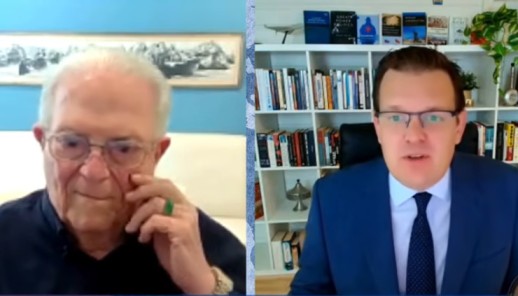
EDITOR’S NOTE: Ambassador Chas Freeman, former U.S. Assistant Secretary of Defense and Ambassador to Saudi Arabia during Desert Shield and Desert Storm, joins host Glenn Diesen to assess two crises now colliding: the return of U.S.–Iran fighting and NATO’s conduct of the war in Ukraine. Drawing on decades at the center of American diplomacy and defense policy, Freeman argues that Washington has abandoned a chance to de-escalate with Tehran and that NATO has used Ukraine to weaken Russia at Ukraine’s own expense. This Greater Eurasia Podcast episode premiered September 3, 2026.
TRANSCRIPT:
Welcome and Introduction
GLENN DIESEN (00:00:00 – 00:00:14): Welcome back. We are joined today by one of the great American diplomats, Ambassador Chas Freeman, who was the former US Ambassador to Saudi Arabia and also the Assistant Secretary of Defense. Thank you for coming back.
CHAS FREEMAN (00:00:15 – 00:00:18): Very glad to be with you, Glenn, and good to see you.
The U.S. Return to War Against Iran
GLENN DIESEN (00:00:19 – 00:01:16): So we see that, well, the United States, it signed the MOU to get out of the war, and then more or less shortly thereafter, return to war. And now last week we saw the US announced, I mean, Bessent said it also, I think Marco Rubio, that the economic sanctions and the blockade were so successful that there was no need to go back to kinetic strikes anymore.
And well, this week the US restarted the fighting against Iran with bombing, especially its port cities. And the last 48 hours, the Iranians have really been responding. They’ve been hitting targets in Bahrain, Kuwait, Jordan, UAE, and also one target at least in Iraq. I was wondering, how do you assess the situation? That is not the actual damage on the ground necessarily, because we haven’t seen that, but why going back to war?
CHAS FREEMAN (00:01:17 – 00:05:14): Well, I think of the famous remark by the great Israeli foreign minister in the early days of Israel, Abba Eban, who said that of the Palestinians, but really should have been referring to the United States, that they never miss an opportunity to miss an opportunity.
I mean, the MOU was an opportunity to call it quits and cut our losses and leave. And we didn’t take advantage of that. Quite the opposite. We immediately began eroding it and violating it and eventually ended up with no compliance at all. The Iranian position remains that when and if the United States implements its undertakings in the Memorandum of Understanding, there will be the opening of the strait. And of course, the 60-day period for negotiating a settlement of this dispute has expired.
And it is apparent that the Trump administration does not know of any method of influencing foreign behavior other than thumping them with, that is, the pesky foreigners, with bombs and missiles. So we are back at it, and very predictably, our escalation has been met with counter-escalation on a higher level by the Iranians.
As you said, we do not know the extent of the damage in the various American military facilities that have been attacked because the Pentagon has a rule, conceals, covers up whatever the damage is. But there is undoubtedly some bad damage, and it may be significant. It has been enough time passed so that equipment which had been destroyed in earlier Iranian strikes may well have been replaced and now destroyed again. So this is a losing game. It does nothing.
And I know that in the middle of this, the claims that the strait is open are belied by the attacks on 2 Saudi oil tankers. Which were apparently attempting to sneak out with American support, and which struck mines in the Strait of Hormuz, which gives the lie to the claim by the Central Command that they had removed all the mines in the strait. And in effect, a blockade of a strategic line of communication like a strait is enforced by the insurance companies, and they must judge that in fact any ship that attempts to enter or leave the Strait of Hormuz is in jeopardy. The insurance rates must be colossal, and very few tankers will risk a transit under these circumstances.
There is a lot of nonsense on social media, some of it swallowed by reputable organizations. Goldman Sachs, for example, has a really absurd report on how much oil is getting through the strait, totally incredible. So this brings me back to the final point, which is that all of this is as much an information war as a kinetic war, and the American information war is transparently built on gossamer fictions, lies. They don’t work. Reality has a habit of destroying the, or refuting the absurd statements that come out of the Pentagon and the White House briefing room.
Israel’s Strategic Position
GLENN DIESEN (00:05:16 – 00:05:48): Well, given the, I guess, the decision to go back to war, we see Israel already somewhat overstretched. How do you see its position in the region though, the strategic position being? Because I can understand if the US would succeed in the war against Iran, it would strengthen Iran’s position, but going into this war and then failing, it looks as if, you know, Israel, which is already very vulnerable, would be put in an even worse situation.
CHAS FREEMAN (00:05:49 – 00:08:44): Well, the war was undertaken, as we know from explanations by Marco Rubio and others, on behalf of Israel. It did not respond to any direct American interest. It was derivative from the Israeli interest in subduing Iran and eliminating opposition to its greater Israel project of expansion in the region and subjugation of its neighbors. And it failed. And there is no military option now, especially since the United States has depleted its magazine, its stores of weapons, which are relevant either to the Persian Gulf or to other theaters.
Therefore, notwithstanding Israeli pleas that the United States continue the war against Iran, even though Israel is no longer participating in it, Israel is instead concentrating on ethnic cleansing in the West Bank, completing the genocide in Gaza, turning southern Lebanon into a wasteland, and annexing land in Syria while contesting influence in Damascus with the Turks. It has basically left the United States to fight a war it instigated.
But there are no military options, and therefore the U.S. government has fallen back on a tried and true failed approach of economic warfare, attrition, a warfare of attrition economically, and on the theory that the Iranian economy is in difficulty, which is true, and that the Iranians will therefore fold before the United States does. But this is highly improbable. I do not think it has any credibility outside the Oval Office, which invented it.
And so the prospects are that we will, and I think I have discussed this with you in the past, you know, the normal situation is warfare in post-Ottoman West Asia. And I guess we are back to that with tit-for-tat exchanges now between the United States and Iran affecting the interests of American client states whom we can no longer protect, and eventually probably reaching back to Israel. So we are in a cycle of escalation and counter-escalation, much as is the case in Ukraine.
The Path Forward: Escalation, Nuclear Options, and the Limits of Force
GLENN DIESEN (00:08:46 – 00:10:20): Well, yeah, actually, I did want to ask about Ukraine later on, but I just want to add one more question about this. That is, the calculation by Trump, at least listening to his rhetoric, is that if we just strike the Iranians hard enough, so the military pain, if we can destroy their economy enough in pursuing this economic pain, then this would compel the leadership to surrender. If they don’t want to surrender, then at least we can make it so painful that at least the people take to the streets. You know, this is what very recently now Donald Trump wrote on social media as well. “Rise up! You know, the country is being destroyed.”
But well, given that any defeat of Iran wouldn’t just mean going back to the old 47 years of status quo of continuous threats and sanctions, but it could even mean the destruction of Iran itself. It doesn’t seem that this would be likely. In other words, the Iranians will be prepared to absorb these costs. Where does the US go from here then? You mentioned stuck in escalation. If there is no path to peace, if none of these military and economic means aren’t working, do you think it is likely that the US could reach for a nuclear weapon? And if the US wouldn’t, and I just spoke with Joe Kent and he was making the point that perhaps the Israelis will tell the Americans, you know, we could launch a nuclear strike, you just look the other way. Do you see this as a likely possibility or?
No Stated Objectives, No Exit
CHAS FREEMAN (00:10:21 – 00:18:57): Well, there are quite a few things in that question that need to be addressed. One is the obvious point that there are no stated objectives of any of this. That is, there is no “yesable proposition” putting forward to the Iranians. What could they do that would halt the maximum pressure campaign? Nobody knows.
I mean, their judgment is that the United States is simply biding its time to reconstitute its forces and try again. And the irony is that we started all this with an alleged objective of getting rid of the purported but never confirmed Iranian nuclear weapons program. We had an objective of regime change. We had an objective of inciting rebellion in the streets. We had an objective of depleting Iran’s arsenal of missiles capable of striking Israel, and cowing Iran into submission.
We’re right back at the regime change thing because there is no specific demand. Now, when you try for regime change, you should know what the new regime is going to look like and how it will be better than the old regime. We tried for regime change February 28th following, as we did in June of last year. And in each case, the successor regime has been more hardline, more difficult to deal with than its predecessor. And I don’t see any reason to doubt that that dynamic would continue. So this is a pointless war that Trump has gotten the United States into. From which he has no apparent exit. He is not willing to admit that he would be better served and the United States would be better served by cutting our losses and retreating.
The Nuclear Undertone
So there is all that. Now, on the question of nuclear weapons, there is a possibility that Iran’s notable exemption of Israel from its attacks on American installations, aircraft, and the like, is the result of some private Israeli communication to Tehran, which threatens nuclear attack. In other words, Iran is playing it safe by not involving, re-involving Israel, despite the fact that the Memorandum of Understanding required Israel to end its depredations. In Lebanon, among other things. And so there is an undertone of Israeli nuclear threat here circumstantially. No proof that that’s the case.
And of course, there is talk in the Pentagon of the use of tactical nuclear weapons, not just in Iran, but elsewhere. And this is a very frightening thing because that would cross the nuclear threshold once and for all and legitimize the use of these weapons of mass destruction. I do not think anybody wants that.
I have made the point that on the Iran nuclear program that we have provided Iran with the best possible argument for developing a nuclear deterrent. Since all other deterrents have failed. And yet Iran has apparently not, at least openly, developed a nuclear weapon. We don’t know what it may have done clandestinely. And of course Israel has been obsessed with the notion that Iran might emulate it by clandestinely developing nuclear weapons, thus ending the Israeli nuclear monopoly in the region.
That has been interestingly not ended but compromised by the Pakistan-Saudi-Turkey tripartite entente, which implies a Pakistani nuclear role in security for the region, the Pakistanis being an openly declared nuclear power.
Turmoil in Washington
Would the United States use nuclear weapons? I think there would be tremendous resistance at senior levels of the U.S. military. Whether that would sway Donald Trump and his sycophantic advisors, who apparently fear saying anything to him that he doesn’t want to hear, I don’t know.
At the moment, however, it’s very interesting. We’re seeing regime change in Washington. That is to say, the devotees of Marco Rubio are on the rise, pushing out the followers of Vice President Vance everywhere, the Secretary of the Army being the most notable case in point. We are seeing the military object to the deployment orders they are getting, that is the regional commands. Which are the warfighting commands, objecting. We are seeing the Secretary of Defense, the self-proclaimed Secretary of War, under increasingly vicious attack in the press for incompetence and for damage to the prowess of the American armed forces, as well as, of course, for his racist, misogynist attitudes and his persecution of military officers of color or the wrong gender.
So the United States is in a bit of turmoil at the moment, and no one can tell what will happen in this case. We’ve just seen the President of the United States threaten Great Britain that if it didn’t buy more weapons from the United States, we would turn over the Islas Malvinas or Falkland Islands to Argentina somehow. I suppose we could do that. But what would be the point? I guess we like Mr. Javier Milei, the president of Argentina, a great deal. He’s another nut job. And I guess the world’s mentally ill leaders need to stick together. So perhaps we will support him in the Falklands.
Sanctions and the Shanghai Cooperation Organization
Who knows what will happen? And that is precisely the point. Since nobody knows what is going on or what might go on, nobody is inclined to follow the American lead. So we have a request from Washington, you know, everybody should double down on sanctions against Iran. But the sanctions are not against Iran. The United States has no trade or financial dealings with Iran, so we cannot sanction Iran. So, we are demanding that everyone else do it for us. And we are demanding that at the point of an economic threat, sanctioning the biggest bank in Egypt, for example, and threatening to do other sanctions on countries that continue to deal with Iran.
This has not cowed either the Chinese or the Russians or the Arabs more generally. And we have just seen the Shanghai Cooperation Organization meet in Bishkek, Kyrgyzstan, and roundly condemn American policy toward Iran, then demand an end to the war and the repudiation of these secondary sanctions which are aimed at them as the means of putting pressure on Iran.
So this is all crazy stuff and it just doesn’t compute and it isn’t going to go anywhere. And therefore I come back to the thesis that we’re in a state of war which is expressed in intermittent strikes and counterstrikes for as long as we can see forward. There’s no diplomacy going on. At all.
Sanctions as a Self-Defeating Tool
GLENN DIESEN (00:19:00 – 00:19:58): Yeah, no, the sanctions policies, it does— sanctions tend to use if it’s moderate over a shorter period of time, but going after China, telling the world not to buy Chinese technology, going after Russia, telling the world not to buy Russian energy, going after Iran, telling no one to trade with them, and then of course using the tariff weapon left and right against adversaries and allies alike. It becomes, it seems, well, self-destructive because at some point countries begin to reach the conclusion that it’s easier just to absorb the pain from the US and at least trade with the rest of the world. At least if you trade with the rest of the world, you diversify, you make yourself a little bit more immune to this kind of economic coercion. But no, it seems like they’re betting everything on this though, because now, I mean, if the goal is to split these countries, prevent them from trading with each other, they’re doing the exact opposite, as you said, from—
CHAS FREEMAN (00:19:59 – 00:26:24): It’s a bad bet. It’s a very bad bet. I know something about sanctions. In the apartheid era in South Africa, I was the administrator of the Comprehensive Anti-Apartheid Act and therefore responsible for administering sanctions.
Generally speaking, sanctions are political gestures that cost those who make those gestures nothing. Very often they appease their own constituents. So in the case of South Africa, there was a ban on apple imports. By whom? By the state of Washington, senators from there, and the senators from West Virginia, 2 apple-producing states. We banned imports of South African coal or purchases of it until we recognized that our own coal sales depended on blending South African coal into them. We banned, we lifted the South African sugar quota, which disempowered Zulu sugar farmers in Natal, KwaZulu-Natal. And so, and so it goes.
But sanctions are effective for the politicians who advocate them because they shift the burden of policy pain onto someone else. They don’t pay any price. They’re able to go to the voters and say, “Well, look, I’m tough on apartheid, I’m tough on Iran, I’m tough on China and Russia or whatever.”
But more importantly, they’re not effective as an instrument of influence, except as a threat in conjunction with negotiations. If you are conducting a negotiation and you say, “If this negotiation fails, then you will be subjected to sanctions,” that adds to the leverage you have in the negotiation and increases the prospect of a successful outcome. But once you impose sanctions, the market immediately rearranges itself. People find ways around them. People find ways to profit from them.
The South Africa Precedent
And in the case of South Africa, very relevantly, there was an arms embargo on South Africa. That was the basis for the development of Armscor, one of the world’s great military-industrial combines. The South Africans actually produced their own nuclear weapons and cruise missiles with a little help from the Israelis. And so when you impose sanctions, you basically give the target country the benefit, the equivalent of a tariff wall or an import ban. So, industries and agricultural enterprises that would otherwise not be viable become viable because they’re protected.
Final point on this, and again using the South African illustration, when South Africa was under sanctions, its wines, which are quite good, but were not excellent, were really not competitive in international markets. They were sold in Southern Africa under strange labels. I remember Margaret Thatcher went to Lusaka for a meeting of the Commonwealth in which she was the only government representative. Britain was alone in opposing sanctions on South Africa. But the irony was that at the Commonwealth meeting, the wine that was being served was labeled “non-aligned wine,” and it came from South Africa. And so where there’s a will, there’s a way.
Once the sanctions were off South Africa, South African wineries had to compete internationally, and what were good wines became excellent wines. So I think that this is a very strange thing. Basically, I would say economic power is only really effective as an attractive force. You can pull countries together like the European Union by enlisting economic integration. But if you try to push on economic ties, it’s like pushing on a string. It really doesn’t accomplish anything.
Woodrow Wilson’s Flawed Premise
So this is all the product of a farcical claim originally by Woodrow Wilson that sanctions were more terrifying than warfare and that anyone subjected to them would immediately surrender. Well, he said that back in 1917, and we’ve had now how many years? 111 or something, 109 years of experience that refutes that claim decisively. And yet here we are, still in the same game.
Final note on this is, this is having terrible effects on the bond market. You know, people buy bonds because bonds are less volatile than shares on the capital market, stocks. But now bonds are volatile and interest rates are going up. And people are cashing in short-term bonds to buy long-term bonds with higher rates of interest. And people are not all interested — not all people are interested in long-term bonds because they calculate that the policies the Trump administration has followed are going to boost inflation to intolerable levels, and that long-term bonds therefore will cause you to lose rather than make money.
So there are lots of knock-on effects from this stupid policy. It is not going to bring Iran to its knees. It is not going to endear the United States to others. Whether Great Britain steps up its purchases of American weaponry or not, I think the Falkland Islands will not become the Islas Malvinas.
Europe’s Energy Miscalculation
GLENN DIESEN (00:26:27 – 00:27:17): No, I don’t see it happening right away either. Well, with the sanctions, though, we have the same. We saw the same problem in Europe. The idea that they think they can control the markets when they cut themselves off the Russian gas and the oil, but they still needed energy. So they instead went to the Middle East, and then they start snatching up all the energy which India would need, and then where they usually buy. So driving up the prices so that essentially forced the Indians to go buy from Russia where they hadn’t bought much before. Even the Americans told them to, “You should go to Russia, buy, so stabilize the energy prices.” And, you know, so the Russians ended up making more profit and the whole thing was kind of pointless. Now the Europeans are upset with the Indians because they’re buying the Russian energy after the Europeans went for the Middle Eastern energy.
CHAS FREEMAN (00:27:17 – 00:28:39): At a big discount too, usually. Yeah. But, you know, think of the absurdity of the United States telling countries that import oil from the Persian Gulf, “Don’t use dollars to buy oil because you can’t, because we’re going to stop you.” If it is possibly Iranian oil, you are going to be cut off. SWIFT, the messaging center in Brussels, that is the center of the dollar transaction trade system. If you say to people, “You may not use dollars to buy something you need,” what do you suppose they’re going to do? I think they’ll find another currency to do it in, do it with, and indeed that is happening.
So this is self-destructive and idiotic, and rather like the blockade of the Strait of Hormuz by the United States. Iran, you know, probably would have been able to conduct an effective blockade on its own, but we are helping it, you know. And every country in the world is suffering from energy shortages increasingly as a result of the joint U.S.-Iranian blockade of the Strait of Hormuz. You know, this, you couldn’t make this stuff up. It’s crazy. Alice in Wonderland.
GLENN DIESEN (00:28:39 – 00:30:04): I think that was one of the Iranian concerns. That is, they wanted the economic pain on the United States because that was the main instrument. But they were a bit concerned that the rest of the world might blame them. And then Trump puts a double blockade on and relieved them.
I mean, it reminds me of when Obama essentially said, you know, we’re going to make the ruble into rubble. We’re going to, you know, we will be behind their economic problems. And essentially all economic trouble that emerges in Russia is — the government no longer holds responsibility because Mr. Obama was on TV taking credit for it. So yeah, some things I don’t think they always think through.
But it’s a bit the same with this. Well, the same would apply with wars though, because you went through the different objectives before — the U.S. objectives in Iran — and again, they wanted regime change, the people to go against the government. Instead, now they rally behind the government. They wanted Iran to cut its ties with its allies. Now the allies have become more important to Iran than ever before. They wanted to scale back the ballistic missiles. Now Iran is replenishing its missiles at a rate we didn’t expect. And also it’s imperative for their survival. So there’s no way they’re going to do it now. And of course, the nuclear issue where they didn’t even pursue a nuclear weapon in the past, they might do now. And yeah, of course. The whole idea—
Iran’s Nuclear Calculus and Israel’s Internal Fractures
CHAS FREEMAN (00:30:04 – 00:34:32): Sorry, I think, Glenn, that the principal constraint on Iran now — obviously Iran is not subject to any international supervision of its nuclear programs anymore. That ended with this war. And it’s not going to be renewed, I think. But Iran is constrained by the view, its understanding, that if it emulates Israel in going nuclear, that this will cause the Saudis, the Egyptians, the Turks, and possibly the Iraqis to do the same. So it will be surrounded by nuclear powers, not just menaced by Israel, but by other powers in the region with whom it has a kind of tangled history. It now has 2 nuclear powers on its flanks, Pakistan and Israel. It would end up with 4 or 5. So I think that is the principal constraint on the Iranians actually going ahead with that to develop a warhead.
And then the other thing is, I suspect there are people in Iran who imagine that the only effective use of a warhead would be to put it on an ICBM, much like the North Koreans have done. To strike the United States. That would give Iran the deterrent against American action that it has lacked. And so I think we have done ourselves really a very bad disservice and greatly increased our own insecurity while increasing Iran’s apprehensions about us. So I think that is, on the nuclear front, that is an important matter.
I think there is a possibility that, Israel is not doing well. You mentioned that it was overextended on many fronts. That is true. I mean, the Chief of Staff of the Israeli Defense Forces, Herzi Halevi, has warned that the IDF may fall apart. We have Israelis emigrating in very large numbers, and the people who are emigrating are the best and the brightest, the backbone of the startup economy that Israel has been so famous for. So Israel is draining its talent in the direction of other countries in Europe, the United States. Elsewhere. And this is very bad for its prospects of survival. It has also, of course, alienated the majority of people in the countries that traditionally supported it, whether it’s the United States or Britain or Europe beyond Britain. So it has isolated itself politically and potentially economically. I mean, more and more countries see a reason to sever their economic ties with it. So not a pretty picture.
One has the sense that the Israeli election coming up in October, that Prime Minister Netanyahu and his opponents are going full blast on Israeli nationalism, anti-Palestinian programs. The Minister of Interior, Itamar Ben-Gvir, has shown and now taken down a video — AI produced — showing overweight Palestinians on a conveyor belt going into a torture chamber, concentration camp, and coming out emaciated and trembling at the other end. In other words, he’s basically reimagined the Holocaust for the Palestinians. What is the point of this? I can see the point in terms of extremely dysfunctional attitudes on the part of much of the Israeli public. But the foreign reactions to this are obviously horrendous and not taken into account at all. So Israel is doing itself in, quite without regard to what happens with Iran.
Ben-Gvir’s AI Video and Israel’s Self-Inflicted Damage
GLENN DIESEN (00:34:33 – 00:34:58): Yeah, the weird thing about this AI video posted by Ben-Gvir was it’s intended for the election. It’s supposed to win votes with this, making an Auschwitz for the Palestinians. I mean, this conveyor belt, industrial conveyor belt leading them into the slaughterhouse. I mean, it’s quite strange.
CHAS FREEMAN (00:34:59 – 00:35:40): It’s just awful. I mean, it’s unspeakable, really. And it’s so destructive of any residual affection for Israel internationally that, yeah, it tells you a great deal about the attitude of the voters as seen by politicians like Ben-Gvir, who is an effective politician, whatever else he may be — they respond, they approve of sadism. They approve of torture. They approve of sodomy of prisoners. They approve of slaughter. And so that is an own goal if there ever was one.
Ukraine’s Escalation and the Risk of NATO Overreach
GLENN DIESEN (00:35:43 – 00:36:42): Well, on the topic of reckless escalation — you mentioned Ukraine before, and I would say we’re already going up the escalation ladder, but it appears that it’s going to be maybe hard to control from now on, because after this 40-day strike on the deep strike inside Russia, where the Western leaders say what great strategists, and of course they’re providing the weapons and the intelligence to strike these civilian targets. You saw now the Russian retaliation being quite brutal, that it’s not just bombing of Kyiv, the naval blockade on Odessa, but things appear now to be going, let’s say off a cliff for the Ukrainians on many levels. There’s a lot of problems building up, which makes me concerned that NATO would do something foolish to try to rescue the situation or at least stabilise the front. I was wondering, how do you read the situation now in Ukraine?
CHAS FREEMAN (00:36:43 – 00:41:57): Well, President Zelensky — acting President Zelensky since he’s exceeded his constitutional term in office — has just threatened all aviation in Russia. That means those airlines that did not follow the North American and European boycott of Russian airspace. Chinese airlines, Qatari airlines, Emirati airlines, Middle Eastern airlines generally, African airlines, and of course Russian airlines. This is an escalation that invites a response which would be terrible for Ukraine. Every time Ukraine has escalated, the Russians have counter-escalated, and that pattern is going to be repeated.
Meanwhile, 2 things are happening. One is in Western Europe and in the European Union, in the Baltics and elsewhere, there is a ferocious campaign of disinformation intended to alarm people about a Russian threat of invasion going on. Frankly, I don’t think it has much credibility. We have an incident at Leipzig Airport which has immediately been attributed to Russia. Maybe it was a Russian action, who knows? But the whole effort to alarm people and rally support for Ukraine by doing that is in full force. And it does support the escalation-counter-escalation cycle.
And in the middle of all this, Ukraine is falling apart politically, and Zelensky is in an increasingly shaky position. When the CIA Director Ratcliffe made his mysterious visit to Moscow, my initial thought was, the key to a peace agreement now is obviously a change of government in Kyiv. Ukraine is falling apart. It’s trying to recruit women to replace men on the battlefield because it’s run out of manpower. Its industry, its infrastructure, its energy before the winter comes — its heating ability before the winter comes — are all being destroyed. It can’t export anything. Its import of military equipment by sea is stopped. It’s basically landlocked now, and it’s really on the ropes. The Ukrainians have proven remarkably resilient, so one can’t write off Ukraine, but it is clear that it has never been under this degree of pressure before, and the calls for the removal of Zelensky are mounting.
So I thought maybe Ratcliffe was going to Moscow to say, what if Zelensky is displaced by someone who’s willing to actually negotiate along the lines of the Istanbul Agreement of 2022? What would your reaction be? Would you embrace a negotiation? Could we get rid of this war in that way? And the implication being that maybe the United States might, instead of threatening Britain with the loss of the Falkland Islands, rein in MI6’s encouragement of Zelensky’s escalations and maybe even help to arrange a graceful departure for Zelensky to one of his numerous villas elsewhere. I thought maybe this would have been an intelligent approach to this issue, not terribly noble, but intelligent.
I don’t think that’s what happened. I think Ratcliffe went there with a message from Washington that was not conciliatory, that offered no off-ramp for the Russians. And I think the Russians are about to go hell-bent for leather against Ukraine. So we have an emerging crisis. Europeans now more agitated than ever, less willing to talk to the Russians than ever, criminalizing dialogue with Russians actually. And Ukraine falling apart politically. And the Russians on the warpath. This is about as bad a situation as you could imagine. And how does it end? Again, Abba Eban’s remark comes to mind. The United States never misses an opportunity to miss an opportunity. I think we had an opportunity with the Ratcliffe visit given the circumstances. I see no evidence that anyone thought about that.
Kennan’s Warning and the Criminalization of Diplomacy
GLENN DIESEN (00:41:59 – 00:42:59): In ’98, George Kennan gave this interview to Friedman in the New York Times, and at the end of it he made this comment — well, the whole interview was about him warning against NATO expansion that essentially would take us where we are today — but he was making the point that getting us out of the Cold War alive was one of the great achievements. And it was sad to see it was all being thrown away by essentially restarting the Cold War by expanding NATO. But we did get out of the Cold War. We survived it. It’s just strange that we’re willing now to essentially risk nuclear war on the principle that NATO must expand. There is no other option. There is no middle road. Any compromise that can maybe be made. Indeed, we criminalize diplomacy. We signal that we’re now ready to essentially fight the Russians. We show that intentions even though we don’t have the capability. It’s very risky.
NATO’s Real Agenda and Ukraine’s Abuse
CHAS FREEMAN (00:43:00 – 00:45:57): Yeah, it’s incredibly risky. And on top of it, I would dispute that we still have an agenda of NATO enlargement. I think that is pretty much drawn by the boards. What we do have — the Europeans have and the Americans have — is a retreat to Lloyd Austin’s formulation for what the war was about, to weaken and isolate Russia and to do it through Ukraine at the expense of Ukrainians. Ukrainians have been terribly abused by NATO, by the European Union, by the United States. They have suffered terribly, not in their own interests, because as was shown at Istanbul, they could serve their own interests in a negotiation with Russia. They basically signed up for the American and European agenda of doing Russia in.
Kaja Kallas talks about breaking Russia up into its constituent parts and other wild schemes. I suppose the Laplanders in Finland would be happy to have Russian support for secession. But anyway, this is not a fruitful approach. And the risks are rising. So I hope someone takes advantage of the apparent opening in Ukraine for more flexible policies. Ukrainian polls show the people are very eager for an end to this war for understandable reasons, and they’ve had enough. And those who are left — a very shrunken population by comparison with the start of the war — those who are left would welcome a regime change in Kyiv.
And we have now Fedorov and others advocating that. That is what calling for elections means — a change of regime, a government that is prepared to do what Zelensky ran on in his election campaign, namely deal with Moscow, work out a deal, work out a modus vivendi, a way of living side by side with the Russians. Of course, there’s so much hatred now, and it’s even spilled over. Ukrainian actions now have alienated the Poles to an alarming degree. This is a country that is in desperate condition and flailing around in ways that are essentially self-destructive. Someone needs to put an end to that.
NATO’s Abuse of Ukraine and the Path Forward
GLENN DIESEN (00:45:59 – 00:47:07): Well, I think that I agree there with the assessment of NATO is abusing Ukraine, but the general public in Europe at least, they do not see it this way because the political media establishment has very well formulated what they’re doing to Ukraine as helping Ukraine. Because yes, you’re right, the majority of Ukrainians want to have immediate negotiations, the vast majority. But when the Europeans boycott diplomacy, they say this is to support Ukraine. That is, they will never put any of this Ukrainian majority on the TV screen. You will only see on our TV screens those Ukrainians who are chanting for a fight till the end. Most of them are, of course, abroad, so it doesn’t make much sense. But also pro-Ukraine now means supporting Zelensky, ignoring any call for elections, ignoring the Russification. But I think that’s where they are. They support Zelensky’s uncompromising position as supporting Ukraine.
CHAS FREEMAN (00:47:07 – 00:48:14): Because Ukraine is doing their dirty work for them. And they’ve actually openly said so. And they didn’t care about the Ukrainians. They care about weakening and isolating the Russians. And so, this whole thing is bass-ackwards, as they say. It is upside down. Helping Ukraine would mean helping to produce a democratic, prosperous Ukraine that was at peace with its neighbors, Russia, Poland, Romania, and others, Hungary, which dealt with its minorities fairly rather than prejudiciously. And that’s not what we’re doing. That is not what we’re doing. And we remain, as I said at the outset of this war, prepared to fight to the last Ukrainian. And the last Ukrainian is somewhere out there at this point.
Ukraine’s Democracy Under NATO Stewardship
GLENN DIESEN (00:48:17 – 00:48:37): Yeah, but the celebration of Ukraine as this wonderful democracy under the stewardship of NATO, it’s also a bit absurd because the Ukrainians — they had the democracy in 2014. Now they have a ban on elections, purging media, political opposition, language, culture, the church.
CHAS FREEMAN (00:48:37 – 00:50:31): I mean, it’s a dictatorship and it may be valiant, a valiant dictatorship. And we can all, like Pete Hegseth, extol the warrior spirit in Ukraine. But it’s suicidal and needs to be recognized as such. You know, I think you can have elections and we have elections in the United States, or maybe we do. We’re not sure at this point whether we’ll have them or not. They have them in Russia. They have them in lots of places, Kazakhstan, so on. Does that make democracy?
Ukraine is not having elections. And as you said, it has banned political parties, it has nationalized the media, it has banned the Russian Orthodox Church and created a nationalist alternative. It has continued to enforce draconian conscription practices. You know, we are now told that it needs to recruit 30,000 people a month to replace those who are either killed or desert on the battlefield.
The end is coming. When? I don’t know. Ukraine has been, as I said, enormously resilient and resourceful. So have the Russians been, by the way. And so they are, after all, cousins. So this is not headed to any outcome that will please anybody in Ukraine, in Europe, and it will leave the Russians oriented eastward rather than westward, which is not a strategically desirable outcome.
Isolating Russia and the 2019 Elections
GLENN DIESEN (00:50:31 – 00:51:51): I was going to say, earlier on you spoke about the efforts of isolating Russia, and that could have worked in the ’90s, but these days you push them out of Europe, you push them into Asia, and I think that’s what you’ve been seeing now. But even when Ukraine has had elections, though, the last one being in 2019, you saw 73% voted for this peace platform. And immediately thereafter, the Western-backed fascist groups and nationalists, in cooperation with these Western NGOs, drawing essentially red lines under the entire peace platform.
So all of this about speaking to Donbas, implementing the Minsk Agreement, making peace with Russia, all of it was reversed. It was under these NGOs we financed there — they were called — it was referred to as capitulation, something, you know, “we stand with Ukraine, we can’t accept that 73% want capitulation.” So reversed it. I mean, you can have elections, but if you can’t change the policies, this is still democratic. Anyway, sorry, I had one last question though. You mentioned before that the Russians are might unleash hell on the Ukrainians now, or something of the sort. What do you think the Russians are going to do now? Because if the Ukrainians are on their back foot, I don’t expect them to — I mean, this is not the time to stabilize the fronts.
Russian Escalation and the Threat to Ukrainian Airspace
CHAS FREEMAN (00:51:51 – 00:53:50): This is, they will push hard on the front, as hard as they can. They are doing it apparently largely with standoff weaponry, glide bombs and the like. They are now using the jet-propelled version of drone, which is apparently more difficult to intercept because it flies at a faster speed. All of this will be stepped up.
But I think the most dangerous thing that the Ukrainians have proposed is attacks on civilian aircraft in Russia. I think two can play that game. And we remember the Malaysian airline that was shot down in the beginning, apparently by the Russians, although we do not know that for sure. And we are headed back into that. Ukraine could lose total control of its airspace, and that ought to disturb us. Ukraine has lost access to the sea. It may now be about to lose access to the air. This is not a good ploy.
I’ve thought all along, if you are the smaller party in a war of attrition, the weaker party, and you escalate, you basically give the other side an excuse to counter-escalate, and you can’t match them. Why pick fights where the other side has the preponderance of the strength and better options than you do? And yet Ukraine has repeatedly done that, apparently at Western urging. And that’s where we are. I don’t know what the Russians will do. All I know is they will do something. They will not fail to respond to what is an incredible violation of international law, basically under the rubric of terrorism, terrorism against civilian airliners. And they will respond.
NATO’s Role and the Risk of Further Escalation
GLENN DIESEN (00:53:52 – 00:54:34): Yes. And the worst part is, while our media will portray it as simply being a Ukraine-Russian escalation, I think the Russians will see this as being NATO-backed terrorism, of course, against Russia. So it’s, as you said, it’s an incredible escalation. So, but I am still surprised they were willing to go this far. But again, for NATO, we’re not really absorbing any of the costs because we’re fighting with Ukrainians, so they kind of have to take the punishment. But I think if we go after their airlines, civilian airlines, then it’s going to be very hard to pretend as if NATO’s an innocent part in this. So no, I think we’re going to go somewhere very dangerous.
CHAS FREEMAN (00:54:34 – 00:55:30): You have to assume, if that policy is more than a threat that it will rely on American and British intelligence to target the aircraft. So we are talking about, as you suggest, a major escalation with terrible consequences. And I think this could be the — what Zelensky hopes for, of course, is he hopes to provoke a Russian attack on NATO. Validate the thesis that Russia is a threat. Of course, Ukraine has validated the Russian thesis that association with NATO is a threat to Russia. You can ask anybody at a refinery in Russia whether that is the case or not. But I think we could be at a moment which breaks the — goes over a red line for the Russians.
Closing Remarks
GLENN DIESEN (00:55:33 – 00:55:38): Well, I guess we won’t end on an optimistic note today either.
CHAS FREEMAN (00:55:38 – 00:55:39): Another sherry conversation.
GLENN DIESEN (00:55:40 – 00:55:48): Yeah, it tends to be very gloomy, but thank you nonetheless. It’s, yes, I always appreciate your insights.
CHAS FREEMAN (00:55:49 – 00:55:50): Well, thank you, Glenn, for what you do.
Related Posts
- Pepe Escobar: Rise of a Post-Western World at the SCO Summit (Transcript)
- Alexander Mercouris: Ukraine Unravelling – War Enters New & Dangerous Phase (Transcript)
- Transcript of Nepal Floods: China’s Silence, Medog Dam And India’s Himalayan Nightmare w/ Abhijit Iyer-Mitra
- Transcript: ‘China Had 20 Minutes to Warn People’ – Lobsang Sangay on Nepal–Tibet Floods’
- Transcript of WW3 DEBATE: ‘We’re On the Brink of Global Collapse’ – Modern Wisdom