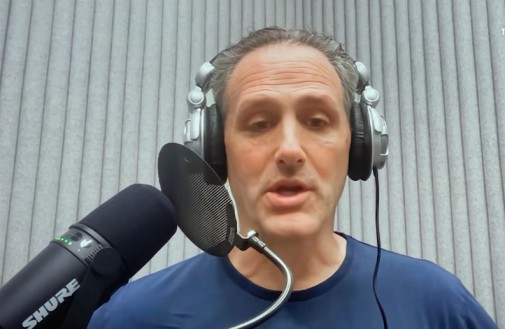
EDITOR’S NOTE: In this episode of The Prof G Pod, Scott Galloway sits down with journalist and author Josh Tyrangiel to discuss his new book, AI for Good, which examines how real people across government, healthcare, and defense are actually using artificial intelligence. The conversation ranges from AI’s role in reducing sepsis deaths at the Cleveland Clinic and modernizing the IRS, to the geopolitics of AI regulation, autonomous warfare in Ukraine, China’s AI strategy, and what AI means for the future of writing, education, and jobs. (This episode was premiered September 4, 2026.)
TRANSCRIPT:
SCOTT GALLOWAY: Josh, where does this podcast find you?
JOSH TYRANGIEL: I’m actually in the podcast office at The Atlantic right now.
SCOTT GALLOWAY: Wow. That’s a good rap. The podcast office at The Atlantic. Hipper, whiter things have never been said.
JOSH TYRANGIEL: Yeah, it’s better than a bunker in SoHo.
SCOTT GALLOWAY: There you go. So let’s bust right into it. Your new book, “AI for Good,” takes us inside government agencies, hospitals, schools, and the Pentagon to show how real people are actually putting AI to work. What was the inspiration for this book?
The Inspiration Behind “AI for Good”
JOSH TYRANGIEL: The inspiration was probably just a whole lot of bullshit, to be honest, in the sense that I was covering AI.
And when I would go out to the Valley, what I would hear from people sort of zealot-eyed on both sides was, on the one hand, “This is about to change everything for the better. Utopia is coming. We have to move really quickly. We’re going to cure cancer and we’re going to mitigate climate change.”
And then on the other side, I heard this sort of very familiar, “No, come with me if you want to live. AI is going to change everything and turn us into a sort of zombie apocalypse in which we’re enslaved mentally to the machines.”
And I was writing a column at the time for The Washington Post. And as a columnist, you’re like, “Well, this is great, right? We’ve got warring factions, power and money.” And after about 8 weeks of that, I just got exhausted of it because it was hype, and it was hype driven by financialization on both sides, often.
So I was having this conversation with a guy named Danny Hillis, who’s sort of a legend of computing. He created cloud computing. He’s in his 70s now. And I was sort of venting about this sort of early AI scene to Danny. And he, Danny just kind of has the patience of the Buddha, and he’s seen everything.
And so he smiles at me from the Zoom screen and he’s just like, “You need to separate the tech from the tech companies, because then you’re going to start finding interesting things like real experimentation and real people with values. Until you do that, you’re just going to be stuck in the hype cycle.”
And it embarrassed me to realize that I had not thought one could do that. I thought during these 8 weeks of just frantic coverage, “Oh, right, well, they own all the technology.” And in fact, people have been experimenting with tech outside the walls of these megalopolises for a long time.
And so as soon as I did that, I just kind of discovered this whole new frontier of people who were experimenting with AI to solve things that I actually care about and that they care about. And it was just a completely different scene. It was almost like countercultural, to be honest.
SCOTT GALLOWAY: And when you think about — give us some examples of what your book’s done a great job of is kind of using these on-the-ground case studies to highlight what’s overhyped, what’s underhyped. Give us kind of your 2 or 3 favorite case studies of how AI is being used and what it says about people’s perception of AI, where they get it right and where they get it wrong.
Cleveland Clinic and the Sepsis Prediction Model
JOSH TYRANGIEL: Yeah, look, I think that this thing has entered in a particular context, which is we’re already pretty skeptical of technology in the year of our Lord 2026. Because most of us who are of adult age were promised certain things with social media that turned out not to be true, and promised certain kinds of experiences with the internet that are not true.
I went to the Cleveland Clinic because I care a lot about healthcare and health outcomes. And one of the most fascinating things at the very front of my experience reporting there is I talked to the CEO. And Cleveland Clinic’s a great healthcare system, and naturally the CEO is a cardiac surgeon, right? He’s just come up through the ranks.
And he sort of smiled at me and he said, “Look, one of the things about healthcare is that it’s a terrible business. And as a result, a lot of people in my position are always looking to become the something else of healthcare, right? We’re going to become the Microsoft of healthcare.” And he said, “That’s not our mission. We’re a nonprofit hospital system. We have 2 things we do. Number one, we experiment with technology to improve the quality of care for our patients. And we experiment with technology to reduce our quite terrible business model and costs, so that we may pour more money back into the care of our patients. And so when we use AI here, it is only with those 2 parameters. That’s it. We’re not trying to create some new gangbusters thing. We have to solve within those 2 things.”
And he basically invited me to tour around. So what I saw was this very disciplined — unlike a lot of corporate America right now — very disciplined thought process, which is: we have specific problems, and we are going to find out whether AI applied properly can solve them.
And so the big one that I saw was the application of a sepsis prediction model in the hospital.
And so in about 2021, the clinic — you know, it was a very renowned system — looked at its sepsis numbers and realized about 3,000 people a year died in its care of sepsis, which is pretty standard across the country. But they said, “This is preposterous. This is a ridiculous number of people to be dying of something in our care.”
So they did a sort of system-wide commitment. And the first thing they said is, “Look, we’ve got to find people who we can educate here. Who’s going to captain this?” And second, they had a new CTO, and he came in and realized this is a perfect problem for machine learning, because sepsis masks itself by looking like almost anything. It can look like a cold. It can look like dehydration. It can look like an excessive wound. All of the responses are the same. You have this overwhelming amount of signal, but it needs to be dispersed from the rest of the body’s noise.
And so they went through this process. They reminded everyone in this 80,000-person system that sepsis could be anywhere. They imported a model called Bayesian Health, which is a very sophisticated model. And what I found in all my reporting is that the personal motivation of the people who make AI products is inextricable from their success.
So the woman who created the Bayesian model had a nephew who died of sepsis, and she just so happens to be a brilliant computer scientist, understood sepsis, and understood healthcare. So they bring her and the model in, they apply it through another system, which is Epic Health, which runs most of America’s healthcare systems.
At first it’s fine, but not great. And so they have to refine it, and they have to work at why it’s missing cases. They have to do it in an ICU, which is very different than doing it throughout the rest of the hospital. But what they got over the course of a year with sort of really dull, really unglamorous kind of commitment is that they reduced sepsis mortality in the system by 41%. So that’s more than 1,000 people who are alive because they had this very narrow focus about what they wanted to do. They had people committed to finding the solution to the problem, applying it, refining it, working with their systems.
And so at the end of the year — look, the thing that was most frustrating to the people in Cleveland Clinic — and I spent a lot of time with a nurse in the ICU whose grandmother died of sepsis — she was frustrated because in the ICU, where bodies give off all of these crazy responses constantly, they never got above 90% in the prediction model. And she could routinely walk the halls and look at a patient and diagnose them as septic, and AI couldn’t.
SCOTT GALLOWAY: Right?
JOSH TYRANGIEL: And so when I talked to the CEO about this, he said, “Look, 90% is pretty good, right? And what I’m looking for with AI is not, ‘is it going to solve my problem,’ but ‘is it going to improve the solution that I had before?'” And so when we hear 41% reduction in mortality — is it perfect? No, but it doesn’t need to be perfect to be useful.
And so that really stuck with me, because so much of the hype around AI is about perfection, is about this sort of silver-bullet technical solution to all of our problems. And what I found time and time again is that is just not how it works. But if you can get comfortable with it being better, with it needing to be nursed through a process and applied diligently, you can get better stuff.
SCOTT GALLOWAY: I’m curious if a lot of people talk about AI and potentially — it’s spawning a new, this golden age of discovery, which we’ve been waiting for in healthcare. I think of pharmaceuticals. We’ve been waiting for this golden age. I used to go to these Singularity conferences with Peter Diamandis, and he would talk about, “In 10 years, we’ll be growing limbs in a lab.” And while — the way I would describe progress in the healthcare industry is it’s been steady, unremarkable, and incremental, but it compounds. And now the majority of people who get cancer survive it. But we keep waiting for this acceleration of discovery, new drugs, new treatments. One of the things you’re talking about, it sounds to me like just operational best practice is what you’re talking about with the use of technology. Do you think we are potentially on the verge of an age of discovery around healthcare with the use of AI?
JOSH TYRANGIEL: I know why it’s tempting to say yes, right? I’m not sure we are. I think we’re entering an age where discovery may become more commonplace, where there may be more things — like we heard about the treatment of prostate cancer, which is great. But I tend to believe that that is sort of narrative-induced thinking, right? That we all want the moment of immense clarity when the solution arrives, when in fact it’s just what you described. Is it likely that we’re going to wake up one day and cancer will be cured? Or is it more likely that year by year, by treating it, by identifying it, we’re going to make cancer much less of a threat, until at some point in the distant future we say, “Oh, I’ve got cancer. Oh, bummer. That’s going to be a real pain for the next couple weeks”? I tend to think the latter.
SCOTT GALLOWAY: Yeah. I think — and it’s happening. I just wonder, I mean, and I don’t know how much AI had to do with it, but all these new drugs — for the first time, it feels like pancreatic cancer may not be a death sentence. Anyways, let me give you the 2 places I think AI is going to actually be monetized, and I’m going to kind of try and segue into AI and shareholder value or the economy, if you will. Have you done any work around AI and industrialized robots, or AI and autonomous driving? And this is a comment pregnant with a question. I think those are 2 areas where AI will actually live up to the hype. I think in most places it’s overhyped, not because it won’t be significant, but because the hype is just unsustainable or unrealistic. But I do think the place — I’m sitting here in Los Angeles, and if I look out my hotel room, I just see Waymos everywhere, which I think is an enormous unlock. And I think about manufacturing, and AI plus robots equals just much better robots. Anyways, robotics and autonomous — your thoughts?
Robotics, Autonomous Driving, and the Human Friction Problem
JOSH TYRANGIEL: Yeah, look, I think that they do hold great promise, and I think they hold great promise for a conjoined reason, which is that they don’t involve human beings in their operation.
SCOTT GALLOWAY: Right.
JOSH TYRANGIEL: And listen, I love human beings. I’m on team human. But when you try to engineer systems with human cultures, what you get is friction, and that friction slows things down.
So one of the reasons that, when you and Peter are talking about “we could grow limbs in 10 years” — yeah, we could, but we could also do about 30,000 other things. And so our inability to agree on what we should focus on dilutes our resource.
This is a common human theme: in areas where you can apply robotics and automation minus human beings, there will be rapid gains, right? So we’ve seen that the Chinese are operating warehouses and industrial centers, including an auto manufacturing plant, with a handful of human beings. That robotics — and not the kind of robots on “The Jetsons,” but like disc robots, much more blunt-force robotics — is capable of incredible operational efficiency.
When it comes to driving, controversial though it may still be, LIDAR and robotics are better drivers than human beings. They just are. There are fewer accidents. It’s safer on the roads. That’s a computer science aspect.
Now, when it comes to friction, particularly around automated driving, that’s a human system, right? And a lot of what you’re seeing as far as the friction is politics. So mayors, governors are now suddenly faced with this integration of 2 different systems, one automated and one human. People really like to drive.
And so I would be much more bullish, just strictly from a business perspective, on robots than I would be on Waymo or automated driving, because we still have to tackle the fact that human beings overestimate their own ability to drive. They love driving. They’re not going to get off the road. And so if you have one system that is a perfect sort of driving system interacting with human beings who are texting, maybe not paying as much attention — there’s going to be friction, there’s going to be collisions, and somebody from a political standpoint is going to have to say, “No, we’re doing it and we’re going to go all the way.” I look forward to seeing who takes that risk.
SCOTT GALLOWAY: You wrote actually a really — and it was one of those articles that gets forwarded to me, and very, very little stuff gets forwarded to me around AI, because I think people assume I’ve already read it. But in a 2024 essay, you argued that AI could remake the entire federal government. I’m curious, 2 years later, do you think that the government can actually still pull that off? And let me use a case study: the University of California, which I think is the ultimate economic elevator up, but it’s obviously a large bureaucracy, and I’m thinking a lot about it right now — $54 billion budget. How do you think AI can remake the federal government, and what are the best use cases to get started on that? Because that’s one of those big bold statements, right? “Cure cancer.” “Remake the entire federal government.” And I think a lot of people are up for the remaking of the entire federal government. Say more about what you mean, and give us specific areas where we could start that disruption.
Operation Warp Speed and Remaking the Federal Government
JOSH TYRANGIEL: Yeah, look, I’ll start with what the inspiration was, which was that I did a kind of deep dive into Operation Warp Speed, which many people have forgotten because of the stupidity of our politics. But Operation Warp Speed was the effort to distribute the COVID vaccine across the United States equally to every state in an incredibly expedited fashion.
SCOTT GALLOWAY: Huge success.
JOSH TYRANGIEL: No, huge success. Huge.
SCOTT GALLOWAY: Yeah.
JOSH TYRANGIEL: Got buried because it was a Trump administration success around vaccines. So the Trump administration has forgotten about it, and the left doesn’t want to celebrate it. But the architect of it was a general named Gus Perna. And General Perna is a logistician. So he delivers munitions, he delivers supplies, he keeps the Army stocked.
And he got this call basically in early May that said, “Hey, we may have a vaccine and we have no plan about what to do with it.” And so he comes — he meets with the Joint Chiefs, comes in, he has no budget, he has 3 colonels, and he starts to meet with consultants, all of whom are pitching him what you would expect, which is like “medical blockchain, we’re going to put hardware in every doctor’s office.” And finally, some people from Palantir come, as they do, and they said, “No, you need a digital twin of the supply chain. That’s going to get this done for you. It’s not going to be perfect. We’ll show you how to do it.” And he just was like, “Sold. Let’s do it. Let’s just build it.”
SCOTT GALLOWAY: Right.
JOSH TYRANGIEL: And similar to what I told you about the Cleveland Clinic and sepsis, what they ended up building wasn’t perfect. It didn’t have pure end-to-end visualization from Pfizer all the way to your arm, but it had a lot of it.
SCOTT GALLOWAY: Right.
JOSH TYRANGIEL: And what they were smart about is not letting the perfect be the enemy of the good. And they did this in a matter of months. And they did it with a program that cost about, as I recall, $16 million. A government software program could cost $16 million. The machine learning aspects of it, if we were to talk about them today, we’d laugh kind of at how primitive they are. But you’re talking about building data pipelines, cleaning the data pipelines, constantly updating them, getting to a dashboard so that the general and his team could play the pandemic like a video game.
And so he and I talked, and General Perna is a booming — he’s a classic general, he’s got a lot of personality. And he and I just sort of spent an hour almost like pyromaniacs in the backyard, thinking about ways we could apply this incredible success to other aspects of government, including things like the IRS, including things like the VA.
Inside the IRS: Modernization and the Disruption of Doge
So then I went off and tried to figure out if it’s possible. And so in the book, I spent a lot of time at the IRS. And the IRS is my own sort of personal bugaboo, because again, it’s 2026, and the way we interact with the IRS is we take a guess at what we think we owe it, we send them a check under penalty of criminal prosecution if we’re wrong, we don’t have any real record of it, we don’t have any real clear interaction. And these are numbers, and AI is fantastic at numbers.
And so I went in a little bit hot, to be honest. I started to discover what was going on in the IRS. They have immense political issues, right? This is a body that the left and the right don’t want anything to do with, because it’s so wildly unpopular. They’re dealing with mainframes, which are 1960s technology that is often updated. But the Individual Master File, which is the white whale of government tech, contains every individual’s tax record and every change ever made to that record. And the IRS, by law, has to keep those things, make them accessible. And so they have a weirdo tech stack.
But what I found was there are a couple of people in leadership positions who realized that the compact with the American people was at risk here, and that if the IRS couldn’t effectuate just basic service, it was going to have a problem. So sort of quietly, starting in 2014, they began to modernize, and they began to modernize using machine learning and AI. And the whole goal was simply to get the stack to a place where it would be in the present. Because then, as opposed to being written in COBOL and all of these ancient languages, you could begin to hook it up with off-the-shelf software that would make the experience of interacting with the IRS much more pleasant, much more predictable.
And as I spoke to people, including Alex Karp, who’s the CEO of Palantir, he said, “Look, the problem with government right now is that every action between the citizen and the government contains friction. And when something doesn’t work, the temptation to tear it all down becomes greater and greater every time.”
And so inside the IRS, what I found were people honestly egoless enough to take the swipes of whatever politician was after them, but to continue modernizing. And when I last reported with them, the day that I left my last interview with the CTO of the IRS was about 4 days before the election. And when I next checked in with him, they were about to migrate the entire Individual Master File to modern software.
And then Doge showed up. And what Doge did under the guise of being AI-friendly was really just dilettantism and vigilantism. And it was about finding fraud where there was no fraud. And they kind of undid a bunch of the progress that had been made with machine learning and AI.
And so it’s kind of a heartbreaking story, but what I saw is: we can absolutely use this software to improve the operations of the federal government, state governments, municipal governments — but we actually have to want to have those governments be successful. Because if we don’t, AI is just as good at destroying those things.
SCOTT GALLOWAY: So, and I’m a fellow traveler in terms of my interest in tax policy and the IRS. My sense is that probably the greatest tax cut that people don’t talk about was neutering the IRS’s funding. And my understanding is there’s $750 billion referred to as a “tax gap” — that’s basically taxation that’s just not collected because they don’t have the rules or the enforcement mechanism. And I love the idea of AI, quite frankly, just being a more efficient mechanism for figuring this shit out, collecting taxes that are due. But the fear I have with the practical reality — I’ll put forward a thesis: AI is going to create efficiency and compliance and enforcement across the simple and modestly complex tax returns, right? If you’re a nurse and you make $92,000 a year working for Cedars down the road here, AI will be able to go, “This is exactly what you owe. And by the way, we can flag all sorts of shit and see that you’re writing off your entire apartment and you shouldn’t.” And enforcement — boom, done. Whereas my taxes, which are substantially more complex, AI probably won’t be able to do. At least I don’t know if it’ll be allowed to do it because of the complexity, or how does it deal with me lawyering up with tax people, or enforcement, or political, whatever it might be. But I worry that technology is going to do a great job of enforcement around the lower middle class, but we’re still going to have a system mostly promoted by wealthy people that says, “No, don’t use AI on the most complicated tax form.” I mean, essentially the IRS or the government has figured out a way to make the tax system so complex that the only people who really benefit are the ones that can navigate by starlight or have GPS — specifically, rich people. The complexity takes money from the simple tax form and transfers it to the complicated one. Because if we try and audit Ken Griffin, they’re going to need a team of 30 people, which they don’t have. And anyways, AI has this perverse effect of another transfer of wealth from the young and the less wealthy to the wealthy in terms of our tax system. Your thoughts?
AI, the Tax Gap, and Wealth Transfer
JOSH TYRANGIEL: I agree 100%. I would say that’s not the fault of AI. It’s the fault of a system that is absolutely picayune, that makes it easy to hide, right? And you’re just not going to get AI that can roll out and manage all of this human complexity, because all of the laws that you just talked about, all of the shelters, were engineered for people to go hide.
And so one of the things that was interesting that I did see is that Danny Werfel, who was the commissioner of the IRS, was very aware that it is not really even legal to have AI substitute for a human being inside the IRS, but having it as a copilot — to look into things like the Dutch Sandwich, which is a tax shelter move that many wealthy people use — was actually pretty effective. But you had to know what you were looking for, and it was endlessly complex. You would need much more computing time than you would expect.
What I kept running into with government, as I’ve run into with my reporting on employment and inequality, is that the tool’s pretty good at doing what we want it to do. The big issue is: what do we want to do with our society? And this gets to safety as well, where — I’m sure you and your listeners have tracked — an OpenAI model just sort of escaped and attacked Hugging Face. Well, yeah, they can do that. What rules do we want to establish around it?
So when I was doing some reporting around AI and the future of employment, I had a lovely chat with a guy named Nick Clegg, who was both the former president of Facebook — I think it was still Facebook when he was there, not Meta — and also the Deputy Prime Minister of the United Kingdom. And he loves America. He’s a really smart guy, and he’s been both corporate and governmental. And what he said is that these issues are really disadvantageous to large, functional democracies. He said the people who will thrive when it comes to creating AI policy are the countries that are capable of having mature conversations. So like the Scandis, right? Where there’s a homogeneous group of people, relatively shared values, not that much distance to travel to talk. So those countries — countries that have no conversations at all, like the Chinese, who are able to implement policy by dictum — but when you’re the United States and you’re already fractious, coming to an agreement about how you want to use AI seems like a really big challenge, particularly when it comes to the fact that our politicians don’t understand tech.
And this is one of the real things that I emerged from in reporting the book: you’re expecting people to create regulations around this stuff who really don’t know what AI is and are often not using it. And as we think about the midterms, we have to begin to evaluate the literacy of the people who are representing us on the most important issue that we have. And we have failed to do that now for a quarter century.
SCOTT GALLOWAY: It’s really — it’s become such a, like everything else, it seems to be getting more and more politicized. One thing your book did, or your articles have done for me, is it softened my view of Palantir. I think I immediately had this gag reflex that Palantir is violating all of our privacy. I do like the fact that Alex just wraps himself in the American flag when I think so many big tech companies were virtue signaling by shitposting America, thinking that’s what their young employees wanted to hear. And he just said, “No, we’re very much pro-America, we’re pro-Israel.” I appreciate just how transparent and out of the closet around this is what I believe. You softened my view on Palantir. The impression I got from your work on it was that it is an innovation, and that the government is correct to embrace it.
Palantir’s Rise and Alex Karp’s Vision
JOSH TYRANGIEL: Yeah, I think that’s right. I do. I mean, the history of Palantir for most of its existence was a struggle just to exist, right? And so the first thing that they came up against in trying to make software for the Department of Defense was that the established contractors had such a moat around the Pentagon, that Palantir could be making cheaper software readily available, the software could exist, and the Pentagon just wouldn’t pay attention to it.
And so ultimately, what they did, which is not advised in most industries, is in 2016, they kept getting shut out, so they sued the DOD. And they basically said, “Look, there’s a law on the books by Congress, passed very specifically, that says if software off the shelf exists to solve a problem, you cannot go create new software with a new vendor. And we’ve seen endless versions of you doing this. So we’re going to sue you.”
And I read through the trial transcripts, and it’s just unbelievable. I mean, the DOD’s excuse is basically like, “Well, come on, that’s how we do stuff, guys. What do you want from us?” And so Palantir sort of broke through. And what they were able to do is ultimately they just have the goods, right?
And this is one of those instances where it’s very hard to remove the identity of the founder from the culture of the company. Alex is one of the co-founders with Peter Thiel. Those 2 do not agree on very many things. Alex is a self-identified socialist, backed Hillary Clinton, backed Kamala Harris. They met in law school and bonded over a handful of things, one of which is America should have the best software.
But ultimately, where they got to is: yeah, we can make things that are good enough, cheap enough. And Alex is half Black, half Jewish. He has a tremendous chip on his shoulder that he will be very open about. He’s like, “Look, my biography leads me to believe I’m going to be discriminated against by somebody somewhere.” So what I’ve infused Palantir with, as he says, is paranoia. “We have to be better and we have to be cheaper. And if we’re not, we’re going to lose.”
And so that’s a compelling founder statement. And they do, look, they produce the goods. You can disagree with the government’s use of Palantir, and whether they’re violating certain rights — they haven’t been found to violate them in court — but they believe that America needs the best software, and that they produce the best software. And so, you know, the government is a big client. It is hardly the only client. As I said, they do stuff for the Cleveland Clinic as well. It’s often transformative. It’s often pretty cheap. And so we have to reckon with the fact that it is a very good software shop with a very pro-American stance.
SCOTT GALLOWAY: You wrote something that was pretty controversial, or you made a statement about the possibility of nationalizing our most powerful AI systems. Say more.
The Case for Nationalizing AI
JOSH TYRANGIEL: Yeah. So this is an idea that’s floated around in a bunch of places. And when I first talked to Sam Altman shortly after GPT-3.5 came out — so we’re talking about early 2023 — I said to him, “This seems really powerful. Should the government take it over?” And he said, “Well, it’s funny you say that. In 2017, I went shopping to a variety of places in the federal government and said, ‘We think you might want to nationalize this.’ And nobody listened.” It’s like, “Oh, that’s interesting.”
SCOTT GALLOWAY: So let me just press pause. That sounds like bullshit to me. Is that true?
JOSH TYRANGIEL: So, listen, I take nobody’s word in the world of AI because of the hype cycle. I did some reporting on it. I went to people, particularly in DOD. DOD said they had not heard of it — that they had not heard of Sam Altman. They didn’t — they knew who he was, but they hadn’t had these conversations. I did talk to somebody in the executive branch who said, “Yeah, that might have happened.” It’s like, “Oh, okay.”
Now, I don’t blame anybody in 2017 for saying we’re not going to nationalize AI, because we have no proof of concept about what you’re even talking about. All I am saying in citing this as an example is: it has come up from both the people who make AI, it has come up from opponents of AI, including Bernie Sanders, including Steve Bannon, because they feel like — and I think this is where populism becomes a really important component of the AI debate — their lack of faith in our ability as a system to regulate AI leads them to this pretty extreme idea, which is, “We’re never going to be able to do it.” So let’s take board seats, and let’s take — Steve Bannon wants to take more than 50% of these companies.
Now, I think that’s a lot. I think it’s unprecedented in modern American culture. But it’s an interesting idea that keeps coming up, because I think people are really worried we’re not going to be able to regulate these companies, and really worried about the downstream impacts that may be negative. I would like to think we’re capable of more nuance than just saying we’re going to nationalize it. But maybe we’re not.
SCOTT GALLOWAY: Yeah, the idea is less crazy than it sounds, because if you believe the founders and some of the key executives of AI that this technology is more powerful than — is it fission or fusion for a nuclear bomb? I always get confused. But if it’s more powerful than nuclear bombs, would we have let Oppenheimer create a corporation and sell their nuclear bombs to France, sell into LVMH? It just makes a lot of sense. And you’re right, the nuance here is I think it’s way too fucking late. And regardless of Sam Altman saying — and all these people with the ridiculous notions that “regulate us” — remember Sheryl Sandberg saying they were open to regulation and meanwhile deploying hundreds, if not thousands, of lawyers to get in the way of anything resembling regulation. It feels as if there’s nuance around, well, okay, at a minimum, let’s regulate them, and maybe even do crazy things like have a 60-day holding period where a very thoughtful blue-ribbon panel of people, including yourself and economists and technologists, bang the shit out of these things before letting them loose on the public. We don’t even have that.
Modeling AI Regulation on Nuclear Nonproliferation
JOSH TYRANGIEL: We don’t. And you mentioned nuclear, which — early on, as I started to report on this, when people would talk about nuclear power versus AI, I was a little skeptical, right? Because obviously, if you are hyping your AI product, sure, you might scare a few people when you say, “No, it’s capable of destroying the world,” but you’re also going to excite some people who want to see what the return on a software that could destroy the world is.
But one of the things that came up was: we actually do have international nuclear regulation, and it’s not perfect, but it’s been largely successful.
SCOTT GALLOWAY: It’s worked.
JOSH TYRANGIEL: And so would we model something on the International Atomic Energy Commission, where you do have to declare what kind of materials you have, you have to be open to inspection, models over a certain size need to be passed through an international regulatory agency to confirm that they’re safe?
And where this always dies — and I’m fascinated by why it dies here — is the people who we just referenced say, “Yeah, but China.” Well, but China what? It’s one of those unexamined statements where we just presume we know what China wants out of AI. But do we? It’s interesting that Trump and Xi Jinping had the very first conversation about AI in the spring. Everyone I know who reports and writes and thinks about China will tell you the same thing: what China wants from AI is what China wants from everything else — stability. They want stability.
And so you have these 2 great powers, both of whom kind of want the same thing when it comes to global — you know, they would like to both be in charge of the world. Is AI the kind of thing where you can just come around and say, “Well, at the very least, we could both regulate it this way”? We haven’t tried, but we do have a pretty successful model. I’ve heard other people speak about it. I think there’d be openness, certainly from the rest of the world, to see some sort of regime work there. But I don’t sense a lot of progress on it yet.
SCOTT GALLOWAY: Fascinated with — so I want to talk a little bit about warfare, the wars in Iran and Ukraine. The word that keeps coming up is asymmetry. And that is — inexpensive, basically a lawnmower with a bomb attached to it and wings, right — is kind of changing the game versus these expensive platforms and systems that our military-industrial complex benefits from, but create enormous risk. We can’t lose a B-1. And we also get very freaked out when, understandably, 17 of our service people are killed. And so asymmetric warfare just seems to be — I mean, the footage coming out of Russia right now is nothing short of breathtaking. It also strikes me that it’s autonomous. The reason we have this asymmetric warfare must be in large part because of the software, specifically powered by AI. Curious if you’ve done any work on what the future looks like of warfare as AI increasingly permeates our systems.
Asymmetric Warfare in Ukraine and the Future of Combat
JOSH TYRANGIEL: I think it’s fascinating. And so I have done some poking around, largely because I think the battle between Ukraine and Russia is a battle between technology and old-fashioned human meat, right? Russian soldiers — I’m sure you saw this stat — but new Russian soldiers deployed to the battlefield are surviving hours.
SCOTT GALLOWAY: Yeah. Life expectancy of like 4 hours, right?
JOSH TYRANGIEL: Yeah. I mean, it’s shocking. And the reason is because the Ukrainians were forced into a situation where they had to innovate on the fly, and they did. They innovated using AI and drones, where they are playing war like a video game. They have integrated data that they can operate off of, and they’re winning with smarter machines and cheaper machines.
And so when you think about that, and they’re fighting still to some degree what some people would call guerrilla warfare, because it’s really hard to be organized and structured that way up against an empire like the Russian Empire — but they’re doing great. And when you think about how that plays out to countries with vastly more resources like the United States, I think what I’ve been told is that you should expect that our wars will be fought from Tampa, that they’ll be CENTCOM. And we’ll be fighting them on screens, not merely with drones that we’re used to, but much smaller drones. There’ll be forward deployments of people who can validate what you’re seeing in a satellite.
But that war is here. And so we have very little time to adjust to that. And I think the DOD should be very concerned about what happens with anybody. I mean, Ukraine is small. We’ve infused it with lots of our own technology and lots of money in the short term. But what they’ve shown is that anybody can kind of do this, and that terrorism and guerrilla warfare are going to be very different going forward.
We need to adapt, but this is absolutely fueled by AI and machine learning and pattern recognition and image recognition software, all being infused on the fly. The degree to which the world is different in warfare from the beginning of the Ukraine war is shocking, just shocking. And the difference between the original invasion of Crimea in — I believe it was 2016 — to today, it looks like decades. It doesn’t look like a single decade. It looks like 50 years. So this thing is happening really quickly. I don’t think the U.S. industrial complex has caught up to it yet, even though we make much of the software. But again, we have a system of government and a system of procurement that’s still kind of operating like it’s the ’60s and ’70s.
SCOTT GALLOWAY: I mean, you were talking about how to totally disrupt or redefine or reshape the federal government. It feels to me like there’s probably a decent opportunity to take our military budget from $1.5 trillion to $500 billion and create a more lethal fighting force embracing AI and asymmetry, as opposed to these incredibly expensive platforms that just make us, quite frankly, give us a glass jaw — unless we know there’s no risk of losing this $2 billion B-1 or B-2, that cheap and cheerful — or we need to Old Navy the entire thing — that there might be a real benefit here, a peace dividend or an AI dividend.
I want to talk a little bit about AI in China. I want to put forward a thesis and have you respond to it, and that is: I believe that what China tried to do in the steel industry in the ’80s and ’90s, it’s actually doing right now in AI. And that is — I think this is the biggest story in business — it’s engaging in massive AI dumping with cheap, subsidized LLMs, that CFOs across America who are increasingly asking difficult questions around ROI are going to opt for the lesser model that costs 1/35th, over the frontier model. And that Beijing is going to do to Silicon Valley in 30 weeks what Tokyo did to Detroit in 30 years. Your thoughts around that thesis?
China’s AI Dumping Strategy and IP Theft
JOSH TYRANGIEL: Totally possible. It’s very plausible. I would add one thing just for context, which is: we still don’t know about the percentage of distillation. And distillation is just essentially bootlegging, right? So when Anthropic or OpenAI comes out with a new model, the thought was that they would be anywhere from 9 months to a year ahead of the Chinese in their sophistication, in the size of the model. And what we’re seeing is that is shrinking rapidly. And what the labs are alleging is that these models in China are distilled, or basically stolen.
SCOTT GALLOWAY: You mean IP theft?
JOSH TYRANGIEL: Yeah, it’s just classic IP theft, right? And we’ve seen this in every significant industry since the ’80s from China. So they’re alleging that on the supply side, they’re actually just stealing their product. But the ability to undercut price is significant. And we’ve seen this playbook from the Chinese on the Silk Road. We’ve seen it in Africa. We’ve seen it in Latin America, where they will subsidize the cost to convert national customers to using Chinese products. And they win twice, right? So on the one hand, they’re able to gain access to those countries’ cultures, to their data. They get customers who are linked to them, to heavy infrastructure, for a really long time. And on the other, they’re taking money away from American companies.
The issue for the American companies right now is they really haven’t found a way to turn a profit on their AI — that the costs of compute, the costs of energy are so high. And what they have to do is so bad for their customers, by locking those customers into a particular platform, that a lot of CFOs and COOs are like, “I can’t afford this.” Especially because right now — and I’m sure you’re hearing a lot of this too — what you’ll hear when you talk to CEOs is it’s a little bit like advertising in the ’60s: “50% of it works. I just wish I knew which 50%.” And now it’s like, “Well, AI works, but what part of the transaction was the one that worked? Why are my token costs so unbelievably high? Why can’t I trace where the wastage is? And why do they just keep going through the roof?”
And so inevitably, when somebody comes along with something that is equally good, or maybe 10% less good, but 1/30th the cost, you’re going to migrate over there. And at some point relatively soon, I would expect that we’ll need a political solution to that. Because otherwise, I think it’s very possible what you described is a very feasible scenario.
SCOTT GALLOWAY: I think one place we don’t agree is AI and jobs. And that is, I think the AI job apocalypse — I describe as “apocalypse no.” I think like any other technical revolution or technological revolution, there’ll be some short-term job destruction, but ultimately I think the margin of productivity will likely increase the number of jobs. Where do I have that wrong? And by the way, I’m in the minority.
AI and the Future of Jobs
JOSH TYRANGIEL: Yeah, I don’t think you have it wrong. I think there’s just one X we need to solve for, which is the natural rate of adjustment. I did a big story for The Atlantic in the spring just about what is happening.
SCOTT GALLOWAY: Right.
JOSH TYRANGIEL: We’re hearing AI and jobs. We’re hearing that the cuts are coming. But in the data right now, and even today, there just isn’t that much to indicate any pattern one way or the other. And yesterday, we saw some announcements from some of the consulting firms, some of the big tech firms, that they actually plan on doing a fair amount of hiring throughout the rest of ’26.
But from just a rational perspective, if AI can mimic a lot of white-collar cognitive work and it’s cheaper, we know the way businesses work right now. When I talk to economists for this piece — I talk to Nobelists, I talk to much younger economists — the disagreement in economics is not about what you just said, right? General purpose technologies — and let’s say that AI is a general purpose tech — over time tend to bring more productivity, more jobs. They tend to enrich cultures.
To go back to sort of the big one that everybody cites: electricity. Electricity comes in and it replaces the steam engine, but it takes about 40 years for the impact of that change to be diffused throughout the economy. And the reason, of course, is that most factories were built on top of steam engines, so it was going to be a while before they just ripped out the guts of their factory and replaced it with electricity. America had to go through this massive project of electrification in rural areas. And so the benefit took about 40 years, and there was growth over that time because we had time to adjust.
Something more relatable and more modern: it took about 30 years for E-ZPass to replace toll booth operators, for elevator operators to be phased out, and you just don’t notice, because it happens 3 to 5% a year until all of a sudden a job category is obsolete and there’s no impact on the labor market.
The question about AI — and this is a very, very hot debate in a very cool discipline, which is economics — is whether this is going to take 3 years, 5 years, or 30 years. If it’s 30 years, you’re not going to notice. It’ll be fine. Job categories will change. Paralegal will go away, but there’ll be some new field. Nobody’s worried if it takes that long.
And the divide is actually between older and younger economists. The older they are, the more they think, “I’ve seen it before, it’s going to be fine, everybody should just chill.” The younger economists, who frequently use AI in their regular work, are like, “You guys aren’t misunderstanding the numbers, you’re misunderstanding the technology. This is technology that is capable of rolling itself out into an enterprise.” And so we have to anticipate it is going to move much, much faster. And if it moves much faster, the disruption is going to be significant.
And so those are the sort of two sides, and we’re waiting for data. It’s the weirdest conversation with economists, because both sides have dug in, but the data doesn’t yet show anything persuasive one way or the other.
SCOTT GALLOWAY: I’m curious, so we both write — you do it with much greater aplomb — but as someone who spends a lot of time with a laptop open trying to work on that last sentence, how do you use AI?
How Josh Tyrangiel Uses AI in His Own Writing
JOSH TYRANGIEL: I mean, it’s a great question, and it evolves day to day. Most of the time, look, you know it too — writing is so fucking hard and lonely.
SCOTT GALLOWAY: Hardest thing I do. Hardest thing I do. Yeah.
JOSH TYRANGIEL: And it’s hard because you actually have to organize your thoughts, and you’re confronted with them physically in a way you are not when you’re just walking around town.
And so what I have sort of migrated into is a pattern where I kind of use it like a tennis player uses a brick wall, right? I get some strokes in. I can try some things that don’t look very good. I can hone sentences. I’ve found that it’s very good as a kind of co-work partner on my roughest ideas.
I can’t really use it for — I still get results that I don’t love when I try to use it for disciplined research. Summaries, it’s still not great at. I still find myself reading every original thing I need to read. And look, you and I are sort of at the far end of the bell curve — not on our greatness as writers, but just on our volume, right? There’s a lot of our stuff out there. And so God forbid you ask even a really sophisticated model to write like you. What I get back is kind of cringeworthy. And maybe to other people it wouldn’t be, but I feel like I’m looking at one of those caricatures of yourself you get at a bar mitzvah or something, where you’re like, “Oh my God, do I sound like this?”
And so it’s not a writing substitute. I guess it’s a helper — particularly what it’s particularly good at, in my experience, is helping around the explanation of AI itself. So I have to do, in my writing, I try to make AI as relatable and understandable to normal people as possible. And sometimes that is really, really hard. And I like metaphor, because I think metaphor is a pretty functional way to teach people something that relates to them.
And so a lot of times I will be struggling with a paragraph, or maybe even 2, and I’ll be bashing my head for an hour, and I will go to an LLM and say, “Look, essentially unfuck this paragraph.” And what I mean by that is put what I’m saying in logically coherent bullet points, so that I can see if it actually stacks up. And I’m telling you, it is great at that, and I find that incredibly useful.
But it’s still — I still find it pretty weird. I mean, you and I have been at this for a while, so our work behaviors and our techniques are pretty well honed. But I do find it, on balance, pretty helpful.
SCOTT GALLOWAY: Yeah, using the tennis metaphor, I would describe it as an amazing world-class coach, or maybe even a doubles partner who’s better than you that raises your game.
Will AI Erode the Next Generation’s Critical Thinking?
JOSH TYRANGIEL: Yeah, that’s good.
SCOTT GALLOWAY: And I find it, again — I feel like everything in our society leads one place, and that is a transfer of power and prosperity and money from the young to the old, and people who’ve had the benefit of certain asset ownership or tax policy. But with AI, I see it happening again as it relates to writing, because we write well, but the reason we write well is because I got a C in English my senior year in high school, and then I really struggled with English in college, but I did the fucking work. I went back to each sentence and I tried to figure it out. And as a consultant, I wrote a shit ton for my clients, and summarizing things, and got to a point where I was making a living, not as consulting, but writing earnings reports or writing memos for CEOs who would then agree to pay me $1 million for a consulting engagement if I would continue to write their company-wide communiqués.
And now that I have that base of knowledge, AI is like, “Okay, I’ve got a pretty good tennis stroke, and you’ve put the greatest racket in my hands ever.” But I had to learn how to play tennis. And I worry — and I want to get your thoughts here — I worry that AI’s really going to fuck a younger generation of thinkers and writers who never learn how to actually write.
And the basis — they’re never — my son said something so illuminating to me. My son, who’s 18, about to turn 19, a year ago he said to me, he said, “Dad, I’m meeting a friend on Kensington High Street. Is there a good coffee place there?” And I said, “I don’t know, just type it into AI.” And he’s like, “I don’t use AI for simple things. I want to learn how to sort through this stuff on my own.” And I thought to myself, “Don’t be so fucking mature.” And I thought, “I’m the one that’s supposed to be telling him these things, not him me.” But it made so much sense.
And the better high schools are just warning people, “If you don’t learn how to do this shit on your own, you’re just going to be part of the system. The system’s going to be using you.” And you’ve seen the same articles I’ve seen, that 38 out of 42 kids are given an F in an exam because all of them are using AI. Your thoughts on AI never teaching us how to actually critically think, and we’re raising a generation of kind of anodyne, non-creative, I don’t know, workbots or transistors.
JOSH TYRANGIEL: Yeah, I worry about it. I do. I have a daughter who’s going to college in the fall.
SCOTT GALLOWAY: I—
JOSH TYRANGIEL: She’s a pretty good writer. She works hard. But the temptation — until you’ve actually seen the results of struggle, you don’t know why you’re struggling, right? And I think that’s why we’re all so focused on people between 18 and 24 when it comes to critical thinking.
And so I was asked, and I had the privilege the day before their graduation — you know, the one-eyed man in the land of the blind, right? So they wanted me to come in and talk to the kids about AI. And I have a bunch of friends in education, and they’ve really helped me sort of organize my thoughts around it, because education in America is really for 2 things, and we’ve over-rotated in one direction, right? So on the one hand, it is for credentialing, right? We educate you so that you may have a credential that says you are certified in these sets of skills. And AI is really good at that. It’s really good at just taking care of me, of cheating, of making sure that you can meet any credential any way you want, whether it’s writing for you, whatever it does.
The other thing that a traditional education does is identity formation. And identity formation is generally the key to a happy life. And so we’ve kind of rotated away from identity formation in many of our schools. We focused on fiscal ROI. That’s a way to measure it. That’s how policy works. And what I see is: the value of identity formation in the age of AI is never going to be greater. You better know who you are, what you want out of your relationship with the world. Otherwise, I fear for exactly what you said, which is this kind of lobotomized moving through the world, constantly consulting AI to help you make trivial and important decisions, writing things for you.
And so this sort of life without struggle that could be achieved — first of all, it’s not a life worth living, in my book. And second, it will dead-end somewhere. You will always be found out. And so my hope — and I see a lot of what you see too — is that there’s a certain kind of self-motivated kid who’s like, “Okay, if this is what the world is going to throw at me, fuck the world, I’m going to do it my way. I’m actually going to try harder to do this.”
Now, the one thing I would say about writing is: you and I chose this perverse thing, right?
SCOTT GALLOWAY: Yeah, we’re masochists.
AI as an Equalizer: Translation and Accessibility
JOSH TYRANGIEL: Yeah, like you have to — it’s a very particular kind of person. There aren’t that many of us. I do think that there are people who are getting great gain from the way AI can write. And it’s not migrating entirely to the wealthy or the privileged.
So I have a friend who, through a series of bizarre circumstances, inherited an apartment building in the Bronx. It’s like a 7-unit building. He didn’t know it was coming to him. And for the first, I don’t know, couple years he was managing this building, it was an immense struggle to understand what his tenants, who did not speak English as a first language, what they wanted, why they were angry, what the communication was.
And then he woke up one day in the fall of 2023, and he’s like, “I don’t understand it, but I’m getting the nicest, most direct and clear emails from my tenants.” And what they were doing is they were using AI, and they were using AI to translate for them. And the translation component, to me, is the most interesting and effective use of AI that I’ve seen socially. They were clear, they were polite, and they were able to elevate skills that they didn’t have.
I’m not suggesting that’s happening everywhere, but I do think that there are ways in which it’s going to lift the floor for people who’ve been denied certain skills that are preventing them from getting what they need out of the world. And so I don’t — I know what you and I are worried about when it comes to the intellectual formation of the next generation of thinkers and leaders. But I also think it can be helpful in ways that sometimes are a little bit, you know, kind of blind spots to us.
SCOTT GALLOWAY: I’m curious — you’ve led newsrooms at Time, Bloomberg, and Vice, and you’ve been generous with your time. We’ll wrap up here. I’m just curious to get sort of your overall take, or any predictions you might have, on the evolution of the media landscape — print, streaming. What do you see happening? What predictions would you have for the current media ecosystem?
The Future of Media in the Age of AI
JOSH TYRANGIEL: You know, it dovetails a little bit with what we were just talking about. And I’ll tell you a story from when I was at the Washington Post and AI was just coming in. I was writing this column about AI, and one of the executives was eager to talk to me, because they thought, well, surely this is the guy who’s going to understand how we can automate so much more of our writing. And I was like, “Oh no, no, no, no, you’ve barked up the wrong tree, my man. Don’t you understand that successful journalism — the moat is in news, new information written by human beings.” Until a Blade server can go out there and actually ascertain new information and talk to sources, this is a great business to be in.
It’s going to be rough for a couple years, because we’re going to have to compete with a bunch of AI slop. But I actually think the incredible prominence of bullshit AI is great for places like the New York Times and the Atlantic, and eventually the Washington Post, because what we do is not old data. It’s not slop. Well, one, it’s not slop, but two, it’s not old data, right, that can be processed and sort of spit out and regurgitated. What we’re delivering is new information about the world as it spins forward.
And so if we can focus on that, if we can be disciplined not to — you know, I unfortunately have come up in the age of like constant Hamburger Helper bullshit in the newsroom, right? Very famously, people figured out early that search was driving articles. So the most famous example: “What time is the Super Bowl?” If you Google that, you’re going to find something like 75 stories every year written by AI content mills now just to respond to a simple search.
Well, guess what? Let AI have that bullshit, non-monetizable crap. Why don’t we in journalism focus on the thing that we were always supposed to be focusing on? New information written for our customers. So I’m actually quite bullish, post the next 1 or 2 years of disruption, on our ability to have even better relationships with our customers, who are no longer going to be able to use Google to sort of cheat around and figure out what we’re doing. I think that the complete Google Zero is coming. So let’s have direct-to-customer relationships, like a normal, healthy, productive business.
SCOTT GALLOWAY: Yeah, the most critical thing I can say about a piece of work that comes across my desk from the team is, “This sounds like AI wrote it.” It’s just so anodyne, and it’s all chip, no salsa.
Josh Tyrangiel is an award-winning journalist who writes for The Atlantic, created Vice News Tonight on HBO, and previously ran Bloomberg Businessweek. His latest book, “AI for Good,” is out now. Josh, I got a text from my friend Stephanie Ruhle that said, “You have to have this guy on.” And so I trust Stephanie, and I’m glad we were able to make this happen. Very much appreciate your time and your continued good work.
JOSH TYRANGIEL: Thanks a lot, Scott.
Related Posts
- Transcript of Kathy Sanders Interview: The 1995 Oklahoma City Bombing – Tucker Carlson Show
- Transcript: Tucker and Saagar Enjeti on America’s Fastest-Growing Addictions – Tucker Carlson Show
- Transcript: NVIDIA’s .2B Quarter, China’s 200,000 Fake Accounts, & OpenAI’s New Chip – Moonshots EP #284
- Transcript: The Historians Who’ve Had Enough of Woke History – Nigel Biggar and Robert Tombs
- Tucker Carlson Interviews Missouri Farmer Joe Maxwell (Transcript)