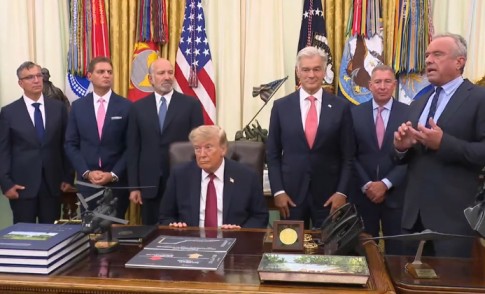
EDITOR’S NOTE: On August 31, 2026, President Trump announced a major expansion of the Most Favored Nation drug-pricing initiative at the White House, with nine additional pharmaceutical companies joining to offer Americans the lowest prices available anywhere in the world. The agreements now cover 26 companies representing 90 percent of the U.S. market and are projected to generate more than $600 billion in savings, while also driving new domestic manufacturing investment and expanded access through TrumpRX.gov. The event highlighted concrete price cuts of 50–80 percent on key medications and framed the policy as both a cost-reduction measure and a step toward greater pharmaceutical independence. Read the full transcript of this White House event below:
Opening Remarks
PRESIDENT TRUMP: Thank you very much. This is, to me, a really big day, one of the biggest ever because this announcement is as big as it gets medically. I think it just can’t get — certainly, when you talk about medical and dollars in the same sentences, it doesn’t get bigger. So I’m thrilled to announce a major expansion of one of our signature affordability initiatives, something that people have been trying to get for years, for decades. And I’m not even sure that other presidents tried.
They didn’t try because the chances of them getting it were very slim. They would never have been able to do it. And that’s Most Favored Nation drug pricing. Biggest thing you’ll hear. We would cut drugs for one eighth of a percent.
It was a big deal. We’re cutting numbers that you’ll hear in a second are astronomical. Nine new pharmaceutical companies are committing to deliver their lowest drug prices for American patients. They’re largely standing behind me. I want to thank the president of Astellas Pharma, Percival Barretto-Ko, CEO of BeOne Medicines, John Oyler, CEO of BridgeBio, Neil Kumar, senior vice president of CSL, Julie Schiffman, CEO of Sun Pharma, Rick Ashcroft, president of Kyowa Kirin, Steve Schaefer, executive vice president of Teva Pharmaceuticals, Christine Fox, CEO of UCB, Dr. Jean-Christophe Tellier.
I think I got those names almost right. Very interesting names. We’ll have to talk about that later. Okay. But congratulations because the job you’re doing is amazing and your companies are doing amazingly and a big contribution you’re making to health.
Thanks as well to Secretary of Health and Human Services, Robert F. Kennedy Jr., Secretary of Commerce, Howard Lutnick, Administrator of the Centers for Medicare and Medicaid Services, Dr. Mehmet Oz, chief counselor and nominee for deputy secretary of Health and Human Services, Chris Klomp, and future FDA Commissioner, Dr. Heidi Overton. Great people. For decades, Americans paid the highest drug prices anywhere in the world by far. It wasn’t even close. We were ripped off by the pharmaceutical companies, and we were ripped off more than anything by other countries throughout the world — we’d never had a president that wanted to fight for us.
Most Favored Nation Drug Pricing
But under the Most Favored Nation agreement that I negotiated at great length — and at great, really lost some friends over it, some very good friends. It wasn’t easy, but under that Most Favored Nation agreement, we now pay the lowest price paid by other countries anywhere in the world. So we went from the highest price for pharmaceuticals, for drugs, to the lowest. We’ve slashed the cost of dozens of commonly used medications and ultimately everything, all drugs, by price differences of 400, 500, and even 600 percent. Drug prices have gone down and will go down 50, 60, 80 percent.
There’s never been an announcement like that. It won’t get covered. If it were Democrats sitting here, it would be the biggest story in the last 20 years, but it won’t get covered. That’s why I speak up. I have to speak up, and the people behind me speak up also.
But it’s the biggest thing to happen in medicine, I think. This has a tremendous impact on health care because, as you know, pharmaceuticals — medicine is such a big part of health. So when you’re reducing it by numbers like we’re talking about, it has a huge impact on health care. Since launching our Most Favored Nation initiative less than one year ago, my administration has forged agreements with the world’s 17 top pharmaceutical companies, and some of them you’ve met at other meetings, to offer their medicines at these steep discounts. And with today’s announcement, we now have 26 companies representing 90 percent of the domestic pharmaceutical market, and the other 10 percent are also coming in.
They have no choice. In total, these agreements are projected to save Americans more than $600 billion over a very short period of time. Think of that — $600 billion. That’s savings to Americans. Nobody else could have done it.
The United States represents less than 5 percent of the global population and only consumes 13 percent of all prescription drugs. So when you think of that, it’s pretty amazing. So it’s 13 percent of all prescription drugs. Yet for years, pharmaceutical companies have taken 75 percent of their profits from The United States. So with a small percentage of the drugs, they make most of their money from The United States, meaning they’re ripping us off, but not any longer.
We’re subsidizing — and we were subsidizing the entire world at our expense. And I had to call the leaders of other countries and say, you’re going to have to raise your drug prices. And they laughed at me when I said it, and then all of a sudden, they said it in a certain way, and they didn’t laugh any longer. And they all agreed.
They had to agree. Now other countries are paying more so that Americans can pay less. We had to get their prices up in order to get our prices down. And they went up very considerably, and we went down by much more because the world is a bigger place than us.
For example, we have slashed the cost of the weight loss drugs like Ozempic by more than $1,800 per year. IVF patients are seeing savings on fertility drugs of more than $6,000 per birth. These savings are available to all Americans at trumprx.gov, which has turned out to be an amazing thing. I was named by Bobby and Oz. That was not named by me.
They said we’d like to do it. I said, do what you want, but you sure it’s going to work? It’s more than work, actually. It’s the hottest thing there is, which now has more than 800 drugs available at tremendous discounts, at discounts that nobody’s ever even imagined before. Our Most Favored Nation discounts represent the largest reduction in prescription drug prices in the history of our country and in the history of medicine.
It’s the largest drug discount, the largest price reductions in the history of medicine. I would say that’s pretty big. And today, we’re taking a major step forward. So when you say we got the biggest drug reductions in the history of medicine, typically, that would be a front page story. It won’t be.
It’s not even believable, but it won’t be. Our Most Favored Nation discounts represent things that nobody could even imagine, including availability — not only the biggest price reductions, but availability. These companies have agreed to offer all of their drugs to state Medicaid programs at Most Favored Nation prices, which is a tremendous discount, which should bring down the cost of your medical care by tremendous amounts. They’ll also offer all new medications to American consumers at the lowest cost anywhere in the world. Every drug now — almost 90 percent, and we’re going to be at 100 percent very shortly — will be the lowest prices available anywhere in the world.
Anybody that’s lower than us, we therefore meet that price. So it’s like a downward spiral, and nobody thought it was possible to get. And I understand why they thought that. These new discounts apply to medicines used to treat many costly chronic and rare conditions, including Parkinson’s, liver disease, and various other cancers, almost all other cancers, actually. In addition, companies are committing billions of dollars to research and development in The United States where they’re moving in from other countries.
These deals — one of the reasons is tariffs, I hate to say. We’re doing really well. We have over almost $20 trillion now of money coming into The United States that we would never have had. We were losing money. Now we’re setting records.
No country has ever been even close to the $20 trillion of investment made in our country right now as we speak. These deals, along with my America First trade policy, have already generated $640 billion in new investments in The United States having to do with this subject. And the pharmaceutical industry has been creating jobs like they’ve never done before. Over 100,000 new jobs in this industry alone. We have every industry.
And right now, there are more people working in The United States than ever before. We have never had as many people working as we have today, which I think is a great stat. I especially want to thank UCB, Sun Pharma, Teva, and Astellas for contributing a combined 290 metric tons of active pharmaceutical ingredients to our strategic reserve. We have a strategic reserve that is amazing that a lot of people don’t know about, but they’ve just built it up, topping it out. These materials are critical for lifesaving medicines used to treat seizures, bacterial infections, high blood pressure, and organ failure.
And especially in times of need, we have a stockpile, and it’s an amazing thing. And by stockpiling such materials in vast quantities, we can ensure Americans are never left without them in the event of an emergency. So we have emergency — including wars and lots of other things. We are fully equipped to handle it, but nobody’s going to attack us. You know why?
Because they’re smart. For decades, politicians from both parties promised to make health care more affordable, but they all failed, every one of them. Drug prices went up. Every year — drug prices, except for my fourth year in the first term, they were down one eighth of 1 percent. And I had a news conference to announce this, and now they’re going down 50, 60, 80 percent.
Think of it, what we’ve done. Under the Trump administration, for the first time ever, drug prices are coming down, and they are coming down very dramatically. This will significantly — I mean, nobody has ever seen anything like the significance and the amount — lower the cost of health care overall by substantial amounts. In other words, health care should now — because the drugs and the medicines, everything you need for health care, is approximately, they’re saying, 50 percent. Well, if the drugs are coming down at numbers like we’re talking about, health care should be following, and I think very rapidly.
I think Bobby and Oz will talk about that. So now we need Congress to expand these agreements and codify them into permanent law. We want to make it permanent. This is now under the Trump administration. Now I don’t know if it’s really that necessary to make it permanent because I can’t imagine a person sitting here saying, I want to double and triple and quadruple your drug prices.
I don’t see that happening. But I think it’s a good thing to do. I just don’t imagine anybody would be brave enough to sit in this position and say, Trump reduced your prices by numbers that nobody’s ever seen, we’re going to raise them back up. So I don’t see it.
But it’s still good to have it codified, have it approved by Congress. And I just want to thank everybody behind me. These have been incredible people. These are brilliant people, leading brilliant companies, and doing absolutely incredible work. Some of the things that they’re finding over the last two years have been incredible.
Nobody can believe some of the medicines that are taking place. Some of the diseases that are disastrous, that lead to death, where the people actually walk away in a week and two weeks, and they’re completely healed. It’s really incredible. So I want to thank you all for being here. And maybe I’ll ask a couple of you to say a few words.
We’ll start. Maybe Oz and Bobby, do you want to say something, please? And then we’ll ask some of the CEOs to talk. Please.
Secretary Kennedy and Dr. Oz Remarks
ROBERT F. KENNEDY JR.: Thank you very much, President Trump, for your leadership.
Today brings the total to 26 companies that have now made agreements with us. These agreements cover nine out of ten drugs that are used by Americans. This is going to have a dramatic impact on medical pricing and on public health in our country. Probably the biggest change in public health prior to this — and is dwarfed by this announcement — was in 1962 when my uncle signed the amendment to the Food, Drug, and Cosmetics Act, and that signing was triggered by the Thalidomide scandal. Thalidomide was a drug that was used widely in Europe and the rest of the world to treat morning sickness.
It turned out it caused grotesque deformations. Tens of thousands of children were born without their limbs. Our country was spared of that because a very courageous scientist named Frances Kelsey at the FDA refused to allow the drug to be sold in this country. My uncle gave her an award, and then he signed a new piece of legislation that required for the first time an FDA to regulate the efficacy of drugs. It was a dramatic change in health policy and in the public health business, but nothing changes the public health business like this.
We are lowering prices dramatically so that Americans will be paying, instead of the highest prices in the world, the lowest prices of any developed nation in the world. And this could not have happened, President, except for this one. Everybody tried sincerely — both Bushes, President Biden, President Obama — they were unable to do it because of the inertia that is built into this system to prevent this reform from happening. President Trump, as I’ve said before, called me and Oz every hour of the day and made it very clear that our jobs were dependent on this getting through. And we thought — how to fire a Kennedy.
I couldn’t — the thought of firing this guy, I wasn’t going to do that. Go ahead, Bob. They were very, very emotional conversations. Let me put it that way.
President Trump was able to attract to this administration an extraordinary caliber of people, and one of those is Chris Klomp, who led the negotiations, and I don’t think anybody else could have done this. Chris Klomp walked away to join his administration, to join my agency, from a billion dollar company that he built, and he built that company, which was a platform for hospitals sharing their medical records. And it was completely built on his integrity. To succeed at that company, a lot of people have to trust you. And he was able to bring that quality and that virtue into these negotiations.
And all of these leaders who you see here, they are doing something very patriotic. They’re taking a big risk, and it’s a risk based on trust, ultimately. Trust this president, trust the people who helped them with this negotiation, and understanding that we tried to understand their companies and their business models so that we could make this work for them as well. President Trump gave us a very specific order, which was not only that he wanted the lowest drug prices in the world, but he also wanted to make sure we didn’t bankrupt these companies so that The United States continues to be the hub for biomedical research globally. And then the last thing he asked us to do was to make sure all the companies began reshoring their production.
And these companies today have agreed to $19.6 billion of construction to reshore their production in this country. Altogether, we’ve got $668 billion of agreements from other companies to reshore production. So it was an extraordinary achievement. Chris Klomp, Dr. Oz, Heidi Overton, and of course Howard Lutnick all made this happen. It is an extraordinary achievement.
And I want to thank the CEOs here today for their vision, for their commitment to something other than short term profits, but a long term commitment to our country, to patriotic values, and to human health.
DR. MEHMET OZ: If I can add one thing from the front lines. Trump Rx, which you asked about, is incredibly popular with pharmacists. And the most common thing that they’re saying is it’s good for their business. And when they see the patients and they come back, for example, on GLP-1 medications, the usual thing they say is you look wonderful, because they’ve lost a lot of weight, and they feel healthy, and they’re driving better, they couldn’t have afforded it.
Because of that, as an update, Medicare two months ago offered — at $50 a month, anyone listening right now, pay attention to this — $50 a month, if you’re eligible, be able to get access to these GLP-1 medications that the president highlighted earlier were $1,200 or more. The so called “fat shot,” as you have called it, sir. Could never have gotten those prices even close to that. Now we have 600,000 seniors already, just in two months, have signed up to get these medications, and we project we’ll actually be able to save money for the taxpayer because the savings aren’t only in dollars, they’re in saved lives, less hospitalization, less complications from high blood pressure, diabetes, and all the ravages of obesity because we got prices where they need to be.
We can go on and on, but Most Favored Nation pricing is on trumprx.gov. We’re going to do a separate event just around that topic, but it’s an incredibly big success story, what has been achieved with that website. Thank you. I want to just also thank John Brooks, who works closely with Chris. He runs all of Medicare, Inma Hernandez, and the usual crew.
They run the drug negotiations section. To echo what the secretary said — they would never have joined the administration normally. These are the top tier people in the country in these areas, and I think all the CEOs may comment on this. They went head to head with these very brave leaders who want to take a risk, but they also went head to head because they were equals on parity and could negotiate these deals.
Howard?
Secretary Lutnick Remarks
HOWARD LUTNICK: So the Commerce Department is involved because we want these companies to reshore. Right? Because reshoring produces national security. Right? We need our drugs made in America, and then that brings jobs and investment in America.
So this group, $19.6 billion today, just today, taking us to $638 billion of all the deals that the president has made. $638 billion in just pharmaceuticals coming. So not only do you have the jobs, but you have the driving down the cost of drugs in America. Right? We all talk about affordability.
Drug costs are the number one cost. Right? And you got to take care of your family, and the president is driving down those costs. So driving down costs today from all these companies, you now have 90 percent of the drugs covered. You’ve got building, and jobs, and you’re also protecting national security.
That’s three of the most important things in America, all today. And it’s all thanks to you, because nobody thought that this was possible. When you first brought this up, Bobby and I were talking with us saying, oh my god, this will never happen. And now you’ve covered 90 percent of America with your power of energy and your way of thinking innovatively and understanding where this country needs to go.
So thank you, Mr. President. You’ve done it.
PRESIDENT TRUMP: Thank you, Howard. And just the enthusiasm — you hear these three guys. I hear them all the time. And maybe they’re more enthusiastic about this. Everybody — nobody can believe what’s happening. Just take a look at this. $638 billion of new pharmaceutical investment in the country.
Look at the chart. Going up like a rocket, and it’s going up a lot higher than that. And then over here, we have another one. $600 billion in lower drug prices under Trump. Under Biden, $550 billion higher.
So you add that up, you’re talking about numbers that nobody even imagined possible. Could I ask some of the companies to say a couple of words, I’ll get started.
Company Executives Remarks
PERCIVAL BARRETTO-KO: First of all, thank you, President Trump. And I’d be remiss not to say what an honor it’s been to work with you and your incredible team in making sure we stay focused on putting American patients first. So today, I’m representing Astellas, and I wanted to announce that our Medicaid prices will be matched with those of developing countries.
And further to your point, we’re committed to ensuring that our new drug pricing will be aligned with global markets. And as you’ve mentioned earlier, Astellas — unbelievably low, right, compared to us. We were the highest in the world, and now we’re the lowest in the world.
So, furthermore, to your point earlier, we want to also announce that Astellas will be donating to the U.S. government the active drug substance for tacrolimus, which is used post-transplantation to ensure that we secure our supply. And that’s consistent with our focus on patients along with our cutting edge innovation and multiple manufacturing partnerships across this great country. So thank you, Mr. President. Thank you very much.
PRESIDENT TRUMP: Appreciate it. Thank you. Please.
JOHN OYLER: Thank you, Mr. President, for bringing us together to expand life saving medicines for American patients. Thank you to the team for making this happen too. The fight against cancer is far from over. More than 2 million patients a year that are Americans are diagnosed with this terrible and horrific disease. And although in certain areas we’ve made tremendous progress, other areas like liver cancer and pancreatic cancer are very dire for patients and continue to take far too many lives.
That’s why I founded BeOne Medicines. We’re a company that is developing breakthrough cancer therapies, and we, from the beginning, have been trying to make them more accessible to patients. Today, we’re advancing that goal by providing one of our oncology medicines to Medicaid at a deeply reduced price. And we’re committing to pricing future medicines in The U.S. in line with other key developed markets. We’re also investing nearly $11 billion in U.S. research, development, and manufacturing through 2029, and this is helping to strengthen America’s leadership in biopharmaceutical innovation.
I want to thank you very much, Mr. Brooks. Thank you.
PRESIDENT TRUMP: Great job. Great job. Thank you. Please.
NEIL KUMAR: Well, thank you, Mr. President, and thanks to everyone in the administration who made today possible, including, critically, Mr. John Brooks. For BridgeBio, it’s a privilege to be here on behalf of BridgeBio, but probably more importantly, the 30 million Americans suffering with rare genetic conditions. I’m grateful to the administration and you, Mr. President, that you’ve helped us come through on our commitment to provide most broadly and most accessibly the medicines that we make. And I might say, alluding to your earlier point, that as an entrepreneur and founder in America, partnerships like today’s partnership allow us to reinvest in technology and innovation on our shores to bring ever more medicines to the patients that deserve them. So thank you. And tremendous progress has been made recently on cancer, and someday the cure — a tremendous progress has been made, more than has been made in many, many years.
So a lot of things, a lot of good forces at work. Please.
JULIE SCHIFFMAN: Mr. President, thank you so much for your leadership and for bringing industry together in support of American patients. I’m Julie Schiffman. I’m so proud to represent CSL, a company driven to serve lives since 1916.
We join our peers to support these agreements, which will lower prices for medicines and strengthen U.S. manufacturing. As one of the world’s largest plasma derived biotechnology companies, CSL employs nearly 19,000 Americans across 44 states, and our planned $1.5 billion investment in Illinois will help onshore our end to end production of plasma derived therapies, including immunoglobulins, which will allow us to reliably serve patients with serious and rare diseases for generations to come. Thank you.
PRESIDENT TRUMP: Great job. Thank you. Thank you, Mr. Brown. Thank you very much. Christie, are you going to say a couple of words, please, because you are a star.
CHRIS KLOMP: Thanks, Mr. President. We have to do — and then we’re going to get back to the companies.
I appreciate it. Today is fundamentally about affordability. You’ve heard that loud and clear. You’ve heard some big numbers. Council of Economic Advisors projecting $600 billion of savings for Americans in aggregate over a ten year period.
Two things stand out to me. Number one, this has been a matter of months since we stood here and made the first announcement. These savings are things you would expect over a multi year period, legislative billing and otherwise. It’s been less than one year, months. That’s incredible.
And number two — one number — over $1 billion of out of pocket savings to consumers just in the last handful of months since we launched Trump Rx, since we launched GLP-1s. That’s a billion dollars of savings, not to insurers, not to drug companies or anyone else, to everyday Americans in their pocket. That’s extraordinary. And we talk about these big numbers, we talk about these things in aggregate, but the privilege is mine to get to hear from individual patients and beneficiaries every week, and hear stories about how they were paying a thousand dollars for a drug. They now pay $50 for a GLP-1. They were trying to conceive and it was out of reach. And now they can actually have life saving medications.
They can have reproductive medicines. These are real impacts for everyday Americans in their pockets. It’s affordability. It’s the president fighting for affordability. It’s the president honoring a promise to fight for affordability and doing it in one of the most conspicuous places possible, which is at the pharmacy counter.
So thank you, Mr. President. It’s been an absolute privilege. We’re so grateful.
PRESIDENT TRUMP: Very much. Great job. You’re doing too. By the way, affordability — still prices are coming down. Inherited, a year and a half ago, the highest prices and the worst inflation in the history of our country, and we brought them down a lot. But what’s happening now with prescription drugs and drugs is something that nobody thought was possible. Okay. Please.
STEVE SCHAEFER: Yes, Mr. President. Thank you. It’s a pleasure to be here. I’m Steve Schaefer on behalf of Kyowa Kirin.
We specialize in making rare and intractable cures for patients that have extremely rare diseases. There are 30,000 rare diseases in the world, and only 10 percent of those diseases have treatments. That’s what we do. We appreciate partnering with you and your administration to bring low drug prices down for the American patients. And like the other companies that are here, we stand ready and willing.
We are bringing our manufacturing onshore, so much so that by the next two years — right now, 5 percent of our drugs that are manufactured in The U.S. are for American patients. In the next two years, over 95 percent of drugs that are manufactured in The United States will be for American patients. The other thing we continue to do is continue to innovate in The U.S., and our commitment to innovation in The U.S. and creating a world leading global infrastructure that is led by The United States is unwavering. So we thank you, Mr. President. We look forward to working with you and your administration, and we appreciate the opportunity.
PRESIDENT TRUMP: So you say there are 30,000 rare diseases?
STEVE SCHAEFER: Yes, sir.
PRESIDENT TRUMP: That’s one I never heard of. That’s a lot of disease. And you’re on it. Right?
STEVE SCHAEFER: Yes, sir. I hope to be.
PRESIDENT TRUMP: That’s a full time job. That’s not easy. I heard you’re doing fantastic. Please.
RICK ASHCROFT: Thank you, Mr. President, and thank you to the teams at Health and Commerce for their collaboration in this effort. I’m pleased to represent Sun Pharma and the patients we serve. For over 40 years, our mission has been to reach patients and touch lives, and these agreements allow us to further that mission.
We’re incredibly proud of the work we do to be able to meet patients wherever they are in their journey. As a result, we have products in consumer health care, generics and innovative medicines. We’re extremely proud of our commitment and investments in The United States, where we have commercial operations, we run our global research and development, and we have manufacturing sites. These agreements are further acknowledgment of that commitment and that investment. Thank you, Mr. President.
PRESIDENT TRUMP: Thank you very much. Thank you. Good afternoon.
CHRISTINE FOX: Thank you so much for the invitation today, and probably more importantly, thank you so much for the collaboration. We’ve really established a great back and forth and really appreciate the insights and the thinking.
I’m Christine Fox and I represent Teva Pharmaceuticals and all the amazing employees that we have across the globe. One of the things we’re most proud of is that eight patients every single second in The U.S. alone gets a Teva prescription. And so we take that as a huge responsibility, and it’s why this mission that we all share in this room is to enhance and ensure access, affordability, and most of all, quality medicines for patients that need them.
And so we’ve just begun this journey, and we’re really excited to get started. We’ve got lots of work to do, but we’re delighted to be part of the team.
PRESIDENT TRUMP: So did you ever think you’d see Most Favored Nation? Most likely, no. What do you think?
CHRISTINE FOX: You said already, I don’t think so.
PRESIDENT TRUMP: No. No. Most people said it was impossible, but we got it done. We got it done. Great group of people we have. Please. Thank you very much.
JEAN-CHRISTOPHE TELLIER: Thank you very much. Thank you. Thank you, Mr. President, and members of the administration.
UCB has always been guided by one mission, which is helping people suffering from chronic disease to live the best life possible. Mr. President, you have been clear about the necessity to invest into innovation, and we share this commitment. And it’s very important to think that the breakthrough of tomorrow will need and depend on the investment that we are making today. And today, we are making the largest manufacturing investment that our company has done, with a $2 billion facility in Georgia. And on top of that, we are also strengthening American supply in times of emergency, as we are donating Keppra, an essential anti-seizure medicine, into the national stockpile, as you mentioned.
So UCB is proud to continue to invest in science, in manufacturing and in people and talent in order to improve patient life for the generations to come. So big thank you for allowing us to do that.
PRESIDENT TRUMP: Great job. Thank you very much. Thank you.
Heidi, first of all, congratulations. It’s big stuff. And you’re going to do a phenomenal job. They all know exactly what I’m talking about. And there can be no bigger jobs.
Good luck with it. Would you like to say something?
DR. HEIDI OVERTON: Yes. Well, today is, first and foremost, about affordability, and it is a huge achievement. I was with you in term one when we had those small achievements, and to see what you and Secretary Kennedy have unleashed here is incredible.
It’s a huge day for Americans. It’s also a huge day for national security. And to see those numbers, the amount that you all are investing here in America and the primacy of American innovation, it is the top priority. Your direction is to go fast, but also to bring back and to preserve American innovation. That is the goal.
So we’re so thankful to the companies. We can’t do it alone. But we do have real problems with other countries eclipsing us in where early stage clinical research is happening. So there’s a lot more happening in your administration to not only bring the manufacturing home, but we want to bring the clinical trials home. We want every part of clinical research, clinical trials done here in America, to both protect our national security and to make it more affordable.
And under your leadership, we can do both. We don’t have to do one or the other. We can do both. So thank you, Mr. President.
PRESIDENT TRUMP: Good. Then we’re really dominating the world in terms of everything that we’re talking about. And I want to thank Eli Lilly and Pfizer, Merck, all of the big companies that are all part of this. They’ve been here. They’ve spoken very, very well, very beautifully about what they’re doing, but everyone’s involved. We have a small group that isn’t, but they will be very shortly.
And their names — their companies will be announced. But this is fantastic. And Bobby and Oz and Chris and everybody, I want to just commend you on the job you’ve done. And Howard was fantastic, especially in a couple of instances that were really — some problems that he was able to get done. So, with that, we’ll take a few questions.
Q&A Session
PRESIDENT TRUMP: Maybe you can keep it on this. This is to me such a big event that I think we should try and focus on what’s just taken place because nobody can even believe it. Yes, please.
REPORTER: Thank you so much for doing this. So first of all, on health care affordability, which is a big issue for voters — proposals from the Democratic Socialists of America is Medicare for All, paid by the government, by taxing the higher earners. How do you contrast that approach with what you are highlighting today, which is bringing more of these private companies on board to lower cost for Americans?
PRESIDENT TRUMP: Well, this is much bigger, much better, much less expensive, and it’s something that works. The other doesn’t work.
And, you know, when you talk Medicaid for — usually, that’s the entire budget of the whole country. So you’d have to quadruple taxes. The other thing is — I understand it — you’ll lose it if you have private health care. A lot of people are very happy with what they have privately, and they lose all of that. They lose everything they’ve had, and there’d be a tremendous backup.
But it’s actually, in many cases, bigger than the budget. I remember they tried it in Vermont, and they tried it in a few places. They went into it, and they realized it costs more money than the entire amount of money taken in. And this was by a liberal governor, very liberal, who wanted to do it. And I’m all for anything, but what we’ve done today is we broke down prices, and you get a level of prescription drugs and care, ultimately care, that you could never get the other way.
It just happened to work. And I’d like to ask Bob Yaraz — because it is a very good question — I’d like you to address that for a second, the difference. You hear it, it sounds so good, but in the end, it’s horrible health care.
DR. MEHMET OZ: It doesn’t work, and we know that for two reasons. One, you censor and, ultimately, limit access to care. We see that, for example, in other countries that are remarking how effective this Most Favored Nation drug pricing has been, because they actually just don’t give their patients who have, for example, a cancer, who’s older, the medication. They just let them pass. We also know without any question that those programs ultimately get more and more expensive until they devour the system, so they end up with a two tiered system.
So you have affluent people who get better quality care in private clinics, and you have the average American who would have to go to wherever they’re allowed to go. And if you notice, when we talked about the program with GLP-1 medications in Medicare, the most common place that GLP-1 medications are sold now in America — what used to be the Upper East Side of Manhattan, one of the richest places in the country, and they’re using the drug to look a little better when they go to the Hamptons this weekend. But now we’re giving it to all Americans, if they desire, who are eligible, at $50 a month, which means most Americans can now afford that. That’s a democratization of health care, and we believe that that is part of what America’s always been. You own a piece of the rock.
You own your health care to get on the playing field to compete in commerce or anywhere else. You have to be on the field. You need your health to be able to do that. And I’ll leave you with one last big issue. The president has said this many times.
If we could just get the average American to feel so healthy, so with it, so vibrant that they want to work just one extra year, that’s worth $1 trillion to our GDP every year. So investing in cutting edge technologies, giving the best access that we can afford to every American everywhere they want it, actually builds the value of our nation because we’re a working country. That’s what’s always made America special.
PRESIDENT TRUMP: Okay. Bobby, are you okay?
ROBERT F. KENNEDY JR.: I’m good, Mr. President.
PRESIDENT TRUMP: Because I’ve spoken to Bobby about it. He understands it maybe better than anybody, and he feels the same way. Please.
REPORTER: Thank you, President Trump. Is the resumption of strikes in Iran part of a limited campaign or a return to full scale war? And how will you respond to the Iranian strikes?
PRESIDENT TRUMP: Nation — they’re a failed nation. They’ve got 350 percent inflation.
They have no currency. They’re not paying their soldiers. Their leaders are largely dead. Their navy is gone. Their air force is gone.
Their surveillance equipment is almost entirely gone. That doesn’t mean we won’t smack them. We’ll see what happens. But we have the Strait of Hormuz in extremely good shape. We’re taking over many, many ships.
It got through last night, as you know, with the Navy’s assistance. And we’ve been averaging 30 ships a night. That’s a lot. And a lot of oil is coming out. That’s why you haven’t seen the price of oil go like they thought it might have to go.
And the main thing — when I say it all, I could go on for an hour about what a great job we’ve done. We’ve done a great job with Venezuela. We’ve done a great job with Iran. Iran will never have a nuclear weapon. That’s what it’s all about.
It’s not about any of the other things. It’s about we as a country, and as for the world, Iran cannot have a nuclear weapon. If Iran had a nuclear weapon, Israel would have been wiped out. You would have no Israel right now, and you’d probably have no Middle East. And they’d be hitting our cities at some point because they’re sick people, and Iran will never have a nuclear weapon.
REPORTER: Mr. President, on this announcement, I do want to ask you a follow-up on that. But on this announcement — it comes right before the midterms. In your opinion, do you think that health care prices or gas prices right now are more important for American voters?
PRESIDENT TRUMP: I think both. I think everything’s important.
I would say health care is, to me, very important. You’re talking about life. It’s very big. It’s very important.
REPORTER: [QUESTION INAUDIBLE — regarding Iran negotiations and leadership]
PRESIDENT TRUMP: Of the Iranians? They don’t really know. In my opinion, they don’t know who the leader is.
You have the radicals, but they’ve been wiped out from the standpoint of the military because the military is just a fraction of what it was. I don’t really think they know who their leader is.
REPORTER: Should the president — starting tomorrow, you’re going to bring in imported beef duty free in an effort to try and bring down prices. Shouldn’t that concept apply to other consumer goods?
PRESIDENT TRUMP: It could, but we’re doing very well in so many different things.
And do you remember, affordability — I inherited that from the Biden administration. We had very high prices. We had eggs that were selling at four times what they are now. We had all sorts of product that was just tremendously out of control.
We had health care that was through the roof. This is going to bring down health care at numbers that nobody’s ever even envisioned before. If I would have told you a year ago that we were going to pull off drug prices that would be down 50, 60, 70 percent, you would have said that’s impossible. So that’s just the way it is. And I think you’re going to see some very big drops in a lot of different categories.
Yeah. Please.
REPORTER: Mr. President, Fed Chairman Kevin Warsh signaled Friday that he might consider raising rates. Are you opposed to this, and have you spoken to him about it?
PRESIDENT TRUMP: No. I have a lot of respect for him, and he’ll do what he has to do. I think our interest rates are too high. I think that we’re the leading country in the world. We’re now an economic force like we’ve never been before because of what’s happened. We have the greatest investment ever made in any country, by many times.
Again, we’re over now $20 trillion of investment coming in. No country’s ever been there. And we’re number one. We should have the lowest interest rates in the world. Because if we wanted to — you know, a lot of countries that are paying less interest rate only because of us, because they do business with us.
If we wanted to put tariffs, or stopped doing business — we have the right to stop doing business with them — they would go from a so-called elite country to a poverty stricken country. So we should pay, in my opinion, the lowest interest rates anywhere in the world, by far. And someday, I think maybe we’ll be able to convince people of that. It’s very easy. You take certain countries — I don’t want to mention any — but countries that you consider great, and they’re paying a half a point.
Alright? A half a point. But they make $40 billion a year with The United States. If they don’t make the $40 billion — we don’t need their product.
It doesn’t have to — we really don’t need their product. So we cut off trade with that country. We just made $40 billion. And you do a few countries like that, and we become a big money machine. We should have the lowest interest rates anywhere in the world. We should be lower than any country.
It used to be that way 30 years ago. We had the low — even if we weren’t doing well, we had the lowest interest rates. And the other thing, and I say it a lot, but someday it’s going to get through. In the old days — meaning you go back 25 years ago — if we announced good numbers, interest rates went down. Now if you announce good numbers, interest rates go up because they’re so afraid of inflation.
But what they’re doing is they’re really saying you can never step on the gas. We could have a GDP of 14, 15, 16, and 20. But every time you do well — we just announced great numbers, and so now they’re talking about raising interest rates. It’s ridiculous because success in growth does not cause inflation. Inflation is caused for other reasons, and I’m not a fan of inflation.
But inflation is caused for other reasons. When we do well, they shouldn’t have to raise interest rates. They should, in many cases, lower — because you know why? We become a better credit. When we’re doing well, we become a better credit.
When you become a better credit, you’re supposed to cut rates, not raise rates.
REPORTER: Mr. President, at the end of the month, Xi Jinping’s upcoming visit — you’ve already been successful with pastor Ezra Ji Jin Ming’s release from China. Will you be talking to him about other Americans’ release, including Nelson Wells Jr. and Don Michelle Hunt, who’ve been held in China for well over a decade?
PRESIDENT TRUMP: Who is it? Who?
REPORTER: One is Nelson Wells Jr. and Don Michelle Hunt.
PRESIDENT TRUMP: I’ll speak to him about a lot. He’s coming in a couple of weeks. He looks forward to it. I look forward to having him. We’ve had a very good relationship.
As you can see, even with the strain of Hormuz, he’s relatively inactive. He’s been relatively inactive by comparison to what he could have been. He’s a man that I have a lot of respect for. I think he respects me, and I think he respects our country again. He didn’t respect our country two years ago.
He left — he thought our country was run by fools, and he was right. He was right. Now we have the hottest country in the world. Right now, we have the hottest country in the world.
Two years ago, we had a laughing stock. We were a laughing stock all over the world. Right now, we have the hottest country anywhere in the world. Nobody close. Yeah, please.
REPORTER: Mr. President, last month, DHS recorded a record number of deportations. What changed to make that possible?
PRESIDENT TRUMP: Nothing. We just were able to break the court system a little bit. We had judges that were very hostile.
I mean, look, in New York, the governor of New York, Kathy Hochul, just announced that she’s letting 7,000 people go — into criminals — go right back onto the streets of New York. What’s wrong with her? What’s wrong with her? How can she do that?
So we’re able to get people easier, and they’re bad people. We want to get bad ones out of here and get them out of here fast, and that’s what we’re doing in record numbers.
REPORTER: Sir, have you seen the reports that Secretary Hegseth is considering a 2028 run, and could you see yourself supporting him?
PRESIDENT TRUMP: Well, I think he’s doing a fantastic job, but it’s very early to talk about that. We have to get through the midterms first.
He’s talking about it. And I think he’s a very good guy, but I bet there’s a lot of people considering it that you don’t know about. You probably have a lot of people, but he’s done a great job. And right now, all he loves and all he cares about is the military and taking care of the military. And we went into Venezuela.
We won. We went into Iran, and we’re beating the hell out of them and doing a good job. Yeah. Please.
REPORTER: Thank you — Most Favored Nation, sir. Secretary Kennedy talked about why some predecessors failed, and he talked about the inertia in the industry. That hasn’t bothered you. You’ve delivered voluntary deal after voluntary deal. What have you recognized about industry, deal making, about the problem that has led you to deliver on this when past administrations have failed?
PRESIDENT TRUMP: So I think the reason we were successful — we were able to talk to drug companies. You needed two elements. The drug companies had to agree, some of the people right back here, and we treated them with great dignity and respect, but we said we have to do it because it was very unfair. They couldn’t justify that.
Why were we paying ten times more for a certain medicine than they were paying in Great Britain, than they were paying in Dusseldorf? Okay? You go New York City versus Dusseldorf versus Munich versus Paris versus London. Why were we paying ten times, sometimes? Sometimes less.
We’d pay for a pill $10 in London. You go to London as a tourist, you’d buy a pill for $10, and in New York, it costs you $130. Why was that? And I’d say that to the drug companies, and I think I made the point. It was very tough, but I think I made the point.
So I felt I had — that the hard part — and one of the reasons they agreed, and by the way, their stocks went up, not down, which is something that is pretty — your stock, I bet, is all going to — it’s gone up because it’s been more of a free enterprise thing. It’s not rent regulated, like they have rent control in New York, where everything’s regulated. You end up paying far more. A very big thing though was the countries. Everybody said it would be impossible for France to agree to double and triple their drug prices, but they agreed to do it.
And they agreed to do it because I said if you don’t do it, I’m going to put tariffs on everything coming into The United States. And that is far bigger dollar wise than the money we’re talking about — without the use of trade, not only tariffs, doing business. We don’t have to do business with the country. We have the right to cut off all business with the country, and I threatened that also.
And without the power of tariffs, or the power of not doing any business at all, whether cutting them off from The United States, I would have never been able to have gotten them to agree to double, triple, and quadruple. Now, because it’s not as bad as it sounds for them — they’d have a $10 pill and it would go to 20. Or they’d have a $40, and it raised it from 40 to 60, but they weren’t raising it from 40 to 120. But we were bringing it down because the world is a bigger place. We’re bringing it down from $200 to 40, not to 10.
They go up and we go down, but we went down much more than they went up. And so you’re seeing numbers that nobody’s ever seen before. There’s never been anything like it. Certainly in this country, but even in the world, there’s never been anything like it. Steve, please.
REPORTER: Should Venezuela leave OPEC now, given your announcement over the weekend?
PRESIDENT TRUMP: Say it again?
REPORTER: Should Venezuela leave OPEC given your —
PRESIDENT TRUMP: Well, I don’t know. That’s up to them. That’s going to be up to them.
We have a great relationship with Venezuela. It’s a team, in a sense. And we’re taking out millions and millions of barrels of oil going to Houston, going to Louisiana, going to lots of different places in The United States and all over the world. And we’re making a fortune, and they’re making a fortune. They’re starting to make real money.
And we have Exxon going in. We have Chevron going in. We have our big oil companies going in. And everybody is bidding. And there are those who say it was the greatest deal ever made.
Let’s see what happens. But I have to stress, it was also a very good deal for Venezuela, because you have the most powerful, the richest companies in the world going into Venezuela, where before it was just — it was just unbelievable value that was sitting dormant. We’re going to be taking all of that. We’re going to be taking that oil out. It’s all coming to The U.S. for refineries.
So our plants, our refineries are specifically meant for Venezuelan heavy oil. Heavy oil is a good thing, not a bad thing. It’s good for other things. You know what heavy oil is good for? Asphalt, roadways, all of that.
So we do a lot of things. Here’s a deal that nobody’s ever heard of a deal like that. Maybe the greatest deal ever made. Who knows? But it’s millions and millions — already, we paid for the war.
The cost of the war has been paid for many, many times before. Where have you heard that before? You didn’t hear that with Afghanistan. You didn’t hear that with Vietnam, and by people that ran it a lot differently than I run it. Yeah, please.
REPORTER: On this massive oil deal that you just announced, how do you expect that to impact the lives of everyday Americans, both in the short and the long term? And also, what’s your message to the oil executives that you’re planning to meet with?
PRESIDENT TRUMP: Well, I think it’s going to have a tremendous impact. It’s going to ultimately — prices are going to come down.
Now, will it happen before the election? I can’t tell you that, but I think people are very smart. They know we had to go into Iran. It only went up because of Iran. We had to go into Iran.
We had to make sure they don’t have a nuclear weapon. Sometimes somebody will take the other side and say, well, did you have to do it? I say — let me ask you one question. And I’ve never had a different answer. Let me ask you one question.
Can Iran, the number one state sponsor of terror in the world — can Iran have a nuclear weapon? They always say no, they cannot. I say, well, then we have nothing else to talk about.
I had to do it. If I didn’t do it, they’d be taking shots at our cities. They would have wiped out Israel. They would have wiped out the Middle East, because that’s their inclination. They were called the bully of the Middle East for a reason.
They’re not the bully anymore.
REPORTER: President Trump — on the Venezuela deal — great job you’re doing, by the way.
PRESIDENT TRUMP: Thank you.
REPORTER: And thanks for taking questions. On the Venezuela deal, analysts predict it could take several years before the Venezuela oil action —
PRESIDENT TRUMP: Could be a little bit, but it’s going to go fast. Going to go fast.
REPORTER: When you say fast, when?
PRESIDENT TRUMP: Well, because analysts predicted that a thing like this could never happen too.
Nobody ever thought it was possible. Remember? Russia was there. China was there. They’re not there anymore, are they?
You know who’s there? USA is there. It’ll go fast, much faster than what the analysts say — two years, three years. But if it was two years, that’s a short period of time. It’s hundreds of billions of dollars.
It’s actually trillions of dollars we’re talking about, trillions. And it’ll come out as fast as possible. One of the things I want to do with all of that oil that we now have — I want to fill up these strategic reserves, and we’ll get that done fairly quickly.
REPORTER: In the moment, Iran — several military leaders have reportedly told Secretary Hegseth that a prolonged large scale operation there weakens our ability to confront threats elsewhere, including the homeland. Have you heard those rumors?
PRESIDENT TRUMP: Number one, we have nothing else in mind. Number two, we’re very respected. Nobody else would be crazy enough to do it. Number three, we have so much ammunition and munitions, as they like to call it, all over the world that we can always take from if we want. And this is a relatively little war for us.
This is not a big war. You know where the money went — was Ukraine. The money was really taken out — the ammunition, if you talk about low — we have tremendous amounts, unlimited amounts of mid grade and older stuff that’s also very powerful. Unlimited amounts.
We’re only talking about what we call the elite — the elite stuff. And even that, we’re in very good shape. But we can always take from other sources, but I don’t think we’re going to need it because nobody’s going to mess with us. Nobody.
REPORTER: [QUESTION INAUDIBLE]
PRESIDENT TRUMP: I just want to finish. They say we used it in Iran. We used very little in Iran by comparison. Joe Biden gave Ukraine over $300 billion worth of stuff free. Now I also help Ukraine, but they have to pay for it. So Europe is paying for it.
It goes to the European nations. It goes to NATO. They pay us for it, and we help them out. But he gave away $300 billion worth of ammunition. That’s — can’t do that.
REPORTER: I do have a question for you about clock cameras, but first on Iran. Have you ruled out using a nuclear weapon against Iran?
PRESIDENT TRUMP: Well, I would never say that, but the answer is yes. I rule that — no, use — there’s no reason for it.
REPORTER: And has that been —
PRESIDENT TRUMP: What a stupid question that is, actually. Well, uh-oh. Here they are. They’re totally defeated militarily. So now I defeat them, and now I should use a nuclear weapon on top of them?
What a stupid question. Okay. Thank you very much, everybody. Thank you.
UNIDENTIFIED SPEAKER: Thank you, guys. Thank you so much.
PRESIDENT TRUMP: I hope so. I hope she’s fantastic.
REPORTER: [QUESTION INAUDIBLE — regarding refiners]
PRESIDENT TRUMP: I would like her to be — I would like Bobby wants it fast, so we’ll put Bobby on.
REPORTER: Are you reviewing the Falkland Islands? Are you reviewing The U.S. position on the Falkland Islands?
PRESIDENT TRUMP: I always review every position. That’s just one of many.
REPORTER: Steve, you want The UK to cut — where it increases 3 percent?
PRESIDENT TRUMP: You’ve some problems, but they’ll get solved.
REPORTER: What was the thinking behind inviting the Russians to the G20 meeting in Asheville? Where’s the European —
PRESIDENT TRUMP: Well, we’re going to see what happens, but we like getting along with everybody. Sure. One of the reasons that I’m so successful, I get along with everybody. Thank you, Steve.
REPORTER: Are you going to push out the fires?
PRESIDENT TRUMP: Thank you, guys. Thank you all. Thank you so much. You can head out.
Related Posts
- Transcript of Senator Ted Cruz Interview: PBD Podcast #851
- Transcript: President Trump Meets with U.S. Travel Industry Executives – Sept 2, 2026
- Transcript: President Trump Remarks at Rose Garden Dinner – Sept 2, 2026
- Transcript: Trump Remarks at the Congressional Space Medal of Honor Presentation
- Transcript of Jon Stewart Interview: Politics, Anxiety, and Finding Hope in the Chaos on IMO Podcast