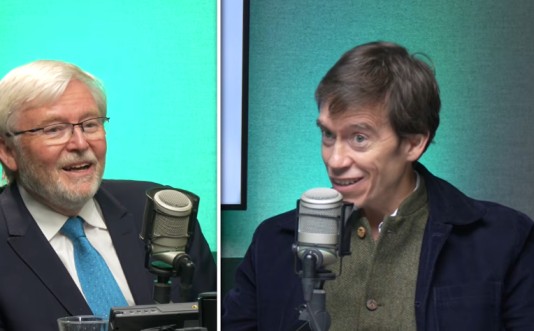
In this episode of The Rest Is Politics, Alastair Campbell and Rory Stewart sit down with former Australian Prime Minister and veteran China scholar Kevin Rudd to explore how Xi Jinping really thinks. Drawing on his exhaustive study of Xi’s speeches and writings, Rudd explains the Chinese leader’s Leninist politics, Marxist economics and nationalist foreign policy, and discusses Taiwan, the US-China rivalry, the AI race, AUKUS and life as ambassador in Trump’s America. The conversation ends with a sharp exchange between Rory Stewart and Rudd over how candidly he speaks about Donald Trump. Read the full transcript below:
Introduction
ALASTAIR CAMPBELL: (00:00:00 – 00:00:08) I last saw you, Kevin, at a conference in Hong Kong where I overheard you talking what sounded to me like fluent Mandarin.
KEVIN RUDD: (00:00:08 – 00:00:09) I’d just been drinking a lot.
ALASTAIR CAMPBELL: (00:00:10 – 00:00:46) To a young Chinese guy to whom I went over afterwards and said, “How good is his Chinese?” And he said, “Well, if you close your eyes, you’d think he was.”
And you’ve also written several books, but the 2 that are most relevant to this. One is about The Avoidable War, which is about possibility of conflict between the US and China. But also you’ve written an extraordinary book, On Xi Jinping, essentially analyzing really in incredible detail practically everything he’s ever said. And of course, he doesn’t communicate in the way that Trump does, but when he communicates, it’s worth analyzing. So thank you. We’ve got a lot to get through.
KEVIN RUDD: (00:00:46 – 00:00:50) Thank you. Thanks for having me on the program.
What Makes Xi Jinping Different From His Predecessors
RORY STEWART: (00:00:50 – 00:01:04) I think let’s begin maybe with Xi Jinping and see how you would explain to someone what is different about this Chinese leader. Compared to predecessors going back to maybe Deng Xiaoping, going back to the late ’70s, early ’80s.
KEVIN RUDD: (00:01:05 – 00:02:50) Yeah, he is cut from a different cloth. Unlike his 3 most recent predecessors, Deng Xiaoping, then Jiang Zemin, then Hu Jintao, taking us back over the last 35 years with a few other ring-ins on the side, he is the son of a former Politburo member whose name is Xi Zhongxun. And he therefore is what is called in the Chinese political class a taizidang, which is a princeling. That is, he comes from CCP, Chinese Communist Party royalty. So that’s the first thing.
The second is in his political formation therefore, there’s never been a doubt about the absolute centrality of the party to China’s future. Whereas this was subject of some debate on the part of his 3 predecessors and things which would emerge from time to time as under the euphemism as a debate on the Chinese political system and its reform. Those debates have been canceled and rendered verboten since about 2014. So the party, as he is reputed to have said in a gathering not too long ago, “is in our veins.” And so it’s very much a Leninist view.
I think the other thing for us all to bear in mind is he’s terrified by the collapse of the CPSU. Communist Party of the Soviet Union and the subsequent implosion of the then Soviet Union into a series of smaller parts. And for him and in his worldview, that would be the corollary for China if this Leninist party ceased having absolute power and control in holding the Chinese national entity together.
Leninist Politics, Marxist Economics, Nationalist Foreign Policy
ALASTAIR CAMPBELL: (00:04:01 – 00:04:16) So if he’s Leninist in his view of politics and Marxist in his view of the economy, and yet he’s got this very nationalist, feels to us from a Western perspective, quite right-wing approach to foreign policy. Is that a fair judgment?
KEVIN RUDD: (00:04:16 – 00:06:11) Yeah. I mean, when I was trying to wrap my head around this stuff, and I’ve been studying Chinese for God’s sake 50 years this year, since as a junior woodchuck I went off to the Australian National University to try and wrap my head around this language, I realized that trying to understand his ideological worldview, given that ideology is a key organizing principle still in contemporary Chinese politics, you had to go back and read the stuff.
And so I came up with 3 sets of conclusions based on the time I did up in Oxford at the tender age of 59 trying to do a DPhil with a whole bunch of fellow students who used to call me grandpa. And it was this: he deliberately changed the center of gravity in Chinese politics to the Leninist left. He moved the center of gravity of Chinese economics deliberately to the Marxist left. And he moved the center of gravity on Chinese foreign policy and security policy to the nationalist right.
So when you deal with Oxford dons on this subject, and frankly academics anywhere, they say, “This thing, il ne marche pas. It doesn’t work. You can’t go left and right simultaneously.” I said, “Sorry guys, I’m just an old-fashioned Australian empiricist. I just follow the evidence where it takes me.”
These 3 things have happened simultaneously and there’s a connectivity between them. He doesn’t want to lose control of the economy to the private sector, which then fuels his problems about politics and therefore the Leninist Party’s control. Typically the private sector becomes more powerful than the state.
And then on the nationalist side, that becomes a new form of legitimacy domestically in the eyes of the country at large, that China has now stood up and become not just wealthy, but powerful in the world. And the time has come therefore to assert that. So the pomp and circumstance of the recent visit to Washington, all these things roll together. So they are, I think, the 3 essential organising principles for the change we’ve seen unfold for the last decade or so.
China’s Historical Narrative and Nationalism
RORY STEWART: (00:06:12 – 00:06:38) Nationalism presumably was a very, very strong phenomenon in China for a very long time, a long way before Xi Jinping.
KEVIN RUDD: (00:06:38 – 00:07:17) Chinese imperial or dynastic history over the last 2,000, 2,500 years has had this rolling thematic. Though the term nation, even this Chinese term guojia, didn’t exist in that period of time. But the historical narrative is kind of interesting. The good emperors and the great dynasties are those which united the empire and held it together. And the bad emperors and the bad dynasties are those who let it disappear into a thousand contending parts.
And so it’s not just the predations of you Brits when you arrived in the Opium Wars, demanding that China open its treaty ports for the very noble trade of selling lots of opium. Hang your head in shame, both of you.
ALASTAIR CAMPBELL: (00:07:18 – 00:07:19) We weren’t around.
KEVIN RUDD: (00:07:19 – 00:07:19) Yeah, it’s okay.
ALASTAIR CAMPBELL: (00:07:20 – 00:07:23) Rory’s pretty— were your antecedents involved in that?
RORY STEWART: (00:07:23 – 00:07:24) Drug runners.
KEVIN RUDD: (00:07:24 – 00:08:30) That’s okay. Well, we’re just British criminals in Australia. We have nothing to bring to this conversation anyway. The bottom line is this narrative, to let you guys off the hook for a bit, long predates the implosions that occurred in modern Chinese history from the Opium Wars in the 1840s through to China’s final reunification, if you like, under the communists in 1949.
So yeah, there’s this big historical narrative about 2 things: protecting the borders of the place from external barbarians, of which there have been multiple attacks in Chinese history. The Qing Dynasty were barbarians. The Yuan Dynasty were Mongols. There’s been a stack of them over the centuries and over the millennia. And you guys were just— and the French were the most recent interlopers in the 19th century.
So the central imperial narrative is, “We must have the Son of Heaven, the emperor, or whoever succeeds the Son of Heaven holding the empire together in order to protect us from the predation of those on the outside.” And a further narrative which says, “If there is weakness at home, there will be predations from abroad.”
Did Xi’s Predecessors Consider Political Reform?
ALASTAIR CAMPBELL: (00:08:30 – 00:08:48) You mentioned his fear of somehow the CCP becoming like the Communist Party of the Soviet Union. Did any of his 3 predecessors see themselves as a kind of Gorbachev-type figure? And did he ever think that they were trying to make change that would threaten this vision that he has of China?
KEVIN RUDD: (00:08:49 – 00:09:13) Deng Xiaoping in the ’80s, when I first went to work in Beijing, and my job in embassy land was domestic Chinese politics. He authorized a number of debates about the future reform of the political system. Of course, all that came to a crashing halt in ’89 in Tiananmen when the student protesters, I would argue, got ahead of the wheels of history and they were brutally repressed by a Leninist state.
ALASTAIR CAMPBELL: (00:09:13 – 00:09:15) Do you mean by that they should have bided their time?
KEVIN RUDD: (00:09:15 – 00:10:04) How can you ask kids to bide their time when they see an opportunity to hold high the banner of individual freedom? Very hard. But was there a trajectory prior to that coming off the back of early-stage economic reform, opening up to the market, greater discussion about political futures for the country, at least in the academy. Rolling that out for another decade or so, one of the imponderables of alternative history is where would that have landed?
Jiang Zemin, not really a significant conversation about these things, but I do note that by the time we get to about 1999, we’d seen the conclusion of an internal debate about whether there should be some peaceful transition of the party towards what was often described in the party as the normal shall we say Nordic social democratic model over time, but with Singaporean political characteristics.
ALASTAIR CAMPBELL: (00:10:04 – 00:10:05) You think the debate went that far?
KEVIN RUDD: (00:10:05 – 00:11:16) Well, I’m old enough to have been in and around those discussions in the ’90s, in and out to various think tanks organized and authorized by the International Department of the Communist Party, et cetera. Hu Jintao had one final attempt in the last 10 years before Xi Jinping came. He was general secretary from 2002 to 2012. And that decade, what you see is his attempt to take the debate into practical land by authorizing contested elections for local authorities in China at the county level and at the village level. So were these rivulets of possible change there? Yes. Did any of them reach maturity? Not really.
Was Xi Jinping, the other part of the question, genuinely concerned about this? One of his earliest pronouncements on this in about July of 2013 in what’s called Document Number 9, I love the way the Chinese call these things Document Number 9. I should have done this when I was prime minister. Let’s just name our documents in this sort of authoritative sort of way to guarantee that nobody would read them if it was in Australia. But it said, “There shall be no further debate on constitutionalism or these types of political reform.” That was an internal document, which was then fully leaked.
RORY STEWART: (00:11:16 – 00:11:53) One of the things I guess that an old China hand might have said in the 1980s, is that Xi Jinping was pretty inevitable. And that people got overly excited by the idea of liberal democracy emerging. And I can imagine somebody saying to you, “Listen, Deng Xiaoping was hardly a democrat, and Tiananmen represents pretty much where they were going.” And that nobody should be that astonished to discover that we end up with a Marxist-Leninist nationalist running China, because that was a pretty strong part of what was going on. And the West was deluding itself if it thought that China’s economic expansion was going to lead to the growth of a liberal democracy.
KEVIN RUDD: (00:11:53 – 00:12:50) I think what surprised many of us in the analytical world was not so much the construction of a fence around the political project, because that was clear from about 2013. What surprised some of us was the extent to which a parallel fence was constructed around the economic reform project by 2017.
But of course, Xi Jinping being a great orthodox Marxist-Leninist had done his dialectical materialism and he worked out the interrelationship between the economic base and the social superstructure and where those things led to over time. So he was not just going to deal with the superficialities of a discussion about political pluralism. He wanted to ensure that the base was back under control within the economy of the party so that it would not generate a critical mass of folks who experiencing freedom in the marketplace, free flow of information, et cetera, and the international marketplace would then indirectly infect the debate about what happened above, namely in politics.
Xi Jinping’s Anti-Corruption Campaign
ALASTAIR CAMPBELL: (00:12:50 – 00:13:16) We have a view of him in terms of crackdown on corruption is one of the things for which he’s kind of fairly well known. And of course, right now with his opposite number in the United States seeming to sort of unleash a kind of unbridled corruption, you’re almost tempted to think, well, at least Xi Jinping doesn’t like the corruption too much. What’s happening? What should we think of that in terms of what it says about him? And about what he’s trying to do as leader.
KEVIN RUDD: (00:13:17 – 00:13:37) For those of us who have looked carefully at the anti-corruption campaign, which he did launch within a year of taking office, and it is now China’s single longest ongoing political campaign in the history of the Communist Party. It’s been rolling now for the better part of 12 and a half years. 5 million cadres formally disciplined by the party.
ALASTAIR CAMPBELL: (00:13:37 – 00:13:37) 5 million.
KEVIN RUDD: (00:13:37 – 00:14:59) So you’re getting up to 5% of the total party membership who have either been purged, fined, demoted. Jailed, in some cases worse. It’s been about 2 things. I mean, one is on the governance of the party. He figured out ultimately there is a legitimacy question. A, can you grow the economy and make sure that people’s living standards are rising? 2, are you holding the country together? Our earlier conversation, let’s call it on the nationalist agenda around a strong country. But 3, Is the party itself still got credibility in the eyes of the people, or has it become a franchise for just earning a lot of cash?
Most analysts of the party, whether they are supportive of Xi Jinping or not, would say that corruption in the previous 35 years evolved from retail to wholesale to industrial-scale corruption. It was big, particularly in the military. So Xi Jinping would not be oblivious to this when he took over, and therefore in restoring or seeking to restore that element of legitimacy to the show, launched a campaign. Many thought it would be just once over lightly. It didn’t turn out that way. It’s been serious. It’s got teeth. What’s the term they use in Chinese? “Exposing the bare blade of discipline onto the party itself.”
ALASTAIR CAMPBELL: (00:14:59 – 00:15:00) It’s a control thing.
KEVIN RUDD: (00:15:00 – 00:15:28) And then it’s a cleaning up thing, but the second part of the agenda is it’s a control mechanism. And so if I think, Rory, you and Alastair are mucking up, or you’ve got it in your eyeballs and that you could be a problem in 3 years’ time, I’m sure all of you have got sins, mortal or venial, somewhere that a good dose of the anti-corruption police will root out, thereby keep you off balance, and frankly stick you into jail if I need to. And there’s that element as well.
China’s Territorial Ambitions
RORY STEWART: (00:15:28 – 00:15:44) When we talk about nationalism, European nationalism, Nazi nationalism, Russian nationalism, we often are thinking about big imperial expansion, Russian tanks rolling through Poland. What is the territorial ambition of Chinese nationalism beyond Taiwan?
KEVIN RUDD: (00:15:45 – 00:16:54) You can break it down into about 4 or 5 boxes. Taiwan, you’ve just mentioned, unfinished business from ’49. In the maritime domains, it’s the South China Sea and the East China Sea, both of which contain islets, or in the case of the East China Sea, islands contested by many of the neighbors, including Japan, as well as offshore islands and maritime areas with Korea. This rarely gets a mention, but it’s with Korea, it’s with Japan, it’s with the Philippines, it’s within Vietnam and other Southeast Asians as well. They would be the top 2 or 3.
Then of course you have the Sino-Indian border. I’ve just come from Delhi to here, so this is still the central concern in the India-China relationship. Whatever happens in the India-US relationship is what will happen these massive disputed zones in Ladakh and down at the other end of the border as well. Then there’s a really interesting one at the end, which is the 1.5 million square kilometers which the Russians took from the Chinese between about 1858 and into the early 20th century in the dying days of the Qing Dynasty.
What Kind of Global Power Does China Want to Be?
RORY STEWART: (00:16:55 – 00:17:14) And what sort of global power would a Chinese nationalist want to be? Would they be launching the kind of interventions the US launched in Iraq and Afghanistan? Would they be trying to have their fleet sitting in the Gulf? Would they be trying to topple regimes in Venezuela? I mean, what kind of regime would they want to be? Would they want to be a superpower on the US model?
KEVIN RUDD: (00:17:14 – 00:19:41) I remember years ago when I was first talking to a newly elected Prime Minister Modi about these questions. A very perceptive man, Mr. Modi. He asked this question, “Does Xi Jinping want to be a regional leader or a global leader?” So in terms of the answer to it, obviously the Chinese Communist Party haven’t posted to me a copy of their long-term plans. I’m waiting for the unauthorized edition, or hopefully the authorized edition.
But I see it a bit like this. Number one is resolving the territorial questions we mentioned before. So there is, depending on which side of those debates you fit and stand, is it revisionist or otherwise?
Second, in East Asia, by which we mean everything from the Korean Peninsula through Southeast Asia and presumably west to around India. There is a long-term study in the modern Chinese academic literature of how does China learn effectively from the Monroe Doctrine in Latin America. That is to be obviously the primus inter pares in Greater Asia or Greater East Asia and the West Pacific. And that does not necessarily mean taking armed military intervention as your course of action, but it does carry with it a set of assumptions, which is that regional states in that hemisphere, the East Asian hemisphere, would conduct themselves in a manner which was not offensive to Chinese core interests and Chinese core values.
And there’s a historical precedent for this in the history of the tributary states during the Ming and Qing dynasty over about 500 years. China by and large didn’t set out to invade the tributary states, but they did take military action when people in their view mucked up. Ask the Vietnamese about the history of that over 1,000 years.
And the third part of the answer to your question, Rory, is beyond East Asia, the West Pacific, and let’s call it that hemisphere, what about the rest of the world? I think China would see its future as being the anchoring geopolitical power around a future international order, just as the United States has been the anchoring geopolitical power around this post-’45 order in one form or another, sometimes at large and sometimes more narrowly. And again, it doesn’t mean taking unilateral action militarily beyond the theater, but it would expect to be treated with considerable respect and for it increasingly to shape the rules of the system. I think if you saw it in those sort of concentric circles, I think that’s the way it’s seen.
Inside Kevin Rudd’s Book on Xi Jinping
ALASTAIR CAMPBELL: (00:19:41 – 00:19:46) You’ve literally read and thought about and analyzed every word that Xi Jinping has said in public.
KEVIN RUDD: (00:19:46 – 00:19:51) And therefore you don’t necessarily know, by the way, what he actually thinks. There’s a writing group.
ALASTAIR CAMPBELL: (00:19:51 – 00:19:51) For sure.
KEVIN RUDD: (00:19:51 – 00:20:04) All this stuff comes out in his name. And the book that I wrote on Xi Jinping says, “Are these his words? Do they actually reflect everything he thinks when he sits down at night and has a cup of cocoa and puts on the socks and goes to bed?” I don’t know.
ALASTAIR CAMPBELL: (00:20:04 – 00:20:08) No, you don’t know, but you’ve probably gone into it with greater depth than a lot of analysts have.
KEVIN RUDD: (00:20:09 – 00:20:13) Yeah, to save you all the trouble. Okay. And the pain and torment, actually.
ALASTAIR CAMPBELL: (00:20:13 – 00:20:25) Well, it’s the only book I’ve ever read where the introduction says, “By the way, unless you’re a complete nerd, I wouldn’t read the whole thing. Go to chapters 4, 5, 13, and 17, and you’ll get it all from there.” So I did the whole thing.
KEVIN RUDD: (00:20:25 – 00:20:27) Wow, you get time off purgatory for that.
ALASTAIR CAMPBELL: (00:20:27 – 00:20:30) Well, I’ll tell you what, it’s a dense piece of work, I’ll give you that.
KEVIN RUDD: (00:20:30 – 00:20:37) No, it’s a hard read. I say that up the front. And Oxford University Press, by the way, said, “You cannot write that in the introduction of a book.”
ALASTAIR CAMPBELL: (00:20:37 – 00:20:37) Well, you did.
KEVIN RUDD: (00:20:37 – 00:20:47) And I said, “Well, I mean it.” I mean, if you want to really understand its argument, it’s in 3 or 4 chapters. The rest is for academic nerds. But that’s to establish the case. Sorry, I’m interrupting.
How Xi Jinping Views the United States and Donald Trump
ALASTAIR CAMPBELL: (00:20:47 – 00:20:56) Right. So based on all that, what do you actually think that Xi Jinping thinks about the United States and about Donald Trump’s presidency?
KEVIN RUDD: (00:20:57 – 00:22:18) I think because Xi Jinping in his heart of hearts and his mind of minds is an ideologist and therefore looks at the United States structurally through the lens of historical materialism and the rise and fall of nations and movements over time, and as well as dialectical materialism, contending forces in the here and now. Are forces of action and reaction. And these methodologies are actually taken seriously within the party’s analytical system.
Their conclusion is the United States is declining. Their conclusion is that China is rising. Their conclusion is the United States is internally fragmenting. Their conclusion is that China remains internally cohesive. Their conclusion is the United States is fragmenting with its allies strategic partners and friends around the world, whereas China is consolidating its position with the Global South in particular.
So in the sweep of history, they see the winds of history as blowing in their sails. And on President Trump himself, they see him as the leader of this tottering entity. Now I actually think all that’s flawed, but if you ask me what I think comes through their literature, they are predisposed towards reaching, in my view, premature conclusions about Uncle Sam.
The Strengths and Weaknesses of China’s Economy
ALASTAIR CAMPBELL: (00:22:18 – 00:22:44) Interesting. And then just on the economy, Rory often points out the relative comparisons between the size of the Chinese economy, say when Tony Blair became prime minister, and even Italy not that long ago had a bigger economy. While you’ve been following this, China’s economy has become incredibly— well, it’s grown and grown and grown and grown. But you also have a view that it’s possibly unsustainable and that there are inherent weaknesses. What are those weaknesses and how worried is he about those?
KEVIN RUDD: (00:22:45 – 00:25:44) You’re right. I mean, when I first went to China in the early Mesolithic period as a young diplomat, the Chinese economy was the same size as the Australian economy. There you go. In the ’80s. And now it’s second only to the United States. And depending on the measure, GDP at market exchange rates or purchasing power parity, it’s either 70% the size of the United States or 125% the size of the United States. I think we can all conclude it’s big.
But the model has problems. Part of Xi Jinping’s efforts to move that center of gravity of economic policy settings towards the Marxist left has obviously created a whole range of additional growth problems for the economy. Private sector is less incentivized. Planning has reasserted itself. State-owned enterprises have reasserted themselves. Income redistribution is now much more at the center of the equation.
Net effect of all the above is that the domestic drivers of growth— private domestic consumption, private fixed capital investment, private residential construction— which normally in an economy at that stage of development would be powering ahead. Think of the US economy late 19th, early 20th century when it ceased to be utterly export dependent, was driving on the basis of its own domestic growth. These sectors are bumping along the bottom at the moment in China and have been for quite a number of years in the post-COVID period.
What’s working for them is 2 things. Net exports, hence the problems in Europe as China’s enormously subsidized oversupply in its manufacturing product is now sold in the world. Look at German manufacturing, 12,000 jobs going a month. Look at Volkswagen. Look at the rest. Look at the emerging reactions in the European Union and what caused the Americans to act in the way in which they did 7 or 8 years ago in 2018.
The other thing that’s working for the Chinese is Xi’s techno-industrial strategy, where he’s seen massive levels of state investment driven by the party center. To become the dominant technology power when 10, 15 years ago they were nowhere to be seen. But now, with the exception of semiconductor chips, perhaps jet engines, and one or two other things, they are now comparable in many respects to the United States. So that’s his second success story.
But is it yet generating a massive slab of extra growth in the economy? No, including the AI stack. It’s not yet producing the productivity yield. So is it big? Yes. But the double-digit growth finished not long after he became general secretary. It’s been single-digit growth, and then domestically, probably not growing much more than 1 or 2% before you roll in the $1.2 trillion a year they earn each year from net exports.
Trump, Xi Jinping and the US-China Stability Pact
RORY STEWART: (00:25:44 – 00:26:07) US opinion on China seems to have lurched very, very dramatically from ’80s, ’90s, where a lot of the leading commentators were all in on China and optimistic. And then a moment where they all seemed to wake up and all flip to the other side and become increasingly cross with China in different ways.
KEVIN RUDD: (00:26:07 – 00:26:09) Only a Brit could say cross. I love that.
RORY STEWART: (00:26:09 – 00:26:46) Increasingly cross with China. And you saw, I mean, you can see versions of this happening with Obama. You can see versions of this happening with Trump 1. You see it continue with Biden. One of the things that interests me though about Trump 2 is that he now seems to be an outlier in the other direction.
I’m very struck by the fact that in his recent encounters with Xi Jinping, he sounds like less of a China hawk than much of the consensus, the Democratic and Republican establishment, that if you were, I don’t know, Pottinger or the congressmen who were running the Chinese Communist Party committees, you’d be looking at Trump at the moment and say, “Whoa, what has happened there?”
KEVIN RUDD: (00:26:46 – 00:28:21) Structurally, the way I can best answer the question you’ve posed is the strategic competition rolls on. And it doesn’t matter whether you’ve been in Beijing, I was there just last week, or in Washington, I was there the week before. The dynamics of the competitive race in the military, in cyber, in space, in the economy, in trade, in investment, in technology, in artificial intelligence, in foreign policy, in ideology, rolls on and is ever more acute. Because what is at stake here? Who prevails and who becomes the fulcrum of the emerging or continuing international order?
However, President Trump, I think, has concluded that in terms of his own interests, and I think President Xi Jinping for similar interests, that a stability pact for the period ahead is no bad thing. That is, in China’s case, what is at stake for them through a stability pact with President Trump, what they’re seeking to avoid is another unilateral tariff war, which would help crush this remaining growth engine they’ve got, particularly if the Europeans followed in hot pursuit.
And secondly, from President Trump’s perspective, he wants a stability pact to get back to a normal supply of critical minerals and rare earths, which currently the Chinese are holding a chokehold on. The way I see it is it’s a tactical accommodation in both directions, a stability mechanism to accommodate that. But when I interrogate what’s going on in the full breadth of the relationship, it’s still a competitive fight.
Taiwan, TSMC and the Future of Pax Americana
RORY STEWART: (00:28:21 – 00:29:22) Just one more on that, because a lot of the narrative around US involvement in the South China Sea and Taiwan doesn’t sound very much like the world of Trump. It sounds like the post-1945 order. In fact, Trump is often making comments about this. He often says that he finds it a bit weird that the United States is concentrating on something that’s 9,000 miles from the United States and 70 miles from China, which his predecessors would not have thought of as weird.
He also hasn’t set himself up as a champion of democracies around the world. So the sort of arguments that China hawks used to make, which is we need to stand up for Taiwan because more recently Taiwan’s become a democracy and we need to stand against this authoritarian state. Again, it doesn’t naturally sit with Trump’s views. And if you look at Russia-Ukraine, he seems to believe in spheres of influence. He seems to be a bit doubtful whether America wants to be a global policeman. He’s not really into democratic sovereignty. So all of that would make one think this is somebody who’s less likely to get in behind Taiwan than his predecessors.
KEVIN RUDD: (00:29:23 – 00:31:15) I think in the back of President Trump’s mind, there will be 2 considerations beyond those you’ve just listed concerning, let’s call it, his skepticism. One is this. TSMC, the Taiwan Semiconductor Manufacturing Company, which currently provides 90% of the world’s most advanced semiconductors, which if it went down the gurgler as a consequence of a Chinese takeover, would in President Trump’s calculus and the US body politics calculus and the economy represent a catastrophic problem and possibly triggering of recession, if not worse, whatever China’s assurances may be that supply would continue. Because let me tell you, the action would not be a peaceful one if they decided to take Taiwan by force. The Taiwanese would fight and God knows what would happen to the TSMC facilities in the way through.
The second is this. I think there is a view that if Taiwan was to fall to military force as a consequence of a Chinese invasion. It would end up being the end of Pax Americana in the wider region for these reasons. Japan would look at this and say, “Really? Either no American action or a late and failed one? Our security guarantee from the United States is now paper thin. We’ll proceed with ourselves turning nuclear.” And Prime Minister Takaichi in her own quiet and inimitable way, has sanctioned quietly the beginnings of a public debate in Japan about acquiring nuclear weapons.
If Japan went nuclear, there’s no way on God’s earth that the Republic of Korea would allow that to happen in the absence of them going nuclear. If those 2 went nuclear, the question arises as to what China and North Korea would do as an attempt to preempt. What Southeast Asia would do is an open question. What Australia would do is an open question. And what India would do is an open question.
RORY STEWART: (00:31:15 – 00:31:16) India doesn’t need to go nuclear.
KEVIN RUDD: (00:31:16 – 00:31:34) No, no, no. I’ve worked that one out. I’ve just been there as well. But the point is there is a fundamental set of strategic verities which then are imploded simultaneously once this change occurs. And that’s as a product of the perceptions of regional states.
RORY STEWART: (00:31:34 – 00:31:56) Is that not in a sense simply a version of what we are already seeing playing out with the United States inability to defend Ukraine against Russia? Already Germany’s talking about nuclear weapons, Sweden’s talking about nuclear weapons. We’ve essentially concluded that the Pax Americana no longer operates. States in the NATO heartland. So it seems perfectly conceivable that Trump could do the same with the Pax Americana in the Pacific. I mean, it may feel like this is a revolution.
KEVIN RUDD: (00:31:57 – 00:33:11) I mean, given that I’m neither a Russian specialist and certainly not a Ukraine specialist, I’m always cautious about commenting on things I don’t know much about. But yeah, I observed Russian strategic behavior and American responses to it, and particularly most recently.
But the United States, remember, including this president, sees its future as a great power fundamentally anchored in the Asia-Pacific because America is a Pacific power. It has territories in the Pacific. It has a state in the middle of the Pacific. It has territories in the West Pacific. It is also the region which will generate the vast bulk of economic growth for the next quarter of a century across the world.
And for those reasons, even in, let’s say, this complex Trumpian worldview that you’ve described before, what drives the president is how does America remain number one? And whatever his agnosticism towards the transatlantic may be and to the Europeans may be, with the Indo-Pacs, it’s quite a different kettle of fish in terms of America’s manifest destiny. Before we add in the TSMC factors and the roll-on consequences, if Japan and Korea went in their own national directions.
The Trump-Xi Summit and Taiwan
ALASTAIR CAMPBELL: (00:33:11 – 00:33:48) Okay, Kevin, Rory, quick break and back for more. I think we were surprised that so relatively little of substance came out of the recent summit between Trump and Xi Jinping. But one thing that really struck me that Xi said to Trump in these terms: Taiwan is a very dangerous issue that could bring collision and conflict. And Trump’s reply to that essentially was about how far away from China America is. Was I reading too much into that and thinking that was Trump showing a bit of weakness and it was Xi Jinping indicating strength?
KEVIN RUDD: (00:33:48 – 00:35:33) I think, Alastair, you’ve correctly identified the changing trajectory of Xi Jinping’s commentary on Taiwan. There are certain verities around the sort of normal Chinese posture on Taiwan. And then there is an accentuation and an acceleration, if you like, of the language. And I think we’re seeing a fair bit of that from Xi Jinping and others within the Chinese system. And essentially the bottom line is this, “Don’t mess with us.”
What am I most concerned about? That’s me, Kevin, in the real world, is where all this tracks in ’27, ’28 when we have a potential tripwire event in terms of the Taiwanese presidential elections of January of ’28. And if the current pro-independence ruling party is then reelected or governing party is reelected under Lai Ching-te.
On the Trump side of the equation, what the American system says is nothing fundamentally has changed in the US position. And there is, in terms of the private conversations between President Trump and President Xi Jinping, none of us know. We can only actually report on those which occurred in front of officials.
But what I see is even when these summits have been occurring, the standard operational procedures of American Pacific Command, Indo-Pacific Command under Admiral Paparo and the units available to him continue in the South China Sea, in support of the East China Sea, regular and large-scale exercises involving all regional partners, for example, recently conducted in the Philippines. So there are 2 realities here. One’s the declaratory level where you’re right to point out the changing nature of his language. And at the operational level, where those of us who observe the meat and potatoes of this don’t see much change.
RORY STEWART: (00:35:34 – 00:36:26) Let me push back on that a little bit, because part of the argument for the disentanglement from Europe was the tilt towards Asia-Pacific. And part of the reason why Ukraine was told that it couldn’t have Patriot missiles was those missiles were required in Asia-Pacific. The US then proceeded to blow them in a very major way in the Gulf. Who knows, 50, 70% of the stock. Things have been taken out of South Korea in order to help the Gulf.
This doesn’t exactly feel like an administration that has made the strategic decision that you are attributing to them, which is that this is continuity, Obama, Trump 1, Biden, Asia-Pacific tilt. This feels to me like an administration that is very, very undecided. About what it’s really trying to do is prioritize China as opposed to doing things which certainly in the Gulf don’t seem to add up to that at all.
KEVIN RUDD: (00:36:26 – 00:37:51) I’ll come to the Gulf in one second. All I can report to you is whatever the declaratory language is used by President Trump, operationally in terms of tempo, intensity of normal levels of military activity, we don’t sense any significant change in our part of the world around, let’s call it Taiwan contingencies, and Taiwan-related signaling and broader, shall we say, deterrence activities in the wider East Asia, West Pacific theater.
You’re absolutely right, Rory, about what just happened in Iran. I do not know from my own discussions with American commanders how much hair has been pulled out of people’s head as a result of having to redeploy kit and equipment and frankly keep assets operating well beyond normal deployment ratios. That I don’t have sort of granular information on.
The Chinese have a saying about their relationship with the United States, which I always find disturbingly amusing, which is, “Every now and then when in our strategic contest with the United States and we think that the Americans have got our mettle and they finally got the script and they’re finally heading in a particular direction, don’t worry, our old friend comes along to help us out.” And you say, “Who’s the old friend?” I said, “The Middle East, of course.” And America’s fatal attraction going back over the last 3 quarters of a century with the cocktail of Afghanistan, Iraq, and now Iran.
Who Is Winning the AI Race: The US or China?
ALASTAIR CAMPBELL: (00:37:51 – 00:38:00) Who’s winning the AI battle long-term, US and China? You live in the US, you study China. What’s your sense of that?
KEVIN RUDD: (00:38:00 – 00:40:07) This is the granddaddy of them all right now at least, I think if you go across the AI stack, China is ahead on energy, which is necessary for compute. United States is ahead on compute because of superior chips, probably by about a 5-year factor in terms of the quality and the nanometers attached to the most advanced chips out of NVIDIA and TSMC and others in the US chip ecosystem. The Chinese haven’t cracked that code yet despite multiple efforts to do so.
On frontier models, the Americans are barely ahead by 5 or 6 months because the Chinese are compensating for their lack of rapid and efficient compute with simply scale. They just build bigger and bigger data centers with more and more energy used, and they can therefore test their LLMs accordingly. It’s just more expensive.
And then on diffusion, so the other part of the AI stack, the Chinese are vastly ahead of the United States, probably by a factor of 2 to 1. That is, proportion of the real economy and real firms now deploying for productivity purposes frontier models or variations of them within their business operations.
Xi Jinping’s view is we will prevail against the United States across the stack and diffusion, that is use in the real economy, will deliver us an unprecedented productivity yield and advantage against the United States because we can use the levers of the central state to not just encourage, but to leverage the economy to deploy these capabilities rapidly and comprehensively.
So if you were to ask me therefore who’s going to be ahead, I mean, I spend a fair bit of time in Silicon Valley and Seattle. These guys are sharp, bright, competitive, and producing stuff which none of us thought possible 6 months ago, let alone 5 or 6 years ago. So never count the Americans down for the count on this stuff. But the Chinese, the great advantage is to leverage scale, and they have scale to leverage in terms of the size of their domestic market.
Can the Western Alliance Survive Trump?
RORY STEWART: (00:40:07 – 00:41:02) Are you aware of how much the narrative has changed in Europe in relation to the United States? That the kind of assumptions that Xi Jinping might have had that the US is going to begin shedding its European allies may turn out to be much closer to the truth than you want to acknowledge. But when Alastair and I do public events now, it is almost consistent if you ask people whether the US or China is a greater threat to national security, that 90% of hands will go up for the US, not China.
And Greenland, Ukraine, the International Criminal Court, and the continual violent humiliation of Western leaders, Carney being portrayed being whacked with a hockey stick begging for life on the— This stuff I don’t think will be forgiven. And I think a bet that you can resurrect a Western alliance behind a tilt to Asia-Pacific, I think is for the birds.
KEVIN RUDD: (00:41:03 – 00:41:46) I think you’re wrong. Let me answer as best I can. The first is this. Yes, the memo and the telegram has reached Australia. We do understand the volume of reaction because opinion, public opinion responses in Australia are not dissimilar to what you’ve just described. I mean, we’re not some sui generis mob down under who don’t tune in. You simply have to look at the most recent global opinion poll research produced by Pew to understand where America now stands in global public opinion across the democracies and across the Global South, objectively within its own comparators and against the Chinese. In Australia, for example, Xi Jinping is now twice as popular as Donald Trump.
ALASTAIR CAMPBELL: (00:41:46 – 00:41:46) In Australia?
KEVIN RUDD: (00:41:47 – 00:41:54) In Australia. Published research. So yes, this memo has reached us. And it was—
RORY STEWART: (00:41:54 – 00:42:00) Actually, I wasn’t talking about Australia. I was talking about the particular China community in the United States, which you said— oh no, sorry, sorry.
KEVIN RUDD: (00:42:00 – 00:42:03) I thought you meant you, you meaning me, and I happen to be Australian.
RORY STEWART: (00:42:03 – 00:42:07) So I meant you meaning Asia Society China US commentators.
KEVIN RUDD: (00:42:07 – 00:45:09) Don’t worry, I often lead American delegations to Beijing because we are an American institution, the Asia Society. We’ve been there for 70 years. Secondly, why I think though, notwithstanding the above, you may be wrong is as follows. In the Indo-Pacific, there is no security policy alternative to the United States against the critical mass of Chinese military capabilities and the collective predisposition of US friends, partners, and allies to engage in whatever strategic balancing strategy is necessary in order to secure their effective autonomy as actors within the region.
So does anybody like being beaten around the head, whether you are the South Korean president or the Indian prime minister or the Japanese or ourselves? No. But is there more of a predisposition to see this as the current evolution of American politics and to look at the long term rather than the immediate term? There is more of a predisposition to do that in our part of the world.
For the Europeans, I defer to all of you because that’s where we are at the moment in Europe. But I do ask the question again in terms of core security concerns on the part of, let’s say, frontier states with— I was about to say the Soviet Union, but the Russian Federation. If you’re among the Baltics, if you’re among the Nordics in the High North, and if you are Poland, given its unique history and a problematic piece of real estate both to its east and to its west, before you start heading further south to the good folks in Ukraine and Zelensky doing a powerful job under impossible circumstances.
Ultimately, can folks in the security policy calculus do without the United States against their core strategic objective? Probably not. Can they do more independently and nationally? Yes. Can they do more collaboratively among themselves? Yes. Are they doing that in the case of Ukraine? Yes. But as we’ve just seen through the most recent debate over Starlink, for example, that’s a piece of American commercial/military infrastructure. So it’s complex.
Is there going to be lasting damage to everyone being hockey-sticked as Mark happened to experience recently? Of course. These things are not easily forgotten. But America at the moment, and I’ve lived there for now 10 years, is going through this cathartic, deep, ugly, multifaceted internal wrangling over what sort of country it wants to be in the world in the future.
So we either wait for that process to conclude and in the meantime engage in a whole range of other contingencies such as effective security collaboration with each other, or do we junk that option forever in the future? That is the United States being a future reliable security partner. I don’t know friends, partners, and allies who are willing to go down the path of Plan B yet.
The Future of AUKUS
ALASTAIR CAMPBELL: (00:45:09 – 00:45:11) Where does AUKUS go in this?
KEVIN RUDD: (00:45:11 – 00:46:16) Well, that was 3 years of my life working on AUKUS, both in its submarine and non-submarine dimensions. It’s been legislated through the Congress, so it happens. And it’s therefore legislation signed into law by President Biden, not repudiated by President Trump. So all of the implementation machinery around AUKUS and the submarine program as it affects Australia, the United Kingdom, and the US is now being fully implemented. I mean, I know that for a fact.
Similarly, what’s called AUKUS Pillar 2, which is creating a more seamless defense science and technology and industry market between the 3 countries, is happening as well. And so when President Trump said, when we were in DC last October, “Full speed ahead for AUKUS” because it’s a command and control system politically now under President Trump. Guess what? It’s full speed ahead. And that’s what’s happening. You’re always going to have folks who are going to say there’s a problem here and a problem there. I get that. That’s the nature of the beast. But do I think strategically there’s a problem with it at this stage? No.
Being Ambassador in Trump’s America
ALASTAIR CAMPBELL: (00:46:16 – 00:46:19) What was it like being ambassador in Trump’s America?
KEVIN RUDD: (00:46:20 – 00:47:28) It’s a character-building experience. And it’s just President Trump is President Trump. I mean, I’d said some critical things about Trump in the past. He returned the compliment when I was there sitting around a table with our Prime Minister Anthony Albanese at the end of last year. And then the cameras having gone off, he leant across the table and said to Albo, as I call him, our Prime Minister, he said, “Well, he looks like a nice guy to me,” pointing to me. And then our Prime Minister said, “Well, he is. That’s why I sent him here.”
He also used to be our Prime Minister and President Trump didn’t quite understand that point. “Why? What are you doing here then?” But then he went and said, “Ah, that’s fine. Nice guy. All’s forgiven.” So this is a day in the life of working with President Trump. It’s intense fury followed by, let’s get on with the business.
So is it complex? Yes. Is it normal if you are a career Foreign Service officer? No. Everyone would be reaching for their smelling salts every 30 seconds. The only good thing about having been an Australian politician, which as you know, is not for the faint-hearted and it is a blood sport without—
ALASTAIR CAMPBELL: (00:47:28 – 00:47:30) Check out The Killing Season.
KEVIN RUDD: (00:47:30 – 00:47:37) Yeah, check out The Killing Season. It takes a bit more than that to put me off my game.
Rory Stewart Presses Kevin Rudd on Trump
RORY STEWART: (00:47:37 – 00:48:00) Can I understand this a little bit more? So you’re no longer the ambassador to the US, but you’re not— I mean, that was one of the most understated commentaries on Trump I’ve ever heard. You sounded like a serving prime minister or an ambassador. Is it that your job at the Asia Society stops you from saying this man is a loathsome, shameful, corrupt individual who’s undermining global security? I mean, why do you speak in this way?
KEVIN RUDD: (00:48:01 – 00:48:14) You’re running a podcast. I’m running a think tank. And a think tank seeks to work with governments around the world in moving the dial in directions which maximize strategic stability and security for us all.
RORY STEWART: (00:48:14 – 00:48:20) So your job— You’re also there to tell the truth, aren’t you? You’re also there to tell the truth about international—
KEVIN RUDD: (00:48:20 – 00:48:26) That’s right. And are you beginning to say, my Tory friend, that what I’ve just said is untruthful?
RORY STEWART: (00:48:27 – 00:48:34) Well, I think it’s true, but I think to fully understand the global situation has to begin from a discussion of—
KEVIN RUDD: (00:48:34 – 00:48:58) No, I’ve sought to accurately describe— What I just sought to describe before, Rory, was you asked about how do allies view their future with or without the United States. What I’ve sought to do is to reflect my best understanding of having had multiple conversations with serving ambassadors of Asian and European allies in D.C. And their chancelleries around the world about what we do over the next couple of years. Hence why I answered in the way in which I did.
RORY STEWART: (00:48:58 – 00:49:02) But the answer is you can be brutal about Xi Jinping, but not about Trump because you’re trying to influence the US administration?
KEVIN RUDD: (00:49:02 – 00:49:08) Well, I think I’ve been fairly clear about my public commentary concerning the president of the United States, hence why he took exception to them.
RORY STEWART: (00:49:08 – 00:49:09) Remind us. Remind us.
KEVIN RUDD: (00:49:09 – 00:49:16) “What do you think of President Trump?” Furthermore, nice try, my Tory friend, but I’m not going to go down that path. So you can get your headlines elsewhere.
RORY STEWART: (00:49:17 – 00:49:18) Well, why would this be a headline?
KEVIN RUDD: (00:49:19 – 00:49:52) I’ve seen a few ones outside the off stump over the years. Because I have an institution to run which seeks to work within the parameters laid down by both the Chinese Communist Party and the Chinese leadership and within the United States administration. And therefore, if you are doing that as an institution such as ours, the Asia Society, which has had to deal with similar complexities over the last 70 years that we’ve been in existence, that’s what you do in order to produce a result. My job therefore is quite different to yours. You’re running a podcast. I’m not.
RORY STEWART: (00:49:52 – 00:49:57) No, no. I’m just saying that the way that you talk about Xi Jinping is quite different than the way you talk about Trump. It’s not even-handed, is it?
KEVIN RUDD: (00:49:57 – 00:50:22) Oh, it is entirely. Because if you were to go through the book that Alastair, in order to familiarize himself with the sort of stuff I’ve been writing, you will not find a single polemical phrase about Xi Jinping the person. Anywhere, or more broadly in all my public commentary. In fact, the stuff I’ve said in the past about Trump has been infinitely sharper and harder and more direct. That’s my answer to your proposition.
ALASTAIR CAMPBELL: (00:50:22 – 00:50:25) I enjoyed that.
KEVIN RUDD: (00:50:25 – 00:50:28) You bowl them up, mate. I’m going to bat them back.
Pauline Hanson, Brexit and Australian Politics
ALASTAIR CAMPBELL: (00:50:28 – 00:50:52) I could happily stay here and talk all afternoon, but I’ve got to go to a bloody medical appointment. Can I ask one final question, which is, it’s got quite a lot in it. You can go yes or no, or you can explain. Will Pauline Hanson be Prime Minister of Australia? Do you think Britain will ever be back in the European Union in some form? And thirdly, because we haven’t really talked about Australia, will you come back at a future date where we can do Australian politics as well?
KEVIN RUDD: (00:50:53 – 00:52:47) On the first one, I don’t think so because the sheer dynamics of our electoral system, compulsory voting and compulsory preferential voting, or what do you call it in the United States, compulsory ranked choice voting. But she’s making a huge mark. And the challenge for the government back home is to deal not just with better messaging, but the reality of dealing with cost of living pressures for working families in a way which is material, which people feel, sense, and understand.
Because that’s why the rest of the right-wing populist message has worked in this country, has worked with Alternative für Deutschland, it’s worked with Le Pen, as it’s worked with MAGA, as it’s also unfolding in part in Australia. And we’ll have a state election in Victoria to soon test that.
Secondly, on the Brexit stuff, I mean, I’m on a unity ticket with you guys in the sense that this was the strangest thing that Her Britannic Majesty’s realm ever did. It never made sense and has yielded not the results which the Brexiteers had hoped for. Will Britain come back into full union with Europe? I believe that’s where history and the economy is taking you. And I see that happening.
And frankly, if I was looking at the upcoming elections, which are due, what, in 3 years’ time here in the UK? A binary in terms of a Britain strong in Europe and strong in the world and benefiting from the above, as opposed to an Anglo-Saxon keep with a slightly leaky moat around the outside. I mean, I think quite apart from the policy benefits to the United Kingdom, the political narrative in terms of the British government would be clear, concise, to the point, and become a binary. And there’s a whole bunch of people out in Britain who have not benefited from the Brexit experience. And the last question I’ve now forgotten.
ALASTAIR CAMPBELL: (00:52:48 – 00:52:49) Whether you’ll come back and we’ll talk about Australia another day.
KEVIN RUDD: (00:52:50 – 00:52:53) Yeah, sure. Happy to. To the extent that it’s of interest to those who—
ALASTAIR CAMPBELL: (00:52:54 – 00:52:58) Well, we have a lot of listeners in Australia and I’m fascinated by Australian politics as you know. So yeah.
KEVIN RUDD: (00:52:58 – 00:52:59) That’s a fatal attraction.
ALASTAIR CAMPBELL: (00:52:59 – 00:53:00) I know.
KEVIN RUDD: (00:53:00 – 00:53:02) We’re a modest democracy.
ALASTAIR CAMPBELL: (00:53:02 – 00:53:04) Well, my favorite book about Australia was The Fatal Shore.
KEVIN RUDD: (00:53:05 – 00:53:10) The Fatal Shore is, for those of us of convict extraction, it’s a fatal read.
ALASTAIR CAMPBELL: (00:53:10 – 00:53:12) Exactly. Thank you.
KEVIN RUDD: (00:53:12 – 00:53:12) Good to be with you.
RORY STEWART: (00:53:12 – 00:53:13) Thank you very much for having me.
KEVIN RUDD: (00:53:13 – 00:53:14) No, it’s good to be with you.
Alastair and Rory Reflect on the Interview
ALASTAIR CAMPBELL: (00:53:15 – 00:53:32) So Rory, now we’re going to have to analyze these situations where, what is it that draws them all together? Jonathan Powell, Jamie Rubin, Sadiq Khan, Zucman, Gary Stevenson. I mean, Michael—
RORY STEWART: (00:53:33 – 00:53:33) Gove.
ALASTAIR CAMPBELL: (00:53:33 – 00:53:54) Michael Gove. It was all going incredibly well. I was thoroughly enjoying a— and I don’t say this in anything other than an absolutely genuine way— a lesson, a history lesson about Xi Jinping, a geostrategic lesson about China and US relations. And then it all flares up with you at the end. Rory?
RORY STEWART: (00:53:55 – 00:55:04) Well, I think what it is, is it’s a combination of 2 things. One of them is a position I profoundly disapprove of. So I think there is so much cowardice around Trump, and I don’t think it’s a legitimate excuse to say, “I run a think tank and therefore I’m not going to be clear about the incredible danger that that man and his personality poses to the world.” I think the fundamental obligation of somebody running a think tank is truth. Not staying in the good books with the administration. So that’s kind of starting point.
And obviously I have Trump derangement syndrome like you, so I find it very, very, very difficult finding something. And I think cowardice is at the heart of everything going wrong in the United States. It’s all those bloody think tanks, all those bloody business people who think that they can’t say anything about Trump because they’re not going to get their money, they’re not going to be invited to the White House, that has created this entire position. It is your profiles in cowardice.
And an Australian prime minister should be much, much better than that. And my goodness, if I’d wanted to, I could give him examples of dozens of people running university centers and think tanks who do not feel that they have to conceal their views on the president of the United States when they’re proposing to talk about international geopolitics.
ALASTAIR CAMPBELL: (00:55:04 – 00:55:13) Yeah. I mean, I guess, and I could see you bristling when he said, “You present a— I run a very, very important think tank.”
RORY STEWART: (00:55:13 – 00:55:42) And added to which, we were doing it in order to get— it was a gotcha thing because we were going to get a headline. I mean, the whole thing was— so that’s the second thing. It’s usually an issue that I disagree with secondly. And then it’s when they turn onto the attack and they start the niggling, they start implying that my question is somehow poorly motivated, insincere, a sense that I’m not a serious human being. A sense that I’m trying to trap them rather than actually engaging with the nub of it.
ALASTAIR CAMPBELL: (00:55:42 – 00:56:08) Yeah. Well, I had a little chat with him a couple of days later and he was saying he wanted me to try to persuade you that he genuinely does think he has a role still in trying to build bridges between the United States and China. And that involves trying to persuade people that whether we like it or not, for countries like Australia, for countries like Japan, Korea, that the United States remains, whether we like it or not, indispensable.
RORY STEWART: (00:56:08 – 00:57:03) Well, that’s the big question, isn’t it? And I suppose that’s really what we should have gone into. And I got a little bit of that at the end. He profoundly disagrees with Mark Carney, and I profoundly agree with Mark Carney. He does not believe that anything fundamental has changed. He thinks that Trump is, I think, privately, he probably thinks Trump’s a pretty unpleasant person.
But fundamentally, he thinks the world order is the West against the rest and the West needs to stick with the United States and that the idea that we can separate ourselves from the United States is ridiculous, too risky, too costly, and we’re all going to end up weaker. And therefore that’s the nub of it, isn’t it? And I think I find it, given that I’m in Camp Carney and I feel we should be getting people to acknowledge how much things have changed and that building a system around the United States is not just humiliating, but dangerous for our national security. There’s something real going on there.
ALASTAIR CAMPBELL: (00:57:03 – 00:58:15) Yeah, there is. But we also have been seeing in Ukraine, in the Middle East, lots of situations where America does remain so important, so powerful, and all of these guys are having to try and work out how to deal with it.
Just on the China thing though, I mean, I do love the fact that he wrote in the introduction to his book on Xi Jinping, “Look, unless you’re a complete nerd, I wouldn’t read the whole thing.” But it is an extraordinarily scholarly piece of work. It really is. And I think it is pretty impressive to have somebody who’s been an elected politician, reached the level of prime minister, but has had this for many decades now, this absolute obsession with following Chinese politics as closely as he does.
I’m not remotely expert in China, and I’d love to know whether people who are genuine experts in China, what they think of Kevin Rudd’s contributions on this. But I find what he writes about China and this book in particular, because so much of it is literally about analyzing every word that Xi Jinping has ever said publicly, it’s an incredible piece of work.
RORY STEWART: (00:58:15 – 00:58:31) It’s an incredible piece of work. And I think he’s a genuinely serious China scholar. And I think he’s a very unusual personality, a very unusual politician. I think his whole mannerisms in some ways are more of that of an academic than a front row politician.
ALASTAIR CAMPBELL: (00:58:31 – 00:58:32) He was pretty good at the brutal stuff at times.
RORY STEWART: (00:58:33 – 00:59:09) He was. I mean, we didn’t get into that, but that whole relationship with Gillard and the way in which he conducted himself, there’s something interesting there too. No, I think the China thing’s huge and I’m really pleased we managed to do something serious on China.
And it’s important also to balance it by reminding people that China is still very strongly Leninist, has a very, very weird distorted economic system, has a very nationalist outlook, and that it would be the height of naivety to somehow think that because the United States is becoming our intolerable relationship, China somehow is a welcoming alternative.
ALASTAIR CAMPBELL: (00:59:10 – 00:59:17) Yeah. And also that whatever we think of Trump, Xi Jinping is a pretty effective dictator. For life.
RORY STEWART: (00:59:17 – 00:59:17) Absolutely.
ALASTAIR CAMPBELL: (00:59:17 – 00:59:20) For life. Okay, Rory, well, listen, see you soon.
RORY STEWART: (00:59:21 – 00:59:23) See you soon. Thank you, Alastair. Take care. Bye-bye.
ALASTAIR CAMPBELL: (00:59:23 – 00:59:23) Bye.
Related Posts
- Transcript: Calley Means Interview on Joe Rogan Experience #2578
- Transcript: Canadian PM Mark Carney Remarks on 2026 Federal Budget – Nov 6, 2026
- Bernie Sanders Speaks on What’s Next After the Midterms (Transcript)
- Transcript: Trump Takes Questions In Oval Office After Massive Republican Midterm Losses
- David Plouffe on How Democrats Pulled off Such Massive Election Victories (Transcript)