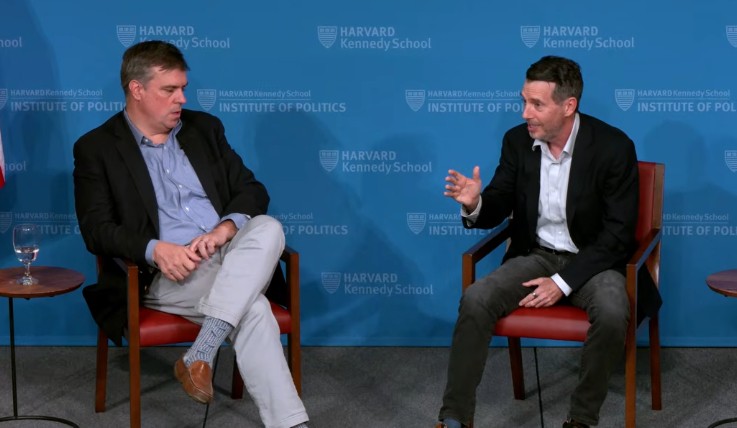
The day after a historic 2026 midterm election, veteran Democratic strategist David Plouffe joined Politico’s Jonathan Martin at Harvard’s John F. Kennedy Jr. Forum to unpack how Democrats pulled off such massive victories, from a blue Texas to razor-thin races in Mississippi and Louisiana. They discuss what went wrong for Trump’s 2024 coalition, the new electoral map heading into 2028, the wide-open Democratic presidential field, corruption, AI, and what Democrats must do to turn one great night into a lasting majority. Read the full transcript of this discussion below:
Introduction
DOMINIC MBANG: Thank you, Morgan. Good evening, and welcome to the John F. Kennedy Jr. Forum.
My name is Dominic Mbang. I am a Harvard College first year studying social studies and linguistics, and I am a member of the JFK Jr. Forum committee. Well, it’s been quite an eventful 24 hours in American politics. And judging by the election results, I think it’s fair to say that some political strategists got a much better night’s sleep than others. But regardless of where you fall on the political spectrum, this year’s midterm elections have been nothing short of historic.
With Democrats making significant gains in states long considered Republican strongholds, voters have reshaped the balance of power in Washington and raised new questions about the country’s political future.
Joining us tonight to examine these questions is David Plouffe, a veteran Democratic political strategist who managed Barack Obama’s historic 2008 presidential campaign, helping secure victories in states that had not voted Democratic in decades. He subsequently served as a senior adviser in the Obama White House, and more recently, as a senior adviser to the Kamala Harris 2024 presidential campaign.
Moderating tonight’s conversation is Jonathan Martin, a senior political columnist at Politico and former national correspondent for the New York Times. He is the coauthor of This Will Not Pass, which chronicles the political turmoil surrounding the 2020 election and the early Biden presidency, and previously served as a fellow here at the Harvard Institute of Politics.
With that, please join me in welcoming David Plouffe and Jonathan Martin to the John F. Kennedy Jr. Forum.
JONATHAN MARTIN: Well, happy day after, everybody. I hope you guys all had a quiet night. Went to bed early, maybe. Maybe had a little TV dinner.
DAVID PLOUFFE: Got to bed about 9:30. Nothing happened. It was nothing happened last night. Was really quiet. You didn’t miss anything.
JONATHAN MARTIN: What a treat to be here the day after. I think we can call it a historic election.
DAVID PLOUFFE: I think it was a historic election. I don’t think we’ll see a midterm quite like this, once in a generation midterm quite like this last night.
JONATHAN MARTIN: What a great person to have. You guys are really in for a treat. My friend David Plouffe, architect of the Obama campaign, veteran political operative, and like me, somebody who has a love affair with the American political map. So we’re going to talk a lot about the map tonight. But I want to start… We’ll kind of do this in order of yesterday, today, and tomorrow, not literally, but metaphorically.
What Happened to Trump’s 2024 Coalition
Let’s start with yesterday and where this story really begins, which is the 2024 election. Donald Trump puts up this incredible coalition, one that we really hadn’t seen on the right since Reagan. Younger voters, Hispanic voters, Black voters, keeps the Republican coalition alive, even though as fractious as they are, both MAGA and non-MAGA, and sweeps every swing state. For a moment there, it really felt like a transcendent political moment. Two years later, that coalition’s in tatters.
Could he have done anything just to have sustained, nurtured that coalition? Or was that coalition that he built, David, entirely one of the moment of Biden, Kamala, drama, ’24 is a mess for you guys and he just happens to come along or was there a way he could have kept it together do you think?
DAVID PLOUFFE: I think he could have mitigated the damage. It still would have been a bad night for Republicans. I mean, listen. If you wanted to make a Polymarket bet now, you’d say Democrats just had a great night. It’s possible. I wouldn’t say it’s likely, but quite possible. They could have a great 2028. And almost certainly, Republicans will romp in 2030, because we keep having these elections bounce back and forth.
I’m sure we’ll talk about that. So he could have made it. If he didn’t start a war in Iran and I will tell you, of all the things Trump said through these many years, and I’ve watched everything he’s ever said since 1977, he talks about two things consistently. Tariffs. Tariffs and no wars.
I never thought he’d do what he did in Iran. And if he just messaged and did things on the economy, they would have had a bad night. But let’s remember, he’s not a great vote getter. He wins the presidency in ’16 in a black swan on 46.1% of the vote, loses in ’20 with under 47, and yes, he won in ’24, but only by 1.5, when statistically he probably should have won that race by five or six points because the economy was so bad.
But yesterday was, we mentioned ’94, 2006, 2008, 2010. You have to go back to 1974 to have a result like this. So this is like fifty years since we’ve seen something like this, and I think the question is, how do the Democrats, I think they have to look at this as, to use a football analogy, two halves. They just had a great first half of football, and the knowledge that you had a great half of football, you took advantage of mistakes, but the other team threw like six interceptions.
JONATHAN MARTIN: Yes.
DAVID PLOUFFE: How do you keep it going in ’27 and ’28?
Polarization, Tribalism, and the Swing Voter
JONATHAN MARTIN: Yes.
There’s no way Democrats could actually gain really more than probably the top end was going to be net 240 House seats because the playing field is limited. This is not ’94. It’s not even ’06 or 2010. There’s just fewer seats because of gerrymandering, sorting and tribalism of our times. Are we wrong about that? And is the American voter just not as tribal as we assumed?
DAVID PLOUFFE: Voter’s been pretty tribal.
JONATHAN MARTIN: Yeah.
DAVID PLOUFFE: But I think there’s something inspiring about it, in a world of prediction markets and AI and big data, both sports and politics still have the capacity to surprise.
JONATHAN MARTIN: Yes, yes.
DAVID PLOUFFE: Human endeavors.
JONATHAN MARTIN: Yes.
DAVID PLOUFFE: For me to see Republicans… The Eagles are terrible, surprisingly bad this year. We’re going to get a first round draft pick, okay?
JONATHAN MARTIN: David’s a big Philly sports guy.
DAVID PLOUFFE: We got LeBron, baby.
JONATHAN MARTIN: There you go. He’s already spinning, he’s already changing the topic, look at that.
DAVID PLOUFFE: But I think that to see in states like South Carolina and states like Mississippi, 12, 14% of voters vote Republican… This is how Obama won Indiana back in the day. So by the way…
JONATHAN MARTIN: That was the shocker for you guys in ’08.
DAVID PLOUFFE: Yes, this is healthy though. Because we need to see, by the way, so if the Democrats are in control and we fumble the football, I think it’s healthy if a bunch of Democrats vote Republican. We have to be able to course correct, so the truth is, as you know, there was in political science circles a belief that there was no such thing as a swing voter.
JONATHAN MARTIN: Always, yes.
DAVID PLOUFFE: There’s a lot of swing voters out there in any election, even when there’s not that many of them, they tend to swing in one direction. There’s only 4 to 5% of them, but they go to… That’s how they decide close elections. Last night was large of that, so I think it’s very, very healthy, and here’s the thing, Jonathan, I don’t know if you disagree with this. I didn’t talk to a single person who saw this coming. This scale.
JONATHAN MARTIN: Scale. No, no. Not the scale. Of course not.
DAVID PLOUFFE: Not the margins in places we thought we were going to win and not the places like South Carolina, Mississippi. There are people who won US House races that spent a couple $100,000 and never did a poll. There are hundreds of people who won state legislative races as Democrats last night that nobody was paying attention to. And that doesn’t happen much in politics.
JONATHAN MARTIN: It’s interesting. Nobody talked about this at all, but Tom Cotton, a graduate of Harvard College.
DAVID PLOUFFE: He wouldn’t like you to say that.
JONATHAN MARTIN: Safe seat we think. At least in this year, Arkansas is a deep red state. Tom Cotton took this race seriously. For six months he pounded his opponent. He was running scared because he knew.
I think there were a handful of folks who knew it was going to get bad, but nobody knew it would get so bad that we’d be in a recount in Mississippi, I don’t think. I was in Tupelo the Friday before the election in large part to see Bill Clinton who had some great insights about this campaign as he always does. But I also wanted to talk to Scott Colom there and spend time with him.
But I have to confess I came away from that thinking well look Louisiana and Mississippi will be interesting. But the racial polarization of the two states means high floor, low ceiling and they’ll bump up onto the ceiling because that’s what happens in those states. But to your point the beauty of politics is the rules change. They don’t always turn out like you expected and last night was one of those nights.
Trump’s Closing Argument
DAVID PLOUFFE: Well and I think when I certainly reflect on this, obviously prices, gas, heating oil, groceries, that drove the election. But this was much bigger than this. This was about the cruelty and the corruption and the attacks on rule of law, and I think that it was a whole bunch of things together. Priorities too. “He’s looking after himself, not me.” Well, he was at the ballroom today. Literally. The day after a historic beatdown by his…
JONATHAN MARTIN: How about the day before, David?
DAVID PLOUFFE: The day before. Yeah. Algae in the reflecting pool.
JONATHAN MARTIN: Keep the stuff up. Yeah. Algae and other things.
DAVID PLOUFFE: I’m still not sure what the other things are.
JONATHAN MARTIN: You know what they are. They’re posteriors of various politicians.
DAVID PLOUFFE: Yeah.
JONATHAN MARTIN: Oh my God. Is the closing argument. I mean the most consistent message he had in the final weeks of the campaign is that Jon Husted has a nice a**.
DAVID PLOUFFE: Yeah. Exactly. Don’t forget Nicki Minaj.
JONATHAN MARTIN: As Biden would say, not a joke. That was the most consistent message he had. Talk about one senator’s butt.
DAVID PLOUFFE: Can I just say…
JONATHAN MARTIN: Yeah, go ahead. You can.
DAVID PLOUFFE: This is going to seem partisan.
JONATHAN MARTIN: Yeah.
DAVID PLOUFFE: Worked in…
JONATHAN MARTIN: Please butt in.
DAVID PLOUFFE: No, yeah. Having worked in the White House and spent a lot of time in…
JONATHAN MARTIN: I won’t back off. Go ahead.
DAVID PLOUFFE: Listen, Trump is the lamest of lame ducks. I think it’s fair to say he’s now, this is a failed presidency. Much will happen domestically, it’s a failed presidency.
But presidents have enormous power in the fields of foreign policy and defense. And to see the deterioration of him just in the last month should scare us all as Americans, because he’ll still walk down to that situation room, he’ll have his advisors, that’s a loose use of that term, sitting around the room and they’ll have their thoughts on what he should do. But ultimately it’s a decision of one.
A Free and Fair Midterm
JONATHAN MARTIN: Let me just say something controversial in this audience or at least in parts of this audience. There’s a lot of people on the left in this country who said we’re not going to have a free and fair midterm. You guys have no idea. “He is not going to accept the results. He’s going to fight this thing. He won’t seat these members. We’re going to have a crisis after the election.”
By about 10:15 last night he had moved right along. Were you surprised that he didn’t try to fight this at all?
DAVID PLOUFFE: Well, it was too big to rig, to use his term. If it had been a scenario where Democrats…
JONATHAN MARTIN: Murky.
DAVID PLOUFFE: Were 220, 222, and they’re waiting for California races to come in, I think they would have gone to extreme measures. By the way, this doesn’t mean that we’re out of the woods for ’28. So I think we need to stay vigilant. But the one thing I’d say, back in 2022, the only major Republican candidate who said their race was stolen was Kari Lake. So it was, on the one hand, that’s good. This is a Trump singular thing.
JONATHAN MARTIN: Yes, indeed.
DAVID PLOUFFE: But a lot of that had been mainstreamed. Last night, I don’t think there’s a single Republican who’s objected to the results. So I think there’s a question in a post-Trump world. Are we going to stop attacking the results of elections?
JONATHAN MARTIN: Yes.
DAVID PLOUFFE: And are we going to stop historic corruption? I don’t think we have to assume that that stuff’s going to continue, no matter what parties. That may seem naive, but I think if it had been close they would have, they had a menu of things they would have done, but it was clear it was so big.
JONATHAN MARTIN: Yeah, it was, yeah.
DAVID PLOUFFE: Go ahead.
What Democrats Should Take From Last Night
JONATHAN MARTIN: Yeah, was just that clean of asking again, yeah. Let me ask about your party. What should Democrats take from last night?
DAVID PLOUFFE: Well first of all, I would say this was a vote against Trump more than a vote for the Democratic Party. Our brand is still quite weak. We obviously had some tremendous candidates, young candidates, exciting candidates. That’s one thing we should take, candidates matter, and let’s keep having people who emerge who don’t just criticize Republicans, but take on the entire system, which has failed too many Americans. Number two, people are going to expect Democrats to be focused on their priorities, and this is really important.
We now control the House and the Senate. I’m not sure the House and Senate will pass any legislation that will help anybody that Donald Trump will sign, so what do they need to do? They need to do magnificent, consistent storytelling about what they’re doing, and right now, Jonathan, as you know, that still means, “Hey, we’re on the floor of the House or Senate and we’re giving speeches about HR1 and we do a press conference.” There’s not a single voter that matters in 2028 who’ll know they did a f***ing thing. Excuse me.
JONATHAN MARTIN: Yeah, it’s okay.
DAVID PLOUFFE: Not enough sleep last night.
JONATHAN MARTIN: That’s okay.
DAVID PLOUFFE: We spend all this money, I’d like to see more of that money be spent throughout the year so we can have content served in Ohio and in Iowa and in Michigan, Wisconsin to say, “Hey, the Democrats in the Senate and the House just tried to lower your healthcare costs. They tried to end the Iran war. They just passed a sweeping corruption law.”
Secondly, two-thirds of Americans now live in states with Democratic governors. Unless Florida’s a battleground state, every battleground state now has a Democratic governor. So how those Democrats govern, what they actually do, how they communicate is going to be a big part of making sure when we head into ’28, because here’s the thing, the economy’s…
JONATHAN MARTIN: Here’s the map.
DAVID PLOUFFE: Not going to be better.
JONATHAN MARTIN: This is the governors.
DAVID PLOUFFE: I mean, it’s an amazing thing to see, and so I think that this is going to be really important, so the people who went from Trump to Democrats, or first time voters, Democrats did really well with both first time voters and voters who did in ’24, say, maybe inflation is still too high, but the Democrats are trying to do something about it.
The risk here, because those voters don’t pay a lot of attention to what’s happening day to day in their state capital, the US Capitol, is we have to be completely focused on communicating with tough to reach voters to understand that for us to reach the same heights we just had in ’26 and ’28, we need that brand to improve.
A Blue Texas and the New Electoral Map
JONATHAN MARTIN: I’m looking at that map and it’s like one of those corner bars where the neon is sort of flashing at you and you can’t… it’s the Texas blue. It’s glaring at me. I can’t stop. I can’t believe I’m looking at a blue Texas. It’s stunning.
But you just look at that map. And besides the New Hampshire and Vermont anomalies, Phil Scott, who incredibly is a survivor. He has Teflon. He also endorsed Kamala Harris, as you know, in 2024. Kelly Ayotte’s a different story. I think she’s going to have a future in her party surviving last night as the governor of New Hampshire. But that is a sea of blues.
Let’s have some fun here. We just did some vegetables. Let’s get into a bit more of our dessert. What states or what results last night do you think were the most consequential for the future of our politics?
DAVID PLOUFFE: Well, as it relates to the presidential race.
JONATHAN MARTIN: Yes.
DAVID PLOUFFE: And it’s important to understand, after the next census in 2032, there’ll be six or seven electoral votes that switch, at least as we thought before last night, to the Republicans. So Democrats can no longer win the White House, just winning the blue walls in the Harris and Clinton states. So we have to be able to win states like North Carolina, Georgia, Arizona, Nevada, now Texas.
So I think the key thing is Georgia and North Carolina will be core battleground states. I think Nevada will be as well. Arizona could be. Now the question is, the Texases of the world, the Iowas, Ohios, I think a lot of that depends on who the two nominees are and what the atmospherics of the country.
JONATHAN MARTIN: I agree.
DAVID PLOUFFE: If the economy is as bad as people perceive it then as it is now, we could compete presidentially in Ohio, Iowa, Texas. So we don’t know yet, but we start with a lot more shots on goal than we ever could have thought imaginable 48 hours ago.
JONATHAN MARTIN: I look at last night’s map, and I think the most ominous thing besides that big bulging blue Texas is the prospect that last night was not anomalous and that Georgia, North Carolina, and Arizona become what Colorado and Virginia were ten years ago, which were momentary purple states on the way to being blue states. Because if you got Texas every four years as a battleground but you can’t count on Georgia, Arizona, North Carolina. You’re a Republican, boy, it gets really hard really fast, doesn’t it?
DAVID PLOUFFE: It does, but we as a party, conversely, I’m not sure twenty years from now we’re going to like where the Upper Midwest is.
JONATHAN MARTIN: I was going to say.
DAVID PLOUFFE: By the way, okay, the 1976 Electoral College map.
JONATHAN MARTIN: Oh, this is fun, yeah.
DAVID PLOUFFE: All of the West is red, Republican. All of New England is red, Republican. South is blue. Electoral College changes. So I hope that’s not the case. I hope we’re winning Michigan, Wisconsin, Pennsylvania, and Minnesota for decades to come. But history suggests that you have to have other places. So for us, it is North Carolina, it’s Georgia, maybe eventually it’s Mississippi, South Carolina, certainly it’s those Western states of Arizona, Nevada, and Texas and Florida are the big prizes.
JONATHAN MARTIN: You haven’t mentioned one last one, Kansas.
DAVID PLOUFFE: Yeah. Well, I mean, I don’t know. I mean, that was such… Hamilton was such an extraordinary…
JONATHAN MARTIN: But they got a governor too?
DAVID PLOUFFE: And yes. So Kansas is really worth… I think… Listen. A good presidential campaign kind of forgets the past a little bit. I mean, you know the past, which is what’s possible today? So yeah, I mean, Democrats probably have 370, 380 electoral votes that they’ll start thinking maybe we have a chance to be competitive. It’s an amazing thing. The last time we had that was ’08.
JONATHAN MARTIN: For decades the Kansas parties would trade the governorship two terms apiece going back for at least forty years. That changed last night. Democrats won a third term for governor of Kansas which is extraordinary. But what’s bigger is to win a federal race there. And to win it because they never carried that state for Senate races, never carried the presidential, and to win it so convincingly I thought was striking.
DAVID PLOUFFE: The short version of this is there’s just more options now for Democrats. Right? There’s just more paths.
JONATHAN MARTIN: But you make an important point, is Iowa and Ohio came back last night. Not since Obama were those states sort of really reliable blue states. They came back last night. But are you just borrowing Iowa, Ohio, Michigan, Pennsylvania, Wisconsin? And do you risk losing them five years from now, ten years from now?
DAVID PLOUFFE: Well, first of all, Ohio and Iowa were gone since ’12, not back.
JONATHAN MARTIN: I know. The question is, was that just a last night thing?
DAVID PLOUFFE: Exactly.
JONATHAN MARTIN: Or is it a ’28 thing? What do you think?
DAVID PLOUFFE: I think it depends on who we nominate and what the conditions are in the country. I think Pennsylvania, Wisconsin, Michigan are core battleground states in ’28. They will be in ’32. The question for me is more like ’44, just with demographics.
But having run a presidential campaign, this is what you want, is you want as many shots on goal so that you can miss as many shots as possible and still get the 270 electoral votes. When you have to run the table, it’s punishing, and I think we’re back to the point now where Democrats at least start this election cycle with a view, and again, Texas to me, those electoral votes are backbreakers.
Republicans can’t win the White House. There’s no path without Texas. And when we won Florida back in ’08 and ’12, it was a killer. And Florida was interesting last night because you saw both the governor’s race and Senate race close. We won a bunch of local races, a bunch of House races, but it’s Miami-Dade County that’s still the problem.
The rest of the state actually looked somewhat like we saw back in 2012. So we have to figure out a way to get Miami-Dade back to a place where we’re netting hundreds of thousands of votes out of it because then Florida becomes something we can unlock.
JONATHAN MARTIN: But part of the challenge there is they don’t cotton to the S word in Miami-Dade. You know what the S word is? Socialist.
DAVID PLOUFFE: Or Seminole, but yes.
JONATHAN MARTIN: Wow. Well, Florida State. I mean, come on. You.
DAVID PLOUFFE: Big game for the Canes, by the way, this weekend.
JONATHAN MARTIN: Notre Dame.
DAVID PLOUFFE: Notre Dame. Exactly.
Will Texas Be a 2028 Battleground?
JONATHAN MARTIN: So let’s talk about Texas for a minute. As we sit here today, will Democratic campaigns be paying for TV and making stops, president, vice president, in October 2028 in Texas?
DAVID PLOUFFE: Again, I’m not dodging. We don’t know.
JONATHAN MARTIN: Yeah.
DAVID PLOUFFE: Yeah. I think we say…
JONATHAN MARTIN: How can they not, David?
DAVID PLOUFFE: Well, because…
JONATHAN MARTIN: You hold it. It’s a blue state. You hold everything.
DAVID PLOUFFE: Well, we won a blue state.
JONATHAN MARTIN: Sorry, Ted Cruz. I didn’t forget about you.
DAVID PLOUFFE: We won a…
JONATHAN MARTIN: Except Ted Cruz. Last man standing. I’m not kidding. He’s the last person standing in Texas…
DAVID PLOUFFE: Yeah.
JONATHAN MARTIN: In the GOP.
DAVID PLOUFFE: Won every…
JONATHAN MARTIN: Somebody else.
DAVID PLOUFFE: Statewide office. But so here’s what I’d say.
JONATHAN MARTIN: I’m sorry. Ag commissioner, Sid Miller is still there too. So right…
DAVID PLOUFFE: Sorry, Sid. So Jon, my point is right now you’d say, yes. But what a presidential campaign thinks they can win is an incredibly important decision.
So we know in September ’28, Michigan, Pennsylvania, Wisconsin, I would actually add North Carolina, Georgia, Nevada, and Arizona will be core battleground states. Will Texas be? It depends on who we nominate, who they nominate, what the state is, but it’s possible. And I will tell you, what Talarico and Hinojosa did last night was extraordinary. They both ran extraordinary campaigns.
I love that picture of them at 3AM in the morning…
JONATHAN MARTIN: The Whataburger.
DAVID PLOUFFE: The last night. So it shows what’s possible. By the way, this is an important thing right before a presidential race, is particularly federal races, which are different than governors. We win the Senate race in Texas. We obviously won a Senate race in North Carolina. We won a Senate race in Georgia, all by big margins. Cooper won by 20 points.
So this, as a, if you’re thinking as a data nerd, you say this happened in ’26, this is the recipe, not just to win those states, to win big. That’s what we have to do again, it’s a guide. It’s not based on a race twenty years ago, it just happened. And you can fashion a campaign based on that. It doesn’t mean you can recreate it, but it’s an amazing tool to have to see what this just happened, and this is what we can learn from that.
So, a lot will depend on who the Republicans nominate. If they nominate someone who seems not MAGA, I think that’s hard to do, then I think the presidential race will be highly competitive. If they nominate someone in the MAGA lane and MAGA wing, so here’s the way I think about the moment…
JONATHAN MARTIN: You want to run against Vance, don’t you?
DAVID PLOUFFE: Oh God, yes.
JONATHAN MARTIN: You go.
DAVID PLOUFFE: God, yes. Yeah. For so many reasons.
JONATHAN MARTIN: Marco’s harder for you guys, right?
DAVID PLOUFFE: Well, he’s, right now, voters see him as not part of the Trump administration. I don’t… what matters… If I was running a presidential campaign against him, I would just emblazon that on his f***ing forehead. So give me a break, he’s not going to escape, sorry. I didn’t sleep that far.
JONATHAN MARTIN: It’s okay, we don’t mind.
DAVID PLOUFFE: Donald Trump’s president, they’ve heard those words before. This ain’t Delaware, okay? I say it in the world.
JONATHAN MARTIN: The blue hand comes out, exactly.
DAVID PLOUFFE: So what I would say is, I mentioned 1974. Last time we had an election like this, ’76 was almost as good at the congressional district vote. Now, Carter-Ford was close. So that’s a four year period where Democrats had historic… ’06 and ’08, same thing. So the question is, is ’26 just ’26 or is this going to be a four year period?
And that to me is the question and I think Democrats, if they stay focused on both delivering and communicating what they’re trying to do for people, continuing to find new and exciting people, and the Republicans nominate someone who’s of the Trump family, and the economy stays weak as people perceive it, we could have a four year thing just like we had in those two other eras.
Why Democrats Need a Primary
JONATHAN MARTIN: If you could sort of just airlift a Democratic nominee, just get past the primary and drop them in the general election.
DAVID PLOUFFE: I’m not playing that game.
JONATHAN MARTIN: Well here’s why. Who is it?
DAVID PLOUFFE: We don’t know.
JONATHAN MARTIN: I mean the presidential race.
DAVID PLOUFFE: Yeah. You want to see a primary? You actually want to see a primary.
JONATHAN MARTIN: Yeah, because past performance…
DAVID PLOUFFE: Obama got better in the primary.
JONATHAN MARTIN: Of course.
DAVID PLOUFFE: I mean most people don’t. A presidential race is like a live streamed 24-hour proctological exam. Impossible to communicate how grueling it is. Everything you do, how you eat your food, the thing you say, how you laugh, it is 24/7 and most people don’t survive it.
So people who look good on paper generally have not been able to transmit that from the state level to Broadway essentially. And so that’ll be the question. We won’t know who a strong Democratic nominee is. There’s three things. One, what will Democratic primary voters be looking for on 01/22/2028 when the first vote is? What’s the state of the economy? What’s the state of foreign policy? Who has it?
JONATHAN MARTIN: That’s a silly “it.”
DAVID PLOUFFE: It. Oh, it’s true.
JONATHAN MARTIN: Democrats have a type.
DAVID PLOUFFE: They do. Yes. Right? Who has it?
JONATHAN MARTIN: I know.
DAVID PLOUFFE: Less so on the Republican side. So we don’t know, it’s a big audition. And my only hope is lots of people who are off Broadway now, and they’re all off Broadway, decide to audition for the big show. And we’ll all get to kick the tires on it.
JONATHAN MARTIN: Who can command the attention economy too? Who can get your attention on that? By the way, you keep mentioning 1976. You know what the decisive state where Carter locked in 270 votes on election night in ’76 was, you’re going to love this. Mississippi.
DAVID PLOUFFE: Mississippi.
JONATHAN MARTIN: Full circle, baby. Full circle. We’re here now waiting for the results and once again all these years later, 52 years later.
The Supreme Court and Holding the Senate
DAVID PLOUFFE: I just think it’s important to understand this because for Democrats in particular, I mean, okay, so I’m going to say, I’m a Democrat. I think it’s essential for the country and the world that between now and let’s say the end of the next decade, Democrats hold the White House and Senate for as many of those years as possible.
So if you have an opportunity to build on a historic night with even more wins, you have to seize it because you don’t know in 2030 or ’32, you may have winds against you. By the way, the Supreme Court, even if you just look at that…
JONATHAN MARTIN: Did you see what DeSantis said last night, by the way? DeSantis, these tweets were like SOS signals. He was despairing last night. He said, “We’re not going to be able to appoint conservatives to succeed Thomas and Alito. It’s gone.” Which makes me wonder by the way if Thune doesn’t face pressure in the next two months to do a quickie lame duck.
DAVID PLOUFFE: Because you would have to decide to leave.
JONATHAN MARTIN: Well that’s the problem. It’s like Chuck Grassley. Chuck Grassley was asked today, are you going to step down so that Kim Reynolds, the outgoing GOP governor can appoint your successor so that the incoming Democratic governor can’t replace you when you go to your reward? He said, “No.”
DAVID PLOUFFE: Of course not.
JONATHAN MARTIN: “No, I’m staying.” And I think Thomas and Alito, same thing.
DAVID PLOUFFE: No.
JONATHAN MARTIN: No. No. And your party knows something about that too, right?
DAVID PLOUFFE: Well we had, God rest her soul, Ginsburg obviously. And listen, McConnell set a very, very insidious standard.
JONATHAN MARTIN: That you’ll follow.
DAVID PLOUFFE: Listen, this is why you have to hold the White House and the Senate.
JONATHAN MARTIN: Yeah.
DAVID PLOUFFE: You have to do it.
JONATHAN MARTIN: Yeah.
DAVID PLOUFFE: It’s so essential.
JONATHAN MARTIN: Yeah.
DAVID PLOUFFE: And you’ve got to hold it for a long, long time. Now, the good news about last night is, anything can happen. But the Democrats could hold that…
JONATHAN MARTIN: I mean, that’s what DeSantis said. He said, “The Democrats are now going to have the Senate for six years.”
DAVID PLOUFFE: Yeah, it’s incredible, isn’t it?
Election Administration in the Battleground States
JONATHAN MARTIN: Talk to me about some more states and races last night that you think are going to sort of echo, that they are going to have real impact, either because of the impact on the map or because of who won and kind of what that says or who lost.
DAVID PLOUFFE: Well, first of all, Democrats now control the governor’s office and the machinery of election administration…
JONATHAN MARTIN: This is important.
DAVID PLOUFFE: In every battleground state.
JONATHAN MARTIN: I think that’s right.
DAVID PLOUFFE: Yeah. Yep, unless you count Florida.
JONATHAN MARTIN: Unless you count Florida.
DAVID PLOUFFE: Every one. So that’s critical.
JONATHAN MARTIN: And Dave, unpack that for the audience, why that matters though?
DAVID PLOUFFE: Well, it just matters so that we can actually have elections where votes are cast without interruption, votes are counted, and winners are certified. And that is enormously important, because as long as Trump stays in office, I think elections are at risk.
I think the margins that we saw last night in Georgia, in Arizona, in Nevada, surprisingly big margins in the governor races, big House races, those are incredibly important, again, because those are all going to be battleground states. And I think what we saw in the South showed the ability that maybe some of these Southern states that we thought were out of reach…
JONATHAN MARTIN: Yes.
DAVID PLOUFFE: In some of these Southern states, I mean we lost the Senate race in Louisiana by one point.
JONATHAN MARTIN: One.
DAVID PLOUFFE: By the way, losing white voters by what, 50 points, 60 points because of high African American turnout. So if we can actually get to the point where we’re even doing five or seven points better with white Southern voters…
JONATHAN MARTIN: Speak and change the map.
DAVID PLOUFFE: Those states become in play.
JONATHAN MARTIN: Yes.
DAVID PLOUFFE: And so these are the things I think we need to think about.
The Wide-Open 2028 Democratic Field
JONATHAN MARTIN: Yeah. Let’s talk about the possible field on your side. Because as I look at it, three of the top five people who you see at the sort of commanding heights of the early surveys that are, I think worth the price of that water glass right there. But they’re fun for folks in my business. But Kamala Harris, Jon Ossoff, and AOC, you see those names at the top of every poll. Is it possible that none of the three run for president?
DAVID PLOUFFE: I mean, it’s totally possible that the three biggest…
JONATHAN MARTIN: Three of the biggest names, none of them run.
DAVID PLOUFFE: Right? This is the most wide open Democratic primary since at least what? ’04, ’92? You tell me.
JONATHAN MARTIN: Yeah.
DAVID PLOUFFE: And even if they run, it’ll be wide open.
JONATHAN MARTIN: Yes.
DAVID PLOUFFE: But if two or three, all three of those don’t run, even more so.
JONATHAN MARTIN: Yes.
DAVID PLOUFFE: It’s going to be a complete chaotic fun circus. And our calendar is very different. We now have six states that are early instead of four. South Carolina goes first, not last. We have some big states like Michigan and Virginia. We have a state like New Mexico that’s never gone early. Nevada. So it’s going to be super, super fascinating.
JONATHAN MARTIN: Yeah. And do you think AOC looks at the results of Michigan last night? Abdul El-Sayed didn’t win by a point and a half. He didn’t win by a half point. He won by seven. He hung a seven point margin after all that. You think she sees that?
And look, she said it herself a couple weeks ago in New York, “If he wins there that means anybody can go anywhere.” Does she take that to heart herself, do you think?
DAVID PLOUFFE: My sense is just trying to discern what she’s saying in interviews, she’s not sure she wants to run right now. Jon Ossoff has said the same thing.
JONATHAN MARTIN: Do you believe him?
DAVID PLOUFFE: I mean, listen, I think Ossoff is an amazing communicator in many ways, but I think one of his strongest attributes is people get a sense that he tells the truth and it’s very clear, and so I personally, as much as I personally would like him to run, think he’s probably not because he’s saying he’s not going to run. But if AOC runs, she’s going to start at 20, 25% probably. Question is can she grow out of that? If she doesn’t run, then that is wide open.
JONATHAN MARTIN: Where does she…
DAVID PLOUFFE: That’s where I think someone like Abdul may say, “Even though I just won, should I look at it?” And that’s the thing about this race, it’s so wide open that there may be some people who run who surprise us. I also think there’ll be some people who don’t run who surprise us.
Because people need to look in the mirror and really say, “Am I up to this?”
JONATHAN MARTIN: Yes.
DAVID PLOUFFE: “Why have something unique to offer my party in the country? Could I do this job? Do I want to put my family through this?” And some will say yes, some will say no, but I think there may be some surprise entrants. Because listen, both Trump and Obama in different ways lowered the barrier of entry to run for president.
JONATHAN MARTIN: Yes.
DAVID PLOUFFE: And so you can kind of run from anywhere right now and mount a presidential campaign of some force if you’re compelling and interesting and exciting.
JONATHAN MARTIN: Well, it’s also a down payment for people who know that they’re probably not going to be the nominee but want to be part of the next government. And the next government is going to have a big rebuilding task. And if you’re governor or senator X and you get a couple of good debates under your belt, maybe you’ve just gone from being Secretary of Education to Ambassador to NATO or something.
Example, let’s say that you’re a former mayor of Chicago and ambassador to Japan and you served at a couple of White Houses. Maybe you can’t be the nominee but you’ve got something to say. You know the party, you know the country and you’re confident and articulate. Maybe you can do yourself a little bit better. What do you…
DAVID PLOUFFE: He’d have something colorful to say to you about that description.
JONATHAN MARTIN: You know what they used to say about Ed Koch, David, he’s unavoidable for comment.
DAVID PLOUFFE: I mean, I think this is such a…
JONATHAN MARTIN: Unavoidable for comment.
DAVID PLOUFFE: My view is this is such a…
JONATHAN MARTIN: He’s calling right now, hold on a second. Hold on a second.
DAVID PLOUFFE: Sure he is.
JONATHAN MARTIN: Hold on a second, hold on. My back.
DAVID PLOUFFE: Give you the four fingered salute.
JONATHAN MARTIN: Exactly.
DAVID PLOUFFE: I think that, this is such a grueling process, I think that even people, huge underdogs, don’t run necessarily because they think they’ll become a cable news host or cabinet member. Now, they have that maybe in the back of their mind, but you’ve got to be all in.
JONATHAN MARTIN: Yeah, it is so demanding.
DAVID PLOUFFE: It’s so demanding. It’s hard to describe how demanding it is. It’s not as demanding as being president, but it’s probably the closest thing we have as a replica to it. You really get put through your paces through that process. And listen, as you know, you’re a student of history more than pretty much anybody on the scene these days.
The political graveyard is littered with people of both parties who look like they would be absolute sure presidents. And they just didn’t have what it took on that big stage.
JONATHAN MARTIN: Rudy Giuliani in 2007, 2008, America’s mayor. I mean, you know Rudy today, but you can’t appreciate what a towering figure he was coming into that primary.
DAVID PLOUFFE: John Glenn ’84 and oh my God.
JONATHAN MARTIN: Fred Thompson.
DAVID PLOUFFE: Fred Thompson. Yeah, I know.
Jon Ossoff and the Power of Short-Form Video
JONATHAN MARTIN: We’re going to take questions. But I wanted to ask you one more question about a topic you and I have chatted about before. And it’s about Jon Ossoff. It’s an obsession of mine which is Jon Ossoff’s buzz has taken off entirely with people who have never seen Jon Ossoff in person. They’ve seen him maybe on cable TV but they’ve mostly seen him in video clips on their phone.
The Ossoff boom is entirely based upon thirty second to three minute clips on a phone. Is this what FDR was to radio, what JFK was to TV? Just a sort of new medium, a new technology that he has somehow mastered and that is going to lift him to the presidency maybe?
DAVID PLOUFFE: Well, this is a presidential campaign.
JONATHAN MARTIN: It is, right? That’s it.
DAVID PLOUFFE: Yeah. With some exceptions, and so you have to master the communication on this device, which is not entirely, but a lot of short form vertical video, but it’s not only that. So I think that his clips excite people.
JONATHAN MARTIN: Yes.
DAVID PLOUFFE: But it’s not just a tactic. It’s the content. I would say this. Jon Ossoff is in Georgia. He’s not in California. He’s not in New York. And his critique of Donald Trump is to me the strongest, most honest, fearless critique of anyone in the party, and I think people respond to that.
JONATHAN MARTIN: So…
DAVID PLOUFFE: There was no bulls***. There was no, “Well look, if he wants to help Georgia, I’ll work with the president.” No, no, no. None of that crap.
JONATHAN MARTIN: No.
DAVID PLOUFFE: Just Mike Tyson uppercut to the jaw every time. It came from a very strong moral place.
JONATHAN MARTIN: Yes.
DAVID PLOUFFE: And so I think that’s what excites people.
JONATHAN MARTIN: An outrage almost, right?
DAVID PLOUFFE: Yeah. So anyone who’s going to be our nominee, you’re going to have to find a way to communicate with people that will never see you in person, that may never watch you on television, through the phone, and obviously that has to be… Now, tactics are less important than what you’re saying. Are you the right person at the right moment? Do you have an incisive message?
Do you seize the moment or two that happens in a presidential campaign where you can become more than you currently are? That’s not about the tactics, but you really have to think through, whether it’s Reddit, TikTok, YouTube, Reels, you have to have, and this is why the most important staff people in campaigns these days are people who are 22, 23, 24 leading these digital efforts, and they need to have more and more of the budget, more and more of the say, and that’s exciting to me.
JONATHAN MARTIN: Oh, it’s extraordinary. I was at a rally for Ossoff last week outside of Atlanta and there was somebody there. You could just tell he was smitten with him, just the way he was looking at him while he was speaking. It was actually a little awkward. But I couldn’t help but notice that Obama really liked him a lot.
DAVID PLOUFFE: Game recognizes game.
JONATHAN MARTIN: No, actually Obama gave him a hard time. Said, “Look, you got this Kennedy-esque senator here.” And of course, Ossoff didn’t mind being called Kennedy-esque and the crowd just loved Obama and loved Ossoff.
But I’ll tell you what though, that crowd, let’s be honest, that crowd is there for Obama. 80% at least, but talking to voters, they were as excited about Ossoff. A lot of them were as they were Obama. He has become a sensation. Overnight it’s the most fascinating political development I think so far of this cycle.
Audience Q&A: Newsom, DeSantis, and the 2028 Race
JONATHAN MARTIN: All right. Let’s take some questions. Yes, sir.
AUDIENCE: My name is Ricardo Delfuent. I’m here in the senior executive program.
JONATHAN MARTIN: Thank you.
AUDIENCE: This month. I remember David Gergen said, “Every four years, they say it’s the worst election, and every four years, they’re right.” So my question to you is, there was a lot of talk of Ron DeSantis and Gavin Newsom. I’m a big fan of Gavin.
JONATHAN MARTIN: Yeah.
AUDIENCE: What would you advise Gavin and Ron DeSantis to reignite their campaign? Because I’ve seen that they’ve been dipping in all the polls and Polymarket. Do you think they have a chance? Because they seem to be the hot ticket when they were doing that big governor’s debate.
JONATHAN MARTIN: Let’s take one each, and David, you alluded to this earlier, but is there a chance that Gavin doesn’t run?
DAVID PLOUFFE: Well if Kamala runs, he said he won’t.
JONATHAN MARTIN: I know it’s not.
DAVID PLOUFFE: I think if Kamala doesn’t run, I assume he’ll run, but again, he’s got to make sure his family’s on board. But I would say this, polls and Polymarket, they don’t matter right now. Basically everything goes back to zero, and you have a chance to build a campaign and connect with people. So DeSantis is interesting. He was horrible when he ran last time in 2024.
JONATHAN MARTIN: Another governor of Florida.
DAVID PLOUFFE: Remember, he was the front runner.
JONATHAN MARTIN: Yeah, another example, exactly.
DAVID PLOUFFE: Kind of falls apart. Even things like wearing white boots, that can kill you in a presidential campaign.
JONATHAN MARTIN: I mean. That’s true.
DAVID PLOUFFE: So, but he is on AI, on Iran and on corruption, the strongest voice kind of against the way Trump’s handled all those issues. And so he has some currency, and I think Newsom obviously is deeply respected by Democrats because he’s been kind of a fierce warrior.
But here’s the thing, what we don’t know yet, it may just be Democratic voters say, “I want someone new.” And it almost doesn’t matter what kind of campaign you run. Or they may not. I don’t know what we’re looking for. And we won’t have the foggiest idea until we get into the fourth quarter of next year.
JONATHAN MARTIN: I think DeSantis, I mean, he may not, but the last 24 hours would suggest to me he’s going to run. J.D. Vance’s tweet today, if you didn’t see it, basically throwing his boss under the bus on Iran, would suggest he’s trying to figure out how to get some space. So the moves are starting.
DAVID PLOUFFE: By the way, Abdul has nicknamed Vance JV Dance.
JONATHAN MARTIN: Call him JV Dance. Abdul’s got a lot of Trump in him by the way. I kind of liken Abdul to one part Trump, one part Stephen A. Smith and one part Obama and maybe a dash of Pete in there too because there’s a lot of Midwest Rhodes Scholar to him too. But man, that guy’s got some lip.
DAVID PLOUFFE: By the way, there was some of the most credulous stuff about DeSantis early on, early in ’23. “This guy is going to come to the primary like a freight train.” These stories are written in Tallahassee.
JONATHAN MARTIN: Oh, wait, that was me. All right. Yes. Yeah, go ahead.
Accountability Versus Affordability
AUDIENCE: Hi, my name is Isha. I’m a second year master’s of public policy student. Last night, Representative Garcia’s message to Republicans was just “lawyer up,” and so there’s clearly a lot of appetite among Democrats to hold the Trump administration accountable, but the party also just went really big on issues, namely affordability.
So do you think this aggressive posture is politically smart, or does it risk distracting from the issues that brought swing voters over, and how should Democrats balance these priorities moving into 2028?
JONATHAN MARTIN: Key question.
DAVID PLOUFFE: Great question. And I’ll try and be brief, because I could probably do thirty minutes on this. So first of all, whether you got elected to the House, Senate, Governor, County Council, you have to have day in and day out, both what you’re doing, what you’re trying to do in communicating, “I’m trying to improve people’s lives.” That’s table stakes. If we don’t do that, we don’t deserve a good ’28.
Now, what is so insidious about Trump and those he surrounds himself with, including some of the wealthiest people in the history of the world, is they don’t want accountability from the voters, from the press, from the courts. And so this is set up as maybe a bunch of illegal things were done, but you will pay a political price for trying to investigate them and hold them accountable. So you don’t have a country, a democracy, if that is how we operate. So I think Democrats should spend time on corruption for one.
I personally do not think we should be talking about impeachment. I think we should be focused on the corruption, and the corruption should be very much because what happened last night, I think this surprised a lot of people. Corruption was at the very top of the list of what drove people’s votes, and they connected it to their poor economic situation. They get it.
We should, now should we just investigate companies to investigate companies? No, but we should say if you gave money for something, what did you get out of it? Let’s look at the finances of the Trump family, which is basically, the wealthiest person in the world is believed to be Putin, and I think that Trump admires that. So we need to get to the bottom of this why. Yes, to hold them to account, but more importantly, so it never happens again.
This is for me as an American citizen, to see our government basically be treated as a vending machine, which is you put money in and you get something out. We’re not going to last if that’s the case. So I think that they need to make the investigations and the hearings really count, connect it to the problems that people are facing, and I think if they do that, they can do both of those things, and I think voters will respect that.
But if they think all we’re doing, James Talarico was asked about this today and I thought his answer was great, “I did not run for retribution. I ran to deliver results for people.” Now that doesn’t mean you ignore wrongdoing or illegality or corruption that’s hurting people, but you have to take care at the base level, which is “I’m waking up every day, I’m running through that wall for you to try and help your life.” And this is ultimately the big question for the country.
As Jonathan knows, we keep having landslide elections. Change elections every two years. Why? Because people’s economic situation is getting worse and worse, and ultimately, we need to figure out how do we fix that?
JONATHAN MARTIN: Yes.
DAVID PLOUFFE: And my personal view is I hope that our presidential nominee goes beyond the polls and just raising taxes on the wealthy and more healthcare as important as that is. Let’s attack the big things here. Aging population, AI, the healthcare system that’s clearly not working. An education system that clearly needs to be changed, China. What are we going to do about all that? Robotic armies.
There’s big stuff coming at us and I would love to see, because at the end of the day, I trust the American people and I think if we deal with them in an honest way, in a big way, we will benefit from that. By the way, Jonathan, I think that is going to be an interesting thing in both parties in the primary for president. You’re going to see some candidates on both sides run small campaigns, poll tested candidates, and you’re going to see others go big. I don’t know where that’s going to net out.
JONATHAN MARTIN: That’s a great point.
DAVID PLOUFFE: I personally hope the people who talk about the problems in the most honest way, which means by the way, you don’t have the easy sound bite solution to everything. I hope those people get rewarded.
JONATHAN MARTIN: But it looms as probably the most consequential campaign for president in our lifetimes, with no hyperbole at all, given the bill that you just laid out there, I mean just the challenges ahead, the rebuild at home, the rebuild abroad, right?
DAVID PLOUFFE: I think so.
JONATHAN MARTIN: Enormous. Obama got razzed in ’09 for doing the apology tour by the right. I mean the next Democratic president is actually literally going to have to do an apology tour. They’re going to be in Canada in the first quarter of 2029 eating poutine and putting maple syrup all over it to apologize, right? By the way, credit to, speaking of Rahm, credit to Rahm who was on the corruption issue early and aggressive. He staked that out.
Corruption and Elon Musk’s Spending
DAVID PLOUFFE: Let me say this, this is one where Trump I doubt will sign it, so this is the Democrats just passing, but by the way, they can also leverage all those governors.
JONATHAN MARTIN: Yes, yes.
DAVID PLOUFFE: There’s an orchestration to this, which is let’s leverage every resource we have to drive message on something like corruption. The corruption thing that should be passed by the House and Senate should go beyond what most Democrats are comfortable with. We should do it all. You can never lobby Congress. Term limits. Never trade a stock. Crypto, everything.
And this is where there will be some tension, but our margins are large enough that I think we can pass something that would really resonate with voters. By the way, I hope our presidential candidates do the same thing. This is a place where I don’t think you can swing hard enough for the fences.
JONATHAN MARTIN: Yeah, agree with that. The twin scourges of the era are income inequality and the cynicism about politics and politicians, and it’s the latter of those two that I think is the root of the frustration about corruption.
DAVID PLOUFFE: Well, we just had, listen, and Musk I think found himself on the wrong side of politics this time. But I think his spend, I think it was very harmful.
JONATHAN MARTIN: Two years in a row, David, Wisconsin last year and Texas this year.
DAVID PLOUFFE: But it just…
JONATHAN MARTIN: Burned his money.
DAVID PLOUFFE: There’s a story here which is the wealthiest person in the history of this planet is spending the most money…
JONATHAN MARTIN: Ever.
DAVID PLOUFFE: In the history of this planet to buy and influence government. And someone who has enormous influence in space, in telecommunications, in the military, in social media, it is a parable about what’s wrong, and I think Democrats, Talarico I think spoke really powerfully to this because he was at the center of so much of the spending, but I’d like to see more Democrats kind of lift this up, and that means, by the way, we have to be true then in our opposition to it.
JONATHAN MARTIN: It makes the rail barons of the nineteenth century look like they’re running the Dunks across the street here. All right, go ahead.
The New Governors to Watch
AUDIENCE: Hi, I’m Amy Muller. I work with the Taubman Center for State and Local Government here. I’m exclusive. I do not care about the Congress or Senate. They seem cute. Governors, county executives, and mayors.
DAVID PLOUFFE: I already like you.
AUDIENCE: Thank you. We run a program that sends students to newly elected governors, county executives, mayors during our January term. Who got elected last night that you were the most interested to see what they do, especially their first one hundred days in office, and what do you think they’re going to do?
JONATHAN MARTIN: This is real sicko stuff here. And I didn’t want to nerd out, but I can’t help but think about what David said about the 2010 cycle because I wonder which of those folks last night are going to be one term wonders and which of them are just walking zombies. I mean some of these people are going to have a really hard time in 2030 surviving. Right. And by the way, the smart Republicans are already thinking about themselves running in 2030.
But look, I mean I think you… I was talking about this with a colleague. Some of these state capitals have no muscle memory left. Who are they going to hire to run their… The state of Texas is a nation state. Who is she going to hire to run Texas? There’s nobody left there. Ann Richards lost in 1994. It’s been forever. Ohio, Iowa it’s been since 2010.
I mean, somebody told me that Dick Celeste, the governor in his eighties, that the Celeste people were talking to Amy Acton. The Celeste people? How old are they? I mean, no offense to the old folks here, but so, yeah, it’s going to be fascinating, how they staff, how they survive, what they do. I mean, I’m really fascinated in these states that have just no recent muscle memory of Democratic politicians, staff ecosystem, how that’s all going to work. And I think that’s going to be fascinating to watch.
DAVID PLOUFFE: Yeah, well first thanks for what you did. I think Hinojosa is the most interesting for some of the reasons Jonathan said. I think Acton’s interesting. They’re both going to have to figure out a pathway, I think, forward on data centers. And I think there is a pathway, but it’s going to have to be a lot of energy and water, no special tax deals, transparency, different than the old way.
But Hinojosa obviously, I think in particular, because they won every statewide office, she’s going to have to get some stuff done right away. She’s very focused on education. So I think those two are going to be super interesting. And again, I think particularly because Texas does not meet every two years, she’s got this legislative session. Now of course, she can do a lot of things outside of the legislature that are important to deliver results for people, but she’s really got to maximize this legislative session.
And the other thing is, there’s going to be Republicans in the state legislature obviously who are trying to…
JONATHAN MARTIN: They’re biennial, yeah.
DAVID PLOUFFE: Torpedo her at every step, so that’s going to be interesting. Iowa’s going to be interesting because Sand obviously won in a landslide, but he still has a Republican legislature.
JONATHAN MARTIN: Yes.
DAVID PLOUFFE: So figuring out how to kind of, you’ve got to find a way forward, and that’s the thing. Usually at the state level, unlike Washington, which can be very theatrical and empty, states generally have to get stuff done.
JONATHAN MARTIN: And can I just throw in one more thing? Republicans found out last night that their gerrymander was a dummymander. All right. It blew up in their face. Wisconsin has been craving a trifecta in state government ever since Scott Walker flexed his muscle. Guess what. They got their trifecta last night. If you’re Wisconsin Democrats, do you go for it now and redraw maps?
DAVID PLOUFFE: I can give you five more states.
JONATHAN MARTIN: “You got a trifecta now. We’re going to do what they did. We’re going to draw maps. We’re going to lock in these seats,” or does that make them what the other guys were? I’m fascinated about that too.
AUDIENCE: Thank you.
The Deep South and the Path Forward
JONATHAN MARTIN: Yes, sir.
AUDIENCE: Hi. Thanks for being here, this is super interesting. I’m a second year at the business school. I’m a native of Alabama. And my question is…
JONATHAN MARTIN: Tigers.
AUDIENCE: Obviously, the Deep South is not a monolith, but there are certainly super similar political and certainly racial dynamics across the Deep South conservative states, and I think it’s interesting that you see some states like Mississippi, as you mentioned, Louisiana, that are sort of edging closer to being really in play, or at least last night were in play, whereas Alabama not quite there, Tennessee not quite there.
I’m curious to hear your perspective on the nuances of that situation, especially the African American vote and just how you kind of read that from either side.
JONATHAN MARTIN: The most fun campaign I’ve ever covered in my life, no offense to David, Obama ’08, but it was 2017 Alabama, the special to replace Jeff Sessions. There were three campaigns, primary, runoff and general and they were all great fun. And Doug Jones obviously won that special election there in 2017, extraordinary. And he was the nominee for governor last night. It didn’t get a lot of attention.
And I think if Jones had more money and more attention, may he have pushed that race really… I think the margin is three, three and a half there. It could have been a lot closer for the reasons that we’re talking about today. If you can just get a couple more white folks, God, you can really be in the game. But Alabama is hard. It has the same racial sort of polarized politics there. It’s difficult and if you’re not getting the money then that’s going to be a real challenge going forward. Governors races tend to be a little different but that was fascinating last night though too.
DAVID PLOUFFE: Historically federal races are harder in the South for Democrats. But last night it just, maybe last night was a unicorn. It just didn’t seem to matter last night.
JONATHAN MARTIN: No.
DAVID PLOUFFE: And Tennessee governor was very close. So you see the contours of what’s possible. In Alabama, Tennessee, Democrats obviously have to improve their share of the white vote in particular. But Tennessee obviously has a lot of migration.
JONATHAN MARTIN: I was going to say.
DAVID PLOUFFE: Particularly in the Nashville area, and so it reminds me of North Carolina fifteen years ago, and I do think we’re on a path where, it doesn’t mean we’ll win it all the time, but North Carolina’s a big state, Tennessee’s a big state, so I think there’s a pathway there.
But listen, part of the lesson here is you have to take advantage of time in great cadence, but in all the, look at Georgia, look at Texas, years and years and even decades of organizing work, and you lose and you lose and you lose, but you stay at it, you stay at it. A lot of great work happened in Mississippi this election and in prior years to allow that result, and he’s up now 1,000 votes, by the way, which means, generally, you survive a recount if you’re up 1,000 votes.
But I think this is really important, and I think Democrats, what it showed last night is there’s going to be elections where we have headwinds, where we can’t win places like that, but we have to get to the point where we can take advantage of tailwinds, but the key thing is to win in a neutral environment.
JONATHAN MARTIN: Yes.
DAVID PLOUFFE: And that’s the thing Democrats have to figure out a way to unlock, and by the way, I’d say this, the Republicans are trapped by Trump for the next two years. We’re not. We can be whoever we want to be. So we have the opportunity to be a stronger offering than we even are now, and they I don’t think can. And that’s an asymmetric situation that we need to take…
JONATHAN MARTIN: For two more years, yeah. No, David’s right. Nashville, every day it becomes more like Austin. It’s going to become a more competitive state. The other place that I’ll give you in the South nobody’s talking about, you will have a competitive House seat in Fayetteville, Bentonville, Arkansas in the next ten years because of the migration issue. Yeah, go ahead.
Big Tech, AI, and Voters’ Fears
AUDIENCE: Thank you, I’m Kelsey. I’m an MBA, MPA celebrating the blue wave, so feeling good today.
JONATHAN MARTIN: And Casta Blue too, yeah.
AUDIENCE: Yeah, see, yeah. Anyways, so I’m from California, from Silicon Valley, the Bay Area, and we saw kind of a swing from the early Facebook kind of era of the world where big tech was kind of aligned more with liberal values and then kind of swung towards Republicans. And you mentioned the data centers and it brings up a bigger conversation about AI and what do Democrats need to message around AI.
It’s not just the compute issue, but potential labor displacement. There’s a lot of apprehension around it. So can you talk a little bit more about that, both big tech and kind of the average American, I guess, perception of AI, how to manage those fears successfully?
DAVID PLOUFFE: Well, I think you saw big tech swing to Trump. I mean most, I think clearly around his inauguration where he was surrounded by all of the folks, and I think there was a couple things going on there in my opinion. One, they knew how Trump operated. Flatter him and favor him and you will get what you want. Number one. Number two, I think a lot of those tech leaders were tired of being criticized. They built these historic companies.
JONATHAN MARTIN: Yeah, they’re human too.
DAVID PLOUFFE: Trump was going to throw rose petals in front of them. So I think as it relates to AI specifically, this is a thing where I think we’re going to see, in many respects, I think the data centers both substantively, there’s an answer there because I think even Gina Hinojosa was not saying we should not build data centers. It’s, how do we build them?
And so we’re going to have to build them differently than we had in the past, where communities really had bad deals, energy, water, tax preferences, those days are done, I think. AI is much more challenging, and I think when you spend time with voters listening and talk about AI, they feel like all this is happening to them. “It’s just happening to me. I’m told I may not have a job, my kids might not have a job, society ends, we could be extinct, and nobody’s doing anything about it.”
JONATHAN MARTIN: Yeah.
DAVID PLOUFFE: So I think that what, I may be wrong about this, but I think the opportunity the Trump administration is missing, because it is true, technology, AI doesn’t have borders. Now Ted Cruz said he’d rather be killed by an American killer robot than a Chinese killer robot.
JONATHAN MARTIN: What a…
DAVID PLOUFFE: Don’t think about it that way. But what would the Chinese government feel…
JONATHAN MARTIN: Thanks for your service, Ted.
DAVID PLOUFFE: Correct. They fear the firewall crumbling and their loss of control. So my sense is that there’s probably a way to kind of deal with this globally where we have pacing and we have transparency, slowing down. So I think my guess is in both parties, you’re going to have people saying we shouldn’t build data centers and we basically need to shut down AI. You’re going to have other people saying, we need to be more thoughtful about it. We need to have a plan for it.
There’s no doubt, I’ve seen polling. It’s, by the way, not really, you’re not really able to do this, but the notion of a kill switch in the Oval Office that a president could pull is 90% support. It tells you how worried people are.
JONATHAN MARTIN: So interesting.
DAVID PLOUFFE: So I think that what concerns me, not really politically, is people are scared to death, and right now I don’t think they’re going to get a lot of leadership. I don’t think we’re going to see course correction on AI from the Trump administration. I think they’re going to continue all systems go.
JONATHAN MARTIN: Yes. It’s the economy to him.
DAVID PLOUFFE: Well listen, and people ask, was AI a driving issue, and by the way, this is important to understand. An issue that may have 80% support or 80% opposition, the question is, are people casting a vote on it?
JONATHAN MARTIN: Yeah, yeah.
DAVID PLOUFFE: And not that many people last night were casting a vote on AI as much as they’re concerned about it, and I think that’s going to change in ’28 for one of two reasons. Either it’s going to really take off and we begin to see job displacement and we begin to see bank accounts and we begin to see grids come down. Well, that’s going to be a big issue, or it kind of goes belly up and we have a recession or a depression and a debt crisis and a huge problem in the economy. So either scenario, I think it’s going to be really important in 2028.
So this is where we need leadership, right? And by the way, the American people are smart. They understand whether they want it to be or not. Technology is kind of undefeated. Technology is going to come. The question is how do we deal with it? And by the way, when you listen to parents with kids who are eight, 10, 12, 14, they don’t know what to do. “What should my kids learn? Should they go to college?”
Kids who are just graduating don’t know what their future is. So there’s enormous unease out there and people feel like there’s nobody helping them navigate it. And so I think there is an opening for political leaders to step into that. They don’t have to have all the answers. They at least need to start by, “I acknowledge some of these questions that you have.”
Can Democrats Govern With Their New Majorities?
JONATHAN MARTIN: We’re at an hour. David’s been very generous with his time.
DAVID PLOUFFE: Thank you.
JONATHAN MARTIN: One more question right there. Yeah, go ahead.
AUDIENCE: Hello, thank you so much for being here. I just had a question. So the Democrats have the House and the Senate, but does that really mean you have a majority if maybe some people in your party are not going to vote with you because it’s so divided at the moment? So I wonder if, is there a plan or how…
JONATHAN MARTIN: Well the pad helps, right?
DAVID PLOUFFE: Yeah, I mean we could get up to close to 260, so you can lose 40 of your members…
JONATHAN MARTIN: Midnight.
DAVID PLOUFFE: And pass anything. So the House, now of course the Senate, filibuster’s still in place, so most, not all issues require 60. So you’re going to have to find some Republicans to play. Now we may end up at 56 if we win Alaska and Mississippi. And so you’re only four away on some issues.
So I think in the House now, you’ve got a lot of margin for error, again, this is important because Democrats, I don’t think, should focus on, by the way, if Trump wants to do a deal on immigration, I think they should have that conversation. If he actually wants to talk about AI, we should talk to him. But they should not be imprisoned by things that only Trump will sign, so whether it’s corruption, whether it’s healthcare, whether it’s energy, whether it’s stopping the Iran war, they should be passing things every day.
JONATHAN MARTIN: And selling, selling, selling.
DAVID PLOUFFE: Selling and say, “We could be making progress on this, but Trump is standing in the way and the Republicans.”
JONATHAN MARTIN: I can’t think of a better way to spend the day after this historic election than talking politics with David Plouffe. Thanks, David.
DAVID PLOUFFE: Appreciate it.
Related Posts
- Transcript: Trump Takes Questions In Oval Office After Massive Republican Midterm Losses
- Diary Of A CEO Interview w/ Robert Pape – 8 Dangerous Weeks Ahead (Transcript)
- Victor Davis Hanson: What the Democratic Midterm Sweep Means for 2028 (Transcript)
- Max Blumenthal Interview: Can Trump Salvage His Presidency? (Transcript)
- Douglas Macgregor: Midterms & Revolution in Europe – The Cost of Strategic Failure (Transcript)