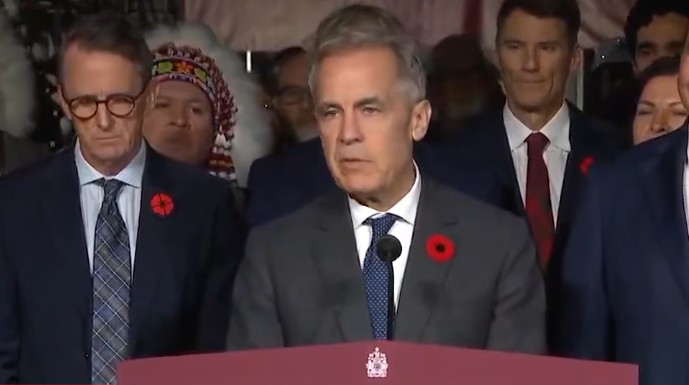
Prime Minister Mark Carney visited Winnipeg on November 6, 2026, the day after tabling the federal budget, to unveil Budget 2026’s $30 billion national plan to end homelessness in Canada within a decade. Joined by Manitoba Premier Wab Kinew, Carney announced more than $1 billion for over 2,000 transitional and supportive homes in Winnipeg and a new Winnipeg Centre for Mental Health and Addictions, then took reporters’ questions on Quebec, U.S. tariffs, immigration, fiscal sustainability, fertilizer and trade with China. Read the full transcript below:
MARK CARNEY: Thank you. Thank you very much, Ben. Premier Kinew, Mayor Gillingham, Mayor Martinez Ferrada, Mark Chipman, David Thompson, Grand Chief Daniels, leaders of the Red River Métis, Minister Gudin. And I also want to recognize, although it’s hard to see with the lights, I want to recognize the many Winnipeggers here today who serve this community by caring for those in need.
The outreach workers, shelter staff, nurses, counselors, volunteers who show up day after day, night after night to help their fellow citizens.
Budget 2026: Building Our Sovereignty
Yesterday, we tabled in Parliament the federal budget for 2026, and we tabled that to become masters of our destiny to what purpose. We tabled it so that we can more fully live those values. In an increasingly turbulent world, Canada is determining our future. We have the strength to build, the discipline to deliver, and the values to take care of each other.
And so the budget is the next step of our ambitious and pragmatic and generational plan to make Canadians, as I said, building our sovereignty and giving us the freedom to live our lives as we choose.
That means investments that build our sovereignty so entrepreneurs are empowered to grow so that ideas become companies so artists and creators can tell our stories. So we have energy that we generate and control so that Canadians have more choice and lower cost. And so that there is a home for every Canadian.
The Homelessness Crisis
Here in Winnipeg, as in many cities across Canada, the homelessness crisis is acute. It starts with people who are just getting by then something goes wrong. A lost job, a family breakdown, an illness and addiction, or often several blows come all at once. And when the systems that are meant to help can’t cope, people fall through.
And for too many, homelessness doesn’t end quickly. Most people experiencing homelessness in Winnipeg have been without a home for six months or more. Some have lived this way for years, some for decades.
The basics that most of us take for granted, a shower, a bed, a door that locks become a daily struggle. Maggie Helwig describes homelessness as, and I quote, “more than anything else, a life of constant displacement.” It’s also dangerous. Extreme temperatures, violence, no easy access to a doctor, a meal, or a bed.
Every year here at Hope Alley, just off Main Street, this community holds a memorial for those who died on the streets. Two weeks ago, nearly 200 names were read out loud. People lost to homelessness and to toxic drugs, some known only as John or Jane Doe.
There are similar memorials across our countries. Torontonians gather at the Church of the Holy Trinity, Edmontonians at the Memorial Plaza. When people have nowhere to go, the whole community feels it. In our emergency rooms, on our transit system, in our downtowns.
Today, across Canada, an estimated 65,000 people are without a home. People staying in emergency shelters and transitional housing, sleeping in cars doorways. Canada’s strength and our compassion must be put to work for those who need it the most because Canada strong starts in a warm home.
And just as there’s no single way into homelessness, there’s no single way out. There’s no simple answer. This is a hard problem. And hard problems demand the humility to learn from previous well intentioned efforts that have fallen short. And it demands the resolve to build on what succeeded.
For decades, governments and communities have tried to address this crisis. Too often these efforts have been inadequately resourced, poorly coordinated, and not sustained. We’re learning from these experiences. And as we learn above all, from the people working on the front lines, many of whom are with us here today. And what works, what we get from those learning comes down to a combination of three things.
What Works: Help
First, help works. Help can start before someone ever loses their home. Covering the rent when a paycheck falls short. A call to a landlord, support when a family is in crisis. And for someone already on the street, help is an outreach worker who knows their name and gets them to a warm bed at night. Help can be a way forward, replacing a lost ID, getting income support, finding a job and a permanent home.
And that’s what Reaching Home helps do. Through this program, the Canadian government backs local organizations that do this work every day on the ground across Canada.
Here in Winnipeg, that support flows through organizations such as End Homelessness Winnipeg, an Indigenous led group that lifts people out of homelessness and maintains vital real time data. That data tells us that four out of every five homeless Winnipeggers are Indigenous, and their work helps to reach them.
As does Chalmers Neighbourhood Renewal Corporation, which helps families keep their homes by sitting down with a landlord, covering back rent, and providing one to one support. And the North End Women’s Centre, where women and gender diverse people can find a safe place to stay while they get back on their feet. So help works.
What Works: Housing
The second thing that works, obviously, is housing. And that means transitional homes as a safe bridge out of crisis and deeply affordable homes so that the bridge leads somewhere permanent to live. And it means that the help continues as needed.
So today, we’re standing on the construction site for the formerly known as the Hudson’s Bay Building.
When this structure opens, reopens, it will provide 373 affordable homes for First Nations families. Safe homes, permanent homes. In the heart of downtown led by the community that it serves. A landmark of the past becoming homes for the future.
What Works: Health
And the third thing that works and is essential is health. For the most vulnerable in our society, this is a further requirement. Now not everyone without a home needs health care, but most desperately do.
Nine in ten people on the Winnipeg streets face a health challenge, most often addiction, mental illness, or both. And for them, the emergency room becomes their only respite, but it’s a temporary respite. They’re treated, discharged, and then they go straight back onto the street, and the cycle begins again.
There is, however, a better way. In Toronto, the University Health Network built Dunn House, a four story modular building, 51 homes for the people who use the ER the most with care right on-site. It was built in partnership. The hospital, the City of Toronto, United Way, the charity Fred Victor, the Province of Ontario and the Government of Canada, all working together.
The early results are striking. ER visits cut in half. Days in hospital down 80%. An entire community that benefits. So when something works and the need is great, we should do more of it. And that’s exactly what we’re proposing to do in Budget 2026, to help set Canada on a path to end homelessness over the next decade.
A $30 Billion National Plan to End Homelessness
To get there, we are investing an unprecedented $30 billion in a coordinated national plan. Now I want to be clear. We understand both how difficult this will be, but equally how imperative it is that we all succeed. Because in Canada, we know we’re not perfect, but we always strive to be good. And we do things because they’re right, not because they’re easy.
Ending homelessness is hard, and it’s good, and it’s right. And it will require more than compassion. It will require ambition, execution, and partnership amongst all levels of government with contributions from philanthropy and business. So our plan is built on what we’ve learned that works. Help, housing, health.
Let me say a few words about each. Start with help. Budget 2026 invest $5.5 billion in the Canada Housing Benefit. And that puts money every month directly towards the rent of low income Canadians. Here in Manitoba, it means families can receive over $300 in monthly payments. And for someone on the edge of homelessness, that can be the difference between keeping a home and losing it.
We’re also introducing and expanding automatic tax filings, which will help ensure that people get all of the benefits that they deserve. We know that prevention is also vital in this regard and keeping people in the homes that they already have.
Next, housing. Budget 2026 makes an investment of $10 billion to Build Canada Homes and I salute the minister here today. The objective, the intent, Mr. Robertson and his team will build 25,000 transitional and supportive homes across Canada. And as more partners step up across the country, we will ramp that investment up.
Here in Winnipeg, what that means is $800 million for more than 2,000 new transitional and supportive homes. And that’s possible because we’re working with the City of Winnipeg and the Province of Manitoba as they choose sites on public land, which will allow us to start sooner and build cheaper.
And it’s possible because the province will step up and operate these homes and provide the supports that come with them, including helping people with training, finding a job, income support to cover bills, mental health and addictions care being close at hand.
And that brings me to health. Budget 2026 is investing $2 billion more in the Health Infrastructure Fund to build mental health and addictions treatment facilities in communities across Canada. And we’re committing $5 billion to a new Integrated Supports Fund to build housing and healthcare together with public, private and philanthropic partners.
New Winnipeg Centre for Mental Health and Addictions
And I’m proud to announce that the first investment from that fund, a fund we created yesterday, the first investment will be over $200 million in federal funding to build the new Winnipeg Centre for Mental Health and Addictions in partnership with the province and with the.
As my colleagues know, this centre will bring acute and outpatient mental health and addictions care together with permanent housing and coordinated support services. And it will be operational as soon as three years from today.
So one pathway to help, housing and health. And that’s how we begin to break the cycle. We’re starting in Winnipeg today because the Government of Canada, the Province of Manitoba, the City of Winnipeg and private philanthropy in recent months have all been coming together to develop a comprehensive plan that works.
And with other projects already underway in Winnipeg, the Government of Canada is working with partners to build a total of 2,500 new housing units for those most vulnerable. Now we can do this everywhere, everywhere across Canada. The Government of Canada is willing to work with every willing partner.
Hope Alley
A few years ago… Let me finish.
A few years ago, Al Wiebe, a man who once lived on these streets, gave the alley off Main Street a new name, Hope Alley. And as Al put it, “hope is not only life changing, but life sustaining.” Hope needs something to hold on to. The prospect of help when you need it most. A home of your own and the health care to keep you well.
We have the strength in Canada to build. We have the discipline to deliver. And Canadians, we all have the values to take care of each other, to take care of every single Canadian. Budget ’26 and today’s partnership is how we can not only provide hope, but how we will turn that hope into reality. Thank you very much, merci beaucoup.
And it’s now my pleasure and honor and with great gratitude for his leadership, it’s my honor to pass the word to the Premier of Manitoba, Wab Kinew.
Premier Wab Kinew: “A Huge, Humongous Deal for Manitoba”
WAB KINEW: Prime Minister, Mayor, ministers, I’m very very proud to be here today and to be here with all the great people on the front lines, to be here with the people in the hard hats and the steel toes, building the housing, to announce a huge humongous deal for Manitoba.
I’ve long believed in terms of politics and political ideas. If you can explain something to a child, you’re on the right track. And when I go to visit schools, we do… I Love to Read Month and things like that. The number one issue far and away that kids in Manitoba tell us to work on is homelessness. It just makes so much sense to a young child to say there’s people out there in the cold who are freezing, and we should give them homes.
And now today, to the youth of Manitoba and across Canada, your Prime Minister, your premier, your mayor, your elected representatives, and Indigenous governments and at every level are listening to you. We are working together to end homelessness in Manitoba by 2031.
And for everybody else in the province and across the country, we’re listening to you too. The mayor just came out of an election campaign, and he’ll tell you, people want us to “clean up the streets.” But then people will immediately add, “we want you to do that with compassion.”
We know that there’s people out there who’ve been struggling for years because of generational trauma, because of mental health issues, maybe they served overseas and didn’t get help with the PTSD that they brought home. Well, now the help is coming.
Since our government took office, we’ve been working with Mayor Gillingham and other local leaders across the province and First Nations and Métis governments as well to ensure that we have the services to support people.
And those good hardworking people on the frontline organizations who work hand to hand with our relatives on the streets, they keep challenging us and they say, “your plan sounds good, but you need the housing units. Where is the housing?” Today, Prime Minister Carney and your federal government have stepped up to deliver the housing to end homelessness across Canada.
So a couple of details at the provincial level. In order to furnish the supports to keep people off the streets and in housing to keep those new housing units that you’re investing in with your tax dollars, to keep them at a good habitable standard. The provincial government is going to invest $84 million per year in supporting our relatives to get on a more positive path.
And when we’re talking about this new Manitoba Centre for Mental Health and Addictions, I want to make clear what we’re talking about here. We’re talking about a new hospital, a new health care campus in our province that is responding to the calls of people from all walks of life who’ve been saying we need to do more on mental health, and we need to do more on addictions.
And when we’re talking about addictions, I want to make clear, yes, there’s a lot of people we drive by on the street doing the fentanyl fold, but there’s people in the suburbs in a basement who are struggling right now. There’s people in rural communities who are struggling from the very same vices and the very same disease, and this service is going to be there for everybody in Manitoba who wants recovery.
And then, of course, we’re coming together as a transformational partnership with Indigenous governments, with the federal government, with the municipal and local governments, and, of course, us as the province to ensure that when a relative puts up their hand and says, “I am ready to leave the streets behind,” we’re going to greet that hand with a warm and hearty handshake and say, “alright. Let’s go.”
And so I want people to view today as a turning point, and I want people to hold us accountable to that commitment to ending chronic homelessness in Manitoba by 2031.
Thanking the Two Marks
I want to give two specific shout outs. Obviously, tons of shout outs already. I shouted out the ministers, Pankratz, Asagwara, and Smith who did a ton of work and their deputies at the provincial level to get this agreement signed, as of last Friday, I believe it was signed. And tons of other people here all around, they’ve done tons of work. But there’s two Marks in particular that I want to thank.
Mark Chipman is making this hospital happen basically through sheer force of will. And you will remember, for a while, we were not an NHL city until he decided to change that. And now we are part of the league again.
And so when he says there’s going to be a new hospital for mental health and addictions, believe it. There is going to be a new hospital for mental health and addictions, and I might just push my luck and say the Jets are bringing the Cup home the same year that that opens.
MARK CARNEY: I can’t support that. No. No. No. Okay.
WAB KINEW: Well, there’s an emerging consensus around the table. And then the other Mark that I have to thank is Prime Minister Mark Carney. Because while the idea of the mental health and addictions initiative was spearheaded by members of our community, full credit belongs to the Prime Minister for saying, “we want to build the housing to end homelessness in Canada.” And when we heard that, we jumped at the opportunity.
And so to the Right Honourable Mark Carney, I just want to say you have made nation building the centerpiece of your administration. There is no greater nation building project than building up the people of Canada, and that starts with ensuring that everybody has a home.
No one in a country as rich as Canada should ever be homeless. And so now we are going to take the responsibility to ensure that every single person has a home. After all, it says it right there in our national anthem at the beginning. “O Canada, our home.”
Q&A: Other Premiers and Quebec
REPORTER: Notwithstanding the premier standing directly behind you, have you discussed the strategy with the other premiers? What are they telling you? And specifically, what are you hearing back from Quebec?
MARK CARNEY: Thank you for the question. We’ve… I’ve had discussions the time I’ve been Prime Minister with Madam LaMares, Soraya Fernandez… Martinez, finance… Oh my god. Soraya. Can I just say Soraya? Sorry. Pardon me.
With Soraya, with Bruno Marchand from Quebec, with the mayors briefly in Alberta. In mayors across the country. What… And Minister Robertson with his counterparts across the country as well.
And what we needed to do as a federal government was to get ourselves organized at a scale that was going to make the difference. And as I outlined in my remarks, that’s across all three areas where we provide help, the core of the housing, and where we can help with specific and impactful health in its broadest sense, infrastructure.
Why this came together was because of the initiatives that came from the ground up here in Winnipeg, and were very much supported and led by the premier and the mayor. And so that came together.
We feel confident in the model because of those conversations. It’s informed by the mayors. And so we brought this and we will look forward to working with all willing partners as things come together.
I have great respect that the new premier of Quebec has made ending homelessness one of his top priorities, if not the top priority. And, of course, he is also assumed not just… He’s not just the new premier of Quebec, but he is the minister responsible for the issue.
So we see real opportunities, obviously, to work together, and I look forward to sitting down with him and when we meet in person in a few weeks. I will note as well that he and I in our first conversation, this was one of the topics that we discussed in some detail.
UNIDENTIFIED SPEAKER: So hasn’t to be follow-up?
REPORTER: Yeah. So have any other of the other premiers bought in or committed to the degree…
MARK CARNEY: Well, we…
REPORTER: And if I may…
MARK CARNEY: Yeah.
REPORTER: You mentioned the health care component of this.
MARK CARNEY: Yeah.
REPORTER: Do you see that potentially becoming a point of leverage between the provinces and the federal government going forward?
MARK CARNEY: It not… This is not leverage. This is about solving issues for Canadians. Absolutely not. It… And it’s, again, being clear in terms of shared partnership. We’re providing funding for the health infrastructure component of this. The provincial responsibility, the provision of the health care services very much remain with the provinces. We will look at other ways that we can help.
One of the aspects here, which I think and others can speak more clearly to this than me, but we will see some of the innovations in addiction treatment that have developed around the world. There’s some expertise that’s also resident here that will be applied.
And in terms of other provinces, now we’re going out and will be reached out. I would say that I’m pleased that my phone and other phones are receiving a number of incoming calls to see how we can work together. And that’s the best of Canada stepping up to address this crisis. Thank you.
UNIDENTIFIED SPEAKER: Next question.
Q&A: Where Will the Housing and Hospital Be Built?
REPORTER: Jeff Keele, CTV Winnipeg. To whoever can answer this, where specifically will all this housing be built and where’s the health center… Or as the premier calls it a hospital, where’s this all being built? Locations, specific locations. One of you.
WAB KINEW: Should I go?
MARK CARNEY: You go.
WAB KINEW: Alright. On the hospital, we’re on the feasibility stage right now. So location is TBD. But with the federal government investing the capital to build this new health care campus, this is far and away massive, massive opportunity.
We were talking backstage. Some people were saying this is a generational investment. I don’t know if every generation gets an investment like this, actually. I have to think back to the 1960s maybe when these housing co-ops were built by the federal government of the day back then to compare to something of this magnitude.
So we’re going to get it right, but you heard the man. Three years. We’re going to get it done right. We’re going to get it done quick. And the housing similarly for us to stand up 2,000 housing units and get people settled in by 2031 means we’re going to be looking everywhere. We’re going to be working with Indigenous governments because there’s a ton of great innovative ideas coming from there.
We’re going to be working with communities across Manitoba to make sure that we can build the housing, build it right, build it quickly, and we’re going to be creative too. We’re not just going to stand up a bunch of apartments across Manitoba to solve the problem. We’re going to look at modular homes. We’re going to look at tiny homes. We’re going to look at everything in order to meet this target.
Q&A: U.S. Tariffs
REPORTER: Next question is for the Prime Minister. Change the topic a little bit. Have you spoken with Ron Wyden or any of Democrats, newly elected Democrats on plans to potentially introduce legislation there to get rid of US tariffs?
MARK CARNEY: The short answer is I… No. I haven’t. Obviously, we welcome any moves to restore a free trading arrangement between Canada and the United States, which is in the interests of American families struggling with affordability. It’s in the interests of American workers looking for good high paying jobs and stability.
And it’s fundamentally in the interest of Canadians and Canadians. And we will continue to work with Americans to get a deal that works for Canada. Thank you.
UNIDENTIFIED SPEAKER: Next question.
Q&A: Immigration and the Pathway to Permanent Residency
REPORTER: Question. Bridgen from Global News. This is a question from one of my colleagues for the Prime Minister. You’re in your budget. You introduced a pathway for 200,000 temporary residents already in Canada…
MARK CARNEY: Yep.
REPORTER: To become permanent residents by the end of the year. That’s in addition to 380,000 permanent residents annually isn’t the actual number higher, and is that in line with sustainable immigration?
MARK CARNEY: Let me answer the last part of your question and expand or your colleague’s question I guess to be specific. Yes, we believe it is in line with sustainable immigration and let me be clear as well. Let me be clear about the overall picture, and then I’ll go to the specifics of the 200,000.
We have taken back control of immigration. We’ve reduced the number of asylum seekers by 70%. This is the flow. The number of temporary foreign workers by 60%. The number of foreign students by 80%. Those are the new numbers.
And we’re working now, and this is work that Premier Kinew and myself and the other premiers need to do in the coming months to where we go from these new sustainable levels of immigration, where we go forward, how we draw on provincial expertise and sense closer to the ground where economic, so called economic migrants, the selection of those and the placement of those.
Now, with respect to the 200,000 temporary, so called temporary workers or temper… Nonpermanent is the preciser. Who are these people? These are people who have been temporary workers in the same firms, in the same communities for years. And every year, the firm goes through the process of… And the paperwork of renewing their temporary permit.
They are members of the community, as say, and they are in many respects, in all respects, permanent residents of the country, and we’re formalizing that. That’s one class.
The other class of these people, and it’s about fifty-fifty, the divide between the two, are again long term, many multiple year, people who’ve come to us from Ukraine and from Hong Kong, who again are quite there are many examples here, obviously in Manitoba and my home province of Alberta as well across the country.
So these are people who are not permanent in terms of the classification, but are effectively permanent residents, and we’re recognizing that. It’s the right thing to do, and we’re absolutely clear about that, and it’s within the context of a sustainable immigration system. Thank you.
Q&A: Interest Payments and Fiscal Sustainability
REPORTER: You’re ramping up spending on housing as well as military spending and other priorities. At the same time, the country’s already paying a billion dollars a week in interest payments according to the Canadian Taxpayers Federation. However, you talked about the healthy economy, but how do we really sustain this? How can Canadians afford this when we’re paying so much interest?
MARK CARNEY: Well, let’s be absolutely clear. We have the strongest fiscal position of any advanced economy in the world. In the world. And part of the way what you have to do in government is you have to make choices. And so here’s some of the choices that our government has made.
In the last eighteen months, we’ve taken the growth rate of overall direct program spending from 8% a year, which is what it was in the previous decade, to less than 2%. We have cut the federal civil service by 10%. Those are tough choices. We are on track to making $60 billion of savings overall in those expenditures. And what are we doing with the space that’s being created?
We’re keeping the deficit at the lowest level in the G7, the net debt level at the lowest level in the G7, and we are choosing to invest. We’re investing in growth, major measures such as major projects, Port of Churchill and everything associated. That would be an example, with the private sector, getting the tax system right, Productivity Super-Deduction.
And most importantly, as we build a stronger, more independent, sovereign Canada, we focus on the values of Canadians. And two values that are revealed or that this budget follows through on. One is creative and artists and support there. And the second is taking care of each other.
So everything from the caregiver tax credit, making that fully refundable for people who are taking care of differently abled child, a parent with dementia, someone else close to them, to starting this path and committing what’s necessary to end homelessness.
As the premier just said a moment ago, in a country as strong and Canada is strong, we are fiscally strong, a country as strong as Canada, we should make the decisions that up to our values, and this is the decision we make as a government. We stand fully behind it. Thank you.
UNIDENTIFIED SPEAKER: All over?
REPORTER: Yeah. And just to give the… How sustainable are these housing investments over the long term? How are you going to be keeping this going for the full decade?
MARK CARNEY: Look, we’re a triple-A country. As I just said, we’ve got the lowest deficit. We’ll continue to make choices. We’ll continue to manage spending accordingly. And let’s be clear as well. We are balancing the operating budget next year.
Which means that the only deficit spending that we are making, the only borrowing we are making is going to investment. It’s investment in building the economy stronger and, yes, it’s investment in housing and where we choose to invest in housing is where it’s most needed, most for those most vulnerable. Thank you.
UNIDENTIFIED SPEAKER: Next question. Question, please.
MARK CARNEY: Yeah. Can I let the premier add something to that, please?
UNIDENTIFIED SPEAKER: Yeah.
WAB KINEW: I just want to support what the Prime Minister is saying here. As background, our province, we had our credit rating affirmed yesterday by DBRS. We’re balancing the budget this year. We’re serious about fiscal responsibility. We’re serious about your tax dollars.
There is a huge cost to our province and to our country for not addressing homelessness, and it is borne by the police officer who has to revive somebody. It’s borne by the paramedic who has run off their feet every shift, and then it hits our books through disability and WCB and other claims.
We see the impact in the downtown of Winnipeg, in the downtown of Brandon. And there’s an impact on the cash receipts of all those businesses. And you can just go on and on right down through the list, the nurse in the hospital, in the emergency room.
There is a huge cost to the status quo. The status quo is not working. On reserve, the status quo is clearly not working. And so sometimes you have to spend money to make money, as they say in the business world.
Translated to this announcement today, this is about making an investment first and foremost for humanitarian and compassionate reasons that will also have the added benefit of moving the needle by saving human suffering and cost for future generations of Canadians.
UNIDENTIFIED SPEAKER: Next question. Question, please.
Q&A: Fertilizer and Global Food Insecurity
REPORTER: Yeah. Mr. Prime Minister, Ed White with Reuters News Agency. This is a world gripped by food insecurity due to in a large degree, lack of fertilizer or lack of affordable fertilizer. Canada is a world player in fertilizer. You’re very focused on developing Canada’s markets and economy. What are… Is your government doing in this moment of food insecurity and Canada trying to diverse… Diversify its markets?
MARK CARNEY: Well, thanks very much for that question, and it’s very on point because the lesson that’s being taught because of the wars, the conflicts, Putin’s unjustified war in Ukraine, war in the Middle East is the insecurity of our global systems, which creates an opportunity for the world’s most trusted country to provide more of the goods, more of the services, more of the solutions, and that very much includes in fertilizer. We’re amongst the leaders, but we could step up more.
Some of the things that we have done have been to create a much more attractive environment for investment, Productivity Super-Deduction. Let me just be absolutely clear. The cost of investment, the tax on investment in Canada with this budget is less than half the rate in the United States, less than a quarter of the average rate for other advanced economies. This is the most… Become the most attractive country in the world to make those investments. We are… So we’re doing that. We’re doing things.
Minister Robertson’s here. You saw the announcement. You may have seen the announcement of a couple days ago with the Port of Vancouver, Roberts Bank, expanding port capacity so that we can be part of the global solution.
We will also look at specific opportunities. There’s a series of tax credit and other measures and things through our food security strategy that can help to build out the fertilizer opportunity.
We are in discussions as well with the Americans on a potential as one element of North American fertilizer independence. So we’ll watch this space and see how those go, but the bigger picture is all those other elements.
Q&A: Canada-China Trade Relationship
REPORTER: Follow-up. And Mr. Prime Minister, your government recently announced an extension of Canada’s access for agriculture and seafood products to China. It’s an extent that brought a lot of relief to those industries, but it’s an extension, not a permanent access to the Chinese market. How do we read that? How is Canada and China’s relationship in trade now?
MARK CARNEY: Well, our relationship, it was important development a year ago, earlier this year rather, when we began the process of normalizing trade with China and the strategic partnership that we signed in Beijing, including for a host of agriculture and fishers, fishery products.
I’ll just note the $7 billion opening up for canola itself, that market, as a huge example. Canola prices up almost 30% to the farm gate now this year.
We are in discussions with Chinese about where to next on trade. The trade minister has been there recently. The finance minister is meeting his counterpart in a few days. I will be meeting with the president, President Xi in a few weeks at APEC in China.
We have more opportunities to provide greater stability to that relationship. Your question. But also to expand the breadth of the trading relationship. And I would note that this is something that we look to work with the Province of Manitoba on as well. Thank you.
Related Posts