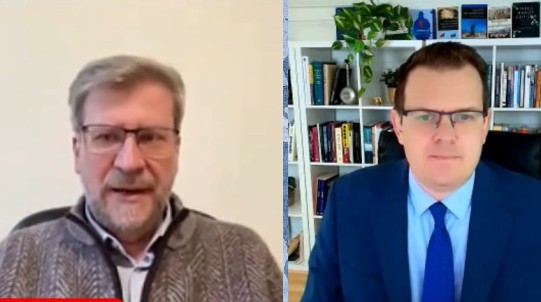
In this interview, Glenn Diesen talks with Fyodor Lukyanov, chairman of Russia’s Council on Foreign and Defense Policy and editor-in-chief of Russia in Global Affairs, about how the Kremlin weighs diplomacy against military pressure in Ukraine after the US midterm elections. Lukyanov also covers the collapse of trust between Russia and Europe, why the Helsinki-era principles no longer fit today’s multipolar world, the contradictions of a new model of globalization, and whether the US, Russia and China can rethink great-power relations. Read the full transcript below:
GLENN DIESEN: (00:00:00 – 00:00:15) Welcome back, everyone. We are joined today by Fyodor Lukyanov, the chairman of Russia’s Council on Foreign and Defense Policy, also the editor-in-chief of the journal Russia in Global Affairs. Thank you for coming back on the program.
FYODOR LUKYANOV: (00:00:16 – 00:00:17) Thank you, Glenn. Hi.
How the Kremlin Views Diplomacy and Military Leverage
GLENN DIESEN: (00:00:19 – 00:01:03) You have a good finger on the pulse there in Moscow, and I wanted to ask you how you think the Kremlin might view the current state of the conflict, because we appear to be at the crossroads, that is being able to pursue both. Well, there’s, I think, both a momentum perhaps for diplomacy as well as a military option. That is, the war is obviously not going well for Ukraine and NATO, which leaves them with the option of either seeking, well, giving more concessions or escalating.
I was just wondering, how do you think Russia is assessing this situation? I mean, what are the considerations and what directions might they take?
FYODOR LUKYANOV: (00:01:05 – 00:06:44) First of all, there is fortunately or unfortunately no contradiction between window for diplomacy and continued military activities or maybe even military escalation. So that was pretty clear from the quite a— if not from the very beginning, but for quite a long time— that Russia sees military option and military— Russia sees warfare as part of diplomatic leverage.
And starting from at least June ’24, so for 2 and a half years now, President Putin stated what he afterwards repeated many times, that we have particular conditions for beginning of the peace process, end of military hostilities and beginning of the peace process. And those conditions did not change. Basically since that time. I mean, territorial integrity of Donbas, so Ukrainian forces should withdraw from the remaining part of Donbas, and the setup of demands concerning the military capacity of Ukraine, military status as a neutral status, non-alignment, and so on, security guarantees and so on.
And despite the fact that situation changed many times since that, at both directions, there were periods where when Russia seemed to be in slightly worse position, it led to next phase when Ukraine was seen as the weaker part. So this picture of what Russia wants to achieve never changed.
And the culmination of this was in Anchorage in this meeting with President Trump on August 15th. It’s not a coincidence that Russian diplomats and President Putin in particular, Minister Lavrov constantly referred to that meeting and those— Russian side calls it agreements, American side calls it understandings. But anyway, it was a certain contour of possible mutual concessions to end the military phase. And that has been never implemented because President Trump failed to achieve progress with the American allies.
So coming back to your question, I’m sorry for that long exposé. Now basically nothing changed. I mean, this combination of elements of this peace, not a peace settlement, but the beginning of the peace process is exactly the same. Putin mentioned and said many times, I don’t know, 10 times or more, that we have this setup of ideas. “You might accept it or not. If you don’t accept it now, then the next time, situation will be worse for you.” And of course, the Russian hand will be even more over and Russia will demand more.
And so far, it’s exactly the case. Each time when the negotiation round, diplomatic round is being restarted or somebody tries to do it, the American administration or the Russian side, it’s always the same that in Ukraine, situation is much worse than it would be if Ukrainians would accept the same package the last time.
And now, yes, of course, politically we see a lot of changes. And by the way, what happened just now in the United States with the outcome of the midterm election might have an impact on this, political impact, diplomatic impact. We will see whether President Trump in this new situation of a significantly weakened presidency will be able and willing to devote that much time to Ukrainian issue as before. But despite this change of political entourage. I think Russian course and Russian insistence remain the same, which means that Russia does not change the basic combination of those demands, and that will remain.
The Impact of the US Midterm Elections
GLENN DIESEN: (00:06:45 – 00:07:29) But on the topic of the midterms now being over in the United States, and obviously, yeah, Trump, as you said, finds himself in a much weaker position. Do you see a window of opportunity closing in terms of finding some diplomatic path? I’m not saying that Trump has been a great peacemaker in any way, but the Democrats seem to be much more inclined towards devoting more resources to the war against Russia and they might also, yeah, just have more power to disrupt any diplomatic settlement. So again, they lean more to the European position. Do you? How do you think? Or do you think this is exaggerated?
FYODOR LUKYANOV: (00:07:31 – 00:11:12) It’s probably not exaggerated, but everything I hear from my colleagues who are specialists in U.S. political system. All of them say that the foreign policy field is primarily the domain for the presidency. And Trump will be significantly weakened in the whole area of the domestic decision-making. And certainly he will face a storm of accusations and inquiries launched by Democrats to take revenge for, how to say it, the period of Trump’s almighty when he behaved in a very special way, including vis-à-vis Democrats.
But in terms of foreign policy, it actually will depend not so much on Democrats in my understanding.
But on Trump himself, whether he will be able to keep focus on foreign issues and in our case on the Ukrainian issue, because it might happen that he will be deeply consumed by domestic struggle. And we know him quite well now, he might enjoy it. He is a very special person. He might feel paradoxically pretty comfortable in fighting and shouting and all this. And whether he will reserve time and energy for Ukraine, it remains to be seen.
I guess, yes, he will continue. He will keep trying. He will certainly be forcefully pushed to do something with Iran because Ukraine is an important issue for some Democrats, but Iran and this unfinished business without any clear prospect of finishing that is of course very important for all, both Democrats and Republicans in the US Congress. And the US public.
So to make a long story short, I would guess that President Trump will continue to try to pay attention. But in general, what is probably important, he will be perceived, in particular in Europe and in Ukraine, by the way, as a very much lame duck. And a lot of things which he tried to do vis-à-vis Ukraine was based on his very powerful authority, so to say, “United States is behind me and you bastards should do what I say.” I exaggerate a little bit, but basically it’s how he tried to behave.
Now it will be easier for opponents in Europe and in Ukraine who frankly were pretty skillful in avoiding and escaping what Trump was trying to impose on them even before. But now they will be encouraged for sure to keep going as they want it.
Is There a Formula for Russia-Europe Diplomacy?
GLENN DIESEN: (00:11:15 – 00:12:19) I did want to ask about the, in terms of diplomacy though, how you view the possibility of restoring some diplomacy between Russia and the Europeans and please correct me if I’m wrong, but I get the impression that Russia would like to restore diplomacy, especially for the purpose of discussing the European security architecture. But there’s some more reluctance to include the Europeans in talks about ending the Ukraine war because, well, a bit like Washington, they view the Europeans as spoilers, someone who, well, will not be able to contribute constructively.
But then we end up in a weird situation where the Europeans only want to discuss the conflict in terms of Ukraine and Russia, while the Russians only want to discuss the underlying cause of the European security architecture, in which Ukraine isn’t— well, it’s more of a symptom than a cause. So do you see any formula here for restoring diplomacy between the Russian Federation and the other Europeans?
FYODOR LUKYANOV: (00:12:21 – 00:17:13) Not so much. Of course, the general situation, in particular, the severe crisis inside Ukraine, we see that winter is looming and the domestic situation there is far from great. And Russia keeps going. Russia continues to strike very hard the whole infrastructure. And we hear even from Zelensky some different tones, different compared to what we heard from him before. It does not mean much because Zelensky can say whatever he wants and then abstain from that and then say exactly the opposite, but still.
But in case of Russia-Europe, it looks like pretty hopeless at this point. We saw reaction in Europe to a very modest attempt by Norwegian Prime Minister and Finnish President just to speak. That conversation which they had with Putin did not bring anything new. Basically, both sides expressed their views, their previous views. And the difference was that they did it directly and they did not shout at each other as we used to do since quite a long while.
And even this attempt was met in Europe with the highest suspiciousness, to put it mildly, or even something worse, which means that it look that Europe is prepared for anything serious. Europe is not ready to change the basic approach, and the basic approach has always been that Russia cannot get anything out of this war. Russia should be punished. Russia— okay, we don’t hear now about strategic defeat anymore, but that Russia as an aggressor should be the side which cannot get any benefit from this period, that’s still there.
And the second reason, which is maybe connected to the first one, Europe is institutionally unable to organize something like a fruitful or even productive discussion. In case of the United States, we also have several doubts whether the model chosen by President Trump with the special envoys whose competencies and whose power is unclear, actually, it’s not institutionally endorsed. But still, those are people who enjoy personal trust from the president and they demonstrated that at least they can organize this channel and this track.
In case of Europe, we don’t see it. Even the European institutions, if they would like to engage in talks, I don’t think they will be able to produce a consolidated and a solid mandate from all countries. In case of Norway-Finland, that was quite remarkable for us that both leaders emphasized that they called Putin in national capacities, which is the first time since I don’t know how long. When anybody from Europe suddenly wanted to strike, wanted to underline that it’s not a European call, it’s a national call. It’s something new.
Maybe that’s a reflection of the belief of those 2 gentlemen that as representatives of Europe, they will not achieve anything because Europe will immediately rebuff them and, so to say, remove all the results of— cancel all results of this conversation.
A Crisis of Legitimacy in the West
GLENN DIESEN: (00:17:15 – 00:18:31) Yeah, no, I didn’t expect the outreach from the Finns and the Norwegians to achieve much, but nonetheless, there was positive that at least it seemed like one step towards decriminalizing diplomacy, that it’s— if it becomes possible to talk again, at least that would be something. But as you suggested with the reactions, I think that was predictable, which is also why they may emphasise that they only spoke for their own countries.
But regarding the poor conditions of diplomacy, it does appear that the wars with Iran and Russia have exacerbated an economic crisis, political crisis in Europe, but also the US geopolitical, I mean, the whole efforts of adjusting to a multipolar distribution of power, all of this has put, I would argue, fuelled a political crisis of legitimacy, not just in Europe, but in the United States as well. I was wondering, how do you see this crisis? Because it can’t really be denied anymore. And I’m looking for precedents, but where have we seen this before?
FYODOR LUKYANOV: (00:18:34 – 00:22:24) That’s a good question whether we saw it before. Normally, I try to disregard the panic statements about anything which is happening that, look, it’s something unprecedented. If we watch a little bit back, history was less nice than we imagine sometimes today. And now, for example, many people are nostalgic about the Cold War, that it was a period of mutual respect and more or less well-structured relationship and the diplomacy, I think we overestimate a little bit. If we study the real Cold War, it wasn’t nice at all.
But of course, the level of anarchy in different approaches is probably like in periods which we don’t remember ourselves. Because yes, indeed, all of us, you, me, and most of people living now on the Earth, got used to political systems which have been pretty well regulated, not ideally, but well regulated after the Second World War. Now it’s over. It’s totally over. And we need to find new ways, first of all, to increase trust between, increase confidence between actors, which is at this point absolutely unavailable.
And I think the biggest problem between Russia and Europe is trust below zero, significantly below zero. And there is absolutely no way to try to understand the logic of the opposite side. It’s not the case on the European side. I must say it’s not much, not so much the case on the Russian side. And that brings us in a spiral of fears that each move by the opposite side is being perceived as not a reason why we need to engage in talks, but the reason why we need to be even more prepared for possible collision.
And for example, look what is happening in Poland these days. There is a typical internal crisis, domestic crisis in Poland, which is not new. This is between 2 major political forces there. We know what both of them stand for, and it’s absolutely not surprising. But suddenly the liberal side, the government, Prime Minister Tusk starts to emphasize that this is mostly about Russia, which again, which is absurd because we know the Polish internal collisions since years, if not decades.
And in such situation, when each power, each actor, first of all tries to use this fear to address domestic problems, which are numerous everywhere, that’s absolutely no way out.
Revisiting the Helsinki Accords and the Charter of Paris
GLENN DIESEN: (00:22:26 – 00:23:47) Well, trying to frame domestic issues through the foreign policy lens is nothing new. That’s why we saw it in Russiagate, we saw it in the Brexit referendum, German politics, of course. The AfD simply tried to be criminalized by referring to them as simply being, well, stooges of the Kremlin. So it’s not a new thing.
But I was wondering though, in terms of finding a formula for peace, it doesn’t seem like we have to reinvent the wheel. That is, if we go back to the Helsinki Accords and then the Charter of Paris for a New Europe, we had some common principles, but there seemed to be a bit of a contradiction within these agreements. That is, they had 2 key principles. One was that of indivisible security, that is, one should not enhance its security at the expense of the other. And then there was also this component of countries should be free to choose their own foreign policy or security arrangements.
And it seems that at least the NATO countries and Russia focus on each one. That is, Russia’s focusing on indivisible security, you can’t expand NATO. And NATO is arguing, well, look at this component, countries should freely choose. How do you think this could be resolved?
FYODOR LUKYANOV: (00:23:50 – 00:28:20) I’m afraid all references to those models which basically belong to the Cold War, both of them, they are not relevant at all anymore. As I mentioned earlier, the Cold War was very special. In a way, unique period of international relations, relatively well-structured and well-organized.
There is an interesting debate among historians and foreign policy specialists in Russia about the Helsinki Accord now, because the traditional view in the Soviet Union during the Cold War and after the Cold War in the Russian Federation was to praise this agreement as an example how 2 severely competing blocs could reach a mutually acceptable agreement. But at the same time, other people argued that Helsinki Accord was actually the first step made by the Soviet leadership towards future degradation and collapse.
And the very fact that the Soviet Union, first of all, started to emphasize status quo, I mean, to try to preserve what has been achieved during the Second World War and not to try to creatively look at the European situation. That was one thing. And the moment you start to work on preservation, then probably you should expect somebody to come to change it.
And secondly, of course, the— and this is the profound thing for the whole liberal period, acceptance of the Soviet Union that values should matter, the 3rd basket, so-called, that the human rights and democracy should be respected in all signatories. It sounded very great, but of course it started a process which then contributed to the collapse of the Soviet Union and then produced the post-Cold War liberal universalization, liberal globalization based on not just economic but also on political unity.
And that was actually the key element of why NATO expansion which was bad enough from the point of view of geopolitics, of balance of forces, but it was worse because the NATO enlargement brought up a certain political and social model which all countries outside NATO had to adopt. And Russia, which never aspired to join NATO but was seen as another post-communist country which of course should aspire to take this model as well. And that created the biggest mess.
So coming back to your question, why I believe that it’s impossible, because now we are in a very much multi, not just multipolar, multicultural, multi-value-based world. And the basic assumption should be that it should be security, divisible, indivisible, we can argue about that, but security should be taken as a central piece of that. And all the rest, including how different countries should be organized, that should be put aside. Because in the previous model, it was put together.
A New Formula for Globalization
GLENN DIESEN: (00:28:22 – 00:29:31) Well, I guess, yeah, there was another contradiction though. That is, well, from the Helsinki Accords to the Charter of Paris, we had the concept of, well, sovereign equality. Each state had the same sovereignty, but that can only be sustained if you recognize the Westphalian principle of cultural distinctiveness. But once you begin to embrace the concept of universal values, be it liberal values, as the foundation, you will divide the world into civilizational teachers and civilizational students, in which you can’t have sovereign equality.
But on the topic, though, becoming multipolar, or already having become multipolar, or multicultural, many different civilizations, and as we often hear from Xi Jinping, one civilization shouldn’t teach another one or dictate to another one how to develop, we’re in a different formula for globalization, though, that is, countries are very much still interconnected, getting more connected, but their societies seems to be pushing for preserving distinctive identities and very unique political arrangements. Do you— how do you see this new globalization formula? Because that impacts, of course, the question of war and peace.
FYODOR LUKYANOV: (00:29:33 – 00:33:48) I think that we live in a pretty unique international environment. Because when it comes to the fragmented world with very much different cultural, political, ideological systems, it’s not new. Mankind lived in this situation for most of its history, in the 19th century, in the 17th century, whatever, 20th century. Another element like the liberal globalization, which we remember very well because it was pretty recently, that’s another model, good or bad we can discuss, but that was a more or less centralized system assuming that there are common rules and common principles for everything from economy to politics.
So we know those 2 models, but what we have now is exactly the mixture, because on the one hand, there’s a very much fragmented world with increasing, severely increasing competition on different levels. At the same time, everybody is interconnected, as you said, and this connectivity is not just increasing as well, but it’s the necessity. Without connectivity, without working together, no one can develop.
And how to reconcile it, that’s the question which no one knows because this is a new situation. We never lived in systems like this, highly conflicting but inseparably interconnected. And I think that we will need some time to understand that we cannot, so to say, we cannot go back to one of more traditional systems, be it a conflicting fragmented world or just the globalized world. We will have both.
And my— I don’t know how it should be organized, so I cannot answer how this new model of globalization can work. What I see and what all of us see, despite those conflicts, which are sometimes extremely severe and bloody, like the Ukrainian war or a situation in the Middle East and so, but yeah, and political, heavy, massive political interference in economy, market principles are being destroyed at many occasions, but still we see that economic interdependence, economic world finds way how to survive without falling apart.
The most fantastic example of the absurdity, but also maybe Russia, certain kind of rationality of the current system was a situation in March this year. If you remember, when United States launched an aggression against Iran, Trump proclaimed that Iranian civilization had to be destroyed. At the same time, US Treasury cancelled sanctions against Iranian oil for a while because oil, Iranian oil was needed on the world market and the Americans wanted to keep prices down. That’s something absolutely absurd, but it happened.
So I think we will see much more of that in the future, but I, maybe because I’m old enough to start my studies in the Soviet Union and to learn, to study Marxism. Here, I believe in economy more than in politics.
Can the US, Russia and China Rethink Their Relations?
GLENN DIESEN: (00:33:49 – 00:35:20) Yeah, no, it seems to more easily find a way. It does when you speak though, it reminds me of that famous quote by Gramsci. Well, we all know it’s paraphrased. He argued in the late 1920s, early ’30s that “the old world was dying, the new one hasn’t yet been born.” And it’s in between these 2 orders that all this chaos emerges. It appears that’s one of the situations we’re in at the moment, where we have to adjust to a new reality.
But just as our last question, how do you see the— in this new world, because it’s not either here or there, we’re in this middle ground. And if you look at the possibility for the United States and Russia to fundamentally change their relations, I mean, many people were quite optimistic at the beginning of last year, but for good reasons, the pessimism has set in.
But at the same time, while it might look like that window of opportunity might be closing between the US and Russia, you also see the US and EU are not just drifting apart, but essentially the old status quo, the old models are starting to fade away, which means something else has to come in its way. So now we hear Xi, Putin, and Trump might have this possible meeting later this month, and do you see any possibilities for, I guess, rethinking relations between not just the US and Russia, but at least the 3 great powers?
FYODOR LUKYANOV: (00:35:22 – 00:39:49) I’m pretty skeptical about the possibility of revolutionary change in relationship between Russia and the United States. In this particular case, and those expectations and those hopes we had, and some people here had last year when Trump came, were connected to his personality because we know that Mr. Trump is highly motivated by the profit, by the potential hypothetical economic gains. For himself, for the United States, for, I don’t know, American people, whatever.
And unfortunately, just in case Russia-US, there is actually not so much. So there are certain areas, and first of all, energy, where we can cooperate, but in general, Russia has never been a big trading partner, economic partner for the United States. And the United States, including Trump, did not see much concrete, much particular gains which can be drawn from this relationship.
What is more— from my point of view, what is more encouraging is not the prospect of a new relationship between Russia and the United States. It’s the prospect of the transformation of the United States per se, as such, as a country, as a political entity. Now, of course, Trump will be beaten and criticized very, very cruelly. But if we look at persons coming up on the side of Democrats, new persons, and this election brought a couple of pretty new unusual faces to higher positions, they have diametrical views, but where they are compatible, where they are actually in line with Trump, we need to deal with the United States, with American people’s needs, not with anything connected to the outside world.
And I think that is more important in the middle-term and long-term perspective than any particular relationship, be it relationship between US and Russia, US and China, EU, and so on. I mean, a reevaluation of US political identity, which will become much more selfish. Again, be it Republican president after Trump, Democratic president, doesn’t matter. And much less inclined to preserve alliances which cannot change.
Transactionalism of Trump has been criticized very heavily, but in fact we see that this is a global trend. Everybody tries to be transactional because of necessity to use all possibilities for development, be it the big countries, small countries, it doesn’t matter.
I think that for Russia, again, I don’t expect any breakthrough between us and Americans, but what is important for Russia to see US to be transformed from highly ideological power to more or less normal power. Of course, with such a mind, Americans will continue, will try to dictate everybody, no doubt about that. But when you dictate based on your pragmatic interests, that’s at least some ground for negotiations and bargaining compared to dictate based on ideological mantras.
Russia’s Strategy and a Decisive Winter
GLENN DIESEN: (00:39:51 – 00:40:33) Sorry, let me just squeeze in one last question. Last, last question. Regarding the war in Ukraine, it’s obviously not very stable anymore, not just the front lines, but the Russian attacks in the Ukrainian rear. And there’s a lot of the, again, the diplomatic initiatives or revived desire to find a political solution appears to also have some root in this, that things are going very bad very quickly. How do you assess Russia’s strategy moving forward? Because we see a heightened focus on not just energy, but wider logistics. I was just wondering what your thoughts were on this.
FYODOR LUKYANOV: (00:40:36 – 00:43:30) The general situation is awful, of course. I understand the military logic. There’s no other option in the current situation. So since diplomacy has been stalled and Ukrainians refuse any diplomatic opportunities and so on, but in general, of course, nothing to be proud of.
The war as it turned now, and I must underline, and you know that very well, that until last summer, Russia never used this way of warfare because President Putin from the beginning was very much conscious about against whom we fight. Not Ukrainian people, not Ukrainian civil population, not Ukrainian cities, against military force. But since Ukrainian side started to heavily attack infrastructure in Russia, then war escalated to a different level.
I guess that this winter will be decisive. Of course, it will be very difficult for Ukraine. It will be quite difficult for Russia as well, because we see that Ukrainians are able to deliver pretty sensitive strikes. And I don’t believe that their potential to do it has been exhausted. It’s still there. So unfortunately, we will need to see more of destruction before the common sense will prevail. I mean, in particular on the Ukrainian side.
Unfortunately, Zelensky is in a situation when he cannot make any step back. He understands that his fate is connected to continued war, to eternal war, actually, protracted war. That’s a very bad thing.
And coming back to the midterm election, the bad element of it is that most likely Trump will be, as we discussed, will be much more occupied with domestic issues. And as we saw until recently, the only way to at least try to push Zelensky towards more reasonable behavior, that was the personal pressure from the United States, from Trump and his close circle. Maybe they will do something else, which means that unfortunately this stage of war will be protracted.
Related Posts