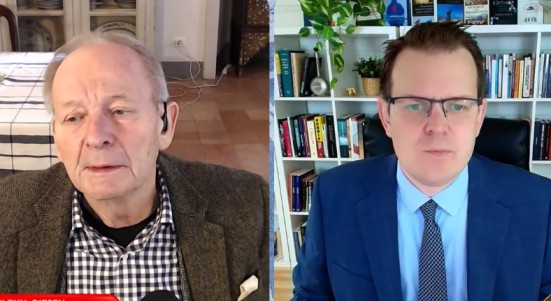
In this interview, former British diplomat Alastair Crooke joins Glenn Diesen to explain how the US midterm defeat and Israel’s elections have left both Donald Trump and Benjamin Netanyahu politically weakened. Crooke discusses Netanyahu’s push for a renewed war on Iran, the CIA’s independent campaign against Russia, J.D. Vance’s call for radical change, and the deepening fiscal and political crisis across Europe. Read the full transcript below:
Introduction
GLENN DIESEN: (00:00:01 – 00:00:25) Welcome back, everyone. We are joined today by Alastair Crooke, a former British diplomat and expert on the Middle East, who’s also a prolific author. He writes on the Conflicts Forum Substack, and for the best insights into what is happening across the Middle East, I definitely recommend it. So make sure to check out the link in the description. So thank you for coming back on the program, Alastair. It’s good to see you.
ALASTAIR CROOKE: (00:00:26 – 00:00:28) No, it’s a pleasure to be with you again.
Trump and Netanyahu Weakened After the Elections
GLENN DIESEN: (00:00:29 – 00:00:59) So I, well, we see now that elections in Israel and the United States are over and, well, it appears that the geopolitical landscape has changed to a great extent. I was wondering, how does that affect, you think, the, I mean, the dealings now between Netanyahu and Trump? I mean, this is often explained as one of the key reasons why we had the Iran War and indeed the crisis across the region.
ALASTAIR CROOKE: (00:01:14 – 00:15:25) Well, every day to press him to attack Iran and. During this period. But the reality is that, as we’ve seen from the midterms, Trump is politically weaker than he was a little while ago, politically weaker because to a very great extent, I mean, he had made the midterms about him saying 47 times, in fact, that “it is all about me.” And, “this is an election about me” and that he was the one that was on the ballot. And I mean, he did go on to that extent.
And of course, now with the results in, it’s pretty clear that that has been a rejection of Trump, primarily a personal rejection in the sense that if you put yourself out like that so many times, then you— it’s all about you. And then you come out with the results like we saw over the last day or so, then, it is clearly, I think Trump has moved in a way through a progression.
When he started this term in office, he was still something of a novelty, at least second-term novelty, a bit intriguing, contrarian, what’s going to happen. Bit of excitement to it. Then it moved into a phase where Trump was almost entirely entertainment. I mean, he was an entertainer and he was good at it. He’s good at the TV and of managing narratives and coming up with surprising initiatives and so on.
And then in this last stage, it seems he’s moved to a different phase where there is active dislike of him. I think of his language, his conduct, the corruption, the lack of, if you like, rectitude, not only to him and his financial dealings, but his family. And circles around him in their financial affairs. And then, of course, the war on Iran and, of course, the closeness to Israel. Those were the issues that have been highlighted.
But nonetheless, I think Trump clearly is weaker than he was. Netanyahu is weaker too, a lot weaker. In 2 ways, politically, but also physically. If you’ve seen any of the videos of him or looked at him recently, he’s not what he was. He’s obviously ill. And he says doctors accompany him everywhere. And it’s fairly clear that they are. There’s talk that he has a pacemaker and so on.
So he’s weaker. His number of seats slipped to 18 from what they were or what they are at the moment. They slipped to 18. And he therefore, again, he made this election very much being about him too, like Trump. And he was defeated, not completely, but he was badly wounded in this election. And people can see it and they have a feel for someone who is more vulnerable and more wounded and they can see his decline. So he’s in a difficult position.
Israel’s Coalition Struggle and the Push for War
Trump had put a lot of pressure on the president to ask Netanyahu first to be the one to try and form a government. Now, it is the president’s prerogative to choose who he thinks might best form a government. And he hasn’t asked Netanyahu yet. He might. But he hasn’t. And he might ask Eisenkot, the leader of the other bloc in the Knesset. He hasn’t a majority either. But he might.
He has in his coalition Arab parties that he says he will not form a government with. But altogether, he is if you like, politically somehow better placed because some of those Arab parties have said they will join with him if they need to, if it comes to it in a unity government or in a coalition government. He set them sort of 4 tests of their adherence to Zionism. And about 4 parties passed the test and are regarded as being pro-Zionist. Although they come from a different, completely different demography of Israel.
So, if he gets asked then to form a government or try to form a government, whether he succeeds or not, both, for both of them, it looks pretty secure. But if he gets asked, then Trump goes into limbo. For 40 days. While, I mean, he can do— he can give up earlier than that, but most likely he’d take it. In the middle of this is Lieberman, who seems to be playing a spoiler role both for Netanyahu and for Eisenkot more.
So the— so he’s weaker. Netanyahu is a much, much weaker.
He needs the war, and he says he needs the war, which is why he keeps ringing Trump about it, because that is his best chance of forming a unity government. If there’s war, then people will rally around Israel as a state, and he will get a unity government. They had a unity government at the time of COVID. And again, after 7th of October, there was a unity government. So it’s quite— it’s possible people will come together and join them. So he needs a war and needs one badly. And so he’s pressing Trump.
Trump’s efforts at persuading the president to either give him a complete pardon and cancel the corruption charges against him, haven’t succeeded. And it’s not clear that Herzog is going to choose Netanyahu as the caretaker. If he’s not caretaker, which he isn’t at this moment, it is problematic about going to war on that basis. Because as a caretaker, formally and legally, he can prosecute a war on Israel’s behalf. He can order and mandate the IDF and the military forces to pursue the war. If he is not a caretaker, then it’s harder for him.
And the Chief of Defense Staff and others, like Amos Yadlin, the former military intelligence chief, have said they see there is no immediate reason for Israel rushing to war. There is no evidence whatsoever of Israel, of Iran moving towards a nuclear weapon. There’s no such evidence. And there is no particular reason that things would not wait several months and still be the same. They point out that Iran has largely rebuilt its weapons armories. And so there’s no particular reason. For fabricating war. So they’re really pushing back the IDF.
Of course, he has the support of Mossad. The head of Mossad was his private secretary, and he gets the support of Shin Bet. So he’s reduced at the moment to claiming that the elections were stolen by the Arab parties. They were gerrymandered. But the head of the commission says there’s absolutely no evidence of that and refuses to accept that the elections are not corrupt and in order. So that’s where we are in the relationship between the two of them.
Vance’s Tweet and the Conditions for Change
So Netanyahu keeps pushing Trump and Trump after the midterms. And you, I think your viewers will have been aware of Vance’s tweet in which he said pretty plainly, the cause of this problem was and is the Iran war, but also Iran-Israel. And he said the cause of this is basically the war with Iran and that therefore there needs to be a quick retracing of the agenda and change. Radical change is necessary. Otherwise, we’re going to lose the MAGA supporters. We’ve lost them effectively.
I mean, he admits they’re lost and he says Trump admits they’re lost, but then he outlines what needs to be done and 4 points that he needs that would need to be done. But the prospects of that happening, I think, are not high.
The first one would be to accept Iran’s memorandum of understanding. In other words, capitulate. I mean, in terms of unfreezing of Iranian assets, lifting of the naval blockade, the return of all its assets, lifting of the sanctions and tariffs on Iran, and agreeing to Iran’s administration of the Hormuz Channel. That’s quite a bit for Trump to digest, I guess, in— as we are where we are. I mean, maybe it would have been easier to do it at the time. But he decided to reject that statement by Iran.
Then the other ones would be to the other conditions that people have set out, and Vance has mentioned is cost of living. That would have to be attended to. And also, of course, to do something about Ukraine. That too is quite problematic, doing something about Ukraine. It’s problematic because the implication, an implication that some of the people close to Vance are saying is he probably has to dismiss the director of CIA, Ratcliffe. For, in order to stop, if you like, the continued attacks deep into Russia against refineries and against other targets. So that would be, I think, also quite difficult, and it’s quite clear he hasn’t been able to do that.
Indeed, we can see that the CIA, I mean, he was not able even really to put the pressure on Zelensky to take part in a ceasefire by slowing, if you like, the speed of Starlink that made it so that over a certain period distance, the drones and missiles wouldn’t function because they’d lose their link to their controllers. And it only took 2 days before they were restored.
And it was only a day afterwards that a missile was fired at a refinery, even though that was Trump’s main request to Zelensky, said “stop firing, stop destroying their diesel exports because we need them. Because price is too high here.” And it was only a few days later that they did, and quite clearly that was facilitated by the CIA.
Is the CIA Operating Independently?
GLENN DIESEN: (00:15:28 – 00:15:58) Hey, when you describe this though, the need to fire the director of the CIA, it doesn’t appear that the White House and the CIA are on the same page here. To what extent is there a competition for influence between the— yeah, with the intelligence services, because this is not a new thing in the Trump administration if we think back at the Russiagate years. But to what extent is the CIA operating independently here from U.S. foreign policy?
ALASTAIR CROOKE: (00:16:00 – 00:23:03) From Trump’s foreign policy, it is acting independently. And they make no bones about it. In a recent article, they were very clear. “We’re in the lead. In the war on Russia. We’re on the lead and we’re being very successful with what we’re doing. We have people on the ground and we’re quite satisfied that we are making great progress in, if you like, attacking Russia, in undermining their oil exports and their oil infrastructure and making Russians more frightened by the threat of missiles at airports and suchlike.”
So he is not operating to the instructions of the president. He’s operating to, if you like, 2 things.
The Long War Against Russia
One is, and I mean, you had someone, I think, just recently on your program. I think Stephen— what’s his name? Kinzer, who’s written a number of books, was with the New York Times, and he was talking about how there’s been a long history of, if you like, particularly radicalized people who have come to the United States who were viscerally hostile to Russia.
And you probably remember, I remember at the time that originally they sort of settled in the Hudson Institute. I mean, these were at that time sort of Trotskyists and children of Trotskyists. Hudson Institute I’m talking about in the ’70s. And then Scoop Jackson, who was the senator for Washington, where the weapons— Washington, not the Washington, D.C., Washington State. And he took up this group and others. And he became 3 times Democratic presidential candidate.
And they, so they settled there. They were very much involved in the policy on Israel, on Palestine. There was Uzi Arad, who I remember dealing with. Much, much later in Israel. He was at the Hudson Institute at the same time. But basically, they were all radical revolutionaries looking for, as they used to say very clearly, “permanent world revolution,” as well as a Zionist state. So they’ve been sort of very influential.
And Scoop Jackson particularly made sure that some of these people were placed into the National Security, the NSC, the National Security Coordination, and also into State Department and other places. We refer to them as the deep state quite often, loosely. But that isn’t the deep state. The deep state is something else. They are, shall we call it, the shallow state. These are the people that, if you like, are the technicians that operate from the deep state.
And there’s been a long war against Russia that goes back. Much of its roots lie in London, but it goes back to, if you like, the 18th century and earlier. And of course, has had its roots in the Western support for the war, the Japanese war on Russia, which nearly brought down the Tsar. And then of course, financial support for the revolution, Bolshevik Revolution.
So he’s operating, and what his people say about him is that he is absolutely clear on the threat that Russia poses to the United States and to all its allies. It doesn’t sound someone who’s very open to diplomacy. It said very clearly that “He’s very much a man that understands the enormous danger that Russia presents to the United States.”
And so the CIA operate quite often independently in the sense that they have, you know how the European Union, you’d be more familiar with it, has its acquis, all the sort of treaties and legislation that cumulatively come together and become the law of Europe. But it’s a sort of process of agglomeration of sort of judgments and so on. It’s a collective thing that takes place.
Well, the same sort of thing has happened with the CIA and they’re called presidential findings, but they go back a long way. Authorizing action against Russia may be years old, but it’s still in operation today because it hasn’t been canceled. So the CIA have much scope for sort of maneuvering between various findings of some time. And Trump has not or cannot issue a new finding which cancels the old findings, it seems.
So it is operating somewhat independently, not somewhat. I mean, very obviously independently. On one hand, you have, I put in one article, you have Trump making nice with Putin. And then 2 days later, there’s a missile attack deep into Russia on a refinery. At the same time, Trump is pleading with Zelensky, “no more, no more attacks on refineries. We want to keep the, get the price of diesel down.” So it’s, I mean, what one can say is it’s, shall we say, dysfunctional.
Dysfunction Inside Israel
GLENN DIESEN: (00:23:06 – 00:24:18) Well, dysfunctional is a good word when you have this kind of infighting within the state. I mean, in political theory and realist theory, this is usually how you define irrational state once it doesn’t act as a unitary actor. You have this internal fighting. But if they have, the Americans have this internal fighting, what, how do you see it in Israel?
Because it looks as if Netanyahu— well, he— let me first say, it looks like he’s often capable, quite capable of holding on to power longer than people think. But his political survival. It’s obviously now it might come to an end, and it looks as if the survival depends now on increasing the conflict with the Iranians, pulling in the Americans. But what happens on the Iranian— on the Israeli side if Netanyahu goes down? I mean, would he meet scrutiny over the events on October 7th, or how do you see this, the drama playing out?
ALASTAIR CROOKE: (00:24:19 – 00:33:04) Well, first of all, there is dysfunctionality. I mean, if that’s what you call it, because the Mossad operates in entirely different command structure. It operates directly to the Prime Minister. The head of Mossad was his military secretary, and he was chosen directly to go to Mossad, allegedly for his loyalty to the prime minister.
And then you have, if you like, the police who operate to Ben-Gvir. He largely operates— he has literally a small army that he commands, which is quite separate from the IDF. And the IDF are very frightened of the settler army, armed, trained, and probably about 10,000 strong. So they’re quite a formidable force.
And then you have the courts, the Supreme Court that the Likud, or at least the policy of the government, is to try and deconstruct it and to end its jurisdiction over much of politics. Israel doesn’t have a constitution. So it’s mostly this what they call the basic law that judges that. And then the court has a say in whether things comply with the basic law. And Trump and the justice minister are trying to end that. So there’s a certain degree, quite a big degree of dysfunctionality in Israel too.
A Knesset Investigation Into October 7th
Now, what’s being afoot at the moment in Israel is that Eisenkot, the new Knesset, not yet with any government involved, is due to meet on the 9th of this month for the new members of the Knesset will assemble on the 9th. And I don’t know if he’ll do it on the first day, but he has 2 objectives, Eisenkot, to remove the Speaker of Parliament, who is a Netanyahu strong ally, and to replace him with someone else. And to do 2 other things.
And one of them is to institute on a majority basis, because he’s not a government at that stage, but he assumes that he will be able to command a majority in the Knesset to launch an investigation of Netanyahu and what happened on the 7th of October. I haven’t the numbers. But my best guess is he will get a majority for that because the Arab parties will certainly support that. And so will other people also support it.
This, of course, is absolutely toxic for Netanyahu. And if it does happen that Israel moves to another round of elections, it’s going to be very bad for him. If the whole of the 7th of October events and when was he informed and what was he informed and what did he do about it is aired, he’s already been panicking about that.
You remember he flew to the Gulf, to UAE, and it was particularly to make sure that MBZ didn’t repeat his allegations that he’d warned Trump 11 days prior to the 7th of October that this was going to happen, and he wanted to make sure that that wasn’t said during the election process. And MBZ didn’t repeat it. And he also asked Qatar not to stay silent on these issues.
So we are seeing already the moves towards a new administration taking place. And therefore, Netanyahu is on the back foot politically and weakening. Therefore, where is this going to go? Well, I think ultimately, it’s probable that I think he’s got— I don’t know that it will happen, but he’s got a good chance of forming a government eventually. Some of the Arab parties will probably agree to be part of the coalition. He will lose levers in the process because he has refused to have anything to do with Arabs. He will not be in a coalition with them.
Is this going to change things? Maybe it’ll not really change so much. I think if you look at the policies of Eisenkot, they’re not much different. I mean, on Gaza or West Bank, they’re exactly the same. On Iran, they are not that different, except that he’s not in favor of a war with Iran that would put Israel at risk, but he certainly would be in favor of America at war with Iran.
And I think one could say that if governments are formed, where is Israel going? I would say that it is much more fragmented. It is changed drastically. It is changing radically, but radically moving, radically means moving hard right. Israel, all the polling shows that the electorate are moving hard right, and that’s particularly noticeable amongst the young. The Israeli young are harder right than their elders quite often.
The US-Israel Relationship and the Security Bill
So, I mean, what will change in policy terms? Well, and what will change in their relationship with the US? I mean, I don’t think from the Israeli end much will change, but I think something will change from the American end because it’s quite clear the question of the relationship with Israel is a big issue in the United States and will be for the foreseeable future. It’s going to be something that is going to be in contention. So that is going to continue in contention very much so.
And of course, I mean, there’s a lot of sleight of hands going on here. Trump announced that, “oh, well, they won’t receive any more money from the United States.” You probably saw that, the $4.5 billion that they received, and that Netanyahu agrees to that. Well, that’s true.
But then if you look at the present process, that the bill that advances the sort of the fusion of Israel and American security and defense and intelligence structures, the merging of Israeli security and military sites with the Pentagon, I think it’s called Section 212 or something like this, of this is still proceeding through the Senate. And may well be approved by the Senate.
Well, that bill alone will give Israel $1.5 billion a year extra. So they lose the $4.5 billion over 10 years, but they get $1.5 billion a year anyway if this bill goes through. And they’ve got to do that by, of course, January 3rd when the new comes together, assembles in the new year.
Will There Be Another War With Iran?
GLENN DIESEN: (00:33:06 – 00:34:20) Well, I was wondering what this means for possible renewal of the war with Iran, because on one hand I would think that Netanyahu would see, or Israel in general would see a 2-month opening in the possibility of, well, still having a possibility of going back into deeper war, or at least entangling the Americans more deeply in Iran. On the other hand, what you were arguing is also very reasonable, that is that there is obviously now a much greater concern among the Americans on Israeli intelligence, both the information they receive as well as the cooperation.
So, yeah, where do you see going from here? I mean, we kind of go back to where we started with J.D. Vance’s tweet where he lists all the reasons why they lost, which, well, he said, of course, Israel directly, the relationship with Israel has to change, the Iran war, and yeah, failing to put America first. I mean, all of this, the common denominator is Israel, it seems. So how will this affect— I mean, do you think Trump will be more restrained pulling away from these rallies, or do you think they will go all out?
ALASTAIR CROOKE: (00:34:23 – 00:50:45) I think the possibility of a war, which could happen at any time, is a high possibility. It is a high possibility. Now, the only thing that has sort of changed the calculus, I think slightly, has been the midterm elections.
Because first of all, I mean, that has meant that people like Vance, but others too, have been saying to the president, “look, your approval ratings are in the drain at about 30% or something like this. And if you’re going to recover at all for the next 2 years, you need to get those ratings up to about 40%.” And even then it’s problematic.
But otherwise, you may find that you’ve lost the Senate and you’ve lost the donors if you stay with your approval ratings at that, because they’ll be looking at 28 and thinking, “you’re no good. I mean, you’re not going to be a worthwhile investment for us.” If your ratings are that bad, especially as they see what’s happened with the clean sweep by the Democrats.
So what people like Vance and others are saying to Trump clearly is saying, “listen, to go back and attack Iran now, I mean, this is crazy because your approval ratings are bad enough. And you yourself say that the cause of this debacle in the elections was the war in Iraq. Well, now it’s time to get out of it, isn’t it?”
Now, the question is, he still is not convinced. He still says that, or he’s compelled to say that he was right to go to war with Iran. “And if it came to it, I’d do it again. And I may do it again. And the war with Iran only ends when I say it’s ended.” So this is what he’s saying. So it’s clear that he’s leaving the door open to more, another attack. And then he suffixes all of these statements by the same thing. “Iran may not have a nuclear weapon. It may not have a nuclear weapon.”
The Paleoconservative Turn in MAGA
So, I mean, it hasn’t all gone away, even if Vance and the others are saying this is not a good idea, because if you want to try and revive the— because it’s not just about you, but the Republican Party. I mean, the people who led, that abandoned them in these midterms were the young people, the demography between sort of 18 and 20 and 18 and 49. I mean, it was only the boomers that stayed with the Republicans and their vanishing constituency. So the young, I mean, were the most viscerally opposed Iran.
How, and this is what I think Vance must be worried about, how do you actually remake the MAGA? How do you give it a sense? Because I think the other part of this, which is less spoken about, but which is obvious from the results, is that it wasn’t just Iran and Ukraine and these wars, it was quite clearly from the language and the language of MAGA was the propensity of the United States to go to endless wars, one after the other, after the other, after the other.
And so I think in a certain sense, what we’re seeing is a section. I mean, it’s too early to say that it’s actually shaped in this way, but we’re seeing a paleoconservative group in MAGA in the Republican Party, i.e., returning to the ideas of Pat Buchanan and also importantly, Pat Buchanan’s economic structures, which were America First economic structures. About building economic infrastructure in America. And the famous Buchanan saying, “the United States is a republic, not an empire.”
And so I think with that, and they feel they’ve landed a blow on the neocon constituency, which is mostly Democratic constituency. But of course, there are people like Rubio and others in the Republican Party who are neocons too. But I think they are going to interpret the elections also in that important divide in terms of what may come from America, from the Republican Party, of discrediting the neocons. Fracture, maybe existentially, and bringing back what they call paleoconservative ideas back to Pat Buchanan and that period of economic thinking.
Which was then, of course, completely overtaken 2008 and all of these subsequent periods by the financialized approach, the debt-led approach to the economy, which has eaten away precisely the jobs that the Republican demography used to have because all that manufacturing was offshored. By America to Asia.
And those jobs, when America used to be, these young people, if you speak to them, I mean, they remember the time, particularly with their grandparents, but even with their parents, they worked in plants and assembly and manufacturing, and they got good incomes. They could afford 2 cars and a decent house and holidays. Can they do that now? Can they even dream of getting a job? I mean, of any sort that, other than helping out at a hamburger joint. I mean, where are those jobs? What are they going to do?
Europe’s Fiscal Crisis and the Cost of Ukraine
So I would say the other thing that’s so important from this election process, and dare I say it, because I’m sure there are many Americans who watch your programs too, but I mean, think about Europe. Don’t think about it in the usual way, that because Americans regret Europe, “oh, we don’t bother about Europeans.” Not that, but look at Europe burning. Europe’s on fire. Look at Poland. Look at Belgium. Look at France. Look at Italy.
Look, it’s across the whole of Europe, the anger and sometimes quite widespread violence that is taking across Europe. What’s that all about? And are you completely unaffected? Does it not matter to you because that’s Europe? I suggest it isn’t, because what you’ve seen in Europe is that the whole idea of Europe, the whole myth of Europe was the idea that it would bring a prosperous way of life to most people.
That prosperity was part of the message and prosperity and social services and welfare provisions were part of— this is the myth of what Europe is about, but it was also the myth of America was rather, rather similar. And this is completely broken. It’s broken because it can’t be afforded. Europe can’t afford itself any longer.
Look at what’s happening with the budget. I mean, the European budget, they need a huge increase from member states. The mandatory part that member states give to the Commission, up by about 80%. Huge increases is required. So Germany is expected to increase its contributions from about 40 to 70, France from 30 to 40. All the states are going to be asked for big increases in their contributions just to stand still. No extra expenditure.
And of course, not included in any of this is the putative Ukraine expenditure. Ukraine is not in the EU budget as it exists. The €90 billion that the EU gave is off budget sheet. You try and find it in, you couldn’t even find it as a line item. You can’t even find it under the expenditure and spending item. It’s under a thing called headroom.
That’s where it comes and it’s a debt that is guaranteed under this process against the future EU budget. It is guaranteed by member states with several member states refusing to comply with the guarantee. But because if Zelensky or whoever is president of Ukraine doesn’t repay it, then it falls on the states to repay it. And that is separate.
And the question is, and people are saying, at a time when hospitals are being shut, hospital beds in hospitals are being lowered, when schools are not being adequately maintained, when welfare and services are run, basic services like buses and trains are going or getting worse and worse because of lack of maintenance and new investment and things. And they’re saying, “how are we going to increase this expenditure?” They can’t.
So what France and Germany are facing, if they want to keep funding Ukraine through the EU, if they want to keep funding the EU at levels to which it has been a custom, then they have to impose huge austerity. We’re going back to that period in Europe when austerity was imposed and things will have to be cut and cut more and taxes raised and raised more. So the taxes will be raised on the states and then individual states will raise taxes.
That whole modern, if you like, the whole idea, the modernist idea of a prosperous, of Europe, prosperity in Europe is collapsed, has collapsed. It can’t afford it. And either it has to cut back drastically on services on, I mean, not, this is not, we’re talking about just immigrant service. We’re talking about mainstream services and higher numbers in schools and all these things. All of this is collapsing.
And at the same time, America say, “well, you’ve got to pay for Ukraine now.” And Ukraine and Zelensky has told the EU, “I need another $70 million immediately. Actually, I need $155 billion, please, very shortly.” And as the more frugal member states are saying no way is this going to happen outside of agreement first on the budget. There has no more of this sort of smoke and mirrors that we are funding the Ukraine off budget under headroom in the system. It can’t go on like this. It’s got to stop.
Structural Problems on Both Sides of the Atlantic
So, I mean, this is, and I’ve spent a little time detailing the situation, but this is a situation, I mean, it doesn’t matter who will win this election next. I mean, the Democrats will have the same issues. They may be a little different in America because it’s not exactly the same, but the same thing is there. Jobs, jobs, well-paying jobs are vanishing. AI is contributing to the vanishing of jobs, manufacturing jobs.
There are, it’s not, most of them are not being taken up, are not going to native-born Americans. They are going to people who’ve immigrated into America instead, because quite often they can be paid less. And even technical jobs are mostly coming through a special provision of visas from places like China. And so there’s a special visa allowance for people who’ve got the right technicalities, technical qualifications to work in Silicon Valley.
So all of this is, the Europe will be no doubt smiling broadly saying, “oh, Trump is gone. We were always expecting, wait out Trump, and then the Democrats will be back and everything will be fine.” Well, look what’s happening in Europe and then see what are the Democrats going to do about that?
Because these are big structural problems, not just a little gerrymandering here and there is going to do it. Change of interest rates in the central bank, 1% up or down is going to improve the situation. It would need a structural change to end the bipolar economy. And that’s very, very difficult. And the plutocrats in Europe and America would fight that tooth and nail.
GLENN DIESEN: (00:50:47 – 00:51:27) Well, when the political leaders in Europe are asked, “what will you prioritize, stabilizing your own country or funding the Ukraine war?” People like Chancellor Merz openly says, “we’ll go with Ukraine.” And now he’s down to a 10% approval rating. I mean, that’s historic in Germany. So this economic irresponsibility is translating into a political legitimacy crisis. So it is just wild to see this happening live, and you see where this is headed, and they’re doing nothing for course correction. Anyways, Alastair, thank you so much for taking the time. I appreciate it.
ALASTAIR CROOKE: (00:51:30 – 00:51:30) Always a pleasure.
Related Posts