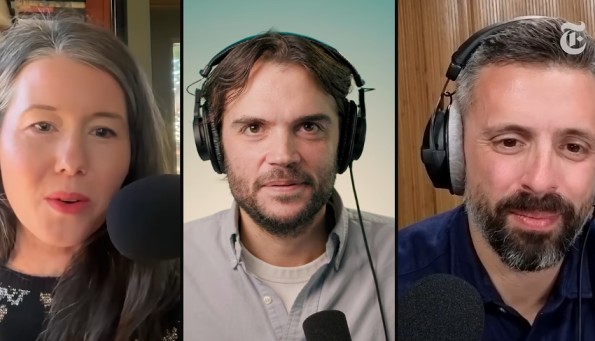
In this episode of Hard Fork, Max Read sits down with New York Times Opinion columnist Ezra Klein and tech reporter Erin Griffith to unpack why Elon Musk and the tech right couldn’t buy the 2026 midterm elections, and how backlash against AI, data centers and billionaires shaped the “national scolding.” Later, Max talks with Times reporter Theodore Schleifer about which tech donors got a return on their political spending, from Reid Hoffman and Sergey Brin to Andreessen Horowitz, Greg Brockman, the crypto super PAC Fairshake and Elon Musk.
What Just Happened to Elon Musk?
MAX READ: (00:00:00 – 00:02:06) What just happened to Elon Musk? 2 years ago, the SpaceX founder and world’s richest man was riding high. He and the rest of the tech right of Silicon Valley had helped propel Trump into office and had grand plans to reshape the federal government. Remember DOGE? Those plans are now on hold.
Musk once again spent hundreds of millions of dollars this election cycle but got almost nothing in return. Instead, his allies had among the worst losses of their lives. And he became one of the main villains of some of the cycle’s most important races.
On today’s episode, we’re going to dive into the midterms and try to figure out what happened. Was this election a repudiation of Musk and his cadre of Silicon Valley billionaires? A referendum on AI buildout and the data centers cropping up around the country? Or an entire rejection of the accelerating AI future that the tech industry has been aggressively selling? How did Elon Musk lose so badly? And what will he do next? Next, I’m Max Read. This is Hard Fork.
Welcome to Hard Fork. I’m joined by Erin Griffith and Ezra Klein. Erin is a tech writer for the New York Times, and Ezra is, I believe, a podcaster who’s been sent to us from the 28th floor to talk about politics.
It’s now been a little while since the Democrats retook Congress, and the thing I really want to talk about, the thing I’ve been thinking about, is what we have called the tech. Right? So I’m talking about a very highly visible group of Trump-supporting executives, founders, investors from Silicon Valley, people like David Sacks, Marc Andreessen, Palmer Luckey, and of course, Elon Musk.
This was 2 years ago, felt like the most powerful faction within the Trump coalition. They were able to dominate news and attention, most of all campaign contributions. They arguably helped elevate J.D. Vance to the vice presidency. After the election, they were kind of put in charge of federal government budgeting and provision. And now it feels like it’s all fallen apart.
Both of you guys are close observers of the tech industry, and I wanted to see how you would characterize what happened this week to this growing conservative movement of leaders. Ezra, what do you think happened to the tech right?
How the Tech Right Attached Itself to Trump
EZRA KLEIN: (00:02:07 – 00:03:40) Well, it attached itself to Donald Trump. And this is a place, I think, where at least in part, their success became a failure. The tech right is not the reason Trump layered the world in tariffs. It is not the reason that he went to war in Iran. But it is at least part of the reason why he has a hideously unpopular position on AI.
And I was surprised in the exit polling how important people said AI was to their vote. So 56% said that artificial intelligence and data centers was a crucial or major factor in their vote. 57% said AI would do more to hurt society. 24% said it would help society. 76% opposed a data center in their community.
So you’re dealing with an issue that people were both in a kind of direct and vibesy way actually taking into account. And Trump, because in this period he has been really bought in on the David Sacks, Jensen Huang, Marc Andreessen, et cetera, view of the world, his view and the Republican Party broadly’s view on data centers was let them rip, build as many of them as you can. Whoever wins the wins.
And that put them on sharply the wrong side of public opinion on an issue that’s sort of unlike the diffuse issues of costs or the war in Iran. You could really sometimes tie a specific politician like Husted in Ohio to data center backlash. And that gave Republicans, maybe who didn’t like them, a reason to cross party lines on them.
MAX READ: (00:03:41 – 00:03:55) Yeah. I mean, let me ask the chicken and egg question. Is AI getting dragged down by Donald Trump and the tech right? Or is this that AI just has naturally bad politics, and its association with these figures is dragging them down?
Why AI Has Bad Politics
EZRA KLEIN: (00:03:56 – 00:05:06) I think it’s a mistake to think that the only reason we regulate things is to slow them down or to stop them or because they’re bad. You regulate things to put them within a trustworthy, at least semi-democratic container such that people can make peace and have confidence in their trade-offs.
There is a world where AI is rolling out in a way where people think that the folks in charge have thought through the risk, have thought through the questions of jobs, are finding out what they need to find out, and maybe have more trust in it. In that way, I don’t think it’s being dragged down by Donald Trump’s popularity.
I think the problem with AI in terms of popularity is that the basic sell on it is it might kill everyone. It probably will take your job. But if it doesn’t do those things, you can have cheaper energy. It’s not a good description of a technology you want.
But the problem it is having on a secondary level is that it’s rolling out at a time when the people rolling it out just don’t seem trustworthy.
ERIN GRIFFITH: (00:05:06 – 00:05:29) But that’s been the whole point of this rightward shift, right? Is all the tech guys are so excited to be able to not have to actually care and soft pedal things and sell them to people, right? Hasn’t that just been the gleefulness of this kind of Trump 2.0 tech right kind of thing where they’re like, “Haha, we’re so powerful and rich that we don’t have to convince you. We’ll just do it and you’ll like it or you won’t, but we don’t care.”
EZRA KLEIN: (00:05:29 – 00:05:31) And as you see, it’s working out great.
ERIN GRIFFITH: (00:05:31 – 00:05:36) Well, I think we’re seeing the direct backlash to that, which is kind of what you’re saying, right?
Why Tech Leaders Went for Trump
MAX READ: (00:05:36 – 00:05:46) Erin, you were sort of addressing this in the last thing you were saying. But I’m interested in why we feel like this, at least this group of tech investors and executives went for Trump so hard in the first place.
ERIN GRIFFITH: (00:05:48 – 00:08:01) Oh, well, there’s a lot of layers to this. I mean, you could, obviously, a lot of them just don’t want to see regulation. You can go back to Marc Andreessen’s whole thing that he went on this media tour after he came out for Trump and he was telling this story of “the deal,” the broken deal, and the elites are now under attack. And we had this meeting that may or may not have happened, and subsequent reporting has called into question that, where all the Democrats were saying they were going to kill AI.
I do think it’s also just a little bit of a cultural thing where it just seemed like more fun for them to be edgelord meme kind of posters and not having to care about cancel culture and wokeness and all of that.
And so I think on a high level, a lot of the billionaires and the leaders of the industry kind of went to the right and everyone said, “Oh, well, the rest of the tech industry is still very liberal.” But I think over time, that sort of very online kind of thing attracted way more people to that side. And so I’m going to be very interested to see how that plays out if people kind of just start backing away from that vibe.
The one thing I want to also just say, just to add on to what I was saying earlier, is this idea of kind of ramming through the tech stuff regardless of whether people like it, regardless of sentiment. And they’ll like it on the other side is very prominent amongst a lot of the VCs that I talk to where they say, “Well, people don’t like big tech or people don’t trust big tech. But look at their revealed preferences. Look at how much they’re using Facebook and look at how much they’re using Amazon. And they love their iPhones. They’re addicted.”
And they’re just sort of looking only at the data and saying, because people use AI a lot, because ChatGPT has a billion users around the world, ergo, people are going to like this stuff. They might just not have the trust or whatever, but that doesn’t matter because people are using it.
And I think this election is actually showing us that that’s the wrong way of looking at AI because people obviously are very, very mad about it and to the point where they don’t want it.
The “National Scolding”
MAX READ: (00:08:01 – 00:09:46) This felt like a decidedly anti-tech election. But I think we can also separate some of the sentiments that were contributing to the votes and the blue tsunami. I heard somewhere that in Japan, because you don’t want to call it a blue wave or a tsunami, they’re calling it “the national scolding,” which I think is so much better. So I’ll call it the national scolding.
The factors that went into the national scolding, I’m going to separate the sort of tech stuff into 3 different categories. One is the sort of broad opposition to AI that you’re talking about, Erin. One is the sort of specific anti-data center sentiment that really captured a lot of attention this summer that a lot of politicians ran quite hard on. And then finally, a kind of general anti-oligarchy, anti-billionaire sentiment that focused in particular on Elon Musk, but I think in general on a lot of tech billionaires.
I want to take these one at a time and start with the anti-AI sentiment. And I’m going to play a little bit of Jon Ossoff’s victory speech from last night.
VIDEO CLIP BEGINS:
JON OSSOFF: And at our grave peril, humanity is fast forgetting the terrible lessons of 2 world wars and the Holocaust. Meanwhile, the titans of Silicon Valley dig bunkers for themselves and warn that the artificial intelligence they’re creating risks human extinction.
VIDEO CLIP ENDS:
MAX READ: That’s pretty strong. I mean, and I’m not talking about those new biceps he’s got, folks. That is a real— well, he’s getting— he’s a lot stronger than he used to be. I thought that would play a lot harder, but maybe we can cut it out later.
It’s a pretty specific, pretty aggressive— I mean, this is a speech written by somebody who’s on Twitter at the very least, who sort of has a strong understanding of AI culture, Silicon Valley culture. Ezra, what did you make of this part of Ossoff’s speech?
EZRA KLEIN: (00:09:47 – 00:10:23) So at the beginning of the book “Abundance,” which Derek Thompson and I wrote, we have this sort of thing about supply-side politics where we say the core question should be, what do we want more of and how do we get it? And the basic problem that they have on AI is they’ve not convinced people to want more of it.
They understand how you get it, right? Push all this money to CapEx. But not why do you want it? And so first you have all this energy going into that, and then the data centers are just big and ugly, and they don’t create jobs, and people don’t like the construction of industrial facilities near them, even in normal times.
ERIN GRIFFITH: (00:10:23 – 00:10:23) Right.
EZRA KLEIN: (00:10:23 – 00:10:47) It’s hard to build an apartment building. It’s very hard to build these gigantic systems. So they seem to have come up with this view that it’s not going to matter because people enjoy using their chatbot. But it is going to matter. And the reason, Ossoff, but not just Ossoff, I mean, El-Sayed had a great answer on AI pause when he was talking to our former colleague Ross Douthat on 60 Minutes.
ERIN GRIFFITH: (00:10:48 – 00:10:50) Yeah, he actually knows what distillation is.
MAX READ: (00:10:50 – 00:10:51) Yeah, it was very impressive.
EZRA KLEIN: (00:10:52 – 00:10:55) A lot of the frontier research is just spoofing our models.
MAX READ: (00:10:55 – 00:10:56) China’s research.
EZRA KLEIN: (00:10:56 – 00:11:29) China’s research. And it’d be like you’re pulling a skier on a boat. And you speed up the boat and you’re like, “The skier is still so close, we got to speed up, skier’s still so close.” Well, it’s because you’re pulling the skier. He knows what distillation is, right?
That this is a thing that I think younger politicians are really developing expertise on. I can tell you they all understand and believe it will be a central issue in politics going forward. And sort of like everybody else, they’re not buying the “just don’t worry about it” line.
The Inevitability Thesis
ERIN GRIFFITH: (00:11:30 – 00:11:55) Okay. One question on that, though. What do you make of their sort of answer to how did this happen, is that AI has a messaging problem, which to me misses the point a little bit. That they’re sort of reinforcing that, again, what you’re saying, they believe that this is what’s best for everyone. And if everyone just lets them do it, then we’ll see. But if they stick to that, it seems—
EZRA KLEIN: (00:11:55 – 00:12:12) I don’t think they do believe it’s best for— I mean, some of the tech right guys do, but I think one of the most interesting things when I talk to them, and I’d be curious how much this backs up your experience, is a lot of the people in AI say publicly and privately, “Oh, if I could, I would push the button. I would stop it for now.”
ERIN GRIFFITH: (00:12:12 – 00:12:13) Yeah.
EZRA KLEIN: (00:12:13 – 00:13:21) “And I just don’t feel we can.” There is this inevitability thesis. There’s China. There are the other companies, right? There’s this kind of spirit of technology in some ways, like when Elon Musk talks about it in a very teleological fashion, right? “I tried stop it. It turns out I can’t, so it’s more fun to be part of it.”
That it is true that some of the tech right people we’re talking about feel that way, and some of them also don’t care or don’t see it in existential terms. But what people are hearing from a lot of them and correctly absorbing the lesson, as Jon Ossoff is— I mean, a lot of lab employees are going to Congress and talking to people like Ossoff and explaining their concerns.
That the message I think a lot of us are getting is that what is pushing this forward is a belief that it cannot be stopped. But even the people pushing it forward believe that maybe if it could be stopped, at least for a while, and figured out, that would be better.
And so if you don’t buy into inevitability, and most politicians don’t buy into inevitability, then all of a sudden it’s like, well, why not try to pace it, slow it down, regulate it, change public opinion on it?
ERIN GRIFFITH: (00:13:22 – 00:13:52) Well, I think there’s 2 groups, though. There’s the kind of employees that are very worried, what you’re talking about, especially at places like at the labs. And then there’s the investors who I spend a little bit more time with, and they’re not so worried about the existential risk kind of piece of it.
They don’t think it’s inevitable because they worry about regulation. And they worry about not having the data centers and the compute. And so they’re kind of on the flip side of that a little bit.
The Data Center Backlash
MAX READ: (00:13:53 – 00:14:32) Yeah. Let’s talk about data centers for a second. So Tuesday night, near total rout for data centers on basically every level. Nearly every local referendum went against them, but also a bunch of the states that have been building them most intensely. Democrats took control often on anti-data center platforms.
But I’m still sort of trying to figure out how big a deal it is, ’cause there’s a certain amount of, it’s not necessarily as salient as tariffs, as affordability, as Iran, as immigration, but it also clearly animated voters all year. So I’m wondering how big a driver do you think the data center issue was of these results?
ERIN GRIFFITH: (00:14:32 – 00:15:01) I mean, it was interesting because last week we talked about how it was ranked in the bottom maybe 5 out of 30-some issues when you’re asking voters what they care most about. But it’s clear as you’re describing that when asked on a binary yes or no question, the answer is “Absolutely not.” And so whether or not that drove people to the polls, Ezra, you probably have a lot more info on that, but it’s obvious that it’s going to be continuing to be an issue.
EZRA KLEIN: (00:15:02 – 00:15:13) Yeah, I think it was spiky. So in states where there is a ton of data center buildout happening, so states like Texas and Ohio and Georgia and Arizona, it was a really big issue.
MAX READ: (00:15:14 – 00:15:14) Yeah.
EZRA KLEIN: (00:15:14 – 00:15:57) I think you have to look at the Texas results, and Texas is a place in the country that’s been building the most data centers. They were the most vulnerable. It was a huge part of the campaign, particularly in the governor’s race. And it worked. I mean, it was just a huge wedge. And it’s a wedge that I think very importantly doesn’t polarize normally. You can win over Republicans that way.
But you just look at that list, Texas, Ohio, Georgia, and Arizona. Those are just all states where Democrats performed really, really well. And in Ohio in particular, they really went at Ramaswamy and Husted, the Republican gubernatorial and Senate candidates on the data center issue. I think what you see here is, I don’t think data centers were a huge part of the Alaska race.
MAX READ: (00:15:57 – 00:15:58) Yeah.
EZRA KLEIN: (00:15:58 – 00:16:00) But in the place where they’re building a lot of them, it really mattered.
How Investors Are Reacting
MAX READ: (00:16:01 – 00:16:28) Yeah, that’s interesting. And it does feel like there’s going to be a big shift in how we think about the buildout. It doesn’t necessarily mean a full sort of cessation of data center buildout, but it’s going to take more time and it’s going to be moving to other states, maybe Louisiana, maybe Oklahoma. Erin, I’m wondering how you think this is going to play out among the VCs and investors you talk to, how they’re changing their plans or thinking about it differently now?
ERIN GRIFFITH: (00:16:28 – 00:16:40) I mean, I think in general, investors are a little bit terrified by the results, particularly in Texas. When I was watching the All-In feed last night and as the Texas—
MAX READ: (00:16:40 – 00:16:42) As you do every Tuesday night.
ERIN GRIFFITH: (00:16:43 – 00:18:08) And the Texas governor race was the one that they seemed most upset about. There was this kind of cope moment of, “Oh my God, well, they’re only reporting the blue districts. We still have a chance.”
Because they know that of the sort of 45 gigawatts or so of total compute, that’s our energy that’s supposed to come online next year, 10 to 15 gigawatts of that could be now in danger of not coming online because it’s in Texas. Because they all expected that the moratorium that was put on for building data centers in Texas up through the elections would just be removed and they would all go back to building and everything would be great.
And so this is going to slow down a lot of the AI development. This is going to make compute capacity much more constrained and ergo much more expensive. And it’s going to sort of hurt the growth not just of the frontier labs that need the compute, but of all the ecosystem of companies that are sort of playing into the quote unquote “AI trade,” all of the kind of chips and neolabs and cloud resellers, all of that.
So that is potentially going to hurt this kind of bull market that we’ve been on for a long time. So they’re getting a little bit dramatic about that. I’ve heard, there was a little—
MAX READ: (00:18:08 – 00:18:10) No, no, investors getting dramatic.
ERIN GRIFFITH: (00:18:10 – 00:18:33) I don’t think— there was a little bit of catastrophizing, no less than the entire market’s going to tank, the economy’s in the sh***er, we’re— China’s going to win, all of that. I even saw a tweet. Beff Jezos, the kind of internet personality, tweeted that this is the end of Western civilization. It’s time to move to space, which is where the data centers were moving anyway.
EZRA KLEIN: (00:18:33 – 00:20:32) So you got to get that space real estate. What I thought was interesting about this, I was hearing some of this from investors too. And then the Nasdaq futures were down. And then the market opens up on Wednesday morning and it bounces up. And so first, clearly the market doesn’t think this is so bad, but a good contrarian take I’ve seen floating around a bit is that this might be good for investors.
Because I do think there’s a widespread suspicion that there is a kind of collective rationality problem happening right now where everybody is investing too much in data centers because they don’t want to be the company left behind. But that might lead to, say, the end of Oracle as an existing American corporation.
And a situation in which the CapEx investment is externally paced, such that some of the, particularly the more fly-by-night players that are beginning to emerge, who could really collapse easily, either don’t get off the ground or can’t keep going. And similarly, a situation where players like Anthropic and OpenAI focus more on diffusion and making what they are deploying economically useful, as opposed to racing each other to the notional goal of superintelligence. It’s not obvious that that’s bad for markets.
A CapEx bubble is really bad for markets. You create dangerous AI before you create economically useful AI is actually bad for markets. But in a kind of slightly more sober sense, what markets need is a kind of alignment between how fast the buildout is happening and how economically useful the product is, and thus how quickly it is adopted. Not at all obvious to me that a slowdown in data center construction from where we are right now is bad for that.
Anti-Billionaire Sentiment and Elon Musk’s Money
MAX READ: (00:20:32 – 00:21:05) Yeah. Let’s talk about tech billionaires. This is sort of the third category of anti-tech sentiment that I’ve seen pop up throughout this election season. And it came up quite often on Tuesday in some of the victory speeches. We have James Talarico effectively calling out Elon Musk, which is something he did many times over the course of the election cycle.
Ezra, I’m wondering if you think that the amount of money that Elon was pouring into this election, ’cause he poured in a lot of it, was counterproductive to him in some sense, ’cause it gave politicians like Talarico a foil to play against.
EZRA KLEIN: (00:21:05 – 00:21:57) Hugely counterproductive. So think about what that money is buying. That money is attempting to buy attention, but the sheer size of that money and its attachment to Elon Musk himself, who’s an attentional super object, get attention. And the attention it got was that Elon Musk is trying to buy the election, buy it from you, and specifically buy it in Texas.
And did Ken Paxton want one of the central themes of the closing weeks of the election to be “Elon Musk is trying to buy the election”? There’s broad anti-billionaire sentiment. You can poll this, people really don’t like billionaires. There’s specifically negative Elon Musk sentiment. I was a little bit surprised, actually, that in California, the wealth tax proposition didn’t pass. In California—
MAX READ: (00:21:57 – 00:21:58) Yeah, I wanted to— Sorry. No, go ahead.
Why California’s Wealth Tax Failed
EZRA KLEIN: (00:21:58 – 00:22:40) In California, there’s a proposition to do a wealth tax on the very, very wealthiest California residents, which would not be that many of them, a couple hundred people. But it was going to be a sort of hard-to-administer tax, and there was fear of having billionaires flee California for, say, Texas. And it didn’t pass.
So in this sort of election in which anti-billionaire sentiment was very, very, very constant, the argument that potentially driving some of them out of California would be bad for California actually won, which struck me as a little bit surprising. If you had told me how badly Republicans would lose the election, if I knew that a week ago and you said, “What’s going to happen to the wealth tax?” I’d be like, “Oh, that’ll definitely pass.” It didn’t.
MAX READ: (00:22:41 – 00:22:52) Erin, I wanted to ask you about this because we talked about it last week and you’ve done a lot of reporting on this. And I’m wondering how you sort of account for this result in what was otherwise a very clearly anti-billionaire election?
ERIN GRIFFITH: (00:22:53 – 00:24:02) It feels a little bit like a California thing where people might just be tired of the politicians kind of throwing together a plan that doesn’t seem fully thought out and saying, “Just trust us, we’ll figure this out.”
And so I think there was enough messaging that introduced doubts to this, basically saying— I mean, the messaging from the anti-Prop 40 groups were, “This is poorly written, they’re just going to lose all the money, they need to do a better job of this, it’s not sustainable, it’s a one-time thing.” I guess that kind of resonated with people.
And honestly, it’s the one thing that the billionaires I’ve seen, and the tech right that we’re talking about, are clinging to this week now where they’re like, “If they can’t pass this kind of billionaire tax in a blue tsunami in California, it’ll never win anywhere in the country.” And I don’t think that’s true.
Ezra, I’d love to hear your thoughts on that, but I think there’ll be more attempts at bat at this in the next few years. They’ll just try to maybe position it a little bit differently or find ways that will resonate with people a little bit more. But I think in general, people are just kind of tired of half-hearted props that are thrown out there. And this one got a lot of criticism for that.
EZRA KLEIN: (00:24:02 – 00:24:49) Yeah, I agree that the California prop has, first, the problem that Californians have begun to be skeptical of ballot propositions, just full stop. Correctly so, speaking as a Californian. But I do think the other issue with it was that there was a specific concern that would disadvantage California. I mean, I think it is meaningful that Gavin Newsom did not support it.
And to the sort of comfort the tech right is taking this, I think it’s going to be basically table stakes in 2028 for Democrats to have a wealth tax proposal. And the argument for a national wealth tax is a lot stronger than the argument for a state wealth tax because they may say they will, but they’re not actually going to move to Ireland or wherever it might be. Argentina.
MAX READ: (00:24:50 – 00:24:54) And so it’s a long history of people moving to Argentina when things go south in their country.
EZRA KLEIN: (00:24:55 – 00:25:16) So you’re going to have Gavin Newsom with a wealth tax proposal, I think, for that election. So the idea that this is gone as opposed to it is going to move to the level at which is better administered, which is the full force of the IRS and the full jurisdiction of the United States, is more the way I understand the situation.
The Fall of Vivek Ramaswamy
MAX READ: (00:25:17 – 00:26:05) Yeah. I want to talk about one more billionaire. Pour one out for Vivek Ramaswamy, who lost the governor’s race in Ohio. I mean, Vivek is more or less a tech billionaire. He was ascendant in politics or seemed to be. He was one of the two faces of DOGE.
And now he’s frankly humiliated and probably should be ashamed, given the final ad of his campaign involved putting his opponent, Amy Acton’s mother, on TV to call her daughter a liar after Acton had said that her stepfather had abused her as a child.
I’m wondering if this race stuck out to you, if as a figure, what you remember about his rise in his fall, or if he was just a singularly bad candidate regardless of the tech halo around him.
EZRA KLEIN: (00:26:05 – 00:26:34) Look, Vivek, and for that matter, J.D. Vance, are the kinds of MAGA politicians the tech right actually wants. They don’t want Donald Trump with all of his all-over-the-placeness, right? They want these guys who are actually their guys and can go to their conferences and talk knowledgeably about the kinds of highly cerebral reactionary policies that the tech right likes.
ERIN GRIFFITH: (00:26:34 – 00:26:38) And they also don’t have to convince him, right? They already agree.
EZRA KLEIN: (00:26:39 – 00:29:47) They don’t have to sell them on it. And the thing about both of those guys is they’re bad politicians. And Ramaswamy here, I think, has a particular arc where he could have lost this election in an honorable way, and he decided to lose it in a maximally dishonorable way. And it was just a grotesque, awful, immoral thing to do that should cover Ramaswamy in shame.
But I would say that I see this sometimes with Vance. I see it with Ramaswamy. I see it with a bunch of Republicans where they kind of speak Trump with an accent, that Trump has this cruelty to him, this outrageousness, but because it’s natural to him, he actually knows where the lines are. He knows how to deliver it in a way where people don’t take it exactly that seriously.
He’s done some stuff that is pretty gross in his time, quite a lot of stuff that is very, very gross, but he has a finesse to it that these guys who are mimicking him as if they are a GPT-3-level LLM, right? Smart, but without any art to it whatsoever, has no feel for the situation. And then it just comes out horrible, right? Horrible and cruel. And it’s a silent room where nobody’s laughing. And that’s that race.
And Vance runs into this kind of problem too, right? Dogs and cats thing is an example of this for J.D. Vance. Where I think they think they’re doing what Trump is doing, and they don’t understand they’re not.
And the thing here about them, and it speaks to maybe to kind of tie this a little bit to our main conversation here, a big problem the tech right is going to have. The tech right could only really survive as a factional player in a broader Republican ecosystem in which their completely inhuman and bizarre views about how to treat other people were not dominant, right?
They could have a lot of influence, so they were the smart players in the coalition. They had a lot of money. But ultimately, the thing was run by this guy with animal charisma and magnetic cunning. And when you kind of reverse foreground and background here and put them and their people in the front, it goes really, really badly. Because what the non-college white working class is looking for is not Vivek Ramaswamy. It’s just not the brief.
And I don’t think this is where the politics is going. And I think you see in the failure of some of these candidates and in the problems I think that J.D. Vance himself is going to have, where the tech right is very, very, very fragile, which is it doesn’t understand and often doesn’t seem to like human beings, to say nothing of the kinds of people who will need to vote for things, and it doesn’t want to listen to them. And that’s not how you win in politics.
ERIN GRIFFITH: (00:29:48 – 00:30:24) It’s kind of wild seeing them learn this in real time because it does feel like in 2024 they just had this awakening where they realized, “Oh my God, we are so rich. And the amount of money we have, if you apply it to politics, is absurd. Our money goes so far in politics.”
Fairshake, one of the largest PACs ever supporting crypto things, the amount of money they actually raised was just a drop in the bucket for some of these billionaires and the companies that donated to it. But now they’re starting to learn, as you’re— this is a great point. They’re starting to learn that it takes more than money.
Is the Vibe Shifting Back?
MAX READ: (00:30:24 – 00:30:50) So let’s pause for a sec and look forward. I kind of want to game out or at least speculate about what’s coming next. 2 years ago, we were talking about a big vibe shift in Silicon Valley. I’m wondering whether or not we’re vibe shifting back again and what the sort of early signs are. I want to ask in particular, Erin, I’m wondering what you’re seeing in sort of the early days after the results, how investors and other Silicon Valley figures are reacting to this.
ERIN GRIFFITH: (00:30:50 – 00:30:54) Well, first of all, we’re seeing a victory lap from the likes of Reid Hoffman.
MAX READ: (00:30:55 – 00:30:55) Yeah, for sure.
ERIN GRIFFITH: (00:30:56 – 00:31:45) And it’s still a little bit confusing because he’s out there saying we should get money out of politics. And while he’s one of the biggest left-wing donors in this last cycle. So that’s a little odd. I think it’s going to take a little while to shake out.
I mean, maybe they’re all going to hire their lobbyists and sort of buddy up to people on the left and figure out how to get their companies well positioned for this next moment. But I think culturally, we’re still going to see people hanging out and espousing their right-wing ideas. I don’t know that this big forgetting that everyone’s talking about is going to happen as rapidly. But Ezra, I’m sure you have thoughts.
EZRA KLEIN: (00:31:46 – 00:32:46) It’s not obvious to me if in a vibe shift back in the other direction, okay, Mark Zuckerberg takes off the chain, you have some things like that happen. But in the way that Andreessen and Musk and some of these other figures have become kind of influencers, right? They all became tech online influencers. Do you have a group of them, with maybe Reid being among those people who can do that in the other direction, given the kind of headwind they’re against?
In some ways I think this is a good moment to be a Satya Nadella, right? A just neutral, a normal tech CEO, right? Who doesn’t seem to be out there trying to be a kind of comic book villain or a podcaster, right? Just somebody who runs the company in a seemingly normal way. I think that is going to be the play. I don’t see there emerging a kind of left-wing analogue to the All-In guys.
Democrats and Their New Relationship With Tech
MAX READ: (00:32:46 – 00:33:47) Yeah, I think that’s true. I mean, I would also suggest, part of what we’re seeing, as we’ve already been discussing, is a collection of liberal to left politicians who are pretty well versed in tech and tech criticism beyond a kind of anti-oligarchical stance. I mean, we already sort of swooned over El-Sayed’s 60 Minutes interview where he’s able to talk about diffusion, but not in a way that suggests that he’s fully bought in.
I mean, one of the really interesting contrasts between this blue wave election and the one in, say, 2008 is, maybe I’m only speaking for myself, but I think we all associate Obama and the Obama administration with Silicon Valley and the sort of tech industry of the 2010s. And now we’re looking at a Democratic Party that no longer has the same relationship to the tech industry.
And so I’m interested not just in what CEOs emerge as normal or even liberal-leaning or whatever, but also what politicians emerge and how their relationship to tech is going to unfold over the next few years. And it feels like— go ahead.
EZRA KLEIN: (00:33:47 – 00:34:35) I think the flip side of that is also for the Democratic Party, and this is going to be harder in this period, which is what do they want from tech as opposed to just what do they not want from tech? Right. They don’t want billionaire and oligarchical influence. They don’t want AI to take all your jobs or kill the human race or whatever it might be. They don’t want the effects on utility rates and water and the environment.
But if you go back a couple of years, and I thought a lot about this in terms of the work I was doing in this period, when climate was the issue, there was a sort of natural union emerging between the Democratic Party and an area of tech. I mean, there’s some alternative universe where Elon Musk, who makes solar panels and Teslas, just as a normie Democrat and remains a normie Democrat and is very influential from that perspective.
ERIN GRIFFITH: (00:34:35 – 00:34:36) What a world.
EZRA KLEIN: (00:34:36 – 00:35:21) The problem is that particularly with AI, although not only with AI, the question of “do we want this” is so salient. And for right now, for most people, the answer is, not under these conditions, not if it’s going to do the thing you say it’s going to do, you person who is building it and profiting off of it and in control of it.
And in that world, it’s just very hard to have a positive politics of technology because the technology is perceived, I think, very correctly and understandably, as first and foremost a threat. You go back to that ’08 world you’re talking about, and what tech means in politics is the internet and social media, which is going to connect everybody, and we’re going to have more friends, and we’re going to know about more things, and also bring energy.
ERIN GRIFFITH: (00:35:21 – 00:35:22) And it’s going to save the economy from the recession.
EZRA KLEIN: (00:35:23 – 00:36:50) Going to save the economy. Economy and green energy. Right. And right now it has all cohered around AI. And the AI story is just a much more mixed and frightening story for people at the moment. I don’t think you’re going to have any politicians running saying what we just need is way more AI. I think you’ll have some saying there are things we can get from AI in terms of drug development and other domains, and we should encourage that.
But yeah, I mean, the problem with the tech industry is right now they are all in, no pun intended, on something people increasingly don’t think they want. And that’s not a messaging problem. I just wrote a column about this the other week. Max, you wrote about it with this idea of “on we risk.”
But even when you hear them talk about the world they’re trying to get to, this world where human beings are the well-kept pets of these superintelligent AIs. That world sucks. People don’t want that world. That’s not an inspiring vision. And so there’s not a messaging problem here.
Too many people in Silicon Valley are building towards a future that if it goes well, if you’re not in the existential risk scenario, people don’t want that future either, where I got a 7- and a 5-year-old. It’s completely unclear what it would mean to train them to have jobs.
MAX READ: (00:36:51 – 00:37:26) They’re not going to be prompt engineers. That no longer seems to be a growth industry. Okay, we’re going to take a break. When we come back, we’re going to do a segment that— okay, we’re trying out a new name. We’re going to see how it plays. The new name is “Pacing the Frontier,” and we’re all going to take stories. This is a really negative reaction so far.
If you’re not watching this on YouTube, I’m getting the stoniest faces I could imagine. We’re going to talk about stories that we are tracking ourselves that maybe other people aren’t looking at that we think are important over the next few weeks, months, or years. This is Hard Fork. I’m with Erin Griffith and Ezra Klein.
ERIN GRIFFITH: (00:37:27 – 00:37:29) Wait, I thought you were going to announce a name for the segment.
MAX READ: (00:37:29 – 00:37:30) “Pacing the Frontier.”
ERIN GRIFFITH: (00:37:31 – 00:37:32) I don’t get it.
Stories We’re Tracking: Google Turns Off Search for Schools
MAX READ: (00:37:32 – 00:38:01) I know it doesn’t really make sense, does it? Welcome back to Hard Fork. I’m here with Erin Griffith and Ezra Klein. We are doing a segment that before the break was called “Pacing the Frontier” and after the break is no longer called “Pacing the Frontier.” We’re asking our guests about stories that they’re tracking that we think are going to be important over the next few weeks or months, but that nobody or not enough people are paying attention to right now. Erin, what did you bring to show and tell today?
ERIN GRIFFITH: (00:38:02 – 00:39:22) So there’s a great story by our colleagues Dana Goldstein and Natasha Singer about Google announcing that it’s going to turn off search, the main thing we know Google for, for schools that don’t want to use their AI products. And this is notable to me because, I mean, Google is in many, many schools. Google Chromebooks are kind of the most used laptop in schools. And so kids are using Google Search for a lot.
There’s a lot of schools, including New York City schools, I believe, that don’t want their kids to be exposed to or using AI. And Google is basically kind of saying, “You don’t want our AI? Well, fine, you don’t get our search either,” which is such a classic tech industry move of, “I’m taking my ball and I’m going home because you don’t like me.”
And Google had to come out and clarify and say, “Okay, well, we’re going to figure out a way to kind of work through this.” But essentially any schools that don’t want AI also don’t get Google search. And there’s definitely a backlash to this, but it also, I think, speaks to this moment that we’re in of schools and parents and everyone pushing away from tech in schools and education. And Google is kind of going in the other direction. So this story is, I think, something that’s going to continue and be something to watch.
MAX READ: (00:39:23 – 00:40:00) And it’s a good story to talk about on this episode in particular, because it feels like this is an issue that is going to weigh heavily on the electorate and politicians for the next 2 years. I mean, speaking as a millennial parent, I get the feeling that a top issue for us voting millennial parents is going to be keeping AI the hell away from kids and education, and maybe away from kids entirely.
And I think this kind of thing where the tech company doesn’t seem to be listening exactly, if you are a campaign manager somewhere or a chief of staff somewhere, you are going to want to stick your crowbar in and use your leverage to make it a big issue.
ERIN GRIFFITH: (00:40:00 – 00:40:01) I mean, I don’t know why they don’t just use DuckDuckGo.
MAX READ: (00:40:02 – 00:40:12) But I mean, I do think all classrooms should be very aware of surveillance and privacy issues. I’m happy to come and lecture at elementary schools about this stuff. Ezra, what story are you tracking this week?
Stories We’re Tracking: The Permitting Reform Bill
EZRA KLEIN: (00:40:12 – 00:41:42) There’s this permitting reform bill, and I think it’s actually relevant to this whole conversation in a couple of ways. So this permitting reform bill was struck. It’s a bipartisan bill between, on the Democratic side, Senators Whitehouse and Heinrich of Rhode Island and New Mexico. On the Republican side, Shelley Moore Capito of West Virginia and Mike Lee of Utah.
And it’s a big bill. It would take a long time to kind of go through it, and parts of it I don’t understand, but it basically makes it easier to build energy of all kinds, green energy, non-green energy. And then it also has data center provisions about trying to internalize more of the costs of the data centers.
And this is a bill that’s kind of splitting the Democratic Party a bit. It is there in the lame duck, but it is really a movement around how easy is it to build energy in this country. And then there’s also a place where, as it gets amended and worked through, the data center backlash can find a place to express itself.
So this bill’s, I think, going to be a signal for how much bipartisan dealmaking the 2 sides want to do, particularly in the lame duck session right now. And how much Democrats are going to want to stick with that now that they have so much power coming up, I think is a very open question.
But it’s also a place where this question of how easy should it be to build energy, particularly at a time when a lot more natural gas is being built to power data centers, and then what are the national rules on building data centers? This bill could become a vehicle where a lot of that gets fought out, or we get to see actually there’s not enough consensus for even a very, very bipartisan piece of legislation to move forward on this right now.
MAX READ: (00:41:43 – 00:41:46) And what’s the sort of time frame you’re looking at? This is over the next several months?
EZRA KLEIN: (00:41:46 – 00:41:54) So the last I heard, it was going to be to start moving forward in the Senate in the next week or two. But yeah, over the next several months.
MAX READ: (00:41:55 – 00:42:00) Yeah. So we’ll get a good picture on how willing Trump and the Republicans are to make those deals and the Democrats.
EZRA KLEIN: (00:42:00 – 00:42:09) Right. Because I think the theory right now is that if the deal does not get made in the lame duck, it probably will not move forward. It’s actually going to be harder in some ways under a Democratic Congress, even though the bill does have Democratic support.
MAX READ: (00:42:10 – 00:42:10) I see.
EZRA KLEIN: (00:42:10 – 00:42:11) But we’ll see.
Stories We’re Tracking: Prediction Markets
MAX READ: (00:42:12 – 00:42:58) Interesting. My story is kind of a non-story. I was shocked that prediction markets didn’t make more of a splash this week, and that’s not to say that they weren’t everywhere, being advertised to constantly. You walk outside the Times offices, they’re all over Times Square. There are Kalshi and Polymarket ads, but they seem to have largely gotten the elections “right.”
Air quotes because I think it’s a question of philosophy and epistemology what prediction markets are actually doing in terms of getting things right. But unlike the Brazilian elections a few weeks ago, there weren’t any huge swings. We didn’t have any crazy stories about wins or losses. Just feels like less of a coming-out party than a sort of a moment when it feels like prediction markets have been folded fairly thoroughly into the elections and newsmaking apparatus.
EZRA KLEIN: (00:42:58 – 00:43:09) I don’t know. I’m a little skeptical of this whole thing. Go look on Polymarket at the prediction market for the Mississippi Senate race.
MAX READ: (00:43:09 – 00:43:11) Okay. That’s fair. That’s fair.
EZRA KLEIN: (00:43:11 – 00:43:14) Just look at what that— I couldn’t believe— what happened there?
ERIN GRIFFITH: (00:43:14 – 00:43:16) I missed that. Were they really wrong?
EZRA KLEIN: (00:43:16 – 00:43:22) Yes. But it’s more just the way the thing just all of a sudden you get the actual information and then the 2 lines go like this.
MAX READ: (00:43:23 – 00:43:24) Yeah. Right.
EZRA KLEIN: (00:43:24 – 00:43:31) And it’s not like the prediction markets got something wildly right either. They’re willing to swing faster in the direction of information we’re seeing.
ERIN GRIFFITH: (00:43:32 – 00:43:36) But I do kind of track the polls quite a bit in many of the races.
MAX READ: (00:43:36 – 00:43:52) But really more than anything, it just felt like this was an election where we all kind of just nodded our head and said, “Yeah, of course there’s prediction markets and they exist.” And that’s there on every TV screen all the time. I’m not saying that’s good. I’m not saying it’s bad, though. I have my suspicions. It just was sort of an interesting feature of the week.
ERIN GRIFFITH: (00:43:53 – 00:43:58) I mean, maybe it’s just that they’re becoming more sophisticated and that there’s less suckers out there.
MAX READ: (00:43:58 – 00:44:31) And so, I mean, I think there is less money to be made. Yeah. Sadly for degenerate gamblers— not for me. Not for me. I’m an ethical journalist. I do not have any stakes in any bets on the election, but I’m happy to give tips to Hard Fork readers. Email us hardfork@nytimes.com.
Thank you, Ezra and Erin, for joining us. This is an unbelievably stimulating discussion. I had a really good time. Everybody else stick around. We’ve got Teddy Schleifer coming on to talk about who spent their money wisely and who spent their money poorly. I’m going to give you a hint who’s in the latter category. His initials are E.M. Thank you guys.
ERIN GRIFFITH: (00:44:32 – 00:44:33) Thank you for having us.
Winners and Losers: Theodore Schleifer on Tech Money in the Midterms
MAX READ: (00:44:39 – 00:45:07) Welcome back to Hard Fork. I’m here with Times reporter Teddy Schleifer to talk about winners and losers in tech from this week’s elections. So Teddy, you’ve spent the last several months reporting on campaign money, especially as it pertains to the tech industry in this cycle.
I know from your reporting, the top 20 donors injected about $2 billion into the midterms. More than $800 million of that came from the tech industry in one way or another. I want to start by identifying the big players. When we’re talking about the top tech donors, who are we talking about?
THEODORE SCHLEIFER: (00:45:07 – 00:45:11) Sure. I mean, the number one tech donor is a guy named Elon R. Musk.
MAX READ: (00:45:12 – 00:45:13) Okay. I’m going to write this down.
THEODORE SCHLEIFER: (00:45:13 – 00:45:52) Sorry. He spent, looks like about $470 to $500 million, somewhere in that range, on the election. Other tech people that folks may have heard of are Marc Andreessen and Ben Horowitz, the founders of Andreessen Horowitz, the venture capital firm, spent $100 million themselves.
There’s also people like the company Coinbase, which joined Andreessen Horowitz in backing a big crypto super PAC this cycle. And there’s a couple other individuals such as Greg Brockman, the president of OpenAI, who spent a ton of money on MAGA Inc., the Trump super PAC, and also has been a huge proponent of all this money supporting quote unquote “pro-AI” politicians.
Does Money Still Buy Elections?
MAX READ: (00:45:53 – 00:46:18) A couple years ago, it felt like a sort of conventional wisdom was coalescing among at least some people in the Valley that they were so rich, maybe Elon in particular was so rich, they could really just spend freely and get what they wanted out of politics. Feels a little bit like a big lesson from this election is that that’s not really true. Tell me a little bit about how spending has functioned here, how it’s maybe different from 2 years ago, and what kind of lessons we might take away from it?
EZRA KLEIN: (00:46:18 – 00:46:18) Sure.
THEODORE SCHLEIFER: (00:46:18 – 00:47:29) I mean, so now 16 years ago, the Citizens United decision comes down from the Supreme Court, which kind of begins this new era of anything-goes billionaire political spending. And now people can cut checks of unlimited sizes to political committees. And every cycle, the zeros keep adding up to more and more.
So in 2024, Elon Musk spent somewhere around $300 million. And this is just in disclosed giving. And we’re not even touching all the undisclosed giving that happens. And the narrative formed, I think somewhat unfairly, that it was a raging success. So what Musk did in 2024 was perceived as successful. And I think the gospel of kind of the entire world of money in politics is that money helps with politics, that you win elections by spending more money.
This cycle, I think, and this is a meta-critique of my own stuff over the last decade, I don’t know. I mean, there are times when that’s true. There are times when it’s not true. Last night was a vivid illustration of the fact that you can spend, in Musk’s case, $500 million or $450 million, and this stuff doesn’t necessarily convert.
Reid Hoffman and Sergey Brin: The Winners
MAX READ: (00:47:30 – 00:48:00) Yeah. So part of what I want to do in talking to you is create— I don’t want to call it a loser list. Let’s call it a “return on investment power ranking.” I want to know whose money was well spent and whose money wasn’t. And I want to talk about some of the people that you were just mentioning, seems to me, and I’m going to throw out the names that seem like they’ve done particularly well, and feel free to challenge me if you disagree.
Reid Hoffman is basically the only Democratic donor among the tech group in the top 20. It’s got to feel like he did pretty well with his money. Yeah.
THEODORE SCHLEIFER: (00:48:00 – 00:48:38) I mean, Reid’s single biggest investment this cycle, at least publicly, was he spent $17 million on supporting James Talarico, including in the Democratic primary, which was competitive. And of course the general election was competitive and Talarico won by a shockingly large margin. Makes you wonder if Reid didn’t even need to spend anything in the general honestly in retrospect.
Yes, he is somebody who knows a thing or two about political spending at this point. He’s been doing this now for 10 or 15 years and he believed that Talarico was a generational talent and the sort of person who could win Texas, and he won.
MAX READ: (00:48:39 – 00:48:41) So we can maybe put him somewhere near the top.
EZRA KLEIN: (00:48:41 – 00:48:41) Sure.
THEODORE SCHLEIFER: (00:48:41 – 00:48:41) Let’s do that.
MAX READ: (00:48:41 – 00:48:49) Another person I want to talk about, it didn’t come up before because he hasn’t been a huge donor sort of nationally across the midterm cycle, but Sergey Brin did pretty well for himself.
THEODORE SCHLEIFER: (00:48:50 – 00:49:50) Yeah. Sergey is not on the list we mentioned because all of his giving is at the state level, but Sergey Brin, the founder of Google, if Reid is a veteran, Sergey is a rookie. He spent over $100 million this cycle on a California political effort called Building a Better California.
Brin basically started this group to push back on the proposed wealth tax in California, which at least as of this recording seems like it’s going to fail. And that is in large part because Sergey and other wealthy people from tech spent $330 million on a political effort to kind of cripple this thing. And it worked.
I mean, Sergey, they were able to demolish this thing financially. Not only did they raise $333 million, but the pro side of the union pushing this billionaire’s tax in California basically raised bupkis. They were outspent tremendously. And it’s a testament to money in politics.
The Crypto Industry and Fairshake
MAX READ: (00:49:51 – 00:50:17) So these 2 guys, Sergey and Reid, we might put at the top of our list. Yeah, partly because they’re the only guys who got what they wanted out of the races last night. I want to turn to the crypto people because this is a whole grouping that you’ve put together.
When we’re looking at the top 20 top donors, we have the Winklevoss twins who were big donors to Trump and Trump-aligned PACs. And there’s also this thing called Fairshake, a super PAC that is crypto-aligned. Where are the crypto people spending their money? What are they looking for?
THEODORE SCHLEIFER: (00:50:18 – 00:52:04) Yeah, so this kind of started in 2024 when Fairshake raised somewhere in the $100 to $150 million from a couple of key crypto companies, including Coinbase, Ripple and Andreessen Horowitz. And the narrative that was set was that it was a raging success and that basically they were able to elect a very pro-crypto Congress. Even Trump ended up being seen as pro-crypto.
And they wanted to keep it going in 2026. They had some successes in primaries, there was a congressional race in Maryland in a Democratic primary where they elected a pro-crypto person. They had some losses in primaries where the Illinois Senate race, but this November, their big bet was identical to 2024, which was to defeat Sherrod Brown, the Ohio senator who used to be in charge of the Senate Banking Committee, which of course regulates crypto. It’s a big deal in Washington.
Sherrod Brown was the target of $45 million of ads against him by Fairshake in September and October. And Sherrod Brown won last night. And there is an invincibility or an infallibility that I think that people felt about crypto where, if you were going to oppose the crypto industry, you were going to get demolished.
And Sherrod Brown, obviously, that would be very resonant for him because he lost in 2024, in part because the crypto industry, I think, spent $40 million hours then, but this time they won. And the crypto industry has won some other races, so I don’t want to say that they’re totally on the bottom of the losers list, but certainly in their highest profile race, it’s an L for them.
MAX READ: (00:52:04 – 00:52:06) Yeah. I mean, there’s lots of room on the losers list.
THEODORE SCHLEIFER: (00:52:06 – 00:52:07) Sure.
MAX READ: (00:52:07 – 00:52:32) One interesting thing here is I think there was a whole narrative that got built out of both the money that crypto was spending, but also a sense that there was this demographic shift in 2024. Young men were becoming conservative and Republican, a sense maybe the Democrats had to appeal to crypto owners, crypto traders.
This was a narrative obviously pushed quite hard by the crypto industry. Feels like the armor has been pierced a little bit on this. Maybe we’ll see Democrats being a little more aggressive with the crypto industry after something like that.
ERIN GRIFFITH: (00:52:32 – 00:52:33) Yeah.
THEODORE SCHLEIFER: (00:52:33 – 00:53:25) I mean, and the reason why Fairshake got involved in such a significant way at all this cycle was because they encountered this pushback you’re speaking to. I mean, basically in September, it was not clear whether or not the crypto industry was going to spend all this money they had.
Basically, the way that these super PACs tend to work now, which I think is kind of interesting, is they raise a ton of money, and then it’s sort of in this bank account, and they don’t necessarily always spend it. It’s just this permanent looming threat, “Shame if something happened to you.”
And basically Democrats blocked this crypto policy bill called the CLARITY Act in September. And then like that, the next day was time to punish the Democrats, and they spent all this money against Brown. So, right, if you’re a believer that the crypto industry is overrated politically, obviously you’d be emboldened by Brown staring down $45 million and winning.
Andreessen Horowitz and Leading the Future
MAX READ: (00:53:25 – 00:53:54) Yeah. Let’s talk about another set of donors to the Fairshake super PAC. Andreessen Horowitz. This is one of Silicon Valley’s most famous and prestigious VC firms, but also quite memorably a conservative one. Marc Andreessen, obviously one of the loudest sort of pro-Trump voices in the Valley.
They were big donors on this. They donated to Fairshake, but they also were donating to an AI super PAC called Leading the Future. Tell me a little bit about the money they were spending and where that was.
EZRA KLEIN: (00:53:54 – 00:53:54) Sure.
THEODORE SCHLEIFER: (00:53:54 – 00:54:24) I mean, it’s fascinating for people who have read his biography or are familiar with his oeuvre kind of politically, because this is somebody who in his 20s was an institution in Democratic fundraising. I mean, Andreessen has been around forever. And now he and his firm, for a while until Elon Musk entered the picture, were the biggest political donors in the entire cycle. And I wrote a story kind of earlier this year about how they got into this. The AI stuff they do is the most interesting.
MAX READ: (00:54:25 – 00:54:25) Yeah.
THEODORE SCHLEIFER: (00:54:25 – 00:55:10) Because basically after Fairshake spends all this money in 2024, then the crypto industry is seen as political savants. They basically say, “Hey, let’s do the same thing with AI.” The AI industry in 2024 is nascent, but in 2025, 2026, it’s becoming this huge thing.
And it’s the exact same model. Obviously it’s not crypto companies that are funding it. It’s AI firms like OpenAI’s co-founder Greg Brockman and Andreessen Horowitz, which has a ton of investments in AI, and they basically run it back with AI. The difference, as probably is predictable in retrospect or foreseeable, is that people have a lot stronger opinions about AI than they do about crypto.
MAX READ: (00:55:10 – 00:55:18) Right. I mean, it’s funny to sort of say that AI feels more toxic than crypto right now, but if, as we’re making our losers list, it feels a bit like that’s what we’re learning.
THEODORE SCHLEIFER: (00:55:18 – 00:55:34) Yeah. I mean, on crypto, I do think there’s some political upside on crypto for people, especially because there’s the downsides. The downside is it’s not a salient issue for people. So taking money from crypto can be a net positive decision strategically.
Greg Brockman’s Pledge and the Pushback Inside OpenAI
MAX READ: (00:55:35 – 00:55:57) Right. But let’s keep talking about AI, because I think perhaps even below Andreessen Horowitz on our list is Greg Brockman, co-founder of OpenAI, president, one of the most prominent people at the company after Sam Altman. And a major donor to Leading the Future. You reported, and I found this story incredibly fascinating, on the controversy that spurred inside OpenAI. Tell me about that.
THEODORE SCHLEIFER: (00:55:57 – 00:57:06) I was going to say, he’s the biggest donor, one of the biggest donors to Leading the Future, asterisk, which is that it was pledged. And this shows how quickly the politics of AI have changed. Greg Brockman in 2025 and his wife Anna commit to giving $50 million to Leading the Future, and it’s matched by $50 million from Andreessen Horowitz.
Only the latter actually happened because the Brockmans gave the first $25 million in 2025 when AI is a policy issue, but it’s not like it is today. And then a year later, they back out of the second $25 million they’re going to give so that instead of being 2 installments of $25 million, it becomes one.
And that’s in part because Greg Brockman said internally inside the company that he was upset that his support for the super PAC was becoming a distraction. We’ve also seen this with, not totally the same, but Meta as part of their political engagement this cycle, also retracted about $20 to $25 million from their state political giving.
It was timed in the same way that the Brockman gift was, which is to say, as the politics were getting worse, they wanted to spend less money. So this is tough and it just shows how quickly things have changed.
EZRA KLEIN: (00:57:06 – 00:57:06) Yeah.
MAX READ: (00:57:06 – 00:57:30) I mean, it does seem like we’re seeing a revival of some of the internal employee pushback that was really common in the tech industry at the end of the 2010s, say, and then got really quashed during the Biden administration and the second Trump administration. But it seems clear that if you’re an executive, you want to be careful about what kinds of causes your name is getting attached to and what kind of politics it’s getting attached to.
THEODORE SCHLEIFER: (00:57:30 – 00:57:59) Yeah. And that’s why we have the beauty of dark money groups, which is if you want to do something, there’s a way to do it. And I mean, that’s a joke, but it’s also that we’re talking about gifts to disclosed vehicles, and so much of the world of money in politics and billionaire influence now funnels through things that are undisclosed. If you’re Greg Brockman out there and you’re listening to this and you want to get another $25 million into the political system, there’s a nonprofit out there waiting to take your money.
Elon Musk at the Bottom of the List
MAX READ: (00:57:59 – 00:58:38) OK. We’ve kind of constructed a list here. We’ve got a couple people who got what they wanted and then a lot of people who really didn’t, who spent their money in different ways. I think at the very bottom of our list, no matter what, is Elon Musk, who spent $400+ million and didn’t— I don’t know that he won a single race that he spent money towards, he got a positive outcome out of it.
Beyond that, even more than somebody like Greg Brockman, who became a story when he didn’t want to, Elon became an enemy, especially in Texas when he was constantly invoked as a foil in the Senate race. I don’t even know where to begin with this. Sort of what happened with Elon’s money here and why did it turn out so poorly in your estimation.
THEODORE SCHLEIFER: (00:58:38 – 00:59:40) Yeah. Let’s roll back the clock to last spring, the spring of 2025, when this special election in Wisconsin— this is a random election. People probably don’t even remember it. But Musk spent a ton of capital, literally, and also in terms of his time on this judicial race in the state where he again became the main character in the race. This is at the time he was leading the Department of Government Efficiency.
After the guy lost in Wisconsin, his name is Brad Schimel, Musk kind of realized, I think, based on some reporting, that this was not working out to be so visible in his political support. And he wanted to take a much, much lower profile going forward.
That election, I think, was basically why Musk for over a year was not really doing much at all in the public eye. He was talking at one point about starting a third party. Never did that. Never recanted it, I should also add. It’s still technically a live situation.
MAX READ: (00:59:41 – 00:59:46) It’s so crazy that Elon Musk announced something he was going to do and then it didn’t happen. That’s probably the first time that’s ever happened.
THEODORE SCHLEIFER: (00:59:46 – 01:00:51) He does delete tweets though. He has not deleted the tweets about the third party. Musk this time, he was barely saying anything about it. Tweeted “vote red today,” which he did delete later at some point overnight on Tuesday night.
His spending was concentrated in a few places. We don’t have all the details yet because of campaign finance reporting, but essentially probably about half of the spending, maybe a little bit more of it, was centered on Texas and was centered on Ken Paxton’s race, and that’s why James Talarico was able to really make him a foil at the end, including in his victory speech last night, where he basically took a shot at Musk.
Paxton lost by a lot. And ultimately, that sucks for Elon Musk. So he deserves the bottom spot here. But to what extent he is to blame, I mean, Paxton probably would’ve lost even if Musk had spent zero. And maybe the argument there, the ROI is to not spend in a race where you’re going to lose, because at least that way you still have the $500 million, right?
MAX READ: (01:00:51 – 01:01:02) Yeah. I mean, you could also argue that Elon Musk was going to become a character in this race no matter, since he is an important figure, a huge right-wing figure in Texas and around the country.
THEODORE SCHLEIFER: (01:01:02 – 01:01:02) Yeah.
Looking Ahead to 2028
MAX READ: (01:01:02 – 01:01:18) Can we look forward a little bit? So we’re still sort of— the dust is still settling on this week’s elections. We’re still figuring out what happened. Are you expecting all of the people on this list to be on it again in 2028? Are there figures we should be looking out for who weren’t on it this cycle?
THEODORE SCHLEIFER: (01:01:18 – 01:03:43) Yeah. I mean, let’s start with Musk. I mean, the most extensive thing he said about the midterms was a couple days ago where he basically said his fear and the reason why he was so involved in the midterms this cycle was about 2029. His fear is basically to have a Democratic trifecta where they have the White House and they have both houses of Congress, which they now do, and that that’s going to lead to, in his view, the end of civilization.
I think he said “game over for America” or something like that, which meant Democrats are going to let all the illegals in from Mexico and they’re going to basically register all as voters and then it’s the end of civilization and blah, blah, blah. That, to me, I read that as, yes, Elon Musk plans to play in the 2028 Republican primary.
Musk has a pretty good relationship with J.D. Vance. Probably not a surprise, but that relationship has stayed pretty good even with the ups and downs with Trump. I would be shocked if Musk did not support Vance.
The other people on the list that we’ve mentioned, I don’t know, because some of the folks who are really tied to a specific industry who are just kind of doing effectively pay-for-play lobbying, I don’t really mean that in a nefarious way, but the crypto industry, the AI industry, where they’re really engaged on a specific issue, it really depends what politicians do on those issues.
We’re also talking about Republicans, in the Democratic primary, will there be a crypto candidate who kind of gets the money from the crypto industry, or there will certainly be a range of opinions on AI even in the Democratic primary. Will there be someone who is more pro-AI and get some money there?
The Rise of AI Safety Money
One interest group that I think is fascinating, which we haven’t talked about from the tech sector, is the AI safety money, which is basically the backlash to the Andreessen view of the world. And that is a huge source of cash.
I think one of the big takeaways from this cycle is that there is a ton of money in the Anthropic, effective altruist, lowercase d, maybe uppercase D, democratic world, where people who want the AI companies to move more slowly, who are more concerned about existential risk. And it’s absolutely going to be a force in the Democratic primary. And I think in 2028, Dario Amodei could be on this list, or even some people at OpenAI who are more partial to that.
MAX READ: (01:03:43 – 01:03:56) Yeah. I mean, I expect, given your beat, that you are looking with some interest at the Anthropic IPO coming up soon because you’re going to mint a bunch of billionaires who have exactly the passions you’re talking about and exactly the interests.
THEODORE SCHLEIFER: (01:03:56 – 01:04:54) Yeah. I mean, they’re already on the cap table to some extent. I mean, already on the cap table of the company and I think on the campaign finance cap table, so to speak. I mean, people like Eric Schmidt, who’s a big investor in Anthropic, is a huge Democratic donor. Dustin Moskovitz, who was one of the earliest investors in the company and is a huge Democratic donor.
The resources, though, that’s going to be created by these IPOs are going to mint a lot of people who are not necessarily even billionaires. But it’s a very civically minded community of people at Anthropic, as a casting with a massively broad brush. But these are people who could easily give $1 million or $2 million or $3 million.
And I know that Democratic fundraisers are also watching the Anthropic IPO closely with kind of the hope that there’s going to be a lot of 30-year-olds who are going to make a ton of money and are going to want to host Josh Shapiro when he comes to San Francisco, for example.
The Growing Role of Dark Money
MAX READ: (01:04:54 – 01:05:04) You mentioned dark money before. I mean, is there a version of the next— I mean, I suppose this is the version of the next cycle where a lot of the people who are on the list right now are spending the same kind of money, but they’re keeping it much more secret.
THEODORE SCHLEIFER: (01:05:05 – 01:05:17) Yeah, that’s a huge caveat to everything I’ve said, which is that I am very curious and hopefully self-aware about the amount that we don’t know.
MAX READ: (01:05:18 – 01:05:18) Yeah.
THEODORE SCHLEIFER: (01:05:18 – 01:05:54) About what’s happening in this space. I’ve been writing about this kind of on and off for 10 years now, and there is less disclosed than ever, especially in the Democratic world where so much political giving now happens through nonprofits.
And to read a campaign finance report is just to be inundated with an alphabet soup of nonprofits that are Americans for America Inc. All these groups started 2 weeks before you’re reading the thing and suddenly there’s a super PAC that is $30 million that got this donation from Americans for Americans Inc.
MAX READ: (01:05:54 – 01:05:55) And it’s like, how did that happen?
THEODORE SCHLEIFER: (01:05:57 – 01:06:48) And that’s an attractive way of kind of engaging in politics now, especially in the Trump era where lots of Democrats are fearful about investigations or Trump regularly threatens big Democratic and progressive donors and he’s gone after Harvard and other Ivy League institutions for philanthropic gifts and tried to withhold research money.
There’s a wholly legitimate reason why I think liberals fear the Trump administration and want to have their political giving be more shrouded in secrecy. But the downside is no one really knows much about this stuff now, and none of the nonprofits made the list you’re referencing because there’s so many of them, honestly. The number of different nonprofits that started in August that each donated $10 million is— you could have your own list made of just that.
MAX READ: (01:06:48 – 01:07:01) All right. Well, on that very cheery note, Teddy, I want to thank you for coming by and talking to us about this stuff. You can find Teddy’s work as well as Erin’s on the New York Times app, where you can also watch or listen to every episode of The Ezra Klein Show. Thanks for coming on, Teddy.
THEODORE SCHLEIFER: (01:07:01 – 01:07:02) You bet.
Related Posts
- Transcript: How Xi Jinping Really Thinks w/ China Expert Kevin Rudd
- Transcript: Calley Means Interview on Joe Rogan Experience #2578
- Transcript: Canadian PM Mark Carney Remarks on 2026 Federal Budget – Nov 6, 2026
- Bernie Sanders Speaks on What’s Next After the Midterms (Transcript)
- Transcript: Trump Takes Questions In Oval Office After Massive Republican Midterm Losses