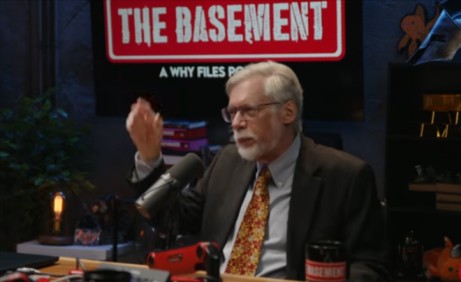
Editor’s Notes: In this episode of The Basement #011, host AJ Gentile sits down with veteran investigator Peter Levenda to untangle 50 years of research into the dark intersections of intelligence operations, occultism, and hidden history. From his teenage stunt sneaking into Bobby Kennedy’s funeral to uncovering Nazi colonies in Chile and classified SS expeditions, Levenda shares mind-blowing accounts that challenge conventional narratives. The conversation spans a vast landscape of topics, including the UFO connection to the JFK assassination, the mystery of Nazi gold, and a startling theory regarding Adolf Hitler’s possible escape. (April 14, 2026)
TRANSCRIPT:
Introduction
AJ GENTILE: Today I’m talking with Peter Levenda. He’s the author of more than 20 books. Unholy Alliance, the Sinister Forces trilogy, the Secret Machine series with Tom DeLonge. The guy’s been investigating the dark intersections of occultism, intelligence operations, hidden history, CIA for over 50 years.
HECKLEFISH: He’s been investigating the CIA for 50 years and he’s still alive? That’s either very impressive or very suspicious.
AJ GENTILE: And it started when he was 17. He dressed up as a fake Orthodox priest. He talked his way past the Secret Service and snuck into Bobby Kennedy’s funeral at St. Patrick’s Cathedral. The stunt dropped him into an underground world that he never climbed out of.
HECKLEFISH: Yeah, he’s lucky he didn’t end up in a duffel bag he couldn’t climb out of.
AJ GENTILE: Peter has some of the most mind-blowing stories I have ever heard. CIA fronts disguised as churches, Nazi colonies in Chile, classified documents on SS expeditions to Tibet. A possible escape route for Hitler that nobody was looking at. We cover a lot of ground: the assassination connections, the Council of Nine consciousness, a Men in Black encounter that takes a turn that I’d never expected, and a theory about Hitler that actually shook me. I mean, seriously, I had to stop the show for a minute to process it, but we kept the camera rolling. Let’s go to the basement. Peter, welcome to the basement.
PETER LEVENDA: Thank you very much. I’m very happy to be here.
The Research Process and Sinister Forces
AJ GENTILE: My typical process with a guest is do a little reading, do some prep, get to know the material, and then just chat. Rarely do I refer to notes. I keep them around, but rarely do I use them. Today, this is the only way I can keep up with you.
PETER LEVENDA: Sorry about that.
AJ GENTILE: No, no, it’s— it’s— I love it. But if you catch me just fumbling through pages, that’s me just trying to— because there’s so many names. So many connections.
PETER LEVENDA: It was bewildering to me. I mean, when I started this, I thought I’d have a handle on it. It got out of control real fast. Too many names cross-referenced with too many other events, too many other people.
So it made it— I had to do it. And people argue with me sometimes, “How come you don’t give us an analysis? Tell us what’s really going on. Give us your analysis.” I said I can’t do that. In the first place, it would be wrong. What I want to do in Sinister Forces was to give you this data and say, you tell me, what do you think this is?
I’m not going to tell you. The Kennedy assassination is a perfect example. I hesitated to write about that because everybody writes about the Kennedy assassination. But for me, it’s not just what we think it is, it’s something deeper. And I wanted to say, look at all of this stuff. Look at all these weird coincidences, these synchronicities that multiply like crazy around the assassination.
I’m not going to go and tell you Oswald acted alone or Oswald was part of a conspiracy. I’m going to say there’s another thing happening here. There’s something else going on. Take a look at this. You tell me what this means. And if you’re so literal-minded that you think it means it’s a conspiracy of a bunch of guys in a back room smoking cigars and saying, “Let’s kill Kennedy,” there could be that. But there’s something a lot deeper going on because it happened, and it happened in a certain way, at a certain time, in a certain place. All of these things meant something deeper than what we’re looking at.
So what I wanted to present was the data and say, look, open your eyes and look — there’s a UFO connection. What?
AJ GENTILE: What?
PETER LEVENDA: Right? Look at it. I mean, Jacques Vallée pointed it out back in 1963.
AJ GENTILE: Yes.
PETER LEVENDA: Vallée said, wait a minute, Kennedy just got shot. There’s something weird going on. There’s some violent eruption, a volcanic eruption underneath our society, under our daily lives that we don’t even suspect exists until it erupts. And he says, kind of like the UFO phenomenon as well, right? These things are somehow talking to each other.
AJ GENTILE: Yes, they are.
PETER LEVENDA: And that was inspirational too. I saw that and I said, okay, that’s where we’re headed.
AJ GENTILE: Yeah, one or two connections you can dismiss, but when there are hundreds — hundreds you connect. And I think I’ve heard you say that you’ve had readers reach out and actually make additional connections for you, like, “Hey, Peter, in this book 10 years ago you said this, but this matches here.” Yes, it does.
PETER LEVENDA: And things that I will miss because I’m too focused on telling one story. And that’s what happens when you’re focused on telling a story — you’re ignoring evidence. That happens all the time. With Sinister Forces, I try to pull back and say, “I’m not going to tell you a story that way. What I’m going to do is I’m going to show you a lot of evidence.
AJ GENTILE: Your books are so fun because the reader becomes part of the detective story.
PETER LEVENDA: Exactly.
AJ GENTILE: They’re super fun.
PETER LEVENDA: That’s what I want them to do. I want them to contribute, just the way they have.
Nazi Gold, Indonesia, and the Hidden War Against Sukarno
PETER LEVENDA: In that particular instance you mentioned, for instance, I was writing about Indonesia, and I was writing about a Nazi war criminal who had escaped to Indonesia after the war. And wound up at a remote island, and people thought he was Hitler — that Hitler had actually escaped — and he had a wife who looked a little bit like Eva Braun. So this whole thing was very strange, very mysterious, but it was real. There were photographs, there were documents, and I said, I’ve got to look at this. I went nuts compiling the information, and because I was trying to make a case, I didn’t catch all the evidence that I had in front of me. And that happens all the time to any kind of researcher, right? Your bias makes you selectively choose things and ignore other things.
AJ GENTILE: 100%.
PETER LEVENDA: And here I had basically a major story in front of me, and I didn’t know it until somebody went and said, “Excuse me, but in the first book you wrote about this guy, you mentioned these two particular weird numbers and this address, and then in the second book that you’re writing about this guy, you don’t put it together. You write about everything but that around it. But I’ve got news for you — it’s the same numbers. That means that your famous Nazi war criminal opened an account in Jakarta that was used to funnel Nazi gold into the country.”
AJ GENTILE: This is true.
PETER LEVENDA: And it’s true. It’s there, right?
AJ GENTILE: So facepalm moment, right?
PETER LEVENDA: Exactly.
AJ GENTILE: Right.
PETER LEVENDA: “How did I not see this? It was the same numbers, just repeated, and I didn’t put it together.” And the address was the same, and they said, “Take a look again,” right? And that opened up another entire front in the war.
So here was all this Nazi gold — tons of Nazi gold — came out of Portugal at the end of the war, wound up in Macau, which was Portuguese territory at the time. 20 tons of it disappeared somewhere into China. Maybe to support the Kuomintang, maybe Chiang Kai-shek’s people, I don’t know. But the other 20 tons went into Jakarta, went into Indonesia for Sukarno. He was trying to create an International Monetary Fund of his own that would be for non-aligned nations.
AJ GENTILE: He was trying to oppose the World Bank.
PETER LEVENDA: A new IMF. A new IMF.
AJ GENTILE: Yes.
PETER LEVENDA: Right? It was called the Revolutionary Fund. And then it kind of disappeared. We don’t know what happened. But then I found out that there was, the 1965 Year of Living Dangerously, all of this stuff that happened — this revolt that took place, the civil war that erupted, Sukarno being deposed, the army taking over — all of the embassies, the West German embassy and the West German consulates in Indonesia were staffed by former SS. Former Nazis were in position there, which I found out only much later, and gold was being used to finance this operation against Sukarno and that government by painting him as a communist, by saying he was 100% communist, which was not true. But even OSS at the time and CIA said, no, it’s not true. The people who said that at CIA were fired, right?
So anyway, this is a long story, a long aside, but what I’m trying to say is if you try to tell a story, it can be very believable and very convincing, but you’re going to miss some evidence that tells another story. So I pulled back with Sinister Forces and said, I’m going to give you a lot of evidence. Unfortunately, look at the size of that thing.
AJ GENTILE: Yeah, I needed help carrying it in here.
PETER LEVENDA: I’m sorry about that, guys, but it had to be done. So it’s all there. You can just start anywhere, open it up anyplace and start — look at names that are familiar. And then Google away, guys. You’re going to find all kinds of amazing material.
Peter’s Origin Story: Dodging the Draft and Becoming a Priest
AJ GENTILE: Well, today — and it’s on my list to get to — Nazis escaping, different Hitler theories. I covered it myself. I ended up in Argentina where everyone else does. Indonesia took me by surprise, so I’d love to dig into that. But I think we need to set the stage. 1968, dodging the draft.
PETER LEVENDA: Yeah.
AJ GENTILE: And you become a priest. Can you tell the story?
PETER LEVENDA: It was cool. This is the thing, okay? Actually, in ’67 is when it started for me. I’m in high school, Columbus High School, as you pointed out before, and I’m going to high school and I’m turning 18 in 1968, and there’s the draft. It’s an actual draft, so no way out.
And my politics at the time — my parents were sort of right-wing, my father was kind of right-wing. He was a segregationist, actually, while he was in high school, so we were sort of worlds apart on that. So he was sort of right-wingish on these things, and my mother was similarly right-wing, but I could not get my head around why we were bombing Vietnam. I could not understand it.
I understood World War II. I understood the Nazis, going after them. My uncles fought the Nazis. I understood Japan, fighting Japan, fighting in the Pacific. My uncle similarly fought in the Pacific theater. So all of this I kind of understood. I understood these were bad people doing bad things, enslaving populations, murdering populations. Yeah, you’ve got to stop that.
AJ GENTILE: Did you understand Korea?
PETER LEVENDA: Korea — my parents were kind of always on the fence about Korea. They were saying, “Well, it’s not really a war, it’s a police action.”
AJ GENTILE: Right.
PETER LEVENDA: I’m saying, I mean, people are getting killed, right? They’re shooting at us, we’re shooting at them. So Korea was a problem, but Korea was where we got brainwashing and all this other stuff, right? How cool was that, right? So we had that issue with Korea, but at least we weren’t fighting in Korea at that time when I was in high school. Korea was like, you could get sent to Korea and sit there.
AJ GENTILE: Right.
PETER LEVENDA: But knowing me and my luck, I would be in the tall grass before you know it. And it wasn’t a question of my safety that I was concerned about — this is the thing. I didn’t want to be responsible for what might be a series of war crimes. I mean, I grew up on the Nazis, right? I grew up on Casablanca.
AJ GENTILE: Yes.
PETER LEVENDA: How can you grow up on Casablanca and say, “Let me go to Vietnam and bomb a bunch of villagers?”
AJ GENTILE: You had that sense back in the ’60s? I mean, because it’s all war crimes as far as I’m concerned, which I don’t think it’s debatable at this point — Gulf of Tonkin and all that. But back then you had that instinct very early.
PETER LEVENDA: I did, because I was a strange child. I was a sort of loner, I was very introverted by nature. I’m the kind of introvert that doesn’t answer his phone, if you know what I mean.
AJ GENTILE: My wife is nodding her head right now.
PETER LEVENDA: That’s the kind of person I am. So I’m very introverted where that’s concerned, but at the same time fascinated by foreign cultures. I mean, the pivotal moment of my youth was watching Lawrence of Arabia when it came out in 1962.
Growing Up: War Films, Occultism, and the Vietnam Draft
AJ GENTILE: The best.
PETER LEVENDA: I was sent— we were part of a class that had to go and see the movie. If you can imagine a class of, like, 7th graders going to see Lawrence of Arabia. Strange choice, but okay. So we went and we sat there and it blew me away. And I said to myself, okay, I never had a childhood hero or anything growing up. I said, I want to be that. “I want to be that guy who goes out in the middle of nowhere to all these people who he’s not related to, doesn’t even speak their language, but gets right into it with them, and in the end winds up leading the revolt.”
Later I found out he was not that great of a guy. Drew the lines for what we’re constantly dealing with in the Middle East right now. Drew the boundaries. He and Gertrude Bell sat there and created Iraq out of whole cloth, and on and on. But that’s another story.
But at the time, that was my sensitivity. And growing up on war films— Passage to Marseille, Casablanca, all these, Bogart and Claude Rains and all the rest of this stuff. And who do I see in Lawrence of Arabia? Claude Rains again. So it’s like there’s a continuum in my mind, if you can understand how I’m thinking and how I’m understanding this.
And to go to Vietnam— I would have welcomed going, as a kid, with my kid sensibilities, I would have welcomed going to war against the Nazis. I would have joined up. Anything like that. I mean, there was a mission, there was a real mission. I didn’t see the mission.
AJ GENTILE: You can’t see John Wayne in Vietnam. You can’t see him there. No, no, no, you can’t.
PETER LEVENDA: And I’m now with a bunch of people my age in high school, and they’re thinking to themselves, “Why are we doing this too?” And I’ve got SDS, Students of a Democratic Society. They were in Columbus High School, and eventually they became the Weathermen, right? One branch did. And so they’re trying to raise—
AJ GENTILE: I don’t think Dad liked them. What? I don’t think Dad liked those guys.
PETER LEVENDA: No, no, no, not his cup of tea. No. So we had this happening. So all of this was there. My consciousness was being bombarded and raised, basically. I mean, I was surrounded by people saying, “What the hell are we doing going over there?” And then seeing the footage on television every night, the body counts and all the rest of this stuff. I said, body counts? That’s what we’re reduced to now? We don’t win battles, we just have body counts. What the hell is that?
So a lot of that just didn’t make sense to me. So I said, no, I’m not going to do this. And there were options. You could go to Canada, you could go to Sweden. But I was a strange child, as I said, and in the mid-’60s, I was doing a lot of research into occultism. Séances and things of that nature. And I would get Fate magazine. What, as a 10th grader? In 1963, ’64, so I was 13, 14 years old. Yeah, something like that.
AJ GENTILE: Reading occult magazines?
PETER LEVENDA: Fate magazine was like my Bible. Fate magazine was great, but not just so much the articles— it was the ads in the back. The ads were great. All kinds of weird stuff were in the ads, and you could send away for free for a lot of stuff. So I’m sending away for whatever is there for free because we were pretty broke as a family. So I’m just sending away whatever you have that’s free, I’m on board. And so I would get these things for the Universal Life Church, right?
AJ GENTILE: And that’s going to come up a lot today. Is it? Sorry? Universal Life Church, sure.
Creating a Church to Dodge the Draft
PETER LEVENDA: Yeah, well, there’s reasons, did you know? So there’s Universal Life Church. I’m looking at this thing and I’m saying, wait a minute, I can send in $5 and I’m a priest of the Universal Life Church. Okay, so I did that. I scrounged together $5, and I really mean scrounged. That was difficult in those days. And I got my certificate that I’m now a priest. I’m thinking, does this get me out of Vietnam? No. As it turns out, not exactly.
So I’m starting to do some research, which in those days, there’s no internet, boys and girls. There’s no cell phones, there’s no laptops, there’s no computers, there’s nothing. You do research, you go to a library and look at paper. And I’m doing this and I’m researching the deferments. How do you get deferred from going into the Army? The 4s, right? So 4-F means you’re physically unable, so you’ve got to be missing an arm or a lung or something. I said, that’s a little drastic.
But there was a 4-F deferment that said clergyman. And that’s when the light bulb came on. I said, wait a minute, Universal Life can do this, we could do it, but we could do it better. We meaning me, the editorial we. I said, let’s see what I can do.
So I’m in high school in Columbus with a schoolmate whose background is similar to mine. My father’s parents were from Slovakia. They were immigrants from Slovakia. His grandparents were immigrants from Czech and Slovakia, both sides, Czechia and Slovakia. So we kind of got along on that basis. We had a common Slavic sort of heritage. And he was totally into religious stuff, kind of alarmingly so, as I later found out.
But he had— he was Third Order Franciscan, which is a kind of monastic thing for laypeople. He had a closet full of vestments, Catholic vestments, chasubles, cassocks, the Roman collars. Again, as a teenager? As a teenager. Okay. See, his parents were divorced. And what happened was one parent would play against the other parent, so he was getting money from both sides. So he would go and get this stuff from places, right? Sometimes it was secondhand, whatever.
But he had a chalice, he had a ciborium. You could say Mass in his bedroom. It was all there. Everything you needed was there. And his father worked for the Triborough Bridge and Tunnel Authority in Manhattan, so he was a welder, right? So he’s welding suits of armor, he’s welding shields, he’s building swords. Lances, he had a mace.
AJ GENTILE: Wow, he sounds awesome.
PETER LEVENDA: But he was like a no-nonsense kind of guy. He was salt of the earth. Very strong human being, right? But very solid of the earth. And his son was this very wispy— as I learned later— very gay guy. And I was like innocent as hell. I knew nothing about gay, straight. Everybody else seemed to know he was gay. I didn’t. If they had told me, I would have known what they meant.
So he had all this stuff. He just loved all of this. And he had a mustache— he’s a junior in high school and he has a mustache. He would wear suits, right? The whole thing. And he took snuff. He took snuff? He took snuff. He had a little snuff and he took snuff.
AJ GENTILE: I see him with a pipe or—
PETER LEVENDA: No, snuff. Snuff, okay. So this was— he was fascinating, right? He’s a fascinating character. And he was fascinated by me, I think, because I was so strange, right? So we would have these discussions. And I liked foreign languages. I was always studying foreign languages. I had 3 years of French. I had a year of Latin. So I was linguistically inclined where this was concerned. And he was as well.
So we were looking at things, and then Vietnam would inevitably come up. And I said, you know, you’ve got all this stuff. Why don’t we create our own church? That’s all we have to do. We just get it incorporated. In the state of New York. We need somebody because we’re too young to sign incorporation papers. We need people to sign for us. We create a church, we register it in Albany.
AJ GENTILE: So who did you find to do the paperwork?
PETER LEVENDA: I think we had— I think his father was a signature. I think we had one teacher who signed as well.
AJ GENTILE: And what, you just sold it as a project?
PETER LEVENDA: No, his father knew what we were up to. I think the teacher might have known, and as I found out later, the teacher was also gay. So I think there was something going on there between the teacher and the— not to defame the dead, he’s gone at this point, but— so my friend had his connections, I guess, and I had mine.
So they signed the papers and we were incorporated in the state of New York. We have the seal, the whole thing, the wax seal, the stamp, everything. We were legit. And Congress can make no law concerning the establishment of religion. That’s in our Constitution, boys and girls. So if we say we’re clergy of this legally incorporated church, we are clergy of that church.
Now, the next hurdle would be convincing Selective Service that this was true. So how do you— if you’re both 17? A little mysterious how you can be priests at 17. We needed another priest. We needed somebody who had some clout.
The Bishop of Borat and the Orthodox Paper Trail
PETER LEVENDA: And he had a friend. And this friend had been— he’s an Eastern European of some description. We don’t know, I don’t think we ever knew where he really came from. He had a heavy accent that was identical to Borat. Really? Identical. When I hear Borat, I hear this guy. He talked like that all the time. We used to make fun of him, the way he talked.
And he had been a clergy of some kind. He had been stationed at Grottaferrata outside of Rome, which was a place where Eastern European Catholics were taken quite often when they were escaping communism, so they were like set up there for a while. So he talked always fondly about this place.
But anyway, he lived in this weird basement apartment in the Upper West Side that had Christmas lights strung up like year in, year out. He just never took them down, and he was just a crazy guy. He was just totally crazy, but we named him our bishop. And he said, “No problem. It’s okay. We know that I might be bishop. No worries.” So he was the bishop of this church. So his name was in the middle and we were on the other side.
So I was Petro, which is Peter, which is just the Slavic version of Peter. But my friend, he had to have a different name. So he went for Eleftheri. Eleftheri is from the Greek. It means freedom. In his head, this was his freedom, right? We built this church out of nothing, but we had all the garb, right?
So, okay, we’re going to be Orthodox now. We are now Eastern Orthodox. We can’t be Catholic, obviously. The Catholics would have a word with us. But Orthodox was a free-for-all. We were very astute at 17. Because Orthodox churches, a lot of them were behind the Iron Curtain. So they didn’t communicate with their Orthodox churches outside. So we picked a church that was in Czechoslovakia, still behind the Iron Curtain.
AJ GENTILE: Brilliant.
PETER LEVENDA: There were no Slovak Orthodox people.
AJ GENTILE: As you’re going through this, are you still afraid of the war, or are you more excited about the project?
PETER LEVENDA: Oh, it’s both. It’s both.
AJ GENTILE: Okay.
PETER LEVENDA: So the energy into this project was because of Vietnam. So we really hustled on this, and we said we have to somehow create a paper trail that we’re really Orthodox. So we visited all these Orthodox churches, and we made friends with Brother Victor. Brother Victor was the principal of St. Sergius Russian Orthodox High School, which was part of the anti-communist Russian Orthodox Church, the Tsarist, which was really a beautiful outfit up on Park Avenue and 92nd Street.
AJ GENTILE: Oh, nice. Very nice.
PETER LEVENDA: They have the whole mansion that they bought with the money from Tsarist Russia.
AJ GENTILE: And if he’s gay as well, that’s fine.
PETER LEVENDA: Victor, I don’t know about Victor. I never knew that. He never got a chance to find out if he was gay. But the church— the Russian Orthodox Church Outside Russia, as it was called— this brings us back to the assassination, because Russian Orthodox Church Outside Russia is usually spelled R-O-C-O-R, abbreviated ROCOR. ROCOR figures prominently in the assassination, and I’ll get to that in a minute. But of course, I had no way of knowing then.
So we would visit this guy, we would hang out with him in our stuff, and we had the hats, these stovepipe hats with the veils, right? Like, never on Sunday.
AJ GENTILE: What, on the F train? No, just in your stuff? Absolutely. Really? Oh yeah. I love this.
PETER LEVENDA: No, you had to. I mean, Orthodox, we had to do the whole thing. So we would go and hang out there, and of course the other Orthodox would look at us, and they were suspicious. As they had every right to be. But we kind of passed. I mean, both Slavs, and we managed to pass.
AJ GENTILE: You’re doing the accent on the train and stuff, just chatting?
Infiltrating the Orthodox Church
PETER LEVENDA: No, I didn’t. I wouldn’t do the accent. Only when we had to do the accent, only when it became absolutely necessary. Otherwise, no, we talked like normal English-speaking people. So they were our friends, and then we would go and visit the other Russian Orthodox, which was the Communist Church, we called it, which owed allegiance to Moscow, the patriarch in Moscow.
Now, if you watched the TV series Americans? I have. Okay, the last season there is a prominent number of characters who are Orthodox priests who are actually KGB agents.
AJ GENTILE: That’s right, it took a long time to get there.
PETER LEVENDA: It took a long time to get there and I was so pleased when they finally got there because I’m waiting for this because I knew that was how they were moving agents into the country as Russian Orthodox priests and that comes back to my story again a little later.
AJ GENTILE: I don’t think I knew that.
PETER LEVENDA: Okay, great. So KGB agents dressed up as priests sent by KGB, but trained in Moscow to look and act like Russian Orthodox priests. And of course, in some cases they kind of grew up with Orthodoxy around them, even though it was suppressed by the Soviet Union, but the churches were there and they heard stories from their parents. They had basically an understanding.
So they would move these people into the church on 97th Street on 5th Avenue — so in our heads we would say 97th Street, 93rd Street, 92nd Street, 97th. We knew the streets, we knew what we were talking about. We said 97th Street meant the Russian Orthodox Church Moscow Patriarchate, right? We said 92nd Street or 93rd Street, it was Russian Orthodox Church anti-communist, pro-Nazi as it turned out, another thing, but anyway.
So you had these two to deal with, right? So we would shuttle back and forth and keep an eye on both, but then we visited the Serbians, the Bulgarians, everybody. Are you going into the church? Absolutely.
AJ GENTILE: We’re introducing ourselves. Wow, this is audacious.
PETER LEVENDA: Well, and they took us at our word. We dressed the part.
AJ GENTILE: When you walk up, who else would dress like that, right? When you walk up for the first time, are you like, oh, is this going to work this time? What’s—
PETER LEVENDA: We had no — just after the first time, it became easy after that. We would gatecrash things you would not believe.
AJ GENTILE: Being 18 is amazing, isn’t it?
PETER LEVENDA: You have testicles, and you just don’t really — you just walk in and do it. You brass it out. You don’t care. What possibly could go wrong? Right. So we’re doing all this, and we’re building this sort of thing, and we’re getting the robes right. We’re making this ourselves. The hats we had to make, right? So those were made. But we had the material needed. And the guy turned out to be a pretty good seamstress.
AJ GENTILE: I was picturing it, picturing the sewing.
Blessing Graves for Money
PETER LEVENDA: Yeah. Everything was happening fine. So we’re doing all this, and he’s going to town now. He’s getting more money from both sides of his family, from his mother and his father. He’s buying gold crosses to wear from his neck, imported from Greece, right? ‘Cause Greek Orthodox is like the motherland for all this stuff. And he’s got all kinds of stuff. He’s got the staff with the serpents, you know, around it, the whole this. He’s got this he’s traveling with. I’m getting whatever I can get from the side because my family, as I say, is broke. So my working my father and my mother is not going to help, but he’s got all this great stuff, right? So I get whatever he has extra.
AJ GENTILE: So you guys aren’t hearing confessions on the train or doing anything like that, are you?
PETER LEVENDA: No, no, no, no, no. But we are blessing graves. What? Yes. St. Michael’s Cemetery in Queens. When we needed money, we would go on a weekend, like a Saturday. We would just show up in a cemetery fully decked out in the black robes and everything else. We would walk very sedately through along the graves. We would stop at a grave. And we would bless it in the Orthodox cross and the whole thing and mumble something in Church Slavonic. People would see it and they would walk up to us and say, “Father, could you come and bless our grave?” Of course. Of course. We would go and do that and they’d give us $5.
AJ GENTILE: I don’t know if that’s heresy or beautiful. Both. I guess it’s both. It’s a beautiful heresy.
PETER LEVENDA: So we would—
AJ GENTILE: A part of you has to start to connect with it though. When you’re blessing graves, you have to connect with it on some level, right? Well, you want to do a good job.
PETER LEVENDA: I mean, you want everybody to be pleased with the result. I don’t know about the person in there. They’re saying—
AJ GENTILE: But you’re not mocking, is what I’m getting at.
PETER LEVENDA: No. Right. So we would bless graves. We would do that, and we’d pick up sometimes $20, which in those days was a lot of money. Sure. And it paid for things that we needed. So we would do that every weekend or so. If the weather was promising, we would go, or if it was like a Memorial Day, we would go on Memorial Day especially. There’d be a lot of customers in the cemetery. So we’d just go and work the crowd. Let’s go work the crowd. How is that different from any other religion?
AJ GENTILE: I was thinking the same thing. What’s the difference?
PETER LEVENDA: What’s the difference? So, okay, yes, so hearing confessions, no, but blessing graves, yes.
Bobby Kennedy’s Assassination
So this is going on, and then finally, the event that changed it all for me was June ’68, and Bobby Kennedy is assassinated. And I watched it — I’m watching the returns in California on our little black-and-white Zenith TV, and there’s Kennedy saying, “Onwards to…” I forget what state he was going on next, but they had just won the California primary. He had just won. And then suddenly, the newscasters are coming on, “Bobby Kennedy’s been shot.”
So you were sitting there when it happened live?
AJ GENTILE: Yeah. Okay.
PETER LEVENDA: And it’s — that was going to be like the savior, right? He was going to get us out of Vietnam. We believed that anyway. And remember, this happened only 3 months after Martin Luther King. And I remember Martin Luther King’s assassination, what happened at Columbus High School in those days. I mean, that was just surreal. And then this, and this is the month we’re going to graduate high school, June ’68. And I’m stunned by this. I mean, I think this is it, this is over. “We really got to get out of this situation, because this is going to be terrible now. And we have no hope.” Hubert Humphrey? Are you kidding me?
So, anyway, what does my friend say? “We’re going to go to the funeral,” he tells me.
AJ GENTILE: Which is at St. Patrick’s.
PETER LEVENDA: Yes. They’re holding the funeral at St. Patrick’s Cathedral. Now, because he was a Third Order Franciscan, he had connections at St. Patrick’s Cathedral. How? As a teenager? Well, because of the society. I mean, he had a mustache. It’s possible.
AJ GENTILE: That goes a long way.
PETER LEVENDA: Goes a long way. People don’t ask questions if you have a mustache. So he knew some bishop, he knew somebody there. Believe me, I never knew all the details about my friend Prosky, William Andrew Prosky. I never really knew all the background here. I don’t know what he was involved with — to be honest, more than what I saw myself, so I can’t jump to conclusions, but he knew a lot of people.
We could get into, for instance, the Metropolitan Opera. We could go into Carnegie Hall. We could go to places like that and just sort of show up when nobody was there and play the organ in the opera house or at Carnegie Hall or something. He knew, he had contacts. As a teenager, he had contacts somehow.
AJ GENTILE: And you didn’t — I guess as a teenager, you really wouldn’t ask. You would just go.
PETER LEVENDA: You just go. Yeah. Oh, this is cool. I’ll go. So this kind of thing would happen.
Crashing Bobby Kennedy’s Funeral
So anyway, the night before the funeral, the night before, we go down to St. Patrick’s, at night. He goes in — we both go into the building that’s connected to the church, and we talk to somebody who’s evidently somebody in charge, a Catholic priest of some kind. I think he was a monsignor. He had the red with the thing. And—
AJ GENTILE: Did you go down in costume?
PETER LEVENDA: Oh, yeah. Absolutely. And we said, we want to pay our respects as well. Is it possible for us to — can we also get in tomorrow and do that? We represent the Slavonic Orthodox Church. And the guy says, okay, maybe come back tomorrow, right?
And so we go into the church itself, and the coffin is already there. Wow. So Bobby Kennedy is there. Wow. And Rose and Jackie are in the front pew. There’s nobody else in the place. Oh my goodness. And they’re kneeling and praying. And we see the coffin, and my friend doesn’t miss a beat. He goes right up to the coffin and starts going, doing the sign of the cross and everything else. And—
AJ GENTILE: Is the impact of this hitting you at that point?
PETER LEVENDA: It’s really hard to say. It’s surreal. It really is. Because I’m looking at the guy who would have saved the country in my 17-year-old imagination. And he’s in a box in the church, and I’m there next to him. I’m touching the coffin.
AJ GENTILE: This is so powerful.
PETER LEVENDA: It is, but my friend doesn’t see it that way. My friend, this is an opportunity for him to act like a bishop, ’cause he wants to be a bishop now. He’s not — priest is no longer enough. He’s turning 18 that month. And priest, no, he wants to be archimandrite, which is a higher level, just below bishop. But he has his sights set on bishop. So he’s blessing, and he’s in his element. Me, I’m just shaking. Of course. So there’s just two different poles happening at that moment.
And I look over, and there’s people that I’ve seen since I was a kid, Rose and Jackie. And they’re praying. Of course, they’re praying. We’re not going to bother them — at least my friend had enough sense not to do that. So we left.
We go back to the Bronx on the subway, and he says, “We’re going tomorrow.” He says, “I’m going to rent a limo, and we’re going to go down that way.” And I remember to this day, the limo cost us $18. So that was a good $20 we got at the cemetery. So that cost $18. The limo picked us up in the Bronx. We had all the stuff on, and we got into the limo and he drove us straight to St. Patrick’s, right up to the side entrance. The door is open — the Secret Service is there, obviously. You can imagine the security at the funeral of a dead Kennedy.
AJ GENTILE: Oh yeah, well, you had to get through PD first, no? So they just wave you in?
PETER LEVENDA: Wave you in. They saw a limo. And they saw hats, they said, come on in.
AJ GENTILE: It was probably auxiliary guys, probably. What do you expect, Boy Scouts?
PETER LEVENDA: So, the Secret Service is there, right? They got the things in their ears and they got the lapel buttons, and they run up to me as we were leaving the car. We’re standing there and there’s Rosie Greer, right? The guy who tackled Sirhan. He’s right there. I mean, my mind is — what the hell am I doing here, right?
AJ GENTILE: Is your heart just pounding in your chest?
PETER LEVENDA: Oh yeah, I don’t know where this is going to lead. I don’t know how far this is going to go.
AJ GENTILE: I need to hear some nerves here. Yeah, sure, absolutely. But your partner, he’s probably cool.
PETER LEVENDA: He’s cool with it. And he says — we made this agreement. He will not speak. His voice was still changing.
AJ GENTILE: Oh, good God.
PETER LEVENDA: His voice was a little bit still changing. He says, okay, I’ll do all the talking. You’re going to be the bishop, ’cause now by this time he’s bishop. He has the panagia, he has the cross, he has this big—
AJ GENTILE: Oh, well, congratulations on his promotion.
A Chance Encounter at the Kennedy Funeral
PETER LEVENDA: Yes, there you go. I’m still the schmuck in the back. So we go up and the Secret Service walks up to me and he says, “Russian Orthodox representatives?” And I say, “Nyet, Slavonic Orthodox representatives.” And he says, “Okay, follow me.”
And he says, we’re going to go a rather circuitous way into the church, but, you know, we’ll be fine. So the two of us — he’s, my friend is walking like this with his cane, with his Crozier, whatever the hell he’s carrying. I’m walking behind with, you know, my heart in one hand and my lungs in another.
And so we imagine, and he opens the door, and we’re in the freaking sanctuary. We’re in the sanctuary. I thought we’d be out with the, you know, somewhere in the congregation. Of course. We are in the sanctuary with everybody else.
AJ GENTILE: With, and that’s in capitals, Everybody Else.
PETER LEVENDA: Everybody Else, yes. All the high clergy, people, all the bishops, archbishops, cardinals, whatever you want, they’re all there from all the different religions as well, not just the Catholics, right? Mostly Catholics, but — and there’s the head of the Greek Orthodox Church, Iakovos, the hated and dreaded Iakovos, Archbishop of the Greek Orthodox Church, and a very powerful guy at that time. He owned all kinds of — he was a slumlord, basically. He owned kinds of property, and he was, you know — but there he was, he’s glaring daggers at us, like, “Who the — who are these people? I never saw these people in my life. I know everybody in New York City. I don’t know who these guys are.” But he can’t say anything, right?
So my friend goes to that side. We have to go on opposite sides of the altar. So he’s on one side, I’m on the other to keep, I guess, the numbers even or something. So he’s on that side, I’m on this side. And I’m in the front row now of the sanctuary. I’m just staring at this like, “What do I do now?” There’s klieg lights, there’s huge lights, you know, the whole thing is happening. And I look over there and there’s like the President of the United States.
AJ GENTILE: Oh my goodness.
PETER LEVENDA: There’s senators, there’s names that I recognize, there’s actors, there’s — I’m looking at this, I’m thinking, holy Christ, what am I going to do here? I’m in deep s* if something, if they find out. What are they going to do, drag me out in front of everybody? I don’t know.
AJ GENTILE: This has spiraled out of control. I don’t think you’re aware of it.
An Impossible Security Breach
PETER LEVENDA: No, out of control at this point. And I kind of think, in a way, this is going to sound outrageous, but the passage of, like, how many years now? 50? Something like that? More? Almost 60. Almost 60? With the passage of all that time, I’m thinking, did we, like, create at that moment an alternate timeline suddenly? Was the weirdness and the impossibility of this something that split off into a different direction? Because there’s something strange about everything that happened after that. Yes. It should never have happened. I was a poor kid from the Bronx.
AJ GENTILE: ‘Cause this set you on the whole path.
PETER LEVENDA: Whole path. Completely different path than I was already set on.
AJ GENTILE: What were you planning on doing?
PETER LEVENDA: I just wanted to be a writer. Just wanted to be a writer. That’s all I wanted to do.
AJ GENTILE: Novels?
PETER LEVENDA: Yeah, anything. Anything. I wrote poetry, short stories, novels, essays. I just wanted to write. It was like a thing.
AJ GENTILE: So let’s not go to Vietnam. I’ll be a writer. All good.
PETER LEVENDA: But instead. And not even to make money. I knew I would get a regular job. I would write for the drawer. I didn’t care. I just wanted to write with nobody telling me what to do. So that was the extent of it. That’s all that I had. That was my only dream in life. Maybe travel, of course I wanted to do that. But, you know, general terms, right?
But here I am sitting in this pew. And as I’m sitting there, the service begins, right? And there’s Ted Kennedy giving a eulogy.
AJ GENTILE: What am I doing, right? If you or anyone else — think of the security breach here.
PETER LEVENDA: Oh my goodness. Exactly. I was wearing one of these freaking hats. Yeah. They’re tall stovepipe hats. You could put anything in there. Yeah. You could put a bunch of dynamite in there.
AJ GENTILE: Boy, talk about making the news.
PETER LEVENDA: Like that? Yeah. I could have had that in my —
AJ GENTILE: Now that’s in poor taste, sorry.
PETER LEVENDA: But that’s what I, you know, I could have done that. I could have had a pistol. I could have done anything. Sure. Nobody was checking me for weapons, right? I’m wearing robes like this. I could have had a machine gun underneath there.
AJ GENTILE: Who would have known? They’re not patting down the —
PETER LEVENDA: No. Right. They’re not patting down the A-list, right? Right. So I mean, I could have just leaned over and taken out the first couple of rows. I mean, anything was possible. This is a horrible breach of security. Yes.
But at that time, I’m not thinking of that. I’m thinking, how do I get out of this? And so the service is proceeding. We’re standing up when we have to stand, sitting when we have to sit. As Orthodox, we have certain things that we do, so we remove the hat at a certain point, put it back on. All of these things are going on. They’re reciting the creed. We make sure we don’t say “filioque.” So all of these weird things that, you know, as an Orthodox you’re supposed to do, which we, you know, crash course, we figured out.
So we’re doing everything right, and at one point I get a tap on my shoulder. I’m thinking, “Okay, this is it.” I turn around, and it’s Andy Williams, and he asks me, “Am I on yet?”
AJ GENTILE: What?
PETER LEVENDA: I say, “No.” You say no. No, you’re not. I just shook my head and said no. I’m thinking, I just told no to Andy Williams, who at that time, ladies and gentlemen, boys and girls, was a very big pop star. Yes. If you saw Breakfast at Tiffany’s, Moon River, etc. Yes. So I figured he wasn’t going to sing Moon River. I just had this instinct that was not going to come out of his mouth, but I had no idea. I mean, there was a program, but I didn’t — I’m not looking at it.
Leading the Procession Out
So eventually then, the service is over and everybody has to get up, but I’m the last one in. My partner, Prosky, and I, we’re the last ones in, so we’re the first ones out. We have to lead the procession out of the cathedral.
Oh my goodness. Now, a little backstory for you. I was terrible doing this in Catholic school. I was so bad because I was the shortest kid at that time in Catholic school. Catholic school does everything in sized places. So when you’re the shortest kid, you’re in the front, you’re the leader. You’ve got to memorize everything that the big taller kids in the back, they can just dopily follow you. And I could never get straight how I go down this way, turn right here, turn left here, do this thing over here. They had all these elaborate ways to lead this procession in the church, holding candles and flowers and stuff when you’re a kid in Catholic school.
AJ GENTILE: Did they want you to lead like down the nave or? Yeah, yeah, yeah, completely, you know. Past the heads of state and?
PETER LEVENDA: Well, when I was a kid in Catholic school, it was the whole church, right? Right. And I always screw that up. And at one point, Sister Agatha grabbed me by the shoulders and she shook me so bad, I couldn’t get it straight, I vomited all over her.
AJ GENTILE: I’m telling you, I know her name. Sister Agatha?
PETER LEVENDA: Oh yeah. Oh yeah. She was evil. That’s what Dad said. I was terrified by Sister Agatha.
So anyway, that was then. So now it’s not that much later, really, ’cause I’m still a kid. But now I’m leading the procession out of the cathedral, straight down the center of the church. They’re going to open the doors in front of me. Atlas, you know, Rockefeller Center is there. Yep.
Okay, so what happens behind me? Andy Williams is finally on. Singing you out. Singing me out, the Battle Hymn of the Republic. Oh my God. Right? And then as he’s ending, right, that — Leonard Bernstein, okay, has the choir and the organs, and he’s doing the Hallelujah Chorus from Handel’s Messiah. As the doors open and as Atlas is there, and I’m thinking, well, I don’t know, but I just graduated high school, man. Oh yeah. I’m not going back for this.
My problem was I still can’t do a procession, right? So I’m walking down the aisle, but I’m hoofing it. You’re hoofing it. I’m going a bit too fast.
AJ GENTILE: The cameras are trying to track you.
PETER LEVENDA: And somebody comes up behind me, one of the clergy says, slow down. And I realize that Prosky is starting to seriously walk. So we’re not in sync, right? So I have to wait for Prosky and then we start moving the rest of the way out.
The Strange Bishop and the American Orthodox Catholic Church
We leave the church this way. Now your listeners are thinking, what does all this have to do with anything? Well, this is what it has to do.
We leave the church. We know a way to get out without being seen because we’re going to take the subway back. We didn’t keep the limo. Didn’t keep the limo. We go out through like an underground passage that’s there. Again, who do we run into? Rose and Jackie. They’re doing the same thing. They’re trying to get out to avoid the paparazzi. So we mumble something about condolences and everything else. We don’t know. It’s a shock, right? They’re shocked, we’re shocked. We keep going.
We come out on the other side, and there’s a strange-looking bishop waiting for us. This is a guy dressed in some purplish robes and stuff with a hat and everything. And he says, “What denomination are you with?” Okay, and I’m still doing the talking. “Slavonic Orthodox Church.” And he says, “Here’s a pamphlet from our church. We’re in the Bronx, the American Orthodox Catholic Church. Why don’t you come up and see us?”
And we take the thing, we say, “Okay, fine,” and we just leave. And we get in the subway coming back home, we’re looking at this thing, we’re saying, “This guy’s, like, not that far from us.” He’s near the Bronx Zoo, actually, appropriately enough, as it turned out. So we said, okay, we’re going to go and visit these people.
So, like, a Sunday or two later, we go and visit the American Orthodox Catholic Church, not having a clue who these people are. And that church turns out to be the one that had David Ferrie and Jack Martin as bishops, among others. And that they were running — Chuck Crisman as well. Well, Crisman. And they were running ops, you know, for the feds. The whole thing was totally bizarre.
AJ GENTILE: But you don’t know any of this at this point, right?
PETER LEVENDA: At that time, of course, I don’t know. I know nothing about Fred. I never heard the name David Ferrie. I mean, didn’t know anything about any of that. Or Jack Martin. Nothing like that.
All I knew was, here’s a church and a beautiful mansion. And they had a beautiful church, a wooden church. I think it was a wooden structure. Inside it was anyway. It was a lot of wood. An Orthodox church. They had icons. They had everything set up. You know, and they said, why don’t you just join us? And we thought, this is it. We don’t have a church, we don’t have a building, we have got nothing. We tie up with these guys, we’re home free, right?
And so we go on a Sunday, we’re figuring we’re going to go and do this elaborate ceremony with them, there’s going to be all these people. Place is empty. There were no parishioners. No. There never were any parishioners. Never. That wasn’t the point. Wasn’t the point. Beautiful church though. They had the edifice, it was there. Total front. And every Sunday they did the Mass, they did the Divine Liturgy. They did it with nobody present, but they had to keep up the appearances, right? And are you concerned yet?
AJ GENTILE: Like, this is odd.
PETER LEVENDA: No, because we don’t have any parishioners.
AJ GENTILE: I guess that — nobody has it. Nobody has them. We’re cool. No flock anywhere. Okay.
The Ukrainian SS, Anti-Communist Networks, and Strange Encounters
PETER LEVENDA: Until day after day, things start getting a little strange. In what way? Well, the bishop, the guy who runs the church, a guy called Profeta, was a Ukrainian Orthodox priest first, and then he broke away from the church and formed his own denomination called the American Orthodox Catholic Church. And he was a valiant anti-crusading guy. He hated communism, really, as a Ukrainian. He despised communism and anything that was wrong in the world was due to communism, right?
So he had these things. He was on television programs in the ’50s and the early ’60s talking about the Katyn Forest massacre, talking about atrocities committed by the communists against the Ukrainians, and on and on, trying to build this big anti-communist crusade. So much so that he showed me a letter from Dewey, who was running against Harry Truman at the time for the presidency. If Dewey had won the presidency, Profeta would have been the White House chaplain. He had it in writing from Dewey. So this guy was that much of an anti-communist crusader. And he ran a lot of anti-communist stuff in the state of New Jersey. A lot of his real background was the Ukrainian churches in New Jersey, which is a little strange also.
AJ GENTILE: Why would that be strange?
PETER LEVENDA: The deeper we get into this, the more it all gets very connected. But a lot of the Ukrainians in New Jersey — okay, let me background a little bit. During World War II, people talk a lot about Ukraine and Nazis. It’s a trope. You see it all the time. It’s very complicated. Ukraine was under Soviet Union control. They were not allowed to speak Ukrainian, print in Ukrainian. Of course, their church was basically banned. So when the Nazis came along and said, “We’re going to help you be free of the Soviet Union,” a lot of Ukrainians said, “No problem, we’ll support you.” So you had a lot of pro-Nazi Ukrainians just because they wanted to get away from Russia, from Soviet control, and not because they necessarily agreed with Nazi philosophy. Right.
AJ GENTILE: And the Vatican supporting all that as well.
PETER LEVENDA: And the Vatican was supporting it. Right. So you had this big movement — let’s get the Ukrainians on the Nazi side. So after the war, there was an entire Ukrainian SS division, an entire division of SS Ukrainians. They wound up in New Jersey.
AJ GENTILE: Whoa. Wow.
PETER LEVENDA: They were brought over. Family — not just the officers themselves or the soldiers, but everybody.
AJ GENTILE: Were they brought over under the Paperclip project?
PETER LEVENDA: No, it was just another special — either as asylum seekers or—
AJ GENTILE: Right, because now we’re learning that Paperclip was mostly just intelligence assets coming over, not scientists.
PETER LEVENDA: Right. Okay. So here they are. They have a church in New Jersey — it’ll come to me — and they have their own cemetery and they’ve got famous Nazi Ukrainians buried there. I mean, the whole thing is like that, right? And that was Profeta’s background. I mean, that was his people there.
AJ GENTILE: So, did you know this at the time or later?
PETER LEVENDA: Putting it together later. But at the moment, okay — Ukrainian, and that he was anti-communist was perfectly fine. He made that clear up front. He showed us film clips from when he was on television with famous spokespeople and other bishops and everything else talking about communism.
AJ GENTILE: So all of this was known to me at the time. And anti-communism was a thing. Was a thing. Everywhere.
Bishops, the FBI, and a Nigerian Holy Prophet
PETER LEVENDA: So it’s fine. Nothing too surprising. But then, weird people start showing up at the church, right? So you get a guy from Italy who shows up — an Italian, obviously a Catholic background — but he’s going to be consecrated as a bishop. This guy never met Profeta. Profeta never met him. But the Italian consulate sends people to witness this thing and to send this guy back. Again, part of the anti-communist thing.
And then Holy Prophet Aluya shows up. This is like the freakiest thing of my memory with him. There’s this African priest whose name on his passport was H.P. Aluya. HP stood for Holy Prophet. That’s his name. And he was — I don’t know what he was — but he was coming from Nigeria to the United States to be consecrated a bishop and sent back. Why? Because he represented the anti-Biafra wing of Christianity.
Now, if you know about the Biafran Civil War at that time — again, it gets into the weeds. I’m sorry for your listeners who may think, “What the hell is this all about?” But there was a civil war going on that was really very famous at the time. The Biafrans were mostly Catholics or Christians anyway, and they wanted to secede from Nigeria, which was mostly Muslim. So what the Muslim majority in Nigeria needed were Christians who were supporting the regime. So we consecrated this guy, the Holy Prophet, who showed up in African robes, right? Put him back on a plane with a big photograph of him smiling, getting consecrated, and a document, and sent him back to Nigeria.
I mean, this is the kind of stuff that went on. And at one point, Profeta told me, “We have no problem here. I have one CIA agent and one FBI agent as people who incorporated my corporation as a church. We are very protected here.” And then one day, these guys show up — wingtips, black suits, the whole thing — FBI, obviously FBI. They walk in, closed doors, have meetings with Profeta, and walk out again. So he’s working hand in glove with the feds.
AJ GENTILE: Now, what are you thinking when you see that? When you see the suits come in? Like, what is going on here? The adults are doing adult things.
PETER LEVENDA: You know what I mean? Fair enough. Yeah. So the feds are there. I’m not a conspiracy theorist at this point, right?
AJ GENTILE: They’re not bothering you, so—
PETER LEVENDA: Yeah, it sounds cool. Okay.
AJ GENTILE: We’re cool, right? HP, Louie, yes. Hilarious.
PETER LEVENDA: Yeah. And I kind of know he’s on the wrong side of this conflict. I mean, Profeta must have his reasons. He doesn’t look like a Christian would dress to me. But who knows? It’s Africa. Different people, different customs. As they said in The Man Who Would Be King, “Different people, different customs.” So I don’t know what’s going on. I just go along, go with the flow.
Delta Metal Industries and Harry K.
Until it does start to look too weird, right? So it starts to get stranger and stranger. We go for a meeting — why, I don’t know — downtown, Lower Fifth Avenue, a place called Delta Metal Industries. Delta Metal Industries had a showroom of metal furniture that they imported from Europe — Italy, I think, mostly — and it was like wrought iron furniture. And it’s this big elaborate showroom, nice, one whole floor of a building down there, third floor, I think, on this building.
And it’s owned and operated by a guy called Harry K. K was not his real last name. K was the initial, but he had made it his last name, I guess, for legal purposes or signing documents, whatever. So he’s Harry K. And there was something very fishy about Harry K. So we would go for meetings there once in a while with Harry K. Harry K. would be there, and there were never any customers at the showroom. Nobody ever showed up, nothing like that. It’s like another Orthodox Church deal.
AJ GENTILE: What are you discussing at your meetings?
PETER LEVENDA: I couldn’t figure it out. They’re talking in code, you know? They’re talking in a code that they understand, but we don’t. We’re just there for window dressing because we’re dressed right. And one time there’s a party they’re throwing. So they throw this party and we’re invited. And there’s like Hollywood, there’s like Broadway celebrities, Hollywood celebrities there at this thing. I kind of recognized some of them here and there, I thought. I didn’t know what I was doing there except again to give legitimacy, right?
So making a long story short, I began to suspect there was something very fishy about Harry K. and Delta Metal Industries. And then I befriended the secretary who worked there, and she’s telling me, “Oh yeah, you know, this is not what it looks like. This is something else.” And she would get a little drunk on rum and Cokes and start saying, “Oh yeah, this is like a whole different thing that we’re doing here.”
AJ GENTILE: Did she tell you specifically or just, “It’s not what you think?”
PETER LEVENDA: It’s not what you think. Plus, they kind of want to get rid of you, she tells me. But just get rid of me from this thing because I’m not on board with this program, or I would not be expected to be.
AJ GENTILE: Of course, get rid of you. Of course.
PETER LEVENDA: I’m a liability. So that makes me worried.
Andre Pinocchio, The Godfather, and Selective Service
Now, at the same time we make a friend — some other bishop shows up. I mean, we’re up to our neck in bishops, right? There’s no other clergy and there’s no parishioners, but we’ve got bishops like you would not believe. Are you clear of Selective Service by now? Oh, I’m getting to exactly that point. I’m getting right to that point. I know it takes me a long time.
AJ GENTILE: No, no, no — I could do this all day. This is amazing.
PETER LEVENDA: So this guy shows up — Andre, Andre Pinocchio, very Italian, and as he insists to us, very Sicilian. So he’s Andre Pinocchio, and he’s a priest with the Liberal Catholic Church. Now, the Liberal Catholic Church was kind of an offshoot of the Theosophical Society, and they had their own church that had — they did mass on Sundays.
AJ GENTILE: Is this Blavatsky?
PETER LEVENDA: Blavatsky’s people. Really? Yeah. They have their own wing, sort of a church. Liberal Catholic, it’s called. And they have like a Buddha statue with the cross and everything else. And they have mass on Sundays. They used to. I went to one or two just to see what that was all about.
AJ GENTILE: They had swastikas too, didn’t they?
PETER LEVENDA: Not in the Mass. Not in New York. Okay. So Pinocchio was a priest of that denomination and he was kind of a chaplain at one of the prisons as well. He would go — and I don’t know what he would do in the prisons — but he was like a macher. He knew everybody who was anybody.
He knew a guy called Harry Hershfield — again, people wouldn’t know who he is, but he was a very prominent kind of guy back in the day, cartoonist, political cartoons and stuff. And he was connected with the unions. He had a statue of Nefertiti, which was an original head, without the eyes — the eyes missing and stuff. He says, “This is the original. They always show her with the eyes, but she didn’t have any eyes when we found it.”
He knew Joseph Kono, who was a major union guy at the time. He knew everybody. He knew comedians, he knew actors, he knew wrestlers. He just knew everybody. He was like a major Hollywood plugged-in guy.
Later, it turns out he got a role in The Godfather. Now, all the Godfather buffs are saying, “No way. He doesn’t show up anywhere.” He does. If you look at the baptismal scene — the famous baptismal scene, everyone knows that scene — he’s the guy standing in the back with the purple and the white, saying nothing. He has no lines. But he’s standing there, right? And he’s standing again outside in the church when they’re all leaving. He’s that guy. That’s Andre Pinocchio.
Okay, he became a bishop by the time they were making The Godfather. At the American Orthodox Catholic Church, they made him a bishop because he had all these connections. And he had connections enough that when it came time in October for my Selective Service situation, he brought me to the head of Selective Service in the Federal Building downtown. Colonel Kirschenbaum — thank you very much, Colonel. And this guy sat at a nice desk. He looked like Allen Dulles. He had the jacket with the patches on the sleeves and the whole thing, and the pipe and the glasses and the mustache.
AJ GENTILE: Forgive my language, but are you shting bricks in your robe?
PETER LEVENDA: No, because again — it’s a colonel! Well, he’s not dressed in uniform.
AJ GENTILE: Okay, that’s a little easier. It’s a little easier.
The Intelligence World and the Church
PETER LEVENDA: He’s in civvies. Right? But that’s his rank, it’s Colonel Kirschenbaum. And he’s sitting there looking at me and looking at Pinocchio, who brought me in, and we want to make sure that he gets his ministerial deferment. And he’s looking at me and he says, “Well, we can do that, or, you know, you could be a chaplain in Vietnam.” And he’s joking, right? He’s just pulling my leg. I’m looking at him like— He says, “I’m kidding, I’m kidding, okay? I’m kidding.”
“But we do have one request.” And I’m looking at him like, “What is it, my liver? What do you want?” And he says, “We want to know when the Russians are moving agents through 97th Street.” Wow. “And you guys are well-placed.” Yep. “Keep an eye. You see somebody you know who’s not really a priest,” which we saw from time to time. Sure. He says, “Just let us know.” I said, “Okay.” Stamped the papers. I’m done. I’m out. I got my deferment. “No worries.” Wow. Yeah, from the head of Selective Service in New York himself. Unbelievable.
AJ GENTILE: Did you ever report a name that you saw?
PETER LEVENDA: I am not at liberty to discuss this. Understood. But things went south after a while with Harry Kay and the Orthodox Church and my friend, so-called high school friend— Do you remember Othafio?
AJ GENTILE: Are you a member of AFIO?
PETER LEVENDA: I am, yes. Okay, that’s fine.
AJ GENTILE: That’s it. I’ll just throw it out there.
PETER LEVENDA: That’s another story. That brings in Michael Aquino. I don’t think you want to know that story.
AJ GENTILE: Oh, everybody does. Of course. Temple of Set? Yes.
The Selective Service Standoff
PETER LEVENDA: Yes. We’ll get into that later. But that’s why I was in AFIO. Okay. Long story. So, things are getting worried. I’m getting worried. They’re telling me, the secretary is telling me, you know, your goose is cooked. And that’s the expression she used. I said, okay, in that case, I’m out of here. So I just told them, I said, I’m through with this. I quit. I quit the whole thing. I quit the church.
Within, I would say, a week, I get a notice from Selective Service: your classification has been revoked. No. Wow. A little piece of paper. Eyes all over you. So I said, okay. I called Selective Service and I said, you guys want to do this? Then I’m going to talk about what I know. The ball’s on you. And they gave me back my 4-D. My 4-F deferment. They gave it back.
AJ GENTILE: Did you know how dangerous of a move that was?
PETER LEVENDA: No, more dangerous was me being in Vietnam. That’s fair enough. To me, that was dangerous.
AJ GENTILE: Right, one or the other.
PETER LEVENDA: I’m gone either way.
AJ GENTILE: Right, right. Did you call Kirschenbaum directly?
A Wrestler, a Rabbi, and the CIA
PETER LEVENDA: No, no, no, I didn’t call Kirschenbaum. I called— who did I call? Because I figured Kirschenbaum, Panaccio, that’s all part of the same cabal. True. Right? So, you know, let me go and talk to, you know, go directly and say, this is what I’m going to do. And I got my card back in the mail. I was cleared again. Very mysterious. Yep.
And then I started getting calls. From the Russian Orthodox Church outside Russia, from all different groups, were starting to call me like they knew what had gone on, and they’re trying to get me to join them, right? Which would keep me sort of under control, under observation by all these guys. I even got— this is another story which takes too long to explain, but I even got involved with the Syrian Orthodox Church at one point. Oh my, it’s out of control. The Syrians were saying I knew somebody who knew somebody, and they said, you know, you can join us. And I’m thinking, the person who made that introduction was a questionable political background, let’s put it that way. Understood. Okay? Middle Eastern, questionable. So I said, maybe not.
So I just joined no one, you know. I met some of them just to visit, see what they were talking about, what was up, you know. I met the Russian Orthodox guy. Very strange. But then, okay, so I break off my contacts with all these people. I have my deferment, that’s all I really care about. Everything is copacetic, I’m fine.
I’ve left the church and, you know, but before I do, before all this has happened, Panaccio has one or few tricks up his sleeve. And before I actually leave, while we’re still sort of all friendly, kind of, he says, “We’re going to go to another meeting. We’re going to go to a meeting at the Brotherhood Synagogue.” In Greenwich Village. I didn’t know what that was, but that was a synagogue that was half synagogue, sort of, and half Presbyterian church. And the guy running the Presbyterian church side and the guy running the synagogue side, Panaccio knew both of them. So we’re going to go to a meeting. I don’t know why we’re going to these meetings. I have no freaking clue. I’m just showing up because I’m supposed to show up. So Prosky, my friend, is there as usual.
AJ GENTILE: The robe comes back on.
PETER LEVENDA: Everything, everything. I’m there, Panaccio is there, the rabbi of the— Rabbi Bloch of the Brotherhood Synagogue is there, and another guy shows up. Turns out he’s a famous wrestler, Antonino Rocca. Antonino Rocca. Doesn’t ring a bell. Famous wrestler from, again, back in that time. Argentine-Italian. Okay. Italian ethnicity, but Argentine.
AJ GENTILE: I came into the Bruno Sammartino years. That’s maybe a little later.
PETER LEVENDA: A little later. So this guy is there. What the hell is he doing here? I never heard the name before either. I didn’t know who he was. Huge guy, right? Hands like this. And he starts telling us stories of working for CIA in the Middle East, right?
AJ GENTILE: The wrestler in the synagogue?
PETER LEVENDA: The wrestler in the synagogue is talking about CIA in the Middle East. Nothing makes sense. No, of course not. This is all David Lynch material, you know, except minus the smoke machine, right, and the little guy dancing, but everything else is there.
I mean, so he’s going on about this, he says, “Don’t worry,” he’s telling the rabbi, “Don’t worry, we got you covered, doesn’t matter what Congress does.” He says, “We’re flying in Phantom jets.” They’ve not been approved by Congress. They were sold to Luxembourg. He says, Luxembourg ordered these jets. Luxembourg doesn’t need jets. He says, we’re flying them from Luxembourg to Israel. No worries. He said, and Lebanon? I had 2 people killed out from under me in Lebanon. No worries. We got it under control. Everything is fine.
I’m listening to this thinking, what the hell am I listening to? Is this still ’68? This is— early ’69, spring of ’69. In March of ’69, I was elevated to an abbot. So I became an abbot. I forgot about that, slipped my mind. That was in March. So yeah, this month in ’69. So yeah, so I’m still in good graces with everybody at this point, but now Panaccio is running the show. And so there’s Antonino Rocca.
Now, okay, I file this away. A couple of years later, he died. There was a funeral, the whole thing was there. But before he died, I tried— there was an agency you could call to get contact information. And I thought to myself, I want to talk to this guy again. I didn’t imagine all this, right? So I call this agency, “Oh yeah, we have Antonino Rocca’s contact information, no worries.”
AJ GENTILE: What, you call his agent or something?
PETER LEVENDA: It’s not an agent, it’s like an agency that specialized— this is before internet again, right? So this agency specialized in having contacts of famous people. That was their thing. “Oh yeah, we have it. I’ll call you back.” I said, “Okay, fine.” They call me back. I’m at the office, right? I’m working at, I think, the Bendix Corporation at this point. And they call me back and they say, “No, we got nothing on it.” Hung up, right? What the hell, right? And then I find out later that the whole CIA stuff was most likely true.
AJ GENTILE: So do you ease out of the clergy?
Back in the Field: Spying on Monks
PETER LEVENDA: I eased out of all of that until I get a call from Prosky again in 1972. I think it was ’72. And he says, “Listen, could you do me a favor? I want you to meet. I have a favor to ask of you.” I don’t have any hard feelings. All right, okay. I show up. He says, “Listen, there’s these guys, these monks. They joined the church, you know. I’m a little nervous about them.” They don’t know you. They’ve never seen you. They don’t know you exist.
AJ GENTILE: Which church is he with now? The one in the Bronx?
PETER LEVENDA: Yeah, by the zoo? Oh, no, no. He now has his own Autocephalous Slavonic Orthodox Church of North and South America, Inc. Autocephalous? Yeah, Autocephalous. Not autocephalus, as people used to make fun. Autocephalous. So it’s a self-governing Orthodox church. So no, he has, you know, he’s doing that, but he’s involved with the Ukrainians. This is another story. He got involved with the real Ukrainian Orthodox Church, and they acknowledged him as a bishop. They consecrated him as a bishop, and then he became a genuine Ukrainian Orthodox bishop. Wow. And there’s photographs of him at the meetings at the— and he was a kid. Right. Right? They consecrated him when he was not even 20 years old. Oh my goodness. I have photographs of him with the bishop, a very famous bishop, Hryhorii.
AJ GENTILE: Does he have a mustache in the photo?
PETER LEVENDA: Oh, he’s got the beard now. He’s doing the whole thing. So, you know, so he’s now heavily involved with the Ukrainians. He’s learned pretty much to communicate in Ukrainian. He’s actually learned to pick up some Greek, so he’s talking to the Greek Orthodox, like the breakaway Greek Orthodox groups. So he knows like a lot of people in the church. But now most importantly, he’s really affiliated with the Ukrainians. And that eventually proved his downfall, but at that moment it was fine.
But he says, you know, and he shows me this library that he’s been developing, all these ancient rare books, you know, stuff hundreds and hundreds of years old. And they’re all like palmistry, astrology, you know, occult-oriented stuff, because he’s still— he got the bug from the time. So he started collecting all these books. He became fascinated. He says, look at this, you know. I’m looking at books, my jaw is dropping. You don’t find this stuff in libraries.
AJ GENTILE: And you know that stuff already from the magazine.
PETER LEVENDA: I know it already, right? More than the magazine, but yes. So I’m looking at all this and I’m thinking, “Well, this is great.” And he says, “They just bring me this stuff all the time.” He says, “I don’t know where they’re getting it.” He says, “Can you just kind of go over there and spy on them?” Go over where? To where they have their operation and just kind of spy on them, because they have a separate little “chapel,” quote unquote. He says, “Just tell me what they’re up to, because I have a feeling these books are stolen. And if they’re stolen, I got all this hot property here.” He didn’t have really much of a problem with that. He just didn’t want to get busted for it, and that would be the end of everything. So he says, “Let me know. I need to know if this stuff is hot or not.” So I said, “Yeah, all right, okay. Sounds like fun. I’ll do it. Where are they?”
AJ GENTILE: They’re in Queens?
PETER LEVENDA: So I suit up. Okay. And I suit up. I got all the stuff. I got the collar and everything. So I go to their chapel. I have the address, and I’m looking at the address, and I’m saying, “This can’t be right.” I said, “It’s a strip joint on the first floor, and they’re on the second floor.” Right? We’re in town.
AJ GENTILE: What part of town? Jamaica. Okay. Down in Queens. Jamaica, Queens.
PETER LEVENDA: So I go upstairs, creaking upstairs, and I knock on the door timidly because I don’t know what’s going on the other side of those doors. And it turns out they have this little chapel set up in the front facing the window that faces outside. But in the second half of this apartment, I guess, there’s this elaborate operation for steaming seals out of paper and for eradicating ink, right? But it’s back there, like they’re not talking about it up front.
So I walk in there, you know, I was here, I did this, I was this background, that background, and Prosky had told me these guys, you know, they seem to be really into books and bookbinding. They claim to be bookbinders. “Read up on bookbinding so you sound knowledgeable in bookbinding.” Can you imagine the intelligence operations we’re running in our teens and early 20s? So anyway, so yeah, okay, so I do that. So at least I know the language and the lingo. So what’s verso, what’s recto, you know. So I go in there and I’m talking to them. They look at me like, oh, this guy could be useful. He knows this kind of stuff, right? I go back 2, 3 times. By only, I think, the third time, they’re inviting me into the back to show me their operation.
AJ GENTILE: What did you tell them the reason for your visit was?
The Book Theft Ring and Father Fox
PETER LEVENDA: Well, because I was— I found your church and I wanted— you know, okay, you know, and of course they were vain enough to believe that must be true.
AJ GENTILE: And the strip joints downstairs.
PETER LEVENDA: The strip joints downstairs, that’s convenient. So, and you have to convert all these people. They say okay, and they kind of introduced me. Well, we use this machine for steaming out the seals, and they’re showing me, you know, we get this book, it’s got this seal, and they didn’t say they stole it, but they have a book and they got to remove this seal, or there’s the ink stamp, we got to get rid of the ink. So they do it. So we sell them to collectors, you know. Okay, fine.
And then the thing that tore me— they had maps, old, old maps that they had taken out of the books they were in to sell them separately because they make more money that way.
AJ GENTILE: Where are the books coming from at this point?
PETER LEVENDA: Well, they’re not saying, right? Okay. I’m looking at them, and I’m sort of smiling and going along with it, but my soul just died. They’re tearing maps out of books. Are you kidding me?
So I put all this together, and I go back and I tell Bratsky. I say, you know, “This is what’s happening.” And he says, “You know, I was afraid of that.” And within a couple of weeks, they were busted. By the feds.
And what happened was, they had another clergyman— this is clergyman up to here on all of this— Father Fox. And if you’re listening, Father Fox, give us a call. Father Fox was a remarkable character that everybody seemed to know, but nobody knew. Father Fox had been with the Russian Orthodox Church. He had been with the Syrian Orthodox Church. And at one point, I had access, I had to hold them in my house, a lot of his personal papers. And in those personal papers were all of these air tickets, these stubs from flights to Vietnam in the ’60s.
AJ GENTILE: Why are you rifling through Father Fox’s papers?
PETER LEVENDA: Well, somebody had Father Fox’s papers. They wanted me to hold on. I think it was Prosky. He wanted me to hold on to this stuff because he didn’t want it in his place in case they got busted for the books. So I’m looking at this stuff and there’s like letters, there’s stuff. This guy was in constant contact with the Vietnamese, with our army in Vietnam. Like, what the hell is he doing? Flying? Who flies to Vietnam for vacation, you know what I mean? This doesn’t look right.
And then I start, I find more documentation that shows he’s married and has a wife and child in the Bronx, right? Which is unusual, to say the least, because he was supposed to be a monastic. Russian Orthodox priests, Orthodox priests in general can be married, that’s not the problem, but his reputation was quite different. So I’m thinking, wow, this is weird. What is all this about?
Then these guys get busted, the two monks who were stealing books, they get busted by the feds. The guy who turned them in was Father Fox. Father Fox got the call probably from Prosky. Fox calls the feds, has them turned in. Why was he so eager to turn them in? Because he and one of the other monks had fought over a woman.
AJ GENTILE: Oh, you’re kidding!
PETER LEVENDA: So, you know, this is as pathetic as this whole situation gets. You’re in the middle of a soap opera with priests and guns and Vietnam and spies and communists. It turns into a soap opera overnight, you know, because of the Profeta church experience, because of all of that, the anti-communism Vietnam, everything else that was going on.
The Road to Nazi Research
And the fact that I had been brought up, as I said, on Casablanca and Passage to Marseille and, you know, all the Claude Rains and Humphrey Bogart and all of that. I was fascinated by the Nazi phenomenon, let’s call it that, because there was something about it that was, to me, indigestible. I couldn’t quite get past what it meant.
And talking to people who were viciously anti-communist to the point that they were pro-Nazi, like the Russian church on Park Avenue, which was kind of pro-Nazi. They wanted the Nazis to win and to defeat the Soviet Union, not because they were necessarily in tune with the Nazi ideals, but the enemy of my enemy is my friend, that kind of thing. The same thing with the Ukrainians. There were anti-Semitic Ukrainians, don’t get me wrong. There were some who embraced the idea, but there are a lot of Ukrainians who simply wanted Russia gone, the Soviet Union out of their lives.
So I’m kind of sensitive to the fact that there’s nuance in the world. But when it came to the Nazis, I wonder how much nuance can there be really? How can I understand it a little bit better? And the best way to do that would be to confront them face to face, just to see what these people believed. Neo-Nazis, okay, I can start there. But that’s not the real thing. Neo-Nazis are like fanbros of Nazis, right? I want to know what the real Nazi was.
And that basically was what led me to South America. I wanted to just see it with my own eyes. I wanted to talk to them and see in their eyes what they really— how they act. I wanted to get a vibe. I wanted to get a feeling from them. I wanted to say, okay, this is what we’re dealing with here.
AJ GENTILE: Were you writing a book?
PETER LEVENDA: I was writing Sinister Forces.
AJ GENTILE: Okay, so this was research. This wasn’t just—
PETER LEVENDA: This is research. But Sinister Forces, the original idea was the relationship between religion and politics. That was like the original feel because I was in that world, right? With the Orthodox churches, I was in religion and politics. I was awash in it. I wanted to understand it better. How do these things interact? How do they influence? They should not be on the same page, right? But they obviously are. They’re all over the place.
Discovering the SS Ahnenerbe at the National Archives
So I started researching that and I started reading these weird things about Nazi occultism. And, you know, Morning of the Magicians, everybody was brought up on that in my time. So I said, half of this book has got to be fake. There’s no documentation, there’s no sources. I said, it’s cool, but I need to know more. And then more books came out and they were also really badly researched. And I said, this is not good enough. So I’m going to the National Archives and I find out that they have a captured German documents section— and again, boys and girls, before internet— so I’m going to this thing and I say, I want to research the Ahnenerbe. I heard that there was an organization called the SS Ahnenerbe, the ancestral heritage research division of the SS.
And the very kindly guy, I think his name was Wolf, the archivist there, very famous guy, everybody knew him at the time. And he says, “Oh, you want these documents on the SS documents and the Ahnenerbe?” “Yes.” “You come with me.” And he had all this microfilm, right? In those days, microfiche, these cards. And he said, “All of these trays here, that’s what you’re looking for. Have a nice day.”
So I’m there at the microfiche reader, my eyes are like falling out of my head, and I’m looking at the SS expedition to Tibet. Well, hold on. Like the Shambhala investigation?
AJ GENTILE: That document?
PETER LEVENDA: It’s there.
AJ GENTILE: Yeah. I didn’t know that. I cover these stories and half of them it’s like, yeah, this is all nonsense.
PETER LEVENDA: No, it’s there. So Tibet—
AJ GENTILE: I didn’t mean to interrupt, but you just blew my mind.
PETER LEVENDA: No, in detail. Not just the Nazi documents themselves, not just the authorization form signed by Heinrich Himmler with “Heil Hitler” on them and his signature and the swastika allowing these guys to go to Tibet and do this.
AJ GENTILE: Tibet, Antarctica, search for the Spear of Destiny.
PETER LEVENDA: No spear. I didn’t come— I came across the spear from a different angle, but this stuff was Antarctica for sure, Tibet for sure. It was research on runes and can we have a yoga that’s based on runic symbols instead of the other stuff the Indians do, which is like maybe untermenschen, we don’t know. So all this kind of stuff is going on, right?
I’m looking at this thing, I’m thinking, holy sh, how come nobody’s gone here and done this, right? Why are they writing all these books when the mother lode is sitting right here? Well, it’s all in German. Okay, but there’s pictures. So I’m there spending a fortune copying page after page after page. It was very expensive, like 25 cents a page or some damn thing at that time. So I’m copying page after page of this thing. I’m coming back home with stacks of this. I’m thinking, oh my God, nobody’s going to believe this.
The ersten Schweizer Ersten Deutschen? No, the first, I think they said the first white people in Tibet, not the first Germans. The newspaper articles about the Tibet expedition, right? And there’s photographs of these so-called archaeologists and anthropologists with their Tibetan contacts and with swastika flags behind them and everything in Tibet in the ’30s.
So I’m freaking out. I look at all of this, and then I discovered there’s a place called Tibet House in New York— I don’t know if it’s still funded by Richard Gere, but it was like a major thing. And they had all this film footage. Film footage of the Tibet expedition and film footage of when OSS sent their people to Tibet to see what the hell was going on. So I’m thinking, oh my God, are you kidding me?
And I’m looking at all this and I’m just like, I’m going crazy. This is now in the ’80s, now I’m doing this, right? By this time, all kinds of other things have gone on in my life. I’ve been to China, right? And I’ve come back with photographs of Tibetan Buddhist rituals in China. And I’m showing them to the people in Tibet House and they’re telling me, “Oh, you know, Richard would love to see these,” Richard Gere.
So I’m researching the Tibetan stuff in the ’70s, but I’m amassing this information. I got nothing to do with it. I mean, I don’t know where to put it, right? So again, no internet, nothing like that, so you’re very painstakingly trying to create drafts of books and manuscripts and proposals and going publisher to publisher. It’s taking forever, right? So in the meantime, I’m still doing the research, so I’m still collecting it, but I’m telling anybody who will listen, listen, there’s this weird sh.
Colonia Dignidad and the Post-War Nazi Underground
So then I find out there’s this place down in Chile and what’s-his-name writes about it, Ladislas Farago. He writes about it in a book called Aftermath. And it’s about the post-war Nazi underground. Well, he is roundly attacked by people who claim that he’s making stuff up and he obviously was not. Did he make mistakes here and there? Possibly, sure, everybody does. But did the basic story come through to me? As far as I was concerned, yeah.
He was looking for Martin Bormann. He thought Bormann had escaped to South America. He was on the trail of Bormann. Now, the standard ritual that we have to say is Martin Bormann died in Berlin in 1945. There’s no mystery there, blah, blah, blah. We have his grave. We have his body. Yeah, I don’t think so.
AJ GENTILE: In my research, I don’t think so.
PETER LEVENDA: I agree. I think he did get out. But that’s another story. So I’m researching this. I’m reading Farago, and he says, you know, there’s this place in Chile, it’s called Colonia Dignidad, and it’s run by ex-Nazis, and they have a weird cult that they operate out of there. They’re doing weird cult things, and they’re Nazis, and it’s weird. And I thought to myself, book me a ticket. I’m going. I’m there.
I’m 28 years old. I’m invulnerable. I’m going to go down to Chile in the middle of martial law and the Pinochet regime to go and take a look at a Nazi estate. What could possibly go wrong?
AJ GENTILE: Oh my goodness. Is it common knowledge at this point that Nazis were fleeing to South America? It must be.
PETER LEVENDA: Oh yeah, of course.
Peter Levenda’s Journey to Colonia Dignidad
PETER LEVENDA: Oh yeah, sure. But Argentina was everywhere. Yes. Argentina, because Eichmann had been picked up in Argentina. So they’re thinking Argentina and that’s it. They cut it off there. Brazil then came into play because of Mengele. Yes. Dr. Mengele. He was, you know, dead in Brazil. So it’s Brazil, it’s Argentina, but Chile, nobody knew. Who knew from Chile? Except I had Ferrago to lead me, to guide me there, so I said, “I’m going to go and figure this out, see if this place really exists.”
Martial law. This is 1979. Okay. It’s in June of ’79, so they had taken over. Pinochet’s people had taken over in ’73. On September 11th, 1973, they had deposed Salvador Allende. Salvador Allende, who historically was notoriously anti-Nazi. He was a political leader at the time during the war, and he was very much anti-Nazi in a country that was kind of pro-Nazi the whole time.
So I’m down there, and I’m going to go to Colonia Dignidad in this town called Parral. And so I’m just waiting for a couple of days. I’m getting the lay of the land. I’m looking around, and it was the weirdest vibe ever. I’m downtown Santiago, the capital. And it’s quiet. If you can imagine a downtown municipal, a municipality of any kind, imagine downtown New York. People are on the streets, there’s cars, there’s people, but nobody’s talking. There’s no noise.
AJ GENTILE: It’s like a Twilight Zone episode.
PETER LEVENDA: You go into a restaurant, it’s deadly quiet. People are there, they’re eating, they’re deadly quiet. Why? Because they don’t know who’s listening.
AJ GENTILE: Oh, right.
PETER LEVENDA: They don’t know what to say. They’re afraid. So then I go, there’s a military school, right? And there’s Bavarian-style architecture. Okay, so you know what’s going on here. Sure. And then there’s this young guy, he couldn’t have been like 18, 19 years old, in the guardhouse in front. And I wanted to take a picture of the school, and I raised my camera. No phones in those days, boys and girls, it was an actual camera. I’m raising my camera to take a picture, and this guy goes, shh, like that. And he has this terrified look in his face like, “Don’t make me shoot you, but I will if I have to.”
And I dropped the camera, it was around my neck, I dropped it, I backed away, I said, “Okay, no problemo, me voy.” So, it was that, that was the atmosphere. So in that atmosphere, I decided, “Let me go to Colonia Dignidad anyway, just to take a look. It’s in a small town in the middle of nowhere in the Andes Mountains, what could go wrong?” Right, it’ll be fine. It’ll be fine. “All right.” So I go and I buy a bus ticket. Now, I’m a New Yorker. I never learned to drive at this point, okay? I take a bus wherever, public transportation. I’m not going to rent a car.
AJ GENTILE: Look, we didn’t know what gas cost.
PETER LEVENDA: Well, exactly. No clue.
Arriving in Parral
PETER LEVENDA: So I go and I get a bus to Parral, the town where this place is located. I get there and I get off the bus. It’s the middle of the night, it’s like 4 o’clock in the morning, freezing cold. It’s June, but the seasons are reversed. And I’m wearing a trench coat. Why? Because I want to be really visible, right? So I’m wearing this really visible, obviously foreigner trench coat with the thing around the belt, the whole nine yards.
And I’m just there, and it’s quiet, it’s deadly quiet. And then out of nowhere comes this guy on a bicycle and a dog, and the dog is attached with a rope to his bicycle. And he bicycles over to me from a street, from a corner. And it’s so quiet. There’s no lights and everything. It’s like a ghost town. And this guy comes out and he’s wearing a beret. It’s like something out of a Fellini movie.
AJ GENTILE: “What the hell is this?” you’re thinking.
PETER LEVENDA: Yeah. “What is this?” I don’t know. He doesn’t look dangerous, but that dog, I don’t know. So he rides up to me and he asks me who I am, what am I doing. “Peral.” Like, he didn’t say, “What the f* are you doing?” But he said— I said, “Well, the train station was right there, so I’m waiting for that train.” And he starts laughing. He says, “There hasn’t been a train here in years.”
Right, right, right. “Are you kidding me?” So, plan B. Plan B, tell the truth. Yep. “I’m here to see Colonia Dignidad.” And he says, “Are you out of your mind?” Of course. “You better just wait for the train. You’d have more luck there. You’re not going to Colonia— No, you don’t want to do that.”
AJ GENTILE: Did you tell him, “I’m a writer, I’m looking into this”?
PETER LEVENDA: Yeah, I didn’t go into all the explanation because my Spanish at that time was pretty rusty. But he’s saying, “¿Por qué?” And I’m saying, “Yeah, I’m doing research.” So, okay, he says, “Come with me.” And I’m thinking, “Well, where?” So he goes to his house and he has this stunning wife sleeping and his kids. This is an old grizzly guy on a bicycle. And he says, “This is my wife.” They’re sleeping in bed, right? They kind of wake up and look at me. “These are my kids.” “Oh, buenas noches. Un placer.” What can I say?
So then he leads me out of there and he says, “Come with me.” And I said, “Now where are we going?” Right? And two guys walk up to us. They’re obviously carabineros. They’re police-army combination. And they walk up to us and then he introduces and he makes the introductions and he says he wants to go to Colonia Dignidad. Predictably, they laugh. So they said, “Come on, come with us.” We go to this hut, and we walk into this hut and we’re sitting there and they bring out the aguardiente. Now, aguardiente is rotgut, basically. It’s homemade, it’s like moonshine. Right. And there’s like grapes in it and everything else at the bottom, and it’s really strong stuff. And we’re going to sit there and drink until the sun comes up.
AJ GENTILE: Yes, you are. You have to.
Warnings About the Colony
PETER LEVENDA: What are you going to do? And then they start opening up. You don’t want to go up there. “It’s like they have their own embassy up there. These are not people from Chile. They don’t obey our laws. They’re dangerous.” Okay? And they said, “Besides, they’re heavily funded. Every week a car comes down from Chile, a Mercedes.” They were very— pointing that out. Yep. “And they go to the post office first. They get a bunch of envelopes, and then they go to the bank and they take money out of the envelopes or checks or whatever, and they deposit it into the account.” For the Colonia. They said they’re getting money from overseas, from every country, from Europe, from the United States, every place. Sure. He says they’ve got this funding, they’re very dangerous, but they have a clinic, and that little clinic is open to people from Chile for free.
Really? He says, but we don’t want to go there unless we really have to, because sometimes we don’t come back.
AJ GENTILE: They said that?
PETER LEVENDA: They said that. They said we’ve lost children mostly up there. They said, so you really should not go. It’s not safe for anybody. It’s not safe for us.
AJ GENTILE: Why do they lose children? I mean, is it that dark?
PETER LEVENDA: Well, yeah, as it turns out. Trafficking?
AJ GENTILE: Trafficking.
PETER LEVENDA: Yeah. And the leader, whose name was Paul Schaeffer, oddly enough, which confuses with the bandleader at the Letterman Show, but anyway, he was evidently a pedophile. That’s what really came out. About that later.
AJ GENTILE: And U.S. Embassy is aware of all of this?
PETER LEVENDA: All of this? You can say so, yes, as we found out more, as more time went on. But at that time, what do I know, right? So I’m thinking, okay, I came this far, I’m going to go, I don’t give a shit, right? So I find a driver. It’s Sunday morning, the church is going to open, dawn is breaking, the birds are singing. There’s this—
AJ GENTILE: The hangover is pounding.
PETER LEVENDA: Yeah. And there’s this driver, there’s the for hire, a car, it’s an old, old Chevy, and I say, “Look, I’m looking for someone to take me to Colonia Dignidad.” He looks at me, “Colonia Dignidad?” He says, “Yeah.” He says, “Bueno, vamos.” He didn’t care, he says, “Come on in.” So I sit up in front with him, and we drive up to the colony and he’s telling me his stories about the colony. What does he hear?
AJ GENTILE: Because it’s local legend, no?
PETER LEVENDA: Local legend says Nazis. It’s Nazis. He flat out said it?
AJ GENTILE: He just came out and said it’s Nazis. Was he the first one to say that word?
PETER LEVENDA: I think he’s the first one to say Nazis. The others were saying Germans, they were saying evil, they were saying this, they were saying that. They were saying they don’t use the same religion we have, they’re not Catholic, right? That was a big deal, they were not Catholic.
AJ GENTILE: Right, they talk around it.
PETER LEVENDA: They talk around it, but they don’t really get there. So this guy is having a great time. It’s a Sunday morning, he’s making money more than he probably ever made in a week, because I agreed to whatever he wanted. So we’re driving up and we pass basically gauchos, guys on horseback with the hats and everything else, they’re coming down the mountain. And it’s a dirt road going up, and I realize we’re getting really, really remote.
Then we pass by a place called Colonia Italiana, which is like the first place you get to before you get to Colonia Dignidad. I said, “Colonia Italiana?” He says, “Yes, you know, Italian.” And it was kind of poor and run-down, and I said, “An Italian colony, now the German colony.” Sure. Okay, all right. So we get to the German colony, and it’s quiet. There’s a gate, and it’s open, right?
AJ GENTILE: What does it look like? Does it look like German architecture?
Inside Colonia Dignidad
PETER LEVENDA: Not yet. Okay. We cross over a little bridge, a little tiny, like, pointless kind of looking bridge. There’s a gate that’s wide open. We drive to this, like, gravel parking lot, but there’s no cars parked there. We’re the only ones. And there’s a building there that seems to be, like, maybe a guardhouse maybe or something like that. It’s a large enough building, it could be for meetings or something, or maybe for dealing with the press. I mean, I don’t know, it’s just a building. No sign on it that I could see.
I walk up to the building and I hear voices on the other side of the building, and it seems like they’re talking on a radio.
AJ GENTILE: Can you— do you hear the language they speak?
PETER LEVENDA: No, it’s German.
AJ GENTILE: It’s German?
PETER LEVENDA: For sure. So I said, okay. I took a bunch of pictures, I got into the car and I said, “Okay, let’s go. I just want to take pictures.” I said, “Let’s get out of here.” He says, “Okay with me.” And as we’re pulling out, that’s when the Mercedes, the mysterious Mercedes pulls out, the gates close, Mercedes blocks our way of getting out, and two really big guys get out of the Mercedes on either side. And they stand on either side of the car, just looking, not speaking.
AJ GENTILE: Big blonde guys.
PETER LEVENDA: Yeah. Big, big, heavyset wrestler types. On either side of the car. And I’m looking at each, and my driver, all he can say is, “Uh-oh, uh-oh, uh-oh,” over and over again. I wanted him to stop saying it.
AJ GENTILE: Please stop saying it.
PETER LEVENDA: But he was pretty frightened at what was happening. He said, “This isn’t good,” right? Were you? The funny thing is, a kind of switch went off in my head that said, “Keep your cool. We’ve got to get out of this.” Okay. “Do not freak out.” It was a kind of— something took over that said, just press it out, right?
AJ GENTILE: Man, you’re no armchair researcher, man. This is balls of steel. This is real, real stuff.
PETER LEVENDA: Stupidity of steel. Yes. And as I’m sitting there, I hear someone running at the car, and I’m thinking— and if somebody’s out of breath and he’s wearing a lab coat— what? Yeah, a lab coat. That’s all I needed to see. “So is it safe?” So I’m flashing on movies.
AJ GENTILE: Marathon Man.
PETER LEVENDA: Oh, yes. So here’s a guy in a lab coat, and he knocks on the window, tells me to roll down the window, which I had rolled up. I rolled down the window. Yes? And he looks at me, and he says the classic line that I’ve waited my entire life to hear since Casablanca. “Your papers, please.” No! Yeah, exactly those words. In that tone, “Your papers, please.” How wonderful was that moment, you know?
AJ GENTILE: Fear and joy fighting.
PETER LEVENDA: Fighting.
The Encounter at Colonia Dignidad
PETER LEVENDA: So he’s looking like, “You better hand me your passport or we’re going to get it.” So I took out my passport and handed it to him, and he walked away with it, right? Which is a sinking feeling for any person. Sure, like, “What? What? What?” That’s happened to me a number of times since, but not as bad as this. So this was, “When am I going to get back? No one’s talking.”
And then who shows up but Paul Schäfer himself, the leader. The leader stands behind the car like he doesn’t want to be seen, but he’s wearing a Sam Brown belt. He has the military jacket on, the whole uniform, and he’s got a fatigue campaign cap on his head, and he’s hands on the hips like this, and he’s barking questions in German to this person who’s then translating it into English because I refuse to speak Spanish under these circumstances, my Spanish being not good enough to negotiate for my life. Fair enough. I make a grammatical error, I could be doomed, right?
AJ GENTILE: But at that point you could probably hear a little, pick up a little German. I could pick up the German as well. So you’re catching words.
PETER LEVENDA: Oh, of course, right, but not enough that I could speak. So I’m listening to that go on, and so they’re translating for me. “Why are you here?” Right? “I’m here researching German immigration to South America.” That got a huge laugh out of Schäfer, right? “Yeah, bullshit,” is basically what he’s saying. “Of course.” And, yep, yep, okay, that’s not it. Okay, next question. “When did you arrive here?” Right? Kind of give them basically when I got here.
At the same time they’re talking to me, they’re talking to the driver. But they’re asking him more pointed questions. “How many of them are there? When did they arrive?
AJ GENTILE: Where are they living?” Did they pull you out of the car separate?
PETER LEVENDA: No, we’re still in the car. Okay. I still feel safe. I’m still in the car. I don’t have a passport. Nope. And I can’t get out, but I’m still safer. So they’re asking him these very pointed questions.
And finally, in Spanish, and I could understand perfectly what they’re asking him, and then they ask him, they say this one thing, “We have to be careful of the Jews. There’s a lot of Jews these days. They’re around.” “We have to be very careful.” What an odd thing to say, no? It was odd until just a couple of years ago I found out what that meant. I only found out recently what that really meant. But at the time I thought, “They must think I’m some kind of an Israeli commando.” Do you want to tell us what that— This was an Israeli commando.
AJ GENTILE: Right.
PETER LEVENDA: If you can see me, no, this is not what an Israeli commando looks like. And I was in my 20s at the time, you can imagine, 120 pounds. No, not a commando.
AJ GENTILE: But are they also worried about Mossad, Nazi hunters, all of that?
Expelled from Chile
PETER LEVENDA: All of that. Of course. Yeah. Nazi hunters for sure, as I found out later. But again, later. At this time, I’m going on Ladislas Farago’s book. That’s all I got. That’s all you got. Right? So the rest of it, I don’t know.
So I’m there, and they’re talking back and forth to me, back and forth. They come back and they hand me the passport, thank God. But they tell me a very strange thing. They say to me, “You’re no longer welcome in this country.” “You must leave immediately, go back to the United States and do not come back again.” People who are Germans in Chile telling me I’m not welcome in Chile. Not welcome here at Colonia Dignidad, no problem, I won’t be back.
AJ GENTILE: But telling me, “No, we don’t want you in Chile.” But you don’t say, “You don’t have jurisdiction.” Yeah, sure, I’m going to say that. “You don’t have jurisdiction.” You say, “Okay.” Okay.
PETER LEVENDA: “Okay, no worries.” Remember, I have the driver as well. They pull me out and kill me, he’s a dead gunner. He’s the witness. That’s not going to happen, right? We cannot fight with these guys. So, all right, the car pulls away, the gate opens, we hit the road, my driver starts laughing uncontrollably. He says, “Oh my God, you don’t know what danger we were in. We got out of there. You are so lucky.” He says, “This could have turned out so—” He’s just like laughing the whole way down. He can’t believe— The relief— Of course. —is incredible. Incredible.
He gets back into Parral, into the town, he wants to tell everybody what happened. Of course he does. And I pay him, I forget how much money, he must have made $100 that day. And then—
AJ GENTILE: Are you relieved as well? You just wanted your passport back.
PETER LEVENDA: I wanted my passport back, I’m okay. Right. I don’t know if I’m getting out of the country, quite frankly. Still? Well, I don’t know what’s going on here with these guys. How can they tell me I’m not welcome? What influence do they have over the Border Patrol?
AJ GENTILE: But you felt they had it.
PETER LEVENDA: I felt they had it because what happens next, two more carabinieri walk up to me, two more cops, and they say, “Are you the guy that—” And I said, “Yeah.” “Is your name Peter Levenda?” Oh, shit. How do you have my name? Yeah. Right? “Can we see your passport?” I show them the passport. They look at each other. “Okay. Are you going back now to Santiago?” “You bet your sweet ass I am.”
So, okay, I waited for the bus as usual, because I’m a New Yorker, I take the bus. I got on the bus and I’m going back to Santiago, and halfway up, not halfway, twice on the way up, so I guess every third of the way up, the buses stopped. That didn’t happen on the way down. And troops come onto the bus asking for me by name. Oh no. To make sure I’m on the bus. That freaked me out.
AJ GENTILE: That did.
PETER LEVENDA: Yeah. That means, yes, they have that clout. They could tell the Chilean military and the Chilean army, right? Look out for this guy, make sure he leaves the country. Yep.
So I get back to Santiago. I get back to my room in the hotel there. I open the door and there’s a note. Your reservation is confirmed.
AJ GENTILE: You’re going.
Controlled All the Way Home
PETER LEVENDA: So they got me. They got LAN Chile to make sure they controlled that as well. Yep. Right? So I was on the flight. So I get on the plane, and I’m still— I’m cool as a cucumber. I’m sitting next to two people, a married couple, who actually worked for Flying Tigers in Asia. You believe it? It was a shipping company, but it started as this ad hoc sort of civilian military air force that was bombing the Japanese back in the day during World War II. And they became then part of the regular Air Force, kind of, and they became a shipping company, basically.
AJ GENTILE: Yeah, that was like a Cheyenne-Chek thing, wasn’t it? Yeah, yeah, yeah.
PETER LEVENDA: And they’re sitting next to me in the plane. That’s weird. And as I’m sitting there, suddenly I start to feel ill. I get up and I go into the restroom in the back of the plane, and I am sick as a dog for almost the entire flight back. The tension finally hit. Finally. The adrenaline hit on the plane out of the country. It kept me sane and sober and perfectly measured until I got on the plane, and then I was freaking out. So I finally got myself together just before landing.
That’s a long flight from Santiago to New York. And actually, it was only Santiago to Miami. I wasn’t supposed to go to Miami. I was supposed to go to New York, but it was the first plane they had that could get me on and get out of the country. So I get off the plane in Miami, and I’m sick as a dog. I’m walking through immigration. And then it starts again. Then two guys meet me at the airport at immigration. Two of our people. Right. They flash some badges too fast for me to see what it is, and they say, “Are you Peter Levenda? Can we see your passport?” And I showed it to them. They looked at each other. They nodded like the Chileans did, and they walked away. No explanation. My people, right? People who were supposed to protect me. Right. Were making sure I was getting off the plane. So I didn’t somehow get off somewhere else.
AJ GENTILE: All being controlled by some remote German village. Yeah, imagine that.
PETER LEVENDA: Having ours. So when people ask me, and they did ask me in the Patreon, they asked me, what do you think, does this still go on? Are you kidding? No.
So then, okay, now I’m still shaking, right? I get past immigration, I get a booking to go to New York, and there’s the Miami Herald, and I open it up, and there’s the headlines: West German Parliament votes to continue statute of limitations on Nazi war crimes. In other words, they were voting in the German parliament that week whether or not they would continue to hunt Nazis. And they voted to continue to hunt Nazis.
And they thought at Colonia Dignidad I was there as an agent provocateur or something to try to make them do something stupid. Of course. To switch the vote, to make sure I influence the vote. That’s their thinking, their rationale. So I said, “Oh my God, this is what happened.” This was a terrible idea.
AJ GENTILE: Yes.
Back in New York — The Strangeness Continues
PETER LEVENDA: And then I get back to New York, right? I’m fine. I get back to Bendix, right? “Oh, where did you go?” “Uh, Chile.” “For what?” “Not to hang out.” I didn’t tell them what I was doing. So that’s fine.
And then what happens? Jack Anderson, if anybody remembers Jack Anderson, he was a famous journalist at the time, an investigative journalist. He was in all the newspapers and stuff. He had columns everywhere. A very famous guy in the ’70s and ’80s. He had stories on Colonia Dignidad. He was running stories on it after I got back. I said, “Thanks a lot, Jack.” After you got back? Yeah, not about me at all, just about that Colonia Dignidad was being investigated, the CIA knew about it, were there Nazi war criminals there?
AJ GENTILE: And that was all happening while you were there? Yeah.
PETER LEVENDA: Just wandering, so of course there’s synchronicity, right? Yes, of course these things happen, right? So I’m thinking, okay, my goose is cooked. Now they think I was responsible back at the colony. My friends down at the colony, back at the ranch, they think that I did something here. So now I’m freaking out, right? And I did have problems.
So now I’m on the street, I’m in Queens, I’m going to Astoria, I’m going to eat Greek food in Astoria. That’s what you do in Astoria. It is. I went to Astoria to have some Greek food. I’m walking down the street, and this guy walks up to me. He’s wearing a white suit, and he has a red carnation in his lapel. He walks up to me and he says, “Don’t worry, you’re among friends.” Oh. Then he walked off.
AJ GENTILE: I don’t want any part of whatever that is. What are you talking about? Right? What are you talking about?
PETER LEVENDA: Now I’m going to Brooklyn. I’m going to Brooklyn just because I used to live in Brooklyn Heights. I’m going down to Brooklyn, and a taxi with 4 big guys in it starts following me down the street calling me Juden, right? They’re talking to me in German, calling you blah blah blah, so-and-so Jew, on and on and on, going on about this, right? And they’re following me, and I have to— I don’t know what to do. They’re getting ready to get out of the car and beat the shit out of me. So I have to find— go down a one-way street that they can’t drive down and try to lose them.
So all of this is taking place. This is all in 1979. This is all so weird. This is all part of the same problem that’s going on. So that went on for a while, and then that same, I think just a month or so after I got back from Chile, Bendix no longer needed my services.
AJ GENTILE: Of course not. That’s that. That’s that.
PETER LEVENDA: So all of this was all tied in, all connected together, I imagine. But that was what was going on. So that was my adventure down there in Colonia Dignidad in South America.
But that led me to really energize me on the research. This was too much. I couldn’t let— I couldn’t walk away from it. I couldn’t say, well, that’s it, this is too dangerous, I’m not going to do this. This was like, if you’re an investigator, if you investigate, you’re a journalist of any kind, you need this, right?
AJ GENTILE: You do. You have to. You needed that. You needed that experience.
PETER LEVENDA: You need the experience and you need to keep going.
AJ GENTILE: I’m the armchair researcher, though. I don’t have the balls to go down there.
The Origins of Nazi Occultism and the Thule Society
PETER LEVENDA: These days armchair can be just as dangerous.
AJ GENTILE: Well, this is a great time to take a quick break because we come back and now it gets thick.
PETER LEVENDA: Now it gets thick. Now it gets thick, okay.
AJ GENTILE: Back in a minute. I didn’t realize how amazing that story is.
PETER LEVENDA: The problem is when you start with one, there’s so many tentacles that reach into other aspects of everything that, that’s the problem. You just can’t tell the straight story. I have a problem doing that, and I know that I can go on, I’ve tried to narrow down to the essentials, but sometimes there’s an aspect that connects to something that we’ve talked about already that’s pertinent and is relevant, and what can I do?
I tell people, I use this expression all the time, I say, “I Forrest Gumped my way into this.” I wasn’t intending to join a church that was a front for an intelligence operation. I mean, to begin with, right? I just wanted to get out of going to Vietnam. Had this been 1942, I would have enlisted. It’s just what happened, right? So there was no intention to wind up where I wound up. I look back now and there was a fork in the road at that point, and that’s what happened.
And then people think, well, you must have these connections or those connections. Nah, you just pay attention. You just show up. 90% of success is just showing up. So what you have to do is show up. The New Yorker said that. So what you have to do is just be there. Be there, be aware, keep your eyes open, and when you see opportunities, you take them if you can. If you can’t, you file it away for next time and you’ll be more aware.
But I think that a lot of people essentially go through life either afraid to take those chances or, smarter than I am and don’t take the chances or whatever. Or don’t recognize the opportunity. And they don’t have— it’s a question of imagination. And that was my thing as a kid. I was really an imaginative kid. So I lived in my head a lot. I read a lot of books. I imitated the writing of people that I liked and that kind of thing. So I was in that mindset all the time. So it made me sensitive to certain things maybe other people weren’t sensitive to.
From Chile to Unholy Alliance
AJ GENTILE: Well, this is a storytelling show, so whatever detail, color you want to add, that’s fine. So is the Chile experience what led to Unholy Alliance?
PETER LEVENDA: Yes. Basically the Chile thing was supposed to be a chapter of Sinister Forces. I was just going to do one chapter on the Nazis. That was my idea initially. But I came across all that data at the archives, the National Archives, the stacks of paper on the Tibet expedition and all this other weird stuff the Nazis were doing. And then Colonia Dignidad, all of this became a book, basically. I didn’t know what else to do with that information.
I was gathering it together and around about the 1990s is when Unholy Alliance finally became a book. That was my first book. It took that long. When I made the trip in 1979, it took that long to find somebody who was interested in that story. And I said, it’s Nazi occultism. But it has ramifications beyond that, right? It has political ramifications. People tend to think Nazi occultism is this kooky side alley of history, and most historians think of it that way too. A lot of the feedback I still get from academia where this is concerned is, “Yeah, it’s not that important. It’s not really essential to understanding it. You’re overblowing it.” I’m just quoting what I saw.
AJ GENTILE: Yeah, I disagree. I think it’s very important.
PETER LEVENDA: I kinda think so because it speaks to something darker.
AJ GENTILE: Yes, it does. Something that’s still here.
PETER LEVENDA: Right. It’s not only a story about battles won and lost, right? Why did they go to war in the first place? Why did the Holocaust happen? Why did they invade Russia? That didn’t make any sense, right? Why did they do half the things they did? Why did they send SS officers all around the world looking to see if there were swastikas painted on old pots in the jungles of South America or the jungles of Asia or someplace? Why were they doing this? What was the endgame here? What were they really trying to establish?
They were trying to establish a complete ecosystem for Nazism, right? To rewrite history completely from a Nazi racist eugenicist point of view. That’s what they were trying to do. And if we look at it only in terms of the battles that they fought, we won’t understand them.
AJ GENTILE: No, the Reich meant the whole thing. The whole thing.
The Nazi Party as a Cult
PETER LEVENDA: Yep. And that’s why I always tell people the Nazi Party was not a political party the way you think of it. It was a cult. It was a complete cult. If you study Nazism, you are studying a cult. That’s it. So Nazi occultism is almost a tautology. We are talking about Nazism and occultism, but it was kind of the same thing for a while.
Under Himmler, of course it was. Hitler as well, he didn’t— I always fight with people who claim that Hitler performed magical rites or something. No, I don’t think that at all. But he was very well aware of all of that material. As a poor, impoverished painter in Vienna, he made a lot of very strange friends. And he read a lot of strange literature, which helped fuel this idea of a master race, fuel the idea that Europe should be for one race only, fuel the idea that there were pure Germans and not pure Germans. All of this he was reading in the occult magazines of the day, the Fate magazines of their time. He was picking all of this up at the time.
AJ GENTILE: But do you think Himmler was driving it?
PETER LEVENDA: Oh, Himmler was off to the races where this was concerned. He was totally sold on it. Remember, Himmler was one of the earliest followers of Hitler. As well was Rudolf Hess. Rudolf Hess was very much into the occult as well. I mean, he picked an occult auspicious day for his flight to England, right? He was very much into— he claimed he was in telepathic communication with his wife after he was arrested and thrown into Spandau Prison. So he claimed he was in telepathic communication all the time. They talked occultism all the time.
So Hess, Himmler, and then the other people around him in that circle, including some of the people who got him involved with Japan, right? These were people who said, “Don’t get involved with China. They’re like the Mongol race of Asia. The Japanese are the elite. You want to be allied with the Japanese.” A major political decision was made on some guy that had visited Japan, right? And was studying Japanese and thought that this was a good thing to do. And he died in the camps. He was eventually— they got rid of him and his son because they were thinking about maybe joining a conspiracy to overthrow Hitler at the end. That didn’t work out.
But the Nazi Party itself, where did it come from? The Deutsche Arbeiterpartei was invented almost out of whole cloth in the basement of a hotel in Munich, the Four Seasons. And in the same hotel, the Thule Gesellschaft had meetings in the same rooms. The Thule Gesellschaft was blatantly a cult organization.
AJ GENTILE: We know it as the Thule Society.
The Thule Society and the Swastika
PETER LEVENDA: Thule Society, right. Gesellschaft, society, same thing. The Thule Society. Their symbol was the swastika, right? That’s where that came from. But it has earlier antecedents, right? So the swastika, not only as around the world, it’s a symbol from around the world, but the Theosophical Society embraced it. When the American Theosophical Society was founded in New York City, it was called the Aryan Theosophical Society, and they had the swastika. And these were the Blavatsky followers.
AJ GENTILE: And when was that?
PETER LEVENDA: Around the same time as Blavatsky had started what we know as the Theosophical Society, which also started in New York City.
AJ GENTILE: Did Hitler and his crew base this ideology on Blavatsky?
PETER LEVENDA: No, well, not Hitler, no. What happened, for those of you interested in this part of ancient history, what happened was that the swastika was seen by the German racial theorists of the turn of the century. So we’re talking 1890s, 1900s, 1910s. They saw that as the symbol of the Aryan race, and they got some of that from Blavatsky because Blavatsky talked about Aryan race in terms of root races and what races were coming into power, which races were leaving it. She had some kind of dark things to say about Jews. She insisted that the Afghans were the real Jews in one book.
AJ GENTILE: I discount her importance in history, I think. Yeah. I think I do. Because when I read it, it’s like, who would believe? This sounds wacky.
Theosophy, Darwinism, and the Rise of German Racial Mysticism
PETER LEVENDA: Theosophy is wacky. But at the time, it was a response to Darwin. The religions were being shaken by this idea of the origin of species and the possibility of evolution. The religions were the ones to get the brunt of that. Because science was saying, no, there was not Adam and Eve. They came from this long line of monkeys. And then branches branch off and you had monkeys on the one side and the humans on the other. That didn’t sit well with the Genesis people. So that was a problem.
So you had Blavatsky come along and spiritualize Darwinism and say, we can look at it as spiritual evolution. And that kind of made everybody sit back and say, oh, maybe we can work with this. But then that worked for everybody. So you had the Germans, the Austrians, and people in the northern regions thinking to themselves, yeah, well, we had religions before. We had symbols, we had runes, we had all of this stuff. We had our own race, we had our own religion, we had our own— So there was this idea that maybe, yeah, we could go along with this Theosophical thing. Maybe they’re talking to us right now. This ancient racial knowledge, ancient racial mysticism theory. So that was very much, I think, part of it.
When World War I was coming to an end and the communists were in danger of taking over Germany, which we forget was going on in 1918. Germany was falling apart. They had lost the war. Their troops were coming back from Russia saying, “Yeah, we want a workers’ revolution,” right? So you had the navy turning red, different cities were turning red, all this was happening. And suddenly out of nowhere in Munich comes the Stahlhelm, the Freikorps brigades, these sort of militias. And one of these militias had the swastika symbol as their symbol as they marched into Munich.
Just one unit? One unit, one big unit, one very violent, brutal unit, but the swastika was their symbol. And the Thule-Gesellschaft had the swastika as their symbol. In 1919, there was a massacre of people who worked at the Thule offices. I think it was 7 people who were massacred on April 30th, 1919, Walpurgisnacht, which is a very famous holiday in Europe. It’s their Halloween, basically.
So there was a massacre that took place. These people were killed and there was an ad in the newspaper that the Thuleists put out commemorating this massacre. They said these people were just killed. One of them was a von Thurn und Taxis, which is one of the noble blood Prussian types, was killed, also part of this. So you had all these people who were killed and that sparked an outrage in Munich.
So suddenly you had Red units fighting the German unit— the Reds fighting the fascists. So you had the Stahlhelm Brigades, the Freikorps Brigades, now they’re fighting and they’re using the swastika as their symbol, maybe in commemoration of the Thuleists who were killed because that was their symbol, right? We don’t really know the chain of events. It could be that. But they came in with that, with the swastika, with a song about the swastika. They even had a song made up that they would sing as they were marching. So that was 1919 already, long before Hitler came to power, long before there was the Nazi Party as we understand it.
Hitler, Wagner, and the Nordic Gods
So Hitler, who had been in the trenches in World War I, had written poetry to the Nordic gods, to Thor and Odin. That’s right, Thor and Odin. So he was already on that wavelength. And those poems have been reproduced, I think, in one of the big histories— one of his biographies. Toland’s history. So it’s in there. You can read the poetry yourself. So it’s there. So he was already on that wavelength.
And what was he a fan of? Wagner, right? He was a total Wagnerian. He would stand SRO in the back of the halls where they were doing Tannhäuser and stand there for like 4 hours, however long that thing takes, and he was just totally into it. So you got Wagner, which has a mystical element writ large, but it’s mystical Nordic paganism.
AJ GENTILE: How do you think Hitler got attracted to that? Where did that leak in from?
The Maury Island Incident and the Dawn of the UFO Era
PETER LEVENDA: Because that wasn’t a movement, no? Not particularly, no. I mean, Wagner, of course, was Wagner. But I think he got into— I think it was an emotional thing. He had watched his mother die of cancer, I think on Christmas, on Christmas Eve. And the doctor who was treating her was Jewish, as it turned out. So there’s something going on in the background there. I don’t know all the details, but having your mother die on Christmas Eve is kind of Wagnerian. Yes, it is. You know? So it could be something to do with that.
So anyway, he is sent to investigate the German Workers’ Party by a group within the military that’s trying to salvage whatever they can of the German government before it collapses entirely and becomes communist. So he is sent there as a spy, basically. Go and check these people out and see what they’re up to. And he was looking at them and thinking, he went back and said, they need a little help. I think I can help them.
He went back and said, “We’re going to change the name of this organization. German Workers’ Party sounds too red, too communist. You guys are toolists basically. You’re in the same freaking building and the same room as theirs. We’re going to change this. We’re going to make it the National Socialist German Workers’ Party.” They said, “National Socialist? That sounds a little red too, doesn’t it?” He says, “But it’s National Socialist. We’re not internationalists like those other guys. We don’t care about other countries, we only care about National Socialism.”
He joins that and he changes it entirely and he adopts the swastika as their symbol. He takes it from the Thule Society and puts it there. So there was a guy called Sebottendorf, Baron von Sebottendorf. He had founded, or was one of the co-founders of the Thule Society. When Hitler came and took it over, Sebottendorf says, “Yeah, maybe I’m out of here.” So he goes back to Turkey where he’s appreciated for what he is. And he had been an occultist and astrologer and all this kind of stuff. He had been doing all of this. He had basically given the Thule Society all of its mystical fascinations, right?
He goes to Turkey, he comes back from Turkey, and he writes a book, Before Hitler Came. He’s going to reveal what happened, how Hitler took over the party, what the party was like before, what the Thule Gesellschaft was, the Thule Society was, all of this stuff, and it’s banned, right? They throw him in jail, right? They’re going to kill him. I think he escapes, if I’m not mistaken, goes back to Turkey, but his books were unavailable. You couldn’t get it because that was, especially after the Night of the Long Knives, when Hitler really took over power. All of that stuff was out, right? People who knew him from before, killed or they disappeared. Anybody who was part of that scene.
So we have reason to believe that Hitler maybe was more involved in occult thinking than he was, but all the witnesses are dead, so we don’t know. I don’t think he had patience with occult societies per se, because he didn’t have patience with the German Workers’ Party either. I mean, he didn’t have patience with sloppy organization and stuff, and that’s pretty much the hallmark of most occult societies, is a lot of sloppy organization. So I think he thought to himself, “No, we can’t have this.” And he definitely was not going to join any society that he was not the president of.
Of course. So none of it made sense after that point. The generals knew, right? And some generals tried to kill him. And you know, it didn’t work. That didn’t make sense either, right? They were all there in the room, they had the bomb, Hitler escapes.
AJ GENTILE: He’s behind the table or something.
PETER LEVENDA: Behind the table, right? So this is the problem that I see. It’s not just what we can see and prove. There’s something else that’s going on, something else underneath the surface of all of this that’s making sure these things happen.
Hitler, Inevitability, and the Fascination with Darkness
AJ GENTILE: I was just going to say Hitler was inevitable. Yeah. Because of whatever it is under there. I think that could be part of our fascination, is it’s a way to tap into that darkness just to try to understand it. Because I’m drawn to those stories. Sure. Even though you despise the man and everything he stands for, but oh, he’s digging for Spear of Destiny, Holy Grail, Ark of the Covenant. That’s interesting stuff. Sure it is. Fascinating.
PETER LEVENDA: It’s somebody who has the money, the means, and the resources to say, and the will to say, “We’re going to go and find the Holy Grail, right? Send poor Otto Rahn out there to find the Holy Grail.” Yeah. Let him do it. He can do it. He’s written stuff like that. So I mean, that’s— yeah. And we’re looking for that. We’re looking for somebody to say, “Let’s go find the Holy Grail.” And we don’t have that yet. We don’t have a person that has that vision that can excite people to that extent, to the better angels of their nature, right? We’re looking for somebody to do that and to do it with class. Yes, to do it with élan, to do it with style, to do it in a Hugo Boss outfit. Yes, to do that.
We’re kind of conflating it with masculinity, I think, to a certain extent. We think it’s masculine to be that rigid, to be that— Nazi? I think so. Stoic. Stoic. Yep. Courageous. Courageous, in control, organized. Yeah. So we associate that with Nazism, right? Or we associate Nazism with that. You can be that and not be a Nazi, but Nazi is the most easily accessible image of that we have. Right. And it’s our fault that it is because we keep portraying them that way.
There are a lot of cowardly Nazis out there. Of course. They were drug addicted, they were psychopathic, they were horrible human beings that put on the uniform and had the badges, but they didn’t strut like Werner Klemperer, you know? I mean, they were not Hogan’s Heroes. I mean, they were comic opera Nazis. There were a lot of them, right?
AJ GENTILE: And we need to stop calling each other Nazis. Yeah, well. That’s not— Unless you really are. Unless you really are.
PETER LEVENDA: But we need to draw a distinction as to what it means, Nazi. We do. We do. So that’s—
Kenneth Arnold, Maury Island, and the First UFO Fatalities
AJ GENTILE: Yeah. 1947. Kenneth Arnold sees some weird stuff, draws the little delta wings. And then I think it’s a couple of months later, Tacoma, Seattle area, Maury Island. There’s a UFO incident. Do you want to tell this? I’ve covered this at length. You want to tell the story?
PETER LEVENDA: You tell it great. Well, I mean, I’ll try to make it brief because I know there’s a lot more we could do with it. You don’t have to. You don’t have to.
AJ GENTILE: And I’ll just add color like John Madden.
PETER LEVENDA: Okay. Well, the Kenneth Arnold sighting was June, I think, right? Yes. Roswell was in July. Yep. So it was in between that period, kind of. It was really close to Kenneth Arnold’s sighting where a guy called Harold Dahl, D-A-H-L. He’s in a little boat out in Puget Sound. He’s got his dog there and his son, and they’re in the boat. They’re just sailing around.
AJ GENTILE: They’re scavenging logs. Scavenging logs.
PETER LEVENDA: There we go. Log scavengers, which is a thing. And so they’re out there scavenging logs. And in the middle of their scavenging, what happens is something flies over them. A bunch of things fly over them. But one of these things that are flying over them is in distress of some kind, and it rains down a kind of shrapnel or slag onto the boat, killing the dog and wounding his son in some case. Harold Dahl freaks out, sails back to port, and he goes to the portmaster, I guess at that time, who’s a guy called Fred Crisman. And he says, “Fred, they killed my dog.” It’s the first ever UFO fatality.
AJ GENTILE: I don’t mean to laugh.
PETER LEVENDA: And by the way, also my son got damaged, but the main thing is the dog. So Crisman says, “What happened?” And he shows him the slag, whatever that was that fell. And Crisman is saying, “You saw what? What did you see?” “Well, you know, you heard this thing about Kenneth Arnold? There were these things flying around. Was it like maybe like that?” And Dahl is saying, “Well, yeah, kind of like that. It was like a squadron of them or something, and they flew over, but one of them was raining this stuff on top of us.”
So one thing led to another between Crisman and Dahl, and they start calling people. And this is a long story, but to make it manageable, they eventually call the Air Force, right? This is 1947. The Air Force is in the middle of a transition. They’re going to become a separate entity, but right now they’re Army Air Force. And there’s an Air Force base near Tacoma, and they’re going to send some guys down to look it out. Let’s check it out.
At the same time, though, Crisman decides to contact a friend of his, Schaeffer, who writes these weird tales magazines. He’s an editor of these magazines that does these strange stories.
AJ GENTILE: Amazing Stories or something like that.
PETER LEVENDA: Amazing Stories, something like that. And tells him the story. He says, “You know, we could do a story about this. We can make a weird story and write about it.” And Schaeffer says, “Yeah, it sounds good. Write about it. Let’s write it up and do this.”
So we’re in this era where fact and fiction are already together. There’s something factual that happened, but now they’re creating stories about it to sell magazines. At the same time, he’s contacting Kenneth Arnold saying, “Ken, can you come and talk to us? We’re going to get some guys from the Air Force. We’re going to get together and talk about what you saw and what happened to us in Puget Sound.” And Arnold is like, “I don’t know.” He was kind of hesitant about it, but they eventually managed to convince him to go.
So he shows up, but there’s no reservation for him at the hotels. Everything’s booked. Everything’s booked. There’s a convention or something in town. It’s a small town anyway, by today’s standards. Everything is booked until he calls the most expensive hotel in town, and they already have a booking for him. “Yes, they do.” “How do they have a booking?” And he’s amazed, like, “I didn’t make a booking. Nobody that I know made a booking, but there’s a booking.” So he gratefully accepts the booking, and he’s in this hotel, a very, like I say, a fancier hotel than what he was expecting.
And they have a meeting in there. There’s Fred Crisman, Harold Dahl, and these two Air Force guys, and Kenneth Arnold.
AJ GENTILE: Did those Air Force guys come out of Wright-Patterson? Was that a Blue Book dispatch?
PETER LEVENDA: I don’t think so, because they came right away. I think they must have been local.
AJ GENTILE: Close by? Okay.
PETER LEVENDA: I think they were local. But they were Air Force intelligence. Yes, they were. For sure.
AJ GENTILE: And we know their names. That’s all. We know their names.
PETER LEVENDA: They were a FOSE, or what would become a FOSE later on. So they show up and they listen politely to this whole discussion. And Kenneth Arnold’s a famous guy now because of the saucer stuff, the delta wing craft that he saw. So they’re all having a nice time together talking about this.
Then the Air Force guy says, “Listen, okay, can you give us the stuff that you collected? We’ll take it back and have it analyzed. We’ll take it back to base.” And Crisman says, “Okay.” They get a cereal box. They couldn’t think of anything better than a cereal box. They put all this slag in the cereal box. Not all of it, probably, but a box full. And at the last moment, they hand it over to the Air Force guys. They put it on board their plane. They wave goodbye, “See ya,” get onto the plane. Take off, and moments later the plane explodes in midair, and these two Air Force people are killed. I think the pilot makes it out alive. Did he? I think somebody made it out alive.
AJ GENTILE: It was a B-25. Yeah. Okay.
PETER LEVENDA: I think he made it out, but they definitely did not, and the slag went with them, wherever that went. So these are really— not the dog, but these are the first fatalities. Of the UFO era, I guess. So this is bad enough, right? But there was a reporter who was trying desperately to find out what they were talking about in that hotel room, and they were not talking to the reporter.
AJ GENTILE: I think it was Tom Morello.
The Maury Island Incident, Guy Bannister, and the JFK Assassination Web
PETER LEVENDA: Yes, Tom Morello. And yet, old Tom, he did manage to find out what was happening. Yes, he did. He heard a transcript of what was happening in that hotel room. They had that place mic’d in 1947. Okay? They had that room set up. Of course. Everything was all arranged. They went there. So who was doing the taping? It wasn’t the Air Force officers, most likely. They went down with the ship. So who is doing that taping? Who is actually behind the mic? We don’t know. Tom Morello can’t tell us. He died. That’s right.
AJ GENTILE: Pretty soon after, yes? Pretty soon after.
PETER LEVENDA: Died very mysteriously. So he’s gone, and that transcript, I guess, gone with him. So what was going on? What was that all about? Now, that’s not the end of the story.
AJ GENTILE: Oh, by no means.
PETER LEVENDA: Unfortunately, it gets worse. Because at the same time this is happening, there’s this rather portly dude called Bannister. W— I don’t know what the W stands for. Walter, maybe? Guy Bannister. W. Guy Bannister. Rings a bell. He’s an FBI agent out of Pacific Northwest.
AJ GENTILE: Out of Pacific Northwest.
PETER LEVENDA: But he has a brief. He’s been told directly by J. Edgar Hoover himself, there’s all this weird UFO stuff going on, flying saucers, Kenneth Arnold, all this stuff. “I need you to go out there, keep tabs on all of this. Any UFO sighting, I want to hear about it. Any people who saw occupants, aliens, you tell me, you get back to me on this.”
And fortunately, what we do is we have the documentation, because old Guy Bannister, he sent airtels. An airtel was the old-fashioned form of a telegram. I’m saying telegram so people know what I’m talking about. But anyway, it’s a way of sending a digital message to somebody, but it had to be printed on paper eventually.
So Guy Bannister is out there, and he’s religiously — he’s visiting people. He’s like a Men in Black kind of guy. He’s going where there’s sightings. He’s asking questions, and then he’s reporting back to Hoover directly.
AJ GENTILE: And just to jump in, that telegram, those are X files. Yes, they are. Those are designated as X files.
PETER LEVENDA: If you look at the originals, they’re called X/files. Yep. Real thing. These are the real thing. The real X files. And they’re all about UFOs. Definitely, it’s consistent.
So this stuff is going back to Hoover constantly. This is 1947. Guy Bannister’s doing his thing. He’s a respected FBI agent. I think he becomes SAC, Special Agent in Charge, in Chicago. Yes. And then eventually he retires from Chicago and he winds up in New Orleans. Interesting. And he opens up a detective agency. Okay, so it’s the Guy Bannister Detective Agency in New Orleans.
And Guy Bannister is a racist son of a b, and very anti-communist, belongs to all the right-wing organizations, hates everybody. He’s a guy you really have a hard time getting along with, based in New Orleans, involved with a lot of shady characters, including a guy called Jack Martin. Jack Martin was one of his so-called researchers. He worked for a guy out of that office, and another guy that was around at the time was a guy called David Ferrie.
David Ferrie also did some research for Guy Bannister. David Ferrie also involved in very strange extreme right organizations, anti-communist groups, stuff like that. As was Crisman. As was Crisman. Because why? Why do we even know about this?
Well, because one of the other people that kind of hung out at Guy Bannister’s location was a guy called Lee Harvey Oswald. Now we all know Lee Harvey Oswald — Guy Bannister Detective Agency — he had stamped the address of his agency on his Fair Play for Cuba leaflets, which is how we know these people went together. Right. Not only that, but Lee Oswald was in the CAP unit that was being run by David Ferrie back in the day.
AJ GENTILE: And did we mention that address was the same building as Guy Bannister’s?
PETER LEVENDA: Same address, Guy Bannister’s address.
AJ GENTILE: Just the other side of the street. Right.
PETER LEVENDA: Camp Street, I think it was. Camp Street. Yeah. It was the same building. Yep. Depends what door you walk in.
Jim Garrison, Clay Shaw, and the New Orleans Connection
So there you go. All these people, right? You have David Ferrie. You have Jack Martin. You have Guy Bannister. You have Lee Harvey Oswald in one building. But wait, there’s more.
So back in 1967 or so, is it ’68? We have the district attorney in New Orleans, all right? Very famous guy. This district attorney decides, he says, “You know, there’s something really weird about this Kennedy assassination stuff. I was disturbed by what happened in ’63. There was like notices, there was something to do with David Ferrie. There was connections to New Orleans I didn’t quite understand at the time. Guy Bannister was involved. I know Guy. Weird guy. He had that detective agency, right?”
So he’s putting these pieces together and he opens up an investigation into the assassination, thinking that the plot took place in New Orleans. Lee Harvey Oswald was there. Everybody was there who mattered in this thing. Maybe it had something to do with New Orleans. So they start pulling at threads.
And the threads they pull lead them to Guy Bannister, obviously, who was hunting UFOs in 1947. And it leads them to Fred Crisman, who was a victim of a UFO by association in 1947. Who was involved in this thing with the airline pilots and the blowing up of the plane and all the rest of it.
What are the odds that in 1947 a UFO incident that attracts Fred Crisman and Guy Bannister then turns into the assassination conspiracy in 1963, the purported conspiracy, right? Same guys. Crisman involved, Bannister involved, Crisman involved in the same kind of weird extreme right organizations as everybody else. They all know each other.
Fred Crisman’s in a weird church. David Ferrie’s in a weird church. Jack Martin’s in a weird church. And it’s all the same church, the one that I belonged to in 1968. United Life, right? Yeah. Well, I wasn’t involved in any conspiracies, thank you very much. But the same bunch of people.
AJ GENTILE: And Crisman has a strange background — that he was maybe OSS, he was a pilot. The E.Z. papers, which are a kind of myth. A kind of myth, but he knew Clay Shaw. So Clay Shaw, which was the Tommy Lee Jones character, for some reason — he was the only arrest, I think, Garrison made. The first call goes to Fred Crisman.
PETER LEVENDA: Yes. Why? We don’t know. To this day, we don’t know. But he was subpoenaed.
AJ GENTILE: Yes, he was subpoenaed. He was interviewed. And he said, “I’m in New Orleans to help this guy Tom get a record contract.” Yes. And I think the transcript is like a page and a half. That’s it.
PETER LEVENDA: And it was Beckham, right? Tommy Beckham? Tommy Beckham. And Tommy Beckham also involved in the churches.
AJ GENTILE: Yep, and the right-wing stuff. All the rest of it.
PETER LEVENDA: But nothing to see here, right? Nope.
AJ GENTILE: And I think Crisman is accused of being a chaos agent for Boeing. Yeah, there was that rumor. Triggerman.
PETER LEVENDA: Possibly. We don’t know. We don’t know.
AJ GENTILE: One of the tramps, perhaps.
PETER LEVENDA: One of the tramps, yeah. Howard Hunt might have been one of the tramps.
AJ GENTILE: Might have been.
PETER LEVENDA: Howard Hunt had a major beef with Kennedy, we know. Hated him because of the Bay of Pigs, not giving the air support. Yeah. Kennedy hated the CIA at that point. So who do they put in charge of the Warren Commission? But Allen Dulles.
AJ GENTILE: The last guy Kennedy would want.
PETER LEVENDA: The last guy you would want in charge of that investigation. The last guy you would want. So it goes on like that. It does. It’s nauseating.
Segue into The Nine
AJ GENTILE: But Dulles is a great segue — unless you want to add more color to that story — is a great segue into The Nine.
PETER LEVENDA: I know where you’re going. Yep. Well, yeah.
AJ GENTILE: That’s — so now we’re going to New Year’s Eve, 1952, in a — Let’s not get there just yet.
PETER LEVENDA: Take it away. Let’s open the door. Okay. And say, why are we going to talk about The Nine in this situation? Well, because of Oswald. Right. We already talked about how weird it was that you had Fred Crisman, you had David Ferrie, Jack Martin, Guy Bannister, all these people involved somehow in the assassination. And they all have, like, UFO connections and weird religion connections.
AJ GENTILE: We know they’ve been together. We know they’re spotted together. We know they knew each other at the Ruby’s Bar. Tippett’s in Ruby’s. Everyone’s there. Everybody’s there.
PETER LEVENDA: They’re all part of this. And now there’s poor Lee Harvey Oswald in the middle of it. The poor bastard never had a chance, right? He’s surrounded on all sides. He’s a patsy. He’s like the ultimate patsy. He’s like the poster boy for patsies.
So here is this poor guy — I mean, I’m saying poor guy in a sense, in a kind of pejorative sense. He’s desperately trying to find a job, right? He’s looking for a job in Texas now. He was in New Orleans. He got busted in New Orleans for the Fair Play for Cuba stuff. So there’s a problem there. So now he’s going to go from New Orleans — he was from New Orleans. So now he’s leaving New Orleans. He’s going to Texas.
AJ GENTILE: What’s the timeline of his defection at this point? Is this prior? He’s back.
PETER LEVENDA: He’s back from the defection, for sure.
AJ GENTILE: So he defects to Minsk?
PETER LEVENDA: Yeah, where he’s known as Alec. As Alec. We’ll get to that later. Okay. So he defects to Minsk where he’s known as Alec, and he defects back to the United States. With a Russian-born wife who is the niece of a GRU colonel, a military intelligence colonel in the Soviet Army.
AJ GENTILE: And with a convenient loan from State Department too. Yeah, sure.
PETER LEVENDA: Come on back. I know you defected and you gave up your citizenship and all that. No hard feelings, man.
Lee Harvey Oswald, Ruth Payne, and Arthur Young
So he comes back. So he’s now in Dallas and he needs to find a job. He needs to figure out what to do. There’s a guy called George de Mohrenschildt, a very strange operator himself, a guy with a lot of sleazy connections, maybe Nazi connections, all this kind of stuff, and he says, “You know, we can help you out,” and he introduces him to a number of people. I’m trying to see how do I parse this down to where it makes sense. Ruth? Well, yeah, it’s Ruth Payne. Okay, well, let’s use that. Ruth Payne —
AJ GENTILE: This is a lot right now.
PETER LEVENDA: Yeah, it is a lot. And I know people are listening, “What? I can’t keep track of all this.” It’s going to work.
Ruth Payne wants to study Russian. That’s her story. This is 1963 when the world thinks Russia is the Antichrist, right? So she wants to study Russian. She’s Quaker, she’s open to it. Yeah, no problem. “I want to study Russian.” And then someone says, “Well, I have the perfect guy for you. Here’s Lee Oswald. He’s from Russia.” I mean, he speaks some Russian, but his wife speaks fluent Russian. She is Russian, right?
And this is their group that they’re meeting — of Russian Orthodox people, right? So a lot of people attending this party where they all meet are members of the Russian Orthodox Church Outside Russia, which I introduced to you a long time ago, about 4 or 5 years ago in this interview. And we talked about the Russian Orthodox Church Outside Russia — the anti-communist, pro-Nazi, briefly — Russian Orthodox Church. Oh, they’re going to hate me for this. You’re going to get mail. But this is inescapable. This is what happened.
So Ruth Payne is like, “Oh, this is cool. Let me learn some Russian from your wife, your very beautiful wife, and you have these kids. Stay at home with us. You’re looking for an apartment? Stay with me for a while. You can teach me Russian. Meanwhile, I’ll help you find a job in the Texas School Book Depository.”
Okay, so he gets a job in the Texas School Book Depository because of Ruth Payne. Yep. Ruth Payne is the key. Ruth Payne also is another key to another whole branch of this thing. She’s the daughter-in-law of a guy called Arthur Young. Arthur Young invented the Bell helicopter during the war. Arthur Young gave up on military technology and all that sort of thing. He wanted to study occultism and the paranormal and astrology and spiritualism. He devoted his life then to studying that.
AJ GENTILE: Because he made a fortune with that. He made a fortune. Right.
The Round Table Foundation and the Nine
PETER LEVENDA: So he said, “I’m out.” Yeah. He says, “I’m out. I got my money. I don’t want to deal with this anymore. I’m going to study spooks.” Right. So he has a friend called Andrija Puharich, who is a medical doctor, but also with a lot of very strange intelligence ties. Yes. And ties to anti-communists as well.
And Puharich was about to take up a position at a hospital on the West Coast, Kaiser Wilhelm, I think. And instead, he meets some friends of his who are fellow Serbo-Croatian people, and they’re saying to him, “Nah, why you want to do that? Why don’t you set up here? Just stay in Maine, the state of Maine. It’s winter, you’re snowed in, now you can’t go home anyway. Stay here and open up an institute to study paranormal things, and to do your electronics research too, because you’re doing weird things with electronics. You’re putting microphones in people’s brains and stuff. This sounds pretty cool. Why don’t we do that?”
So he kind of falls in line with this and says, okay, yeah, maybe I’ll do that. And he opens up this thing in Maine where he’s going to do this, the Round Table Foundation, and he’s going to do all this kind of weird stuff there. And the people who induced him to do this, these fellow Serbo-Croatians of his, they were friends of Nikola Tesla. In fact, the gentleman in charge of this defection played the violin at Tesla’s funeral.
AJ GENTILE: I didn’t know that.
PETER LEVENDA: Yes, so these people were really in with Tesla, and they’re telling Puharich, “I think you should do this stuff instead.” And Puharich says, sounds good. Maybe I’ll do that. I won’t take up a prestigious position running a hospital on the West Coast. I’m going to stay here in Maine in a barn and do this instead.
The 1952 Séance and the Council of Nine
So 1952 to ’53, there’s a séance. He invites all his closest friends. His closest friends are blue blood Americans, right? Astors, DuPonts, people like that, Forbes. Royalty. American royalty. And American money and American royalty.
Arthur Young is there with his wife, the excessively nomenclatured Ruth Forbes Paine Young. Okay? So her name tells you her story. Forbes is in there. Ruth Forbes Paine. Paine, Thomas was her husband at that time, was kind of a Trotskyite or something, but he was related to one of the signers of the Declaration of Independence. And then you had, of course, Arthur Young himself.
So she has all these connections, and her best friend is Mary Douglas, I think her name is, and Mary Douglas was the BFF, the best friend of Ruth Forbes Paine Young, but also the girlfriend, the mistress of Allen Dulles.
AJ GENTILE: Long-time mistress.
PETER LEVENDA: Long time. Wrote about it. Everybody knew. Very intense connections between all of these people. Yes. Those are just two of the people at the séance. There’s an Astor, right? Of the famous Astor family — was it her father that died in the sinking of the Titanic?
AJ GENTILE: Yeah, the wealthiest person on that boat. The wealthiest, yeah.
PETER LEVENDA: And there she is. She’s attending. There was a DuPont there. DuPont, no more needs to be said. And a couple of other people who have kind of strange pedigrees, which we can kind of explore later. They were hard to pin down.
There’s a group of 9 people and a medium from India. And this medium, who according to his family — because I contacted them —
AJ GENTILE: You did?
PETER LEVENDA: Oh yeah. I went back and contacted the family to see if I could find out if he ever was really a medium in India. And they said, “Are you kidding me? He was never a medium in India. He was interested in religion. He was in the United States for some world religious conference or something. But he never evinced any mediumistic abilities to us.” At least that’s what they said in writing to me.
So he’s the medium though, and he’s going to make contact with some forces. And he does, evidently, and he starts talking. And Puharich is taking all this down, like he’s transcribing exactly what’s being said. Puharich asks him questions, scientific questions. He’s getting correct answers from this guy who has no scientific background.
And who’s he channeling? Well, this is what we don’t know yet. In the beginning, we’re not quite sure. Except they say something strange. They say, “You are 9 individuals, you are 9 people, we are 9.” So whoever they were, there were 9 of them. And, “You are 9 and we are 9, together we’re going to change the course of history. We’re going to change the course of what’s happening in the world.” We don’t quite know what that means yet, because they’re kind of ambiguous about it.
But they go on and on about it. They go on about different things and they talk about all kinds of stuff. You can actually read these transcripts. Puharich published them. There was no mystery about it. There was no attempt to hide anything about this.
AJ GENTILE: We know all these people were there.
PETER LEVENDA: Yeah, we know the people were there. We know who they are, who their background is. He started attracting more people like that later. So there were a lot of other people from the paranormal sort of community who were involved. But these were all people that were involved in this séance.
And it turns out eventually it’s revealed that these 9 individuals are in some kind of UFO. They’re evidently in what they deliberately term low Earth orbit. So they’re here. They can’t be seen, but they’re here, and they’re somehow directing things that are happening on the planet, which is what a lot of people are saying now anyway, right? They’re saying, are they controlling us? The alien presence is here. How is this happening? Back in 1952, ’53, that’s what these people believed.
1952: A Wild Year for UFOs
AJ GENTILE: ’52 is a wild year for this stuff.
PETER LEVENDA: Yeah, because what else happened in ’52?
AJ GENTILE: The UFOs over the White House, the weird press conference where the Bible is mentioned along with the UFOs.
PETER LEVENDA: The press conference freaks me out.
AJ GENTILE: That’s a wild thing. They’re talking about angels and demons in ’52.
PETER LEVENDA: And who was at the press conference? Who was one of the people organizing that? And speaking at it was the guy who had Roswell, the Air Force general who was there at Roswell. That’s right. Who doesn’t bring up Roswell in this press conference.
AJ GENTILE: So step out of the story for a second and tell me, what’s going on in your mind as you’re untangling this? Are you like, these are all holy sh moments and they just keep piling up?
Connecting the Dots: Oswald, UFOs, and the Assassination
PETER LEVENDA: They keep piling up, especially when I realized that Ruth Paine went up and visited her relatives just a couple of months before the assassination and told them what was going on. Said, “I got this Russian defector in my house and his wife and kids.” Right. I mean, that means that’s a direct plug-in to this whole world, this whole other world that’s going on. Poor Lee Oswald’s in the middle of this. He’s clueless, I believe. He’s also involved in New Orleans with all these other weird people. More UFO stuff, more UFO connections. This is a UFO connection to the assassination.
AJ GENTILE: You’re not a UFO researcher up to this point, right?
PETER LEVENDA: I wasn’t. This is what brought me into the UFO stuff, was finding this out. I was fascinated by UFOs like everybody else, but I wasn’t planning on writing about it. Then I come across all this UFO stuff connected to the assassination. I’m saying, “Oh my God.” Who’s going to believe this?
AJ GENTILE: I was just going to ask you, you’ve got to be thinking, I don’t want to do this.
PETER LEVENDA: This sounds nuts. Absolutely. I said, I’ll have to start from scratch on the UFO stuff then. I’ll have to become an expert on it, at least as much as we can be, and figure out why this connects. And it turns out you can’t figure out why it connects. It just does. So you’ve got to start with the basic premise: it connects. Okay, now how? What are the ramifications? What are the implications? What can we predict on the basis of this?
It’s tough going because these people show up and then they disappear. They show up and disappear. I’m talking about the actual people, not just the UFOs. So you’re dealing with this conundrum. It’s impossible to figure out.
David Ferrie and the Orthodox Connection
And one of my favorite characters in this whole thing was David Ferrie. I mean, David Ferrie, played by Joe Pesci in the movie JFK. You can’t forget him. He has the fake red wig and the whole thing. And he’s like smoking cigarettes like crazy and drinking coffee. They revealed it in the JFK movie in that scene after his suicide, supposed suicide. So there’s Kevin Costner there and there’s the clerical garments. There’s a photograph of Ferrie with the bishop’s miter. That’s right. Not a Catholic bishop’s miter, an Orthodox bishop’s miter. Only if you’re into it would you pick it out right away. That crown he was wearing is what the Orthodox wear, not what the Catholics wear. So he was doing this Orthodox stuff.
AJ GENTILE: I don’t think they really addressed that in the movie, do they?
PETER LEVENDA: Oh, not at all. Right. Even Jim Garrison, the DA at the time doing this, he couldn’t figure it out. He wrote to the Church Committee, he said, “Guys, there’s these weird churches, I don’t know what they represent. You should probably check it out. I couldn’t find out what the connection was.” He blatantly said, “I have no idea,” threw up his arms. Can’t handle it. So I feel for him.
So yeah, there’s the church stuff, there’s the UFO stuff, there’s the intelligence operations that are obviously underneath all of this as well. And there’s people who are obviously not really intelligence-type people. There’s the Arthur Youngs of the world. Yes, they have intelligence connections for sure, but they weren’t running ops. These are just people who were peripherally around them.
Puharich also, of course — he had a military commission during the Korean War when all this was happening. In 1953, he was giving speeches at Edwards Arsenal, but he was giving speeches on weaponizing the paranormal. That’s right. So we’re in the thick of it with these people.
Uri Geller, Stargate, and To the Stars
AJ GENTILE: And he’s the one who brings Uri Geller to SRI. Yes.
PETER LEVENDA: And Uri Geller starts channeling the Nine.
AJ GENTILE: So what blows my mind is you’ve got Puharich brings Uri Geller into what will be Stargate, SRI, Russell Targ, Hal Puthoff, To the Stars, Peter Levenda. There you are again.
PETER LEVENDA: There you are again.
AJ GENTILE: Can’t get out of it. What’s going on?
PETER LEVENDA: Every time I think I’m out, they pull me back in. What’s going on? I didn’t approach Tom DeLonge. I was like a poor innocent guy when he called me. And I thought, yeah, sure, you’re Tom DeLonge from Blink-182. Yeah, right. Tell me another one, right? It turned out it was true. And he said, “No, we’re going to do this. We’re going to knock on doors. We’re going to get some answers, man. But we’re going to do it in the right way. And I want you to help me do this.” I said, okay, fine. I’m on. It sounds good. I don’t know how much I can help, but I’ll try. So yeah, that came out of the clear blue sky. I did not go looking for Tom DeLonge or Blink-182. I didn’t go looking for any of this stuff.
Men in Black and What Comes Next
AJ GENTILE: We’re going to come up on a break, and on the other side of the break, we’ll get into consciousness, maybe some Jacques Vallée. But before then, how about a yarn or two about Aquino? Your Men in Black experience is wild. If you want to tell either of those.
PETER LEVENDA: Well, Aquino will take us a little bit more, probably. Well, it’ll bring us back to something we’ve already talked about. Whatever you want to do. The Men in Black thing is something that, again, makes no sense also. And it’s because it makes no sense that it’s important, if you know what I mean. It means there’s something else at work, something else in operation that we cannot realistically comprehend. I was living —
AJ GENTILE: Every time you tell a story, the skeptics step up and then you smack them right in the mouth, which is what you’re going to do right now.
The Men in Black Encounter
PETER LEVENDA: Yeah, I’m going to do my best to tell you straight what’s going on here, but I can’t promise anything. I can’t promise your reaction, what it’ll be.
I’m living in Rhode Island. I’m living in Westerly, Rhode Island. It’s a small town on the border of Connecticut. You can go back and forth from each state, it’s just walking across the street and suddenly you’re in Connecticut. So it’s that close.
And I have— I’m living in this house on Ashaway Road, and this is a town, it’s a small Rhode Island town. It’s not a city, there’s not like a lot of traffic. It’s a small town, a couple of houses here, a couple of houses there, a house across the street. It’s like that, rural. Very suburban, look at it that way, on the verge of rural.
So I’m living in this old house on kind of a hill. There’s a driveway that leads down to the main road, which is just a two-lane, basic road. And I’ve just come from shopping, I think. I had learned to drive by this point. Just for those of you who are keeping track, yes, I did learn to drive. But I was 38 years old when I learned. So people tell me, “You really haven’t learned to drive yet.”
I’m unpacking the car from shopping, and I notice, I look up and I notice there’s an old black Cadillac, like an old model Cadillac, big black car — not parked, idling in front of me, in front of the house and my car and my driveway. And out of the driver’s side window, somebody’s aiming a camera at me with a very large lens, this wide lens. And I’m thinking, what the hell is this?
I put down the bag of groceries, and I start walking over to the car. This is not done. It’s small town New England. You don’t do this. I walked over to it, and they just took off. And I tried to see the license plate number, but I didn’t get a chance to get all the numbers. It was the same color as a Rhode Island plate. But a Rhode Island plate and a federal plate, they were the same colors at that time. So I didn’t know what I was looking at.
I said, “This is very weird.” I ran back to my car. I was going to follow them. For some reason, I felt I had to do that. This was just too strange. And I had run-ins before with people doing things like that, following me or doing that kind of stuff. So it pisses me off, so I’m going to follow him.
I got to my car, and another car pulls in right behind me, blocking my way of getting out of the driveway. And it’s another old car. It’s an old station wagon with the wood paneling on it. I haven’t seen those in years. And out of the car, there’s two women in the front seat, driver’s side and passenger. They open the doors, they have these sort of wide eyes. They get out of the car and they’re dressed kind of oddly in like old-fashioned clothing, not really old, but like 1950s era clothing, like cloth coat, that kind of thing.
And they walk out of the car and they look at me sweetly and they say, “Do you know where De Vilbiss lives?” And I’m really pissed off. I want to get out and follow the other car.
AJ GENTILE: Right. It’s getting away.
PETER LEVENDA: It’s getting away. I said, “There’s nobody named De Vilbiss here.” “Thank you.” They get in the car and they drive off. But of course, by then it’s too late. I can’t get out.
And I don’t realize— I always kick myself. It’s obvious it was a two-car team. Of course. They blocked me from leaving, right? Obviously. Because they were just as weird as the guys in the other car. Two very old model cars, but in pretty good condition. With strange people in them, messing with me. So that kind of bothered me, and kind of really bothered me.
AJ GENTILE: That feels like a message. Because you’re obviously been surveilled the whole time. But by what? Or whom? I don’t know, because that’s sloppy tradecraft.
PETER LEVENDA: Well, yeah, plus it’s expensive tradecraft. 2 cars, 4 people. That’s a lot of money for somebody like me just sitting at home.
AJ GENTILE: So they’re sending you a message.
PETER LEVENDA: It has to be a message of some kind.
The De Vilbiss Connection
So I look up “De Vilbiss.” I said, that name sounds vaguely familiar. I start looking it up. Nobody in Rhode Island with that name at all. So that’s not happening. But then it occurred to me, I know the name. It’s the name of a company in Ohio. They make machinery. And the reason I know is because a guy I worked with in Rhode Island gave that name and phone number to me saying, “You should call these guys because they might be good customers.” So I had called De Vilbiss, I think, once or something, and nothing ever happened with it. That’s fine.
But the guy who gave me the phone number to call De Vilbiss had used to work at — not Huntington, what’s the name in Alabama? Huntsville.
AJ GENTILE: Huntsville. NASA?
PETER LEVENDA: He worked for NASA. He was an engineer who worked at NASA, and he retired and started working up in Rhode Island. So he knew Wernher von Braun. He had met von Braun personally. So he had stories he would tell.
AJ GENTILE: And he recommends De Vilbiss.
PETER LEVENDA: And then these two people come in there and ask me about De Vilbiss. It’s like they looked inside my brain for a possible name, a connection. “Oh, De Vilbiss, that’ll work.” And they gave me De Vilbiss.
The Singapore Encounter
Okay, that’s not the end of the story, though. That was weird enough. I was fine, but I was really annoyed. I was annoyed at myself for not being more alert.
Back to Singapore. Remember I said I was in Singapore? I was constantly in and out of Singapore for years. So I’m in Singapore. I just landed at Singapore Airport, probably from abroad somewhere, from the States or from Europe, I forget where. And so I’m dragging myself through the airport. This is why I always term it “dragging myself,” because that’s what I felt. I had my same suitcase, probably the similar one that I came in with today.
I was dragging it in, and I feel a tap on my shoulder. Someone just taps me on the shoulder. Now this is Singapore, and people don’t do that. We’re kind of straight-laced here. We don’t go chummy with each other. But it could have been somebody I knew from the States or somebody tapping me on the shoulder. But they just tapped me on the shoulder and left.
I turned around to see who it was. It was the girl from the car.
AJ GENTILE: What? How many years later is this?
PETER LEVENDA: This would have been in the ’90s. This happened in—
AJ GENTILE: And the first visit was? At least 10, 15 years. Because the first one was, I think, ’88? Around there? It was the time of the first Gulf War. 1990. Okay.
PETER LEVENDA: So this would’ve happened about 10 years later, 1999, roughly 2000-something.
AJ GENTILE: Are you sure it was her? Okay. I have to do my job.
PETER LEVENDA: She looked at me like she recognized — I have to. She looked at me like she knew I recognized her.
AJ GENTILE: And she waved. This is the message.
Timothy Good and the Nature of the Phenomenon
PETER LEVENDA: And I said, holy — I started following her, right? Because you don’t do that. I mean, that’s like too blatant. And I said, “Who is this? What is going on?” I go running after her and of course she disappears in the crowd.
Later, a couple of years later, I meet Timothy Good, the British UFO researcher. We were doing this thing in Amsterdam, this secret space conference in Amsterdam. There’s videos of it all over the place. So I used to read Timothy Good’s books. The two of us were in this hotel in the middle of nowhere. It’s Amsterdam, but we’re in the middle of nowhere. It’s not like the cool part of Amsterdam. So we’re sitting there going, “Okay, what are we going to do now?” He had a bottle of scotch. I said, “Okay, we’re going to drink it.” So we just sat there in his room. We drank, I think, the bottle of scotch that night.
And he started talking to me. He’s talking to me about, “If you want to catch them in the act, if you want to know if they’re among us, it’s all you have to do.” I think he wrote about this in one of his books as well. “Just go to a very public place — an airport’s the perfect place, or just any very public place. Just sit there, close your eyes, think for a second, and just say to yourself, to them, ‘If you’re here, say hello. Give me a sign.’ Just give it a minute and open your eyes and look and see if anything happens. And somebody will turn around at some point and kind of look at you, wink at you, give you the high five, something — they will acknowledge, and that will be it.”
AJ GENTILE: Well, you just took a turn. So we went from intelligence surveillance to non-human intelligence surveillance.
PETER LEVENDA: Right. And I interpret what Timothy Good told me as a way of saying they are here. And we can mistake them for people like us. We can mistake them for intelligence agents. The whole Men in Black — were they really intelligence agents or were they something else?
AJ GENTILE: So did you think, like I just did — did Timothy make you go, “Holy s*, I thought they were just sloppy agents?”
PETER LEVENDA: Well, yeah, initially, until Singapore, I thought they were sloppy agents.
AJ GENTILE: So Singapore, then you’re like, there’s something more.
PETER LEVENDA: There’s something more. This is not right. If you’re an intelligence agent, why would you call my attention to the fact you were in the same airport?
AJ GENTILE: I would think it was a threat, like a horse head in the bed.
PETER LEVENDA: Possibly, yeah. But they weren’t carrying any suitcases in the airport. They were like free as a bird, just walking around.
AJ GENTILE: So what — speculate then. What was this? Clearly a message. What is it?
PETER LEVENDA: I think we have to interpret the Men in Black, generally speaking, not as intelligence agents working for the government, but as something else. That this is part of the phenomenon. Because I never saw a UFO at that point in time. I had never personally witnessed a UFO. I didn’t deserve a visit from the Men in Black, according to the mythology. So why would they show up?
AJ GENTILE: I don’t know if they’re saying, “Stop doing this,” or they’re saying, “You’re on to something. Keep going.” That’s what I felt — the latter.
PETER LEVENDA: The latter. In fact, Whitley Strieber, I think, kind of came down on that side of the argument as well. They’re just saying hi.
AJ GENTILE: He would know.
PETER LEVENDA: They’re just acknowledging.
AJ GENTILE: Now, you hadn’t had a UFO sighting until then, but you had one since.
PETER LEVENDA: I had one, only one since, and it was—
AJ GENTILE: It’s one more than I’ve had.
Peter Levenda’s UFO Sighting
PETER LEVENDA: Well, I believed in the whole subject. I understood it thoroughly. I know that whole thing exists without having to have the benefit of personal attachment, right? Nothing like that ever happened to me. But I saw the evidence was strong enough that I had to believe in the UFO phenomenon. And that’s why I wrote about it in Sinister Forces and everything else. This is a real thing. I didn’t need to see a UFO to do that.
And then a couple of years ago, just when COVID started, the December before the whole COVID thing happened, I’m now back in— I’m in Florida at this point. I get around, I know. So I’m in Florida and I’m driving back from having eaten at a restaurant, and it’s like a little gated sort of pseudo-gated community. I get past the gate, I’m driving down, and suddenly I see what I thought were the lights, the very bright lights of a helicopter. We get helicopters all the time. We’re close enough to the private airports, a private airport there that we get sometimes jets and stuff. So I was just interested, a lot of light right in front of me. I stopped the car, I’m looking at it, but I don’t hear rotors. I don’t hear a helicopter. So I’m confused by it because I know the terrain very well. There’s nothing up there that emits light.
Do you hear anything? Nothing. So I get out of the car. I sort of open the— first I open the door, I roll down the window, and I look up and I see there’s light. But then I have to get out of the car and then I can see the whole picture. And it’s 3 lights in a triangle. Right? And I’m looking at this triangle and I’m thinking, what kind of plane looks like that? I’m so freaking stupid, right? I think I would be the best one. Like the Men in Black thing.
AJ GENTILE: I hear it all the time. No one takes the picture because they’re like, “I didn’t think of it.”
PETER LEVENDA: I didn’t think of it. Obviously you’re thinking of every other possible explanation.
AJ GENTILE: Right. You’re just trying to make this work.
PETER LEVENDA: And as I look at it, I suddenly realized it was gone. And then I had this terrific sensation, look behind you. I looked behind me and it was out there all the way at the horizon and then gone again.
AJ GENTILE: Did it fly or did it—
PETER LEVENDA: It just disappeared from here and appeared over there. I didn’t hear anything. I didn’t see— it didn’t like accelerate that you would expect to see it go slower than faster. Nothing. It just was there and then not there. I said, “I just saw a UFO.” And I emailed everybody, emailed Tom, and sure, I just saw one for the first time in my life. I saw this thing, and then Tom was jealous. I said, “It’s— it’s— I saw it. What can I say? I just— it’s the weirdest thing.”
AJ GENTILE: Did anyone else see it? Did you report it to MUFON or— No, no, I knew it was pointless.
PETER LEVENDA: Yeah, MUFON. Okay, right. No, I didn’t. It just was there. I mean, I talked about it enough and I reported it like online kind of, but I didn’t actually go to efforts. I mean, it would have meant nothing. I just— it was a momentary sight of this thing that made me stop the car and look up and then took off.
And then since then there’s been odd things, and Whitley says it’s, they’re just saying hello, don’t worry about it. But I had the— it was after that, very late at night, maybe 2 o’clock in the morning. I frequently work late at night, so it’s extremely quiet.
The 3 AM Knocking Experience
AJ GENTILE: Is this about 2 AM? Yeah. Let me tell you a quick story first.
PETER LEVENDA: Okay.
AJ GENTILE: I had Mark D’Antonio in here very recently. Great guy, astronomer, scientist. Had a visitation. He woke up middle of the night, 2, 3 AM, and he heard rhythmically 1, 2, 3. 1, 2, 3. 1, 2, 3. 1, 2, 3. 1, 2, 3. 1, 2, 3. Proceed. Yesterday, 2 AM, he told this story yesterday.
PETER LEVENDA: Okay, well, this is the first— I think this is the first time I’m talking about this on air. It was 2 AM. 1, 2, 3. 1, 2, 3. 1, 2, 3. 9 knocks. 3 groups of 3, but only once. And then this weird electronic sound, like I blew something, like something went— I blew a fuse. This is a sort of zapping sound, and then it stopped. And I searched the house for whatever could have caused that. There’s nothing, nothing. I had nothing that would do that. There was nothing plugged in, nothing that could have caused it. My computer was fine, it was not making that noise. So there was nothing. I had nothing. It was just an electronic noise in the middle of nowhere, of nothing. After those knocks.
So who do you call when you have a problem like that? You call Whitley. I didn’t call him. I sent him an email. I said, “This just happened. Now what am I supposed to do?” He says, “Don’t worry about it. They’re just saying hi.”
AJ GENTILE: They’re just saying hello. Was there a follow-up to that? Because Mark had another experience the next night. No, I did not. No follow-up.
PETER LEVENDA: And his experience was not a positive one. I avoided that because they like me better. Maybe. But the 3 knocks—
AJ GENTILE: Sorry, Mark. It blows my mind. I heard that story yesterday in this room, and there it is again. That’s bizarre. Yeah. So now I want to look for that.
PETER LEVENDA: I’m glad you said that first.
Whitley Strieber, Suppressed Memories, and the Nazi Connection
AJ GENTILE: So, speaking of Whitley, I know we have to take a break. I can’t help myself. There was something that you were working on with him I had never heard before, that he may be suppressing memories. Yeah. That have to do with Nazis again?
PETER LEVENDA: Sure, yes. That’s the reason that we basically got into contact the very first time. I was still living overseas, and Unholy Alliance had come out already. It came out in ’95, I think it was. So I’m overseas ’96, ’97 already, and he manages to get an email to me, I guess through the publisher. And so we start communicating, and I’m thinking, this is cool, this is the guy from Communion, this is Christopher Walken. So this is— the book was great and the movie, I love the movie, but I know— Creepy. Yeah, I like the creepiness, that was the point.
So we’re in contact, so we’re communicating. This is the thing about Whitley, if I can tell tales out of school, I guess I’m not violating any confidences. Whitley is a sincere guy. He’s not trying to sensationalize anything. And when he contacted me, it’s because he was extremely okay. He was okay with figuring out that what he was having maybe were screen memories, that the UFO stuff, the alien stuff, was a memory that was hiding something darker, that he had developed this to protect himself against. And he was more than willing to accept that his experiences were not, you know, alien UFO stuff, but that they were hiding something darker.
And he said, “Here’s the reason why. I grew up outside of Randolph Air Force Base. My father worked there. We had relatives there, all this other stuff. I know that Strughold, this famous Nazi doctor, had his aviation science operation there.” He said, “And I have memories of being in a room with a German guy.” I guess I won’t mention the name. I think that’s probably between Whitley and whatever, but he gave me the name. It was a very common German name. “And I have the feeling that this guy was SS or something. He was a Nazi. And I think what was going on is that these experiences seem to connect with that in some way that I can’t understand. So maybe if you could find out, since you wrote this book about the Nazis and the Nazi underground post-war, maybe you can find out who this guy was. You wrote about Strughold, you’ve written about this. Maybe you can narrow in on who this might have been. Maybe we can solve this problem that way.”
So yeah, that’s how it started. That’s how the relationship started with Whitley Strieber, was me looking for that. And it took years. I mean, it took decades, I would say, to find this, because a lot of those documents don’t survive. Randolph was not forthcoming, particularly on this either. So that was a problem. I wouldn’t even know who to ask at Randolph to narrow this down. Maybe it happened off-site. Maybe it was something that Strughold was doing, having to do with psychiatry, having to do with mental manipulation.
AJ GENTILE: I was just going to ask, is this an MKUltra?
PETER LEVENDA: Is this a Bluebird? Yeah. I mean, it’s come up in conversation, right?
AJ GENTILE: It’s come up as a possibility. No, nothing definitive. No. Where do you land opinion-wise?
Tracing the Nazi Trail to Colombia
PETER LEVENDA: Sure. Well, I had a name. I had Whitley’s definite insistence this was a Nazi. I wasn’t so sure about SS necessarily. This could have been any Nazi, or it could have just been no SS at all. It could have been something else completely. It could have been Gestapo. He mentioned Gestapo. I said, “That’s not secret police. This is not what this is about.”
So I started to investigate it, and that meant doing a lot of investigation in South America. Long distance for the most part. But there was a connection with Colombia for some reason. Now, a lot of people don’t realize there was a large Nazi presence in Colombia. During the war as well. There were pro-Nazi sympathizers but also Nazi agents in Colombia running stuff down there, and after the war there was a postwar Nazi presence in Colombia.
AJ GENTILE: FBI was hunting Nazis in Colombia as well?
PETER LEVENDA: Yes, they were. So I was following that up, and one thing led to another, a very long, tedious process as this kind of investigation is, but you’ll find a school that was a kind of an international school but designed for German-speaking people only. For German-speaking students. And I started to peel back the layers of that. That got closed during the war mysteriously, no reason given, and then opened mysteriously after the war, no reason given. But enough after the war, not immediately after, sort of 1950s era-ish, ’52, ’53 maybe.
And then I found that one of the guys there had the same name as the person Whitley was looking for. And he was a teacher at the place, and he was known for having the Nazi sympathies and everything else. But he was also involved in medicine in some way, whether it was psychiatry, psychology, or something like that. And so I managed to put it together, and I said, “Okay, well, this is Colombia, this was the school, this was the location. They were closed during the war, they reopened, this guy traveled back and forth.” I know that much, and then the trail goes kind of cold.
AJ GENTILE: What brought you to Colombia? What was the thread that pointed you down there?
PETER LEVENDA: Well, that’s just a long story. It’s like papers, it’s documents, it’s names found here, names found there, the link back to Colombia that way. And Colombia being kind of— I thought, like everybody would think, Mexico or Argentina at first, right? Because I was looking for Nazi agents in Mexico at one point, crossing the border into Texas back and forth for another project I was working on that had nothing to do with this. And that led me— that opened up some documents and archives that I had been looking at. That I then went back to and looked at. But eventually I got to Colombia. So that’s what— and I started researching Nazis in Colombia because I had to do that, right? So that’s why I look older than I am. Actually, I’m actually only 25 years old. But, you know, it’s—
Operation Eagle Flight: Did Hitler Escape?
AJ GENTILE: So, and now we have to do this if you have the energy. Operation Eagle Flight, ever hear of that? It’s a theory about Hitler escaping. Yeah, the U-boats. And I think part of that theory is Bariloche is where he ends up, lives out his life, divorces Eva, new wife, that sort of thing. I was able to track down quite a bit of that, not Hitler himself, but there were U-boats bringing stuff down there, the sympathetic government, all of that. When I read that you ended up in Indonesia, I had never heard that, right? Can you connect those dots? And did Hitler make it out? Because I covered the jaw, the skull doesn’t make sense, digging up the body, it’s a mess. It’s a mess.
PETER LEVENDA: It is a mess, 100%. And I happen to know, I’ve never met him, but through emails and phone calls, I know the archaeologist who used to be the state archaeologist of Connecticut, who had gone to Moscow to investigate what they claimed was Hitler’s skull, right? And he came back and said, “No, it’s not.” It was like a woman’s skull.
AJ GENTILE: It was a woman’s skull.
PETER LEVENDA: And it wasn’t Eva. He had enough information that he could do DNA testing, and he said no.
AJ GENTILE: And I think then the Soviets stopped cooperating after that embarrassment.
Hitler’s Escape: Evidence and the Indonesia Theory
PETER LEVENDA: Because it was essential that they had the skull to their mythology. And no, it’s not. But anyway, yeah, that led me on a whole goose chase going to Indonesia. That Indonesian story is a whole story. You sure you have time before the break?
AJ GENTILE: I do. You want to take a quick— we’ll take a quick break and come back with that. It’s too good. Whatever’s comfortable for you. I’m easy. Yes, you are. We’ll be right back. So we were talking about Hitler escaping, and let’s just get right to it. Do you think he did?
PETER LEVENDA: There’s enough evidence to suggest that he did that hasn’t been investigated. I think they don’t investigate it because they just say, “Well, he died in the bunker.” The problem is the eyewitnesses of that all have a different story. He shot himself, he took poison. He shot Eva, Eva took poison. Eva took poison, then he shot her. So there’s all these different stories. Was he shot or did he take poison or did he do both? How did that happen, right? So there’s enough doubt there, but the doubt comes because the people that were captured who knew what happened in the bunker were split among the British, the Americans, and the Soviets. They all had their own witnesses telling them a different story. None of these stories matched. Right away, you know there’s a problem, right?
So then the second problem was burning the corpse. They say he took the corpse outside of the bunker, they poured gasoline, they cremated it, end of story.
AJ GENTILE: And this is the Soviets.
PETER LEVENDA: This is the Soviets. Well, that obviously didn’t happen. The amount of fuel it takes to burn a corpse, not counting him and Eva at the same time, it’s an enormous amount of fuel. It has to be tended. Nobody was doing that. They were being bombed. So they took the bodies out, they poured some gasoline, set a fire, that was it. Those bodies would be not necessarily 100% intact, but pretty much intact. You would have a lot of tissue to work with. You’d have a lot of skeletal material to work with and all of that.
But according to the Soviets, no, they didn’t have any of that. They had his skull, right? At one point they said they had his skull with the bullet wound in it, and that was the proof that he was dead. But then we found out with the fall of the Soviet Union, the KGB files were opened on this case, and they told a completely different story. They found bodies. They didn’t find cremains. They didn’t find ashes. They found intact bodies. That was number one. They had bodies.
Now they’re transporting these bodies. They don’t know what to do with these bodies because this could be a rallying point for Neo-Nazis — whatever Nazis still existed — to have the body might trigger some kind of an uprising. They’ve got to bury the bodies. They bury the bodies, and like a week later they dig them up and take them someplace else and bury them again. They do this a couple of times, and that’s in their own records. No one’s making fun of them, they’re actually saying, “This is what we did.” And why did they do that? They didn’t know what to do with it. They kept getting different—
AJ GENTILE: Because it was like, “We’re waiting on orders, bury him here, and we’ll come back and—” We’ll come back and get him.
PETER LEVENDA: And that’s what they had to do. They came back and got them. They buried them again. They buried them again. They finally buried them under what would be in East Germany a KGB headquarters in a parking lot. The parking lot paved over their graves. And they had this KGB headquarters. So that’s where the bodies remained.
The Dental Records Mystery
Okay. There’s also the dental records.
AJ GENTILE: I was just going to ask you about that.
PETER LEVENDA: This was so strange. Both Hitler and Eva went to the dentist in Berlin to have new dentures made. Hitler had notoriously bad teeth. He only had like 1 or 2 teeth left in his head, right? So he had to use dentures. He went and got new dentures a month before Berlin fell. What?
AJ GENTILE: You’re in the bunker. You’re in the bunker.
PETER LEVENDA: There’s bombs falling everywhere.
AJ GENTILE: You’ve lost the war for a month.
PETER LEVENDA: And you’re getting new dentures? New dentures. Eternal optimist. Right. Eva, you get a pair of dentures too. In fact, get 2.
AJ GENTILE: The food’s great in Nuremberg. Right, yes.
PETER LEVENDA: So 2 sets for each person according to the dentist. 2 sets of dentures. What would you need 2 sets of dentures for unless you’re going to leave one set with the bodies and take another set with you? Right. They found the dentist. That’s what the dentist said. “Look, I can only tell you what happened. They came, they got 2 sets of dentures.” Are these Hitler’s teeth? “Yes, those are the dentures that I made. That’s Eva Braun also. But you know they made two, right?” Nix-nay on the two. Right. So that was a problem.
Now a British researcher went and did all of this. It wasn’t some weird conspiracy theorist. This is a British researcher saying, “There’s some discrepancies here, man. I’ve got to find out what this means.”
Okay, the other story was, “Well, Hitler could not possibly have left Berlin at the end.” Except Hanna Reitsch, his famous favorite pilot, flew into Berlin right at the end. Right? Flew right in, no problem, into Berlin, visited with Hitler, hung out with him for a while, got in the plane, flew back. As far as we know, flew back alone. We don’t know.
AJ GENTILE: Right, right. But we do know he was there.
PETER LEVENDA: We know he was there. We do. Yeah. So now what? Right? What’s the next avenue of escape, right? So all the stories that we have, the bunker story and everything else — we prefer that to be the story, right? That’s the way. Maybe he made the two dentures because he was planning this whole thing, and maybe he didn’t make it out in time. That’s a possibility.
The problem is the Soviets do not have the skull. What happened was around — I’m losing track of the dates when that would have happened — around 1980 or so, whenever it was that the KGB guy became— No, before he became Premier of the Soviet Union. Anyway, I’ll get back to it in a second. Are we talking Andropov? No, before Andropov, the other one. Andropov was later. Okay. I think — okay, it might be Yuri Andropov. Yeah, it might have been him then.
The Indonesia Connection
The same time that my Indonesia story is taking place, this other story is taking place. Some guy, some weird guy in Indonesia dies sort of unexpectedly in the town of Surabaya on the northern coast of Indonesia. He dies. Nobody pays much attention to that particular death. It becomes important later.
The same time this guy dies, within a month I think, Andropov — I guess it was Andropov — orders the KGB to dig up the bodies of Eva and Hitler, of Adolf, and really destroy them this time.
AJ GENTILE: And this time we mean it.
PETER LEVENDA: Yeah, this time we need those bodies gone. They dug up the bodies, they took them to the bank of a river, and they did a complete full cremation, the ashes into the river, the whole thing. They allegedly kept the skull of Hitler with the bullet hole. As we know now, that’s not true. That’s not what they have. But for some reason, he took that particular moment to say, “We have to destroy these, get rid of the evidence.” So they did.
Testimony of the eyewitnesses all contradicts the dental records, the sightings. My problem is that the trip to South America — I am not on board with him going to South America surrounded by people who had ratted him out to save their own ass, quite frankly, right? He was like the commodity. Sure. Everybody wanted this guy and they wanted him dead. So would Hitler have trusted his henchmen? Would he have trusted an Eichmann? Would he have trusted a Mengele? Any of these guys, right? No. Klaus Barbie? No. These guys that we know were in South America, would he have trusted them to keep him safe? Would he have trusted Perón? Perón he might have trusted.
AJ GENTILE: I think he might have trusted.
PETER LEVENDA: Might have trusted Perón, but then Perón would really have had to keep him under wraps from all the other Nazis. He’d have to go out of his way. Look what happened to Eichmann. So that was Argentina, you know, so that’s — I don’t know, but I think going to South America would have cost him.
But Indonesia? There were things I didn’t know until I started looking into that story, and then I said, “Well, how come I didn’t know this?” One of them was Hitler’s closest friend was a guy called Walter Hewel. H-E-W-E-L. Walter Hewel. He was known as Surabaya Wally among the Nazis because — why? He had been on the march for the Beer Hall Putsch with Hitler. He was an old guard guy. He was with him right at the beginning. He was a kid at the time. He was a teenager. He marched with Hitler. He was arrested with Hitler in 1923 when they had the putsch, the attempted putsch. Yeah. He was in prison. He gets out of prison kind of early because he’s a kid. He winds up in England for a short time. He gets a job with a tea trader, some guy who sells tea, in Indonesia. So Wally Hewel winds up in Indonesia, and when he’s in Indonesia, what does he do? He establishes Nazi Party offices everywhere.
Of course. All over Java from one end to the other. Jakarta, which was not known as Jakarta, it was Batavia in those days. Surabaya, everywhere. He’s opening up these offices. There are photographs of these Nazi Party meetings in Indonesia in the 1930s, right? So this is Surabaya Wally. He has all these stories about Indonesia, how great it is and how safe it would be for Hitler because they’re Muslim and they don’t care about any of the stuff going on here. “You might be a hero to these people, you don’t know, but you’ll be anonymous because they don’t know what’s going on.”
AJ GENTILE: I’m annoyed that I don’t know any of this. I never heard this theory. No. I hadn’t heard about the gold either. Which I think is documented, yeah?
PETER LEVENDA: Documented, yeah. Das ist richtig. Das ist korrekt. So yeah, it is. So Walter Hewel — I’m thinking, well, this is outstanding. Hitler would have known about Indonesia because Hewel was always telling stories about Indonesia. He was regaling everybody around with these stories, and Hewel had no other job but to hang out with Hitler. He was called ambassador without portfolio. Which is like a bullshit job. So he just sat there and hung out with Hitler. Entourage. Yeah, he was entourage. And he was really like a tall guy, very dignified kind of guy, but he told all these ribald stories about growing up and all this stuff, the tea plantations and stuff.
Himmler’s Friendship Circle and the Indonesia Link
Now I’m looking at this and I’m thinking, “Well, this is really strange. Indonesia and Nazis, that’s kind of a stretch.” And then I find out about the Freundeskreis Himmler. Himmler’s friendship circle. Himmler, not Hitler, but Himmler. Himmler had what they called a friendship circle, and these were wealthy industrialists who were kind of financing Himmler and his stuff, right? When the Nazi Party couldn’t have enough money, these guys pooled their resources, and Himmler wanted to do this, “I want to do that, I want to buy Wewelsburg Castle,” okay, no problem.
So these were people, and this same Freundeskreis, friendship circle, then went and they lobbied for Hitler to be reinstated as chancellor. They went to the president of Germany. Hitler had lost the election in the Reichstag, but he was still alive because the Freundeskreis said, “No, we need Hitler. He’ll protect us from the unions and the communists.” And so they bent and they put Hitler in charge.
The Freundeskreis was composed of most names that people would know from the German companies. But one of the people that was there was from Indonesia. This guy was a major shareholder. He was the owner of that company, basically, and he was based in Indonesia, outside of Indonesia, in a town called Bandung, which is where all the wealthy people hang out. And if you’re based in Jakarta, you live in Bandung. It’s kind of cool there. It’s nicer. The weather is better. So he was based there in Bandung, and there’s a cemetery for Nazi U-boat people in that town. You can go to that cemetery. There’s a cemetery for U-boat people.
AJ GENTILE: Did they set up these mini German cities like they did in Argentina?
Hitler in Indonesia? The George Anton Poch Mystery
PETER LEVENDA: No, it wasn’t the same like in Chile or Argentina. It wasn’t a German city, it was just kind of quiet, but you know, you can go and visit the U-boat cemetery. Why? Because there were German U-boats all over Indonesia during World War II. They were transporting stuff back and forth— oil, rubber, all the things they needed for the war effort was going back and forth. And then the Indonesian side needed other stuff. The Japanese were getting stuff from the Nazis, so there was a major trade route.
So the Nazis were very, very much there. In Singapore and Malaya, which had been taken over by the Japanese, you had German U-boats and you had German U-boats all over Indonesia, all over the port cities, and there was a Nazi party there. And during the war, of course, the Dutch were the colonial powers in Indonesia. They were taken over by the Third Reich in the Netherlands. So now the Japanese were putting people in jail who were Dutch, right?
So they were working with the Nazis to do this, and the Japanese were saying, “I don’t know why we’re putting these people in jail. We don’t put just normal people— our war is with ideologies, not with people.” Some experiments— they said, “No, you gotta put these guys in jail.” So the woman who became known as the Happy Hooker back in the ’70s— she wrote these very risqué sort of biographical accounts of her life— she was one of those people who was sent to the camps in Indonesia. She was Dutch, but she was sent to Indonesia in the camps. You know, she was there already with her family. So there’s a lot of connections. You start pulling this apart, it becomes insane.
AJ GENTILE: Were there any sightings of Hitler there?
PETER LEVENDA: Well, that’s where I’m getting to. This guy that died in Surabaya was supposed to have been Hitler according to the Indonesians. What year, what age? Much later. I mean, he died around 1970-something, I think.
AJ GENTILE: Right. So that’s the thing— this is a massive failure of every intelligence agency on the planet.
PETER LEVENDA: Well, this is the thing. So I saw a picture of this guy. When I was in Indonesia, they kept talking about this, and I thought, this is bullshit, this is not true. Hitler died in the bunker. I was sort of married to that idea for a long time, because he died on April 30th, Walpurgis Night. Cool. Makes sense. I like that. I was happy. Don’t disturb me. It’s neat. I don’t want to be disturbed.
But they came and said, “No, you gotta look at this. You gotta look at it seriously. You really have to.” So they showed me a photograph of this guy. I said, “That’s not Hitler.” It’s this thin, skinny little looking guy with this mustache. He had the mustache, but that’s about it. Then I saw a photograph of Hitler in the trenches in World War I. I’m thinking, oh my God, these guys could be brothers.
AJ GENTILE: Really? Because he’s kind of a scrawny kid.
PETER LEVENDA: They were both kind of the same. The head shape was the same, the earlobes looked like they were the same. And they said, “Oh no, we have his passport.” Well, that should tell me something. Could be fake, but at least it’ll tell me something. The guy was born in Austria, same year. I’m thinking, oh no, no, no, no, no, no, this can’t be right.
So I started to doubt myself, and I said, “Maybe.” But they had his diary or a notebook of some kind— addresses and a diary. And it was written in Gabelsberger shorthand, which is a famous shorthand that was famously studied by Eva Braun when she wanted to be a secretary. She wrote Gabelsberger, and it’s shorthand. If I’m running a diary, would I write it in shorthand, or would I dictate it to somebody to take it down in shorthand? So I’m thinking, okay, this is starting to look more real. And then there was an account of an Indonesian military doctor who visited this particular guy while he was alive at his weird clinic on a remote island in Indonesia.
AJ GENTILE: Did you authenticate the diary?
PETER LEVENDA: I’m getting to that, yeah. The diary is full of stuff that really blew my mind. But anyway, so this guy goes and he visits— he says this guy and his wife, they’re very strange, they’re German, obviously they speak to each other in German. She kept calling him Dolph, but that’s not his name according to the records. His name was George. Why is she calling him Dolph? And this kind of stuff— he was kind of spooked by it. He goes back. He was not like a World War II buff or anything, but it was just strange people.
He goes back and then he reads this article on the fake Hitler Diaries. If you remember, that was back in the day. They faked the diaries. Really well done fake, but it was a fake. And because it was in the news in Indonesia, he saw all these photographs, he saw all this stuff, and he thought, “Holy Christ, that’s the guy that I saw.”
So he died in Surabaya. He would never leave his little island. He was on the island of Lombok, which is kind of far east of Bali. In those days it was remote. Monitor lizards this big and stuff. It was that kind of, you know. And it was next to the Komodo Dragon Island. It’s like right next door. So we’re talking out there— why would this guy wind up there? What’s the whole point?
So he put it all together and he said he went to visit the widow because he died. He had converted to Islam. His wife left him. The German wife left him, went back to Germany, which I found interesting. He remarried. He married one of the people who worked at the clinic, a nice sweet little Indonesian lady, but in order to do that he had to convert to Islam. So he did, and there’s photographs. Yes, there’s photographs of him wearing Indonesian outfit and the wife and all the rest of it.
AJ GENTILE: Hand tremors or anything?
PETER LEVENDA: Well, photographs, not video.
AJ GENTILE: I’m just wondering, is he hiding his hand like he always—
PETER LEVENDA: Well, maybe. I don’t know. I couldn’t tell from that, but I think by that time he was off drugs, so maybe. But he received this emergency— he had to go to Surabaya, and he hated to leave. He would never leave, not even to go to Jakarta. He would always stay on the island. He never left, except he went to Bali. And he went to Bali during 1965, during the massacres of the Chinese, where they killed hundreds of thousands of people. And he went there happy and came back happy. He told his wife, “We’re finally getting somewhere, right?” That’s according to his wife’s testimony, his Indonesian wife, and there’s more to that story.
So anyway, he died. He went to Surabaya for this emergency thing, didn’t last 24 hours. He’s in Surabaya, he’s dead as a doornail. Nobody knows why. They say heart attack, they don’t know. He’s buried in Surabaya, in that town. I know the grave, I know the cemetery. So I said, I’m going to go and take a look.
The Grave in Surabaya
So I go to the cemetery. It’s an Islamic cemetery, which has a distinct special nature compared to cemeteries you might be used to here.
AJ GENTILE: Islamic cemetery? I didn’t think they did that.
PETER LEVENDA: Muslims? They bury, for sure. And they’re very specific-shaped headstones and everything else. And he’s buried that way. So I went to look at the cemetery, and a guide— there’s a guide there, the guy walking around the cemetery— “I’ll take you. I know who you’re looking for.” I had the name written, printed out. “Oh yeah, I know who.” He takes me there, and I’m walking through the cemetery. We get to it, and he shows his hands, and he says, “Hitler.” No! So I’m looking at him saying, “Okay.” And there’s the gravestone.
The gravestone was missing data. Now, if you know, I spent a lot of time in Muslim countries. The dates are very important, like they are here. Birth date, date of birth, date of death. That’s like a given. That’s always there.
AJ GENTILE: That wasn’t in this case.
PETER LEVENDA: No dates. Just George? What? George Anton Poch— P-O-C-H with an umlaut-C-H.
AJ GENTILE: That name does ring a bell. Maybe from your book.
PETER LEVENDA: So he’s buried there. His name is there, as I believe. I have photographs of it and I’ve posted them, so they’re there. But the dates were not inscribed on the stone. They were written in later, like with a magic marker. Doesn’t make sense.
So then I’m talking to the guy, and he says, “Oh, you know, people come in from abroad every once in a while, foreigners. They come from Europe and they stand here and they’re at the grave and they have some ceremony of some kind and then they go back.” He says, “They come here maybe every year or so on the anniversary and they show up.” What the hell is showing up for this guy?
The Diary and the Rat Line
Eventually I managed to see the diary, or enough of it, that I could start to make sense of it and translate the shorthand, the Gabelsberger. I found somebody who knew it and could help translate it for me into German and then back into English. This might have been the actual grave of George Anton Poch. That might very well have been, because this document is him running from the authorities, right? Running from the Allies.
AJ GENTILE: That’s the diary?
PETER LEVENDA: That’s the diary. And his hatred for the Allies and his contempt for Jews. It’s all in there, right? But this guy, as I later found out— one of my other friends then had a missing piece of the puzzle, and they said, “Oh, my grandmother knows this story,” and sent me newspaper clippings when they were looking for him in Austria back in 1945, ’46. They were going to put this guy in jail, him and his wife. They were both wanted war criminals. So they wind up in Indonesia, not in Argentina. So here’s a leg of the Rat Line we didn’t know existed.
AJ GENTILE: That’s right, the Rat Line.
PETER LEVENDA: That’s another Rat Line. We didn’t know this existed. We thought it was Argentina and that’s it, right? Or at least South America, Bolivia, Chile, whatever. But Indonesia? Who thought?
AJ GENTILE: Did the diary tell us how he got out?
PETER LEVENDA: Evidently, kinda. He escaped across the border into northern Italy, which was the major stopping-off place for the Rat Lines. Because you went to northern Italy, then you went across Italy, and he had the names and addresses of the Rat Line stations. They were there. I could verify them, right? Including a few new ones we didn’t know about. So the churches for the monastery route— they’re in there. They’re in there in his handwriting, or somebody’s handwriting, but in ancient handwriting. Because if this is a fake, this is very convoluted to get—
Oh no, I’m sure it’s not a fake. I have seen the passports as well, everything, the real originals. So I know this is all real, this all exists. So it’s there. And this is a whole other element of the Rat Line we didn’t know existed. And that ties into the gold, it ties into 1965, it ties into the overthrow of Sukarno, all the rest of it.
This guy didn’t have to be Hitler, but he was a damn good imitation of one because of what he managed to cause to happen. And they wanted him— the Allies were looking for this guy. They wanted him. His wife was a famous anthropologist. She was at one point head of the Austrian Anthropological Society. She worked with the Nazi authorities in the Netherlands because she wanted specimens of Ashkenazi and Sephardic Jews to find out what the genetic difference might be. She had this whole plan worked out with the guy who was executed at Nuremberg.
AJ GENTILE: Do we have documentation of the Allies looking in Indonesia?
PETER LEVENDA: Indonesia? No. Looking for him in Europe?
AJ GENTILE: Yes. And South America?
PETER LEVENDA: Yes.
The Rat Lines to Asia and the Nazi Gold Trail
PETER LEVENDA: No, South America, they weren’t looking for him there. They were looking for him in Europe. They thought he was still somewhere in Europe, and he remained in Europe until, like, 1952. He didn’t go out, and that mystified me. Why didn’t the guy take off? He had all the documentation. He had all the contact information. He knew exactly how to get out. They got out through Genoa. My people. They got out that way. It’s like, why didn’t he go? Why didn’t he go?
There was a reason. Suddenly he gets very active, and it’s in the passports and it’s in the documentation. He leaves his nice comfortable hideout in northern Italy, in the Tyrol. He leaves that, goes into Switzerland for a little while, couple of days, buys some tickets in the Netherlands.
AJ GENTILE: Switzerland was friendly to the party, I believe.
PETER LEVENDA: Quite. And of course there were large accounts. Yes. He goes into Switzerland, then he goes to this port in the Netherlands, boards a ship, and the ship goes very leisurely through the Suez Canal and everything else to finally to Indonesia, to Batavia, to Jakarta. He and his wife. Hella Poch. Hella, very famous name in Austrian anthropology circles.
So they both wind up there in the ’50s. They go to that bank account, right? They open up these accounts, then they go to this remote island in the middle of nowhere. Why wouldn’t they have stayed in— I mean, these were people from Germany, from Austria, right? They wanted their schmaltz. They wanted whatever, right? They had a lifestyle they wanted. No, now they’re far away. And she couldn’t take it after a while. Evidently she went home.
Now you’re not going to believe this part of the story, because I don’t either. I’m in Costco or someplace. I’m in one of these places. This is way in the 2000s already. I’ve already published the first book on Ratline, on this guy. So I published Ratline. It had just come out in 2000-something, and I get a call on my cell phone. Now, as I mentioned, I’m an introvert. I don’t answer the phone. I don’t want anybody to have that number. I don’t give it to anybody. It’s unlisted as far as it can be.
And then the phone rings, it’s a number I don’t know, and on a whim I answer it, because I ordinarily would not. I answer the phone and it’s this woman calling me from Pennsylvania, and she says, “You’re writing about Gerhard, Georg Poch and Hella Poch?” I said, yeah. “Oh, I know them. They were family. Hella Poch was family. Yeah, she came back after the war, after Indonesia. She came back to Austria. I can tell you stories. Georg, very unpleasant human being.” She’s telling me this on the phone.
AJ GENTILE: Well, how are you just chatting with her? Aren’t you like, how did you get this number?
PETER LEVENDA: Who is this? Exactly. She’s—
AJ GENTILE: Don’t worry about it, right? Don’t worry about it.
PETER LEVENDA: So then she asked for an address, or I forget if I give her the address or whatever, but she sends me a letter, and she sends me some details on the story, and I can’t believe it. That Hella Poch’s, like, niece or something, I guess the relationship might be, is now telling me the story of what she knows. And she says, yes, it was Hella, and yes, she came back, and yes, she was, you know, what she said she was, but she came back and she was very quiet. She wasn’t sure if they were still looking or not for her, right? So she came back and she lived under the radar.
She had been a very famous anthropologist, published everywhere, very important, published a lot about the Middle East, a lot about different parts of the world. Her first husband was a famous anthropologist, the first guy to use tape to record songs in the field, to record speech and everything else in Africa. So he was like a major, major influence. He died kind of young, and then she married, I think it was his brother, same last name. I was always mystified by that, but they cleared it up. Yeah, it was the same family.
So she married this guy, and this guy became the chief medical officer of Salzburg in Austria. So as chief medical officer, he was the guy responsible for putting people out of their misery. He was the person responsible for the war against the “life not worthy of living” program. So people who had mental disabilities, physical disabilities were exterminated. He was in charge of that program. That’s why the authorities wanted him.
When the war was over, they were looking for him. And he found out they were looking for him. He had been questioned once by the authorities, and then he said, that’s it, I’m out of here. He wrote that in his diary. He and his wife left, but they split up and they went into the Tyrol separately, and they finally met at the Tyrol because traveling together was too obvious. So they split up, they went to the Tyrol, they met in the Tyrol, and that’s where they stayed for a number of years, which to me is still mystifying.
It’s very strange. Yeah, they could have gotten out. They could have wound up in Argentina immediately. The paperwork was all there. They had— they even had names of Spanish tutors to learn Spanish. It’s in there, in that diary. Plus they had a couple of other addresses that opened my eyes. There was a museum, I think, in Rome that they were using as a transit point as well. Of course. So all this stuff was there. This is compelling.
AJ GENTILE: If George is really him, what does that mean for us in history? What can we do with that information? Well, there’s two things.
PETER LEVENDA: If Georg was Georg, that’s already a major thing. There’s a story there that has not been told. The Nazi involvement in the overthrow of Sukarno. That’s one story. The other story is the rat lines to Asia. We’re all looking in the wrong place, like in Indiana Jones. So, you know, there’s that. All the people we haven’t found, maybe that’s where they are.
The Nazi gold story is a story that won’t go away. Some people have written about that at length. They’ve been tracing that all over Asia, and the Japanese gold as well. It’s another whole story. So there’s that. But what if he was Hitler? What if that was really the story? That’s a whole other— that’s, of course, as you said, a huge failing of intelligence or deliberate.
AJ GENTILE: Or deliberate is where I lean.
PETER LEVENDA: Yeah.
AJ GENTILE: I don’t know how to even process or sit with that. Because no one’s looking there.
PETER LEVENDA: No one’s looking, no. And the Indonesians, they’ve kind of— I get it. They don’t want to talk about the problems that they had in ’65. They don’t want to talk about the problems they had in ’98. There’s a lot of bad blood there. There’s a lot of water under the bridge that they don’t really want to go back and look at anymore. No, they’d be happy if that could just go away. They want to have a nice, peaceful, happy life. And dredging this up is something that they’re fighting. But some groups are out there trying, saying no, we have to address this. We have to face it. We have to talk about it. But if you throw the Nazis into this pot, it becomes a whole other story.
AJ GENTILE: And Israel hasn’t looked into this? Because boy, they looked everywhere.
Mossad, Colonia Dignidad, and the Politics of Silence
PETER LEVENDA: I have no idea if they had. But now that you mention it, that’s the story that I wanted to tell about Colonia Dignidad. That was the piece that was missing. Israel looking for war criminals. Because when I was in Chile and I was looking at Colonia Dignidad, I just found out about 2 years ago that Mossad had sent agents already to Chile at the same time, the same month and year that I was there looking for Walter Rauff. And Walter Rauff was the guy who created the mobile gas vans. He was one of their major persons on their list they wanted captured. And now we have video of Mossad agents staking out the house where Walter Rauff was in Santiago while I was down in Colonia Dignidad the same week looking for Nazis down there. Wow. That’s what they meant when they told the driver, “They’re here.” That’s what they meant. We just don’t know how many and where they are.
AJ GENTILE: So they weren’t saying there are Jews here as just like— they meant agents. They meant Mossad. They meant Mossad is here. Because that is dangerous.
PETER LEVENDA: And that I found out only recently. So much I’ve only found out recently about that trip in ’79. It’s not funny. And when I went after trying to get people interested in this story in ’79 and nobody wanted to hear it, and I went to some of the Jewish agencies, I went to the Simon Wiesenthal people. I went to them and said, you know, I got this thing happening, you guys should know. “No, it’s okay, we know there’s Germans down there, we know, nothing to look at.”
I found out later this was a deliberate decision by Israel. They didn’t want to piss off Chile. They were in business with Chile, they were trying to get some deals done. They were kind of warming up the relationship between the two countries. Doing something like Colonia Dignidad, spilling that all over the newspapers would have been bad. Getting Walter Rauff privately, okay, they could see that. One guy, take him out, maybe take him out right there and call it a day, and nobody knows who did it. One thing. But making a big deal and going after Colonia Dignidad and making a major investigation? No, they didn’t want to do it. I found that out much later.
AJ GENTILE: And I find that hard to digest, actually.
PETER LEVENDA: They had so much trouble with Eichmann. Yes. Everybody criticizing them over Eichmann, going to a sovereign country, kidnapping the guy, taking him back. They didn’t want to go through that again.
AJ GENTILE: That’s true, and I feel like there’s got to be America’s fingerprints on that too. Yeah. Saying, take it easy, take it easy.
PETER LEVENDA: Could be, sure. Especially after the overthrow. Yes. Now that Pinochet was in charge. Yes.
AJ GENTILE: Don’t rock the boat. Don’t rock the boat.
From Nazi Occultism to UFOs and Consciousness
AJ GENTILE: So, how does a— I’m shaking. How does a Nazi researcher researching occultism go into UFOs and consciousness? What’s the consciousness connection now? That’s— now is not a leap. But at that time, it would have been. Only Jacques Vallée, I think, was talking about that. And this is leading into my question about Cargo Cult, which I love.
PETER LEVENDA: During the ’60s, I read a lot of, I guess you’d call it popular anthropology and popular psychology or psychiatry. I read a lot of R.D. Laing, who wrote The Politics of Experience, a great book, sort of mind-blowing kind of book at the time. Everybody was talking about it then. I read Victor Turner. I read the standard, like Margaret Mead, like the standard stuff, right? Because it was just interesting.
So I used to read that and then we would discuss it. I had friends in Brooklyn Heights. We would meet and drink coffee for like 14 hours and just, at a coffee shop there. And in those days you could do that. So we would just hang out and talk about these things, right? We had a lot of cross-fertilization where that was concerned. So I found that kind of stuff fascinating and I had exposure to different points of view. People were artists, they were writers, they were musicians. So there were different perspectives in all of this. And I think that contributed to it somewhat.
And the fact that I’m an autodidact, right? So I had not gone to college. I didn’t go to college until the 21st century. So I had been self-taught on everything. And when you’re self-taught, you read whatever you want to read. You don’t care. There’s no organization to it at all. So I read a lot of stuff. And so eventually you’ll run into John Keel, you’ll run into Vallée, you have to. And then you run into weird Nazi occult books, right? And weird other things that people are telling you, different stuff that you can’t believe. But you start putting things together in a way that’s kind of sub rosa, right under the table. And you kind of think that there are connections to things and you can’t quite put your finger on it.
And then when weird stuff happens to you, as it happened to me, the whole church thing, that’s a consciousness thing, right? That’s all about ritual. It’s about how you’re dressing, the effect it has on people. They immediately make certain assumptions about you. Symbolism. Symbolism, very much so. So symbolism is like a major thing, right? So I was reading all kinds of sort of outré kind of literature in that area, reading about liminal experiences. So you have Victor Turner talking about, there’s this place which is regular, this is a sacred place, and there’s a spot between.
AJ GENTILE: Right, the transition.
PETER LEVENDA: The transition between the two. And that was very fascinating stuff. And you read Jung. Because in the ’60s you have to read Jung.
AJ GENTILE: And his synchronicity story.
Living with the Unexplained: Consciousness, Synchronicity, and the Nature of Reality
PETER LEVENDA: Synchronicity story is very important. So all of this and direct experience of weird stuff makes you think that there is something more to everything than meets the eye. If you’re living an ordinary life, God love you, because if you can lead an ordinary life without having these experiences, without being introduced to something different, except maybe it’s a nightmare or a spooky sound one day or something, and that’s it, and you forget about it. Well, that’s great, right? But if you live in a world where weird things happen to you all the time, you tend to pay attention.
AJ GENTILE: I’m glad you said that because you’re one of those people— yesterday I spoke to Mark, he’s one of those people with all these experiences. People listen and they’re like, oh, I wish that stuff would happen to me. You kind of don’t. All right, you’re right.
PETER LEVENDA: You kind of don’t. You kind of don’t, because it will change your life. Yeah, because now you’re looking, always looking, right? You’re always looking. You’re always sensitive to it. You know when it happens.
Yeah, that’s what I mean. God love you if you don’t have this, because you’re kind of secure, you know. And if you’re listening to this particular broadcast right now, there’s like spooky stuff happening, right? And you’re listening to all these things happening, but there’s an entertainment value aspect to it, sure. And if it stays that way, that’s cool, right?
But there’s some of you listening that you’re going to hear this and it’s going to resonate with something that’s happened to you. It will. And it’s happening to you now, or it’s happening to you later. It will happen to you. It has happened to you in the past. And now you’re starting to put things together. And that’s when it gets a little tricky.
You can go off the handle completely and you can say, wow, I’m talking to God, you know, or I’m the incarnation of Cthulhu. You know, all those things are possible. Happened to me. But seriously speaking, things like this happen and you take them too seriously. You can identify with them too much. That’s a good point. Because what happens then is you close off to the rest of the experience. You don’t want to do that.
Once you’ve got this ball rolling, you might as well see it through. If you close it and you say, no, this means this, you’ve missed the boat. You’re deluding yourself, really. Because there’s so many other things that will talk to you, that will expand and elaborate on what you’re experiencing, that make it more clear, make it more obvious what’s going on.
You’ll feel a bit more comfortable with it later on as well, eventually, but you’ll be able to put it together and say, “This is happening for this reason. Now I’m beginning to understand why this is going on.” That’s a good point.
AJ GENTILE: You have to walk that line between wanting it and seeing something that’s not there and just relax and let it happen and then recognize.
PETER LEVENDA: Because it will continue to happen. It may not happen tomorrow, but it will happen next week or a month from now. And when it happens, it’s going to be one of these things where you say, “Oh my God, really?” Because you’re surprised every time.
AJ GENTILE: Absolutely.
PETER LEVENDA: So you’re not looking for it.
AJ GENTILE: Something comes out of left field.
PETER LEVENDA: It’s like, “Here I am again.” Right. Here I am again. And the synchronicities, I mean, my books, let’s be honest, they’re not up there with James Patterson. They’re not selling multimillion dollars of copies. So you have a rather smaller but dedicated readership, and they notice things. I don’t need millions of people to do it. I need the thousands or the 50,000 or whatever to sit there and say, “Okay, we noticed this. This is here and this is there, and you didn’t notice it. Here it is.” You can’t put a price tag on that. That’s perfect. And it also shocks me every single time it happens. And it shouldn’t, but it does. Somebody comes out of left field and said, “But you said this here, and now you’re saying it over there. Don’t you see the connection?” I’m thinking, “Well, yeah, now that you mention it, now that you make me feel like an idiot, yeah, I do.”
But this happens all the time. You cross the Rubicon at some point. And I mentioned it some time ago. Somebody asked me about how do people protect themselves from this? And I say, “Well, this is the problem. You can read a lot of books about it and you’ll be safe.” You know, all those books that you’re reading, you can chalk it up to fiction. You can say it’s fiction. You can say the nonfiction books are fiction. They’re fake in some way or something. It’s very popular now to say what you don’t agree with is fake. You can protect yourself that way. You light that first candle in that first attempt to talk to something else, it’s over for you, babe.
AJ GENTILE: It’s it. Now you’re in.
PETER LEVENDA: You can stop it, you can blow that candle out, you can say, “Sorry, only kidding,” but you’ve opened a door.
Consciousness as the Interface Between Worlds
AJ GENTILE: So the connection between consciousness and UFOs— Whitley said the same thing. Yes, just sit with it and it will be there because it’s part of our reality.
PETER LEVENDA: It’s there, only now because of our technology, we have cameras, we have tape recorders, we have video, we’re now recording something, and this is the tricky part, right? I have a dream, I’m not recording it, right? I don’t see it later on and look at it and say, well, that was really weird. That doesn’t happen, right? So you could have chalked everything off, all religious experience, to delusion. Sure, chalk it off. Yep, you’re deluding yourself. That’s it, right? Throw it out.
But now you got it on tape. Now you have a meteor that stops and changes direction, right? You’ve got weird stuff like that happening. You can’t explain it now. Why are we talking about consciousness? Because that is the interface. Now they’re saying, guess what, right? Before we were angels and demons. Well, now we’re craft, right? Yeah, that. And now you see us, and now you don’t. And now it’s one craft. Oh no, we split into three. We split into 12. Oh, now we’re back into one again. That’s right. Explain that, assholes.
So it’s that kind of thing, you know. That’s why it’s consciousness, because now we need the tools to understand that. We need to understand what we’ve known for millennia as people who’ve been either religious or not religious, but having these experiences, having very basically paranormal or occult experiences. We now have to get to the point where these experiences are now becoming material, materialized in front of us. They are materializing.
The Tic Tacs materialized. In and out. They were there and then they weren’t. You know? They decide when and where. That is an effect on our consciousness that’s almost impossible to overemphasize because we can’t explain it, so we don’t look at it. Right? We file it away like it’s not happening. But now we can’t get away from that anymore. So that is a consciousness problem.
You know, is this a material thing or not? Is this some ectoplasm that’s able to appear on photographic plates, on our radar, that we can see it and then suddenly they’re not there? They’re screwing with us. Yes. Deliberately so. They know what they’re doing. I think I’m making that assumption because they seem to be operating according to a kind of cause and effect. They turn off our missile bases, turn them back on again.
AJ GENTILE: It feels like Loki coming out of the ether. Yeah. Or the jinn playing with us. Yeah.
PETER LEVENDA: Which means that all those old stories had some truth to them.
AJ GENTILE: Yes, and I believe they did. Well, so do I.
PETER LEVENDA: Now I have to go back and reevaluate all this and say, what does it mean? That’s a consciousness problem. It’s not a technology. You can do the technology thing till the cows come home, but until we understand how we perceive— how is this perception situation going? What is consciousness made out of? Because that’s consciousness too.
AJ GENTILE: That’s the question, because we could talk about ancient Sumerian, we can talk about Anunnaki, and I’m on board, right? I’m on board with the Promethean theories, right? That’s not the big question though. The big question is what’s going on? Is this consciousness? Are we all connected? Are we being guided? How many different entities exist? What is— I mean, what’s going on? What does it mean? Why does it suddenly feel like it’s accelerating? Art Bell would call it a quickening. Yeah, because of our technology.
PETER LEVENDA: Our technology has made it less possible for them to hide. Maybe in the old days we didn’t have cameras, we didn’t have photographic evidence, there’s nothing like that. Someone came and said they saw a spaceship. Yeah, okay, fine. Now here’s the picture, right? Now of course with AI slop, we got too many of them. Yes, that’s true. Now that’s a problem, and that’s devaluing the entire field, right? To an extent. It’ll fix itself later.
But right now what we have to ask ourselves is, whatever that is, let’s assume it has consciousness. What does that mean for our consciousness? Is it the same consciousness? Does it come from the same source?
AJ GENTILE: That’s what I mean.
PETER LEVENDA: Is it totally different? Right? We don’t understand ours well enough to understand theirs. And they’re forcing us— pay attention. Yes. Pay attention to what this is. It doesn’t necessarily mean it’s hostile, but I understand the defense departments around the world saying, well, we can’t take that chance, right? We have to develop some kind of a defensive position here where these things are concerned. They’re turning off missile bases. They’re imitating missile attacks, you know, as they did with the Soviet Union. Can we, like, live with this constantly?
AJ GENTILE: And look, I don’t think they’re dangerous, but I still want my government to be prepared just in case. Yeah.
Why There Is No Disclosure: The Real Reason
PETER LEVENDA: So do that. Or the corollary to that is our governments have no sovereignty over our own skies, in fact over our own seas, or maybe our own land. The corollary to this is if you can’t defend us, what are you good for? Because this looks like a bigger existential threat than any of these countries that we’re constantly screwing with, right? So shouldn’t you be defending us against that?
Well, we don’t know what it is. We don’t know where they live. We don’t know what they are. We don’t know what they want. We can’t go and bomb their cities because we have no idea where they are or if they have cities or if that even makes any sense or if we could bomb them, which means they don’t have legitimacy as government.
That’s the one— if you’re wondering why there’s no disclosure, that’s why there’s no disclosure. That’s absolutely true. That’s it in a nutshell. It’s not because they have alien bodies or they have a flying saucer. Maybe they do, I don’t know, but they can’t come out and say what they really know to be true, which is that they don’t know.
AJ GENTILE: Is there a cabal, and maybe that’s too dark of a word, is there a group of kind of controlling disclosure that live above sovereign nations, above the government, the Majestic 12, the whatever, the Bilderberg, whatever theory or conspiracy— is that a thing?
PETER LEVENDA: I mean, such groups existed in the past. They existed during the Cold War. We had scientists on both sides of the Iron Curtain secretly communicating with each other, not just the Nazis, but our own people.
AJ GENTILE: That table of 9 really did change history. Right.
PETER LEVENDA: So you have that going on. You have groups like that that did exist. Are they the same as, you know, is this the Illuminati? Is this something like this? No, I don’t think so. They’re still human beings. They’re still fallible.
AJ GENTILE: Yes.
PETER LEVENDA: They’re still weak. They have weaknesses that everybody has. So this idea of the super-secret organization that’s militarized to the death and is controlling everything, I doubt that very much. I know a lot of people. No, I don’t think so.
AJ GENTILE: Couldn’t keep a secret, and we’re too greedy and selfish. Right.
PETER LEVENDA: Greedy and selfish and frightened and terrified and maybe having moral qualms. You can’t keep it. You can’t keep something like that operating for too long. So my feeling is that kind of a cabal does not exist.
But are there people who have seen things and decided to shut up about it and told their subordinates to shut up about it? Yeah. And if all those subordinates got together and compared notes, would they have a disclosure? They’d have something like it. It wouldn’t be real disclosure. It would be what they’re being told not to look at, not to say, not to reveal. And what that is may not be very much, but it may be the revelation that the people that we have in charge don’t know what the hell’s going on up there. That may be the disclosure, and that’s what they’re afraid to unleash.
Now, if they suddenly release all the UFO documents they have, to me, physical impossibility, but let’s just say they can and they do it and they release all this stuff. Is that going to tell us anything more than we don’t know already?
The Cargo Cult and Humanity’s Cosmic Drive
AJ GENTILE: I don’t think they’re going to release it, and I don’t think it would tell us anything if they did.
PETER LEVENDA: I don’t think so.
AJ GENTILE: I really don’t think so.
PETER LEVENDA: There’ll be a lot of stuff. There’ll be a lot of documents with names and places, and we’ll be forced to try to make some sense out of it, and it’ll take years to, and by that time there’ll be new sets of documents and new players on the field.
So let’s characterize it this way. Let’s make it easy. What if we’re not talking about UFOs? What if we’re talking about witchcraft? Right? Okay. There’s people out there who perform witchcraft ceremonies. Sure. Some are people with a pedigree going back hundreds of years as witches. Most are not. There are covens. They come in and they come out of existence. Are we covering up anything about the covens? Is there documentation we’re holding back on witchcraft, right? Not really, right? No.
If we’re talking about magic spells, do they work? There’s going to be some scientists that say yes, they work. Some scientists will say, “No, you’re deluded.” Some scientists will say, “Well, there’s physical properties that could be construed as,” and you’re going to get all of this. It’s not disclosure. It’s not. “Here’s all the remote viewing documents.”
AJ GENTILE: Have at it. Right.
PETER LEVENDA: We got them. Right. Have at it. We got the Stargate stuff. Yep. We got the Gateway tapes. We’ve got all kinds of stuff we can do on this.
AJ GENTILE: Go ahead and chew on that.
PETER LEVENDA: Nobody’s doing it. No. Why? Because they’re looking for a smoking gun. You want to know what Stargate was all about? Do the damn Stargate stuff. Do it. Do the remote viewing. You want to find out about it? It’s a consciousness thing. You’re not going to find proof in the documents. The documents don’t tell you. You’ve got to do it.
There’s a line in the Bible that I quote a lot. People hate me for it. “Faith without good works is dead.” Martin Luther hated that line. He wanted faith to be enough. But I’m a firm believer that you can’t have one without the other. You’ve got to actually physically get involved in order to understand what this is all about. You can’t just read the books because everybody’s well-meaning, mostly, when they write these books, right? They’re trying to tell you— I’m doing the same thing. We’re all trying to explain it. But if you actually go and just— “One impulse from a vernal wood will teach you more of man, of moral evil and of good, than all the sages can.”
AJ GENTILE: I don’t know that one.
PETER LEVENDA: That’s a poem I learned in high school, I think, and now I’ve just forgot the author. Anyway, it’s this idea of you actually experiencing something, which makes all the philosophizing about it suddenly put into a very calm perspective, very narrow perspective. The experience will tell you more. I’m not recommending everybody go out there and start lighting candles and talking to orbs and trying to make saucers appear.
AJ GENTILE: I would actually recommend against it.
PETER LEVENDA: Yeah, I would as well. But my point is that the disclosure will be more like that than anything else. It will be people talking about weird stuff that happened that they can’t explain, because what else are they doing? If they’re aliens, they’re not talking to the President of the United States.
AJ GENTILE: They’re showing up in your backyard. They don’t care. There’s no treaty with Eisenhower. No, there’s no treaty.
UFOs, Technology, and the Limits of Disclosure
PETER LEVENDA: Believe me, there’s no treaty with Eisenhower. That can’t happen, right? So if that’s not happening, what is happening? If UFOs have been sighted since the beginning of recorded history, as Jacques Vallée has a book out with that, if that’s true, then no, it’s not tech the way we understand it. What tech did they have 1000 BC, right? What was it? So it was something different, right?
It wasn’t tech during the great airship mysteries, right? Where the airships are floating along across the country and into Europe. That wasn’t tech. It was seen, it was observed, it was reported on. It wasn’t tech. But now we’re saying, “Oh no, it’s all tech. It must be tech. It has to be tech.” I love that in a sense. I wish it was. I wish it was tech because that would explain everything. We didn’t have to worry about consciousness.
AJ GENTILE: Well, then tell us why we’re a cargo cult because that kind of leads into it.
PETER LEVENDA: Well, that’s it. That’s the key. That’s the thing that I think Tom and I came up with in the very beginning of To the Stars, the Secret Machines program. Tom said, “What we need is like a mission statement. We need to talk to these people and show them something that we have, these advisors that he was going to talk to.” And I said, okay, let me write the first chapter of Secret Machines, just from my perspective, how we’re going to go about it. And I said, it’s a cargo cult. What we’re talking about is a cargo cult.
And what does that mean? Back in the day, a long time ago, about 100 years now, in the South Pacific, there were planes landing on remote islands to support— at first to support archaeologists, explorers, but then later during World War II to fight the Japanese, or the Japanese were landing the planes to fight the Americans and the British or whatever. So planes would land on these remote islands, and there are people living basically Stone Age technology, in Papua New Guinea, for instance, in places of that nature. They look up and they see something coming out of the sky that they’ve never seen in their life before, making a hell of a lot of racket, and then sailing down like a canoe, but through the air, and landing on this airstrip that a bunch of explorers have hacked out of the wilderness. And this thing lands, and out of the back of this plane, it opens up and all this stuff comes out. Treasures.
AJ GENTILE: Treasures. Beyond imagination.
PETER LEVENDA: Things these people have never seen that they didn’t know existed. Forget the plane, they didn’t know that existed. They’re seeing all of this and it has this profound effect on people who— it’s a consciousness problem, right? Yes. It was not a tech problem. It wasn’t, “We don’t have the tech.” It’s like, “We don’t know what the hell this is. Is it real? Are we dreaming?”
So they decide to answer that question. What they have to do is create their own airstrip. So they go back to their villages and say, “Let’s do what they did. Let’s make this airstrip. Let’s build a tower out of bamboo.” Right. They had lights. Let’s have candles. Let’s have torches. Let’s see if one of these things can land and give us stuff.
AJ GENTILE: The steel gods will come and bestow treasure upon us.
Humanity as a Cargo Cult: The Origins of Civilization
PETER LEVENDA: It was a religion. Sure. Wasn’t it? I mean, it was a religion based on tech. Somebody else’s tech, but it was religion. Not based on their tech, but based on what they saw, what they perceived.
And I said, “That’s human society since the first contact was made. We don’t know when that was made, but at some point we were hunter-gatherers. We were happy. We were wandering around, just here in the 200,000 years of our Homo sapiens sapiens wandering around being perfectly happy to do that. Then at some point something happened, something clicks, and we all around the globe, all around the same time said, ‘Oh no, no, no, no, we’ve got to build cities.'” We’ve got to build fortresses. We have to build temples. We have to chart the stars. Why do we need to chart the stars?
AJ GENTILE: We were fine. We were fine.
PETER LEVENDA: We don’t need no stinking stars. We’re out there, we’re just wandering off, and we have food, we have everything we need. We follow the herds wherever they go.
AJ GENTILE: But no, we have to track stars for generations.
PETER LEVENDA: We have to do this. The thing that always amazes me— Babylon, right? We consider Sumer to be like the first civilization. Probably not, but that’s what we say. Somebody there sat on their back every night for hours, for days, weeks, months, and years. They didn’t have writing per se. They had cuneiform clay tablets and they’re marking positions of stars. They’re staring at that thing, which is nothing but dots of light. And they’re saying, “No, there’s one moving. There’s one that’s not in the same place that it was 5 weeks ago.” Right. “I know it’s changed.”
Who does that, right? What’s the motivation behind that? Who can do that? Who finances that? What society said, okay, your job is to do this? Not just one person, but a lot of people, right? They’re doing all this charting and mapping. There’s star charts from ancient Sumer.
AJ GENTILE: What? Why are they tracking Venus’s 8-year cycle? Yeah. How long did that take? And why are you doing that?
PETER LEVENDA: Right. For agriculture? Right. Unless someone came down and said, “You should do this.”
AJ GENTILE: Yes.
PETER LEVENDA: “This will lead to this will lead to—” Someone from there came down and said, “You should do this.” The sky people, the sky gods. Like that scene in Close Encounters of the Third Kind, right? They go to India. Where’s the sound coming from? Everybody points up. That, right? That’s the reason. That to me is where we are now. We are the cargo cult. Our medicine, our science, everything is based on this idea of achieving immortality and going to the stars.
AJ GENTILE: That’s true. Everything—
PETER LEVENDA: That’s the motivation behind it all, behind all the technology, behind all of everything— started with people saying, “We need to go there and we need to live forever to do that.”
The DNA, as I’ve mentioned many times, the people are sick of hearing it, the DNA wants us dead. The DNA wants us to reproduce and get out of the way. Yep. The DNA wants to reproduce itself constantly without being stopped. So you have to have kids, and the kids have to have kids, and the kids have to have kids, and you have to die because you’re taking up too many resources. But there’s something inside of us that’s not happy with that. We’re not ready for that. We want to live forever.
So part of us is kind of this Promethean instinct to live forever, to constantly be there, because Prometheus basically lived forever. Not very happily, but he lived forever. And the other part wants to go off planet. Wants to go to the stars. Our dead gods, right? Our dead pharaohs become stars, right? The pharaohs, the famous ceremonies of mummification were designed to enable the pharaoh to take his place among the stars. Not among the people, not among the earth, not here in Egypt, but he was going to go up there. He was going to follow the stars of the Dipper to the pole star and sit on the throne and be immortal.
AJ GENTILE: Is that something within us calling us home?
PETER LEVENDA: Something maybe, yes. Something came down and said, “Wake up.” Yeah. So whether it’s calling us home or maybe somebody up there is lonely, I don’t know. But they’ve come down and they said, “You’re going to go off planet. You’re going to achieve immortality. And you’re going to do it by starting this way. You’re going to learn writing. You’re going to learn mathematics. You’re going to learn astronomy.” Why? “No, believe me, you’re going to need it. Trust us. Astronomy? Yeah. You’re going to need all this stuff. You’re going to need to plant stuff. You’re going to need to reap and sow and reap. That’s kind of planetary. You’re going to have to look up at the planets also.”
So there’s this idea that you’re going to have to do all of this. Our medicine is designed to what? To keep us alive forever. That’s our mind. To heal illnesses is to keep us alive.
Closing Reflections: Thirty Years in the Darkness
AJ GENTILE: I feel like we’re going to be able to do it. Am I in the cargo cult? I feel like we’re going to be able to get there someday.
PETER LEVENDA: No, I think so. I think we will be able to get there. I think we’re on the way, and we’re on the way to the stars as well. Kinda, kinda. Maybe there’s a way of getting to the stars that’s not the way we’re looking at. Maybe that’s where the consciousness comes back in.
AJ GENTILE: I think there is. Last thing for you, and I’m throwing these away now. Now we’re just two guys from the Bronx, two guys from the Bronx. We ate at the same restaurants, our cousins were whacked. Hey, that’s how it was down in East Stream on Arthur Avenue. Best bread in the city on Arthur Avenue.
During this discussion, which I loved, a couple of times I had to pause and process. I’ve never had to do that. And the Hitler stuff actually shook me to my core. And I kind of don’t— I’m not sure why, but you’ve spent 30 years in the darkest corners of human psyche. Have you ever been shaken? Are you a darker person? Or are you more hopeful? How has this not affected you?
Finding Peace Amid the Darkness
PETER LEVENDA: That’s an interesting question. I don’t think I’ve ever heard it put quite that way. I think basically I understand that what we live through is a kind of a game. It’s a kind of a glass bead game. It’s something that— it happens not only here where we can see it, it happens where we can’t see it.
And once you’re kind of sensitive to that understanding, that you know that things are happening in both places simultaneously, that what’s happening here is kind of a simulacrum of something taking place someplace else, you feel a little bit better about it. Not 100%, because there’s a lot of cruelty, a lot of horrible things take place on this planet. Not just recently, always. It’s always been that way.
People have called this a prison planet, right? Are we in prison here for some reason? And the famous writer Wilhelm Reich once said, he once wrote about that, saying that we are in a kind of a prison. The problem is there’s a big exit sign, and every time somebody sees the exit sign and they point to it, he gets beaten up by everybody else. So they don’t want you to see the exit sign. They feel intimidated by it.
There is a way out, and we just have to work to find it and to accept it when we hear it, right? Most of the plans we have for solving our problems are not that imaginative, unfortunately, where we have small plans to tackle big problems. We don’t tackle the big problems where they are, and unfortunately consciousness is part of that problem.
We’re dealing with people who feel and think and operate, are motivated by different ideas than the rest of us. So everybody’s being motivated by something else. So the problems are not really medicine, it’s not really science. It’s really— it becomes more political. It becomes more people’s desire to improve themselves, to save themselves, to save other people around them. And to do that, they feel they must enslave, entrap, or kill people who are not on their side. And it just— that just balloons and it balloons and it balloons. We’re frightened of our reality. We’re frightened of this planet. We’re never at home here 100%.
AJ GENTILE: But how are you? Not how everybody, how is Peter with this? How do you sit with this? Honestly, this is so heavy.
PETER LEVENDA: There are people in this world who make that easier.
AJ GENTILE: That’s a beautiful answer. Yeah.
PETER LEVENDA: Those are the people that, you find those people and that makes it all easier. That ameliorates the feelings very much. You suddenly realize there’s this other person or these other people. They have their consciousness. They’re living in the same world I am. And look at them, right? They’re happy. Or maybe they’re not happy, but they’re seeing it differently than you are. They’re seeing a way out. Don’t make fun of their exit, right? Don’t make fun of the way they deal with things that are happening, right? Learn to learn from them, because they’re the ones that are helping you.
They’re keeping you on an even keel, maybe, by something they say, some offhand remark. Remember, all these coincidences that are happening, they’re happening with personal relationships as well. There are people who are saying the right things at the right time. And that always happens, right? And that always sets you on the right place. Just when you’re getting dark, somebody has the right thing to say or the right gesture or the right whatever, and suddenly you’re okay. You’re okay for the next round, whatever that happens to be.
AJ’s Post-Show Analysis
AJ GENTILE: And you’re okay? Oh yeah, this is a perfect answer, perfect way to end it. Peter Levenda, a joy, a treat. I hope you come back. Thank you so much. Thank you. We’ll have a slice. Have a slice. Yeah. Goodbye, everybody.
Okay, so that was one of my most favorite conversations ever. Peter does a lot of interviews, and everybody usually skips right to the Hitler stuff or the UFO stuff, the JFK stuff, but my favorite part of all of that was the story of a fake priest as a 17-year-old dodging the draft and ending up crashing Bobby Kennedy’s funeral. I mean, I did a lousy job hosting because I kept bouncing in my chair and I was yelling, “You gotta be effing kidding me!” So sorry about that.
Anyways, analysis. Peter Levenda is a real researcher. He’s not an armchair guy. Unholy Alliance came out in 1995. The Sinister Forces trilogy is a beast. I mean, they’re like that thick. 3 volumes covering the intersection of American politics, intelligence, and the occult. He co-wrote the Secret Machine series with Tom DeLonge through To the Stars. These are published, cited, reviewed, and the man has a huge body of work.
Colonia Dignidad was real, a German sect-like settlement in Chile run by Paul Schäfer, founded in 1961. The UN published a report in 1976 linking it to Pinochet’s torture apparatus. Amnesty International confirmed this. Schäfer was eventually arrested in Argentina in 2005 and convicted of child abuse. He died in a Chilean prison in 2010. That place existed exactly the way Peter described it.
The Maury Island incident— that’s surreal. I’ve covered it. June 1947, Harold Dahl and Fred Crisman, the two Air Force officers who collected the debris did die when the B-25 crashed. Fred Crisman was later subpoenaed by Jim Garrison during the JFK investigation. Guy Bannister’s FBI, all the air tales about UFOs, they’re in the National Archives. These connections between early UFO incidents and the Kennedy assassination, they’re documented. Now, whether they mean what Peter thinks they mean is another question, but the threads are there.
The Nazi-Tibet expedition of 1938-39. That happened, led by Ernst Schäfer under Himmler’s authority. They brought back a complete edition of the Kangyur, the Tibetan sacred texts. Photographs of SS officers with swastika flags are in Tibet. You can see them. Peter found this material at the National Archives on microfiche before anyone else was writing about it or taking it seriously.
Now the bigger stuff. The Nine. In December 1952, Andrea Puharich brought an Indian mystic named Dr. D.G. Vinod to his Roundtable Foundation in Maine. 9 people attended. They included Arthur Young, the inventor of the Bell helicopter, and Alice Bovary, born an Astor. The medium channeled entities that called themselves the Nine. Puharich later brought Uri Geller into the fold, and Geller reportedly channeled the same entities.
Ruth Forbes Paine Young, Arthur’s wife, was the mother-in-law of Ruth Payne, the woman who housed Lee Harvey Oswald’s wife and got him the job at the Texas School Book Depository. That chain of connections is real. I can’t tell you what it means, but it’s real.
The Hitler-Indonesia theory. That was crazy. Now, Peter’s book Ratline traces a documented war criminal named— forgive me— George Anton Puch, an Austrian doctor wanted by the Allies. He escaped through the ratlines to Indonesia in the early 1950s. His wife Hella was a prominent anthropologist who collaborated with Nazi authorities. Peter found the passport, the diary written in Goebbelsberger shorthand, and the grave in Surabaya.
Whether Puch was connected to something larger, that’s the question Peter’s still asking. The Indonesians have their own theories. Now, the diary has addresses in it that match known Ratline stations, so I don’t have an answer for you on this one either. But again, the documentation is there.
That Men in Black story, that took a turn I didn’t expect. Now, I can’t verify a personal experience, but Peter’s not the only one who’s reported encounters like that. Timothy Good, John Keel, Jacques Vallée, they’ve all documented cases where the phenomenon seems to interact with researchers directly, not through technology, through something else.
But here’s what’s sticking around. Peter said something near the end that I keep thinking about. He said we’re a cargo cult. All of human civilization, the temples, the star charts, the medicine, the rockets, it’s all one long response to something that showed up and said, “Wake up.” Now, I don’t know if he’s right, but I can’t seem to shake it.
Where to Find Peter Levenda’s Work
Now you can find Peter’s books anywhere books are sold. He’s got a lot of them. Buckle up, they’re thick, they’re worth it, but they’re intimidating. Unholy Alliance, The Sinister Forces trilogy. The 20th anniversary edition of that is out right now. Ratline. The Secret Machines with Tom DeLonge. He’s also on Substack and active on social media.
If you want a Y-Files take on some of Peter’s stories, I’ve covered some of them. There’s the Maury Island incident, the CIA Men in Black, and the plot to take out JFK. That was weird because I hadn’t stumbled across Peter’s research yet.
So this is inside baseball, I’m off script. When the Maury Island incident came up in our story pitch meetings, I didn’t want to do it because it sounded stupid. It sounded silly, the slag and the dead dog. It just sounded too weird. But I looked into the characters, started pulling the threads, and I came across Fred Crisman, and that led me to Guy Bannister, and I was like, I know that guy. And that led me to JFK. And then I told the team, “This is not a UFO story, this is a JFK story.”
So when I came across Peter later and saw he made the same connections, oh, it was so satisfying. And his books have so much more detail. I wish I’d got his research when I was working on the episode. It would have been helpful. But his books, they’re amazing.
Back on script, if you like the Hitler escape stuff, I did Operation Eagle Flight, the escape from Berlin to Bariloche. Now, I didn’t make the Indonesia connection. I didn’t even see that coming. Mine goes to Argentina and Central America, where everybody else does. But it’s still a fun episode. If the occult stuff is interesting to you, I have an episode called Symbols of Power, but good luck finding it. It’s so demonetized and buried, but it is there. It’s about occult organizations and the intelligence community. I wonder why I can’t find it.
Until next time, be safe, be kind, and know that you are appreciated.
Related Posts
- Transcript of Elizabeth Lane Interview on Propaganda Network: Tucker Carlson Show
- Transcript of Justice Ketanji Brown Jackson Interview: IMO Podcast
- Transcript: Mary Talley Bowden Interview on Tony Fauci’s Diary @ Tucker Carlson Show
- Transcript of CIA Whistleblower Jim Erdman Interview: Tucker Carlson Show
- Transcript of Shawn Ryan Interview: Trump’s Betrayal – Tucker Carlson Show