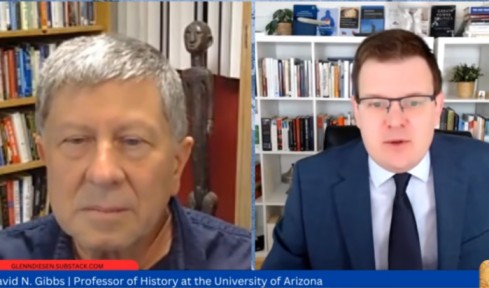
Editor’s Notes: In this episode, Glenn Diesen interviews David Gibbs, a professor of history at the University of Arizona, to explore whether the current global energy crisis mirrors the catastrophic 1973 oil shock. The discussion delves into the historical role of the U.S. in encouraging past price hikes to build up the Shah of Iran’s military, contrasting those strategic motives with today’s adversarial climate. They also examine how the modern financial system’s fragility and high debt levels could make a contemporary crisis even more devastating for Western economies than in the 1970s. Ultimately, the conversation highlights the shifting geopolitical landscape as the U.S. dollar face challenges and the world transitions toward a multipolar order. (Mar 29, 2026)
TRANSCRIPT:
Introduction
GLENN DIESEN: Welcome back. We are joined today by David Gibbs, professor of History at the University of Arizona. So thank you for coming back on the program.
DAVID GIBBS: Thanks for having me, Glenn.
GLENN DIESEN: So you focus a lot on the geopolitics and the economics of it and I was hoping you could shed some light in terms of the comparisons of where we are now. If we’ve seen anything similar in the past, that is, the scale of this energy crisis in the world, it’s well deeply disturbing and to some extent unprecedented. Yet we had a crisis back in 1973, of course, with this oil shock and I was wondering if this gives us some context about also the possible socioeconomic as well as the political consequences of what we’re seeing today.
The 1973 Oil Crisis and Its Long-Term Economic Impact
DAVID GIBBS: Well, yes, that’s right. There is a very close parallel actually between what is happening now or what happened over half a century ago beginning in 1973, which is an oil crisis, an energy crisis emanating from the Persian Gulf. And Iran was deeply involved in both, and that was in the current one as well as in the past one.
Before I go into the details, I will note that the energy crisis that resulted from the events of 73 triggered — was the main trigger to — a major recession that was the worst economic downturn up to that point in time since the 1930s. It also resulted in a decades-long malaise economically of basically flat rates of productivity growth in the United States and greatly reduced performance in most of the rest of the world.
And so in some respects, actually, if you look at long-term rates of GDP growth, it was quite high up until 1973. Then 1973 you see a big drop and rates of economic performance have never fully recovered from the early period. So this is something of a historic breakpoint and it’s very unsettling when you think about the fact that something very similar is happening right now before our eyes. Before I go on to the details, do you want to ask any more questions before I launch into the historical background?
GLENN DIESEN: No, no, it’s the historical background which would be fascinating because I kept thinking that we haven’t seen anything like this. That is first, yeah, Russia was taken off the grid to some extent with all these economic sanctions. Well, but no, not completely. In Europe, for example, we still buy the gas just through an Indian mediator, for example, at a higher price. Yeah, of course they want their markup. Sorry, the oil as well.
But now with this shutdown of the Middle East and given that it’s not even as temporary, it seems to be more prolonged. I’m not sure how long it would take to fix these things. But even a political settlement after this war, it doesn’t seem like Iran is prepared to go back to the way things were — they’re looking for a massive disruption to the former status quo.
And indeed, in the wider context of what we’re seeing in the world, that is that the unipolar world has ended. Now you have a multipolar world, which you can say, yes, it will be more balanced, but it’s also less organized, it would seem, if you have more actors. So no, again, the historical background would be great.
Two Phases of the 1973 Oil Crisis
DAVID GIBBS: Well, let me say that this is based upon research I’ve done on this topic in the National Archives, and that’s for a book I published last year on the topic.
What you had is a two-phase oil crisis. The first phase began with the October 1973 Arab-Israel War. Again, Israel is front and center in both events, the current one as well as the last one. And in 1973, Israel went to war — war was invaded first — and went to war with Syria and Egypt. And as a result of that war, the Arab world basically, or much of the Arab world, imposed an oil embargo using the OPEC oil cartel as an instrument to basically embargo the United States for its very close ties to Israel and its military support for Israel.
The first phase was led by Saudi Arabia, which on religious grounds objected to the whole idea of a Jewish state in the Middle East and the idea of Zionism. And it was ideological in character.
And then there was a second phase, though, after a few months. In terms of the so-called “moderate” Arab countries — or Muslim countries, I should say, not Arab — led by Iran, a close US ally, they realized that they could make a lot of money from oil price increases. Iran did not have any real interest in the Arab-Israel issue and had businesslike relations with Israel. They were a major supplier of oil to Israel, but they wanted to increase their revenues. The Shah had ambitious plans of building up a vast military apparatus, which he was rapidly doing, and to pay for it through oil revenues.
And so in the second phase you had continued oil price increases. I believe it was about 400% — oil prices increased 400% to the United States. The United States had much oil production internally. Europe and Japan were hit even harder; the Southern hemisphere, harder still. So it was a global event.
The United States’ Surprising Role in the Oil Price Increase
What I do want to emphasize is that what has come out more recently out of the Archives — it was not known before — is that the United States government, led by Richard Nixon and Henry Kissinger, encouraged this price increase. They did not oppose it, they encouraged it. They privately told the Shah of Iran, “You can raise oil prices as much as you like. The United States will not object to it.” And I’ll get into the reasons why in a moment.
But again, this is really very surprising because the oil shock devastated the US economy. As I said, it was extremely damaging to the US economy and the US was deeply complicit in it. You might say it was an act of self-destruction by the Nixon administration. The question of course is why.
But before I go into why, let me just note that after a few months there was a factional dispute within the Saudi elite, and another faction of the Saudi elite seemed to come to the fore and wanted to repair the damage they did with the United States and offered privately to work with the United States to lower oil prices. Amazingly, the United States refused to do this. They did not want low oil prices and they rebuffed the Saudis, to the astonishment of the Saudis.
We have letters from Ahmed Zaki Yamani, who was the Saudi Minister of Petroleum, who expressed astonishment that the United States was not interested in his offering, and that underscores the fact that the United States was committed to raising oil prices and damaging their own country, which is what they did. And now the question is why? I don’t want to keep going on and on. Do you want to interject anything at this point or ask any questions?
GLENN DIESEN: No, the why is quite interesting.
Why Did the US Encourage Higher Oil Prices?
DAVID GIBBS: Well, there are a number of reasons I think. One was that the United States had been building up the Shah’s Iran as the guardian of American and Western interests in the Gulf. The British had pulled out of the Gulf after 1967-68, I believe, and the United States was not able to basically insert military forces into the Gulf because of the Vietnam debacle. And so we relied upon the Shah to do it for us. And so building up this military was functional from that standpoint.
In addition, Nixon was very eager to increase American military sales to the benefit of American military exporters. We had been hurt very severely by the Vietnam War, which had tainted American weapons sales. We just lost a war, so nobody wanted to buy our weapons. But the Shah wanted to buy our weapons and that was seen as a good thing.
Furthermore, the Shah had been carefully building up support in the US political and economic elite for decades. The Iranian Embassy in Washington had gone around giving expensive gifts to hundreds of top-tier journalists in the United States as a kind of method of, if you will, buying them off, which produced fawning coverage of the Shah. The Shah employed the wife of a top senator on the Foreign Relations Committee as a publicist.
In addition to that, American companies benefited considerably. The major oil companies — five of which were American-owned, the Seven Sisters they were called; five of the Seven Sisters were American oil companies — they benefited from the increase of oil prices and increased their profits. The very powerful Rockefeller family was historically very friendly socially with the Pahlavi dynasty of Iran. And there was a whole series of business interests that benefited considerably from the economic boom going on in Iran thanks to high oil prices.
And so I think these considerations, both the strategic considerations as well as the, you might say, more grubby economic considerations, was what swayed Nixon and Kissinger. Kissinger, by the way, himself was very close to the Shah personally, but he was also a bit of an acolyte of the Rockefellers historically. So I think all of these kinds of connections was what drove US policy, even though by any reasonable standard this was a self-destructive policy Nixon was following. But whatever the cause of the policy, what we now know is the United States encouraged this oil price increase and the results were quite devastating.
Drawing Parallels to Today’s Energy Crisis
GLENN DIESEN: But if we draw a parallel to today, there’s no real “why” anymore. There’s no interest for the United States to drive this price up. Indeed, if the prices go up, we see the main countries benefiting would be Iran and Russia — these are the adversaries of the United States. And if this conflict continues, it could wipe away some of these Gulf nations which are, well, to some extent, if not assets, at least close allies of the United States, which is a partnership the US benefits from. So from this perspective, it’s not comparable given that it’s not in their interest today, I assume.
DAVID GIBBS: Yes, the motive is very different and I don’t see any evidence the United States encouraged the oil price increase. Quite the contrary. And you’re quite right, of course it goes against America’s interests at every level, including interests Trump himself would see as clear, which is that it undermines America’s global influence as well as undermines American living standards.
I think one of the lessons people are drawing — or should draw — from this war is that aligning with the United States does not enhance your security, it weakens your security. Just look at all the Gulf states: they allied with the United States, they aligned with bases, now they’re being attacked by Iran. That wouldn’t have happened if they hadn’t aligned with the United States.
The European countries would have to ask themselves, if they were smart, is it so wise to align with the United States when it’s cutting off all our sources of energy, first from Russia and now from the Persian Gulf? This American alliance has been a disaster for Europe, whether they realize it or not. We’re seeing a real irrationality on the part of the European elite, particularly in the Scandinavian countries, that is absolutely astounding.
Could the Effects Be Worse Than the 1970s?
But nevertheless, looked at through a rational standpoint, what we’re seeing here is that there’s no benefit whatsoever for the US or its allies from what’s happening in the Gulf. This has been a fortuitous occurrence — fortuitous at least in the sense that it wasn’t expected, at least by Donald Trump. He expected to win the war. He expected a short, easy, and glorious victory that would make him a great president, like Abraham Lincoln, I suppose — put him on Mount Rushmore — and that hasn’t happened. He miscalculated very badly here.
But the causes of the oil price increases are somewhat different from the 1970s. The effects could be somewhat similar in that this could be very devastating on the same scale as the 70s, or possibly worse. And the reason I say that is that in the 70s, the financial system was much more regulated than it is today. The possibility of a collapse of the financial system was reduced given the high level of regulation, at least in the United States. That’s not true anymore. The financial system is substantially deregulated.
Also, the level of debt is much higher, particularly the level of household debt. Personal debt by individual Americans is much higher. That means a higher level of vulnerability. And that does not bode well for the economic future in terms of the secondary effects of this oil price increase. So I’m very worried, and everyone else should be worrying about what’s going to happen next.
Financial Fragility and the Legacy of 1973
GLENN DIESEN: Well, the European irrationality, it’s not just losing access to Russian and Middle Eastern energy. It’s also deliberately reducing the tech cooperation with China. I mean, no one’s suggesting they should only do trade with economic, well, technological cooperation with the Americans. But if there was more than one partner, one would be in a more beneficial position.
Also in regards to the relationship with the Russians, a large reason why we’re in this conflict to begin with, it seems, was the decision to expand NATO, essentially go back to bloc politics. I think this was a price many were willing to pay. The alienating Russia, restarting the logic of the Cold War because NATO at least cemented America in Europe. And it’s good to have the Americans in Europe in terms of having the pacifier, of course, having the most powerful military as a close ally, these are all good things.
But now that the US is going away more and more, one has to ask, if we had just a cool-headed, non-emotional Kissinger type in Europe, he would say, “Well, the situation has changed now. Perhaps we don’t need to do the bloc politics anymore. We can find a way of ending the dividing lines in Europe and cooperating more with the Russians.” Indeed, Americans wouldn’t object to it either if this means Russia not leaning that heavily towards China.
But we don’t have the Kissinger type. We have very angry, emotional politicians who, as you suggested, don’t sound very rational at all.
But one thing that’s different from 73 though would be the alternatives it seems in energy markets. So we have the US shale production, we have diversification, for example, not just of suppliers but also the means of energy. So renewables, for example, where China is leading the way. Do you see this impacting either reducing the blow, or countries shifting faster, for example, into renewables?
DAVID GIBBS: Well, Thomas Friedman has made this point, and he’s no doubt right. The degree to which we’re energy dependent, or dependent on fossil fuels today, is less than it was in the 70s, due to precisely all the things — renewables as well as increased efficiency of use. This kind of thing, all of this has reduced our energy dependence. Moreover, we’re still highly dependent upon fossil fuels. Not as much as the 70s, but given our lower level of dependence, we could say that the blow will be softer in that respect.
But another aspect is much more vulnerable financially, because financially deregulated population and household debt. And so the latter, I fear, as a secondary effect of the energy crisis, could make the overall crisis much more severe. The economy became financialized in the United States and in Britain. Germany maybe is a separate case, but they retained — and it’s true, and that may change now. But the United States and Britain became financialized to a considerable degree.
The United States moved — this is something again I can discuss historically — with the role of the US Dollar. The United States moved from being an industrial civil power, what it was, say, in World War II. Charles de Gaulle referred to the extraordinary productive capacity of the United States. Beginning in the 70s, the US emerged as a financial superpower as it is today. And the downside of that is domestically we’re so dependent on finance that it could become a house of cards. And if you get a real shock, like an energy shock, it could produce a financial crisis as well.
And so it’s hard to say, are we more or less vulnerable than we were in the 70s? My guess is probably more so, given the financial fragility we’re in today, actually, in terms of how it’ll play out. We’ll see. It’s going to be bad no matter what. And the question is, how bad?
The Great Decoupling and the End of the Glorious Years
GLENN DIESEN: I often think when Trump has the slogan “Make America Great Again,” I keep thinking this would mean putting America back to 1973, actually, because this is when, after this oil shock, it appears that this is when things began to go a bit wrong. Indeed, you see this — what some refer to as the great decoupling — when companies kept making more profits, but the salaries were kept stagnant. You saw the debt levels getting out of control. All of these economic consequences — really, a lot of this began after the oil crisis of 73.
DAVID GIBBS: It’s absolutely right. If you look at some of the happy decades, the French refer to the “30 glorious years.” It was actually 23 glorious years from 1950 to 1973, if you look at the data. But that ended. The 30 glorious years ended in 1973 for the United States and Europe. And it was an era of, first of all, lowered economic performance — permanently lowered economic performance — but also much more concentration of wealth. In the United States, we’ve seen an extraordinary concentration of wealth and a stagnation of wages and living standards. Most Americans today live paycheck to paycheck. They have no reserves. It’s going to be interesting to see what happens if they have no reserves, if their income goes down because of inflation.
One more thing, of course, also is the historical response to inflation in the 70s was austerity — to increase unemployment as a means of controlling inflation and reducing living standards, basically as a means of controlling prices. That occurred in the United States, particularly towards the end of the decade, again with devastating consequences. It produced an even deeper recession by the late 70s, and much of that came from the oil prices.
And so we could be in for a massive bout of inflation. We’re already seeing it. You fill up your gas tank in the United States, and gas prices have already gone up by about a third. I suspect that’s just the beginning. Food prices go up because agriculture is very energy dependent. And so the next phase could be calls for austerity — having the central bank, the Federal Reserve, increase interest rates, increase unemployment, and lower living standards as a means of controlling inflation. That should get very exciting. People hate it when living standards are lowered, and for good reason.
Overall, I think what we’re seeing is how foreign policy is fraying the social fabric in the United States and also in Europe. You’ve had the cutoff of energy in Europe, or partial cutoff of energy in Europe from Russia — a dilemma of their own making, you might say. But it’s lowered living standards for sure, and to a limited extent in the United States as well.
Now we’re seeing a secondary cutoff, and also calls, of course, to increase military spending — in some cases dramatic increases. And this is going to really fray the social fabric. European leadership is going to pay for this with increased social turmoil and social problems in Europe, and the rise of far-right parties like the AfD in Germany, the Reform Party in Britain. These are rising rapidly, and that’s a consequence of decisions made by the European elites learning nothing from the past mistakes.
The Welfare State vs. the Warfare State
GLENN DIESEN: Yeah. An argument which I remember — I think it was made in the Financial Times, but then repeated among political elites in Europe in different forms — was that because of the war against Russia in Ukraine, Europe would have to abandon its welfare state in order to build the warfare state. So, just shift money to the military. But that money overall now seems to be disappearing. So whatever economic problem there was a month ago, this is going to get much, much worse. And as I said, as all of these things are going wrong, they’re also going to militarize.
So it just seems that it’s not just the economic aspect, but how will this impact society? Because suddenly we won’t have the welfare state. Essentially, the way the societies have been organized since the Second World War will have to come to an end. We’re going to see more militaristic language from leaders.
How does this play into, I guess, the change in society? I was going to ask you if our economies are more resilient today, but you kind of answered that already. Again, with the US $39 trillion now in the hole and Europe also doing extremely poorly, it doesn’t seem like we’re prepared. But again, if we go away from the economical issue, how does the economics of it impact the societal component, material societies apart?
DAVID GIBBS: Predictably, one of the most unhealthy things you can have is stress, especially financial stress. It’s not good for you physically or mentally. And you’re going to see a lot more of that in the United States and Europe with very negative results.
The United States is an interesting country in a way. It’s a very wealthy country. It has this unmatched military power — everyone knows that. But if you walk around in American cities, it’s a country that’s broken down and not functioning very well. You see immense social problems, massive homeless camps, including right in front of my house in Tucson. Infrastructure that’s totally broken down and doesn’t work. If you fly from Europe to the United States, you might very well land at JFK International Airport in New York. And that’s one of the most beat-up airports I’ve ever seen in my life. It’s completely dysfunctional. And most American airports are like that — train stations, subway stations, the roads don’t work. This is a country that simply doesn’t work anymore.
And there are a lot of reasons for that. But one of the reasons is overspending on the military. We’ve been favoring guns over butter now for decades, and it’s catching up with us.
And Europe is a much nicer place to live. My son relocated permanently to the Netherlands, partly for that reason. I visited there. I’m very impressed by the fact that the quality of life is visibly much higher. I haven’t been to Japan, but I understand in Japan it’s even better organized than it is in Europe.
And I guess I’m expressing astonishment that Europe somehow imagines it would like to become more like the United States. Well, good luck with that. If you want to become more like the United States, European leaders should go and walk around American cities and see what they look like these days. And they’re terrible. They want to become more like that? Well, they need to see a psychiatrist.
Energy as a Geopolitical Weapon
GLENN DIESEN: Yeah. So Hegseth made, one or two days ago, this comment that the problem with Iran was that they keep using their money on weaponry instead of spending it on their people. And I thought, what a wonderful thing to say, because that is part of the problem there. But I think you’re very correct, because in Europe this is the kind of thing the Europeans often point out and berate the Americans about — that is, why spend so much on the military instead of spending it on your society? But now it’s essentially going the other way. The Europeans will now emulate the American model, take away from societal spending.
I agree with you very much. I did one of my PhDs in the Netherlands — a great, calm society. I’m a big fan, at least.
But one thing we saw in 73 though was that all these oil-producing states were able to limit their supply of energy in the markets in order to achieve different geopolitical goals. How do you see oil and gas being used this time as a weapon? Because again, they’re not all on the same side. They might use it for a different reason.
But also we’re in a very different time now. It seems the whole world is trying to navigate away from the hegemonic system. Since World War II, the US has dominated all the main maritime transportation corridors, all the key straits, the technologies, the main industries — all this has slipped, of course, the last few years — the main development banks, the global currency. So across the board. But now, of course, there are a lot of countries trying to shift and diversify away from this, which means that there are a lot more geopolitical aims or geo-economic aims one can have for limiting energy supplies or limiting access to corridors, be it into the Red Sea or through the Strait of Hormuz.
So how do you see oil and gas being used as a political weapon this time around?
The Decline of American Hegemony and the Petrodollar System
DAVID GIBBS: Well, the large issue that everybody knows, it’s discussed many, many times in your show, is the issue of decline of American hegemony and the rise of a multipolar world, and other desperate efforts by the United States to prevent that, for both reasons of pride and grandeur. Also the fact that there’s a large network of interconnected interests led by the military industrial complex that benefit from it.
And so the US establishment, not just the governments but the larger establishment, is very committed and has been committed to preventing the collapse of US hegemony by using desperate measures. I think the first one, Washington, this was indeed by the United States. If you look at the diplomatic records, there’s really nothing about that. They look at it coldly and objectively.
And now basically there’s the effort by Donald Trump, who ironically wanted to break with this sort of idea of endless wars and so on. But in his second term, he’s furthering the idea of endless wars. Now with Iran, I see this as much more consistent with American presidents before, such as Joseph Biden, that was using, he sought to use it as a means of gaining further cementing US control of world oil, gaining, establishing the United States, or re-establishing the United States as the primary hegemon in the Persian Gulf, and thereby being able to gain leverage over China in the process of doing so.
And you know, this follows again, we see a clear thread here. Under Biden, we saw an effort basically to shatter Russia, also break it up into pieces, to cut Europe off of Russian energy, and thus to establish the United States as a pole of power. And that failed badly. And now we saw a similar effort to gain control of the Persian Gulf in war, and that’s going to fail even worse, even more dramatically.
And so I think what you have here is you had a gradual decline of US hegemony, and in trying to stop that decline, instead, it’s accelerated. The United States has put its foot on the accelerator, an accelerator of its own decline. And the end result unquestionably will be to increase the speed at which we’ll arrive at a multipolar world.
Iran, the Strait of Hormuz, and Regional Security
GLENN DIESEN: Yeah, well, I can see the objective of Trump there. He again, you break Iran, you restore the primacy of the region. But it appears now that it’s failing, and Iran will be in a position to not dictate necessarily the outcome, but have more influence than it did before this war.
You know, if I was advising the Iranian government, I would suggest, you know, perhaps you should limit the access to the Strait of Hormuz. You know, you can tax the countries who at least attacked you or contributed to it, as a form of reparation. You know, you could condition access to the Strait of Hormuz based on not hosting hostile or American military bases. There’s a lot you can do. You can ask them not to sell their oil in dollars if they want to pass through the Strait. I mean, there’s a lot of power you can have by controlling the Strait of Hormuz and conditioning the access.
It just seems to me, well, that’s, if I would advise the Iranians, if I advise the Russians, the Americans, I would suggest if they can’t win this war, then at least the second best thing would be to incentivize some kind of, or encourage some kind of a collective security institution in the region, that is that the Iranians could work with the Gulf states to manage it together, the strait, something that would reassure the Iranians that they wouldn’t be attacked again, but also make sure that the whole strait, then on the other hand, the Iranians will have to give something, and that would be the strait not being solely in their control. So it would not be used in a zero sum game against America and America’s allies.
But again, it’s a little bit like the problem in Europe. The language the politicians speak in is so emotional and heated. They’re fighting God’s war against the mullahs who want to destroy the world. It doesn’t seem there’s any climate to just have a relaxed discussion about where the Iranian security concerns are legitimate, where the Gulf states’, America’s interests lie, what area can we actually align our interests, and where do we have to manage the competition. There’s no discussion at all. Everything is all or nothing, which is not conducive to stability, of course.
DAVID GIBBS: I want to make a comment on that. I think we have seen a much more emotional tone during the post-cold war period. You always have emotional tones in foreign policy discussions. That’s not new. The post-cold war world has seen a much more emotional tone than during the Cold War. I know enough to remember very well that there was a little bit more of a detached analysis and a calm discussion more than today.
And I think one of the things that’s happened is, for some reason, the wars of the Balkans, particularly in Bosnia-Herzegovina, to a lesser extent in Kosovo, produced a tremendous kind of emotional, almost religious enthusiasm for intervention. That was very self-righteous. A tone of moral self-righteousness replaced any kind of real analysis. The whole idea is that if you engaged in dispassionate analysis, it showed you were a bad person, you were somehow engaging in an act of immorality. If you tried to use strategic empathy, say how is the other side looking at this, it showed what an immoral person you were and therefore you were to be disregarded.
That kind of language emerged in the 90s in response to the Balkans and it’s been with us ever since. And I think it very much infuses discussion, first I think in Europe, even more so than here. That’s mind-crushing in Europe, especially in Germany. It’s extraordinary. And I think that it infuses discussion about Russia and Ukraine and means we can’t do a proper analysis of why we have that conflict.
And it’s now infused in the discussion of what’s going on in Iran. I think that even though many people in the United States and Europe are uncomfortable with Trump and his very strange style of communication and erratic behavior, which is recognized by most people, I think there’s still a certain sense that Iran is run by such an evil regime, one that persecutes women, one that persecutes gays and so on, which it does by the way, but so much so that going to war with them is maybe a good thing, and overthrowing them would be a delightful outcome in the view of many, without any analysis of what would happen if they were overthrown, what a disaster that would be if they were overthrown. In all probability, you can’t ask that question because that shows you’re an immoral person.
And so I do think you have this kind of emotionalism that has taken over as a substitute for analysis. One more thing I do want to discuss, though, since we’re about halfway through the interview, is the role of the dollar and how the oil crisis of the 70s produced a new role for the dollar. Before I go into that, do you want to ask me anything?
The Petrodollar System: Origins and Significance
GLENN DIESEN: No, actually, that’s where I was going to go. Because on the Iranians closing the Strait of Hormuz, I assume that one of their objectives, when they’re pushing for sales in other currencies other than the dollar, I assume that this is an effort to not just remove the military presence of the United States, but to decouple the security interests of the US in the region. Because a lot of the reason why the Americans are in the region is because them providing security to the Gulf states has kind of been the condition for them selling the oil in dollars. So if you want to really divorce the US from the region, you can’t just bomb their bases or chase them out of Iraq, for example. Then you have to decouple the dollar as well. It seems that’s the thinking in Iran. Again, speculating. But I thought for that reason, I really wanted to ask you about the petrodollar system. That is the historical relationship between oil pricing and the US dollar after the Bretton Woods system collapsed.
DAVID GIBBS: Well, the context in the mid-70s was again profound US weakness. Weakness owing from, well, first of all, the economic weakness associated with the oil crisis, but also the impending defeat in Vietnam. The fact that the United States was clearly being defeated in Vietnam, was defeated in 1975 in Vietnam, and for a major power, losing a war is a big deal, is a humiliating event.
Associated with that, economically, was that in 1971, the United States, for the first time over a sustained period, emerged as a deficit country in its trade balance. The United States, traditionally a very strong exporter of industrial products and farm products, moved into deficit. It was importing more than it was exporting. And that’s a real problem because, well, first of all, you have to eventually balance your trade. But also the United States dollar was, since 1944, established as the world’s currency. And so the status of the dollar was seen as being under threat. There was open discussion, and again I saw this in the documents for the period, it was open discussion of maybe we would have to consider a new world order based on some global currency, not based on the dollar, given American economic weakness.
And that was avoided. That was avoided because the dollar is a source of power to the United States, in that because the US is unique in issuing the world’s currency, it controls the monetary policy of the whole world, not just the United States. And so the United States was very reluctant to part with this great privilege, the “exorbitant privilege,” as the French called it.
And so a deal was made, and it involved petrodollars. In 1974, US Treasury Secretary William Simon flew secretly to Jeddah, Saudi Arabia. This only came out recently, by the way, it was classified for a long time, and cut a deal with the Saudis. The deal was that the Saudi elite had enormous reserves from their greatly increased profits from oil exports and they were just sitting in banks earning interest. And so the deal was that Saudi Arabia would plow their surpluses into buying US treasury bonds as a way of financing the US debt. Furthermore, it would use its clout with the smaller Gulf states like Qatar, Kuwait, and the UAE to do the same thing. And they did that.
And because they were buying US treasury bonds, and again it wasn’t recognized at the time, but this was part of an explicit deal, it sent a signal to central banks and private bankers all over the world to pour their money into US treasury bonds, thus financing the US debt. And so this was a way of compensating for US economic weakness. And it also ensured that the United States moved from being an industrial power to being a financial power, that America was just seen as a safe haven for spare dollars that were now used basically to finance the debt.
And that basically gave a new lease on life to American economic hegemony. It meant the United States was able to finance hundreds of overseas bases that might have become non-viable otherwise. It meant the United States had this enormous instrument it could use to control other countries, including, by the way, to operationalize sanctions against countries, which is an enormous source of power, including against Iran, Venezuela, and Cuba, at enormous cost, by the way.
There was recently a study by the Lancet in Britain which found that an average 500,000 people a year died over the last 50 years because of US sanctions. And that was made possible by the dollar and by the new lease on life of the dollar given by the Saudis.
In exchange, by the way, what the Saudis got was US political protection. They got massive arms sales from the United States and cooperation with the United States, whereby their intelligence services would be able to intervene all over the Middle East and Africa in cooperation with the CIA. In exchange, also, they had to basically close their eyes and accept the fact that the United States was going to be allied with Israel and they would have to tolerate that fact, as they did. And so this was a deal, and it’s lasted basically ever since. And that’s a deal that now could very well be unraveling.
The Erosion of the Petrodollar and the Challenge to US Power
GLENN DIESEN: Yeah, well, as we began saying, the debt today is very different than it was in 1973. Again, $39 trillion. I remember back in 2008, when the global financial crisis began, I think it was about $9 trillion. Now it’s $39 trillion. So the problem is now that the debt is unsustainable and, as you said, it’s also being weaponized. Well, the dollar is being weaponized through sanctions. It creates a big demand for alternatives, especially for big powers like China and Russia, because by holding a lot of dollars, they also allow themselves effectively to be taxed by the United States, because if they print new money, the United States government has more money, but the holdings of China and Russia are worth less. So it’s a way of taxing countries, taxing their own adversaries to contain them.
So it seems to be a very strong incentive to move away from the dollar, or at least have alternatives. So given that there’s now this challenge to the, well, possible challenge to the petrodollar system, at least that could happen as one of the scenarios or the possible outcomes of the war against Iran, how important do you think this is to American power? And what would happen if the war in Iran would then intensify the erosion of the US dollar?
De-Dollarization and the Decline of American Hegemony
DAVID GIBBS: Well, it should be noted that the economic benefits of this have been greatly overstated. I just heard Jeffrey Sachs, basically, who’s an economist, of course, basically say that the economic benefits to the United States are, as I said, overstated. And I think there’s a strong tendency in the economic profession in general to agree with this. And you can see it basically that it doesn’t really contribute that much to American prosperity.
On the contrary, you could say America would be better off devaluing the dollar, having a weaker dollar to encourage exports and to re-industrialize. The benefit is strategic, okay? It’s strategic in that it’s a weapon the United States can use against other countries, an instrument to enhance American power. For example, the fact basically we’re able to punish Iran over decades for not being a vassal of the United States was made possible because of the dollar.
We tried that with Russia. I guess they were just a bit too big and powerful for that to work. But we thought it would work with Russia. We thought we could destroy them with economic sanctions thanks to the dollar. And so there’s that. But again, it’s not clear that this is a great benefit to the American public in terms of economic prosperity. I don’t think it produces prosperity at all.
It is good for the financial sector, by the way. The financial sector benefits from it in that it pumps lots of dollars into the US economy and the financial sector can, shall we say, play with, and helps to supercharge finance. But again, that’s not really in the interest of the American public more broadly, because financialization has been a major driver of deindustrialization in the United States. The needing of high paying union jobs, for example, has gone hand in hand with financialization. So I’m not sure any of this is really beneficial to the American public. But again, we’re sacrificing prosperity and high living standards for international grandeur and power, which is what we’ve been doing since 1945, you might say.
But we are seeing it unravel. As we’ve noted, countries are starting to recognize that this is an intolerable system. Countries such as China and Russia are powerful enough to resist it. I’m sure China is rapidly diversifying out of US dollar denominated assets because they don’t want to be vulnerable to sanctions or US control. I’m not seeing a lot of evidence that China is trying to establish the yuan or renminbi as a global currency to replace the dollar. I think what you’re seeing much more are sort of bilateral relationships where countries essentially are trading with each other almost in the form of barter, using localized currencies.
As far as I can tell, I’m not seeing a global replacement for the dollar anytime soon. At least if there’s any tendency in that direction, I haven’t seen it. Perhaps we could ask Jeffrey Sachs that question. He could probably give you a more informed answer. But nevertheless, what you are seeing is de-dollarization. I think it is inevitably going to be one of the main results of America’s recent foreign adventures, which first began in Ukraine and Russia and now in the Persian Gulf.
The Dollar’s Role and the Iran Question
GLENN DIESEN: I think you’re right though. And often I think the challenges to the dollar in terms of rivals being set up, it’s a threat which is, or maybe not a threat, but it’s a challenge, which is often overstated. Because for China, I think they would agree with you that holding the world reserve currency would come at a significant price, that is in terms of their economic development. So they seem to be, well, reluctant essentially to take on that role.
So I think rather than China taking over the dollar’s status as a reserve currency, I think it’s more likely to see more simply trade, maybe more national currencies or something tied up to gold, I’m not sure. But either way, it doesn’t seem like having the dollar as a reserve currency has only benefits. But as a last question though, how do you see the current tensions now with Iran? To what extent do you link this or have this impacting the oil and currency system we have today?
DAVID GIBBS: I’m sorry, can you rephrase the question, my friend?
GLENN DIESEN: The oil and the currency system we have today, to what extent do you think this would be impacted by the war we’re seeing now in Iran? Or is this merely threats you think, or consequences? Or do you think there’s a greater push, a wider strategy there?
DAVID GIBBS: Well, Iran has every incentive not only for them to move away from any kind of dollar denominated trade, but to force other countries to do so as well. And to the extent that they now have significant control over what passes through the straits, they’re in a position to do that. And so I’m assuming, given their control of the Strait of Hormuz, they’re going to force countries not to basically trade in dollars as much as possible. And China of course is going to back them, Russia is going to back them, not only militarily but also they’re going to encourage de-dollarization because they have an incentive to do that.
So I think there’s every reason to think, again, what we’ve had here is a broad tendency away from American hegemony, financially, now being accelerated by desperate moves to preserve American hegemony, first again by Biden, now by Trump.
Trump’s Contradictions and the Neoconservative Playbook
GLENN DIESEN: This is such an ironic consequence of the Trump administration, because one of the reasons I was optimistic about Trump is because in this very turbulent time, I thought he would be a signal that he was capable of transitioning into a more multipolar system, which would be beneficial for the US as well. That is, instead of holding on to the global hegemon, which would continue to exhaust the US of its resources, going further into debt and see the rest of the international system collectively balance it, he seemed to argue through the new security strategy, suggesting that if we just pull a bit back to the Western hemisphere, focus on China, and if we pull back, don’t pursue global primacy, then the other great powers will begin to balance each other. We can regain our strength, it would be good for the United States to recover. The rest of the world would be more under balance of power, and it could have been ideal.
So to see this war against Iran now, which will then, for all the mistakes of Biden, this just puts it on further steroids. It’s quite remarkable to see. I don’t understand it, to be honest. According to how he communicated, essentially what the grand strategy for the US should be moving forward, compared to what he’s actually doing, it’s very hard to make sense of. I was wondering if you have any final thoughts on this before we wrap up?
DAVID GIBBS: I do have some thoughts on that. I think basically what I’m seeing in Trump is there’s a very big difference between Trump’s first term and this second term. In the first term, he did a lot of very destructive things, including tearing up the agreement that had been worked out between the United States and Iran with regard to nuclear enrichment. And he assassinated an Iranian general, General Soleimani. He did all sorts of varieties of destabilizing things around the world. One thing he did not do was start a new war. And I would say he’s the first American president in his first term since 1945 who did not start any new wars. Every single American president other than first-term Trump did, but he did not. And so in that sense, he was indeed a less aggressive, less militarily aggressive, less militaristic American president than any we’ve had before.
And let me go into it. There’s a larger issue there, which I’ll go into in a moment. But obviously, in his second term, he’s showing an opposite tendency, following very much a neoconservative playbook that he previously had disparaged. He’s following very much the positions of Secretary of State Marco Rubio, so it would seem, who was very neoconservative in his orientation. And he’s becoming extremely aggressive and showing a level of aggression comparable to his predecessors, including Biden. That’s really remarkable, and a very kind of bloodthirsty language that’s disturbing to hear, quite honestly. That goes beyond anything he said in his first term.
And the question is, why did he change? And that’s a difficult question to answer because you have to read his mind. The best I can make out of it is Trump and his megalomania — and he certainly has a certain extraordinarily narcissistic tendency — is that he not only wanted to be a two-term president, he wanted to be a truly great president. And he comes from the viewpoint that a great president is one who wins wars. And obviously he’s not going to win this war, but he assumed he would. And I assume that that’s the main motive here is to leave a legacy of greatness. And so this is the ticket to that legacy.
Let me add there’s a larger issue of sort of this popular base. One of the reasons Trump was elected — there are many reasons he was elected — but one of them is it was indeed a popular desire for an end to American expansion overseas. The phrase “America First” means a lot of things. One of the things it means, I think, for many people, is more emphasis on butter and less on guns, and an end to constant overseas wars and overseas adventures.
I can give a little bit of personal insight into this because teaching in Southern Arizona, where there is a very heavy military presence, I’ve over the years and decades had many military personnel in my classes. And I do recall after the war on terror, I noticed a distinctive tone of bitterness among men and women who came back from those wars, and a certain sense they’d been lied to and mistreated by the system, and they were very resentful of the whole idea of constant addiction to war as something that really has to stop. And I think one of the appeals of Trump is that he seemed to channel that resentment.
And so I think what you’re going to get here is a lot of political turmoil in the United States as Trump’s coalition breaks apart. And it’s already breaking apart. We’ve seen Tucker Carlson, the famous conservative pundit, very strongly criticize the war. You’ve seen many others. And so I think as the war increasingly goes badly and as Americans start to die in larger numbers, if Trump has marched ground forces in, as he’s about to do, I think you’re going to get a lot of political turmoil with very uncertain results.
The Democrats, of course, also are committed to precisely this kind of policy, at least in general. Many of them supported the war, I’m sure. And their opposition to Trump, I think, is largely just partisan — it’s Trump doing it, but not the war itself that they really object to. Now, again, how this is going to play out as the public tires of these policies is going to be very hard to observe.
Hubris, Overreach, and the Lessons of Empire
GLENN DIESEN: Yeah, I think, well, the Europeans now, they appear to be very critical of the war, but I think that’s not a moral stance. It’s just they were more optimistic when they saw the war going well. That’s my theory, at least. If Trump would have asked them to join in the first day or two, then they would have joined, but he asked them too late when things were falling apart, and then asking them to essentially carry the burden. And I heard that’s part of the concern from the Gulf states as well. If they join in fully on this war as well, that could actually give Trump the opportunity to actually step back and say, “Well, this is a conflict between the Sunnis and the Shiites. It’s been here for a thousand years, nothing to do with me,” and dump it over to them, like he outsourced the Ukraine war to the Europeans.
But overall, I suspect you’re right about his motivations. I think success probably has a price. That was the main lesson for me. I think after the Cold War, that is, once one comes out of the Cold War victorious, the Soviet Union collapses, and then this hubris, if you think you can absorb all costs, it lets you do silly things. I heard, for example, when Biden made some interviews saying we can confront Russia, China, Iran at the same time, we’re the greatest power there ever was. I mean, when you start to talk like this, you know that success has a cost.
And anyways, the point I was getting to, I think the Trump success in Venezuela, I think that got to his head as well. If you just show extreme force and confidence, then your adversary will kneel before you. And then, of course, he goes to Iran, which the comparison made no sense at all. There’s no flying into Tehran and kidnapping anyone, or even murdering a president, and the country falls at your feet. I mean, it was a crazy thing to believe, but I think hubris, probably.
I remember Putin made a speech once where he made that point as well, that once you’re an empire, if you think you can take on everything, you can absorb any cost. After a while, speaking from his own experience in the Soviet empire, the costs keep building and building until, finally, that final straw which breaks the camel’s back. But that could be it. But again, I don’t have a window into Trump’s head either, so it’s hard to say.
Anyways, thank you very much for taking the time. I thought that comparison with 1973 was quite informative and interesting. So thank you very much.
DAVID GIBBS: Thank you.
Related Posts
- Transcript: World’s First AI Actress Interview on Piers Morgan Show: ft. Tom Conti, Tom Bilyeu & Prof Jiang
- In Vivo Podcast: w/ Cathy Tie and Prof. Jiang on Editing Embryos (Transcript)
- Transcript of Evy Poumpouras Interview: Read People, Spot Lies & More – FO563 Raj Shamani
- DOAC AI Emergency Debate: ft. Ed Zitron, Andrew McAfee, Nate Soares & Roman Yampolskiy (Transcript)
- Transcript of Norman Finkelstein Interview: Tucker Carlson Show