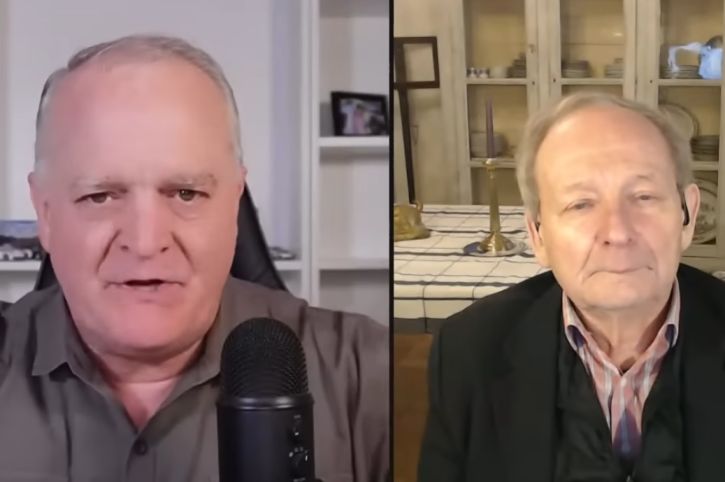
Editor’s Notes: Former British diplomat and MI6 officer Alastair Crooke joins Daniel Davis for a critical analysis of the intensifying geopolitical conflict between the U.S., Israel, and Iran. The conversation examines Iran’s strategic leverage over the Strait of Hormuz and its broader objective to dismantle Western regional dominance through a fundamental shift in the Middle Eastern power structure. Crooke warns of a potential global economic catastrophe and highlights the severe military risks associated with a U.S. ground intervention in the region’s unforgiving terrain. This deep dive provides a sobering look at the tactical realities of modern asymmetrical warfare and its long-term implications for international security. (Mar 27, 2026)
TRANSCRIPT:
Introduction
DANIEL DAVIS: As President Trump has moved the goalposts yet again on this alleged ultimatum. First it was 48 hours, and then it was five days, and now it’s 10 days. And we’re still trying to figure out where all this is going. There’s still lots of talk about going in on the ground, something possibly even as soon as this weekend. And yet at the same time, we seem to be still trying to find a diplomatic way out.
But now then, we’re listening to some things coming out of Iran itself from their version of what they think is going to happen diplomatically or not. And we’re going to try and divine just exactly where is all this going. And we couldn’t have anybody better on to talk to it about today than Alastair Crooke, who’s a former British diplomat and MI6 officer with decades of experience in the Middle East and European security affairs. He also served as a senior advisor to the European Union, and he is founder of the Conflicts Forum, which you can find on Substack and which we will be referring to in this show here. Alastair, welcome back to the show. As always, a pleasure to have you.
ALASTAIR CROOKE: Well, thank you for having me back.
The Absence of Regional Understanding in Washington
DANIEL DAVIS: It’s always a delight for us to have you on because you have such insights based in decades of experience and understanding that very few have actually. And one of the real shortfalls of the current U.S. Administration is the near absence of any kind of depth of understanding of the region. I actually just had a conversation this morning with somebody with direct ties to the administration. That was one of the things that they pointed out to me was the frustration that there are so few on the inside that have an understanding beyond basically an inch deep to understanding how ramifications work and what other people in the region may be thinking. And I just wonder if you see that as a problem in trying to figure out how to navigate this war that we’re fighting.
ALASTAIR CROOKE: Oh, I think it’s a lot worse than that. There is a complete breach with reality, a complete diversion from reality. I listened to a bit of the public part of the cabinet meeting that Trump was chairing a day or so ago, and it seemed — I mean, it was talking from another planet as far as I was concerned. It sounded more like a sort of discussion going on in an asylum. Nothing connected to reality at all.
Iran’s Position: The Foreign Minister Speaks
DANIEL DAVIS: Let’s take a look at what that may mean and let’s look at some specifics about how that is not connected to reality. Here’s what they are saying — but actually I want to start off today with what the Iranian side is saying, because they haven’t said too many things specifically after this 48-hour, then the five-day ultimatum and now this change here. But Foreign Minister Abbas Araghchi did make some pretty extensive comments just today. And so I want to put this here because here’s how he views the entry level position of the Iranian side and how they’re going to deal with the United States.
ALASTAIR CROOKE: “Iran stands today amid the throats of an illegal war imposed by two bullying nuclear armed regimes, the United States and Israel. This war of aggression is blatantly unjustified and brutal. They initiated this aggression on 28 February while Iran and the United States were engaged in a diplomatic process to resolve Americans alleged concerns over Iran’s nuclear program. They betrayed diplomacy for a second time in the course of nine months.”
Two Irreconcilable Positions
DANIEL DAVIS: One of the things President Trump said in his cabinet meeting yesterday was, “Hey, there’s a deal on the table. They’re begging us for a deal, but they have to meet our conditions or we’re not going to go.” So how do you square those two very different interpretations?
ALASTAIR CROOKE: Well, you can’t, because they don’t gel at all. On the one hand, Trump is saying there are negotiations taking place — that is simply not true. There are no direct or indirect negotiations taking place with Iranians, from the government, none at all.
And on the other hand, there is no publicity, no recognition. But a few days ago, the Supreme Leader — the new Supreme Leader, the son of, if you like, the last, the assassinated Supreme Leader — he gave a 12-minute recording. The first part was about Nowruz and was standard. And then he changed tack and it was a very tough line.
He said, “Okay, you’ve given us your positions. These are our positions. Our position is you have to get out of the Gulf altogether. You have to exit all of your bases in the area. You have to give us reparations for the damage that you have done. And also we are going to enforce a new legal regime over Hormuz.”
So it was a very strong and tough set of three propositions that he made. And he said, “Here are mine. What is your response to that?”
So we have two quite opposite assertions of the conditions for any change.
Iran’s Broader Strategic Objectives
ALASTAIR CROOKE: And why is there such a gulf between the two? It is because we are not looking at what Iran is doing in the way the West is thinking. Iran is not looking for another compromise. It did all this at Geneva and in Oman — a simple JCPOA-type compromise on where uranium facilities would be closed, what would happen to their missiles. No, they’re not looking at this.
They are looking at a complete paradigmatic change in the Gulf region. A change which would see America out, would see the Gulf states being compelled to deal with Iran, who will be the only state that can provide security and safe passage through the Hormuz. And it will also bring about an end to the petrodollar, because they are insisting that any cargoes that pass through Hormuz must be paid for in yuan, not in the dollar.
And they want the Gulf states to give up also their connections with the United States dollar. Investments like Microsoft and Amazon — they’ve mentioned those — must go. It’s got to be de-dollarized. The Gulf is de-dollarized. That means the end of the petrodollar essentially. It means the end of US dollar hegemony.
These are very audacious objectives that Iran is setting. And of course the proof of the pudding is if they can achieve all these. But they have a lot in their hand. They have all the cards to play — not trump cards, they have the cards to play — because first of all, they control Hormuz.
The Strategic Importance of the Strait of Hormuz
ALASTAIR CROOKE: We can talk about whether there will be a military operation to remove that control. But they control Hormuz. And what is important is it’s not just the oil. 20% of the global oil passes through Hormuz. But other things come through Hormuz — important things. Sulfuric acid, helium, all of these key elements are vital commodities and components in the West.
And the experts say very clearly that if this is shut for another three weeks — almost shut for another three weeks — it will be a catastrophe for the Western economy. Not just the oil and the price of the oil, because Iran will be controlling the price by setting the volume. If it increases the volume or reduces it, no longer will the United States be controlling the price of oil, but Iran will be controlling the price of oil and will be controlling the amount of energy going through this and through the Red Sea. They’ve said they will combine the two of them.
And also these vital commodities — you can’t extract various elements without sulfuric acid. Helium is important, also fertilizer is vital to our food production. Three weeks of it closed, then that is going to make a catastrophe for our economies. And this will not be resolved in the short term — it will take a long time for these things to come back to normal. Even if it were open in a couple of weeks or three weeks and Iran was no longer imposing its regulation on the Hormuz, it would still cause huge damage to the West.
I don’t think it’s realized how bad the damage could be to the West, and particularly to certain Asian countries that are allies of the United States, like Japan and South Korea, and others — Malaysia and so on. And at the moment, Iran is giving them passage through, providing they certify that they are inspected and they can show that their cargoes are bought in yuan.
Japan is now negotiating. Pakistan and India have had cargoes going through. Of course, the story about 10 tankers that were presented to Trump is just a confabulation. There were never tankers. The Iranians have refused to respond, as far as I know, to the 15 points that were put to them by Kushner. They refused to respond to them at all. So they’re denying that. I imagine they are just not prepared to respond to them. They probably refuse to accept those.
Iran’s Near-Term Leverage and the Strait’s New Reality
DANIEL DAVIS: Well, especially if what you just said — if any version of that is accurate — they wouldn’t agree to any of them anyway. So there’s no point in even talking about those. And I think that the timeframe here is really important. This potential for three weeks — definitely the Iranians are aware of that. So it’s not like, in my view — and I’d like your answer to this — that they kept thinking, “All right, we have to hang on for a year and we have to survive,” because they have some near-term leverage points that maybe the White House isn’t even paying attention to.
And to your point here, this is some information here that the Strait of Hormuz situation, quote, “will not return to the way of the past,” which it seems is a big marker that they’re putting down here. And their Zulfaqar — if I’m saying his name right — spokesman for the IRGC said, “The situation in the strait will not return to the past. Negotiations are not,” the spokesman said, adding that “permission for transit will be determined by us.”
So it looks to me like they are just absolutely saying everything you just did — that they are putting it into effect now. And we have got to either find some way to force it open with military means or to find some sort of negotiation. But tell me what you think the terms to negotiate that opening are going to be — pretty high for us.
Why Iran Won’t Negotiate: The Strategic Calculus
ALASTAIR CROOKE: Well, I don’t think they’re even politically possible for the United States because they are wanting the withdrawal of the United States. Because the GCC — I mean this was the motor of financialization in the West. This was the instrument, the petrodollar and the GCC, which are the main petrodollar savers and passing it on and buying US Treasuries. If they are stopped from doing that, it’s a huge change in the whole structure of the region and a change that will mean that ultimately the GCC states will probably face a difficult decision.
Either they are going to have to come to terms with Iran or they will not be able to export their petrol or any of the other products through Hormuz or be able to import food. For example, UAE has about 10 days supply of food and that food comes through Hormuz. So it’s going to turn the tables on the whole of this area as planned by Iran.
So why would they negotiate? What is the point? Three weeks. They will of course be able to control the Hormuz for the next three weeks or maybe longer. The damage will have already been done by them in our supply lines, in Western supply lines, in Western commodities. Many things won’t be able to be produced without helium. Many things won’t be able to be extracted without sulfuric acid. This is going to change dramatically.
If you like the color and the idea — we’re going back to what it was, just to be clear, before the 70s when America changed the whole formula. But before that, Iran was a major power in the region, a major regional power, a major civilizational power, a major Islamic power. And in the 70s, effectively the United States decided that it wanted to make the emirs and the monarchs, the Sunni emirs and monarchs of the region, their proxies and put them in opposition to Iran. And of course, together with Israel, Israel has also used this to contain, weaken and undermine Iran.
And now Iran, which has been planning this since 2003, is unfolding their plan for a return of Persia to prominence in the region.
The Cheney-Bandar Plan and the Roots of Sunni-Shia Rivalry
After all these years, since the revolution and since Dick Cheney — if you like, it was Dick Cheney in 2006 after the war in Lebanon — he was complaining bitterly. Cheney said, “Look, what’s happened? The war in Lebanon” — this was the war between Israel and Hezbollah in Lebanon — “they seem to have won it. And we thought the Iraq war was going to weaken Iran, and we thought this was going to weaken Iran.”
And he had with him in this meeting Prince Bandar, who was then the head of Saudi intelligence. And Bandar said, “Listen, we can sort this out. The king says, and the king knows, the weakest point for Iran is Syria. We can cut Syria. And then apart from actually a collapse in Iran, cutting off Syria and its lifeline to Hezbollah is the next best thing we can do.”
And Cheney initially said, “Oh no, how would you do this? It’s too difficult.” And Bandar said, “Islamists. Islamists will do it. We can do that. And don’t worry, you don’t have to be involved.”
And that was an attempt to try and create, if you like, a Sunni primacy across the whole region in antagonism and in hostility to Iran, the former power that had been very much an influence in the region until that point. And so now we are seeing the move to shift it back to what it was — Iran emerging as a dominant power, and the states, the monarchs, the emirs of the region, of the GCC, taking a subordinate place in the new paradigm.
Iran’s Plan Now in Motion
DANIEL DAVIS: So now we have to see where do we go from here, because you kind of alluded to this at the beginning. That may be the Iranian plan. They may want to return that. They may have had this for decades as an idea. And now, perversely, only because President Trump opened the door with this war of choice to actually allow them to put it into operation. Now it is going in there — their IRGC spokesman said basically they’re implementing it now, that only we will determine who goes through the Gulf.
But that implies that they can. Now there is a lot of traffic rolling around. I’ve got some sources from a couple of different places that imply that we may be about to do something on the ground to try and shake this up, to take away the Iranian capability. The missiles apparently are going to continue to rain. So the question is, if we go in on the ground somewhere in addition to what we’ve been doing in the air, is that going to compel Iran? Force them to open up the strait on our terms, not on theirs?
The Military Folly of a Ground Operation at Hormuz
ALASTAIR CROOKE: I think it’s likely to be a catastrophe for the United States. The geography of Hormuz is most unforgiving. This has been something that has been fought over since the 1500s. The Portuguese established forts all along the Hormuz to control it at that time. And then eventually it was taken away from the Portuguese and ended up with the British for a while. But the Hormuz is terrible terrain all along.
First of all, the length of the Hormuz — the border, the area of Iran extends for 2,000 kilometers. That’s the extent of, if you like, their facing onto the Hormuz waterway. And it’s cliffs, it’s mountains behind and cliffs at the front. So all along those cliffs it’s honeycombed with anti-ship missiles. In the mountains you get air fire control. If you look at the actual peninsula, you can see that anyone trying to go there — because Iran has 270-degree fire control, not from missiles or anything, but simply from the mountains behind. That’s where their artillery is. It’s close enough to control it by artillery.
But of course they have many other things. They have high-speed submersible drones, they have speedboat surface drones, they have manned drones. And they have something else which has not been put into the consideration — they have about 25 or so mini submarines. And the mini submarines, unlike bigger submarines, can actually operate inside Hormuz. It’s not a large, deep seaway, but the mini submarines can operate in it.
So where are these troops going to stage? How are they going to be split? How are they going to get there? I mean, I heard Hegseth talking about helicopters — Apache helicopters and Osprey aircraft. For goodness sake, that part of Iran is watched with manpads that would bring down an Osprey or an Apache aircraft. I know — I was sort of responsible in Afghanistan, and we brought down Russian helicopters, and other things were brought down by manpads.
It’s very easy terrain for Iran to defend because they have bare rugged mountains behind cliffs. There’s no land. I think there are about three little beaches along that area. And 2,000 kilometers — two and a half thousand Marines coming in, one Marine Expeditionary unit. That means one man per kilometer. And then the 82nd Brigade comes in. It’s light infantry. They don’t have heavy armor, they don’t have heavy weapons. They just have the food that they carry with them. How long does that last and where are you going to resupply it from?
The Wider Regional Consequences of Escalation
And what is going to be the consequence? What is Iran going to do in response? Iran has made it clear — if there is an attempt to take the islands in Hormuz or to take Kharg Island, they will then attack the remaining elements of infrastructure in the Gulf States, especially those that have declared war on Iran, as UAE has just done. Their Ambassador Yousef Al Otaiba in Washington has written a statement saying that the UAE has now joined with the United States in a war on Iran. So it’s a belligerent in it.
And I don’t think that people are looking at the wider landscape of what’s happening. You can’t just look at it in terms of Hormuz and nothing else. Look further. Look what’s happened in Iraq. After the United States bombed some of the official army of Iraq, Prime Minister Sudani gave the militia, the PMU, the Hashd al-Shaabi, permission to join the war with Iran against the United States and against Israel. And they are mobilizing.
They have been mobilizing in Erbil. They’ve been attacking the Kurdish forces in Erbil and the American bases in Erbil, and they have been attacking that heavily, driving the Kurds into a trap with the Iranian forces on the other side of the border. And they are also massing on the border of Kuwait. They are enraged by the attack on the Supreme Leader.
Iraq is a majority Shia country, and many of the ayatollahs in Iraq have declared mandatory defensive jihad against the United States and against Israel. So the Iraqis are actually mobilizing and advancing — mobilizing at the border of Kuwait and at the borders of Syria elsewhere — and they’re ready to join this war.
If America decides to escalate it further, or if UAE escalates it further, then you will find that the whole topography of the war is then spreading. Turkey will then undoubtedly have a say in this, certainly in Syria. It will want to place its forces there in Syria.
Israel’s Mounting Losses and the Broader Collapse
And we are already seeing massive attacks by Hezbollah taking place against Israel. I don’t know if you’ve been following it, but they’re losing their Merkava tanks. In one day, 21 tanks destroyed by Hezbollah — 21 tanks. And of course the crews too. And then the day before it was eight tanks. They are suffering enormously. Hezbollah is attacking the whole of northern Israel. The settlers are very unhappy and they want to leave and abandon the townships in the north.
And in Israel itself we have Naftali Bennett — who is likely to be possibly the next prime minister — saying, “We’ve lost the war. We are losing this war. We have lost it in Iran. We are not achieving any of our objectives in Iran. We’ve lost it with Hamas and we’ve lost it with Hezbollah. We are losing the wars.”
And he was very clear. Because then the chief of defense staff called an emergency — it’s in the Hebrew papers today — and said, “Listen, I’m putting up 10 red flags. We don’t have the troops for this. We’re so short of troops. We can’t do all these wars at the same time.”
And in fact, it was also put out by RUSI — the Royal United Services Institute in London — that Israel has run out of missiles: its self-defense missiles, its standoff missiles. Sixteen days, and it has run out of these missiles. And so has America. And America has had to remove its one carrier. The other carrier is now far off the shore.
So we have to take the big picture of the war into account when we talk about troops landing in Iran, in the Hormuz. What would that mean? It would mean the war widens, becomes a regional war, perhaps even somewhat of a sectarian war. And America would be in the middle of this and it won’t find a friendly staging point in Iraq.
In fact, I think Iraq is intending to occupy Kuwait, and Iran — if there is an attack and UAE is a part of it — may decide to invade the UAE. We’re talking about something very different.
So that’s why I made these rather terse comments about the cabinet meeting where everyone was saying, “Oh, it’s wonderful, Iran is begging for a negotiation. They are failing. We’ve defeated their air force.” By the way, what Hegseth was saying is just untrue. They do not have air superiority over Hormuz. They just had an F-18 — or whatever it was — shot down over Bandar Abbas. The Iranians have been slowly showing their hand, not all at once. And now we see that they do have air defenses and that they’re quite efficient.
The Disconnect Between U.S. Claims and Reality on the Ground
DANIEL DAVIS: Let me go down that path because that is part of this, the curiousness of it. And for those who may have missed it, I want to show a bit of what Secretary Hegseth has said in that meeting. But I’m going to kind of set it up by looking here.
I mean, this is in the New York Times — you were talking about the Israeli admissions that was leaked — that apparently their conflict, that they can’t even continue to fight with the troops they have. And this is the precedence here: “We are already suffering and 13 of our military bases in the region are all but uninhabitable.”
So that’s the entry point. We have had both an F-35 and an F-18 shot down here recently when they have attempted to penetrate. Lots of MQ-9s, the drones that we have for reconnaissance, also have been shot down, at least 11 of them.
And yet with all of that, here’s what Pete Hegseth is doing — boasting about yesterday: A-10 Warthogs, if you know them, you love them, and Apache helicopter gunships are flying strike missions inside Iranian airspace and throughout the Strait of Hormuz. “At will. You only send these slow, low-flying close air support platforms when the enemy has no meaningful air defenses left. Their presence is proof that Iran’s air defenses are gone. Their command and control is shattered. Their top leaders hiding in underground bunkers while their mid-level commanders are being crushed in the field. The morale of their fighters plummeting.”
We see that disconnect daily. So talk about a disconnect daily. I mean, what he described there and what you described so beautifully in the foregoing section here are literally incompatible. They can’t be talking about the same place. And yet this is the guy that’s going to be in charge — with the orders and instructions of the guy sitting next to him — to potentially launch a ground operation to force the hand here. How do you see that unfolding?
A Catastrophe in the Making
ALASTAIR CROOKE: Well, as a catastrophe. That’s why I said a catastrophe, because there doesn’t seem to be any real understanding. I mean, at that level — of course there is in other parts of the Pentagon — but there is not an understanding at the level that there should be about what they’re facing.
To claim that they’ve got air superiority, air dominance, is just untrue. There is only some areas of, if you like, penetration. But all of the attacks on Iran — all of the attacks, vast amount of attacks — are by standoff weapons, standoff cruise missiles, JASSM missiles. And America is running out of those too, by the way. I think RUSI says that perhaps it can last for another 10 days, but then they’ll be exhausted, so they haven’t got even those.
So to suggest you can fly the Osprey, which is a very vulnerable aircraft, into hostile territory — I mean, the Iranian army, just to remind ourselves, and I know you’re aware of it, but this is not just a sort of little irregular group. It’s a million-man army. A million-man army. And that’s not the militia. The Basij is also another million. I mean, these are big forces to take on. And to take that on with two and a half thousand marines, I think, is asking for trouble. It should be a real concern to people in the leadership.
But the way that cabinet meeting was being held, and the discussions, and Witkoff coming in and saying, “Well, look, what we have to say to the Iranians — if they don’t take this opportunity, woe betide them. This is the last chance you’ve got. You’ve got to sit down and sign up to the 15 points.”
15 points. They’re not interested in those 15 points. They’ve done with all of this. Now we are in the decisive war for Iran. This is their existential war and they’re going to prolong it as far as necessary to meet their objectives.
Iran’s Economic Strategy and Missile Dominance
ALASTAIR CROOKE: And of course, part of this will be that they expect that Hormuz will be a major source of income for them. They talk about $800 billion a year from the fees that they will charge to vessels passing through Hormuz — all the vessels operating in it, don’t forget — and that they will get paid. In fact, they’re already getting paid. The Pakistanis, I believe, paid $2 million. Other ships are offering to pay. And all of this is circumventing new payment mechanisms that the Iranians have already put into place, meaning that they’re getting these payments circumventing the dollar siege, if you like, the financial siege. They’re going around the wall of the dollar sphere in order to take payments for the vessels passing through.
And they control — I mean, as I say — they can control Hormuz by artillery almost, let alone use their missiles. And their missiles, of course, will reach it. And we’ve seen them. Look at what we see now in this last week: a new missile coming out from Iran which they’ve been holding back. This is not Khorramshahr-4. This is the Fattah-2 hypersonic, flying at 18,000 miles an hour. And when it comes back into the atmosphere, it has a secondary rocket engine which then ignites as it re-enters the atmosphere and therefore makes it steerable. So it can do a sort of ballet dance around any remaining air defense missiles fired at it.
But what you see — and I mean this is incontrovertible — as he says, America has air superiority. Iran announced missile dominance over Israel because it was able to land two major missiles on Dimona Town, just adjacent to the Nuclear Research Center, and on Arad, causing huge damage. And Israel — I mean, Dimona is the most sensitive, the most highly guarded target in Israel — they were not able to put up any air defenses.
So the Iranians are saying, in contradistinction to what Hegseth said, “Actually, we have missile dominance. You don’t have air dominance. We have missile dominance over Israel.”
So these narratives don’t even touch at any single point. The one being presented — a cabinet of a desperate Iran, sending gifts to Trump of tankers and begging for the start of diplomacy — well, actually, they have the cards in their hand. They are winning this war.
Missiles Over Tel Aviv and the Human Cost of War
DANIEL DAVIS: And it’s interesting — while President Trump was saying during that meeting that they have air dominance, Trump at one point actually specifically said, “They only have a few missiles and drones left. It’s all but taken care of.” And we showed on our show yesterday that literally while he was talking, a Fox News on-the-ground reporter was telecasting live from Tel Aviv with the sirens sounding behind him and he was wearing his helmet. He said, “This is the 10th round of missiles fired against Tel Aviv on that day.” That was literally as he was talking, which obviously is physical evidence that what the President said was not exactly wired tight, shall we say.
But one other question I want to ask you — back on the not-really-diplomatic rail. I guess this is more on the human level. One of the very first shots in here was not just the assassination of the Supreme Leader, but also that missile that hit the school that killed, I think, 175 teachers and kids. And I’m going to show you what Abbas Araghchi said about that today. And I wonder if you can just kind of tell us what impact this could have on the willingness of the Iranian population to endure a lot of suffering. Watch this.
VIDEO CLIP BEGINS:
ABBAS ARAGHCHI: Among the most harrowing manifestations of this aggression was the calculated, phased assault on Shajarat Hayeba Elementary School in the city of Minab, where more than 175 students and teachers were slaughtered in cold blood. This barbaric attack is but the visible tip of a far bigger iceberg.
Mr. President, at a time when the American-Israeli aggressors, in their own assertions, possess the most advanced technologies and the highest precision military and data systems, no one can believe that the attack on this school was anything other than deliberate and intentional.
VIDEO CLIP ENDS:
DANIEL DAVIS: Now, it almost doesn’t matter what actually happened — whether it was an error in targeting, whether we used old maps, or whether it was deliberate. I certainly have no way of knowing any of those things here. We’d like to think that it was an accident, that we wouldn’t actually target kids. But it almost doesn’t matter what actually happened. What does matter a lot is how it’s viewed in Iran. And in the process of that speech there, that was one of the things he used to say that “we will never surrender and give in to any of these 15 points or anything else.” How can that kind of moral, mental, emotional narrative be used by the population in Iran to resist, even if we come in on the ground?
Iranian Resolve and the Rage Fueling Resistance
ALASTAIR CROOKE: They’re so angry about it. They’re really angry. And every night, people are going out into the streets to support the Islamic Republic and to chant against Israel and America for that attack. They are outraged by it, and they keep comparing it. And if you look at the Iranian press, you see lots of emojis about this and interviews with young girls on the street and others — not by Israeli Iranians, but by other journalists. And these girls say, “Well, we’re prepared to die too. We would like to be martyrs. All these people are martyrs.”
I mean, look at Larijani — not only did the Israelis kill him. The head of the Security Council, Ali Larijani, when he was killed after the Supreme Leader — he was at home and he was with his son. And he said to his son during this period, “Will you please go away from me? You must go away.” He obviously knew that, because he was prominent, Israel would try and kill him, which of course they did. And all his family died at the same time because they wouldn’t leave. They wanted to be with their father, even though he said, “Please go, keep away from me. I’m asking you in the interest of saving my family.” And they said no.
And when Israel destroyed it — to make sure they got him — they destroyed a whole block in Tehran, killing 50 people, quite nothing to do with Ali Larijani, just other residents. 50 people killed, many more injured. They wanted to kill him, so they just took down the whole block. It makes the Iranians really angry.
The Collapse of Diplomacy and Iran’s Refusal to Offer Trump a Way Out
ALASTAIR CROOKE: One of the things — I had this discussion with someone just today — and they said, “Well, in their experience, Iranians are very conscious of the need to save face of their adversaries as well. They insist they’re tough negotiators, but they also know that adversaries need to save face.”
And I said, I don’t think that’s going to be the case now, after these killings of good men. Like we’ve seen with the Supreme Leader and Ali Larijani, who is probably one of the most moderate people — closer, if anything, to some of the reformists — and the killing of the schoolgirls.
And what has happened now, because Israel and America have been unable to destroy the missile cities — which are buried 500 meters down in Yazd and others — they’ve been trying to bomb them, they’ve been firing missiles at them, but they have special concrete underneath. The whole thing is automated. The missiles come out on rail tracks, they fire off from an area, they’re impenetrable. And because they can’t hit their actual missile armories, increasingly — and you know what this is like with armies, I saw it in 2006 when I was in Lebanon — the Israeli army ran through their target bank in about a week. And so after that, well, they still have to go on bombing. So they bomb houses and schools and other things. We see it in Gaza.
The authorities in Iran say — and it’s from the Iranian authorities, you may not believe it, but I think it’s probably true — 20 hospitals have been targeted in this period. Many schools have been targeted. There’s been almost targeted bombing. I mean, these are standoff — they’re not necessarily airplanes coming in. They’re standoff cruise missiles and long-range missiles. Some of them are glide missiles coming in and bombing Tehran.
But the people come together and are angry and resentful. And I don’t think they’ve got any interest in saving the face of Mr. Trump or giving him a ladder out of his tree. Why should they want to give him a ladder out of the tree? He started this, he’s responsible, he’ll have to take the consequences — I think that is the attitude from Iran. So I don’t think there’s going to be a ladder provided for him.
The Iranians generally are very good at diplomacy, and there was diplomacy. Twice that diplomacy was punctuated by a surprise bombing by Trump. The one on the 13th of June — you remember, they were off. Kushner and Witkoff were engaged in talks the following Monday in Oman. And then there was a surprise decapitation strike by Israel that happened on the 13th. And then now they were talking, they were in talks in Geneva. And what happened then? There was, this time, an attack by the United States.
So I’m not sure that their generosity will extend to heeding the pleas from Witkoff and Kushner saying, “Well, we have to find a way for both sides to stand down from this. We need to find a compromise that can help Trump out of this trap that he’s in.” I think they’re saying, “Well, stuff that. We’re not prepared to help them.”
The Geopolitical Stakes: Iran, Energy, and the Western Order
DANIEL DAVIS: And you know, I’m showing here a relief map of Iran. And then this one of these, on X, was pointing out that the U.S. Military has not fought a corps size maneuver warfare against a regular army in 35 years, with Iraq in 1991, which I participated in, and I can tell you even that one was not a fair fight because the Iraqi army was not even close to being a peer.
It says they have not fought a corps size maneuver warfare against a peer enemy for 73 years, back into Korea. And then it says they are not going to survive invading the fortress of Iran. And it shows the mountains all along the western aspect, anywhere you would want to come in.
And yet here we have information that the United States already has around 10,000 ground troops in the area, which could be going into operation. As I said, I’ve been told by a number of different sources, even this weekend, and another 10,000 was put on alert yesterday, which implies that they’re already thinking that those may not survive or succeed. So they’re already thinking of ramping up.
But at the same time the Iranian side has been saying, “Bring it on. We actually want you to come in because that will complete your destruction here.” And given that terrain, is that empty bluster? Because I’m hearing — I’m a Texan — so I’m hearing “Remember the Alamo” kind of vibes as Foreign Minister Araghchi was talking about. Remember these 173 kids. Remember Ali Larijani and his family. Remember the Ayatollah and his family, the current Supreme Leader, his family, his wife, his child. All kinds of people have been killed.
It sounds to me like they’re saying there’s no price you can put on us that’s going to make us submit. How do you see it?
ALASTAIR CROOKE: I think you’ve hit the nail on the head. That’s exactly right. This is a culture which accepts sacrifice, which believes in fighting oppression. This is what Karbala, the battle of Karbala, was all about — fighting the oppressor in the name of justice. Even with inferior troops, they took on the forces of the Caliphate and were all destroyed. And that is what this is. Imam Hussein. And I’ve been to see his shrine in Karbala, and during the pilgrimage, 21 million come from across the whole region to pay their respects at his shrine.
The energy and the sort of radicalism — this was some years ago, before this present conflict — was huge. It was palpable. You could feel the energy of these people. They are Iranians, they are Shia, they are religious, and they are prepared to make sacrifices in the name of justice and of fighting oppression. And that is what they see this war as.
Whereas we see it as, “We’d like the control of oil, please,” or something like this. We want to control the oil, and we want to be able to control all of the waterways of oil so that we can squeeze China and we can squeeze Russia, because we have full control and domination of energy.
Well, Iran has just taken that away from the United States, because this is the key. These are the two key choke points, together with the Malacca Straits as the entrance to China. So China is already building up in that area, and there is going to be probably a war for the tankers. Already Europe has started to try and do that, saying they’re going to seize tankers on the seas that are taking illicit cargoes from Russia — as if Britain and France can decide what is illicit cargo of oil by Russia.
So we are in a bigger war. And of course, Russia and China are parties to this war in an indirect way. Look at Venezuela — naval blockade, seizure of vessels. What’s been happening to Russia in the Baltics, in the Mediterranean, attacks on their tankers, France seizing — I think the Danes have seized a tanker — and the Russians saying, “Well, we’ll have to have naval escorts for vessels.”
So this big attempt by the United States to crush BRICS essentially, by controlling energy and making China’s growth prospects vulnerable by squeezing its energy supplies and squeezing Russia’s exports, is part of this bigger war. And Iran is a crucial pivot in this war.
This is why it’s so, so important what Iran’s plan is, because it is to upend that whole paradigm of domination of energy, domination of the seaways, of the choke points by the West, and change it into real, true freedom of navigation — rather than freedom of navigation at the permission of the United States — to change it to freedom of navigation with the permission of Iran, and with Iran providing the security to it.
Britain’s Role and the Vulnerability of Gulf States
DANIEL DAVIS: Let me ask you one final question here before we let you go today. This is more from your domestic situation. In the UK, there are some British special forces which may participate with the United States in any kind of a ground incursion here. And a lot of military folks in Britain seem to be thinking, yeah, that’s something that we should do, that we can. I don’t know if it’s to maintain this Western dominated system that you just described or what, but I wonder if you can tell me what the mood is like inside the UK, whether it’s at the government level, the military level, or the people level. How is all this playing inside Britain?
ALASTAIR CROOKE: Well, I’m actually in Italy, I don’t live in Britain, so I’m not really equipped to answer that in the general sphere. But I think the Special Forces aspect — we’ve been relying on Special Forces for a long time, seeing them as a solution to doing proper military operations, that special forces can go in and do something clever and come out again.
But I think this will be very difficult. How do you insert them? What equipment are you going to use to insert them? Are you going to sail up the Hormuz? You’ll never do it. Are you going to land them on Kharg Island? The Iranians have been putting their troops there for some time. Kharg Island is small, it is flat, it hasn’t got cover, it’s just a loading terminal. And then the Iranians will just turn off the oil supply to Kharg Island. They’re not going to give it to America. They’ll turn it off back on the mainland where it originates.
How are you going to feed and supply special forces on the ground? How are you going to extricate them? Where is your base? It won’t be in Iraq, because the Iraqis will take the opportunity. The Iraqis have been destroying all American bases in this time. No one seems to be appreciating that. The killing of the Supreme Leader really fired up Shi’ism across the whole region. And overall, about half the region is Shia and not Sunni. Even in Saudi Arabia there are Shia. Bahrain is 70 to 80% Shia — that’s why they’re so vulnerable — with a monarch who is Sunni and a protection force that is Sunni sitting there.
And it’s in uproar tonight because they killed a very prominent young man, 35, but he’s a descendant of the Prophet. There is a huge uproar taking place in Bahrain at what they call his execution. He’d already been in prison. There is deep anxiety, unrest. Bahrain is unstable. Kuwait has the Iraqi forces at its door. UAE is very vulnerable. Remember, UAE only existed after 1971. Before that it was called the Trucial States, it was part of Oman, and all of those states were closely connected. Bahrain until 1971 was a province of Iran. It’s not as if they’ve been there for years and years — until 1971, Bahrain was, I can’t remember which number, but one of the provinces of Iran.
Dollar Hegemony and the True Stakes of the Conflict
DANIEL DAVIS: And now we have Iran trying to set things up and change the dynamics here. To me, what’s really at stake here is profoundly more important than I think many Westerners, and certainly Americans, recognize, because we think it’s just about getting the strait back open to get the price of oil back down. But what you’re saying is that the Iranians have a long-standing idea that they were looking for an opportunity to upend the whole Western domination of the region. So this is a big, big operation at stake here for the Iranians.
ALASTAIR CROOKE: And just to say, at one point I think last year Trump said, “If we were to lose dollar hegemony, it would be worse than losing a major war. It could be worse for America than losing a major war.” And the dollar hegemony came about basically after 1973, 1979, with the big increase in oil prices. And the whole of those GCC states were the manifestation of petrodollarism. Basically, petrodollarism flows from those Gulf states. So the hegemony of the dollar is at stake. And Trump’s political prospects are at stake too.
DANIEL DAVIS: And you say that Trump is said to have claimed that losing the petrodollar would be worse than losing a war. But what if you lost both? I mean, that could have reverberations throughout the entire world, don’t you think?
ALASTAIR CROOKE: That’s the point I’m making. Basically, this is much bigger, and people have been approaching it through this narrow sort of lens and not understanding that it has global aspects.
As I say again, three weeks and you will start to see all our supply lines stopping, breaking up. Food shortages. Petrol prices will be up, of course, but because of the problems with fuel, there’s rationing in Asia. Petrol and fuel is being rationed, so food is not being distributed. It’s already affected things, but we don’t notice. It’s carefully excluded from the mainstream media — what’s happening in Iraq, excluded. What’s happening with Hezbollah and Iran, not taken into account.
What happens if Hezbollah increases its attacks? It’s attacking directly into Tel Aviv now with its missiles. And an Israeli general said, “We have lost this. We can’t cope with what Hezbollah is raining down on us, and we don’t have the forces.” Furthermore, in this tank battle that is taking place, yesterday they lost 21 big Merkava tanks in Lebanon to Hezbollah. And the Israeli commander said that because of shortages, Israel was having to limit its return missile fire to 12 per day. It couldn’t cope with more because it would run out of missiles.
So everywhere, on the Israeli side and the United States side, the logistics are running short. It hasn’t been planned because they didn’t think it was necessary. They don’t have the logistics to sustain the war anyway. So do they have the logistics to sustain an invasion of Iran or in Hormuz? That’s a question the Iranians are asking themselves. And they think the answer is they don’t.
Supply Chains, Semiconductors, and the Three-Week Warning
DANIEL DAVIS: Yeah, because here — this is in Politico — “Iran puts Taiwan chips at risk.” This is another not quite off-the-radar issue. Iran’s blockage of the Strait of Hormuz — because of these chips, because of the LNG that’s going on there, and helium and some other things that you might not think about that are getting blocked out there — could have an impact within two or three weeks inside of Taiwan. And so the chip making in the tech industry, upon which much of the world, especially the Western world, runs, could also be at risk within that same three-week period. So we’re coming up on a really, really damaging and dangerous period here.
ALASTAIR CROOKE: Exactly. And when I listen to either the Secretary of Defense or the cabinet talking about the situation, I feel there’s absolutely no sense of the realities of what they’re dealing with. They don’t understand Iran. They don’t understand the nature of the war — that Iran has been planning an asymmetrical war for 20 years. Exactly this war, for 20 years, really from 2003, the bombing of Baghdad, the air war. And that prompted Iran to say, “How do we cope with this?”
Well, the obvious answer is: we can’t have an air force, but we can have missiles as an air force, and we can bury all our infrastructure deep into mountains where even though they bomb them, they’re not having any effect. They’ve been bombing the Yazd mountain every two days, and still the missiles are coming from different silos in part of the mountain there. It’s one of their big main missile centers. We don’t know where the other ones are, because there’s one in every province around Iran, deeply buried 500 meters.
As you had that excellent map up there — two ranges of mountain, forests, and all that cover. They’re all there. And Hormuz is on the sort of left-hand side of it, and all of that is perfect artillery cover to give fire control. And digging artillery out of mountains — you, as a military person, will know that is a big, big headache. It costs a lot of troops.
Israel’s Nuclear Signaling and Pressure on the US
DANIEL DAVIS: I started my career as an artillery officer. So yes, I am very well aware of that. And I have been just cringing imagining going into the teeth of that as a light infantry force like apparently we’re considering doing. Well, listen, I wonder if there’s anything on your Conflicts Forum for anybody who wants to know more about these things than any other things you may be publishing here, anything up there you want to highlight that people should read.
ALASTAIR CROOKE: Well, just this last one that we — the main piece, I forget what it’s called now, even though I suggest other — “Or Will There Be Negotiations with Iran?” I suggest, because that sums up most of it and says why this sort of false idea of a ceasefire and then push everything down the line, you know, kick the can, is not going to work.
DANIEL DAVIS: Yeah, that is trouble. So we certainly advise people to go and look at the Conflicts Forum for that one, as to keep up with it because there’s great, great stuff coming.
ALASTAIR CROOKE: I would also look at the things that we’re talking about, because there’s a shift taking place in Israel. Israel says it cannot keep going beyond two or three weeks with this war because the population cannot sustain being in the shelters so often. And they’re saying, we can’t go if Trump won’t take the next leap. And the advocacy coming out of Israel in the Hebrew press — you don’t see it in the English language press — is saying very clearly regime change has failed, it’s over, it’s not going to work. So Trump has to be made to take Kharg Island. And this is the gist of the message coming out of Israel at the moment. Pressure on Trump to take Kharg Island and to keep it as a means of having leverage over Iran.
DANIEL DAVIS: And so, so let me just ask you —
ALASTAIR CROOKE: I know, good luck.
DANIEL DAVIS: We’re probably over your time a little bit already.
ALASTAIR CROOKE: No, it’s all right. It’s no problem.
DANIEL DAVIS: Okay, but so let me ask about that, because that’s where the pressure is. There’s pressure here as well to take Kharg Island, to be seen as doing something that’s going to give us leverage over Iran. Will that give us leverage over Iran even if we succeed?
Can Taking Kharg Island Give Leverage Over Iran?
ALASTAIR CROOKE: No, no, it won’t. The idea that — I mean, as I say, Iran is perfectly able to keep — I mean, if Kharg Island is taken, they just shut off the petrol. I mean, people seem to have forgotten that they have a pipeline that goes outside of the Hormuz Straits to just on the shore. I mean, it’s not a huge pipeline, but it’s about 350,000 barrels a day. But they have, you know, they have potential for transporting it.
In fact, even, you know, there’s a railway line now that connects Iran directly with China, which can take fuel and petrol as well as cargo. It’s not much noticed. It came into operation last year in May, I think. So I mean, you know, they have options, they’ll survive it.
DANIEL DAVIS: Is there a leverage that if we take it, or if we put pressure on it, that could make them change their mind and go back to the status quo ante?
ALASTAIR CROOKE: I think it’s very improbable. Very improbable. I mean, as I say, because they’ve said, you know, you do that, we escalate, you escalate, we will go up the — we will match you on the escalatory ladder. Maybe they will take UAE. That’s possible. Wouldn’t be so difficult, other side of Hormuz. Or if they come in, maybe the Iraqis will come in through Kuwait. Bahrain will probably, you know, change anyway because it’s going through a revolution there. And then, you know, what would happen to UAE? You know, it’s a fragile place. Everything comes in.
And Iran has said, you know, if you attack us and if you attack us further, we will escalate. And we will escalate, including to water purification plants, because the Gulf is wholly dependent. I think Qatar has 99% dependency on water purification. The other states between 40 and 70%. Iran, 3%. And what happened? They attacked it.
The Dangerous Nuclear Game of Chicken
I’ll just finish with one thing. In order to put pressure on the United States to do what Israel wants — to put boots on the ground and to try and take Kharg Island — they are upping the ante on the nuclear side very sharply. A few days ago, they attacked Natanz. Now Natanz was just, you know, was attacked before by Trump on — whatever date it was — the 12 June attack.
But then they put a missile very close to Bushehr, to Bushehr power plant, nuclear power plant, about 80, 100 meters from it, a missile. Now, Bushehr is an operating power plant that is shared with the Russians, is under IAEA control because Russia needs it under IAEA control. It’s a joint, if you like, nuclear facility at Bushehr. And they put a missile within 80 meters from the thing.
Then I think it was in the last day they fired a missile and it actually damaged the power plant. And Russia has now withdrawn all its staff from it, taken them out. I think 143 Russians were removed from that plant. And that provoked the Iranians to fire their missiles close to Dimona, the Israeli nuclear research station, and to Iraq close to it, too.
So there is also this dangerous game of chicken going on in a nuclear sphere. And I think this is a message, not so much to Iran, but a message to the United States. If you don’t do what we ask you, maybe we’ll start using tactical nuclear weapons to achieve our ends in Iran, because we’re determined to come out of this war with Iran with achievements, and if we can’t get them any other way, this might be what we have. So I think this is the message that is actually intended more for the US than it is for Iran.
Could Iran Be Racing to Build a Nuclear Bomb?
DANIEL DAVIS: And, and final question here — what do you think of the prospect that Iran is privately now running to get a nuclear bomb behind the scenes because of everything that’s happened here, to include the assassination of the former Supreme Leader?
ALASTAIR CROOKE: There’s pressure for it and it’s possible. People don’t really understand the Iranian system very well, but the order — the, if you like, fatwa — that prevented the use of nuclear weapons, which came out of really the Iran-Iraq war, when there was a decision by Iran that it would not reciprocate when Iraq used chemical weapons. They chose not to respond with it, even though Iraq was using chemical weapons against Iranian troops. And the Supreme Leader put that — the Supreme Leader, incidentally, was on the front then, even though he was, you know, president. He went and was with the troops on the front during the Iran-Iraq war, but he then laid down this fatwa.
Now, under the Iranian system, there’s a thing called ijtihad, which is not the case in Sunni Islam, where the gates of ijtihad were closed in — I think it was in about 1580 or something. But in Iran, there is ijtihad, which is by reasoning, that is determined by the present circumstances. A change of circumstances, a change of timing, era — change of era. It’s possible for the mujtahids — these are people who are juridically empowered to make such decisions — to change that decision. It doesn’t go through — I mean, parliament would then endorse it or whatever, but that is the process.
So it could happen. It could happen if there was enough demand for it in the sense that, look, the only thing we need this for is the protection of the people, the ummah of Iranians — we need to have this weapon. I’m not saying it will, but I’m saying it could happen. And if that decision was made, I don’t think it would take very long for it to be implemented.
Closing Remarks
DANIEL DAVIS: Well, let’s hope that it doesn’t, because that could open up another Pandora’s box that we may never be able to get closed from that. But there’s not enough on the conventional level here to make us feel very comfortable. But we are always very much appreciative of you coming on, unintimidated and uncompromised, to bring the truth no matter what it is. And we need to know about it because we’re not getting it on the mainstream press. And we are very grateful for you for bringing it. Thank you.
ALASTAIR CROOKE: My pleasure. Thank you.
DANIEL DAVIS: And we will be with you guys again later today. We have Matthew Hoback who’s going to look at the deadlines for escalation. And now we’ve got some more additional information to share with you on that this afternoon. Anything new coming out of the White House in between now and then, you can count on that. Matt Hoback always has very interesting observations to make.
Thank you very much, folks. And we’ll see you this afternoon on the Daniel Davis Deep Dive. Don’t forget to tell your friends, the ones that love to listen to podcasts, get them to add Daniel Davis Deep Dive to their podcast listen list. They need to know what you know. They can get it to where they already get their podcast. You just got to tell them.
Related Posts
- Transcript: World’s First AI Actress Interview on Piers Morgan Show: ft. Tom Conti, Tom Bilyeu & Prof Jiang
- In Vivo Podcast: w/ Cathy Tie and Prof. Jiang on Editing Embryos (Transcript)
- Transcript of Evy Poumpouras Interview: Read People, Spot Lies & More – FO563 Raj Shamani
- DOAC AI Emergency Debate: ft. Ed Zitron, Andrew McAfee, Nate Soares & Roman Yampolskiy (Transcript)
- Transcript of Norman Finkelstein Interview: Tucker Carlson Show