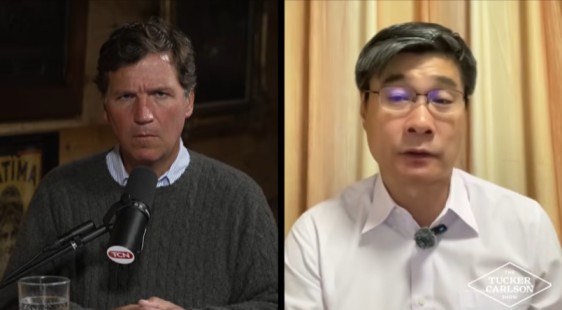
Editor’s Notes: In this thought-provoking interview, Tucker Carlson speaks with a guest known for his remarkably accurate geopolitical predictions to discuss the escalating conflict in Iran and its potential to trigger a global economic crisis. The conversation explores a sobering vision of the future, where a protracted war of attrition leads to $200-a-barrel oil, the collapse of the petrodollar, and a forced reorientation of the world’s major powers. Beyond military strategy, the two delve into the “Greater Israel project” and a controversial analysis of how Western civilization may be undergoing a “controlled demolition” from within. It is a wide-ranging discussion that connects Middle Eastern eschatology with the shifting tides of global power and cultural identity. (Mar 20, 2026)
TRANSCRIPT:
Introduction
TUCKER CARLSON: Professor, thank you very much for doing this. We’ve never met. I don’t know a great deal about you, but I have seen a number of your videos in which you make remarkably accurate predictions. So that’s what I know about you, and I’m impressed by that, by your ability to call events before they happen.
So with that in mind, let me ask you, where do you think this war in Iran is going? How will it be resolved and what are the consequences likely to be?
PROFESSOR JIANG XUEQIN: Well, thanks so much for inviting me, Tucker. I’m a huge fan. I’ve been admiring your work for a number of years now.
TUCKER CARLSON: Thank you.
The War in Iran: A Long War of Attrition
PROFESSOR JIANG XUEQIN: So I think that this war in Iran will be very similar to the war in Ukraine, meaning that this will be drawn out, be a war of attrition. Neither side will concede defeat, even though it is in the best interest to reach a ceasefire. And this will have dramatic consequences on the global economy. And this war could drag on for years and years.
Already we’re seeing major repercussions on the global economy in that flights are being canceled in Southeast Asia. They ran out of fuel, so they’re asking people to stay at home. And in a few more months, experts are predicting a food shortage, meaning that nations will be forced into food rationing.
And today there’s a major escalation in that the Israelis struck the largest gas field in Iran and Iran retaliated by attacking energy infrastructure of the GCC. And Iran has stated that its purpose, its goal, its strategy is to move oil to $200 a barrel, which will have a really significant impact on the global economy because the entire global economy is based on access to cheap energy.
So unfortunately, I think that we can expect this war to drag on for years and years. Eventually, America will send in ground troops. Eventually the Strait of Hormuz will be contested. Eventually this will spread all across the world. Eventually other nations will be drawn in. So Saudi Arabia is thinking about declaring war on Iran. And Saudi Arabia has a mutual defense pact with Pakistan. So Pakistan will be drawn into this war. So things are spiraling out of control.
And just recently, Ali Larijani, who is the de facto head of the Iranian war effort, was assassinated. And he was a pragmatic elder statesman in Iran who had the authority to negotiate a ceasefire. Now that he’s gone, there really is no more off ramp. So both sides are committed to a long war of attrition and the consequences for the entire global economy are quite dire.
Why Can’t the Global Powers Settle This Quickly?
TUCKER CARLSON: That is — I wouldn’t say that’s the worst case scenario. The worst case scenario would include a nuclear strike by one or more actors and the destruction of the Al-Aqsa Mosque complex in Jerusalem, which would spark a religious war. So that’s as bad as it could get. But you’ve just described one step before the worst, which is protracted, destructive, impossible to stop.
So my question is, because there are so many global players — big global players, the US and China — who would be hurt by this? Why is there not an incentive to get it settled quickly and why can’t that happen?
PROFESSOR JIANG XUEQIN: Right, so once this war starts, it achieves a momentum and a logic of its own. So the United States doesn’t really have an off ramp, meaning that if it tries to negotiate a ceasefire with Iran, Iran would ask for reparations, about $1 trillion. Basically it would ask for the United States to leave the Middle East permanently to ensure its long term survival.
If the United States were to do that, then the GCC nations would collectively become client states of Iran because only Iran can guarantee their safety as well as use of the shared Strait of Hormuz. The GCC is the basis of the petrodollar. So what the GCC does is it sells oil in US dollars and then recycles this money back into the American economy. So if the GCC were to abandon the petrodollar, then this would have severe repercussions on the American economy.
Also there’ll be a chain reaction in that Japan and South Korea would look at what’s happened in the Middle East and decide that the United States can no longer guarantee their safety. So they would have to remilitarize and they would have spent all the resources on adapting to the possible China threat. And then you have Europe. And Europe would look at what happened in the GCC as well as in Southeast Asia and they would be like, “Why are we fighting Russia? Wouldn’t it be in our best interest to negotiate a peace treaty with Russia as soon as possible?”
What this would mean is the collapse of the US dollar as a global reserve currency. Remember that America is sitting on $39 trillion in debt. And so the American economy is a Ponzi scheme that relies on foreign nations to continually buy US dollars.
The Chinese Perspective
TUCKER CARLSON: What is the Chinese perspective on this? I mean, it seems like China has an interest in peace in the Persian Gulf with those oil producing countries. Why wouldn’t China step in and try and settle this?
PROFESSOR JIANG XUEQIN: So both the United States and China benefit from the status quo. And China has an invested interest in seeing a very quick solution to this war in the Middle East. China imports about 40% of its energy needs from the GCC. So not just Iranian oil, but also Qatari natural gas.
TUCKER CARLSON: Right.
PROFESSOR JIANG XUEQIN: So as you point out, China very much wants to see a ceasefire as soon as possible. Unfortunately, it is the nature of the Chinese government not to interfere in foreign affairs. China doesn’t really have a geopolitical framework, a grand strategy. It really believes in global trade and it doesn’t really have a framework for how to resolve armed conflict. And so Chinese policymakers are really stuck.
And in fact, Chinese policymakers have come out publicly saying that they would like the carnage, the violence in the Middle East to stop as soon as possible and for the Strait of Hormuz to open up. But unfortunately, as I pointed out previously, when a war starts, it achieves a momentum and a logic of its own. And it’s very hard to stop a war once it starts.
The Global Economic Impact: Two Years From Now
TUCKER CARLSON: So if your prediction is correct — and I pray that it’s not, I’m sure you do too, hope that you’re wrong — but if you’re not wrong and this continues to grind in the way that it is now, destroying energy infrastructure, just really destroying the civilizations of the region and Iran and the GCC, what does that look like in say two years globally? What’s the effect on the global economy?
PROFESSOR JIANG XUEQIN: Right. So this war will accelerate three major trends and nations will have to adapt to a new reality in which energy is no longer cheap and accessible.
The first major trend is deindustrialization, meaning that right now you just have too many people living in cities. And you can do that as long as you can import cheap energy and cheap food. But when cheap energy and cheap food are gone, then you need people to work the fields to grow food for your economy. And so you have to deindustrialize and reduce your energy dependence. That’s one major trend that we should see very soon.
The second major trend we should see is remilitarization. Before we had Pax Americana, where America basically guaranteed global peace and basically prevented nations from going to war against each other. So for example, Trump brokered a ceasefire between India and Pakistan because these two nations have much hostility against each other. But now that America no longer has the aura of invincibility, now that the American military does not come across as almighty, then America doesn’t have the power to stop kids from attacking each other on the playground anymore. So nations have to remilitarize, especially nations like Japan, which before relied too heavily on American military protection. So that’s number two, the remilitarization of the world.
And the third major trend we should see is mercantilism, meaning that now that global trade is disrupted, nations — especially advanced industrial nations such as Japan and Germany — they need to create their own independent, self-sufficient supply chains. Fortunately, America doesn’t have this issue because the Western hemisphere is extremely wealthy and abundant in natural resources. But if you are Japan and Germany, then you have to reach out and expand your borders if you are to maintain your industrial might. So these are the three major trends we should be seeing very quickly.
Japan: A Resilient Power in East Asia
TUCKER CARLSON: I mean, we’ve of course seen this exact dynamic very famously in the last century. And I do think Japan is the big question mark because traditionally, a rising power, a great power like China just kind of intuitively demands hegemony in its own region. Like China controls the East — I would imagine that’s the Chinese perspective. But in the way of that are Japan, the historic enemy, and South Korea, but particularly Japan. And I know that people in your country are very focused on Japan. So is it plausible that China allows Japan to become, say, a nuclear armed power at this point?
PROFESSOR JIANG XUEQIN: Right. So from the surface, it seems as though Japan has a lot of structural weaknesses. So for example, it has an aging population. It has the oldest population in the world. That’s a huge constraint on the future growth potential of Japan.
Another problem for Japan is that it is resource dependent. It relies on imports for its resources. And Taiwan blocks off the Strait of Malacca. Because Japan requires most of its energy from the GCC through the Strait of Malacca, and Taiwan will be a barrier. So if Taiwan were to reunify with China, then basically Japan can be blockaded and they could be starved.
And the other major issue with Japan is its economy, where for the past 30 years, it’s been in a deflationary spiral because of its excessive debt burden. So there are fundamental weaknesses to Japan.
But I’m a historian and I study historical patterns, and what I’ve seen is that the Japanese people are incredibly resilient. You go back to the 13th century when the Mongols invaded not once but twice. And at this time, Japan was very much a feudal nation divided into different fiefdoms. And they came together as a people to defeat the greatest empire in the world at that time, not once but twice.
And you go to the middle of the 19th century when China was being carved up by these Western industrial powers, and it seemed as though Japan was about to be carved up as well. But the Japanese engaged in something called the Meiji Restoration. And in 20 to 30 years time, they went from a feudal, backward nation into an industrial power, ultimately defeating Russia in the Russo-Japanese War of 1905.
And then you go to World War II when America devastated Japan — not just nuclear strikes, but also the fire bombings. So at the end of World War II, Japan was completely devastated, but in like 20 years time, in a generation, they became the world’s greatest manufacturing power.
So I would not count the Japanese out. There’s something about their culture that is extremely resilient, extremely entrepreneurial. And I think that given crises, they will come together as a people and adapt to these challenges.
And so if I were to bet — if you gave me like a billion dollars and said, “In East Asia, you can invest your money either in China or Japan, or you could invest half and half” — well, Tucker, I’ll be honest with you. I would invest all my money in Japan.
Can China Tolerate a Competing Power in East Asia?
TUCKER CARLSON: What a fascinating analysis. I agree with you. I mean, intuitively I agree with you, but I just wonder if China can tolerate that, given the history between the two countries and the focus and just the growth of China. Can they really allow right in the middle of East Asia a competing power?
China, Japan, and the Self-Sufficient vs. Outward-Looking Divide
PROFESSOR JIANG XUEQIN: Right. So the major issue with China is that it sells itself. The Middle Kingdom, the Middle Kingdom, which is to say that the Chinese believe that they are a universe onto themselves. And what happens outside China doesn’t really impact China. So what’s important is to maintain the national sovereignty of China because it is a self-sufficient nation that has no interest in the outside world.
Japan is the complete opposite in that it is an island and it requires — it basically needs to extract resources from other nations in order to survive as a nation. So these are two very different mentalities where China is very much an agricultural, self-sufficient nation that is insular and conservative, and Japan is an outward-looking, seafaring nation.
South Korea’s Precarious Position
TUCKER CARLSON: Interesting. So it sounds like they can coexist. Well, you just said it. You’re not betting against Japan. What about South Korea, which has one of the lowest, if not the lowest birth rate in the world, in contrast to North Korea, and has basically modeled itself on the United States — I mean, down to the most basic level. The US pulling back from East Asia. That’s going to be a transformative thing, I would think, for South Korea. What happens?
PROFESSOR JIANG XUEQIN: Yeah, South Korea is in a very precarious position primarily because of North Korea. So once the United States is forced to withdraw from Southeast Asia, then North Korea can take the initiative. And the problem with this conflict is that Seoul, the largest city in South Korea, is only 30 minutes away from North Korean artillery. So in like a whole day, North Korea could flatten Seoul. And so South Korea is in a very precarious position.
Also, if you look at the economy of South Korea, it’s a very ossified, very corrupt system where just a few companies control the entire economy. And this is what’s led to intense competition in South Korea, which has led to the extremely low birth rate.
So South Korea is in a very precarious position. But what I will say about the South Koreans is that they are fanatical workers. They work really, really hard and they have a long memory of colonial persecution from both the Chinese and the Japanese. And these are fiercely independent people.
So I would not be surprised if North Korea and South Korea were to come to a compromise at some point. Because both nations aspire for national reunification, and because China and Japan will be in conflict with each other, then the Korean people could actually navigate this conflict to their benefit.
Economic Monopolies and the Birth Rate Crisis
TUCKER CARLSON: That’s very smart. I sense you’re absolutely right about that. Let me just ask you about an observation you made parenthetically a second ago, which is because South Korea’s economy is ossified and centralized — it’s a monopoly economy — its birth rate is low. What’s the connection between economic monopolies and low birth rate?
PROFESSOR JIANG XUEQIN: Yeah, great question. So when you have a monopoly, what you do is you create a hierarchy, because everyone’s trying to get into these companies, because these companies are the most prestigious in South Korea. And South Korea is very much a Confucian culture where face is everything.
So the problem though is, how do you get into these companies? It’s a very prestigious position where everyone’s trying to get in. And so you usually get in through the college entrance examination, which allows you to get into a prestigious university. So if you are a South Korean couple, your strategy is either not to have children because you cannot afford to play this game — because you need to send your kid to cram schools, get the best tutors, basically focus all your resources on ensuring the child does well on the college examination so that he or she can get into Samsung — or you can choose not to have any children because it’s too expensive for you. But if you choose to have children, you can only choose to have one kid, because it’s much more strategic for you to put all your resources into one kid than to spread it over three or four kids. So that’s why monopoly would naturally lead to a low birth rate.
TUCKER CARLSON: So what you’re saying is intense competition for scarce resources produces an incentive that results in a low birth rate.
PROFESSOR JIANG XUEQIN: Exactly. Because everyone sees themselves as competitors against each other, and you lose a sense of community. You have a lot of children because you want to contribute to the community and grow as a nation. But when you see your neighbor as your enemy, then that reduces your incentive to have children.
The Energy Crunch and Its Impact on Asia
TUCKER CARLSON: Interesting. So what will be the economic effects on China and also on the rest of Asia and Southeast Asia — Philippines, Vietnam — if this energy crunch continues in the Middle East?
PROFESSOR JIANG XUEQIN: The reality is that this war in the Middle East is having a severe impact already on the entire Southeast Asian economy. So India imports about 60% of its oil from the GCC. Pakistan also imports a majority of its oil. Japan imports about 75% of its oil from the GCC. China imports about 40%. So all these economies are being impacted. And already Thailand and Vietnam are running out of fuel. Even when you go to a gas station, there’s no more fuel for your motorbike. And now people are being forced to work from home. There’s fuel rationing, there’s no jet fuel. So this is impacting all of Southeast Asia.
So the question isn’t who will be impacted, because everyone’s impacted. The question is who will be most resilient and the most willing to innovate and adapt to this new reality. Because we’re not talking about a short-term war, we’re talking about long-term change to the global economy.
And I think that China will actually be the least resilient and the least ready to adapt to this new reality. Because for the past 30 to 40 years, China has gotten very wealthy because of the global economy, where it imports cheap energy and exports manufactured goods. And the entire Chinese economy is currently based on this model.
Now, for the past 20 years, China has been moving towards a consumer-based economy and more of an innovation-based economy — AI. But unfortunately, AI itself is dependent on cheap energy. And Chinese consumers are refusing to spend money for a variety of reasons, primarily because they are not that optimistic about China’s growth in the future. So Chinese household savings is about 40%, and unless the government is able to get Chinese consumers to spend more money, then it will be very hard for the Chinese economy to move towards a consumer-based economy.
So all of Southeast Asia will be impacted, and I think China will be impacted the most in the long term — maybe not in the short term, because China still has access to Iranian oil. Scott Bessent announced today that they will lift sanctions on Iranian oil in order to make sure the global economy is not too impacted by this war. But in the long term, the Chinese economy is now much too focused on export and manufacturing in order to shift to a much more diversified economy.
A Massive Reorientation for East and West
TUCKER CARLSON: So it’s not just the West that is locked into the current arrangement — where we consume and the East produces — it’s the East that’s locked into producing. So this is a massive reorientation for everybody, I think, is what you’re saying.
PROFESSOR JIANG XUEQIN: Yeah, yeah. And I would say, look, the East is going to be much more impacted than the West, because at the end of the day, the wealth in the Western hemisphere is just tremendous. The Western hemisphere is self-sufficient. But that’s not true for Southeast Asia. Southeast Asia is very dependent on energy from overseas.
The Impact on Africa
TUCKER CARLSON: How does this affect Africa?
PROFESSOR JIANG XUEQIN: Right. So with this war in Ukraine and with this war in the GCC, experts are saying that in the worst-case scenario you could have famine in Africa, because so much of food and energy sustains the African economy.
The GCC: A Mirage Shattered
TUCKER CARLSON: Okay, just moving west now. What about the GCC? What does that look like in five years?
PROFESSOR JIANG XUEQIN: Right. So unfortunately, the biggest loser of this war — regardless of how it turns out, even if Americans were to win — the biggest loser is the GCC. Because for the past 30 to 40 years, the GCC is basically built on a mirage, because it’s essentially a desert with very little access to fresh water and very little agriculture. And so it couldn’t really sustain a large population.
But with the petrodollar and with American military protection, then the GCC nations felt free to invest in technology that allowed them to grow the population — desalination plants, modern infrastructure. So you saw this massive growth in Dubai, in Qatar, in Riyadh.
And what this war has done is shattered this mirage and revealed the limitations of the GCC. So for example, look at Dubai. Dubai for many years has prided itself as this safe, very cosmopolitan, very open tax haven. So a lot of wealthy people immigrated to Dubai. But because of this war — when you’re talking about a few drones hitting hotels — it’s really shattered the image of Dubai. And once you shatter this mirage, you can never ever rebuild it again. So the idea of Dubai as the future New York or London, the financial capital of the GCC, this mirage has —
Iran: Devastation and the Long Road to Recovery
TUCKER CARLSON: — evaporated. Iran in five years.
PROFESSOR JIANG XUEQIN: So Iran is being devastated right now. The Israelis and Americans are attacking critical infrastructure. The Israelis attacked the largest gas field in Iran. The desalination plant was destroyed. But we also have to remember what is being hidden from us. And what’s being hidden from us is the fact that the Israelis and Americans are trying to destroy the capacity of the state to govern the nation — basically destroy the state’s monopoly on violence.
And so what we’re hearing are attacks on police officers, on military installations. And there’s talk of special forces going into Iran and starting to fund dissident groups, like the Kurds and the Balochis in southeast Iran. So no matter what happens in this war, it’s going to be very hard for the government to maintain national control, even if they were to survive this war.
Also, another huge issue for Iran is that for the past few years it has suffered drought issues, so its agriculture was heavily impacted. They were actually talking about moving millions of people out of the city of Tehran because the capital can no longer sustain this large population. So this war will only exaggerate these environmental issues, especially with the attacks on critical civil infrastructure — for example, dams and reservoirs. It’s going to take years and years for Iran to recover from this war as a nation. You have basically the stoking of ethnic sentiments and the destruction of a state’s capacity to deliver basic services.
But the good news for Iran is that it seems as though they will be able to maintain control over the Strait of Hormuz. And that is critical, because now they’re able to charge a toll on anyone who uses the Strait of Hormuz. And they talk about 10%, which should generate about $800 billion a year annually for Iran. So the nation will be destroyed in this war. But if it’s able to harness the pride of the Persian people, if it’s able to unify the Persian people, and if it’s able to leverage the resources of the Strait effectively, then we can expect Iran to rise again in like 10 to 20 years’ time.
Israel’s Future
TUCKER CARLSON: Where is Israel in a few years from now?
The Greater Israel Project and American Power
PROFESSOR JIANG XUEQIN: So if you look at the main beneficiary of this war, it is Israel. Because Israel has an ambition called the Greater Israel Project, which is what they believe that their God Yahweh promised to their ancestor Abraham. And so they believe that Yahweh promised Abraham all the land from the Nile in Egypt to Euphrates in Iraq. If you look at the entire map, it also extends to Anatolia, which is southern Turkey, and even into Saudi Arabia.
So if you look at what’s happening, well, it’s convenient in that the GCC is being destroyed. Saudi Arabia will probably be drawn into this war. It is possible Turkey will be drawn into this war as well. And this war allows Israel to remake the Middle East in its own image.
Also, if you think about it, according to game theory, the main constraint to Israel achieving the Greater Israel Project is actually not Iran, but America. Because America guarantees the military safety and protection of the GCC — Saudi Arabia, Qatar, Kuwait, Bahrain, UAE — these nations. And so if Israel has become dominant, it’s become the hegemon of the Middle East. It needs to figure out how to remove America from the equation.
And quite honestly, this war has shown the limitations of American power. It’s really annoyed the American people. The American people do not want this war. The American people don’t even understand why America is still in the Middle East. And so it’s very possible that regardless of what happens in this war, America is forced to withdraw from the Middle East, in which case Israel is able to achieve its Greater Israel Project.
America’s Military Limitations and the Risk of Mission Creep
TUCKER CARLSON: It was clear to me that that was part of the motive, that Israel understood this and roped the United States into this war in order to get the United States out — in order to hurt the United States and get the United States out of the Middle East. Do you think that will be successful?
PROFESSOR JIANG XUEQIN: I think the way this war is going, this plan will work. And the reason why is the American military has not fought a real war for decades. 2003, this war in Iraq was not a real war because Saddam Hussein basically gave up. He didn’t have air defense because those economic sanctions had destroyed his economy. And his logic was this: let the Americans invade. They can’t possibly invade because if they destroy us, that would make Iran, which has hostilities against America, the regional power. So why would America do this? It is self-defeating, it is not logical, it is not rational. So I’m not worried about them attacking me.
And he was surprised when they did attack because it was not logical, it was not rational. But they did attack. It was a cakewalk. It took about two weeks. America achieved air supremacy very quickly and they rolled into Baghdad very quickly on top of the regime. So that was a very quick and easy war that fit the American military doctrine of shock and awe.
Iran is completely different. And the American military does not want to fight this war because they’ve war-gamed this countless times. And each war game they discover that they lose, because the American military is too bulky — it’s not as nimble and resilient as the Iranian military. And we’re seeing that play out right now, where you have these devastating carriers, Abraham Lincoln and the Gerald Ford, threatening Iran but not actually doing anything, because they’re afraid of getting too close to the coast of Iran — because then they become susceptible to drone strikes as well as hypersonics.
So the Iranians have been preparing this for 20-plus years. They know the entire American playbook and they have the perfect strategy to counter the American playbook. So America will have a really tough time winning this war.
The big question now is: will America send in ground troops? Because once America sends in ground troops, then it becomes partly committed — it’s mission creep, sunk cost fallacy — it’ll make Vietnam over. So right now there’s talk of 2,500 Marines coming in from Okinawa. They’ll be in the Middle East in about seven days’ time. And the rumor is — and I don’t know, but the rumor is — the intention is for them to take Kharg Island, which is the main oil depot for Iran. Iran exports 9% of its oil from that facility, the island.
And if the Marines were to take it, it would be great optics. Trump would look good on TV, it’d be a great boost for American morale. The problem is that you can take it, but you can’t hold it, because it’s too close to the Iranian coast and Iranians can attack with artillery, with drones. Which means that you now have to take on the coast. You have to occupy the coast and create a forward operating base. But then you’re exposed to the Zagros Mountains, which means that you’re now forced to occupy the mountains as well.
So it’s mission creep. It’s exactly like Vietnam, where in 1965, 3,000 Marines went into Da Nang to occupy an air base. And like four or five years later you have half a million troops. So it started off as a very limited, self-defined mission, but then it just balloons. America could find itself in this situation very quickly.
What Should America Do Next?
TUCKER CARLSON: If you were the Commander in Chief of the United States, what would you do at this point as of today?
PROFESSOR JIANG XUEQIN: Commander in Chief meaning Donald Trump?
TUCKER CARLSON: Yeah. You get to make the decision. What does America do next? If it’s acting in its own interest, if it’s trying to preserve its power and wealth at this point, what does it do?
PROFESSOR JIANG XUEQIN: Well, first of all, I would acknowledge that all these events are interconnected. So this trade war with China, this war in Ukraine, this war in the Middle East — it’s all interconnected because the American empire is too overstretched and it has its fingers on everything. And so it allows its enemies to provoke it into these never-ending wars.
So what I would do is basically sit down everyone — including Russia, China, Iran — and say it’s time for a new world order where we are partners in this relationship. Before, America was a hegemon, the US Dollar was a world reserve currency. But now what we want to do is open a dialogue where everyone is respected, where America is no longer the bully, but a willing partner in creating a new economic order that benefits everyone and not just a few.
TUCKER CARLSON: I think that’s the wisest possible advice and probably the only path that preserves civilization. But the one country standing in the way of that is Israel, which is the only beneficiary of this war, as you just said. I think that’s true. Can you think of another beneficiary other than Israel of this war?
PROFESSOR JIANG XUEQIN: Well, Russia benefits, because Russia is trying to win this war in Ukraine.
TUCKER CARLSON: That’s correct.
PROFESSOR JIANG XUEQIN: And America is forced to lift oil sanctions. And so now Russia is able to take all these war profits and then help finance the Iranians in the struggle against the Americans and Israelis. So the Russians also benefit tremendously from this war.
TUCKER CARLSON: Yeah, but fair point. Israel has to be constrained by the United States in order to do what you just recommended it do. Is that possible? Does the American president have the authority to control its client state?
Eschatological Fever and the Irrational Logic of War
PROFESSOR JIANG XUEQIN: So if you look at the domestic situation in Israel, Israel no longer behaves rationally. It is sort of overtaken by eschatological fever. So if you look at videos coming out of Israel, there are rabbis going around saying that this war in the Middle East — even though it’s destroying Tel Aviv — it’s good for us, because this will lead to the coming of our Messiah.
So they believe that it is when Israel is under the most strain, when the very existence of Israel is threatened, then God will intervene, because the Jewish people will come together as a nation again and commit themselves, renew their faith in God. And once God sees the blind, trusting, absolute faith of the Jewish people, then he will save his people by sending his Messiah, who will then redeem the Jewish people.
So another saying — this is secular — temporal matters don’t really matter. This war in the Middle East, not an issue. What matters is divinity. What matters is our relationship with God. What matters is faith. If nuclear bombs go flying, doesn’t really matter.
TUCKER CARLSON: What’s so interesting is that 25 years ago, at 9/11 — whatever you think of how that happened and why — there was, I saw it personally, a political Islam. There were Wahhabists, there were a lot of Islamic radicals around the world. And for a bunch of reasons, over 25 years, that hasn’t disappeared. There still exist Islamic radicals, but it’s not an important political force anymore.
At the same time as Islam in general has become much more moderate — and the GCC is the most obvious example of this — there has been a rise of Jewish Wahhabism and evangelical Christian Wahhabism, so to speak. I mean, you’ve seen this eschatological extremism among some American Protestants, Christians, and some Israeli and American Jews. How did that happen? What is that?
Christian Zionism, Secret Societies, and the Eschatological Script
PROFESSOR JIANG XUEQIN: So first of all, I don’t think we can ever overestimate the influence of eschatology in American politics. I’ll give an example: about a quarter of Americans are evangelicals and a lot of them are Christian Zionists. So they believe that Israel is crucial — the linchpin — to achieving God’s plan and the return of Jesus.
A very prominent figure that you probably know very well is John Hagee, who runs something called Christians United for Israel. It’s 7 million members. And these are the people who are financing a lot of the conflict in the Middle East, in Israel, because they’re the ones who are funding West Bank settlements. So Christian Zionism is an extremely powerful political force in America.
So your question is, how did this happen? And the issue is that this is a plan that has been in motion for centuries. And it’s a very complicated history, but it involves different religious groups. Among the Jews — Sabbatean Frankists, Chabad-Lubavitch, which you’ve talked about — but it also involves the Freemasons, the Knights Templars, the Rosicrucians, and the Jesuits. So you have these different secret societies, different religious organizations working together through the centuries to achieve this plan for the end of the world, which heralds the messianic age.
And there are different components of this plan. The basic components are: one is the creation of the nation state of Israel, which happened in 1948. And then you need to have the building of the Third Temple, which requires the destruction of the Al-Aqsa Mosque — which could actually happen during this war, given what we’ve seen so far.
So the Israelis have closed off the Al-Aqsa Mosque, as well as other religious sites like the Church of the Holy Sepulchre, to tourists these past few days. There are rumors that for the past two years, the Israelis have been conducting archaeological digs under the Al-Aqsa Mosque to basically destroy the foundations of the mosque, so that they can conduct a controlled demolition of the mosque and blame it on a missile strike from the Iranians. And there’s actually talk among Israelis of using this plan to ignite a war between the Arabs and the Persians.
So the Al-Aqsa Mosque needs to be destroyed for the Third Temple. They also talk about this war of Gog and Magog between Israel and the entire world, then the coming of the Jewish Messiah, the creation of the Greater Israel Project, the return of all Jews from the Diaspora. So there are different components to this plan.
If you just observe geopolitical events, we’re seeing these events converge together today. All these events are playing out. So it seems as though there are these very powerful shadow forces working behind the scenes. We don’t know who they are, but it seems as though they’re able to control geopolitics in a certain manner as to fulfill their eschatological script.
TUCKER CARLSON: What role do you think Donald Trump plays in this?
The Motives Behind Trump’s Actions
PROFESSOR JIANG XUEQIN: That’s a really hard question to answer. So let’s look at different possibilities. The first possibility is that he’s been employed as an actor, and he’s just following a script, but he doesn’t really know where this movie is going. He’s just doing his part. But he’s manipulated behind the scenes by people around him.
And when reporters asked him, like, why is this war in Iran happening? He did say that his advisers, which includes Siv Wykoff, Jared Kushner, Peter Hegseth, Marco Rubio, told him that the Iranians were so close to getting a nuclear weapon and that the Iranians were going to attack first. And so he was basically misled. And I think that’s probably true in that Trump surrounds himself with certain people that have a certain political eschatological agenda. So that’s one possibility, that he’s just an actor.
Another possibility is that he himself has a messianic calling. And what I mean by that is if you go back to January 2021, he was politically dead, right, because the January 6th riots happened. He was impeached twice. And then after he left office, there was lawfare conducted against him and he went bankrupt. So it was as though the entire world went against him. But now he’s President of the United States. And so how would he personally understand this? I think a lot of it is God has asked him to serve, there’s a call to serve, and he has to fulfill a mission. But what this mission is — whether it’s to save Israel, whether it’s to save America, whether it’s a part of a grander scheme — only he in his heart knows. And I think no one except him knows. So that’s another possibility.
And the third possibility is that this is all Israel doing. Netanyahu is the one who’s forced him into this sort of situation because Israelis attacked first. And Marco Rubio said this — you know, what we wanted were these negotiations, but the Israelis were planning to attack. If they attacked, the Iranians would be compelled to attack both the Americans and the Israelis. And we did not want to put our soldiers in harm’s way, so we attacked with the Israelis. So it’s possible this is all Netanyahu and all these machinations.
Another fourth possibility is they have co-opted him. Like there’s blackmail on him. And he has no choice but to do what he does because he’s compromised in a certain way, and maybe his family is under threat. So all four are possibilities. And quite honestly, I have no idea which possibility is the most correct.
The Future of North America
TUCKER CARLSON: Yeah, I don’t think anybody does. And I’ve really tried to keep speculation to a minimum. You always want to believe that people’s motives are transparent, that they state why they’re doing what they’re doing. But of course, you can never know what’s inside a man. Even in yourself, it’s hard to know your own motives very often. So I think that’s a wise take.
What happens to North America — the United States — and I do want to include Mexico and Canada. We don’t think a lot about those countries, but they’re both massive land masses and they have big populations and they’re our neighbors. And so if the world is reorienting, I think you need to think in terms of continents rather than just nation states. What does that look like in three or four years?
PROFESSOR JIANG XUEQIN: Right. So from a geopolitical perspective, if America is forced to retreat back into the Western Hemisphere, it needs to worry about resources. And so it is in the best interest of America to eventually take over and colonize both Canada and Mexico.
TUCKER CARLSON: Yes.
PROFESSOR JIANG XUEQIN: Mexico for its labor supply, Canada for its resources. You know, Canada’s probably the wealthiest country in the world.
TUCKER CARLSON: I know.
PROFESSOR JIANG XUEQIN: And so from a geopolitical perspective, if the world is retreating into self-sufficiency, if there’s mercantilism, if there’s trade barriers, the market has absolutely no choice but to ensure its own supply networks, and that means eventually taking over Greenland, Canada, Mexico, Latin America, Cuba, Venezuela. So America doesn’t really have much choice in this matter.
At the same time, what we’re seeing is that this war, as well as other events, are causing political fissures in America, especially between left and right. Like what happened in Minneapolis in January. And so we can expect that as this war continues — and there’s a strong possibility that Donald Trump will call up a national draft in order to ensure the manpower to fight this war — then you will have rioting on the streets, you will have massive violence, in which case the National Guard is deployed. There’s a plan to deploy the National Guard to all major American cities by April.
And so unfortunately, America is probably going to suffer many long years of sectarian violence. Not a full-fledged civil war, but maybe something along the lines of the Troubles in Ireland. I’m not sure if you’ve seen this terrible movie called One Battle After Another. It’s just a terrible movie, by the way, but it gives you insight into what a civil war might look like, where you have these insurgent groups fighting against the state.
TUCKER CARLSON: Yeah, but you expect the United States to hang together as a coherent nation state?
PROFESSOR JIANG XUEQIN: Listen, Tucker, the United States is the greatest nation in the world. The people are open, true, generous, entrepreneurial, energetic. The resources of America are infinite. America is a continental fortress, protected by two oceans. America doesn’t have a peer competitor in North America and South America. And so America, regardless of what happens, will still come out doing pretty well, just because of the pure energy and creativity of its people.
Canada: The Suppressed Giant
TUCKER CARLSON: You mentioned Canada. Most Americans don’t even know the capital of Canada. Canada does not appear on their radar, doesn’t figure in their thoughts. But you described it as “probably the richest country in the world.” I think that’s objectively true. And yet Canada is not a rich country. In fact, it’s getting poorer. Its life expectancy is declining, its GDP is declining, and that’s on purpose.
The nation of Canada has been suppressed on purpose. Its population is being killed off by the state through its assisted suicide program. And its population is changing through mass immigration against the will of the population. So that country is being held down on purpose. And my question is, by whom and why?
PROFESSOR JIANG XUEQIN: Sure, that’s a great question. And this is something that I struggle with all the time because I am a Canadian citizen. I went to school there. So my answer is that Canada was never really a nation state. It’s more of a glorified resource colony for the British, the City of London. And the reality is now that the British are under a lot of strain. The City of London is under a lot of financial pressure. It sees places like Australia, New Zealand, and Canada. And what do you do if you have financial issues? Well, you do corporate restructuring. You change the middle management.
And historically, the British got along very well with the Indian elite. They went into India and stole trillions of dollars from the Indians, and the Indian elite were perfectly happy to help them. So why not use the same model for Australia, for Canada? There are millions of Indians who immigrated to Canada in the past five years. And it’s put a lot of strain on the Canadian economy because housing prices have exploded, and so ordinary Canadians can no longer afford to buy a house. And it’s put enormous pressure on the Canadian welfare system, on the Canadian economy.
And you would think that the proper strategy would be to have a moratorium where they say, “You know what? We’ve had too many immigrants and we need to close the borders and absorb these immigrants because we want to ensure that these immigrants have proper housing, they have decent jobs.” You would think that that’d be the right strategy. But instead, Mark Carney goes to India and says, “We want more Indians. And also we’ll give you scholarships to come to Canada to study for free.” Meanwhile, there are a lot of Canadians who are homeless, who are unemployed, and who cannot put food on the table. But hey, we want more Indians. So if it’s not corporate restructuring, if it’s not trying to asset strip Canada, I really don’t understand the strategy for this.
The Controlled Demolition of Western Civilization
TUCKER CARLSON: Well, I mean, it’s a kind of genocide, right? Against Canadians, people whose ancestors built the country. But you wonder what the purpose is, because it is happening all over the West, all over the English-speaking world, in the white countries. And it’s not an accident, it’s not organic. So it’s a big picture that spans from Australia to Ottawa. And what is that? Do you know?
PROFESSOR JIANG XUEQIN: Right, so let’s look at Europe, because in 2014 this was a major turning point in Europe. You had tens of millions of refugees trying to escape these wars in the Middle East created by America’s wars in the Middle East. And they were trying to reach Europe. And at this point, Europe had a choice. It could choose to close its borders and maintain its cultural identity, or it could open the floodgates.
And Angela Merkel, the Chancellor of Germany, she said something really famous, which stuck in my mind, which is, “We can do this. We are Europeans. Somehow we can take in these millions of refugees and welcome them into our societies and thrive as a people.” And the complete opposite has happened.
You’ve got millions of these refugees who fled into Europe — not because of their choice, by the way, but because their nations were devastated. Libya, Syria, Afghanistan, Iraq were all devastated in these wars against terror in the Middle East. So they go, and these are proud Islamists, they love their religion, they love their family, they love their community. And so they’re not going to absorb themselves and assimilate themselves into Europe. And today you’re looking at population replacement in a lot of cities. You go to certain places in Britain and you might think you are in Cairo or Baghdad. And this has caused tremendous conflict throughout Europe. I would not be surprised if in 2 to 4 years’ time you have civil war break out, insurgencies break out in places like Britain and France.
So the question is, why is this happening throughout the world at the same time? Why is it that these different nations — whether they’re European, whether they’re Canadian or Australian — why are they adopting the same policies, not just in terms of COVID, but also in terms of immigration? And so that’s one of the great questions that we have to ask about the world we live in today. It seems as though it’s almost a controlled demolition of Western civilization — the Anglosphere, Western Europe. It seems as though these nations are being destroyed purposely. For what end? I don’t know, but I would just say there’s a certain pattern that has emerged, and the result can only end up in the controlled demolition of these societies.
TUCKER CARLSON: I don’t even think that’s up for debate. I mean, of course, just look at the bottom-line numbers. Of course the white populations are being killed on purpose. And the question is why? And I don’t have the faintest idea, and I know there’s a lot of speculation as to who’s doing it. I’ll just say bluntly, I don’t know. I mean, I know who the instruments are, of course, but Keir Starmer’s not in charge of Great Britain. Macron isn’t in charge of France. I’m not sure how many leaders really do have control of their countries. I don’t know how many countries actually have sovereignty. I really don’t know the answer, but something is going on. Is there any precedent for this in history? Have you ever seen anything like this as a historian?
PROFESSOR JIANG XUEQIN: Right, so you look at what’s happening in Ukraine, where the war is lost. It was lost two years ago. The Ukrainians have lost over a million fighting men. A lot of their people have fled overseas. And no matter what happens in this war, Ukraine is finished as a nation state. It is no longer viable as a nation state.
And rather than admit defeat and come to a ceasefire with Putin, what the Europeans are doing is saying that they’re going to draft their men and have them fight in the trenches of Ukraine, which would be suicide because the Russians dominate the battlefield with their drones and artillery and trenches in Ukraine. So it’s almost like a suicide mission.
But not only that, the Germans have said that they can only draft German men, but not Islamic men, because they’re afraid of their loyalty. Which means that you have a situation where local men — British, French, German men — are being sent to die in the trenches of Ukraine. And back at home, you have these immigrant populations that have not assimilated into your culture. So it’s a really weird strategy. And I don’t know who comes up with this sort of stuff.
And look, there’s no historical precedent for this. There just isn’t. I mean, there have been incidents of mass immigration. You go back to the fall of the Roman Empire and how these hordes of immigrants flooded the Romans, and it’s almost impossible to assimilate so many people. Eventually there’s going to be a cultural takeover. With so many people who are insistent on maintaining their cultural identity, and because they have more children than you, eventually they’re going to overwhelm your cultural identity.
The Decline of Western Civilization and the Role of Education
TUCKER CARLSON: Yeah. And I do think that is the story of history. One population replacing another. There’s no such thing as multiculturalism. There’s always a dominant culture that insists on dominance. Of course.
I just don’t think there’s ever been anyone who thought this could happen globally. Like a systematic targeting of a race for elimination globally. I mean, well, it wasn’t possible until pretty recently, but it would be interesting to know what the plan is. There’s clearly a plan behind that. There’s a plan behind everything. How many Americans do you think understand what’s actually happening in the world right now?
PROFESSOR JIANG XUEQIN: Unfortunately, I think that if you are educated in America — I went to Yale, and so I know a lot of these Ivy League people — unfortunately, we’ve been indoctrinated to believe certain values, and these values are not questionable.
So, for example, there was a court case that went to the Supreme Court about affirmative action at the University of Michigan. And affirmative action is clearly against American values, against the idea of American meritocracy. But the Supreme Court said that affirmative action was good because diversity is an inherent good.
And it’s interesting because if you go to a place like Yale or Harvard or any of these Ivy League schools, there’s actually very little diversity. I’m talking about intellectual diversity. I mean, there’s different skin color, but if you actually look at the ideas that they engage with in a classroom, it’s a very conformist setting.
So it’s one of these great ironies where affirmative action is supposed to bring diversity to the classroom. But if you go to any classroom in an elite setting, it’s extremely conformist. You’re not allowed to bring up these issues about population replacement, immigration, because then you become — you get called a racist. And that’s the worst thing to be called. I mean, you’re better off being called a pedophile. Pedophiles have more rights now than racists.
So unfortunately, it’s not just what’s happening in current events. It’s also what’s happening in the classroom, and in the popular culture, where people are not even allowed to ask questions that are blindly obvious. If you just walk the streets of any Western city —
How the Rest of the World Views the West
TUCKER CARLSON: — you’ve lived around the world. I think you’re now in China. Does the rest of the world see this more clearly?
PROFESSOR JIANG XUEQIN: Yeah, I mean, if you’re not in the West and if you’re not subjected to this brainwashing indoctrination that they feed you in the schools, it’s — I mean, it’s obvious. Again, it’s blindingly obvious to anyone if you just walk the streets of any major city in the West.
So there’s a joke in China — Chinese don’t actually like to go to Canada for tourism. And someone asked, “Why doesn’t anyone recommend Chinese going to Canada?” And the response was, “Well, would you recommend someone going to India?” So it’s a bit racist. It’s very racist. But I mean, it’s obvious to people.
TUCKER CARLSON: It’s just interesting because I’m not defending the whites — I am white, of course — but white people have done a lot of bad things, just like people do a lot of bad things. But in general, people like to go on, as you just noted, vacation in white countries because they’re pretty nice.
So I think you’d have to say, if you took the emotion out of it and just looked at it net-net, whites have been a pretty big addition to the world. Invented a lot of stuff, created a lot of beauty, created places people like to go on vacation — which really is a good test. So why would you destroy all that?
Western Classics and the Purpose of the University
PROFESSOR JIANG XUEQIN: Look, in my school, I teach great books. I teach Western civilization. I teach Homer — the Iliad, the Odyssey. I teach Plato — the Republic. I teach Dante and the Divine Comedy. I teach the Bible. And my students love it. Because Western civilization, it’s just not about people being white. It’s really about what it means to be human, and what it means to be spiritual and to have connections with the divine.
So it’s unfortunate that just when the world needs Western civilization the most, the West decides to destroy its own civilization. I mean, Homer, Dante, Plato, Shakespeare, the Bible — these are classics that speak to every human. I know, because I teach in China to Chinese students who have absolutely no exposure to Western culture, yet they fall in love with Plato, Dante, Homer, and Shakespeare. And why is that? It’s because there is eternal truth embedded in their words.
And so universities — Western universities — ought to be the places, the fortresses that are the greatest defenders of Western civilization. But if you go to these elite universities, Yale, Harvard, they are the most critical of Western civilization. They don’t want to teach Homer and Dante and Plato. And it’s like, if you don’t teach these classics, what’s the purpose of university?
I always thought the university was the heart and center of civilization — like what monasteries were in the medieval age. And I thought these professors, they would dedicate their lives to promoting the classics. But instead they now promote complete nonsense like DEI.
Where Is the Hostility to Western Civilization Coming From?
TUCKER CARLSON: Of all the — and this is my last question. Professor, thank you. It’s been a wonderful conversation, and I hope it won’t be our last. And I hope we can have dinner when we’re on the same continent. But this is my last question.
Since you’ve traveled so much and lived in so many places and speak multiple languages, where would you say the part of the world that’s most hostile to Western civilization, as you just described it, is? Trying to understand where this hostility is coming from.
PROFESSOR JIANG XUEQIN: Well, I would say Canada, Britain, Western Europe. I would say these places are the most hostile towards Western civilization. Chinese people have tremendous respect for Western civilization. In fact, China is in the process of promoting the classics — Plato, Homer, Shakespeare — in China, because Chinese recognize the tremendous cultural value and immense eternal truths embedded in these classics.
So we’re in a very weird situation where the West is destroying itself by abandoning what makes it great, which is these classics.
TUCKER CARLSON: I think if we talk longer, I’m going to start to cry on camera. So I’m going to take an emotional break here. Professor, thank you.
PROFESSOR JIANG XUEQIN: Okay. I do not mean —
TUCKER CARLSON: No, no, no, I’m half kidding. No, it’s emotionally resonant for me because I know that you’re telling the truth, and it comports with everything that I’ve seen. And so it’s hard to accept something that’s true. But I think what you’re saying is true, unfortunately. So bless you for this, and I hope to see you again soon. Thank you.
PROFESSOR JIANG XUEQIN: Yeah, I really enjoyed it, Tucker.
Related Posts
- Transcript: Mayor Mamdani Interview on Weekly Show
- Transcript: Tucker Interviews Dr. Chris Martenson on Global Energy Crisis
- Transcript of Arnab Ray Interview: ANI Podcast with Smita Prakash #EP-433
- Transcript of Pink Floyd’s Roger Waters Interview: Tucker Carlson Show
- Tony Robbins Interview: Secretary Kennedy Podcast (Transcript)