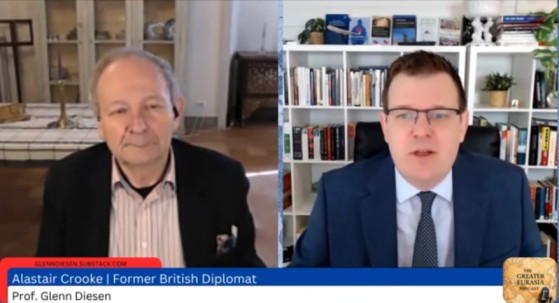
Editor’s Notes: Former British diplomat Alastair Crooke joins the Greater Eurasia Podcast to analyze the rapidly escalating conflict between Iran, Israel, and the United States following recent strikes on regional energy infrastructure. The discussion explores the strategic implications of Iran’s move to regulate passage through the Strait of Hormuz and the potential shift from US dollar-based energy trade to the Chinese Yuan. Crooke also provides insight into the logistical challenges and intelligence miscalculations that are currently reshaping the geopolitical landscape of the Middle East. (Mar 20, 2026)
TRANSCRIPT:
Introduction
GLENN DIESEN: Welcome back to the program. We are here today with Alastair Crooke, a former British diplomat and negotiator who worked for decades on the different conflicts in the Middle East. Alastair Crooke is also the founder and director of Conflicts Forum and I’ve left a link to this, his excellent Substack that is Conflicts Forum in the description. So thank you as always for coming back on the program.
ALASTAIR CROOKE: My pleasure to join you today.
The Escalating Situation: Attacks on Iran and the Gulf
GLENN DIESEN: Over the past few days we’ve seen some, I guess, dramatic developments. The US and Israel, they attacked the South Pars, which is the largest gas field in the world, the Busher nuclear plant, and also assassinated Iranian leaders, which is now triggering this massive retaliation from Iran. I was wondering, how do you read this situation? To what extent is this escalating out of control or is this calculated? How are you assessing where the direction this is going?
ALASTAIR CROOKE: I think the wheels are coming off this whole thing. It’s sort of spiraling really out of control. And it increased enormously with, if you like, that attack on the Iranian end of the South Pars gas field, which is important to Iran. It underpins a lot of its electrical supplies and other things. So that was a very big escalation.
Now of course, Trump has said that, he did it through social just the other day saying, “Oh no, it was, you know, this was Qatar, had nothing to do with it. It was the innocent in all of this.” And it’s outrageous that in a response Iran had attacked the energy infrastructure of a number of Gulf states. Hitting all the infrastructure, not the tanks any longer, not the storage which was under attack before, or the port, but this was the infrastructure. And they attacked, if you like, the infrastructure of Qatar. And that has set it back, caused huge damage to the liquefaction structures, their infrastructure, set it back and damaged it. Qatar is now calling force majeure on its long term gas contracts for five years. And they estimate it’s going to take at least five years to rebuild it.
So what happened then? And the explanation that I have heard from someone talking to those in the circles of Trump, Mike Wolf, and he says what happened was Kushner, Jared Kushner rang up his father in law and he said, “You know, the Qataris are hopping mad, they’re going crazy. They’re really angry at what’s happened. And you know, this is bad news because Jared has huge sort of investments there. Much of his, you know, funds, his investment funds come from Qatar.” And so he said, “You know, this is bad. They’re really angry and they’re very upset about it.” And Trump said, “Well, look, look, I’ll take care of it, I’ll take care of it.” And so he produced some response, this Truth Social saying, “Oh no, you know, I didn’t even know about it. And the Qataris didn’t know about it. It was purely Israel.” So it put it also onto the Israelis.
The Israelis are pretty clear. I mean, you can read it. We’ve been looking at the Hebrew press, I mean, this morning, and they’re very clear and they say, “Listen, on these things, we’re joined at the hip with the White House. Of course they agreed it, of course they approved it.”
And why? Because Trump thought, you know, that pressure, that there would be pressure, that would put pressure on Iran to abandon the selective closure of Hormuz. He thought that this sudden sort of attack on the gas field of Iran, the Iranian side of South Pars, that would make the Iranians say, “Oh my goodness, we better stop and open those.” I mean, delusional stuff, really. That’s why I say the wheels are coming off this thing because you’re getting into complete delusion.
Trump’s Confusion and the Spiral of Miscalculation
And then I watched a clip, I don’t know exactly the date, but Trump was sitting there with Susan Wiles, who turned out to be one of the main advisors besides Jared and Steve Witkoff on the Middle East issues. She, of course, is closely connected to Israel. I think she was a campaign manager for Netanyahu at one stage. Anyway, he’s sitting there with her and he’s saying, “You know, I, I, this is, I don’t understand. These missiles, these missiles, the attack was intended for Iran. No one expected that they would, you know, attack back. They would react and hit Gulf states. I mean, who could have guessed that?” I mean, we are in la la land. It’s getting completely out of control and the wheels are coming off.
Because there’s a lot of, you know, this is becoming quite desperate in terms of American politics and in terms of the economy. I mean, the economy, particularly for Europe, I mean, he doesn’t care too much about that. But even American, what they call gas prices, petrol prices to Europeans, but the gas prices are going up and people are noticing it and are not happy about that. So it’s really going out of control. It’s serious.
The attack by Israel on the Iranian gas facilities and the reaction to it is taking energy off the market for many years, perhaps up to five years.
Markets, Propaganda, and the Hormuz Gambit
So of course, now panic is setting in and markets are still just about surviving because they survive simply every time Trump tells them. I mean, it’s, I don’t know how they run these things, but every time Trump says, “Oh, it’s going to be a short walk, short walk, soon be over,” then the markets go back up again. I mean, it’s instant, really. You know, they don’t seem to do any sort of due diligence on these things. They just go up and down according to, you know, oh, and then he says, “It’ll be short, it’ll be short now, and then we’ll open Hormuz and it’ll be short. And then prices will sink, oil prices will go straight down.” I mean, you know, again, as I say, this thing is just sort of spiraling, not just out of control, but out of rationality and, you know, a sense of what is possible for the United States to do and what is not.
I mean, now we know they’re talking about sending two and a half thousand Marines aboard amphibious ships to Kish Island or to sort of open, you know, militarily, open Hormuz. And now I believe, I’m not sure, I haven’t confirmed it. So it may be, you know, there’s so much misreporting at the moment and so much propaganda going around it, you can’t tell. But he said, “No, you know, he may have to send thousands to open Hormuz.” I mean, we may get into that in a while, if you want, because that is delusional too, absolutely delusional.
Israeli Propaganda and the Pressure to Declare Victory
And Israel is putting out absolute propaganda. You know, Netanyahu’s virtual news briefing conference, you know, the line that is coming out from Israel is, “You know, they are collapsing, Iran is collapsing, their command system, their leadership and their command system is in chaos. They don’t know who’s in charge any longer. It’s complete chaos. They are blind, breaking down. And, you know, we have destroyed, we have destroyed utterly their nuclear capability,” Netanyahu said, “and we’ve destroyed their capability of assembling and constructing new missiles,” hoping, I suppose, that people don’t remember. He said exactly the same thing after the June war, that they destroyed both the ballistic missile capacity and the nuclear prospect.
But it’s quite clear the interest of Israel, at least the faction in circles around Netanyahu, because others in Israel are saying other things. But those that are in the Netanyahu circles are very clear that unless they can be presented as a great success, presented mainly for Trump’s interest, as a great success, that everything is going first, then there is going to be a crisis in the United States for Israel and for Trump. So they have to keep the propaganda flowing, full stake, in order to say, “No, everything is going perfectly. There’s no problem. This is a great success.” And of course, it’s Trump’s success.
And he needs that because there’s big divisions opening up within the Republicans and indeed within the Democrats. And it’s turning to be something that can be an increasing danger to the Republicans, indeed to the sort of, I believe, the political fabric of the United States, because people are getting more and more critical about, you know, “Who actually took us into this war, what were their interests? What is this sort of barely visible command structure above the political level that takes us in? We don’t know who leads it, what their interests are.”
But nonetheless, there is this feeling in one section of the Republican, the MAGA side, that there is this invisible, if you like, superstructure that is, if you like, a control structure that stands above what they can see, what they can touch and what they can understand. And they’re saying, “We need to really understand what’s going on.” And of course, the resignation by the head of the counter terrorist department has exacerbated this.
How Israel Defines Victory
GLENN DIESEN: Well, you follow the Israeli media, especially the Hebrew language media, quite carefully. How do the Israelis assess this development of the war? I mean, how is victory defined? Victory, I guess, redefined. And, well, overall, how is the assessment of how Israel is able to — well, you said they exaggerate a lot — the pain they’re dealing to the Iranians in terms of everything falling apart, but also their ability to absorb pain?
Public Sentiment and Propaganda on Both Sides
ALASTAIR CROOKE: Because, yes, it’s quite difficult to give a direct answer because much of it is based on sentiment. The support for the war in Israel is at 93%, according to the Post, huge support for it. But much of that is based on sort of, again, you can call it Hopium or delusion, whatever you want, but is the expectation, which has been fueled not only by Netanyahu, but also by Trump’s statements about obliteration. “We’ve obliterated their navy, we’ve obliterated their missiles. We’ve obliterated, obliterated everything. And we bomb and we bomb.”
So there is a lot of expectation that Iran’s state is about to collapse and fall and this will be a miracle. A miracle that is often framed in religious terms by Naqmi, Apple and others, that this is, you know, something that is almost a divine providence coming led by Trump that is going to bring about a sort of pro-Western, completely de-radicalized, disarmed Iran from the war.
And so there’s a lot of that and people cling to that a great deal. And I have to say that because, you know, they are not immune to the propaganda that’s been coming out about this from America and being followed up. I mean, the propaganda is all over the West. I mean, European newspapers are full of the same sort of propaganda suggesting that Iran is about to collapse and will fall into Israel’s lap anytime and it will be completely de-radicalized, in a sense where the whole psyche has been seared by the defeat so much that it will emerge, you know, from this war like at the end of the Second World War, Germany or Japan emerged. They’re slightly seared by the defeat they experience.
So there’s that side of it and there’s still that, I mean, euphoria in parts of the Hebrew press. There’s also people who say, and senior military officers and others who say very clearly, “Well look, you know, Netanyahu truly should just declare victory and get out. And you know, the sooner he does that the better.”
And you know, they are very careful not to say anything too much about, you know, the damages that are inflicted in Israel because the propaganda inside Israel is very strong too. The censorship is huge. There is a five-year prison sentence for photographing incoming Iranian missiles. There is a five-year prison sentence for photographing the aftermath.
Yes, I know you’ve probably seen videos of, you know, the remains of bombs and so on. But as the Israeli news magazine 972 has reported, these videos that we see are being run by the authorities in Israel, by their public relations departments deliberately to show almost banal images. A slightly damaged car, debris in the street, accompanied by messages that only light injuries have been experienced, and they’re mostly, almost all, sort of an Indian or a Sri Lankan has been injured by these missiles.
So they are deliberately showing a little glimpse of the debris, and in one case they were confronted by a local who said, “No, no. What are you filming this? This is nothing. Film what really has happened here.” And you know, the camera crew just ignored them and continued.
So I’m just trying to paint a picture that for Israelis — do they know how damaging the Iranian attacks are? Do they have a sense of the balance in this war? I don’t think they really have a proper sense of it for those reasons, because of the endless sort of good news propaganda and also because, you know, nothing is allowed to be shown.
However, I mean, you know, last night it was reported after the Iranian barrage, 7 million people were in shelters for the whole night. Well, my understanding is that equates almost exactly to the population of Israel at seven and a half million, I think. So there must be a greater sense of something wrong. But I guess a lot of people just cross their fingers and hope that, you know, this is all going to turn out to be, you know, a divine victory for Israel.
Iran’s Resilience and Unity
So that’s on the Israeli side. On the Iranian side, I mean, it’s much easier to see because we’ve seen the photographs of, you know, after Iftar and people — quite clearly, Iran is now more together, more engaged than since the revolution in 79. I mean, they are fully behind the state and fully supporting it and they are resilient.
And it’s hard, I mean, you know, when occasionally you see, when a missile comes and lands nearby, they just stand there. They don’t run, you know, they don’t run for the shelters. They just stay out in the squares at night when this happens.
I mean, of course, occasionally people do. And of course, you know, a lot of the attack strikes have been on — I think Iran says they’ve had 20 hospitals attacked in this period, from the Iranian sources. They say the head of the medical service said country hospitals have been attacked, schools have been attacked, residential blocks have been attacked. Of course, people have to run when that sort of attack is taking place, but by and large the resilience is strong.
Iran’s Retaliation Strategy
GLENN DIESEN: Well, I thought in this war, if the purpose is to exhaust each other, that is to be measured by the ability to cause pain and absorb pain, it makes sense in the propaganda to exaggerate the pain caused on the adversary and the limited pain cost on one’s own. I guess Iran is different in this regard because it was attacked. So if it shows the destruction to itself, it becomes also the evidence of what the aggressor has done. And it also helps to unify the country because this is not the cost of military opportunism, as it would then be seen by the populations of Israel.
But how do you make sense of the wider Iranian retaliation strategy? Because as you said before, Trump claimed that no one could have foreseen that they would hit the US military bases across the Middle East, which is an incredible statement. But it’s interesting that they apparently weren’t well prepared for the attacks on these bases, the attacks on the energy facilities in the region, the closure of the Strait of Hormuz. Is this essentially an economic strategy solely, or how are you assessing the objective here of the Iranians?
Iran’s Strategic Planning and the Strait of Hormuz
ALASTAIR CROOKE: Well, there’s a fundamental objective that people often overlook because it’s becoming pretty clear that the West was not prepared for a conflict. They were prepared for a very short three-day bombing exercise. Their logistics were for a short bombing process, and those logistics are now expiring, running out.
Very clearly, interceptors are not. Israel does have almost zero intercept capacity, especially for the new missiles that Iran is using, the latest one being the Fatah 2 hypersonic missile. And also Gulf logistics have not been attempted. So there was no proper preparation for this. It was not thought through, the planning for this.
On the other hand, Iran has been planning this for 20 years against the possibility that at one time or another they would have to fight a war with the United States, because of 50 years of hostility effectively to Iran. And it seemed to be there was no way out, because otherwise you got into the cycle, which Kaliba has said, you know, you have war, then you have a truce, then the war comes back three years later, the truce. You heard all this from Russia too, about the danger of ceasefires and what they lead to.
So they’re very clear that it’s a long war. What this means is that they have a plan, if you like, a sort of paradigm of how they will sort of increase the pressure on Israel, and they will judge that to, if you like, the depreciation of the capacities of the West and of Israel, and to reach a peak, probably just after they judge that those capacities are waning, so that they can have the maximum effect on Israel.
Iran’s Long-War Strategy
So for Iran, really, it’s only just getting started. I mean, they knew it would be two to three weeks. And then they calculated — I mean, I’m not privy to their actual calculation, but I do know that they were thinking that it would be two or so weeks, and then the depletion would become evident, and then they could use the main force that they had been keeping.
So it is both a very phased and planned structure that they have for a long war that would reach its peak at a point where they saw the maximum military advantage to it. And so they’ve been keeping missiles back and husbanding, if you like, the more sophisticated missiles — they’ve been keeping those back, metering their use out for a long war, and for the moment that they wanted to rise to a peak.
And that I think is a psychological issue as much as it’s a military one. You know, when is it going to be the most effective at collapsing the psyche of Israelis? When is the moment when it’s going to cause a rethink and an undermining of the confidence of the Arabs and parts of the West? If you go too soon, you don’t affect it. So it’s psychological as well as a military calculus, I believe, that is underpinning that.
So it’s a prepared force, carefully prepared, well thought out, asymmetrical warfare against ill thought out, ill prepared, poor logistically supplied alternative coming from the United States and from Israel. They haven’t got the missiles, they haven’t got the interceptors they need for anything other than a short war. They bet on a short war. They were clearly already wrong on their calculus.
Israeli Intelligence Misjudgments
They’re wrong on the second calculus that the state was about to crumble because they were assassinating people. I mean, for all the hype about Israeli intelligence and how wonderful they are, they’ve made really some strategic intelligence misjudgments. Some of them — not all of them, I emphasize that — there are some that see, you know, the idea that after Larijaní was killed, it was like Qasem Soleimani: now it’s going to collapse the state.
So they thought they were convinced of that, and now they say, “Well, it didn’t happen, there’s no sign of it, it hasn’t happened, and the command still carries on.” So a lot of Israelis are looking at it with clear eyes, but they haven’t come to the conclusion of what that means. That leaves them confused and unsure. So what’s next? Where do we go from here? And I don’t think they have an answer to that.
Lloyd’s of London and the New Hormuz Passage System
So that’s the element of it, if you like, in terms of how Iran is thinking about this war. And the other part of the war, apart from the kinetic point — and this is really important, it’s so significant — Lloyd’s of London have come out. I said it yesterday or the day before, but Lloyd’s have now confirmed it.
Lloyd’s of London are the main insurance agents for shipping worldwide. All ships have to have these — they all use them. And they are saying that the IRGC has now completed a system for allowing the passage of vessels, of approved vessels through. And this is very important because it’s through a special channel.
If you look at the map, you’ll see the island of Qeshm, which is quite close to the peninsula there. But between Qeshm and a small Iranian island called Larak is the new channel — not the main channel. The channel which is for big ships, if you like, is a slightly smaller channel. It’s very close to Qeshm, so there can be a visual inspection of the vessels passing through and checking that they have the license, the permission to go through it.
Whereas the main channel — I don’t know if they’re going to mine it, or if they’re going to simply attack any attempt to add an escort or naval vessels, American naval vessels going in. I don’t think it’s understood that in fact over that entire Hormuz passage main channel, which is the one that the Americans would have to use because the naval vessels have a deeper draw, and the fact that they’ve created this small channel.
The Yuan Condition: Reshaping the Global Energy Paradigm
What is so interesting about it is I think they’ve given nine vessels. So they include vessels from India, they include vessels from Pakistan, Malaysia — I can’t remember the full list, but those vessels, and what they are required to do is to show that their cargoes are bought with yuan and not with dollars.
And this is going to — I mean, we know it’s restarting the whole global energy paradigm. By that, you will not get passage for any cargo that is traded in US dollars. This is going to be the case for the Gulf states, which will be a shock to them, and it will be the case for Europe.
And I think — I hear, I can’t confirm it — but I think there are some European states who are toying with opening negotiations. So it’s going to become much more — Lloyd’s of London say this is going to be much — the IRGC is about to make it a regulated system of passage through the special channel, and they will check at Qeshm that they have the papers proving it was bought in yuan. And this will be negotiated and will be regulated and will become, if you like, the way in which the energy supply can be served, but only by those states that have not taken or provided military support to the attack on Iran, and which are leaving the US dollar structure and buying only in yuan.
And I think ultimately everyone is going to have to choose. It may be awkward, but the Gulf states will have to choose, because it’s not just oil and gas that go down Hormuz. The UAE imports nearly all its food through Hormuz, and I believe they have about 10 days of reserves of food at the moment. And then there are other things — fertilizers, other chemicals — that also pass through Hormuz.
The Chokehold on Western Energy
So they have a chokehold. The IRGC have a chokehold on this, and they can regulate the amount of energy passing through — possibly just sufficient to avoid a major economic collapse, but not enough not to cause a certain amount of pain, or to, if you like, minimize their hold, their chokehold over energy, and this leverage over Western states.
Very interesting. And of course Chinese vessels are passing through without any problem. They have been from the start. In fact, I think America keeps saying, “Well, they’re going to try and stop it for China.” But the Chinese vessels pass through. Whereas China does take 40% — as in the case of the oil energy that passes through Hormuz — it’s not crucial to China because there are so many other sources. It’s only about 5% of their total energy imports into China because they’ve got many other sources of energy. So yes, it’s significant, but it is not existential for China, even if it was shut. But it’s not going to be shut.
And so, you know, we’ve heard a lot about freedom of navigation of the seas, which America seems to take to be their prerogative. Well, actually they are just losing that, because a new freedom of navigation of the area around Hormuz and Bab el-Mandeb is coming into effect. So this is a complete inversion of the geopolitical paradigm.
The US National Security Strategy and China
And I just add, what it does is it affects this basic strategy that we saw in the National Security Statement — the NSS — that was drawn up by, I always get his name wrong, Colby, not Everod, and anyway, the Assistant Secretary who wrote a book about it earlier. But his book was essentially saying: “We cannot allow China to consume as little as they are. They have to consume more, because we have to stop them exporting more. So we have to restrict their exports and coerce them to be more of an internally consumption nation. And so we can leave the export market more open for America to compete in.”
And we can do that one of two ways. The NSS suggests either through tariffs and sanctions, or alternatively by blockades and squeezes on the sea passages — the naval corridors, the choke points that affect China, Russia, and Iran. And so we’ve clearly seen from Venezuela the naval blockade, Cuba naval blockade, seizure of vessels, seizure of the Russian so-called shadow fleet of tankers.
And so both Russia and China see this American strategy of trying to squeeze — in China’s case, the energy supply; in Russia’s case, the energy exports — by either blockades or tightening the screws on the choke points, or by just seizing and declaring all their vessels to be under sanction.
GLENN DIESEN: Well, it’s a good point you make that the great powers, the great maritime powers, they always extract a lot of power out of controlling these key maritime corridors. The British and then later the United States. And this is indeed — if you look at Alfred Mahan, the strategy for the US to become a great power — a lot of this happened after the Spanish-American War of 1898. After that you saw the US controlling all these key corridors.
Hawaii gave them control over the Pacific. You have the Panama Canal connecting these oceans. Again, the US under Trump reasserted this control over the Panama Canal. Greenland would be good for the Atlantic and also the Arctic, where the Russians are setting up a corridor.
As you mentioned, the blockade on Venezuela, Cuba — we’re really back in this. Well, the freedom of navigation is something large powers can strip away as well. And again, this campaign against the Russian ships is something that is also enhanced in ability, especially with NATO expanding in the Baltic Sea. But against the Chinese, the Americans always have the Strait of Malacca. So you always have this key point which you go after.
But this is why it’s so unique — as Namgadi mentioned, straight-up moves. But they can also, with cooperation with Yemen, start to tighten up the Bab el-Mandeb, that other strait accessing the Red Sea. So there’s a lot of things in the plan.
Hezbollah, the Houthis, and the Balance of Pressure
ALASTAIR CROOKE: Are you sure? That is certainly in the plan — absolutely. But as I said, all of this is carefully metered and planned. Has Hezbollah been activated? The Hashd in Iraq have been activated at the right time, and I don’t know when that is. Of course the Houthis are all primed and ready to shut down the pipeline that Saudi Arabia has that connects to the Red Sea, the loading port where they can load petroleum from Saudi Arabia. It’s only about 5 million barrels a day total, I think. But they’ll shut that down at the right moment. It’s all about getting the balance of these things just right.
Oil, Naval Power, and the Legacy of Churchill’s Decision
But I was going to say — when did all this start? In a way it’s quite interesting. I think the late 19th century was crucial, because Churchill made this dramatic decision that he was going to stop having the Navy — the Royal Navy of Britain — fueled by coal, and change it to oil-powered engines. And so the whole navy was converted away from coal to oil. And of course most of that oil had to come from Iran.
And so much of that thinking has stayed in the process — that they have to keep oil, even from that distant period, Iranian oil. And the idea of allowing the Iranians to nationalize their oil and keep it out of Western naval hands has been anathema, even if nowadays we have nuclear ships and everything like this. These old ideas linger on.
The Risks of U.S. Military Intervention and the Strait of Hormuz
GLENN DIESEN: Yeah, I assumed I saw some U.S. Marines leaving America’s west coast and I assumed that perhaps they might be heading for Yemen to possibly preempt the shutting down of the Red Sea. Again, I don’t know what Americans are thinking, what they’re going for, but the Iranians did say or indicated that things with the Strait of Hormuz can’t go back to the way things were.
So I saw that you mentioned this, creating the selective access to Strait of Hormuz and the safe shipping corridors on your Substack as well. And I was wondering if this is a possibility that this could also be used as a form of extracting reparations in terms of taxing those that go through. Because I have heard this comment as well that the Gulf states at some point will have to pay compensation for the destruction they allowed the US to inflict on Iran.
Iran’s Military Control Over the Strait of Hormuz
ALASTAIR CROOKE: I understand, I can’t be absolutely sure, but I understand that the fee for Pakistan’s passage through this channel was $2 million equivalent. But it was $2 million. I think it was to use it. So yes, the IRGC are building a sort of structure.
So all right, the Marines, what are they going to achieve? I mean, I don’t think again. I mean, I can’t see that this is going to — the idea of boots on the ground, I mean, it just seems absurd. As you pass around the Musandam Peninsula in Hormuz, the very narrow strait there, from the land side, the Iranians have a 270-degree fire control over that, over the Hinge at that point. Behind, on the Iranian side, all up the Hormuz is a mountain range. And so at the moment they control, if you like, Hormuz — it’s under fire control from artillery, not on the coast, way back in, even from the mountains. I mean, 80 kilometers for artillery is okay.
The straits at that point, when you go through it, is only 5km wide when it passes through Larak and Qeshm. So they can control it simply by artillery. But also they have all these other means. They have things we haven’t seen yet, but submerged submersible drones which you could think of as high-speed torpedoes which are directable, steerable — you can target them, they travel underwater and then hit a vessel.
Then they have surface drones, both with explosives that can be directed, and they are in underwater tunnels and they can emerge from tunnels that have been mined into the sea, come out, and they’re very fast and they can attack a vessel. And then they have manned runs, or these manned vessels. I think they are supposed to have at least 300 of these and 600 of the unmanned varieties, and they are equipped with anti-ship missiles. And then you have mini submarines which could maneuver into the Hormuz because they are small and do not need a great depth, and they can fire anti-ship missiles whilst submerged.
So you know, when we hear, “Oh, the Iranian navy has been disabled, it’s on the floor of the ocean, we’ve just obliterated it” — they haven’t obliterated one jot of the ability of the Iranians to control this passage and indeed this strait. And so where are these amphibious ships going to go with these Marines to take control back of Hormuz?
I mean, we hear talk of Carl Vinson — Carl Vinson’s at the other end of Hormuz. It’s not by the straits at all. I base it on Qeshm Island, and you know, that’s under control of artillery and ballistic missiles, and this whole coastline of Hormuz, which is Iranian, is 2,000 kilometers long. I mean, so what do you get? You put 2,400 Marines into this — I mean, that equates to one Marine for every kilometer of the coastline. And then what do you do? Who’s going to keep supplying them? How are they going to be reinforced? How are they going to be supported? All a mystery. No one says, no one sort of spells it out — I suspect because they can’t.
And that’s why I wonder if it already happened, because I mean, I can’t think of a better recipe for disaster than to try and land a lot of Americans who are completely unfamiliar with the Middle East into a country which is mountainous, has forests, has tunnels, and has an army of a million men.
Using the Strait as a Bargaining Chip?
GLENN DIESEN: You know, it doesn’t make any sense, really. I keep wondering if some of these talks about opening the Strait of Hormuz, as you suggested, are efforts by Trump merely to talk down the oil prices even temporarily, just to try to mitigate some of the worst of this situation.
ALASTAIR CROOKE: I think you’re probably very right. But you know, you can fool me once, fool me twice. I mean, how many times can they fool — will they be able to fool the markets by saying, “Oh, no, no, we’re going to close Hormuz.” You know, there’s a certain shelf life to this tactic.
Existential Risks for Israel and the U.S.-Israel Fracture
GLENN DIESEN: This is the last brief question. What do you think are the wider risks to Israel here? Because you said that a lot of the damages inflicted on Israel are underreported because they seem to abet more or less everything on this. And even the U.S. partnership with Israel is now challenged by many key voices in the United States, especially some factions of the America First crowd — at least what it was supposed to mean — are now very worried about this. Did you see this possibly becoming even an existential threat for Israel? Because that seems like something even Iran should be very worried about, given that this is a nuclear-armed country which tends to link its security to the concept of regional dominance.
ALASTAIR CROOKE: Oh, yes, I think that’s exactly what we are going to see. But as I say, you know, what we’re seeing from Iran has been a carefully unfolding plan which has been thought through carefully over years. And so we’re at the early stages, and only just in the last day or so, the hypersonic ballistic missile that is steerable being released — so that it has an extra motor attached to it, a rocket motor, so that when it comes back into the atmosphere from going out into orbit at Mach 18, then they can steer it around air defense missiles and land with great accuracy. Some of these missiles are starting to have warheads of 2,000 kilograms, according to Israel. There are still only two real casualties and a few light injuries and nothing to be concerned about. But I mean, I think this is going to — yes, the question is, when does the psychology change? When does the psyche suddenly think, “Oh my God, this is a crisis, this is a catastrophe. The wheels have come off. What’s next?”
And it’s interesting because you mentioned America. It’s exactly the same in the sense that America is actually arriving there perhaps before Israel is arriving at the same point, because it is becoming a crisis in America between those that are America First in opposition to the Israeli First — the hardline neocons, you know, the Rubios and all those voices on the neocon front, Lindsey Graham’s and others. So it’s becoming a real division with the closeness between the United States and Israel. I mean, in many, many ways, more than just closeness — I mean, that sort of integration. I mean, I think that is going to feed back into Israel, too. The fracture that is taking place in America on this war, I think, is feeding back into Israel.
At the moment, Israel is just sticking. As I said to you earlier in the beginning, it’s quite clear from what we have read, even today in the Hebrew press — they are saying very clearly, it is so important to keep alive the sense of “victory is imminent, victory is in our hands, it’s going to happen, the war is progressing perfectly” — in order to, if you like, keep Trump engaged in the war and to keep America engaged, and to get American boots on the ground. That is the objective: to get American boots on the ground.
However, my own view — this is a personal view, I’m not in America, I’m in Europe — but my personal view is, if there is an absolute red, red line for the MAGA people, it will be boots on the ground in the Middle East. I just think it will be politically catastrophic. Yet I have to say, it’s quite possible. I mean, everything Trump says suggests that he is contemplating this. I think it is, in terms of military strategy — but he does. I think it’s possible that will happen. It will be catastrophic, and therefore it’ll be catastrophic for Israel, too.
And in Israel, I mean, both Trump and Netanyahu have elections coming up. They have to be winners. They need to be sure that they are strong, that they’ve taken these — you know, Trump said the other day, he gave the statement saying, “I’m the only one. We’ve had this problem for 47 years, and I’m the only president.” And a former president came to him and said, “I envy what you’ve done because you’re the only one that could do it.” I mean, it’s a lie because all the past presidents have denied they ever said that to Trump. The three or four presidents said, “No, no, we never said that to him.”
But, you know, as part of Trump’s persona — “Only I had the nerve, only I had the courage to do this, and something that’s been begging to be done. These people are evil, they’re horrible. We have to get rid of them altogether. So we’re going to obliterate them.” I mean, you know, this all may come apart. I mean, this is much more serious than the other predicaments he’s got himself into. For America, for the Republicans, for the West, for Europe — it’s going to have a huge impact. So let me keep on it.
Trump’s Narrative and the Parallels with Ukraine
GLENN DIESEN: Well, Trump also said that the Iranians told Witkoff that they would continue to develop nuclear weapons no matter what, which sounds weird again — the lies are getting ridiculous. But I very much agree with this assessment of Trump, though, because the whole premise behind “Make America Great Again” is that America is in relative decline, it’s weakening. And he kind of blames the reasons for this, oversimplifying it as being simply weak leaders. So the return of America’s greatness does require strength, and he embodies more or less this strength, which is why he’s indispensable for the revival of America.
But this narrative — “we’re winning, all is going well” — we listened to this for four years now in Ukraine, and it was obvious nonsense from day one. So it just suggests that they can spin it nonetheless, because reality doesn’t always have a chance against narratives. But there is something weak about the narrative control in this one. At least in Ukraine, they controlled the narrative to a great extent.
ALASTAIR CROOKE: Now.
GLENN DIESEN: It’s a bit all over the place, I feel.
ALASTAIR CROOKE: But you can understand that with his mindset — he can’t understand. I mean, you know, he says, “Here I am, I’ve done what everyone said. These awful people, I’m obliterating them, I’m bombing them, I’m bombing their military, I’m bombing their nuclear, I’m bombing their missile capacities. What’s there not to like about it? Why are people questioning it?”
Well, Mr. President, it might be because you’ve actually made a big mistake and have messed up. You’ve gone into a war without any preparations, unprepared, without the logistics to last longer than a very short time, based on your presumption — your intelligence was faulty, that the Israelis probably gave you — that Iran was a house of cards ready to collapse at the first little shock. And you will face the consequences.
Lessons from Iraq and the Meaning of Victory
GLENN DIESEN: Well, Iraq was, 23 years ago, supposed to finish off in a few weeks. Now they also dealt a lot of death and destruction. And now, of course, the U.S. Embassy in Baghdad is under fire. Iraq overall is leaning much heavier towards Iran than it otherwise would have done if they had let Saddam stay in power. So yeah, killing a lot of people doesn’t necessarily translate into victory. So I guess how one assesses victory is quite important. But yeah, everything is oversimplified, I think. Anyways, as always, thank you very much for being so generous with your time.
ALASTAIR CROOKE: Well, thank you. Thank you for allowing me to speak on your program. Anyway, thank you.
Related Posts
- Transcript of Elizabeth Lane Interview on Propaganda Network: Tucker Carlson Show
- Transcript of Justice Ketanji Brown Jackson Interview: IMO Podcast
- Transcript: Mary Talley Bowden Interview on Tony Fauci’s Diary @ Tucker Carlson Show
- Transcript of CIA Whistleblower Jim Erdman Interview: Tucker Carlson Show
- Transcript of Shawn Ryan Interview: Trump’s Betrayal – Tucker Carlson Show