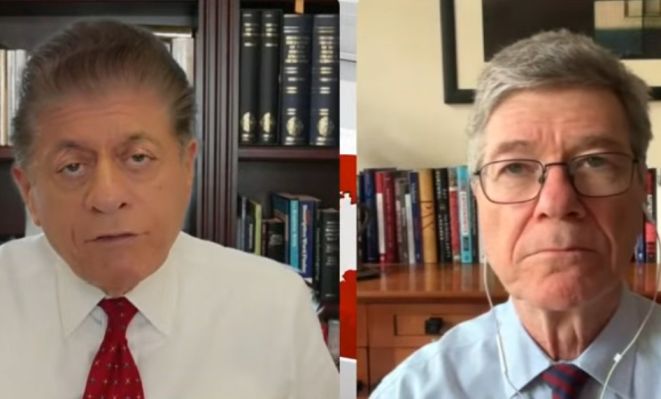
Editor’s Notes: In this episode of Judging Freedom, Judge Andrew Napolitano welcomes Professor Jeffrey Sachs for a critical examination of current global conflicts, focusing on whether the war in Ukraine is truly nearing an end. Professor Sachs provides a sobering analysis of the ongoing hostilities and the shifting geopolitical alliances, particularly the strengthening ties between Russia and China. The discussion also explores the broader implications of U.S. foreign policy in the Middle East and the potential for further escalation in regional tensions. (April 20, 2026)
TRANSCRIPT:
Introduction
JUDGE ANDREW NAPOLITANO: Hi everyone, Judge Andrew Napolitano here for Judging Freedom. Today is Monday, April 20th, 2026. Professor Jeffrey Sachs will be with us in just a moment. Is the war over? Which war?
Professor Sachs, welcome here, my dear friend. Thank you for accommodating my schedule. I want to take a break for a few minutes from all things Iran and speak to you about the special military operation in Ukraine. Is it effectively over?
The War in Ukraine: Far From Over
PROF. JEFFREY SACHS: Oh no, there’s fighting every day. There’s an intense drone war. There are Russian actions. It’s by no means over. Europe seems intent to pour in more weapons. Russia is continuing to fight for its stated objectives. So the war very much continues.
In fact, other moves that are rather shocking are reported, including Europe, many European countries saying that they’re going to essentially return young male Ukrainians that are in Europe right now forcibly back to Ukraine to be sent to the front lines. So, sad to say, the war is not over by any means at all.
Europe’s Failure to Recognize Reality
JUDGE ANDREW NAPOLITANO: Haven’t the EU elites recognized that Russia’s been around for 1,000 years and probably will be around for another 1,000, and they might as well live, and they might as well engage in peaceful coexistence?
PROF. JEFFREY SACHS: No, by no means have they recognized that. They seem intent — and I’m talking about a few of the key leaders, definitely the European Commission. I’d say, probably Macron, Starmer, Mertz, although he’s a little bit more ambiguous about this — that they want to create a new line which separates Russia from Europe. We had the Iron Curtain, so-called, during the Cold War. Now they’ve moved it to the east. They want Russia to be separated.
So they have broken trade relations, they’ve broken physical infrastructure links, they have broken the mutual trade with energy coming from Russia to Europe and European manufactured goods being exported to Russia. Those links are broken, and there is absolutely no sense of almost any European leader that they want to restore that.
Now, to my mind, this is all tragic, completely self-defeating. The reality that you stated is the overwhelming one. Russia’s there. It’s big, it’s part of Europe, at least the geographers say up to the Ural Mountains are in Europe. The interconnections that go back 1,000 years, the trade, the finance, the cultural interdependence are all real. But a number of European countries, goaded by the Baltic states and by Poland, have taken an extraordinarily ideological hard line against Russia to the great detriment of Europe.
I think it’s important to understand Europe is a very densely populated area, relatively light on natural resources. Russia is a huge area, relatively sparsely populated and rich in natural resources. That means from an economic point of view that Europe and Russia are naturally complementary, that they would naturally trade with each other. And they have for hundreds of years.
Europe decided to break that in an ideological position. So what Russia has done is to reorient towards another densely populated region with low natural resources, and that’s China. That’s also a complementary fit. Russia and China economically fit together just perfectly. So the Europe-Russia economic connection, which was very mutually beneficial, has been sundered. The Russia-China economic relationship was the result that’s also naturally mutually beneficial.
What Europe and the United States have done is to solidify a very strong Eurasian group that is not interested in United States and European hegemony. That is Russia and China, and many countries that neighbor them in Central Asia and in Southeast Asia and so forth. And this is basically the new world economy taking shape.
So that’s a long-winded answer to your question. Of course, Europe and Russia should live together. Russia is actually part of Europe geographically and in every other way. But the European leaders have made, in my view, a dreadful mistake.
Is Peaceful Coexistence Even Possible?
JUDGE ANDREW NAPOLITANO: Is peaceful coexistence even probable?
PROF. JEFFREY SACHS: Well, it’s either peaceful coexistence or they blow each other up. So in some sense, it’s not really a choice. It’s a necessity. But at an ideological level, it’s perfectly possible to have a Russophobic hateful Europe that is constantly blaming Russia for every ill, overlooking every sin that Europe and the United States commit.
And this is the big mistake in the world. I often point to the Gospels, I have to say, when Jesus famously says, “Why do you point to the mote in the other eye when you have a plank in your own eye.” I regard that as good foreign policy advice as well. Why do we do nothing but berate Russia? “Oh, you’re so evil, you’re so evil.” But then neglect completely our own behavior, the aggressive behavior, the overthrow of governments, the support for genocides, as if we’re pure, they’re evil. Therefore, we should break all connections and all relations.
That’s the approach we take. Heavily moralizing, heavily naive, heavily biased, and self-defeating. Self-defeating in two ways. You break the economic linkages, but you also stoke such hatred that it spills over to people dying in large numbers.
Why do the Europeans persist in this? One specific point we need to stress — and it’s true of our worst warmongers as well, such as Lindsey Graham and Richard Blumenthal in the US Senate — it’s the Ukrainians dying.
So okay, continue the war. We hate Russia. Let the Ukrainians die. It’s not our people dying. And to continue that dying, now they’re going to ship home any young Ukrainians that became refugees from this war in Europe.
So it’s totally awful, actually, the inability to take an honest assessment of the situation and find a mutual benefit from peace. That’s the reality we face.
U.S. and Israel’s Attacks on Iran
JUDGE ANDREW NAPOLITANO: Segueing a little bit, did the brutality and the treachery of the U.S. and Israel’s attacks on Iran shock the Russian foreign policy establishment?
PROF. JEFFREY SACHS: I don’t think anything the U.S. and Israel do shock anyone that has eyes open. U.S. foreign policy is without principle. It’s based on violence. It’s based on regime change. It’s based on lying and deceits. But the explanation is, oh, anything else is just niceties. So the U.S. behaves as if it’s all-powerful and can do what it wants.
I don’t think the Russians are naive to that. What I do find, I have to say, is the Iranians are a little bit shocked. Maybe they’re not as experienced with the US duplicity and treachery as the Russians are. The Russians have been at this since 1945. The Russians have faced the CIA, have faced regime change operations, have faced color revolutions, have faced all sorts of US unilateral sanctions, all sorts of US double standards for 80 years.
With the Iranians, they keep coming back and saying, “Oh, just be fair, be nice.” And then the US bombs and assassinates the negotiators each time. So the Iranians don’t quite get it, how the US behaves. But the US American behavior is basically our way or the highway, and we’ll kill you if you don’t like it. And if you sit down especially to negotiate with us, then we know precisely how to kill you. That’s the American way of foreign policy right now, unfortunately. It’s unprincipled.
The Collapsed Ceasefire and the Blockade of Iran
JUDGE ANDREW NAPOLITANO: Well, as we speak, it’s 11:15 in the morning, New York time, on Monday, April 20th. The vice president and his colleagues have landed in Islamabad, and the Iranian negotiators have not left Tehran. Do you blame them?
PROF. JEFFREY SACHS: No, not at all. We can see what’s happening, and it’s so bizarre, it’s primitive. None of us would behave this way. It’s only the arrogance of power that has the United States behaving the way it does. But let’s just recap for the last couple of weeks.
A ceasefire was reached. It was clear what it meant. All shooting should stop. Israel should stop its attacks in Lebanon. The United States and Israel should stop bombing Iran. Iran would stop retaliating with its strikes in the Gulf and against Israel. That’s what a ceasefire is.
As soon as that happened, Israel carpet bombed Beirut. And the Iranians said, “We have a ceasefire.” And the Americans said, “No, it doesn’t cover Lebanon.” And then the Pakistani mediator says, “Excuse me, it does cover Lebanon.” So when the attacks on Lebanon continued, then the Iranians said, “Well, look, we don’t have a ceasefire. We close the straits.” Then Trump says, “Okay, we blockade Iran.” Then apparently Trump said to Netanyahu, “Stop the attack so we can get back to the ceasefire.” So Israel, after massive killing of innocent people, bombing of Beirut, stopped the bombing. Then the Iranians said, “Okay, we’ll open the straits.” Then Trump says, “But we’re going to keep the blockade anyway.”
Unbelievable. Unbelievable. What is that? That’s no principle. That’s just American vulgar arrogance is all it is. And so things broke down because the United States can’t keep any deal for more than a minute, because the mindset of the United States is, why should we be talking with them? We are the United States. They need to surrender. That’s all. It’s simple. All the rest is a charade.
And so what’s happened now is that the United States has kept the blockade. And it attacked — it seems, I don’t know the details because it just happened within hours and I haven’t seen an authoritative account — but it attacked or boarded an Iranian vessel. So it opened fire, apparently. But in any event, it used its military to enforce this blockade. And then it says, “Negotiate with us.”
Well, what’s the negotiation? And incidentally, the whole point of the ceasefire was that Trump wrote, well, the Iranian 10-point plan is a good basis for negotiation. And then the United States hasn’t mentioned that one more time. Because what Trump said then is meaningless. The next moment you say something else because you’re the United States of America. You don’t have to take seriously anybody else.
And the speaker of the Iranian parliament, of course, famously tweeted that Trump lied 7 times in his post by making statements about what the Iranians would do. This is mind play of a side that regards the other side as nothing.
Trump’s Real Objective: Reversing 1979
PROF. JEFFREY SACHS: And the whole idea of the United States is to dictate, to take over Iran. And interestingly, Trump made a very telling statement that hasn’t been properly understood. He said that he’s done what the last 7 presidents for the last 47 years have failed to do. He’s taken on Iran.
Interesting statement. 47 years ago is when Iran broke free from the American imperial rule. The United States had established Iran as a kind of colony in 1953. It overthrew a government and then put Iran under a police state, which the US backed. That was the police state of the Shah of Iran. In 1979, the Iranians had a revolution and broke free of American control.
So Trump says he’s just regaining the control from 47 years ago. He’s not saying, “Oh, the Iranians didn’t agree last month,” or “the nuclear issue.” Those weren’t on the table 47 years ago. In Trump’s mind, he’s solving a problem from 47 years ago, not any of the specific issues that are purportedly on the table.
The only issue that’s really on the table from the US point of view is the idea that Iran had the nerve to break free of the American empire. That’s what’s on the table. We had Iran under our control from 1953 to 1979. And then they had the audacity to break free. And Trump is going to fix that because he says no president since 1979 has been ready to take that on.
Not about the nuclear issues, which didn’t exist then, not about any of the other issues. It’s basically a matter of raw power. The United States refuses to let Iran have its independent existence. Israel wants to overthrow the regime to build so-called Greater Israel, a disaster for the Middle East and for the people of Israel, by the way. And this is what this is about. This is about the test of power. It’s not about any specific issue that is claimed by the United States.
Has the War Against Iran Been a Failure?
JUDGE ANDREW NAPOLITANO: This is all so depressing. Do you think that Netanyahu and Trump have recognized that the war has been a failure? There will be no regime change, there will be no degrading of proxies, there will be no degrading of Iran’s ballistic missiles.
War as a Video Game: The Moral Collapse of Washington
PROF. JEFFREY SACHS: I’m guessing, but I think, no. I think that they want another round of this. I think we’re going back to a hot war, and perhaps even more destructive than the war that has killed thousands of people in recent weeks.
War has become almost literally a video game for the people in power right now. They don’t care about the lives lost. There hasn’t been one nanosecond in the United States where any single American politician, much less the President of the United States or our mindless Secretary of War, expressed any sadness over killing the schoolgirls on the first day. By the way, targeted by all accounts by Palantir, which I have not heard an apology for their mass murder from their AI program.
So what we have is video games. For them, killing people, that’s just, that’s what you do. You’re a great power. We have great AI systems we have to test. We have to test our drones. We have to test our targeting systems. Anduril, with all its insider investors and Palantir and all the role that these warmongers play inside the White House. It’s a video game for them. So I doubt that it’s at an end, except if Iran capitulates, which I don’t think it’s going to do.
JUDGE ANDREW NAPOLITANO: So, so depressing.
PROF. JEFFREY SACHS: It is. Because we’ve left any kind of normal morality, any sense. Of course, we have a President of the United States in contemptuous, vulgar attacks on the Pope. We’ve left any basic decency in Washington right now. These people are thugs. They are devoid of any human feeling. They’re playing games. They’re playing literally video games, except the people that are dying are not avatars. They’re real breathing human beings, men, women, and especially children.
That was true in Gaza too, but we’re in a world now where a genocide a few months ago is just forgotten. That’s passé. Oh, who wants to talk about that anymore? So this is extraordinarily dangerous, the kind of complete breakout from the most basic morality, “thou shall not kill.”
Preparing for Another Major Invasion?
JUDGE ANDREW NAPOLITANO: Do you think that Netanyahu and Trump are preparing another major invasion by—
PROF. JEFFREY SACHS: They’re certainly preparing. Whether they will do it, I don’t know, but you don’t ship at enormous cost these aircraft carrier groups to this region and tens of thousands of American soldiers and all of the ammunition, and that’s pouring in every day right now. So they’re certainly preparing.
I fear the worst because I see that there’s not even a glimmer of honesty and decency in the behavior of anybody in Washington right now. Nobody speaks the truth. No one bemoans the deaths. No one bemoans the vulgarity. No one bemoans the lies. No one bemoans the warmongering. This is all normalized right now.
And when you pour in tens of thousands of soldiers, and you have 3 aircraft carrier groups that are there, one is steaming there right now, and you have the return to the utter vulgarity of our president about the destruction that he’s going to unleash. And when you have Netanyahu, who’s a very sick man, by the way, talking about the 10 plagues that he has visited upon Iran — that was his Passover message — how can one think that this is just going to quiet down? It’s not.
We’ve lost any basic self-control, or I should say the American people have lost any control over the apparatus of war, and the warmongers have lost any self-control whatsoever and don’t show a glimmer of morality except quoting the Bible to justify murder.
The UN Ambassador and the Threat of Force
JUDGE ANDREW NAPOLITANO: Tell me if this, which we’ll play in just a few seconds, is typical of diplomacy at the United Nations. Chris, cut number 4.
VIDEO CLIP BEGINS:
UNIDENTIFIED SPEAKER: I hope we don’t have to go back to a military option, but President Trump’s made it very clear. And by the way, bridges, power plants that are run by the IRGC, which runs the entire military, are absolute legitimate military targets. Not only now but have been historically. That is a false, fake, and ridiculous notion that this is some type of war crime.
VIDEO CLIP ENDS:
JUDGE ANDREW NAPOLITANO: They didn’t add schools for little girls after bridges and power plants.
PROF. JEFFREY SACHS: Even if it’s bridges and power plants, it’s completely illegal. It’s completely in violation of all international law as well as international norms, as well as morality, as well as prudence and basic common sense.
In international law, what Mr. Waltz just said there is itself illegal. You cannot threaten another country with the use of force. Threaten. You certainly cannot use force against another sovereign country, except in self-defense under an armed attack. These are the most basic provisions of the UN Charter. Article 2, paragraph 4 says that no country can use force or threaten force against another country. And Article 51 says that the only legitimate use of force is in self-defense, and that has been understood and adjudicated for decades as meaning being under armed attack.
And so you have a US ambassador that doesn’t know even the first words of the UN Charter. This is par for the course right now. And then he quotes legalities. What he said just there was illegal — to threaten Iran with the destruction of bridges and power plants. On what basis? That the United States can do it. That’s the only basis. That’s not a legal basis. That’s not a moral basis. It’s also not a prudential basis, because Iran will retaliate and will cause devastation and the world will suffer. All of the world will suffer terribly from this, and this is normalized behavior of our regime.
JUDGE ANDREW NAPOLITANO: Professor Sachs, thank you very much. Thanks for the refresher on Ukraine and the refresher on — because events change so quickly — the past 2 or 3 weeks. All the best to you, my dear friend.
PROF. JEFFREY SACHS: Talk to you soon. Sure. Bye-bye.
JUDGE ANDREW NAPOLITANO: Coming up later today at 2 o’clock on All of This, Kyle Anzalone, and at 3 o’clock, Scott Ritter. Judge Napolitano for Judging Freedom.
Related Posts