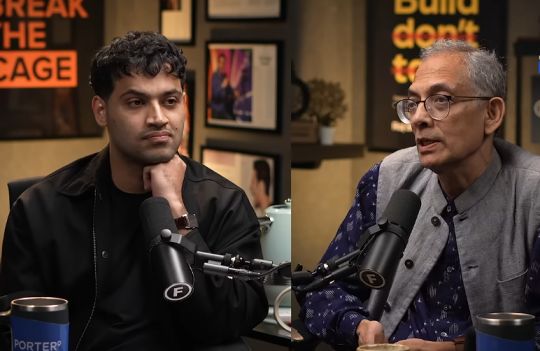
Read the full transcript of Nobel Laureate Abhijit Banerjee’s interview on Figuring Out With Raj Shamani, June 11, 2026.
Editor’s Note: In this episode, Nobel Laureate Abhijit Banerjee joins Raj Shamani to break down complex economic concepts like GDP, poverty, and inequality in India. Together, they explore how technology and policy changes are shaping the country’s future and why it is crucial to look beyond surface-level statistics to truly understand the challenges facing the Indian population.
Why Only the Rich Are Getting Richer in India
RAJ SHAMANI: Why only rich are getting richer in India.
ABHIJIT BANERJEE: I think there’s several pieces to that. As you will notice, there are certain global products which everybody wants. Call them iPhone, call them Prada, call them ChatGPT. But if you own those, and those products are all basically, the production cost is very little. Once you produce them, it’s just the intellectual property. You know, Prada’s Kolhapuri costs the same ₹600 or whatever that any Kolhapuri costs. And then they sell it for ₹6,000 or whatever. So, you know, it’s—
RAJ SHAMANI: Probably ₹60,000.
ABHIJIT BANERJEE: ₹60,000. I don’t know. I’m the last person who’s going to buy a Kolhapuri from Prada. So it’s not, I haven’t bothered to find out the price. But in any case, the point is that it’s not the cost. Therefore, if you happen to have the intellectual property to the thing that people want, it’s infinitely scalable. You can keep selling it to more people and you don’t run out of it because the cost of producing it is very, very little.
So therefore, that’s sort of the argument we make in our 2019 book, “Good Economics for Hard Times.” We make the argument that we are in a world of massive increasing returns. And so those people who happen to have the technologies where there is demand are going to become vastly rich. And the rest of the people, there is really very little that you can do to compete against that. So you are going to be, you can’t really get there.
In fact, now AI is doing something else, and it’s been happening for a while. Even in India, the business press recognizes that middle-class salaries have not been rising. This has been written about by people in the business press. Software salaries are flat, this and that. And that’s because partly the code writing is increasingly automated. Claude can write much better code than I can. So therefore, why would I do it? And that means that there’s a lot of jobs that used to be well-paid jobs in India, which are kind of disappearing.
And so if you look at the data on the income distribution, the rich in the income distribution — the data that we collect — totally leaves out the really rich. You can’t get to their apartments because their darwan sends you away. So therefore, the only people captured as rich in those surveys are actually the middle class. And those people are actually losing ground even in the National Sample Survey relative to the poor, who are doing construction jobs or this or that. There the wage is rising, not fast, but is rising somewhat. The wages of the software engineers is flat.
And so in fact, in the data, it looks like inequality is falling. Now, to me, my guess would be that’s false, because we really have no data on the rich. There is none. I mean, there used to be tax data. Many years ago, Thomas Piketty and I used the tax data to show that a big part of the gap between the kind of income from the National Sample Survey and income from the national product can be explained by the exclusion of the rich.
The Disappearance of Good Jobs for the Middle Class
RAJ SHAMANI: But are you saying that middle class is feeling poorer just because there are no good jobs left?
ABHIJIT BANERJEE: There are fewer and fewer good jobs. And that’s true globally. It’s not something that’s easily fixed because a lot of the Indian middle class were in the service industry. Unless you are — I mean, there are jobs that are clearly going to have more demand. Like being a healthcare professional is going to still be good because I think AI will help with healthcare. And if we have an aging population increasingly, demand for healthcare will go up. So I do think that healthcare will be fine. Teaching will be fine, I think. Though eventually I think some of the lecture will be replaced, I still think that there’ll be a lot of complementary activity explaining the lecture and all that, even if it’s an online lecture.
But I think other jobs, like for example being an accountant — AI is so much better at accounting than anybody. Or being a low-level animator, or any of these kinds of jobs which are reasonably high-skilled jobs that you have to learn how to do — AI is just so much better at those things. So I’m pessimistic about that class of jobs. People need to move out and into maybe podcasting, some creative sector, maybe.
RAJ SHAMANI: But what do you call middle class? Give me some income range.
ABHIJIT BANERJEE: You know—
RAJ SHAMANI: In India.
ABHIJIT BANERJEE: Yeah. So I would say people who make maybe over ₹30,000-35,000 a month, all the way up to people who make ₹1-1.5-2 lakhs a month, even more actually. Maybe these days, ₹3 lakhs. Yeah, that’s that range.
RAJ SHAMANI: Okay, so ₹30,000 to ₹3 lakh, you would call it middle class?
ABHIJIT BANERJEE: Yeah, ₹30,000 is really the bottom.
RAJ SHAMANI: And specifically, if you talk about tech jobs, it’s like ₹18,000 or maybe lesser than that.
ABHIJIT BANERJEE: Yeah, yeah. So ₹30,000 is a reasonable benchmark for a middle-class job. And then maybe the top end of that is ₹3 lakhs or something.
RAJ SHAMANI: Yeah.
ABHIJIT BANERJEE: What that means is that in inflation-adjusted terms, the salaries have actually fallen for many, many of these groups. Their inflation has been not huge, but still over 10 years there’s been substantial inflation.
RAJ SHAMANI: But why do you think this is happening? Because the top talent CEO salaries has been increasing, and it’s gone over the roof, but the middle-class salaries have stayed flat and probably fallen if you adjusted with inflation.
ABHIJIT BANERJEE: A lot of these jobs were, at some point, jobs that there was no substitute for. Increasingly, technology is substituting for those jobs. It’s a relatively simple point, which is—
RAJ SHAMANI: But shouldn’t in the companies where people are making a lot of money — or probably these companies which are global product companies that are profiting a lot and making a lot of money — the salaries should rise there?
The Market’s Logic and the Problem of Inequality
ABHIJIT BANERJEE: This is an interesting use of the word “should” there. I would agree with you, but it’s a very specific moral view of the company. The company takes the view that if I can replace this guy and get AI to do it for less, I’m going to do it. It’s the problem with the market — it has its own logic. And unless you actually actively resist it, let me say that it’s not true that the whole world works the same way.
In Germany or in Denmark, the highest and lowest salaries — the band is relatively small within a company. In Sweden or even in France, though it’s a little bit higher, the CEO is often paid maybe 10 times what the lowest employee is paid. In India, and in the US as well, you can make that division much wider. So there are labor markets that are much more normed, where there is an expectation that you don’t cross a certain ratio.
The US used to have that till the ’70s. And since then, the ratio of the CEO — I mean, you think of Elon Musk getting paid $54 billion. I’m not making that number up. $54 billion. So a billion is a million times a thousand. So 54,000 — if somebody gets paid that, which is a very good salary for a low-skilled employee, probably they don’t get it, they probably get 27 and not 54 — that’s a million times more. I’m just giving you a kind of benchmark example. But the fact that that’s considered acceptable socially, that’s a problem to me. That’s respecting the market way too much, to say that if I can get it, why shouldn’t I? That’s a level of cynicism which eventually undermines the social equilibrium.
Should It Be Illegal to Replace Workers with AI?
RAJ SHAMANI: Did you see what recently China is trying to do in the world of AI and jobs? They are saying that it’s going to be illegal to replace and cut human beings because of AI. Do you think that’s the right thing to do?
ABHIJIT BANERJEE: Yeah, I think so. I mean, the Chinese—
RAJ SHAMANI: It should be illegal to cut people off because AI can be more effective than humans?
ABHIJIT BANERJEE: The question is, what would the human do? In the end, one thing to realize is that when somebody gets fired, in India, we don’t do much for them. But if you take a state which is more welfarist — China is more welfarist than we are — they’re more conscious of unemployment being a social problem. It becomes the state’s liability. The state pays for those people to somehow survive, to transition to another job. It’s not free. It’s money that comes out of somewhere that’s paying for those people.
And so I think there is a legitimate ground to say that if I can increase my profit by 5% by firing somebody, but I ruin somebody’s life, then there is some value attached to that choice that should be taken into account. There’s some social concern that is reflected in the fact that this is somebody who has children who go to school, who will have a hard time — rather suddenly, even if he can get a job somewhere else — to move and to cut his standard of living and to sell his car and move out of his apartment. All of these things are extremely costly, emotionally costly, but also economically costly. Does he have to take his children out of the good school they go to and put them into a corporation school? All of those choices have social costs.
And so the idea that this is just the market’s logic seems to be missing the fact that there’s no justice in the market. It’s just somebody got lucky and got a better technology, and therefore I’m screwed. And there are costs being imposed on people. So I don’t know. You can obviously have a different view. Elon Musk surely has a different view, but I’m not going to take that view.
RAJ SHAMANI: But do you think then you should continue working with employees who are ineffective and inefficient with the growing technologies of the world?
ABHIJIT BANERJEE: The question is, what does that sentence mean? So inefficient, yes, maybe if some job can be done much better, you should let technology do that. But I think if it’s only 5% better, it’s not clear that the social cost is worth it. And second, I think society has an obligation to think about, well, then what will this person do?
The Human Cost of Displacement: Lessons from the US
ABHIJIT BANERJEE: I think one day we’re going to face this problem in droves — that there’ll be people extremely angry because they have nothing to do. If you think of what happened in the US, why there is so much support for Trump, it’s because there are places where people had jobs, they had stable living. And then Chinese imports came in and took those jobs away. And they were 53 or 57 or 46. And it’s very hard at that age to move because you’re not fresh out of college or something. You have your social network, you have your friends, your daughter goes to school, you are the coach of the local baseball team. And they suddenly realize their life is no longer viable. They have to move somewhere and live with their 80-year-old parents because they don’t have a living. And so they’re extremely angry.
One thing that you see in the US is the reason why I think Trump is popular with a certain group is because he articulates that anger. It’s a huge amount of anger. So I think eventually you can treat people like they are machines, but they’re not. Machines don’t get angry. And I think we need to take that into account.
India: A Top Economy with Widespread Poverty
RAJ SHAMANI: India is the 6th largest economy in the world. Actually, we’ve fallen down to 6th now.
ABHIJIT BANERJEE: It’s a bit about — these are very fragile things because the rupee goes down because there’s a war in the Gulf. Are we suddenly much poorer or not? It depends very much on too many factors that have no real meaning. So true, true.
RAJ SHAMANI: But so we are 6th in the world, 6th largest economy, and yet we have one of the world’s most poorest populations in the country. How are both of those things true at the same time?
Who Is Getting Richer? Understanding India’s Poverty Gap
ABHIJIT BANERJEE: So one thing to say is this — I find this rather, I don’t know, I think there are reasons to maybe sometimes talk about the size of the economy, especially if you are talking about what happens to the global economy if India suddenly slows down, then the size of India matters. But for poverty, what matters is per capita income. And we’re still very poor in per capita income. Because it’s not — we have a gigantic economy, but we have an even more gigantic population. So once you do the division, you get to where the real meat is.
RAJ SHAMANI: But so are we getting richer or poorer then?
ABHIJIT BANERJEE: We’ve been getting richer. I think the question is more what you asked right at the beginning, which is who’s getting richer. And there, some people are getting richer and richer and richer. I go sometimes to an expensive restaurant in India. And it’s like, you can’t get in. There’s so many people who can spend ₹5,000 per head without a thought. And then there are people who can’t spend ₹5,000 in a month. But it’s not that you see the — yeah, you know what I’m talking about.
RAJ SHAMANI: Yeah. And what do you think is the biggest thing then which economists, politicians, or all the experts are probably fundamentally getting wrong about India’s poor?
ABHIJIT BANERJEE: I don’t think they’re getting it wrong. I mean, there are kind of very politically motivated people claiming there is no poverty in India. But I spend a fair amount of time traveling in rural India, so I have a relatively firsthand view of this. I was in December in northern Maharashtra in the tribal belt, and you see what the houses are like. I’m not saying that things haven’t improved — things have improved. But if you look in Mumbai, the jhoparpattis are still there. You come into Andheri and suddenly there is this set of completely falling down little — I mean, other than people who have very specific political motivations, it’s hard to imagine anyone not recognizing that there’s a fair amount of poverty left in India.
That’s not to say that things haven’t improved. Things have improved vastly in my lifetime. The poverty I saw when I was a teenager — I spent a fair amount of time in villages in Jharkhand or somewhere — the poverty was dire. Nobody had, you know, people wore one dhoti and maybe had a gamcha to put around their shoulders, but that was it. There was a dire poverty.
The Rich-Poor Gap: What Has Changed?
RAJ SHAMANI: What has changed about poverty and the rich-poor gap?
ABHIJIT BANERJEE: I think the rich have got richer relative to the poor. But the government has also — our fraction, the fraction of income that the government gets, has gone up. GST has increased the government share. Now, a lot of that money is coming from middle-class people who are spending. It’s not that it’s coming from the rich. GST is something everybody pays — it’s not that Ambani pays the same GST as the poorest person, there are some brackets and this and that. But still, that money means that for the poorest people, the government is able to redistribute. And there is more redistribution now than there was before.
The NREGA wages are higher. The jobs in construction — I’ve actually spent a lot of time interviewing construction workers in Delhi and Hyderabad, not last summer but the summer before that. And they were getting paid, depending on your skill level, ₹500 a day or ₹350 a day, but not ₹50 a day. If you paid ₹50 a day, you wouldn’t get anybody. They would stay in the village. So there is an effect — if you can make some reasonable amount of money in the village, why would you move to the city unless you’re paid substantially more? So I think there is a push pressure from the bottom. And that has meant that nobody’s making the kind of salaries that people were making even 20 years ago.
RAJ SHAMANI: So that has changed — at the bottom, people are making more money.
ABHIJIT BANERJEE: And I think that’s a result of policy. The fact that now, for example, if you live in a village and you are classified in the bottom 75% of the economy, you get PDS. You get food subsidies. So survival is possible — if you live in your village and you have a ration card, you can live off that. It’s not wonderful. I don’t want to glamorize poverty in any way. I find it reprehensible. But I still think that things are better now.
What Is RCT? Explaining the Nobel Prize-Winning Concept
RAJ SHAMANI: So coming back to your professor mode a little bit — we started that way and you said you can teach with basic terms as well. So first teach me, on a whiteboard or a white paper if I have to just put it out for you — what is RCT? How would you explain it to me if I don’t know anything about it? Why did you win the Nobel for it?
ABHIJIT BANERJEE: Okay. So, imagine that you want to know whether having computers in school matters. These are different schools — some of these have computers, some of these don’t. What would your guess be about the performance of the children in these schools versus these schools?
RAJ SHAMANI: They’ll perform better because they have computers?
ABHIJIT BANERJEE: Or because they are in schools that can afford computers. Their parents are richer. Their parents can hire tutors. Their parents have access to online classes. So everything is correlated here. What RCT does is it says — if I want to study the effect of computers on children’s learning, the first thing I need to do is compare like with like. I can’t compare the Ambani school with the Bombay Municipal Corporation schools for a million reasons, not just because they have computers.
So what I should do is run an experiment where I randomly choose schools. I’ll randomly choose this one, and this one, and this one, and give them computers, and leave the rest without. Then these are comparable because I chose them without any systematic bias — I blinded myself and picked them out of a hat. Then I can compare them and say, is learning really higher in the schools that have computers than the ones that don’t? That’s the extremely basic idea. There’s a lot of technique and statistical nuance to deal with, but the basic idea is that if you just compare naively, you get biased outcomes. You might say children in a wealthy school learn better because they have computers, but in fact that’s not true. This is what we are guarding against.
RAJ SHAMANI: And what could be one statistical nuance?
ABHIJIT BANERJEE: Suppose I chose 4 schools to have computers, but only 3 of them actually got the computers — the delivery to one of them failed. What do I do in that situation? Does the experiment have to fail, or is there a way to deal with that nuance?
The answer is, if I compare the schools that were originally assigned to have computers with the schools that were assigned not to have computers, that’s still a valid comparison. I know that not all of them got it, but I can scale by that. So that’s a statistical nuance, if you like.
How Economists Think: Individual Choice and Collective Outcomes
RAJ SHAMANI: Got it. And what if you had to explain economics to me in this way — how would you explain economics?
ABHIJIT BANERJEE: Economics takes very seriously the idea that you have to understand people’s motivations in interpreting the effect of anything. So if I want to look at what happens in a particular situation, I can either say people are from this caste and therefore they behave in this way. Or I can say that the world is always changing and they’re also looking at other opportunities. And therefore I need to understand how people’s behavior interacts with the market situation or the institutional situation.
Economics takes that second step very seriously — that individual choice and collective outcomes are related, not in a mechanical way. It’s not just because I’m from a particular caste that I won’t do a certain behavior. What I do also depends on what government programs are available, what kind of schools are available, what the macroeconomic situation is, whether I can borrow easily or not. All of these things matter.
So you can always take the fact that people are inside this complex of related but distinct institutional movements, making active choices — economics takes that very seriously. That’s what makes economics a very distinct way of thinking about anything.
When I think about the computer in the school — going back to that example — I naturally ask, why is it that these schools have computers and those schools don’t? I have a theory of that, which makes me suspicious of comparing them naively. Why am I suspicious? Because I know these schools probably don’t have a computer just randomly. They probably have a computer because their parents are rich, or the government is particularly focusing on these schools, or some particular privilege is there. Asking that question is what makes me an economist — I’m very much interested in the underlying causal mechanisms that cause these differences. And that allows me to then think of what’s the right experiment.
Indian Economics and the Pressure Cooker
RAJ SHAMANI: Interesting. And you said on the briefing call that you would explain Indian economics with the help of a pressure cooker.
ABHIJIT BANERJEE: The pressure cooker is a good example of something we use a lot more in India than in most of the world. Indians have adopted this technology even though it’s actually a very interesting one. The fact that pressure raises the boiling point and therefore allows things to cook much faster is an idea that has been around for a while. But if you look in a regular US household, they wouldn’t have had a pressure cooker till 20 years ago, when in some sense the Instant Pot — which is actually a pressure cooker — was introduced. And even then, the Instant Pot went out of business. It’s not vastly popular there.
It has something to do with two things. One is our lifestyle — we make slow-cooked dishes, what were traditionally slow-cooked like dal, and we need to melt things, which is relatively unusual in the US or in Germany. The second thing is that we are poor, and especially we are an energy-poor country. We are always conscious of energy prices and very sensitive to global energy prices. So we are always going to be worrying about — can I afford to cook this dal? This chana will take a long time to boil. And what a pressure cooker does is make that much more energy efficient.
So the pressure cooker is a very good example of where preferences and the market interact to define a particular style of cooking, which is very Indian. You read an Indian recipe and they’ll always say, “Put it in the pressure cooker, wait till 3 whistles, and then you’re done.” You try finding that in a Chinese recipe or a Spanish recipe — it just doesn’t exist. The fact that it’s there is a very interesting interaction of energy prices, poverty, and taste.
RAJ SHAMANI: But so the pressure cooker became popular just because of energy efficiency in the country?
The Economics of Food, Poverty, and Behavior
ABHIJIT BANERJEE: We had used to have something called ikhmi cooker before the pressure cooker, which was, I think, I’m actually not old enough to have used one or seen one. But I think there was a prior thing where they would at least cook. And I’ve seen that as a child, I saw that. When you cook rice, you put in a little dabba inside the rice, you put some sabzi. So that when the rice cooks, the same heat cooks the sabzi. And so that idea is, I think the ikhmi cooker basically was a way of using that structure.
So there’s all this thinking about how to economize on energy. And this has been a while. I mean, I’m saying last 100 years we’ve been— ikhmi cooker goes back to the 1930s or something. So I think these things were— ikhmi comes from economic, by the way. It’s exactly this idea that it was an economic way to cook.
RAJ SHAMANI: And what has what these things has to do with economics.
ABHIJIT BANERJEE: So one of the—
RAJ SHAMANI: samosa, laddu, chips, and mithai.
Why Poor People Eat Chips and Samosas
ABHIJIT BANERJEE: So one thing that, one idea that I think is very prevalent even in our policy conversations in India, I mostly say unfortunately, is being judgmental about the poor. And you hear this a lot. You say that, you know, she was, she has no money, but she is always eating samosas or something or having chai. And I always thought that’s backwards.
Because we have such fulfilling lives, we are able to, it’s much easier to resist temptations when you have fulfilled lives. It’s easy to be disciplined when I know that I’m getting lots of rewards. When you think your life is a bit dreary, you know, you clean people’s dishes. Some pleasure needs to, there has to be some space for pleasure. Otherwise, life isn’t worth living.
And so I think fundamentally, why are chips popular? Chips are popular because they are very easy to transport. They are available. If you go to a village in, I know, in rural Udaipur district, okay, which is, you know, once you get out of Udaipur and you go 50 kilometers, you are in the middle of nowhere. I spend lots of time in those places. And in those villages, you’ll get Parle-G and you’ll get a bag of chips. These are durable. So there are things that are easy to, you know, they provide a certain amount of quick satisfaction. They’re cheap to transport. So, cheap, therefore, they stay cheap. If you try to provide, you know, this burfi there, that would be much more expensive. Burfis don’t travel well.
So there’s a logic to why these things are available, which is for poor people, they want something a little bit different. They eat, you know, whatever, makai ki roti and some sabzi, and it gets tedious. And especially children, I think, it’s the children often say, “I had that every day.” So mother then says, or father then says, “Chalo, I’ll get you a bag of chips.” I think those are very important for survival. And in that sense, I am very much against being judgmental about what poor people do. I think they have a hard enough life without us criticizing them.
RAJ SHAMANI: True. So they usually consume more chips and more samosas because of indulgent pleasure?
ABHIJIT BANERJEE: I think not more because of course we can afford anything, but for them it’s much more important.
RAJ SHAMANI: And it’s like a short escape for them? Yes. And what’s with laddu and mithai?
ABHIJIT BANERJEE: They’re the same. Laddu and mithai, I’m just saying—
RAJ SHAMANI: But it’s much more expensive.
ABHIJIT BANERJEE: It’s much more expensive, so it’s a much bigger treat. They might actually give it to the God. Say, you know, you’ll buy one mithai and you give it to the God and then you share it among your family. You know, then you have done some, you know, so you got some punya and you also got some mithai.
RAJ SHAMANI: And what if you wrote something about this somewhere?
ABHIJIT BANERJEE: It’s a good one. It’s a nice one.
The Nutritional and Economic Value of Guava
RAJ SHAMANI: Why is guava so pyara?
ABHIJIT BANERJEE: Exactly.
RAJ SHAMANI: What is in guava?
ABHIJIT BANERJEE: So guava, turns out, has a very— is a very good source of bio-accessible iron. So the problem with iron is partly that many things have iron, but they’re not very bio-accessible. Meaning they don’t— even if your body gets it, it expels it basically. So you don’t actually absorb the iron. The advantage of guava is it has— it’s a very good source of bio-accessible iron.
And we have a huge anemia problem. We are like with a few other countries, we are kind of where the anemia in the world is concentrated. And so, the guava is— it was more that it was an example of some very simple thing we can do to help with this anemia issue. That there is not a matter of—
RAJ SHAMANI: How anemia issue in Goa and economics, it’s related?
ABHIJIT BANERJEE: Well, anemia is a huge productivity issue. There’s evidence showing that anemic people are 20% less productive. Okay, so big gains from anemia, solving anemia. So that’s one part of the economics. Economics, productivity is like, you know, if you read the business press, it’s like number one issue. So there’s nothing so surprising about.
And the second thing is, I think that goes back to what I said before about understanding behavior. So what’s nice about guava is it’s available everywhere. It’s really like one of these things that grows in most villages. You don’t have to, it’s not a, and it’s tasty. And so people are willing to eat it without really, you don’t have to, it’s not a, you know, that this special saag that you have to eat and, or this laddu that has made with this and that and the other. Is there a kachchi? It’s much more difficult to implement when it’s something that people intrinsically don’t. But if a guava, if you tell people that, yeah, eat more guavas, this is still easy.
And I think that’s the connection with what I was saying with the economics, which is understanding what behavioral, how do we deal with that people have certain behavioral patterns and they will, if you give them a very difficult challenge, you know, you have to go to the city and buy this thing and regularly eat it, some will do. But a lot won’t. But if you say, “Gaame pyara milta hai, aap har roj ek khale na,” perhaps a lot more people will do it.
RAJ SHAMANI: True. And why will earnings go 15% up?
ABHIJIT BANERJEE: Because anemia just undermines work. Anemia, you just, your body doesn’t absorb oxygen. So you get tired. It’s very simple. Iron is— you know, hemoglobin is related to iron, and if the body doesn’t have enough iron, you get tired faster. It’s very— there’s lots of studies of that.
The S-Curve of Poverty
RAJ SHAMANI: And what is an S-trap curve of a poverty curve?
ABHIJIT BANERJEE: So, this— nice, nice. So, think about somebody, okay, who has extremely low income. And when you have extremely low income, you’re, you know, you’re tired all the time. Just, we talked about anemia, but even just not having enough calories means you’re tired.
Or I give you maybe a more, an example I believe more. Suppose you want to start a business. But, you know, a business where you have a shop, you maybe you can have a shop. A lot of, if you go to slums all over in India, you see that there are lots of shops. People basically take part of their front room and put a wall and put a shelf and then they put some stuff on it and so you are Kirana, little Kirana shop. Typical, absolutely. But maybe you can do all that without a lot of capital. But if you don’t have any capital, you can’t put anything on the shelves and then nobody’s going to come to your shop. It’s a waste of time.
So that means that the productivity of your investment actually goes up very fast as you get more and more investment. So what the idea of the S-shape is that when you’re very poor, going from being able to stock 2 packets of biscuits to 6 packets of biscuits is still pointless. Nobody’s going to come to your shop for the 6 packets of biscuits. But if you go to 6 packets of biscuits, biscuits plus, you know, some other chips per mixture, plus, you know, other toothbrush plus toothpaste plus shampoo, then people will come.
So the return to capital is steeply increasing for a while. You have more capital, you can just— your shop, you have a shop, but your shop is worthless till you have enough. So that’s the idea of an S-shape is that for a while, if you think of the left tail of the S, a little bit more and a little bit more and a little bit more doesn’t do much. So you have to get a substantial amount before the business really flourishes because till then, nobody’s going to come to your shop to see if you have the fourth packet of biscuit, but they will come if you have many things and, you know, it’s attractive. And when I get there, I’m going to think of what I’m going to buy, but it’s a nice attractive shop.
So it’s very much this idea that as we get further up the S, S kind of goes up steeply for a while. So that’s, if you make more investments, you get for a while the returns. And of course then at some point, if you have a small store, there’s no point investing more. So then it becomes the top of the S where it kind of flattens off.
Lump Sum vs. Monthly Payments: A Kenya Experiment
RAJ SHAMANI: So you’re saying that if you have to get someone out of poverty, giving them small amount of money, probably every quarter or every year is not going to make significant difference? Giving them one short lump sum money is going to make the difference.
ABHIJIT BANERJEE: Yeah, I did an experiment in Kenya where people got either, you know, I guess, monthly small amount of money, or they got all of that at the beginning. So then this, both of this continued for, so I’ll actually say it in 2 steps. So this continued for, so the monthly small amounts of money continued for 2 years. The lump sum that they got was equivalent to that 2-year amount.
RAJ SHAMANI: Okay. What was it like, what was the monthly?
ABHIJIT BANERJEE: It was, I think it was, so 83 cents a day in, but at Kenyan real exchange rate. So, the amount, it’s more like a monthly in dollar terms. Would it be, it would be something like maybe $8, $9 a month.
RAJ SHAMANI: A month. Okay. So, like ₹800.
ABHIJIT BANERJEE: Yeah.
RAJ SHAMANI: Somewhere around that.
ABHIJIT BANERJEE: Yeah.
RAJ SHAMANI: A month.
ABHIJIT BANERJEE: A month.
RAJ SHAMANI: Into 24.
ABHIJIT BANERJEE: Into 24. Or, or the equivalent in, in—
RAJ SHAMANI: One lump sum.
ABHIJIT BANERJEE: One lump sum. And you see that the lump sum generates many, many, many more businesses than the— So, this is a randomized controlled trial. Some villages got this, you know, small amount, some people.
What’s more remarkable is that some people were given a promise that they will get that small amount for 12 years. And the lump sum was only for the value of 2 years. And it still generated more businesses than the 12-year amount. Why? Because people, exactly what you say, you know, what will people, you know, you give them small amounts, they’ll never be able to— either they’re very disciplined and they save up and save up and save up, or there’s no way to turn it into a business. So they buy whatever, you know, they repair, they spend it in whatever way that makes sense for them. But assuming that it’s very hard for them to build a business, whereas you give them a lump sum, they know that this money will go if they don’t turn it into a business, they turn it into a business.
Does Free Money Make People Lazy?
RAJ SHAMANI: But then, has it ever happened that if you give lump sum money to somebody for no reason, just for free, they end up misusing it?
ABHIJIT BANERJEE: Sure, some people will. But I think the most striking fact is that, you know, you don’t really see— there’s lots of studies of this, of people getting lump sums or getting, you know, free money of some kind. And there’s no evidence that it generates more laziness or more drinking and all the things that people imply. There’s evidence on all of them and none of them happen.
RAJ SHAMANI: But you’ve junked this theory, right?
ABHIJIT BANERJEE: I’ve junked it for years and the evidence keeps mounting that it’s not true.
RAJ SHAMANI: Tell me, explain me if somebody is hearing this for the first time, why do you think or believe that giving free money to people or giving freebies to a lot of poor people is not making them lazy. It’s actually good for them.
ABHIJIT BANERJEE: Yes, it’s good for them. In fact, there is a—
RAJ SHAMANI: It’s not ruining them.
The Evidence on Freebies and Work Ethic
ABHIJIT BANERJEE: Yes, there is a study. Before USAID was shut down, they did a meta-analysis, which is like when you combine 140 different studies and looked at the effect of that on work. And they found that people who get freebies, let’s use the popular word, work slightly more, not much more, but slightly more, not less. The important thing is that they don’t work less, they work more.
And that’s what we found also. When you give people, in all of these studies, there was no evidence that they work less. Why? Because I think we misunderstand what motivates work. I think being depressed and thinking that your life basically sucks is not a way to get people enthusiastic about working. When you give them an opportunity, they say, “Look, you know, you can do— now you can have a better life maybe.” They are more enthusiastic about trying things. I think we just don’t understand.
RAJ SHAMANI: But do they not get used to that, “Hey, because I’m getting things for free, I should just be this.”
The West Bengal Study: 17 Years Later
ABHIJIT BANERJEE: I’ll give you an example. In West Bengal, we did a study now 18 years ago, 19 years ago. There were women who were extremely poor. So poor that the poor people in the villages, we asked them, “Who’s poor in your village?” And they would say, “Those people are poor.” So we did a mapping and they identified the poor.
So these were people who the very poor people who live in West Bengal villages all thought were poor. They were given an asset, given. Usually, some got cows, some got goats, some got some trinket to sell in the local villages. They could choose. They chose whatever they wanted. And then they were given some handholding. Somebody from the organization came and said, “Yes, yes, you can do it.” And that went on for a year.
We now look at them 17 years later. We have data for them 17 years after. So we’ve been following them. 17 years after, the people who got that asset are 40% richer. They’re still richer. And this asset was given to them once. Remember, that’s why it connects to your question. They were given the asset in 2007. And in 2024, we see that they are 40% richer. The consumption is higher. Their income is higher. Their children are doing other things. Their lives are transformed.
It’s more that I think people underestimate how hard it is. It’s not that everybody does that. Of course, some people, whatever their mental illness— I mean, there are lots of reasons why not everybody will do it.
RAJ SHAMANI: Yeah, they’ll get drinking problems, they’ll get some stuff, but that’s going to be very small.
ABHIJIT BANERJEE: But on average, the effects are dramatically positive.
Why the Poor Are More Motivated, Not Less
RAJ SHAMANI: Why do you think is that? Like, why do you think— actually, there are two questions to this. One is, why do you think people who have been given free cows or free business opportunity or free money to start something, why are they more motivated? And eventually in 10, 12, 15 years, they do better rather than just getting addicted to the free money or free stuff and misusing it. That’s the first question.
And then second is, if there is enough evidence that people who have been given freebies do better, why do a large section of society believe that they’ll get addicted to free money and be lazy, and that giving money is not good?
ABHIJIT BANERJEE: The first part I’m going to answer quite specifically. And the second one, I’m going to say something and then speculate a little.
So the first part is, I would say, you know, for a lot of people, it goes back to that S-shaped curve we discussed. It’s the fact that they are— it’s not that they were sitting there waiting for, “Okay, I get some free money, I’m going to go on vacation.” They were hoping that they get a chance in life. A lot of people want to do things in their life.
And you are someone who’s done something in your life. You know that you didn’t come just from this sense that, “Okay, this is programmed into me.” It was a choice. You wanted to do something. And I think, why would we think poor people are any different from us? So if you give them an opportunity to give a better future for their children, a better future for themselves, to live in a house that’s a nice house, why would they just say, “No, no, I should just go drink?” Why would that be the psychological model that we believe in? That’s my answer to the first question.
Second question— so there is actually now a fair amount of policy traction. In Bihar, the GVK, which is part of the Labour Ministry, a semi-governmental organization which implements social programs, they implemented this program I described to you, which is the one of giving cows, et cetera, which is called the Graduation Program, bizarrely enough. That program they implemented, I think, for 1 lakh families. And with part of that sample, we did a randomized controlled trial. And it’s vastly successful, dramatically successful also.
Why the Rich Underestimate Luck
So my view is that there is now some policy traction. The last question is why do people resist it? Because I think people need to feel that their success is fully earned. And so these poor people, they didn’t earn it. “I earned it.” In fact, we don’t recognize that a huge part of our success is always luck. We were born into the right kind of family.
I was born into a family of professors. My grandfather was a schoolteacher. My great-grandfather was a schoolteacher. We had books all over the house. So the fact that I can read and write and understand things is not an accident of my genius. It was just luck. I was born in the right place. My parents encouraged me— they discussed ideas with me. My father would give me math puzzles and we would discuss them. All of this cultural capital is luck.
And I don’t think of myself as being a genius. I think of myself as being someone who was in the right place at the right time, and I benefited from it. I think people underestimate how difficult it is for the poor to get out of where they are, and how much pressure is on them. And in reverse, they give themselves too much credit.
Why the Wealthy Give Less
RAJ SHAMANI: And why do you think rich people don’t do much charity? They don’t actually give freebies. A lot of people don’t. And I asked this question specifically to Bill Gates as well— when you go ask for money, or probably just spend time with people with a lot of money, why are there just a few tech billionaires who are ready to give away their entire wealth versus the conglomerate who’s accumulated wealth over years and years, and they are not able to give money so easily?
ABHIJIT BANERJEE: I think, sadly, a lot of people have the attitude of, “Why will I?” I find it deeply disturbing. And this is not everybody, obviously— there are people who actually genuinely are committed to the poor. And Bill Gates is an excellent example. What is particularly laudable about his example is that he not only gave his money, he gave his attention. And that’s a very valuable thing. He’s a very, very thoughtful man. He gave his intellectual investment to this project. And I fully credit him for that.
I think what gets misunderstood is that it’s also exciting to do these things, to solve problems. And a lot of people haven’t got that taste. A lot of it is also about feeling that this is a remarkable project. When people do charity, they haven’t yet got this idea that, “This is going to give meaning to my life.” There are people, of course, who do feel that way.
RAJ SHAMANI: But more rich people give less money. There are few who give a lot.
ABHIJIT BANERJEE: Because I think they also feel that it’s not exciting for them, and there’s all this nonsense about, “This is going to just be bad for the poor.” I really think this conversation is important because I hope people really look at the data. I’ve been looking at the data, and I don’t think I’m a pushover. Part of the reason why I’m successful is that I’m known for being quite careful about these things. And I would say the evidence is very clear that this is not going to ruin the lives of the poor. So they tell themselves these stories also. That’s why the stories are damaging.
Is Freebie Politics Ruining India?
RAJ SHAMANI: Why do people also say, because if there’s data that freebies are actually helping, that the freebie politics in India is ruining the country?
ABHIJIT BANERJEE: So there is a question which is slightly distinct there. I think part of it is what we discussed, which is that people don’t like the idea that their tax money is being given to the— this issue you read all the time, I must say, and it depresses me.
RAJ SHAMANI: But do you think that freebie economy or freebie politics is ruining the country?
ABHIJIT BANERJEE: I don’t. And actually, it’s interesting that all parties do it. And I don’t think it’s ruining the country.
RAJ SHAMANI: But they keep topping it up.
ABHIJIT BANERJEE: They keep topping it up, but remember the country is also getting richer. It’s not that the share of GDP going to the poor is dramatically exploding. So as the country gets richer, there’s more GST, as we discussed, and there’s more money to—
RAJ SHAMANI: For welfare.
ABHIJIT BANERJEE: For welfare. So I don’t see a reason why this is such an awful thing. But nonetheless, I do think that the one worry which is real is that there’s a little bit of chasing visibility. In Tamil Nadu, it was famous that before the elections, the Chief Minister would summon people and tell them, “This time, TVs for everybody,” or “Computers for everybody.” So there is a little bit of that. And it’s not clear that everybody needs a TV or needs a computer.
So I do think that there is some amount of visibility chasing, which makes it sometimes wasteful. There is some reason to try to be very disciplined about these things and say, “Here’s what the evidence says, and we should really invest this money thinking about the long term,” rather than, “Here is a pre-election scheme, which happens to be computers for every school.” It may be that that’s not what they need. I do think that there is some validity to the concerns.
Competitive Welfarism: Good or Bad?
RAJ SHAMANI: So do you feel this competitive welfarism for popularity in winning votes— is it good or bad?
ABHIJIT BANERJEE: I would say that overall it’s meant that more money is going to the poor. So it’s good. As I said, there are better ways to do it. And I’m happy that Bihar went through this. They really went through the research. We discussed the research with them. So they were very mindful of the fact that money, if you want to do right by the poor, is scarce.
RAJ SHAMANI: And what would be a better model to give? The way government is in a few specific states, they’re giving it to women— 1,000 rupees a month, or 3,000 rupees a month, 2,000 rupees a month. What do you think is a better way— giving them 1,000 rupees a month for the next 5 years, or giving them upfront like 60, 70,000 rupees upfront?
ABHIJIT BANERJEE: Women’s labor market opportunities are often very constrained. Will their family let them start a business? I remember a lot of the women we worked with in that graduation program were actually either abandoned women, or widows, or had husbands who had a stroke and were not going to do anything. And so they were actually very much working. And whereas a lot of our— this issue about labor force participation— I don’t know whether women will be allowed. This whole story that I told is about women being able to work. And so that’s the reason why it may be different for women. In India.
RAJ SHAMANI: Doesn’t it become a big hole, or like a big burden on a state’s capital or budget? Isn’t that a problem? Because then, I mean, is that not harming the state because they’re spending literally lakhs, crores of rupees?
Tax Havens and Global Taxation
ABHIJIT BANERJEE: You know, another way to think about it is that the fact that there is social peace and that India is a relatively stable country and that there’s not a lot of violence and all that has something to do with the fact that the inequalities that are as glaring as they are, you started with inequalities, so I know you’re aware of it, are not allowed to explode totally. That is, in some sense, the poor are not allowed to go to zero.
So I think there is something there about maintaining social coherence that’s critical in any society. So I don’t even think that this is— I think the rich should understand that their access to a stable large economy is partly funded by these social programs.
RAJ SHAMANI: You have publicly said that tax havens should go.
ABHIJIT BANERJEE: Yeah.
RAJ SHAMANI: What do you mean by that?
ABHIJIT BANERJEE: Should go, meaning every country should want them gone. I mean, why would you want tax havens? It’s a bit like, you know, it’s undermining your own project of taxing people. And then there’s a little bit of cynicism sometimes in the sense that governments often want to pretend that they are very serious and then not do it because the rich are very powerful. But beyond that, I see no reason to have any sympathy for tax havens.
RAJ SHAMANI: But why do governments not ban tax havens? Which one would be the most lucrative tax haven in the world?
ABHIJIT BANERJEE: In the world? Probably less. I think both Switzerland and Monaco are probably, but they’re less and less good tax havens.
RAJ SHAMANI: They’re not great tax havens.
ABHIJIT BANERJEE: Like Saint Lucia and all of that would be great tax havens, but they are a little bit less, you know, people are— what Monaco does is it is like, you know, you become a resident, there’s no taxes. It’s much more like legit. Now, if you move to St. Lucia or Grenada, it’s a little bit dodgier. It’s shady. So there is some trade-off there. But I think both Monaco and Switzerland are moving towards more compliance. So I think that this is changing. I think it should change totally.
RAJ SHAMANI: But why, let’s say, why does a country like India not ban these tax havens?
ABHIJIT BANERJEE: The question is, what does the ban mean? Mauritius and Dubai are big investors in India. So Indians take residency in Dubai. So what does it mean? You can’t invest in India if you’re a resident of Dubai? Dubai gives you no taxes. So it’s not that.
The question is more what counts as taxable income in India. And there are countries, the US for example, which are much more tough about that. They don’t, you know, you can’t just say that I’m leaving, bye-bye, and I won’t pay taxes. And Sweden has an exit tax, you have to pay to leave. So there are countries that can do much more, but it’s a matter of— you can’t tell people that they can’t move to Dubai.
So therefore, when you say ban, what does it mean? If there was a world agreement that says that if Dubai does it, we’ll stop all trade with Dubai, then indeed you would have no problem. Or if St. Lucia has to grow all its crops because we’re not going to give them any food, then— using trade to coerce countries is not unknown. So we could do it. We could say that Grenada gets no more rice, and then they will presumably have to collaborate a bit more.
RAJ SHAMANI: But why should it happen? Like, countries like Monaco or the UAE, they survive on the fact that they’re building such a good, safe, secure country, which is probably tax efficient for ultra-high-net-worth individuals. That is how they attract people, or else they’re just going to be deserts and barren lands.
ABHIJIT BANERJEE: But the amount of damage they do to countries which have many, many, many more people. It’s a matter of people, right? So eventually we want to help large populations. And these countries do huge damage too.
RAJ SHAMANI: But it’s always going to be like a debate of— how do you, like, do citizens of these countries matter more because that’s how they make money versus some other country where there are more people?
ABHIJIT BANERJEE: I think the debate is more about— when my economic model is that I’m going to exploit some other country, then you could say that that country has a right to push back. Europe is basically— I think there’s a minimum tax on corporates which will happen. So all companies will have to pay. If they want to sell in Europe, they can’t just locate in St. Lucia. Europe after all is providing their market. Why should Europe subsidize their lifestyle? Europe should impose a high minimum tax on any income that comes from selling in Europe. I think that will happen actually.
RAJ SHAMANI: That happens in India as well, right? Like even if you’re in some other country and you’re selling it here.
ABHIJIT BANERJEE: No, we don’t have a—
RAJ SHAMANI: Place of business, you have to pay at least not personal tax, but you have to pay the GST and stuff like that.
ABHIJIT BANERJEE: We don’t pay— I mean, we don’t have any tax on Meta, on Alphabet. Are they paying any taxes on anything?
RAJ SHAMANI: No. But they must be paying GST just to operate here. Oh no, they’re not paying corporate tax.
ABHIJIT BANERJEE: No, but they’re not—
RAJ SHAMANI: And their Indian entities must be paying, no?
ABHIJIT BANERJEE: Because they are not making— they’re not selling anything here. They’re selling advertising online. So I don’t think they are— I mean, I’m not an expert on Indian tax law. If I’m wrong, I’m wrong, but I doubt that they’re paying much in taxes.
I doubt they pay very much because in fact, Europe is fighting this battle against Trump to get to tax Alphabet and Meta and Microsoft or whatever these companies. Europe is fighting and Trump basically forced them to not tax them. So I don’t think actually we would dare.
RAJ SHAMANI: Meta paid ₹5,993 crore in income tax in 2026 to the Indian government.
ABHIJIT BANERJEE: Yeah, but as a fraction of their revenue coming from India— that’s the part I don’t know.
RAJ SHAMANI: So the point is that they pay some tax. Based on— I think there is some rule that all the services which are being availed here, you will have to pay taxes here on that. You probably don’t have to pay personal income tax because probably Mark would be making— that’s a personal citizenship. But I think the company, the place of business, the profit tax—
ABHIJIT BANERJEE: We don’t get the profit tax.
RAJ SHAMANI: I do think that the foreign co must not be paying, but the Indian co must be paying.
ABHIJIT BANERJEE: Yeah, Indian Co is probably paying. I’m saying the Europeans are fighting this battle as we speak. I’m not a tax law expert— that’s now two steps away from me, but I can tell you that the Europeans are fighting this battle and Trump is very much— that’s why they are so pro-Trump.
You could imagine a law which says that every country, every market gets the same share of— if you were operating in a market, after all, we provide them with a huge market.
RAJ SHAMANI: Consumption market.
ABHIJIT BANERJEE: Yeah, why do we provide them free? So the question is, what’s the scale of it? I think that’s one question. And then the question of personal income and paying taxes on it is a distinct question. So I do think that those are separate.
RAJ SHAMANI: It’s interesting to me because yesterday I was having a conversation with Sameer Karan. He said the same thing, that we give such a big, large, humongous consumption market and a potential market which is growing and getting richer, and we don’t price it right, and we are just giving it away for free. He said the same thing. You are saying the same thing. Almost every thought leader is moving in this direction.
ABHIJIT BANERJEE: I think Europe is fighting this battle right now. So it’s not— the signals are there, which is that Europe is trying to get these large American global service providers to be taxed based on the revenue that they are getting from European countries.
China’s Economic Model and India’s Growth
RAJ SHAMANI: China, how do they do it?
ABHIJIT BANERJEE: China doesn’t allow these people in. Very simple.
RAJ SHAMANI: Apple is there, right?
ABHIJIT BANERJEE: Apple is there, but Apple is a company also in China. They’re producing. But they don’t allow WhatsApp, Apple or Google. So they have a— they don’t have the same problems that we do.
RAJ SHAMANI: They’re like a closed economy.
ABHIJIT BANERJEE: Yeah, yeah.
RAJ SHAMANI: Do you think for an economy to grow, keeping it closed makes sense, just like what China did?
ABHIJIT BANERJEE: I think China never kept it closed. When it started growing, China was always— what they did was they undervalued their exchange rate. So that’s a little bit like closing because Chinese things were cheap and foreign things were expensive. But they were never closed. They were always open because they realized that at this point, we need chips. If you want to be competitive in AI, we need chips. And if you don’t get the chips, there’s zero chance. NVIDIA is an American company, we’ll have to pay there.
So I do think that there is no alternative, especially in today’s world, to using the world market for the key input. So I don’t think we can afford to be closed. And I think we did very badly when we were fully or almost fully closed. Everything was such a pain to get. People weren’t using the right inputs and everything was a little bit of a jugaad and all that.
RAJ SHAMANI: Even before ’91.
ABHIJIT BANERJEE: Before ’91. So I don’t think— I think we’ve been there, done that. Do we have to be perfectly open or partly open? These are harder questions. But the Chinese certainly were not fully open. They always kept their exchange rate undervalued, which then is a way to basically close it partly.
GDP vs. Quality of Life
RAJ SHAMANI: Talking about China, that gets me to our economy again. We are in this race where we’re going to be competing against China and the U.S. at some point in a couple of decades or years from now. And we are at this point chasing Japan, right? Our GDP is almost going to be around that. Yet an average Indian is probably 10 or 11 times poorer than an average Japanese. Does it mean that we are growing as Indians and we have arrived? Or does it just mean that it’s some number which is good for books and pride and it actually means nothing?
ABHIJIT BANERJEE: The GDP comparison, I already said this, means very little to me. There is some significance, of course— we have more sway in the world than, you know, Guyana. Because we have more of a— we’re a bigger market. If we banned, like China has, Alphabet, it would be costly for Alphabet in a way that if Guyana bans Alphabet, it’s not going to be so. The size matters. But first order, it has very little to do with what we should really take pride in, which is quality of life for our people.
RAJ SHAMANI: And quality of life, is it improving?
Quality of Life vs. Economic Growth
ABHIJIT BANERJEE: It has improved in some ways. But I think especially if you look at the amenities we provide the poor, there I really think, if you go to the, not the central part of Delhi, but like Rohini or Dwarka or places like that. I know Mumbai less, but it is such completely desolate places. I mean, the urbanization is so low quality. There are no parks, it’s dusty, children get to play in the dust rather than in some place which is healthy.
The quality of the air is terrible in Delhi. It’s so terrible that some estimates are that people are losing 10 years of their life. I mean, these kinds of numbers should really— that’s quality of life, right? It’s just how long do you live? If you’re sick from the age of 55 because your lungs get weak, then that’s low quality of life.
And I think a lot of people, except those who can afford to get out of Delhi and go to the house in Goa in the winter, or those who can have air purifiers in every room and good ones— for the rest, it’s a bit of a— if you talk about quality of life, that’s the trade-off. Delhi used to have much better air. Now the poor are richer in Delhi, but the air they breathe is terrible.
RAJ SHAMANI: Yeah. So you said poor are richer in Delhi.
ABHIJIT BANERJEE: In Delhi. Yeah, I mean, compared to 1990, the poor in Delhi are much, much better paid, even inflation adjusted. But does that mean that their quality of life is higher?
Marry for What? — Marriage as an Economic Choice
RAJ SHAMANI: You had another paper, you wrote another paper, “Marry for What?” What does it mean?
ABHIJIT BANERJEE: You know, what determines marriage is a huge economic choice. And it’s always been. In the Middle Ages in Europe, there were a lot of people who died very young. A lot of widows who were older, meaning they were 28, would marry 18-year-old boys because they wanted a strong boy to work on their farm, which their husband had— they had been widowed. And so it was always an economic choice. They were buying labor.
And now in India, in a sense, we do the reverse. We buy labor. Women, very cheap labor who work like 12 hours — kana banana, taking care of the elderly, getting the children to school, come back, cook for them. They have very long days. So in a sense, there’s always that element. So is marriage an economic choice? Of course. And the question we were asking was, how important is caste in these decisions? And we found that despite being an economic choice, caste is very important.
RAJ SHAMANI: What did you find?
ABHIJIT BANERJEE: We found that the premium on getting a groom from the same caste — and this is not necessarily the choice of the woman, but of the family — a premium groom who is from the same caste is like the difference between a high school degree and an MA. That’s a big difference. So people were willing to sacrifice a lot of education for caste matching.
RAJ SHAMANI: And you’ve seen that different castes have different wealth structures. Is it that even in 2026, there are some castes who end up getting wealthier than others?
ABHIJIT BANERJEE: Yeah, but I mean, we discussed this. In the end, social connections matter, family background matters, the fact that your uncle who can give you a loan of 10 crores to start your business matters. So why wouldn’t it be? And your uncle is from your same caste. There’s nothing surprising about that.
AI, Inequality, and the Future of UBI
RAJ SHAMANI: Do you think in future, now that AI is coming, the inequality will be more or less?
ABHIJIT BANERJEE: I think what’s going to happen is that especially the middle class will be hollowed out.
RAJ SHAMANI: But then will the UBI come?
ABHIJIT BANERJEE: I think we are moving towards covering more people. The fact that the PDS covers 75% now is not accidental. We are moving towards including a lot of the middle classes into these schemes. Whether UBI will come anytime soon, no, because our tax capacity is still extremely limited. As we were discussing, if we start to try to tax the rich, they will move to Dubai and put their money in Maldives. So I’m skeptical that we’re going to get there anytime soon.
RAJ SHAMANI: OpenAI recently published a paper, and they’re working on it very openly, that at some point, because AI is going to do most of the jobs, we will have to launch universal basic income. Do you think that’s the future?
ABHIJIT BANERJEE: I think the part that OpenAI is not open about is how will we fund it? And who’s going to pay the taxes? It’s very easy to say that productivity will be high, so we don’t need workers and we can give them UBI. All sounds good, but then you ask them, okay, shall we have a 70% tax rate on the rich? Because that’s how we’ll fund it. How will we fund it otherwise?
This conversation is a bit dishonest in my view. We really need to talk about paying much higher tax rates than we are facing now. I’m very keen to join that conversation because I have thought about it, but I just don’t see it. The fiscal side of it needs to be honestly dealt with before we can talk about UBI.
RAJ SHAMANI: So the rich who are making consolidated wealth — that wealth should be taxed way more.
ABHIJIT BANERJEE: Way more. That’s the only way — I mean, if you want to get into the UBI conversation, there is no—
RAJ SHAMANI: Are you in favor of that though?
ABHIJIT BANERJEE: Yes, I am in favor of the UBI concept. Whether it’s UBI, that’s a different, more difficult question. The question of taxing the rich more — yes. Whether right now we need UBI or we need to have more targeted— if in India we went to do that, we are still pretty poor. We may want to do more targeted investments than that. There’s a lot of other things we need. We need urban infrastructure. We need to deal with the pollution in our cities. We need to improve our education institutions. There are many things we need to do.
Whether I would say UBI is the number one on that list is a much harder question — whether we should go directly to UBI or we should invest it in other things. Should we tax the rich more? Yes.
Inequality Even in Jail
RAJ SHAMANI: There is one thing which came in my research — you were in Dehar for 10 days, and even in jail, there was inequality. What inequality was there? Like jailers of certain studies — what is this exact example?
ABHIJIT BANERJEE: 1893, I think, or something — the Indian Penal Code, which we have now replaced, but it was what we were jailed under. There was a provision which said that people with bachelor degrees can get bhindi or vegetables. The others get different diets. So we were going to get, if we could prove that we all had bachelor degrees, we could get vegetables without dal. Otherwise you just get dal roti.
That was literally the law — that if you’re jailed, you will get better bhindi if you are— Graduate.
RAJ SHAMANI: Graduate.
ABHIJIT BANERJEE: Why? This is in 1893. They had other values. Caste was much more accepted. It’s all kinds of things were different. It’s hard to go back to that point and ask so much why.
RAJ SHAMANI: Did you learn anything specific in those 10 days when you were in jail which nothing else in your life can teach you?
ABHIJIT BANERJEE: We were very privileged because a lot of friends were with us. I think being alone, I would have gone nuts. I was there with really many of my very close friends who are very close friends now.
RAJ SHAMANI: Even today.
ABHIJIT BANERJEE: Yeah.
GDP — How Much Should We Trust the Number?
RAJ SHAMANI: Last question that I have — you said GDP is quite not a metric that we should be looking at. It’s not like a number we should— like you don’t take GDP very seriously.
ABHIJIT BANERJEE: I don’t take it very seriously because I know a little bit about what goes into the sausage. A lot of it is — for example, the informal sector, which you might notice is big in India. The informal sector is actually not measured on a yearly basis. It can’t be done. So what they do is they use a coefficient, they estimate it from some model, which they build every 5 years, using some NSS data to connect. If this is how much spending is happening in the formal sector, this is how much spending is happening in the informal sector.
Now, the fact that the informal sector is shrinking now because of GST and all that, and the formal sector has grown — how do you take into account all of this? It becomes a— So when you talk about the growth rate being actually not 8.7%, but 8.6 or 6.8 — these second digits after the decimal, I don’t have much faith in those numbers. I know how they’re manufactured a little bit. India’s got richer. I don’t think there is anyone who’s disputing that. How much richer exactly, and how good is our measure — that’s the question.
RAJ SHAMANI: And what should we measure? What number should we look at if not GDP?
ABHIJIT BANERJEE: I think we do need to look at GDP. The question is, should we invest more in measuring it? And if we don’t invest more, then should we put so much faith in that number? That’s more the question. I’m not saying we should give up on it because it’s still the globally accepted measure of the size of an economy. I’m not going to be the one who says give it up.
But it’s certainly the case that we put too much on, “Aha, this year 6.8%, last year 6.7%, Bhargiya.” It’s such a squishy thing. So you don’t want to spend too much emotional energy on that kind of comparison. You can say that we are doing okay as an economy. The GST collection this quarter was a record, and that’s a measure of transactions. So that’s in some ways as good a measure as GDP. It gives you a sense of scale that things are improving.
Now, of course, what gets covered by GST varies and the rates vary. So you have to still dig into those numbers to see exactly what that implies. But no statistic is telling us that the economy is not growing. It’s just how fast, et cetera. People have different views. We could do better on many things. No one number tells you the full story. So there’s no point in trying to think of the whole — the Holy Grail doesn’t exist.
RAJ SHAMANI: Fair. Well, all right. Thank you so much for spending time with us and explaining the concept of things. I really enjoyed talking to you.
ABHIJIT BANERJEE: It was very fun. Thank you.
Related Posts
- Transcript: World’s First AI Actress Interview on Piers Morgan Show: ft. Tom Conti, Tom Bilyeu & Prof Jiang
- In Vivo Podcast: w/ Cathy Tie and Prof. Jiang on Editing Embryos (Transcript)
- Transcript of Evy Poumpouras Interview: Read People, Spot Lies & More – FO563 Raj Shamani
- DOAC AI Emergency Debate: ft. Ed Zitron, Andrew McAfee, Nate Soares & Roman Yampolskiy (Transcript)
- Transcript of Norman Finkelstein Interview: Tucker Carlson Show