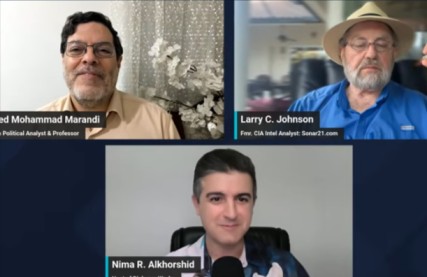
Editor’s Note: In this timely discussion, political analysts Larry Johnson and Professor Mohammad Marandi examine the breaking news that the United States and Iran have reached a tentative agreement aimed at de-escalating tensions across the Middle East. The participants analyze the proposed 14-point plan, the challenges of implementation given the pressure from various stakeholders, and the potential impact on regional conflicts. They offer a skeptical yet informative perspective on whether this memorandum of understanding can truly lead to long-term stability or if it will be derailed by political infighting. (June 14, 2026)
TRANSCRIPT:
US and Iran Reach Deal: Larry Johnson and Professor Marandi Discuss
NIMA ALKHORSHID: Hi everybody. Today’s Sunday, June 14th, 2026, and our dear friend Larry Johnson is here with us. And Professor Marandi, in a moment he’s going to join us because we were waiting for him. He didn’t join, but he’s going to join us as we talk.
Larry, let me start with what is going on right now between Iran and the United States. We had the Israeli attack on Dahieh in Beirut. Again, again, they couldn’t achieve the objective. They couldn’t kill, assassinate those Hezbollah commanders because they wanted to assassinate some people there, right?
Then Iran said they’re going to attack, they’re going to retaliate. The retaliation didn’t come. And just moments before coming to this live, we’ve learned that the United States and Iran has reached some sort of deal, and they’re going to sign it on Friday.
And just imagine, you have your negotiating as the president of the United States, talking and reaching a deal. And he was so serious, I think he thought that he’s going to get it on his birthday, you know. And that’s why he was so serious about it. And you see Benjamin Netanyahu attacking Dahiya to destroy just everything, right?
What is your understanding of that before getting to the deal? Because we have the 14 points of the deal, it was published by Iranian media, we’re going to discuss it later on. Go ahead, your take on that.
Larry Johnson’s Initial Assessment
LARRY JOHNSON: Well, let’s see the US publish its version and then let’s compare the two and see if they match. Number one, what we have right now is — it looks — I do think the press reports that the Trump administration was busy making promises to Iran, you know, “Oh, we’re going to lift the blockade, oh, we’re going to let you get money up front, $12 billion, oh, and then the Strait of Hormuz is open.”
Now notice, all of this is predicated upon — we got an agreement, but we haven’t seen it from both sides yet. We got the Iranian version, we haven’t seen the U.S. version yet. We have seen Trump say things that are at odds with what Iran’s saying. Iran said, “Hey, oh, you’re reopening the Strait of Hormuz on Friday? There’ll be tolls, fees, whatever you want to call it, they’ll be paid, and we’ll get business back to normal.” Whereas Trump’s saying no tolls will be paid. Trump said, “Oh yeah, we’re lifting the blockade, but we’re going to continue to intercept Iranian ships that are carrying Chinese military equipment.” That’s called a blockade.
I think what we have is we’ve got the promise of an agreement that isn’t signed yet, and with still lots of 5 days away, lots of time for mayhem, reversals, betrayals, lots of potential stumbling blocks that can derail this whole thing. Israel took its best shot today to derail it. I don’t think they’re done. I haven’t had a chance to monitor the Israeli press, but I suspect they’re not a bunch of happy campers right now.
Netanyahu’s Opposition and the Deal’s Details
NIMA ALKHORSHID: Yeah, I am sure that they’re not happy. I don’t know if you saw the post of Yair Lapid today. He said that if the United States and Iran reach a deal, that’s a total disaster for Israel. Israel lost everything. And right now, that deal — it seems that they’re going to sign it on Friday. They have announced it before, just moments ago. They have announced that they’re going to reach it.
But when it comes to the content of the deal, what the details — I think that’s so important. And they said that Iran didn’t attack Israel because they had a new concession on the part of the United States. I don’t know what that means when it comes to — it could be, it must be related to the situation between Israel and Lebanon. What is your speculation on that?
LARRY JOHNSON: Well, again, the 5 red lines for Iran had been: immediate lift of sanctions, unfreezing assets, lift the blockade, recognize their control over the Strait of Hormuz, and end of the fighting in Lebanon and Gaza. Those, as I understood it, were Iran’s 5 red lines. Those had to be given. I don’t see Iran making concessions on those.
Well, so then you get into the details of, okay, when are those things actually executed? As we saw with the JCPOA, Iran was supposed to get sanction relief and effectively did not. And the other thing that’s sort of hovering over this agreement is the fact that you’ve got United Nations sanctions that haven’t even been addressed yet. And you’ve got indications from France and the UK that they’re doing all they can to sabotage this deal as well.
The 14-Point Memorandum of Understanding
NIMA ALKHORSHID: Yeah, here is what was reported by Mehr News. Again, the same news agency that before — you remember that 14-point plan that I sent you the other day? And they just announced it. This is official. Let me send it over to you. You can look at it right now, and I’m going to read it here for our audience. This is the 14-point plan MOU, Memorandum of Understanding, to be signed on Friday.
LARRY JOHNSON: Right.
NIMA ALKHORSHID: It doesn’t take all of these descriptions, but it mentions the important points — the 14-point plan.
Do you see any sort of sign, Larry? Let’s assume that this can happen. The first point of this plan that is going to be signed on Friday — they have already announced that they have reached an agreement. There were two phone calls today between Donald Trump and Benjamin Netanyahu, and in one of them Benjamin Netanyahu, it seems he said that he’s not going to abide by the agreement between Iran and the United States, and Israel is not going to withdraw from Lebanon. That’s not going to happen.
Trump’s Leverage Over Israel
LARRY JOHNSON: Yeah. Trump is in a position where he has the power to shut off all support to Israel. He can do that. And if he does that, Israel is going to be forced to toe the line. What we don’t know is whether Trump has the actual spine to do it, the willingness to do it. So that’s what we’ve got to wait till Friday to find out.
And that’s why I describe it as this: they’ve announced there’s going to be a wedding. The wedding’s going to be on Friday. We still haven’t signed the prenuptial agreement, either side. And nobody’s exchanged rings. There’s not even an engagement ring yet, but “promise me it’s going to be a great wedding.” Okay, I ain’t holding my breath. I think 5 days is a long time. I think this can get derailed pretty quickly.
But I see JD Vance doing his best to spin this for Trump to say, “Oh look, man, you are bringing — you’ve got this, you’ve got the nuclear deal, you’ve guaranteed that Iran’s not going to have a nuke.” You know, number 9 on those conditions: “Iran reiterates its commitment under the NPT not to produce nuclear weapons.” Which, I forget when Iran first signed the NPT, but that’s been their commitment all along.
US Military Support for Israeli Operations Against Iran
NIMA ALKHORSHID: Yeah, I think with the case of Lebanon, if the United States is serious, they can do something about it. You know better than me that the United States, in the latest attack — the Iranian attack on Israel — without the United States, Israel is not going to be able — correct me if I’m mistaken — Israel, without the help of the United States, they’re not going to be able to attack Iran. Because their fighter jets must be refueled by the United States, and the help of the United States is substantial if they decide to attack Iran.
LARRY JOHNSON: Yeah, no, they’ve got a few tankers of their own. They could still probably do something, but not on a very massive scale, and they’d do enough to get Iran retaliating on them big time.
But what really hasn’t got a lot of reporting is the significant damage that Iran did to the US bases in Kuwait, Al Asalam, and I forget the name of the army base. They hit the Fifth Fleet headquarters, what’s left of it, very, very hard, destroying some more critical radar systems. They hit Prince Saud Air Base. That didn’t get any attention. Nobody talked much about it.
NIMA ALKHORSHID: This is Bahrain, and these two are in Bahrain.
LARRY JOHNSON: Yeah.
NIMA ALKHORSHID: And this is Ali al-Salam in Kuwait, which was the air warning radar system was attacked and destroyed in this big picture, you know, the left one and the right one. You see in the right one that it was destroyed.
Damage Assessment and the F-35 Reports
LARRY JOHNSON: Yep, it’s gone. And then you had the attack on Mawafiq Salti Air Base in Jordan. Again, significant damage. Now, Russian and Iranian channels were reporting the destruction and damage of up to 12 F-35s. Wow. Now they could be exaggerating, but what’s interesting is the United States is not coming out with this battle damage assessment at all. It looks like they’re covering it up. So we’ll see Friday. Friday is a long ways away, 5 days away.
NIMA ALKHORSHID: But when you’re talking about them being limited in their refueling tankers, it seems like, because if they go to attack Iran, they have to bring something like 20, 30 fighter jets to attack Iran, or they’re going to go with 10, 15, something like that? And you have to have at least — for 10, 15, you have at least 6 or 7 refueling tankers. Is that right?
LARRY JOHNSON: A refueling tanker can handle up to 6 aircraft, KC-135. So 5 tankers would allow you to handle 30 aircraft. And to reach the Persian Gulf from there, they’ve got to go at least 2 air refuelings because the F-35s have about a 500-mile combat radius. So just to get out to the edge of the Persian Gulf, they’d need 2 refuelings, and then to get back, you’re going to need 2 more. So yeah, it’d be a big — start with 6 air refuelers and 6 more would need to take off.
I don’t know how many Israel has in its inventory, but I think they may have enough to do that. But the issue is they’re going to have to overfly Jordan. I don’t think the Saudis, particularly with the announcement of this deal at hand and Pakistan taking a victory lap, will allow them to fly over Saudi Arabia, the more direct route.
GCC Pressure and the Strait of Hormuz Dispute
NIMA ALKHORSHID: It seems that Donald Trump was somehow under the pressure of GCC countries as well. He said that, at least he mentioned a little bit about that, how the 5 countries were somehow putting pressure on the United States to achieve it, to make the deal. I don’t know what is the reality of that. Do you see any sort of reality considering that?
LARRY JOHNSON: No, I think the United States is definitely getting pressure from the Saudis and Qataris in particular. And it looks like Iran’s diplomatic efforts with the UAE have been successful. At least tensions have calmed down there.
Again, I can’t emphasize enough that this is — they’ve announced the intent to sign an agreement that will take place on Friday, but right now we’ve got an Iranian version out there. We don’t have the U.S. version. Show me the US version and then let’s compare them. If they’re the same, then I’d say, “Okay, yeah, we are at least now on solid footing. We know that they both agree to the language.”
But Trump has said things in the last couple of hours that would indicate that the United States has a radically different view. For example, instead of tolls being paid to get through the Strait of Hormuz, it’s toll-free, no payments.
NIMA ALKHORSHID: You know what’s strange? Donald Trump, in his tweet, he said that the blockade is gone, the strait is open. But in this 14-point plan that I’m seeing right now, it says that they have to lift the naval blockade, or the blockade on the Strait of Hormuz, on the part of the United States and Iranians within 30 days. So it’s not going to be something immediate, right?
LARRY JOHNSON: Done.
NIMA ALKHORSHID: It seems it takes time, and the two sides are somehow looking at each other, what the other side is doing. And the whole thing — it somehow seems to me something like a fantasy.
The Prenuptial Agreement Analogy
LARRY JOHNSON: Well, it’s again, somebody that’s been married 2 or 3 times is getting remarried. One of the things they want to have is a prenuptial agreement. So in this case, we look at the Iranians and the United States. They both had bad marriages. They’ve both been through divorce. So they want a prenuptial agreement to figure out how things are going to go. That’s not signed yet. They’re getting ready. All they’re going to do on Friday is sign a memorandum of understanding, like in this document, outlining general guidelines or goals.
Yeah, we’re going to reopen the Strait of Hormuz within 30 days under Iranian arrangements, which means Iran charges the toll, working with Iran, tolls that are going to be paid in Chinese yuan, that the US is going to commit to withdraw its forces from the areas around Iran. Okay, when? Now? 3 months from now? A year from now? 5 years from now? So there’s no time, no deadline on that. Complete lifting of the naval blockade.
I know that the one Iranian channel called Powerful Iran said that the United States is, okay, yeah, we’re going to lift the blockade, but we’re going to continue to intercept any Iranian ship carrying weapons from China.
JD Vance and Ali Baqer to Sign Deal in Geneva
NIMA ALKHORSHID: Yeah, it seems on Friday, Larry, we’re going to have JD Vance together with Ali Baqer, the head of Iranian Parliament. These two will sign the deal in Geneva. This is what has been said just moments ago.
And the second point, Larry, getting to the second point, that the United States is not going to interfere in the Iranian internal affairs. I think that basically is talking about the way that the United States and Israel were preparing for this war. And the Israeli media is extensively reporting on the way the plan was prepared before the attack. It was all about the United States and Israel attacking Iran and using the Kurdish terrorists in Iraqi Kurdistan to come in and to do the regime change, making some sort of chaos by using these people.
And here is Professor Marandi, he’s joining us here. Welcome, Professor Marandi.
PROFESSOR MOHAMMAD MARANDI: Hi Nima, hi Larry, how are you doing?
LARRY JOHNSON: There’s a familiar face. You’re the hardest working man in television there, brother.
PROFESSOR MOHAMMAD MARANDI: Well, I’m glad I didn’t wear your shirt. It would have been, I would have looked very awkward.
LARRY JOHNSON: No, no, you would have looked in style, man.
PROFESSOR MOHAMMAD MARANDI: No, because you’re actually not wearing the proper shirt.
LARRY JOHNSON: But I wore it. I chose the blue, I’m sorry.
NIMA ALKHORSHID: It seems like—
PROFESSOR MOHAMMAD MARANDI: Well, I’m glad that I didn’t wear this shirt, because I would have looked very different from the two of you.
LARRY JOHNSON: Oh no, look at him.
NIMA ALKHORSHID: I mean, the only one that’s pursuing the codes of this program is me.
PROFESSOR MOHAMMAD MARANDI: Yeah, yeah. He’s the only one who got the memo.
Show Me the Money: Skepticism Over the Deal
LARRY JOHNSON: Yeah, well, we were just discussing, I’m glad that there’s all the positive news coming out, but as I told Nima, this is like, you know, you’ve got an invitation to attend a wedding on Friday and the bride and groom still have not signed a prenup. And they haven’t exchanged rings yet. So the words on paper are nice, but it’s not an agreement yet.
And I personally am skeptical. I don’t doubt — Iran’s put out its version of what the agreement is. The United States still hasn’t. And Trump, the Zionist lobby is just beating the hell out of Trump right now. He’s taking a drubbing, and I don’t know how long he can stand up to it.
And the other thing is, Iran says, okay, yeah, we’re going to lift the blockade in 30 days, and it’ll be under Iranian arrangements, which means they’re going to pay a resort fee. I like to use the language they use in Las Vegas. You pay a resort fee. 25 years ago in Vegas you didn’t have to pay a resort fee. Now you go to Vegas, you got to pay a resort fee, which is usually like one-third the cost of the hotel room to start with.
And Trump said, “No, no, no, it’s toll-free. There’s no—” and so I’m saying a little bit of disagreement there. Or, “We’re lifting the blockade immediately, except we’re going to continue to stop and inspect Iranian ships that might be carrying Chinese technology, military equipment.” And I’m saying, I don’t know, last time I checked, that’s still called a blockade.
So show me — let’s see the money, let’s see the withdrawal of U.S. ships, let’s see the lifting of the actual sanctions. Then I’ll be a believer. Right now, I’m still from Missouri. You got to show me.
Netanyahu’s Blunder: Bombing Beirut During Stalemate
NIMA ALKHORSHID: Yeah. Professor Marandi, I think the point that Larry just raised is so important. But before getting there, we had an Israeli attack on Lebanon and Iran has decided not to attack Israel, not to retaliate. What was that? Can you explain?
PROFESSOR MOHAMMAD MARANDI: Yeah, sure. Well, as you know, the two sides were somewhat close to an agreement, but they still had significant differences. And then the Americans tried to impose new conditions. This is like a couple of weeks ago or so. And Iran said, “We’re not discussing these.” And then there was a stalemate. So the Israeli regime bombed Beirut, Iran responded and struck the Israeli regime. The American Navy attacked Iran on multiple occasions. The Iranians responded in a heavy-handed way. And then on Wednesday, I think. Sorry, it’s like 3 AM right now. So I may be — I’m out of fear of Nima and out of my friendship to Larry. I’m on the show, but it’s really Nima’s threats that forced me to come on at 3 AM.
LARRY JOHNSON: God bless you.
PROFESSOR MOHAMMAD MARANDI: Thank you, and you too, and Nima. So the gap between the two sides continued after what the Qataris on Wednesday sent — they sent a delegation informing the Iranians that those demands were withdrawn. So we went back to where we were a couple of weeks ago, but the gaps remain.
Now, what Trump said the day before yesterday — I don’t know, it’s 3 AM here, so I don’t know, but when earlier, not yesterday, the day before, depending on which calendar we’re looking at. Yeah, because it’s here, it’s Monday now. Contrary to what Trump said, there wasn’t an agreement. Contrary to what the Pakistani Prime Minister said, with all due respect, there was not an agreement, there was not a final text. So there was a stalemate.
And yesterday, meaning your today, I spoke with a couple of people who were involved, and they were saying it’s unclear what will happen. This is like 12 hours ago, 10 hours ago. Then Netanyahu makes the biggest and most stupid mistake possible. He goes and attacks Beirut at a time when we were in stalemate and Iran had demands and Americans were not accepting and Iran was not going to back down.
So this fool bombs Beirut and the Iranians say, “We’re going to hit you.” And it was clear as day that Iran was going to strike. And the Iranians were preparing. And then in the negotiations, Trump, out of deep concern — and I think the only thing I can think of is that Trump knows that the United States is going to fall off a cliff, the U.S. economy is going to fall off a cliff, and he knows this. So he’s just saying, “No, please don’t attack.”
And the Iranians said, “We’re going to attack.” And so at the negotiations, which ended 2.5 hours ago, roughly, the United States conceded key demands by Iran. The Israeli regime has to end the wars on all fronts and it has to end the occupation of Lebanon. And the siege on Iranian ports has to end immediately. And on Friday, Iran will allow the ships to move through the Strait of Hormuz.
But the point is, and there are other things too, but I don’t know everything because no one’s answering phones from now on. Those couple of people who I did call, they didn’t pick up and they’ll probably curse me tomorrow. So I don’t have too many details.
But the important thing is that the United States conceded these points because of Netanyahu. Now, either Netanyahu abides by Trump’s commitments, and it’s a catastrophic defeat for Netanyahu. Or he doesn’t and he humiliates Trump and the world sees him as the reason for the imminent economic crisis because he’s the one who’s impeding the implementation of the deal. So for Netanyahu, it is a lose-lose situation.
If Netanyahu does not abide by Trump’s commitment, Iran will not abide by its commitment. So whatever happens, Trump loses and Netanyahu loses. If Trump does not implement, it doesn’t look good for him. If Netanyahu does not implement, it looks horrible for both of them.
But Iran does not have any expectations. Iran’s demands have been met. They must be implemented immediately, like Lebanon, Iran’s assets, and the end of the siege. If it doesn’t happen, we won’t carry out our side of the bargain for obvious reasons. So even if Trump does not implement the deal, or if Netanyahu doesn’t implement the deal, Iran wins. But Iran will punish Netanyahu.
But more importantly, Netanyahu will be seen as the one who for almost 3.5 months has been pushing the world towards a catastrophe. And now right before the global economy falls off the Niagara Falls, Trump is trying to hold it back, and Netanyahu is saying, “Nope, let’s just let it go over the falls.” So it will be a political victory for Iran either way.
Trump’s Will vs. Netanyahu’s Defiance
LARRY JOHNSON: Yeah. The point I made earlier before you got on, Sayed, was that Trump has the power, he does have the levers to coerce and force Netanyahu, but I’m not sure he’s got the will, and I don’t think he’s got the political spine to do it.
PROFESSOR MOHAMMAD MARANDI: I agree. The Iranians are not at all counting on smooth sailing. That’s not what the Iranians — but in any case, we now have an acceptable deal to the Iranian people, major concessions by the United States. And if the United States chooses not to implement it, the world will not blame us. They’ll blame the United States and the Israeli regime. The Iranian people will see that we’ve negotiated a good deal.
Some people are still unhappy. They’re saying we should, like, continue with the war or — but I think that this agreement for now is better than striking the Israeli regime. Because if the Israeli regime, now that they’re committed to end the killing and to end the occupation, I think that is preferable. We don’t want any — because they’re massacring women and children every day, day and night. They’re just slaughtering people across Lebanon. This is another Gaza being repeated.
And so, if Iran can force the Netanyahu regime and the Zionist regime, prevent it from continuing this genocide in Lebanon, that is a huge defeat. It’s much better, it’s much greater than lobbing missiles and striking targets in Israel. Although I’m sure people across the world would be very happy to see Iran fire those missiles. But if Iran could get something much bigger instead, I think that’s even a bigger achievement.
And what would be even the best of all, perhaps, is to see this clash between Trump and Netanyahu, because either way, Iran’s adversaries — the world’s adversaries — they lose. Both of them.
The Crucial Question: What If Israel Strikes Again?
NIMA ALKHORSHID: I think the crucial question right now is, Professor Marandi, if Israel continues with attacks in the southern part of Lebanon, if they do something new in Dahiye or Beirut, is that going to mean no deal? That Iran’s going to close the Strait of Hormuz and then they’re going to attack Israel? Does it mean that?
PROFESSOR MOHAMMAD MARANDI: Yes, they will definitely close the Strait of Hormuz. And in my opinion, of course, I don’t know this, I’m speculating — just as yesterday, your today, I said that Iran will punish the Israeli regime and then I didn’t have information, but I thought it would. No one told me that they’re going to attack, but I assumed that they would based on my understanding of Iran and they planned to do so.
So Iran will continue the siege and Iran will punish the Israeli regime. Iran has already fired missiles at the regime and it has hit them pretty hard and hit them much harder than the Israeli counterstrikes. And then of course Iran responded to those counterstrikes. The Israelis have already lost the 12-day war. But even this confrontation that we had a few days ago, it was not Iran that asked for it to end.
And so right now we are in a situation where the ball is in Trump’s court. Trump either has to implement the deal, and that means Netanyahu has to implement the deal, or there’s no deal and the world sees Trump as incapable and incompetent and Netanyahu as unwilling to, or determined to, destroy the global economy.
NIMA ALKHORSHID: I think, Larry, you can come in with the case of Trump. I think that what Professor Marandi just mentioned is so important for Donald Trump. If he doesn’t control Israel, they’re going to get back to the same thing that they were having before the agreement.
The Deal’s Details and Implementation
LARRY JOHNSON: Yeah, I’m not sure how long Iran will wait to see if Trump fulfills his promise, because again, when you go through the document that the MERS folks released, there’s a lot of ambiguity in there, and it’s going to be up to Iran to say, no, we gotta tighten up on all of this. So permanent immediate halt of war on all fronts means now, not tomorrow, not next week, but now. So if by the end of Monday, Israel is still carrying out attacks in Lebanon, that’ll be a violation of that. The complete lifting of the naval blockade within 30 days — well, that’s one that should have been immediate in my view.
PROFESSOR MOHAMMAD MARANDI: It is immediate. It is immediate.
LARRY JOHNSON: Okay, the one that Mirror News Agency put out said complete lifting of the naval blockade within 30 days.
PROFESSOR MOHAMMAD MARANDI: No, that was an older — the concession, one of the concessions that Trump gave is lifting of the blockade now, but Iran will not open its trade — yes, he did. He corrected his previous tweet. So Iran will not open the strait until Friday, but the lifting of the blockade is immediate.
LARRY JOHNSON: Now the other one — and this came out of a Powerful Iran Telegram channel — said that the blockade would be lifted but the United States would continue to interdict Iranian ships carrying cargo from China or military equipment from China. Well, in my book, that’s still a blockade. You’re just trying to dress it up with something else.
PROFESSOR MOHAMMAD MARANDI: I don’t think that that’s in the agreement. It’s the end of the blockade, right?
NIMA ALKHORSHID: No, I agree.
PROFESSOR MOHAMMAD MARANDI: If Trump does not abide by — I don’t know all the details, but that’s not what the Iranians —
NIMA ALKHORSHID: Yes, Professor, let me read what Donald Trump himself tweeted just moments ago. He said, “The deal with the Islamic Republic of Iran is now complete. Congratulations to all. I hereby fully authorize the toll-free opening of the Strait of Hormuz and simultaneously herewith authorize the immediate removal of the United States naval blockade.” This is what he tweeted. Go ahead, Professor. Sorry for interrupting.
Iran’s Diplomatic Victory
PROFESSOR MOHAMMAD MARANDI: Yeah, again, since it’s like 3 AM, 3:12 now. I didn’t have people to call before we came online, so my information is based on one phone conversation with someone who’s well informed, but I was in a rush because I had to join you, and so I didn’t ask him too many questions.
But what I know is that the gap between Iran and the United States, which existed till yesterday my time and today your time, ended — what did I say, 2 and a half hours ago? Sorry, I’m sleepy. But yeah, so the negotiations ended 2 and a half hours ago. So all that talk that we had a deal yesterday, or in my time the day before yesterday, is all nonsense. We only had the deal 2.5 hours ago.
And what broke the deadlock was Netanyahu’s stupidity and Trump feeling the need to end this now. So he gave all those concessions, those multiple concessions to Iran, and that closed the gap. Now, that means an end to the occupation. It means an end to the war. It means an immediate end to the siege. In my opinion, Iran won this by far.
But what Larry said is absolutely correct, that who knows what Trump will do if he wakes up in the morning and feels that — if he doesn’t feel well, he may change his position. He may refrain from carrying out his commitments, and then Trump may say, well, in Lebanon, this has to happen, then of course everything will fall apart.
But the important thing is that at least if it is not implemented, this is a diplomatic victory for Iran and a big defeat for Trump, because this text will come out, and it will be a humiliation for Netanyahu. And a defeat for Netanyahu and for Trump. If it is implemented, so much the better. So in any case, whatever happens, this I think is an important moment. But that doesn’t mean that the deal is going to be implemented, and it doesn’t mean it’s going to last very long.
NIMA ALKHORSHID: I think here is the answer to the question that Larry just asked you, Professor Marandi. I don’t know if you saw the new statement of Iran’s Supreme National Security Council in which it says, “According to the agreements reached, the war and military operation on all fronts, including Lebanon, will end immediately and permanently starting from tonight. And furthermore, the naval blockade against Iran will be immediately and completely lifted.” Larry, the answer to your question.
Iran’s Military Capabilities and US Concerns
LARRY JOHNSON: Yeah, and Iran will test it immediately — is the United States serious or not? I think one other factor that was at play here, and really not getting much coverage, is that Iran really inflicted significant damage on US military assets — both radar communication systems, early warning systems, and aircraft in Kuwait, in Bahrain at the Fifth Fleet headquarters, what’s left of it. The Army base in Kuwait, Prince Saud Air Base — that’s the one that I was told PSAB got hit. And you’ve hardly seen any reporting on that. And then the Muwafiq Salti base in Jordan got clobbered.
Both Iranian and Russian sources said they destroyed or damaged 12 F-35s, which is a significant number. So I think Iran’s success — and I know that the general staff, I was told, is panicked and blaming Russia and China for providing Iran with better intelligence for targeting. And I guess that’s been the case since the outbreak of the war. They started providing shortly after the 28th of February.
But in that interim period, I think we’ve seen a significant upgrade in Iranian anti-aircraft assets. I noticed that during one of the last strikes when the United States fired like 49 Tomahawks, that at least at Bandar Abbas, they took 5 down with Iranian air defense systems. Significant. So the cooperation between China and Iran and Russia and Iran has led to a significant upgrade in Iranian capabilities. It’s also weighing in the back of the mind of at least the advisers around Trump.
PROFESSOR MOHAMMAD MARANDI: Yeah.
The Strait of Hormuz and Friday’s Signing
NIMA ALKHORSHID: What is so important to be mentioned is that the blockade would be immediately lifted in this document. But when it comes to the Strait of Hormuz, there is nothing of that happening in the document. It seems that the Strait of Hormuz — Iran would decide about it on Friday when they finally sign the agreement. Is that the case?
PROFESSOR MOHAMMAD MARANDI: Yes, and of course Iran will be looking to see if the siege is truly lifted and if the Israeli regime discontinues the genocide in Lebanon.
NIMA ALKHORSHID: Yeah.
PROFESSOR MOHAMMAD MARANDI: And by the way, I hope I’m coherent, but it’s 3:18 AM. So I hope tomorrow you don’t contact me and say I said a lot of nonsense. But yeah, okay.
Israeli Reaction and Non-Interference Clause
NIMA ALKHORSHID: The Israeli media here, by the way — I24 — says that this agreement is a strategic disaster. “The Americans give the Iranians plenty and get nothing in return. The most absurd thing is that this war ends with sanctions relief for oil sales, something that didn’t exist before the war.” And I think there is a lot to be said with the case of the new agreement between the two sides. Let’s see what would happen.
Professor Marandi, I think one of the most important parts of the deal is that the United States is not going to interfere in internal affairs of Iran, which we know they have been doing before the war started — with the Iraqi Kurdistan, they sent a lot of weapons, they had agents on the streets with those protests. What is your understanding of that, and how is Iran going to measure that the United States is not doing this?
PROFESSOR MOHAMMAD MARANDI: Well, this is important, but it’s symbolic. I don’t have any faith in the United States ending its interference in Iranian affairs. And of course, Iran also promised not to interfere in US internal affairs. So I guess the coups in the United States and the uprisings that the Iranians have been paying for during the last 10, 20 years will have to come to an end.
But no one’s going to trust the Americans, and Iran has never been interfering in US internal affairs. So it is important, it is symbolic, it is an acknowledgement of sorts that the United States is interfering in our internal affairs. And it is legally important, it’s symbolically important, but I don’t expect any memo being sent to the CIA saying, listen, Iran is now off limits. For some reason, I doubt that’s going to happen.
NIMA ALKHORSHID: I think you have to ask Larry how the CIA is going to behave.
PROFESSOR MOHAMMAD MARANDI: Well, it’ll be business as usual.
US Military Posture and Netanyahu’s Role
LARRY JOHNSON: Yeah, I don’t see them backing off yet. The other thing to watch is, is the United States going to start withdrawing military assets from the region? They’ve been on this uber alert and these assets have been forward deployed. Will the United States start withdrawing them again as a sign of good faith, or are they just going to keep them there in place?
PROFESSOR MOHAMMAD MARANDI: Larry, I think everything will depend on Netanyahu. If Netanyahu abides by Trump’s commitment, I think Trump will withdraw. But if Netanyahu refuses to do so, this is going to be a big problem because the American people and people across the world will see Netanyahu as pushing the world over a cliff. And it will be humiliating for Trump. It will not be good for Netanyahu either way.
But if Netanyahu does end the occupation and end the slaughter of women and children, then I think probably the Americans will begin withdrawing troops. But if he doesn’t do that, I don’t think that’s going to happen because there won’t be a deal. And then these troops will have to stay in the Arabian Peninsula with the humidity and heat that we all know how devastating it is.
LARRY JOHNSON: Oh, yeah. Hey, let me ask you a related question. Sanctions relief from the United States is one thing. Has there been any discussion about sanctions relief from the UN, the UN lifting its sanctions?
The Nuclear Deal’s Second Phase and European Irrelevance
PROFESSOR MOHAMMAD MARANDI: Yes, that is— I haven’t heard anything today, but yes, that is— that will be in the second phase because the nuclear issue and the sanctions and all that will be left for later. And that will be negotiated. But that will mean that the laws have— if there’s going to be a comprehensive deal, that means the House and the Senate will have to remove sanctions.
Again, this is not something that I believe is going to happen. If the world is lucky, in my opinion, if the world is lucky, Netanyahu will be forced to obey Trump and he’ll back off in Lebanon and he’ll try to compensate by doing horrible things to the people in the West Bank or so. I don’t know. These are monsters. But he will, if he will, this is like the best case scenario. He ends the slaughter. He ends the occupation and the negotiation. And then of course, the siege is lifted. The Strait of Hormuz is open. And then there are negotiations, and this lasts for 2 months. That, I think, is the best case.
And then the 2 sides will start— during these 2 months, they’ll start negotiating, and they’ll see that there’s big, big problems, because the Iranians are not going to accept sanctions relief or concessions over the nuclear program. They’ll go and say, the UN sanctions, gone. US laws have to be removed. So maybe there’ll be some provisional deals, bits and pieces. Again, this is like, for me, the best case scenario where the United States lifts sanctions that are not linked to the House and the Senate, that are not in law, and the UN sanctions are removed. This is like a best case scenario, and the Iranians give some limited concessions on the nuclear program.
But for those people who think that the enrichment— Iran’s enriching at 60%— giving that up is a catastrophe for Iran, I don’t at all see it that way. From the very beginning, those who’ve been following the Iranian nuclear story, and I would advise people to read Gareth Porter’s book, Manufactured Crisis, or, and or, Peter O’Borne’s book— I’m sleepy now— Dangerous Delusion. These two books are books to read on the nuclear issue. And of course, Going to Tehran, as I said, by Clinton Hilliard-Leavitt and Alyssa Crooks’ book Resistance. These are books to read.
But on the nuclear program, anyone who’s been following the nuclear issue knows that Iran enriched uranium at 60% only to force the Americans and the Europeans back to the negotiation. Because after the nuclear deal in 2015 and US constant violations and ultimately Trump tearing up the deal, the Iranians waited for 2 years before fully restarting their nuclear program. And then afterwards, they started enriching at 60% to put pressure on Western countries to remove the maximum pressure sanctions. So that was the intent all along.
So if the Iranians put the 60% enriched uranium on the table in order to force the other side to give concessions, that was a plan all along. And also in order to— I don’t know what the term would be called, but to lessen the enrichment levels, they will have to use their centrifuges. So that would automatically mean that the United States will have to accept enrichment, because if they want to take it down from 60% to 20% or to 3.67% or whatever, they’re going to have to enrich.
So in any case, the first phase, which is totally unclear if it will be implemented, is the easy part. The second phase is the hard part. And the second phase, if we’re lucky, we’re going to have partial deals. If the world is lucky, we’re going to have partial deals. A full deal, I don’t see that happening unless there’s some enormous world-shattering change in the United States like what happened in the Soviet Union where— I’m not saying that the United States splits apart, but some enormous change where the nature of the state changes, not necessarily with the changing of borders, but where the US state changes as a result of economic crisis or whatever.
NIMA ALKHORSHID: I—
PROFESSOR MOHAMMAD MARANDI: Unless something like that happens, I don’t see a comprehensive deal.
NIMA ALKHORSHID: Yeah. The United Kingdom, France, Germany, and Italy said in a joint statement that they are prepared to lift relevant sanctions on Iran if Tehran takes clear, verifiable steps regarding its nuclear program.
PROFESSOR MOHAMMAD MARANDI: And nothing about what the Americans have to do. Remember the German chancellor last year around this time, during the 12-day war, right after the 12-day war, he said, “The Israelis do our dirty work for us.” So have no expectations of these pawns.
But Europe is irrelevant. Who cares what they say? This is between Iran and the United States. Iran couldn’t care less what the Germans and the French and the British say. They can just print whatever they like. This is between Iran and the United States. The Europeans have made themselves irrelevant for a host of reasons. One is after what they did with the JCPOA, but also after the war in Ukraine and after they’ve weakened themselves so much that no one cares.
Closing Remarks
NIMA ALKHORSHID: Yeah. Thank you so much, Larry. Do you want to— do you have something to add before wrapping up?
LARRY JOHNSON: I just wish my good friend well. Get some sleep, brother. You’re working too hard, but you’re doing good work. You’re keeping people informed to think rationally about this. And Nima, thank you for doing this, and I’ll see you in the morning.
NIMA ALKHORSHID: Exactly.
PROFESSOR MOHAMMAD MARANDI: All right, bye-bye, guys. And hopefully I’ll be asleep and I won’t be watching, but then I’ll watch it later on. Yeah.
LARRY JOHNSON: Do that. Make sure you get some sleep.
PROFESSOR MOHAMMAD MARANDI: Okay, I’ll watch it later then. Bye for now.
LARRY JOHNSON: Bye guys. Bye.
Related Posts
- Transcript: Nepal PM Balen Shah’s Speech At UN General Assembly 81st Session
- Transcript: President Trump and the President Xi Remarks at a State Dinner
- Transcript: Israeli PM Netanyahu Addresses UN General Debate, 81st Session
- Transcript: President Trump and President Xi Deliver Remarks at Arrival Ceremony
- Transcript: Secretary Marco Rubio Remarks at Press Conference in New York City – Sep 23, 2026