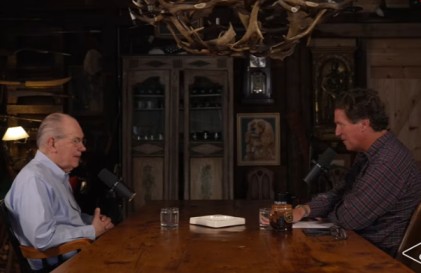
Read the full transcript of political scientist John Mearsheimer’s interview on The Tucker Carlson Show, Jun 10, 2026.
Editor’s Note: In this episode, Tucker Carlson sits down with political scientist John Mearsheimer to analyze the ongoing U.S. military strikes against Iran and the geopolitical consequences of this escalating conflict. Together, they explore the complexities of current foreign policy, the failure of recent diplomatic efforts, and why these events may represent a significant pivot point in global history.
U.S. and Israel Launch Strikes on Iran
TUCKER CARLSON: U.S. Central Command announced just moments ago that the American and Israeli militaries are commencing with strikes on Iran. These strikes are reported to be planned to continue for the next several days. In fact, this may well develop into another phase of a full-scale war, a hot war, kinetic war, people dying, bombs dropping, missiles flying.
And on one level, it’s not surprising if you haven’t been checking in on the progress of our war with Iran, but if you have been sporadically reading headlines about where we are and where this is likely to go, you may be a little bit confused because we were just told the other day that a deal— the president of the United States told us that a deal with Iran is imminent any moment now. We’ve been hammering out the details. Our crack diplomatic team has been traveling back and forth to Pakistan, and we’re very, very close.
That turns out it’s not true. That is, and we counted, the 38th time the President of the United States has announced since March 23rd an imminent deal with Iran. And like the other 37 times, this one turns out to be completely untrue for whatever reason. And we are back to bombing Iran.
And Iran has pledged to respond not by bombing the United States because they can’t, but by hitting our allies in the region, the 6 Gulf states who are closest allies in the Middle East. And they’ve almost all of them have sustained tremendous damage, in some cases very severe damage to military and civilian infrastructure, and they’ll continue to do that. So this is escalating.
The war is back on despite repeated promises that it was over, that we’d already won. We could play you a lot of clips. No point really in doing that because it’s depressing. We could play you all 38 announcements of an imminent deal. Again, you get the point.
But we can’t resist playing just one from about 6 weeks ago. This is President of the United States saying that victory is already ours and we’re all really only hanging around to increase the magnitude of the victory. Here’s President Trump.
VIDEO CLIP BEGINS:
DONALD TRUMP: “We’ve already won, but I want to win by a bigger margin. But we have, we already, we have destroyed their navy, destroyed their air force, destroyed all of their — if you look at their anti-aircraft equipment, their radar equipment, their leadership — their leadership is destroyed.”
VIDEO CLIP ENDS:
The Limits of American Power
TUCKER CARLSON: We’ve destroyed everything. So it’s hard to know which of those details is accurate or not because there has been, really since February 28th when this began, a total news blackout on the details of this war. We don’t know how many Americans have been killed. We don’t know how many have been injured. We don’t know how they were killed and injured. We really don’t know anything beyond what we read on the internet or in press releases. And in case after case, that has turned out to be untrue.
So there really has never been a war of this magnitude with this little factual coverage supplying the public with usable information about how it’s going. So we don’t really know. We can take some of that at face value. The United States military is formidable. It’s huge, has a budget of over $1 trillion a year. So we can bet that tons of Iranian assets have in fact been destroyed over the last several months. But fundamentally, we can conclude that Iran has not lost this war. In fact, by the only measure that really matters, Iran is winning the war.
What’s that measure? Well, of course, it’s the ability to control the Persian Gulf, the eastern aperture of the Persian Gulf, the Strait of Hormuz, now famous. And as of right now, Iran controls the Strait of Hormuz. It did not when this war began. Now it does.
Trump’s Overselling and the Limits of American Power
And so what do we learn from this? Well, we learn that President Trump is not a great diplomat. He’s overselling this like it’s an all-you-can-eat buffet in Atlantic City. “Oh, it’s going to be the best.” And so it’s tempting to kind of lay all of the blame at Trump’s feet. And on one level, it is all his fault. He decided to do this. Whatever pressures he faced, it was his decision. And he has oversold America’s position in this, and he is in some very real way not good at this.
But that would be to minimize the profound nature of this moment. What we’re really learning is not simply that Trump is a spotty commander-in-chief and certainly no diplomat and obviously not a dealmaker. If you announce a deal 38 times and it doesn’t materialize, you’re not a dealmaker. What we’re beginning to understand, unfortunately for the rest of us, are not just the limits of Trump, but the limits of American power. That’s what we’re actually learning— how limited the United States is in what it can do and how it can project its will abroad.
And a lot of Americans, particularly if you grew up, came of age over the last 30 years when the United States had really unrivaled power globally, global hegemony. It was in charge. It was the lone superpower up until maybe 10 years ago.
But despite having that military, despite aircraft carriers that cost $120 billion start to finish to put in the water, the United States military has not been able to open that strait to shipping to the rest of the world, to global commodities in months. And there is no promise that it will be able to. So we have first and foremost learned the limits of American military power. There are some things we just can’t do, and you would have thought we’d be able to do them. Iran, fewer than 100 million people, primitive backward theocracy that everyone makes fun of, globally reviled as a medieval state. The US military could not force Iran to do one thing: open up a narrow waterway.
Economic Power and the Myth of Energy Independence
So our military power has limits that a lot of us didn’t appreciate until February 28th. Our economic power has limits that a lot of people didn’t fully understand. It’s a little confusing after hearing for decades that the United States has one of the world’s largest oil reserves and by far the most sophisticated oil extraction technology. Every oil-producing country in the world uses American technology to get the oil out of the ground and the gas.
It’s a little confusing to learn, but it’s true, it turns out, that despite having energy independence, the United States is not at all energy independent, and gas is now more expensive in your town because of this war. Does that make sense? Well, yeah, if you understand the true nature of the US economy, which is globalized. The United States economy, like every other economy on the globe, is linked to the rest of the world and dependent on the rest of the world. And so while conceptually the US may have enough oil and gas to meet its own needs, in real life, the price of Brent crude set on the global market determines the price of gasoline in your town, which is another way of saying Iran has massive power over the United States economy.
Who knew that? We spent decades hearing about how Iran was a military threat somehow. This sanctioned backward country was going to nuke us for reasons that were never exactly clear because they hate our freedoms. But we thought of Iran— most of us who listen to the media thought of Iran purely in military terms. Iran is crazy. Iran is heavily armed. Iran is a theocratic Shia death cult. And they want to kill us, and we should worry about Iran’s military power.
Well, here, according to the president, we’ve eliminated a lot of Iran’s military power— its Air Force and Navy. Who knew they had those? But they’re gone in any case, according to him. And Iran is still exercising power over the United States, not just because it’s slamming our enemies with drones and missiles, but because it is affecting the price of energy in our country thousands of miles away.
And that illustrates a really important truth, which is the United States is not independent on any level economically, because the United States is part of a global economic system that the United States promoted and benefited from in some ways for many decades. So we are ensnared by globalization. There’s kind of no way out of it, at least in the short term. You may want to ignore what happens in Iran or the Persian Gulf and say, “Well, we have— we can meet our needs.” But you actually can’t. And not just with energy, with every manufactured product, starting with pharmaceuticals and ending with automobiles. All of it is dependent on free trade between nations, on globalization, which again, our country promoted and has benefited from. But now we find out that we have a lot less economic power than we thought we did. Because we’re not in control. Control is actually in the hands of international markets, whatever those are, but it’s not in our hands.
The Erosion of American Moral Authority
And the third area in which American power has been radically reduced, obviously, is its moral power, which conservatives spend a lot of time making fun of. “Moral power? What’s that? We don’t have to be loved. We have to be feared.” But it is also true that those very same people in fact acknowledge it when they say America is exceptional. It is a beacon of freedom to the rest of the world. People look to the United States as an example of what we’d like to be, and that’s why the majority of global constitutions copy ours, our system of government, liberal democracy.
And all of that rested on the idea that the United States, while flawed and capable of fomenting coups and assassinating people, kind of went out of its way to pretend it didn’t. Now, why did the United States pretend it didn’t? Why did the US government do these things and then deny doing them? Well, because even while doing them, the United States government acknowledged those things were wrong. It is never allowed to kill the innocent. Assassination is not war, it’s a crime. Killing the families of people you don’t like is not allowed.
We have done that. But we’ve never admitted that we’re doing it. We’ve never done it openly. And when caught, we either deny it or apologize for it and put the people who did it on trial. Lieutenant Calley and the rest, et cetera, et cetera, et cetera. That’s why we have war crimes trials— to make the statement that we have standards that are above savagery. We’re America. We’re better than you morally, not just richer, but better than you. And that has power. And we have in fact used that moral power to our great benefit for a long time.
Suddenly that is gone. How do we know it’s gone? Because the United States government is no longer pretending that it is not doing certain things that it has never done before, like assassinate people openly, beginning with General Soleimani at the end of Trump’s first term. It is killing civilians. It blew up a girls’ school attached to the IRGC naval base in the opening hours of the war and never apologized for it. Not one time did anyone from the US government say, “Well, that was awful, sorry.” Not one time. That’s just the cost of war, apparently.
And more specifically, and in some ways more shockingly, the United States government has threatened to target, and then two days ago targeted civilian infrastructure. Meaning the systems that keep people alive, keep civilians alive in Iran and any country. Power, water, sewage, desal, necessary for life. The lives of people who are not fighting in the war, who do not make the decisions that led to the war, who are innocent bystanders, the kind of people you are not allowed to kill on purpose. But when you destroy civilian infrastructure, you are killing them on purpose.
And so while the US government in war has destroyed civilian infrastructure at scale— by the way, during the Second World War, this has happened before— but it has never happened so openly and without apology. And never once has any American leader threatened in public to kill civilians unless the government of the country he opposes submits. That’s never happened. Because that’s barbaric behavior. That’s not what civilized nations do. And suddenly, not only is the US government doing that, but no one is saying anything about it. Like, that’s just fine.
And there’s also, of course, because why wouldn’t you at this point, it’s threatening nuclear strikes against entire populations, or as the president himself said, “civilizations.” Now, let’s hope none of that happens, and let’s hope there aren’t further strikes on civilian infrastructure, that civilians aren’t killed on purpose, not simply because we’re bleeding heart liberals that think it’s bad, but because it’s not good for our country. Because, well, in the end, what you do will be done to you. That’s almost a physics principle. That’s just a fact. That’s not moralizing. That’s reality. What you do will be done to you.
And the United States has a lot more civilian infrastructure than Iran does. So if the global hegemon is announcing that it’s okay to murder civilians in a country you don’t like, whose policies you oppose, it stands to reason that we may be the victim of that kind of thinking. In fact, it’s dead certain that we will be the victim of that kind of thinking. Americans will be the victims of that. So this is a huge moment and a huge loss for the United States.
American Sovereignty and Who Is Really in Charge
But maybe above all, the way in which American power has been reduced— and this is the saddest to say out loud— is that it is suddenly obvious to everyone, both in this country and around the world, that the United States does not have sovereignty, which is another way of saying American leaders aren’t really in charge of America. They can make some decisions, they can make noises and give speeches, but the big decisions, the ones that change the course of history, are not up to them. They’re employees. They’re not the boss.
Now, who is the boss? Well, that’s an open debate. But in this war, it has become very obvious, undeniable, and in fact it’s been admitted by this administration that the president of the United States didn’t decide the time and place of this war. The prime minister of Israel decided the time and place of this war. Benjamin Netanyahu was in charge. Admitting that out loud, and of course it was known to everyone who was paying close attention, is a sea change in the way not just the rest of the world thinks about the United States, but the way Americans think about their own country, because the premise of our system is that the people who live here are in charge of it and that they can control its outcomes by voting.
We just had elections in a lot of the country, primaries yesterday, and an ever-diminishing number of people march off to the polls with the notion in mind that “I can change things with my vote.” The war in Iran has taught us that actually, on the big questions, the people you elect aren’t even in charge. Someone else is, in this case Benjamin Netanyahu.
What are the long-term effects of a population understanding that voting doesn’t make any difference? Well, it’s hard to know. We’ve never been here before in 250 years, but it’s easy to imagine that radicalism, extremism, violence would be the outcome of that, because if people cease believing that they have any power whatsoever to change a system that is hurting them, there’s no peaceful way to make the pain stop. They will use non-peaceful means to get what they want.
Democracy, famously, is a pressure relief valve that keeps people calm. “You may not like what’s happening right now, but just wait till the election and you can change it.” When people start to believe that’s not possible, that it’s all fake, that in the end, no matter what you vote for or who you elect, Benjamin Netanyahu or some other foreigner is in charge of your country or the donors. Why wouldn’t they take extra legal means to express their frustration? Well, they probably would. And you would get a violent, chaotic country like so many countries around the world.
So you don’t want that. But unless someone restores not just the fiction, but the reality of sovereignty to the United States, meaning you can elect somebody and he can change the system if he wants, if he has a mandate from voters to do it, he can change it in ways that Bill Ackman doesn’t like. Unless that is clearly true, then you’re going to get a very radical population. And if you mix that realization with an economic downturn, which is the obvious end result of this war, who knows what you could get.
So the costs of this war to the United States are profound, and they have nothing to do with Iran’s nuclear program or its navy, assuming it even had a navy. Did Iran have a navy? Who cares? Who cares about its nuclear program? Actually, Pakistan has a nuclear program. Lots of countries you don’t think should have nuclear weapons, including Israel and France, have nuclear weapons. What matters in the end is whether the United States survives in recognizable form, and this war makes it less likely that it will. Not certain. It’s not lights out or anything, but we are clearly on the road to radical destructive change in the United States accelerated by this war. And that’s bad.
Iran’s Likely Emergence From the War
And while we’re at it, what about Iran? What’s going to happen to Iran after all this? Well, of course, it’s impossible to really know because this is so dynamic. Again, the announcement was made less than 20 minutes ago that we’re back at war, and who knows where that will wind up. But if current trends continue, it seems pretty clear that Iran will emerge from this war stronger. Battered, lots of dead people, lots of destroyed infrastructure, probably a refugee crisis, not much of a standing army, maybe, who knows. But it is very hard to believe that Iran will emerge from this without control, maybe shared control with Oman, but still control of the Strait of Hormuz.
And that makes— that one fact alone makes Iran a global player in the globalized economy. There is no getting around the fact that if you want to get your commodities out of the Gulf, through which a fifth of global commodities flow— energy, petrochemicals— you’re going to have to deal with Iran. So that means that after months of war with Iran, this rogue state, this Middle Eastern North Korea run by crazy people who are cannibals or throwing gays off buildings for fun, that country becomes almost inevitably a real country that other real countries deal with as a peer country.
It’s also pretty easy to imagine an enhanced Iranian economy because at some point US sanctions will either have to be dropped, reduced, or they will just become less meaningful because the US dollar will not be dominant in the way that it is now. And finally, and this is not a minor point either, Iran’s image around the world will be enhanced, and even in the region.
Now, how would that happen? How would that work? How could Iran, which is not Arab, it’s Persian, and the Persians and the Arabs do have a long history of animosity toward each other, but also intermarriage and complex relationship for sure, but some animosity. Particularly the Persians and the Gulf Arabs. And it’s not just religious difference, there are cultural differences and attitudinal differences that have caused friction between those groups for a long time.
But already Iran, which is bombing Arab countries and destroying Arab countries, is more popular in some Arab countries than it was at the beginning of the war. Now, how could that be? Well, because Iran has taken a clear position on the murder of Palestinian civilians, particularly in Lebanon, but not just Lebanon, in the West Bank and Gaza also. Iran has tied its ceasefire negotiations to a ceasefire in Lebanon.
Now, that’s not something that resonates with most Americans, like, “Who cares?” But in the Middle East and in the entire rest of the world, really
Iran’s Growing Influence and the Cost of American Foreign Policy
Iran. Hate to say that. Wish that weren’t true. Wish it didn’t fall to Iran to do something about this, but it has, and they are, and they’re doing more about this than any other country, including ours, including any of the Gulf states.
Sorry. Because they are tying the reopening of the strait, which the world wants, to an end to Israeli bombing and murder in Lebanon. So in the eyes of the region, whatever people hate about Iran, and there’s a lot that the Arabs hate about Iran, they are uniquely standing up for the Palestinians.
The mass murder in Gaza, the genocide in Gaza, and history will record it as that. It is genocide. It is a state policy to eliminate a people and transfer them out of a land. It is genocide by any definition. Is the biggest thing that is happening at this point in history. It is the biggest thing. It is the thing about which the most will be written going forward.
How did the rest of the world watch this and do nothing? How did the United States back this? How’d the United States become the only country on the planet other than Israel to approve of this genocide? These are questions normal people will ask fairly soon. They’re asking them now.
And Iran, for all of its many faults, as an American, it’s painful to admit this, has tried to do something about it. So long term, that doesn’t hurt Iran. Whatever their motive for doing that, that does not hurt Iran. That enhances Iran as a state.
So the whole thing, like so much of life, has turned out to be exactly the opposite of what you thought. You initiate a regime change war against Iran, you kill its elderly cleric head of state, you blow up a girls’ school, you sink its ships, you decapitate its air force, whatever that was. You unleash the full fury of the largest military in human history on this country. And in the end, almost inevitably, that country becomes stronger and the countries that attack it become weaker.
Again, only in real life do ironies like this exist, but they are everywhere. In fact, that is the story of life. The opposite happens. Who could have called this? Who could have seen this coming?
Washington’s Failure to Predict the Consequences
Well, certainly almost no one in Washington saw this coming because they’ve been talking about this war with Iran and the need to decapitate Iran and do something about Iran. America’s biggest problem is Iran and their proxies and the Houthis and Hezbollah and Hamas. And they’ve been yammering on about this at the Brookings Institution and CNN and the Atlantic Council and every place where midwits with overpriced degrees gather to talk about the world that they don’t understand, whose languages they don’t speak.
But whenever they gather in Washington to talk about the world, Iran is at the top of the list of problems we must solve. And in almost none of these gatherings has anyone piped up to say, well, wait a second, if we do that, the opposite will happen. Iran will become more powerful and we’ll become less powerful. Almost nobody said that in Washington. Literally almost nobody. And if there is somebody, who is that person? There wasn’t one.
Introducing John Mearsheimer
But there was at least one person outside of Washington who said this. His name is John Mearsheimer. He’s been a professor at the University of Chicago since 1982, over 40 years, and he studies international relations, the way that countries get along with each other, balances of power regionally and globally. And he’s smart and he’s erudite, but above all, he is wise.
He draws obvious conclusions from longitudinal data sets, as they say in academia. He looks at what happens over time and tries to understand what this tells us about the way nations behave and about the way people behave, about human nature, which is constant. It doesn’t change.
And because he is one of the very few people in the field of international relations who has this ability married to personal bravery— he’s willing to say things that are unpopular, which is the rarest of all qualities in academia— because he has these two qualities, he has been maybe the only guy or one of the very few guys to call it right.
The Israel Lobby Book and Its Aftermath
Back in 2007, he and a friend of his from Harvard called Stephen Walt wrote a book on the so-called Jewish lobby, AIPAC, and the whole constellation of nonprofits in Washington that seek to steer the U.S. Congress and the executive, the White House, to giving Israel more money and more military aid, to changing the inherent priorities of American foreign policy, which are to protect and enhance the United States, to do things that are good for the population of America, to change that priority to protect Israel, do what Israel wants.
And the two of them wrote this fairly famous book about it back in 2007 and were immediately attacked— can you guess— as Nazis and anti-Semites. Well, turns out neither of them was a Nazi or an anti-Semite, just the opposite, kind of normal liberals, not racist in any sense. And the charge itself was ludicrous.
You notice what AIPAC is doing? You’re an anti-Semite. Be like if you criticized Pfizer, you’re against all science. I mean, it doesn’t make any sense. It’s a slur. It’s slander designed to make you be quiet. And in most cases it works, which is why they keep doing it.
But in this one specific case, it didn’t work. John Mearsheimer, who had tenure at Chicago, did not lose his job. And not only did he keep speaking, he upped the volume of his speaking and kept telling the world— though most people didn’t listen— what he had personally seen and how he interpreted that.
In other words, why does the United States military go to war? And Mearsheimer, through close observation, concluded, well, in the modern era, mostly it goes to war, big wars, on behalf of Israel.
VIDEO CLIP BEGINS:
Here is Professor John Mearsheimer in 2007 describing why the US went to war in Iraq.
JOHN MEARSHEIMER: It is manifestly clear to most Americans that the Iraq War is one of the greatest strategic blunders in American history. Our argument is that Israel, and especially the lobby, were two of the main driving forces behind the decision to invade Iraq. It is hard to imagine that war happening in their absence.
To start with Israel, it was the only country besides Kuwait where both the government and a majority of the population favored the war. The Israeli government, to include Prime Minister Sharon, pushed the Bush administration hard to make sure that it did not lose its nerve in the months before the invasion. Other influential Israelis, like former Prime Ministers Ehud Barak and Benjamin Netanyahu, also implored the United States to take down Saddam.
In fact, Israel was pushing so hard for war that its allies in the United States warned Israeli officials to damp down their rhetoric lest it be seen as a war for Israel. I might also add that President Clinton said in 2006 that every Israeli politician I knew thought that Saddam was so great a threat that he should be removed even if he did not have WMD.
VIDEO CLIP ENDS:
Mearsheimer’s Vindication
TUCKER CARLSON: So you can see why Professor John Mearsheimer was considered threat number one by AIPAC, and we’ll just use the phrase, and its amen chorus in the American media. Not because he’s a bigot or a Nazi, but precisely because he is not. He’s an eminently reasonable man who understands the facts and isn’t afraid to say them. He’s not acting out of animus. He’s acting out of honesty and in fact decency.
So you can’t have people like John Mearsheimer talking. If people are going to criticize Israel, they should also be attacking Jews. They should be full-blown crazy people. People like that are helpful to the cause. People like John Mearsheimer tend to provoke an open, rational debate on the topic that AIPAC and the defenders of Israel’s influence over the United States cannot possibly win because it doesn’t make any sense at all. So they don’t want to have the debate.
So Mearsheimer was basically written out of the world he occupied. Though he is a full-tenure professor at the University of Chicago, one of the most prestigious universities in the world, suddenly he wasn’t getting invited to write a lot of New York Times op-eds. In fact, for many years, very few non-experts heard from him at all.
But he kept saying the same thing, which is the Israeli government and its agents in the United States, registered and unregistered, are pushing the US government toward outcomes that will hurt the United States. And now his ultimate vindication: the war in Iran. And not just the war in Iran, but the war between Russia and Ukraine, which is in fact a war between the United States and Russia. And we got into that war because of pressure from exactly the same people, the people who have pushed for war in Iran have spent the last 5 years pushing the United States to go to war with Russia, and that war is still ongoing because of pressure from those very same people.
The Interview Begins
TUCKER CARLSON: So where does this leave us now? Is either one of those wars going to end anytime soon? Is it possible that either one is resolved in a way that doesn’t hurt the US? And what is the motive behind getting the US military, American taxpayers, and service members involved in wars in Ukraine and Iran that can’t possibly benefit us? Why would you want to do that? And why has our political class allowed it to happen?
Those are some of the questions that we asked Professor John Mearsheimer in an interview that every person should listen to. Every American should watch this. So without further delay, here’s Professor John Mearsheimer.
Professor Mearsheimer, thank you very much. The most vindicated man in America. I think of you all the time. By the way, your piece on the Israeli lobby came out in 2006. I just checked. The book came out in 2007, so 20 years ago, and it was widely derided, universally derided in the media as a conspiracy theory. There was no such thing. If that book came out today, how do you think it would sell?
JOHN MEARSHEIMER: Oh, I think it would sell lots of copies. There’s no question about that. It sold lots of copies. Oh, I know. Then, although the lobby went to enormous lengths to suppress it. Do you know Abe Foxman, the former head of the ADL, wrote a book attacking our book before our book came out? That was due to come out the same day our book was supposed to come out.
TUCKER CARLSON: Actually?
JOHN MEARSHEIMER: Actually, yeah. He wrote a book, Abe Foxman, that was a direct attack on our book before our book was published, and he didn’t have the page proofs or anything. He was basing his attack on what we had said in the article written the year before, and it was scheduled to come out on exactly the same day that our book came out.
And then of course the lobby went to enormous lengths to make sure that we got as little attention as possible. They ended up getting us canceled at Google. We were supposed to give a big talk at Google, and the lobby moved in and got that talk canceled. We were supposed to give a big talk at the Chicago Council on Foreign Relations, which the lobby then got canceled.
TUCKER CARLSON: Because the lobby doesn’t exist, it’s just a conspiracy theory, and if you disagree, the lobby will cancel you.
JOHN MEARSHEIMER: Yeah, yeah.
A World in Turmoil
TUCKER CARLSON: Well, I’m just grateful that you lived long enough to see yourself vindicated, completely vindicated, and not just on that question but on many others. So now this has got to be, as someone who assesses the world for a living, one of the most interesting moments of your life because the world is— well, where are we? Let’s just start there. You look out and what do you see?
JOHN MEARSHEIMER: Nothing but trouble everywhere. And that makes it incredibly interesting and depressing at the same time. I do wake up sometimes in the morning depressed at the thought that I’m now going to have to go read all the newspapers and all the websites and get the bad news. But it is a fascinating world and trying to make sense of it is a very interesting business. So the idea of coming here to talk to you is very enticing because we get to sort of feel our way around and try and figure out what’s going on.
TUCKER CARLSON: It’s just incredible. And I don’t know the answer. That’s why I’m grateful you’re here. But I sense that this is a change that history will record as profound. Like this is not just a bump in the road. This is a detour.
The Risk of Nuclear Escalation
JOHN MEARSHEIMER: I think with regard to both the Ukraine war and the war against Iran, profound change is going to result from both. I think that Putin is going to win in Ukraine. Ukraine is going to end up as a dysfunctional rump state. I think in the process of this war, NATO has been wrecked. The US-European transatlantic relationship has been badly damaged.
And if you go to the Middle East, I think the Iranians are going to come out of this war in much better shape than they went into the war on February 28th. And I think that America’s position in the Middle East and certainly Israel’s position is going to be damn badly damaged as a result of this war.
TUCKER CARLSON: Those are my instincts as well. Along the way to that outcome, which, I mean, nothing’s guaranteed, but I strongly agree with your assessment. I think that’s very likely to happen in both places, but all kinds of other things could happen. So as bad things, very destructive things. So as you look at both conflicts, which gives you more concern?
JOHN MEARSHEIMER: I find it hard to answer that question because I’m so concerned about both conflicts.
TUCKER CARLSON: Yes. Well, let’s start with Ukraine.
Drone and Missile Attacks Deep Into Russia
JOHN MEARSHEIMER: Yeah, and I would just say as a general point, I think that the worst outcome in both cases, and I can expound on each, is the possibility of nuclear weapons being used.
And let’s start with Ukraine, as you say. The Ukrainians, with strong support from mainly the Europeans but also the United States, have ramped up their drone war and missile war against the territory of Russia. In other words, they’re striking deep into Russia and they’re doing significant damage inside of Russia. And the Russians believe that this has to stop, especially since the Europeans and the Americans are talking about increasing the volume and quality of the attacks in the future.
The Trump administration — I don’t think President Trump himself, but I think the deep state is committed to the Ukraine war still. I mean, Trump has pulled away in a lot of respects, but I think the deep state remains committed, and certainly the Europeans remain deeply committed to helping Ukraine inflict punishment on the civilian population and on infrastructure deep inside of Russia. And the Russians are having a devil of a time stopping that.
And the end result is that there is increasing talk inside of Russia that the only solution to this problem is for Russia to attack with conventional weaponry to start with, European countries or NATO countries. In other words, Russia has to stop limiting its attacks to Ukraine and it has to start thinking about attacking inside of Europe, but with conventional weapons.
And the view of many inside of Russia is that if that doesn’t work, if the conventional weaponry doesn’t stop the attacks on Mother Russia, then what Russia should do is use limited nuclear attacks against NATO countries to send a very clear signal to the Europeans and to the United States that they better stop or this will escalate out of control. So I think there is a serious possibility — I don’t think it’s a likely possibility, but I think there’s a serious possibility — that nuclear weapons will be used in the Ukraine war.
TUCKER CARLSON: There’s been very little coverage in the American press of Ukrainian, European-American attacks on the Russian homeland. To what extent have they caused damage and casualties? They’re serious attacks.
JOHN MEARSHEIMER: Well, they’ve caused serious damage to the energy infrastructure, and they occasionally kill a good number of Russian citizens. This is nothing like the bombing attacks in World War II, or even the American bombing campaign in Vietnam. It’s not on that scale. But from a Russian perspective, any serious attacks on Mother Russia are unacceptable.
And the problem that Putin faces is that there has long been widespread criticism inside Russia that he has not waged the war against Ukraine vigorously enough. The fact is that Putin and the Russian military, of course, have gone to great lengths to minimize the number of Ukrainian civilians who have been killed. It’s very important to understand — you’d never know this from reading the mainstream media in the West.
TUCKER CARLSON: No, because he’s Hitler.
JOHN MEARSHEIMER: Yes, that the Russians have actually not waged a serious punishment campaign against the civilian population inside of Ukraine, with the possible exception of destroying the electrical grid. But even there, the end result was that not many civilians were killed.
But what’s happening here is that pressure is beginning to build on Putin to up the ante, to escalate, because of these attacks on Russian infrastructure and on the Russian civilian population. And the pressure is really building.
Sergey Karaganov’s Warning
And you see this in the writings of Sergey Karaganov, who is the principal proponent of the view that I just described. Sergey Karaganov says that when he first proposed this view shortly after the war in Ukraine started — this is back in February of 2022 — most people viewed him as an outlier. They didn’t take his arguments seriously.
He says now that the overwhelming majority of people that he talks to inside the Russian elite and even inside the broader population agree with his view that it’s time for the Russians to take the gloves off and to begin to attack into Eastern Europe with conventional weapons to start with, of course. But then if that doesn’t work, use nuclear weapons. It’s time to send a clear message to the West that their attacks on the Russian homeland, their attacks deep into Russia, have to stop.
TUCKER CARLSON: I understand the reasoning. I disagree. I think that European leaders and American leaders would be thrilled if Russia bombed the Baltics, Eastern Europe, even Western Europe. And I think they’d be more thrilled if they used nuclear weapons because it would give Western leaders a justification for waging an all-out direct war on Russia, which is what they want.
JOHN MEARSHEIMER: I don’t think the United States wants an all-out direct war on Russia. If it was a nuclear war, that would mean that a large number of people would be incinerated.
TUCKER CARLSON: I mean, it does seem like though there’s this pattern, and I think you see it in this current war, where the West provokes Russia to action so it can cast Russia as Nazi Germany and justify aggression against Russia.
JOHN MEARSHEIMER: There’s no question about that. But here we’re talking about NATO getting involved in a war, and NATO’s in no position to win a war against the Russians. Number one. Number two, the last thing the United States wants — given that we’re up to our eyeballs in alligators in the Middle East, plus we have to worry about containing China in East Asia — is a war in Ukraine against Russia. And then most important of all, once you talk about the United States and Russia actually fighting each other, the threat of nuclear escalation goes up greatly. And the last thing we want is a nuclear war over Ukraine, because Ukraine is just not that important. It is to some people in the US government.
TUCKER CARLSON: I mean, their ancestors are from there. They identify with it. They really care about it. I mean, of course, I agree with everything you’re saying, but I just — then people are not thinking clearly. They really think that by killing civilians or destroying infrastructure in Russia, they can get Putin — who’s under pressure from his right flank, as you just said — to say, “Okay, you’re right.”
JOHN MEARSHEIMER: Look, Karaganov’s point is, you’re absolutely right that people in the West are not thinking clearly. So what we have to do is we have to focus the mind. And there’s no better way to focus the mind than to pop off a couple nuclear weapons in Europe. That will focus their mind. They will get the message. They will understand that we are then out on the slippery slope to oblivion, and they will back off. But that’s the only way you can get them to back off.
TUCKER CARLSON: Do you think the people in Russia saying this mean it?
Russia Views Ukraine as an Existential Threat
JOHN MEARSHEIMER: Yes. The thing you want to remember — and I think it’s very hard for Americans in general to understand this — is that Russia views what’s happening in Ukraine as an existential threat.
TUCKER CARLSON: Yes.
JOHN MEARSHEIMER: Ukraine is their backyard. Think back to the Cuban Missile Crisis. The idea of the Soviet Union placing nuclear warheads on missiles inside of Cuba was categorically unacceptable to the United States. Just unacceptable. It was viewed as a threat to our survival. It was a mortal threat. Whether that was right or not is another issue, but that was the view.
The Russians have made it clear since 2008, when we said that NATO would expand to the point where it included Ukraine, that this was an existential threat. It would not be allowed to happen. The war broke out in February 2022, and since that war broke out, we have a situation where Ukraine, which is backed by the United States, invaded Mother Russia. Just want to think about that. Ukraine, an ally of the United States, a country we’re supporting, invaded Mother Russia. That was in August of 2024.
Then in February of 2025, Ukraine attacked one leg of the strategic nuclear triad of Russia. It went after its nuclear bomber force. Again, Ukraine is supported by the United States. It gets intelligence from the United States. These kinds of actions were unthinkable during the Cold War.
So here you have a situation today where we are right on Russia’s doorstep, and we are supporting Ukraine, which invaded Mother Russia and is launching attacks on its strategic nuclear triad. The Russians think that this is categorically unacceptable, and they’re going to go to enormous lengths to prevent this from continuing.
They’re going to win the war. They’re determined to win the war, and they’re determined to make sure that NATO does not continue working with the Ukrainians to hit targets deep inside Russia. They feel like their survival is threatened. They feel like they’ve been backed into a corner. And when great powers feel like they’ve been backed into a corner, you never want to underestimate the risks that they’re willing to take. And that’s why people should take Karaganov’s warning so seriously.
Trump’s Broken Promise on Ukraine Peace
TUCKER CARLSON: I know I do. But the administration doesn’t seem to. And I’m confused by why, as a candidate, Donald Trump bragged about — and I think he meant it, I know he meant it — shutting down, you know, bringing peace between Russia and Ukraine immediately. “I can do it in one day,” he said. He did seem motivated to do that. He talked about it for years. And then didn’t do it.
Trump’s Second Term: Russia Policy and Ukraine
JOHN MEARSHEIMER: Why? Well, let me just start by reminding you that in his first term, when he came into office, he had two goals, two major foreign policy goals. One was to end engagement with China and move to a policy of containment, and he was very successful at that. But he also wanted to improve relations with Russia, with Putin in particular, and do everything he could to peel the Chinese and the Russians away from each other and get the Russians on our side of the ledger. That was his goal. But he was undermined by Russiagate. This is very important to understand that.
So when Trump leaves office in 2021, relations between Russia and the United States have hardly improved at all. Now, when he comes into office in January of 2025, at that point in time, his goal is to do in the second term with regard to Russia, what he did in the first term.
So he starts out on the right foot and lots of people, me included, believe he has all the right instincts and that he’s in a position where he can significantly improve relations with Russia, which would certainly be in our interest and maybe even end the Ukraine war, which would be in everybody’s interest, including Ukraine’s interest.
But the problem that he runs into is twofold. First of all, he’s ham-fisted when it comes to diplomacy. He’s just not good at the art of the deal, at least at the diplomatic level. At all. There’s just no question about that at this point in time. So he fails to shut down the war. And of course, he’s facing huge resistance from inside the deep state. Because there are lots of people inside the deep state who don’t want to reach an accommodation with the Russians. And there are lots of people on the outside as well in the general foreign policy establishment who don’t want to reach an accommodation with the Russians. So that’s point number one.
But point number two is he then gets deeply involved in the Middle East, especially with the Iran War. And in a very important way, he’s now so consumed with Iran that he has hardly any time to pay attention to what’s going on in Ukraine. And that allows all of these people in the deep state and in the foreign policy establishment who want to continue to have good relations with the Europeans and Ukrainians and antagonistic relations towards the Russians to dominate the diplomacy in Europe. So for that reason, we’re basically back to square one with regard to Ukraine.
The Futility of Striking Mainland Russia
TUCKER CARLSON: And we have less influence in Europe than we have had in our lifetimes. I would say now we have less — harder to restrain the Europeans. It does seem like a kind of nihilism though, to keep lobbing missiles and drones into mainland Russia, because no normal person thinks that that’s going to achieve the stated effect. It can only result in something horrible happening.
JOHN MEARSHEIMER: Let me make two points.
TUCKER CARLSON: Yes.
JOHN MEARSHEIMER: One is, if you think about the Russian bombing campaign against Ukraine —
TUCKER CARLSON: Yes.
JOHN MEARSHEIMER: Although the Russians have not killed many Ukrainians, as I said before, it was not a punishment campaign. They have done a huge amount of damage to infrastructure inside of Ukraine. The Russian bombing campaign against Ukraine has been much more extensive than the Ukrainian bombing campaign against Russia. But we have seen no evidence that the Ukrainians are willing to throw their hands up and surrender.
TUCKER CARLSON: Smart.
JOHN MEARSHEIMER: Therefore, why would you expect the Russians to throw their hands up and surrender? And in fact, given our previous discussion, what the Russians are talking about doing now in response is attacking into Eastern Europe.
Misperceptions About Putin and Russia
TUCKER CARLSON: It just seems like there is this misperception, and you see this in a lot of other theaters and countries, of the leadership of Russia. So we tell ourselves that Putin is an absolute dictator, Chairman Mao-style dictator, who can do whatever he wants, who’s got total autonomy, sovereignty in his own country. That there are no competing political forces, he’s not under pressure from anyone domestically, he just wakes up and decides what to do. That’s completely false. And then two, that he’s like the most scary Russian nationalist who’s ever lived. He hates the West, he wants to rebuild the Soviet Empire. That’s not true either. He’s pretty moderate by modern Russian standards.
JOHN MEARSHEIMER: No, he’s very moderate.
TUCKER CARLSON: Yeah, I know.
JOHN MEARSHEIMER: People who argue that we should get rid of him and we’ll get a real peacenik in his place are living in a dream world. As I said before, he’s being criticized far and wide inside of Russia for not having waged the war vigorously enough. In fact, going back to when the war started in 2022, I’ve argued on a number of occasions that if I were playing his hand, I would’ve mobilized the Russian military much more quickly than he did, and I would’ve played hardball in ways that he has not played. So he has been — I don’t want to say he’s been a pussycat, but the idea that he’s been this ruthless leader on the same scale as someone like Adolf Hitler is a laughable argument.
But what’s happened in the West is that we’ve created this caricature of him and we’ve created this Russian threat that bears no resemblance to reality. I mean, you see this when people talk about the danger of Russia conquering Eastern Europe. In other words, a lot of people are saying we’ve got to stand up to the Russians now because they’re on the verge of conquering all of Ukraine, and once they’re done with Ukraine, they’re going to move into Eastern Europe, and Putin’s ultimate goal is to recreate the Soviet Empire. And of course, he has the wherewithal to do that. That’s one set of arguments that you hear.
But then you hear the argument that the Ukrainians now have the Russians on the ropes. The Russians are in deep trouble. The Russian military is suffering enormous casualties. They’re being pushed back by the Ukrainians. These are two completely different sets of arguments that are at odds with each other.
TUCKER CARLSON: Yes.
JOHN MEARSHEIMER: And the question is, which one is true? And the argument that the Russians are on their back feet is wrong. The Russians are moving forward. They’re steadily but slowly winning the war. But the idea that they’re going to conquer all of Ukraine — not going to happen. The idea that they’re going to conquer territory in Eastern Europe — not going to happen. But people in the West make that argument. This is especially true in Europe, because they want to create a Russian boogeyman so that the Ukrainians stay in the fight. We continue to support the Ukrainians and we go to great lengths to continue to wreck Russia.
There are lots of people — it’s important to understand this — who want to wreck Russia. They want to continue to do everything they can to wreck the Russian economy. More and more sanctions. And support the Ukrainians on the battlefield so that they can turn the tide and then support the attacks with drones and missiles against Mother Russia, because that will affect the civilian population in ways that cause the population to rise up against Putin. There are lots of people who still believe this, despite the fact that after 4+ years, it hasn’t worked. And if anything, the Russians are going to win the war.
Why Does the West Want to Destroy Russia?
TUCKER CARLSON: I still, after watching this all these years, I still don’t fully understand the motive. Here you have one of the most beautiful countries and cultures in the world with flaws, but compared to what? I mean, Russia is a beautiful place with a beautiful culture, a sense of itself, and it’s a civilization, not just a country. Why would you want to destroy it? What drives people? I understand why you’d be mad that Putin moved into Eastern Ukraine, fine. But destroy Russia? Where does that come from?
JOHN MEARSHEIMER: Well, the United States during the unipolar moment — and the unipolar moment runs from about 1992, immediately after the Soviet Union collapses, up until about 2017 — is by definition the only great power in the world. And we don’t like the idea of being challenged when we are the unipole. We think that it’s our way or the highway.
And you want to remember that in 2000, this is in the middle of the unipolar moment, Putin takes over in Russia. And Putin, over the course of the time from 2000 up to 2026, has stood up to the Americans. He gave a famous speech at Munich in 2007 where he made it very clear to the West that he was sick and tired of how the West was treating Russia. And the fact is the United States does not like anybody standing up to it. You have to do it our way. You have to be subservient. And Putin was not subservient.
Contrast him, Putin, with Boris Yeltsin, who ran Russia during the 1990s. Yeltsin basically did what we told him to do. We had him in our hip pocket. That was not true with Putin. So for that reason, we got increasingly angry with Putin as the unipolar moment wore on.
And then once Russia becomes a great power in roughly 2017, the United States is interested in knocking Russia out of the ranks of the great powers. We understand that they’ve become a great power, but we’d like to knock them out of the ranks. And of course, you want to understand that the Russians after 2017, when they’re a great power, are resisting our efforts to bring Ukraine into NATO. And this is just unacceptable to us. So we begin to think of ways to undermine Russia, to knock Russia out of the ranks of the great powers.
And if you fast forward to late 2021, early 2022 — remember, the war in Ukraine starts on February 24th, 2022 — if you go back to December 2021 and ramp forward to when the war actually starts, what you see if you look carefully is that Putin is going to great lengths to try to avoid a war. He does not want a war.
TUCKER CARLSON: Oh, I remember well.
JOHN MEARSHEIMER: Yes. The United States makes no effort to work with the Russians to avoid a war. It’s really quite remarkable.
The Istanbul Negotiations and Boris Johnson
TUCKER CARLSON: Well, and not just that, but provokes Russia by sending Kamala Harris to the Munich Security Conference and saying in public to Zelensky, “We want you to join NATO,” on camera.
JOHN MEARSHEIMER: Absolutely. This is right before. In February. That’s exactly right. And then just think about this. The war starts February 24th. Shortly thereafter, a day or two later, Putin sends a message to Zelensky and says, “Let’s start negotiating.” They first start negotiating in Belarus and then they go to Istanbul. These are the famous Istanbul negotiations. This is in March, early April of 2022, almost immediately after the war starts. And it looks like the Ukrainians and the Russians may be able to cut a deal. They did not cut the deal, but they’re getting closer and closer. Things are working out very well.
What happens? Boris Johnson, with support from the United States of course, comes in and he tells the Ukrainians to walk away from the negotiations. Now the question you want to ask yourself is, why did this happen?
TUCKER CARLSON: Yes, I’ve wanted to ask him that, but he won’t talk to me.
The Consequences of Cornering a Great Power
JOHN MEARSHEIMER: The reason it happened is that we thought that economic sanctions would bring the Russians to their knees and that the Ukrainians who we had armed and trained — we meaning the West — had armed and trained between 2014 when the crisis first broke out and 2022 when the war broke out, the actual war, in that 8-year period, we had armed — we meaning the West — had armed and trained the Ukrainians, and they were a quite formidable fighting force, as the Russians found out over the course of 2022.
We believed that the Ukrainian army on the battlefield, coupled with economic sanctions, would do the Russians in. And that’s why we told Zelensky to walk away from the negotiations in Istanbul.
And you want to also remember that late in the fall of that year, 2022, General Milley, who was the chairman of the Joint Chiefs of Staff, understood that the Ukrainians by that point in time had reached the high water mark. Remember, the Ukrainians had launched two successful offensives against the Russians in 2022, one in Kharkiv, one in Kherson. And Milley said, “This is wonderful, but it’s time to cut a deal now because as time goes by, the balance of power will shift against Ukraine and in favor of the Russians.” Because at that point, Putin was beginning to mobilize the Russian army in a serious way. I think he called up 300,000 troops in September of 2022.
But anyway, what happened was that Milley was told to cease and desist from making that argument. They put Milley in the back closet, said no more talk about cutting a deal now because we think we’ve got the Russians on the ropes.
And you remember, it’s in early June — I think it was June 4th of 2023. Remember, 2022 is when the war starts. In June of 2023, that’s when the Ukrainians launched that massive offensive where they think they’re going to affect the blitzkrieg and bring the Russian military to its knees.
This just shows you that we thought the success that the Ukrainians were having on the battlefield coupled with the sanctions would allow us to defeat Russia and knock Russia out of the ranks of the great powers and put an end to having to deal with Vladimir Putin — Putin who wouldn’t dance to our tune.
The Dangers of Destabilizing Russia
TUCKER CARLSON: I kind of get it conceptually, and I have no question that you’re describing the thinking of the people who made these decisions. But I think if you just ponder the potential consequences of their plan — so you knock Russia out of the ranks of the great powers, you displace Putin somehow, what happens then? This is the biggest country on Earth. It’s diverse, it’s got all kinds of ethnic groups that get along sort of, but it could break apart and it’s got the largest nuclear arsenal in the world. Destabilizing Russia could be really dangerous for everybody. Did that occur to them?
JOHN MEARSHEIMER: No. So how stupid are they? Incredibly. Look, as I said to you before, I’ve studied a lot of international relations over time. When you corner great powers, when you threaten their survival, you do not want to underestimate how risky the policies will be that they are willing to pursue. And I think if our policy had actually worked, if it looked like the Russians were going to be knocked out of the ranks of the great powers, they would have then used nuclear weapons.
TUCKER CARLSON: Yes. Or if it did, if the government collapsed, whatever that meant, we succeeded in killing Putin, which I know we’ve been trying to do on and off for a long time. What then? What if there was a civil war, ethnic breakup of Russia? How is that good for the rest of the world? It’s terrible for Russia, but what about the rest of us? It’s not good for us either. Chaos is not good, is it?
JOHN MEARSHEIMER: Absolutely. You’re correct. I mean, we could have easily lived with the Russians. Putin wanted to have good relations.
TUCKER CARLSON: He wanted to join NATO.
JOHN MEARSHEIMER: Yeah, the idea that Putin was missing the Soviet Union to the point that he wanted to recreate the Soviet Union and the Soviet Empire in Eastern Europe bears no resemblance to what is in the historical record or what —
TUCKER CARLSON: — child’s explanation of it.
JOHN MEARSHEIMER: It’s just crazy.
And by the way, just to go back to Trump — I think Trump’s instincts on both China and Russia, starting with his first term and even second term, in the beginning, his instincts were correct. In both cases, it was time to abandon engagement, contain China. And with regard to Russia, it was time to have good relations with Russia, to end the war in Ukraine. This is in his second term because the war didn’t take place in his first term.
So I think Trump’s instincts were good. But again, Trump’s problem is that when it comes to diplomacy, he has the Midas touch in reverse. And the end result is that he’s made a hash of things with the Russians.
Why European Leaders Are Fixated on Putin
TUCKER CARLSON: So what’s the motive of European leaders — of Macron and Starmer and Merz in Western Europe, and then the various Eastern European leaders? Why are they monomaniacally focused on Putin?
JOHN MEARSHEIMER: I don’t know for sure. It just seems to me that they have convinced themselves that Putin is the second coming of Adolf Hitler. You know, you make these arguments enough times, you come to believe them yourself sometimes.
I don’t know what they’re thinking. I mean, there’s just no evidence to support this argument in terms of what Putin has said over time or what he’s written over time. Or if you just look at the power that’s built into the Russian army — this army’s had a difficult time capturing the eastern one-fifth of Ukraine. The idea that it’s going to conquer all of Ukraine and roll into Eastern Europe is not a serious argument. And again, he’s never said that he was interested in doing that. This is not the second coming of the Wehrmacht.
But for some reason, the European elites have convinced themselves that this is the case. And it seems that they won’t listen to common sense on this issue.
TUCKER CARLSON: So the idea is that the largest country in the world by landmass with the most resources on Earth wants to capture overcrowded, collapsing welfare states and do what with them? It’s so nuts. What would the motive be? Why would the Russians want any of these? Maybe Poland, but even Poland — why would they want that?
The Lessons of Soviet Occupation in Eastern Europe
JOHN MEARSHEIMER: Well, let me offer an alternative view as to why they wouldn’t want it — just to the one that you just described. First of all, the Russians controlled all of those countries in Eastern and Central Europe during the entire Cold War, and it did not work out very well, right?
TUCKER CARLSON: And they didn’t enjoy it, actually.
JOHN MEARSHEIMER: Yeah, the most powerful political ideology on the planet is nationalism.
TUCKER CARLSON: Yes.
JOHN MEARSHEIMER: And nationalism is all about sovereignty and self-determination. Whether you’re Polish, Czech, Hungarian, German, you want to control your own destiny. And the last thing you want is another country like the Soviet Union or now Russia invading your country. And if you’re Russia and you invade that country, what you’re going to find is a significant amount of resistance.
Just think about the Soviet Union. They had to put down a major insurrection in East Germany in ’53. They had to invade Hungary in ’56. They had to invade Czechoslovakia in ’68. They almost had to invade Poland 3 separate times. Then they had to deal with the Albanians, the Yugoslavs, and the Romanians.
TUCKER CARLSON: Totally.
JOHN MEARSHEIMER: Right? Been there, done that. Did not work out very well.
TUCKER CARLSON: So you fought in the Cold — well, you went to West Point, you served as an Army officer in the Cold War. Do you think, having studied it, that Russia got a lot out of its empire? Like, was it worth it for them? The Soviet Empire, the Warsaw Pact, the Eastern Bloc — was that worth having?
JOHN MEARSHEIMER: Great question. But let me just say, I was actually an Air Force officer. I was an enlisted man in the Army before I went to West Point, but then I was an Air Force officer.
TUCKER CARLSON: Really?
JOHN MEARSHEIMER: Yeah.
TUCKER CARLSON: But you went to —
JOHN MEARSHEIMER: I went to West Point. You want to remember that before 1947 — that was when the National Security Act created the Air Force Academy. There was no — and created an independent Air Force. The Air Force was actually the Army Air Corps. So West Point provided officers to the Army and to the Air Force. And when I graduated from West Point in 1970, there were a set of limited conditions under which you could go into the Air Force. And I qualified. So I was in the Air Force rather than the Army.
The vast majority of my classmates went into the Army, but I went into the Air Force. But I had been in the Army as an enlisted man before I went to West Point. So I actually, including my West Point time, spent 10 years in the military.
But to go back to your excellent question about the Soviet Union and its experience in Eastern Europe — the reason that the Soviet Union ended up in Eastern Europe is because on June 22nd, 1941, Nazi Germany launched Operation Barbarossa for the express purpose of destroying the Soviet Union. Thankfully, the Soviets won the war, but to win the war, they had to drive across Eastern and Central Europe into Germany. You remember, it was the Red Army that went into Berlin in April of ’45. And that’s when Hitler, of course, committed suicide, and that war ended on May 8th, 1945. And the Soviets ended up, needless to say, occupying virtually all of Eastern Europe.
But what happens after that is that the Cold War breaks out, and you have the United States on the other side of what we came to call the Iron Curtain — called the intra-German border — and the Soviet Union on the other side. And I think that there were two reasons that the Soviets had a vested interest and we had a vested interest in keeping that status quo.
One is we didn’t trust each other and we were afraid if we got out, the Soviets would conquer more territory. And they were afraid that if they got out, we would move eastward. That was one reason.
But the other reason that we both stayed was the German problem. You want to remember that World War I and World War II were both all about Germany. Very important to understand that.
TUCKER CARLSON: Yeah.
JOHN MEARSHEIMER: We forgot that in the Cold War because the Soviets defeated Germany. Nevertheless, what happens after 1945 is that Germany is cut in half. The Soviets take one side and we take the other side. And most people don’t talk about this in polite company, but we solved the German problem. We cut the country into two parts. They occupied the Soviets’ one half, we occupied the other half.
And although the Cold War was somewhat dangerous, it was altogether pretty peaceful as these things go. I mean, we did have the Cuban Missile Crisis and a handful of crises over Berlin. So I don’t want to overstate the case, but we never came close to having a serious war in the heart of Europe, and we solved the German problem.
But that’s why the Soviets stayed. But what eventually happens is two things, and this leads to the end of the Cold War and the end of the Soviet Empire in Eastern Europe.
Number one, the Soviet economy begins to run aground. It really starts in the mid-1960s and it accelerates in the early 1980s. And of course, Gorbachev comes along and the rest is history. But it’s fundamental flaws in the Soviet economy that eventually brings the Soviet Union down.
But the second thing that happens — getting back to what we were talking about before — is that the Soviets understand that occupying Eastern and Central Europe is incredibly expensive. And the people don’t want us there. And it’s time to go home. And once you go home, a good idea would be to stay out.
TUCKER CARLSON: Yes. So it wasn’t a net benefit. It’s not like they stripped it of its resources and got rich doing it.
JOHN MEARSHEIMER: Well, they did strip a lot of resources out of Germany early in the Cold War. For sure. But afterwards, no, it was not.
TUCKER CARLSON: Industrial resources. But I mean, they weren’t there for the coal.
JOHN MEARSHEIMER: No, no, no, no, no. It was not economically a net benefit.
TUCKER CARLSON: That’s what I’m saying, right? It was not — it’s not a win.
The Fall of Empires and the Limits of Power
JOHN MEARSHEIMER: Yeah. By the way, if you just think about the collapse of the great empires, we read about the great empires like the British Empire, the Belgian Empire, the French Empire, the Dutch Empire, and so forth and so on. They’ve all gone away. And the question you want to ask yourself is why did they all go away?
There are two reasons that are directly related to what we’re talking about. Number one is nationalism. These people in places like India and the Congo, you name it. And this was true of the United States back in the day. Of course. 1776. Did not want the British or the French or the Portuguese telling them how their politics should be run. They wanted to be independent nation states. What I’m telling you is that that nationalism, this incredibly powerful force, was the number one reason for bringing down these empires.
The second reason was that the economic benefits, once the Industrial Revolution comes, melt away. Before the Industrial Revolution, we’re in a world where commerce is of great importance. You can exploit these colonies and they make a lot of sense economically. But by the 20th century, by the time the Industrial Revolution is in full swing, these empires are basically an albatross around your neck. India is an albatross around Britain’s neck, in my opinion.
And you’ll notice just going to who the powerful countries are in the 20th century, Germany, the United States, Russia slash the Soviet Union. The only one that has an empire is Germany, and it’s a tiny empire that it acquires in Africa in the late 1800s.
TUCKER CARLSON: Yeah, tiny, tiny. Namibia.
JOHN MEARSHEIMER: Yeah, yeah, exactly. They’re not a major imperial power. So the three behemoths on the planet— Soviet Union, United States, and Germany— do not have empires. Britain, France, Belgium, they have empires. And what good are those empires? The economic benefits are small.
TUCKER CARLSON: So it’s really the aesthetic benefits that they were after. They fall in love, they’re sentimental about their empires.
JOHN MEARSHEIMER: Absolutely.
TUCKER CARLSON: But they’re not justified by the math.
JOHN MEARSHEIMER: Yeah, they’re not justified by the math. And then go back to the nationalism part of the story. When you occupy these places, you run into resistance. Vietnam, French experience in Vietnam, American experience in Vietnam, Algeria, Afghanistan. That’s exactly what you run into.
In 1979, when the Soviets invaded Afghanistan, everybody said this is the end of the world, the Soviets are on the march, we’re in deep trouble, and we have to do something to counter the Soviets. I said at the time that this is dead wrong. This is wonderful news for us. If you’re arms racing with the Soviets, if you’re engaged in a security competition with the Soviets, what you want them to do is jump into a place like Afghanistan, just like they should have been happy that we went into Vietnam. You’re jumping into a quagmire.
TUCKER CARLSON: You said that out loud in ’79?
JOHN MEARSHEIMER: I said it out loud, but there was no internet at the time. There was no Tucker Carlson.
TUCKER CARLSON: So you have a long history of countercultural pronouncements, huh? Well, how did people respond when you said that? Because I mean, even I remember I was 10 years old. I remember that vividly. It was just hysteria over the invasion of Afghanistan.
JOHN MEARSHEIMER: Yeah. No, you should be— in fact, you want to know something, just to go to Putin. If you really want to do Putin in, you should welcome him into the Western part of Ukraine.
TUCKER CARLSON: That’s totally right.
JOHN MEARSHEIMER: Where there are all those ethnic Ukrainians. Exactly. Who will put up a huge amount of resistance.
TUCKER CARLSON: Definitely.
JOHN MEARSHEIMER: Cause the Russians untold trouble, right?
TUCKER CARLSON: I completely agree.
JOHN MEARSHEIMER: You know, I often say the two principal obstacles to aggression today are number one, nuclear weapons, and number two, nationalism. If you really think about it, invading other countries and trying to do social engineering is going to get you into a lot of trouble.
Israel’s Hubris and the Limits of Military Power
TUCKER CARLSON: And I know, and for all the hate, much of it so well-deserved toward Israel now, part of me always feels sorry for Israel because I don’t think they’re brilliant at all. I don’t think they’re even very clever because they’re ignoring the lessons that you’re just describing now, which don’t ever change, which is hubris leads to destruction. Overreach, territorial overreach always weakens you. You can hold Gaza for 65 years or whatever, it’s not even 60 years actually, and the West Bank and all that stuff. But in the end, Lebanon, Israel is kind of ensuring its own destruction by its behavior right now. And I feel sorry for them. They don’t seem to know that.
JOHN MEARSHEIMER: Well, let me make two points on this. The Israelis have no sense of the limits of power. And we have a lot of that. As you know. But the Israelis have no sense of the limits of military power. They think you can just pound people into submission and you can do that sometimes, but most of the time you can’t.
Second point I would make to you is if you think about the whole Zionist enterprise, you go back to 1900 and ramp forward to the present. An amazing accomplishment that small numbers of European Jews coming out of Europe could go to the Middle East and could carve out a state, a Jewish state in a sea of Arabs. Palestinians.
TUCKER CARLSON: It’s really quite remarkable. Reviving a dead language along the way. No, the whole thing is amazing. I totally agree.
JOHN MEARSHEIMER: Yeah. But in the early years, certainly up until 1967, the Israelis have a really powerful sense of the limits of what they could accomplish. And they are very careful. They don’t have the United States as a great power ally at the time. There’s no Israel lobby of any consequence, and certainly before 1948, and they’re in a sea of hostile neighbors. So they have to be very cautious. They have to be tactically and strategically smart.
But what happens to Israel over time is not only do the guardrails come off— or maybe put it in slightly different language, not only do the checks come off— but they developed this incredibly powerful military, because of help from the United States. And of course, this is where the Israel lobby comes in. But they become a Goliath. They look like a David to begin with, if you think about it, but over time, that David turns into Goliath. And there are no guardrails. The United States will not only sanction anything they do, it will support what they do with material resources and protect them diplomatically.
Just think about the genocide in Gaza. Here we have a people that was a victim of one of the greatest genocides in recorded history not long ago, committing genocide against the Palestinians in Gaza. And the United States is complicit in this genocide, both under the Biden administration and under the Trump administration. This is truly remarkable.
It just goes to show you that Israel can do almost anything and we protect them and we provide them with huge amounts of weaponry. And this has not worked to Israel’s advantage. And in a very important way, the lobby, which is so essential for making this relationship work the way it does, is undermining Israel. All these people like Bill Ackman who think that they’re doing wonderful things for Israel, that they’re protecting Israel, are living in a fool’s paradise.
The best thing that could happen to Israel is if Donald Trump could actually get tough with them, read them the riot act. And that was true of many previous presidents, people like Barack Obama, Jimmy Carter. These people were not anti-Semites. They actually were philo-Semites of the first order, and they cared about Israel’s security. They just thought that Israel was going about providing for its own security in the most foolish ways, and they wanted to crack down on the Israelis, but they couldn’t do that because the lobby made it impossible to do. And the end result is that Israel is in a deep hole. And what is it doing? Digging deeper.
TUCKER CARLSON: Why?
JOHN MEARSHEIMER: Because it can get away with it. And because it believes that there’s got to be some magic military formula that we can find to win against Hezbollah, to win against Hamas, to win against Iran, and to have absolute security.
TUCKER CARLSON: None of these people are parents because a parent would know, like, buying your children vodka, probably not a good long-term strategy for their health and happiness. Like, that’s basically what we’ve done for Israel, just abetted all their worst impulses, backstopped them when they get into trouble, made excuses when they get arrested or hauled into the principal’s office, just acted like a hysterical single mom. “My baby didn’t do it.” And the kid just becomes increasingly unruly and self-destructive. Like that’s exactly what we’re watching, I think.
A Western Failure of Thinking
JOHN MEARSHEIMER: I think, Tucker, what we’re saying here, and this gets back to our conversation about how European leaders think about Putin as Hitler and they think about this great Russian threat. And when we talk now about the Israelis, there are just a lot of people who are not thinking straight these days. It’s really quite remarkable.
TUCKER CARLSON: What is that?
JOHN MEARSHEIMER: I don’t know. I mean, it’s a—
TUCKER CARLSON: Have you seen anything like it in all the years you’ve been—
JOHN MEARSHEIMER: No, not at all, not at all. I mean, first of all, in the mainstream media, during the Cold War, we had a much more vibrant and open-ended debate about foreign policy than we do now. We have a big debate now, but it’s sort of the alternative media platforms— like your show, Judge Napolitano, and all these other shows— on one side, and the mainstream media on the other side. But inside the mainstream media, it’s truly amazing the extent to which people parrot this conventional wisdom and prevent voices that get heard on the alternative media from intruding into the mainstream. It’s such a narrow band.
TUCKER CARLSON: It’s not even a debate, really.
JOHN MEARSHEIMER: Yeah. And the thing is that most people in the United States, and I believe around the world for sure, understand that what they’re hearing from the mainstream media and what they’re hearing from their leaders makes no sense. And this of course is why someone like Trump gets elected, because Trump says things that are counter to the conventional wisdom. Forget what he actually does when he’s in office. He ran on a platform that there’s something fundamentally wrong and the elites are bankrupt. And people voted for him.
And of course, people who think that the establishment, whether you’re talking about the foreign policymakers, people at think tanks, or in the mainstream media, if you think that they’re bankrupt in terms of how they’re thinking about world politics, you’re correct.
TUCKER CARLSON: But it’s not even like a disagree. I listen to some of the stuff and it’s not even that I disagree, it’s that I’m just confused by how anyone could think that. Just like basic observations about life that no rational person would deny. Don’t push your enemies too far. Don’t corner people because you cause them to have no option but to do something crazy. Give your opponent some wiggle room. Try to reach a nonviolent accommodation if possible. If you love someone, don’t help them destroy themselves. These are just obvious, obvious life lessons. Lessons that everyone knows, and yet the people who run these countries seem determined to ignore them. So what is that?
JOHN MEARSHEIMER: I don’t know.
TUCKER CARLSON: And they’re not all dumb. I know some of them, they’re not dumb, they’re not low IQ. It’s like they’re under a spell or delusion or I don’t know what it— I’m sincerely confused. And it seems global, or Western anyway.
JOHN MEARSHEIMER: It’s Western. No, there’s no question about it. It’s Western. It’s Europe. And it’s the United States. I don’t believe it’s true in East Asia. I think if you go talk to the Japanese and the South Koreans, they think basically like we do. They won’t say that.
TUCKER CARLSON: In the Middle East, same thing.
JOHN MEARSHEIMER: Oh sure, sure, sure. I simply don’t have a good explanation. But just to add to your point, we also just have a lot of evidence over the past decade or so that thinking the way the elite has been thinking does not lead to a good ending. It’s not like we’ve had great successes. It’s not like the Israelis have had great successes. You know what I mean? I kind of don’t get it.
The Path to Resolution in Ukraine
TUCKER CARLSON: So where— okay, but back, just back to Ukraine. Sorry, I have too many questions. How do you think that— what’s the most likely resolution to that? And when? If you had to guess?
The Frozen Conflict and Eastern Europe’s Future
JOHN MEARSHEIMER: I think you’re going to get a frozen conflict, and what’s going to happen here is that the Russians are almost certainly going to end up conquering the 4 oblasts that they have now annexed. They fully control one of those oblasts, Luhansk. The one that gets the most attention in the media today, they control 85% of that, Donetsk, and they control about 75% of Zaporizhzhia and about 75% of Kherson.
I think they will continue the war until they fully control all the territory in those four oblasts, which again, they’ve annexed along with Crimea. I would not be surprised if they actually end up taking more territory. I wouldn’t be surprised if they take Odessa and Kharkiv. Kyiv as well. But that remains to be seen.
I think it’s quite clear that their progress on the battlefield has been relatively slow, and it’s in large part not because the Ukrainian ground forces are formidable troops, but because of drones. I think drones have made it very difficult for either side to move, but I think the Russians will end up conquering a huge slice of eastern Ukraine.
And at some point, the Ukrainians and the Russians will stop firing at each other. There will be an armistice. This will be the frozen conflict. Ukraine will be a dysfunctional rump state, which it already is, and it will not join NATO. So the Russians will have achieved their major objective of preventing Ukraine from joining NATO.
But the problem is, Tucker, that you end up with a frozen conflict, and the Ukrainians will never accept the fact that Russia has annexed this territory. They will not see it as Russian territory. They will believe that this is sacred Ukrainian territory that has been illegally taken away from them and that they need to get back.
So what this tells you is you will have poisonous relations between Russia on one hand and Ukraine on the other. And given that the Ukrainians are joined at the hip with the Europeans, this will mean that you are likely to have poisonous relations between Russia and Ukraine and the Europeans for the foreseeable future. This is a disastrous situation because it’s easy to imagine how that frozen conflict turns into a hot conflict once again.
I’m not saying that’s likely, but there’s one other very important dimension to this that we don’t want to lose sight of. And that is that superimposed on the Ukraine-Russia conflict are 6 other potential flashpoints. One is Belarus. Two is Kaliningrad. Three is the Baltic Sea. Four is the melting Arctic. Five is Moldova, and six is the Black Sea. These are all potential flashpoints where you could get conflict between Russia on one side and the Europeans on the other side, or the Ukrainians on the other side. So Eastern Europe is going to be a very dangerous place for the foreseeable future.
TUCKER CARLSON: The amount of armaments moved into that region by the rest of the world is just beyond comprehension too. So it’s incredibly well armed. People are still using Albanian, Enver Hoxha’s weapon stockpiles to fight wars around the world. So when you move a lot of weapons into a region, the tail on that is very long.
JOHN MEARSHEIMER: Absolutely. And the Ukrainians will go to great lengths over time to get more and more weaponry. I mean, you have to understand that from Ukraine’s point of view, Russia is an existential threat. You and I have paid a lot of attention in the previous conversation to the fact that from Russia’s point of view, what’s happening in Ukraine is an existential threat, which it certainly is. But if you’re a Ukrainian leader and you see what’s just happened and the Russians are closer than ever to you and they’ve taken territory of yours that you want back, you’re going to see the Russians as an existential threat. And the Ukrainians will therefore go to great lengths to do everything they can to work with the Europeans and hopefully from their point of view with the United States to solidify their position, to get armaments to protect themselves. Which you can just marry to the point you were making immediately.
TUCKER CARLSON: No, that’s right. And all of Eastern Europe. Of fear. The Romanians, Hungarians, the Poles, I mean, they’re all completely afraid of the Russians, and I get it.
Nuclear Proliferation in Europe
JOHN MEARSHEIMER: Take this a step further. What about nuclear weapons, right? As we were saying before, this conflict has done enormous damage to NATO, and the American military footprint in Europe is shrinking. And one could argue that we’re going to have remarkably few troops in Europe in the foreseeable future. Who knows for sure how that will play out, but the importance of pivoting to Asia, the problems that we have in the Middle East, Europe is really number three on the list and getting out of there will be a high priority, or getting large numbers of troops out of there will be a high priority, shifting the burden to the Europeans.
But the problem is the Germans don’t have nuclear weapons. The Poles don’t have nuclear weapons. And if you believe the Russians are 10 feet tall, and of course the Poles, it’s in their mother’s milk to believe that the Russians are 10 feet tall.
TUCKER CARLSON: And they’re excitable.
JOHN MEARSHEIMER: Yes. So the incentives for Poland to get nuclear weapons are very great.
TUCKER CARLSON: Oh, they’ll get nuclear weapons, don’t you think?
JOHN MEARSHEIMER: I don’t know.
TUCKER CARLSON: If Pakistan has them, Poland’s going to get them. Poland, the industrial power of Europe now? Yeah, they’re going to have nuclear weapons, I would think.
JOHN MEARSHEIMER: And the Germans, right? They’re going to have an incentive to get nuclear weapons, right? And then the question you have to ask yourself is if you’re the Russians and you’re watching the Germans — remember, these are the Germans, World War I, World War II — you’re watching the Germans get nuclear weapons. How do you think about that? And if you see the Poles getting nuclear weapons, how do you think about that?
So the potential for danger here is just not to be underestimated. I mean, we were talking before about the Sergei Karaganov scenario where the Russians use nuclear weapons in Eastern Europe because the Ukrainians are attacking Mother Russia with drones and missiles. Here we’re talking about a situation where Poland and Germany might go down the nuclear road and asking ourselves the question, what would be the Russian reaction?
The Iran Question and the Israel Lobby
TUCKER CARLSON: Before I ask you about what’s happening in Iran, a mystery that I’d love to hear explained. Why is it that the very same people who pushed Donald Trump to war, regime change war against Iran, are literally the same people who pushed him to continue the regime change war against Russia, the war against Putin?
JOHN MEARSHEIMER: Well, I think there are two reasons. Number one is that the influence of Israel on the American foreign policy establishment cannot be underestimated, in large part because of the lobby. And Israel and the lobby have a deep-seated interest in making sure that the United States is militarily involved all over the world because they want an American military that’s at the ready if Israel gets into trouble. So whenever you talk about restraint, like the Quincy Institute in Washington talks about restraint, this raises the hackles of the lobby. You notice there was this big—
TUCKER CARLSON: Not because America’s on the verge of being invaded. But because, which is not, but because Israel might need the fire department to show up in an emergency and we’ve got to pay for that?
JOHN MEARSHEIMER: Yes, you want a big fire department that is fighting wars and is honed to win those wars. And this is in Israel’s interest.
I’ll show you a good piece of evidence that supports this point. There’s a recent article in the New York Times about Israeli intelligence going into overdrive and tracking the activities of particular individuals in the United States. And in the New York Times article, it was pointed out that the two people who have apparently attracted the most attention are Steve Witkoff, because they want to know what he’s up to, and Elbridge Colby.
And since Elbridge Colby works mainly on China issues, the Times speculated on why Israel would be so interested in keeping a careful eye on Elbridge Colby. And the Times actually said at the end of the piece, it’s probably because he’s a restrainer, right? He’s interested in a restrained foreign policy. Colby does not want to be fighting wars everywhere. He once told me that he was opposed to the Iraq War back in 2003. He wants to concentrate on containing China, but he’s not interested in fighting in Ukraine. He’s a restrainer. And of course, the Israelis do not like restrainers. They do not like the Quincy Institute, right?
TUCKER CARLSON: So they’re allowed to just spy on American citizens but then continue to receive our tax dollars in order to fund spying on us?
JOHN MEARSHEIMER: Well, the answer is yes to that, or at least it’s been yes to that in the past. But in answer to your question, the first reason here that our engagement in Ukraine is pushed by the same people who are pushing the Iran war is because of Israel and the Israel lobby and the influence that the lobby and Israel have in seeing the United States involved in places like Ukraine.
The second reason — you have lots of Americans, Jews and non-Jews, who have roots in Ukraine. And those people believe strongly that Ukraine should be a sovereign state and that the Russians are the bad guys. And they believe that we should support the Ukrainians hook, line, and sinker. And the journalist Steve Kinzer has written a book on this that I believe is coming out later this year, that explains this phenomenon in great detail. His new book shows how many Americans inside of the foreign policy establishment who have roots, family roots in Eastern Europe or in Ukraine or in Russia are deeply committed to supporting Ukraine in its war against Russia, which they see as the bad guy.
Immigration, Allegiance, and American Identity
TUCKER CARLSON: Yeah, it was right around 1905 that there were quite a few loud voices in America saying, “Let’s not have mass immigration from Eastern Europe because it’s going to cause us massive problems down the line.” And they were dismissed as crazy. Just want to say that out loud.
JOHN MEARSHEIMER: Well, anytime you have immigration, you run into the problem. I was recently in Miami, Florida, and it’s quite clear that one of the principal reasons that we now have our gun sights on Cuba, which I think is ridiculous—
TUCKER CARLSON: Insane.
JOHN MEARSHEIMER: Is because of the Cuban American community, which wields significant influence inside the United States, much like the Israel lobby.
TUCKER CARLSON: Yeah. I mean, I’ve spent a lot of time — I lived in Washington most of my life, spent a lot of time at the White House and in Congress. I never once lobbied for Swedish interests. It just never occurred to me, though my name is Carlsson.
JOHN MEARSHEIMER: American.
TUCKER CARLSON: I have blue eyes. But I just — I felt like that would be wrong. Do you know what I mean? It’s disgusting. Come here and then lobby on behalf of a foreign country, whatever that country is. It’s disgusting.
JOHN MEARSHEIMER: I agree completely. I’m against dual citizenship. I think if you come to the United States, you become an American.
TUCKER CARLSON: You should have a German last name. Have you ever lobbied on behalf of Germany?
JOHN MEARSHEIMER: No, I don’t consider myself German-American or Irish-American because I’m also partly Irish-American. I consider myself American. I think when you come to the United States and you become a citizen, there’s a social contract involved, and that social contract involves becoming an American and becoming an American firster by definition. Otherwise don’t come to the United States, or get a temporary visa, which is fine. But if you become an American, I believe that you should not be lobbying on the part of other countries, whether it’s for Cuba or China or India or Israel.
TUCKER CARLSON: And I think it’s within bounds just to say that. As an American, I think I have a right to say that.
JOHN MEARSHEIMER: And I say that, by the way, as somebody who’s been a big proponent of immigration over time. I’m glad they let all those Russian Jews into the United States or East European Jews into the United States. I think immigration is what made the United States great. If you go back and read about what happened in this country after we got our independence in 1783, and certainly in the 19th and early 20th century, all the immigration is what turned us into the superpower that we are today. So immigration’s a good thing, but it has to be done in a careful way.
TUCKER CARLSON: Well, sex is a good thing, eating is a good thing, but you keep them within certain boundaries so they remain good things. And if you’re going to have immigration, particularly at scale, you have to have rules. And the number one rule has to be transfer your allegiance from the country of origin to the country you live in now. That’s just got to be rule one. And if you can’t hold to that rule, you can’t have immigration, it seems to me, right?
JOHN MEARSHEIMER: I think that illegal immigration is an absolutely terrible thing. And I think it’s damaged many Americans’ views towards immigration in general.
Jeffrey Goldberg, The Atlantic, and Dual Loyalty
TUCKER CARLSON: Yeah, I agree.
JOHN MEARSHEIMER: Me too. Number one. And number two, although I’m in favor of immigration, I do think if you come to the United States, you become an American and only an American. You give up your German citizenship or your Russian citizenship or whatever. And I think—
TUCKER CARLSON: What about working as a guard at a prison camp in Israel on a volunteer basis like Jeffrey Goldberg of The Atlantic did? As an American? Is it okay if you’re a leading American foreign policy thinker to volunteer as a prison camp guard in a foreign country, or is that — there’s something kind of maybe disloyal about that?
JOHN MEARSHEIMER: Well, this is a particularly egregious situation.
TUCKER CARLSON: Sir, I can’t help bring that up.
JOHN MEARSHEIMER: Here’s a guy who is fully in favor of using the American military to fight wars on Israel’s behalf. But when the time came for him to serve in the military, he served in the Israeli military, not the American military.
TUCKER CARLSON: As a prison camp guard.
JOHN MEARSHEIMER: Something deeply wrong about that. It’s sick. And of course, he is the editor of one of the most influential magazines in the United States, where he’s in a position where he can control the content of that magazine in ways that support Israel. And you can rest assured that anybody who criticizes Israel in a meaningful way is not going to appear on the pages of The Atlantic.
TUCKER CARLSON: How have you been treated in The Atlantic?
JOHN MEARSHEIMER: Well, there is the period before Jeffrey Goldberg and since Jeffrey Goldberg. I certainly have not appeared in the pages of The Atlantic since Jeffrey Goldberg. But beforehand, you want to remember, as I think you do, that our lobby piece — the piece that Steve Walt and I wrote on the Israel lobby, which appeared in 2006 in the London Review of Books — was originally supposed to appear in The Atlantic Monthly, but it did not because The Atlantic got cold feet and refused to publish it. But they did run a very nice piece on me by Bob Kaplan after that experience. So I can’t say that I’ve always been treated badly by The Atlantic.
TUCKER CARLSON: Kaplan was a very reasonable guy at one point, actually, I thought. Of course, the previous editor, Michael Kelly, who I have no question would have run that piece because he was brave and honest, was killed covering the Iraq War.
JOHN MEARSHEIMER: Yes, I remember.
TUCKER CARLSON: Waged on behalf of Israel, so it all kind of comes together.
JOHN MEARSHEIMER: But Jeff Goldberg is another one of those people who thinks he’s doing good for Israel. He thinks that behaving the way he does — in terms of supporting Israel at every turn and suppressing criticism of Israel as best he can — is in Israel’s interest. I just want to make it clear, I think he’s fundamentally wrong. And I think it’s people like him and the Bill Ackmans of the world who are doing enormous damage to Israel.
TUCKER CARLSON: Again, you’re a parent. If you treated your children — whom you love as much as Jeffrey Goldberg loves Israel, you love your kids — if you treated them like he treats Israel, your kids would all be in rehab. Correct?
JOHN MEARSHEIMER: I agree.
TUCKER CARLSON: Excuse every fault, attack anyone who points out their shortcomings. You would wreck those kids.
Trump’s Desperation and the Iran Endgame
TUCKER CARLSON: Where does the Iran War go?
JOHN MEARSHEIMER: I think at this point in time, where we are is that President Trump is desperate to get a settlement. He understands the economic consequences of this war going on for a few more months. With the straits closed, it would be disastrous. He’s got to get a deal — and not just simply for economic reasons, but for political reasons as well.
The midterm elections are coming up, and he runs the great danger that if the economy is tanked by November, both the House and the Senate will be run by the Democrats, and he will get impeached and found to be guilty. So he wants to avoid that, and of course he wants to avoid crashing the international economy for obvious reasons. So he’s desperate. You can see it in his face. You can see it in his actions.
The problem that he faces is that he can’t get the Iranians to accept what is, from an American and an Israeli point of view, a favorable deal. The Iranians are now in the driver’s seat. The Iranians started this war on February 28th of this year in a much weaker position than they are in now. They’ve actually done quite well in the war, as we saw when they attacked Israel a few days ago. Here you have a situation where Israel did not attack Iran. Iran felt that it was free to attack Israel, and Iran has made it clear it’s more than willing to go up the escalation ladder with Israel. They feel like they’re in the driver’s seat. So the Iranians won’t cut President Trump any slack. They won’t give him a deal that’ll allow him to walk away from this. And again, he’s under ever-present pressure on the economic front to shut this one down.
At the same time, the Israelis will not cooperate with him either. What Trump really wants to do is cut a deal that basically accepts the fact that Iran won. He can’t change Iran’s position, and he’s got to accept the fact that Iran has won and cut a sweetheart deal for Iran. But the Israelis under no circumstances want him to do this, and Bibi is resisting.
So what’s happening here is Trump is being pushed from one side by Bibi, and he’s being pushed on the other side by the inexorable forces of the international economy as it reacts to the shutdown straits. Desperate Donald Trump is beginning to put pressure on the Israelis because he can’t put pressure on the Iranians. He’s putting pressure on the Israelis in ways that he’s never done before. He said really terrible things about Prime Minister Netanyahu last Monday — this was on June 1st — and he’s been really playing hardball with the Israelis in ways that we’ve not seen before. And you can tell that Bibi Netanyahu understands this. He understands that Trump is desperate and that Trump is putting real pressure on him.
Now, Netanyahu has resisted, and to a large extent — not completely, but to a large extent — up to now. But I would maintain that what’s likely to happen as we move forward is that the international economy is going to continue to put pressure on Trump. And because he can’t put pressure on the Iranians who are in the driver’s seat, he’s going to put pressure on the Israelis in ways that he has never done before. So the question you have to ask yourself is: what is this growing conflict between the United States — and in particular Donald Trump — and Benjamin Netanyahu going to look like moving forward?
Can Trump Break With Netanyahu?
TUCKER CARLSON: You saw yesterday Mark Levin — who’s a longtime Trump hater, then became Trump’s closest political ally — start to attack Trump for wavering on the question of backing Israel. The second Trump criticized Bibi, Mark Levin attacks Trump. Can Trump realistically, do you think, fight a rhetorical battle against Netanyahu and win, given that his support now in the United States politically is only Zionists, or kind of the only people who still support Trump?
JOHN MEARSHEIMER: Let me ask you a question. What’s the alternative?
TUCKER CARLSON: Take this to a really, really crazy place where all of a sudden the war comes home. I mean, there’s some attack on the homeland and all of a sudden you go full post-9/11 where the whole country is mobilized against Iran.
JOHN MEARSHEIMER: I mean, that seems more likely to me, but even there, what are you going to do? Let’s just assume that there’s some incident somewhere that incentivizes us to really crush Iran. How do we do that? You want to understand that we cannot do it with boots on the ground. That’s out. Number one. Number two, in terms of restarting the air war — been there, tried that, did not work out very well. Furthermore, we used up huge amounts of our precious weaponry. That’s another one of the reasons Trump doesn’t want to go back to the air war. So what are we going to do? Use nuclear weapons against Iran? I don’t think so. Trump has no option. That’s the point here.
If you think about the situation he’s in, he’s been unable to coerce the Iranians and the Iranians are feeling their oats. They’re feeling powerful. And they’re not willing to compromise. And they understand that the longer this war goes on, the more leverage they have. So they’re tough to coerce. And Trump just has to do something with the Israelis as he’s crushed by these international economic considerations. And if he doesn’t, we’re all going to go off a cliff economically. The economic and political consequences are going to be disastrous.
And if the Israelis really have an in-your-face attitude towards Trump and they start to bomb Iran, what are the Iranians going to do? They’ll shut down the Red Sea. They’ll go after the UAE. They’ll go after Saudi Arabia. They’ll play hardball. And that’ll just make the economic situation even worse.
So what can Trump do? My surmise, looking at this, is that Trump has really no choice but to play hardball with Netanyahu in ways that he has never done, and in ways that no American president has ever done with an Israeli prime minister.
TUCKER CARLSON: Trump’s devotion to Israel is so slavish that it’s just hard to imagine. It’s hard to picture that. I mean, I pray for that. I pray for sovereignty. We should have a country whose leaders make decisions based on what’s best for America. I just can’t picture Trump actually threatening to defund Israel, which is what it would take. You’d have to say: no more money for you if you keep hitting Beirut. I mean, what are you doing?
JOHN MEARSHEIMER: Yeah, he would have to play hardball in ways that you’re just saying you find unimaginable, and which I find, in a certain sense, unimaginable as well. But what you want to understand — and you understood this before February 28th, and you told Trump that he would be remarkably foolish to start a war against Iran — he didn’t listen to you. He didn’t listen to his advisors. He didn’t listen to a lot of people.
TUCKER CARLSON: These advisors didn’t tell him that. They’re cowards. But yeah.
JOHN MEARSHEIMER: But anyway, he started this war.
TUCKER CARLSON: He knew.
JOHN MEARSHEIMER: And he is in deep, deep trouble, as is Bibi Netanyahu, by the way. He’s in deep, deep trouble too, just like Trump is. He’s in a no-win situation. If he bucks Trump, he’s in real trouble. And if he doesn’t buck Trump, he’s going to be clobbered inside Israel because his critics — the opposition — is going after him for being a pussycat, for not being willing to say no to Trump. So if he doesn’t say no to Trump, he’ll get clobbered.
Israel’s Dependency and Peak Hubris
TUCKER CARLSON: Who are these Israelis who are like the most flagrant welfare case in world history? I mean, way more dependent on our government than any welfare queen in Detroit has ever been. Without us, they’re done. Literally done. What world are they living in where they’re like, “Well, don’t take that from Trump”? You don’t have a job, son.
JOHN MEARSHEIMER: Look, the argument you can make — just building on what you said — is that the Israeli body politic, and here we’re talking mainly about the Israeli elites, will understand what you just said, which is they can’t survive in a meaningful way without American support. And that they are running the risk of losing American support if they don’t cooperate with Trump. The threat of losing American support will be sufficient to convince the Israelis to play ball with Trump. So the argument there is that Trump can play hardball with the Israelis in ways that no other president, including Trump himself, have ever played hardball with the Israelis, and that it’ll work because of the logic that you just spun out.
TUCKER CARLSON: I talked to someone in Israel yesterday who’s smart — very smart — who said there’s no sense of that at all. The average Israeli support for the war was over 90% in Israel, was 93%. And the average Israeli thinks that they’re running the world, that they have total control and that they need nobody. And that if the US pulls out, “We don’t need the US actually, there are too many strings attached” — when in fact there are no strings attached. But they’re just so high on their own supply that they don’t see at all their vulnerabilities. They’re really at peak hubris. That’s what this person told me.
The Looming Defeat: Iran’s Growing Power and the Path Forward
JOHN MEARSHEIMER: Well, there is some of that for sure, and there’s good reason for them to think that they own us. Because they have owned us. But I do think we are at a very special point in history here. I think, again, you cannot underestimate what a colossal blunder President Trump and Prime Minister Netanyahu made on February 28th. And the chickens are coming home to roost now.
And I believe that Netanyahu — who’s had a handful of conversations with Trump — Netanyahu fully understands the pressure that Trump is under. And I believe other people in the administration are talking to the Israelis and telling them that. And it’s easy for the opposition to Netanyahu, or on the outside and who would like to run Netanyahu out of office so they can move into his seat, to criticize Netanyahu. But I think even with regard to them, they will eventually get the message.
And if they don’t, Trump then has two choices. He can basically cut off aid to Israel and distance the United States from Israel in ways that was unimaginable, a month ago. Or we can go off the cliff economically. That’s the choice here.
TUCKER CARLSON: But either way, we’re going to emerge from this with Iran, the government of Iran, controlling the flow of commodities out of the Persian Gulf.
JOHN MEARSHEIMER: Yeah.
TUCKER CARLSON: I mean, that’s crazy. That was not true on February 27th, but it’s going to be true going forward, period.
JOHN MEARSHEIMER: Yeah. First of all, we had 4 demands regarding Iran’s missiles, support for Hezbollah, the Houthis, Hamas, regard to their nuclear program, and with regard to regime change. Those were the four goals that we started with. None of them have been achieved. That’s the first point.
Second point is your point that they now control the Strait of Hormuz. Third point I would make to you is they’re going to come out of this in better economic shape, in part because they control the Strait of Hormuz, but also because a lot of sanctions are going to be lifted off them. And that’s good news for them. So economically, they’re going to be in a superior position after February 28th than before February 28th.
Finally, you want to remember that on February 27th, we had a basing structure in the Gulf and we had an alliance structure in the Gulf that looked quite formidable. All those bases have either been destroyed or badly damaged, and that alliance structure that we had with the 6 Gulf states has been wrecked in very important ways. And it’s not clear that we can stay in the Gulf. So if you think about—
TUCKER CARLSON: I told Trump this going in, this is going to result in us leaving the Middle East. We’re going to have less influence in the Middle East by the end. It was so obvious.
JOHN MEARSHEIMER: Yeah, well, you and I agree on that, that so many of these things are so obvious, but yet so many really smart people — people who went to fancy universities, have fancy degrees, worked for fancy law firms or what have you, were successful in business, you name it — don’t see obvious things that people like us see in the foreign policy realm. Again, getting back to your question before, I can’t explain it.
The Decline of Public Policy Thinking
TUCKER CARLSON: Not to get sidetracked, but since you’ve seen more of it than I have, do you think the — well, I know the answer. To what extent has the caliber of public policy, public intellectual declined over the past 50 years?
JOHN MEARSHEIMER: Oh, drastically. There’s just no question about that. If you think about the discourse, we live in a world—
TUCKER CARLSON: I’m sorry to interrupt. This is from the president, from the White House. “I’ve just been informed by our great military that last night the Iranians shot down one of our highly sophisticated Apache helicopters while patrolling the Strait of Hormuz. There were two pilots involved. Both are safe and uninjured. Nevertheless, the United States must of necessity respond to this attack.”
JOHN MEARSHEIMER: I’m sure that he’s going to respond, and I would bet a lot of money that the Iranians will respond. The Iranians have made it clear that every time either Israel or the United States or a country like the UAE attacks Iran, Iran will not just simply retaliate in kind, but it will retaliate more forcefully than the attacker did when it hit Iran to start with.
US Military Capabilities Four Months Into the War
TUCKER CARLSON: As a graduate of West Point and a former Air Force officer, what is your assessment of the US military’s capabilities, 4 months into this war with Iran?
JOHN MEARSHEIMER: Well, the United States military is an incredibly formidable fighting force, but that doesn’t mean that it can win a war against Iran. We certainly can’t decisively defeat Iran. And in terms of going up the escalation ladder, which is what we’re talking about here, the United States cannot trump Iran as we go up the escalation ladder.
Iran has a huge inventory of missiles and drones. It operates in a target-rich environment. And if we go after targets inside of Iran, you can rest assured that the Iranians will find targets to go after inside of American-controlled areas. And we don’t end up coming out on top. Let’s watch what happens with President Trump. Is this going to improve our situation? No, not at all.
TUCKER CARLSON: I don’t understand how 4 years into the Ukraine war, the United States can be this far behind in drone technology and why we’d have all these aircraft carriers under construction when it’s obvious that aircraft carriers cannot be the main means by which we project force in the world. I mean, we can’t even use them in this conflict meaningfully. So why does it seem impossible for our military to respond to technological changes in a quick way?
JOHN MEARSHEIMER: I think you want to remember that the Ukraine War started in 2022. And really for the first 2 years, it was not clear that drones mattered too much. So that takes you up to, let’s say, 2024. And I remember I argued that the key weapon on the battlefield was artillery. It was the king of battle. And what really mattered, in Ukraine this is, was the balance of artillery on the two sides. And I paid hardly any attention to drones.
If I were writing about the balance of power between Ukraine and Russia now, artillery would get second place on the list of important weapons. And I think drones would be the most important weapon affecting events on the battlefield. And so that’s 2024. Here we are in 2026. So it’s only recently that we’ve become aware that drones matter as much as they do. And I would imagine that the US military is now scrambling like crazy to deal with the drone issue.
TUCKER CARLSON: You would think so.
JOHN MEARSHEIMER: Yeah. So I think that it’s explainable, in rational terms, why we did not pay that much attention to drones up until about 2024. But I think we are now paying attention, as is everybody else, because we understand that this really matters.
How Does This Conflict Get Resolved?
TUCKER CARLSON: How do you think this conflict is resolved? And how quickly?
JOHN MEARSHEIMER: I think that basically you’ll end up with something like a frozen conflict. I think that you want to understand that what President Trump is trying to do here is he’s trying to get a ceasefire. And the idea is that if he can get a ceasefire for 30 or 60 days — the number changes — that after you get this ceasefire in place, you can then move to negotiations on things like the nuclear issue, reparations, the future of the overall package of sanctions and so forth and so on.
You want to understand here that we’re not talking about settling the nuclear issue in these initial negotiations. The initial negotiations that are going on now are designed to set up a real ceasefire. In other words, we want to stop the shooting completely, and this includes in Lebanon. Stop the shooting completely. We want to open the strait and the American blockade and the Iranian blockade. Open the strait. The Iranians want $24 billion in frozen assets given back to them.
TUCKER CARLSON: Their money.
JOHN MEARSHEIMER: Their money. That’s number 3. And number 4 is the Iranians want sanctions taken off their sale of their oil on global markets. So those are the 4 things that have to happen to get a real ceasefire. But you notice in those 4 elements, you see no evidence of the nuclear issue or the question of overall sanctions or reparations or control of the strait moving forward. All these issues will be settled in the second round.
Now, my view is that you’re probably going to get a real ceasefire at some point because that will open the straits, and opening the straits matters immensely to President Trump because of what the consequences are for the international economy. Now, when it comes to violating that ceasefire, the country that will violate it is Israel. But if Israel violates the ceasefire and the Iranians react by shutting down the straits again — oh my God, we’re back to the economic threat resurrecting itself. So I don’t think Trump will allow the Israelis to wreck the ceasefire. They may try anyway, but I don’t think so.
Then the $64,000 question is what will happen in the negotiations over the nuclear issue? Control of the strait, reparations, overall sanctions package, and so forth and so on. And there I find it hard to believe that you’re going to get a meaningful deal. Trump likes to say — remember, this is Trump speaking — it took many years to negotiate the JCPOA. That was the original nuclear deal.
TUCKER CARLSON: That’s what he said. The one he ran against and hated?
JOHN MEARSHEIMER: Yeah. And by the way, the one he walked away from in 2018. And he now says, when people say, “Why don’t you have a nuclear deal now?” He says, “You have to understand it takes many years to negotiate a nuclear deal.” Of course he’s correct. But what you want to ask yourself is what does that—
TUCKER CARLSON: Boy, that’s chutzpah.
A Nightmare for Israel — and the Prospect of an Iranian Bomb
JOHN MEARSHEIMER: Yeah, exactly. And by the way, this is a nightmare for the Israelis. If you want to think about what this war means for the Israelis — they were so much better off with the JCPOA. They were so much better off with the deal that they would’ve gotten on February 27th.
Now they’re in a situation where I don’t think they’re going to get a nuclear deal. I may be wrong. I don’t think they’re going to get a nuclear deal. And the Iranians, as we both know, have a lot of highly enriched uranium, up to 60%. They can easily turn it into weapons-grade material and build the bomb. And the Israelis have just demonstrated that they don’t have the capability, and we have just demonstrated that we don’t have the capability to go in there and get that weapons-grade material and shut down their nuclear enrichment capability forever. So it is possible that the Iranians may get a bomb.
TUCKER CARLSON: Well, they’re certainly going to get a more robust economy, and they certainly have cemented their place as a legit regional power, which they sort of weren’t fully before. I also think this changes their relationship with the GCC. I think some of the Gulf states at least were kind of shocked by the unwillingness or inability of the United States to protect them from Iranian attacks.
JOHN MEARSHEIMER: Actually act as a magnet for Iranian attacks.
TUCKER CARLSON: Totally. And the whole deal was like, “We’ll send trillions to the United States in foreign direct investment, but you’ve got to protect us. We’ll align with Israel, we’ll sign the Abraham Accords, we’ll do whatever you want, but you’ve got to protect us.” And we didn’t.
And so you can imagine a world where some of those 6 countries anyway become closer to Iran in 20 years than they were before. But certainly the world sees Iran as a real country now, and they control the aperture at the end of the Persian Gulf. So how are they not way more powerful than they have been in our lifetimes?
JOHN MEARSHEIMER: Yeah. Well, as you know, we like to portray other countries as irrational and crazy. Second coming of Adolf Hitler.
TUCKER CARLSON: Completely. And praise theocracy where they throw gays off buildings or something.
JOHN MEARSHEIMER: But the truth is, if you look at Iran today and you look at the United States and Israel today, which of those three countries looks like the responsible stakeholder in the international system?
TUCKER CARLSON: Yeah, of those three countries, which seems the least unreasonable? This country seems like it has more blasphemy laws than Iran sometimes. I mean, it’s crazy the number of things you can’t say in the United States — certain words are literally verboten, certain interpretations of history are crimes. Those aren’t blasphemy laws.
Yes, they are. That’s — I mean, this is true.
The Damage Done — To Israel, To America, And To Our Own Integrity
JOHN MEARSHEIMER: But there’s much truth in that. But the point is, if you’re another country on the planet and you’re looking at those three countries, Israel, the most hated country in the world, by the way, according to recent polls, and the United States, which is not far from the bottom, and Iran, which country right, looks like it is the most responsible in terms of its foreign policy, right? And it’s the Iranians, right? And it’s the Americans and the Israelis who both basically look like they’re rogue states just running around the world, invading countries, causing genocide, and so forth and so on.
The damage that has been done to Israel’s reputation is just off the charts. It is very hard for me to believe how much damage Israel has done to itself with help from the lobby, as I’ve emphasized in our conversation here. But also the United States, the damage that we’ve done to ourselves, right? And a lot of people will say this is due to Trump. Trump has contributed to this for sure, but look at the Biden administration. It was the Biden administration that supported the genocide in Gaza from the get-go. It was the Biden administration that’s principally responsible for what’s happened in Ukraine. The Biden administration could have prevented the war in Ukraine.
TUCKER CARLSON: Of course they wanted it.
JOHN MEARSHEIMER: In fact, it wanted it. Exactly. So the Biden administration, one could argue, is almost as bad, if not worse, than the Trump administration.
Using Diplomacy As A Trap — Assassination And The Soleimani Case
TUCKER CARLSON: May I ask you, so over the past 6 years, there have been a bunch of different moments where the United States has been accused of using negotiations as a ruse in order to lure its opponents into vulnerability and then assassinate them. And I’ve been hesitant to believe that that could be true because I’m American and I love this country, and that’s so dishonorable that you would never want to live in a country that would do something like that. That’s truly out of bounds, starting with the killing, the assassination of General Soleimani about 6 years ago in Iraq. He flew in commercial for negotiations. He was killed, which was shocking to me, but everyone else loved it.
And then a bunch of times in the past several months, the bombing of Doha by the Israelis on September 9th of last year, again and again and again, it seems like the United States has been party to or aware of traps in which diplomacy was used as the lure. Is that real? Do you think we actually did that?
JOHN MEARSHEIMER: Well, there’s no question that our closest ally in the world, who we support at every turn, which is the Israelis, is obsessed with assassination. They’re constantly murdering, and I think murdering is the right word.
TUCKER CARLSON: That’s absolutely right.
JOHN MEARSHEIMER: Leaders in countries and in organizations all over the Middle East. There’s no question about that. And there’s also no question, as the Soleimani case makes clear, that we’ve moved in that same direction. We’re not as bad as them, although we do support what they do. We never criticize them, but we are deeply involved.
TUCKER CARLSON: But to pretend that you want to have a negotiation with someone, get them to drop their guard and then kill them — that’s like something Western countries have never done. That’s totally out of— but that’s what we used to criticize the American Indians for doing, right? Or the Japanese or some other primitive Eastern culture, right? We don’t do that.
JOHN MEARSHEIMER: Well, if you remember, we attacked Iran last June. Yes, the 12-day war, June 13th to June 25th. And that attack, which was initiated by the Israelis, came out of the blue. And it’s when the Iranians were in the middle of negotiations with—
TUCKER CARLSON: Oh, I remember.
JOHN MEARSHEIMER: Yeah.
TUCKER CARLSON: But I remember thinking, this can’t be really happening. We couldn’t have known. We would never sign off on that.
JOHN MEARSHEIMER: That’s the level we’ve sunk to. I mean, there’s just no getting around this. And you see this, I think, with the General Soleimani case. I think that was a colossal mistake on our part, but this is where we’re at.
And by the way, I think this whole business of assassination is very important because I think it has a blowback effect into the United States. I don’t think you want to be sending a signal to people in the United States. Certainly President Trump should not want to be doing this given that he was the victim of an assassination attack.
TUCKER CARLSON: Right.
JOHN MEARSHEIMER: I agree with that. Should not be sending the message that assassination is a legitimate way of doing business.
TUCKER CARLSON: Yes, I agree with that.
JOHN MEARSHEIMER: You just don’t want to do this. It’s not only morally wrong, it just doesn’t make any sense for how we conduct politics inside the United States or around the world. Assassination should just be for very exceptional circumstances. If you could have assassinated Adolf Hitler, of course you would have done that. But these are the extreme cases. Otherwise, we should be out of the business of assassination and actually condemning it when it happens.
Has Anyone Ever Admitted They Were Wrong?
TUCKER CARLSON: Last question. Do you ever get calls from people who say, “20 years ago I attacked you as a crank and a bigot, but now I got to admit you were 100% right about everything?”
JOHN MEARSHEIMER: Yes.
TUCKER CARLSON: Really?
JOHN MEARSHEIMER: Yes. Well, I don’t get phone calls because we don’t do phone calls anymore.
TUCKER CARLSON: Do you ever get texts?
JOHN MEARSHEIMER: I get text messages and I get lots of emails because my email is available. So lots of people send me very nice emails. And a good number of those people say that they once thought that I was out to lunch, that I was all wrong and— Really, they did? Oh yeah, yeah, yeah.
It’s only in the elite that people never admit they’re wrong and never change their views. I think in the broader public, and by the way, lots of people write to me who disagree with me on different issues but agree with me on other issues. I actually find that my discourse with the greater public is quite variegated. There are some people who agree completely with me on the Middle East and on Israel in particular and agree with me completely on Ukraine who are deeply offended by my views on China because I believe that we should contain China, right? And there are other people who write, who like my views on the Middle East and on Israel, but dislike my views on Ukraine.
So when you engage the public, and when I talk about the public here, I engage with people all over the planet. I get huge numbers of emails from the Global South, from Europe, from Russia. But when you engage with people, what you discover is that no group of people have the same views on every issue. That’s right. That people tend to disagree. And I actually think that’s a wonderful thing.
And this gets back to our whole discussion of the media, the mainstream media, and the fact that we have so few views that challenge the conventional wisdom represented in the mainstream media. This is not a healthy phenomenon. What you want is you want lots of people with different views to contend with each other and for them to fight it out. And I don’t mean fight it out in a nasty way, fight it out in a professional way, for lack of a better phrase.
But anyway, I find that when I go talk to groups or when my podcasts appear on the internet, that I get lots and lots of people who applaud me, and nevertheless, at the same time, will — I won’t say often, but will sometimes criticize my views on particular issues at the same time they’re applauding me. And I do not feel bad about that at all. I think that’s the way the business should work.
I’m not a proselytizer. I’m not going on your show or going on any other show to tell people the truth and tell them that they should accept the truth from John Mearsheimer. What I’m trying to do is talk in a very intelligent way, as you are, about how we think about particular issues. And of course, people are sometimes going to agree with us and sometimes disagree with us. That’s wonderful.
And what’s happening here is that in the vast majority of cases, I think people take their bearing from what we have to say. If they listen to Tucker Carlson talk about issues, issue X, and they’re trying to figure out what they think on issue X, they’ll use your framework, they’ll use your answers to help inform how they think. And hopefully you’ll have a positive influence. Hopefully I’ll have a positive influence.
But I think — this may sound idealistic, but I do think this is the way it should work. And this is why you want to have an open discourse. Of course.
A Pivot Point In History
TUCKER CARLSON: I think now is — like I said this at the outset, and I really believe it, though I don’t fully understand it — I think this is like a pivot point in history. And it’s important to understand at least some of what’s going on. I think it’s impossible to understand all of it and how it interconnects and what it will mean down the road. But I don’t think that we should just see these as isolated bubbling up of turmoil in this or that region. Like, I think the whole world is changing, and it’s important to try to know what is happening.
JOHN MEARSHEIMER: I would say, Tucker, in the best of times, the world is incredibly complicated. Yes. Right. And I sometimes like to say we live in a world of radical uncertainty. Yes.
TUCKER CARLSON: Right.
JOHN MEARSHEIMER: That’s in past times. Today, oh my God, it’s so hard to figure out what’s going on, right? We’re all in a very important way kind of flying blind, and what we’re trying to do is make sense of the world. And what we try to do in exchanges like this is go further down that road, and both of us trying to refine our thinking about these important issues and inform lots of people in the process so that everybody is less blind moving forward. Yeah.
TUCKER CARLSON: And really the only sin from my perspective is lying. And anyone who’s trying his hardest to tell the truth, right or wrong, is an ally of mine. That’s how I feel about it.
JOHN MEARSHEIMER: Amen.
TUCKER CARLSON: Amen. John Mearsheimer, professor, thank you very much.
JOHN MEARSHEIMER: Thank you for having me. Oh my gosh.
TUCKER CARLSON: Such a joy every time.
JOHN MEARSHEIMER: Thank you.
Related Posts
- Transcript: Nepal PM Balen Shah’s Speech At UN General Assembly 81st Session
- Transcript: President Trump and the President Xi Remarks at a State Dinner
- Transcript: Israeli PM Netanyahu Addresses UN General Debate, 81st Session
- Transcript: President Trump and President Xi Deliver Remarks at Arrival Ceremony
- Transcript: Secretary Marco Rubio Remarks at Press Conference in New York City – Sep 23, 2026