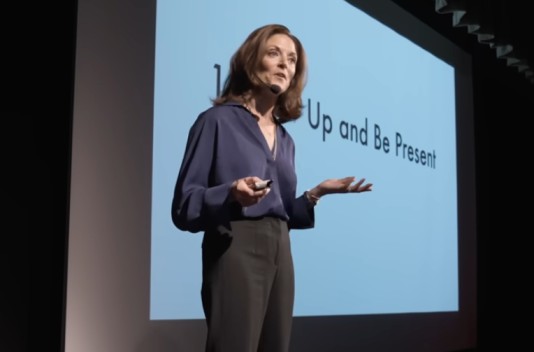
Read the full transcript of comedian Dani Klein Modisett’s talk at TEDxCapeMay, Jun 7, 2026.
Editor’s Note: In this TEDx talk, comedian and author Dani Klein Modisett shares how she learned to use the power of laughter to connect with her mother during her battle with Alzheimer’s. By offering four simple, actionable techniques, she explains how anyone can foster deep, meaningful human connections through humor, even in the most challenging and disorienting circumstances.
Listen to the audio version here:
TRANSCRIPT:
A 3 A.M. Wake-Up Call
DANI KLEIN MODISETT: Okay, it’s eight years ago. I wake up on a couch in New York City at 3 a.m. to the sound of footsteps. My mother, in her nightgown, pacing, very upset, wringing her hands.
“Mom, what is it?”
“It’s, it’s…”
“Mom, what?”
“It’s just…”
I stand up. “Mom, what is wrong?”
“Oh, I should have married Van Johnson!”
Side note, my mother was married to my father, Victor, my late father, for 40 years. This is just a little upsetting. Van Johnson? Van Johnson, the matinee idol?
“Mom, Van Johnson was gay.”
“Well, we didn’t know that then.”
The Power of Shared Laughter
Great, we laughed. We’re present and connected. That’s one of the byproducts of sharing laughter. It gets us connected. It’s also not something that people usually associate with Alzheimer’s. I know I didn’t.
I mean, I didn’t realize it at the time, but that night — that was not only the beginning of my education about Alzheimer’s, it was the beginning of my understanding about the power of shared laughter for connection, even in the most disorienting circumstances.
I had flown to New York after a phone call from my mother’s friend, Marilyn. “Your mother is arguing with waiters, and she can’t fill out a deposit slip.” Arguing with waiters, not that unusual. But not being able to fill out a deposit slip — my mother was a real estate broker. Filling out a deposit slip was one of her few remaining joys.
In daylight, of course, in New York, I could see there was something wrong. Yeah, there were stacks of mail, and open cabinets, and plates of food half-eaten with dog hair. My meticulous mother, at 78, had taken in Buster, a traumatized rescue pug.
The next day, my sister comes in, and we go to see a doctor, and we hear two words that many people are more afraid of now than a cancer diagnosis. It’s Alzheimer’s.
From Near Death to Making People Laugh
I know. So, how did I get from Alzheimer’s to laughter? Okay, let’s start at the beginning. I almost died when I was born. Thank you. Here’s where it gets really funny. No, it’s true. But I actually have the letter that my parents wrote to the doctor, thanking him for saving my life.
And it’s amazing, but I’ve spent from there until, well, probably right now, trying to prove that my life was worth saving by making people laugh. Naturally, I became a comic. I mean, other people, they want multiple homes, and fancy cars, and health insurance. But what’s gotten me out of bed since the beginning was the chance to make someone, anyone, laugh.
And did you know that we are 30 times more likely to laugh with people? And the Surgeon General declared loneliness more dangerous for us than smoking two packs of cigarettes a day. And that sharing laughter is proven to break through feelings of isolation. So, adding all that up, by making people laugh, I’m more than earning my place here. I’m rescuing people, one laugh at a time, until the laughter stops.
We keep my mother at home for as long as we can. But within a few years, it becomes clear she needs to move to LA to be near me and my family. And very quickly, she realizes she isn’t going home, and she becomes depressed.
And I feel terrible. I’ve been a comedian for 20 years. I taught stand-up at UCLA for 10, and I’ve written several books on the power of laughter in family life. And I can’t get my own mother to laugh, smile, anything.
And I’m at my dentist. And because it’s Los Angeles, she’s also a life coach. “I love you so much. You have nothing to feel guilty about.” She takes the cotton out of my mouth. “But I don’t know. I feel terrible. I can’t get my mother to laugh. I don’t know. Maybe I should hire someone else to do it. Like, someone not her daughter.”
“Good idea. Do it.”
So I post, “Looking for Comedian Interested in Gerontology — Paid Gig.” Right? My phone rings seconds later. It’s a comedian in Los Angeles sitting on park benches. Loves old people. Seniors. Forgive me.
I’m an old person, so I get to say that now. And she’s making them tell their stories. So I invite the woman over. And she comes in. And at first, she does jokes. But, you know, nothing. But then she pulls up a chair and makes eye contact with my mother and says, “I know. You don’t want to talk to me. You’re probably thinking, who is this schmuck just talking to me?”
My mother hears the word schmuck. And her eyes light up. “Schmuck,” she says. Like she’s getting away with something. And then the comedian, being a comedian, tops her. “That’s right. Schmuck.” And then she says schmuck. And she says it’s like a schmuck-off happening. And everyone is laughing. They’re both laughing. And that’s it.
And then — and this is important — the comedian hands my mother a glass of water. And she takes it. Trust had been created through laughter. Because that’s another byproduct of laughing with others. It creates trust. Forbes also reported, “You laugh with the people you trust. Laughter can be used to quickly create trust.”
And it’s even better news for people with Alzheimer’s.
Because the University of Iowa discovered that in cognitive decline, emotion outlasts memory. Which, for us, means, yeah, they’re going to forget the joke. But the feeling of laughter stays with them.
The Results Were Undeniable
I hire the woman on the spot, eight hours a week. You’re finding this so funny. It’s great. But what wasn’t funny is it completely worked. Like, the results were undeniable. My mother started eating again. And laughing and joining in her community, even when the comedian wasn’t there.
So, sure, laugh. But by now, you might be thinking, genius. Thank you. But there’s a reveal. And it’s pretty humbling. And actually very good news for you. You don’t need to be a professional comedian to create connection through laughter.
And realizing this, I thought that my mother wasn’t laughing with me because I was her daughter. No. It turns out she wasn’t laughing because I was showing up as a tense perfectionist. Nobody laughs with that woman.
Realizing this, I started using the tools that I’ve been teaching for decades. Like, responding to what’s happening right in the room. And letting go of the moment before. And staying curious. And listening. And no surprise, we found laughter.
Laughter Beyond Alzheimer’s
My mother died five years ago. And I’ll always be grateful to that first comedian. And then I figured out how to break through and laugh with her in time. And I actually wrote an article about the experience for AARP Magazine. And I got hundreds of requests for comedians all over the world. So now I have a business that does that.
And thank God for the timing. Because a month later, COVID. COVID. Global isolation, unlike anything any of us had ever known. And I knew I could help. So I actually created Lunchtime Laughter, Monday through Friday, open to the public, interactive comedy for seniors. Except very quickly, perfectly lucid people were showing up who wanted comic relief.
So here’s something I didn’t know. Humans are not the only mammals who laugh. Yes, dolphins, chimps, even rats, if you tickle them just the right way. But humans — we have language. We can use language to create joyful humor.
Now, Plato and his buddies, they warned against the use of humor. They said it was dangerous. It would only be used for humiliation and to flex status and superiority. But I don’t know. Because babies laugh 300 times a day and they have no idea who has the fanciest crib.
Researchers today, they talk about affiliative humor. Humor that creates trust and a sense of belonging. So if this is the goal — and I can’t think of a better time for this goal — I am going to share with you four comedian’s tools that I use with my mother that will create connection and laughter with anyone, whether they’re losing their mind or not.
Tool #1: Show Up and Be Present
Number one, show up and be present. Yes, just go. Just go. Put your phone down and show up for someone, even when you don’t really feel like it.
Because, if you don’t go, you definitely won’t laugh. And, as far as being present, there is one sliver of a silver lining with Alzheimer’s. You can’t regret the past or obsess about the future. There’s only now. So, isn’t that what we download meditation apps for? You never know where you’re going to find your teachers.
Four Key Lessons for Finding Laughter
Number two, know your audience. If I wanted to connect with my mother, I had to meet her where she was, not who she had been. I had to pay attention to who she was right now, in the moment. Affiliative humor is never about superiority. It’s the direct result of staying curious and listening and responding authentically. It’s also how we create humor that unifies rather than divides.
Number three, let go of the moment before. If I tell a joke and it bombs, I can’t go off stage and cry. I mean, I can and I have, but it’s not helpful, right? I need to reset and with the faith that the next one is going to land. I’d be visiting my mother and she would be disappointed and withdrawn and I’d feel terrible and then I’d look back and she’d be waving and smiling. And, if I’d stayed in disappointment, I would have missed that next moment of joy. And, this is true for so many of life’s experiences. If we want to find laughter where we least expect it, we have to reset, refresh regularly and reset with a hope that whatever’s going to be the next big thing is going to work, whatever that means for you.
Number four, embrace imperfection. Comedians know the funny is in the mistakes. I mean, who doesn’t laugh at a good blooper reel? But, this is also true for us, for all of us who are showing up moment to moment. If we want to find laughter, we’re going to have to just accept exactly the way things are, in the moment, embrace it, laugh with it.
Stop Saying You’re Fine
I am reminded, thinking about the need for imperfection, of those early days with my mother, with other adult children, everyone trying to keep a brave face, “I’m fine, I’m fine, me, I’m fine.” Can we all please just stop saying we’re fine? No one is fine. And, worse, fine is not funny. So, even if it makes us feel a little bit exposed, in fact, especially if it does, let’s not say we’re fine.
Greatest Hits for Creating Laughter
These then are my greatest hits for creating laughter that makes people feel good. Now, it won’t make you a professional comedian, but if you use them, at the end of the day, you will feel 83% less regret. Okay, I made that up. No, I mean, think about it. How could this not be true? How could this not help with regret? You’re showing up when you don’t want to. You’re responding authentically. You’re listening to someone. Even if you’re not laughing, you’re helping someone. And, we 100% never regret this.
I want to leave you with one thing, that’s worth repeating. If you want to make the people you care about laugh, you don’t need to show up with your scintillating, sarcastic wit. You just need to have the courage to be yourself and the willingness to embrace all the moments of the day. To embrace all the moments of life that are imperfect, because there are so many. And, instead of feeling alone with them, that’s my mother glamorous, by the way. I had to throw that in because she would really like it. Instead, of feeling alone during those imperfect moments, we could be laughing. Thank you. Thank you.