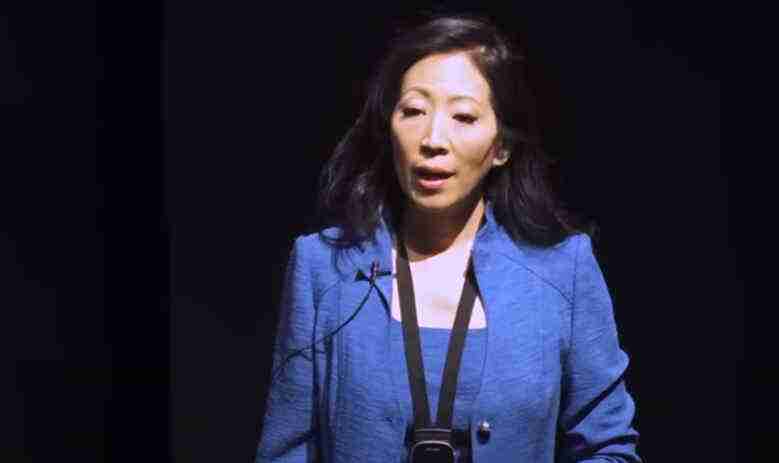
Read the full transcript of Cornelia Choe’s talk titled “How To Connect With Different People” at TEDxSwansea 2024 conference.
Listen to the audio version here:
TRANSCRIPT:
The Journey Begins
CORNELIA CHOE: When I was 10 years old, my family moved from a town where I had spent my entire life, and we traveled 6,000 miles to a place that my father called a land of great opportunity. On my first day of school, I recognized some girls that I had met earlier that morning. I pushed them, and somehow their shoulders came together, and they blocked me from speaking with them. The whole circle of girls closed up, leaving me no place to enter.
I felt excluded and rejected, and I missed my friends back home, in Minnesota, in the United States, where I grew up. I asked myself, “Is there something wrong with me? Was I wearing the colors of a rival school? Is this how my new life in Seoul, South Korea will be?”
I looked like the people around me, so you might think that I’d find inclusion right away, but it could have been further from the truth. I didn’t know how to be Korean. I had grown up eating cheese and sandwiches and blueberry pie. My friends and I, we loved going swimming and skipping stones during the summer, and a favorite pastime in our community in Minnesota was to go ice skating.
What was ironic is that I didn’t look like the people around me. I was the only non-white girl in my group of friends. But I never questioned whether I belonged. I knew that I belonged, because I saw it in the instant smiles of my friends and their parents and my teachers. They had chosen to build kinship with me.
The Paradox of Diversity
My best friend Stacy was gone. My other friends were mostly gone, and I thought I was gone, until I moved to the bustling, crowded city of Seoul, where I looked like the people around me. Yet, paradoxically, my ideas for our pathway to go skipping stones were flatly rejected, because it was too exotic and too unrelatable, especially coming from someone who looked like them. And that’s when I realized that our diversity is defined on the inside. It’s defined by our experiences, which are invisible to us when we first meet someone.
In my life, having lived in three continents by the time I was 18, and seven countries in total, today, I bring together leaders from around the world who are at the top level. For example, the CEO of an international tech company, or the head of a global non-profit organization, or a senior governmental official. And I bring them together into small circles of other leaders who are very different from them, and they meet regularly to discuss their different viewpoints. And together, they’re able to resolve enormous problems facing them in their work and in their lives.
The Challenge of Inclusion
Personally, having had to adjust to a new country each time, I’ve had to find a way to get myself included. And I’m familiar with the fear of the unknown that we have when we meet someone new. It’s like a noise that you hear at night, and you’re not sure what it is, yet your heart starts beating fast, and you’re ready to instantly react. Our brains kind of mitigate and manage the fear by attempting to determine immediately when we meet someone, if they’re a friend or foe, and what they’re like.
But it’s hard to know what someone’s like when we meet them. Research from Princeton University shows that when you see a new face, we form an opinion on that face in a tenth of a second, but that these opinions are rarely accurate. It’s becoming more and more difficult to predict what people are like when we meet them today. Let’s look at some reasons why.
Over the last 50 years, the level of international migration for people living abroad has more than tripled, bringing together people from different cultures and climates and continents, and a distance of over 100 times the distance that our hunter and gatherer brains have become accustomed to. And we add more complexity to this. Whereas traditionally, we’ve had one career and one job, or just a few, today the average American worker has 12 different jobs during their lifetime. And career changes have become commonplace.
The Paradox of Diversity and Inclusion
So, as we shed our predictable, standard lives, and we adopt more customized, unique lives, our stereotypes have never been as unrepresentative as they are today. And when we meet someone, it’s becoming hard to know who they are, what their frame of reference is, and how to connect to them. So often, we don’t. The fear of the unknown and other factors are deterring us from reaching out and including others, especially if we feel that they’re different when we first meet them.
The more diversity we have in a team, the more unknown and the more social distance we have between team members, leading to more uncertainty and sometimes even fear, making it hard for everyone to feel included. And this is the paradox of diversity. We think that diversity and inclusion go hand in hand. But actually, diversity and inclusion are contradictory.
The more diversity we infuse into a team, the harder it is to get inclusion, and the more time and effort we need to devote to ensuring that everyone feels included. So it’s not diversity, equity, and inclusion. It’s not D-E-I. It’s D-O-R-I.
Especially when we first bring people together. When I first moved to Seoul, and that group of girls who excluded me that day, they weren’t the mean girls. They were the scared girls. They themselves were afraid of being excluded.
And sometimes, when we want inclusion, we can end up excluding others.
And this can happen anywhere. I try to pay attention to this because it’s so easy to do. So when we first bring people together, our work only just begins.
The Path to Inclusion
And that’s why programs designed to just bring people who are very different together are having a hard time with inclusion. Diversity doesn’t create inclusion. But inclusion enables diversity. We want to benefit from the many ways of seeing, thinking, and doing that diversity can bring us.
But to get to inclusion, we need to cross the unknown. And this journey is usually a personal one. We need to personally decide to get to know, understand, and include others. So just as diversity is defined on the inside, inclusion is created on the inside.
Inclusion happens from the inside out. And when we’re able to include others, we’re finally able to enhance our lives and to enrich ourselves with a variety of ideas and perspectives that diversity can unlock in the people around us. I see this all the time in my work, bringing together leaders into small circles. These leaders come from five different continents, from North America, South America, Europe, Africa, and Asia.
And within our circles of leaders, we have many different types of diversity, different types of neurodiversity or multiple genders. So our leaders are very different. But what keeps them so closely knit is who they are on the inside. And the speed and efficiency with which they’re able to help each other astounds me.
Three Steps to Inclusion
And this is how we do it. These are the three steps to inclusion:
The first step is the humanization of the unknown. When we first meet people, our fight or flight reflex kicks in. But if we’re able to feel safety, it’s easier for us to use our curiosity to get past our vulnerability and get the courage to know the other person, to hear their stories, and to share ours. In our circles of leaders, the first day they get together, and for the first few minutes, it’s silent. No one talks. Everyone sits alone in a circle of one. And then when I invite them to introduce themselves with what has nothing to do with their job, they have the courage to share their vulnerabilities and their stories. And every time, for the first break, it’s an explosion of talking and connecting to the point where they’re locked into their own joint world, and then hearing about perspectives they wish they’d known about a long time ago.
The second step to inclusion is to enjoy our commonality. As we hear people’s stories, we find surprising similarities and coincidences, such as places we love to go or hobbies that we share in common. And as we get to know each other and feel familiarity and connect, research has shown that our brains, our hearts, and even our breathing align in similar patterns, bringing us together. And this can happen in a group of people watching a movie or in a group of people watching a TED Talk together.
The third step to inclusion is to celebrate the individual. As we get to know people, we start to see what makes them unique. What are their lives like? What are their hopes? What are their dreams? And as we come together in an environment of safety, empathy, and generosity, we’re able to make amazing outcomes.
In our groups of leaders, they’re able to resolve intractable problems that have to do with the world around them, with the people around them, with their own paths, and with total company restructuring, and to complexities that we couldn’t have solved on our own or in an exochain universe. And you can have these amazing outcomes, too. It’s like a muscle. The more you go through these three steps, the easier it becomes.
So the more you go through humanizing the unknown, enjoying our commonalities, and to celebrating the individual, the more you grow your social adaptability or your ability to connect and create partnerships with a wide variety of people and connect with people, because connection is one of our greatest gifts in life. So you can use these powerful tools in your workplace or in your everyday life.
I saw this several years after moving to Seoul when I moved again, this time to Spain, in a town outside of Madrid. It was my first day of summer camp, and I was one of the first ones there. Walking down an empty hallway that smelled like a floor cleaner, and hearing the echo of my own footsteps, I was rehearsing the few lines I could say in Spanish that were actually comprehensible. And then suddenly, I see three other campers arrive, and they’re all bigger and older than me, and they walked with me in a warm circle around me, and they looked at this Korean girl. I stopped dead in my tracks, and I said, “Hola, I’m Cornelia.”
“Cornelia?” they said. “I’ve been living in North America and in Asia, and now I’ll be moving to Barcelona, after this camp.”
“Eh?” They were flabbergasted. And while we didn’t understand everything, one thing was clear, that we shared the same sense of humor, and we stood there, shoulder to shoulder, enjoying each other’s company for a long time. You know sometimes how if you walk into a networking event, and everyone’s busy talking in their circles, yet you don’t know anyone? And then someone walks up to you with a kind smile. That’s how I felt. Safe and understood. And I didn’t know it then, but I had just met three friends for life, Julio, Maria, and Hector. And when I got married, over a decade later, each of them said, “I don’t know when and where you’re getting married, it doesn’t matter, I’ll be there.”
Conclusion
What would it be like if all of our unknowns, if all of our apprehensions, if all of our barriers disappeared, and all of us were able to overcome the paradox of diversity?
Each country that I’ve lived in is now a part of me. I’m grateful to have friends in so many parts of the world, including in Seoul. It’s taken a lot of courage. I’m no longer the blissful blonde girl you’ve never heard of.
Today, when I travel to Boston, I miss Spanish croqueta. And when I go to Barcelona, I miss kimchi. And when I go to Seoul, I miss a good homemade blueberry pie. And don’t forget the vanilla ice cream.
You may have felt these feelings of homesickness yourself. But when we have the courage to reach across the unknown, to see your eyes, and to create connection and inclusion, we get the reward of finding a feeling of familiarity and comfort wherever we go, with each new person we meet. And this is my hope for you. Humanize, enjoy, and celebrate, and grow your social adaptability.
We can overcome the paradox of diversity. You just have to be able to see people from the inside out, and to include others. And that inclusion comes from inside of you. Thank you very much.