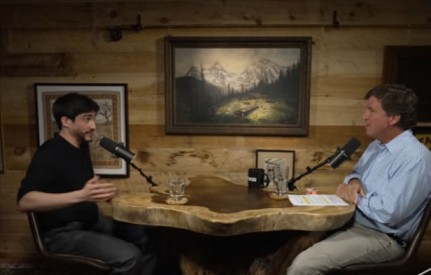
Editor’s Notes: In this episode, Tucker Carlson sits down with Kian Sadeghi, the founder and CEO of the biotech company Nucleus, to explore the complex ethical landscape of genetic testing and IVF. They dive into the controversial practice of “baby customization,” discussing how modern technology allows parents to screen embryos for traits ranging from hereditary diseases to IQ and height. The conversation tackles deep philosophical questions regarding eugenics, the role of human agency in reproduction, and the potential societal consequences of treating genetic optimization as a consumer product. (April 14, 2026)
TRANSCRIPT:
Introduction
TUCKER CARLSON: Thanks for doing this. I appreciate it. I’ll just say at the outset, which I told you off camera, I disagree with this conceptually, I think, but I’m also completely ignorant of the details.
KIAN SADEGHI: Yeah.
TUCKER CARLSON: So I kind of want to know what this is before even asking you questions about whether it’s a good idea. Can you just— I’ll just stand back and let you explain what you’re doing.
KIAN SADEGHI: Yeah. So first, thanks for having me on.
TUCKER CARLSON: Of course.
What Is IVF?
KIAN SADEGHI: Patients, there’s one way of reproducing via IVF, right? So you can conceive naturally via sex, or maybe if you’re infertile or if you have some sort of hereditary disease or for some other reason you do IVF. When you do—
TUCKER CARLSON: Yeah, I’m sorry, I’m going to— I specialize in dumb questions. Can you explain for people who don’t know what is IVF? Yeah. What is IVF?
KIAN SADEGHI: IVF stands for in vitro fertilization. So basically imagine the egg and the sperm, right? The foundation of life to make an embryo. It’s basically putting those things together in a clinic. Right. And then basically you take that embryo and you would transfer it into a woman and then it would implant and the woman’s pregnant.
TUCKER CARLSON: So conception takes place outside the womb.
KIAN SADEGHI: Correct.
TUCKER CARLSON: Okay. Yeah.
How Genetic Optimization Works
KIAN SADEGHI: And so during this process of IVF, what you do is today, even if Nucleus didn’t exist, even if genetic optimization didn’t exist, you make several embryos. Okay. So when you’re in an IVF clinic, you make several embryos. The amount of embryos you end up making, it varies, but you might have 4 or 5.
You actually do genetic testing on these embryos to identify things like chromosomal abnormalities, like Down syndrome, for example. So that’s very commonplace. That’s done in basically every IVF clinic in the United States. They will actually screen embryos, the genetics of the embryos, to see if they have some sort of severe chromosomal abnormality.
What we do is we basically provide more information on the embryos. So we also read the DNA, but now we give information on things like other hereditary disease risk, also chronic diseases, things like cancers, Alzheimer’s, diabetes, also traits like IQ or height, et cetera.
So to be clear, we’re not changing any DNA. There’s this process in IVF where you make embryos already. Genetic testing is done on embryos. What we do now is we provide you a little bit more information on your embryos. Basically, that information can be used to implant which embryo the couple deems to be best. So basically give more information to couples to then choose which embryo they want to implant.
Can Genetics Determine IQ?
TUCKER CARLSON: I don’t want to derail this conversation 2 minutes in.
KIAN SADEGHI: Okay.
TUCKER CARLSON: But you just said we can tell the IQ of a person by the genetics?
KIAN SADEGHI: So IQ—
TUCKER CARLSON: I was reliably informed IQ is not real, okay? And it’s not determined by genetics.
KIAN SADEGHI: So there’s— I think it’s helpful to think about all these different characteristics from diseases to traits, right? People know intuitively something like height, for example, right? Height, they say, oh, that’s genetic. Or something like breast cancer, eye color, right? Yeah. These things people intuitively know are genetic. And so you can actually basically take these different phenotypes and measure how genetic any phenotype is.
So what does it actually mean? The most simple way of explaining it is imagine you took two identical twins, so they have the same DNA, and then basically you separated the twins, they grew up in different environments. Sometimes in pop culture, people hear about these different things where you actually take twins and they have, again, the same DNA, they’re identical DNA, and then they grow up in different places for whatever reason, so they’re subject to different environments. And then you can actually measure basically how similar they are across all these different phenotypes to see basically how genetic something is.
TUCKER CARLSON: Twin studies.
KIAN SADEGHI: Yes, twin studies. Yes. And so using twin studies, you can actually get measurements of things from diseases, right, like cancers and diabetes and Alzheimer’s, as mentioned, to things like height or IQ or BMI, et cetera. So twin studies show that IQ specifically is about 50% genetic.
But to be clear, IQ is just one of over 2,000 factors that we actually look at, right? Principally, parents and patients, they come for disease. They always come for disease. And remember that when the embryos you’re picking from, the most important determinant of the genetics of your embryos is, well, your partner, right?
So you’re actually not changing DNA. This is not gene editing. You’re not changing DNA. You’re not making an embryo’s DNA better. You’re basically reading the embryo’s DNA that you have. So when you pick your partner, you’re basically picking the kind of genetic pool, and then you can basically pick which embryo you deem to be best based off of your preferences and values.
The Bell Curve and the Genetics Debate
TUCKER CARLSON: I mean, again, I just want to say thank you for doing this.
KIAN SADEGHI: Yeah, absolutely.
TUCKER CARLSON: I’m not here to attack you at all.
But up until pretty recently, the public conversation has settled on a consensus that everything is environment and that genetics aren’t real. And this was at the very center of our national debate about race and crime and educational achievement, income. And it all grew out of or was crystallized by a book called The Bell Curve. Have you heard of this?
KIAN SADEGHI: Yeah, I have.
TUCKER CARLSON: Yeah. So it seems like that debate is over and we’re— and I’m not— this is not an attack at all. It’s just crazy to me that people are just saying this out loud. Yeah, genetics plays a big role.
Hereditary Disease Screening
KIAN SADEGHI: Yeah, genetics plays a role. So I think in society today, when people think about height or cancers— and to be clear, I’m not talking about— there’s hereditary disease risk like PKU, Tay-Sachs, cystic fibrosis, beta thalassemia. These are conditions we also screen for, right, to make sure that parents can reduce suffering each generation. So that’s also part of what we do.
And those conditions are basically deterministic in nature, right? So if you have two bad copies of cystic fibrosis, of course you’re going to get cystic fibrosis and it’s debilitating. And so there’s policies that basically encourage Americans and people around the world to do screening, to not pass down basically an invisible genetic burden to their child.
TUCKER CARLSON: Right.
KIAN SADEGHI: Right. That’s classical genetics. So I think it’s interesting because you make—
Is This Eugenics?
TUCKER CARLSON: It’s eugenics, right?
KIAN SADEGHI: No, no, no, not eugenics. Eugenics—
TUCKER CARLSON: Well, how is it not? It’s improving the human species through breeding.
KIAN SADEGHI: Eugenics refers to basically corrosive use, corrosively controlling human reproduction, right? Forced sterilizations, even euthanasia, controlling who can get married to who. So— No, no, no, no, no.
TUCKER CARLSON: Those are methods by which you implement eugenics, but they’re not the only ones. Eugenics simply means— well, you can disagree with the concept, but the concept is, gross or not, the improvement of a species, in this case, the human species through selective breeding.
KIAN SADEGHI: Well, but there is no selective breeding. Remember, patients choose who they marry and then in the embryos they have, right? You’re not changing embryos. In the embryos they have, patients can make their own choice in which embryo they want to implant. So juxtapose eugenics—
TUCKER CARLSON: How is that not selective breeding? This is literally— well, breeding is by definition the process of bringing new life into the world, and you’re deciding which of these embryos becomes a person. And so that is breeding.
KIAN SADEGHI: What—
TUCKER CARLSON: It’s not choosing people’s marriages, it’s not giving them forced vasectomies, but it is breeding. That’s what breeding is.
The History of Eugenics and Genetics
KIAN SADEGHI: I would say that in IVF clinics for the last couple decades, there’s been this process of basically taking these embryos, getting more information on the embryos, and then picking whichever you want to implant. Right. Again, you’re not changing DNA. You’re not controlling who can get married to who.
Just to be clear, if you go back, eugenics is a term that came up in the late 19th century by a scientist named Francis Galton. Okay. He was a British scientist.
TUCKER CARLSON: Yeah. A bunch of them. Havelock Ellis. Yeah.
KIAN SADEGHI: Yeah. He came up with the term eugenics. Interestingly, the term eugenics was actually about 20 years before the term genetics. This is really interesting. A lot of people don’t know that. Yeah, this is very important. Eugenics naturally did not require genetics. So genetics, when the term was coined, it was the science of heredity, right? Of passing down information. The unit of heredity identified as DNA— that was only until the 1940s.
TUCKER CARLSON: Right.
KIAN SADEGHI: Right. And then identifying the structure of DNA was actually after World War II in the 1950s. So we didn’t even know— in 1927, and I think it was Buck v. Bell, the US Supreme Court deemed forced sterilizations constitutional.
TUCKER CARLSON: Okay.
KIAN SADEGHI: At that point, we had no idea that DNA was actually the genetic basis. This is really, really important. People always get this wrong because they don’t follow the timeline. Eugenics as a corrosive ideology to control populations had nothing to do with molecular genetics, period. It had nothing to do with the genetics.
TUCKER CARLSON: Why was it corrosive?
KIAN SADEGHI: Well, I think if you basically forced sterilize somebody against their will— I mean, I think that’s against the fundamental liberty of a person.
TUCKER CARLSON: There’s no question. I couldn’t agree more. But again, that was just one manifestation of it. So force played no role in a lot of it. It was steering people, giving them options, telling them that if you married this kind of person, here’s the outcome you’re likely to get when you have children.
KIAN SADEGHI: Well, force did play— I mean, again, in 1927, the United States Supreme Court deemed constitutionally that forced sterilizations are constitutional.
TUCKER CARLSON: I’m just saying that— and I couldn’t be more opposed to that, in fact, to the whole program. But I just want to note as a factual matter that forced sterilizations were an incredibly ugly evil manifestation of an idea that was not limited to forced sterilization. The idea is the same idea you’re articulating, which is people should try to improve the human species by selective creation of children.
Is There a “Best” Embryo?
KIAN SADEGHI: So, yeah, I disagree with that.
TUCKER CARLSON: How is it different?
KIAN SADEGHI: So, Nucleus ultimately, and what we give patients— ultimately what patients actually want, right? Again, patients are choosing their partner, they’re choosing to do IVF, they have basically options, they have several embryos, they get information. There’s actually no best embryo, right?
So Nucleus is a company and no patient can ever say, “Oh, this is the best embryo,” because there’s no fundamental virtue rooted in biological characteristics. So the idea that you could even have a best, for example, is misguided principally in my view, because something like virtue— and I think of two kinds of virtue. There’s natural virtue and then divine virtue. It’s fundamentally not biological. It’s not physical. Genetics can only program for physical things.
And then people can basically make their choices within the partners that they choose and then doing IVF to then pick the embryo that sets the best set of biological characteristics to them. But there is no virtue. There’s no morality in that decision.
TUCKER CARLSON: Well, I’ve noticed.
KIAN SADEGHI: Yeah.
Virtue, Choice, and the Deaf Child Example
TUCKER CARLSON: But so do you think that it’s equally virtuous to have a child, intentionally have a child, which we can now do with the genetic testing you’re describing, who has Down syndrome, Tay-Sachs, and CF? Is that as virtuous as having a child who has none of those things? Because I thought you just said that it’s good to get rid of those things.
KIAN SADEGHI: To be clear, virtue is independent of biological characteristics. Parents can choose based off their preference what they want, what is best. So let me give an example. There was a case in reproductive medicine where a deaf couple, they want to have a deaf child.
TUCKER CARLSON: Yep.
The Genetic Basis of Schizophrenia
KIAN SADEGHI: That to them was what was best, basically. That term “best” is relative, context-specific to the parent. We have patients, for example, that might have Huntington’s, which is a severe neurodegenerative disease. Very, very severe. It’s autosomal dominant, means it’s passed down.
And by the way, this is actually interesting. Something like Huntington’s or schizophrenia, these are exactly the kind of conditions that in the 20th century they would say, “Hey, these people are unfit. They should not reproduce,” because they have some sort of neuropsychiatric or some sort of debilitating condition that runs in the family.
In my case, one of the reasons why I started the business is because one of my family members, she unfortunately went to sleep and she passed away in her sleep. These things are deeply personal to people and they—
TUCKER CARLSON: Is that the result of a genetic anomaly?
KIAN SADEGHI: Yeah, a condition that can cause irregular heartbeat and cause sudden death.
Parental Choice and Genetic Conditions
TUCKER CARLSON: I don’t want to sidetrack you, but you threw in schizophrenia, rather. Is there— I don’t know the answer. Is there evidence that that is genetically predisposed?
KIAN SADEGHI: Schizophrenia is very strongly— there’s a very strong genetic basis to schizophrenia.
TUCKER CARLSON: Right. Really?
KIAN SADEGHI: Correct. Yeah.
TUCKER CARLSON: And we know that.
KIAN SADEGHI: Yes. That is very well established science.
TUCKER CARLSON: Yeah. Sorry. Yeah. I’m learning. Yeah. Okay.
KIAN SADEGHI: It’s interesting.
TUCKER CARLSON: So, okay. But you said a minute ago that there is a nationwide, indeed a global effort to get rid of conditions like—
KIAN SADEGHI: But again, deafness is a great example. It’s not for me to tell a deaf couple whether they should or shouldn’t have a deaf child.
TUCKER CARLSON: No, no, I understand.
KIAN SADEGHI: But that can apply across everything now. If somebody wants to have a child based off their set of what they deem to be best based off their lived experience, that’s their right and that’s their choice. So I’m not saying that it’s better to have a child that is not deaf, for example. I can’t do that. I can’t possibly say that. It depends. I think that’s entirely the choice of the family. That’s entirely the choice of the parents.
TUCKER CARLSON: But that’s a consistent position. I wonder though, because you described something that’s absolutely real, which is a system globally that is designed to minimize, to reduce the incidence of certain conditions. So you said that that’s the policy. Like, you genetic test all the embryos at every IVF clinic because you want to make sure we have less Down syndrome, for example.
KIAN SADEGHI: But no, but again, what’s important here is there’s not some sort of broad centralized body being like, “Oh, we need to all do this sort of testing embryos.” That decision rests in the parent’s choice. A parent could choose not to screen embryos for Down syndrome. They could make that decision. And if they make that decision, they can then transfer that embryo and have that baby. That’s entirely their choice. It’s not like—
TUCKER CARLSON: Do you think there’s no— and I don’t— I mean, let’s not be disingenuous. There is a global effort to reduce the incidence of certain conditions. Of course. Everyone just assumes— I mean, that’s why the incidence of Down syndrome has fallen off a cliff. There’s been an elimination of Down syndrome. Not entirely.
KIAN SADEGHI: Those are parents making choices though. Those are parents and couples making choices.
TUCKER CARLSON: You don’t think the healthcare systems steer people in certain directions or have a preference?
The Healthcare System and Genetics
KIAN SADEGHI: I think the healthcare system unfortunately right now is a sick care system. The healthcare system actually is very much not in the business of prevention. I was looking at these stats, which is the US healthcare system spends about $5 trillion. It’s a lot. About, I think, $4 trillion goes to chronic disease treatment. So things like cancers and diabetes and Alzheimer’s. In 2021, 4 times as many people died of a chronic disease than COVID. 4 times as many people died of a chronic disease than COVID at the peak of the pandemic. So you have to ask, what is the real pandemic here?
And on that point, of the $5 trillion, so $4 trillion, about 80% is chronic disease. About $500 billion is about rare diseases. So these rare genetic conditions that I outlined. Genetics has a strong impact on both hereditary disease like cancer, as I outlined, like chronic diseases, as well as rare disease. So genetics can help impact $4, $4.5 trillion of healthcare expenditure.
But, and there is a but, remember those $4.5 trillion, somebody’s making money for someone being sick.
TUCKER CARLSON: Well, yeah, I mean, of course. That’s horrible.
KIAN SADEGHI: Of course, you say, of course, but I think that we can’t just take that as a given. Genetics as a science, if deployed, can be used for parents to make their own decisions to dramatically reduce breast cancer risk, diabetes risk. If there’s something in their family, schizophrenia, Alzheimer’s, help reduce that next generation. So these things can be used to basically help build what we call generational health effectively.
TUCKER CARLSON: You save a lot of money. Through improving the species through eugenics. Everyone, people made this argument for over 100 years. I get it.
KIAN SADEGHI: I’m just wondering— well, I’m wondering a lot of things, but one thing to say, remember too, that IVF is about 2% of the way babies are born in the United States. Most babies are still born naturally conceived. We actually have a service for those couples as well where you can just basically take a cheek swab. You can do something called procreation stimulation and simulate basically the risk for your child. And that is a service that can basically help any couple too. So I just want to be clear that it’s not just IVF patients as well. These are couples that then can employ this screening and then to have a healthy baby.
Sex Selection and Parental Choice
TUCKER CARLSON: What about sex?
KIAN SADEGHI: What about sex?
TUCKER CARLSON: Well, I mean, the number one thing that people have used prenatal testing for is choosing the sex of their child. So that’s what explains the demographic imbalance in China.
KIAN SADEGHI: As you know.
TUCKER CARLSON: So that’s like the number one thing globally. India, same.
KIAN SADEGHI: And India actually outlawed it, to be clear, too. So in an IVF clinic, you can’t even pick sex in India because there’s a disbalance.
TUCKER CARLSON: But well, legally, but of course it happens all the time because there’s a global preference for sons, and that’s why you see so many more boys than girls, when in fact it’s the opposite in the United States.
KIAN SADEGHI: Actually, if you look at the IVF, it’s about 50-50.
TUCKER CARLSON: I’m saying I’m not talking about the US, but how do you feel about that? Would it be okay with you if someone came in and said “get rid of the girl embryos”?
KIAN SADEGHI: So to be clear, in the United States, this has played out over the last like 20 years. People have been able to pick the sex of their child in IVF clinics, both in the United States and then again at some point internationally too, but eventually became outlawed for the reason you outlined, which is people generally pick slightly more boys. I mean, it’s illegal and it’s much harder in these countries.
TUCKER CARLSON: Yeah.
KIAN SADEGHI: In the United States though, if you actually played out people making their own choices, it ends up being about 50/50. So this is actually interesting.
TUCKER CARLSON: What do you think of it? Is it valid for someone to come in and say— I mean, you said this is an ethically neutral question about whether or not to have a child with this or that genetic condition. But what about sex? Is that ethically neutral? Is it okay, in your view, for a couple to say, “I don’t want any girls”?
KIAN SADEGHI: In my view, that is the prerogative of the parents to pick which sex they want. And if you play that out across many, many, many couples making their own independent choices, which is the embodiment of this kind of liberty and choice, you see it ends up being about 50-50, which I think actually undercuts this idea that everyone’s going to pick a boy, for example. There’s this notion—
TUCKER CARLSON: Well, it’s culturally specific and it’s time— you know, exactly, of course.
KIAN SADEGHI: But that applies across any traits then, Tucker, which is people— there’s not a universal best. It’s very much case-specific to the specific family history, specific values and culture.
TUCKER CARLSON: Of course, of course. But I think we’re talking about two different things. You’re talking about outcomes and I’m talking about the process and whether the process itself is valid. And I totally— I’ve actually seen the numbers. So I know that you are absolutely right on the question of sex selection, but you think it’s okay. There’s no moral problem at all because these are questions of life and death. So I do think moral questions are relevant questions. You don’t think there’s any moral question around choosing by sex?
Biology, Morality, and the Soul
KIAN SADEGHI: To be clear, I think that there is no universal biological best, period, across any phenotype, because biology is inherently neutral. Now, there is universal morality. Specifically, again, two kinds. There’s natural virtue, and also divine virtue. Natural virtue can come from the cultivation of the soul, which is independent of biology. It’s not in the physical plane.
TUCKER CARLSON: How is that different from divine virtue?
KIAN SADEGHI: Divine virtue to me is more about union with God. So natural virtue is about—
TUCKER CARLSON: Where does the soul come from?
KIAN SADEGHI: There’s God. There’s God. What do you mean? Why is there no God?
TUCKER CARLSON: Of course I agree, but I don’t know why there’s a distinction between the virtues again and the weak.
KIAN SADEGHI: Natural virtue, I’ll tell you why. Natural virtue can be intellectually derived. Wisdom, courage, justice, temperance. It’s kind of classic Aristotle. And then there’s things like grace and revelation, which come from God. You can’t necessarily— a human being’s mind is limited. It’s finite. You can’t necessarily grasp that.
So you can— one, you can derive from thinking what leads to basic eudaimonia, human flourishing, that kind of virtue, natural virtue, coming from Aristotle. And the other kind is thinking about divine virtue, which is what goes beyond the intellect, which Thomas Aquinas basically brought together and thought about. There’s this idea of natural virtue that the Greeks came up with. And then, of course, there’s this idea of divine virtue coming from the Old and New Testament about union with God. And all religions actually talk ultimately about surrendering. Personally, I do believe in God, just so you know, if that’s not clear.
On God, Morality, and the Nature of Life
TUCKER CARLSON: What kind of God do you believe in?
KIAN SADEGHI: So I’ve meditated for about 7 years, and what I keep coming across is the best way to articulate— I see God as an experience versus an ideology, which is that there’s a quote, it’s actually from Rumi. I think he articulates it well. Rumi is a Persian poet. He says, imagine you go to the ocean and you come back with a pitcher of water. So the pitcher in my mind is the ego, is the logical mind. And then the ocean is God, the source, the one, the divine, whatever you want to call it. That’s how I think about God.
So I think from my experience meditating and from what I’ve seen, the human mind, the intellectual mind is limited and finite. And there’s basically this vastness. It’s hard to describe, which is why often the Sufis would use poetry to actually describe God, because it’s this—
TUCKER CARLSON: You can allude to it. You can’t describe it directly because it’s too big.
KIAN SADEGHI: Precisely. It’s infinite. It’s vast. That’s why I like the ocean as an example. Another way I like to think about it is like, if you’re a raindrop, and it’s easy for us, especially in modern society, to think the raindrop is the world, but eventually you return to the ocean and you realize it’s much bigger.
TUCKER CARLSON: So that’s your conception of God?
KIAN SADEGHI: Yes, that’s my— Again, I think God is more an experience. God cannot be conceptualized. It cannot be articulated. It’s not a logical thing. You cannot use logic to articulate God. To me, that’s incompatible. But I think you can try to use metaphors, you can try to explain it. I always like the Sufi poets because I feel like they do a really, really nice, beautiful job of that.
TUCKER CARLSON: Certainly of describing the vastness and fundamental incomprehensibility of God, for sure. I couldn’t agree with you more. Only poetry can capture that, but it leaves unanswered the core question for the three Abrahamic religions, which is what does God want? For us to do and believe. And what’s your view on that?
KIAN SADEGHI: Well, Islam specifically— Islam literally means surrendering to one.
TUCKER CARLSON: Yes.
KIAN SADEGHI: I think that’s the answer. In other words, Islam— and you can, I’m not Christian, you’re Christian, so you can tell me more about Christians’ view, but there’s a concept of surrender in Christianity. So in Islam, it means literally— Islam means to surrender. Not just a concept. Yes, it’s an experience.
TUCKER CARLSON: It’s the whole thing. Jesus literally surrendered to being tortured to death.
KIAN SADEGHI: Exactly.
TUCKER CARLSON: Yeah, of course.
KIAN SADEGHI: And then in Buddhism as well, they call it different things in Buddhism. It’s a little bit more like surrendering to the illusion of the ego, for example. But the concept of surrendering, I think, is basically universal.
TUCKER CARLSON: There’s no question.
KIAN SADEGHI: And so, yeah.
TUCKER CARLSON: But—
KIAN SADEGHI: So that’s my answer.
Moral Philosophy and the Question of Divine Rules
TUCKER CARLSON: That’s the very beginning. That’s the conceptual understanding of it. But then you move immediately into what does God want you to do? What powers does he have? What powers do you have? What are the things you’re allowed to do? What are the things you’re not allowed to do? I mean, that’s just a product of logic, but it’s also pretty spelled out in every one of the three religions that derive from Abraham. So what’s your view of that? Are there things that God won’t allow us to do?
KIAN SADEGHI: The way I think about this is there’s sort of three different moral philosophies somebody could adopt. There’s one idea of consequentialism, which is basically the end justifies the means. Which you see a lot of in today’s culture.
TUCKER CARLSON: I hadn’t noticed that.
KIAN SADEGHI: Yeah, unfortunately, even in Silicon Valley, which we can talk about.
TUCKER CARLSON: Even in Silicon Valley?
KIAN SADEGHI: Especially. Especially.
TUCKER CARLSON: Did you just say that?
KIAN SADEGHI: Especially in Silicon Valley.
TUCKER CARLSON: Sam Altman may even be doing it.
KIAN SADEGHI: I mean, yeah, we can talk about that. And the thing is, when people realize or not there are moral philosophies, they end up succumbing to one anyways, or they recognize it’s consequentialism.
TUCKER CARLSON: Everybody’s religious.
KIAN SADEGHI: Yes. Exactly. And then there’s this concept of deontology, which is sort of like maybe the end just does not justify the means, and there’s rules, right? Murder is bad, lying is bad, and it’s kind of no matter what the specific circumstance— sorry, these things are wrong, right? There’s that moral philosophy you can adopt, deontology, which can be secular or non-secular is my understanding of it. Then there’s virtue ethics.
TUCKER CARLSON: Not really. If there are rules, why are they rules rather than preferences? If you came up with them, they’re preferences. If the power that created the universe came up with them, then they’re rules, then they’re laws. So one has no meaning at all. Nothing can be better than anything else. And the other is absolute. So no, there can’t be a secular— sorry, Aristotle— a secular understanding of absolute value.
KIAN SADEGHI: I think there cannot be a secular understanding of divine virtue. We can get more into this, what I mean there. But let me just outline this quickly, and then I think I’ll bring it around.
So there’s consequentialism, which is most people I think in contemporary society adopt. There’s deontology, which as you root it in some sort of— maybe there’s some universal, this is good, this is bad. Then there’s virtue ethics, which basically instead of saying, oh, the consequence— instead of saying, oh, this action is good because the consequence was good, or this action is good because the action is inherently good or wrong because of some secular or non-secular set of rules— you’re saying, hey, the actual thing that you need to measure and you need to think about is the moral character of the person doing the action.
And then if the moral character, if they possess these kind of cardinal virtues, things like temperance and justice, and wisdom, for example, then it so follows that the action they do would be virtuous. So you try to cultivate the soul basically. And then in cultivating the soul and cultivating virtue, confers basically virtue in the action.
So basically the first two, in my view, deontology and consequentialism is very much about the action. It’s saying, hey, is this outcome good based off some thing you’re trying to maximize? And then deontology, which is this concept of forget about the outcome is good or not, is this the right or wrong thing? — then the concept of virtue ethics, which is instead of looking at the action— because ultimately human beings produce action, actions aren’t just there, human beings produce action— the quality of the action should be measured, or it’s deemed virtuous if the person can strive and embody virtue.
And so personally— and I’m still, by the way, talking about natural virtue right now, I’m not even talking about divine virtue. I’m talking about in the intellectual plane, things that people can think about and reason, argue over, things of the mind, not things that go beyond the mind.
And so in the concept of virtue ethics, I think this is the true moral philosophy. We try to embody it in saying, hey— and this comes back all the way to embryonic selection— hey, there is no biological best. There is none, right? Again, the soul, which is non-physical, ultimately does not rest. It cannot be programmed in biology. So people can have different preferences. Somebody could say, I want my son or daughter to be a lawyer. Someone else could say athlete. Someone else could say an entrepreneur. Someone else could say an artist. These are different outcomes that are based off people’s local preferences, physical preferences, contextual preferences. But they’re smaller, right? They’re smaller preferences. They’re not a divine preference. There’s no such thing as that.
TUCKER CARLSON: Well, of course I disagree that there’s no divine preference, but I—
KIAN SADEGHI: There’s no divine preference in biology because the divine isn’t rooted in the— It’s not— Well, it depends where you think biology came from, I guess.
TUCKER CARLSON: I guess that’s true.
Can Humans Create Life?
KIAN SADEGHI: I mean, I also don’t— Can people create life?
TUCKER CARLSON: No. No.
KIAN SADEGHI: So this is actually a paradox that I struggle with too. Another thing that I think a lot about is something called panpsychism, which is this idea that basically each object has its consciousness, even like a rock, right? And this might sound strange to people, but—
TUCKER CARLSON: Doesn’t sound strange. Doesn’t sound strange. I don’t think you’re fully off base.
KIAN SADEGHI: I don’t know the answer. I don’t know. Yeah, I don’t know. It’s a crazy thing to work with. So this idea that a rock has a consciousness, it’s a being, albeit not as sophisticated as human consciousness, but it’s there. And then it provides this idea that consciousness is this kind of spectrum all the way up to, let’s say, humans. And then each thing has this consciousness and accordingly it’s endowed with something that goes beyond just its weight or matter, basically. It’s basically very non-empiricist, just non-materialist. And it basically believes this idea that, again, God has given this consciousness to everything. And I tend to— I actually like that a lot. I actually like that a lot for a lot of reasons.
TUCKER CARLSON: Okay, so can I ask you a couple fundamental questions?
KIAN SADEGHI: Sure, please.
TUCKER CARLSON: So you just said— I think you said that people cannot create life.
KIAN SADEGHI: I think nature has a greater intelligence and human beings. Sometimes people will say we are part of nature, but we are nature.
TUCKER CARLSON: But life— you’re in the life business, right?
KIAN SADEGHI: I mean, obviously what IVF does, for example, is they use natural laws. We didn’t make these natural laws, right? We use natural laws that exist, and then we— and to be clear, we’re not an IVF clinic. We work in IVF clinics, and IVF clinics are the ones that do IVF. We provide more information. But in the context of IVF, you are using natural law. You are not making natural law. You’re not— you can’t make a baby. This is, you know—
TUCKER CARLSON: And I think there’s a good chance you may be violating natural law, but I don’t know. I’m not in charge. But I want to get to the fundamental question though, which is who creates life?
KIAN SADEGHI: I think I would say God, but to be clear, so this is complicated, but—
TUCKER CARLSON: You’re not the only one who isn’t certain.
KIAN SADEGHI: I mean, I don’t know.
TUCKER CARLSON: Obviously I don’t know. And I don’t mean to put you on the spot. Who creates life? Come on. I shouldn’t be even asking questions like this and expecting you to have some cogent answer because I don’t— anything anyone does other than to say God, or to say more precisely, not us. Not us. Is that fair to say? Not us.
KIAN SADEGHI: That is fair to say not us. And we operate within that plane. And to be clear, the stories of sci-fi, right, like Frankenstein, for example, or even Jurassic Park is an example— but Frankenstein, this idea that we can make life, right? We cannot make life. That’s the lesson of these stories.
TUCKER CARLSON: Let me just say, I think you’ve thought a lot more about this than your average businessman. I was going to— I didn’t know how I was going to handle this, but you’re a lot more thoughtful than I expected for a young entrepreneur. So thank you.
KIAN SADEGHI: Thank you, Tucker.
Do We Have the Right to Take Life?
TUCKER CARLSON: No, I mean that totally sincerely. You’ve actually thought a lot about this, and I don’t know the answers to any of these questions, really, but giving my best shot. But we both agree that some higher being created life. We know that we didn’t. So we could assign it to nature, we could assign it to God, but we don’t create life.
KIAN SADEGHI: We don’t create life. We operate within nature. Right.
TUCKER CARLSON: We operate within nature. Amen.
Do we have the right to take life?
KIAN SADEGHI: So, no, we don’t. Now, if we talk about embryos, I assume this was your—
TUCKER CARLSON: I’m not sure. I mean, it has all kinds of implications, including for the Iran War, but I’m just— it’s all around us. The thoughtlessness with which we take life. It’s not aimed at you, it’s aimed at everybody on the globe. But it begins with the question, do we have the right to take life?
KIAN SADEGHI: So again, let’s think about the different moral values that someone could have here. If someone has consequentialism, they could say, hey, look, we want to commit murder for this good. And maybe they have some good that they do.
TUCKER CARLSON: I’m highly familiar with justifications for murder. I just want to know what you think.
KIAN SADEGHI: I’ll tell you what I think, but I just tell you that it’s very pluralistic. And then somebody could say murder is always bad, which is fine. I respect that opinion. Absolutely. And then there’s sort of this last bucket, which again, I’m going to keep playing back to this idea of virtue ethics, which is, can you have a cultivation of the spirit of the soul to think, hey, what is right in this situation?
Because society does not have a definitive answer to this question, right? People will sometimes say knee-jerk, they’ll say, oh, murder is always bad, but then they’ll be pro the death penalty, right? Or they’ll be pro war.
TUCKER CARLSON: People are inconsistent. There’s no doubt about it. And they ignore their own failings and highlight those of others. They’ve got planks in their eyes and they’re picking the sawdust out of yours. Famously. So I get it. People are flawed. But I do think that we can, through a little bit of rigor, arrive at what’s right or wrong. Yes. I mean, that’s what we’re trying to do. What can we say about the right of a person to take another person’s life?
KIAN SADEGHI: Well, I personally, I don’t think there is a right. I personally don’t think there is a right in any circumstance. I don’t see that. I mean, and of course there’s a question like, what is— I don’t think there’s a right, period. I just don’t think so.
TUCKER CARLSON: I’m with you. Now, I think we both understand it’s hard not to want to exercise that right when you can, or someone annoys you, or there’s a country you don’t like, or there’s a— okay. So then what can we say about an embryo in a lab? Is that life?
Does an Embryo Have a Soul?
KIAN SADEGHI: So going back to the panpsychic philosophy, right, which is the— no, no, no, Tucker, I’ll give you a proper answer. But these things are not simple. I can’t be like, oh, yes, it’s— let’s just bear with me for a second.
There is a spectrum of consciousness. There’s a spectrum from rocks to a sentient being all the way to a more conscious being like a human, a more complicated, evolved, fully conscious being. And the question is, where does an embryo sit in that? That is the fundamental question. Does an embryo have a soul, for example? That is the key question. That is the key question in my view.
I totally agree. That is the key. Let’s just make no mistake. Anytime somebody argues about an embryo and IVF, and to be clear, I just want to be very clear on the purpose of our business. We do not do IVF. We work with an IVF clinic. I understand. I just want to be very clear to everyone listening.
You’re just at the intersection of every big trend. No, we have a huge responsibility. And so I think it’s important to, before we can even argue, oh, is embryo life? It’s like, well, where does the life come from? Is it the physical thing?
For me, I think about when I think about death, I think death is a doorway. That’s my own personal belief. This is a vessel. You’re not the physical. We’re not the physical. We’re something else. We’re metaphysical. We’re soul. And so then the fundamental question is that, okay, well, does an embryo have a soul?
And then I think about it. I really like to think about things inductively. So I just don’t want to think about an embryo, but I think about there’s a huge diversity and a range of life. And I can, in my head at least, and again, this is the feelings of the intellect. I think the intellect can only do so much.
But when I think about it, I think, okay, I think about a rock, which I think has some kind of maybe proto-consciousness, some very, very limited consciousness that we don’t understand. Maybe through some psychic or meditative work, you could try to become a rock and try to understand its more subjective experience if it exists. All the way to an embryo, to a dog, to a human.
And so because of this spectrum, it comes down to this question of at what point basically do we have this— is there a soul in an embryo? And I tend to think, and I don’t know obviously, but I tend to think, I tend to think that an embryo doesn’t have a soul.
TUCKER CARLSON: Now, why do you think that?
KIAN SADEGHI: Well, I don’t know. I don’t know. But why would you think— I would think that there’s a couple reasons why, which is an embryo. So I can take a more reductionist approach and I could say an embryo is principally a cell. And when you reproduce already, embryos actually— it’s one cell.
TUCKER CARLSON: Yeah. It divides.
KIAN SADEGHI: Exactly. It divides and becomes many cells. But principally at first it begins just as one cell.
TUCKER CARLSON: I thought it was the sperm and the egg made the embryo. Yeah. Oh, by definition.
KIAN SADEGHI: Yeah. It’s a cell. Yeah. Sperm meets egg. It’s a cell. And then it starts dividing and becomes more and more of a, eventually into a human. Sorry, I was just saying I just lost my train of thought.
TUCKER CARLSON: So the question was, you said you tend to think that an embryo does not have a soul, and I asked why would you assume that?
KIAN SADEGHI: Yeah, yeah, yeah, I was articulating why. So when you look at the way that, when you look at the way that actually people conceive naturally, what ends up happening is that you have these formations of kind of small formations of an embryo. Okay. Right. Which is this, an egg meets the cell and then it travels down and tries to implant. And then many times actually naturally it doesn’t implant successfully.
So nature already has it such that you forget about IVF in natural conception. It is the case that basically you have these embryo formation and then ends up not forming. And now the way I see it is I see that nature wouldn’t make it such that, or God wouldn’t make it such that an embryo would have a soul if in natural procreation it is the case that the embryos come and go. Because I don’t think God, in my personal belief, I don’t think God would basically be getting rid of souls. I just don’t think so.
Now, do I think that there’s a fundamental beauty, not just, I mean, absolutely to an embryo in that, and this is really important for me to say because I don’t know how else to say it. I do think it is similar to like a wave that forms and then again returns to the ocean because everything returns to the ocean. So I don’t see it as something that’s like, oh, the embryo is being discarded. I see it as returning back to the source, even if I don’t believe that it has an explicit soul. Does that make sense? So it’s a little more of a nuanced argument.
The Right to Choose and the Limits of Human Choice
TUCKER CARLSON: It does make a kind of sense. Right, yeah. It does make a kind of sense. I don’t think it’s insane. And again, I think you’ve thought about this in a way that I’m very impressed by, even if I don’t agree. And I just wish more people in your business would think about this because it’s important. Beginning. Yeah, right. It is. It’s very important. It may be the most important thing. It is.
So I guess the difference between a wave and IVF is the human choice involved in the latter. And so I guess the core problem that I have with this is that I’m convinced that we have a right to make certain choices. Do people have the right to make any choice available to them?
KIAN SADEGHI: I think people don’t have the right. In our culture, people will conflate greater performance with being morally better, which is, I think, a big problem. So there’s two kinds of value. There’s instrumental value and there’s moral value. Instrumental value is contingent. And this is actually really important.
All of biology, all of nature is contingent value. For example, you would maybe want an entrepreneur potentially to be more risk-seeking, but you wouldn’t want your surgeon to be more risk-seeking, right? In other words, the value of phenotypes actually changes depending on the environment, right? And this is obvious to say, but it’s actually— I think people miss this sometimes because they think there is a universal best.
They’ll say, hey, if you optimize for X phenotype that I deem to be best, it will lead to a better person. Doesn’t lead to a better person. It might lead to a more optimized outcome, but it doesn’t lead to a better person.
TUCKER CARLSON: You’re destroying your own case.
KIAN SADEGHI: No, I’m not though.
TUCKER CARLSON: Yes, you are, because what you’re saying is right. No, no, you’re telling the truth about the way people are, which is lacking foresight and understanding of the holistic picture. So if people have the choice to choose their own children, we’re going to have a nation of private equity people. No, I’m serious. They’re going to optimize for what’s good right now.
KIAN SADEGHI: Yes. Okay, so this is actually interesting. A couple of things. Oh, wow. You know I’m right.
TUCKER CARLSON: Oh, wow.
KIAN SADEGHI: No, no, no. You explained it better than I did. Tucker, this is so interesting because you’re making an assumption about the way people are.
TUCKER CARLSON: Yes, I am.
KIAN SADEGHI: There’s many parts of this. The first part is, will people basically all choose in the same direction? And interestingly, again, people actually want very different things. And we see that every day with patients, right? Which is like, there’s this idea that like rich people will come in and be like, oh, every rich person is going to pick the same way.
As you mentioned, sex is actually a great proxy for this, right? Sex selection in the United States is about 50/50. And so if you think about any possible phenotype, like even when somebody comes and says, I want to optimize for type 2 diabetes risk, someone else might want to do schizophrenia or Alzheimer’s depending on their family history. Somebody else might want to do height, for example. If they’re both shorter parents, they might want to have a taller kid. To be clear, the traits always come after diseases, but nevertheless.
So what I’m saying is that there’s this notion, there’s this idea of a universal best biological characteristic. It doesn’t exist. It doesn’t exist.
Diversity, God’s Design, and the Limits of Optimization
TUCKER CARLSON: No, no, we’re arguing two different things. I’m not saying— I agree with you completely. And I believe that the diversity baked into humanity comes from God. He created different tribes. Okay? He did that on purpose. That’s my belief. And they’re different from each other by definition. They’re different tribes and they have different characteristics. And a lot of those, as you have been brave enough to admit, are genetic. And that’s a fruit of the creation. God did that. We didn’t.
People are very different. They demand uniformity. And by the way, if you think we’re going to get diverse outcomes, have you been around rich people? They’re not only very similar, they dress the same, they have exactly the same attitudes. They want their kids to get into the same 6 schools. I’ve lived in this world my whole life. It’s the opposite of what you’re describing.
The Cost of Genetic Technology and Accessibility
KIAN SADEGHI: They’ve all changed. Rich people make up a very, very small set of society. There’s a big world out there. There’s a big ocean out there.
TUCKER CARLSON: What percent of IVF patients do they make up? What percentage? Rich people? About all of them.
KIAN SADEGHI: I wouldn’t say it’s about all of them. There are a lot of people that—
TUCKER CARLSON: People who are dialed in to this technology.
KIAN SADEGHI: People do IVF if they can’t generally, almost always, because they can’t conceive naturally, to be clear. And natural conception is able to all— It can cost quite a bit. No, but Tucker, but no, attacking anyone. I know, Tucker, but this is important to say, which is people conceive naturally first. And actually, natural conception is free, to be clear.
TUCKER CARLSON: But that’s what it cost me.
KIAN SADEGHI: Let’s assume, let’s actually play this out because actually it’s really, really interesting. And I actually think you do touch on a fundamental point on the way that people tend to move together, especially wealthy people. They tend to do the same thing. They tend to— it’s pretty much every group.
TUCKER CARLSON: I don’t mean to pick on rich people at all. I’m one of them, but I just am very familiar with them. Yeah, but social societies are governed by herd instincts. That’s why it’s a society and not just a collection of hermits.
KIAN SADEGHI: So I think there’s a couple ways that I think about this. There’s the kind of on the ground what I’m seeing, which I can tell you about what I’m seeing, and then I can tell you about the more of— we can talk about more broadly how this plays out, where the fact that people are pretty mimetic in what they pick.
Okay, on the ground what I’m seeing is I see couples, again, a diverse range of couples, to be clear. This technology is going to get cheaper and cheaper. Whole genome sequencing specifically, this is actually interesting. The cost of reading all of somebody’s DNA, it used to be about a billion dollars, right? So the Human Genome Project in the early 2000s, it cost a billion dollars. When I started the business about 6 years ago, in 2020, it was about $1,000, right? So billion dollars to $1,000. That’s the kind of wonder of making things cheaper and making things more accessible.
So I do think there’s a point where this technology anyone can actually access. That’s really important to say. And that’s one of my missions is to say, hey, this shouldn’t only belong for people who have means. It should belong to everybody, right? Because ultimately every parent should have the right to reduce the suffering in their future child. I mean, I just think every parent has that right.
Suffering, Virtue, and the Limits of Optimization
TUCKER CARLSON: I would never argue against the desire to reduce suffering, I guess. But then you have to ask yourself if the reduction of suffering is the most virtuous thing you could do, why are the societies on this planet with the least suffering falling apart the quickest?
KIAN SADEGHI: Have you ever noticed that? Well, I think in more contemporary society, we’ve lost the concept of virtue generally, in my view.
TUCKER CARLSON: But is there a connection between suffering and virtue? And of course there is. It’s a one-to-one, and there is no virtue without suffering, actually.
So in other words, if you had a drug that could eliminate anxiety, just take a pill, no more anxiety. You could call it, I don’t know, pick a name, benzodiazepines. And all of a sudden you could just eliminate this suffering. And would there be downsides to that? Oh, there would be mass overdose deaths. There would be the zombification of the entire population. There would be addiction, physical addiction that you could die because of.
So I guess what I’m saying is I’m not making a case for anxiety, which is horrible. Anyone who’s ever had it knows how horrible and terrifying it is. I’m only saying that maybe there’s a purpose to suffering. We don’t want to deal with it. None of us does. I certainly don’t.
KIAN SADEGHI: We can’t transcend suffering in the same way we can’t— Maybe we shouldn’t. But we can’t. It’s like saying, let’s transcend gravity. We’re in this world with this natural plane.
TUCKER CARLSON: Well, we’re trying to transcend suffering. And all I’m saying is— I’m not for suffering. I’m against suffering. I hate war. I don’t like suffering at all. And I think we should try to alleviate it. All I’m saying is, maybe these aren’t decisions that are up to us, and maybe there’s a larger picture that we can’t see. And maybe we should pay close attention to our successful attempts to eliminate suffering and assess the fruits. Like, what happened? Did it work, or did it cause even more exquisite suffering, more grotesque suffering? I think that’s a very fair—
KIAN SADEGHI: In the context of, you know, there’s a great example of obviously opioids. People get addicted. They think they’re getting rid of pain. What are opioids exactly? In getting rid of pain, you’re actually creating more suffering. And that’s a fair point.
I think in the context of genetics and what we’re doing, it’s actually interesting because it’s noninvasive genetic— the optimization technology costs a couple of thousand dollars, which is a lot. But it’s going to keep coming down, right? And so suddenly now at the very beginning, you have these embryos, eventually you’re already doing IVF, you’re already picking an embryo, you get more information, you can pick an embryo with a 50% reduction risk in breast cancer. You can have an embryo without BRCA, which is a breast cancer marker, right? Schizophrenia, debilitating condition, really impacts families. Horrible, horrible, horrible.
And in fact, these are the very people who wouldn’t want to have a child, who wouldn’t want to. But now, because of the advent of more advanced screening, they are more comfortable having a child. And that actually, I think, gets lost too. I’m with you. Pro-genetic technology is fundamentally anti-eugenic. It’s actually pro-genetic technology or pro-natalist in that way, because the very people who would have been deemed unfit by some definition, right, because they have more suffering— and to be clear, if you suffer more, you have no less moral worth, to be very clear. We’ve said that already. We’ve established that you and I agree on that.
But those are the very people that genetics is helping. That’s the very people they’re helping, the very people who would have been deemed unfit by the 20th century. Now, through this technology, they’re actually able to have a child through IVF. They’re able to have a child and feel comfortable doing that.
Eugenics, History, and the Moral Distinction
TUCKER CARLSON: Also, there’s been— Wait, no, I can’t— I’m not criticizing anything you’re saying. It’s just that I’m a stickler for definitions because they’re important. This is eugenics. And if you read the early eugenicists, some of whom were really smart, really smart.
KIAN SADEGHI: Eugenics was an international movement, actually. It spanned many, many things.
TUCKER CARLSON: To your point, very aware, and it was thoroughly discredited by the Nazis, who were the most enthusiastic eugenicists of all. I mean, they cleared out the mental hospitals. Yeah. And they cleared out—
KIAN SADEGHI: But this is important though, in that way it’s actually anti-eugenic, because the very people that the Nazis, for example, would target, right, people who are sick and kill and murder— it’s kind of been forgotten to history. Horrible. But those very people are now— they can actually access this technology. It’s actually interesting.
TUCKER CARLSON: Hold on, hold on. So the point that I don’t want to bring the Nazis in because it’s so emotionally fraught and they had all kinds of other sins, but the goal of eugenics was the same. It was, let’s reduce human suffering, let’s optimize human ability, let’s make this better by being thoughtful about how we reproduce, and let’s bring whatever science we have— they had much less than we have— to bear on this question.
And they would make, they did make the argument, that Lothrop Stoddard, who was a Harvard professor and a brilliant, legit brilliant guy, historian— a lot about him was absolutely virtuous, I would say. But he was also a wild-eyed eugenicist because he was smart and he saw all this human suffering. He’s like, let’s get rid of it. It’s nothing against people with Down syndrome, but we don’t want more of them. That was his argument, because it will reduce human suffering. Fewer kids with Down syndrome, less suffering.
KIAN SADEGHI: Well, it’s a moral failure because the eugenicists, in my view, misconstrued the idea of, again, this idea of virtue with biology. There is no virtue in biological characteristics.
TUCKER CARLSON: He wasn’t making that case. No, he was making the case, and the smart ones were.
KIAN SADEGHI: People are— Tucker, please.
TUCKER CARLSON: Less suffering. That’s what they were saying.
KIAN SADEGHI: Less suffering. But less suffering isn’t more virtuous. And it’s hard for people to understand, what does he mean by that? Well, I agree. Just because— I mean, I believe in a religion with suffering at the center of it. Loved ones that have passed away, God forbid, from some disease. Right. I mentioned my cousin. My grandmothers both died of cancer as well. My uncle died of a heart attack, right? When he was playing soccer with my dad, he was 45. He collapsed and he died from a heart attack, which, by the way, is the number one killer in this country.
Just because somebody had cancer, just because somebody has heart disease, just because somebody has a condition— schizophrenia, Alzheimer’s— these conditions, again, they impact 200 million Americans. So this is the problem of our time, okay? Does not make them any less of a person.
And so the fundamental moral failure— it was a moral failure of eugenics, which was misconstruing these things, which idea that it’s better to reduce suffering. Better— that plain term of better doesn’t come from the physical plane. It comes from something beyond.
TUCKER CARLSON: But I’m not even sure that we’re disagreeing. I think we’re agreeing that there’s no— that your physical condition is not a reflection of your moral value.
KIAN SADEGHI: No, but by the way, the eugenicists got that fundamentally wrong.
TUCKER CARLSON: Why? Maybe, I’m sure some did, but—
KIAN SADEGHI: They were consequentialists though. That’s actually important. Going back to the kind of different moral philosophies, if you look through the world that way, it actually helps articulate things. They viewed it as the end justifies the means. We should actually do this, forced sterilizations.
TUCKER CARLSON: We should make it constitutional. I think the ends justify the means was a much less common argument among the eugenicists as it is now among the technologists. That’s true. That’s for sure. That’s very true. But these attitudes not only have not been suppressed or eliminated, they’ve flowered into the dominant attitude in the country. So they won. I’m just saying— I’m not trying to— I’m just saying this idea that you can make people better and in fact that you should.
KIAN SADEGHI: No, but that’s not what we’re saying, though. Remember? No, Tucker, Tucker, this is nuanced, but it’s really important for people to understand.
TUCKER CARLSON: You’re saying people have the opportunity to do it.
KIAN SADEGHI: But people have the opportunity. Nucleus. We never say, hey, these are your 5 embryos. This is the best embryo. We cannot. We are not divine. We can never do that.
TUCKER CARLSON: I understand. But the choices that people make are governed by a lot of things, of course, but one of the— their intuition, their religious views.
The Patient Experience and Personal Stakes
KIAN SADEGHI: To be clear, first and foremost, it’s the direct experience of suffering. The patients that come to us without fail, and to be clear, they might want to optimize for a trait as well. I’m not saying— of course they would. People think about these things holistically, but the first thing they care about is my mother had breast cancer, my dad had prostate cancer, my grandfather had Alzheimer’s. So I just think— schizophrenia. I get it. Yeah, right. So you want to start with the lived experience of the patient. And then go from there.
TUCKER CARLSON: That’s all baked in the cake. Every person has experienced suffering and every person has seen a loved one die if you live long enough. And I just want to be totally clear so I don’t seem self-righteous, which I never want to be. If I had had the opportunity when my children were in utero or before to say no to schizophrenia, no to the things that I really fear, schizophrenia is at the top of the list. I think it’s the cruelest thing, but also CF, which is in my family, all these things.
KIAN SADEGHI: By the way, I’m a carrier for cystic fibrosis. A lot of people are. A lot of people are. And I don’t want my baby, God forbid, to have that.
The Self-Correcting Nature of Genetic Selection
TUCKER CARLSON: Of course not. No, though, actually, the therapies for CF have— that’s a whole separate conversation. I don’t want to be boring. But anyway, I would just say, like all expectant parents, if I’d had a chance to reduce or eliminate the risk that my children would have these horrible diseases or conditions, I would have taken it. How could you not? Absolutely. So I’m not judging anybody. I get it completely. I would have done it.
My question is, honestly, what’s the effect of giving people this choice, which is to improve, in their minds, you say you’re morally neutral on it, not attaching a value to deafness or hearing, but we’re not. Okay. But people do. Everybody does. Everyone other than you does.
KIAN SADEGHI: No, no, no. But to be clear, we can have more philosophy and then say, but most people will reject the idea that there’s this idea of conflating reduced suffering. They would say that that’s better. And then we can play that out. So let’s play that out. Let’s play out how it actually works.
TUCKER CARLSON: So you tell me what you imagine, because this is one of the biggest changes in human history.
KIAN SADEGHI: I will say, Tucker, I will say again that people will make different choices. I really want to say that. There’s actually two parts to this argument.
TUCKER CARLSON: You’re dodging that.
KIAN SADEGHI: No, no, no, I’m not. I’ll answer your question.
TUCKER CARLSON: Some people will make different choices, but not like—
KIAN SADEGHI: So a lot of like—
TUCKER CARLSON: It’s a random distribution of choices? Is that what you’re saying?
KIAN SADEGHI: No, I’m not saying that. I’m not saying that. Okay. What I am saying though is people will bring their— so one way to think about this, to make it more intuitive for people, is if you think about our— there’s this concept in cell and molecular biology, okay? It’s basically this concept called— it’s eluding me— basically that the more specialized something is, the more effective it is.
So in biology, you see things specialized all the time, right? So for example, things begin stem cells, they become neurons, they become immune cells, they become different parts of the body, right? Because these bodies have different functions, and so you need different specializations. Right. Okay. And when you actually— I’m a big believer that everything mirrors everything from the molecular to the celestial, everything. Okay. And so let me keep going with this. And so I remember what it is. Specialization breeds sophistication. Okay. That’s true in cell and molecular biology, which is specialization breeds sophistication. The more specialized something is, the more sophisticated it is. Okay.
And so in a society, if you look at people who are really high in their craft, right? Like Alyssa Liu figure skating versus like an Einstein versus like an Elon versus like an artist like Da Vinci. These people have very different sets of characteristics. And the way nature works is human beings cannot defy nature. It’s a seesaw.
So let me give an example. Every single time people always say this to me, they say, “Oh, people pick for IQ.” Let me put aside my moral argument. Let me put aside my people won’t actually always pick for IQ. But let’s actually assume that’s the case. Let’s assume that’s the case. Everyone will pick for IQ.
One interesting thing about picking for IQ genetically is that when you pick for IQ, and this is interesting to me, when you tell patients this, you can see how they refactor the decisions. When you pick for IQ, you’re actually picking against conscientiousness and extroversion genetically. It’s a seesaw, right? It’s almost like if you’re playing like a FIFA MyPlayer or something and you make somebody stronger, longer, they have less agility. So what happens is, and also you’re making them genetically speaking more likely to be autistic. So these things are genetic. You can’t defy these things. So these things go in opposite directions. So you start selecting for one, it actually takes these things away. So it starts becoming more of a value judgment.
I understand. So wait, let me play this out. So let’s assume that to your point, there’s a fashion of the day, right? People are— we’ve seen this with fashion, we see this in tech, we see this with VC investors, they’ll allocate toward AI, people where they end up wearing the same thing in SoHo in New York. How is this possible? People go to the same private school as you were saying this, right? All these things end up kind of the taste follow through. So let’s assume all the rich people basically start optimizing for IQ, or everyone actually start optimizing for IQ, not just rich people, everyone start optimizing for IQ.
There’s actually an evolutionary mechanism, it’s called frequency-dependent selection. What is frequency-dependent selection? What it basically means is that the rarer a phenotype becomes relative to the other phenotypes. So in this case, for example, if everyone picked for IQ, extroversion and conscientiousness starts decreasing, becoming increasing in terms of the prevalence in the population, the more valuable that phenotype becomes. In other words, the rarer that extroversion and conscientiousness becomes, the more valuable it actually becomes to actually flourish in a population.
TUCKER CARLSON: So you’re arguing it’s a self-correcting problem.
KIAN SADEGHI: And that’s the key point, which is we think as humans we can defy nature. We cannot defy nature. We have to operate within nature’s bounds, within evolution’s bounds. We have to operate within this framework.
The India Example: Sex-Selective Abortions
TUCKER CARLSON: So if that were true, then why did India ban sex-selective abortions?
KIAN SADEGHI: It’s interesting because India specifically was about— so let’s actually walk through this. India was about 55-45 males to females, 55-45, right? People actually think often it was higher. And by the way, the natural rate of having a boy is actually slightly biologically higher than a girl. So people think it’s actually 50-50. It’s actually not. It’s actually like 52-48. So actually, through that perspective, it is statistically significant, but it’s actually not insanely high.
TUCKER CARLSON: Well, over a billion and a half people, it’s—
KIAN SADEGHI: Yeah. It can, it can, it can absolutely over generations. But actually it’s not. I think what’s interesting here is, it’s just a kind of a factoid, but males, babies, they tend to actually have higher risk of basically dying at infancy. So it ends up happening. If you look at the general population, it’s about 50/50, but actually biology has it that it slightly errs toward males.
But let’s take the sex example. Let’s say it plays out that over many generations, people, let’s say it wasn’t outlawed or people still practice anyways, and people start picking across sex. It’s actually the same phenomena, whereas the number of males, for example, come down, the number of females come down because of frequency-based selection. Let’s say you’re in a population, just very simply, there’s 70 males, 30 females. The value of female in that population is much higher. And basically you can model this and show that each successive generation, there are certain sets of genetics that confer a slightly higher probability then of having a female. And so that will actually propagate such that the genes that confer higher females would keep proliferating through until the population comes back to actually equanimity.
TUCKER CARLSON: Why did they ban it?
KIAN SADEGHI: Well, obviously that’s like a longer-term evolutionary thing to saying that things will self-correct.
TUCKER CARLSON: So it actually was self-correcting and it was making the society unstable. I mean, if human choice on questions of life and death and procreation at this granular level is self-correcting and it’s just inherently good and there are no downsides, then why did the biggest country in the world ban it?
KIAN SADEGHI: To be clear, I’m not saying that there is not short-term material consequence for something like sex selection. Of course there’s, especially sex selection. I’m not saying that. But I’m saying—
TUCKER CARLSON: Why is that more significant than any other kind of selection?
KIAN SADEGHI: Sorry, what? I don’t— why is that unique? Like, it’s not actually— like, well, it’s unique in that over IQ. I mean, these are deep, these are deep characteristics, defining characteristics.
TUCKER CARLSON: It’s actually an interesting point you make on sex because if you look at sex, it’s a way of kind of playing out what happens if people pick across traits, right? Because sex is— it’s not a disease, it’s a choice. Depending on what you want, people make different choices, right? So it’s actually a good kind of heuristic of how people will choose.
KIAN SADEGHI: And on that point, actually, interestingly, sometimes we receive criticism from, for example, the American Society of Reproductive Medicine for saying that traits are not reproductive medicine. However, sex is ultimately a trait that people have been picking for the last 20 years. So there’s a bit of this hypocrisy in medicine.
Is There a Downside to Playing God?
TUCKER CARLSON: I guess what I’m trying to get to is really the core question, which is, is there a downside to playing God?
KIAN SADEGHI: Okay, first off, we’re not playing God. But of course there is.
TUCKER CARLSON: Of course we are. We’re making choices that were not available to us until very recently that have never in human history been made by people ever, not one time.
KIAN SADEGHI: We cannot play God. God created us, God created everything here. We cannot play God.
TUCKER CARLSON: Let me be more precise and use a less charged way to describe it. We are doing things that have never been done in human history.
KIAN SADEGHI: That’s actually not true, I would argue, in this case.
TUCKER CARLSON: Oh, well, it’s very true. Because how long have test tube babies, IVF— IVF’s been around since 1970.
KIAN SADEGHI: ’60s. So it’s about 40 years actually. And by the way, it’s not like you look around, you’re like, “Oh, that’s an IVF baby.”
TUCKER CARLSON: I’m not attacking IVF. Yeah. I’m certainly not attacking IVF babies or people at all. I’m merely saying that in the scope of human history, this is brand new.
KIAN SADEGHI: When you say this though, what do you mean?
TUCKER CARLSON: The ability to choose the traits of your children with this level of precision, to get a certain number of embryos and say, “I want the ones that don’t have these conditions that do have these traits.” That has never been tried in human history, period. I would— well, there’s no debating that.
KIAN SADEGHI: No, I would caveat a little bit. When you— remember, you’re picking from—
TUCKER CARLSON: Do the Sumerians do this? Wait, let me just be clear.
KIAN SADEGHI: You’re picking from the pool that— so when you pick your partner, for example, you’re setting the possible genetic pool.
TUCKER CARLSON: So for example, obviously, two short parents— this is what mating is.
KIAN SADEGHI: Yeah, two short parents are not going to have a tall baby, right? The same is actually true for genetic optimization. You can’t have two short parents have a tall child with this technology. You can have a taller child.
TUCKER CARLSON: I understand, but we’re— okay, those— but the core point is this is something, this is an acceleration. Look, people want this. I wouldn’t debate you there. And people do calculate these things as they choose a mate. Of course. “He’s too dumb, I can’t marry him. He’s too short, I can’t marry him. He’s from, you know, whatever.” There are lots of genetic qualities that people don’t want to pass on.
KIAN SADEGHI: In doing that, they’re actually picking, by the way, the most important set of outcomes for their child because it’s your partner. It’s the other side of it.
TUCKER CARLSON: Absolutely. Yeah, but never with this level of precision. Never has there been a menu where you can say, where you can identify qualities that you can’t identify by smell or sight. You can’t know so much of what you’ve just described except through brand new science. So I’m not even attacking that. I’m merely asking a question that has to be asked, which is, what are the downsides?
Weighing the Risks: Science Fiction vs. Reality
KIAN SADEGHI: So, I mean, we talked about the— I mean, you point out one of the downsides, which is like, okay, if everyone starts picking for a specific sex, for example, right, it can create population problems. And even if I would argue, and I did argue, “Hey, over time this actually self-corrected,” which I think is truly valid. So this will be self-corrected, right? But obviously in the short term, there’s still like an acute problem, right?
But I would say actually IVF has been operating for, again, for 40 years. And other policies, like for example, China’s one-child policy, has led to much greater problems. IVF is still the way, 2% of the way babies are born.
I think your principal concern on where this can go awry, I mean, there’s a long history in science fiction of people thinking, “Oh, you know, I can— ” you know, Frankenstein. I mentioned Frankenstein. It’s literally that. It’s somebody saying, “Hey, huh, I could make life, right? And then how about life?” Jurassic Park actually too is this idea that, “Hey, I can do this and then there’s negative unforeseen consequences.” I would argue both of those were consequences. I don’t think that’s science fiction.
The Unintended Consequences of Genetic Technology
TUCKER CARLSON: I mean, hey, let’s create Lyme disease. Hey, let’s create, let’s, I don’t know, let’s strengthen this virus. Oh gosh, it’s out of the lab intentionally or not. It doesn’t matter. You infect the world with COVID. That just happened 5 years ago.
So it’s like, we don’t need to look far to see the unintended consequences of emerging science. I’m not blaming anyone for it. I think people have a terrible track record of foreseeing the consequences of their actions. We know that in our own sex lives, don’t we?
So I think we can just say it’s important with something this powerful and potentially transformative to admit that there will be unintended consequences, because that’s 100% true always. And think through, B, what those consequences might be. That’s all I’m saying.
KIAN SADEGHI: I agree. I think we should be tangible with them though and make sure people actually understand. So again, IVF is the way 2% of the way babies are born. IVF has been operating in the United States for about 40 years. This is not like— 40 years? It’s the 1970s.
TUCKER CARLSON: Oh, I was there. I remember.
KIAN SADEGHI: Yeah, yeah.
TUCKER CARLSON: The test tube baby was on the cover of Time magazine.
KIAN SADEGHI: It was, yeah. I mean, people don’t call that abortion.
TUCKER CARLSON: Are there any consequences to that? To IVF? Yeah. Have we studied the consequences?
KIAN SADEGHI: Yeah, they’ve actually tracked children. The study sizes are a little bit smaller from when I looked into it, and then one might expect, but basically they see no material difference. No. Is it true?
TUCKER CARLSON: That what? There’s no measurable difference at all between children born from an IVF procedure and children conceived naturally?
KIAN SADEGHI: Obviously there’s some environmental things you’re taking averages, but yeah, when I looked into this, and I’ve obviously talked to a lot of scientists about this as well, they said, yeah, there’s no difference. Yeah. Which is pretty amazing. But actually I think it’s just into nature. Well, we can track it over the course of the decades since IVF.
TUCKER CARLSON: Well, this isn’t nature, of course. It’s something that we — well, it’s by definition not nature. It’s something that people are doing in order to improve nature. Like, nature would be infertility. I’m against infertility, by the way. I’m not arguing for infertility. I’m just saying whatever it is is not nature. It’s the opposite of nature.
KIAN SADEGHI: I think we are operating within nature. So let’s go into the framework of God created these natural laws. We’re using natural laws. We’re not making life. We didn’t go to a lab and make life. We’re using the principles of nature, using the principles of heredity, and we’re applying design to them. It’s still beautiful. It’s still very beautiful.
TUCKER CARLSON: I’m not saying — and so I think we are using nature in that sense. I’m not saying it’s bad or not beautiful. I’m just saying it’s not nature any more than nuclear weapons are nature. You could say, well, they’re made from atoms, the essential building block of matter. Okay. But we’re exerting force and our will on nature to create an outcome that wouldn’t occur if we didn’t do that. So it’s by definition not nature.
KIAN SADEGHI: The outcome could have actually occurred even if you didn’t necessarily do it, it could have just — the baby could have happened that way. That’s — but also I would say that, remember that there’s gene editing, which is much further out, and just the idea that you can actually take an embryo and make it whatever you want, basically, theoretically, we could talk about that, which is very, very different.
So I think the concept of IVF clinics using this technology to give patients more information when they’re already getting information on their embryos, now we expand the information, we can help deal with the chronic disease crisis in the United States, the rare disease crisis as well, right? Genetics is unique. I appreciate the upside.
Acknowledging the Downsides
TUCKER CARLSON: No, I agree with you on the upside. I just want to know the downside. Yeah, I don’t see here any — there’s no downside. Of course, of course there’s downsides. What do you imagine it might be?
KIAN SADEGHI: Well, I think let’s play this out. Okay. The first thing I’d say is that with IVF at its prevalence today at 2%, I think it’s actually more or less fine. It’s 2% is about 1 in 50 babies. I think I’m going to outline the scenario where I think there’s a lot more risk and where human reproduction is going to materially change, right? We might argue that you might argue this is a material change, right? I would actually argue IVF was the principal material change.
TUCKER CARLSON: You’re arguing that it’s a material change because you’re saying that we’re going to have less chronic disease, lower healthcare costs, less suffering, and that’s all good.
KIAN SADEGHI: Patients can choose that. Patients can choose that.
TUCKER CARLSON: Well, you’ve argued that will be the result. Yes. And you’re right, it will be the result. And I’m for it. I just want to say I’m for it. I’m just saying that whenever I hear the upside, as you would in any scenario, including your personal family investments, like, tell me the downside. If someone says, “Well, there’s no downside,” I don’t know if I trust you anymore.
KIAN SADEGHI: So what’s the downside? Again, I will articulate downside. It’s just I have to explain.
TUCKER CARLSON: No, you’re going to blame some other technology.
KIAN SADEGHI: No, I’m not going to blame some other technology. Gene editing is bad.
TUCKER CARLSON: No, but what about the technology that you’re offering has an upside? I totally agree with you and that will be real and I’ll support it. Support, I don’t know, a lot of things. But what’s the downside? Like, you must have thought about that. Of course, of course.
KIAN SADEGHI: The fundamentally the — this technology can be exploited by centralized bodies to try to control reproduction. Yes. That is the downside. That is the story of the 20th century. Sorry for getting emphatic, but it’s just like, yes, that is the downside. We’ve seen the downside. We’ve experienced the downside.
But to be clear, that is a moral failure. That is not a failure of the technology. I’ve established that eugenics, for example, was decades before genetics.
TUCKER CARLSON: Yeah, it’s a distinction without a difference in my view. But what you’re saying is, without saying it explicitly, that people misuse the creation and they use it for good, but they also use it for bad. And that’s just how people are and they’ve always been that way and they will always be that way.
So with that in mind, I totally agree that of course centralized powers, whoever they are. Yeah. Well, yeah, yeah. I’m not even sure who they are, but they clearly exist.
KIAN SADEGHI: Governments principally.
TUCKER CARLSON: I mean, that’s the 20th century. Or the Epstein class that runs the governments or whoever these entities are. Yeah, that’s bad. I totally agree.
But the experience of India shows us that given choice, people will also make the wrong decisions as individuals. So I’m just wondering what those consequences might be.
Let me just say, I’m interested in this because I have hunting dogs and I’ve had them my whole life. And hunting dogs are bred for certain qualities and I watch it carefully. And dogs have such short life cycles relative to people that you can kind of in your lifetime watch this happen. But they’re bred for certain — I have flushing dogs, Spaniels. Animals, and they’re bred to work close to you, find the bird, jump the bird, retrieve the bird.
If you are not very careful about breeding them, or if you breed them only for certain specific qualities, you can wind up destroying the dog. And this is well known in animal husbandry. It’s well known in bird hunting. It’s well known among anybody who deals with animals. And I don’t see people as any different.
And I know that there are massive consequences to the dog. Like you get dogs that die of cancer at 5, you get dogs with hip dysplasia, you get dogs with unexplained rage that bite your children. Like we can’t foresee with any precision the effects of our tinkering with reproduction. Absolutely.
The Case of CRISPR and Gene Editing in China
KIAN SADEGHI: Let me actually give a real example of this. So in China, the scientist who was known for using gene editing to engineer the first babies, actually, Dr. He, what he did was he engineered the CCR5 gene. I believe that’s what the gene was called. And he used CRISPR. CRISPR is a bacterial immune response system. It stands for Clustered Regularly Interspaced Short Palindromic Repeats. Basically refers to the set of palindromic DNA sequences in a bacteria. Yeah. Okay.
And he used that to make a gene editing device called CRISPR. And he basically used CRISPR — oh, I remember very well. And CRISPR is composed of two things. It’s composed of like a guide, which basically — imagine it takes the device to the right part of the DNA, which is like a scissors. And then it — excuse me, it has a guide which takes the CRISPR to the right part of DNA and then it has an endonuclease which basically cuts the DNA.
A little bit of a technical explanation. Basically, you can use a bacterial immune response system, harness it as a gene editing device, okay? And this is what the scientist did. And obviously, you know about the story. And he went and he actually engineered human embryos. Dangerous. Okay. And it’s going on now in China, other parts of the world too.
So basically what he did was he knocked out the CCR5 gene, and what his justification for knocking out this specific gene was that it would make the children basically resistant to HIV/AIDS. That was what he said.
This is really interesting for a lot of reasons. One is because you didn’t need gene editing to do that. You could have actually just done that with existing genetic technology that was much cheaper, much less expensive. But even putting that aside, getting to the fundamental thing that you’re articulating, which is unintended consequences — when you actually optimize for knocking out that specific gene, you’re also opening up the susceptibility of that baby to other infectious disease. Because what CCR5 does is it encodes for a specific immune receptor that basically, when destroyed, it makes it easier for other pathogens to basically infect you.
In other words, the dangerous side of this, to your point, is that balance — which is in trying to do something good, what he deemed to be virtuous, if you will, it actually potentially could have had very severe consequences on the children’s health. And so I think that’s a very real, tangible example that we’ve seen of some of the dangers and the balancing act that is nature.
The Unexpected Blessings of Life
TUCKER CARLSON: And that’s really important to say. What about in your life? Have you ever wound up with something that you didn’t expect and maybe didn’t want and found it to be a great blessing over time?
KIAN SADEGHI: Yeah, absolutely. I mean, meditation.
TUCKER CARLSON: I mean, I know, but something that — that’s something you presumably chose to try.
KIAN SADEGHI: I think, you know, sometimes you know, a broader force guides you to these things.
TUCKER CARLSON: Yeah. You know, the experience of having children is the most profound example of that. I think if you ask any parent, or most parents, many parents will tell you like, “I didn’t expect this at all.” Yeah. I didn’t grow up with girls, didn’t have a mom, didn’t have sisters. Years, didn’t want girls. I don’t understand girls like my wife, but don’t want girls. Ended up having a ton of girls. Never would have chose that. And really one of the great experiences of my life. Truly, I mean that. And I’m not embarrassed to say this because my girls know I feel this way.
But anyway, I never would have, if I’d had the choice, just like, “I don’t get girls. I can’t be the father of girls. Like, what?” And yet that again turned out to be this great blessing. And I’m really glad I didn’t have the choice. Have you ever had an experience like that?
KIAN SADEGHI: I mean, yeah, I think some of the best things that happen in life are not things that you can control. It’s part of the divine. Yes, yes, absolutely. Absolutely. 100%. And sometimes there are things that, man, you don’t want at all, but it’s actually good for you. Yeah. It’s the best for you. The best thing for you. Yeah. Want isn’t the thing that you need.
TUCKER CARLSON: So maybe if you get to be the author of your own story and of your own children, if you — the more control you have, the more you get what you want, the more totally you’re destroyed. I don’t know. It’s not good for you to get everything you want. I don’t — that’s been my experience.
KIAN SADEGHI: Remember though, like, genetics obviously is not deterministic, right? So there’s two other parts of life.
TUCKER CARLSON: Wait, what? You were just telling me it was — we can get rid of all these diseases, which I’m for.
KIAN SADEGHI: But Tucker, a good example is like lung cancer. You smoke, increase your risk of lung cancer. There’s some genetics component, but it can be both.
TUCKER CARLSON: Also, your enjoyment of life.
The Limits of Genetic Determinism
KIAN SADEGHI: I just want to put in a good word for smoking if I could. Yeah. Heart disease as well. Right. Obviously, there’s a family history component to it, but there’s also what you eat, how much you exercise, these things. So under the framework, you think, okay, what I think is really important in life, which again goes well beyond genetics, we’re not genetic determinists here, obviously, that’s just not reality. Again, I will go back to the spiritual and cultivation of the soul, that cultivation of the soul to eventually, hopefully divine virtue, union with God, right? That is available to everyone independent of their biological characteristics. And so I think it’s important not to, again, conflate optimizing for success.
TUCKER CARLSON: No, you’ve made that point and I so appreciate it.
KIAN SADEGHI: But that point is such, that is the point. That is the point. The point is that the union with God ultimately is, that is what life is about. So you’re not actually removing, like this idea that you can, if there was a world where somehow parents could perfectly predict the baby’s going to be like this and this and this, you can’t physically, you can’t encode the soul is what I’m saying. It doesn’t come from biology. We know a lot. So there’s stochasticity always is what I’m arguing.
TUCKER CARLSON: Yeah, I mean, but what you’re saying is right. It’s true. There’s no debating what you’re saying. It’s fact. And I appreciate that you’re saying it. Yes. But it’s equally true that we are exercising powers that we didn’t have until very recently and that we know more than we ever have. And I just think, and I don’t think we can stop it. I don’t think there’s any way we can stop it. If you weren’t doing this and the gene editors weren’t doing it, I mean— I don’t like that moral philosophy generally.
KIAN SADEGHI: Maybe you’re right. I actually think people way overshoot that case. People way overshoot the idea that, oh, technology is inevitable. Technology is not inevitable. This drives me crazy. People make choices that drive technology forward. Technology does not just happen. It’s been 20 years of really, really 15 years probably since some of these more advanced screenings had existed, but they’d never actually been adopted. Right. So the idea that technology naturally progresses is a narrative created by Silicon Valley to try to justify raising more money. And by the way, taking away more responsibility. No, people make choices that drive technology forward.
Power, Responsibility, and the Limits of Science
TUCKER CARLSON: I think you’re to an extent right. I mean, this is a whole separate conversation I don’t want to bore our remaining viewers with, but I do think we make choices. That’s absolutely right. And it’s incumbent on us to try to make the right choices for ourselves and those around us. Okay. All true. Those choices matter. Also true. We are also products of the time in which we live in the systems in which we operate. So those things are equally true. Again, I don’t want to be boring, but I agree with you. Our choices are important.
But there’s also, again, a lack of respect for what we don’t know, which makes me very uncomfortable in science. And one of the reasons that I think that we should put a lot of doctors and scientists in prison as soon as we can is because they’ve really hurt us over the last, say, 6 years by not acknowledging what they don’t know, overstating their own foresight about things that no human being can know. Like, there’s no respect for the limits of the human mind. Okay? And suddenly we have these enormous powers that are not actually matched to our wisdom at all. And I just want to say out loud, I’m really worried about it. And I think certain individuals should be punished for doing this. Like the guys who made COVID in the lab, they’re not in jail? Like what? Does that bother you? Do you think that’s a lesson?
KIAN SADEGHI: Yeah, it is definitely a lesson. We have to be responsible stewards of the technology.
TUCKER CARLSON: Should there be punishment for people who kill millions through their foolishness?
KIAN SADEGHI: Yeah, I mean, I think the key is that, again, genetics can program for somebody to be smarter, but it cannot make somebody wise. And the idea that you can genetically encode somebody’s life, again, that’s not true. Not in the DNA, in the nucleus, that’s not true. So I want to be clear that you’re not controlling the life outcome of your child. You’re not going to be like, okay, now the child’s going to become LeBron James and they’re going to be a star. That will come from virtue of hard work, et cetera.
TUCKER CARLSON: So genetics is important.
KIAN SADEGHI: Genetics is important. It plays a factor, plays a role, but I’m not going to sit here and say, oh, genetics is everything. It’s not. Obviously, I’m making the case that it is. No, but the argument that parents can control their child’s life trajectory would suggest that genetics is pretty deterministic.
TUCKER CARLSON: I’m actually making the opposite argument, which is you have no freaking idea what’s going to happen when you tamper with this stuff. We actually know way less than we think we do. We have less control than we imagine, and we should proceed with that in mind. That’s my only argument. But my question is much more specific. You said the technology is not inevitable. I kind of agree with you.
KIAN SADEGHI: It’s not inevitable.
TUCKER CARLSON: No. We certainly have an obligation to do our best. Yeah. For the people who didn’t do their best and who hurt others, like the whole world, like the guys who designed COVID in the Wuhan lab, which they did, we’ve established that, shouldn’t there be some punishment for them? And wouldn’t that help future generations make wiser decisions if they saw that there were consequences to being thoughtless with technology?
From “Don’t Be Evil” to Techno-Capitalism
KIAN SADEGHI: I think generally speaking, the kind of history, at least the modern history of Silicon Valley has gone from, I think it had some idea of kind of virtue ethics, right? Like, Google back in the day was “don’t be evil.” If you say that today, you’ll kind of be laughed at. That was like their corporate motto. You had Paul Graham had his “Hackers and Painters,” this idea of that, that was kind of this beautiful early Silicon Valley spirit. There was another case of Steve Jobs’ 2005 Stanford commencement address. He ended it by saying, “stay hungry, stay foolish.” Basically humility, have humility, open yourself up to the world, not just the natural world, but the divine world.
I think a lot of the Silicon Valley ideology has moved from sort of “hackers and painters” to maybe capitalists and politicians or the like. In other words, it’s moved into a kind of techno-capitalism, this idea that technology is inevitable, this idea that capitalism is inherently good. It’s inherently good if something grows. And you see that with AI companies all the time. They’ll celebrate, oh, we hit $100 million ARR in 2 days or something. And it fundamentally mistakes speed and the rate at which something grows with value, right? Cancer grows very quickly. It’s horrible. And so I think there’s this fundamental idea that, oh, grow, grow, grow, grow, that the consequences be damned, just grow. Growth is inherently good. I think that fundamental philosophy is so bad.
TUCKER CARLSON: Well, it’s a self-justification. So I wonder where it grows from. You described crisply and well the evolution of the attitudes in Silicon Valley, generally speaking. From, “hey, this is going to liberate everybody, it’s good,” to, “hey, this hikes GDP and I’ve got a massive place in Atherton, therefore it’s good.” And those are definitely different justifications. And I wonder to what you attribute the change. Like, how did that happen? How did you go from one place to another? And here’s my thesis in one sentence. Power. When you get a lot of power, you get corrupted. Exactly. Power corrupts. Yeah. So there’s no greater power than determining what kind of kids people are going to have. So are you worried at all?
KIAN SADEGHI: Again, we don’t determine what kind of kids we have.
TUCKER CARLSON: Yeah, you do. Overpopulation.
KIAN SADEGHI: No, we don’t, because people are making their own choices. We don’t make the choice for them. People are making their own choices. You could easily make the choice. No, we don’t. We don’t. You could.
TUCKER CARLSON: You could just say, we’re only testing for these 3 things or whatever. You design the script. Also remember, you design the outcome of a population.
KIAN SADEGHI: No, virtue’s not in biology. Okay, so no, we do not encode populations because human beings can’t encode. That makes a mistake assuming we are God. We are not God.
Changing the Nature of Humanity
TUCKER CARLSON: We are going to affect the nature of people. That’s an inescapable fact. And I think it’s important to just wear the mantle, like, “this is what we’re doing. We’re changing the nature of people. We’re going to try to make them better.”
KIAN SADEGHI: Nature is a very tricky word. The nature of people comes from God. It doesn’t come from genetics.
TUCKER CARLSON: The substance of people, their intelligence, their height, their lifespan.
KIAN SADEGHI: That’s a key distinction, though, because ultimately any human being should want, again, greater spiritual cultivation.
TUCKER CARLSON: But I’m just saying you are part of, not you alone or even substantially, but you’re part of a trend in science that will change the nature of people. So I do think it’s worth just admitting that, because then once you realize the burden on your shoulders, you can bear up under it. Do you think?
KIAN SADEGHI: I think, yeah, definitely this technology— I just want to be very careful with the word nature versus biological characteristics. I agree that we’re changing biological characteristics.
TUCKER CARLSON: How long people live, you’re changing that. So that alone is how tall people are, how well they do on the SAT.
KIAN SADEGHI: But again, it’s not deterministic in that way. It’s not like you can look at somebody’s DNA and be like, oh, they’re going to get a 1570 on their SAT. But I agree with you though.
TUCKER CARLSON: Over populations, and we’re talking about populations, and I’m not saying IVF is 2% or whatever, but I’m just saying the technology, we can see where this is going. You offer people a chance to have children who are healthier and smarter, and they’re going to take it. And I’ve already admitted that I would have taken it because I love my children. It’s that simple. So we know this is going to happen if the technology exists and it’s widely available.
And so that puts you, and not just you, of course, this is hardly an attack, but it puts you in a position of having power over the course of humanity. Over the evolution of humanity. We’re watching humanity change at the individual level. And that’s a big burden, man. That’s a burden that only God bore before, like, 20 years ago.
KIAN SADEGHI: We are not God and we can never be God.
TUCKER CARLSON: Good. Well, that’s a good start.
KIAN SADEGHI: We are not God. We are not God.
TUCKER CARLSON: Do you see it as profound?
KIAN SADEGHI: Absolutely. Yeah. I mean, to see patients who have had, again, I use the Huntington’s example, right? To see a loved one die at age 25 because their brain decays and then to never want to have a child. Huntington’s is really hard. And then to be able to use the technology, the emotion, the miracle that they can have a baby basically. And that’s amazing.
The Upside and Downside of Technology
TUCKER CARLSON: It is amazing. But I, with respect, I think having watched, I mean, I was out in Silicon Valley in the ’90s covering this and I knew the people, I still know some of them. They were totally fixated on the upside in a good way. They were like, “this gives the Encyclopedia Britannica”— you probably didn’t know what that is, but it’s a physical encyclopedia that sat on your shelf and cost thousands of dollars. That’s replaced by this CD-ROM, this collection of ones and zeros. And it’s incredible the amount of information. People will be so much better informed. And now you look 30 years later and there are definitely upsides to technology, but also downsides.
KIAN SADEGHI: Well, we’re susceptible to the same force because we’re human.
TUCKER CARLSON: Well, that’s exactly the argument I’m making.
KIAN SADEGHI: Yeah, I agree. Yeah, we are susceptible to the same force. It’s how can we continue to do that spiritual work? Because it is spiritual work, right? To cultivate the soul, to make sure we maintain these values than I’ve been articulating.
Rules, Responsibility, and the Limits of Choice
Tucker Carlson: I totally agree. So here’s my final question. I’ll stop torturing you. I think you’ve done such a great job, actually. It has nothing to do with you. I’m just worried about these things, and you’re smart, and you’ve, again, for the third time, thought about them to a surprising degree. For a guy who’s also trying to build a company, I’m impressed.
But if we’re going to proceed, one hopes, with this kind of science in a way that creates rather than destroys, then we need to keep in mind, as you said 20 times, the spiritual dimension. But the spiritual dimension is a dividing point. Some things are good for the spirit and some things are bad for the spirit. Some things are consistent with virtue, some things are not. And if we believe in God, we believe God prefers some outcomes over others. God has rules. It’s the nature of God. So will there be an attempt to say, no, these are the rules? You can’t test for this certain thing. You can’t make this choice. You have to constrain people’s choices at a certain point if you’re going to remain consistent with any kind of ethic.
Kian Sadeghi: No, I’ve thought a lot about that. It’s very tricky because you need—
Tucker Carlson: Just as India did. India said, dude, it’s a billion people.
Kian Sadeghi: You can’t make that choice. Sorry. No, that’s very tricky and very complicated. I think the key thing that we have to do as a business, and the moral line that people can hold us to, is Nucleus has not, is not, and will never say that one embryo is better than another embryo. We just won’t. Because again, we cannot mistake instrumental value with moral value. They’re different things.
And I think in deeply recognizing that and deeply realizing, by the way, the indeterminacy, the stochastic nature of genetics as well. As I said, heart disease — you can have a bad diet, you can exercise. Lung cancer, even for things like schizophrenia, as I mentioned, strong genetic components, but you can take — weed actually has made people more schizophrenic, for example. So there’s environmental components as well. And so I think you have to have the deep humility in saying there’s no better, maintain that moral philosophy, because that is the foundation. For me, that’s the foundation.
The Question of Moral Value in Biology
Tucker Carlson: You can’t say it’s better to be non-schizophrenic than schizophrenic? I don’t think it’s for me to say, though.
Kian Sadeghi: I also, again, to be clear, when we use the term “better,” we start applying moral value. And again, I don’t think moral value lies in the realm of biological characteristics. I don’t think so.
Tucker Carlson: So there’s no moral guide at all?
Kian Sadeghi: No, that’s not true. There is universal morality, which is natural law and divine virtue.
Tucker Carlson: You could say that it’s better not to have schizophrenia than to have schizophrenia.
Kian Sadeghi: Well, again, when we say “better,” I think we’re just defining it differently. I think it’s better in the sense that it reduces suffering.
Tucker Carlson: Suffering. Okay, absolutely. That’s your measure, then it’s better.
Kian Sadeghi: Exactly. But what’s your measure? Exactly. But it’s honestly better in terms of their reward.
Tucker Carlson: So this is totally immoral. This is literally immoral. It has no reference.
Kian Sadeghi: No, not at all. Because everything has a spirit, as I said. Just because there’s the physical world and then each thing has a divine spirit to it, right? So each thing has some virtue, or opposite of virtue — vice, for example, right? That’s true. That’s a true thing. But again, these things are not actually incompatible with each other. They’re actually compatible.
Drawing the Line: What Nucleus Won’t Do
Tucker Carlson: But as a company, can you say there’s anything you won’t do?
Kian Sadeghi: As a — on behalf of Nucleus, I think — well, when you say anything we won’t do, meaning like providing—
Tucker Carlson: I don’t know, you just said biology has no moral reference because everything has a spirit. I’m just wondering, is there like a line where, “We’re not doing that, period, because it’s wrong”?
Kian Sadeghi: We’re not providing an analysis, for example. We’re not providing some analysis. That’s what you mean?
Tucker Carlson: We’re not going to make certain behavior easier.
Kian Sadeghi: When you say certain behavior, you mean picking for a specific characteristic?
Tucker Carlson: I don’t know. I could manufacture fentanyl for a living and say, “I’m not forcing people to take it. It’s their choice.” But I would say I’m not manufacturing fentanyl because it’s bad. It’s just inherently bad. It degrades people and in some cases kills them. So I’m not doing that. So it’s — I don’t know — is it enough to say, “Let the people decide”?
Kian Sadeghi: No, it’s not. It’s not. You have to be careful. Like, given IQ analysis, for example, right? We’ve gone through many, many iterations of that way of doing it. And we sort of slow rolled it out, principally because we didn’t want people to misunderstand it. We don’t want people to think — because again, genetically it’s just not possible in the same way — that there’s always environmental components, that you can just look at somebody’s DNA and guess the SAT score. That’s people’s very simplistic model. But so I’m saying that the way we have a responsibility to very carefully communicate that result — so the IVF clinic, the patient, the physician, everyone understands it. And then when people understand it, it takes it from the sensationalist things and just grounds it.
Moral Responsibility and the Role of the Customer
Tucker Carlson: Well, you shift the moral responsibility from yourself to the — you’re still morally responsible. You ship a product. In what way?
Kian Sadeghi: I could make a product and say, “Oh, this embryo is better than this embryo.” I mean, that would be principally the most immoral line that we could cross. I could say, for example, “This embryo is going to be super, super smart,” right? No, we’re careful in the way we say things.
Tucker Carlson: Well, that’s just a false claim, right?
Kian Sadeghi: Yeah, I mean, it would be false, but also like—
Tucker Carlson: But what you’re saying is that the moral decisions rest with the customers, not with you. They decide what’s better. Is it better to have a kid with Down syndrome or not? They decide. You’re not going to have any role in the moral decision.
Kian Sadeghi: Patients can’t — so again, there’s no moral value. Intrinsic value, because that comes from God, but patients can decide instrumental value, right? Like going back to the deaf couple — the deaf couple deemed it to be best, right? For what they want, for the outcome they’re optimizing for. In this case, “best” means optimizing for the set of biological characteristics for some outcome, right?
For example, somebody might want their daughter to be shorter, to be a gymnast. Somebody might want their son to be tall, to be an NBA player. Someone else might say, “I don’t care how athletic they are, I don’t care how pretty they are, I want them to be an academic and study really hard their entire life.” Depending on those things, as I mentioned, cell biology — specialization breeds sophistication. You realize very quickly, very intuitively, that the value of a phenotype is contingent to its environment.
So this is what it comes back to. It’s up to them, the parents, to decide what is their instrumental value that they map to these phenotypes and to pick. It’s up to you to take fentanyl.
The Promise and the Peril of Great Technology
Tucker Carlson: No, I get it. I just hope it works. I think the worst things that I’ve ever done are the things with the greatest promise. Like the iPhone. I was so psyched for the iPhone. I was like, “I don’t need a computer. I can work in my living room.” Next thing you know, you can’t have a conversation with your wife.
Kian Sadeghi: Yeah, social media, it’s really bad.
Tucker Carlson: But it’s bad because it’s good. Benzodiazepines are great. That’s why they’re terrible. Does that make sense? Benzodiazepines are like the greatest drug. Have you ever taken a benzodiazepine? I took it one time in high school. A kid on my hall in boarding school, his dad was a pharmacist and he had Valium. And I was like, “I’ll take anything, whatever.” I was a child. I was an idiot.
I take this thing. I was like, “That’s the greatest thing I’ve ever taken.” And it was so good. I never took it again because it freaked me out because there was no downside. Literally all of your voices in your head — any woman listening will know what I’m talking about — the things that are going on in the background, silenced. Everything’s fine. You’re not stoned. You’re not out of it. You’re just like, great. You’re improved. You’re your best self.
And my animal sense, even in 10th grade, I was like, “That’s bad.” Whereas you do other drugs — you do cocaine, stay up all night doing cocaine — you suffer the next day. And so it’s really clear this is not good, right? Benzos are the best. And that’s why they’re the most addictive, most dangerous, most society-destroying product that we make. Does that make sense?
Kian Sadeghi: Yeah, that makes sense.
Tucker Carlson: The badness is in direct proportion to the promise, the goodness.
Maintaining Virtue in the Face of Power
Kian Sadeghi: Yes. And then there is a moral character of the person giving out that drug. And in the social media case too, talking about moral philosophy — optimizing for clicks and dopamine, you end up following a consequentialist framework, right? Because there’s no virtue, you end up following consequentialist frameworks, and it justifies the means to the point that everybody’s scrolling and liking and clicking all day. 100%.
So the question that you’re asking is, how do you — there is this problem of power, because power corrupts. Absolutely. There’s a problem in Silicon Valley, which is there’s a promise, but then you underestimate the thing. It’s like, how do you maintain virtue? Basically, the question is, how do you maintain virtue? How do you maintain your soul and your spirit despite these pressures?
Tucker Carlson: What’s the answer?
Kian Sadeghi: Well, it’s really hard. I imagine, and I’m hoping to practice for Nucleus and for hopefully this industry — it’s praying, it’s meditation, it’s deep, deep humility with realizing, going back to what I said, there’s a raindrop. If you think that the raindrop’s entire world, you’re figuring out the entire ocean. That’s where I come back to.
Tucker Carlson: Yeah. Well, you have a lot of authority. You have a lot of power for a young man — more than, much more than I ever will. And so use it wisely, and thank you for your thoughtfulness and your willingness to have this conversation. And I’m sure it’s been hellish for you, but you’ve done a great job.
Kian Sadeghi: Thank you, Tucker. Thank you.
Tucker Carlson: Appreciate it. Thanks.
Related Posts
- Transcript: Dr. Jordan B. Peterson Interviews Megyn Kelly # EP 552
- Mel Robbins Podcast: Dr. Leanne ten Brinke Interview (Transcript)
- Arthur Brooks on Happiness: Triggernometry Interview (Transcript)
- Transcript: The Real Reason You Never Feel Present Anymore – Michael Pollan
- Transcript: Victor Glover Interview at ARC 2026