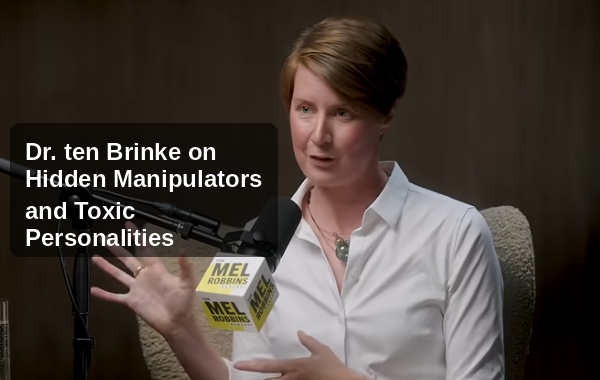
Read the full transcript of manipulation expert Dr. Leanne ten Brinke’s interview on The Mel Robbins Podcast, July 20, 2026.
Editor’s Note: In this episode of the Mel Robbins Podcast, host Mel Robbins sits down with forensic psychology professor Dr. Leanne ten Brinke to discuss how to spot hidden manipulators and toxic personalities. Drawing on her best-selling book Poisonous People, Dr. ten Brinke breaks down the four traits of the “dark tetrad”—psychopathy, narcissism, Machiavellianism, and sadism—and how they manifest in everyday environments like workplaces and family dynamics. From this interview, you will learn practical tools to identify consistent behavioral patterns, set better boundaries, and reclaim their personal peace.
INTRODUCTION
MEL ROBBINS: Please help me welcome Dr. Leanne ten Brinke to the Mel Robbins Podcast.
DR. LEANNE TEN BRINKE: Thank you for having me. I’m so excited to be here.
MEL ROBBINS: I am so excited that you flew in all the way from British Columbia because I am fascinated by your field of expertise and your research, and our team devoured your bestselling book, Poisonous People. And what I’d love to have you do is, if the person listening applies everything that you’re about to teach us from your studies of deception and dark personalities, and they apply it starting today, what will change?
DR. LEANNE TEN BRINKE: I think they learn how to reduce one of the biggest stressors in all of our lives. Because dark personalities — and I’m not talking about the super extreme clinical levels here necessarily — people who are just consistently callous and manipulative in our lives.
Everyone has someone in their lives that kind of might be popping into their head right now. The manipulative sister-in-law, the boss at work who just needs all the attention and takes all the credit for your work, the callous mother-in-law. I get a lot of callous mother-in-laws in the comments.
These are people who cause us incredible amounts of stress. They divide us. They make us think that everyone is terrible, when that’s not the case. They erode norms of polite conduct. They enshrine competition where cooperation would be so much better for everybody. Basically, this one bad apple can really ruin the barrel. And I think today I’m hoping to give people some tools to stop that rot.
What Is a Dark Personality?
MEL ROBBINS: You know what was amazing as you were talking is it probably happened for you as you were listening to Dr. ten Brinke. I started to have situations and people pop into my mind. And one of the things that I wondered almost immediately, because as you talked about, these are a huge source of stress — you talked about callous, manipulative, they divide us, they make you think other people are terrible, they stir up controversy and competition.
Is it always someone who’s doing it overtly, or would this apply to somebody who’s maybe a little bit more victimy and softer in their approach? Because I want to start the conversation by having people in your mind that cause you stress so that you can think specifically about how to apply this.
DR. LEANNE TEN BRINKE: Yeah. We define dark personalities as the overlap between specific dark personalities — which I’m sure we’ll get into — as this kind of nexus of callous, manipulative, and hostile. And they certainly know what they’re doing.
One of the questions I often get is, do these people realize that they are this way? And the answer is yes, because we often measure these personality traits with a self-report. We ask them, is this characteristic of you? And they’ll say, yeah, that sounds like me. Like, I don’t have any remorse. I am a born leader. I am okay manipulating other people to get my way, and I don’t feel bad about it.
So it’s not like they don’t realize that they are this way, but they don’t necessarily care or they’re not concerned about the impact on other people. That’s that callous piece. That combination of manipulativeness and callousness — I’m going to take advantage of you, I’m going to tell lies, and then I don’t really worry about the consequences or how that makes you feel.
MEL ROBBINS: I’m so happy that you just defined callous because that was going to be my next question. So manipulative means my behavior does impact you, and callous means I don’t really care that it does.
DR. LEANNE TEN BRINKE: Yeah.
MEL ROBBINS: So what does a poisonous person look like in day-to-day life?
DR. LEANNE TEN BRINKE: A poisonous person has elevated levels of callousness, manipulativeness, and hostility toward other people. That’s the core of dark personality traits.
MEL ROBBINS: Okay.
DR. LEANNE TEN BRINKE: And if you’re trying to think of what that person looks like in your life —
MEL ROBBINS: Yes.
DR. LEANNE TEN BRINKE: They might be the boss who is consistently self-focused and takes advantage of all of the people that work underneath them, takes credit for their work, manipulates them perhaps into doing work that is not part of their job description, and then is like, oh, this is all about me.
It could be the manipulative mom at the PTA. She’s kind of pulling the strings, she’s spreading rumors, all so that she can maintain this position of power.
There are other versions too. You might have your friend’s new boyfriend who seems really, you know, sickeningly sweet around her but is actually really cruel to everyone else around him. It seems like he might be love bombing her — creating this beautiful sense of a future for them — but you see the pattern everywhere else, which is that he is callous, he doesn’t care about other people, he treats them poorly, he dominates people.
We see these personalities in all different aspects of our life because a personality is a consistent way of thinking, feeling, and behaving.
The Dark Tetrad: The 4 Types of Dark Personalities
MEL ROBBINS: I want to hover right there and make sure that I got that. So a personality is a consistent way of being, thinking, behaving, and feeling.
DR. LEANNE TEN BRINKE: Mm-hmm.
MEL ROBBINS: And when we look at this in the context of poisonous people that are hostile, callous, manipulative — you’re seeing this almost consistent trend of somebody who’s hostile toward other people, callous, I don’t care, manipulative, I’m going to do what I need to do to get what I need.
Before we go even deeper, I cannot wait to dig into this. Could you just list quickly for the person who’s listening right now, what are the 4 kinds of dark personalities that we’re going to dig into in detail?
DR. LEANNE TEN BRINKE: Personality psychologists talk about 4 different but overlapping traits as the dark tetrad of personality traits. So we’ve got —
MEL ROBBINS: Does tetrad mean 4?
DR. LEANNE TEN BRINKE: It sure does.
MEL ROBBINS: I’m learning a lot today. You’re using some big words, Dr. ten Brinke.
DR. LEANNE TEN BRINKE: We probably could have come up with a flashier word.
MEL ROBBINS: Well, I would have thought it would have been a quad if it was 4. So tetrad threw me off.
DR. LEANNE TEN BRINKE: But anyway, that’s what we’ve gone with. We’ve got psychopathy, narcissism, Machiavellianism, and sadism.
MEL ROBBINS: So these are the 4 dark personality types. But as you’ve already said, as we’re digging into each one so we can spot trends, there may be some overlap.
DR. LEANNE TEN BRINKE: Yes, absolutely. That question I sometimes get — is this person a narcissist or a psychopath — suggests that they’re like completely separate things. And when we get into the definitions, you’ll notice that there’s a reasonable amount of overlap. These traits tend to be moderately correlated. So if you’re high in one, chances are you’re also higher in others. It’s not an either-or kind of thing. It’s often a yes-and.
MEL ROBBINS: Gotcha. After this episode, when you start to apply what you’re learning, is it more useful not to label somebody a narcissist but to go, that’s a narcissistic personality style right there — ding ding ding ding ding — or they have the makings of a sociopath? How do I talk to my best friend about this?
DR. LEANNE TEN BRINKE: I think it’s certainly more accurate to say this individual seems like they have high levels of psychopathic personality traits or narcissistic personality traits. I know it’s a bit of a mouthful, but it recognizes the fact that this is a continuum and not a black and white situation.
MEL ROBBINS: What I also like about that, even though it’s a mouthful, is that I think for so much of my life anyway — and I’m sure as you’re listening, you’re going to feel the same way — I have given so much time and energy and experienced so much heartache at the hands of people that are hostile, callous, and manipulative.
And if I can take a step back and be more of a ninja with this, where I can go, oh, there’s a narcissistic personality style, I think I could recognize it sooner. Versus thinking you have to label somebody something, versus spotting behavior and recognizing, oh, I’ve got to step back from that. I’ve got to recognize that and step back.
DR. LEANNE TEN BRINKE: Yeah.
MEL ROBBINS: Versus just saying, oh, that person is that kind of person, if that makes sense.
DR. LEANNE TEN BRINKE: Yeah, totally. I think sometimes we get caught up in trying to figure out what the label is. Is she this or is she that? And that can kind of distract us from — it doesn’t have to be either-or. It’s just like, oh, I see there’s callousness coming across in a lot of her behavior. And so now I’m cued into the callousness and I can try to interact with her in a different way that is going to reduce some of the impact of those personality traits.
MEL ROBBINS: I find that to be really helpful because I feel more equipped to spot it across a continuum versus waiting for behavior to build up to the point where I label somebody.
Psychopathy: The Mask of Sanity
MEL ROBBINS: Let’s start with sociopath because you hear that word thrown around a lot. What actually is a sociopath, Dr. ten Brinke, and how do you spot one?
DR. LEANNE TEN BRINKE: So people with high levels of psychopathy — I’ve got a visual here.
MEL ROBBINS: You do? Okay, good.
DR. LEANNE TEN BRINKE: Yeah. Check this out.
MEL ROBBINS: And I want to tell the person who’s listening what it is so you don’t feel like you’re left out. It is an illustration of a person who is wearing a mask. And behind the mask, you can see that they’re angry, callous, and manipulative. But the mask that they’re wearing has a big smiley, kind of friendly face.
DR. LEANNE TEN BRINKE: Mm-hmm. So psychopathy is actually a constellation of traits. It’s not just one thing. It’s a set of traits that when you put them together creates psychopathy.
I think this illustration is a good depiction of the “mask of sanity.” One of the early researchers who studied psychopathy used this phrase to describe people with high levels of psychopathy. They’re incredibly manipulative and they often come across as very superficially charming. What you see is not necessarily what you get. You can see this friendly-looking demeanor on the outside masking that hostility and anger underneath.
When I talk about psychopathy being a constellation of traits, that means it’s more than just one thing — it all comes together to form psychopathy. One way to map those constituent parts of psychopathy has a relatively long history with Dr. Bob Hare, and he broadly mapped those pieces onto being callous, manipulative, impulsive, and antisocial. And so we can go through each of those.
MEL ROBBINS: Yes, let’s. You’re callous, manipulative, but you also said antisocial. And what was the other one?
DR. LEANNE TEN BRINKE: Impulsive.
MEL ROBBINS: Impulsive. What’s the impulsivity about?
The Psychopathy Spectrum: From Subtle to Extreme
DR. LEANNE TEN BRINKE: The impulsivity is that they tend to respond to risk differently than other people. So they don’t do a lot of thinking before they’re acting. They tend to be pretty reckless and irresponsible. This might lead to them kind of having a, what we call a parasitic lifestyle, like they’re mooching off of other people because they’re not putting in the consistent work and planning of, you know, planning out a career, a family, all these things that go into life, right?
So that’s the impulsivity bit. And then the antisocial is a proneness to breaking the rules. We’ve often studied psychopathy in the context of criminal justice settings. And so this could be legal rules that they’re breaking, but it doesn’t have to be that. It can be kind of social norms of kindness or politeness or fairness. It can also be like workplace conduct, right? Like we’ve got certain rules in the workplace and they are kind of blatantly disregarding those kinds of things. So putting all those things together, callous, manipulative, antisocial, impulsive, that’s what is the kind of combination that makes up psychopathy.
MEL ROBBINS: So when I hear the word psychopath, I think about some sort of horror movie.
DR. LEANNE TEN BRINKE: Yes.
MEL ROBBINS: And some person running around killing people. Dr. ten Brinke, can you give us an example? Since this personality trait runs on a continuum, what does a subtle version of a psychopath look like on one end of the continuum? And what might it look like on the other in terms of what you would encounter in your life?
DR. LEANNE TEN BRINKE: Very low would be someone who is kind and honest and follows the rules, right? And so that is actually most people.
MEL ROBBINS: Gotcha.
DR. LEANNE TEN BRINKE: Very high, but perhaps not that kind of serial killer stereotype, would be someone who tells a lot of lies, is very superficially charming. So they seem very fun to talk to in the moment, but if you think about the conversation you had later, you’re like, none of that really makes sense. There’s not a lot of substance to what they said if you examine it in some depth.
They are also very remorseless, right? Not experiencing a whole lot of guilt, breaking a whole lot of rules, and they’re not really thinking too far ahead. So you can imagine this kind of personality almost anywhere. You can think about them in the workplace. Maybe you might have a coworker who is very charismatic and everyone loves them at the start and they’re always breaking the rules at work. But people see them and they’re like, “That’s a go-getter. They’re great. They are so smart.” But you, behind the scenes, are like, “They don’t do their work. They’re breaking the rules all of the time.” And they’re really more like, you know, talk a big game than actually back it up with the time and the effort that you often need to be good at your job.
Early Warning Signs of a Psychopathic Personality
MEL ROBBINS: That is incredibly helpful. Are there any early warning signs that you may be dealing with this kind of personality type, either in somebody that you’re dating or that your brother’s now dating or in a family member?
DR. LEANNE TEN BRINKE: You spot one of these individuals again by looking for consistent patterns of these traits over time and across contexts. But there are some early warning signs, right? So if you think about if you act in these ways consistently over time, if I just happen to pop into your life for like a minute, chances are I might see some of those patterns happening, right? It’s not a perfect indicator, and I might see new information over time, but there are some things that you can look for.
So you can look for things like inappropriate emotional expressions, especially if someone has failed or if someone is hurting, they might look like they’re actually enjoying that kind of thing. They might be expressing really hostile language but smiling at the same time, so you get this kind of weird emotional presentation. You might also get that superficial charm where it feels kind of really good in the moment, but if you examine what they actually said, there’s not a whole lot of substance there.
They tend to be kind of combative, right? So they might be kind of pushing on your personal and professional boundaries. So even if you say, “Oh, I don’t really talk about my family while I’m at work,” they keep asking you about it. And in addition to that, they might be kind of impulsive in their answers. They’re answering very quickly off the cuff. They interrupt you all the time, but they get really angry if you interrupt them because they tend to like to be dominating or domineering in conversations.
Understanding Machiavellianism
MEL ROBBINS: What is Machiavellianism? Did I say that right?
DR. LEANNE TEN BRINKE: Yes, you did.
MEL ROBBINS: Yeah, it’s a big word.
DR. LEANNE TEN BRINKE: I know, it’s so many syllables. So Machiavellianism is a tendency to desire status and control. Like, they really want to be in charge, they want to be empowered, they want maybe fame or money, whatever that is. And they have a really amoral approach to manipulation, meaning they’re very willing to kiss someone’s butt to get ahead, but they’re also just as willing to spread rumors or tell lies to do that. And they’re not particularly bothered. They’re just like, “What do I need to get to the top of the food chain here?” And they’re willing to do that.
MEL ROBBINS: So somebody will step on your head or spread lies about you in order to get what they want?
DR. LEANNE TEN BRINKE: Yeah, totally.
MEL ROBBINS: Here, I know we have a visual. Let’s pull this sucker up.
DR. LEANNE TEN BRINKE: Yes, we do have a visual. Okay. So this one, we got the chess pieces, right? So he’s knocking you off the board.
MEL ROBBINS: Yes, right.
DR. LEANNE TEN BRINKE: So you’re in the way, knocking you off the board. I think what this depicts is essentially this very strategic social style. So where we talked about psychopathy having that kind of impulsive nature, right? This is different. This is like they’re willing to plan things out. They’re like, “Oh, Mel told me something kind of embarrassing. I’m going to put that in my back pocket and I’ll bring that back up later whenever I kind of need to turn the screws on her or something like that.”
MEL ROBBINS: Is this the kind of person where— I think we’ve all had that experience where you have this sense that somebody is turning it on and showing up when they need something. And the second that they have gotten what they needed and used you for a particular purpose, you’re gone.
DR. LEANNE TEN BRINKE: Yeah, absolutely. I’ve spoken to some people who especially at work would see this kind of behavior, very strategic, pushing people out very subtly, managing up to the boss to try to get what they want. And these people tend to be very unsatisfied with their current position and always gunning for something better.
MEL ROBBINS: What does this look like in a family?
DR. LEANNE TEN BRINKE: That’s a great question. Usually we think about it at work, but in a family, again, it would be just that desire for power, control over other people, and probably very willing to create these divisions maybe between the cousins and the uncles and the whatever. Create divisions so that they come out on top. So it would be very similar, right? We take our personalities with us wherever we go, right? So same kinds of strategies, but just playing out in a different context.
How to Spot a Machiavellian Personality at Work
MEL ROBBINS: How do you spot a Machiavellian personality style at work? Like what are some of the behavior patterns that you should just pay attention to?
DR. LEANNE TEN BRINKE: What’s really going to be helpful here is talking to other people.
MEL ROBBINS: About that person?
DR. LEANNE TEN BRINKE: Yes. So my dear postdoc advisor, Dr. Dacher Keltner—
MEL ROBBINS: Yes, who’s been on this podcast. We love him. The Science of Awe.
DR. LEANNE TEN BRINKE: He’s amazing. He did this study on gossip in a sorority, and essentially he asked everyone to fill out a measure of their Machiavellian traits. And then he also asked the girls, who do you talk about? Who gets talked about in private conversations, right? Who’s well-liked? Who has status? And who is respected?
And what he found is that the people who were gossiped about the most were people who were not well-liked, but they were well-known. And they weren’t well-liked because they were highly Machiavellian, and people perceived them as having status that they didn’t really deserve.
MEL ROBBINS: Oh.
DR. LEANNE TEN BRINKE: And so this is a situation in which it can be really helpful to maybe not take all rumors at face value, right? But pay attention, because people are going to be talking about these individuals because they’re so power hungry and because they are often stepping over other people to get to where they want to be.
MEL ROBBINS: Yeah. It doesn’t seem fair that they have the job they have or they have the attention of the boss or they have the title that they have, because behind the scenes we all know they either manipulated their way there or they didn’t earn it.
DR. LEANNE TEN BRINKE: Yeah.
MEL ROBBINS: Well, that makes a lot of sense. You could see that playing out in a family, where you have somebody that becomes the favorite and who is also always stirring up drama and always sucking the energy out of the room.
DR. LEANNE TEN BRINKE: Yeah.
MEL ROBBINS: And it doesn’t seem fair.
DR. LEANNE TEN BRINKE: Right. Yeah. And it can be hard to see, because they use manipulation and they use it quite strategically. It can be hard to see through at the start. I think that’s what’s hard about all of these personality traits is that they’ve got manipulation at the core of them.
Defining Manipulation
MEL ROBBINS: How do you define manipulation?
DR. LEANNE TEN BRINKE: Manipulation is just the willingness to use other people to your own ends. And so you are essentially pulling the strings on other people, changing their perspective perhaps by telling lies or half-truths.
MEL ROBBINS: Yeah. So it sounds like— because I was about to say, aren’t we all like using other people? But what you just said, though, is very important. You basically said you’re willing to do whatever it takes to use people. Like, I suppose on some level we all hope that our friends reciprocate.
DR. LEANNE TEN BRINKE: Yeah.
MEL ROBBINS: We all hope that by being loving and kind, you’re going to get it back. But that’s not a form of manipulation, because I’m not deceiving you in some way. Is that a fair way to think about it? Because I often struggle with the fact that— and this is kind of probably a conversation for after we finish these 4 personality traits, but here’s something I struggle with.
DR. LEANNE TEN BRINKE: Mm-hmm.
MEL ROBBINS: Like, I know people are wildly stressed out and overwhelmed.
DR. LEANNE TEN BRINKE: Yeah.
Recognizing Dark Personality Traits: Manipulation, Narcissism, and Sadism
MEL ROBBINS: And there’s a lot going on with the state of the world, and you never know what somebody is dealing with. And I also recognize that you typically are not dealing with the actual person in front of you. You’re dealing with their childhood issues and their emotional state and whether or not they’ve eaten anything and their tolerance for emotions and blah, blah, blah, blah, blah, blah. But I often try to give people the benefit of the doubt from a very safe distance.
DR. LEANNE TEN BRINKE: Yeah.
MEL ROBBINS: But we are living in a moment in time where the behavior of people in public, the behavior of people online, the acting out in families — it just seems like toxic behavior has skyrocketed. And so I am just trying to discern when you know that somebody’s truly being manipulative versus somebody is having a super bad week.
DR. LEANNE TEN BRINKE: Yeah.
MEL ROBBINS: Or they’re just really at a point because of the stuff going on that you don’t know about that they’re emotionally flooded. And they didn’t intend to be this way, but they’re walking all over. Do you know what I mean?
DR. LEANNE TEN BRINKE: Yeah, totally. So you could be consistently callous and manipulative, right?
MEL ROBBINS: Yeah.
DR. LEANNE TEN BRINKE: And therefore you probably have high levels of these dark traits, but that doesn’t mean that the rest of us are never callous and manipulative, right? And there’s often situations that are more likely to bring that behavior out. And you’re right that the world right now seems like it is pushing on a lot of those situational factors that increase the likelihood that we’ll behave in these kinds of ways. We can probably all think of a time when we were not our best selves, right?
MEL ROBBINS: And I feel bad about that though.
DR. LEANNE TEN BRINKE: Yeah.
MEL ROBBINS: And I apologize for it. And I then beat myself up over it. And what you’re saying, I’m starting to discern, Dr. Ten Brinke, is that a person with dark personality traits actually does not.
DR. LEANNE TEN BRINKE: No, no. I mean, especially psychopathy. A lack of guilt and remorse is like core to what that personality is.
MEL ROBBINS: Is that the kind of person that also holds grudges?
DR. LEANNE TEN BRINKE: Yes. Yeah, absolutely.
MEL ROBBINS: Obviously I’m thinking of somebody that I know. Dr. Ten Brinke, what’s the number one sign you’re being manipulated?
The Number One Sign You’re Being Manipulated
DR. LEANNE TEN BRINKE: So if this person wants something from you — maybe it’s your time, your money, your influence — and if they seem to be a different person around you than everyone else, I think that’s a big red flag that you’re not seeing who they are.
Early in romantic relationships, we’ll hear about love bombing, and this person seemed like the perfect partner. They were always texting me. They sent flowers. They want the same things that I want out of this relationship. All seems great, just the two of us. But look at how they treat the Uber driver, the barista, the hostess at the restaurant, especially when they don’t think you’re looking. And if you start to see that consistent kind of cruel treatment of people that are not you, I think that pattern is going to come for you eventually.
Because the broader pattern is bad — it’s a dark personality kind of pattern. Eventually you’re not going to be the exception anymore, you’re going to become part of the rule. And I think seeing that kind of deviation when you are the deviation — that I think is a problem.
Narcissism: What It Really Looks Like
MEL ROBBINS: Let’s talk about narcissism. What is the clearest sign that you’re dealing with somebody that has the dark personality of narcissism?
DR. LEANNE TEN BRINKE: Okay, got another visual. Narcissism. So here we’ve got someone looking into a broken mirror, and you see the cracks in the facade. And I think essentially what this is pointing out is that what you see is not really what you get. Actually, this signifies to me a vulnerable type of narcissism where their ego is actually really easily shattered. Grandiose narcissism is the opposite of that, where their ego cannot be deflated even though they’re getting feedback that it should be.
But at the core of both of those kinds of narcissism is entitlement and exploitation of other people in order to get what they think they deserve, which is more than most other people. And I think it’s really helpful to try to identify those things early if you can, because those traits look really attractive early on, and they are the exact same traits that lead to problems a little bit later.
There’s this one study that I love. Delroy Paulhus at UBC did this study of groups of students, and they were working together over the course of a term. Week 1, they all got together in their new groups, and they made these little first impressions of people. And it turns out that the people who were the most narcissistic in those groups were originally seen as really agreeable, really well-adjusted, and very competent.
MEL ROBBINS: Really? That was the first impression?
DR. LEANNE TEN BRINKE: Yeah. And it—
MEL ROBBINS: Agreeable?
DR. LEANNE TEN BRINKE: Mm-hmm. And then week 7, he asked them to do those same ratings again. Those same people were seen as arrogant braggarts who were actually really hostile and who overestimated their abilities. So it’s like there’s this sheen at the start, and it quickly wears off when you start to realize the person they are putting forward is not the person they actually are.
So there tends to be a lot of self-enhancement. Some early cues might be having lots of confidence, coming across very confident in your verbal and nonverbal presentation, the way you carry yourself. They tend to be very concerned about their physical appearance, quite stylish, and put a lot of effort into their appearance. And so it can be really hard to pull apart what is the real person and what is the impression that they’re trying to make. And sometimes it’s time that is going to reveal that.
Grandiose vs. Vulnerable Narcissism
MEL ROBBINS: You said that there were 2 camps of the narcissistic personalities — one being grandiose, which I think we all have somebody in mind you can think of that represents that.
DR. LEANNE TEN BRINKE: Yeah.
MEL ROBBINS: Whether it’s in your family or at work or in public here in the United States. But vulnerable — I think these can be sneakier and you don’t realize that’s what you’re dealing with. Can you talk a little bit about how the vulnerable narcissistic personality shows up? Like, what are we looking for? Because I think this one’s really sneaky.
DR. LEANNE TEN BRINKE: So with respect to vulnerable narcissism, the entitlement and the willingness to exploit other people is still involved, just like for grandiose narcissism. But they tend to have a real fragility to their ego. They’re almost looking for your admiration to prop up something that’s not there. And they tend to be very defensive and somewhat avoidant.
Learning a little bit about what triggers these 2 different types of narcissists is actually pretty revealing. The grandiose type tends to get very angry when there’s a failure, because they are supposed to be incredible and amazing, and they’re going to be pissed whenever they don’t get that job, they don’t get the promotion, they don’t get the raise at work. Whereas for a vulnerable narcissist, because they’re getting that ego boost from other people, it’s rejection that really upsets them. So if they get broken up with, or someone just doesn’t treat them very nicely, they tend to really react strongly to that kind of thing.
MEL ROBBINS: How can this show up in a family, especially in the vulnerable narcissist? Like, is this the person that flies off the handle because you can’t make it home this weekend? Is this the person that’s just constantly giving you the guilt trip if you’re not doing everything they want you to do? Because meeting expectations — if you don’t do it, it’s the rejection piece, right? Like, how does this show up in a family?
DR. LEANNE TEN BRINKE: Yeah. So they’re going to have those same traits, right? The entitlement. So whatever they want the family to do—
MEL ROBBINS: “After everything I’ve done for you.”
DR. LEANNE TEN BRINKE: Yes, exactly. Very willing to manipulate people. So using guilt trips, whatever it would be that would work to push you around. And in addition to that, it’s the rejection piece. So if you don’t come to the birthday party, if you don’t make it to the retirement party, if you don’t come home for Christmas — that is going to really set someone with vulnerable narcissism off. Whereas someone with more grandiose narcissism, it’s like dirt off their shoulder. They’re big, whatever.
MEL ROBBINS: Gotcha. That’s so interesting.
The Fourth Dark Personality: Sadism
MEL ROBBINS: What about the 4th dark personality, which is sadism? What is sadism?
DR. LEANNE TEN BRINKE: Sadism is essentially having an appetite for cruelty.
MEL ROBBINS: Ooh.
DR. LEANNE TEN BRINKE: Oh yeah.
MEL ROBBINS: Oh, I don’t. Oh, really? Yeah.
DR. LEANNE TEN BRINKE: So it’s centered around finding enjoyment in the pain of others.
MEL ROBBINS: Enjoyment? Oh God, that’s awful.
DR. LEANNE TEN BRINKE: Yeah. So we’ve got a depiction of this one too. Here we’ve got someone who is taking some control over the situation. I might actually add like little knives or something.
MEL ROBBINS: So this is a visual that Dr. Ten Brinke is holding. If you’re listening, there’s a person that’s big above and then a little person that’s almost like on puppet strings being manipulated. But you’re saying they take pleasure in hurting other people. And so if you were to add anything, you would literally stab the person that’s at the end of the — oh my, that’s terrible.
DR. LEANNE TEN BRINKE: Yeah, they get enjoyment out of pain. And what’s interesting — so interesting about your reaction is that there are those very extreme versions of this. When I was an undergrad, I was coding these descriptions of sexual homicides, and I was coding them for evidence of gratuitous violence and sadistic violence. And those are obviously very extreme examples. But there are more everyday versions.
So things like enjoying really violent sports, or you’re scrolling through Instagram and you see a video of a kid getting hit with a soccer ball and you find that funny. “Everyday sadism” is what it’s called. And I think we think of these people as monsters, but we can probably all think of a time when we felt something sort of adjacent. So let me try this on you.
Imagine that you are thinking about someone really powerful — maybe a politician, a CEO of some company that you dislike — and they are walking across the stage to give a speech and they trip and they fall. How do you react?
MEL ROBBINS: I guess I might be like, “You deserve that.”
DR. LEANNE TEN BRINKE: Yeah, there might be a little smirk that comes on your face just for a second. You know why?
MEL ROBBINS: And you know what I would call it? Karma. She’s a b and she just came for you because you didn’t deserve that title. And so I can see what you mean by that — that’s just an example of a micro sadism.
DR. LEANNE TEN BRINKE: So the Germans have a great word for this — it’s schadenfreude — and it is taking joy in the misfortune of someone else. And often we experience this when it’s someone who’s in a position of power and they kind of fall or falter. So that’s kind of an everyday sadism kind of experience.
MEL ROBBINS: Let me tease that out a little bit more. Because I was very intrigued when you said a micro everyday form of sadism is watching very violent sports. Or maybe even watching extremely violent horror movies.
DR. LEANNE TEN BRINKE: Yeah.
Spotting Dark Personality Traits in Seconds
MEL ROBBINS: And really seeing that as a form of entertainment that you like. When I think about the example of somebody that you don’t like tripping and you taking a small amount of pleasure — like, there’s a part of me that feels like it’s justice. You know what I’m saying? For somebody who doesn’t deserve the power that they have, how do you know the difference between something that might feel like they’re getting what’s due versus taking pleasure in seeing someone else suffer, if that makes sense? Or is it the same thing and I’m just putting a better label on it?
DR. LEANNE TEN BRINKE: I think what it would be is just kind of like different places on that spectrum.
MEL ROBBINS: Got it.
DR. LEANNE TEN BRINKE: Right. So someone who scores really high on sadism might be like, “Oh yeah, I love violent sports. I love violent video games because I enjoy seeing the heads blow off the characters or whatever.” And they also love trolling people online because it gives them kind of a thrill to just bring people down a notch. And so they might also feel schadenfreude, right? But they would be like, “Yes, yes, yes,” to all of these different items that we present to them. And you would be like, “Yeah, a little bit on one item, right?” So you would be pretty low on that spectrum and they would be pretty high.
MEL ROBBINS: So when there’s a pile-on online and people are just tearing somebody down, those are examples of microsadism?
DR. LEANNE TEN BRINKE: Yeah. There’s great research showing that people who score higher in sadism also tend to be more likely to engage in online trolling. And it’s actually a small proportion of the internet. It feels like a lot of the internet, right? But it’s actually a pretty small proportion of people.
MEL ROBBINS: Why should microsadism — somebody in your life that is really into violent sports or loves seeing heads blown off on video games — should that concern you?
DR. LEANNE TEN BRINKE: I think as with all of these things, I kind of file them away and I’m like, “I’m going to hold on to that red flag and I’m going to think about how I need to interact with you and whether this personality trait is going to get in the way of that.” If you’ve got a brother or a cousin who’s like, “I love UFC,” I mean, this is not necessarily a throw-them-away kind of situation, right? It’s like he might score relatively low on all of the other aspects of sadism and not be a problem whatsoever. It might be part of a personality pattern that is a much bigger problem.
MEL ROBBINS: Gotcha.
DR. LEANNE TEN BRINKE: And so you’re looking for evidence of this over time and across contexts. It’s not just in sports, right? It’s not just in conversations with you. It’s also at work. It’s also at home with his own family.
Temporary Bad Behavior vs. Truly Dark Personality Traits
MEL ROBBINS: So, Dr. Ten Brinke, what are the signs that someone is being terrible just temporarily versus they truly have dark personality traits?
DR. LEANNE TEN BRINKE: So if you’re just coming into the situation at that moment, it’s going to be very difficult to discern. What you really need is time, okay? Because someone who has high levels of these dark traits are that way consistently across time and context, whereas someone who is stressed, is tired, is hungry, etc., and they do something callous, they do something cruel, that is a deviation from their normal pattern of behavior. So having a bigger scope of information about this person is going to help you to see whether that tracks, or more like, “Oh, that was a weird thing that they just did.”
How to Spot a Dark Personality in 5 Seconds
MEL ROBBINS: You know, Dr. Ten Brinke, you say that within 10 seconds even of meeting somebody, you can spot a dark personality trait. What are you looking for?
DR. LEANNE TEN BRINKE: Okay, so bit of a good news, bad news situation here. Good news — people with very little training can detect, with some kernel of truth, the extent to which someone has psychopathic personality traits or not, in just 5 seconds.
MEL ROBBINS: 5 seconds?
DR. LEANNE TEN BRINKE: 5 seconds of their behavior. It’s not perfect, and it might need to be updated over time, but let’s talk about this research. So this is work done by Scott Lilienfeld and his colleagues, and he had videos of men who were incarcerated. They were actually doing a semi-structured interview with a psychologist that was part of a psychopathy assessment. And so he had trained psychologists who were doing this long interview and a criminal case review to try to assess these personality traits. And then he took 5-second or 10-second clips of this interview and showed them to people who just had a little definition of what psychopathy was, kind of like we did earlier in this episode.
MEL ROBBINS: And just for a refresher, psychopathy is when you are manipulative and callous, but you also are a rule breaker and you’re impulsive. Is that right?
DR. LEANNE TEN BRINKE: Exactly.
MEL ROBBINS: Okay.
DR. LEANNE TEN BRINKE: So he gave completely untrained people that little definition that you just gave, and 5 seconds of their behavior, and said, “Where do you think they fall on this kind of spectrum of psychopathy?” And the ratings that these untrained people gave were reasonably correlated with the trained psychologists who had the benefit of a much longer interview and this criminal case file review.
MEL ROBBINS: Okay.
DR. LEANNE TEN BRINKE: So we were like, “What are they looking at, right?” So my colleagues and I, we reached out to Scott and we’re like, “Can we get these videos? We want to code. We want to know what people are looking at.” And what we found was that the people with high levels of psychopathy were saying really hostile things and smiling broadly. We call it a Duchenne smile — you get those little crinkles around your eyes that go along with the upturned lips.
MEL ROBBINS: All I heard was “douche.” And I’m like, okay, yeah, it sounds like somebody would smile as they’re saying something really cruel.
DR. LEANNE TEN BRINKE: Yes. Yeah, exactly. So we’re getting this extreme kind of discordance between the things they’re saying and the way that they’re expressing it. And people kind of naturally were like, “That’s weird. I think that’s associated with psychopathy.” And that was a reasonably useful cue in this case.
There are other things that you can look for. People with high psychopathy are more likely to interrupt you in conversation but refuse to be interrupted themselves. They ignore personal and professional boundaries. They might be kind of oddly calm — like they’re not showing guilt or shame whenever you would expect that to be the case. They have an air of moral superiority about them. They might be unusually angry, and they might get frustrated when they can’t bait you into an argument. Like, if you don’t take the bait, they’re looking for that hostility, and if you don’t give it to them, they can get frustrated.
So none of these are a Pinocchio’s nose, right? There’s no one behavior that’s always going to be like, “All people with high levels of psychopathy do this all of the time.” But if you start seeing this pattern unfolding across multiple interactions, that’s when you can be increasingly confident that this personality trait is present.
Why Dark Personalities Rise to Power
MEL ROBBINS: Why are people with dark personality traits so often in leadership and powerful roles?
DR. LEANNE TEN BRINKE: This is a great question, which I’ve spent many, many a moon thinking about. There are a whole bunch of different reasons. The first one I think we overlook, which is just that they want it. Like, when we study narcissism, often we have people do self-report, so they’re just reporting on their own personality. One of those items is, “I am a born leader.” And you’re like, “How much do you agree with that statement?” If you’re like, “Yeah, I am a born leader,” then you’re probably also gunning for that promotion at work. Like, you’re going to be more likely to put yourself forward for a high-status position. So that’s one thing.
Another is that we tend to be really blinded by their confidence. Like, we confuse confidence with competence. And so when people come across with a lot of bravado, they say they can and they have done all of these incredible things and they seem very self-assured, we believe it. And whenever you’re talking about people who tend to be pumping themselves up and are willing to lie in order to get what they want, that can be quite misleading.
What Gaslighting Really Is — and What It’s Not
MEL ROBBINS: What is gaslighting, Dr. Ten Brinke, and what is not gaslighting?
DR. LEANNE TEN BRINKE: Yeah, so I think people throw around, “Are you gaslighting me?” even when there’s a little bit of confusion, or you interpreted a situation a little bit differently than they did, or something doesn’t make sense to them. And there’s a kernel of truth in the way that we’re using that, but it’s certainly overused.
It’s not just having a different perspective on things. It’s not just a disagreement. It is a type of psychological and emotional abuse that involves someone attempting to make another person feel crazy by creating this kind of surreal environment around them. So it’s not just isolating or intimidating or minimizing someone. It’s trying to make them not trust their own mind, their own memories, their reactions, their experience of the world.
Our brains are essentially like prediction machines. And so whenever we get feedback from another person that all the predictions that you are making are wrong, it can be really destabilizing. And I think what’s most concerning about it is when you start to feel like, “I can’t trust my own mind’s interpretation of events, so I need your interpretation.” And that can create this real sense of dependence on another person and isolation from other people.
Compared to other types of abuse, we actually have relatively little research on gaslighting. But we do know that people with high levels of dark personality traits endorse this kind of behavior in romantic relationships. Like, people were asked, “What do you think about telling someone that didn’t actually happen that way? Or that their reactions are completely outsized? Or trying to make them doubt their experience of the world?” And people with higher levels of all the dark personality traits that we talked about today were like, “That seems fine.” So that can be incredibly destabilizing and difficult to get out of.
Can a Person with a Dark Personality Change?
MEL ROBBINS: Can a person with a dark personality change?
DR. LEANNE TEN BRINKE: So personalities can change. They tend to change very little over time, especially if people are not committed to that kind of change. And people with dark personalities tend not to be very concerned about changing themselves.
MEL ROBBINS: Well, if you’re callous, manipulative, and hostile, yeah, then why would you change?
DR. LEANNE TEN BRINKE: Exactly. They see it as more of a “this is a you problem, not a me problem,” right? So they tend not to have a whole lot of commitment to therapy. Now, the research that we do have, say, on psychopathy in particular, suggests that if people will stay in therapy for multiple sessions, they can reduce — it’s almost like a harm reduction in their behavior. So most of this research is with incarcerated men, and the outcome that we’re looking at is recidivism, so the likelihood that they will commit another offense when they get released. And the guys who stick with treatment longer are less likely to engage in recidivism and come back to prison. So that’s amazing. That’s an improvement. They do not become dramatically different people. Like, they don’t become the most kind and honest person. We’re not looking at a personality 180 here, but you can get a reduction in some of perhaps the more problematic behaviors.
MEL ROBBINS: Well, the reason why I ask you that is because I remember Dr. Ramani Durvasula, who specializes in narcissistic personality disorders, once said something to me that changed the way that I forever deal with a person in my life who clearly has all the traits. And what she basically said is the single thing that is creating so much pain and frustration when you’re dealing with somebody — once you recognize these dark traits — is your belief and hope that the other person will change.
DR. LEANNE TEN BRINKE: Yeah.
MEL ROBBINS: And holding out hope for a fantasy of what might happen if you twist yourself in knots, or you stay for 10 more years, or you just lower your voice, or you bake more cupcakes, or have more sex, or show up at Christmas — that hope for the fantasy keeps you from recognizing the reality of what you’re dealing with.
DR. LEANNE TEN BRINKE: Yeah.
MEL ROBBINS: Do you have any thoughts on sort of that perspective?
Slowing Down and Protecting Yourself
DR. LEANNE TEN BRINKE: I mean, I think she’s totally right, is that my commitment to someone else changing really doesn’t have anything to do with their commitment or ability to change. And so, someone’s personality is, as we’ve been talking about, their consistent way of thinking, feeling, and behaving, not how you feel about it. That’s not part of the definition. So your reaction to their personality or wish. Yeah.
MEL ROBBINS: Or wish is like dream.
DR. LEANNE TEN BRINKE: It’s not part of it. It’s not relevant. But it hurts whenever you are like, “I’m doing all of the things that I can possibly do to change you.” I think there are ways that we can approach interactions with people with dark personalities to make them a little smoother, to make it less likely that this interaction is going to ruin my whole day. It’s not going to change their personality, but it’s going to just — okay, we can reduce the stress, like day-to-day interaction.
MEL ROBBINS: Okay, so let’s take an example. As you’ve been listening to Dr. Ten Brinke, I bet you’re imagining somebody that you have to deal with, whether they’re in your family or there’s somebody that you see at work, or they’re in your friend group. Maybe it’s a neighbor who is particularly difficult and hostile to deal with, or maybe it’s your ex. A lot of people have situations with exes, especially when there’s custody issues, that have a lot of dark personality stuff coming up.
So when you recognize that you’re dealing with somebody with these traits and you also recognize the truth that you have no control over them changing — when you recognize a situation, you could maybe change how you approach a situation to reduce its impact on you.
DR. LEANNE TEN BRINKE: Yeah.
The Most Important Thing You Can Do
MEL ROBBINS: I would love for you to speak directly to the person who’s listening, because you have taught us so much today and really helped us to see both that this is on a continuum, that there’s only certain things you can control, which is how you’re going to show up, and that there are things to do here — one of them not being that the other person’s changing. If the person listening takes just one action after hearing everything that you’ve taught us, what do you think the most important thing to do after listening to this is?
DR. LEANNE TEN BRINKE: I think it’s to slow down. Because personality is a pattern. We keep talking about this over and over again. And it’s a pattern that as a spouse or as a friend or a coworker, you don’t have a whole lot of ability to change. So take some time to get to know someone before you commit in whatever ways you need to commit to that relationship.
I think we’re all looking for this magic bullet, this one behavior I can see and you can be like, “You’re in and you’re out.” But that’s kind of like trying to see an entire puzzle when you’re just holding one piece in your hand.
And so I think in addition to slowing down, don’t do it alone. We know that we are better at detecting lies, at discerning people’s personalities, and at managing relationships when we do it with other people that we trust and we know. Maintaining a supportive social network is just so important. You’re going to need them to identify the bad apple. You’re going to need them if you have to get out of a situation with a bad apple. They’re going to help you escape if you decide to leave, and they’re going to help you muddle through it if you decide to stay. Staying connected to other people, I think, is so important.
MEL ROBBINS: Dr. Ten Brinke, what are your parting words?
Parting Words: Don’t Let the Few Ruin It for the Many
DR. LEANNE TEN BRINKE: I think it’s important to end this conversation by putting it into context. About 1% of the general population would meet the clinical criteria for psychopathy. About 10% of the population on average would agree with the self-report statements that we use to measure dark personality traits. And that sounds like a lot, Mel, it does. But it’s so important to flip that statistic around. That means 9 out of 10 people are not callous and manipulative and impulsive and antisocial. They are honest and they are kind and they are helpful.
And if you take the time to get to know people, I bet you’ll be surprised at how many good people there are out there. There’s such a lack of trust in society right now, and I think some of it is really misplaced. So I hope people don’t let this malevolent few — that can have such a huge negative impact on our lives — keep us from enjoying a life with all the benevolent, amazing people out there.
MEL ROBBINS: Oh, Dr. Ten Brinke, I’m so happy you ended there because you’re right. After you hear all this, you start to just feel like you’re in a dark cave surrounded by dark personalities.
DR. LEANNE TEN BRINKE: It can be a bummer.
MEL ROBBINS: The bigger zoom out is that it’s probably one person. Yeah, it’s probably one person that has been causing the massive amount of stress in your life.
DR. LEANNE TEN BRINKE: Yeah.
Be Strategic About How You Move Forward
MEL ROBBINS: And I really hope that as you’ve been listening, you take to heart what Dr. Ten Brinke has taught us and understand that when you spot these traits — okay, you now recognize what you’re dealing with. And you have to assume this person’s not changing. And if you’re going to choose to continue to be around them, you can be smarter about how you’re showing up and you can think about what motivates a dark personality. Right?
DR. LEANNE TEN BRINKE: Yeah.
MEL ROBBINS: And just get very strategic about the way you deal with this person.
DR. LEANNE TEN BRINKE: Yeah, it can feel like it’s a dark personality’s world and we’re just living in it. But if we can learn how to identify those people and either avoid or approach those interactions a little more strategically, it means that we can dramatically reduce the amount of stress and pain that we feel throughout our lives by just learning how to deal with one person a little bit more effectively.
MEL ROBBINS: Well, we all have that one person that’s causing 90% of the stress. So I appreciate that you walked us through all of this in depth and really explained it so we can see what’s just normal stress and immaturity and what’s really something that you need to protect yourself from. So, Dr. Ten Brinke, thank you. Thank you. Thank you.
DR. LEANNE TEN BRINKE: Thank you, Mel.
MEL ROBBINS: And thank you for making the time to listen to this. And one more thing — in case no one else tells you today, as your friend, I wanted to tell you that I love you and I believe in you and I believe in your ability to create a better life. And I think one of the things that helps you create a better life is recognizing the truth of what and who you’re dealing with.
Taking a step back — remember, Dr. Ten Brinke said: pause, assess, and then be strategic about how you move forward. Because when you start being more strategic about how you relate to other people, I promise you, your life is going to get a whole lot better. So go do it. Alrighty. I will see you in the very next episode.
Related Posts
- Top Sites to Recharge Streaming App Diamonds
- Purebred Cats: Breeds, Traits and How to Choose the Right One
- Transcript: Dr. Jordan B. Peterson Interviews Megyn Kelly # EP 552
- Arthur Brooks on Happiness: Triggernometry Interview (Transcript)
- Transcript: The Real Reason You Never Feel Present Anymore – Michael Pollan