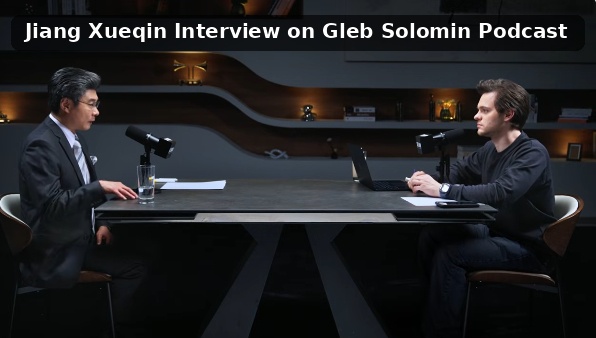
The following is the full transcript of Professor Jiang Xueqin’s interview on Gleb Solomin Podcast, July 19, 2026.
Editor’s Note: In this compelling interview from the Gleb Solomin Podcast, Professor Jiang joins the show to discuss his journey from overcoming severe personal struggles and near-failure to building a massively popular educational platform. Drawing on game theory and his deep academic background, he breaks down his chilling global predictions, including the structural decline of empires, geopolitical conflicts, and the looming pressures of modern technology.
Introduction
GLEB SOLOMIN: When I was getting ready for this interview, I expected a big episode about geopolitics. But I walked away with a story I still can’t get out of my head. It turns out the man whose predictions keep coming true once couldn’t see his own future. How he went from that point to being heard by millions— that might be the strongest part of this episode. But once you hear his predictions, you might change your mind. Enjoy.
Yeah, it was a long journey to start this recording today. Thank you so much for joining our podcast.
PROFESSOR JIANG XUEQIN: Thanks for coming all the way to Beijing.
Predictions and Background
GLEB SOLOMIN: Professor Jiang, I have to tell a little bit my viewers, in 2024 on camera you made 3 predictions: that Trump would win, that he would start war, and that America would lose it. It come true. You graduated from Yale with distinction, did research at Harvard’s Graduate School of Education, and spent 20 years teaching inside the most elite school in Asia. Just in the beginning, shortly, can you say what is your mission and passion?
PROFESSOR JIANG XUEQIN: I am first and foremost an educator. So my mission is to enlighten and inspire as many people as I can, hopefully through our podcast. And this is something that I would want to do for the next 50 years.
GLEB SOLOMIN: And as I understand, your background helped you in this way.
PROFESSOR JIANG XUEQIN: Absolutely.
Childhood and Early Struggles
GLEB SOLOMIN: Let me ask you about your life, about your childhood. What was at the beginning?
PROFESSOR JIANG XUEQIN: So I was born in 1976 in a small fishing village in South China, and at that time China was very poor because this is at the tail end of the Cultural Revolution and China has been closed from the world for the past 10 years. My father was a high school teacher at that time, and he was very concerned about China’s future. So for the sake of me, his son, and his future children, he decided to immigrate to Toronto, Canada, where we had relatives. And for the rest of his life, he would be a dishwasher.
And so because we were poor, my father cut my hair, and all the clothes I wore were gifts from relatives. So they were hand-me-downs. They were secondhand clothes. So my classmates didn’t want to play with me. I was never allowed to play in the games that they played on playgrounds during the recess. When the teacher asked us to partner with a friend for school trips, no one wanted to be my partner.
At the end of grade 1, my teacher asked to talk to my mother. My mother didn’t speak English. She says to my mother through the translator, “Your son is wonderful. He’s very polite. He’s very obedient, but he does not speak a word of English. This entire year he is in my classroom and he does not understand anything I say. Every day he’s staring outside the window. He’s learned nothing this past year.”
And so my mother hears this, she asked the teacher, “Do you mean that you want my son to repeat grade 1?” And my teacher said, “No, that’s not what I meant. What I meant is he should go to kindergarten.”
And my mother then does something that changes the course of my life. She turned around, looked down at me, and she asked me, “What do you want to do?” I said, “I want to go to grade 2. I don’t want to go to kindergarten and I don’t want to repeat grade 1. I want to go to grade 2.”
Now that was the worst decision of my life because the teacher was absolutely right. I go into grade 2 and I fall further behind. I become very insecure. I stutter. I’m afraid to speak in public. And by the time I hit grade 8, my life is just terrible. And my father is being bullied at work as well. I’m a very disobedient kid. Hits me a lot. He’s very violent towards me.
And at this point, I think to myself, there’s no safe space for me. I think about how I should just disappear, and no one will miss me, and I’ll be free of this hell that I’m living in. But I don’t do it. And the reason why is there’s a part of me, maybe there’s just light inside of me that dreams of a better world.
And I’m thinking to myself how I’m shy, I’m insecure, I stutter, but I see myself one day on stage talking to an audience. With my words, I’m able to move people. I’m able to inspire people. A vision in my head that one day I could make a difference in the world. I don’t know where it comes from. I don’t know why I believe it, but I believed it. So I continued. I struggled. I persisted.
Game Theory and Geopolitical Predictions
GLEB SOLOMIN: I’d like to ask about your predictions. How did game theory help you make them?
PROFESSOR JIANG XUEQIN: Right. I start to perceive each nation-state as a rational player trying to optimize or maximize the outcome. And so let me explain using the game theory why I was able to predict that the war between the United States and Iran would start.
GLEB SOLOMIN: Yeah, please.
PROFESSOR JIANG XUEQIN: What is the game being played about? It’s being played about trade access, right? It’s about resources and how to control resources and how to move resources from one place to the next.
Now in the game of geopolitics, there’s a very important theory that you need to know. It’s called the Mackinder theory. And Mackinder was a British military strategist. He explains how Britain as a naval power can maintain control over the world. So at this time in history, this is the 18th century, 19th century, people trade mainly by the sea because it’s the cheapest, fastest way to trade around the world.
The theory is very simple. If you want to control the world, you have to control certain choke points, maritime choke points in the world, and then the world has to obey you in order to access resources. And so the most important choke points are the Cape of Good Hope. It allows you to go around Africa and reach Asia. Then you have the Strait of Hormuz, which Iran now controls. You also have the Red Sea, which is where the Suez Canal is. And this is important because the Middle East is where most of the world’s oil is produced. And you have to ship the oil through the Strait of Hormuz and the Red Sea in order to access the rest of the world, especially East Asia.
Over here you have something called the Strait of Malacca, which is between Indonesia and Malaysia. And the only way for East Asia— China, South Korea, and Japan— to access Middle East oil is through the Strait of Malacca. You also have the Strait of Gibraltar. Over here in the Western Hemisphere you have the Panama Canal. And now what’s happening is that you now have the Arctic being opened up.
Most of human history, these were the critical maritime choke points. So as long as you’re able to control these choke points, you basically control the world. And this is what gave rise to the British Empire. Otherwise, how could such a small island nation control the world?
This is the theory, but there’s a problem with this theory, which is that as the world industrializes, it becomes cheaper to build railways. And with railways, you can negate the sea. You can trade through land. You don’t have to trade through sea anymore. And so the great fear amongst British strategists is that one power would emerge in Eurasia that could unify all of Eurasia, and then blockade Britain from accessing Eurasia. And so the entirety of British strategy was to prevent a land power who could unify Eurasia.
So at first it was the French, right? This is what led to the Napoleonic Wars. There were 7 wars.
GLEB SOLOMIN: Yeah.
PROFESSOR JIANG XUEQIN: Napoleon won 6 of them and he lost the last one. And the reason why Britain fought these wars is to ensure that France cannot control Eurasia because if Napoleon controlled Eurasia, then Britain would collapse economically.
Then after Napoleon, this led to the Great Game between Russia and Britain for control of Central Asia. And then this is what led to World War I, right? Because Germany was emerging as the European hegemon. And if Europe became too powerful, then it could build railways into the Middle East, into Central Asia, and Britain could not allow that. And that’s what led to World War I and World War II.
Now, after World War I and World War II, America became the empire, but America still maintained this system. And again, the idea is in the game of geopolitics, what matters is trade access and the way to maintain your empire is one, to have the greatest navy in the world and control the choke points. But second of all, to create chaos within Eurasia.
What’s happening right now is that the entire Middle East is on fire. The GCC, the Gulf Cooperative Council, Saudi Arabia, Qatar, UAE, they’re not able to export oil around the world anymore. And this leaves now 2 major suppliers of energy in the world. They are the United States, which controls the Western Hemisphere, and Russia. And that’s what the Great Game is about. It’s about trade access. It’s about control of resources. It’s about who is allowed to trade with who.
So given that the Middle East is on fire, Japan, China, South Korea can either buy LNG and oil from the United States or Russia, and those are your two options. So that’s what this war is about according to game theory.
Life After High School
GLEB SOLOMIN: Let’s go back to your early years. What did you do after high school?
From Rejection to Yale: A Story of Resilience
PROFESSOR JIANG XUEQIN: In grade ten, a substitute teacher comes into the English classroom. I feel here’s my chance to convince someone I can be someone one day. And that one week I’m with her, I’m a very different person. I’m focused. I raise my hand. I participate. I feel safe with this teacher. And this teacher told me, “I see something special in you.” And then that was it. She went away. I never saw her again. I don’t remember her name. I don’t remember what she looks like. All I remember are her words. “You are someone special.” I felt validated.
From that point onwards, I decide to make myself special. One day I’m sitting in the classroom and the guidance counselor walks inside the classroom. I didn’t even know we had a guidance counselor. She talks about how maybe some of you, for whatever reason, you might want to go to the United States for college, but don’t do that because the schools in the United States suck except for the Ivy League. But the Ivy League is for rich people. And then I hear this, I’m, Ivy League, what is that? So I become interested. So I go to the library and I study up on the Ivy League.
The Ivy League is where the world’s leaders go. These are people with charisma. These are people who are athletic. These are people who have demonstrated tremendous character, tremendous communication skills, tremendous leadership skills. So from that point onwards, I commit myself to becoming Ivy League material. So I switched schools from my average to the most elite academic public school in Toronto. And they did not welcome me because I was an outsider, but I didn’t care because I had a purpose. And my purpose was to get into the Ivy League.
Then every day on the subway, it took me 30 minutes to get to my school from my home. I read The New Yorker. I read The Atlantic because I needed to prepare for the vocabulary test that was the SAT. And everyone in the school knew that I was utilitarian, I was ambitious. Then I applied to 4 universities, MIT, Yale, Harvard, Princeton.
So the first school to reject me was MIT. It was a very small envelope. And it was a one-page letter that said, “We like you, you’re a strong applicant, but there are too many applicants, we have to turn you away.” The next rejection letter was Harvard. And Harvard wrote the best rejection letter ever, right? Because what the letter said is this, the letter said, “Ultimately, it doesn’t matter where you go, what matters is what you do when you get there.” I read the letter and I thought to myself, that is very, very true. Thank you, Harvard. So Harvard also rejected me, but it was a very nice rejection letter, so I forgive Harvard. And then Princeton rejected me.
By mid-April, I’ve not heard from Yale. And I just assumed that Yale would also turn me down. I didn’t feel I had any chance. At the end of April, I go home, and in my mailbox, there’s this letter from Yale. And I didn’t want to read another rejection letter. So I threw it in the garbage and I went up to my room to read. But then I was like, you know what? I really should open that rejection letter. I open it and the first word is “Congratulations.”
So now I go to Yale. And I’m thinking to myself that my life is forever changed. This is Yale. Here, I’m going to meet people who will become my best friends, and we will do great things together. And here, every day, I’m going to engage in intellectual discussions with people who are very serious. It’s a place for you to learn the etiquette, the attitude, the manners of the elite, how to think like them and how to talk like them.
And for the 4 years I was there, I basically became very isolated, very alienated. I felt even more depressed. At the end of the first year, our freshman year, you’re supposed to find friends to room with, but no one wanted to room with me, so they put me in the attic of the residential college, Jonathan Edwards, where I was assigned. And it was actually called Weir Hall, W-E-I-R. And there’s like 6 rooms, they’re closets, they’re for people who no one likes. And I was one of the 6 that no one actually liked. So Yale was a very traumatic experience for me. Rather than liberate me, rather than empower me, it basically traumatized me into my own depression.
Predictions for the Future
GLEB SOLOMIN: This is one of the most fascinating stories I’ve ever heard on my podcast. You are a very brave person. Thank you so much for being honest and for sharing this story with me today. We’ll definitely come back to this later. And what are your predictions right now? What are they about? What do you think will happen in the future?
PROFESSOR JIANG XUEQIN: So to understand the future, we have to use game theory to understand the situation of each nation state. Okay, so let’s look at America first.
GLEB SOLOMIN: America.
The American Dollar and the Mackinder Hypothesis
PROFESSOR JIANG XUEQIN: What is the source of American power? What’s the point of America? And the point of America is to protect the supremacy of the US dollar. Because everyone now uses the US dollar and America can print an infinite number of them. So that’s the source of American power.
The problem with the US dollar is that it’s a Ponzi scheme, meaning that the US dollar has no inherent value in itself. It’s only valuable if people want it. And unfortunately, right now, because of financial corruption in America, because the American military is too overextended, a lot of nations are choosing to walk away from the US dollar. So look at Japan and China. They are selling more US Treasuries. The GCC nations for the longest time were supporting the American economy, were buying US dollars. But because of this war, they’re now forced to sell more US dollars in order to finance their own economies now that they can export oil.
What’s been happening is that the bond yields for US Treasuries have been going up. This is a problem because right now America has $39 trillion in debt. So if the debt yield, the interest rate is 5 to 6%, that means America has to pay $2 trillion in interest payments alone annually. And you can imagine that over time, this entire Ponzi scheme will collapse.
So America has absolutely no choice but to force the world to continue to buy US Treasuries. So the only strategy available to America is to use the Mackinder hypothesis and create as much chaos as possible so that the world is forced to go to America to buy energy and weapons. So imagine a situation like this where right now in Europe, there’s a war going on between Europe and Russia. In East Asia, there’s conflict now between Japan and China. In the Middle East, the conflict is between Iran versus the United States and Israel. Every one of these nations requires energy, oil, weapons.
America is a continental fortress that has unified the Western Hemisphere. Now they have infinite resources and they’re able to turn these resources into weapons that they can sell the rest of the world. And the rest of the world is forced to buy US dollars in order to buy this energy and weapons from America. So that’s the American strategy moving forward. They have absolutely no choice in the matter because they’re addicted to US dollars, require the rest of the world to buy US dollars. So they need to force the rest of the world to buy US dollars.
Why America Is in Decline
GLEB SOLOMIN: You said that the US may have big problems in the near future and that the chance of this is high. But Elon Musk recently said that AI can help the US. He also tried to find problems in the US government before. Now he believes AI will help the US and other Western countries. What do you think about this?
PROFESSOR JIANG XUEQIN: Okay, so let’s analyze why America is in decline. And when you analyze why it’s in decline, what you recognize is that it’s declining for every single reason why empires in the past have declined before. So let’s go over the 3 major reasons why America is in decline.
# Reason 1: Financialization
So the first major reason is financialization. What does this mean? It means that when an empire arises, it focuses on manufacturing. It focuses on creating real products, weapons, consumer goods. But over time, what an empire does is it offshores its manufacturing to other people, to other nations, to other groups, and it focuses on financial speculation, primarily the idea of usury — money lending.
GLEB SOLOMIN: Why?
PROFESSOR JIANG XUEQIN: Because that’s the most profitable thing to do. But the problem is that financialization does not lead to real productive growth. It doesn’t lead to real wealth generation. It only looks like money on paper. If you open a restaurant or you open a factory, you’re contributing growth to the economy, right? On average, you could be seeing a return of 2%. But if you take the same money, you put it in the stock market, you see a return of 5%. So who’s going to do any work, right?
And the reason why this arises is because of the nature of capital. Capital consolidates, capital monopolizes. And once you monopolize, it’s easier for you to make money and you don’t have to do a good job anymore, right? So think of Google and Apple. They spend most of their resources on stock buybacks in order to create this illusion that they’re creating more value for stockbrokers. This is all financialization.
And the problem with financialization is that it warps the mentality of your population. Before, what was good, what was important is to work hard and contribute to your community. And that meant that people took pride in going to the factory, making products, and helping the factory become wealthier. Now what matters is get rich now, right? So that’s why people like Andrew Tate are so popular, right? Because he’s telling you, “Hey, if you work hard, you’re a sucker, you’re a loser. If you follow the rules, if you listen to your boss, you’re a loser, you’re a moron. What you want to do is get rich and become your own boss.” And that mentality has taken over young people.
This is a huge problem because it means that it’s hard for an empire in decline like America to invest in long-term projects. So AI, absolutely — in theory, AI could make America a much stronger society. It could create real wealth. The problem is if you look at AI, what’s been happening is that it’s basically a Ponzi scheme where there’s only a few companies and they all just invest in each other, creating the illusion of wealth. And even today, no one knows how to make money out of AI. So OpenAI has ChatGPT. People don’t appreciate this, but for every new subscriber to ChatGPT, they lose money. ChatGPT is not a profitable model and no AI expert can tell you how to make money.
And the problem is that an empire in decline is all focused on speculation. It’s about gambling. It’s about getting rich as opposed to being practical and pragmatic. So that’s the idea of financialization. That’s the first problem with an empire in decline.
# Reason 2: The Demographic Crisis
The second problem with an empire in decline is the demographic crisis. The idea is that because society is prosperous and it’s stable and it’s peaceful, people get older. And because they’re getting older, they’re able to monopolize much of the wealth, power, and status in society, leaving little opportunities for young people. And we’re seeing that throughout the Western world today where the baby boomers are in charge and they refuse to give up power.
So think about these US presidents. They’re all baby boomers. You go to Congress and you’ve got guys like Chuck Grassley, who is a US senator, and he’s 93 years old. Can you imagine that? 93 years old. And he is still working as a US senator. He’s the 4th person in line to become president of the United States. If Donald Trump dies, it’s JD Vance. If JD Vance dies, it’s Mike Johnson. If Mike Johnson dies, it’s Chuck Grassley.
And so what’s happening in the Western world is the baby boomers refuse to retire. So what do young people do? They refuse to work. They refuse to have children. They become indifferent to society. But the next step is for them to fight each other, for civil war to break out. And this is just historically what’s always been true.
GLEB SOLOMIN: Okay. You mentioned there are 3 ideas. What’s the third one?
Elite Overproduction and the Decline of Nations
PROFESSOR JIANG XUEQIN: Right. And the last, the most important is the idea of elite overproduction. This is an idea from a historian named Peter Turchin. He’s trying to mathematically model how revolutions happen. He looked at the French Revolution, he looked at the fall of the Roman Republic, he looked at many serious events throughout human history, and mathematically he discovered the main cause of civil war, of collapse, is you have too many elites struggling for too few positions of status, of power.
So think about how America, for the longest time, financiers were in charge. Wall Street was in charge, but then these past 20 years, you have the tech revolution. So now you have these tech oligarchs like Elon Musk and Peter Thiel and Larry Ellison. They want to be in charge as well. So what happened was that they sponsored someone to come into Washington, DC to overthrow the financial elite. And this person of course was Donald Trump. Who backed Donald Trump in 2024? Peter Thiel, Larry Ellison, and Elon Musk, because they’re trying to overthrow the power of the financial elite and establish the power of the tech oligarchy.
And so what’s going to happen in America over the next few years is a civil war rising between the old guard, Wall Street, and the new guard, Silicon Valley. And what Peter Turchin says is that this is the most common explanation for why societies go into decline.
So again, to summarize, there are 3 major symptoms of a nation in decline. America has all 3: financialization, demographic crisis, where young people refuse to have children and work, and then elite overproduction. And then everything else is an outgrowth of these problems. For example, immigration — why is there immigration, both legal and illegal, to the United States? The answer is young people don’t want to work. And so you need to bring in immigrants in order to replenish the workforce. But we know historically, if you do this, if you allow too many immigrants to come into the country, it’s going to cause civil chaos.
From Struggling Student to Yale Honors Graduate
GLEB SOLOMIN: I’d like to go back to that time. How did you graduate Yale with honors? How was it possible?
PROFESSOR JIANG XUEQIN: So I went to Yale expecting to study math and physics because, look at me, I’m Chinese, right? It didn’t mean I love math and physics. It’s just like, I’m Chinese, so I should go study math and physics. So I go into Yale planning to study math and physics. But Yale also requires you to study humanities to graduate. So I took English. We’re studying Chaucer and Spenser and Milton.
My first semester at Yale, I was completely lost because I came from a public school, whereas most of my classmates came from pretty elite private schools. So there are certain things that they did which I didn’t know you’re supposed to do. For example, if the teacher assigned you a book to read, you’re supposed to go read that book. And I didn’t know that. I didn’t know you’re supposed to actually read the book before you come to class. I thought that the teacher would tell us what the book was about in class. So during a seminar discussion, I didn’t say anything. I was completely lost.
And things got so bad that my professor, my English professor, suggested that I don’t take this class anymore. She wanted me to go do something else because she thought I was wasting her time as well as my time because I was not following what was happening in the class.
But by the time in English class that we got to Milton and Shakespeare and the Romantics, Keats and Wordsworth, something snapped in me. Something caught my attention, and I felt a connection to the poetry I was reading, especially Paradise Lost. And I felt that a spark had been ignited in me, and I became really interested in English. My first semester in English, I only got a C-, which is the worst grade you could possibly get. And then I got an A- my second semester, and I improved tremendously as a writer.
And so I felt as though maybe before I was asleep, and now being at Yale in this seminar, reading Milton woke me up and said, “Hey, this is who you really are. You’re meant for something bigger than all. Start paying attention, start getting to work, start taking yourself seriously.” And so I became a very good student. And that actually made me even more alienated at Yale because Yale was a competition. And a lot of the competition was to get approval from the professors.
GLEB SOLOMIN: And you got it.
PROFESSOR JIANG XUEQIN: And I got a lot of approval from my professors. In fact, I’m still friends with some of my professors. When I go to Yale, I stay at their house. So they like me a lot. And we stayed in touch these past 30 years and we’re still good friends.
GLEB SOLOMIN: That’s almost impossible to believe. You started with a teacher telling you that you should go back to kindergarten and you became one of the top students at Yale. That’s an incredible story.
PROFESSOR JIANG XUEQIN: I’m trying to make sense of what happened. And there’s a theory. If you want to learn, then what’s going to happen is you’re going to be assigned the hardest life possible because that’s the only way you can truly learn. So learning isn’t about reading books. That’s part of the process. But the real process is to put you in circumstances that really challenge you and force you to persevere, either thrive or die.
And I think that’s what happened. I think that I came into this world demanding the most challenging life possible. I always chose the hard path in life because in my heart, I knew that’s what will allow me to truly thrive as a person. So that’s a theory. But recently I’ve come to this conclusion.
AI, Surveillance, and the Control Grid
GLEB SOLOMIN: You said AI creates an illusion of wealth, but can governments also use AI to control people?
PROFESSOR JIANG XUEQIN: Do you know much about computer science?
GLEB SOLOMIN: I know this, it is LLM models.
PROFESSOR JIANG XUEQIN: Okay, all right. So for the sake of your audience, I’m just going to go into some basics about machine learning.
GLEB SOLOMIN: Yeah, of course.
PROFESSOR JIANG XUEQIN: All right. So the idea of computers is that it engages in recursion, a recursive loop, just loops in order to solve problems. The most basic problem it’s trying to solve is a math problem. Like what is 1+1? And a computer can do that. When you’re able to do it infinitely — 1+1+1+1 — you create great things. You’re able to do things that humans aren’t able to do. The other thing is that if you’re able to do 1+1, you’re basically able to do every possible computation, including subtraction, multiplication.
And so computers are a wonderful thing, but we need to remember that ultimately it’s about recursion. It’s about taking a simple algorithm and repeating it infinitely in order to generate an output that you want.
The other thing about computers is that what it’s really good at doing is database management. So you have a lot of information inside a database, and there are 2 things you want to do with this database. The first is you want to sort it, basically organize information in a way that benefits you, and you want to search it. Basically you want to retrieve information that is important to you.
And if you look at most of AI, it’s basically this database management. So what’s Google? Well, Google is taking this database that is the internet and searching for information that you want. But you also got facial recognition technology. Facial recognition technology is just basically differentiating a billion faces and then searching for the face that you want. And then LLMs — Large Language Models — are the same way where they take the entire possibility of languages and then try to search or create something that you want.
When they say that AI will transform society, they don’t mean it’ll make your life easier. So let’s look at Palantir.
GLEB SOLOMIN: Mm-hmm.
PROFESSOR JIANG XUEQIN: What is Palantir really trying to do? What it’s really trying to do is take all the databases in the world and combine them into one database. And then once it has this one database, it can categorize people into subcategories.
There are 2 ways that I can know how you behave. The first is I look at who your friends are, and then I look at your past behavior — where you spent your money, how you spent your money. Once I have these 2 crucial pieces of data, who your friends are and what you’ve done in the past, I can predict your life for the next 50 years. And then what I can do is I can take people who are like you, who are maybe born in the same neighborhood, have the same interests. And then at age 1, I can predict how that person will behave for the next 100 years. So that’s a project of Palantir. That’s a project of AI.
GLEB SOLOMIN: Yeah.
PROFESSOR JIANG XUEQIN: To categorize people in a certain way that allows me to predict their behavior, but then also allows me to control their behavior. And this is what’s called the AI surveillance state or the AI control grid. And that’s what AI is.
AI in China: Safety, Convenience, and the Cost of Creativity
GLEB SOLOMIN: Maybe some governments could also use AI in a good way, for example, for public safety. What do you think about that? Is it possible?
PROFESSOR JIANG XUEQIN: It’s absolutely possible. I live in China and we have an AI surveillance state. There’s digital ID and there’s digital currency. There are cameras everywhere. And when I first came to China 30 years ago, everyone would steal everything. So if you left your laptop —
GLEB SOLOMIN: Yeah, we can admit that here it is very safe.
PROFESSOR JIANG XUEQIN: Exactly right. So if you just left your laptop at Starbucks, went to the washroom, it’d be gone like that. Now you can leave your laptop in public because there are cameras everywhere.
GLEB SOLOMIN: Yeah.
PROFESSOR JIANG XUEQIN: And there’s facial recognition technology. So if you steal the laptop, the police know who you are. And it’s really convenient because if you go to a supermarket, you don’t have to use cash anymore. You can just scan your face and then the machine will automatically deduct money from your account. China is a testament to the power of AI surveillance.
But there are problems with this. The problem is that if you look at China for the past 20, 30 years, there’s been very little creativity. I’ve been in China for a long time, and in the 1980s and 1990s, China was producing great movies. You had Zhang Yimou, you had Chen Kaige, and these were really interesting movies and it was producing really interesting ideas.
GLEB SOLOMIN: Yeah.
PROFESSOR JIANG XUEQIN: And these past 10 years, China has not been able to produce that many great ideas. If you look at soft power, China is not that great in terms of soft power in that you have Japan and everyone in the world loves anime. You have South Korea, and everyone in the world loves K-pop. China is not as vibrant and dynamic as a society as it used to be. And you can make the argument that people are much more unhappy than before.
So for example, isn’t it wonderful you can just use your phone and call a taxi driver and then he’ll take you anywhere? Or an app.
GLEB SOLOMIN: Yeah, right.
PROFESSOR JIANG XUEQIN: And it’s really cheap too.
GLEB SOLOMIN: Yeah, right.
PROFESSOR JIANG XUEQIN: But think about the emotional pressure on that taxi driver. His entire world, his entire life is controlled by the algorithm. So if you get a bad review, they deduct your salary. If you are late, they deduct your salary.
GLEB SOLOMIN: Because of that, I regularly try to give 5 stars.
PROFESSOR JIANG XUEQIN: Exactly. This is ruled by AI. It is heartless. It is without compassion. It is inhumane in many ways. So there are good things like cheap cab rides and safe streets and convenient purchasing. But there are bad things as well. For example, you lose your soul.
GLEB SOLOMIN: You know, on platforms like YouTube, if you do something wrong, you might stop being recommended.
The Problem with AI and Human Agency
PROFESSOR JIANG XUEQIN: And let’s just say that we do this YouTube video, and for whatever reason, YouTube accidentally labels it as politically inappropriate. Well, you’re completely screwed, right? Because good luck trying to find a person who to complain to. Good luck trying to plead your case. It’s impossible. It’s all controlled by algorithm. And the reason why is the company doesn’t see us as humans anymore.
These people who do AI, their ambition is to make— is not to make society much more vibrant, to make human life much more creative. That’s what they say. Their entire purpose is to make everyone into a robot.
So let me give you an example of this. For the past 10 years, they’ve been trying to solve the self-driving car problem. So a lot of these companies, Tesla, Google, they’ve been trying to introduce a fully automatized car. They can’t solve the problem because there’s an edge case. And the edge case is, drivers who’ve lost their jobs, who intentionally get into an accident with the self-driving car. You can’t solve that problem. It’s impossible to map out human intention.
So there’s one solution to this problem, and the solution is make every car robotic, make every car self-driving, take away the steering wheel. And you’ve solved the problem. When you buy a car, it’s all electric, it’s all digitized, there are cameras everywhere, and there’s no steering wheel. So you get in the car and you can tell the car where to go. And it’s great if you think about it, because it’ll be safer for everyone, there’ll be no accidents, but you’ve lost all agency and you lost all autonomy.
And that’s the world we’re moving towards. What the AI people are most afraid of is human agency. So the way to solve this problem is you take it away from people. You don’t allow people to drive cars. You don’t allow people to make choices. You don’t allow people to waste money, right? If you are buying alcohol, they’ll program their digital currency to prevent you from buying alcohol. There’s nothing you can do about it because everyone’s using digital currency.
How Professor Jiang Developed His Worldview
GLEB SOLOMIN: Today you are a guest on shows like Tucker Carlson, and many people talk about your predictions because they are often very accurate. I want to ask you, did your education and life experience help you see things this way? How do you make these predictions?
PROFESSOR JIANG XUEQIN: This fame is only recent, right? It’s only been the past 1 year. So let me talk about what happened after Yale.
So I came to China as a high school teacher wanting to reform Chinese education, and my theory was very simple. China has 1.3 billion people, they don’t speak English. I speak English, therefore, everyone should just obey me and they will learn English. That was my theory, right. So here in China, they speak Chinglish, Chinese English, and for them, that’s English. So if you try to teach them like real English, they don’t care. So I learned that the hard way.
So I floundered through school and I decided I can’t become famous being an educator. So I decided that I’ll try to become a journalist, and I was a journalist for a couple years, but that didn’t work out either. Then I tried becoming a documentary filmmaker. That didn’t work out either. I tried working for the United Nations in Afghanistan. Didn’t work out. And by my late 20s, early 30s, I was a broken man because I had failed everything I tried, and I felt that the world was hopeless.
I basically, for 2 years, lived with my parents. I lived in their basement, and I played video games every single day until my parents got sick of me and threw me out. So they throw me out and I’m forced to come to China because China is cheap and I speak the language. And every day I would get up at 12 o’clock, 2 o’clock in the afternoon, and then in the evening I would go and I would get drunk.
In the middle of winter, I sleepwalk naked into a blizzard. And I open the door, and there’s this whiteness and the wind is whipping at me and I’m thrown back. And that’s a sign from God, which is like, you better start getting your act together.
Reprogramming the Mind: Lessons from Failure
And so I commit to change my life. I needed to reflect on how I got to this point, because I was a very good student at Yale and 10 years later I’m a dismal failure. And I reflect and I recognize that my Yale education was very, very limiting. And there are 3 reasons why.
First of all, when you go to a place like Yale, what you’re taught is that only IQ matters. If you’re able to articulate an idea, then you are smart. But all the forms of talent, whether it’s musical or physical, doesn’t really matter. All that matters is IQ.
Second thing is that failure is not an option. You must succeed at all costs. If you don’t succeed at Yale, sorry, if you graduate from Yale and you don’t succeed, you might as well— So there’s a lot of pressure to succeed, to prove you’re worthy of a Yale education.
And the third thing is you don’t need to work with anyone. Just based on your talent, you’ll be able to succeed on your own terms. And all 3 of these things were not true.
And so I committed myself to changing my programming. What I wanted to do was step outside of my body and then look inside my mind and then reprogram it in a way that allows me to be more free, to be more in control of my life. And at this point in my life, and this is like my early 30s, I become interested in a theory called neuroplasticity. Which is to say that we can always rewire the synapses in our brain to be whoever we wanted, as long as you commit yourself to the right activities.
A Year of Doing the Uncomfortable
So for 1 year, I decide to do things I’ve never done before in my life, including stand-up comedy. Because the one thing that in my life I was most afraid of was being laughed at. And again, for the longest time, I took myself very, very seriously. But the moment that I got on stage and I told jokes and people laughed at me, I felt they were laughing with me. The feeling of being able to bring joy to the world made me feel extremely happy and edified.
I also tried a lot of sports, for example, Brazilian jiu-jitsu. So I’m not sure if you practice Brazilian jiu-jitsu, but the way they train is very, very strange because I did Muay Thai and in Muay Thai they teach you technique, right? And they make you practice. But Brazilian jiu-jitsu, you go to the place. And for the entire time, they beat you up. There’s this bigger guy and all he does is beat the crap out of you. And at the end of it, your neck is sore. You want to cry.
I’m going home from the training and I think to myself, this is really stupid. I’m getting beat up in my 30s. And when I was a teenager in Toronto, I was also getting beaten up. The difference is though, now I’m paying for the privilege of getting beat up in my 30s. But what happened is that through this training, you start to lose a lot of your fear.
I also tried skydiving. Don’t do that, by the way. Complete waste of money. But I did skydiving. I did parkour. I learned how to sing. I learned the piano. I did everything possible. And I also tried cooking.
The Humiliation of Cooking School
So when you go to cooking school, you’re supposed to make 2 dishes and you’re supposed to present your dish in front of the chef who will then give you a grade. And so we make our dishes and all my classmates, they line up and they’re very proud of their accomplishment. And the chef tastes the meal and smiles and says, great job. And then the students feel great.
It’s my turn to present the dish. The chef looks at me and says, “I’m not touching this.” And I’m like, wait a minute here. Wait, wait, wait. This is strange. Are you failing me? Am I going to fail cooking school? At Yale, the professors don’t do that. The professors tell you how great you are. They say, you’re great, you’re going to go conquer the world. And here in cooking school, they tell you the truth. And I thought that was illegal. You’re not supposed to do that as a teacher. And cooking school was a humiliation ritual for me.
But then I started to observe my classmates. And there’s this one girl in my class, and she’s 18 years old. She would get up at 4 o’clock in the morning to do 2 hours of CrossFit. Then she’d bike to her work and for like 8 hours she would cut vegetables. Just cut vegetables. And then she’d come to cooking school and then she’d go home and do it again.
And I thought to myself, wow, she is so much more impressive than I am. Because here’s a person who is dedicated, who’s passionate, who’s committed to her ambition. And why do I think I’m better than her just because I went to Yale?
And so I recognized that Yale is about making people arrogant. It’s not about making them educated. If you really want education, the best place to learn it is in life. So open your heart, open your eyes, and learn from others. And that one year really changed the way I perceived myself and the way I perceived education. And I became much more determined to have an open mind and to look at the world much more objectively.
From 5,000 to 2.6 Million Subscribers
These past 4 years, I’ve been teaching politics, and the great books, Plato, Homer, Dante. And I decide to upload my classes to YouTube because I want to generate an international audience. And my wife and I, at first, we’re very optimistic. We were like, we think that we can hit 5,000 subscribers. That’s our goal, 5,000 subscribers. And maybe it’ll take some time, maybe it’ll take 4 years, but with 5,000 subscribers, I’ll be able to help better promote education reform in the world.
Today, my YouTube channel has 2.6 million subscribers. So that sort of surprised us. Our goal was 5,000, we hit 2.6 million, but that’s how I came to, today, can we talk about success?
What Makes People Successful?
GLEB SOLOMIN: I know you’ve done some research on this topic. Can you share your conclusions with us? What makes people successful in our world?
The Keys to Success: Self-Control, Resilience, and Self-Reflection
PROFESSOR JIANG XUEQIN: So if you look at all the studies of people who are successful, there are certain trade habits that they have. They have certain habits that enable them to succeed.
The first major habit is self-control or delayed gratification. So the idea is you’re willing to put away immediate pleasure for long-term gain. So the famous example of this is something called the marshmallow experiment by Walter Mischel. And Walter Mischel at that time was working at UCLA, this is 1960s, and he asked children who are 5 and 6 to come to his laboratory to talk, to just have a friendly conversation. And then Walter Mischel would say to them, “I’m sorry, but I need to go to a meeting for 5 minutes. Could you please wait for me? I’m really sorry. So here, as an apology, I’m going to give you 1 marshmallow. But if you can wait for me to come back, and you still have not eaten that marshmallow, I will give you 2 marshmallows.”
So then he goes away and he comes back and he sees some kids have already eaten that first marshmallow and some kids who have not. And then what he did was he tracked them for 50 years. And what he found was that those who passed the marshmallow test were more likely to do better in school. They did better on test scores. They were more likely to graduate from university. They were more likely to succeed in their work. They were more likely to get married and have happy marriages. And the group that didn’t pass the test was the complete opposite. And that’s the idea of self-control. So the first principle is self-control.
Second principle is something called resilience. So there’s another Stanford psychologist named Carol Dweck, and she did research into who succeeds. And she came to the conclusion that those who succeed have growth mindset, and those who fail have fixed mindset. Growth mindset is whenever you encounter failure or difficulty, you see it as an opportunity to grow. So you welcome failure. Those who have a fixed mindset see failure as the worst possible defeat. So they run away from failure. And so if you keep on accepting new challenges, you keep on growing, and therefore you keep on succeeding. So that’s the idea of resilience.
And the third principle is the idea of self-reflection. This was introduced to us by a researcher named K. Anders Ericsson. He spent decades looking at which students succeeded. So he was basically looking at violinists. So he did a lot of research in Berlin, and he went to music school there. And kids at age 5 get into this music school. And so he looked at these different groups, and what he recognized is those who most succeeded practice something called deliberate practice. You can practice for as long as you want. What the most important thing is to be objective in assessing your weaknesses.
So these are the 3 basic ideas: self-control, resilience, and self-reflection. But if you go deeper, what you recognize is that a lot of this has to do with family. If you come from a good family that’s wealthy and well-educated, you’re much more likely to have self-control, you’re much more likely to be resilient, and you’re much more likely to engage in self-reflection.
So what’s the difference? The difference is that if you come from a good family, you are much more likely to receive unconditional love. How deeply were you loved as a child by your parents? How much love did you receive? Because if you receive a lot of love, you’re much more likely to love yourself and to love others. And therefore, you’re much more likely to engage in self-control, self-reflection, and resilience. But if you didn’t receive any love as a child, you hate yourself and you fear yourself. And so you’re less likely to succeed.
The Illusion of IQ
GLEB SOLOMIN: And do you think IQ score is important for success?
PROFESSOR JIANG XUEQIN: I think IQ is one of the greatest illusions out there. So there’s a very famous American writer named Neil Postman, and he wrote a book called The End of Education. And his argument is the only reason why we have tests is so that adults can differentiate between smart kids and dumb kids, meaning that intelligence is something that we just made up in order to justify a hierarchy of power.
What would happen if all the adults in the world disappeared today? Can we imagine this world? Well, everyone would be like, “Oh, well, it’d be Lord of the Flies. All the kids, the teenagers would start— they would starve to death because they’re incompetent.” No, what happened is the kids would all start working together. The dumb kids, the smart kids, they would lose these distinctions and every kid would do what he or she could in order to build a better society. If you just leave kids alone, if you just trust them, they’ll go on and do great things.
We know this because in the 19th century in Hawaii, all these different immigrant groups were brought in to work in plantations in Hawaii. The plantation owners made a purpose of inviting different ethnic groups because they figure, like if they’re from different ethnic groups, they can’t work together because they don’t speak the same language.
GLEB SOLOMIN: Yeah.
PROFESSOR JIANG XUEQIN: So the parents are working in the plantations and the kids are left alone.
GLEB SOLOMIN: There’s no school.
PROFESSOR JIANG XUEQIN: So what they do, they create their own language, they create their own society, and they create their own games in order to teach each other.
Robots, AI, and the Future of Human Labor
GLEB SOLOMIN: When I think about a country like Russia, it’s very large and it’s hard to manage such a big territory. Some people say there are about 140 million people there and it’s difficult to organize work across such a space. But if you use robots instead of people, you could use the whole territory more effectively, grow the economy and change many things. Why do you think this view is wrong, or do you think it is actually correct?
PROFESSOR JIANG XUEQIN: To answer this question, we need to think about the fundamental nature of reality. And if you look at how human society is created, the main pillar is the expectation of labor. For the longest time, this concept was called slavery, right? So if you go back to the Greeks and you read Aristotle, he tells us that slavery is just a necessary part of life. Never before in human history have we had a society in which everyone had time to be creative. And so Elon Musk and other tech utopian thinkers believe that robotics, AI, digitization will give us this paradise.
I don’t think it’s possible. So let me explain why using Plato’s Allegory of the Cave. So in Plato, his book The Republic, he uses a metaphor to describe human society. So imagine a cave underground. It’s dark, no light comes in, and there are prisoners, about a million of them, lined up together, chained to the floor. They can’t move, they can’t even turn around. They can only stare at a wall. Behind them is a great fire. Around this fire are people. What they do is they take puppets and they project these puppets onto the wall, so the prisoners are seeing shadows on a wall.
They believe that these shadows are real, so they start to create civilization around the shadows. They give it names, they create language, they create religion, they even create a priesthood to celebrate these shadows as gods. They create walls in order to teach these shadows to their children. All civilization arises from these shadows.
For whatever reason, a prisoner breaks free of his chains, and so he goes outside. And at first he’s blinded by the light, but over time he adapts to this new world of light, and his eyes feast on the beauty around him. He thinks it’s all divine, and he thinks he’s in heaven. And he asks himself, “Why did I delude myself all this time?” So he wants to go back and convince everyone to break off their chains and go into light with him. And so he goes back. And the elite should want to kill him, right? Because if the prisoners break free, then society collapses and nothing can function anymore. Instead, what happens is the prisoners kill him themselves. Why? Because they’re too wedded to this reality, and they don’t want to be told that this is all an illusion.
So to go back to the Elon Musk argument, you’re going to have a lot of people, first of all, who will fight against the robots because they’re afraid of losing their jobs. They’re also afraid of losing their own reality. Right now, what the elite is most afraid of are people sabotaging data centers because it’s actually very easy to destroy a data center, right? It’s all electricity. You can just rig a drone with explosives and go blow up a data center. So people are naturally resistant towards change.
GLEB SOLOMIN: Do you think this trend will continue?
PROFESSOR JIANG XUEQIN: I think that if you have a society in which a lot of men are made redundant, they lose their livelihood, then they will take up arms. They will start to create violence in order to reclaim their livelihood.
GLEB SOLOMIN: But maybe by the time people understand the risks, it will be too late and they will not have enough power to change things.
PROFESSOR JIANG XUEQIN: So being a truck driver is one of the most lucrative jobs that a high school dropout can have, right? You don’t need a college diploma, you don’t need to be educated to be a truck driver. Well, what happens if you make truck driving automated, robotic? These millions of truck drivers would lose their livelihood. Are they going to sit back and not do anything?
GLEB SOLOMIN: Of course not, right?
PROFESSOR JIANG XUEQIN: So it’s most likely that they will seek vengeance, that they will try to destroy the robots. And the same thing happened during the Industrial Revolution when you had a lot of craftsmen who made beautiful products by hand. They were proud of the work they did. They also provided good livelihood to their families. And then you had factories come in. You had a lot of work was being mass manufactured. And so these people would go and destroy factories. So you could have a similar situation with AI.
GLEB SOLOMIN: Right. There were people called Luddites, but in the end they lost their jobs and everything changed.
The Challenges of an AI-Driven World
PROFESSOR JIANG XUEQIN: So the first problem is social resistance. Second problem is we don’t actually know if it’s possible to create a world of robots.
GLEB SOLOMIN: We just hope.
PROFESSOR JIANG XUEQIN: Yeah, we’re just hoping, but there has not been enough evidence to suggest that this AI robotic vision is possible.
GLEB SOLOMIN: The first was social. Social will something do with this problem because they will lose their jobs.
PROFESSOR JIANG XUEQIN: Yes.
GLEB SOLOMIN: And you said here is something else.
PROFESSOR JIANG XUEQIN: So right now, if you look at development of AI, it’s very hard to move AI from the digital world into the real world. I’m just thinking as an industrialist, right? I’m using game theory. And so I need to mass manufacture robots.
GLEB SOLOMIN: Yeah.
PROFESSOR JIANG XUEQIN: To mass manufacture robots, I need a lot of crucial ingredients— silicon, rare earths, lithium. And right now there’s a war going on. So it’s getting harder and harder for me to source a lot of this material. I’m also unsure the profitability of robots. I’m not sure how much it’ll cost to produce. I’m not sure if they’ll work. I’m not sure if people will buy them.
So, but now, is there another way to solve this problem? And a possibility, which I think is much more cost-effective, is to turn humans into robots. And all the ingredients are in place, right? So you have in the world something called the gig economy where people are Uber drivers, where people are working part-time as janitors, basically labor on demand. And they’re all controlled by the algorithm, right? We just discussed this.
GLEB SOLOMIN: Yeah.
PROFESSOR JIANG XUEQIN: You also have millions, hundreds of millions of immigrants who want to come into these Western societies to work. Because in the future, if you’re in Africa, it’s possible there’s a famine.
GLEB SOLOMIN: Famine?
PROFESSOR JIANG XUEQIN: Yeah, in famine, you could have a famine in Africa in the next 5 years. Yes. What people don’t appreciate is that the Earth itself, the planet itself, can only sustain about 2 billion people. So the way we’ve solved this problem is by inventing fertilizer. And about a third of the world’s fertilizer is transported through the Strait of Hormuz. Strait of Hormuz has been closed down for the past 2 months. It’s planting season right now. So a lot of places can’t grow food. We don’t know about the consequences now, but wait 6 months and you’re going to hear lots of reports of food shortages around the world, especially in Africa, which is dependent on fertilizer in order to grow crops.
So we are moving into a time of tremendous flux and of tremendous volatility. You’re going to have a lot of people who will be desperate just for food. So you can turn them into cheap labor, right?
And then the last element is your mobile phone. Your mobile phone has become in many ways your best friend.
GLEB SOLOMIN: Yeah.
PROFESSOR JIANG XUEQIN: Or your alter ego. You spend so much time on the mobile phone. Now let me ask you this question. Is there really a difference between a mobile phone and a microchip inside your brain?
GLEB SOLOMIN: You can drop out your phone microchip.
Turning Humans Into Robots: A Cheaper Alternative?
PROFESSOR JIANG XUEQIN: Well, that’s a good point. But a lot of workers cannot leave behind their mobile phone. If you’re an Uber driver, your mobile phone is attached to you because your mobile phone is what will get you a job and food. You also have people working in the AI industry who label training data. Around the world, they’re also married to their phones.
So you have cheap labor that’s desperate for work. You have microchip technology that you can implant into a person to control how this person behaves. And then you have mass demand in Western aging societies. So all the ingredients are in place. So why not just turn humans into robots, which is cheaper than to actually create robots to replace humans.
GLEB SOLOMIN: And it’s true that some companies now are reducing their use of AI because it is very expensive. They lose a lot of money, sometimes millions of dollars. And some companies even tell their workers not to use AI because of the cost. But maybe in the short term it could become cheaper than it is now. Do you think that is possible?
PROFESSOR JIANG XUEQIN: So the reason why consumer goods products have become cheaper over the past 20 years is globalization, right? It’s just cheaper for you to source materials from around the world. But in a time of war, in a time of conflict, in a time of deglobalization, in theory, the cost of robots can only go up, but the cost of humans can only go down because you have hundreds of millions of refugees from Africa, from Asia who are desperate for food. So aren’t you better off turning humans into robots, than mass manufacturing robots, not knowing, not being able to control the cost of critical minerals.
GLEB SOLOMIN: So now, because of crisis, economic instability, and wars, it may be difficult to make it cheaper in the short term.
PROFESSOR JIANG XUEQIN: Look at inflation, right? Look at how energy prices are going up.
GLEB SOLOMIN: Yeah.
PROFESSOR JIANG XUEQIN: So you look at, for example, data centers in America. They consume a tremendous amount of energy. They consume a tremendous amount of fresh water, and they don’t really provide a tangible benefit to society. So I’m not sure how far you can take the AI dream.
The Future of Humanity: Wars, Famine, and Population Decline
GLEB SOLOMIN: Okay. You said that it would be better to have about 2 billion people on Earth. Do you think we will face demographic problems in the near future? Will the population keep going down?
PROFESSOR JIANG XUEQIN: I think over the next 50 years, it is entirely possible that 90% of humanity dies off because we can imagine that these wars that are being fought around the world right now, they will only expand. I don’t see them stopping. I only see them expanding and increasing.
But also because of these wars, it’s harder to get resources to the rest of the world. You’re going to have a lot of famine throughout the world. We’re also seeing a lot of changes to the weather, and it’s possible that we will have some environmental catastrophes over the next 10, 20 years. That’s going to put a strain on the global supply of food. And if that were to happen, then wars will break out everywhere because people are fighting for precious resources.
Historically, we humans have fought over resources. Historically, we lived in a time of scarcity, in a time of war, in a time of conflict, and we believed that we have left all that behind. And unfortunately, what’s going to happen is history is going to have its revenge, and it’s going to be brutal because the entire world right now is off balance. We are living too well, too prosperous, and we’ve borrowed, we’ve mortgaged the future. And so I see only tragedy and conflict for the next 50 years.
Advice for the Next Generation: Reclaim Your Attention and Trust Your Gut
GLEB SOLOMIN: I’m a young guy. I’m 25 and I have many friends and family. I think about my future and their future. Honestly, I care about people and about humanity in general. So, what advice would you give our viewers today and how can they stay safe and succeed in life in today’s world?
PROFESSOR JIANG XUEQIN: So, I’ll give you 2 pieces of advice. The first piece of advice is reclaim your attention. The second advice is always trust your gut, always trust your intuition.
The most valuable commodity in the world is attention. The greatest act of rebellion that you can make is to say, “I want to reclaim my attention,” meaning I turn off the computer. Meaning I take long walks by myself and just think about who I am and what I want. Read books, talk to friends, keep focused, be present. When you do that, you could forever transform the world. Transform yourself, you transform the world.
My second piece of advice is always trust your intuition. We all came here for a purpose. We can only know our purpose by listening to our instincts, which tells us if you’re happy or you’re not happy. We’re all here to learn. We’re all here to love. We’re all here to grow. You have to ignore the noise. You have to let go of your fear. You have to trust your instinct and do whatever you think is right. And know that whoever tells you not to do that, whether it’s your parent or your teacher or your friend, they don’t have your best interests at heart.
10 years ago, I was broke. I had no money. I didn’t have a job. I didn’t have any money in my bank account. I didn’t have a place to stay. And at that time in my history, I’d basically given up on life. But there was a part of me that wanted love. I aspire to love. And magically, out of nowhere, an angel came into my life who is now my wife. I told her, “If you want to be with me, it is possible that we’ll be poor forever. It’s possible that we’ll just have to struggle through life. We’ll be in pain throughout our life.” And she said, “I don’t care because I love you.” We had a child together. Now we have 3 children together.
And so don’t think with your brain. Don’t plan. Don’t say, “I need to do this job. I need to make this much money. I need to be in this place.” Dream with your heart. Look for love, and the universe will provide for you. Because when I met my wife and we married and we had our children, we didn’t have a plan. I had no idea at that time that I would have a YouTube channel and it would have over 2 million subscribers. I didn’t know this.
If your heart is in the right place, if you have the true will and desire, then the universe or God, whatever entity you believe in, will answer you and provide for you. Have faith in yourself and seek love, meaning, and purpose in your life.
Related Posts
- Pepe Escobar: Rise of a Post-Western World at the SCO Summit (Transcript)
- Alexander Mercouris: Ukraine Unravelling – War Enters New & Dangerous Phase (Transcript)
- Transcript of Nepal Floods: China’s Silence, Medog Dam And India’s Himalayan Nightmare w/ Abhijit Iyer-Mitra
- Chas Freeman: U.S. & Iran Back at War & NATO’s Abuse of Ukraine (Transcript)
- Transcript: ‘China Had 20 Minutes to Warn People’ – Lobsang Sangay on Nepal–Tibet Floods’