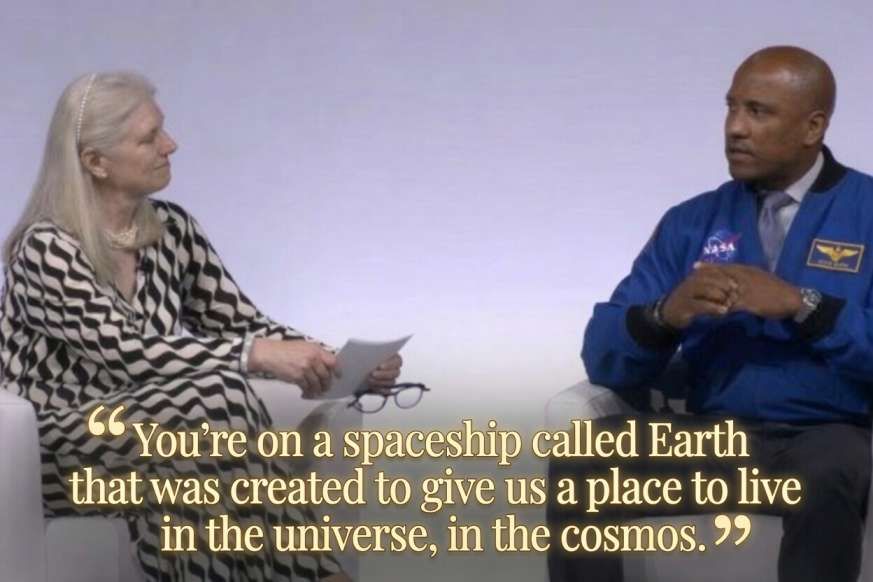
The following is the full transcript of NASA astronaut Victor Glover in conversation with Baroness Philippa Stroud at ARC 2026.
Editor’s Note: In this engaging conversation, NASA astronaut Victor Glover reflects on his profound journey to the moon and the transformative perspective it offered him regarding Earth and humanity. Throughout the interview, he shares the awe-inspiring experience of viewing our “spaceship” from space, emphasizing the deep sense of responsibility and interconnectedness he feels toward all inhabitants of our planet. Glover ultimately leaves the audience with a powerful message about the necessity of maintaining wonder, love, and human dignity as we work together toward a shared future.
Introduction
BARONESS PHILIPPA STROUD: I don’t know about anybody else, but this is a huge privilege for me to get to speak to you, Victor. It really, really is. Just begin. Tell us what was it like? What did you see? Amazing.
VICTOR GLOVER: How long do we have?
BARONESS PHILIPPA STROUD: Okay.
The Launch and the Journey to the Moon
VICTOR GLOVER: Well, first, thank you. This is a huge privilege for me as well. Thank you all for being here. And it was amazing. The journey was — it was unreal. We had the countdown going. It actually starts 2 days before launch. When we got to 10 seconds, 10, 9, 8, these pumps started to spin, and then the core stage engines light 6 seconds prior, 6, 5, 4, 3, 2, 1, and the solid rockets light, and they’re so powerful, it will take the whole 5 million pounds and lift it instantly.
And when we felt this rocket jump off the pad, it was like, oh, I guess we’re going. No one was more surprised than the crew, because you’re prepared to go, but you don’t expect to go. And that seriously, the entire crew was like, oh, we’re going to the moon.
And the rest of the mission felt just as inspiring and just as surprising and shocking. The things that we saw, a lot of this I have not found the right words to describe, actually. And so you’re going to notice this today as I explain some of it. It is difficult to put — the pictures that you’re seeing scrolling, or will see, some of those things I have a hard time describing.
Seeing Earth from the Moon
BARONESS PHILIPPA STROUD: What I love about talking with you is you went to the moon, but it’s actually the Earth that you have kind of spoken so much about. What is that? Why?
VICTOR GLOVER: I’ll start with this poem that I read on account of Michael Collins, the man who stayed in the command module when Neil Armstrong and Buzz Aldrin went down to the surface of the moon for the first time in humanity. Talk about being alone. He was the most lonely human at the time. And he wrote a book called Carrying the Fire, and he quotes T.S. Eliot in his poem Little Gidding. At the beginning, it says, “We shall not cease from exploration. At the end of our exploring is this, that we will return home and see it for the first time.”
And that phrase has always stuck with me. I lived on the International Space Station for 6 months. And I truly felt this unique perspective helped me appreciate home. And I thought, I felt that I’ve been there, I’ve done that, I’ve seen that, I have that perspective in my bones. And then we went to the moon and it just deepened.
BARONESS PHILIPPA STROUD: And what does it do to you as a person having that experience? I mean, that’s quite something.
VICTOR GLOVER: I think the short version is it helped me appreciate, as I sit inside of this metal box that is allowing me to breathe in the harsh heat or cold of space where there’s no air inches from my face, it helped me to appreciate that this, even though we live most of our lives at sea level, this is our space, this is our spaceship, and it keeps us alive.
And I appreciate this planet and I appreciate its inhabitants because the alternative is not great out there in space where most of existence is nothing. I hope this picture that’s going to come up — it shows this one of the Terminator on the moon, it’s a beautiful shot. But the picture that puts the Earth in contrast where you see how far away we are, the Earth being so small, that was the first perspective where I could see the Earth hanging in the blackness of space, which space is mostly nothing.
And so it’s one thing for you to hear me say the words, but to feel that in your bones is truly something. And I appreciate us and I appreciate this place more for it.
A Message from Lunar Orbit
BARONESS PHILIPPA STROUD: And Victor, whilst you were in lunar orbit — I’ve had to actually learn a whole new language to be able to — lunar orbit was not in my language before this moment. Whilst in lunar orbit, you said something that as we listened to it, we as a team were deeply struck by. Can we just actually see it before we talk about it? Can we just play that?
VIDEO CLIP BEGINS:
Interviewer: “Apollo 8 had a memorable Christmas Eve reading from Genesis. Do you have a message you’d like to share from space about Easter Sunday?”
VICTOR GLOVER: You know, I don’t have anything prepared. I’m glad you brought that up, though. I think these observances are important, and as we are so far from Earth and looking at the beauty of creation. I think that for me, one of the really important personal perspectives that I have up here is I can really see Earth as one thing.
And when I read the Bible and I look at all of the amazing things that were done for us who were created, it’s — you have this amazing place, this spaceship.
You guys are talking to us because we’re in a spaceship really far from Earth, but you’re on a spaceship called Earth that was created to give us a place to live in the universe, in the cosmos.
Maybe the distance we are from you makes you think what we’re doing is special, but we’re the same distance from you. And I’m trying to tell you, just trust me, you are special in all of this emptiness. This is a whole bunch of nothing, this thing we call the universe. You have this oasis, this beautiful place that we get to exist together.
I think as we go into Easter Sunday thinking about all the cultures all around the world, whether you celebrate it or not, whether you believe in God or not, this is an opportunity for us to remember where we are, who we are, and that we are the same thing, and that we got to get through this together.
VIDEO CLIP ENDS:
VICTOR GLOVER: That’s the first time I’ve listened to that.
On Humanity and Civilization
BARONESS PHILIPPA STROUD: Really? Oh, Victor’s just told me that’s the first time he’s listened to that. Which is extraordinary. What did being in space, Victor, teach you about our humanity, about our civilization?
VICTOR GLOVER: We’ve come a long way. How we deal with disease, the numbers of people that can read, babies being born have a higher chance of survival today. If you’re familiar with the Millennium Goals, we’re doing great as a species. But that is no excuse for us to rest on our laurels. We have a lot of work to do. And I think going and doing this has made a few things clear.
I have a responsibility. Hearing how many people have quoted that — they played it at church. I landed on a Friday. I got home on Saturday. I told my wife I want to go to church on Sunday, and she said, “Eh, maybe, meh, maybe not.” And we watched online, and the end of the service was what I said before we went LOS. And it’s interesting — our words carry weight. And I take that as a responsibility.
And I think we all have a responsibility. This is ours. I lived in Japan for 2 years. I’ll make an example here. When I moved to Tokyo, I was amazed at how downtown Tokyo was clean all the time. And I watched someone pull a cloth out of their bag and dry their hands and put it back, and I was like, okay. And then I was at the train station and I watched someone walk by and just without thinking, pick up a piece of garbage and take it with them, put it in their bag. And I was like, wow, that’s ownership.
They took ownership of making sure Tokyo — no, they didn’t own Tokyo, but that citizen decided that Tokyo is a representation of our culture. And I want you to be comfortable and appreciate this place when you get here. And that’s how I feel. I take ownership, but not of my country, not of my state, but of the planet. This place that we live and all the borders we try to put on it, that’s something we’ve done. And I just believe we are all responsible for how this experiment turns out.
Training for the Mission — and for Life
BARONESS PHILIPPA STROUD: And one of the things that I love about talking with you is that you have trained really hard to be able to do this mission, to be able to see the things that you have longed to see. And you’ve also lived a different life in order to see the things you want to see. At ARC, we talk a lot about seeing the rebuildings of the foundation of our civilization, which is going to require us to live differently. How do you train? How do you prepare? What challenge can you give us about how we live if we actually want to see the things that we talk about?
VICTOR GLOVER: We trained to fly a spaceship. We trained to handle emergency procedures. But we also — I’m going to start tactical and I’ll zoom out to the larger strategic part of this. We were assigned to this in March of 2023. We spent 3 years training for this mission. And right away, we reached out to a group of people that we call behavioral health and performance specialists. They’re operational psychologists and psychiatrists. And this team helped us to become the best team. We knew that we needed to work on being a team for each other.
And so fast forward 3 years, we launch on April 1st. And one of the things people have responded to the most is how we work together, how we showed up for each other. And so what I go back to, it wasn’t because of our personality, it wasn’t because we just magically showed up and instinctively worked like that. We had professionals helping us. And I think that’s important.
It’s easy to show up as an astronaut in this blue jacket and people think that’s who you are all the time. But we worked very hard with people who were talking to us about our own challenges as individuals. And then how when you weave that team together, how we can be better as a group. I said it often — love covers a multitude of sins. Our team, our group, we covered for each other in a way. And that’s how that small team worked.
The big shift — zooming out strategically — this is a question I would really love my wife to chew on because the real experience that we’ve been on this astronaut job is the last 13 years of 30 years of service to the government as a military officer. And it’s why your email stuck — that barrenness and citizenship. Citizenship requires a civilization, a something to be attached to. You have to be aligned to something bigger than yourself, which, as a Christian, that’s an obvious connection. There is something higher than all of us. But even if you don’t believe in that, there’s something when you’re a member of a society — we is bigger than me.
And that’s the thing. I have for 30 years in my profession, I had to put what I want, myself, second to what the government asked me to do. And I think that that long view is something that, as a young person, I was very grateful to have as the start of my professional life. And now, as an older person, I look at whatever I do for the rest of my life, it’s going to be very strange to not have a mission set. And so I’m going to always keep something in front of me, like my military service, because that has helped me to have a sense of purpose.
A Message for the ARC Audience
BARONESS PHILIPPA STROUD: And as we come into land — in this room we have business leaders, we have politicians, we have artists, we have academics, we have people from social services backgrounds, the whole gamut. You’ve talked about how responsible citizenship has been a key message for you. What personal message would you like to leave with the ARC audience as a way of saying keep going, go further?
Wonder, Awe, and the Philosophy of Love
VICTOR GLOVER: We traveled 252,756 miles from Earth, and you’ll hear that quoted in lots of ways. It’s a record, it’s this thing and/or another. We actually traveled 700,000 miles almost to get that distance. That’s how far we were straight line from Earth, but we traveled a lot farther than that to make that maximum distance possible.
And along the way, we saw some amazing things. These photographs that you’re seeing, I hope leave an impression with you that there are amazing examples. This shot is from a camera on the solar array during the eclipse of the sun going behind the moon. But we’re so close to the moon, the moon is 35 times larger than the sun. When you see an eclipse from Earth, the sun and the moon are about the same size. That’s why you get a very distinct ring around the moon. And so this solar eclipse was one of the moments on the mission where I just felt awe. We use that word a lot, but I felt an awe and an inspiration.
Why am I explaining these pictures to you and trying to share this message with you? I think it’s important for us to carry two things with us as leaders, as people to whom much is given, much is required. I don’t see it enough in the world — wonder and magic. And as an adult, as a 50-year-old, it even feels strange to say those things sometimes, but they exist.
This shot would not have been possible days later or days earlier. Our trajectory would not have flown through the shadow of the moon. But as I get back to Earth — and it never gets old to say, coming back to Earth — being back on Earth and thinking about that experience, that would have happened whether I was there or not.
This is the picture we took from inside the capsule, and it looked even more amazing than that. Can I tell a 2-minute story?
When I lifted my solar eclipse glasses, my eyes were still adjusting. So when I looked out the window, all I saw was a black hole where the moon was and this light emanating from around it. And as we’re sitting there talking about it, I say to my colleague, “You’ve got to come see this. The moon is right in front of us and then it’s gone.”
And so as my eyes start to adjust, I start to see the halo around the moon and I see stars in it. Usually when there’s light outside, you can’t see the stars because it’s too bright — it overpowers, and your eyes adjust automatically. So I can see stars in the glow. If you can go back to that picture — that picture is the one I’m describing, and that glow had stars in it.
And seeing those stars, I’m going, “Wait, I can’t understand why I can see stars in this image now.” And then I start to see craters on the surface of the moon. Now the sun is 100 million miles away and behind the moon. So seeing craters means there’s light coming from somewhere. And as my eyes continue to adjust, the craters are blue. They’re blue. The light on the moon is the Earth shining on the surface of the moon.
And I called over to Reed and I said, “Reed, look at this.” And he floated up to the window and he and Christina both said, “Oh my God, oh my God.” As Christians, sometimes we’ll hear people say that, and what do we usually respond? We say, “Don’t use the Lord’s name in vain.” And it wasn’t in vain. It was the complete right response in that moment.
As I think more about that, it was such a moving moment for all of us, whether we experienced it up close or not. We live in a universe where wonder and awe and magic exist. And what I’ve been driven to is gratitude. I am extremely grateful for the responsibility that I’ve been entrusted with.
As leaders, I think we have to remember — you talk about human flourishing, human dignity and love. I was just talking to Joel backstage about leadership and how, when I think of sailors, as a leader of sailors, as a military officer, I talk about love more than anything else. My love for sailors. That sailor has a family. Constantine’s son is sitting right here in the front row. I think about love more than anything. It drives my leadership philosophy.
And so what I would leave you with — I’m sorry, it’s been very long —
BARONESS PHILIPPA STROUD: I—
VICTOR GLOVER: If you look at that picture and you think it’s amazing, it connects us all. All of us live in the universe that produced that wonder. And we need to spread that wonder, that awe, that magic with a sense of love as we work toward enhancing and ensuring the future of human flourishing. We have to keep human dignity at the center of it.
BARONESS PHILIPPA STROUD: Victor Glover, thank you. I want to thank you for the wonder, the awe that you bring, but also for your adventurous spirit and your refusal to accept any limits. Just thank you so much. Thank you so much.
VICTOR GLOVER: Thank you. Thank you.
Related Posts