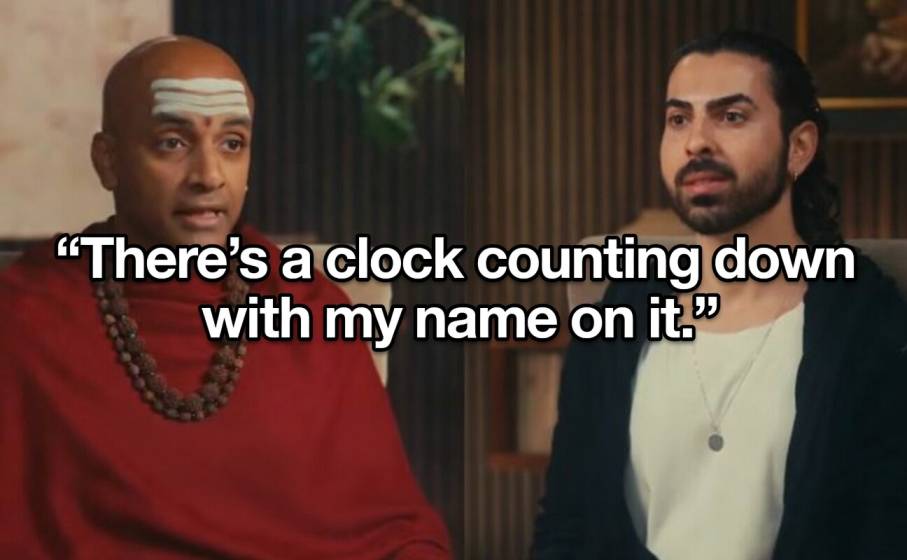
The following is the full transcript of Hindu priest Dandapani’s interview on Know Thyself Podcast, June 30, 2026.
Editor’s Note: In this episode of the Know Thyself podcast, host André Duqum welcomes former monk and Hindu priest Dandapani for a profound conversation on the power of focus and intentional living. They explore why modern distraction is costing us our limited life force and offer practical strategies to reclaim undivided attention in a world designed to scatter it. Throughout the discussion, Dandapani shares insights on how to train the mind to be present, helping listeners move from a state of being “physically present, mentally absent” to living a more fulfilling and purposeful life.
Introduction: The Cost of a Distracted Mind
ANDRÉ DUQUM: Dandapani, you are a Hindu priest who spent over 10 years as a celibate monk and has now gone on to sharing the world about the power of unwavering focus. I just want to start by setting the stage and asking, what does living life with a distracted mind cost us?
DANDAPANI: Everything. Ultimately, our life force, the finite amount of time that we have, each of us have on this planet, which cannot be replaced. We can’t get it back. And the relationships we have with the people that we love and the things that we love, our experience, ultimately. Physically present, mentally absent.
ANDRÉ DUQUM: Physically present, mentally absent.
DANDAPANI: We spend so much time, people, working to earn money to buy experiences with family, with things, travel, whatever it may be, going to a music concert, and then to be mentally absent when they’re physically there.
ANDRÉ DUQUM: It’s almost like life happens in a way where we miss the experience of it.
DANDAPANI: Yeah. And while you’re physically there, mentally you’re somewhere else. You’re either with your phone or you’re thinking about something else. So you’re not experiencing the experience that you worked so hard to create. And then with every passing month, every passing year, you feel less and less fulfilled. Of course you do. Because you’ve had all these experiences which you’ve never actually truly experienced because you couldn’t be present. And you can’t be present if you can’t be focused.
Focus, Concentration, and Presence
ANDRÉ DUQUM: I feel like the concentrated mind, that state of having a concentrated mind, is inherently pleasant. Do you say that the terms are synonymous with presence and focus and concentration? How do you delineate, if you do?
DANDAPANI: Focus and concentration mean the same thing, literally in the dictionary. So I can use those words synonymously. Present is a byproduct of being focused. If I can be focused, I can be present. If I can keep my awareness, as I teach in the book, or my attention on you without it wavering to something else, I’m being present.
But if I’m physically here and while you’re speaking, my awareness is drifting and thinking, “What should I have for lunch? What should I do this afternoon?” — that’s where my attention is going, my awareness is going. I’m physically present, mentally absent, and I’m no longer present anymore. Mentally, I’m not here.
So when people talk about being present and practicing being present, it’s erroneous. You don’t practice being present. You practice being focused. Being present is an outcome of being focused. So the typical Instagram quote, “Be present, be here, be in the now,” is —
ANDRÉ DUQUM: Yeah.
DANDAPANI: You’re looking at the outcome, but what we need to be doing is asking, what is the act that gives us that outcome?
ANDRÉ DUQUM: We live in a time where our attentional system is hijacked in so many different ways because there’s so much more stimulus around us. That plays a huge part into the generation that we find ourselves in.
Clarity of Purpose as a Defense Against Distraction
DANDAPANI: Absolutely. Because people have no clarity of what it is they want in their life. And because it’s easier for me to hijack your attention if you don’t know what you want. If you knew what you want, it would be very difficult for me to hijack your attention. Because then you have clarity of where you’re going, where you’re focusing your energy, your time.
I remember I used to live in New York for a long time, and my wife and I lived in Astoria. And I remember one weekend she said, “I want Thai food.” And our favorite Thai restaurant was about a 20-minute walk away. And we were walking there, and a few minutes into the walk, I said to her, “Oh, look, that Greek restaurant finally opened. They’ve been working on it for a year. Let’s go try that.” She goes, “I want Thai.” I said, okay. We kept walking a few more minutes. I said, “Oh, what about that place? We’ve been wanting to go there.” She goes, “I want Thai.”
So I’m trying to hijack her to go to all these different places, but because she had clarity of what she wanted, which was Thai food, I couldn’t hijack her.
I think similarly in the world, people don’t have clarity of what they want in life, and they are unable to articulate that very specifically. So it’s easier now for the digital world to hijack your attention. And most of us were never taught early on in life that we should have a purpose in life, that we should have priorities, a clarity of what we want in life. Rather, we were trained to think, “You’re still young, you’ll figure it out in time.” That’s the common advice. “You’re still young. You don’t have to have it figured out. Go out there and explore the world.”
But a confused mind compounding on itself becomes more and more confused. A distracted mind compounding on itself becomes more and more distracted. When I do events and I ask my audience, “How many of you here are distracted?” — almost everyone puts their hand up.
Similarly, if we don’t seek to find out what we want and we’re perpetually distracted and don’t work towards finding clarity of purpose and priorities in life, we’ll never find it.
ANDRÉ DUQUM: It seems like knowing what you want and knowing what is worth wanting is born out of having some clarity and a focused mind. And a focused mind is also born out of knowing what you want.
DANDAPANI: Yes.
ANDRÉ DUQUM: And so you brought up a very important point, which is we’re practicing being distracted every single day for hours on end. Talk to me about the law of practice and why that’s an important thing to have context around.
The Law of Practice
DANDAPANI: Let me ask you a question. We’re in Los Angeles. If I wanted to play for the Lakers — humor me — how many hours a day would you recommend I practice?
ANDRÉ DUQUM: Probably as much as you could.
DANDAPANI: Give me a number just to —
ANDRÉ DUQUM: I don’t know, 6?
DANDAPANI: 6 hours. How many days a week?
ANDRÉ DUQUM: 6.
DANDAPANI: So 6 hours a day, 6 days a week. After 6 months, would I play for the Lakers?
ANDRÉ DUQUM: No.
DANDAPANI: Thanks for your faith in me. But I’d be better at basketball, right? And after a year? Much better at basketball. I look at your face and go, there’s no way he’s playing for the Lakers.
ANDRÉ DUQUM: I believe in you, man. Maybe the G League. You never know. Dream big.
DANDAPANI: Dream big, right? Yeah, I could be the next King.
ANDRÉ DUQUM: I think a monk could, a priest could cross some ankles.
DANDAPANI: Yes, I could. But after practicing basketball for 6 hours a day, 6 days a week, after a year, I’d be really good at basketball, may or may not play for the Lakers. What if I practice distraction 6 hours a day, 6 days a week? What would I be good at after 6 months?
ANDRÉ DUQUM: Being distracted.
DANDAPANI: And after a year?
ANDRÉ DUQUM: Master.
DANDAPANI: Master. But the truth is we have 24 hours a day. Most people sleep, what, 7, 8 hours if we’re lucky. So awake 16, 17 hours a day. And out of that 16, 17 hours a day that we’re awake, are we really practicing distraction 6 hours? Or is it more like 7 or 8 or 9 hours? And is it 6 days a week, and Sunday we’re Zen and focused and centered? Perhaps it’s 7 days a week.
So imagine if we were practicing distraction 8 hours a day, 7 days a week. After 6 months, we’d be so good at it. If I practiced the piano 8 hours a day, 7 days a week, you would tell me that I would be better at playing the piano after 6 months, wouldn’t I?
ANDRÉ DUQUM: Yeah.
DANDAPANI: Practicing 8 hours a day, 7 days a week. So why would it be any different for distraction? If I practice distraction 8 hours a day, 7 days a week, after 6 months I’d be great at it. After a year, a master. After 2 years, I could write the best-selling book on distraction. There’d be nothing about distraction that I wouldn’t know.
Most people are masters of distraction because that’s what they practice. They’ve never been taught how to concentrate and they never practice concentration. You can’t be good at something you don’t practice.
Designing Your Life Through Understanding Your Mind
ANDRÉ DUQUM: Not only do we not practice it, we’re also not taught from a young age how our mental faculties work, what our mind actually is. I’m hoping this conversation can serve as a rock in people’s life to come back to, to really gain context and understanding of how their mind works so that they can design their life, know what they want, go after what they want, get what they want, and not let their life pass them by and become a creature of circumstance.
We are practicing distraction — maybe 10 to 16 hours a day for most of us. Our phones are being checked on average over 200 times a day.
DANDAPANI: Insane.
ANDRÉ DUQUM: What feels insane to me is that we have this gift of being alive, and in many ways, unbeknownst to us, these systems — because often again, we don’t know what we want — are hijacking our life in a way where we’re not fully aware of it. So it’s like we don’t even know what we don’t know.
And to continue setting the stage a bit, how did examining your own mortality and the finiteness of your life motivate you to really actually understand how to focus?
Mortality, Finiteness, and the Preciousness of Life
DANDAPANI: The Dalai Lama has a beautiful quote. I’ll try to remember it exactly if I can. He says, “We don’t talk about death to fear death. We talk about death to appreciate the preciousness of life.” And I really love that because talking about death can be unpleasant and uncomfortable for a lot of people. But if you come from the perspective of realizing how precious life is, then you realize that life is not short, it’s finite.
The typical common phrase is, “Life is short.” When you’re stuck in LA traffic for 3 hours, do you ever go, “It’s only 3 hours, not bad”? That’s short. But you go, that’s long. So if 3 hours is long, wouldn’t 3 days be even longer? If I told you you were going to jail for a year, you’d go, “Oh my God, that’s a long time.” So life is not short, it’s finite. There’s a clear, definitive end to it. We just don’t know when that end is.
And I believe in reincarnation, but I know I have one life as Dandapani. My next life, I could — I don’t know — be a 6-foot-tall blonde girl named Olga for all I know. But I have one life as me, and I want it to be an amazing life. And the fact that I don’t know when I will die, and my knowing and realizing that life is finite, causes me to really dial down onto figuring out what is my purpose, what are my priorities. Being able to articulate that clearly, then developing this ability to focus so I can stay focused on that.
And when I can live a purpose-focused life, the outcome of that is I live a more fulfilling life, a happier life. I wouldn’t say a happy life, but a happier life, a more fulfilling, more rewarding life. And there are less things to get distracted by. If I’m driving down a highway and I know where I’m going to, there’ll be less reason to take the exit.
ANDRÉ DUQUM: Yeah.
DANDAPANI: But if I don’t know where I’m going, if I’m just going to say, “I’m going to drive for the next 5 hours,” I can just take any exit I want. And I think that’s what’s happening 200 times a day. People are picking up their phone and taking an exit somewhere. And think how costly that is time-wise, knowing that your life is finite, or energetically, knowing that you only have a finite amount of energy each day.
Preparing to Live vs. Actually Living
ANDRÉ DUQUM: It reminds me of this quote I just pulled up from Alan Watts. He said, “To plan for a future which is not going to become present is hardly more absurd than to plan for a future which, when it comes to me, will find me absent, looking fixedly over its shoulder instead of into its face. They failed to live because they were always preparing to live.”
And I think so much of our life is living in this future-based proposition, oftentimes of desiring things in our life, almost preparing to live — like there’s going to be some ideal state in the future in which we’ll fully arrive and be present. But we’re also training ourselves to not enjoy the moment once we get there. So we’re not going to even be there when it comes time to reap the rewards.
DANDAPANI: Because we’re thinking of the next thing.
The Framework: Purpose, Focus, Simplify, and Sacrifice
DANDAPANI: I use a 4-step framework of Purpose, Focus, Simplify, and Sacrifice. Getting clear of your purpose and priorities, learn to focus, practice focus so you can stay focused on that purpose and priorities, and then simplify your life to those priorities. And part of simplification is sacrifice. I can’t simplify my life by not giving up things and people that aren’t aligned with that.
And simplify doesn’t mean you can’t have ambitious goals. It just means you are hyper-clear what it is you want in life. And you’re just narrowing it down on that. You’re focusing your time, your energy, all your efforts into those things. And for everything else, you’re affectionately detached from.
How the Mind Works
ANDRÉ DUQUM: So I want to — I would love to keep diving into that, but to really set the stage and how you — what your conception and understanding of how the mind works. And how focus works, just to get right to it. What are the different levels of the mind? And how — let’s start unraveling how the mind works, that way we can know what to do with our mind and focus and awareness.
DANDAPANI: I always tell people, we just need a basic understanding of the mind in order to understand it, be able to control it and direct it. People go down the rabbit hole too much because it’s so fascinating, and then stay down the rabbit hole and never come up, and live life. If you look in my book, The Power of Unwavering Focus, chapters 3 to 5 talk about the mind. And there’s two things you need to know.
One is the mind has a vast space with many different areas within it. And awareness — I define awareness as a glowing ball of light, and you are pure awareness moving through the mind. The mind doesn’t move, awareness moves within the mind. And wherever awareness goes, because it’s a glowing ball of light, it lights up that area and you become conscious of it.
So if awareness goes to the angry area of the mind, it lights up the angry area of the mind, you become conscious of being angry. Are you angry? No, you are in an area of the mind called anger, experiencing anger. You are pure awareness in that area of the mind. As easily as you went there, you can move your awareness to the happy area of the mind. It lights up the happy area of the mind. You become conscious of being happy. Are you happy? No, you are pure awareness in an area of the mind called happiness, experiencing happiness.
So what is the takeaway? The takeaway is that the mind and awareness are two distinctly separate things. The mind doesn’t move. Awareness moves within the mind. And your goal is to control where awareness goes in your mind. And that’s the end of the class. And if you can get that, it will completely change your life.
Do you know how to drive a stick shift car?
ANDRÉ DUQUM: I have, yeah.
DANDAPANI: You have? Okay. What do you need to know? 3 paddles. You got your clutch, your brake, accelerator, your gears, steering wheel, left, right, or straight, go forward, right? The critical thing is knowing when to release the clutch, step on the accelerator, and change the gears. If you can get that right, you can drive. If you can’t, the car will just hop and then stall. You don’t need to learn about the fuel injection, the carburetor, none of that, how the brake fluid works, none of that stuff. Once you get those things down, maybe the indicator to turn left or right, you’re good to drive anywhere you want to go.
And once you understand that you’re not the mind, that you’re pure awareness moving within the mind, that’s all you need to know about the mind. You can go deeper and study about the prefrontal cortex and what the serotonin does and the dopamine does and the this and the that. And when I went to sleep, I spent 2 hours in the gamma waves and then 3 hours in the delta waves and then 5 minutes in this state and that state. You can do that till the cows come home. It’s not going to make a difference.
But at the end of the day, can you control where your awareness goes? Because at any given point in time, either I’m in charge of where my ball of light is going in the mind, my mind, or my environment is — the people and things around me. So if you came up to me and said, “Dandapani, your shawl is ugly,” I can allow you to take my awareness to an upset area of the mind, and I reach over and pinch you. Or I could hold my awareness in an uplifting area of the mind and say, “Oh, thank you so much for letting me know I should go shopping today.”
And my ability to control my awareness allows me to choose how I respond and react to life’s experiences. That’s the fundamental level. Ultimately, the goal is to take awareness in a controlled and focused way into your superconscious area of the mind and experience the Self inside of you. That is the goal. But you need to be able to navigate awareness within the mind. But understanding that awareness and the mind are two separate things is the first step.
Distraction and the Level of Consciousness
ANDRÉ DUQUM: You spent so many years deep in the contemplative practices and studying every day. And would you say that there is a correlation to how matured your consciousness is, like how much you’ve grown as a person, and how distractible you are? Like, is there a link between how easily distracted somebody is and where they’re at on their journey of development?
DANDAPANI: Yes, I would say the more you — remember I said the mind is a vast space, right, with many different areas. If we were to put a framework around that vast space, we could look at the mind as a 3-story building. The ground floor would be your conscious mind, your instinctive area of the mind. The second floor would be your subconscious, which is your intellectual area of the mind. And the third floor is your intuition or the superconscious area of the mind. At any given point in time, that ball, your awareness, is in one of those floors.
Now, you can’t be on the second floor of the house and the first floor of the house at the same time. So when you are in the conscious area of the mind, which is the external mind where you’re dealing with your 5 senses, your physical body, everything around you, that world is very chaotic and distracted. But if through your meditation and the work you’ve done with yourself, if you’ve been able to take your ball of light to the third floor and experience even part of the superconscious area of the mind and experience it enough times where you start to realize that it exists — not just a one-off experience — then you get less distracted in life because you go, “I want that. I really, really want that. And all these other things don’t matter to me.”
It’s the same way if you look at a professional athlete, like a tennis player or soccer player that’s playing at the highest level. They’ve tasted something, on one end of the spectrum of winning, of the highest form of excellence. And they want that so badly they’re not willing to get distracted by everything else that’s going on in life, and they’re just focused on getting that.
So the mystic is no different. He or she, through the ability to concentrate really well, has been able to navigate their awareness to the superconscious area of the mind multiple times to experience it enough where it’s gone from knowing to deep experience or realization that such a thing exists inside of us. That you go, “This is why I’m here on this planet. I am here to know thyself, to know who I am. Now, all these things around me are fascinating, but not as fascinating as compared to what’s inside of me.” So there’s less to be distracted with. It’s only when you don’t have the experience of something greater that something lesser, so to speak, becomes more inviting and charming.
Tasting the Superconscious
ANDRÉ DUQUM: Having the taste, the ontological, the first-person experience of — you use the word superconscious — that higher state of mind, to me, that is one of the most immediately transformative experiences because it becomes undeniable. It becomes self-evident in your experience, right? You can be taught and listen to a million podcasts till the cows come home of what you should do, of what’s worth going after, of who you are. And it’s all outside in, right?
And so why I love having this conversation, especially with somebody who’s been deep in the practice yourself for many years, is that you become a walking invitation when you have tasted that place within yourself and you’re no longer under the constant delusion that your life is going to be fulfilled from an arrangement of circumstances outside of yourself fully. When you’ve tasted how fulfilled you can be just in your own being, by tasting that level of yourself.
I’m curious, how does that rewire the way how you walk back into the world? You still build businesses, you’re still in the world, you’re still creating a lot of things. But how does that change what you think that those things are going to actually give you?
Money, Purpose, and the Spiritual Path
DANDAPANI: So I was a celibate Hindu monk living in a cloistered monastery, and now I’m a Hindu priest. In Hinduism, priests and monks lead celibate lives by themselves or in cloisters with each other. And Hindu priests fall under the categories of householders. So there’s two paths in Hinduism, as a monastic or householder. So now that I’m a householder and as a priest and have a family and a business, I need to support myself. So part of having a business is to earn an income so that I could have a life that I could live and provide for my family.
The critical part here is that it’s very difficult to live in the world and pursue a deeply spiritual path if you do not have enough financial resources. In Hinduism, there are 4 goals for a householder’s path: wealth, love, righteous action, and enlightenment. But it starts with wealth, which a lot of people think that money is the root of all evil. And when I grew up deeply interested in spirituality, people would tell me money is bad. But here you have Hinduism, the oldest religion in the world, tells you that if you do live in the world, that should be your first pursuit. Because when you can buy shelter, you can buy food, and safety for your family and security for your family, you’ll have the peace of mind to go sit down and go within without having to think, “How am I going to pay for my children’s school fees? Can I put food on the table tomorrow? Can I meet rent?” And all of these things that are necessities for just existing.
So the pursuit of money for me is solely for the purpose of buying me a lifestyle that allows me to pursue my ultimate purpose, which is self-realization. And when I can no longer assign purpose to the pursuit of money, then money is not worth pursuing anymore. Some people just love making money, and that’s totally fine. We all have our own lives, and we can do whatever the heck we want with it. For me, money serves a very clear purpose. It’s buying me the life that can allow me to pursue my spiritual life.
ANDRÉ DUQUM: Yeah, that’s, I think, important to give the context around, because I mean, it’s foundationally Maslow’s hierarchy in some sense. You living in the world, if you’re not going to be in a cloistered monastery where you can just fully dedicate, you don’t have to worry about the worldly situations as much.
DANDAPANI: But don’t forget, also in the monastery, the monastery needed to get income to pay bills still. To feed the monks, for health insurance, for doctors’ fees, and pay water bills. It’s not like the monastery could exist without money. People just don’t see that part of it. They see the monks walking in robes and meditating. They go, “Look at that life. No money concerns, no this.” There were monks in the monastery whose sole focus was to acquire money to feed all the other monks, right? Money is needed, whether you’re monastic or a householder.
Rewriting What the External World Can Give You
ANDRÉ DUQUM: But I do want to go back to — so you talked about having that taste of essentially the superconscious, having that interior experience where you go beyond the limitations of identification with your own thought and emotion. Part of obviously why we’re so distracted is because we think we’re our thoughts. And so when you taste yourself beyond that, how has it rewritten what you think the external world is going to give you?
The Nature of Anxiety and Distraction
DANDAPANI: I think it’s more clarity of what do I need to do in the external world that will support this journey? And you’re more wisely discerning as to how you’re moving in the external world and engaging with the external world. And what you’re engaging with and what you’re doing serves a bigger purpose of supporting this inner journey.
And going into the Superconscious is not a binary experience. It’s— this is a terrible analogy, but imagine— and an inaccurate one. Imagine if I was flying to the sun. As I left Earth and got closer and closer to the sun, I would feel hotter and hotter. It doesn’t work that way, but imagine this, if I was getting closer to the sun, I would feel more of the sun’s heat. The Superconscious is that way. As you touch into the fringes of the Superconscious, you experience the furthest part of it. Right? It’s— you feel warm, but you can go further and get hotter and hotter and hotter as you would get to finally to the core of the sun, which is the Self.
So a lot of times people mistakenly think that if I touch into the Superconscious, I become enlightenment, I become enlightened, and then that’s it. It’s like a light switch, it’s an on and off, and then I don’t have to do anything else. I just sit there and just be. The whole spiritual path is work. Hard. Work. And it doesn’t sell. No one wants that. The way you become a rich guru is you don’t sell hard work. You sell an easy spiritual path. But it’s nothing but hard work, and it doesn’t end. And you just have to keep working and working and working on yourself over and over again.
And you have to keep taking your awareness into the Superconscious, experiencing it, coming back out again. And there’s a difference between knowing something and realizing something. And realizing something causes a permanent shift in behavior, in perspective, and how you act and react, and how you see the world. There are a million people that can talk about this better than I can, from intellectual, on this knowing place. But I think not everybody can do the work consistently, the same work, not different work. Boring, repetitive, over and over, year after year, decade after decade, same thing to go into the Superconscious over and over again. That’s difficult for most.
ANDRÉ DUQUM: So we have these 3 levels: the conscious, the subconscious, Superconscious. Most of our waking life, we’re in our conscious mind, right? You gave the delineation between the mind, which is like a room with empty, vast space, and the awareness can, like a light bulb, go anywhere within that room.
DANDAPANI: Yeah. Or within the mansion, imagine. And each room would be a different area of the mind in the mansion.
Distraction, Anxiety, and the Mechanics of the Mind
ANDRÉ DUQUM: Yeah. So I think most people would agree that when distracted, it’s like living in a mansion where the awareness is very sporadic, chaotic, and without control. It’s bouncing from— essentially dictated by the environment, right? Any stimulus, whatever dopaminergic impulse, you just kind of go from one thing to another. And we’re experiencing levels of anxiety and loneliness more now than ever.
And I’m curious your thoughts on the connection between the two, because when you’re so distracted, there’s this low-level anxiety and suffering that kind of is coupled with it in ways that we don’t always admit to ourselves. But anybody who doom scrolls feels empty on the other side of it, right? So what is the link there between being distracted and feeling empty? And then we can go into the very real practices that support us being concentrated.
DANDAPANI: Yeah. In my book, I talk towards the end about anxiety and stress and how that relates to awareness in the mind. The critical thing is understanding what is the movement of awareness that causes anxiety. If awareness doesn’t move, that means it’s focused. If I can keep my ball of light on you, it’s focused. What is the outcome of that? I’m present. I’m completely here, not anywhere else.
Anxiety would be something like this. I have projects A, B, C, and D. I’m working on project A. After 3 minutes, my awareness leaves project A and goes to B and goes, “Shoot, I’m supposed to send a Zoom meeting link out. The call’s in half an hour. I bet you everybody’s waiting for the link.” And then I come back to A, keep working on A for another minute. Awareness leaves A, goes to C, and go, “I never sent the invoice out to the client. He was waiting for it yesterday. Shoot, I really gotta get that done.” Then I come back to A again, keep working on A. Then I go to Project D, engage with that for another 10 seconds, come back to A, keep working on A. Then I go to B, I come back to A, I go back to C, I come back to A, I go back to A, I come back to go to B. And I keep doing this. And what am I building? Anxiety. Uncontrolled awareness, which is distraction, leads to anxiety.
And those of you who are listening, try this experience at home. Make a list of 10 things you need to do, work-related or home-related, that are fairly important, and start moving your awareness between each of them for about 15 seconds. Keep awareness on one thing for 15 seconds and then move to the next thing. Go through your to-do list of all the things you need to do about that, and then move to the next thing. Engage in that for another 15, 20 seconds, and then move to the next thing. Tell me how you feel after 15 minutes. If you’re not anxious, I’ll be surprised.
I do this in a workshop and everybody says, stop. Because that’s what we do. Our awareness is on the phone, and then it goes here, and then it goes there, and it comes back here, and it goes there, and it goes through a to-do list in the head, comes back here. You do this over and over again all day long, you build anxiety.
So the critical thing is understanding what is awareness doing that results in anxiety? What is awareness doing that results in being present? You have to understand the mind and the mechanics of the mind so that you can prevent anxiety, you can be present, you can prevent being stressed, you can prevent fear. But you need to know the mechanics of the mind. And you do not need to know an in-depth mechanics of the mind. It’s like driving a stick shift car. I don’t need to know how the carburetor works. I need to know how the clutch and accelerator and the gear stick work.
Stress, Resistance, and Emotional Experience
ANDRÉ DUQUM: No, absolutely. I think even when it comes to things, I heard stress is resistance to existence. There are things in our life that we do or don’t want to do. And let’s take a negative emotional experience as an example. I’m curious because there’s almost like the stress and anxiety comes from our inability to actually be with something fully. When I’ve experienced negative emotional states or grief or heartbreak or whatever, when I’m actually fully in it and fully with it and can put my full focus on it and the resistance to it dissolves, then the suffering surrounded with it dissolves also. And so I’m curious your thoughts on the link between stress being a byproduct of simply our lack of willingness to be with something fully.
DANDAPANI: I think there’s so many reasons why stress comes along. When awareness moves all over the mind like that, the first state is anxiety, and then prolonged states of anxiety lead to stress. So for me, the ability to control awareness in the mind is the first step to eliminating anxiety and then eliminating stress completely. And then what you’re talking about, about the unresolved emotional experiences in the subconscious, which is that second floor, can be extremely stressful as well. But that’s a whole nother can of worms to explore and unravel.
Harnessing Focus: Practical Steps
ANDRÉ DUQUM: I want to read this little quote from your book, because I think it gets at this quite well.
DANDAPANI: Sure.
ANDRÉ DUQUM: So in your words,
“Most people are unable to create what they want in life because they have very little control over where their awareness goes each day. As a result, their energy is flowing to places their environment dictates and what is manifesting in their life is not what they had intended. Their awareness runs rampant throughout the day, driven so much in today’s world by social media algorithms and technology. Their finite energy is dispersed across vast areas as opposed to being harnessed and focused on a few specific things. As a result, none of their goals manifest in life. Frustration brews, eventually boiling over into discouragement. Persistent discouragement dampens the will, leading to the eventual evaporation of hope. The conscious mastery of awareness in the mind is an education and a skill that must be taught to every individual. It is the fundamental building block needed to govern oneself effectively in order to be living a truly rewarding life.”
Well said.
DANDAPANI: Thank you.
ANDRÉ DUQUM: And so I think the problem is quite clear deep into the podcast now of the importance of focus. And I love how you bring it into our everyday experience. So talk to me about the very practical aspect of how we can hone our focus. What can people do to really have a focused mind and use the plentiful opportunities in the day to refine it and practice it?
How to Practice Focus: One Thing at a Time
DANDAPANI: So first step, understanding awareness in the mind. Awareness— the mind doesn’t move, awareness moves within the mind. If you cannot get that, I can’t help you with the second part. You got to find somebody else. You know? So once you get that, now let’s look at focus. Let’s define what focus is, or concentration. I define focus as my ability to keep my awareness, my ball of light on you, until I choose to consciously move it to something else. My ability to keep my ball of light on you is my ability to focus. And that’s how I define what focus is. My ball of light’s on you and it starts bouncing around everywhere, I’m being distracted.
So I think defining things are so critical, because then we have a shared understanding of what— when we say focus, what does that mean? That means I can keep my awareness on you without it moving anywhere. And my guru had this beautiful saying, “Where awareness goes, energy flows.” So my awareness is on you, that’s where my energy is flowing. You feel my energy coming towards you. You go like, “Oh, he’s here, he’s present with me.”
How do we focus? Really simple. We practice doing one thing at a time throughout the day. And what I recommend people to do is pick the non-negotiable recurring events in an average day. So that’s a long— average day would be a Monday to Friday. What’s a simple non-negotiable recurring event? If you live at home with your family, with a spouse and children, every day you speak with your spouse or with your child. It’s non-negotiable. It’s recurring. So every time you speak with your child, give him or her your undivided attention. Keep your ball of light on him. It drifts away, bring it back. It drifts away, bring it back.
If you speak with your child a cumulative total of 2 hours a day, 45 minutes in the morning, 20 minutes here, 10 minutes here, 5 minutes here, add it all up, it’s 2 hours. And every time you speak with your child, you use that as an opportunity to practice concentration. That’s 2 hours of practice a day. We talked about the law of practice. You told me 6 hours a day, 6 days a week, I would still not play for the Lakers, right? But I would be better at basketball. So imagine if I was practicing concentration, practicing keeping my ball of light on one thing for 2 hours a day. After 6 months, what would I be good at? Imagine you played the piano 2 hours a day. Would you be better at it after 6 months? You would.
So rather than create a practice in your life, find something that’s already occurring that is non-negotiable and insert the practice into it. Would it be fair for me to say that most people don’t need one more thing to do in their life? Right? Most people are pretty full, right? So rather than me saying, “Hey, wake up in the morning, do yoga, journal, meditate, blah, blah, blah,” no one’s going to do that. But if I say, “Hey, you talk to your child every day, you talk to your spouse every day, every time you speak with them, keep your ball of light on that. Wanders away, bring it back. Wanders away, bring it back.” Now, this is simple. You don’t have to change your life. You’re just changing how you’re interacting with your loved one.
And it doesn’t have to be with a person, it could be an action like brushing your teeth. If you spend 2 minutes brushing your teeth instead of scrolling while you brush, why don’t you just keep your ball of light on your toothbrush? It drifts away, bring it back. It drifts away, bring it back. Now that’s 2 minutes of practicing concentration. Having breakfast. You just eat breakfast for 5 minutes. That’s 5 minutes of practice in concentration. Now I add up the 2 hours with my child, the 2 minutes brushing teeth, the 5 minutes having breakfast. By the end of the day, I’m up to 2.5 hours, maybe 3 hours of practice in concentration. After 6 months, I’m getting better at it. After a year, I’m really good at it.
Now I go through my life, I meet a friend, I’m completely present. My ball of light has been trained to just be here and not wander off. It’s like a dog. I lived in New York for a long time, and I’d go for a walk and I’d see people walking their dog. It felt almost always like the dog was walking them. The dog was pulling them here and pulling them over there. And they’re always reining the dog back. That’s like most people’s awareness. It’s always running off like an untrained dog. But a really well-trained dog would just walk by your side. And you want your awareness to be like a well-trained dog that’s with you until it’s allowed to get engaged with something else.
ANDRÉ DUQUM: Absolutely. Yeah. I mean, I love how accessible it is and doesn’t add a to-do list on top of everyone’s already full, busy life, but that you can use the plentiful, non-negotiable, recurring opportunities in our day to practice this. We all have this.
DANDAPANI: Yeah. All of us, every one of us has a non-negotiable. Insert the practice into that and make it a part of your life.
Distraction as a Way to Avoid Yourself
ANDRÉ DUQUM: So let’s go into that experience, right? Because in many ways it’s been said, like, the things that are actually good for you taste like poison in the beginning and then have a sweet aftertaste. The things that are bad for you have a sweet taste going in and a bitter aftertaste. Doom scrolling feels great in the moment and then horrible afterwards. Folding your laundry with absolute presence feels boring or annoying at first, but then you actually feel better after. So making the bed, folding laundry, being present with your child, eating your breakfast. When you are in that moment and the mind is distracted, is it simply just a practice of bringing back when you notice your mind gets drifted away?
DANDAPANI: Did your awareness drift away?
ANDRÉ DUQUM: In that moment? Yeah.
DANDAPANI: Or did awareness drift away? Which one?
ANDRÉ DUQUM: Your awareness drifted away.
DANDAPANI: Yes. The mind didn’t drift away. So part of this is getting the terminology right. People always say to me, “The mind drifted.” The mind doesn’t move. Awareness moves within the mind. We have to train the mind to understand itself. So one of the critical things you can do is stop saying— not you, but just the general you— that “my mind drifted away.” No, your mind didn’t drift away. Awareness drifted away. And bring awareness back.
ANDRÉ DUQUM: I’m glad you caught that. I think it’s important to keep using the terms that are accurate because it’s helpful for us to really anchor in the mechanism of what’s happening.
DANDAPANI: And the mind needs to understand it because I can tell my mind anything. I can tell my mind the earth is flat. It’ll go like, “Yes, it is.” I can tell my mind all kinds of things, it’ll believe it. So it’s so important to use words, define those words, and then use them in the correct way to train the mind to understand itself, if that makes sense. And keep it really, really simple.
And now here comes the difficult part. It’s too boring for people. “Is that all I need to do, just keep bringing awareness back? Isn’t there something more, like a cross-nostril breathing or an herb I can take? Don’t you have like some secret monastery practice that I can do in the morning, a chant, maybe an initiation I could do for $5,000 that you could bring me into a practice? What about a circle that we can gather, or an initiation?” No, just bring awareness back. No one will do it. And that’s why everyone’s distracted.
You give someone the simplest exercise in the world. Nothing I’ve said to you right now used any scientific terms. I didn’t use any Sanskrit words. I used a ball of light. A 3-year-old can understand this. A vast space, happy, sad, angry, and this ball of light travels in those spaces. I talk to kids this way and they go, “I get it.” And all you have to do is keep bringing that ball of light back. “No, too simple. Give me something complicated.” And no one will do it. So will you go ahead and live your distracted life? That’s the end of the class. It’s the most unpopular book and teaching in the world.
ANDRÉ DUQUM: No, this is—
DANDAPANI: Why is that about humanity?
ANDRÉ DUQUM: It gives us a way to stay distracted, when we overcomplicate.
DANDAPANI: Yeah. Love to overcomplicate. It doesn’t sell.
ANDRÉ DUQUM: There’s part of us that doesn’t want the solution also. There’s part of us that deeply wants to stay in a state of unconscious or ignorance. There’s also a state of us that wants and craves for the realized state.
DANDAPANI: But here’s the thing also about focus, right? As soon as you can focus, your ball of light is one place looking at something. The longer you stare at something, the more you see. The more I look within, the more I see in a focused state of mind. If I take a 1,000-page book and I just flip through the pages, what would I have read? Nothing. If I open a 1,000-page book and I focus just on one page and read every sentence, I would have some insight into the book.
If my ball of light’s bouncing through my mind at a crazy pace, I wouldn’t see anything. But if it stopped in one area for 20 minutes without moving, it would see what’s in my mind. It potentially would see a past trauma, or a habit pattern that I really don’t like about myself, or a certain characteristic about me that I don’t like. Oof, that’s very uncomfortable. So let’s just keep moving. Let’s not hang around too long. We might see things we don’t want to see. So being distracted is a great exercise to avoid yourself.
Fear, Awareness, and the Present Moment
ANDRÉ DUQUM: So let’s say somebody for 1 day, 1 week, 1 month, 1 year, starts to implement this simple practice of bringing back their awareness when it gets pulled into different things. How does the quality of mind transform on that journey?
DANDAPANI: I would say less anxiety, less stress, less fear. I’ll define fear as awareness leaving the present, going into the future, creating a situation that hasn’t happened, and coming back and worrying about it.
I’ll tell a story my guru told me. So my guru was born in Lake Tahoe in 1927. And when he was 7 years old, he was coming back in the family car. It was snowing really heavily. And he was sitting in the back of the car. He’s thinking to himself, “I’m going to miss my favorite radio program. We’re going to get stuck in the snow.” And back then in 1934, there was no reruns. It was just a guy on a mic on a radio. He’s done, that’s it. You missed the episode.
And then he saw what was happening in his mind. He saw his awareness leaving the present, going into the future, creating a situation in his mind where the car got stuck in the snow, his dad had to go dig the car out, and then they got home really late and missed the show and everything. And then his awareness coming back to the present and now worrying about the situation he created in his mind.
Then he asked himself, “Are we stuck in the snow?” He said, “No.” “Are we still moving?” “Yes.” “At this pace, will we get home?” He said, “Yes.” Then he repeated to himself, “I am all right right now. I am all right right now. In the eternity of the moment, I’m fine.” Fear, he said at 7 years old, is awareness leaving the present, going into the future, and creating a situation that hasn’t happened, coming back to the present and worrying about it.
So when you can start to control awareness and bring awareness back, you start to eliminate fear. Every time your awareness starts to leave the present to go into the future and go, “Well, what if this happens or that happens?” You go like, “Well, it hasn’t.” Bring it back and stay in the present and do what you need to, to compensate for anything potential that might come up.
ANDRÉ DUQUM: So would you describe that phenomena as willpower?
The Gift of Undivided Attention
DANDAPANI: Yes, you need willpower to control that ball of light. So I would define — I like to define things so we have a shared vocabulary. If I could draw biceps around my mind, right? And I would call that willpower. Very poor definition of willpower, but let’s call it willpower.
So my ball of light is drifting away. I use my biceps, I grab hold of that ball of light, and I just bring it back here. And now it stays here for 5 seconds, and then it drifts away again. But we have to be compassionate with ourselves. We’re learning this at 40 years old. That’s 40 years of unlearning we have to do. So the ball of light’s used to drifting away. Now drifting away again, we grab that ball of light, we bring it back. And we train it to do this every day, every week, every month. And after a few months, it learns to stay. You’re just creating a new way of doing things.
And now when my awareness is here, right on you, that’s where my energy is flowing. Where awareness goes, energy flows. You feel my energy coming towards you. You go, “I feel his presence.”
Have you ever had the experience of talking to somebody, and in that conversation, potentially, usually with a partner or something like that, they look at you and they go, “Where are you?” The correct answer is, “I’m right here.” In the context of what we’ve been talking about, what is the correct question to ask? Where’s your awareness? “Oh, honey, it left the moment you started talking.” Because I’m physically present. You start talking, my awareness starts drifting away. So where’s your awareness? Long gone.
Now, how does that person know you’re no longer present anymore? Your energy. Yes, because where awareness goes, energy flows. So if my awareness is on you, you feel my energy flowing towards you. Now, you reply to me. I asked you a question, you reply. You’re talking, my awareness drifts away and I think, what should I have for lunch? I’m still looking at you going, “Hmm, interesting.” But my awareness is somewhere else. That’s where my energy is flowing. That person no longer feels the energy coming towards them. They look at you and they go, “Where are you?” “I’m right here.” Where’s awareness? “Oh, honey, it left.”
ANDRÉ DUQUM: Everyone knows that sensation, maybe at a party or at a gathering where they’re talking to someone who seems uninterested. They’re looking over the shoulder trying to see who is the more interesting person to talk to, or their mind’s somewhere else, or they’re talking to their spouse. Their awareness is somewhere else.
DANDAPANI: By the end of this podcast, you will be a master.
ANDRÉ DUQUM: But there is a direct link to our ability to have a concentrated willpower and directed awareness and observing where that’s absent in the folks and the people around us.
DANDAPANI: Yeah. I’m sensitive to energy. So when I’m talking to someone and I don’t feel the energy coming to me, even though they’re looking at me and going, “Hmm,” then I go, they’re off somewhere. So why am I here?
Going back to your initial, where you started about life is finite — if I said to you, André, if someone came in here and said you had 2 hours to live, would you be doing this podcast?
ANDRÉ DUQUM: Probably not, but we could hang out and figure out what we’re going to do together.
DANDAPANI: 2 hours is pretty finite. And imagine that you say, okay, 2 hours, I’m out of here. And you’re about to leave and I say, “Hey, can I have 5 minutes of your time?” And you’re like, “Oh, I only have 2 hours.” And then out of the compassion you have, you say, “Okay, I’ll give you 5 minutes.” So you sit here and we’re talking for 5 minutes. As we’re talking, I pull out my phone and I start scrolling. Would you be pissed? Knowing that you had 2 hours to live, you chose to give me 5 minutes. And in that 5 minutes, I’m scrolling.
So I look at my life this way. Somewhere out there, there’s a clock counting down with my name on it. I just don’t know how many minutes I have left. I’m giving you a portion of what I have, and you’re not even present. I don’t want to be here. I want to be somewhere else. Because those minutes I’m giving you, I will never get back.
So one of the greatest gifts we can give someone is our undivided attention. The ability to keep awareness here, energy flows towards you. I’m completely present. Not only am I honoring the finite life that I have, I’m also honoring your finite life, because you only have X amount of minutes in life left. You chose to give me some of it. The very least I could do is be present by being completely focused. And that’s me honoring this finite window that you have in this world that you’ve chose to share with me.
ANDRÉ DUQUM: It rewrites, I think, our hierarchy or priority of what we think is valuable, because I could give you $1,000 right now. You might appreciate it, but I can make more thousands of dollars, right? I can’t make back this time that I gave you my undivided attention. And so because that’s a non-renewable resource, it’s way more valuable.
DANDAPANI: It’s priceless. And that’s why I’m very thoughtful about who I spend time with. And if I’m with them, I’m completely here. What a gift. My guru gave me that gift. Whenever he was with me, he was completely present. And I thought, what a gift to give me that. And he’s choosing out of the finite time that he has on this planet, he’s taking the slice and saying, “I’m choosing to give this to you.” There could be a million things he could have done, but he chose to give it to me. I can honor that by being focused and hence being present.
But we don’t. How many times — I mean, I travel a lot, and I’m out in planes and airports and restaurants, and how many people are sitting eating their food? I was in the lounge at the airport yesterday, and there was a husband and wife sitting next to each other, both of them on the phone. And they’re scrolling and telling each other what they’re seeing. No one’s paying attention. “Honey, can you believe this, this, this, this?” “Uh-huh.” “Oh, look at this, this, this.”
Presence as Practice
ANDRÉ DUQUM: I think airports are a great place to put this into practice too, because it’s such a distracted, chaotic environment from TSA to — just giving a TSA agent or somebody that’s behind the desk — because everybody’s so anxious, they’re so distracted, they don’t often get presence. And so sincere kindness and presence feels like an immense gift in those moments.
DANDAPANI: It’s such a great gift to give anybody. And nothing I shared is difficult to do. The question comes down to whether you want to do it.
And I think also the other thing is that people love to go down rabbit holes, especially today — diving into long studies and research. “Do you know that Stanford University came out with this research on the mind and they took the sample and they came out with this, this, this, and then Harvard came out with this study” — all fascinating, right? At the end of the day, the simple question is, can you keep your awareness on somebody without it moving away? And if you can’t do this, all those other things really don’t matter. They’re great distractions. They’re wonderful to talk about. Can sound intellectual and smart, but can you actually just do it? What is the outcome you want — just to do this? You can read 1,000 damn books, meditate till the cows come home. Can you keep your ball of light on one thing?
ANDRÉ DUQUM: I say often that attention is our spiritual currency. That’s why we pay it, just like with any currency. “I’m paying attention.” Paying attention.
DANDAPANI: I like that. Never looked at it that way. Nice.
ANDRÉ DUQUM: Whatever your conception of spirituality, whatever I’m doing at any given moment with my attention is what I’m doing with that life, that spirituality in a sense. And I think from that it’s like, okay, what am I paying with in every moment? Super, super helpful.
The Path to Monasticism
So could I just ask a couple things about your personal path? Because at 4 — do I have it right that you decided you wanted to be a monk, or you thought you wanted to be a monk?
DANDAPANI: Yeah, around 4 or 5, I was living in Malaysia. A monk had come to my house. He was wearing an orange robe and the whole setup.
ANDRÉ DUQUM: A little bit more orange. Less maroon.
DANDAPANI: Yeah, orange. And I saw him and I said, “That’s me.” And I didn’t know what a monk was, so I didn’t even know he was a monk. But it wasn’t until around 8 or 9 years old that I realized it wasn’t about being a monastic. It was about self-realization, which was what I was seeking. The monastic path is the most efficient way to get there. Obviously, at that age, I couldn’t articulate all this that well.
But the drive really was — I think I came to the realization that everything in life goes through 3 phases. Everything is created, exists for a while, and then it goes away. I remember going to my cousin’s birthday party, and my brother and I were excited. All day we were getting ready to go, and that was the creation part of it. And then my parents driving me there, and then the middle part of it was that we were at the party eating cake, playing with balloons, playing with all my cousins, and then getting in the car and driving home. And I remember sitting in the back looking out the window thinking to myself, that’s it. It ended. That sucks.
And we didn’t grow up wealthy, and occasionally we’d go to a restaurant once a year or have ice cream or something. That was very exciting — to go out and have that, eat the ice cream, and then it ended. That sucks. Again, people were born and they live and then they die.
So what is the one permanent thing in this life? And somehow we humans go through the same cycle. We are born, we live in diapers, we go to school, we learn, we grow up, we get a job, find a partner, we have babies, we raise those babies, earn money, children grow up, watch the children get married, children have kids, we have grandkids, we get older, we die, and then we do it all over again. For hundreds of years, for thousands of years. Isn’t that a little weird? Don’t you want to stop by and go, “Hang on a second. Is that why we’re here?”
People say, “Oh, life’s about experiences.” I could reincarnate a million times and still not have every experience this planet has to offer me. So if you say life is about experiences, it’s endless, literally endless. So why are we here? What are we here to do? And that was the pursuit. It just seemed pointless.
ANDRÉ DUQUM: So pointless. And that was the impetus for you to take up a monastic life.
Finding a Teacher and Defining the Philosophy
DANDAPANI: Yes. To have a teacher that could— find a teacher that could articulate to me the— again, I’m giving the perspective from here, right? So I didn’t have this clarity at that time. I just knew what I wanted. I just didn’t put it into words.
I have a teacher that could define for me the philosophy, because the philosophy defines the goal. And even though I grew up a Hindu, he helped me define the Hindu philosophy and define the goal within Hindu philosophy, which is self-realization. Through deep meditation, can I go within and experience divinity inside of me? I am divinity. I am the self. Can I experience that self inside of me? What is the path to that? And what is the lifestyle I need to live to stay on the path to get to that goal?
And he was someone that could articulate all that to me very clearly, give me tools and practices that were really practical and simple, like awareness of the mind and focus and developing willpower and managing energy. And then also be able to put signposts of progress. How do I know I’m making progress? I remember he said to me once, if you meditate every day for 6 months and after 6 months you’re still a jerk, maybe you’re doing the wrong practice. There needs to be signposts of progress. How do you know you’re making progress? What are the benchmarks? If I’m on a weight loss program and I’m not measuring if I’m losing weight, then I don’t know if it’s working or not.
So that was the question. Fortunately, I found a teacher that was very real to me because I met so many gurus along the way as I was growing up, and they were all very philosophical. They spoke in very soft, guru-like voices, that had long pauses, that they were reflecting before they spoke. And I’m like, “Can you just tell me and just keep it really simple so I can understand?” They quoted philosophy and scripture, and I’m like, “None of this stuff is useful to me.”
Because at the end of the day, it’s like, where does the rubber hit the road? Life has so many complications just as it is. Most people are just trying to get through the day. Get the kids dressed, get them fed, get their school lunch ready, get them to school, get to work, get through work, come home, figure out dinner again. Get the kids’ homework, showered, cleaned, to bed. We need to keep things super simple if we want to make progress. And most people can’t, so they don’t end up making progress. And I wanted a teacher that could just keep it really real and doable.
ANDRÉ DUQUM: So you found him.
DANDAPANI: I found him.
Joining the Monastery
ANDRÉ DUQUM: And then you went and you decided. What was that decision like?
DANDAPANI: Joining the monastery? Yeah.
ANDRÉ DUQUM: Did you know you were going to be there for a decade?
DANDAPANI: No, I wanted to join for life. There was no period that I wanted to stay. You don’t join the monastery for periods of time. You join for commitment. It wasn’t a difficult decision. I’d wanted it for so long.
ANDRÉ DUQUM: And you were 21?
DANDAPANI: 23, 24. Yeah. So quite old already. That part in my mind felt like a good number of years, a couple of decades were wasted just wandering around aimlessly on the planet doing what the hell, I don’t know. Yeah, so the decision to join wasn’t difficult. That was clear. I just didn’t want to give my life away to be with someone who wasn’t, you know, full of BS. It had to be— yeah. Unfortunately he died 3 years after I joined. And I stayed for 7 more years. My vows came up for renewal and then I decided not to renew them.
ANDRÉ DUQUM: What was his name?
DANDAPANI: Subramuniyaswami, or Gurudeva, as we call him. And the monastery is in Kauai in Hawaii, yeah.
ANDRÉ DUQUM: Which I’m flying out to tomorrow. Amazing.
DANDAPANI: I hope you get to go see it. Yeah, it’s worth it.
ANDRÉ DUQUM: It’s a beautiful place. I’m excited to go. Going to see a friend and just spend a week there. Kauai is just like absolute heaven on earth for me. It’s so special. A place I like to go because we’re just launching our online community and I have some things I want to go and spend some time to get really clear on the vision around. But I was mentioning before this — I didn’t realize it was in Kauai of all the islands. So I’m definitely going to go check it out.
And so he passed 3 years into you staying there. You stayed for 10 years, and then there was a decision to go back into the world and be a householder as a Hindu priest.
DANDAPANI: Yeah. And that’s when I left.
Contemplative Practices and States of Consciousness
ANDRÉ DUQUM: Yeah. So I would love to just zoom in a bit on what was happening to you in your time there, because you mentioned you’re a very sensitive individual, right? You can become aware and more keenly aware of where somebody’s energy is when you’re here fully, right? And that is a muscle, like your bicep, which maybe was scrawny at the start, and your faculty of willpower got strengthened over that time.
And this is where I’d love to ask you a little bit deeper into some of those contemplative practices and experiences, which you can share to whatever degree feels right for you. But I really appreciate the simplicity of everything that you’ve shared in this podcast. And sometimes talking about what’s possible in terms of higher states of consciousness and deeper states of complete absorption are very exciting because people can feel you. You’re a very sincere guy who doesn’t like to overcomplicate things.
When people hear that there is this experience on offer available to us as human beings where you can taste yourself in such a vast beautiful way, it’s exciting and it’s motivating for us to go and experience that firsthand. So what I’m sure started out as growing your mind, training your awareness — I’m sure there were various experiences which you don’t have to divulge, the what exactly happened or whatever — but what starts as training the awareness grows deeper into these various states, which the Eastern traditions, ancient wisdom traditions have created different maps for. But what’s the next step deeper in terms of what’s possible once you train your awareness and you go deeper into the self?
Philosophy Defines the Goal
DANDAPANI: I want to answer that question, but I think there’s something that comes before that. And what comes before that is getting clear on what philosophy you subscribe to. So most people are like a spiritual mouse, just going around nibbling at a whole bunch of things. I like to say people like to eat off the spiritual buffet table. A little Hinduism, a little Buddhism, a little ayahuasca, a little Native Americans. Put it all in a big bowl and eat it. Why do I need to give it a name? Well, you give your damn cat a name.
So let me just be spiritual, not religious. People hate the C word, which is commit. And my guru used to say, people are committed to not being committed. If you want to go far into the superconscious, you have to nail down on a very clear philosophy, because the philosophy defines the goal.
And one common thing that people getting into spirituality say is that all religions say the same thing. They don’t. They deeply contradict each other. They may agree on a surface level — be good, don’t lie, don’t steal, do charity, all that kind of stuff. You scrape past that thin layer, they all contradict each other.
The Abrahamic religions believe in one God. Islam does, Judaism does, Christianity. Hinduism is monotheistic. It believes in one God. Contrary to what most Hindus say, that Hinduism has many gods, it’s actually monotheistic. Buddhism doesn’t have a god. So now at this level, they’re already different.
Now, Eastern religions believe in karma and reincarnation, soul living in a body, reincarnating over and over again, evolving. Abrahamic religions believe in one life. You’re born, you live, you die, typically a heaven-hell situation, Judgment Day kind of thing.
So before we dive into the superconscious and what you’re going to experience, the philosophy is going to dictate all of that. If I have one life, you can be sure I’m not here on a podcast with you, because when I die, I’m getting to some court that’s going to decide I’m going up or down. I don’t have time to waste. I want the Eastern philosophy. I’m going to reincarnate. I got time. Let’s keep chatting. So all of that makes a big difference.
And then what is God? Typically, the Abrahamic religions believe God is up there, right? A being. Hinduism believes divinity is in all things. Pure energy in everything. You, me, the trees, the stones. Very different. One’s saying, if God is up there, the path is a different path. If God is inside, you can’t use the path to go up there to get the path to go inside. That’s a different path.
So the philosophy has to be really clear. You have to figure out what philosophy do you subscribe to, because that’s going to define the goal. I subscribe to a Hindu philosophy that defines that divinity is in all things, including inside of me, which means then the path is to go within and experience the self within. But if you inherently believe that divinity is not in all things, but divinity is up there, then meditation’s not for you, because it shouldn’t be an internal practice.
I had a Christian lady wanting to come on one of my retreats once. She’s Christian, I said, “You’re welcome to come.” But I said, “By the way, we believe divinity is inside, and our practice is going to take you inside to experience God inside.” She goes, “Well, God’s not inside of us.” I go, “Well, then you’re on the wrong retreat. I’m going to take you away from your belief and your practice.”
The Three States of Mind
So we need to start by getting clarity around our philosophy. To just start talking about the sexy stuff, which is the superconscious and the self and what we experience inside, is erroneous. Get the philosophy right. Philosophy defines the goal. If the goal is to go within and experience the superconscious and the depths of it, the self, then that becomes really clear.
You have three states of mind: the conscious mind, the subconscious, and the superconscious. The conscious is the external mind. How do you get the external mind sorted? You need the right lifestyle. Most people live a chaotic lifestyle. That’s why in the Hindu path, the first two steps on the spiritual path is lifestyle design. Because if your life is crazy, you can’t go inside.
So getting that lifestyle sorted, then going through the subconscious, doing the work on yourself, because that middle layer is everything you’ve ever experienced in your past, which you have to face and acknowledge and own before you tap into the superconscious in the third floor.
And as you go through the fringes of the superconscious and start to go within and deeper and deeper within, I would say one of the first things you experience is — and for everybody it’s different — the sense that you are pure energy. Now, the law of thermodynamics states that energy cannot be created or destroyed. And physics will tell you energy is in everything, right? There’s nothing that doesn’t have energy.
So if energy is inside of me and energy cannot be created or destroyed, is physics saying I’ve always existed? And if I have, what is that essence of that energy? Energy can be transformed from one form to another. So as this body decays, energy doesn’t disappear, it gets transformed to something else. That’s also the law of thermodynamics. But energy doesn’t die or get destroyed.
What is that experience of touching into that energy, knowing that you’ve always existed? And going deeper into that and realizing that that energy is pure unconditional love, deep compassion and empathy, no judgment, and just the purest form of love that you could experience. And even beyond that, as you go further and further in, into the superconscious.
Belief, Identity, and the Gentle Path In
ANDRÉ DUQUM: Yeah. A couple of notes. One thing that I want to push back on a little bit, which I understand the philosophical orientation and how many of these different religions obviously have different epistemic orientations. To me though, because belief is so infused with our identity societally, and it often becomes a pacifier for our insecurity of not knowing — having the ability to experience different contemplative practices and meditation techniques without needing to change your orientation belief-wise, I feel like is a more gentle way in to explore, to have the taste of something beyond your own thoughts and emotions, which then opens the door, I feel like, for different beliefs and philosophical orientations.
That’s why I think this conversation and people can explore these practices at deeper lengths, because it almost takes the pressure off of needing to know what is the right path versus can I discover what is true and can it become self-evident internally first instead of top-down, you know?
The Spiritual Path: How Far Do You Want to Go?
DANDAPANI: Absolutely. Because if you don’t explore, then how would you know? It’s the same way that a Western person might explore Hinduism, Buddhism, and find that that’s the right path for them. But I think the problem is that if you keep just eating off the buffet table and never make a commitment to anything, you have to commit at some point if you want to go far. If you just want to wander around on the surface level, then the buffet is always great.
ANDRÉ DUQUM: Yeah. And I mean, this podcast in some ways is a buffet. I explore so many different lineages and paths, and I completely wholeheartedly agree that we go wide and we sample, and that’s beautiful. Like you were meeting different gurus and finding what resonates the most, right? What is the path that calls you most? And then go narrow and deep, find it at its depths.
DANDAPANI: But the critical thing here too, André, is how far do you want to go in this life? I think that needs to be answered. If I want to play soccer in the local park with my friends, I don’t have to do very much. If I want to play in the English Premier League, it’s a whole different conversation. Or anywhere in between. It doesn’t have to be either or. So I think on the spiritual path, one has to ask him or herself, how far do I want to go?
If you say you just want to find a sense of peace and calmness, then explore different traditions and delve into different things. But if you want to go all the way, the people that play in the French Open or the US Open or in the Premier League or in La Liga in Spain or whatever, they’re not doing 50 different things. That’s their life. Anybody, even the best musicians, whatever, they’re just doing that one thing.
It’s your life, and we all have our own lives and we can choose how far we want to go. There’s no benchmark. We don’t have to feel guilty if we just say we want to explore in this life. Totally do it. It’s your life. But I think if you make that decision, life becomes much more fulfilling, even if it’s just exploring.
ANDRÉ DUQUM: And to me, it’s like, of course, we all make our own decisions, but why wouldn’t you want to experience the absolute truth of your real nature?
DANDAPANI: I mean, that’s my question. That’s why I’m committed to a path.
ANDRÉ DUQUM: Look at you. There you are.
DANDAPANI: I don’t want to waste time. Going back to what we were talking about, life is so precious. And if I can have this, why wouldn’t I? I’ve had the good fortune of working with some really amazing athletes and human beings, and they want the best. Soccer players going for the Champions League or to win the Premier League in England — why wouldn’t they take it? I’ll win the World Cup. I’m going to go for it.
So for me, having the realization that I, in this life, have the opportunity to go within and experience the Self inside of me — the opportunity is there. It’s just for me, if I’m willing to commit to it. Why wouldn’t I take it? I take it. Be insane not to. But then again, it’s my choice. And I think it also comes down to the maturity of the soul, if you believe in reincarnation. Where’s the soul in its evolution?
Signs of Progress on the Spiritual Path
ANDRÉ DUQUM: To me, it goes back to having those smaller experiences where you really taste what’s possible. You see, oh, there is a there there. Like there is actually a self beyond who we’ve been accustomed to existing as — this small, limited, individualistic skin bag, the separate self. Having that experience is the most important thing. And then you mentioned there are these benchmarks, because you asked your guru, how do you actually know you’re progressing? What are the qualities? And I want to ask you, how do you know you’re progressing on that path?
DANDAPANI: One thing my guru said was that the first sign of the awakening of the superconscious is that you become more observant. And so that would be one sign.
The chakra system within Hinduism — not the American version of it, which is very highly adjusted, let’s say — the original version really depicts a sense of unfolding. As one’s consciousness evolves, you would go from a place of being able to be very reasonable. A less evolved soul would be very hard to reason with. You could say something to them and they would fight back and argue. A more mature soul would be able to have more humility, be able to reason and go, “Well, that makes a lot of sense. I can see why I would do this now. Thank you for sharing that.”
And then those are all signposts. I asked my Guru, how do you tell the difference between a young soul and an old soul? He said, by how they respond to life experiences. So someone’s walking down the sidewalk, they trip and they fall down. You see one person going, “Ha ha, idiot.” Probably not so mature. A more mature soul would run over and help the person up and say, “Are you okay? Can I help you sit down? Would you like a glass of water?”
So if someone responds to an issue with empathy and compassion, they’re a much more mature soul. You see this so much today, especially with well-known people, whether they’re business people, sports athletes, or actors. Someone highlights they did something — so-and-so was found drunk, or had an affair, or this. Everybody jumps on and criticizes that person. Mature soul or not mature soul? Not so mature soul. You were happy with them when they were giving you things. And as soon as they make a mistake, like vultures, you go and prey on them.
A more mature soul would respond, “Thank you for all of these years for providing me a service or entertaining me. What can I do to help you? Obviously, you went through a difficult time. Is there anything I can do to support you?” That would be another signpost of a mature soul. So how people react and respond is very critical.
Withdrawing Inward: The Conservation of Energy
DANDAPANI: As you go deeper into the subconscious, I think you — at least I know this for myself — you start to withdraw from the world and become even more and more discerning of how much you want to interact with people and who you want in your life. Because the goal becomes the Self. And you go, I only have so much energy each day because at some point tonight I’m exhausted. So how much of that energy do I want to invest outward? And if I am investing it outward, I need to be very clear where I’m going. The rest of the energy, I want to use it to drive awareness into the Superconscious.
To give a very simple analogy, I talked about awareness being like a ball of light. Imagine awareness as a space shuttle on the planet. What is a space shuttle strapped to? A huge rocket, which is filled with rocket fuel. And you need all that rocket fuel to burst through Earth’s atmosphere and to go into space. It’s no different with the mystic. He or she needs to harness the energy. And that’s why the practice of celibacy and renunciation and not having too many material pursuits — it’s not about material things being bad or sex being bad. It’s a conservation of energy. How much energy can I conserve, strap it onto my awareness, to drive it from the first floor, the conscious mind, through the subconscious, break the atmosphere, and go into the superconscious area of the mind? You need a tremendous amount of energy.
And one of the signposts is that we start to withdraw, but in a very compassionate, wise way rather than a judgmental way. Not going, “Oh, you’re not a nice person.” Just going, “I just need more energy to go within.”
ANDRÉ DUQUM: Yeah. You start to become more observing of people and your surroundings and what’s happening internally. Become what pratyahara and the 8 limbs of yoga is — more withdrawal of the senses. You realize how precious your time and energy is and what’s worth investing it into. Examination and inquiry. And concentration, right?
DANDAPANI: Dharana, right? It’s that step before meditation. You need to be able to withdraw, concentrate, then focus it through meditation, and then finally samadhi — experiencing the Self inside. If you look at those 8 steps, they’re so sequential and thoughtfully structured, starting with lifestyle design. If you can’t get your life in order, you can’t have a lifestyle that supports an inner journey.
ANDRÉ DUQUM: Yeah, we’ll throw it up on screen right now for people that aren’t familiar, so they can see the progression there, because it’s a beautiful multi-thousand-year-old science of examining the process of evolution. The state of samadhi and absolute absorption, what begins as a more infantile or simple practice of bringing your awareness back in and concentration, which at times can feel anything but simple, because the mind is so conditioned to not be doing that. And once—
Concentration Is a Practice, Not a Gift
DANDAPANI: Just to interject here — for those of you listening, if you’re distracted, ask yourself, how hard is it to be distracted? And I can almost for certain say you’re saying it’s not difficult. That’s because you practiced it so much. The same way it’s not hard for me to be concentrated — not because I lived as a monk or I am anybody special. It’s just what I practice. It’s really hard for me to be distracted because I haven’t practiced it enough. So concentration is not a difficult state once you’ve practiced it.
ANDRÉ DUQUM: So I’ve studied a bit in Vipassana and the traditions with Goenka, which in very many ways is training for hours a day to bring your awareness to different sensations within your body. And I want to bring it back into your experience. What was a typical day for you? What was your practice like? Were you having hours of sitting per day? In the monastery?
Life in the Monastery: Preparing for Practice
DANDAPANI: We only meditated as a group for an hour a day. My guru valued preparation more than the actual practice — how you prepare. So we meditated every day from 6 to 7 as a group. Monks did individual practices on their own. And then throughout the day, the monastery was divided into groups. Some monks worked in the publishing department, some worked in finance, some worked in the gardens, and things like that.
But going back to the teaching of integrating the practice into the non-negotiable recurring event — if I was working on my computer in the monastery and someone came in the room, we were trained not to look up and get engaged with that, to just stay focused on what we were doing. If I was milking the cow, then I milk the cow. So all day we were practicing, so that when we sat down for an hour, we were deeply prepared.
I give the example of Usain Bolt running the 100-meter race. I don’t know this guy, but I’m assuming his whole day when he was competing was filled with practice. He was either getting good rest, stretching, running, doing weights, eating the right types of food — all for what? 9.65 seconds? So it wasn’t the 9.65 seconds supporting the day, it was the day supporting the 9.65 seconds.
Most people wake up in the morning, do 10 minutes of meditation, and go, “I’m set for the day,” and then the day is chaotic. For us, the training was to bring the practice into the day, because that’s the hard work. And then when you sit down to meditate for 20 minutes, you’ve done hours of practice. All day long, I’m training to keep awareness on one thing at a time. So when I sit to meditate, to hold awareness so deeply within me and navigate it to the superconscious area of the mind, I’ve been practicing for 12 hours already in everything that I do, from brushing my teeth to talking to people, employees, clients, whatever.
The Path of Self-Realization
ANDRÉ DUQUM: Why I love that understanding so much is because everybody who’s listening has whatever they’re going after in life. Occupations with family and career. Where they can use each moment as an opportunity for self-realization instead of spirituality being something we do. It’s an identity we wear. It’s a practice we have 5, 10 minutes a day. And while maybe the conditions at a monastery are the most conducive for truly cultivating that in a deeper sense, we still have that availability on offer for us all.
And to me, it’s the core of why I do the show. It’s the core of why I’m doing all my efforts in life, because I think that is the most worthwhile endeavor to cultivate in life and to study and to examine and to inquire within. Because similar to you, that indignation of not knowing self, of being able to think about waking up when I’m 80 and having the conditions of life and environment shape me in ways unbeknownst to what I truly wanted and what was possible for me. It’s both the fire that that possibility creates. Devastating. Yeah, devastating.
But then also the absolute love and contribution that’s possible by having some level of self-realization, like who you become possible as a conduit for, as a vessel for, because of that connection and that knowing of self is so powerful because, think about what you’re doing, right? Everything that you have been doing over the past couple decades has been infused with the consciousness in which you have been doing it, right? This cultivation, this awareness that you’ve cultivated in the quality of your mind has empowered you to show up in this conversation so present and writing your book and reading your audiobook and all the media appearances and with your family. And who would the version of you been had you not understood this about your mind and the quality of your awareness? How deep would the offering that you would have given the world, and then the transmission with your book and all this stuff, who’s to know? But yeah, it’s certainly of a certain caliber because of the devotion that you’ve had to the inquiry.
DANDAPANI: And my guru, I give him all credit. Without him, I wouldn’t be here today. And his ability to articulate things — well, first of all, his own Self-realization allowed me to experience through him what that would be and taste into that, which now has made my life dedicated to that pursuit. And then his teachings of keeping things so simple and doable, I think to me, that’s the greatest gift he gave me.
I cannot tell you how complicated people make everything. There’s so much noise in spirituality and fireworks and glitter that people get so distracted on the path, when the practice needs to be what actually moves the ball forward, which is the simple practice of bringing awareness back. Staying focused and working on that. That’s a basic 101. And if you can just do that one thing, you make so much more progress.
Psychic Abilities and Distractions on the Spiritual Path
ANDRÉ DUQUM: I’m curious to ask you, so the jhana states in the Zen tradition, the siddhi states in the yogic tradition, as you cultivate your awareness, our attention is like a penetrative force that can glean us insights to that which we’re paying attention to. Whether it’s internally or externally. And this is where it gets, for the materialist notion, a bit strange, right? Where you can have these almost psychic feeling intuitions and knowings about things you should have no business knowing, right? Whether you go and you just people watch and you sit and you observe, right? And you pick up things about people’s emotional states, you pick things that just become evident to you about somebody else’s field because your sensitivity has gotten to that place.
I’m just curious your thoughts on — and I know they can be kind of described as a distraction on the path — but it is interesting to reflect on what’s possible within human consciousness as you train this faculty. And what is available and on offer for the human mind.
DANDAPANI: It is beyond the comprehension of most human beings what the mind can do. The less mature soul would like to show that and talk about it. The most mature souls I’ve met, the very few monks that have developed capabilities that I wouldn’t even know how to begin to describe, never talk about it, never show it, never indicate to anyone that they have it. Why would they? It’s not the ultimate pursuit. The ultimate pursuit is the Self. They go back to talking about the Self. Not to talk about that they can read your aura, or they can manipulate someone from a distance, or can do this or that. Those are all things on the side. Why would you ever want to talk about it?
The most advanced souls are so simple, like you look at them and you go, “Huh. Nobody important.” And then you go to — it’s the one that is charismatic and talks greatly and can demonstrate little powers. And they want to demonstrate little powers, right? Because that’s how you pull people in. Nothing like a little magic show, you know, pull the rabbit out of the hat, and then all of a sudden you have followers coming. And so many of those today.
And unnecessary on the path because it’s a distraction. And maybe it’s necessary to bring a group of people that are just getting on the path so they could learn about it. But again, it goes down to the question, how far do you want to go? If you want the Self — my guru would often say these are gifts on the path of unfoldment, but they’re also some of the biggest sidetracks.
And I say, if you think the world is distracting, it’s so distracting. Wait till you get on the spiritual path. It is infinitely more distracting than the world, of what opens up inside of you and the abilities. There’s no limit. You’re not bound by physical constraints now. Now you’re open to every possibility. That’s when you have to be even more laser-focused and say, “What do I want on the path? I want the Self.” Not here to display abilities, psychic powers, things that can be done or cannot be done.
ANDRÉ DUQUM: Yeah, in many ways it’s like the higher you go, the harder you can fall, because even talking about those states — or when people ask me, or I’m sure I’ve asked you about deeper, higher states of consciousness and different experiences you’ve had — it can be so easy to have the egoic inflation with sharing that, like, “Look what I’ve done, that makes me somebody,” and it actually has the opposite effect of what you would hope it would.
DANDAPANI: That’s why I say the same thing. And I’m so unpopular. “Just bring awareness back.” People actually comment, “God, that’s all he ever talks about.” Well, if you can just do this, you can have everything. But you won’t. Why won’t you?
The Nature of Mind and Reality
ANDRÉ DUQUM: And to me, it does beg into questions about what the nature of reality fundamentally is when you have these deeper states of experiencing mind and it goes and expands from just inside of this to, “Whoa, the boundary between me and phenomena around me and the experience of life” — that boundary dissolves in a big way. From those experiences and philosophical inquiries, what have you learned? What are your thoughts on the nature of mind not just being something you possess, but as a quality that we live in, in a sense?
DANDAPANI: I don’t even think about it. I don’t even want to go down that road. As you go into the superconscious mind and you start to experience different things, there’s a Sanskrit word, neti neti — “That’s not that. That’s not that.” And that’s the only two words you need to learn. It’s actually the same word, but — because it’s a rabbit hole, right? How much time do I have on this planet? I have no idea. If I start to even explore the mind and all its ramifications and where it can go and what it can do, that same amount of effort and time and energy I could have been directing towards experiencing the Self over and over and over again. And I am laser focused on that one thing.
ANDRÉ DUQUM: But it comes into the personal level where you dive deeper into this understanding and practices. And yes, you have these experiences — if you believe in, for example, reincarnation, or you take it up as a possibility, and then you go on these practices and you start having experiences where these memories come to you that aren’t necessarily yours. For a lot of people, it can be extremely destabilizing. And who knows what percentage of the audience that maybe are listening to this right now are diving deeper into those experiences or have some sort of spontaneous insight into the nature of self. But yeah, it’s just worth stating that this opens up a whole can of realm of existence that was there, but we previously didn’t have conscious awareness of because of how distracted we were.
Going Narrow and Deep
DANDAPANI: I think at the end of the day, each individual needs, for spirituality, to define what they want in life. And by exploring a few different philosophies — not too many — can help you define a few goals and ask yourself which of those you can relate to. And if you really want to go far, you need to go narrow and deep. And that’s it. And not get distracted. And keep your practices really, really simple and do the boring repetition. My guru taught me a meditation in 1996, 30 years ago.
ANDRÉ DUQUM: That’s when I was born.
DANDAPANI: Oh my goodness. I’m still doing the same meditation. People come up to me and go, “Do you have a different one? One I can do with my cat?” I don’t. That’s the problem. It’s the repetition. Do you think the guy that plays, or the girl that plays in the French Open or the Wimbledon final has 10,000 different types of serves? Or maybe they have like 4 or 5 and they’ve just spent all their time mastering that.
ANDRÉ DUQUM: Yeah. I think it’s Bruce Lee who said, “Fear not the man who practiced 10,000 kicks once, but one kick 10,000 times.”
DANDAPANI: Yes. And that’s the thing. And people, when you are in the conscious mind on the first floor, you cannot do that. It’s the opposite. You want 10,000 different kicks. And when someone pursues so many different things and tells you that is the way and that is okay, they’re living in the conscious mind. And if you’re on the third floor, what you say to them will not make sense, and what they say to you doesn’t relate. So you just have to honor where they are on the journey, and that’s where they’re going.
But the people that are practicing one kick 10,000 times — it’s like the mystic that’s just doing one meditation for 50 years. Because he or she is mastering that. That’s what’s going to go narrow and deep to get you where you want to go.
Truth and Worldly Longing
ANDRÉ DUQUM: The Vedas say that “truth waits for eyes unclouded by longing.” And when we think about wanting to live and to know truth, and we live in a distracted state where we are continually pushed by our craving and aversions, the longing of some sort externally — when you contrast your current experience now versus 5, 10, 20 years ago, how has the quality of your longing, your craving, your aversion, how has that transformed, if it has at all? Like, how much of that has been prevalent in your experience?
DANDAPANI: Spiritual longing?
ANDRÉ DUQUM: No, like worldly longing.
DANDAPANI: Oh, it’s deeply minimized. I mean, I never had it so much anyway, because I went to the monastery, obviously, in my 20s. So whatever longing I had, I renounced, never thought that I would leave the monastery. Having left the monastery, my longing has always been making sure step 1 and 2 on the Eightfold Path was sorted. And that was a financial longing. It’s like, “How do I amass enough finances to ensure that I would have a life that’s stable, that would allow me to pursue with it?” But in terms of longing for stuff and things, I think when you experience the superconscious or tap into the Self enough times, everything else comes and goes.
We’ve done this so many times, André. So many times. How many times have I been born and lived and gotten married and have kids and died and lived as a monk and lived as a priest? Thousands of years. Why would I come back again this time and go get distracted by all of these things again? It just makes no sense. We’re here for one purpose and one purpose only, is to realize the Self within.
ANDRÉ DUQUM: Yeah. You mentioned earlier, as your sensitivity increases and your clarity increases, you can more clearly see what is worth wanting, right? Because it’s —
DANDAPANI: Yeah.
The Inner Filter: Quieting the Mind to Hear What Matters
ANDRÉ DUQUM: You can’t really be focused or concentrated if you don’t know what you want to be focused and concentrated on, right? Absolutely. And so for everybody who’s listening right now and they have ambitions for their career, they want to build a certain life, cultivate a certain family. How has getting clear within yourself and having the quality of the mind be such that it’s less distracted, right, where your awareness is here and it’s present. That allows space for almost like what is meant for you to become more obvious and what you truly want to be able to even be chosen because you can become aware of it. Otherwise, we’re so distracted from a noisy internal environment.
From your experience and then working with so many people and high performers and whatnot, what is the correlation there between quieting the internal noise and discovering what is worth wanting in your life?
DANDAPANI: You know, it’s a very old saying, “Everything you need to know is inside of you.” Right? You don’t really need to seek outward to find out what you want in life. The Superconscious has to go through the subconscious to get to the conscious mind so that you can receive it. Right? So I always say the Superconscious works through a clarified subconscious. If that middle floor is so cluttered with unresolved stuff and information, the superconscious intuition can’t come through for you to perceive it.
So when you can focus and stabilize your life, meaning that you have income, you have structure, you have discipline or routines, you create space for intuition to come through and give you clarity about your life. But you need to build, like in Raja Yoga, the first two steps of stabilizing your life, the conscious mind, and clearing the second floor and organizing the second floor for intuition to come through in order to see that. But if not, you will never receive the insights that you need.
But today we do the opposite. We clutter. The first floor is so busy with everything that we’re doing. And the second floor is the storehouse of information. It’s so cluttered with information that awareness can’t even go through that, or intuition can’t come from the superconscious to the conscious mind for us to cognize.
So one of the things that I encourage people to do, especially higher performance people, is to really create a filter for their mind as to what they allow inside. You have a kitchen? Mm-hmm. Kitchen sink? Yep. Do you have a strainer? I do. So you value your kitchen drain so much that you put a strainer to prevent crap from going into it, right? Most people do. But for their mind, we let all kinds of garbage in. Yeah. We protect our kitchen sink, but we won’t protect our mind. There’s no filter.
And what are the filters? You decide what are your guidelines, like, I don’t want to watch this, I don’t want to listen to this. These categories are my filters. So that’s the first step. And as soon as you can create filters to prevent garbage from going in, then you clear the second floor enough to allow intuition to pass through into the conscious mind so that you can cognize. And that superconscious, that all-knowing part of you, will give you insight as to why you’re here on this planet and where you are on your journey and what you should commit to and how much you should commit to and what philosophy you should align with.
So you have to take a systematic approach on the spiritual path, right? And most people never do. The New Age approach is always like, just be free and let go. But you require so much discipline on the spiritual path in order to make progress. It’s not a state of freedom of the typical thinking, like, “I don’t need constraints, rules, and that means I’m spiritual.” No, it’s the opposite. The more structured you are, the more intuition works through it.
ANDRÉ DUQUM: Yeah, I think we sometimes have this backward conception of freedom being able to do whatever you want, whenever you want. And if you follow the whimsies of that, then you’ll actually feel anything but free. Absolutely. So creating the boundaries, the strainer, so to speak, for the BS to not enter your awareness, minimize the opportunities for you to become distracted, which digital life is, of course, now more than ever one of those huge opportunities.
The Mental Library: Controlling What You Let In
DANDAPANI: Yeah. And the other thing is also controlling how much information goes in. So imagine that one part of the subconscious is a storehouse of information and memory. Imagine in your home, you’re creating an extension, you’re building another room, and you want it to be a library. Every day you put 10 books in the library. You don’t index them, you don’t categorize them. After a year, you get 3,650 books, right? Would you be able to find any information? Disorganized. You can’t. You have those books, all the information is there, but you don’t know where to find the book on gardening or architecture or whatever.
How many books are we putting in our mental library every day? In the car ride, we’re listening to podcasts. On the treadmill, we’re listening to something. On the toilet, we’re scrolling. All day, we’re filling our subconscious with stuff, no filter. It’s like, imagine a truck pulled up, André, at your front door, and you had your front door open, and the guy’s handing you boxes of books nonstop, and you’re just chucking it in your house. Every day he pulls up with a truck. And you chuck boxes of books. By the end of the day, you’re exhausted. You wake up in the morning, the truck pulls up again, and you’re chucking boxes of books in your house. After a year, what does your house look like?
ANDRÉ DUQUM: A messy library.
DANDAPANI: A messy library. You can’t gather anything. We think by listening to podcasts, reading stuff, talking to ChatGPT, Claude, gathering information, processing stuff is helping us grow. We’re filling our frickin’ mind so much of crap. And we can’t go back to doing the simple practice of bringing awareness back. Because all of those somehow tell us we’re making— you know, “I read so-and-so said this research, and if you drank this tea or you did this practice, if I saw that shaman and the study showed this latest thing.” Who the hell cares? Can you keep your awareness on this person while you’re sitting with them? That’s all I’m asking. If you can’t do that, none of that stuff matters.
And the subconscious, after a year of consuming stuff all day long, you can’t even go to the toilet without consuming stuff. How would superconscious even get through? Because the second floor is so cluttered. Intuition can’t penetrate through. And then you stop listening to your intuition, because intuition can’t come through. And then how is your own superconscious going to be able to give you an insight into your life as to what your purpose is, or what your priorities are, or who you actually are as a person?
ANDRÉ DUQUM: So well said, man. And in the digital world, the algorithms are very much so designed to prey on this. Yes. On the primal reward circuitry. And so close the door, metaphorically speaking, so that so much stimulus and information isn’t overwhelming your nervous system. And then, like you said, the insights and the intuitions, whether it’s through your superconscious or whatever you want to name, you want to put there. I have the saying, “When you get quiet, what needs to be heard will get loud.” And we don’t have the opportunity to hear what wants to be loud in our system, the things that are our purpose and we’re really drawn towards, because it’s so noisy.
DANDAPANI: Well, we’re allowing things to come in. Right. We’ll protect our drain, kitchen drain, right? Yeah. You have the little filter in your shower drain to stop hair from going in. I mean, I don’t have that issue, but.
ANDRÉ DUQUM: I got that issue. Yeah.
DANDAPANI: And then you got to clean up all the hair that’s plugged in there. So our shower drain, our kitchen drain is so valuable to us, but our mind is not. And even if we just stop reading, I think you’ve read enough and you’ve heard enough podcasts. And if you don’t read anymore for a year or don’t listen to any podcast for a year, I think you’re okay.
ANDRÉ DUQUM: Except this one.
DANDAPANI: Except this one, yes. Make sure you listen to the Know Thyself. Delete everything else. You’re okay, just practice. Get down and just practice it.
ANDRÉ DUQUM: Yeah, no, I mean, it’s funny. It’s worth saying you’re somebody that’s written books. I’m somebody who has a podcast. Hopefully, as somebody who are trying to embody what we’re sharing, that what we create into the external world, whether they’re in the form of media, podcasts, books, is a signal that can remind people and be potent in their life in a sea of a lot of noise. Like, to me, I don’t want to do a podcast unless I truly know in my bones that it’s serving people at a deeper level, just like you wouldn’t want to write a book or do your podcast and stuff. And it’s just so much more rewarding that way.
DANDAPANI: And I’m saying this only because if you genuinely want to make progress, this is what you have to do.
Developing Willpower: Three Steps to Strengthen the Mind
ANDRÉ DUQUM: Yeah. One thing that you mentioned with developing your willpower is kind of 3 steps. First, finishing what you start. You walk through those because I think that’s also a great opportunity to bring into our daily life.
DANDAPANI: So this is something my guru taught to develop willpower, that mental muscle to bring awareness back. Finish what you begin. Do a little bit more than you think you can and do it a little better than you think you can. So I give the example of making the bed in the morning, which is finish what you begin, finish the process of sleep. Before I sleep, I floss, I brush, put pajamas on, I go to bed. And then when I wake up in the morning, I make the bed to finish the process of sleep. Then I do a little bit more than I think I can and a little bit better than I think I can. Maybe I fluff the pillows, I double fold the comforter like they do at the Four Seasons. Whatever, make the bed really nice.
Same like having breakfast. And these are the non-negotiable recurring events, right? If I have time to make tea, I have time to wash the cup and put it away instead of leaving it on the table somewhere. I have time to make breakfast, eat breakfast, finish what I begin, and wash the bowl, put it away. So if we just brought that approach in, we would develop willpower. Then we would have enough muscle, mental muscle, that every time our awareness drifted away, we would use that mental muscle to bring that ball of light back.
ANDRÉ DUQUM: It’s a great reminder. And I think I’ve definitely done more of the first one, finish what you started, make the bed in the morning. That extra little care and attention of doing it better than you would have expected, you know.
DANDAPANI: Because it requires will. Yeah, you need willpower to develop willpower. The same way, in order to build my bicep, I need to use my bicep to lift weights to make more biceps. So you use willpower to develop more willpower. So once you finish what you begin, doing that little bit more or a little bit better is an extra exercising of that willpower.
Setting Boundaries: The Strainer for Your Mind
ANDRÉ DUQUM: And then is there one thing, because you mentioned the boundaries, right? There’s a strainer for your sink. Is there one or two things you think are most important for people to set the boundaries so they don’t let as much stimulus and information into their life?
DANDAPANI: I think if you’re really serious about all of this, then just start turning off stuff, except this podcast, everything else. Just start— because how can you hear what’s inside of you if you’re perpetually listening to what’s outside of you? You need to tell the truck driver to stop coming and delivering books to your house. Because as long as he’s turning up every day with a truck full of books, you’re screwed. You can tell him, “You can’t come back.” And that’s what we need to do. The music we listen to, the TV shows, books we read, podcasts, all the scrolling. Just start.
I’m very, very protective of my mind. It’s easier to keep the mosquito outside the house than inside the house. Once it gets in, pain in the ass, right? So once that information gets into my mind, I have to deal with it. So it’s easier for me to have a strong filter and keep everything outside.
Unpacking the Subconscious: What Rises to the Surface
ANDRÉ DUQUM: Don’t let the mosquito in. Yeah. I don’t — in my house. I know both in your practice, both at the monastery afterwards, in my contemplative practices, you examine how much stuff there is underneath the surface in the subconscious that wants to bubble up and find expression. But because we’re so overstimulated, it doesn’t give it the chance to come into our awareness.
And I think it’s just worth mentioning that step one is, yeah, set the boundaries, develop your willpower. And then as you start to train your mind and your awareness, things will start coming up and out to the surface. Yeah. Unresolved emotional experiences, emotional ties to past memories that we asserted meaning to. What are your thoughts on that process? Because stuff needs to — what’s in must come out. Yeah.
DANDAPANI: No, so that’s actually the sequence exactly as you described. I’m very systematic about stuff. I love it. So I’m going to keep going back to what I said before, beating the same horse. It has to go back to philosophy at this point.
At a very high level and simple level, do you believe more in an Abrahamic philosophy or Eastern philosophy? Because if you believe in the one life that God created the you, created this life, put you on this planet to have these experiences, and then there’s a heaven, hell, that’s a whole different perspective on how you’re looking at what’s coming up.
But if you take the Eastern philosophy of your soul — and there’s no right or wrong, by the way, let me state that. It’s just distinctly different. You pick whatever you want. I’m not saying one’s better than the other. They’re just distinctly different. If you look at the Eastern philosophy as, I am a soul living in a physical body, the physical body dies, I reincarnate.
Now, as things come up, if I look at the Eastern philosophy, I go, wow, the stuff that’s coming up has been building up or has been there over thousands of years. It’s not something that was created just in this lifetime where I have one life. If I’m 30 years old, that’s 30 years of crap that I need to deal with. Now I have thousands of years of stuff to deal with. It allows me to be so much more empathetic towards myself and compassionate to myself and be willing to take time to resolve it.
So the way I look at myself is I look at myself as a building under construction. If you’ve ever been to a construction site, there’s rebar, broken glass, nails lying around. No one goes like, why is this a mess? Well, it’s still under construction. But if you go to the Four Seasons and you see a broken glass, there’d be 10 people standing around it, making sure no one steps on it. Someone will be sweeping it up, 5 people will be watching.
I look at myself as a soul going through many, many lifetimes of reincarnation. So when things boil up and come to the surface, because I’ve created these filters, now I have no noise coming in, I’m able to see the noise inside of myself. So not only the bad things come up, but also the good things come up. And when I look at the not-so-good things, I go, this is a product of hundreds of years or thousands of years. So if it took this long to create this, it’s going to take a while to unwind them, which allows me to be more compassionate with myself.
But if you didn’t have that philosophical understanding, then you would be so harsh with yourself and go like, why am I this way? You look at your life as a 30-year-old or 40-year-old and 50-year-old, you go like, I’m a terrible person, I’m this and that. But if you pull the lens back and you go like, wow, I’ve actually been on this planet for 50,000 years. We’re like, okay, I can be more compassionate.
ANDRÉ DUQUM: Yeah, but again, I think that regardless of what the mechanism is or reality is of past lives, and perhaps what people refer to as junk DNA, or they don’t have any apparent function, or where this memory is even stored, or how it all works, or the truth of the philosophical or religious frameworks — we can almost in essence put all that aside because there’s so much unresolved stuff from this lifetime in and of itself that we could start working with and we’ll become aware, to where it’s like, yeah, if there’s more material in the warehouse of our unconscious from prior lifetimes, that will come to us in the moment, when we move through enough of the stuff we’ve cultivated and accumulated in this life too, right?
Carry-On Luggage and the Closet Back Home
DANDAPANI: So the monk’s goal in the monastery was to work first with the baggage in this life, and then start working with the baggage in the closet. So imagine I go on a holiday. You’re going to Kauai tomorrow. Yeah. You’re taking bags, carry-on? Yep. Right? You’re leaving some of your luggage here, right? And you’re taking some of it with you.
So it’s like going to Kauai is like coming, being reincarnated in this life. You only brought some luggage with you. During the stay in Kauai, you may get rid of some stuff and add some stuff. But you still have more stuff there. So if this life you can quickly work through this carry-on luggage, then you can spend the rest of the time working on your closet that’s back home and emptying that and filling it with stuff that you want.
If you want to go far, that’s the goal of the mystic, right? I want to spend this life resolving everything that I’ve created in this life. And then spend the rest of the time dealing with stuff from previous lives. I want that subconscious to be fairly organized. It doesn’t work — experiencing the superconscious doesn’t require the subconscious to be fully resolved, but it needs to be somewhat cleared to get to the superconscious.
Think of your house with all the boxes of books. If there was no pathway through that, you couldn’t get to the kitchen. But once you have some sort of a pathway, you can start to make your way to the subconscious. If that makes all make sense. Yeah. Yeah. Yeah.
ANDRÉ DUQUM: Yeah, there is so much in this moment that we can metabolize and then more luggage that we can unpack and metabolize that. And then as we get further, we see further and more will become into our awareness in the right moment to process as it comes.
Questions from the Community
We recently launched our online community. It became really clear to me that through this podcast, you start to put stuff out there in the world and you attract people who resonate with it. Yeah. And the goal really with it and this podcast is to facilitate individual awakening towards the collective transformation of a more beautiful world. And so a couple people sent in questions from the community that I just want to ask for today. Yeah. Yeah. Oh, great. Yeah, for you. Let’s do it. Specifically for you. Okay.
Alexandra asks, spiritual practices are many and are more accessible than ever before. How do you recommend to the audience which to choose and focus on?
DANDAPANI: Reverse engineer. Start by getting clear what your philosophy is and start at a very high level. Do you believe — start with the religions because you need to start somewhere. Eastern religions or Abrahamic. Again, no right or wrong. Do you believe in one God or no God? Do you believe in one life? Do you believe God is a person in heaven, a being in heaven, or an all-pervasive energy?
That gives you a starting place, and that will help you articulate what the goal is on this planet. Is it to go to heaven and be with your Lord and Savior, or is it to experience divinity inside of you? Whichever you pick is fine. There’s no right or wrong answer. Is that true?
ANDRÉ DUQUM: Is there no wrong or right answer? No, because, truly all religions can’t be correct in their conception of God and divine.
DANDAPANI: Yes. Agreed.
ANDRÉ DUQUM: But I understand the point you’re making, which is in essence there are many different paths up the mountain, so to speak, and take you to a similar place.
DANDAPANI: Yeah, but not all the paths go to the same location. Absolutely. That’s a very important thing to realize. I don’t want to judge one is better, say one is better than the other. But what I am hardcore wired about is picking one. Pick one that resonates for you. Because I think at the end of the day, André, if you look at where each individual is in their unfoldment, I can’t say this is the only way because a person over here will not be able to relate to me. Absolutely. Yeah.
The person over here needs to pick what resonates to them on this point of the journey. Yeah. Whereas the person over there needs to pick what resonates to them over there. That’s why I say there’s no right or wrong answer because I’m talking to a spectrum of souls across a wide gamut.
ANDRÉ DUQUM: A wide gamut. Yeah. That’s why I appreciate the humility brought into it because it’s — belief. There is always a gap in belief of what you know and what you think you know. And I feel like the humble path is just admitting to yourself what I know, I know. What I don’t know, I don’t know. Yeah. I’m inclined to maybe think this is the conception of the afterlife or how it might work. But let’s go discover myself, first and foremost. Anyways, I don’t want to —
Reverse Engineering Your Spiritual Path
DANDAPANI: So I would say to Alexandra, reverse engineer that way. Pick a philosophy, have the philosophy define a goal. Yeah. The goal will define a path. What is the path to get there? If I’m in LA and I want to get to San Francisco, there’s a path, a few paths. And then the path will define what practices you take.
But if you start with the practices, it’s very confusing because there’s a million different spiritual practices. But if you reverse engineer, it’s so much easier. It’s like cooking, right? If I had 1,000 ingredients, I could potentially create 10,000 dishes. But if I say I want this dish, pasta, then it’s easier to reverse engineer and see what ingredients I need to create this type of pasta. So just reverse engineer spiritual path. Philosophy, goal, path, lifestyle, practices.
ANDRÉ DUQUM: What are your thoughts on — because I feel like our intuition will point us in the direction that is most aligned for us as we find what we resonate in. Like, when I meet somebody and they exude a certain level of qualities that I feel like are sincere, that are potent, they have a degree of realization, that is almost a signal, or it’s a sign that what they know has brought — the path that they followed has actually borne fruit in their life. Yeah.
And you have to be able to discern the shiny objects and the charismatic leaders that maybe put off a shiny path. But I think that the more, at least, and I’m curious to hear your thoughts, but the more you kind of —
How to Spot a Fake Guru
DANDAPANI: I asked my guru that question once when I was a monk. What did he say? I asked him, how do you tell a fake guru from a not fake guru? Yeah, yeah, totally. And he said, by looking at the people closest to it, around him or her.
If the people closest around him, you don’t really want to spend time, or if they tell you how amazing the teacher is — “He’s so amazing, he’s going to transform your life. Wait till you meet him. You’ll be in his presence and you’re just going to get blown away. You’ll hear him talk and he’ll captivate every cell of your body” — stay away, run, get an Uber, go anywhere, get in a car, drive away.
But if you meet their closest students and they start asking you questions like, “So why are you here?” “What do you want to learn?” “What are you interested in?” And they don’t talk about the teacher at all, then you probably found some mature group of people.
ANDRÉ DUQUM: It also feels like those who know, know. Like, game recognizes game, you know? I like that.
DANDAPANI: Game recognizes game.
ANDRÉ DUQUM: Yeah, I mean, to keep bastardizing the basketball references, if I’m playing with Kyrie and you talk up this game, he will know very quickly your level of skill because it’s so embedded within his understanding of it. I think the more you quiet and you are perceptive and observant, you can more easily discern where something is coming from, and the authenticity of a teacher shines through more.
DANDAPANI: And let me say, in this lifetime, in this present moment, there’s an incredible amount of narcissistic spiritual guru men, men gurus out there. An incredible amount of them, deeply narcissistic men that are gurus, that love to talk about themselves and love their face and what they have to say and do. And uff, just be really, really careful of these men. Yeah. Very dodgy, man. Yeah, yeah.
Navigating Ambition, Peace, and the Spiritual Path
ANDRÉ DUQUM: I think it’s one thing that we talk about in this pod a bit is the discernment between waking up and growing up. Like, there’s the characterological personality stuff that if people haven’t dealt with, brought love to, and gained awareness on. The waking up stuff, which you can have higher state experiences, if you’re like non-dual awareness, you’re super conscious, but they are separate things. They affect one another, but why do some gurus die of alcoholism, start these cults that end up with people dying in sexual— why are there so many gurus that are reported to have sexual abuse going on at their ashrams?
And I think it’s a really important point because, yeah, just because there is the title of guru or proposed promise of a path or something doesn’t always mean it is what it is. So I think that discernment is important.
DANDAPANI: Yeah, I would say just be— in today’s world, just be so careful about getting on the spiritual path. And if there’s a guru involved, be extra, extra careful about it, especially with really large congregations and followings. These are highly charismatic individuals that can walk into a room with 5,000 and 10,000 people and have them all be adoring him or her. Mostly him, let’s just say, because there’s very few women that do what these men do. And highly manipulating. And there’s just so many bad things that come out of it. And you just have to be really careful.
Balancing Ambition with Peace of Mind
ANDRÉ DUQUM: Well said. Taylor asks, how do you navigate the balance between ambition and finding peace in the present moment?
DANDAPANI: Yeah, I would say simplification. If you look at time and energy, there’s 24 hours in a day and there’s a finite amount of energy each day. I say finite amount of energy each day because we all get tired at night. We have no energy left. We sleep. And depending how well we sleep, our energy builds back up again. And then the next day, we have the opportunity to invest that energy into things and people.
If peace of mind and your well-being is critical, plus your ambition is critical to you, then you need to take that finite time — 24 hours — and that finite energy, and not balance, but proportionately — and I emphasize proportionately — invest into ambition and your peace of mind. And then for everything else, you need to renounce, which I talked about — purpose-focused, simplify, sacrifice.
So what does that mean? That means you put sufficient energy and time into growing your ambition for work or whatever it is, and sufficient time and energy into self-care and your peace of mind, and then withdraw from all other things in your life. It may be watching 2 hours of TV at night. Instead of going out 5 times a week, you go out once a week. Instead of doing X, Y, Z, you only do X because you’re channeling into those 2 things.
So for me, if you take the framework of purpose defines priorities — focus, simplify, sacrifice — define what the priorities are, focus on that, simplify your life to those things, and then sacrifice everything else. I barely watch TV. It’s not that I don’t like watching TV. It’s just because I don’t have time or energy to do that. I know what my priorities are, and then I take my finite time, finite energy, and I proportionately distribute among those things to make those things grow. Everything else I just say no to.
A Message to His Guru and to Humanity
ANDRÉ DUQUM: Amazing. Is there something that you would share with your guru if he was here right now?
DANDAPANI: Thank you. Yeah, just thank you.
ANDRÉ DUQUM: I can feel the love and devotion and emotion. If your superconscious had a message — in 60 seconds you were to share a message with humanity that is most pertinent right now — no small question, what would that be?
DANDAPANI: Work on yourself. As you uplift your consciousness, you make better decisions. As you make better decisions, there are better outcomes. Those better outcomes affect you and everyone around you and uplifts all of humanity. But you cannot make a high-minded decision from a low-minded place. And the only way to make a higher-minded decision is to work on yourself.
So the greatest impact you can do for humanity is to uplift your consciousness by doing the hard personal work on yourself — the unsexy work, the boring repetitive stuff.
Closing Thoughts
ANDRÉ DUQUM: This has been such a lovely conversation. Thank you.
DANDAPANI: Thank you for having me. And thank you for all the wonderful questions.
ANDRÉ DUQUM: For anyone who wants to stay connected with Dandapani’s work, we’ll leave links down in the description. I believe there’s a link your team gave as well where people can stay connected and get a few free offerings from you guys. So we’ll leave links for that. And is there anything else on your heart that you want to share before we close out?
DANDAPANI: We have one life, and I think we can know this. And if we know this, we don’t really do very much about it. If we realize this, we completely alter our life after that, and we live a different way. And I think that’s the greatest impetus for living the most fulfilling, rewarding life you can — is the realization that life is finite. And don’t waste it. Just do not waste it. That’s the most precious gift we have.
And Divinity is inside of you. If you talk about one philosophy that’s true, that exists like gravity — you are Divinity. Never let anyone take that away from you. Never let anyone tell you that you’re not good enough. You are God. God is inside of you. Everything you ever wanted to feel and experience is right inside of you. You just have to go inside and claim it and experience it.
ANDRÉ DUQUM: Thank you.
DANDAPANI: You’re welcome.
ANDRÉ DUQUM: Appreciate it. Such a lovely conversation.
DANDAPANI: Thank you. It meant a lot. Thank you for all the great questions. I haven’t had a good one like this in a long time. My honor, man.
ANDRÉ DUQUM: Honestly, it’s my greatest joy and pleasure. Thank you so much. And for everyone tuning in, thank you for checking out this episode of the Know Thyself Podcast. Till next time, be well.
Related Posts
- Transcript: Modern Wisdom w/ Spencer Greenberg – 12 Levers
- FO571 Raj Shamani: w/ Neuroscientist Nikolay Kukushkin (Transcript)
- FO565 Raj Shamani: w/ Robert Greene on Power, Influence & Human Behavior (Transcript)
- Mel Robbins Podcast: w/ Oprah Winfrey – How to Find Your Unique Purpose (Transcript)
- Transcript: Dr Sahar Yousef Interview – Guide To 10X Your Focus & Memory – FO559