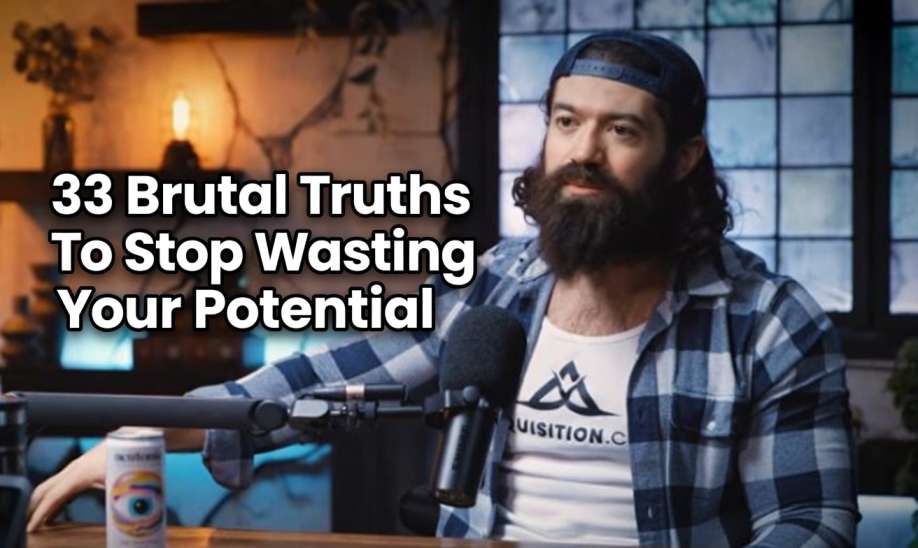
Read the full transcript of entrepreneur Alex Hormozi’s interview on Modern Wisdom, June 29, 2026.
Editor’s Note: In this episode of the Modern Wisdom podcast, host Chris Williamson is joined by entrepreneur Alex Hormozi for a deep dive into the “brutal truths” required to stop wasting one’s potential. The two engage in a candid discussion about the difference between elective physical challenges and the hard, often emotional, decisions that truly define one’s life trajectory. By examining the necessity of commitment, the nature of risk, and the importance of sacrificing mediocrity, Hormozi provides a framework for listeners to shift their identity and take decisive action toward their goals.
Do Hard Things — But the Right Kind
CHRIS WILLIAMSON: Welcome back, man. Another speedrunning podcasting booty call.
ALEX HORMOZI: That’s the hope.
CHRIS WILLIAMSON: “Do more hard things every day” is a great mantra, but it should be less about ice baths and more about making that decision you’ve been putting off for 3 months.
ALEX HORMOZI: Yeah, I think that there’s been a big misconception around hard stuff, which is just that running a marathon necessarily means that you can have a hard conversation with your wife by saying, “I do hard things,” but those hard things don’t necessarily generalize.
And so I think domain specificity is much more narrow unless you decide to generalize to an identity label of like, “I am the type of person who can do hard things because I ran this marathon or because I do these ice baths.” And then as a result, I can then generalize that label to other behaviors.
But if you can make that label and identify with it, then you don’t need to run the marathon in order to do the hard thing. You just need to label.
CHRIS WILLIAMSON: What are the hard things that people should be focusing on more? What are the step change function, hard thing capacity skills that people should focus on more?
ALEX HORMOZI: I think it’s being cognizant of what outside forces are influencing your behavior in a way that is aversive or against your goals. And so if you’re like, “I want to start a business, but I am afraid of what other people will say,” then it means that we are allowing those other people to control your behavior.
And I think when you say it in really plain terms like that, you’re like, “Wow, I didn’t know I was giving them that much power for my life. I’m not doing this because of them, which means they control me.” And to me, the hard thing is in some ways just not allowing that control to persist or to keep going.
Hard Things Physically vs. Hard Things Decisively
CHRIS WILLIAMSON: It is interesting how many people can do hard things physically but can’t do hard things decisively.
ALEX HORMOZI: I have our security team and whatnot. And this is a discussion I’ve had with probably each of them at different times. They’ve seen combat and death and all that kind of stuff. And what’s funny is that the amount of risk that they are willing to put their physical bodies in — literally their lives at stake — but then how that doesn’t necessarily translate to being able to have a vulnerable conversation with a wife, spouse, lover, etc. It’s just interesting. And this is again back to the point that these things don’t generalize. They look good, but they do not mean the same thing.
CHRIS WILLIAMSON: It’s weird that we publicly admire the obvious hard thing, even if that isn’t the one that actually makes the biggest difference to people’s life direction. It’s not predictive of being a good friend. It’s not predictive of being the best partner. It’s not predictive of being a successful business owner. But because it’s more obvious, because it’s more publicly laudable, you can flex it online and you can tell people, “I ran a marathon,” as opposed to, “When my partner asked me a difficult question, I didn’t shy away from it — I told them the truth.”
ALEX HORMOZI: And to be clear, I think that those things are laudable in and of themselves. Like, you go fight a war, you go run a marathon — I think all of those things are praiseworthy. It’s just the generalizable component of that hard being, “Oh, I can do all hard things,” is really the misconception.
But I do think that if for whatever reason you tell yourself a narrative that because you did this hard thing, you can do all hard things, then that’s amazing. And by all means, if someone’s like, “I started doing jiu-jitsu and it completely changed my life,” that’s awesome. But it probably isn’t because you learned how to do guard better. It’s probably because what learning to do guard meant for you changed these other series of behaviors down the line.
CHRIS WILLIAMSON: How correlative do you think it is — people that do hard things physically versus people who develop the capacity to do hard things that matter?
ALEX HORMOZI: Can you say that again?
CHRIS WILLIAMSON: Let’s say that doing hard things electively versus doing hard things decisively. The big difference between the two to me seems to be decisions that require emotion and decisions that require effort. That seems to be one of the big delineations here.
ALEX HORMOZI: So it’s like the hard conversation versus hard physical tasks.
CHRIS WILLIAMSON: Yeah. And how many people who develop the skill to do hard physical tasks as a transformation — how many of those do you think carry over into being able to do the hard thing emotionally?
ALEX HORMOZI: Probably the same in the opposite direction. The guys who can have “hard conversations,” the attorney who can get through all these complex ideas and have whatever — then sucks at jiu-jitsu or sucks in the weight room or doesn’t try hard.
Identity, Labels, and Generalizing Hard Skills
CHRIS WILLIAMSON: How do you generalize?
ALEX HORMOZI: I think it’s creating labels and identity with personality. And so if we define personality by the aggregate of how you behave in all conditions — all these conditions, how you act is your personality — the label we ascribe to that personality would then be the identity.
And so if we decide to change that label, then that label — this is getting a little technical — but basically becomes a global reinforcer for your behavior. Like, “I am honest.” And so we make this label, and then “honest” has a lot of sub-behaviors underneath of it that we then act on because we believe that being honest is good. And so we want to act in accordance with this global reinforcer for ourselves.
And so when we enter a new situation, we think, “Okay, what behavior is most aligned with this label?” And then we do that. And when we don’t act that way, we feel guilty because we broke our own rules of behavior.
CHRIS WILLIAMSON: So the big lesson here is: just because you’re doing hard things in one domain does not mean that it crosses over into all domains, unless you purposefully try to make your identity wrapped up around it.
ALEX HORMOZI: 1,000%. I remember when I went to college, I wanted to pledge a fraternity and it was in the SEC and they’re known for hazing and whatnot. And so I called my dad and I was like, “Hey, this might be bad. I might have to go through some stuff that’s hard.”
And my dad’s given me a lot of lasting gifts, but one of them — he said, “Think about every hard thing that you’ve gone through up until this point. There is nothing that they can do to you that is worse than that.”
And that actually was incredibly empowering. I remember when there were more hardships going on, I just immediately went to the worst things that I had gone through and I was like, “Oh my God, this is nothing.” And so I was able to go through this relatively hard thing where there were people who were cracking and crying — I want to say grown men, but I would say adult boys — next to me. And I was able to stand tall because it was just like, “There is nothing that these other 21-year-old guys can do to me that I have not suffered through.”
The Story You Will One Day Tell
CHRIS WILLIAMSON: It’s a good justification for doing hard things. Rogan’s got this line: “The worst thing that’s ever happened to you is the worst thing that’s ever happened to you.” And if the worst thing that’s ever happened to you is somebody misspelling your name on a Starbucks cup, that’s a big deal.
ALEX HORMOZI: Yeah.
CHRIS WILLIAMSON: But if the worst thing that’s ever happened to you is 1,000 times worse than that — I think one problem we have is recency bias. If you haven’t been through a tough time right now, your memory of being able to deal with hard things fades. You kind of get velvet prison syndrome. And sometimes you can forget — like, I’ve still got that capacity. Sometimes we forget.
ALEX HORMOZI: Yeah, I think one of the strongest frames that has gotten me through those harder times is: “This is the story I will one day tell.” And so almost the more bad things that happen, the more epic the story becomes.
And the main beneficiary of the stories that we tell is ourselves, because we’re the giver and the receiver of most of the stories — by percentage of stories told, we are the biggest receiver of the stories. And so I think that’s actually been such a powerful frame — like, of course this terrible thing will happen, and doesn’t that make the story so much better?
CHRIS WILLIAMSON: Yeah. What’s cool is — I think when you say we’re talking in narrative, story, personification, arc, hero’s journey, it all sounds kind of wishful in a way, mythological, irrational, symbolic. But that’s the way that humans’ brains work. We work in story.
And even if it’s not strictly the way that the neuroscience behind how the medial prefrontal lateral cortex works in order to make us a tougher person — if you are the kind of person that tells yourself the story that you are the kind of person that can get through this, that is functionally exactly what you’re chasing. What you are after is the story.
And by putting that on the front end and going, “Okay, I’m just going to keep on building stories that I’m going to refer back to in future,” I think you’re actually being more direct than if you were trying to take a more rational view of exactly how behavior is put together. The story is the rational view of how your behavior and your identity are put together.
Motivation, Reinforcement, and the Power of Narrative
ALEX HORMOZI: There’s a lot there. With the neuroscience and the brain labeling and all that stuff, I have no idea — that’s above my pay grade. But I just think about how all of our behavior in aggregate is just us doing what we’ve been rewarded for doing. And it doesn’t mean we get a cookie — it could also mean a bad thing goes away. There are a lot of different types of reward.
And so if we remember a story — let’s say you have that story of going through this hard thing and then surviving — it basically serves as a reminder of the reinforcer of the behaviors you did to get through it. It’s almost like with a kid who’s smaller: if you’re like, “Hey, remember last time you did this, you got ice cream?” If you remind them of that reward, then they’re more likely to repeat the behavior.
And so I think we basically use that narrative as a reminder to, in the short term, increase the relative value of a reinforcer. If you think about what motivation is in general, that’s functionally what you’re doing. If you motivate someone — if you sell someone something for the short term — you increase the relative value of a specific reinforcer.
You didn’t wake up wanting to buy cologne, but you see an ad and for the short period of time that the ad goes on, it increases the relative value of smelling good. And so as a result, it changes your behavior and then you buy. I think stories function that same way — we use them to motivate ourselves in the short term to do the desired behavior that might be less comfortable in the short term, but we’re reminded about the larger reinforcing event that we had in the past.
Performing Hard Things vs. Actually Doing Them
CHRIS WILLIAMSON: How many people do you think are doing hard things publicly in order to not need to face the lack of capacity they have to do hard things privately?
ALEX HORMOZI: I don’t know them, so I don’t know, to be honest with you. That’s my honest answer. I think some people really do hard things and what they capture online is a fraction of what they really do. And I think there are people who 100% of the hard things they do are online — and they’re not even that hard. They’ve got a squad of people behind them.
I always think there was a meme around this for a moment — it was like, “But you had a camera there.” It’s like the girl collapses because of crazy news or something like that. It’s like, “But you had a camera there.”
CHRIS WILLIAMSON: And so there’s just this element of mistrust, performative nature.
ALEX HORMOZI: Yeah, yeah.
The 3-Step Process of How to Win
CHRIS WILLIAMSON: The 3-step process of how to win. Number 1: realize no one is coming to save you. Number 2: take responsibility for your current position. Number 3: be willing to sacrifice who you are for who you want to be.
The Power of Commitment and Trade-Offs
ALEX HORMOZI: I think those 3 are really all about power. And the realization — so probably in sequence, the first one should come first, which is you own everything. It’s like, okay, if I own everything, then you could still hope that someone saves you, but it still relies on someone else to change your condition. And so it’s like, okay, I own all these outcomes. I’m not going to rely on someone else to change my condition, but you’re still there, which means you have to take the third step, which is that I have to sacrifice, I have to give up something in order to get something else.
And I think where people actually stay stuck the longest in their careers — from an entrepreneurship perspective or just from a personal development perspective — is the trades that we are unwilling to make. It’s basically the desire to have everything at the same time. And the easiest analogy I have is like, it is totally reasonable to want to have a mountain view and to be on the beach and be walking distance from a Whole Foods. But you probably will not find a place that has all three of those because they are all at apparent contradictions, at apparent odds.
So what happens is we just stay in this paralysis of indecision because we feel like all paths are settling. And I think there’s this movement or narrative around like “never settle” and things like that, but people mistake “never settle” for “never make trades.” And so we have this obsession with optionality or optionality maxing, but options are only valuable when taken.
When we never take the option — which means we don’t cash in the option that we have available — like, some options need to be taken, and when they are taken, other options disappear. Because just having maximum potential does not mean maximum reality, because you need to commit. You have to commit, which is the elimination of alternatives. Show me anything that was worth doing that did not require commitment, which is an elimination of alternatives, a trade-off.
In the beginning of our lives, when we’re younger, we are praised for maximizing our potential. How can we have as many colleges accept us? How can we have all the best grades? How can we have all the paths in front of us? But I think many people know people who were really successful earlier on by maximizing potential, but not realizing potential. And I think the gap between the maximization of potential and the realization of potential is the commitments that we’re willing to make — which is the trades, the elimination of the alternatives — when we have to start cashing those options in and realizing that some of them are never going to come to fruition because we can only have one life, and some of those trades are permanent.
You can only not have a kid until you have a kid. And then at that point you have a kid. There’s no going back. Some decisions in life don’t have refunds. And I think that is what I would say maybe in the earlier part of my career — especially with single guys, because I think a lot of that’s really prevalent in social media right now — is just options maxing. But even in the attempt to options max, you still close off other options. Like, you will not have the benefits of, let’s say, a committed marriage early on because you’ve kept your options open. And you will not have the benefits of a very large business if you try to pursue 5, or don’t pursue any because you want to not make commitments. And so I think that commitment is actually a really strong signal for maturation and growing up.
CHRIS WILLIAMSON: Lots of mistakes were made by standing still. People think that inaction isn’t a decision, but it totally is.
ALEX HORMOZI: Your conditions change through inaction still. Doors close. There are moments where you have opportunities where you have to act or they will go away.
CHRIS WILLIAMSON: Yeah.
ALEX HORMOZI: And so I think it’s like being able to seize those opportunities. And that means that you have to actively say no to something that you might want, or might want a lot. And I think being willing to make those trade-offs clearly and trade them for the things that you want more is how people can progress through life and get more of what they want.
CHRIS WILLIAMSON: The pain of having to accept trade-offs holds a lot of people back.
ALEX HORMOZI: 100%. And then they end up getting nothing. And I honestly think that is at the crux of why so many people are not realizing any potential at all — because they are unwilling to make any trade and then make the biggest trade of all.
Overcoming Decision Paralysis
CHRIS WILLIAMSON: How do you think about overcoming that decision paralysis? Lots of good options in front of you, spent a lot of time trying to maximize surface area of available options. And it’s insane to say, but it’s functionally true for humans that more options make you more miserable, not happier.
ALEX HORMOZI: Super true. And we probably know someone — I can think of people off the top of my head — that didn’t have many options, but the option that they had was very clear. Like, this guy’s a super nerd and just loves coding, and it was very clear, straight on. There were a lot of things that weren’t available to him physically — probably wasn’t going to be the sports star, maybe not even in super great shape. But it was almost like that path was predetermined.
When you fast forward, it’s not like they’re less successful. It’s that because they just already knew what they were going to do, they got to start pulling the future forward down the one path and start walking. I don’t understand this fetishization of having options and seeing that as a proxy for status, when the reality is that they’re all blank checks. You haven’t cashed any of them in.
And so I think the original question ladders to this: people get stuck because they don’t know what they want. And I define what you want by what you’re willing to sacrifice to get something.
Taking Responsibility for Your Position
CHRIS WILLIAMSON: Take responsibility for your current position. What does that mean?
ALEX HORMOZI: It’s identifying yourself as source. And to be clear, it doesn’t mean that your position in reality is 100% because of you. But this is an invalid but useful — more useful — way of going through life: it absolutely might not be your fault, but it is still your problem. Since you are the only one who you can influence directly, then you are the one who is source.
You could still be correct in saying that — because I insert grievance, insert trauma, insert genetic predisposition, insert zip code I was born in, or language or poverty level or whatever it is — all of those things could be true. And yet you still have to take action as the only source that can change it.
CHRIS WILLIAMSON: No one’s coming to save you.
ALEX HORMOZI: Yeah. Which goes back to the first one.
CHRIS WILLIAMSON: The interesting thing about “no one is coming to save you” — it also means no one is coming to stop you.
ALEX HORMOZI: I think some people might. I think actually, as soon as you start, the lobster or crab analogy in the bucket is so true. For me, the hardest part of entrepreneurship was the first set of friends that you have to relinquish. Because once you do it the first time, you realize that you will still survive, you’ll still make it through, you’ll find new friends. But the first time, it’s sacrificing everything you’ve known and loved for something that you’ve never experienced and hope will happen and have no idea if it actually will. So the cost is known, the payoff isn’t. And that is why I think it is the riskiest and why so many people struggle to make the jump.
The Role of Courage
CHRIS WILLIAMSON: The world will reward you in proportion to your courage, not your intellect. The most dangerous person in the world is the one who continues to show up every day, even when the rewards are not guaranteed. Your potential is determined by the amount of uncertainty you’re able to tolerate — and how long you can tolerate it for. You can beat 99% of people if you can master the shame of rejection, the burden of repetition, and the pain of feedback.
ALEX HORMOZI: I was asked, if you could transfer only one trait to your son, what would it be? And I really thought a lot about it. Of all the traits, what would I transfer? And I think it’s courage. Because if you don’t have courage, nothing else matters. You can’t take any action. You can’t do anything worth doing. You can’t stand for anything because you have no courage.
And so I think that’s why it’s so much more preferable to be a failure than a coward. I would hope that I could transfer just that lesson and reinforce it as many times as I can in his upbringing — that you have to take jumps, and you have to lose, and you have to be willing to lose, and then realize that losing doesn’t actually make you a loser. Because losing is the first signal on the path to winning. But not playing is the actual signal for a forever loss.
CHRIS WILLIAMSON: What is courage to you?
ALEX HORMOZI: It’s a really good question. I needed to define it better. Being willing to take action where there’s a large short-term cost with an uncertain delayed benefit. So if you want to start a business and you think that you’re going to get made fun of, or get snide remarks — like, “Oh yeah, you’re doing your podcast thing again,” “Oh yeah, don’t miss out,” “Don’t miss Friday night, it’s a big podcast” — you’re going to suffer that short term. That’s a known cost. And then the payoff is delayed and uncertain. Not only will it come later, but if it were guaranteed — if you knew you were going to make $1 million doing a podcast — then you’d be like, whatever, f* it. It takes significantly less courage.
But I think it’s the fact that it is unknown and delayed. So you basically have to be willing to get kicked in the nuts multiple times, and sometimes for extended durations, before the hope that you will get something. But I think the only way to get through that kind of kicked-in-the-nuts period — for however long it’s going to be — is realizing that you have two paths. One that is guaranteed, which is that the path you’re currently on will not get you where you want to go. And the other path is not guaranteed to get you where you want to go, but it’s the only one where you have a shot.
CHRIS WILLIAMSON: And that’s where your potential is determined by the amount of uncertainty you’re able to tolerate, and how long you can tolerate it for.
ALEX HORMOZI: And I think that also goes to the bigger the games we play. The longer the game you play, the bigger the game you play. And so if you want to create rockets that go to the moon, you have to be able to deal with uncertainty for just an absolutely absurd amount of time compared to most humans on any endeavor.
CHRIS WILLIAMSON: There’s a line at the end — “pain of feedback.” I’m interested in that.
The Pain of Loss and Learning from Failure
ALEX HORMOZI: Rejection hurts. Failing hurts. And I think when you give it your all and then the market, society, the universe, whatever, determines that you are still not enough, that is very painful.
I think that in time you learn that feedback is fuel rather than failure. And once that new association gets paired, I mean, you’ve had plenty of incredibly successful people on this podcast, and I would say many of them have the same kind of — I would call it lesson — is like, it’s not failure, it’s feedback. But it just means that fundamentally they have a different pairing for losing.
And so everyone has to go through this because losing is good and feeling bad about losing is good because it forces you to change. And that change means that over time, as long as you’re changing in the correct direction, you get better.
CHRIS WILLIAMSON: Or else you would continue to do the strategy that caused you to lose last time and you would just run it back again.
ALEX HORMOZI: And this is why I have this — I thought on the way over here, I was thinking about this — I think one of the big losses or failures of society right now is that we are trying to castrate the teeth from the pain of loss. We’re trying to not allow kids, people, the feeling to feel bad. It’s like we have determined that feeling bad is bad, but feeling bad is not bad. Feeling bad is a signal so that we need to change. Because if no one feels bad ever, then it means that everyone is doing what they want to do all the time. And that is not how a functioning society works. Sometimes people do stupid s* and need to know and feel bad for it.
CHRIS WILLIAMSON: Eventually reality is going to come into contact with your decisions.
ALEX HORMOZI: Yes.
CHRIS WILLIAMSON: And the more that that’s put off, the less likely you are to come up with a way to avoid that reality coming into reality.
ALEX HORMOZI: And so the way that — and this is probably the more frightening part about some of the media that’s out there — is trying to just redefine reality and create a fantasy where you losing and you feeling bad isn’t true. But it doesn’t change reality. It just changes someone’s perception of it for the short term and then they have to pay reality back with interest and time. And the check always comes due. It’s just that the interest is much bigger.
And so, in light of my son, my child that I have in the future, I want him to experience the pain of loss so that he can learn. Because how else can you learn? You have to. Otherwise it’s just everything going by feeling. And then also somehow thinking that feeling bad is bad. And also that feeling good is good. And there’s tons of things that you can probably do that feel good that are not good. And there’s tons of things that you can do that feel bad that are not bad.
CHRIS WILLIAMSON: Well, what a gift to give somebody to say, “You can feel bad and not feel bad about it.”
ALEX HORMOZI: Yeah. And that’s okay. Like, you lost. What will we learn? What will we do next time?
CHRIS WILLIAMSON: Great.
ALEX HORMOZI: Do it again.
CHRIS WILLIAMSON: That feels like resilience.
ALEX HORMOZI: Yeah.
CHRIS WILLIAMSON: As opposed to any time that you feel this emotion, which is negative, that is worthy of rushing in and panic and control and distance. That’s almost like a formula for fragility.
When to Push and When to Pivot
ALEX HORMOZI: Laddered onto this — and I know we haven’t talked in a while, so this is fun — is the idea that because you feel bad, it means that the path that you’re on, you need to change something. And so it’s equal opposite, which is like, okay, if we know that we’re on the path of getting kicked in the nuts right now, and I know I’m on my 17th or 100th podcast and I’m still not a millionaire yet, I have not achieved what I want yet. It does not mean that I have to change course.
CHRIS WILLIAMSON: But earlier on, you said that bad feelings, feeling bad, are important to update the way that you’re approaching this situation. So how do you distinguish between the two?
ALEX HORMOZI: And that’s the crux of it, which is judgment. And this is one of the hardest ones — how do you help someone recognize patterns of when you need to — basically it’s the eternal question of when do I push and when do I pivot, right? When do I push through the hardship versus when do I adjust?
CHRIS WILLIAMSON: Am I giving up on this set in the gym because I’m being a p or am I giving up because I’m about to injure myself?
ALEX HORMOZI: Yeah. And I’ve worked through this a lot because it’s a pretty classic entrepreneurship issue of like, do I have product market fit or do I need to just keep pushing? Where am I just trying to push up a hill?
If one of the fundamental assumptions that you began your quest with has been proven untrue based on the feedback, then that is where pivoting makes sense. So if you said, “I think that I’m going to create a doggy skateboard because I think that a lot of dog owners will want to buy skateboards for their dog,” and I believe that the percentage — and I want to make a $1 billion doing this — that would mean that there’s this size of the market, this percentage needs to be the take rate in order for me to get that market share.
It’s like, okay, if I talk to 100 dog owners and none of them want to buy my doggy skateboard, I would not say that is a push situation. I would say that is a pivot situation because our fundamental assumption that we started this quest with is false. And so we need to take that feedback and then pivot.
If, as we’re going through, they’re saying, “Maybe, but I don’t know what you have in your hands. What the hell is that?” — so the assumption is not proven, but it’s more of an execution issue. And so it’s like, okay, I just need to get better. I need to push through.
But it is definitely one of the harder lines to know — when should I push? When should I pivot? What lesson do I learn from losing? Because losing teaches you s*. And we just need to make sure that we learn the right thing. Teaching will occur.
CHRIS WILLIAMSON: Yes. Whether you take it away or not is up to you.
ALEX HORMOZI: I hired my first employee and he was a f* ass. Therefore, all employees suck. So losing will teach you something. It’s just, we want to make sure that we learn the right lesson.
CHRIS WILLIAMSON: I feel like this is a justification for making early decisions as right as possible to try and avoid that PTSD. It’s far easier to learn something than it is to unlearn something. Probably 100 times easier to learn something than it is to unlearn something.
If you’ve drilled a particular habit, a particular bad habit, if you have come up with a mode of interacting with your employees or the world, because all of your employees — the first 3 employees you get, all of them f*ed you over — and then finally you get to the 4th, you have to unlearn all of the compensatory mechanisms that you built on the first 3. Now that you’ve got someone who’s worthy of that and you’re restricting their progress, you’re slowing everything down, you’re being hypervigilant, it doesn’t feel like a good place to work. Try and make your early decisions right.
ALEX HORMOZI: Yeah. Changing a behavior with a long history of reinforcement is harder than changing one with no history of reinforcement.
CHRIS WILLIAMSON: Such a hardcore behaviorist.
Description vs. Explanation: Understanding Why
ALEX HORMOZI: Yeah. Well, I mean, it’s the only thing that’s made sense to me in the world. It’s Skinner-pilled. It’s just my reality.
So I’ll say it differently — many people do not get what they want. They look up at their lives and they’re like, “This is not what I want.” And so if you don’t have what you want, it means that the model that you view the world through is incorrect, or you have the correct model and the incorrect variables or insufficient variables. It’s basically all it is.
And so for me, the more I have looked purely at inputs and outputs, the more I’ve gotten my predictions correct. And so I have been super reinforced for using this style of thinking. And so I do it more. And I read some of my old stuff and I’m like, “Oh man, I could have said this in half as many words,” because it’s understanding why at the most basic level.
I’ll give an example. And I think this is why the vast majority of the world walks around confused — “I don’t have what I want. That didn’t go the way I expected. She took that worse than I thought.” So you’re constantly surprised by reality.
In a simple sentence like, “Johnny stole because he’s dishonest,” most people would nod their heads and be like, “Yeah, Johnny stole because he’s dishonest.” But if we ask, what does dishonest mean? Dishonest means it’s a label that we ascribe to somebody who does a series of different behaviors, one of which is stealing. And so if we were to restate that sentence with the broken down definition, it would then be, “Johnny stole because he’s the type of person who steals,” which is circular and makes no sense.
Because the real reason that Johnny stole is because he’s been reinforced for stealing in the past, or he saw someone who got reinforced for stealing and then modeled their behavior. That is why Johnny stole. And so because of that basic misunderstanding, most people have these words that they use to explain the reality that they don’t actually understand. And as a result, reality fools them more often than it should.
CHRIS WILLIAMSON: He was rewarded for it, or he was punished for doing the opposite of it.
ALEX HORMOZI: Exactly. And that basic — what I just explained is the difference between description and explanation, which is relatively heady and I think difficult sometimes to grasp, but is at the most basic level my worldview.
CHRIS WILLIAMSON: This is what happened. This is why it happened.
Defining Reality Through Behavior
ALEX HORMOZI: From that one kind of basic understanding, everything else can pretty much get laddered up. Said differently, if I wanted to tell a child to get good at basketball, I would not tell him to get better at basketball, because a 5-year-old would be like, “I don’t know how to do that. What does that mean?”
So I would be like, “Okay, well, let’s break it down. We’ve got dribbling, passing, shooting.” But they still probably don’t know how to get better at dribbling, passing, and shooting until eventually I say, “Okay, passing. I want you to take a step with your left foot towards the person, and I want you to extend your elbows and finish with your thumbs down. And if the ball goes towards them in the direction that they’re running and they catch it, you’ve passed successfully.”
And then I would repeat that chain of events until eventually they would understand that that chain of behaviors equals passing. And if they do it a lot and they hit the target many times, they would be good at passing. We’d repeat that all the way down until they’re good at passing, dribbling, shooting, etc. And then eventually we describe them as a good basketball player.
But that basic unbundling and rebundling of terms is why I think the vast majority of people are wildly confused by what’s going on around them. Someone says, “Why don’t you love me?” And he’s like, “What are you talking about? I pay the bills, I take out the trash. What do you want from me?” And she says, “You don’t tell me I’m pretty. You don’t hug me. You don’t listen to me. You don’t ever ask me how my day’s going.” It’s because for her, she defines love in these behaviors, and he defines love in these behaviors. And so then they fight forever rather than just saying, “What does that mean? What does that mean?”
We had two employees that were arguing about something at Acquisition, and one was like, “I would be fine if you were just kind and polite to me.” And I was like, “Okay, what does that mean?” There was obviously a moment of hesitation, because it’s like, you want the other person to guess what you think in your mind means good behavior, but you’ve never articulated it. So you want them to guess and somehow get it right. And finally it just came down to, “Can you ask more questions rather than making more statements?” And the other person’s like, “Yeah, sure.” Great. They’re fine now and everything’s great.
This is why I view the world in behavior, because I have wanted things but didn’t know how to get them, which happens in reality. And so as long as I live in reality, I prefer to define things through reality. And then reality tends to behave far more as I predicted it would.
Unspoken Expectations and the Map of Reality
CHRIS WILLIAMSON: On the “I want you to do this, but I didn’t tell you” — it’s that Neil Strauss line: “Unspoken expectations are premeditated resentment.”
ALEX HORMOZI: Yeah, right.
CHRIS WILLIAMSON: Why would you do this thing that I didn’t tell you to do?
ALEX HORMOZI: Probably not deliberately, because I think a lot of people do it not on purpose.
CHRIS WILLIAMSON: Of course, but it’s an unconscious premeditated resentment. The investment that you are making will be a resentment in future that you aren’t aware is about to come about.
Another thing on people’s map of reality being inaccurate — I think one of the most obvious realizations that you can have when you hear somebody who complains a lot is that their framework of reality is incorrect.
ALEX HORMOZI: Oh, by a mile.
CHRIS WILLIAMSON: A complaint is you saying, “Why is reality not delivering that to me, which I anticipated?” And reality doesn’t care. Reality is just going to continue to deliver to you that which it is giving. “Why is there all of this traffic on the way to work? There shouldn’t be all of this traffic. I didn’t anticipate all of this traffic. I assumed there wouldn’t be traffic.” Reality disagreed with you. Reality is not wrong.
ALEX HORMOZI: It’s undefeated.
CHRIS WILLIAMSON: Reality is undefeated.
ALEX HORMOZI: Yeah.
CHRIS WILLIAMSON: It’s a million and 0. A million TKOs.
Malicious Benefit and Well-Intentioned Harm
ALEX HORMOZI: This is really interesting — how often this misconception of reality causes people to get fooled, keeps the wrong people in their lives, and sometimes keeps the right people out of their lives.
I call this malicious benefit or well-intentioned harm. On one hand, if there are a number of people who make negative videos about you, they intend to harm you. But when you look at your media and the way that you are compensated through the impressions that you earn and the amount of relevance that you have, you make more money. Though they intended to hurt you, they have taken their time and effort — which you normally have to pay people for — and for free promoted you. What a gift. It just means that they are incompetent at doing harm. Which is wonderful. You want all your enemies to be incompetent in their harm-doing.
On the other hand, you have somebody who — I’ll use this in quotes — “loves” you, means you well, but is also incompetent. And as a result, whenever they enter your life, your life gets worse. They cause negative consequences to occur.
A lot of people care a huge amount about intention. This was one of the larger shifts that happened in my life — completely stripping people of their intentions and only looking at their outputs. That made navigating relationships significantly easier for me, because it allowed me to remove the noise from the signal of the person.
Honestly, the very beginning of this kind of thought change was with Layla. I had an advisor at the time, and I was like, “I’m not sure if I want to marry this girl. Help me make this decision.” And he said, “Well, just look at your stats. Are you in better shape?” And I was like, “Well, yeah, she eats healthy and she goes to the gym, so I go with her.” And he’s like, “Okay, so you’re exercising more, you’re eating better. Are you drinking as much?” I was like, “No, she just really doesn’t drink, and I like drinking. I’m probably a bad influencer.” He’s like, “Okay, so she decreases this kind of negative thing.” And he’s like, “What about business-wise?” I was like, “I’m making more than I’ve ever made, and she’s helping me do that.”
He just went down the list of all these different components of my life that I could measure. And he’s like, “It seems like your life is significantly better with this person in it.”
When I contrast that to some of the relationships I had in the past, it was almost the opposite. I would get into the relationship and all of a sudden I wouldn’t work out as much, I wouldn’t eat as healthy, I would go out more, and my business would suffer. All the things that I cared about would go down. Even though I don’t think that person had any malicious intent — I think they had good intent — they had well-intentioned harm.
That lens has helped me make so many decisions in a way that removes a lot of the emotional weight behind them. It’s like, “I absolutely believe that you are a well-intentioned person. I just think you’re very incompetent at doing good for me. You do not have the skill to help me.”
CHRIS WILLIAMSON: I’m not prepared to be the collateral damage of your good-intentioned errors.
ALEX HORMOZI: Yes.
CHRIS WILLIAMSON: As you spin around trying to give me a hug, but by accident punch me in the face.
ALEX HORMOZI: Yes.
CHRIS WILLIAMSON: You’re driving down the street, and because you weren’t paying attention, you ran somebody over. Functionally, the difference between that person being dead because you didn’t mean to — because you were texting on your phone or because you’re a bad driver — and you swerving off the street to hit them, the outcome is the same.
ALEX HORMOZI: And this is something that our society actively disagrees with. Because if we look at how our laws are written, we try to tease out intention and we change punishment and consequences based on intention.
CHRIS WILLIAMSON: Is that not important to a degree?
ALEX HORMOZI: It can be, but I’m saying in terms of how you navigate getting what you want out of life — if you were the one who got hit, you’re dead either way. And so when any n equals 1, I would look at the signal, what happens, rather than the intention, 100 times out of 100.
Transactional Relationships and the Exchange Dynamic
CHRIS WILLIAMSON: Is there any space — it sounds like, for as long as this person in my life benefits me, it’s good to keep them in, and the moment that they stop benefiting me, then I get rid of them. To some people that would come across as a very transactional view of relationships.
ALEX HORMOZI: I think it assumes a binary of benefit, not benefit. And most people have many things that they do. Let’s say you’re married to somebody. What happens when that person stops serving you? Well, it’s very unlikely that tomorrow someone goes from “I help you in these 100 ways” to “I either hurt you or help you in zero.” It’s more likely that you had 100 ways and now 10 years later they help you 70 ways, and maybe 10 years later they help you 40 ways.
But if you’re at least cognizant of the 100 ways that that person helps you, then it allows you to articulate, “Hey, when you do these things, it helps me a lot. It would really mean a lot to me.”
CHRIS WILLIAMSON: Reinforcement again.
ALEX HORMOZI: Yeah. But in different terms — it’s just good communication, right? How do I know what you want until you tell me?
People say what you just said — “People would see this as transactional.” And then I would say, “And? Yes, and? Why is this wrong? Why have you decided that having an exchange is incorrect? It’s how society works. All of capitalism — which built the best societies — has been built on exchange, voluntary exchange.”
CHRIS WILLIAMSON: I think some people would feel icky about applying that exchange capitalism dynamic inside of friendships and intimate relationships.
ALEX HORMOZI: I think that exchange happens either way. They just don’t want to say it. If you have a friend and you’re like, “We’re ride or die,” it means you have a long history of reinforcement, which means you have a long extinction curve. You’ve been reinforced many times for this friendship, which means you were willing to deal with blips. But the amount of blips that you’re willing to deal with is proportional to the history of reinforcement.
If someone new comes into your life and has done almost nothing good and then does a blip, you don’t have as much ballast in the system. You have no reason to. The extinction curve is functionally just how long you’re willing to hope that the good thing comes back.
The Cost of Easy Wins
CHRIS WILLIAMSON: You probably should have a degree of recency bias though.
ALEX HORMOZI: Oh yeah, because if the person’s behavior has changed, yeah, for sure. Yeah, it’s going to be, it’s always discounted.
CHRIS WILLIAMSON: Someone that was 50% a good guy and 50% an asshole, the 50% that is closest to you is more salient than the 50% that started 10 years ago.
ALEX HORMOZI: Oh yeah, if it was front half, back half, 100%. And honestly, I think this is super relevant for a lot of people — people do change. And that’s okay. And you can be friends with the person they once were and no longer friends with the person they are. And that’s okay.
CHRIS WILLIAMSON: Mark Manson dropped this unreal line that reminded me of you.
ALEX HORMOZI: Okay.
CHRIS WILLIAMSON: “Do hard shit, not because it’s fun, but because the win actually means something. You bled for it. You broke for it. You earned it. Easy wins are forgettable. Hard ones change you. That’s the point.” And it’s your line. Everything is hard and no one cares.
ALEX HORMOZI: I’m sorry, accomplishing your dreams wasn’t fast, easy, and risk-free. They wouldn’t be dreams if they were, and you wouldn’t call them wins if they were easy, because they would just be you tying your shoes. And what was once a win when you were 5 is no longer a win when you’re competent. And with increased competence comes increased stakes. You have to be willing to bet more, put more on the line to win bigger, which means if you’re a billionaire, playing $10 hands of poker is a complete waste of time.
CHRIS WILLIAMSON: Gabe from I Prevail, he’s the drummer from I Prevail. “You will always think you suck. That’s okay. It’s okay to suck compared to your standards. As you grow, so will your standards. That doesn’t mean you actually suck.”
ALEX HORMOZI: Yeah, there could just be the actuality of sucking versus the perception of sucking.
CHRIS WILLIAMSON: Correct. It’s that as you increase in capacity, you increase in standards.
ALEX HORMOZI: Yeah.
CHRIS WILLIAMSON: And given that your standards will always outstrip your capacity, there will always be this felt sense lack between where I am and where I want to be.
But yeah, that Mark Manson line I think is really important in sort of an era of AI because you can speedrun or shortcut getting the outcome without putting in the requisite inputs. Now, because everybody’s obsessed with leverage and trying to get as many outputs from as few inputs as possible, that does make sense. But when you begin to fully detach it from it and you don’t focus on the journey that got you there in the same way, and you’re not scrutinizing the outputs with the same level of finitude and resolution—
ALEX HORMOZI: It was lower cost.
CHRIS WILLIAMSON: Yes.
ALEX HORMOZI: Yes.
CHRIS WILLIAMSON: And it’s not just the outputs that matter. It’s not just the output. And this is where the sort of leverage crowd doesn’t fully come into reality. It doesn’t come into contact with the way that humans are telling themselves the story of their life.
The Meaning Behind the Process
CHRIS WILLIAMSON: If you could come up with some sort of super quick code that would write $100 million leads for you, the entire project would feel different. Your process of getting that — it could be word for word the exact same. Take every word that I’ve written and create this book based on this brief. Dink.
ALEX HORMOZI: It would prove that AI knew a lot about leads, but not me. And I think this sits at the discrepancy between saying the output of your life is who you become and the aggregate set of behavior that you’ve learned over your life, or if the output of your life is the stuff that exists as a result of you being here. And that is more of a philosophical question than I think it is a right or wrong.
I think you can make arguments for either side — the person, the purpose of your life is what changed as a result of you being here, what you did or who you became. Or the purpose of your life is all of the outside only existed to change the inside. And I think there are arguments for both.
I would say I have strong affinity towards both definitions because when I go through harder times, I lean more towards like, this is happening for me. And when I’m going through easier times, it’s like, I am happening to it. I’m happening to reality.
CHRIS WILLIAMSON: But the binary of that — seeing it as only one or the other — will create a kind of fragility. If all that you’re focused on is outcomes, then you’re never going to think about becoming the person who can generate those outcomes because you’re going to find shortcuts that don’t necessarily work. And if you’re only ever focused on inputs, you’re never going to actually work out if all of this suffering amounted to anything.
George, in the house last night, was reading one of these books and he wasn’t happy with the way that the author had put together the sentence. And he says, “Show me something I can drop on my foot.” That was his line. Like, I can’t drop anything on my f*ing foot with this. Show me something I can drop on my foot. Wishy-washy, vague language.
Do you remember the park bench scene in Good Will Hunting?
ALEX HORMOZI: No, I’ve seen it long enough ago. Yeah.
CHRIS WILLIAMSON: It’s on a park bench. Robin Williams talking to Matt Damon about love. And he has this line. He says, “Love is an active commitment, Will. It’s a choice to value someone else’s well-being as much as your own.”
If you watch the film, you’ll know that he doesn’t say that. He says this instead: “You wouldn’t know about sleeping sitting up in the hospital room for 2 months because the doctors could see in your eyes that the term ‘visiting hours’ do not apply to you.”
It’s the same thing. Same idea. Right? Idea, picture, words. And that is the order. Not idea, words, pictures. Show me something I can drop on my f*ing foot. That I can drop on my foot.
ALEX HORMOZI: It’s clear language. Both of them. Both of the examples. I think it’s interesting because with the drop on your foot, the picture is obviously more emotive, and because of that can be more motivating, more persuasive, et cetera.
Where I have struggled as a human being is taking that idea and saying, I want to do that. I want that type of love. And then saying, well, the person I love is not in the hospital and I don’t have the opportunity right now to sleep standing up and have a doctor know that visiting hours don’t apply to me. What do I do? And so then it does go back to what I’m willing to give up in order to maintain something.
CHRIS WILLIAMSON: But it’s interesting when there isn’t that level of pressure. When you brush up against the grain of life, when you’re swimming into the stream, it’s very easy to see effort because the whole world is bearing down and you said there’s an enemy to go up against. I think when things are easy, it’s like, okay, well, what does love look like when things are easy?
What Love Actually Looks Like
ALEX HORMOZI: We talking relational love? Yeah. I think, well, I’ll just say more how I measure it. I think it’s just what you’re willing to give up in order to maintain something. And so if I have a relationship and I have somebody that I love a lot, I’m willing to give up everything, including my life, in order to maintain that relationship — or for that person, or for that idea, for freedom, for the country.
If you love something a lot, you’re willing to give up everything for it. And so when that person asks you to do something, or doesn’t ask you to do something and you think that they would still like it, then you are willing to inconvenience yourself to a large degree in order to do that.
And I think the reason this stuff is so valuable for me is that it allows me to both give the things that I think the other person wants or that they’ve told me they want, but also how to differentiate who is using words in order to try and manipulate me.
When someone says, “Dude, you know I love you” — if it was bromance, obviously — you could say, what have you given up in order to maintain this? In what way have you inconvenienced yourself in order to maintain this relationship? Because all of the actions you’ve taken, you’ve taken out of convenience, and this relationship has been only beneficial for you, which is fine. There’s nothing wrong with that, but there will come a time where our needs are at odds. And in that situation, I would like to know how reinforcing was all the other stuff so that it is worth — basically it’s saying, how much good was the good for you so that you’re willing to deal with some bad?
CHRIS WILLIAMSON: Can that lead to a situation where you almost purposefully try to seek out difficulty in an attempt to stress test relationships?
ALEX HORMOZI: Because I wouldn’t—
CHRIS WILLIAMSON: Not all relationships should have it. The glorious friendship would be seamless between you and another guy, and there’s never anything you have to navigate, and it’s all just beneficial and positive in both directions.
ALEX HORMOZI: I have a friend like that. I’ve been friends since 6th grade. And I don’t think we’ve ever had conflict, which is great and rare. And that’s why we are such good friends.
But no, I think it’s okay for conflict to occur. It’s okay for seasons of friendship to end. But you can measure how good of friends you are by how much inconvenience they might be willing to deal with. We just haven’t had any need for conflict or competition. He’s an FBI agent. And so his measures of success — he has zero jealousy, there’s no envy, there’s no anything. It’s just like, how many bad guys you catch today? He’s like, “Bro, you gotta hear this one.” And so we can just — and then he’ll just ask ridiculous questions about money stuff because he just thinks it’s funny.
CHRIS WILLIAMSON: Yeah, yeah.
ALEX HORMOZI: So that has worked out well.
Comparing Yourself to Others
CHRIS WILLIAMSON: You’re behind because you’re in a rush and you’re in a rush because you feel behind and you feel behind because you’re in a different season than the people you’re comparing yourself to. You’re not behind. You’re just early.
ALEX HORMOZI: Yeah, it’s measuring the output difference without comparing the input difference. I think that’s basically it. It’s like, why isn’t my podcast like Rogan’s? Well, he’s got 10 more years and however many more podcasts. So if I were to match that and have done it back in time, would I be bigger?
CHRIS WILLIAMSON: Same skill?
ALEX HORMOZI: Yeah.
CHRIS WILLIAMSON: The same, all of that.
Comparison, Modeling, and the Power of Documentation
ALEX HORMOZI: And so it’s comparing outputs without comparing inputs. And I really just think it comes down to that at the most basic level. Now, most of the time, you are early because most people who make that — I would call it an error in judgment — are earlier in their careers.
And I also don’t think there’s anything necessarily wrong with it. A lot of people are like, “Comparison is the thief of joy.” I don’t agree with that. I think comparison is how you measure things. This is the discrepancy. Labeling the discrepancy as bad is the thief of joy. Comparison in general is how you can know what the discrepancy looks like between what you want and what you have so that you can fix it.
So we should compare. Absolutely. You should compare yourself to Rogan. I’m just using you, but I should compare myself to Elon. Of course I should. So I could look at the massive discrepancy between me and Elon. And that just gives me clarity on what things I need to do to try and decrease that.
CHRIS WILLIAMSON: How do you think about getting rid of the label of bad?
ALEX HORMOZI: I think the first action you take when you have not been reinforced for an action, you do through modeling. And this is why we do these types of podcasts, I assume. If you haven’t done the hard thing, or the hard thing that you want to do, or taking the bet or taking the risk, we look for other people who have been the penguins who jumped off the edge first. And was there a polar bear at the bottom to eat them? Or did they swim and get to the next iceberg and then they found whatever?
So we look at other people. And modeling is a very real way — it’s how you learn everything when you’re a child. You look at what other people do, good things happen to them, and you think, okay, I’m going to do that. So in the short term, we model. The long-term play is that once you take that first step, ideally you don’t get eaten by a polar bear and instead you also get a fish, and then you go up and get reinforced for that. And then basically every moment after that, your own experience becomes the loop.
But the first jump comes from looking at what everyone else does and then taking the jump. Now, where that’s so difficult is that you’re looking at what everyone else is doing — or at least the people that you want to emulate, which is really important. Don’t listen to people closest to you, listen to people closest to your goals, which is not necessarily the same people, and often not. I want to listen to them, I want to look at them, I want to model their behavior, but then also still ignore all the other people. So it’s like I’m listening to these people, I’m ignoring these people, but behavior is tough because you’re still valuing other people a lot.
CHRIS WILLIAMSON: Yeah.
ALEX HORMOZI: And so I think this is why so many — I would say again, I come from the entrepreneur side — but successful entrepreneurs have a very first principles approach of thinking. Because at some point no one has gone to the moon and you just have to say, does physics prevent me from doing this? And then when you reason everything from the ground up, you’re able to find discrepancies between what people believe and what’s true. And that’s obviously where opportunity exists.
CHRIS WILLIAMSON: You David Deutsch-pilled with that. “Does physics prevent me from being able to achieve this? If not, then I just need to—”
ALEX HORMOZI: It’s possible.
CHRIS WILLIAMSON: Yeah, it is possible. I think one of the reasons that these episodes resonate is that a lot of people who want to do things aren’t around people who know how to do them. And the harder the thing is that you’re trying to achieve, the rarer it is to find people who are able to support you in the doing of it — or not even just support you, but give you legitimate advice about how to get there.
ALEX HORMOZI: I 100% agree. And this is something that I’ve struggled a lot with because what gives you the credibility to gain media and attention is being exceptional in some domain most of the time. And being exceptional in a domain makes you unrelatable.
CHRIS WILLIAMSON: And so it’s kind of this very difficult catch-22 where credibility and relatability are inverse, right?
ALEX HORMOZI: But to your point, poor people are surrounded by other poor people and then assume that that is everyone — because it’s everyone they know, not everyone that exists, but it’s their everyone as far as they’re concerned. And I think that’s what makes it so difficult in the beginning to get out of that first bubble, because you have to look outside. And look at some people who might even appear unrelatable and try and grasp at the straws of their character, their origin story.
People could hear me say that I slept on the floor, that I didn’t have enough money, whatever. But they only see me now, not then. No one’s interviewing the gym owner who’s sleeping on the floor, who’s going to someday become something, because they don’t know yet.
CHRIS WILLIAMSON: That’s your one regret. One of the regrets that I have that’s the same as yours, which is I didn’t track the early journey enough.
Document Everything — Especially the Lows
ALEX HORMOZI: If anyone is listening to this — I’m not a big advocate of regrets in general — but a behavior that I would’ve changed, that I don’t think would’ve changed the outcome, is: document. And you don’t have to share it publicly. Just take pictures, take voice notes, email yourself, whatever catalog you want.
I remember one of the most important personal moments that I had was when I lost everything for the first time. I screenshotted my bank account. I went from having 6 successful gyms to losing all of it and having $1,000 to my name. And I remember looking at my bank account and I was like, “Wow, that’s what the bottom of the barrel looks like.” I hadn’t seen a number that low in a very, very long time. Even in high school, I had more than that just because I had jobs and I didn’t have expenses.
And so I screenshotted it, and it was this very cathartic moment for me because I was like, “Never again. I will not let this happen. And I will have this be part of the story I tell.” And I still have that screenshot.
CHRIS WILLIAMSON: I’ve seen it.
ALEX HORMOZI: And I show it because you want to document it because you believe that you will be the hero that will overcome. Kanye had some of those early videos — he believed that he would make it and he believed he would use it. And so I think one of the greatest things you can do is begin the documentation story. It was almost like at that point, I believed when I took that screenshot that I was going to win. And I did believe I was going to get it back.
The earlier you can have that realization — that you have to document this journey, otherwise you won’t be able to tell the story — the better. And the biggest beneficiary of that story is you.
CHRIS WILLIAMSON: I wish I’d done the same. All the way back in my previous life, there was a period in my placement year — I would’ve been 20. I was living in Scotland, and one of the problems that you have with running businesses in events, especially long single outcome events, is that it’s all costs until you finally get to cash in the revenue.
There was a dwindling pot of money that we had because we were putting all of this time in — driving from Edinburgh to Glasgow to Stirling to Dundee and back to hand out flyers, to manage the guest listers, to restock the bars with the t-shirts, to sell the thing. And the event wasn’t going to happen for another month. That just meant it was all output. I needed to pay for my gym membership, I needed to eat food, I needed to drive to these different places. Dwindled, dwindled, dwindled, dwindled. And we’re not going to get to withdraw this money until it happens.
I had a friend who came to help me hand out flyers because my business partner needed to look after Freshers’ Week in Newcastle, and I was going to look after Freshers’ Week across all of Scotland. My friend who came up was a bit of a rough dude, but a nice guy. He’d grown up in serious poverty in the northeast of the UK.
And this was the first time that I was out of money — zero, zero money. I could have rung my parents and I’m sure they would’ve sent me some cash, but I had too much pride and I felt too ashamed to do it. And there was this moment where we were in this flat on Dean Park Road on the other side of Edinburgh. And I was saying, “Hey man, we’re out of food in the house and I don’t know where we’re going to get it from.” He said, “Oh, don’t worry, man. I was going to steal some.”
His background, his upbringing, was that when you run out of money, you go and steal food. And I remember thinking, yeah, it’s wild — I’ve got myself to the point in life where stealing food is a realistic decision. Do I want to video my friend stealing sandwiches from the Tesco around the corner? Probably not. But the fact that that story only exists for me in my mind, and the only way I can communicate the lessons I took from it and the way it made me feel is by having to go through this retelling. Capture sh*t, especially in the beginning.
ALEX HORMOZI: The worst case scenario is you delete it. What’s the downside of doing it? The downside is that you don’t use it and you delete it. But the upside of having it as an artifact of the stepping stones of who you wanted to become — I think that’s invaluable.
Everything Looks Like Luck to the Unskilled
CHRIS WILLIAMSON: “Everything looks like luck to the unskilled. Ignore them.”
ALEX HORMOZI: You have to have skill in order to perceive and recognize skill. You have to have a base level of skill. Now you don’t have to have the same level of skill as somebody else, but the greater skill you have in any domain, the more you appreciate the skill of somebody who’s exceptional.
For example, if you don’t understand the rules of basketball, it’s just guys passing a ball around and you don’t know who scores or how it works or why they’re wearing different shirts. You have no understanding of what’s going on.
CHRIS WILLIAMSON: Brazilian jiu-jitsu is a great example of this. No idea. Is that good? Is the guy winning?
ALEX HORMOZI: Yeah.
CHRIS WILLIAMSON: Who’s winning?
ALEX HORMOZI: Right. And then the greater your skill, the greater your appreciation for how good someone is at that thing.
CHRIS WILLIAMSON: Resolution, more dexterity — 100%.
ALEX HORMOZI: And so for that reason, if people who are around you — as you begin to walk up the ascension of beginning to get successful, you have your first signs of life like, “Oh my God, this might actually start working” — and you get angry, only speaking from experience here, when people attribute the success to luck rather than effort.
The reality is, one, there was probably some luck too. But they don’t have the skill to recognize your skill. It’s a question of competence, not malicious intent. And I think just defining it that way has made it significantly easier for me to realize — it was like, “Oh, they don’t have the ability to recognize what I did.” Because if they did have the ability to fully comprehend the skill that it took, they would be able to do it too.
CHRIS WILLIAMSON: Mark Manson and James Clear have got an idea that’s similar to that. “You only envy the lives of people whose sacrifices you cannot see. It doesn’t make sense to continue wanting something if you’re not willing to do what it takes to get it. If you don’t want to live the lifestyle, then release yourself from the desire. To crave the results but not the process is to guarantee disappointment. You only envy the lives of people whose sacrifices you cannot see.”
ALEX HORMOZI: Yeah, I love Jimmy Carr’s — “People want what you have, but not what you did to get it.” It’s just so good. The first time I heard that, I was like, “F*, I wish I had written that.”
CHRIS WILLIAMSON: That was on this pod.
The Price of Everything
ALEX HORMOZI: Yeah. So good. I wish I had written that. But yeah, and I think part of it is just like, it goes back to what we started with around trades. It’s like, they’re just price tags. And you can totally say that something costs too much. Like, that is good. Like those shoes are nice. They’re not worth a billion dollars or whatever that relative. Yeah. To me.
And so I think that being able to say, like, I think it is okay to say something is both good and not worth it. And people have a hard time with that. So they say it must be bad because I’m not willing to pay the price for it, but it’s like, they might be great shoes. They might not be worth it for you, but they’re still good shoes.
CHRIS WILLIAMSON: I think what particularly hurts is when you as a person who’s put a lot of effort in, see the price that you paid to acquire a skill. And it appears to be dismissed by somebody that doesn’t understand it.
ALEX HORMOZI: Or when you buy the shoes and then someone says, “I can’t believe you bought those shoes. There’s no way I would ever do that.” And you’re like, “I know you would never do that. That’s why you don’t have them.” And it’s okay that you don’t have them either. I’m not saying that as a judgment on you. It’s like, you don’t have the shoes. I do. I thought they were worth it. You didn’t. And guess what? We both are different people who live different lives. And so we have stated the obvious.
Well-Intentioned but Incompetent
CHRIS WILLIAMSON: “Avoiding people who make it harder for you to achieve your goals is the highest form of self-care. The fastest way to change your life is to get around people whose minimum standards are your life goals.”
ALEX HORMOZI: It’s like I violently agree with both of these statements that I wrote.
CHRIS WILLIAMSON: I agree with me. It’d be great if you didn’t agree with you.
ALEX HORMOZI: I was like, whoever wrote that is a f*ing idiot. This is at the heart of the— I wrote that right in the thick of my thinking around malicious goodwill, or sorry, malicious benefit and well-intentioned harm. I think I had some people around me at that time that had done me harm and had said, “But I didn’t mean to. I had good intentions.”
If you were telling that as the person who was texting and driving to the wife of the person whose husband you killed, I don’t think— I think they are justified in not caring. And I think that if that person who continues to drive while texting afterwards, because they lack the skill to not drive without texting, and continues to run over your spouse or whatever, you are justified in removing them from your life despite their good intention.
And I just think intention is desired result, which is like, if my intention was this, this is what I wanted to have happen. And it’s literally just a lack of competence. And competence is incredibly rare. So it makes sense to remove many people who are not competent at helping you.
CHRIS WILLIAMSON: Well-intentioned but incompetent.
ALEX HORMOZI: Yeah. And so I think that’s why being really clear about like, “Hey, if you do this, this would help me. This decreases my risk of failure. That would be helpful for me,” makes serving— and I say that like serving you as a friend or as a spouse or as a whatever— it gives people the tools to help you. And I think that you should totally do that.
If you give someone the tools and then they choose not to help you, then I think you are also justified, or it would be rational for you, if you value your goals more than you value the relationship, to sacrifice the relationship for the goal. And again, we would say which one you love more by the one that you’re willing to give up.
Everyone Was Always Rooting for You
CHRIS WILLIAMSON: “The harshest truth every young man must eventually learn is that everyone was always rooting for you. Your parents want you to be a great son. Your wife wants you to be a great husband. Your boss wants you to be a slam dunk hire. Every first date you’ve ever been on, they’ve been rooting for you to get laid. Every time you started to tell a joke, people hoped it would have a hilarious punchline. Your proximity to anyone is a reflection of themselves, meaning the deck is never stacked against you and your failures are completely your own.” Denzel Rust.
ALEX HORMOZI: I was supposed to say, I was like, who wrote that one? It’s all your fault. No one’s coming to save you. Sacrifice who you are.
CHRIS WILLIAMSON: But people aren’t against you, especially the people that are in proximity to you. People’s proximity to you is a reflection of themselves. We hang around with people who we want to be like and who we want to win so that we can be in the collective glory of it.
ALEX HORMOZI: So this is where the worldview, I think, is super important for me at least, which is like we hang around people who’ve rewarded us for being around them. So either they’ve removed stuff that we hate or they give us stuff that we like.
And I think where it becomes difficult is where you have competing priorities, where you have multiple things that you like and you want to shift. It’s where you begin to change. Basically, your motivating factors start to change, but your environment hasn’t. And so what was once reinforcing for you or was once rewarding no longer is as much. And so this is where people feel this tension between the desired of like, “This is the life I want to live,” versus the life that I have.
CHRIS WILLIAMSON: Trade-offs.
ALEX HORMOZI: Yeah. I mean, I’ve given a tremendous amount of thought to trade-offs and I really think it comes down to that — people are just unwilling to make trades.
The Joy Is in the Getting
CHRIS WILLIAMSON: Why? Experientially, why?
ALEX HORMOZI: Because we want everything. And when we get everything we wanted, we no longer want it because we have it. And I think there’s this amazing comedian, I think his name’s Conan, I’m going to mess it up, but he says he has this awesome bit on this. It’s like more philosophy than comedy. And he says, “All the joy is in the getting.” He’s like, “But once you get it, you just have it.” He’s like, “And getting, so much better than having. Having is like, but the only thing worse than having is losing.” And then you lose and all you want is to have it again. It’s like a 2-minute bit. And he’s like, “You don’t get kids, you have kids.” And he’s like, “You are have, and that is why you will never be satisfied.”
CHRIS WILLIAMSON: But yeah, you only either live in the desire or in the have, and the have is unsatisfactory and the desire is always compelling and out of reach.
ALEX HORMOZI: Layla has been talking to me about this more recently where she’s like, “You know, the things that make you, us, etc., very good at business is always seeing where things could be better, where things could be improved.” And it’s this incredibly— you said earlier, these habits that have been reinforced, these grooves of behavior that lots of water has run through, right?
And being able to live life with two modes, I find incredibly difficult, which is like all I am in one part of my life is dissatisfied and seeing the imperfections in what we do. And then the key to satisfaction of life is saying everything is great, or rather, “I accept everything as it is and I do not wish to change it.” And I think that conflict is, I would just say, just one that I’ve not conquered, just one that I walk through.
CHRIS WILLIAMSON: Is that line about a problem to be managed, not a paradox to be solved?
ALEX HORMOZI: Yeah, dichotomy. Yeah, exactly. It’s a problem to be managed, not a dichotomy to be solved.
CHRIS WILLIAMSON: Yeah.
ALEX HORMOZI: Yeah. And I think many of these things, like there is no, “Oh, number 42, that’s the answer.” I think we just do the best we can. And I think again, to the question that started with, which is why do people have such a hard time with trade-offs? The trades— we don’t want to make the trade. We want to be able to date everyone and have the benefits of a committed relationship. And when you begin to walk down one of those paths and see the other one start fading into the distance, people have an emotional reaction and then they change course and then they flip-flop back and forth between these two things, but then they never actually get to realize any of them.
Loss Aversion and the Snooze Button
CHRIS WILLIAMSON: Because loss is more painful than gain. If you lose 5 pounds, it is more painful than finding 5 pounds. And that means that you are always going to try and avoid loss as opposed to expedite gain, even if you would be happier by doing that, because the pain of the loss is always going to be felt more.
ALEX HORMOZI: And probably short-term, long-term as well.
CHRIS WILLIAMSON: Yeah. Bill Perkins has got this line. He says, “People will endure years of misery to avoid a couple of minutes of pain.”
ALEX HORMOZI: Oh my God. Yes. Incredibly true. And again, if we think about motivation, that short-term pain is always immediate. And so it always motivates you not to do it. You have many motivating operations that are working on us at any given moment.
And so even though something is short-term— it’s funny because many people, obviously there’s some people who just love going to the gym. There are significantly more people who don’t love going to the gym the moment they get to the gym. Then you warm up, then all of a sudden you feel good again, right? But there’s this period where you’re like, “I don’t necessarily want to go right now.” And so you have a motivating operation at all times that is working against your best wishes or your best desires.
And our goal of motivating ourselves is to tell ourselves those stories so that in the short term we can overcome the short-term discomfort so that we can get the long-term benefit that we ultimately want. That we know we want, but we’re reminded. And the first time you work out, it only looks like pain. And then we model, we look at somebody else who’s already done it for a long time and say, “Well, I want that.” And so we model that and we borrow that credibility, that outcome of the penguin that jumps off the cliff. That’s like, “I want the fish, so I guess I’ll try and do that.” And then after that, the loop takes over.
CHRIS WILLIAMSON: It’s like hyperbolic accounting rather than hyperbolic discounting.
ALEX HORMOZI: It happens both ways. So for example, if I want to set an alarm, if I set an alarm at 5 o’clock the night before for 4 o’clock in the morning, I’m going to wake up super early and I’m going to do all this stuff, right? We get the benefit of the idea of our productivity when we set the alarm, but the cost is discounted because it’s in the future. But when we have to pay the cost, it’s immediate. And so the benefit of hitting the snooze button is immediate and the cost of getting up is also immediate. And so we hit the snooze button.
And I feel like that is the microcosm of humanity — setting an alarm 12 hours before or 8 hours before you’re supposed to wake up and being super jacked about it because you only get the benefit and there’s no price attached to it. But then in the moment that you have to make the trade, all of a sudden your priorities change because the mode of operations have changed.
CHRIS WILLIAMSON: Yeah. And the long-term benefit of what will happen to your life if you become the sort of person who gets up early is also in future.
The Power of “I Am” Statements
ALEX HORMOZI: And if you do it a few times in a row, then you tell yourself, “I am the type of person who does this.” And then that becomes a second operation, which can help you overcome the short term. I’m a big believer in “I am” statements as motivating operations, meaning, “I am this type of person.”
I tend to be really hesitant to say “I am” statements because I believe they’re very powerful in terms of changing behavior. But it’s also something that I feel like I listen to a lot when I’m talking to other people. This happens a lot, especially in dating. The thing about first dates, second dates — you’re like, “Well, I’m a—” in the first meeting, they’ll give you like 20 “I ams.” Like, “I’m a neat freak. I’m a blah, blah, blah.” They just give you, “Okay, here’s my latticework of my beliefs about myself.”
When in reality, all of these things are just shorthand for a number of behaviors underneath it. They’re saying, “I’m great at basketball and I’m also great at swimming.” And you’re like, “Whoa, there’s so much here.” But where it gets difficult is when you need to stop dribbling and start passing. You said “I’m great at basketball,” but you’re supposed to do both. And that’s where people get into these really hard times, which is why I think defining everything at the granular and then moving it back up — being able to go clouds to dirt on these definitions of behavior — allows you to change who you are much more fluidly, because you understand that the label is actually just that. It’s just shorthand. It’s not reality. It’s just a bucket to make communication easier.
If I can’t be bothered to describe all of the things that this particular term means, and it would be unreasonable if I had to say he’s a good basketball player — but instead of saying that, I’m like, “Oh my God, he’s really good at taking his right foot and putting it in front” — it would be ridiculous. But you have to understand at that level in order to communicate really clearly, in my opinion.
Excellence vs. Satisfaction
CHRIS WILLIAMSON: This tension between excellence and satisfaction is an interesting one. I had this line this year, which was, “What you are praised for in public, you will pay for in private.” A lot of the time, the things that make you a fantastic operator when it comes to business and your career often can be totally unadaptive, maladaptive when it comes to the kitchen table.
ALEX HORMOZI: Competing priorities. This is one that I think a lot about, because there is one priority that you want more. And I think people have a lot of trouble with that.
CHRIS WILLIAMSON: This is why people who are monomaniacal often get so much further than people that don’t, because even just the thinking cost of managing and navigating the trade-offs. That’s why someone asked me, basically, how monomaniacally should I go after my career? And I said, well, it depends on what phase you’re in. But I think it is almost impossible to make a big swing, make big progress in your life without going complete sicko mode for an extended period of time.
No Half Measures
ALEX HORMOZI: Yeah, it’s about 10 years. I’ve just gone — I’m not going to compromise. No compromises. There’s this episode in Breaking Bad, and the title was, I think, “No Half Measures.” It was about whether you punish someone or kill them, but I remember watching that episode and the line stuck with me a lot — no half measures, either do or don’t. And I think that half measures yield no outcomes.
CHRIS WILLIAMSON: Yeah. It’s not that you get half results.
ALEX HORMOZI: And so what many people are plagued by is they are doing half measures in 4 domains and have yield in none. And they feel like they are trying all the time. They’re working every hour that they’re awake to pursue or serve 4 different masters. And it’s the realization that compromise on one means getting neither. And I think that people have a hard time with that because they’re unwilling to say, “I want one thing more than another.” And I think you just have to be able to say, “I’m willing to sacrifice this thing, not forever, but for now.”
CHRIS WILLIAMSON: Obligation because of anchoring bias, because of the momentum of where you are now, because of the fear of regretting it. This is where the inaction thing comes back in. People think that inaction has no cost, but it does have a cost.
ALEX HORMOZI: Usually it’s higher. It’s like money loves speed, wealth loves time, poverty loves indecision. And if you think about inaction as an action — we are always doing something. Even if you were watching television, you are taking an action. It’s just not making any progress. Well, maybe you’re making progress in a show. Maybe you’re making progress in your relaxation. Maybe your resting heart rate drops. Things are always occurring. And I think it’s just whether we’re voting with our behavior about the outcome that we truly want. And most of the outcomes that we truly want happen at a delay, which is what makes them worth wanting, but also makes them equally hard to get.
Don’t Listen to Other People’s Opinions
CHRIS WILLIAMSON: Friendly reminder that most people are fat, poor pansies — and don’t listen to them when they try to deter you from whatever it takes to succeed. The average person will always try to keep you average. It makes sense that if you want to be extraordinary, you will do things that an ordinary person would see as extra.
This is the really hard part that I had to come to terms with. A lot of people want to see you fail because it justifies the risks that they chose not to take. We always have to think about listening to the people who are closest to our goals, not closest to us.
ALEX HORMOZI: We yearn for the approval of many people who don’t have lives that we want. And so if they have a specific life, then it means that that is what they think is valuable. And if we don’t want what they have, then why would we value their weight on our decisions?
It’s like they have this mold that is “my life,” and your life no longer fits their mold. And you’re like, “Right, I don’t like the pot that that mold makes.” And so somehow when people state the obvious — which is that you are living your life against my preferences — we somehow feel like that needs to change. Because when we’re younger and growing up—
CHRIS WILLIAMSON: You can’t leave.
ALEX HORMOZI: Yeah, you can’t leave, and you do need to live your life according to your parents’ preferences, your teachers’ preferences, your classmates’ preferences, your principal’s preferences. But when you get older, you do have to break the mold and decide what mold you want. And in so doing, you will be against their preferences. And if the vast majority of people have a life that you don’t want, then you’re going to do things that the vast majority of people don’t agree with.
CHRIS WILLIAMSON: I think the average American adult is obese, likely to be divorced, and has less than $1K in the bank. Doing what everybody else does sounds like a great idea, but it’s actually a reliable route to a life that you’re probably not looking for.
The Path to Exceptionalism Is Lonely
ALEX HORMOZI: I feel very passionately about this particular topic because it means that the path to exceptionalism is lonely. And loneliness is something that we decry as a society — there’s something wrong with it, there’s something bad, there’s something wrong with you if many people disagree with you.
But success and pursuit of large endeavors is one of those few domains where everyone disagreeing with you is a signal that you are actually doing something different. Now, sometimes doing something different is the wrong move. I think Larry Ellison said this: “If everyone thinks your idea is stupid, either they’re right, or you’re right. And if you’re right, then you’re likely to make a lot of money.” I’m loosely paraphrasing, but basically it’s like we have to be willing to do exceptional things in isolation and deal with the pain of rejection.
And some of rejection isn’t people saying, “No, I don’t want to buy from you.” Some of rejection is people just rejecting your behavior, rejecting who you’re becoming, rejecting the choices that you’re making. And I think that rejection oftentimes is harder because it often surfaces as snide remarks, jokes that are demeaning, that have a little bit too much edge to them — a little bit too much truth.
CHRIS WILLIAMSON: Or even just being excluded — a more silent version of that, not commission but omission. “We won’t invite them out.”
ALEX HORMOZI: Yeah.
CHRIS WILLIAMSON: You turned up to squash practice. “I didn’t know it was on.” “I just thought — do you guys not tell me?” “Oh yeah, well, all right, come on, join.”
ALEX HORMOZI: Yeah, those moments. And I think those moments are very painful. But you trade those moments for the many moments when you’re at home alone, looking at your life around you and saying, “This is not what I want.”
CHRIS WILLIAMSON: I don’t want to be here.
ALEX HORMOZI: Right. I don’t want to be here. I don’t want to be who I am.
CHRIS WILLIAMSON: And I don’t want to be there with them either.
ALEX HORMOZI: Right. And so it’s no man’s land. And I think that that is the beginning of the metamorphosis, the beginning of the transformation.
The Lonely Chapter
CHRIS WILLIAMSON: The single most powerful idea that me and you have come up with — The Lonely Chapter — by far. And I think the reason that it speaks to people is that the amount of doubt that you have to endure when doing this for the first time, when nobody around you understands what you’re trying to do, when you’re actively being discouraged from making changes and you have no promise of glory or success on the other side of it, is one of the most perfect cocktails of pain and discomfort that you can go through.
ALEX HORMOZI: And this happens on every mountain. So it happens on your first mountain and it happens on your second mountain. If you’ve achieved some level of success that everyone around you deems as successful enough by their standards — not yours — when you pursue the next summit, all of it begins again. The machine begins again.
CHRIS WILLIAMSON: I actually think that for a lot of people, the first big lonely chapter that they will feel will be after their first success. Because for a lot of people, the first success is done within the frame that they’re already inside of. They get to the top of it and realize it wasn’t what they wanted, and then some people decide to go back down.
Maybe some people don’t need to go up the first mountain to realize they’re somewhere they don’t want to be, but for a lot of people — especially people that are driven and pushed toward excellence — I think they actually have to get there. This was my story, right? Getting one of the biggest events companies in the UK, running an organization that is cool and fun and I got to define, and I was the boss and everybody knew me, and there’s some wealth and some status and some freedom and there’s girls. Everybody’s telling me that this is something that I should be happy about and satisfied with. And for some reason it didn’t feel right. And the only way to try and find something new is to let go of something that everybody else is telling you is something that you should want.
ALEX HORMOZI: Local maximums. It’s like the furthest up they can see up the mountain. And then when you get to that new local maximum, you have a different perception than they do and you can see the next peak and they can’t.
CHRIS WILLIAMSON: Some people don’t need to go up the peak, but I think a lot of people do.
ALEX HORMOZI: Yeah.
Falling Off vs. Never Making It
CHRIS WILLIAMSON: I wonder if those are different types of lonely chapter. I wonder if there’s a different type of a lonely chapter of letting go. I really wanted to talk to you about the difference between having fallen off and having never made it. Having fallen off a lot of the time is somebody going from one local maxima to another local maxima that’s higher, or to a global maxima. Sure, some fall-offs occur not through choice, but that evolution might be somebody going, “My priorities have changed and you are judging me on the scorecard of the game that I used to play. I’m not bothered about that anymore.” “Oh, that guy fell off.”
ALEX HORMOZI: And I have two completely different thoughts about this. One is short and then I’ll make the longer one. I realized when I was writing something a while ago, that when you have no evidence or no proof that you’re going to be successful, everyone will ask why you’re working so hard. And then once you win, everyone asks why you’re working so hard.
The Folly of Vengeance and the Value of Hard Work
CHRIS WILLIAMSON: You know, that was the Mark Manson one that he said will tell you how lucky you are.
ALEX HORMOZI: Oh, is it?
CHRIS WILLIAMSON: And you liked the idea of— No, they just ask you again why you’re working so hard. Yeah, yeah, yeah, yeah. And it was a funny remix.
ALEX HORMOZI: Yeah. And it was just a realization that people were literally always going to ask me why I was working so hard or why you were working so hard and why are you pursuing your goals, because they’re saying that your goals are not the goals that I would pursue, and to which you would respond yes.
The second thing was, I was talking to an entrepreneur, really successful, and they were saying, “Hey, I really want to dominate my market. I want to put everyone else out of business,” blah, blah, blah, blah, blah. And I, as somebody who has put people out of business, I will say that it doesn’t come with parades and it doesn’t come with balloons and it’s not Goliath versus Goliath, because by the time you actually beat them into true submission, it’s really like a giant beating a child because it’s almost never a true fair fight.
And there are no rules and there is no referee and no one determines you the winner. And so what ends up happening is you get bigger and bigger and bigger and then they shrink into irrelevance. And then you see a Facebook post that says that they’ve changed their goals and that they actually determined that this isn’t as important to them as it once was. And I think that one, that’s okay. Two, it’s not satisfying at all. Three, when you see the jobs and the employees that actually worked at the company that were just living their lives and have kids, all of a sudden this idea of this conquest that you’re going to beat someone feels significantly less rewarding.
CHRIS WILLIAMSON: That’s glorious.
ALEX HORMOZI: 100%. And I used to joke that when losers lose, they change their goals rather than say they lost. And I think it’s more that they might have at some point while they began to lose — maybe it’s the first quarter or the second quarter of their game, they’re down by a few points — they might have some awareness of what it would take in order to win, but they determined at that point that the trade was no longer worth it. And I think that that’s okay.
And I would say that that is a shift that I’ve had personally. If someone no longer determines that the price is worth it, then amazing. They’ve made a conscious decision. What I would say I advocate against is having that decision made for you because you weren’t conscious of the decision being made to begin with, and then just basically accepting it.
CHRIS WILLIAMSON: Can vengeance be deranging in that way then?
ALEX HORMOZI: Say it again.
CHRIS WILLIAMSON: Can vengeance be deranging?
ALEX HORMOZI: For whom?
CHRIS WILLIAMSON: The desire to get one over on this person. It compels you to act in a way which is being puppeted by them in a very odd way.
ALEX HORMOZI: Yeah, they control you.
CHRIS WILLIAMSON: Yeah, the person that you’re trying to beat has cajoled you and tempted you into doing something that isn’t necessarily in your interests. And then when you do reach the finish line, they’re never going to say, “Well played, man, fair fight.” No one else knows. It’s largely just this silent war between you and your projection of them.
ALEX HORMOZI: And to be clear, I think that vengeance and revenge can be incredibly motivating. And if the only fuel that you have is that to get what you want, then use what you have. But I think that the outcome of it, of beating a specific person, is not nearly as fulfilling as you think it will be. But if along the way you can create good from it, then I think that there’s some reconciliation of pros and cons that happens — like good stuff happened, bad stuff happened. And is there more good than bad that we sum up at the end of our lives?
But I find it interesting when I look at the oldest, the old wise men that I pay attention to, or that I read their dead books — or they’re dead, the books are alive — it is interesting how much they talk about the folly of youth and how much we value things that never really mattered to begin with. And I try to think, what is that guy going to say about what I’m currently doing and will he approve of it? I mean, to be clear, I feel like I always have the answer, but I think it takes the edge off both sides. On the downside, if you do have your losses, it’s like, “Well, this is okay.” And on the upside, when you do have your wins, you’re like, “I’m not that important.”
Time, Space, and the 20-Hour Rule
CHRIS WILLIAMSON: A lot of this feels to be about the expansion of time, being able to see things on a broader time horizon. Is that fair?
ALEX HORMOZI: Time and space. I think those are the two things that can shrink or expand anything. So if we zoom in on the atoms of this table versus zooming all the way out to the cosmos, all of a sudden whether two monkeys are having a podcast that they’re recording matters significantly less. And also when we think about the billions of podcasts that get recorded over the next however many years, it shrinks it. But in this exact moment, this becomes the most important thing that I’m focused on right now. And so I think playing with time and space as ways to cope with hardship is one of the most viable tools that you can have in terms of getting through hard times.
CHRIS WILLIAMSON: Does zoom into enjoyment, zoom out of difficulty?
ALEX HORMOZI: Of pain, yeah.
CHRIS WILLIAMSON: You can get competent at nearly anything in 20 hours. The problem is most people spend a decade delaying the first 20 hours. More potential is wasted through inaction than incompetence.
ALEX HORMOZI: I saw a TED Talk years ago where a guy talked about how he learned how to play the guitar in 20 hours. And that TED Talk changed my life, not because I learned to play the guitar, but all of a sudden complex tasks or seemingly complex tasks felt much much more attainable. Where it’s like, okay, I might not be the best website developer in the world, but in 20 hours I can have a website.
And that 20-hour mantra for me has just been like 2 days, 2 full days, 2 10-hour days, fully focused. You can pretty much go from zero to not hero, but zero to competent. And when you string hundreds of those 20-hour days together, I think you become incredibly dangerous. We were talking earlier about range. The book — I think being cross-departmental, being cross— what’s the—
CHRIS WILLIAMSON: Multidisciplinary.
ALEX HORMOZI: Thank you. Multidisciplinary is hard to calculate how valuable it is, because the first 20 hours of almost every discipline is probably the biggest, most meaningful concepts from that discipline.
CHRIS WILLIAMSON: From not being able to ride a bike to being able to ride a bike.
ALEX HORMOZI: Being able to not read to read — even if you can’t read Shakespeare, but you can read — all of a sudden like 80%—
CHRIS WILLIAMSON: The world of Shakespeare is now opened up to you. It’s just a matter of time before you get there.
ALEX HORMOZI: Yeah. And even if you could never read Shakespeare, the 80% of the books that you can read as a result of a 6th grade reading level is basically more books than you have time to read. And you will get the largest returns from those first 20 hours.
And so there’s a very strong argument for trying to collapse the time between wanting something and beginning those first 20 hours. Because the 80/20 of the skills you gain that have utility — your usefulness across a huge amount of domains — is multiplicative, not additive. So I’ve said this example before, but Jay-Z in the very beginning, it’s like he might’ve had some rhythm or something. And then all of a sudden he learned how to rap, and then he learned how to sell. Now some people say maybe he sold earlier than that, but I’ll just leave it there. He learned how to sell, and then all of a sudden he learned how to market. And with each of these additional skills, his income didn’t go up by like, oh, 1, 1, 2. It went — well, 1’s a bad number — so 2 to the 10th power all of a sudden becomes significantly greater than what you can do.
And so when you’re not sure what to do, build potential, because when the opportunity does come, you want to be ready. And so it does make sense in the beginning of your career to maximize optionality. It’s just that you have to be willing to trade it in. And so when you’re not sure what to do, the logical thing to do is: I don’t know what I’m going to do tomorrow, but I’m going to get a good night’s sleep. I don’t know when I’m going to meet a mate, but I’m going to start getting in shape now. I don’t know what I’m going to sell, but I’m going to start building an audience and making content. There’s always an argument that if you don’t know what to do, there’s still plenty of things to do. But the goal is not necessarily to do those things forever. It’s to do those things to then use them as the launchpad to get the thing you really want.
CHRIS WILLIAMSON: The trap is opening up so much optionality without the concordant decisiveness that you end up being trapped. You end up being stuck because you think, “I’ve got all of these directions that I could go in. I’ve spent all of this time building up a panoply of routes that I could take my life down, and I do not have any ability to decide on which of those to take.”
ALEX HORMOZI: Panoply.
CHRIS WILLIAMSON: Panoply. You like that?
ALEX HORMOZI: Myriad, cornucopia, a plethora. Yeah, yeah.
CHRIS WILLIAMSON: Two people that are obsessed with language have a war with each other, but one is British, so he wins.
Do the Work
CHRIS WILLIAMSON: You only need to get rich once, so you might as well work as hard as you can to get it done as fast as you can. The fastest way to attract what you want in life is to deserve it by doing so much work it becomes unreasonable not to achieve it. Do so much work it would be unreasonable that you fail. The seat at the table is yours if you want it. Do the hard work, build the skills no one can ignore, adjust your mindset to match where you want to go, then pull up a chair and sit down. You want to work with such relentless obsession that when people see you, they’re grateful they don’t have to compete against you. The fastest shortcut is to stop looking for shortcuts. Do the work.
ALEX HORMOZI: Are those all mine?
CHRIS WILLIAMSON: All one?
ALEX HORMOZI: Violence is the answer. There are two quotes on the in the first few pages of our sales handbook, eternally at Acquisition.com. One is “Volume negates luck” and “Violence is the answer.” And I would say that those are credos that the team lives by. And I think—
CHRIS WILLIAMSON: Violent team.
The Quest and Living With Full Effort
ALEX HORMOZI: They are, and violently successful. I think there’s a lot of power in knowing that you’re doing every single thing you possibly can to win. Because if you are, if you can look at yourself in the mirror and say, “I have controlled the controllable,” I think there’s some level of satisfaction in that — entirely the controllable, not the uncontrollable. Those things can happen. I could do my book launch and there can be a lightning strike and there can be no power in Vegas. That can happen.
But in the event that that happens, if you leave it all on the field, if you have nothing left in the tank, I don’t think there’s a feeling that’s more satisfying as a man than knowing that you’ve given everything that you had to give to an endeavor that you deemed meaningful.
And so Layla and I have this thing that we say a lot — a man must have a quest. And I just really, really like that. It’s like, you need to do something. You need to go towards something. And your quest could be being the best father. It could be being the best musician or the best podcaster or the best businessman or the best tire replacer, the best sweeper, whatever it is.
But I think being questless, being aimless, and never being able to use the violence that you are capable of in the pursuit of an endeavor that you find meaningful is where people find themselves lost and without hope. Because hopelessness comes from a perceived lack of options — we don’t know what to do. Anxiety comes from many options, but no priorities — there are many things to do, but we aren’t sure which one.
And so a quest remedies both of those because you have one path that you’re clear on, and you know the only thing that you have left to do is destroy everything in your path to getting to where you want to go. I’m using strong language on purpose, rather than saying that you literally need to destroy everyone, but more so the ideas, the thoughts, the doubts, the perceived risks that aren’t even really risks. Those are the things that we have to march triumphantly towards.
And I think having someone in your corner who believes in that better version of you is one of the rarest gifts that you can have in life. There’s a line from 300 that I love. The queen says to Leonidas, she says, “Come back with your shield or on it.” And I think that we all want a spouse or a partner who can reward us for the good fight. Because what that queen is saying in that moment is not, “I want you to win.” She’s saying, “I want you to die trying.”
And I think that’s literally all we will do — is die trying. All of us will die trying. Well, rather, all of us will die. Some of us will die trying. And I think that’s about as good of a life as anyone can really ask for.
CHRIS WILLIAMSON: One of my least favorite groups of people are those without a quest mocking those who have one.
ALEX HORMOZI: Wastes of space.
The Lonely Chapter and Turning Down the Volume
CHRIS WILLIAMSON: It causes doubt. This is another reason why the Lonely Chapter thing resonates so much — that people who are in it have their certainty about wanting to get out of it diminished by people who can’t see the fact that they’re in it. And you go, f*, all of my friends are saying, “Well, why are you staying in? Because you want to go to the gym in the morning. What does it matter if you miss your workout?” It doesn’t matter if you miss your workout tomorrow, dude.
But no, I really, really want this thing. And my wanting of this hard thing, and the efforts and sacrifices and trade-offs I’m having to make in order to get there — the doubt that already exists inside of me is being multiplied by people who are outside of it.
And if I could give everybody a gift, it would be the ability to turn down the volume on people who don’t understand the goals that you’re trying to achieve. It shouldn’t be your job to explain yourself to people who don’t understand what you’re trying to do. And the confusion of this person gets it and understands it, and this person doesn’t — you shouldn’t be listening to them at equal measure.
ALEX HORMOZI: I have a lot of live translation that I think I’ve wired into being able to handle some things that were difficult, which is I pretty much translate all hate into: “You live your life against my preferences.” And so whenever they’re saying all of these things, like, “No, you don’t have to go to the gym, we were doing this other thing,” it’s just saying, “You’re living your life in a way that’s against my preferences. You’re valuing things that I don’t value.” And you’re like, “You’re right.”
And so it doesn’t mean we need to have the same values, at least in the short term. And I think just accepting that that is okay and that you can still be friends, at least in the short term, is fine. And what they’re really trying to do is get you to comply with their way of living because maybe — not always — when you live in accordance with your new values and new preferences, it brings into sharp contrast how they are not living in accordance with theirs.
When Quitting Drinking Offended Everyone Around Me
CHRIS WILLIAMSON: Yeah. This was 10 years ago when, as a club promoter, I decided that I was going to take 6 months off from drinking — which now sounds commonplace, now is almost a caricature of something lame that people do too much, and drinking has come back around. But 10 years ago I was on the f*ing frontier.
And I remember when I stopped drinking, so many of the people that I would hang out with went from being surprised, to ribbing mockery, to almost offended. And I think a lot of that was people realizing, “Oh s*, the fact that Chris has stopped drinking throws the fact that I need to drink in order to feel social into harsh contrast. My bad habits are being highlighted by the fact that someone near me has broken them.”
ALEX HORMOZI: And what’s really interesting about that is that you made money from other people drinking. And so you clearly had no problem with anyone drinking. You just chose not to drink for you, so that you could grow the business, get more in shape, whatever.
CHRIS WILLIAMSON: Which makes it feel even more elective, which makes it feel like even more of an insult.
ALEX HORMOZI: Right. Which also makes it more ridiculous how violent they were about opposing this choice, because you were like, “I’m not projecting anything on you. I would prefer it if you drank. Please, please spend as much money as you can at the club.”
CHRIS WILLIAMSON: Continue. Yeah, yeah, yeah.
ALEX HORMOZI: Right. But even that — it’s a perfect example because there wasn’t a shade of judgment behind it, because you were incentivized to have them. I was opening the doors myself and cracking the bottle.
CHRIS WILLIAMSON: Yeah, yeah, yeah. Pretty much.
ALEX HORMOZI: And so I actually think it is the perfect example because it shows that it is not about you. That is the point. Because there was no judgment. You were literally incentivizing them to continue that behavior. And yet they still felt bad and angry that you were not doing something that they were doing, which then made them feel that they felt like they shouldn’t be doing it either. And then they just projected it onto you.
No One Hates You — They Hate Their Projection of You
ALEX HORMOZI: And it’s like, when you have this violent opposition, one of the things that I’ve actually been more recently thinking about is: no one hates you. They hate the projection that they have of you, that’s 99% made up, because no one can know 100% of you. The only person whose hate you should really pay attention to is your own, because there’s no other person on earth who has full context to who you are.
And so the person that someone’s making fun of, or they hate, or that they’re disagreeing with — within the context of here, obviously — is the person that’s consumed 6 thirty-second clips of you over the 37 years you’ve been alive, and has filled in the blanks for every other minute of your existence, with the exception of those 3 minutes that they have consumed.
And so how much weight should I give that? I should probably proportionally weight the opinions of people based on the shared experience that they have of my life with me. And so if someone has spent 1 day with me out of the 37 years that I’ve been alive, I have 37 times 365 more context on the individual than they do. And so I should probably weight it appropriately to that.
CHRIS WILLIAMSON: There’s an idea from Gwenda Bogle, which is about this. It’s called tilting at windmills. “An online stranger doesn’t know you. All they have are a few vague impressions of you, too meager to form anything but a phantasm. So when they attack you, they’re really just attacking their own imagination. There is no need to take it personally.”
Which is related to this principle of humanity: every single person is exactly what you would be if you were them. This includes your political opponents. So instead of dismissing them as evil or stupid, maybe seek to understand the circumstances that led them to their conclusions. You know I love that. So good.
ALEX HORMOZI: It also teases out something that I might have to put my hat on for.
CHRIS WILLIAMSON: Throw it on. Switch it up.
ALEX HORMOZI: Which is that if everyone — if you were going to be the same, if you were the exact same person as they are, if you were them — then it removes the concept of free will.
CHRIS WILLIAMSON: Mm-hmm. Mm-hmm. Yeah.
The Buy Nothing Challenge
CHRIS WILLIAMSON: If you’re poor, try the Buy Nothing Challenge. For 30 days, buy nothing except food, rent, gas, and insurance. Don’t bring your wallet with you when you leave home. Pack lunch. See how much you save. Repeat until you have as much as you want. Being good with money literally just means spend less than you make. And put the extra in things that go up, not down.
ALEX HORMOZI: Financial education in two tweets. The hardest part about most things isn’t knowing what to do — it’s doing it. And the hard part about doing it is that you’re often more rewarded for every action except for the one that you need to take. And so there are 100 things you can spend money on. There’s only one nothing.
And so it’s so exhausting to not spend money when you don’t have any, because every single thing that you want — or many things that you want — have price tags associated with them. And you have to at all moments in the day say no 100 times in order to, quote, spend nothing. And so it’s this muscle that we have to build.
But I strongly encourage the Buy Nothing Challenge because, one, you realize how little you can really live on. And when you realize how little you can really live on, you realize how much more risk you can actually take, because the apparent downside of “what if I lost everything” becomes incredibly tangible — which is like, “Well, I lived on $200, $500, whatever.”
CHRIS WILLIAMSON: Not even that bad.
ALEX HORMOZI: Yeah, it’s actually — and this is, I think, Morgan Strouss, I don’t know if I’m saying his name right — when we look back in time at some of our happiest moments, we think we were happy when we were poor. But I’ll just say on an anecdotal level, one of my own words: we often say that we’ll be happy, like we already have the things that we said would make us happy. And yet here we are.
Nostalgia and the Good Old Days
CHRIS WILLIAMSON: Yeah, there’s a nostalgia discount for sure. Nobody ever believes that we’re living through a golden era. Golden eras only ever occur in history.
ALEX HORMOZI: The good old days.
CHRIS WILLIAMSON: Yeah, it’s always the good old days. I asked a question actually recently — there are certain periods that people look back on nationally as times that were particularly wonderful. I did ask the question: do you think anyone will look back at 2026 and think that it was the good old days at some point?
Every generation believes that they’re living through a moment which is markedly different than the generations before. This one does feel particularly unremarkable in that way. I think when I’m trying to project forward stuff that currently we think about with loving nostalgia from the past — and I’m not sure — but then probably during the ’90s, right? Did people think that WWF and F-16 fighter jets, and Limp Bizkit were going to be what people in 3 decades’ time would look back on with loving tenderness?
ALEX HORMOZI: So I’m going to say 2 things that I think are — so one, a behaviorist can explain the nostalgia paradox, which is that across species, negative consequences fade.
CHRIS WILLIAMSON: Fading affect bias.
Nostalgia, Gratitude, and the Fading of Pain
ALEX HORMOZI: Yeah. And the positive doesn’t. And so that’s why you have your ex that you always want to go back to because you forget how crazy she is and then you see her and then you’re like, “Oh my God, I forgot how crazy you were.” And why you drink and then the next morning you say, “I’m never going to drink again.” And then 7 days later you’re drinking again.
CHRIS WILLIAMSON: Story of my life.
ALEX HORMOZI: Right. And so, but even being cognizant of the fact that punishment fades and reward sticks is helpful for making decisions in the future. So that’s thing one.
The second is that when I really think about at least the eras of my life, I’ll just talk personally. When I think about when I was sleeping on the gym floor, in a lot of ways that was like the good old days. I was fighting really hard for something I really cared about. And then there was a moment where it started to work and I started launching gym to gym to gym with Layla, which wasn’t necessarily the good old days, but it was she and I and we were figuring it out.
And I think I have a lot of respect and admiration for that kid who was just working his ass off, even though I didn’t know what I was doing. I just tried. And then obviously when things started working out with Gym Launch and it was really scaling, I remember that period. I think you can ascribe a “good old days,” especially on a personal level, to almost every season of life when you look in retrospect, just because the negative has faded.
CHRIS WILLIAMSON: Of course.
ALEX HORMOZI: And so it’s one of these things that’s a great way to feel bad about how you feel today because you should feel better, because you will feel better about today in the future — the future will have today without the negative consequences and the stressors of today that in the future seem irrelevant.
And so whenever you think about this stuff, my operation for gratitude is: imagine something good, imagine losing it, and then realize that you haven’t lost it. That is how you feel gratitude at the most basic level. And so whenever you repeat that operation, either in your mind or in reality, you feel gratitude. And so I think nostalgia is a flavor of that as we go back in time. Now we can’t get it back, but I guess we can see it through a new lens.
CHRIS WILLIAMSON: That’s the memory dividend thing from Bill Perkins.
ALEX HORMOZI: Phenomenal book. Everyone, buy it.
CHRIS WILLIAMSON: Die with Zero. Go and buy Die with Zero.
ALEX HORMOZI: Really, really good book.
CHRIS WILLIAMSON: Really great. 3 hours to read. Fantastic. Yeah, I think some of the areas that people rely on with more nostalgia from a personal standpoint — times with more simplicity and fewer trade-offs — tend to be looked back on with, “Huh, I was really singularly focused in that way.”
ALEX HORMOZI: Life was simpler then.
CHRIS WILLIAMSON: Correct. And there is an accumulation of complexity. So I wonder if simplification would be a way to remove some of the restrictions between now and front-running some of that gratitude for now in the moment?
Complexity vs. Intensity
ALEX HORMOZI: I think that’s really interesting because the complexity of our lives in the moment that we were living them was just as maxed out as it is now — because we’re human, not because life was more complex, but because we always find the maximum amount of problems that our brains can perceive.
And so at any given moment, whether you’re 20 or 40, you might have absolutely more problems when you’re 40, but you also have higher ability to deal with those problems. The worst thing that’s ever happened to you is the worst thing that’s ever happened to you. You will still have the same number of problems. And so the idea of simplifying our lives is really just an attempt to mirror only the incomplete memory that we have of that moment.
CHRIS WILLIAMSON: Yes, yes, yes. I’m going to try and get rid of the trade-offs that I did have to do in the past in the moment, to make the moment more like the past.
There’s something Adam Lane Smith taught me a couple of years ago. I think it’s really, really true: “Your life does not need to be easier. It needs to be simpler. Your system is designed to handle stress and challenge, but not complication. You probably handle hard things pretty well, but feel overwhelmed when they become messy. Do not attribute to difficulty that which can be explained by complexity.”
ALEX HORMOZI: Really cool.
CHRIS WILLIAMSON: Really cool. And I think that’s where a lot of stress is felt. And this is the line from whatever, f*ing 4 episodes ago — there’s no such thing as being overworked, only underrested. That “overworked” is the asterisk — overworked at a small bucket of things. But there is such a thing as being spread too thin and overworked across a larger bucket of things.
If all that you have to do for the next 6 months or 2 years is write a book, it’s going to be stressful, but it’s going to be enjoyable. If you have to write a book and raise a kid and manage finances and go to work and try and get in shape and connect with your partner and your mom’s ill — it only takes 2 or 3 of those and people fall apart. The system is designed to handle intensity, but not complexity.
The Power of Focus and Many Coats of Paint
ALEX HORMOZI: I think most people would be astonished at how much they can accomplish if they remove things. Because focus is not additive, but multiplicative. The best things that I’ve ever made — books, things like that — the best works that I’ve created have been things that had many coats of paint.
I can look at the same project over a long period of time when I’m on good days, on bad days, it rains, it’s sunshine, Layla and I are good, Layla and I are bad — through all these different seasons. And so I look at the work through as many lenses as I can, and then it creates the texture to the work that gives it that depth. I like the many coats of paint because you have to let it dry. It’s very rare that something on the first shot is very good. It just takes a lot of attempts.
But you can’t get that surface area of thinking if you can only think about it a handful of times. And so there’s only so much thinking time that you have, which means that if you give it to 5 projects rather than 1, getting 1 inch deep on 5 projects is rarely a novel concept. You rarely will come up with something that is inherently unique because many people can give 1 inch deep thought towards any idea.
CHRIS WILLIAMSON: Well, also somebody who is one-fifth as good as you at doing that thing are giving 100% of themselves. So you’re basically curtailing your capacity by spreading it across multiple things.
ALEX HORMOZI: And again, I relate things back to business, but in some ways you believing that you can pursue multiple masters is actually arrogant because it assumes that the people that you compete against can’t beat you when they’re fully focused on one thing — and that you can somehow compete with 3 or 4 or 5 people at the same time and still win. And maybe you can, but I think the vast majority of people just lose.
Every Position Has an Advantage
CHRIS WILLIAMSON: Stop whining. Every position has an advantage. Younger means cutting edge. Older means more experience. Smaller company means more personalized. Bigger company means longer track record. Rich means resources to use. Broke means nothing to lose. You aren’t limited by your resources, only your resourcefulness.
ALEX HORMOZI: There’s always a way to win. Just not always enough desire to win.
CHRIS WILLIAMSON: The position of simplicity as well. Looking across all of these, I can’t see any of them that would be improved by complexity. Young, old, small, big, rich, broke — it’s a universal rule that cuts through all of them, which I think is really interesting.
But everybody is able to find a reason why the situation that they’re in is either great, but more typically not great — because finding all of the ways that the thing that you have or don’t have either limits you or restricts you in a way that it wouldn’t if you were somebody else or in a different situation allows you to front-run why you might fail in future.
Inversion: The Most Powerful Way to Get What You Want
ALEX HORMOZI: This is the reason why inversion is one of the most powerful ways to get what you want, because we are hardwired to survive. And part of survival is threat identification — what are all the problems that exist around me in my environment, in my life that threaten me?
And so when you try to think about what’s good with your life, you have to sit there and be like, “Okay, I have to do my 5-minute journal in the morning and think — what 3 things am I grateful for?” And you’re sitting there trying to do that, especially if you do different things every day.
But what’s interesting — and this is why I think Munger was so brilliant with this — is if you frame it as: “What are all the threats to accomplishing what I want? What are all the things that are going to get in my way? If I had to guarantee failure, what would I do?” It’s much easier to come up with the list of all the things that will guarantee failure, because we’re programmed to find those threats. And then all you have to do is just flip it. As soon as you’ve figured out that monster list of the things that guarantee your failure, you just do the opposite.
CHRIS WILLIAMSON: You know, it’s a cool version of this — if you were to design a day or a lifestyle for your worst enemy who’s trying to beat you, what would it be?
And the inversion of the inversion is: imagine that you were going up against you but with a mustache. It’s you versus a mustache. And this version of you is doing everything that they can to beat you. They know all of your failures. They know all of your shortcomings and your fears. What would that person do? Just do that. Do what that person would do that would beat you. Do what you with a mustache would do to beat you.
And that’s one of Georgie’s ideas. I think it’s really cool. It’s the same as basically, “What would you do if you had 10 times the agency?” Because presumably that person would have way more agency. They wouldn’t doubt themselves as much. They’d be more decisive. They would reduce complexity. They would be less distracted.
ALEX HORMOZI: So there’s a frame in the investing world, which is: if someone else were to come and buy 100% of your company today, what would they immediately do in the first 30 days?
CHRIS WILLIAMSON: Holy sh. I can’t believe that they’re spending this much money on catering.
ALEX HORMOZI: I can’t believe they still have that guy who was good 2 years ago and just shows up for work now.
And I think it’s because what that frame provides you is an emotionless view of your current situation. Your worst enemy with a mustache would have no emotion around making the hard call because he’s not you, he’s someone else. And the person he’s firing is not your best friend Todd. It’s just this inadequate person who’s no longer upskilled.
And so when we have these podcasts around feelings and emotions and whatnot, there’s the experience of life — the things that we feel while we go through it — and then there’s the decisions that must occur in reality. And I think trying to serve both masters is where people get, I don’t want to say in trouble, but at least they understand that they’re making a trade. “I keep Todd on because I feel guilty.” Okay. We just at least understand that Todd is hurting your business and you would rather hurt the business than have the conversation with Todd.
CHRIS WILLIAMSON: Show me your priorities.
ALEX HORMOZI: Yeah. And we know the priorities. It’s just — are the priorities the priorities you want?
CHRIS WILLIAMSON: What are you willing to sacrifice? You either care more about Todd or more about not feeling guilty than you do about your business.
ALEX HORMOZI: Yeah.
CHRIS WILLIAMSON: Show me your priorities.
ALEX HORMOZI: And we know them. We know the priorities. And like you said — behaviorist. And I think your life is a consequence of your priorities. And the question is just whether or not many people want to want — they don’t actually want.
CHRIS WILLIAMSON: Yeah.
Risk, Decisiveness, and the Price of Inaction
ALEX HORMOZI: They want to be willing to give up things in order to get stuff, but they don’t actually give up things in order to get stuff.
CHRIS WILLIAMSON: Above your intelligence, above your work ethic, you will be compensated in proportion to your risk. Pro tip: if you’re afraid to take the risk, write down in excruciating detail what you’re actually afraid of happening, step by step, what happens next when you fail. You’ll often find it’s not so bad when you spell it out. Fear exists in the vague, not the specific.
ALEX HORMOZI: So risk comes in a handful of flavors. One is what we know we will give up that we hope we will get something back from that’s bigger. There’s also the, we want something bigger, but we will pay a cost. So different ways of saying the same thing. It’s going to be, lose something good, get something bad — those are the things that risk presents for us.
A different view on risk that I’ve been thinking a lot about is proportionality of risk. And at the most basic level, this is a lot of what investing really is, which is there is always risk, but is the risk priced appropriately? And Peter Thiel had this commentary around Elon where if he had just had one of his three companies succeed, it would have already been a crazy win. But somehow he got all three of them to become multi-billion, trillion-dollar-plus companies. And he said he must know something about risk that all of us don’t understand.
And I think there’s something incredibly powerful about studying the person who’s accumulated the most wealth in history, or at least in present day. And that man’s understanding of risk is different, and it’s probably a more accurate view of true risk rather than perceived risk. And he often talks about how the downside of trying as hard as you can is basically nothing. If you’re in the developed world, the likelihood that you starve to death is almost nothing. And there is free shelter if literally no one in your social construct would allow you to crash on a couch. And that assumes that during the day you are incapable of working in any way that generates money, which — there are many ways to generate money that do not require tremendous skill, at least today.
And so the downside is nothing. And so that is why the risk of going after whatever it is that you want is mispriced by the vast majority of people, because they have this fear of the big thing that’s good that’s going to go away, or a big bad thing that’s going to come as a result. But the big bad thing is nothing. But the big thing that’s good that they miss out on is everything. And so the risk is almost always mispriced because our brains are wired to misprice it, because if you mess up once, you don’t pass on your genes and you die. But it is in no way wired to maximize your potential and what you’re capable of.
CHRIS WILLIAMSON: This mismatch between ancient programming and the modern world is kind of hilarious. We’ve got a nervous system that was built to fight bears and now it’s worried by group texts. It’s true. It’s true. And how do you think about—
ALEX HORMOZI: Let me add one more piece on that risk piece. I was talking to an entrepreneur a week or two ago and she had grown her great-grandmother’s business from $4 million to $44 million in 3 years. It was like awesome, super cool story. And it became obvious to her that her brand and needing to create more content was kind of the constraint of her going from, call it $45 million to $200 million and beyond. And she said, “Okay, so do you think I should hire an editor?” And what was interesting, she’s like, “Well, how much is that going to cost?” And so the business is doing a million a month of profit now.
What was interesting to me is that oftentimes we don’t also recalibrate our appetite for risk as our exposure to opportunity expands. And so you right now are still operating from the $4 million business owner risk angle where you were making $1 million a year and 1 or 2 editors was 10 or 20% of your net income. When you’re making $12 million in profit, we should be thinking about how do we make a $2, $3, $4 million bet that we think is going to result in an extra $200 million or $100 million on top of that, which is a phenomenal return.
I open up the Offers book with one of my top 2 quotes from Jeff Bezos. He talks about how if you have a 10% chance of a 100x payoff, you should take that bet every time, knowing that you will be wrong 9 times out of 10. The difficulty with that example contrasted with reality is that if you were at a casino and you had a 10% chance of a 100x payoff, of course you should take that bet — but then just assume that the minimum bet is 10 years and you only have 3 hands to play.
CHRIS WILLIAMSON: Yeah.
ALEX HORMOZI: And that’s the reality of life. That said, when we look at what that loss of that 10% — when the 90% of the time that it fails — isn’t actually a loss though.
CHRIS WILLIAMSON: You’ve accumulated a lot along the way.
ALEX HORMOZI: Yeah. And you’ve gained experience, you’ve gained lessons, you’ve gained skills, you’ve gained network, you’ve gained relationships, perspective. And so you only move forward by taking these shots on goal. And I think that if every risk was only seen as zero downside, only upside, and either I win or I learn — which we are not the first people to say that — but whatever version of that narrative you need in order to realize that life has given you an endless amount of scratch-off tickets and you just have to cash them in. I think that more people would take bets and more people would win.
CHRIS WILLIAMSON: It’s way better to be high conviction and wrong than low conviction and wrong. Like, I’m just going to go for it, because at least if you’re high conviction and wrong, you move sufficiently quickly to be able to update your system based on the results that you got. It’s why indecisiveness again, and that inaction thing — inaction has a cost. Do not make the assumption that inaction has no price. It does have a price.
ALEX HORMOZI: And it’s one of those labels that we were saying at the very beginning about shorthand. Inaction isn’t even inaction. We are always taking action. It’s action against your priorities versus action towards your priorities. Which of them will help you accomplish what you want?
CHRIS WILLIAMSON: And when you think that presumably nobody wants to be less decisive — there’s very few. I mean, there’s being rash, which I don’t think is the same as being decisive. “When I’ve met the threshold that is satisfactory or should be satisfactory in order for me to make this decision, I make it,” is not the same as “I make a decision before I have sufficient information in order to be able to make it.”
ALEX HORMOZI: It’s an information question, not a time question.
CHRIS WILLIAMSON: Yeah. But when you think, don’t practice what you don’t want to become. And if you are practicing being indecisive, couched in the wrapper of keeping optionality open, you’re just practicing being indecisive over and over again. And if you think of your indecision as an investment in your future decisions, i.e., making them harder, that actually makes indecision a really, really horrible pitfall to go down.
If Not Now, Then When?
ALEX HORMOZI: I remember one of the things that allowed me to take the bet to quit my job was — and people see me now, but I’m still very risk-averse, believe it or not. I mean, I had done really well, all that kind of stuff. And the thing that got me was, if not now, then when? Because I figured a future version of me that I was delaying this decision for would either have a wife to support, or a wife and kids to support. And I was like, so if it’s this hard for me now, how can I make the assumption that it’s going to somehow be easier at some point in the future? And if I really say that I want this thing, then how can I not do it now when the chips are most stacked in my favor?
And you said one other thing earlier — we have a desire for perfect information in order to make a perfect decision from a world that will give us neither. And so we have to be willing. So what separates a rash decision from a well-informed decision? Well, taking it to the natural extreme, a perfectly informed decision — the decision has often been made for you because the outcomes have already occurred, which means that if you have perfect information, the opportunity has already gone away.
And so we have to be willing to make some assumptions, we have to make some bets, which is why having a worldview or a good model of prediction makes you better at getting what you want, because you can say, “Listen, I know this, I believe this based on my pattern of how I think the world works. And because of this, I think this is a good or decent bet.” And a lot of that calculus is, what’s my upside? What’s my downside if I’m wrong? And if we know that the downside of being wrong is zero, then go for it.
CHRIS WILLIAMSON: What’s that? “All loss is just psychological until death.”
ALEX HORMOZI: Dude, that’s Jocko. I saw that and I was like, f*. Jocko shout out. I love that quote.
CHRIS WILLIAMSON: Yeah.
ALEX HORMOZI: It angers me how good it is. So good.
Why Important Lessons Sound Like Clichés
CHRIS WILLIAMSON: I was thinking about, it’s been almost exactly a year since me and you sat down, and this is the 7th time you’ve been on, maybe something like that. Is it really? Maybe, yeah, 6th or 7th, plus we did the one with me and you and Layla. And I think there’s always an interesting progression. So one of the things that I’ve noticed looking at the time capsule of the last year of your writing, and what I’ve been thinking about too, is risk, uncertainty, and decisiveness seem to be themes that are in there a lot.
And I came across this Nabil Qureshi quote that is maybe a little self-serving, but I think it’s really true about why drilling 20, 30, 40 hours, however long me and you have spoken, why I think it’s important and why I don’t get bored of it. He says, “A cursed fact of the world is that the most important life lessons you learn are the hardest to communicate to others because they always sound like clichés.”
And there’s a bit of me in the back of my mind that hears, “It’s not that deep, bro. You’re overcomplicating it. You don’t need to look at life with this level of resolution. This seems to be unnecessarily dissecting.” This is majoring in the minors, this is taking too seriously things which don’t matter, paying too much attention. It’s a kind of fragility of optimization, et cetera, et cetera.
And the fact that lots of things that are important sound like stuff that you’ve heard before doesn’t discount the fact that you need to hear it. Because if you know it that well, why the f* are you still in the same place? If you are bored of hearing about how important cold, dark, quiet is in order to prepare your bedroom for sleep, why does your sleep still suck? If you are bored of hearing how it’s important to integrate emotions, but there are times when you need to put them to one side — that they’re information, not a master — why is it you still don’t have a good relationship with your emotions?
If you know this stuff, if it’s so obvious, if this is the sort of thing that you should have been taught by your father, or you should have learned in school, or you shouldn’t have had to wait until you’re in your 40s to understand, why is it you haven’t mastered it? And the most important life lessons that you learn are the hardest to communicate to others because they always sound like clichés.
The Fear That Finally Made Him Move
ALEX HORMOZI: We need to be reminded more than we need to be taught. And so that means that the gap between what we have and what we want is typically not a lack of information, but a lack of execution.
And so if it’s a lack of execution, then it ladders up to what are the motivating operations that are either preventing me from doing it or that are insufficient to compel me. And so this is why I think Chris and I go into this very, very minute detail about, okay, you would just sleep on your friend’s couch and how bad is that?
And trying to actually spell out that the downs— like, how do you put the picture? Like we were saying earlier with the waiting room or the hospital bed, it’s trying to take 3 steps forward into the reality of what living through your downside would look like so that you can realize that the downside is 10 times worse in your mind than it is in reality. And if it’s 10 times worse in your mind than it is in reality, then it means that you can take actions in reality because the downside doesn’t really exist.
CHRIS WILLIAMSON: And the excruciating detail is needed in order to be able to bring this imagination into reality. I can feel that. I imagine what it would be like to be on my friend’s couch. I know it would be brown. It would be on the left-hand side of the room. I would have a little thing on the floor that would be a mobile desk that I might work at.
ALEX HORMOZI: And sometimes it takes actually reaching out to a friend before you take a big jump and say, “Hey, if all this— I’m about to do something wild. If this went to shit, would I be able to crash at your place for like an extended period? I would be willing to do X, Y, and Z. I don’t think it’s going to happen, but would you be willing to do it? Because you saying that you’re willing to take me in is going to allow me to do that.”
I would say that if you actually have real friends, 10 out of 10 of them would be like, “Yeah, dude, go for it. I got you.” And I think having— I had a handful of people that I probably called every single night during the 6 months leading into me quitting my job, where I basically rehashed the exact same decision 100 times with them and rederived it.
CHRIS WILLIAMSON: I think people would be surprised to hear that. I think people would be surprised to hear that Mr. Decisive seemingly would need to have that conversation. I also think it’s cool to hear that story because it legitimates somebody’s bravery in the face of uncertainty and repetition.
I think a lot of the time we feel like we’re a burden to our friends for asking them for advice about the same problem that we’ve come to them with before. I’ve done it with you. I’ve been like, “Hey man— yeah, no, no, it’s not new. Yeah, no, it’s the— yeah, it’s the same thing again. I’m sorry. Yeah, I need to— no new perspective. No, I need to— yeah, it’s going to be— it’s the conversation from last week, but now again, is that cool?”
So the license— giving people the license to be boring in their learning, and in their need for support from people. Like, I’m sick of moping about this situation, and I have a friend that’s prepared to sit in it with me. That feels really good.
Hormozi’s Untold Story: The Long Road to Quitting
ALEX HORMOZI: To give more color to that period— because one of the things that Layla and I were talking about was she has a desire to make successful people more relatable so that people who don’t have successful people around them can feel like it is attainable. So I’m going to add a handful of colors to that little chapter and hopefully people will be okay with it.
So in that time period, many people know this, but I got fired. And so like, who would fire Hormozi, the hardworking maniac? Well, I just wasn’t that good of an employee. And so I basically just read books all day instead of working. I read most of the self-help books that you’ve heard of. $100 Million Offers, $100 Million Leads. Those are the books I— I’m kidding. I wasn’t reading those.
But I was reading, and to be fair, I don’t think any one of them— I’d say I can say a handful of phrases in entire books stuck with me. One phrase I heard in a book, can’t remember which one it was, was “wantrepreneur.” And the phrase disgusted me so much because it was like, “Oh yeah, all those people who just want to be entrepreneurs.” And it just said it flippantly. It wasn’t even decrying the term. It just said like, “Oh yeah, this is how we define these people who are like not there, but like business interested.”
CHRIS WILLIAMSON: And the nonchalance is even more insulting.
ALEX HORMOZI: Exactly. And that’s why I was like, I’m that. I am this disgusting thing. I don’t want to be this. But that still wasn’t enough to motivate. It was a negative operating— it was negative, but it still wasn’t enough.
I listened to Arnold’s Ladder of Success speech that he gave. This is obviously 15, 16 years ago. It was this speech I found on YouTube and I listened to it like every morning before I go to work. “You cannot climb the ladder of success with your hands in your pockets.” And I listened to that every morning.
I read Relentless by Tim Grover, and it was basically the first book that I think gave me permission to use— call it the dark side— to get things done. I would say now I don’t necessarily operate 100% from that same perspective, but it was what I needed at the time.
And I called a friend of mine, his name was Victor. He was considering quitting his job too. And so every night we basically just planned and schemed of how we’re going to— our exit plan of how we were going to— and we just mentally masturbated the idea of what freedom would be like if we actually left.
I had this early Bluetooth thing, which is a piece of shit now. And I remember I had this cowhide carpet in my apartment that I got from IKEA, and the path that I would walk on while he and I would talk started getting treaded. There’s this line in the middle of the room where I would pace.
And I would have the lunch with my dad— the “I’m going to quit my job and do my own thing” lunch. I didn’t have that lunch one time. I had that lunch many times. And each time he would reasonably talk me off the cliff and say, “Listen, this is the boring chapter. You’re just going to do your few years and then you’re going to go to business school. This is the plan.” And so it was very clear that I was following a path that was trod upon. And to be fair, my dad absolutely did what he believed was best, and I think his intentions are perfect.
The Moment Everything Changed
So all of these things were happening with me, for me, during that period of time. And I just remember having read as many self-help books as I could get my hands on. And then I looked around my room and apartment and realized that my life hadn’t changed at all.
And that was when I Googled online and decided that I was going to start a business. I narrowed it down to 3, and then one guy got back to me who had a gym. And even then when I had my first conversation with him, I was like, “I really want to start a gym.” He’s like, “So you don’t have a gym?” And I was like, “No.” And he’s like, “Okay, well basically you’re going to need to do something before I can help you. You need to make a serious commitment, make a decision.”
So I thought about this for a while and then a few weeks later I texted him. I said, “I’m ready.” And so I called him back up again and he’s like, “Well, okay, great. So you have a lease? What’s the—” And I was just like, “Oh, oh no, no, I don’t have that.” And he was disgusted. He was like, “Lose my number, dude.” He was disgusted by how little I had done in that meantime.
And so all of these things happened. It wasn’t one of them. And so as much as I could say, “I just read this one book and my life changed”— sometimes you have to hear it a hundred times before it either sinks in or there’s enough negative or enough positive or both that it gets you over whatever perceived threshold of action that you have.
And so it was only when all of those things happened— and I also applied to business school because I was like, what do I do in the meantime? So I was doing 4 hours of GMAT problems every day because I was still driven then, so that I could ace the GMAT. And then I got above Harvard’s mid-score. And then I was doing all the applications because it’s something else that you can do that you can procrastinate with.
And one of the questions that came up was, “How will a Harvard MBA or Booth MBA help your short and long-term goals?” And I remember belaboring over this question for 3 days. I answered all the other questions and I was thinking about it and I was like, “I don’t think it is going to help my long-term goals.”
Because I looked at the math of like, okay, this can cost me $120,000. This is at the time. And I won’t be able to make money for 2 years, so I’m going to stop making money and it’s going to cost me $120,000. And then the average starting salary post-business school was $120,000. And so I thought to myself, could I take 2 years and $120,000, and within that period of time believe that I could get to the point where I could make $10,000 a month— but I would own a business rather than having a job to then maybe someday own a business? And I believed that that bet felt reasonable.
And so even then you’re like, “Okay, so that’s when he quit and did it.” No. It was all of those things. And then finally the realization that it was never going to get easier. And so then the fear that I was never going to start the business that I said I wanted to someday start. The fact that I actually had an exploding offer from life— which is that it was only going to get harder— and that I realized how hard it had been for me to that point to still not have made a decision. And it was the fear that I was never going to make it, which compelled me to make it.
And that’s what got me to pack all my shit, drive my car halfway across the country, and then— and only then— call everyone and tell them that I had left so they couldn’t talk me out of it.
And so if anyone is like, “Man, the so decisive Hormozi or whatever”— it took a Herculean effort and to suspend a shload of doubt and risk aversion. And also in terms of when I talk about this stuff with caring about what other people thought— I cared so much about what other people thought that I knew that I cared so much about what other people thought that I wasn’t even willing to hear them, because I knew if I did hear them, they would talk me out of it.
CHRIS WILLIAMSON: That’s how fragile your conviction was.
ALEX HORMOZI: Yes.
CHRIS WILLIAMSON: That one sentence from the wrong person moving you back in that past direction would’ve pulled you.
Changing Your Environment to Change Your Life
ALEX HORMOZI: I needed to physically create so much space that even if they had talked me out of it, it would still take me a day and a half to drive back. And so the reason I think you read one of the quotes earlier, “if you want to change your life, change your environment,” is so powerful is that your environment as it currently stands right now, the combination of where you live, where your friends are, the routines that you have, the places you go have created loops of behavior for you. And so the best way to change what you’re doing is change the entire environment.
Like there’s the Vietnam War vets, they did this research study, you probably heard of it, but all these guys did heroin when they were in Vietnam. It was like 25%, it was a gigantic percentage. And then weirdly when they came — I think Clear talks about this in his book — when they came back, only 10% of the heroin users relapsed into heroin only. But still, it’s small compared to heroin. The failure rate of rehab institutions is like 78%. So it had an 8x difference in relapse rate, but there wasn’t even rehab that happened. The only thing that happened was that every single environmental cue was changed.
And so if you are having trouble getting out of your current condition, then get out of your current condition. Move, go to a different city. Even if you can’t move to a different city, move across town, move 30 minutes away, train at a different gym, go to a different coffee shop to work. Make different friends for the short period. And realistically, you probably won’t make different friends, but just stop hanging out with the friends you got for a period.
And if you decide that once you’ve gone through that session, that series, that chapter, you still want to be friends, if they are really your friends, they will welcome you back with open arms. If they only were friends with that version of you, then that’s not the version of you that you want to be. And that’s not what you want to go back to anyways. And so that was one of the trades that you made to become who you wanted to be.
CHRIS WILLIAMSON: It’s crazy that we think we can change our thinking environment whilst keeping our external environment the exact same. And we’re going to just continue to use — I don’t know what type of effort we think it is that we’re applying to our own brain — whilst experiencing the same cues and stimulus, but hoping that our thinking is going to adapt.
ALEX HORMOZI: You have to change to change. And it sounds so odd. Like, does that sound like a trite truism or whatever?
CHRIS WILLIAMSON: Like cliché? Yeah.
ALEX HORMOZI: If nothing has changed, nothing will change. And so you have to be like, something has to be the catalyst. And you were the only — like, either you get in a car accident, your girlfriend breaks up with you. You can use the negative at least. Like, if you are not happy with your life and then something bad happens to you, be grateful for it in the moment because it means that a change, a chaos variable has entered the building. And that means that you have the ability for a short period of time, before equilibrium gets reestablished, that you can change sh without the same consequences because all your loops got muddled.
And so those are the periods of time where you can go through tremendous change because you’re like, “Well, f* it. Everything that I thought to be true isn’t. So what else that I think was false but isn’t?” And then you can start moving towards it.
CHRIS WILLIAMSON: Came across this line from Beauty of Sass. “It is an unwritten rule of life that after every prolonged period of hardship and uncertainty, there is going to be a period where you achieve quantum leaps across multiple areas of your life. The only requirement is that you do not give up on yourself.”
ALEX HORMOZI: Failure and success are on the same road. It’s just that failure is an earlier exit.
CHRIS WILLIAMSON: Whatever you do, don’t be the guy who gives up at the exact moment when you should be fighting with everything you have. You’ll make it through either way, but there’s only one way you’ll look back and be proud of yourself.
Fear as Fuel: The Story We Tell Ourselves
ALEX HORMOZI: This is the metaframe of the story that we one day tell. We tell stories of who, of what type of person we are all day long when we’re confronted with different decisions. What type of person am I? And I would like to be known to myself as a fighter, that I’m willing to fight for what I want and for what I believe in.
And I think that is why I would want to have courage be the one thing that is transferred. I’m going to go back to that season because I think it’s relevant. I was a really good student at Vanderbilt. I was vice president of the powerlifting team. I was president of the fraternity that I was in. I had a 3.8 GPA, and I graduated in 3 years. But I was so afraid of not getting a job that I took the first job that I was offered from the first person, which was an introduction my dad had from a patient of his. It wasn’t a great job, but I was so afraid that I would be jobless that I just took that job.
And I only say this to say that you can change your stars. I was not the type of person who does the types of things that I do now, then. And I retell those stories. I don’t talk about them as much because, honestly, I blocked most of them out because I was in so much pain during that period of my life.
And the reason that I’m willing to keep making content and write books and all that stuff is because I know that there is another person who is going through a similar chapter and worried if they are sane or if it is only them, and it is not. You can’t compare yourself to people who are in different chapters. You just have to believe that you can change incrementally, one behavior at a time over an extended period of time, and that those changes will aggregate, that they will stack up. Because we don’t know what the last chapter is going to look like. We only know what the next page does, and we get to write that today.
I was so driven by fear. I was so afraid of everything during that chapter. Other people’s opinions. What if I fail? What if this doesn’t work out? What if people make fun of me? I had all this fear around it. And the emotionality that I have now towards it is because of a mix of pity and pride that I have for that young man, the young Alex that was going through that. Because I’m proud that I made it through that, but I also pity the amount of pain that I was going through to make that jump.
I don’t know who’s listening, but fear can be useful if you know that you were driven by fear to some degree. And in some ways it’s almost shameful to say it because it was the reason that the word I never want to have used to describe me is cowardly — because I behaved like a coward. I was afraid of everything. I was afraid of failing. I was afraid of my dad’s judgment. I was afraid of everything.
And the flip that made it for me was just using that fear against something bigger — that I was more afraid of looking back on my life and never having tried. And I knew that that would be so empty and I would be so filled with regret and that I knew that I would beat myself up over it every single day as I got older. That existence was more terrifying to me than the practical consequences of me taking a step where I would fail.
And it sounds very easy for me to say now to you or anyone who’s listening, “Of course the downside’s not that big. You’ll just sleep on a friend’s couch, whatever.” But at the time, for me, it was everything. It was all of the status that I had spent all of my time trying to accumulate. I was president of this, president of that. I’d done all the good grades. I did a good job on paper.
So whatever fuel you have, whether it’s anger, whether it’s shame, whether it’s fear, even if you have all of them — if you know you have them, try and put them behind you to get you to run away from it. If right now it’s in front of you and it’s preventing you from taking the next step, put it behind you so that you’re running away from this future. Run harder away from the future that your current path is taking you towards that you’re afraid of, than the short-term path that running away from it is going to run you into.
It’s like you can either fear the whip of the person behind you or the enemy in front of you. And the direction you face is the one that you fear the least. And so if you know that there’s an enemy in front of you and a whip behind you, you just need to, in the short term, increase the pain of the one that you want least.
CHRIS WILLIAMSON: Have you seen Succession?
ALEX HORMOZI: The first season.
CHRIS WILLIAMSON: Okay.
ALEX HORMOZI: I don’t watch it because it’s too real for me. It keeps me up and I get too amped when I watch it because I like it, but I’m like, I can’t do this before bed.
CHRIS WILLIAMSON: In the final season, Tom is having a conversation with his wife and he says, “I wonder if the pain that I would feel without you would be less than the pain that I feel by being with you.”
ALEX HORMOZI: Mm-hmm.
CHRIS WILLIAMSON: And that seems to be what you’re talking about here.
ALEX HORMOZI: It’s 100% that. And I —
CHRIS WILLIAMSON: You talk in retrospect about that period, about what that guy went through. Doesn’t sound like pity to me. It sounds like grief. Sounds much closer to grief. Like somebody nearly died or did die or suffered a lot and didn’t deserve it.
Sacrificing Who You Are for Who You Want to Become
ALEX HORMOZI: I think that person totally died. The boy that I was totally died. And the hardest loss that I had to take was the boy that I was in my father’s eyes that was living up to his expectations, which is all that I wanted. And so sacrificing that — and it took years, and my dad and I are cool, we’re great — but for a season, I had to sacrifice that person and it was all I had wanted, was to make him happy. And so, no fault of his own, but that is all I wanted.
It’s like I had achieved the dreams that I had as a younger man. And in so doing, it had become my nightmare. And that’s why the third point that you read about — no one is coming to save you, everything is your fault, and you have to sacrifice who you are for who you want to become — I think is so real for me, is that you do.
Someone’s dreams will die. It is yours or theirs. So you just want to make sure that the person who is dreaming for you has bigger dreams for life than you do. And sometimes well-intentioned people, because they want to be practical and they want to be realistic, have smaller dreams for you than you do. And if they have smaller dreams, then you should listen to you and not them.
CHRIS WILLIAMSON: Obviously your dad built a story about what success looks like.
ALEX HORMOZI: Yeah.
CHRIS WILLIAMSON: And you rejected it slowly but loudly. Now that you’re about to have a child, what story are you going to tell that kid?
ALEX HORMOZI: Of that period or?
CHRIS WILLIAMSON: No, this story about what success looks like. Like, how certain are you that the story that you tell your son isn’t just a new version of the same cage that you had to break out of?
Fatherhood, Purpose, and Going All In
ALEX HORMOZI: It’s something that I think a lot about. The child is going to be born into— by the time he has memory, he will be the son of a billionaire. That’s a lot. In some ways I don’t wish that on anyone, and yet I’m bringing someone into that, which has its own thought circles I won’t get into.
But I am going to focus him, to the degree that I can influence his behavior, on being courageous, on leaving nothing on the field. I will care endlessly about his effort and very little about the outcomes. He controlled the controllables. And I will hold an incredibly high standard. And it is because I respect him and believe in him and that he has the potential to achieve it.
What’s been very difficult for me, because I haven’t fully defined this — and maybe I will by the time he’s born or by the time he’s a little older — is I’ve had trouble trying to define what a successful parent looks like. And what does a successful child look like? Because if we define a successful parent by the output of the child, there’s a whole hell of a lot of people that have had pretty tough parents that have turned out really good. But then does that mean that the parents are good or bad? I don’t know.
And the successful child — is the successful child that he is happy? I tend to reject that definition overall. Is it that he has purpose? I’d probably prefer that. Because I think happiness can be fleeting. Purpose tends to stick a little longer.
But at the very end of the day, I think character, which I still just define as just huge sets of behaviors — I want him to be brave and I want him to try his ass off. And if he does that, no matter what, he will be good enough for me. But I will just more so make the commitment that, given all the resources that I have, both mental and financial, I will do the best I can with what I have to give him the maximum possibility of achieving what he wants.
CHRIS WILLIAMSON: Have you been thinking about life differently for yourself with the prospect of a kid on the way?
ALEX HORMOZI: Not really. That might surprise some people, but first off, I’m not pregnant. And so I don’t believe in the “we are pregnant.” I do not have a baby inside of my stomach. And so no, I haven’t. My behavior hasn’t really changed because my conditions haven’t really changed.
I suspect that when the child comes, I will change accordingly. And I think this is one of those internet strawmans of like, “Well, just wait till the kid comes.” I’ll be like, “Yeah, and then I’ll change.” There’ll be a new condition, so I’ll change to that. It’s just like, “Well, what if you change your mind?” Then I’ll change what I’m doing. This has worked for me so far and I’ll probably take the things that continue to work and I’ll probably adjust others.
I don’t think that having children in any way is going to get in the way of the goals that I have. My proof points are that the wealthiest, most successful business people in the world almost all have children. And so I see that as pretty strong proof that it’s not something that prevents you from achieving business success.
And to be clear, business success for me is more so that I want to leave everything I have on the field. And if that results in growth, then great. If I have many seasons of hardship ahead of me — which I’m sure I do — and moments of plateaus and stagnation and things like that until I figure out whatever the next thing I have to do is, or the next person I need to become, or sets of behavior that I have to adopt, then that’s the game. That’s what I signed up for. I chose this. But I also know exactly what I traded this for, which was the young boy and that life. And I would happily make that trade 100 times over. So I in no way say that my life is perfect, or anything far from it. But it is the life I chose and I am okay with that.
CHRIS WILLIAMSON: You talked about changing your environment often changing your desired outcomes. It’s going to be about as big of an environment change as you’ve had in a decade.
ALEX HORMOZI: Yeah.
CHRIS WILLIAMSON: More.
ALEX HORMOZI: Yeah. I’m sure it will change me and I—
CHRIS WILLIAMSON: What would be the most surprising outcome?
ALEX HORMOZI: I think the most surprising outcome is that I don’t change at all. I actually think the second most surprising outcome — I’ll say the outcome that might surprise other people the most — is that I think there’s a very real chance of a reality where I work significantly less than I do now, because I prefer hanging out with the kid than I do working. And if I do, then that’s what I will do.
CHRIS WILLIAMSON: Is that a pathway of satisfaction that hasn’t necessarily been front and center of your life for quite a while?
ALEX HORMOZI: Basically being willing to enjoy a moment for the sake of the moment and nothing else.
CHRIS WILLIAMSON: It’s a less instrumental view.
ALEX HORMOZI: Yeah.
CHRIS WILLIAMSON: A lot of your life and mine as well is very instrumental.
ALEX HORMOZI: Yeah.
CHRIS WILLIAMSON: “I will do it because I will do it because” — not “I will do it.”
ALEX HORMOZI: Yeah. Also because I enjoy it.
CHRIS WILLIAMSON: But there’s only one more step.
ALEX HORMOZI: Yeah. Yes. And I think it’s just because it’s in accordance with values that I have. I want to be a good father. And so I deem that a label that I would like to live up to. And so I’m willing to make some trades. And I think I will be making trades in the future and I’ll try to make the trades the best I can.
Learning From the Second Run
CHRIS WILLIAMSON: Isn’t it interesting that after a decade and a half, a couple of decades of contorting yourself into this very specific type of engine — or a sort of monster that sucks in challenges and spits out completed tasks — that to most people holidays sound like leisure, but to a certain category of people, holidays feel like work because they need to let go of the routine and pathway that they’ve sort of constructed themselves into.
That there might be a lot of work required in order to be able to co-sleep with your kid at 3 in the afternoon with it laying on your chest, reading fiction — or not, just lying, staring at the ceiling, thinking, “This is cool.” That should be naturally, biologically, hormonally, energy expenditure-wise, relatively seamless to do. And yet there’s potentially going to be a ton of areas for growth in you there.
ALEX HORMOZI: I’m sure that it will be a new challenge and I will dedicate my effort to succeeding at it the same way I do other challenges. And I’m sure I will be uncomfortable, as I have been with other challenges, and I will try and meet that discomfort with action and let myself get used to a new reality. And I will do my best to enjoy every second of it.
Because I do look a lot at older guys who have kids. And one of the really fun ones to look at is people who have second families. So they kind of do first run, first wife, kids, whatever, and then take—
CHRIS WILLIAMSON: Exit the first business, how does he run the second one?
ALEX HORMOZI: Yeah, kind of. And so what’s interesting is I’ve tried to observe what those guys do differently, and almost to a man, they’ll say, “I should have spent more time with the kid.” And it’s one thing to say that you should. It’s something very different to see them do it the second time around. Now there’s the obvious of like, well, easy for them to say because they built the empire the first time. And so they get a do-over.
CHRIS WILLIAMSON: That was collateral damage in getting to the point where they’re sufficiently satisfied.
ALEX HORMOZI: I thankfully — knock on wood, whatever you want to do — I built what I needed to build to feel like I had a sufficient platform to provide for a child in all manners, both like my time flexibility. I work as I choose to, but I have the flexibility, and we cannot work whatever, and the kid can have whatever.
CHRIS WILLIAMSON: The side effect of you working, just whether you chose to or not, is a degree of material comfort and ticking off of the accomplishments that closes the loops around them.
ALEX HORMOZI: I think that if I can live this season trying to steal as many chapters from people’s second go, I’ll see that as a good idea. And I’ll basically use that off of modeling. I’m just looking at what good things seem to happen for them. I’m going to try that, and I’ll adjust as we go, but I’ll probably use that as my baseline. And then I’ll figure it — we’ll figure it out together.
CHRIS WILLIAMSON: Well, I have a little something.
ALEX HORMOZI: Wisdom pending. Loading. Loading competence.
CHRIS WILLIAMSON: It’s very important that the baby’s got good merch.
ALEX HORMOZI: So it’s all about the merch. Yeah, that’s right. Well, this spot on him is — we have a retail price for the ad space. So I’ll let you know.
CHRIS WILLIAMSON: I assumed it would just be acquisition.com, but front end of the funnel, front side of the baby.
ALEX HORMOZI: Yeah. It’ll be like a NASCAR driver with all the sponsors. Everything everywhere. Yeah.
No Half Measures
CHRIS WILLIAMSON: “If you’re going to chase a dream, go all in. If you’re going to love, love fiercely. If you’re going to walk away, never look back. So many people never even give themselves a fighting chance because they never fully commit. If you’re going to go, go all the way. No half measures.”
ALEX HORMOZI: I was about to say “no half measures.” Who wrote that? You think so many solutions are fully committed to and as a result they don’t actually work, and then we think, “Oh, this path was wrong. This business was a bad idea. I shouldn’t have started making content.” When it never had a fighting chance because we didn’t even do close to the amount of volume that would be sufficient for it to work, and not for nearly the duration that would be required.
So it’s like people don’t do enough for long enough to get anything to work. And I think the biggest issue there is because we expect our dreams to be accomplished faster and easier and risk-free, when it will be hard, take a long time, and we will sacrifice more things than we expected. And I think one of the hardest parts about accomplishing big things is that the cost is unknown. So even though it is more than you — you’re giving up some stuff — you still don’t even know everything that you’re going to give up.
CHRIS WILLIAMSON: It’s like running a race and not knowing how long it is.
ALEX HORMOZI: 100%.
CHRIS WILLIAMSON: You don’t know where the finish line is.
ALEX HORMOZI: Yeah. And what’s fascinating about that is that if you know where the finish line is, you can usually handle just about anything.
CHRIS WILLIAMSON: That’s why Uber works.
ALEX HORMOZI: Yeah.
CHRIS WILLIAMSON: That’s the main reason. You can order a cab from anywhere and you don’t need to work out the local taxi number and stuff. The main reason why it works is you know how far away the car is. I know how long this wait is. Remember in the before times, just ring a cab and it would just arrive at some point.
ALEX HORMOZI: Yeah. I think Rory Sutherland had the thing about the tunnel. This is your people’s thing, but you could see that people complained about how long it took, and they could either build another tunnel, which would cost billions of dollars, or they could — they did — which was just tell you how long you had to wait, and it solved all the concerns.
The Psychology of Decisions, Aging, and Wisdom
CHRIS WILLIAMSON: It was Heathrow Airport Terminal 5. If anyone’s ever taken a connecting flight inside of Terminal 5, it’s mad how many times I’ve done that and it’s always the same f*ing escalator. I don’t know whether it’s because I fly the same route or if that’s just the one funnel to go up through internal security for the second time to briefly enter England before you then fly back out without actually being able to leave.
And people were complaining about the fact that it was taking too long to get through security. And classic engineer problem, they decided, we’re going to get new detectors and we’re going to speed up the conveyor belt and we’re going to have an S-shaped queuing system, which will spread people out into more fingers so that the security checking people can get them through and more expeditious. Just hundreds of millions of dollars in reoperating costs. And Rory and his team were like, there might be a cheaper solution. And they fixed it by just putting wait time posters — 15 minutes from here, 20 minutes from here, 25 minutes from here. And the wait time was always 5 minutes longer than the amount of time it took to get there.
ALEX HORMOZI: It’s moving fast, but it’s moving.
CHRIS WILLIAMSON: Yeah, dude, they said it was going to be 25, we got in 17. We got a bit of a bonus.
ALEX HORMOZI: Got some good time.
CHRIS WILLIAMSON: Yeah, dude, that’s why his book’s called Alchemy, right? Behavioral science applied well is kind of like magic.
ALEX HORMOZI: Magic.
The Pain of Indecision and the Value of Irreversible Choices
CHRIS WILLIAMSON: Yeah. But yeah, if he did the no half measures thing, dude, so much of the pain that people feel when it comes to decisions is in the indecision, even in making the decision. It’s the uncertainty when they do it. And this is what common optionality-focused advice is. Well, if the decision’s reversible, then it doesn’t really matter so much, but you should treat reversible decisions still as if they’re irreversible. And this is David Epstein’s new work, which is people are much happier with irreversible decisions than with reversible ones. For instance, if every jeans store that you went into did not allow returns or exchanges, you would be happier with your jeans, even if you wanted to exchange them or return them.
ALEX HORMOZI: It’s like the kid store. You can’t return the kid. So most people are very happy with their kids. You can’t really go back. And so it makes it way less cognitive effort to justify and rationalize that it was a good idea.
Embryo Selection and Buyer’s Remorse
CHRIS WILLIAMSON: So I am an investor and a huge advocate of embryo selection through IVF. And Heracyte, which is the company in the world that’s best for this, have just an endless list of philosophical justifications, medical justifications, biological justifications, humanitarian justifications. And I think that if you agree that trying to avoid disease is good, it scales all the way up to trying to increase robustness, which is pretty much any trait that you care to care about.
The thing that I’m still yet to hear a compelling case in argument against is buyer’s remorse. Because if you have chosen this particular embryo out of a list of 10, because this one had the particular diagnostic criteria and dashboard that you like to look up. Now, the thing that’s weird is this is already happening by doctors, because they look through the scope of the microscope and they go, “That one looks healthy, round. That one’s A, B, C, right? You don’t want the Cs, Bs, probably not. You’ve got 3 As, 2 As in there. Let’s try and implant this one.” Doesn’t take one, whatever. So this was already being done and eyeballed by the doctor, but even that wasn’t your decision. So you could maybe be angry at the doctor, but it’s like, hey, look, we just took the advice of a professional here. We decided to do the thing. That is the one element that I wonder whether when this becomes more widespread, whether we’re going to see just a little tweak.
ALEX HORMOZI: I don’t think so.
CHRIS WILLIAMSON: Okay.
ALEX HORMOZI: Just because I think it would be more akin to, you go to the jean store and they show you maybe like a thread on a thing and maybe a dye. And then the jeans that you get, you still can’t return. And so it’s so far from the final product. If you had 6 kids and you could only pick one and they were fully you and you could talk to them and then you’re like, but you can’t go back.
CHRIS WILLIAMSON: I think people might have more buyer’s remorse because you would have seen what the other options were.
ALEX HORMOZI: Yeah. With the full, with the full. Yeah.
Everyone Is Just Thinking About Themselves
CHRIS WILLIAMSON: Yeah. Don’t stop trying because it didn’t work. It never works the first time. It takes everyone a different amount of time to realize everyone is just thinking about themselves. No one’s watching and you should have just done whatever the f* you wanted to all along.
ALEX HORMOZI: Yeah. Look at old people. Old people have it figured out. My father’s father died before I was able to function. But my dad had a father figure who functioned as a grandfather on that side. And one of the things that I always admired about him was that he literally didn’t have time for this. He’s like, “I’ve got like 10 years. I literally don’t have time for this.” And so his give-a-f* level was so low that he just walked through life unscathed by the worries that weigh down most people. Like, “Oh, I wonder if I said that too rudely to that per—” He was just already on to the next thing. He’s like, “I literally don’t have time.”
CHRIS WILLIAMSON: That’s the “youth is wasted on the young” thing.
ALEX HORMOZI: Yeah. But it’s one of those — I don’t know if youth is wasted on the young. I think you just have peak cognition and health state, and you don’t know anything besides nothing hurts and everything works. And then you just have a slow degradation of everything works and nothing hurts until, at the very end, you just—
CHRIS WILLIAMSON: Nothing works and everything hurts.
ALEX HORMOZI: Yeah. And everything hurts.
CHRIS WILLIAMSON: Yeah.
ALEX HORMOZI: And I think that’s just it.
The Unique Value of Having Time Ahead of You
CHRIS WILLIAMSON: There’s definitely a unique value in the future being long and broad that has a quality all of its own that is only available to people that are young, right? That is not nothing, and it does not just exist inside of your head. You’re able to make a materially different type of plan when there is a long amount of time in front of you than when there is a short amount of time in front of you.
ALEX HORMOZI: Assuming you don’t die or something else happens.
CHRIS WILLIAMSON: Of course. Or the probability distribution of you being able to fulfill these plans is different. And this is Bill Perkins’ thing about — it’s not memory dividend, but it’s — you can only do certain things at certain periods of life.
ALEX HORMOZI: A really great concept.
CHRIS WILLIAMSON: Yeah, that going downhill skiing at 80 is unlikely with your knees. I think he told me he’s in his 50s and he said he got offered the opportunity to go wakeboarding a couple of years ago, and he didn’t want to go. He was tired or something. And then he thought, “This is probably one of the last times that I’m ever going to be able to go wakeboarding. I don’t think I’m ever going to be able to do this again.” And he did. And that very well might be it. There are certain things that you can only do at certain times.
And I think what we’re trying to do — and it’s interesting about that cliché line, unteachable lessons — we choose to learn the hard lessons the hard way. And what we’re all trying to do is get as many clichés through our experience in order to be able to skip over the most well-known pitfalls of the ages ourselves. We know that it’s coming, we know it’s going to happen. For some reason, we refuse to learn by the doing of others. We have to choose, we decide to do it ourselves.
We’re trying to imbibe the most commonly held wisdom that is least absorbed by everybody. “Money won’t make you happy.” “Fame won’t fix your self-worth.” “You don’t love that hot girl. She’s just pretty and difficult to get.” “You should see your parents more.” “Nothing is as important as you think it is when you’re thinking about it.” “All of our worries were a waste of time.”
It’s some sort of macronutrient which is unbelievably pervasive and unbelievably hard to absorb. You can ingest tons and tons of it, but for some reason, what we’re trying to do is find the enzyme or the particular way to cook this thing so that we are able to finally absorb it. But yeah, it takes everyone a different amount of time to realize everyone is just thinking about themselves. No one was watching and you should have just done whatever the f* you wanted to all along. That is every old person ever telling you that. And it’s just a case of, okay, how quickly can I believe that all of the old people are right? Because it’s one of two things that is true. Either all old people have arrived at a similar sort of insight, which is that one, or they’ve all been inducted into some sort of psyop cult to lie to younger people about the same coordinated false flag in order to get them to do something. I don’t know.
Short-Term Reinforcers and the Lessons of Death
ALEX HORMOZI: I think so. Each of the isms that you just said to me is a clear behavior loop where there is a super strong short-term reinforcer and a very long-term one. And so almost all of those are things that you would opt for in the short term. And so until you have a strong thing that tells you that that is wrong, the other magnet is just too strong to resist for the vast majority of people.
And I would also imagine that the older folks have a much closer proximity to death, which — when you see one or two people die, it can affect you. When you see a lot of people die, and the good ones and the bad ones and the in-betweens, all of a sudden you’re like, “Wait.” Because I think when you go through death or someone close to you dying, one of the most jarring pieces of death is how quickly everyone else moves on and how everyone just keeps operating as though that person never existed. And of course there’s the, “I always remember XYZ person.” And of course that’s fine, but the world moves on.
And I think when you see that happen enough times, unless you are completely delusional, you assume that it will move on from you. And then I think what it does is it creates this gigantic pill of humility that I think older people have. Not all older people, of course there are oddballs, but I think by and large, old people are significantly less competitive. There’s less ego, I would say, as a class. They’re more like, “That’s a young man’s game.” Basically, they just choose not to play at a lot of the status games and things like that because they’ve just seen people with the best status and the worst status — they all die the same and everyone moves on just the same. And so I think they shift more to being present because also they could die soon too.
Playing Games You Should Have Transcended
CHRIS WILLIAMSON: I think that’s one of the reasons why seeing somebody who is old playing a game that they should have transcended gives us a sort of a sense of — yeah, we wince a bit.
ALEX HORMOZI: It’s like cringe almost.
CHRIS WILLIAMSON: The businessman who is in his 60s still attending every high-powered conference who already has done the exit as many times as is needed, trying to win the validation of the same group of people who have cycled through a bunch. He never exits. It’s like being stuck on the level of a video game whose boss you’ve defeated and just going back and running it back again because, “Oh, maybe this time it would be different.”
ALEX HORMOZI: Yeah, I think Arthur Brooks talks about this in From Strength to Strength — everyone has to make this leap from the first level of fluid intelligence, high energy, high work ethic, to at some point making the second jump. And some people don’t. And then it just becomes these very miserable older people. And he’s like, you have to make this leap where you switch the way you work.
CHRIS WILLIAMSON: But an old person is not going to beat a young person at being young.
The Power of Repetition and Preparation
ALEX HORMOZI: Right. And that’s where people — and that’s where I think some of that cringeness, and it happens on both sexes, men and women. The 60-year-old woman who’s trying to pretend like she’s 20, it’s like it’s—
CHRIS WILLIAMSON: Yeah, there’s something there too. If you’re nervous, do more. It’s hard to be nervous when you’ve practiced the same thing 1,000 times in a row. When in doubt, stack reps. Anything you start, you will suck at. It will be embarrassing, but you will survive. Then you will realize that looking like a fool lasts a moment. Being one that never started lasts a lifetime.
ALEX HORMOZI: I think people wildly underestimate the value of accumulating significant enough volume that it’s no longer something that you have a reaction to. So you desensitize yourself to it. Exposure therapy, for example. If you give a speech and you’re nervous about the speech, if you do it enough times that you are bored of doing it, that you are sick of the presentation, you’re probably ready.
CHRIS WILLIAMSON: How many times did you do the book launch?
ALEX HORMOZI: Over 100, easily, easily over 100. It was a lot, but by the time that it happened, I was like, I know what the next slide — like I had words on the slides, but I knew what the slide was going to say because my words started them before the words appeared on the slide.
And that has just become my litmus test because, like I said earlier, I definitely cared a lot about what people thought. And so you can do the very hard work of not caring what people think, or you can do so much work that there’s nothing left to control. Like if you’ve controlled the controllables, then I think at least for me personally, my anxiety levels around performance and things like that go down to essentially zero because it’s like, I have done this before.
Before I did both launches — I’ve done 2 big ones now — the first one that I did, I did at a venue, and the woman who kind of ran the whole thing, she had people going on stages all the time. And she said something right before I got on stage. She said, “You were the most calm out of any person that I have seen.” And I just remember looking at her in the moment. I was like, “I have done this before.” And I said it a little bit violently, but I was just like, this is not my first time doing this. Like, I will do exactly what I did the last 20 f*ing times I did this and that is all. I will come, I will do my job.
And that’s why I’m a big fan of the Patriots under Bill Belichick — do your job. You cannot control everything, do the things you can control. And it just takes so much of the anxiety and the second loops of thinking and third order consequences that you’re worried about out of your mind. So if there’s a lot at stake, do so much volume that it would be unreasonable that you fail. And then at that point, if you do fail, you will not blame yourself because you’re like, I did my part and that’s okay. And next time I’ll try and control the things that are outside.
CHRIS WILLIAMSON: And the judgment of other people becomes less scary because your likelihood of failure becomes lower overall and less culpable to you in admission.
ALEX HORMOZI: People think after they fail, they think to themselves like, “Oh, I should have done this differently. I should have done that differently.” It’s like, well, think about what you’re going to say when you fail. Fail, and then do that before you fail, and you probably won’t fail.
When Everything Goes Wrong Despite Your Best Efforts
CHRIS WILLIAMSON: That’s why I think people feel so aggrieved when something happens that was out of their control when they’d done everything, because it is going to suck if there is a lightning strike in Vegas and you go, “For f*’s sake, dude, I worked so hard. I worked so hard. Everything was done.” Yes, it’s not your fault, but the frustration won’t come and you won’t be agitated at it — it’s a different flavor and it’s certainly better than blaming yourself.
I think about botched pediatric surgery, something like that. You’ve got the kid that had been in the traffic accident to the hospital on time, but that surgeon that particular day just wasn’t paying the right amount of attention or whatever happened. And there’s some bad outcome — f*, like we did everything. We did everything. And “we did everything” is reassuring, but there is a type of lack of control that comes along with that that must be also very difficult to deal with. The same for business launches and everything else.
ALEX HORMOZI: So two fun things there. One, people don’t know this, but the day before the launch — the last one — I had someone file a TRO, which is a temporary restraining order, to try and prevent me from launching the book. Let’s just say an adversary. And the hearing for whether I could do the book launch was at 4 o’clock on Friday for a launch that I’d spent $10 million on and almost 2 years of my life, plus the other books leading up to this. And so at 4 o’clock there was going to be a decision. Obviously it was dismissed, but there was a world where I was not going to be able — there’s a parallel universe where I wasn’t going to be able to launch the book.
CHRIS WILLIAMSON: What time did you launch the book?
ALEX HORMOZI: 9 AM Saturday.
CHRIS WILLIAMSON: Right.
ALEX HORMOZI: Like tight.
CHRIS WILLIAMSON: Did you have to attend the hearing?
ALEX HORMOZI: No, I had my counsel do it. But what was interesting is that when they told me that it was dismissed and that we had won or whatever, my honest reaction was, “Darn, it would’ve been a sicker story.” I swear to God, because I already was like, this book is so good, people want to make it illegal. Like, the marketing would’ve written itself.
But anyway, one is I’m a big believer from a marketer’s perspective — you should never waste a crisis. And that means that there’s always a story to tell and you’re the best person to tell it. The second one is that especially with a kid coming, I call them “getting kicked in the nuts” type moments — which is if a toddler wakes up and then decides to, you know, if I had something that was super valuable and very fragile, finds it and then destroys it. And it’s a year and a half or 2 years old. In that moment, there is nothing I can do — there’s no screaming, there’s no punishing. It doesn’t comprehend what’s going on. All I would do is condition it to hate me if I were to punish it in that moment.
CHRIS WILLIAMSON: Moment.
ALEX HORMOZI: And so I just have to suffer. There’s nothing to do there. You just suffer and you can try and avoid it and put it elevated. So of course control the controllable, but let’s assume that you did that and it still happened. I think there’s a certain amount of peace knowing that you did what you could and shit happens. There’s just nothing you can do. And I think in some ways that’s very suffering. Shit happens to everybody.
Character Revealed in the Moments Between
CHRIS WILLIAMSON: It’s interesting how I think about this when I watch people perform, especially people that have become very familiar with their craft. People leak out who they are in the breaths in between the things that they’re doing.
ALEX HORMOZI: Hmm.
CHRIS WILLIAMSON: Somebody’s character is not revealed with how they pick you up on the first date, but it’s how they treat the waiter, whether or not they hold the door open for somebody else who goes in. And I think about this when I see performers on stage — watching a band this year and seeing the drummer who is playing and his stick breaks. And while he’s playing the particular beat, he just seamlessly switches this hand, reaches behind him, picks up another one, twirls it twice, and then gets back to it. And I was like, that is something that you have done 10,000, 20,000, 30,000 times.
It’s got nothing to do with the actual role of playing the drums, not the skill or the talent of playing the drums, but it’s the breath in between what he does. And I think about the same here — it’s easy for anybody to look composed when things are going well, or even when things are going neutral, but it’s very exposing when things go poorly. About their character. It’s the breath in between the big thing. It’s you going, “Well, what I’m here to do is give the presentation for the book.” Okay, well, how do you deal with a TRO the night before?
ALEX HORMOZI: Right.
CHRIS WILLIAMSON: That’s the reach behind. Can I keep going?
ALEX HORMOZI: I see it as — and this is not to pop the bubble of romanticism around it, because I do think that’s really elegant — it’s just how you behave under different conditions. And so if we see personality as how you behave in the aggregate of conditions, it means that you can behave under perfect conditions and you can’t behave under imperfect conditions, which means that you need to practice behaving in imperfect conditions so that you can behave the same way. And so again, part of the reason I think of having so much practice — being basically a proxy for the preparation — is that you will have been exposed to so many different conditions that none of them—
CHRIS WILLIAMSON: What happens when the clicker stops working?
ALEX HORMOZI: Exactly. And I had that happen during one of them. One of my practices, I had the clicker stop working two times. So I was like, oh, am I going to do that? It didn’t happen when we were live. One of the issues—
CHRIS WILLIAMSON: Had it have happened, you’ve already run that, right?
ALEX HORMOZI: We figured that out. I had another run where I had the case of the book stuff and then it all fell over. I had one where I put it — they were backwards, they were like upside down or whatever.
CHRIS WILLIAMSON: So like on the camera, tell me about that.
ALEX HORMOZI: There are all these different permutations — it’s like you can decrease the likelihood of failure if you try and get all the failures out before it actually counts. And I think that’s, at least for me, how I approach performance — how do I get all the failures out of the way so that I have the highest likelihood of succeeding when the time that matters counts.
CHRIS WILLIAMSON: I wonder if Elon intended to do that with the Cybertruck. How many times have you tried to throw that steel ball at the window of a Cybertruck? Presumably not none. Presumably it’s happened before. You just get a little bit overexcited with too much adrenaline and launch it with too heavy of an arm. You’d be surprised how far you can get by only knowing what you want and not accepting anything else until you get it.
Commitment as the Elimination of Alternatives
ALEX HORMOZI: So we’ve talked about commitment and decisions a lot. I find it interesting — decisions, the root of that from Latin is decidere, which is to cut off, and commitment is the elimination of alternatives. And so they’re almost like cousin words in terms of their meaning.
But by definition, if you are the most focused person in the world, then you would have nothing but the one thing that you focus on. For the most focused reader in the world, you would only read. You would not drink, you would not sleep, you would not eat. You’d be the most focused reader in the world. Anything that is not reading is making you less focused.
And so if you know what you want — which I think is for many people more difficult, because it’s not knowing what they want, it’s deciding all the things they’re willing to give up in order to get what they want. Because what you want is what you’re willing to sacrifice for. And so if we want multiple things, which one of the things that we still want are we willing to sacrifice for the one that we want more?
And I think if you get clear on the thing that you’re willing to sacrifice other things for — that you’re willing to put all those things on the altar to sacrifice for the one thing — life gets, to our point earlier about simplicity, much easier, because you have a singular lens to make all decisions through. Kobe was notorious for, “Does this make me a better basketball player?” That was it. Every decision was filtered through that lens. And so it makes decision-making incredibly easy, and the amount of mental bandwidth that you get back is all of it.
But the hard part for most people is making the decision that this is what they want. Not, once you’ve made the decision, sticking through.
The Cost of Switching Desires
CHRIS WILLIAMSON: Yeah, it’s the elimination of alternatives, not the continued commitment to the thing which is none of the alternatives.
ALEX HORMOZI: We talk like there’s tons of stuff on productivity for like switching costs being horrendous. But I think that what is not talked about enough is basically the cost of switching desires. You’re switching wants, and the amount of time and effort that gets wasted in the loops of making the decision and then yearning for the cost of that decision that you already said was worth it.
So one of the things that’s been really helpful for me for big life decisions, when I have conflicting priorities — like multiple things that I want — is when I make the call, I’ll usually write out a document that explains all of the reasoning in its totality. So that if I have this moment of doubt again, I revisit it and then I read it again and then it basically closes the loop almost instantly. And so rather than have these endless thought loops, I’ll have one or two, I’ll reread it and then it kind of goes away.
And this is especially on the relational side. If you had a breakup or something like that, or maybe you were the one who did the breaking up and you know you could get them back, but you don’t know if it was the right decision — writing out every reason that you did it helps, because you forget. And this is the whole point about punishment fades and reward sticks. In the moment of pain, after she comes back and she’s crazy, you have to remind yourself of all the things that you know you will forget. So it’s almost like you’re writing a warning letter to your future self — “Don’t forget about this. Remember the time she keyed your car? She did it again.”
You have to put all those things down so that when you’re in that moment of nostalgia looking back, thinking “those were the good old times, she wasn’t so bad, maybe I was being a little unreasonable,” you can read it again and go, “Oh my God, thank God I made that call.” That way you don’t actually have to waste the next six months relearning the same mistake again, because you already documented it in an artifact.
Tragedy Plus Time Equals Comedy
CHRIS WILLIAMSON: That’s called a borrowed authority exercise. Borrowed authority, but instead of borrowing it from someone else, you’re borrowing it from a past version of you. I like that.
The fading affect bias thing is pretty fascinating. Adam Mastriani says that tragedy plus time equals comedy — that’s the closest thing that exists as a formula in human psychology. Some stuff that was kind of horrendous in the past, over a long enough time horizon, becomes neutral or hilarious. And some stuff sticks about as bad, but even the bad isn’t as bad.
I think that’s one of the reasons why gallows humor exists — that soldiers use when they’re away. I was talking to this British SAS guy, and one of his teammates got friendly fired in the ass by a misfire from someone’s handgun. They’re in the middle of a firefight surrounded by enemy combatants. They’re now going to have to get this guy out of there. That guy’s not going to be able to fight anymore. They’re going to have to sub someone in for the team. And everyone just started laughing. “F*’s sake.” Everyone laughs.
I do get the sense that trying to bring forward humor as a tool is powerful. How do you think about that? You’re a serious guy, you take up pursuits with an existential level of drive. How do you think about the role of humor?
ALEX HORMOZI: It’s funny that you even said “serious guy,” because I would say I’m serious on this podcast because we talk about serious things. But if you were to talk to my team, the recording studio is a not-PG zone. Everyone knows there are two places HR is not allowed — one is where I record, and the second is the gym. There’s just no HR allowed. You just have to deal with whatever I’m going to say.
But if you were to look at my newsfeed right now, it is entirely standup comedy. I’m probably a huge standup fan — it’s almost all that I consume. That’s because I think comedians are modern-day philosophers. They point out these apparent truths that we don’t want to look at. And what’s interesting about comedy specifically is that most of the time they say statements that they would be punished for saying in any other condition than on stage. Comedy gives this veil of protection, which I think we need to protect.
If you think about comedy at the most basic level for a human — kids can laugh when they see someone do something they should get punished for, but not get punished. You see Road Runner get smashed with a hammer, and they laugh. Three Stooges, whatever. It’s slapstick because that’s the level of humor a child can understand, but it’s basically punishment avoided. So we laugh. And when somebody goes up there and says something they should get punished for — they should get bonked on the head, but they don’t — we laugh. I find that endlessly fascinating. I laugh a lot. I’m a big fan of comedy.
CHRIS WILLIAMSON: Yeah, it was about the role of comedy in using humor as a tool — the ability to dispel something feeling serious by laughing at it. It is kind of magical.
ALEX HORMOZI: It’s like the Boggart in Harry Potter. How many of my big fears can I just laugh about? How funny will this be soon? And if I think it’s going to be funny eventually, I might as well think it’s going to be funny today.
CHRIS WILLIAMSON: That’s a fing great archive pull — the Boggart in Harry Potter. This is the thing that you are most scared of, and the way that you get it to f off is to turn it into something hilarious.
The Road Trip Story
ALEX HORMOZI: I still remember the first time I learned about this. I was probably 11. My friend — we were on this road trip and he—
CHRIS WILLIAMSON: At 11?
ALEX HORMOZI: Yeah, well, there were parents who were driving. There was him and his brother. We were just crushing it, crushing life. And right before the road trip, they had just picked those yellow cherries — you know, the little ones, they’re like cherries but they’re yellow and red, like golden cherries. They look like golden apples, but they’re some sort of cherry. They had just picked them from a tree that had just gone ripe, and there was a whole bowl of them and he had all of them.
Then we went in the car to go on this road trip, and about an hour into the trip, he’s like, “I need to go to the bathroom.” And they were like, “Well, we’re not there yet, we’ll stop at the next bathroom.” He’s like, “No, no, I really need to go to the bathroom.” So they had to pull over to this small town that had nothing. They literally knocked on doors to see if someone would let an 11-year-old kid in. And there was an old lady who said yes through a window — I couldn’t even make this up.
We had to go through this spiral staircase up to her flat, her apartment. I was behind him because they said, “All of you kids are going to go use the bathroom if we’re going to stop.” So it’s his dad, the old lady, his dad, him, me, and then his younger brother. I’m looking up as we’re walking up, and I just remember this horrendous smell. And then I was like, “Oh my God, he’s ripping ass.” And then I see just a f*ing deluge of sh just come out and drip down his leg, and it’s on the steps, and he’s walking through, and we’re all trying — it was horrendous. He’s 11.
Anyway, he has to wear his dad’s boxers because he sh his pants. And he was so humiliated. He was like, “Don’t f*ing joke about it.” And obviously we’re 11. But his mother, when she saw it, cracked up — even though he was super serious about it. And she said, “You are going to laugh about this in a few years. This will be a very funny story.”
I just remember that she was already there. She was already at “this is hilarious.” And she was like, “It might take you some time, but this is very funny.” That was the moment where I learned — tragedy plus time is comedy. If it becomes that eventually, then you might as well have it now. “Of course we have a TR — bro, how ridiculous is this? What a better story it’ll be.” Because I don’t remember anything about that trip besides the fact that he sh his pants.
CHRIS WILLIAMSON: Unreal.
ALEX HORMOZI: What a better story it’ll be.
Young People and Work Ethic
CHRIS WILLIAMSON: That’ll definitely breach the threshold for emotional activation. Novelty and intensity are the two things that create emotion, that would create memories. That’s definitely one of them.
That talking of the young people thing — “Young people don’t want to work hard anymore.” No. Young people don’t want to work hard anymore? More for you. You have to create a company worth working hard for.
ALEX HORMOZI: I just fundamentally reject that humans have somehow changed. I do think that there are going to be preferences that change between generations. But they just work differently. I see some 15-year-olds and 20-year-olds that are just as motivated as 15 and 20-year-olds have ever been. And I see some lazy 15 and 20-year-olds that were just as lazy as 15 and 20-year-olds have always been.
I think it’s just convenient more than anything. Typically it’s easier for older people to say that we had it harder. And you did — so what? And also, most generations say, “I want to make it better for the next generation.” And then when it is better for the next generation, we resent them for it being better and easier. But wasn’t that the point? It’s really just resenting them for receiving the gift that we gave them.
Creating a Company Worth Working Hard For
CHRIS WILLIAMSON: What does creating a company worth working hard for mean?
ALEX HORMOZI: I think it’s a combination of the microenvironment within the company and then the global reinforcer that the company stands for. When Elon says, “We’re going to Mars,” or more realistically, “We’re saving humanity” — which is what most people who are bought in on his vision see — he’s created the most noble cause of all time. A goal big enough that it’s worth suffering for. People are willing to suffer as long as the price is worth it. We’re willing to go through just about anything.
So making the company worth suffering for, or worth working hard for, is about number one, making sure that where we’re going is a place that people feel inspired to work towards — “I think this is worth doing.” On the micro level, it’s about how you can make the work environment something that people want to come back to. And a lot of that has to do with training leaders and managers in order to make environments that ward off people who suck and encourage people who don’t suck.
CHRIS WILLIAMSON: If you have a company that continues to get great talent, you can hire people who just weren’t right, or were not going to work hard, or weren’t going to be bought in. But after a while, especially if you’ve got enough staff that work for you, if they continue to be demotivated and not want to work hard, it’s a you problem. What’s more likely — that all of your exes are assholes who are argumentative, or that you’re the argumentative asshole, because you are the common denominator between all of these different exes?
ALEX HORMOZI: Or them. Me and them. “Them” is the other, right?
CHRIS WILLIAMSON: Yes, yes, yes, yes.
The Standard of Leadership and Culture
ALEX HORMOZI: No, but so, no, to your point in seriousness, if we see that as culture, right, which is this big amorphous term, but obviously it’s the business world, so I’ve defined it, which is the rules that govern reinforcement in organization, right? So what are the if-then statements that when someone does this, this happens?
And so the culture of any group, not necessarily even a company, but of any team, any group of people is going to be what are all the things that are rewarded? What are all the things that are punished? And then kind of third categories, what are the things that are themselves reinforcing that we permit but we shouldn’t, right?
And so being really clear, and this is why I’m big on defining things in observational terms, is so instead of saying, “Hey, Susie was lazy,” we’re going to say, “Susie doesn’t respond to Slack quickly and she showed up late to two meetings.” Okay, so that’s what she did. Is she lazy? That’s a label that doesn’t really help anybody. But if I can tell Susie, “Hey, people are beginning to describe you as lazy and it’s because of these things. I’m assuming you don’t want to be described as lazy, right? Okay. If you just change, do this instead next time.”
And it just cuts out so much of the noise. Many of the times they don’t even know that’s what good looked like. No one ever defined success. No one ever defined what the standard was. And so I see that probably the most important job of the leader is to hold the standard, is to define what good looks like in observable terms so that everyone knows this is success.
CHRIS WILLIAMSON: Therefore, failure is also obvious.
ALEX HORMOZI: Right. And then obviously all the downstream implications of that, of how you model behavior so that other people do it, et cetera.
Being Hated by the Right People
CHRIS WILLIAMSON: It’s very hard to have a vision when you have bills to pay. I saw this old white guy giving financial advice on TikTok getting roasted in the comments. Comments, boomer, fake guru, etc. The guy was Ray Dalio. That’s when I realized there was no amount of success that can legitimize you to the ignorant. If you actually met everyone, you’d realize some people aren’t worth being loved by. It’s a good thing to be hated by a bad person.
ALEX HORMOZI: Violent agreement. But that moment with Ray Dalio was like, there are these moments that you have that change the way you behave. And that was one for me. I don’t want to say it was the last nail in the coffin because I don’t think anyone is impervious from outside influences, but it was a significant nail in the coffin of the public opinion for me in terms of content.
Because I think to some degree, maybe I’ll just speak for myself, there’s always a chase for more legitimacy. Like, am I legit yet? Do I need to be a billionaire to be legit? Do I need to be a deca-billionaire to be legit? Like, when am I legit? Right. Which really means when will everyone love me and no one hate me?
But when I was writing that, I was thinking to myself, oh, everyone loved me. Well, I’ve met a lot of people that I think that if they loved me, I don’t think I would like me.
CHRIS WILLIAMSON: I wouldn’t see that as a compliment.
ALEX HORMOZI: Yeah. And so then it was like, oh, well, this is just a fixed cost. I just would prefer to be liked by the correct people. And I should prefer to be disliked by the incorrect people. In which case, great. Some people didn’t like me. That makes sense. I’m not for everyone.
The Internet Is a Very Big Place
CHRIS WILLIAMSON: Adam Masriani’s got the two laws that govern the internet. The internet is a very big place and people have differing opinions. Just when you combine those two things together, it means that some huge portion of people are going to hate you. And as you get exposed to more, given that the internet is a very big place.
I had Joe Santagato on the show, one of the biggest podcasts in the world, recently sold out MSG, fing huge. Sat there and the first thing that I said to him, I was like, they do the same plays as we do on Spotify, the same play. They got their award, their Button Award. That’s literally the same announcement I got mine. Non-zero number of fing plays, right? Worked very hard at it. So Joe, what do you think is the big podcast? Just sold out MSG. I do tours too. I podcast. It’s like, how Venn diagrammy, how much? And he’s like, I think it’s like the headlights of a f*ing cheap car. It’s like two big circles. He’s 80% women at his live events. It’s 90, 95% women for him and his co-host. Hilarious comedian.
ALEX HORMOZI: I’ve never heard of it.
CHRIS WILLIAMSON: So yeah, been on YouTube, The Basement Yard, Joe Santilli, like fing awesome talent, generational talent at what he does. All of the comments, all of the comments. “I like this guy. Who the f is he?” The internet is a really big place. It’s a really, really, really big place.
And sometimes you can have that, which is, wow, two Venn diagrams come together and they actually mix quite nicely. Other times it’s like oil and water. And given the fact that the internet’s a big place and lots of people have different tastes, the problem I think is taking feedback from people who you think are your people but aren’t.
Because the difference between, “Huh, this person is unencumbered and has a type of unbiased perspective of me that is novel and useful to take,” as opposed to people who have seen a lot of me and can frame, maybe I was a bit mean, but they know I’ve got enough ballast in the system that they give me a pass. Suppose this person that saw me for the first time was like, “I think you’re a bit rude to that person.” You go, “F*, actually, do you know what? Maybe I was.” But the other side being this person just isn’t my people.
Determining those two from the internet with the disembodied egg profile thing, everybody, especially with how the platforms work, everybody can go viral because it’s no longer about followers, which I feel unbelievably annoyed by that I was small when followers mattered and now I’m big when just content matters. Like I invested into the market when it was really, really difficult. And now that I’m at the top of the market, it means that it’s easy for everybody at the start, whatever.
ALEX HORMOZI: But the same thing, how do you really feel?
CHRIS WILLIAMSON: It’s true. It is. Followers seemed to matter an awful lot and meant that you’d just piss out huge plays because of your subscriber base. And now everybody, the fact that anybody can go viral, how fantastic. It’s egalitarian. It means that new creators can come through and I’ve seen lots of them and I coach lots of them and help them to try and get up.
But at the same time, that means that people who aren’t creators can go viral. Someone can just yap because they wanted to. I was on this American Airlines flight and I can’t believe that this thing happened, but you wake up the next day and you’re a headline. You go, “Ah, I don’t know if all of these people who don’t know who I am are my people or are not.” And the feedback is very difficult to discern.
ALEX HORMOZI: Or if they see the 15 seconds. I think there was that lady who had that, she went off on the airline pilot. I don’t know anything about it. I literally only know that headline.
CHRIS WILLIAMSON: Oh, I thought you were going to say the one about, that’s like 10 years old now. The chick that said, “I’m heading to Africa. Hope I don’t get AIDS. Lol, just joking. I’m white.” And she tweeted it before she got on the plane, got off the plane, and her whole life was in flames. Family Guy did a bit about this. Brian did it before he got on a plane. So good.
What If They’re Right?
ALEX HORMOZI: And the world saw however many, less than 250 characters, whatever the characters is, and took that and then just said, “This is who you are. This is everything that you are.” And I think that in a nutshell is why we can’t take too much weight from that. They have consumed 280 characters of every character that you’ve ever said or thought in the history of you.
It’s like one thing that I think brings to argue the complete opposite side of this. I think there’s a very powerful question, which is, “What if they’re right?” And so what? For example, I get a ton of like, “Juicehead, gear, steroids, whatever.” I get a lot of steroid-related stuff, especially if I don’t have my flannel on. And I used to be really offended by it. And then Layla was like, “You’ve taken steroids.” And I was like, “That is a fair point.” What if they’re right? And it’s just like, oh, this makes sense. And then Layla, people get after her, her voice being low. And it’s like, she’s like, “I took steroids. So yeah, that’s how that happens.” Anyways, moving on.
CHRIS WILLIAMSON: Look, do you know Joe Hudson? Have you come across him yet?
ALEX HORMOZI: No.
CHRIS WILLIAMSON: He’s been on my pod. He’s Sam Altman’s coach, head of human culture performance, something at OpenAI. Like one of only maybe 2 or 3 people that deserve the title of master coach. Dr. K being one of them, probably Tony, I guess, too. And his handle on Twitter is @FUJOEHUDSON. And I was like, where’s the FU from? It’s like, because people say, “F* you, Joe Hudson.” Because one of my friends a long time ago said, “You know what, Joe, you’re an asshole.” And he thought about it for a while and realized, “I am an asshole.” So sometimes the things that people say to you just are true. They’re just right. And then in the fighting against it is where all of the pain is.
ALEX HORMOZI: That’s all the pain. Exactly. And then as soon as that happened, either that comment stopped happening as much or I stopped seeing it. I don’t know which one actually happened, but either way it stopped affecting me. And so I guess it is simply a frame of acceptance of, “What if they’re right? Well, maybe they are right. And so what? What does that mean?”
The Anti-Optimization Cult and the Danger of Fragility
CHRIS WILLIAMSON: Oh, but the answer, what works, whether they’re right or wrong. Which is why, I mean, that’s one of your old ones, right? I’m thinking about one of my favorite lines of yours that I keep coming back to this year. “The stress of being perfect will kill you more quickly than your imperfections.” The stress of trying to be perfect will kill you more quickly than your imperfections.
I think there’s a burbling but pretty rapidly growing anti-optimization cult at the moment. And I think that people are feeling overwhelmed. Overwhelmed with advice. I think they’re uncertain about the future. There’s loads of chaos going on. Is AI going to take my job? Is the Iran war going to bleed over here? What’s going to happen? Is Trump going to run for a third term? Is there going to be a civil war? It’s just too much. There’s too much information. I’m overwhelmed with screens. I haven’t got good sleep. I’m taking too many supplements. And they just want someone to simplify life.
You can simplify life by trying to wrangle it down into an aggressive routine. But what that looks like from the outside a lot of the time is sort of fragility. And this is your, “America was built on the backs of men who ate bacon for breakfast and smoked cigarettes. Like if you miss your morning routine today, you’ll be fine.”
The line between “this is important for me to improve my mental health in order to create the structure that I need to make progress” and “this is a glorified rain dance that I’m doing because I’m superstitious about how things work.” I even saw this with Jocko, the first ever episode I did with Jocko. He was in a bit of a terse mood. As a terse man, that was like terse squared. And someone brought it up to him afterward, a couple of months later on Twitter. And he said, “I hadn’t trained that morning. I was in a bit of a grump.” He hadn’t been to the gym.
And I reflected about that a lot. And I brought it up to him. I spent a few days with him over Christmas. And I was like, “Remember when that…” Yeah. So interesting because training is obviously the structure that you have built a lot of things on and it makes you feel good and it facilitates your performance. But if the removal of the training doesn’t allow you to do the thing, there is a kind of fragility that’s baked into the system there. Like you want to be able to perform regardless of whether you’ve got to train or not, and the training builds on top. Does that make sense?
ALEX HORMOZI: A thousand percent.
Routines vs. Dependence
ALEX HORMOZI: If the routine that you do is additive, great, then you have baseline performance without it. If the routine creates dependence to do baseline performance, then it becomes a crutch and then you become fragile.
And so I would say on this, on the spectrum of routine versus retard maxing, I’m on the retard maxing side of just working work. Grab your stim, grab your stimmies and get to it. And I think it’s because one of my big fears in life was becoming soft, is allowing, like, nothing feels like success, is letting the laurels soften me to the game, which is like the reason that I still do Q&As with smaller business owners that are doing a few million dollars a year — that’s going to come off weird — is I have to stay connected to the earth. I have to stay grounded here. Otherwise I will lose the edge. That is where all the details are won.
And so, as a flag for self: if you cannot function without your routine, your routine owns you. You do not own it. Full stop. If it’s just additive, great. And that means that if you don’t have it, you should still be able to win.
Because one of my big beliefs is whenever someone has an excuse for losing — “it wasn’t a perfect day for me” — it’s like, there’s this scene in, I think it’s Invictus. It’s a Matt Damon movie. He’s like a rugby player or whatever with Morgan Freeman.
CHRIS WILLIAMSON: South African rugby guy.
ALEX HORMOZI: And there’s this scene where Morgan Freeman is Nelson Mandela and he’s talking to Matt Damon. And I think Matt Damon says something to the degree of, “We’re not playing at 100%,” and I think Morgan Freeman says, “No one ever is.” And it was like, I don’t even think it’s a quoted part of the movie, but I remember seeing that and being like, f*, like no one’s ever at 100%.
It’s like saying I can win if I have perfect weather, perfect conditions, perfect whatever. And so I think that’s why having, trying to get all the failures out so you can try to create or recreate the randomness of imperfect conditions and still win. And I think that’s why I’m such an advocate of just win. Because the thing is, after the game is played, no one remembers whether the ref gave you a bad call or the weather was bad or whether your starting lineup had 2 injuries on it. No one remembers. And so if they’re not going to remember it in 20 years, then it shouldn’t be a reason that we’re going to try and lose today.
CHRIS WILLIAMSON: There’s a Floyd Mayweather quote where he says, “You felt like you were on your A game today.” And he says, “I ain’t got to use my A game, my B game, my C game. I can use my Z game. I don’t even have to hit him hard. The result’s going to be the same.” The prospect of being able to beat somebody with your C game is really f*ing cool. I love it.
ALEX HORMOZI: It’s violent.
Mastering the Mundane Middle
CHRIS WILLIAMSON: Most people think the hard part is getting started. The hard part is continuing to do the work when the excitement wears off and the grind feels hopeless.
ALEX HORMOZI: The visual that I always think about with this is marathon runners — people get excited at the very beginning of the marathon where there’s all these balloons and their friends and they’re cheering them on, there’s music. And then at the end of the marathon is where everyone cheers you on. But the marathon is won in the 26.1 miles between those two tenths of a mile. And it is the boring, unending, relentless, mundane middle. And I think the game is mastering the middle.
It’s just unending, unyielding, and everyone can get motivated for a moment. Motivation is incredibly ephemeral — it vanishes. And that’s why creating the conditions that make failure less likely is so important. Because if we can make successful actions the most likely actions, success becomes the most likely outcome.
And I think that is the piece that people miss, because they actually stack their deck against themselves by never arranging the conditions to make successful actions the most likely action. So it’s like, “I have to use perfect willpower to go out with my friends and not drink. And because of that, I’m going to stay out late, but I’m going to get home and immediately fall asleep. And if I fall asleep perfectly, I’ll get up by the time I have this interview or by the time I need to give this presentation.” They need everything to go perfect in order to have one win, when it is much more — let’s use antifragile — to set up the condition so that everything can go wrong and you can still win.
So when we did the launch for the Money Models launch, one of the frames that we had is we wanted it to be inevitable. And so in order for it to be inevitable, we wanted to have 3 or 4 different ways that we could break the record.
CHRIS WILLIAMSON: Mm-hmm.
ALEX HORMOZI: Like, if we only do this, we break the record. If we only do this, we break the record. If only this happens, we break the record. If we only do this, we break the record. And we figured that if each of these had 80 or 90% likelihood of happening, that the likelihood that we’d break the record would be very high.
And at the end of the day, we still didn’t know. But I think stacking probabilities — and I’m going to bridge this for a second — I think the number of ways that people attack the problems in front of them is not nearly enough in terms of volume and not with nearly enough intensity. Like they’re not going at it with full measure.
Like if you knew that your family was going to die, or the thing that you care about most was going to disappear, how differently would you attack this problem? And how many different ways would you attack the problem? If you said, “Man, I don’t have a job right now,” it’s like, okay, well what have you actually done? “Well, I applied to 3 places.” Okay, cool. How long did that take you? “It took me 45 minutes.” Okay. How many hours are there in a week? How many hours are there in a month? What are you doing that’s not that, that is increasing the likelihood that you get it? Basically nothing.
And so there’s nothing that stops you from applying to 100 or 1,000 jobs in a month. And the likelihood that if you apply to 1,000 jobs and you have the requisite requirements that you don’t get one is very low. So it’s just like, why are you not doing that? And I don’t know the answer to that because I’ve just been a relatively violent person by nature. But I think once you have a very clear path to getting what you want, it’s like, okay, how do I remove everything that prevents me from getting it?
CHRIS WILLIAMSON: Mm-hmm. Mm-hmm.
ALEX HORMOZI: Not in a self-aggrandizing way. I am flawed too, but I’m just saying it helps.
CHRIS WILLIAMSON: It is true that more dreams are destroyed by distraction than incompetence. And that’s in the micro, but in the macro as well.
ALEX HORMOZI: A billion percent. If you had a white room that you were locked into, and there was nothing in the white room except for one black dot — what is the most interesting thing in that room? The one black dot. And so people struggle to get motivated to do the work because there are other more interesting things to do than the work. And so you’re not going to willpower your way through making work more interesting, but you can absolutely put yourself in a situation where work becomes the most interesting thing. And that is how you do a shitload of work.
The Operation of Respect
CHRIS WILLIAMSON: We talked a lot about risk. Over the last 12 months, looking at what you’ve talked about — uncertainty, managing risk — but respect is something else you’ve been thinking about a good bit. What have you — another R word, the other R word — what have you been thinking about to do with respect?
ALEX HORMOZI: Well, I’m so excited you asked. So I’ve been trying to think about the operation of respect because I thought, okay, what is something that I’ve wanted my whole life? I think many men want respect. Some people say status, but I’ll define respect as this.
Respect is letting someone else’s word change what you do, even when they cannot make you. So if I respect someone, what they say changes what I do, even though they cannot force me to do it.
And so there’s two sides to respect: there’s the earning of respect and there’s the giving of respect. And so I was trying to encapsulate this into an acronym that I could remember, because I know I’m going to talk about this a lot, especially with our leaders at the company, because leaders want respect — that makes sense. But how do you gain respect and then also not cross the line of being a tyrant?
And so the acronym that I have is POWERS, which stands for the behaviors that earn respect. Number one is that you pay the cost, which is that you sacrifice for the group where they can see it.
So I remember the first time — when I was a pledge back in my fraternity days, it’s a group where everyone’s even, right? No one’s special. And there was a particular senior who was known for bad hazing and he called the goats. And so the goats had to go to the house and you had to go in pairs. And so he called one guy and the guy was like — “goats” is just a derogatory term for a pledge.
CHRIS WILLIAMSON: Yeah.
ALEX HORMOZI: Worms, goats, whatever — goats, because they’re gophers and they go do stuff for you. Anyways, he just looked at the group of 18 other guys and he’s like, “Who wants to come with me?” Because we knew he was going to get hazed. So somebody just has to basically sacrifice themselves. And so I remember being like, “I’ll go with you, dude.”
And it’s a tiny act where that sacrifice gains respect from the whole group, because that micro-sacrifice benefits everybody else by not having to go through it. And so when you are in a new organization, this is the operation for respect: you sacrifice yourself in a way that benefits the whole, in a way that is visible. You don’t have to do it visibly, because then it looks cringe — they will see it eventually.
CHRIS WILLIAMSON: Signing up early.
Earning and Giving Respect
ALEX HORMOZI: Number 2 is outcomes, which is that things get better when you are involved for everyone. And so functionally it’s competence, which I would define as outcomes improve with your involvement that are traceable to you repeatedly. So it’s the opposite of luck or free riding.
Number 3 is word, your word — the W — which is what you say will happen happens and what you say you’ll do, you do. E is enforce, and this is the stick one I’ll get to more in a second, but it’s you don’t let people cross you consistently. The R is restraint, which is that you hold back when you could punish more and you give more credit than you need to. And then S is steady, is that you function in high-stakes situations the same as normal situations.
And so what ends up happening is that enforcement is basically your compliance floor, which is that if I enforce rules of like, “this is how I want to be treated,” then people will at baseline just do that. But that is where you have a tyrant on their own, because you need the other ones to have respect. You have to be competent. Like if you have just enforcement of rules, but you have no competence, things are not better for anyone. You’ve never bared any cost. Everyone f*ing hates that guy. And the moment their ability to make that person’s life worse goes away, so does the behavior.
And so the key that separates basically fear-driven compliance versus respect is that they have to be able to do it even when you have no ability to make them. Now, on the flip side, if you have all of the competence things but you have no enforcement, then you’re the admired doormat. You do things for everyone, but no one respects you.
So then the next thing that comes up is, okay, enforcement — and this is probably the hairiest of the ones that is still required. And so there are 3 things that have to happen in order for you to be obligated to enforce a standard. Number 1, someone has to know the standard you have — like, “please do not talk to me that way,” “please do not address me in that manner,” “do not turn in the dinner that’s cold,” whatever. They have to have a known standard. Number 2 is that they have to have the ability to adhere to that standard. And then 3, choose not to.
Now, a lot of times people can feel disrespected, but if you’ve never articulated that this is a preference of yours, that you do things a certain way, and then you basically punish someone for treating you in a specific way without ever having told them, then that is when you’ll be seen as tyrannical.
CHRIS WILLIAMSON: “Unspoken standards are premeditated disrespect.”
ALEX HORMOZI: Yeah. So imagine the situation where you have a chef who takes a shithole, turns it around, is best-in-class. And he’s known for both being incredibly hard, but everyone who works for him loves him. So it’s like, how do we manage this apparent contradiction?
A new sous chef comes in, messes something up, the plate comes back in, and then the head chef takes it, dumps it, and looks at the kid. He says, “You just cost us that table. We’re going to comp the bill, but don’t worry, you’re still with us. Show up again at 6 AM tomorrow and do better.”
So you have the moment. We have to enforce it, but it’s about the behavior, not the person. And that’s the big unlock.
CHRIS WILLIAMSON: What would doing it about the person look like?
ALEX HORMOZI: It’s basically, “You lazy piece of s*.” It’s basically labeling them rather than the behavior — criticizing who they are rather than what they did.
And so the 3 things are: number 1, it has to be a known rule. Number 2, they have to have the ability to follow it. And number 3, choose not to. That is when a transgression occurs.
Now, then it comes into, okay, what are the consequences that happen? Does that mean that you just let people transgress after you say, “Hey, don’t do that,” and “Hey, don’t worry, I still love you?” Well, the consequence for crossing you needs to be consistent, which means that every time someone crosses you, there needs to be a consequence. If there isn’t, then you teach people to gamble with you because it’s a variable reinforcer. You need to have consistent reinforcers, which extinguishes the behavior.
And so it has to be consistent. It has to be immediate and it has to be escalating, which means if the first time I tell you, I say, “Don’t worry, you’re with us. Be here tomorrow. Do better.” Fine. If you do it again, then it’s like you’re off for the night. If you do it again, then you don’t come back.
And so there has to be an escalating consequence because what happens is at some moment it stops being about punishing the behavior and it should be about punishing the pattern of behavior, which then means it is the person — which might be at that point, I don’t want to train this person anymore. And so at that point you have to respect the standard for everyone. And out of owing it to everyone, we have to let this person go, even if they’re a perceived high performer.
And so the flip side of it — that’s how you earn respect. You do powers, you sacrifice for the group. You have outcomes that you demonstrate competence for. Your word is your bond. You do what you say you’re going to do. You enforce the standards publicly, swiftly, consistently, and escalatingly. You show restraint when you could yell, like, go fing nuts on this kid for fing something up. You choose not to, even though you could. And then S is that you’re steady. Even when the biggest Michelin star judge is there, you still act the exact same way as though they were just a normal dinner table.
How to Give Respect — The HEARTED Framework
ALEX HORMOZI: On the flip side, it’s like, okay, how do I give respect? Because this is equal opposite if you’re like, “Well, this person needs to show me respect.” And I think this is important because if you’re like, “I felt disrespected,” well, one, did we say what our preference was? And this has been super useful for me because I sometimes will feel disrespected by somebody who doesn’t know. And so it helped me just to say, “Hey, you might not have known this. Don’t do this again. We’re still cool. You didn’t know. If you do it again, now we have a problem.”
So I just came up with an acronym, HEARTED, which is all I could make from my memory. Basically:
H is honor, which is that you respect their preferences, you respect their lines, and you don’t test the limits.
E is esteem — you praise them when they are not present.
A is attend, which is that you listen to them without cutting in or interrupting.
R is reliable, in that your word is as good to them as theirs is to you. If you say, “I’ve got the soup,” you’ll get the soup. You show them respect by saying what you said you were going to do to honor them.
T is truth, and this is where it gets a little bit more interesting. You tell them straight, including what they will not like. And so that means that if you really respect someone, you don’t coddle them, just like a parent would respect a child — “I’m not going to dumb this down for you.”
E is expectations, and this is another hard one — you hold them to the same standard. You don’t lower the bar for someone because otherwise that’s just watering it down and diluting it. Don’t talk down to me.
CHRIS WILLIAMSON: Bringing the standard down to their level of competence.
ALEX HORMOZI: Exactly. And so it’s equal opposite. And then finally, D is defer — in their area of expertise, you defer to their decisions.
And so this has been really helpful for me to define this because respect is one word, but it has many behaviors underneath of it. By defining it that way, it’s been incredibly helpful because when I’m talking to leaders, it’s like, “You need to earn respect, and you earn respect in this way.” And that way I could say, “You have not visibly sacrificed anything for this group,” or “The outcomes that you’ve generated in no way have demonstrated competence,” or “You said you would do this thing and then you haven’t done it,” or “You are allowing people to treat you in a way that is not the way a leader would allow someone to treat them, and you have not enforced anything.”
I would say that the E happens on both sides. I have some leaders in the company, for example, who are overly enforcing and people absolutely comply with what they tell them to do. But it’s because it’s all out of fear — just don’t cross them. But you don’t know what it is, which just means that they look like a loose cannon. On the other side, you’ve got the people who are really competent, but they’re just like, “Ah, you know, it’s okay.” Pappy-go-lucky, but they don’t get the respect because they never enforce anything.
I can think of two different leaders in my company right now that are on both sides of this — both competent, but one that probably over-enforces and another that basically under-enforces. But until I had the words and these behaviors, I can’t give them good feedback, which is why I’m so adamant about defining these terms in terms of behavior, because then I can actually help someone gain respect.
And so if you were like, “Man, no one respects me,” it’s like, well, there’s the list. What things did you miss or what things have you not done? This is something that I’ve — it’s obviously a huge passion of mine — defining the amorphous in terms that people can be like, “Wow, I did that operation and I now have gotten respect.” Like, that’s very cool for me.
Dominance vs. Prestige — Two Paths to Status
CHRIS WILLIAMSON: I read a really great essay about how status is accumulated and there are broadly two ways, especially ancestrally — dominance and prestige. And the interesting thing is that in times of war, tribes tend to prefer dominant leaders. The problem being that a time of war, hopefully, if you don’t lose, will end. And then you’re stuck with this tyrannical dominant guy who’s surrounded himself with sycophants. And that’s when you want someone who’s prestigious. And to find someone who’s prestigious, the issue being that sometimes they’re not as decisive or as cutthroat as you need in a time of crisis.
ALEX HORMOZI: This was the issue with Churchill, right? I mean, Churchill was an amazing wartime leader and then didn’t do as well after the war.
CHRIS WILLIAMSON: A bit of a tyrant. Yeah, I mean, he wasn’t built as a peacetime leader.
ALEX HORMOZI: Yeah.
CHRIS WILLIAMSON: He just — that wasn’t what he needed.
ALEX HORMOZI: UK history.
CHRIS WILLIAMSON: Yeah, of course. Dude, here’s one about Churchill. I’m reading The Splendid and the Vile, which is the best book about Churchill. Only got the whole book — I think it’s 500 pages — and it’s 18 months is what it covers, and it’s all of the journals and diary entries from all of the different people.
Best thing that I learned about Churchill so far is that he really hated whistling. He was allergic to whistling. And there was one day there was a boy that was walking down the street whistling and he ended up in this huge back and forth with this 11-year-old kid, some street urchin. And Churchill — one of the biggest wars before his campaign began was between him and this 11-year-old child. Brilliant. Absolutely brilliant.
Risk — The Price of Everything Worth Having
CHRIS WILLIAMSON: Finishing this off, just talking about probably the word of the day — risk.
“You can’t get rich if you never risk losing money. You can’t get loved if you never risk getting rejected. You can’t get strong if you never risk getting injured. You have to risk looking broke to get rich. You have to risk looking weak to get strong. You have to risk looking desperate to get loved. Egos hold back more dreams than failure and rejection ever will.”
ALEX HORMOZI: It’s like risk not, have not. You have to put something on the altar. At the most basic level, the first step is what you’re willing to lose. And it is the trade of a known and inferior thing for an unknown and superior thing. And it’s the fact that it’s unknown that is the thing that bugs everyone. And I think most of the gains in life — and the lack of gains — come from being unwilling to sacrifice mediocrity.
CHRIS WILLIAMSON: It’s interesting to think about sacrificing mediocrity, right?
ALEX HORMOZI: But that is the appropriate term. People fear being less than extraordinary and in so doing sacrifice being extraordinary. It’s like you sacrifice one either way. And so either you sacrifice being extraordinary to be ordinary, or you sacrifice ordinary for the chance at being extraordinary or less than ordinary. But if you really think about it, many people who are ordinary have failed. And so you’re really just still ordinary. And so why would you not sacrifice ordinary for extraordinary?
CHRIS WILLIAMSON: F*, yeah, man. I appreciate you. It’s always good to sit down with you.
ALEX HORMOZI: Pleasure is mine, as always.
Closing Remarks
CHRIS WILLIAMSON: All right, see you next time, everyone. Dude, yes, yes, so good. We speak f*. There we go. Sit back down. You can present you with two versions of a very famous photo that’s going to be behind you for most of the episode.
ALEX HORMOZI: A Rembrandt.
CHRIS WILLIAMSON: Yeah.
ALEX HORMOZI: An original.
CHRIS WILLIAMSON: Yeah. This is an original. I’m not sure if you’ve noticed.
ALEX HORMOZI: I’d like to thank my friends and family. Your hair’s also really short here too. So you look like, and this one, you look like a child with the—
CHRIS WILLIAMSON: I do. I look like some sort of freak child with bicep veins.
ALEX HORMOZI: I think it’s like ancient Chippendales.
CHRIS WILLIAMSON: Yes, it is. But for some reason, for some reason you’re in Hawaiian shorts. Shorts. I didn’t notice that. And then the one behind it is the, uh, this is the original.
ALEX HORMOZI: All class.
CHRIS WILLIAMSON: It’s just, yeah, all class, no brakes. I love how they’ve kept me in a necklace, but this one’s become like so baroque. Yeah, we’re a tasteful group.
ALEX HORMOZI: I think we’re looking at truth.
CHRIS WILLIAMSON: That’s true. That’s correct. That’s correct. Disregard risk, look at truth. Yeah, yeah. F*. Okay. Appreciate you, man. Congratulations, you made it to the end of a full podcast episode. You are not so TikTok-brained that you’ve completely dissolved into nothingness. Why not watch another one? Right here. Go on. Press it.
Related Posts
- Transcript: Modern Wisdom w/ Spencer Greenberg – 12 Levers
- FO571 Raj Shamani: w/ Neuroscientist Nikolay Kukushkin (Transcript)
- FO565 Raj Shamani: w/ Robert Greene on Power, Influence & Human Behavior (Transcript)
- Mel Robbins Podcast: w/ Oprah Winfrey – How to Find Your Unique Purpose (Transcript)
- Transcript: Dr Sahar Yousef Interview – Guide To 10X Your Focus & Memory – FO559