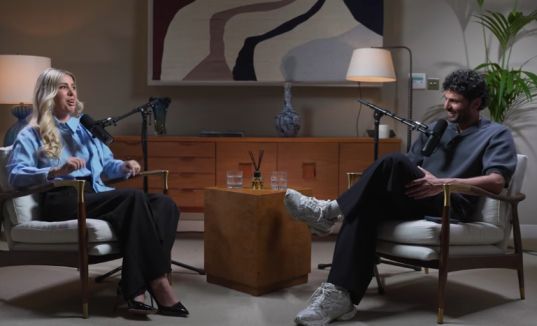
Read the full transcript of social media strategist Carl Santoro’s interview on On Purpose Podcast, June 8, 2026.
Editor’s Note: In this episode of On Purpose, Jay Shetty sits down with tech entrepreneur and social media strategist Carl Santoro to discuss how to redefine success beyond external validation and societal timelines. They explore practical strategies for maintaining discipline when motivation fades, the importance of surrounding yourself with people who truly support your growth, and why believing in your own vision is the key to overcoming any challenge.
Welcome to On Purpose
JAY SHETTY: Coral Santoro, welcome to On Purpose. It’s great to have you here.
CORAL SANTORO: Thank you so much for having me. I’m so excited.
JAY SHETTY: Coral, I’ve been such a fan of yours from afar. We don’t know each other. We just met today.
CORAL SANTORO: Yeah.
JAY SHETTY: But I’ve been following your content. It’s always direct, it’s clear. The message is easy to understand, easy to apply. There are millions of people across the world that are following you, learning from you, and you just told me that the number one Google question about you is, “Is Coral Santoro AI?”
CORAL SANTORO: Well, I think we all in this room can confirm that I’m not. So I love it.
JAY SHETTY: I’m not sure yet.
CORAL SANTORO: I’m not sure. I’m not sure. Is Jay Shetty doing the first hologram ever?
JAY SHETTY: No, no, no. I would not do an AI.
CORAL SANTORO: No, I love it. So yeah, I’m very much real.
JAY SHETTY: How does that make you feel? How does that make you feel when people are asking that question?
CORAL SANTORO: It is so funny because I’m in the actual tech space, so I develop softwares. I’m in AI. And when they started asking me about these things, I’m like, it kind of makes sense.
But at the same time, as soon as I started posting more content, a lot of the people started realizing it was not. I still get a few questions here and there, but it was mostly about me coming into the space of social media. Because what I do is the fun side of my life. What I actually do is tech. So I came into this space and I understood it because no one had seen me before. And in this moment that we are, you don’t know what’s real or what’s not. So I kind of understood it.
And that’s the point that I understood that I had to go more into stories, show people a little bit here and there about me being real. Honestly, it was funny and me being the first interview here, and I’m super happy that people get to see that I’m a real person.
The Purpose Behind the Message
JAY SHETTY: Absolutely. Talk to me about if someone listens to this episode today, what do you want them to walk away with? What do you want them to feel? How do you want them to change their life?
CORAL SANTORO: To be honest, just like the name of the podcast, Purpose. I got into social media and everything that you see. I got into this space because I didn’t want people to feel behind in life because of what they see.
I feel like nowadays we can get confused very easily. And the men’s side, I was talking about this the other day, if you are not flaunting cash outside a Lamborghini and doing all these things that you see, you’re behind. If you’re a woman, if you don’t have a Birkin bag and if you don’t have a bouquet of roses outside of a jet, oh my gosh, I don’t have the right person. And that is not real life.
I hated the romanticism that we’re seeing in entrepreneurship just because real life is not doing a Canva template and saying to people, “Do this course and you’ll be financially free.” And then people believe that. That’s not real life. We all have struggles. We all go through things in our lives, even if it’s relationships or work.
I want people that every time they listen to something, it’s purpose. You’re not behind, you’re on track, you’re not in a race with anyone. And that’s why I love so much everything that you portray. And that’s why I wanted to come here so much because this is real life.
And I feel like the type of content that we put out, everyone relates in a different way. I feel like we’re all in the same boat, but we all have different destinations. At the end of the day, we all have problems. In this room, we all have a problem. And it’s not rare, but it’s just how we can get support from now online.
So beautiful things that I follow, a lot of the guests that have been here and have a voice. And I feel like we all have a voice and we all have a story. And if we can put it out there and people can relate in their own way, I think that’s the purpose of life.
There Is No Finish Line
JAY SHETTY: You spoke about timelines there. You spoke about this idea of not being behind. How do we stop comparing our timeline to everyone else around us when it feels like we’re so overexposed, like you said, to the cars, the Birkin bag, the bank balance, the jet, the whatever it may be. Now, before you’d compare yourself to the 20 people in your class at school, now you can see what 20,000 people across the world are doing. How do we stop comparing our timeline to everyone else’s?
CORAL SANTORO: There’s no race. They made us believe that there’s an invisible finish line and success does not have a finish line. So we can’t compare something that does not exist.
I’m going to tell you a little bit about me.
And I always say, “What will they say about what? It’s your life.” Let them talk for a little bit. Then when you make it, everyone knows you. Everyone is your friend. So what I like to say is, there is no race. There is no invisible finish line. You cannot compare to something that does not exist.
When you follow your own path, when you follow your own passion, a lot of people will not understand. That is for sure. When you’re doing something different, people will tell you you’re crazy. People will tell you that’s not the right path to go. And it’s because they’re talking about their insecurities, not about the reality of what you can portray.
So when I started on social media, I remember myself putting out there years ago because I had an account. It was all about different things. It was about fashion and trips and stuff. And I remember all these people that I thought were my friends. And if someone’s listening to this and thinks that their friends are going to talk about you because you’re online, they’re going to talk about you, and that’s beautiful.
And if you get 4 likes and all the people that you thought were going to support you, the ones you thought were going to buy your product, you thought were going to put a like on your new page for your brand and they don’t, that is showing you who your true circle is. That is showing you that you are doing something that they are not willing to do, which is expose yourself, which is putting yourself out there. And that is bravery to the max.
And I think that today, seeing all these things about comparing ourselves online about people that are younger than ourselves, because a lot of people are like, “Oh my goodness, he’s 20 and he’s already a millionaire.” Well, that’s perfectly fine. KFC started when he was 75 or 70-something. And then you see Vera Wang, she decided her first — we’ve seen this. There’s no timeline for success.
So if you’re patient, I was just telling my team here and I was talking to them about this and I’m like, if you’re not in a rush about posting, at first you’re not going to get likes. That’s fine. If you’re not in a rush, you’re going to get there. So there’s no comparison about you being younger or being older.
My parents are in their 60s and they’re reinventing themselves. They’re like, “I want to do something different.” They’re in their 60s. I started young when I was 18 doing political things with no experience at all. And now I’m about to turn 29 and people are like, “Oh my gosh, you’re a baby.” I’m like, yes. But during these 10 years, I didn’t compare myself to anyone else and just followed my path, followed my gut. And now I’ve got the chance to work with presidential campaigns, Fortune 500 CEOs, and it was my path. So if you still want to do it, get the advice from people that are online, but don’t compare to it. Just get it and go out, put yourself out there.
The Perceptual Trap: What Others Think of You
JAY SHETTY: Any successful person I’ve interviewed or talked to, this idea of knowing how to deal with what everyone thinks of you is huge. It’s one of the biggest things. I was sharing yesterday, last night I was just mentioning to you that I was interviewing Emma Grede for her book launch here in London at the Hackney Empire. She’s from East London, I’m from London, so it was a really, really special feeling.
And I shared this quote that I’ve shared many times, but every time I say it, it has such an impact on me and everyone who hears it. It’s from Charles Horton Cooley. He said it in 1890, and the fact he said it in 1890 tells us everything. He said, “The challenge today is I’m not what I think I am. I’m not what you think I am. I am what I think you think I am.”
CORAL SANTORO: I love that.
JAY SHETTY: And it’s such a brilliant statement. He’s saying that we live in a perceptual perception of ourselves. So we think if everyone thinks I’m smart, then I feel smart. But if everyone else thinks I’m weak, then I feel weak.
CORAL SANTORO: You know what? I heard this and it’s called the Marilyn Monroe effect. So she showed up herself how she wanted to be portrayed. So she was an orphan and she didn’t have the means to be who she was supposed to be. So I’m like, if you want to be a Hollywood actress, if you want to do all these things and you think you don’t have the things, Marilyn showed up as the person she wanted to be.
And I love that because once you believe in yourself so much, you’re going to make it. I always say, you’re going to make it. I didn’t have the contacts, I didn’t have the money to do other things, and I just worked so hard and believed in myself so hard and the talents and the capabilities I had, that it starts showing. And that’s when people start calling you. So it’s just about believing in yourself so much.
The Top 3 Traits of Successful People
JAY SHETTY: What are the top 3 traits you believe successful people have that people who don’t make it don’t have?
CORAL SANTORO: They always ask me, “What’s the difference with the 1%?” They keep going even when it stops being exciting.
A lot of people start, they get the domain, they get the username, they get excited, do some Canva posts, and then nobody likes, nobody buys. The idea’s not good. The idea is not the problem, it’s that you’re not patient enough.
And then you have to be honest with yourself. And I think the honesty is that you have to tell yourself that it’s not going to be easy. That it’s going to require a lot of effort. And once you’re honest with that, you have to be on a track where your vision has to be so strong, but the path to getting there has to be flexible.
So I feel like the one percent is always patient, is always honest, and the vision has to be so strong, but the path to getting there has to be flexible. Once you understand that, you’re going to understand that your timing is not the timing that you want.
I took 10 years to get where I am. So when people see, “Oh, she’s an overnight success,” overnight success does exist after you work 10 years with nobody watching and nobody clapping for you. That’s when it shows.
JAY SHETTY: Mm-hmm.
The Boring Work Behind Success
CORAL SANTORO: So be patient, be honest with yourself, and be very stubborn with your vision, but the path to get there, flexible. So that’s the 1% difference. And once it stops being exciting, be so repetitive about the boring stuff that you’re going to make it.
Because everyone thinks success is exciting. To get here, to do this podcast, the logistics behind it — this is the fun part when we get to talk. But in any brand, in any business, any relationship, the boring stuff is what makes everything stick together.
In a relationship, I love talking about relationships because I feel like it’s been so romanticized. A relationship is a thing that you work on every single day. In a business, you work on relationships with your team, with your employees, even with yourself. So it’s a matter of just repeating the boring stuff over and over again and getting better at it.
And listening to other people. Also, one more thing that we’re talking about — listening. I feel like once you think you know it all, you know nothing. That’s the kind of thing. Once you believe you are better than anyone else, you’re done.
In my company, what we do every Monday, I’m the last one to speak. Because if you speak first as a boss, as a CEO, then everyone’s going to agree with you because they might be afraid not to give you the reason. “Yes, you’re good. Yes.” The yes, yes, yes. I don’t want yes people around me. I want people to make me better.
And that happens with relationships. You want your partner to make you better. Right now I’m in a beautiful relationship that has made me a better entrepreneur, a better woman, a better — because they rise you up. It’s not that you’re comfortable, but they make you better. I have beautiful friends who want me to succeed.
So it’s a matter of, I feel, just listening — the power of listening, not knowing it all. That’s how you learn until the last day of your life. If you listen, you learn and you get to know people better. About the people who love to talk more as well, because people talk too much — they’re the ones who, usually, not always, but owe the least and have the least to portray.
Don’t Listen to the HIPPO in the Room
JAY SHETTY: You just reminded me of Eric Schmidt, the former CEO of Google. He had a principle that he called, “Don’t listen to the HIPPO in the room.” And HIPPO stands for Highest Paid Person’s Opinion. And he said the same thing. He said, if I speak in a leadership meeting, or the most successful or wealthy person in the room speaks, everyone around them will just agree. And so it’s better to allow everyone else.
One thing that you mentioned that really stands out to me — you said what differentiates the winners from the people who don’t make it is that they keep working when it’s not exciting. And I think that’s where the “follow your passion” movement went wrong, because people had this belief that if I follow my passion or if I do my purpose, everything’s going to be easy. I’m going to wake up happy every day. I’m absolutely going to love everything I do, not realizing that actually, if you follow your passion, there’s going to be lots of days where you’re doing things you don’t want to do, where things are not exciting, where you’re not winning, where things are not working out.
And you’re spot on that being able to work when things are uncomfortable is what differentiates the top 1%. And so how do you keep going? How do you keep trying and experimenting when things feel slow and they’re not going your way? How do we stay patient? To your first point.
Success Is Quiet at First
CORAL SANTORO: So I like giving this example. When you go to the gym the first time, everything hurts and you see nothing but just internal pain. And then if you keep going, you start seeing a little bit here and there of a muscle, you start seeing here and there a tighten. That’s the same effect.
Following your purpose and your passion is hard because you’re not going the traditional way. And when you’re not going the traditional way, it’s going to hurt. It’s going to make you question a lot of things about yourself. If you’re capable, if it’s worth it. Why is it not working? Why am I doing wrong? Is the idea bad? It’s not. But once you surpass that pain, that internal pain, you start seeing results — and it’s quiet. Success is quiet at first.
It’s not easy because you are not exposed. It’s just you yourself in a room, maybe with a laptop and not a team or anything. And at first, all entrepreneurs know, you are your own PA, your own personal assistant who’s responding to the emails. You are the marketing team, you are sales, you are everything. And that is fine. That’s how we all started.
But once you believe in the process of that, you’re grieving something inside of you as well during that change. Because I feel like what success really is — if they ask me what is success — success is who you’re becoming in the process. It is the resilience you’re building. It is the path to the top.
You’re going to be losing weight because to get there, you’re going to lose friends. For sure you’re going to lose friends because you’re not the same person. You’re going to not be able to speak about the same things on a dinner table, and that is fine. You’re going to maybe lose family members who didn’t believe in you, and that is fine as well. And you’re going to lose a part of yourself that you might not notice, because in that silence of not noticing changes, you’re changing — and that is already success.
So on the way to the top, I always say the top is not closed. People at the top will want to help you. I heard a friend of mine saying, “A lot of people aren’t helping me.” And I’m like, you don’t need, in life, you don’t need a lot of people. You just need one. If you have one person who grabs you by the hand, tells you, “I’m going to help you, I’m going to introduce you to someone,” that might be enough. You don’t need an army of people to succeed. You need first to believe in yourself and then just one person to introduce you.
So the top is not closed. The thing is that the top is cold. People were not expecting it to be that cold. Because when you get to the top, it gets lonely sometimes — since you lost a lot of things during the process of getting there, it’s a new you. And at the top there are fewer voices. So that means that you have more time to think.
As a CEO, it’s you deciding. You don’t get to run to other people lots of times. So that’s when your mind has to be very clear on listening, on who you are, and being so sure that any decision that you make — either it turns into good or bad — it’s you at the top who got there, who’ve made all decisions to get there, and you’re going to be fine.
So I feel like the same thing. Once you understand that there’s going to be silence, that you’re going to lose people, that you’re going to grieve an old part of yourself, you’re ready. And the climb is slow and you lose people. But it’s worth it.
You’ll Get There, Just Not the Way You Imagined
JAY SHETTY: I always say to people, you’ll get to where you want in life, just not in the way you imagine it.
CORAL SANTORO: 100%.
JAY SHETTY: Because all of us have a visual of what the path looks like, and then reality next to it, which doesn’t look like that at all. And then we start thinking, “Well, this can’t be the right path because it doesn’t look like what I visioned. It doesn’t look like the idea I had in my mind.” And reality’s saying, “No, no, no, this is what it’s going to look like.” And we just keep debating, we keep fighting it. And then you don’t take the step forward in reality because it doesn’t look like the one in your dream.
From Blogger to Political Strategist: Coral’s Unexpected Journey
CORAL SANTORO: In my case, I started so different from where I am now.
JAY SHETTY: Tell me about that.
CORAL SANTORO: So I graduated from high school, like I mentioned, and I wanted to be what it was — it was a blogger at that time, because it was like an actual blog. And I started posting and at first it was like nothing. And it was kind of tough because all of my friends were talking about me and, “Ooh, she thinks she’s an influencer.” I wasn’t an influencer. It was, “Ooh, she thinks she’s a blogger.” That’s so cool when they underestimate you. I love being underestimated because you get to build quieter. You don’t have pressure. You don’t have to prove anything to anyone.
JAY SHETTY: Everyone thinks you’re going to fail anyway.
CORAL SANTORO: Yes. So why not do it?
JAY SHETTY: It’s a good place to be.
CORAL SANTORO: I love it. So once I started posting these things, later on today, they all are my friends. They all know me and they all want something. That’s the path.
When I started, I thought it was going to be into fashion, but once I started getting invited into Fashion Week, I understood the power of technology and where it was going. So I started calling all these brands that were inviting me to Fashion Week and I started doing their social media accounts. So once I understood the power of social media, I went into my first presidential campaign. I managed my first presidential campaign, then it led me to a second one, third, and now I’m starting my fourth one.
So if you told me that I would end up in politics, and then that led to cybersecurity, me developing softwares and cybersecurity, I would’ve never believed it. Or me being a political strategist — never would’ve thought in a second.
So if you told me that by age 29, I would’ve been divorced, I would’ve never believed it. And that is fine. I remember when I got divorced, it was something like, “Ooh, she’s so young and she got divorced.” And I always love to talk about it because it’s not a taboo thing. I got the most amicable divorce ever. It was all good, but it’s just things that happen and life will just throw things at you that you’re not prepared for. But the resilience comes in the hardest moments of your life.
And in that moment, through all the things that I’ve been through, and now I started into this path of social media of what I do — this is the fun things. I get messages from all around the world about people, me changing their lives, which I would’ve never envisioned, right?
So I always say to the people I coach and to people I talk to, “Do you.” Don’t do anyone else — everyone else is taken, right? I’ve heard that phrase: everyone’s taken, just be you. And in my case, I’m young, but I’ve lived so much. Even my Spotify account says that I’m 63 years old. I totally believe it. I’m an old soul.
JAY SHETTY: You mean when it does the Spotify Wrapped? It tells you what you listen to?
CORAL SANTORO: Exactly. That’s hilarious. This makes sense. Exactly, this makes sense.
Do You — And Let Others Do Them
CORAL SANTORO: So it’s just a matter of, do you. Do whatever — dress. If you want to dress in a certain way, dress in a certain way. You want to go a different path that is not the typical one, do it. And don’t criticize others, which is so important, because that energy that you’re portraying by criticizing or doing, it’s not coming back to you in a good way.
I was talking to a friend of mine the other day and she said, “Oh, I heard this friend of ours had a baby and she thinks she’s a mom influencer.” And it’s those things that I hear all the time — “She thinks she is,” “Oh, she thinks she’s a singer,” “She thinks she’s a designer.” She is a designer. She might not be at the top yet, but she’s going to get there. She’s not the top influencer, but she’s going to get there in her own timing.
So the way that we portray words is so important. Because if someone has blue hair and you are staring at her because she has blue hair, let her. It’s just like the Mel Robbins thing, right? “Let them, let her.” If they want to do something different that you are not engaged with, let them be. You do you. You focus on yourself so much that your energy —
I’ve heard this over and over: successful people cannot criticize others because they don’t have the time for it. They’re so focused on being better.
For example, I feel like us sitting here — I’m happy about your success. I’m happy about you having a production company. I’m truly happy. When I saw it, I called Paige, who’s been so wonderful. Paige, if you’re listening to this, it was so good. Because I’m happy for it, because I know what it takes to get to certain places.
And when people read headlines and when we put something out there, it’s not to brag. I always say when people put a vacation there, it’s not to brag. If people put something in their social media, sometimes it’s not to brag. It’s sometimes a way of saying, you know, the times they said no to a lot of things to get there.
JAY SHETTY: Mm-hmm.
The Reality Behind Social Media Success
CORAL SANTORO: So many times they had to cry themselves to sleep to finally purchase the car they’ve been saving for. So a lot of times we read social media in the ways that we want to read. If it’s with envy, we can twist envy in a way. If you’re jealous about something, let it be for good. Let it be for, if he can do it, I can do it. But not in a way of like, oh, he has it, then it’s not for me, or I cannot have it. There’s room for everyone. The world can give so much. The doors are not closed. So just do you, be happy with what you have, and read the things differently.
JAY SHETTY: Yeah.
CORAL SANTORO: Be happy for others. Truly, we are in a society that is so jealous, so confused because they don’t have it. And I know there’s tough times, but it’s in the toughest times, it’s when people can arise, they can become the person they want to become.
I remember one time I had like $12 to my name and I was looking at my bank account and I could have haven’t—
JAY SHETTY: Where were you at that time?
Starting From Zero: A Story of Failure and Resilience
CORAL SANTORO: It was when I just started and I needed to do like my first website for my, it was when e-commerce was started booming. And I remember the YouTubers, that’s when I, one of the things they were like, you’re going to become a billionaire if you do this product. And Amazon FBA was called, I think, or something like that. And I was like, ooh, I’m going to get into e-commerce.
So I saw all these YouTubers, this was like 12 years ago, and I got onto it. I paid this guy to do my website and he basically got my card. I was naive. I gave him my card and basically he took like all the money, didn’t retrieve anything. Oh, worse. And in that moment I understood the power of anything in life, like trust. Like I trust in the guy, it failed. It was a lesson and I opened my bank account and I feel like we’ve all been there. When you look at your bank account, you’re like, oh my gosh, the overdraft fee and all these things, right?
And there was two options. Either I stayed there and cried or I started to work. That’s how it got into tech. I learned how to code my own website because I didn’t have money to pay someone to do my website. And I realized later on how I got into tech was by a moment of failure. Which I love to say failure does not exist. It’s just data. It’s just giving you more information.
And in those moments where you’re like, what am I going to do with my life? And a lot of things I feel like people right now in the world are struggling with financial situations like ever before. And in those moments, I want you to know that I feel like all successful people, we’ve been there.
JAY SHETTY: Yeah.
Real Success Is Who You Become and Who You Share It With
CORAL SANTORO: Like it’s not easy to get to where you want to get. And on my way here, I remember that a lot of people think they see the car or they see the bag or the watch and they want that. And I’m like, it’s fine. You can get there. But real success is not assets. Real success is who you become in the process. And real success once you get there is who you share it with.
Because once you get there, it’s like, who I want to share the news? Before I came here, I called my partner. I’m like, I’m so excited. He was like, oh, you look so beautiful. Congratulations. And like, they’re happy for me. I called my friend and she’s like, oh my gosh, I’m so excited for you. I brought here my team, they’re so excited for me. It’s who you share it with.
And I always say, in friendship, if there’s a slight chance of envy or jealousy, the friendship is gone because they are competing with you. And the second they’re competing with you, it’s broken. People who are around you have to be happy about your success. Because they know their timing is coming. They’re following their own timeline and they’re happy for you. And that’s so important who you share success with.
The Culture of Criticism and What It Reveals About You
JAY SHETTY: I’m so glad you brought up these more underlying things when it comes to success, especially when you talk about not criticizing others, because I feel like as soon as we hear about someone doing something, and if we’re aware of it and they’re doing it a little bit better than us, everyone gets really, really critical. And we’re being critical because we’re being competitive. We don’t even agree with what we’re saying. We’re just saying it because, oh, it’s uncomfortable to hear that someone’s doing it better than me, that someone’s getting it right compared to me.
And I think what that does is it creates a culture of criticism in our mind where now, I think about this all the time, my friends who are doing well on social media will never laugh at someone else on social media. They’ll only send me the good stuff that other people are doing. They’ll say, hey, did you see this update? Did you see what this person just launched? Did you see what this person invested in?
And all of my friends who are doing badly on social media will always send me a video of someone to laugh at them to be like, oh, did you see? Oh, look at, let’s laugh at this. And it’s fascinating to me how you get lost in that world and you feel better about yourself. So what I’ve found is if you’re doing well, you feel better when other people are doing better because it shows you there’s more opportunity.
CORAL SANTORO: 100%.
JAY SHETTY: But when you’re doing badly, you feel happier when other people are doing worse because that makes you feel like a bit of an ego boost. And so I think it’s such a good tell as to whether you’re focused on yourself or whether you’re not because of the critical piece.
The other thing that you mentioned that really stood out to me is this idea of sharing it with people. Earlier you talked about the idea of being lonely at the top and I think people are also lonely at the top because they don’t know how to build the friendships that you’re talking about, because you can’t control whether your friend’s envious of you or not. You can’t control that. How do you maintain good relationships on your way up so that you don’t get to the top and then go, oh, I want to make friends now? Because once you’re at the top, you don’t know why someone wants to be friends with you. Exactly. So how do you maintain great friendships on the way up without knowing if someone’s envious of you or not?
How Your Circle Changes as You Grow
CORAL SANTORO: I think that you change your circle. It’s going to happen because the people you’re doing business with usually end up being your friends and the old circle just stays where they are. And not because it’s wrong, but because their lives are different. And if you’re doing something non-conventional, you’re hanging out with non-conventional people with minds that don’t see the impossible, right?
So I think you just change a circle and that happens in life. Sometimes your group chat went silent, someone had a baby, someone got married, someone went abroad and the group goes silent and then that’s just life.
The other day I was at a dinner and I heard them talk badly about you. And the response was like, that doesn’t matter. What matters to me is why they felt comfortable doing it in your presence if you’re supposed to be my friend. So that’s how you know.
JAY SHETTY: Say that again. That’s good.
CORAL SANTORO: If someone’s talking about you and they come to you, a friend comes to you and says, I was at a dinner and they were talking badly about you. The thing is not why they were talking about me badly. It’s because why they were so comfortable talking about me in your presence if you’re supposed to be my friend. Right? So good. So I love that because if it’s a true friend, they’re not going to dare to talk badly about you. So that’s the thing.
I think circles change. I feel like in my life, my circles have changed multiple times and that’s just life. That’s just the circle of life. And if you’re married, sometimes your partner’s friends are going to be your friends. If you get divorced, maybe it splits. If you go to college, it’s your college friends for that time. Then you depart from that city and then you have a new city and you become new friends.
So I always talk about being an immigrant as well and following your dreams, because I feel like in a way everyone that pursues something usually leaves home. And when you get there, you’re praying that the lease you had is good enough. And if you’re reading a yogurt flavor that you know the brand is good, and then you make your first set of friends and they start to show you the city and then they become your person in that city and then you’re pursuing a dream. So it’s just like, I feel like it changes wherever you go, whoever you want. Sometimes it’s who can take you there.
JAY SHETTY: Yeah.
CORAL SANTORO: Right. And you’re hanging with them because you see that the possibilities. So it’s just a matter of like life. I feel it’s just like the circle of life.
Keeping Old Friends While Embracing New Ones
JAY SHETTY: Yeah, I think that’s fair. I feel really fortunate that I’ve got friends who I’ve been friends with for probably about 20, 25 years who are still in my life. And you’re spot on. The reason that we can all still be friends is because I hopefully am not an arrogant douche and they’re extremely non-envious. And I think those two things work really, really well together when exactly to your point earlier that I have a great group of friends who aren’t envious and not competitive and not trying to take me down.
And then on the other side, you’re absolutely right. Your circle changes and you meet new people that understand your new life. And I think that’s what it is. I think people think when your circle changes, it makes it feel like, oh, because you’re doing better, you want to be around people that are doing better. It’s actually not that. It’s actually people understanding you at different stages of your life who have seen you in different phases, who understand the pain you go through. So I have lots of friends in my industry. The best thing is we can all relate to each other when we’re going through the same things.
CORAL SANTORO: Exactly.
JAY SHETTY: And my friends from back home, they’ve seen the full picture of me. And so I love that too, because they know me deeper than anyone else on the planet because they’ve seen me from day one. Exactly. So that idea that your friends change and your circle changes is valuable. At the same time as I’d encourage people to be like, you don’t have to leave everyone behind. No. And you can open up the door for other people.
Finding Beauty in the Darkest Moments
CORAL SANTORO: 100%. There was this beautiful story. I met one of the survivors of the Andes crash. And they were a set of a group of friends who were leaving for a rugby tournament and the plane crashes. And I think if someone’s seen the show on the movie on Netflix, it’s great. I invite them to watch it.
But I was talking to one of the survivors and he said something beautiful that takes me out of like bad days because I’m like, you’re a group of friends who crashed in the snow. A lot of them died there and you stayed there for 72 days stranded in snow. And I’m like, how did you pull through? And he was like, all of us friends, it was important to see one good thing every day.
And he said something beautiful. I’m like, are you saying this because it sounds good? And he’s like, no, because when you’re in the snow and there’s no sound and you just see plain white, you find beauty in things that you didn’t understand before. He said while they were listening, like, at the rain or the snow falling, they were like, “God is present. And if God made all of this, that means he’s here with us.”
And I find it beautiful. I’m truly believer in God. And I feel like once you leave everything to him, everything starts becoming beautiful. And in that point, when he told me that in 72 days stranded in the snow, they saw one beautiful thing.
JAY SHETTY: 72 days.
The Power of Believing in the Impossible
CORAL SANTORO: 72 days in the cold with no food. It was bad. But then I asked him something, I’m like, “How did you know you’re going to survive?” And he said this, “Because no one told us it was impossible.”
And that is something that you can take to your everyday life. You want to embark into a new chapter of a life and they tell you it’s impossible. The market’s saturated. By the way, the market saturated was invented by someone with low creativity, to be honest. But it’s just you believe in yourself because usually people put their own fears into our own ideas and our own dreams. So that’s why we believe in them and we think we cannot make it.
So when he said that, I truly believe in it so much because he said, “What if we would’ve been stranded with a lot of people around it? The odds of everyone saying, ooh, they’re not going to make it. Ooh, what are the conditions? 72 days in the cold. They’re not going to make it.” It would’ve been higher, right?
So he said, “Nobody told us that it was impossible,” and seeing one good thing in your life. And I truly believe in that. I believe in that on the worst days that I have, I find one good thing. And once you find that one good thing, you push through. You wake up one more day, be like, one more day to fix any problem that I have. One more day to try again. One more day to become the person I want to become. One more day. One day at a time.
Why Jay Doesn’t Believe in 5-Year Plans
That’s why I don’t believe in 5-year plans. With the advance of technology and everything, that doesn’t exist.
You know how I hire people? It’s the funniest thing. I love resumes. That’s all good. Love that. But I usually take them to a smoothie ride. I take them with me to a smoothie and I love how they treat people. I see how they treat the waiter or the person at the cashier. I see decisiveness on ordering. They’re going to take like forever, or, you know, and then while we’re sitting in a casual environment, I ask questions about life, right?
And when you get to know the person that’s going to be part of your team, being good, being a kind person, honest, and having values, the resume will follow. But if you don’t have that as a person, the rest doesn’t matter. You can have Ivy League people in your team. That doesn’t mean anything, but they’re kind people.
The Brave Man from India
I hired the other day someone, it was impressive. I was doing this speech in Dubai and then this guy had come from India and he didn’t know how to speak English, so he wrote on a piece of paper something and he showed it to me at once. I was doing a meet and greet and it was basically him saying that he was in tech and that he had saved the last amount of money and asked his mom to come to Dubai to meet me and had a chance to work at my company.
And I thought that was so brave because he didn’t have the language. He had spent the last cent to come and see me, and he was taking a chance. And that’s what I love, the 3 C’s of life: challenges, choices, and change. Challenges, we all have them, and life will throw at us every single day. But then you have the chance to make a choice.
And once you have that, this guy, I hired him on the spot. He showed me what he had. I thought it was so brave what he had done. And he had Tourette syndrome. So when he started talking to me, he was having a situation and showing with a piece of paper trembling. And I thought that was so brave because the meaning of being brave is not that you’re fearless. It’s that even though you have fear, you’re going to go for it.
And in that moment, he was so brave, and I just gave him a hug, and I’m like, “Come Monday to my office. I’ll pay the hotel, don’t worry about it, I’ll take care of it.” His mom just passed away now, and he was a big chance that he was in my team.
So it’s just a matter of people. If you have air in your lungs, if you get the chance to wake up one more day, you can do it. You can totally do it. I believe in that so much. I have such amazing people. I didn’t get here alone. Nobody gets there alone. You have people that have helped you.
When this guy told me that he has survived the situation, seen one good thing, and his friendships— oh, and one more thing he told me, he said that between all of them, they couldn’t complain. And I thought it was so beautiful because in our everyday, we complain so much about dumb things, that if you use that energy to complain, you’re going another way. It’s the wrong way to go.
And he said that during the snow, it was no complaining, loving each other, seeing one good thing, and knowing that nobody told them that it was impossible to survive. So in your everyday, I feel like what he said is like, nobody can tell you you’re not capable of doing something. See one beautiful thing every single day and do not complain.
JAY SHETTY: That’s a great story. That’s a great experience. You said we can watch the— is it a movie or a doc?
The Society of Snow and the 10-Second Rule
CORAL SANTORO: Yeah, it’s a movie. It’s called The Society of Snow. It’s on Netflix. It’s fantastic. The scenes are so— and it’s a true story. So once you see that, oh my gosh, you see how did they actually survive?
But that’s the thing. I feel like those type of situations when people go through that, it was just like the Hudson River crash. And I heard this beautiful story. The pilot said one engine is out, the other one is out as well. This guy goes, “I realized in that moment when the plane was crashing, that I haven’t loved my wife enough, that I didn’t spend time with my friends.” All these things that you are waiting to do someday, right?
And that’s why we have our planes crashing every single day. Sometimes we feel like we’re down and under, but that’s the moment of wake-up call. That’s the moment when you take a deep breath.
I like myself when I’m feeling down doing the 10-second rule, and it’s just counting myself 10, 9, 8. Even like rockets, they count backwards because they’re going to go up. So I feel myself like that. Even when I don’t feel like it, I count myself 10, 9, 8, 7, and once I’m like, 1, I’m up and I’m doing.
So it’s little rules here and there that I place for myself and nobody taught me. Another thing I like to call is a rule of nines. So people who like productivity tips, I put like a TikTok board and it’s like 9 squares. And if you just put 9 squares throughout your day or throughout your week and you cross them, the mind loves completion. So if you cross it out physically— I love tech, but I like some things physically.
JAY SHETTY: Yeah, analog.
CORAL SANTORO: You cross it out in Post-it notes and just cross it out. Your brain loves completion and you feel like you’re advancing more than if you think that your brain can hold everything together. It can’t, but once you feel completion, it’s fantastic.
So certain things that I’ve learned, it’s like when you’re in school and they put a happy face sticker and you’re like, yay, and you’re happy. When we’re adults, we don’t have that. So we have to give that to ourselves and we have to give the grace of us trying.
Living in the Moment and Leaving an Invisible Footprint
Nobody gave us the blueprint of life. I think that people made us believe that we have another day, that we have more time, time to love, time to forgive. More time to try that thing that we want to start. But life is moments. And we think that we own those moments, but we don’t. And that’s why we have to make the most of it.
And at the end of the day, when our time comes, I don’t want to be able to say, “I wish I had.” Because when the time comes, I want to say, “I tried, I loved, I did it my way.” And the invisible footprint that you’re leaving in someone else’s life, that’s what matters.
I heard the other day that when you die, men especially get their first set of roses or a bouquet of flowers.
JAY SHETTY: Mm.
CORAL SANTORO: And that was beautiful in a way, because why do we say all these things when people die? Why do we hand a set of flowers when we can do it when we’re alive?
They said that two times that people are gathered in your life, all the important people in your life are either at your wedding or at your funeral, right? And I thought that is sad in a way because real life is trying, real life is failing. I don’t believe in failure, it’s just data, but let’s call it failure. I believe in the power that we have as humans to grab each other’s hands and be better.
Unity Over Division
Right now in this time of our lives, we see more division than ever and we see division because we don’t understand. And when we don’t understand something, it’s easier to criticize, it’s easier to hate. And nowadays, with the media, with the world and what’s going on, I believe in unity. I believe that we’re separated by things that should never be separated.
And I love that if we can get the message of just unity, that we’re all humans under the skin, we are all bones, we are the same. And I believe as humans, we can give each other the hand of love and the power of sincerity and the power of, “You know what, I can help you.” And if you need someone, I will call you and check in on your friends.
There’s so much loneliness. It’s a new epidemic. It’s a new pandemic, loneliness. And especially with the economic situation as well, people are not being able to have kids. And now I work in the political space as well. And when you ask someone, “Oh, we’re not having babies,” it’s not because they don’t want to, because maybe they can’t afford it. People who are lonely because they got divorced, or then depression.
And I do believe that now, especially now, we can come together. As humans, not as political parties, not as race, not as nations, but as humans.
The other day I was sitting at a table where there were Christians, where there were Jews, where there were Arabs— it was beautiful. And I told them that, “You realize there’s one of each religion and we can all talk. Because we can all listen to each other.” And then it’s beautiful.
But now that I’ve been moving around in Ubers, the other day my Uber driver asked me about my religion. He was Muslim. And I asked him about his. And as soon as I got off the Uber, he said, “Inshallah, ma’am, I hope your day is beautiful.” And I thought it was beautiful that he was praying in his culture and it’s beautiful. And I told him, “God bless you.”
So the moment that we understand each other as humans, not as political parties, not as anything else that the media can portray, and we just see each other as human beings, I think that the moment that we’re sitting at the table, it’s a table that should be everywhere and around the world. It’s because you listen, because you understand. So the moment you start listening to more people, you understand more and get your own opinion.
Listening vs. Hearing
JAY SHETTY: It’s so interesting now because I feel like we’re listening to more people than ever before, but we’re not hearing them. Right? We’re not actually hearing them because there’s so much noise. And today we have access to more cultures, more countries, more opinions than ever before. But no one’s actually hearing anyone anymore because you’re just filtering it through your own lens.
CORAL SANTORO: Because you feel that your opinion is so set in stone that it becomes your identity.
JAY SHETTY: Yeah, absolutely. It’s because we’d rather be right than have peace.
CORAL SANTORO: Exactly.
Happiness Is Inside You
CORAL SANTORO: Yeah, 100%. That’s why when you listen to someone truly, some of what you just said is that I feel like more and more today with politics all around the world is that you feel that that’s your identity and that’s not your identity. And once you understand more about situations and we have more people talking about free press, let’s say more information, different ways that you can get your information, you can understand that. But any political party cannot be your identity. Your identity is something completely different. It’s who you are on your everyday, who you’re becoming for a better person.
And the other day I found this beautiful story that I told, that there are 3 genies and they decided where to hide happiness from humans. And the one genie goes, “You know what, let’s hide it at the bottom of the ocean.” And the other goes, “You know what? No, they’re going to build a submarine. They’re going to find it.” Yeah, you’re right. The other one says, “Let’s put it at the top of the mountain.” He says, “No, they’re going to learn and put equipment. They’re going to climb and find it.” And the last genie says, “Why don’t we hide it inside them? They were never going to dare to find it there.”
And I thought it’s so funny because it’s true. Because we’re seeking happiness externally and we’ve been taught that because since we’re little, if it’s not an applause, it’s not valid. When people say, “Let’s take a picture and post it because if not, it didn’t happen.” You know what I love? When I take a picture that I’m never going to post because it made me happy.
JAY SHETTY: It’s the best. That’s the best.
CORAL SANTORO: Yeah. It’s the moment that you understand it was for you. The other day my partner took a picture of me and I’m like, “Oh my gosh, I look crazy. I look horrible.” He’s like, “No, to me you look beautiful. I want to remember this moment.” And it’s about moments, it’s not about externally. So when this story about the genies just reminded me of, it’s true, happiness is inside you. The purpose is inside you. It never left. You just let it rot based on someone else’s opinions and because they didn’t clap for you.
So the purpose never left. The other day someone told me, “I fell out of my purpose, I lost my purpose.” I’m like, “No, no, your purpose is inside you. It never left. You just let outside opinion dictate your decisions.”
JAY SHETTY: Yeah, it’s when you feel disconnected from yourself, you stop listening to yourself, that you get distracted by other people’s opinion is when you think you’ve lost your purpose.
CORAL SANTORO: 100%.
This or That: Entrepreneurship Edition
JAY SHETTY: Coral, I wanted to switch into a bit of entrepreneurship, and I want to do this segment with you called This or That.
CORAL SANTORO: Okay, I love it.
JAY SHETTY: And so I’m going to ask you this or that, and you’re going to tell me which one and then why.
CORAL SANTORO: Love it.
JAY SHETTY: And we’re going to go through quite a few. So the first one is, do you believe in discipline or motivation?
CORAL SANTORO: Oh, discipline, 100%. Motivation fades. Motivation fades when everyone’s, “I’m still motivated.” That happens a lot. I was super motivated in January to start gym, went twice, motivation died, I’m out, right? When people say, “I’m motivated to start a new diet, but I’m going to start on Monday.” Why Monday? Why can you not start Thursday? Because as humans, we just decided that Monday was it, or January was it. But now, what is it? We’re halfway through our week and it’s almost June, so that means we’re halfway through the year. And that means, “I’m going to start next year. We’re too late.” No, motivation fades.
Discipline makes you wake up the days you don’t want to. Discipline makes you want on a rainy day. Discipline means you’re up until 5:00 AM and you haven’t slept and you haven’t had any food and you’re still going because you have to finish the task. Discipline, 100%. Olympic athletes, you know, and you’ve probably talked to so many, and it’s discipline.
JAY SHETTY: Yeah, I agree.
CORAL SANTORO: They don’t want to go and swim on -2 degrees and train for the Olympics. It’s going to hurt. And that’s the same thing with entrepreneurship. It’s going to hurt. It’s not the same physical pain as an athlete, but it’s a different kind of pain when you’re the entrepreneur. You’re not going to pay yourself at first a salary. You’re going to pay your team first, or you’re going to have noodles and pasta for the next year because you can’t afford a lot of things. It’s a different kind of pain, but it’s discipline.
And if you stick to it, it’s just like when people post the first time they open an Instagram account, they post once, they post twice, like, “It’s not working.” I’m like, “Discipline, discipline. You’re going to get there. You’re going to learn.” My first video sucked. My first videos got like 50 likes. No, my first videos got my mom, my dad likes, and probably someone else’s account that followed that day. It was a bot, right? But then it just grows and you learn from that. It’s not immediate. So discipline.
JAY SHETTY: Discipline. Okay. Discipline over motivation. Ideas or execution?
CORAL SANTORO: I feel like both, because you have to have a strong idea of what you want to do and not change 10,000 times the idea because sometimes the idea is good, but you have to execute it and change sometimes a lot of things for that idea to work. Because sometimes we think we know the industry we’re getting into, but we actually don’t until we’re there.
And we have to do a lot of different things, like the path to get there, plus it’s visual and strong. So when people tell me that idea is bad, it’s not bad. You just haven’t tried one thing for a long time to see if it’s working. So you try 5 different variables and you don’t know which one’s working, and you think, “It’s not working.” No, just one thing at a time. I feel like at the same time, a lot of people have great ideas, but they just don’t stick to it for a long period of time.
JAY SHETTY: That’s what I — I’m an execution over ideas person. I feel like I’ve seen the worst ideas become really successful because someone executed really well on it.
CORAL SANTORO: You see Liquid Death, right? Yeah, of course. Like water, making it totally water bath.
JAY SHETTY: It’s just water.
CORAL SANTORO: It’s brilliant. It’s just how they do it. The market saturated that we just talked about, it is not saturated.
JAY SHETTY: Totally. Yeah. I mean, I was told podcasting was saturated 7 years ago when there were 700,000 podcasts. Today there’s 2.5 million podcasts.
CORAL SANTORO: There you go.
JAY SHETTY: So I fully agree with you. Last one of these, intuition or data?
CORAL SANTORO: I feel intuition is data.
JAY SHETTY: Talk to me about it.
Intuition Is Data You’ve Lived
CORAL SANTORO: What is the actual meaning of intuition? And for me, intuition is just a lot of things that you’ve lived, which is data, which has given you a sense that we don’t know how to explain. Did you know that when you’re a baby, the first organ that is born is your stomach? So when you feel intuition and say, “I feel it,” it’s because technically it started there. So intuition for me is just data that you’ve lived in order not to make a mistake or in order to make a good decision.
So in my case, a lot of the times when I started in my career, being a woman, young at 18, managing a political campaign on social media when social media wasn’t a thing, it was kind of like, “Who is she? She’s young, she doesn’t have a degree.” But then as I started moving, I’ve worked with soccer, which is fully male-dominated. Tech is a space that has now more and more women, but when I started, it was me. Well, until now, I feel like I work with 100% men on my meetings, on everything. And it’s just a matter of getting into an industry where you have to believe in yourself so much that you’re not drawn apart. So when people give me excuses about, “I’m too young,” or this and that, there’s no excuse anymore. The path and the information has now been open to so many people.
I feel like before, if it was set in a book, it was set in stone.
JAY SHETTY: Yeah, yeah, yeah.
CORAL SANTORO: Google came. If Google said it, it must have been right. Then Alexa came. If Alexa said it, beautiful. If Siri came, it must have been true. And now we have ChatGPT. The information has been out there all along. I started coding when there was no ChatGPT to help me to code. Had to go and read, actually read and go to articles and blogs and stuff online to try to understand. So if you really want it now, you can do it like anything as an entrepreneur. So intuition for me is a must because it’s just backed by the data that you’ve lived.
3 Steps to Building a Social Media Following
JAY SHETTY: Because you do so much of this in your professional life, you are guiding people in their presidential campaigns, you’re guiding Fortune 500 CEOs when it comes to their social media strategy, their digital strategy. If someone right now wants to start building a social media following, what are the first 3 things that they should do?
CORAL SANTORO: First things, go and search your competitors. You know what I love to do? I love to go to Google and find not the 5 stars, but the 3 stars, because the 3 stars are giving you a path of where it was almost good, but not terrible. And that’s your gap. So go to Google, search your competitors, go to Instagram, and on Instagram I would go to Google, even to your page when I started, and I wanted to see what people liked. It’s not going to be the same from you and me because I’m going to do something totally different. So people are like, “Oh, she’s copying,” or “You’re copying.” No, nobody’s copying anything because warm water is already there. It’s been created, right?
But go to your competitors. The first time I started my first account on e-commerce, I would go to Google, I would see the 3-star reviews, and then I would go to all the people that commented. I would go and find them on social media, or go to their social media page and literally invite them to go see my page. So when people are like, “Oh, it’s not working, nobody’s following me,” I’m like, “But have you done the work?” It’s not easy at first, especially if you’re a sole entrepreneur. So first, definitely go and stalk.
JAY SHETTY: Step one.
The Role of Patience and Communication in Business
CORAL SANTORO: Yeah, your algorithm is showing you about your same thing over and over again, so you’re saturated. That’s the way to go. So you, not intentionally, but intentionally, your subconscious tries to copy. And you turn out to be something that you’re not because you’re copying that, right?
The biggest ideas that I’ve gotten for other people’s brands or strategies I’ve done have come — if I’m looking into soap, I would go to nail polish because I would get ideas from there and then we would apply it here. So try to make your algorithm show you something else that’s not in your industry because you’re saturated with that, that you think that’s the path to go. And if that’s not the path to go, it’s done. Force your algorithm to show you different things.
And third, be patient because on social media today there’s no saturation. I started 8 months ago and built a huge platform. It’s so funny because it’s like the Mandela effect. I have people talk to me and say, “I’ve been following you for years,” and I’ve been 8 months on social media, right? So it’s just the effect that they saw me so many times that they think they’ve seen me there.
But that’s the thing, my path, it can be different from you. And if you’re patient and if you don’t have a rush and if you truly believe in yourself and your idea, you’re going to get there. So it’s just a lot of patience. Anything in life is patience. Nothing happens in a blink of an eye. It’s like just getting your body toned. Like if you want to go on YouTube and put “how to get abs in 7 days,” and there are a lot of those videos, you’re not going to get them, right?
The muscle builds and the muscle of resilience in business, it’s hard, it’s tough, but you build a muscle, you build resilience, you build character. And for me, character is something so important because today we hear a lot of people talking about success, but what truly is success is who you are as a person, and who you’re leaving with and the values that you’re leaving people with.
And in your business, if you’re a business owner, always ABCs. The ABCs is always be communicating. And I love that because if you are communicating with your team, if you’re communicating in love, nothing can go wrong. I feel like one of the most important things as humans is the lack of communication because when there’s lack of communication, bad things happen everywhere. It doesn’t matter what happens, it just goes bad.
I had one time one of my team had a bad communication with a business that we were doing and instead of a zero, they added another zero and sent the wire. So I was like, oh, that’s beautiful. Okay, what we’re going to do about it? It was a lack of communication between teams. So it’s just a matter of communicating in love, the same thing. Once communication ends, love ends. That’s something I like to talk about — becoming an entrepreneur is who you are with romantically. It’s very important.
JAY SHETTY: Interesting. Tell me about that.
The Importance of Your Partner When You’re an Entrepreneur
CORAL SANTORO: Who you have next to you can definitely define you because I’ve seen a lot of very talented people that can’t go past that because of the person they have next to them, because they make them feel stuck. If you are a woman getting into business, I felt like you have to have someone that is not afraid of you being more than them, maybe, because there’s certain stigmas in this life that the man was the one that provided — and now we see more and more entrepreneurs, more women who are super powerful by themselves.
Right now I have the most beautiful relationship, right? And I see the difference from others because he is happy by my success. He’s happy to help me in the ways that he can to make me succeed, right? I have close friends who have partners who don’t make it easy for them. I feel like when you’re an entrepreneur, you’re marrying the vision. You’re not marrying the person. You are marrying late nights. You are marrying an idea that the other person cannot see but has to trust you.
JAY SHETTY: Mm-hmm.
CORAL SANTORO: And when you understand that, everything changes. Because when you marry an entrepreneur, you’re marrying uncertainty, you’re marrying late nights, you’re marrying those things that having a 9-to-5 might not give you because that’s more stability, right? But an entrepreneur — marrying an entrepreneur is just marrying an idea that might change 10 times and you have to be good with it.
It might mean that they’re going to miss birthdays. It might mean that they’re in their phone all the time. It might mean that you are on a dinner and you have to leave to take the call and you have to be okay with that because you’re marrying that person or you’re dating that person.
So I feel like who you are with in this lifetime can either make or break you. And it’s just not about being comfortable with the idea because sometimes I’m comfortable then, so I’m staying. Life is not meant to be comfortable. Life is meant to be uncomfortable. I never want to be comfortable.
The other day they asked me in an interview and they said, “But why do you want more?” I don’t want more because it comes to monetary, because I want more money. It’s because I know that I’m not finished being the woman I want to become. And when you’re becoming, that means you’re uncomfortable. And for example, you right now entering a new space. It’s uncomfortable at times because it’s more work and it’s more things and you have a bigger —
JAY SHETTY: That’s why I take it on. That’s why we take it on. Yeah.
Embracing Discomfort and Overcoming Imposter Syndrome
CORAL SANTORO: But I could never envision myself being so comfortable that I’m on a Tuesday night and I’m like, okay, now what? No, I want more because life is meant to be lived to the fullest, meant to be used so much that I wake up every day. I came here and I was so excited about this because once you start living — I feel like in our industry, you get to enjoy all these cool places and dinners and events.
I remember the first time I got invited to the American Music Awards afterparty, and it was a Chainsmokers afterparty, and I did not know anyone in the industry. And my friend Jason Richman, he was at the time the vice president of Paramount Pictures, and I met him there. And we were sitting at this fireplace, and he goes, “Oh, it’s so cold.” And I go, “Yeah, yeah, yeah.” And he’s like, “What do you do?” And I’m like, “Oh, I’m an influencer. I’m a blogger.” He’s like, “Oh, that’s so cool. Can you come to my office, to Paramount? I’m interested in what we can do together.”
I was uncomfortable at that point because they were all celebrities. I remember like One Direction was there, like Hailee Steinfeld. There were so many people that I did not feel comfortable. I’m like, what can I talk to these people about? Like, who am I? The imposter syndrome. And imposter syndrome at the end of the day is just you’re getting to a new level that you’re not familiar with. It’s like getting to an airport where you already know the gate and you already know where you’re going to have lunch, you know all these things, and you go to the airport and you feel at ease. But when you’re landing at a new airport, you do not know, you’re kind of like, “Oh wait, where is the gate?” That’s kind of what imposter syndrome is —
JAY SHETTY: That’s a great analogy. I like that.
CORAL SANTORO: It feels like it’s just another place. So at that time, I remember I was sitting down at this afterparty and I started talking to this guy who I did not know who he was. So I go, “Oh, and what do you do?” And he’s like, “I sing.” I’m like, “Oh, that’s so cool.” And then my friend goes, “Oh, you’re talking to Post Malone.” And I’m like, I did not know how he looks, you know?
And this was one of those really cool things — when I met Daddy Yankee as well. And I’m like, “Okay, where’s the guy?” He’s like, “That’s the guy.” I’m like, “Oh, that’s the guy.” So it’s just moments that you’re uncomfortable and you have to be yourself and you have to open up to the possibilities of what life can bring to you.
At this point in my career, I got to meet so many amazing and talented people. And a lot of times you just see they’re humans. When you see every single person on social media and you see a number, it’s just — I’m a human, you’re a human, everyone in this room, we’re just normal people. We all have problems. The only thing that we have different is that we dare to believe in ourselves so much that people believed in us and gave us a follow. I wouldn’t be here sitting if people weren’t following me. You wouldn’t be sitting giving me the interview if people didn’t believe in you.
So it’s just a matter of — don’t believe in the imposter syndrome. Don’t believe it. It’s not real. Just believe in the thing that I just said: somewhere you’ve not been yet. Which I love the word “yet.” You’re not successful yet. You are not there yet. It’s just yet.
The “I Still Build” Movement
CORAL SANTORO: And I have been doing this movement. I’ve been going around and we brought it to so many countries — 122 countries we brought it to. And it’s the I Still Build movement. And I’m launching my book next year, so I’m going to be definitely launching it with you.
The I Still Build movement is that we’re all builders in either way or not. We are building something. And I love to do this every time I go somewhere, to a different country. I love to do this part where I put on the screen and I’m like, “When fear takes over me and it tells you I’m not enough, what do you say?” And people go around and say, “I still build.” And you just start believing — I’m a builder. You’re a builder. We’re all builders. We’re building different lives.
Someone is becoming a mother full-time. That’s beautiful. You’re building a home. You’re building an idea from scratch that doesn’t exist. You’re a builder. You’re building a life alongside someone that you’re going to spend the rest of your life with. You’re a builder. You’re building an idea that might exist and you want to tweak it a little bit. That’s awesome. You’re a builder.
And in this stage of life, we just see that we’re, like I said, in the same boat, in different destinations. We all have problems, we all have crises in life. And I understood the power of time with this because my dad — I’m an only child. My parents have been, they are my life. They’re my greatest support.
But it’s something that I understood — they always believed in me. I always saw them as builders because they built their businesses from scratch. I always knew what a real entrepreneur looks like because when I was young, I would go to the office on a Saturday because they were building, right?
And my grandma always told me something: “You can do it.” I remember this — “You can do it” — because there was a little thing on my bed and she would hold my hand and she would let go and she said, “You can cross, you can do it.” And it’s the same thing. The most beautiful thing that you can do in life is believing in yourself so much, in what you’re building. It doesn’t matter what it is, but it’s just believing in what you’re building.
The Power Pose
CORAL SANTORO: And in this moment of “you can do it,” sometimes I do what is called the power pose. In the power pose, I heard this article about this neurosurgeon who was going to operate on this little girl’s brain. She was 3 years old. And as a neurosurgeon, he said that if he had made a tiny mistake, the girl would basically be brain dead. So he said that it was a 16, 17-hour surgery and he would go in front of a mirror before it and he did the power pose. And after I heard that, I always do the power pose.
So what is the power pose? You stand in front of a mirror, you put your arms like Superman, and you lock yourself. You see yourself.
JAY SHETTY: Yeah.
CORAL SANTORO: And you see who you really are. You’re like, “You know what? Let’s do this. Bring it. They tell me I can’t? Watch me. You think I cannot do it? Watch me.” And I love that because once you understand the power that is inside you, nothing can break you.
JAY SHETTY: Yeah.
The Power of Self-Talk and Mirror Work
CORAL SANTORO: And seeing yourself in the mirror is something that I always asked, how many times do you talk to yourself? Like, no, I talk to myself. And I’m like, no, you are thinking, you’re having thoughts. And there was a Harvard study that said that 78% of thoughts are negative on a daily basis. So when I heard that, I’m like, you’re not talking to yourself, you are listening to your thoughts in mute.
But what if I told you that you stand in front of a mirror and you said, you know what, Coral, I’m going to have a beautiful. You’re so powerful. You’re so capable. You’re breathing. You get one more chance. And you put yourself in power pose and you see yourself. You see the power inside you. No one that you admire has something different than you. They just believe in themselves so much that once you stand in front of the mirror and you do the talk to yourself and you do this, ooh, life becomes so beautiful. Oh, I love it.
The Power of Constant Communication
JAY SHETTY: I mean, I can definitely say that before I go on stage, there’s rarely a mirror there because I’m backstage. But whenever I go on before stage, if I’m in power pose, it is so much more easier to go out there and own the stage than it is when you’re just sitting there thinking about stuff, whatever it may be. And I love the distinction you made between the thoughts and the mind. That’s not talking to yourself, that’s just hearing.
And the big one that I took away there, my favorite type of people are overcommunicators. And when you were talking about couples, this is how I think about a relationship. You’re in one place, your partner’s in another place, and you’re driving to the same party tonight. And your partner leaves a bit earlier than you, you leave a bit later, but you call them up and say, hey, I’m running a bit late. Can you wait for me outside? And your partner says, yeah, yeah, sure, sure, sure. I’ll wait for you outside. That’s cool. What time are you going to get there? You’re like, I think I’m going to get there 20 minutes after you get there. They go, great. Fine, come at 20 minutes after.
They’re waiting there. You’re on the way. You get stuck in a bit of traffic. You go, hey, look, I’m still 10 minutes behind. I’ll be there in 30 minutes. Why don’t you go inside? Your partner says, I thought you wanted me to wait. You go, no, it’s okay. It’s okay. You just go inside. I’m going to be a bit later. You get there 30 minutes later. You walk in. The relationship wasn’t getting there at the same time. It wasn’t that you were moving at the same pace. It’s that you were in constant conversation and communication and connection about where you were. And I think that’s the communication that’s lost.
Dare to Communicate the Uncomfortable
CORAL SANTORO: And I love that you’re posting on your social media those things that I did once similar, but it was about traffic and like one is having a baby, one just divorced, one is having all situations in life. And I feel like that social media, we just see a tiny window. We don’t see the full picture. And that’s when we communicate each other and we talk to your partner, you talk to your friends, you see, you see like, oh, we’re not so behind. Oh, it’s not that perfect.
I’m like, when it comes to my social media, I wanted people to leave with a message, not with what I have, not with where I live, not with anything at all because my life is not perfect at all. I understood the power of time and life when my dad got cancer and he got diagnosed and there was a moment in life where—
JAY SHETTY: Sorry to hear that.
CORAL SANTORO: He’s wonderful now, thank God. But he got into an exam and he got sepsis from it. And he was in intensive care for a long time. And I understood the power of time, of the things that I wanted to do. I’m like, I want to do everything now. And it’s the moments when you understand all these things, right?
As an only child, I feel like when they ask you, how is it to be an only child? Was it tough when you were a kid? No, it’s when you are an adult and you realize that everything is up to you. So it’s just a matter of like how you can communicate. Everything is about communication. Communicate about the beautiful things you can tell a person. Why wait. If you are in love with someone, say it, even if you’re afraid.
Have you heard that Grey’s Anatomy line?
JAY SHETTY: No, no.
CORAL SANTORO: It’s beautiful. It’s like Eric Sloan that just passed away. He has this beautiful line where he says, “Say it if you’re in love with someone, say it even if it hurts in your bones, even if you’re afraid, even if it’s not the result that you want to hear, say it.” And I feel like that’s life. Go for it. Dare to say it in a meeting.
I heard this amazing story about the guy that invented Vitaminwater, and he went to Coca-Cola and basically said, I have the next product and he literally sold the idea of having like water with flavors and he got paid off like $4 billion, I think, if I’m not wrong. So it’s just about like going, communicating, dare to do it. The worst thing that can happen is a no, and that’s fine, but it’s just a matter of believing.
Communicate yourself, say that you love, say what you don’t like as well, because in the best communications is saying the uncomfortable things. People don’t want to hear uncomfortable things, but it’s what makes you grow in a company. Money, and people have to come and say the things that you’ve been doing wrong. Nobody wants to hear that, but it’s going to make you grow, or it’s going to make you bankrupt if you don’t hear that, right? So it’s just a matter of communication. Life is all about communicating in every aspect of it.
Final Five with Coral Santoro
JAY SHETTY: Well said. Coral, I want to thank you first of all for traveling 30 hours.
CORAL SANTORO: My pleasure.
JAY SHETTY: To be here. This is the dedication. I wanted to point it out because you’ve been talking about dedication, you’ve been talking about discipline, you’ve been talking about putting in the work, talked about overnight success. For you to travel 30 hours to be here, to be on the show, I think that is the longest anyone has ever traveled to be on the show. So I want to honor you for that. I want to thank you for that. Be so grateful for that.
And we end every episode of On Purpose with a Final Five. These questions have to be answered in one word to one sentence maximum. So, Coral Santoro, these are your Final Five. Brought to you by State Farm.
Question number 1, what is the best advice you’ve ever heard or received?
CORAL SANTORO: So I think there’s a quote I really like, and it’s, “A winner is just a loser who tried one more time.” So I don’t stop at failure.
JAY SHETTY: I love that. Great advice. Question number 2, what is the worst advice you’ve ever heard or received?
CORAL SANTORO: Follow your purpose. Because, well, at the end of the day, a lot of people just say like, “Follow your purpose,” but purpose comes with a lot of dedication. So I feel like that’s incomplete advice. So just say follow your purpose, but know that it’s not going to be easy. And that’s the thing, just purpose sometimes is not enough.
JAY SHETTY: Absolutely. Question number 3, when do you know that a relationship is over?
CORAL SANTORO: I think a relationship is over when the admiration dies. You have to admire your partner for the good and the worst. I was just talking to my friend who’s in the studio with me, but it’s a matter of like when you get married and they ask you, in good or in bad, in sickness and health, that’s the priest saying like the cute version. But what if I told you, and I heard this the other day, it’s like, what if they amputate 3 of your members? Would you still love her? It’s like, ooh, it makes you think. What if we bankrupt and we have to start over?
I just heard Ian Somerhalder talking about Nikki Reed and that they were 8 figures in debt and how they pulled through that. That’s not easy. Financial debt is not easy, but it’s just a matter of admiration. If you admire your partner and that dies, I think it’s over.
JAY SHETTY: Question number 4. How do you define a good friend?
CORAL SANTORO: I feel like a good friend is always happy for your success. I have a group chat with two of my friends, and before I got here, one is in Shanghai, one is in Buenos Aires, and they all woke up at the same time to see me get ready in my makeup. And for me, they were happy for my success. So if your friend is happy for you, you have a good friend because they’re not jealous of you and they’re not afraid of your success.
JAY SHETTY: Fifth and final question. We ask this to every guest who’s ever been on the show. If you could create one law that everyone in the world had to follow, what would it be?
CORAL SANTORO: Respect. If you respect each other, that’s it. You don’t need anything else. Respect means that you have heard one another’s opinion. Respect means that you respect their time. I respect so much people’s time because it means that you value their time as well as yours. Respect means that you can respect your partner because you respect that maybe they don’t have a good day, and that doesn’t mean that you’ve lost at all. Respect means that in your team, you respect them with who they are, with their ideas, with their values. So if there could be one thing, and I think the world would be better off with, is respect each other.
Closing Remarks
JAY SHETTY: Coral Santoro, thank you so much. Everyone who’s been listening and watching wherever you are, whether you are at work, at home, please tag me and Coral on TikTok and Instagram with your best moments, the parts that you’re going to try and apply, the parts that you are going to try and live by, the parts that you’re sharing with a friend. Coral, thank you so much for coming on the show.
CORAL SANTORO: Thank you so much, Jay. It’s been a pleasure. So, so thankful. Truly grateful. Thank you.
JAY SHETTY: It’s wonderful to finally meet you. I’m wishing you all the best for your book.
CORAL SANTORO: God bless you.
JAY SHETTY: All the success, may it come your way and continue to help so many people around the world. Thank you so much.
CORAL SANTORO: It’s been a pleasure. And for everyone’s listening, just God bless you. Keep believing in yourself. You are enough. And I’ll see you next time.
JAY SHETTY: Thank you so much. Thank you everyone for watching. We’ll see you soon.
Related Posts
- Transcript of David Senra Interview: 14 Patterns Behind the World’s Greatest Minds
- Transcript: Dr. Marc Brackett Interview on Emotional Mastery – Mel Robbins Podcast
- Transcript of Seth Godin Interview: Mel Robbins Podcast
- Transcript: David Epstein Interview: Modern Wisdom Podcast
- Transcript: Scale AI Co-founder Lucy Guo Interview – On Purpose Podcast