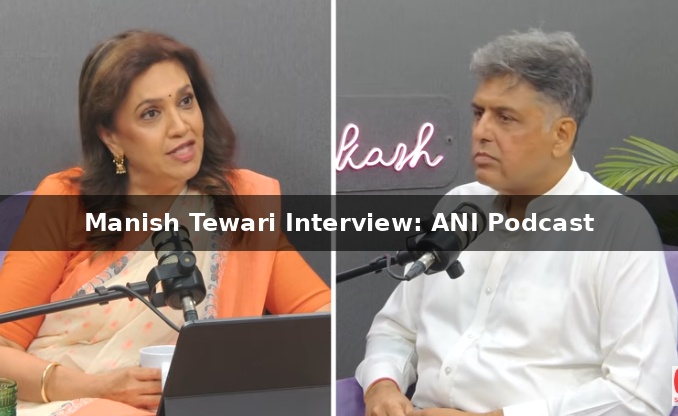
Episode Notes: In this episode of the ANI Podcast, Smita Prakash sits down with senior Congress leader and Member of Parliament Manish Tewari. A lawyer, prolific author, and veteran parliamentarian with over three decades in public life, Tewari offers a deep dive into some of India’s most pressing contemporary issues. The discussion spans across turbulent current affairs, including the protests surrounding the NEET exams, the structural challenges within the anti-defection law, and the ongoing political gridlock in Parliament. Tewari also reflects on his personal history, the trauma of losing his father to terrorism in Punjab, and the urgent need to preserve social cohesion and national unity above partisan politics.
Following is the full transcript of Indian lawyer and politician Manish Tewari‘s interview on ANI Podcast:
Introduction
SMITA PRAKASH: Namaste, Jai Hind! You’re watching or listening to another edition of the ANI Podcast with Smita Prakash. My guest today is the Congress MP from Chandigarh, Manish Tewari. He’s one of India’s most articulate voices on national security, foreign policy, and constitutional issues. A lawyer by training, a parliamentarian by profession, and a prolific author, Manish Tewari has spent over 3 decades at the intersection of politics, law, and public policy.
Thank you, Mr. Tewari, for being in the podcast. I’m very happy you’re here. I want to discuss your book. It’s like going back to college reading it, and every IR student must read it. So I’m reading it with, you know, taking notes down while reading because it’s going to help a lot.
So we’ll get to the book, but before that, I want to get to the current affairs because there’s so much happening and you’re in the thick of it with Parliament on. And of course, we’ll also talk about international affairs, national security, Punjab, everything. I was just thinking, what are the topics that I will discuss with you? And there are just so many because you write on— you’re a prolific writer and you are in court every other day. We’ll discuss some of the cases that you’ve been handling.
But first, let’s talk about this current conflict which is on, not the West Asia one, but which is currently on just a few miles from here. The students who are out there demanding for the resignation of the Education Minister, it’s become political with political parties getting in out there. What’s your take on the issue? Do you think that the government has mishandled it? Do you think that your party, the Congress Party, jumped into it a little late in the day? Should it have been political at all, politicized at all, and/or should it have been a purely student-led movement?
On the Student Movement and Government’s Response
MANISH TEWARI: Well, first of all, Smita, thank you very much for inviting me to your podcast. And I know that you are much watched, and the episodes, or the snippets of the podcast do tend to go viral all over the media space.
So let me try and contextualize before I answer your question. You see, I come from the ranks of the student movement of India. I was the national president of the National Students Union of India between 1988 and 1993. And then I was the only Asian who was the president of the International Union of Students, which was then headquartered in Prague, which is now the capital of Czechlands. And I also had the privilege of heading the— I was the national president of the Indian Youth Congress. So I’ve had a very long tenure from 1981 to 2000 in the student and youth movement of India.
When I saw what happened on Monday, it took me back to July of 1990, when the anti-Mandal movement started. I was then the national president of the NSUI, and our university-level leaders were actually the leaders of this movement. And I saw the government taking a very obdurate stand. And between July of 1990 and, if I recall correctly, the 1st of October of 1990, when the Supreme Court stepped in and stayed the recommendations of the Mandal Commission— of course, later on they upheld it in the Indra Sahni judgment, which of course then was accepted by everybody— a large number of innocent people all across the country lost their lives.
Student movements are never handled with a heavy hand. You need to talk to them. You need to reach out to them. You need to engage in a dialogue with them. If you think by the force of operation or by unleashing repression or beating them up with batons or using excessive force, you will be able to quell or squelch a movement, it has never happened. And my long experience in the student movement tells me to the contrary.
So therefore, government would be very well advised to talk to these students. There are problems in India’s education system. Those problems need to be fixed bottoms up. And so therefore, if the students have a point of view, that point of view should be heard. It should be appreciated because this is not only about the NEET exam. The NEET exam is really a trigger for more deep-seated frustrations emanating out of a very widespread scourge of unemployment and, of course, the rising cost of living.
So therefore, at times, most of these movements actually become a trigger for people to articulate the grievances which possibly have been piling up in their mental space. And that’s why I would very, very strongly urge the government, reach out to the students, engage in a dialogue with them, find a modus vivendi to see how the problems in the human resources/education sector are to be fixed. My prescription would be constitute a joint parliamentary committee to really look at the challenges in India’s education system.
Should Politicians Spearhead the Movement?
SMITA PRAKASH: And for the protest, do you agree that politicians should spearhead this movement now or let the students do it?
MANISH TEWARI: Ultimately, in this country, everything is political.
SIDDHARTH: Several.
SMITA PRAKASH: I mean, Assam.
MANISH TEWARI: So therefore, eventually, mainstream political parties are compelled to or otherwise become a part of these protests because there is a legitimate expectation that your public representatives will articulate your—
The India Alliance and the Jantar Mantar Protest
SMITA PRAKASH: Is this a little bit of bickering which is happening on the ground in the sense that from the very beginning, the Aam Aadmi Party was providing manor material to this protest in Jantar Mantar? Slowly and steadily, other political parties have got involved. You’re seeing the TMC also coming in out there. Samajwadi Party has also brought in its people. And then yesterday, the Jantar Mantar event took place where your senior leadership was there right in front of the Prime Minister’s residence. So it seems a little bit of a khichdi right now. Is it an India Alliance-led movement now? What is happening, if you can explain?
MANISH TEWARI: Purely as someone who has hands-on experience of these movements, my sense is that it is 90% organic. So therefore there is an upsurge, there are genuine grievances that people have, and those grievances are being articulated through the medium of this movement. Yes, political parties definitely do tend to get involved, and therefore— but that is really marginal.
Ultimately, if you look at the Indian National Congress, how it got involved, of course the Congress had been raising the NEET issue for a while, but essentially when excessive and brutal force was used on Monday, that really shook the conscience of everybody. And as public representatives, you obviously, when you live among people, you cannot see that brutality being unleashed on your children. And as I earlier mentioned, as someone who’s seen it earlier, this was redux to me, and I would strongly commend to the government, don’t waste time, engage with this. These movements do not tend to go away.
SMITA PRAKASH: Yeah, I get that. But coming back to the point of Aam Aadmi Party feeling a little miffed that the Congress has jumped in, and of course, when the Congress jumps in, all the media channels are focused on Rahul, Priyanka and the chief ministers, your chief ministers who have come in and become part of the protest. And he said, “To weaken the BJP’s dharana, Modi ji has seated Rahul Gandhi at a dharana at his residence.” This is his allegation that, you know, parachuted Rahul Gandhi. A little wild imagination, I would say, but then that’s my point of view. But all the same, it says, the tweet says that Rahul Gandhi was brought in there by Mr. Modi to protest out there.
Protests Outside the Prime Minister’s House — A Historical Perspective
MANISH TEWARI: I’ll tell you a story. So I was the national president of the NSUI. Mr. Rajiv Gandhi resigned as Prime Minister in 1989. Mr. Vishwanath Pratap Singh became Prime Minister. He used to live in Lodhi Estate those days. So as NSUI activists, we used to regularly protest at Prime Minister’s house. And more often than not, if Prime Minister VP Singh was at home, he would actually invite us in. He would give us a cup of tea because he was from the ranks of the Congress Party. He would actually take our memorandum, give us a cup of tea, and say, “All right, fine, I would look at it.”
I remember later when I was president of the Indian Youth Congress, we protested not once but ad nauseam outside Mr. Vajpayee’s house on Racecourse Road when he was Prime Minister. So therefore, a protest outside the Prime Minister’s house in a democracy— and mind you, when I was the All India Youth Congress president, it was 1998 to 2000, and the security situation even at that point in time was pretty volatile. So therefore, if people talk about sensitivities around the Prime Minister’s house, all I’m trying to say is that what happened on Tuesday afternoon is not really a first. In fact, for a generation of reporters or a generation of people who’ve not seen it, if I sound fossilized, to some extent I am. But we’ve been there and done it.
SMITA PRAKASH: It used to happen all the time for random people to land up out there. It happened even when you were a minister, if you remember, Nirbhaya. They landed up out there. They landed up at Vijay Chowk, the protesters. It happens when random people come, and I’m not trying to demean that you were a random person, but you were a student.
MANISH TEWARI: No, no, no, I was not a student. This was— I was the national president of the NSUI. These were protests organized— Students Union. Yeah, but these were protests organized—
SMITA PRAKASH: NSUI is students.
MANISH TEWARI: Yeah, but these were protests organized by the student organization of the Indian National Congress.
SMITA PRAKASH: Right, but here it’s leader of the Opposition plus 2 Chief Ministers. I have not seen a high-powered delegation in front of a PM House.
MANISH TEWARI: Let me jog your memory. I remember this was January of 1990. Late Prime Minister Rajiv Gandhi had demitted office as Prime Minister. He was Leader of the Opposition. There was a problem with regard to Karnataka, if I remember correctly, something to do with the Karnataka government. There was a Congress government in Karnataka at that point in time, and all the members of parliament led by the leader of opposition marched from Parliament House to the Prime Minister’s office, South Block, and we were also all there. As I told you, I was National President of the NSUI, and the whole night we sat on dharna outside the Prime Minister’s office in South Block. So what these days leads to hyperventilation, Smita, was par for the course in Indian democracy.
SMITA PRAKASH: Maybe somebody who doesn’t remember that period.
MANISH TEWARI: As I said, I’m a bit of a fossil when it comes to the contemporary political history of India.
SMITA PRAKASH: I don’t remember that anybody came. But 1990 would mean before the SPG was brought in. No, yeah, there was no SPG then.
The Anti-Defection Law and Parliamentary Disruptions
MANISH TEWARI: Of course, in 1984, after Prime Minister Mrs. Indira Gandhi got assassinated, the then Prime Minister was first of all guarded by the SFF, the Special Frontier Force. In 1985, the SPG Act was passed, the SPG was created. In fact, one of the biggest—
SMITA PRAKASH: In 1990 there was SPG?
MANISH TEWARI: Yes, yes. One of the biggest controversies of 1990 was that the SPG cover of the former Prime Minister, Mr. Gandhi, was withdrawn.
SMITA PRAKASH: Oh yeah, okay, okay, right.
MANISH TEWARI: And so therefore there was a—
SMITA PRAKASH: And those 4 police, Delhi policemen.
MANISH TEWARI: Yeah, so there was a feeling that if the SPG cover would have remained, what happened on the 21st of March, 1991 wouldn’t have happened. So the short point that I’m trying to make to you is that all this was par for the course in our democracy. Unfortunately, we seem to live in times of hyperventilation.
The Parliamentary Logjam Over NEET
SMITA PRAKASH: Okay, so to get back to that, what happened on Tuesday — Mr. Jitendra Singh is deputed by the Prime Minister to go and speak to Mr. Rahul Gandhi and ask him what are the demands. Mr. Rahul Gandhi gives the demands, Jitendra Singh goes back, speaks, and then when he comes back, whatever the 3 demands were, he said, okay, we are going to have the discussion in Parliament. Fine, we agree with that. He comes back and he says that Rahul Gandhi then changes the position and says that unless Dharmendra Pradhan doesn’t resign, the Education Minister, that’s not one demand which has been met.
Now that’s — now you’re talking about a logjam. And then comes the situation where physically he’s extricated out from there and put inside and taken to a lockup, he and Priyanka Gandhi and several other people with him. So he says that it seems like there is, and then today Rahul Gandhi in his briefing said something about Jitendra Singh, that it doesn’t matter about him when he was asked that this is what has happened. Now there seems to be like a battle of egos and no meeting ground at all. Even Sonam Mansukh has now said that resignation is not a criterion that is needed.
MANISH TEWARI: So let me again contextualize it for you because I was not there yesterday in the evening. But on the 16th of July, when we had a meeting of the Parliamentary Strategy Group — you must be having visuals of that — it was quite clear, and the sense of the meeting was that Mr. Dharmendra Pradhan needs to resign.
Subsequently, when the Congress Parliamentary Party met on Monday in the morning before the session started — this is the day when all that police brutality took place — again in the morning, the sense of the Congress Parliamentary Party meeting was that Dharmendra Pradhan needs to step down as the Human Resource Development/Education Minister.
So therefore, what Mr. Gandhi articulated during his protest in front of the Prime Minister’s house was not a position which he had evolved on the hop. In fact, this was the considered position of the Parliamentary Strategy Group supplemented by the Congress Parliamentary Party on 20th of July in the morning at 10:30 when the CPP met before the monsoon session of Parliament started.
So Mr. Jitendra Singh is a friend of mine also. He is entitled to have his own interpretation of events. I do not know what transpired between him and the Leader of Opposition because that’s a conversation they were privy to. But in my understanding, the resignation of Dharmendra Pradhan was a continuous demand of the Congress Party. It was not something which was evolved on the spot.
SMITA PRAKASH: So you think that Parliament session will just get stuck in the next couple of days? Because unless Mr. Pradhan doesn’t resign, there’s no going back. I mean, neither Samajwadi Party nor Aam Aadmi Party, nor I think the Congress is going to take anything less than a resignation from him or dismissal.
MANISH TEWARI: And till that happens, Smita, I have never been a supporter of disruptions, right? In fact, in November of 2010, when the people who are currently ruling wiped out the entire winter session of Parliament on a very spurious CNDAG report which had no legs to stand on, I had then told the Leader of Opposition, late Mrs. Sushma Swaraj, and Arun Jaitley, both of whom I had known for a fair amount of time in my life, that what you’re doing is not correct.
And when they repeated that in the monsoon session of 2012, and then Mr. Jaitley justified it by saying that “disruption is a legitimate parliamentary tactic,” I have — even if I’ve been in a minority of one — I have never ever agreed to or felt that disruption of Parliament is the correct way of going about it.
SMITA PRAKASH: Actually, at that time, I remember journalists saying that the BJP thinks it’s going to forever remain in opposition, and which is why the default mechanism or the default mode was that.
MANISH TEWARI: Yes, so therefore Mr. Jaitley had evolved a very creative analogy — “disruption is a legitimate parliamentary tactic.” So it’s come back to bite them. But to answer your question, I think things are deadlocked, right? So therefore, you are possibly and unfortunately looking at a potential washout of the monsoon session of Parliament.
Siddharth Joins the Conversation
SMITA PRAKASH: Okay, viewers and listeners, Siddharth has joined. He’s my colleague and he was covering the events of the day, so he joined me late in the podcast, so you can ask the questions. इसके बाद मैं बैठ के सुनूँगी आप दोनों को पर हम लोग अभी बात कर रहे थे। We just discussed what happened on Monday and on Tuesday, and Manish ji was saying that it seems like there’s a logjam in Parliament.
But I was saying it’s unfortunate because you submitted an adjournment motion notice in the Lok Sabha seeking discussion on the need for a new anti-defection law. Now, just yesterday, I had recorded a podcast with Mahesh Jethmalani, which I’m airing after airing yours, which is where he — when I asked him about the Anti-Defection Law, his take is that we need to scrap it completely. We don’t need an Anti-Defection Law. People should be allowed to vote whichever way they want to. And as far as the election is concerned, he still says that mechanism can evolve — that you get voted from a particular party, and if your ideology changes, or if you feel that the ideology has changed of the party that you got elected in, you should be allowed to vote whichever way in Parliament.
Ayaram Gayaram and the Origins of the Anti-Defection Law
MANISH TEWARI: So again, let me contextualize it. If you recall that in the late ’60s, it was ’67 or ’68, there was a gentleman who was called Ayaram. So he was a member of the Haryana Vidhan Sabha. Mr. Ayaram crossed the floor 8 times. So he was called Ayaram and Gayaram and Ayaram and Gayaram. And eventually it created a lot of disgust in the country that you cannot have your elected representatives behave like this.
So between 1968 and 1985, when this particular schedule was made a part of the Constitution, there were various instances of defection which was not predicated upon some genuine ideological differences or policy differences, but driven purely by opportunism. And this is the background in which in 1985, when the Congress had 415 MPs in Parliament and it didn’t require an anti-defection bill, this particular schedule was made a part of the Constitution.
Between 1985 and 2026, the anti-defection law has completely failed to deliver. On one hand, it has not been able to stop defections, which went from retail to wholesale and now have become a mega mart activity. And on the other hand, it completely took conscience, constituency, and common sense out of parliamentary proceedings and subjected them to what I call the tyranny of the whip.
So since 2010, I have a private member’s bill in play, now going back 16 years, which seeks to limit the rigors of the anti-defection law to only those instruments which impact the stability of government — no confidence motions, adjournment motions, money bills, finance bills — and free up the rest of the legislative space.
But between 2010 and 2026, in 16 years, we’ve traveled a long distance. And so therefore, the reason why I moved that adjournment motion is because Parliament needs to seriously discuss how do you stop these opportunism-driven defections whereby — look at what is happening in the Council of States in the Rajya Sabha. The complexion of a state Vidhan Sabha changes and the same eminences resign and come back elected as members of a different political party.
So therefore you have to find the golden mean. How do you stop these opportunism-driven defections, at the same time provide for space for critical dissent? If you have serious ideological or policy differences with your political party, how can you articulate them in Parliament and outside without incurring the risk of losing your membership? Because ultimately, while you are selected by the party to run on its ticket, it is the people who elect you. So your first accountability is really to your electorate, which is what Mr.—
SMITA PRAKASH: Jethmalani is saying also.
MANISH TEWARI: He’s — so, but are we at a stage whereby we can lock, stock, and barrel junk the anti-defection law?
SMITA PRAKASH: I do not know, because honestly, look at the 10th Schedule, everything — relook at everything.
MANISH TEWARI: Yeah, because honestly, between 1952 and 1985, we functioned without an anti-defection law, right? Exactly. And so therefore, if you actually look at the quality of debate in Parliament between ’52 and ’85 and ’85 and 2026, there is a world of a difference. And the reason for that is earlier an MP knew that his vote mattered. So therefore, even on the treasury benches, ministers had to walk an extra mile to build a consensus within their own ranks. Forget the opposition.
Now, there is some joint secretary in government who makes a bill. By the time some minister brings it to Parliament, a whip is issued. So therefore, those on the Treasury benches invariably vote in favor. Those on the opposition benches invariably vote against. And there is no incentive for researching, for actually bettering as to how or learning best practices to incorporate into the law.
And therefore, at 2 o’clock in the afternoon, when Parliament meets for government business, which is the primary business of Parliament, most of the times there is no quorum. And also there is an unspoken understanding between the Treasury and the opposition benches that the quorum issue will not be raised. And this has happened because—
SMITA PRAKASH: Which is why there’s no literacy regarding the bills also.
MANISH TEWARI: This is the reason, because every member of parliament feels disempowered. He knows that his vote doesn’t matter, right? So therefore, if at all he does run the risk of articulating a different point of view from what his party has, that comes at the risk of losing your membership.
Dissent Within the Party and the Lokpal Bill
SMITA PRAKASH: I sense a little bit of angst in your voice. On national security matters, there are people like you and Shashi Tharoor who’ve taken a view slightly contrarian.
MANISH TEWARI: Not only that — there is a provision in the 10th Schedule where you can ask for permission from your party to vote against the whip. Or if you vote against the whip, that act of yours can be condoned within 15 days. I had serious reservations about the Lokpal Bill, which I still continue to have. You know that will require — nobody knows कि क्या है भी कि नहीं है। So that, you know, that’ll require a whole episode to explain it. I will not bore you with the details, but I actually did write a letter seeking permission that I be allowed to vote against this bill.
SMITA PRAKASH: Even on the nuclear issue, people in the BJP at that time were in favor of the nuclear issue, but then again the same whole whip issue comes in.
MANISH TEWARI: So therefore, this entire gamut of whip-driven tyranny requires a complete revisit. And that is why these adjournment motions which I’ve been moving — which of course come at a point in time when emotions are running very high inside and outside Parliament — I think this is the most fundamental thing that Parliament needs to do today.
SIDDHARTH: सबसे पहले मैं हम lighter note पे सर के सामने ही बात रखते हैं जो आयराम का सिक्र किया, उनके बेटे अभी कुछ दिन पहले तक हरियाणा कांग्रेस के प्रेसिडेंट थे। उदय बानुजी। But सर एक बात है जब यहाँ पे कहते हैं कि 2010 में आपने इसको introduce private member bill के तौर पे किया, but Congress party 2010 से 14 तक they were in power.
The Anti-Defection Law and Parliamentary Democracy
MANISH TEWARI: And still, 2014 से 2026 सर, 12 साल में आप लोग भी सबसे ज़्यादा इससे प्रभावित रहे हैं, तो पार्टी क्यों नहीं टेकअप करती है? बड़ी बात ये ही है कि पार्टी क्यों नहीं आपकी टेकअप कर?
सिद्धार्थ, ऐसा है कि जो एंटी डिफेक्शन लॉ है और जिस तरह से उसकी संरचना की गई है, वो हर पार्टी के शीर्ष नेतृत्व को — कटु सत्य है पर ये सत्य है — चाहे वो भारतीय जनता पार्टी हो, चाहे कांग्रेस हो, चाहे वामपंथी दल हो, चाहे आम आदमी पार्टी हो, चाहे कोई भी पार्टी हो — हर दल के शीर्ष नेतृत्व को ये जो टेंथ शेड्यूल है और जिस तरह से उसकी संरचना हुई है, वो उनके बहुत अनुकूल है।
पर उसका जो बहुत बड़ा नुकसान संसद का हुआ है, और संसदीय कार्रवाई का हुआ है, और संसदीय प्रणाली का हुआ है, और जिस तरह की बहस संसद में आज होती है और 1985 से पहले होती थी, उसमें जमीन आसमान का फर्क है। तो इसलिए जो मुख्य उद्देश्य था इस दल बदलू कानून का कि दल बदल को रोका जाए, उसमें तो पूरी तरह से विफल हो गया है।
ये दुर्भाग्यपूर्ण बात है कि इसके ऊपर अगर समय पे उच्चतम न्यायालय कुछ फैसले दे देता, तो उसका एक बहुत रचनात्मक प्रभाव पड़ता। पर आज ये मौका आ गया है कि इसको पूरी तरह से नए सिरे से देखने की जरूरत है।
अगर मेरी जानकारी सही है, आज ही कपिल सिब्बल साहब ने अपने व्यक्तिगत नाम में एक जनहित याचिका दायर की है उच्चतम न्यायालय में, इस एंटी डिफेक्शन लॉ की परिभाषा के लिए, इसको परिभाषित करने के लिए — आज ही दायर की गई है। शायद सोमवार — थोड़ा प्रोएक्टिव स्टेप ले रहे हैं कांग्रेस पार्टी। शायद, शायद नहीं। आजकल लोग — पर वो लोग — टीएमसी बेनिफिट करेगी शायद, क्योंकि वो सबसे ज़्यादा —
पर एक बार लार्जर पिक्चर देखें भाई, सिर्फ नैरो विज़न नहीं है, सिर्फ पार्टी विज़न नहीं है। For the larger good of parliamentary democracy, इसलिए कर रहे हैं। पार्टी नहीं सुनती ऐसी बात की, पर कपिल सिब्बल ने कई बार कहा हुआ है कि उनके डीएनए में कांग्रेस है, तो वो चाहे जिस पार्टी में भी —
प्रोटेस्ट को लेकर अब कांग्रेस लीडरशिप ले रही है और बाकी पार्टीज कह रहे हैं कि ये अट्टी-सट्टी है बीजेपी और कांग्रेस के बीच में। क्या ये सिर्फ सोशल मीडिया में ही ये कॉन्स्पिरेसी थियरी है, कि एक्चुअली ग्राउंड पे भी रिपोर्टर्स ये बात कर रहे हैं? अब हम ग्राउंड पे तो —
बात जहाँ तक ये हो — और इंटरेस्टिंग बात ये है कि समाजवादी पार्टी ने — रामगोपाल यादव से आज हमने जो सवाल पूछा, तो उन्होंने कहा कि बिल्कुल — आप बात के किस तरीके से कह रहे हैं, हमारी समस्या बाहर है।
अखिलेश यादव बड़े नाराज थे। Did you see this? अध्यक्ष मोदे, आपको नहीं बोलने दे रहे हैं। अध्यक्ष मोदे — अखिलेश — ये आपने इनको बुलवा दिया, इनको बुलवा दिया, क्या समझौता कर लिया आपने क्या? This is what he got very emotional about — कि समझौता, आप लोग समझौता करने लग गए हैं, BJP के साथ, वो भी।
देखिए, ऐसा है कि जो सोमवार को हुआ, उससे सभी लोग बहुत ज़्यादा disturbed थे। और मेरे ख़याल में, जो आज अखिलेश जी ने कहा संसद में, लोकसभा में, ये उसी का उद्घोष था कि भई, हमको भी जो हमारी बात है, वो रखने का मौका दिया जाए।
और अमूमन जब इस तरह की बहस होती है या चर्चा होती है लोकसभा में, तो हर दल से एक-एक व्यक्ति को बुलाया जाता है और सभी को बोलने का मौका दिया जाता है। तो बिल्कुल उसी उत्तेजना में आज अपनी वेदना जाहिर की कि भई, हमको भी बोलना है।
उसके पीछे की सर पटकता शायद आपको तो मालूम होगी, लेकिन हम लोग वहाँ थे, तो वहाँ ये रहा कि सुबह केसी वेणुगोपाल मिलके आए थे लोकसभा स्पीकर से। अब फिर वो लड़ाई हो गई — केसी वेणुगोपाल — और वही वही है। मैं उसके वजह — ये रही कि एक दिन पहले जब लोकसभा — लेकिन आज केसी वेणुगोपाल अकेले मिलके आ जाते हैं, और जब अकेले मिलते हैं लोकसभा स्पीकर से, अकेले मिलके आ जाते हैं, तो शायद यही बात जो है, अखिलेश यादव को नागवार गुजरी।
क्योंकि बात हो रही थी — डिस्कशन किस रूल के अंडर में हो, एडजस्टमेंट नोटिस पे हो या कॉलिंग अटेंशन पे हो — इसी बात में अपना स्टैंड क्लियर किया है, तो वो स्टैंड क्लियर करने के चक्कर में यहाँ चीजें डिले — लोगों को नहीं —
देखिए, ऐसा है कि किस प्रावधान के तहत बहस होनी चाहिए, उसका क्या स्वरूप होना चाहिए, ये टेक्निकल इश्यूज़ हैं कि लोकसभा में दो ही प्रावधान हैं, या 144 है, या 193 में है।
और मैंने काफी लोगों से बात की पिछले दो दिनों में — एक, जिसको अंग्रेजी में कहते हैं, general sense of unease है सांसदों में, कि भई, जो हुआ वो बिल्कुल पूरी तरह से गलत था, इस तरह से बर्बरता से व्यवहार नहीं होना चाहिए था, उनसे बातचीत की जानी चाहिए थी। और काफी सारे सांसद, including डिम्पल यादव जी, वहाँ पे थीं। और जब ये सारा घटनाक्रम हुआ है, तो जरूर लोग अपनी बात रखना चाहते हैं — इसमें ज़्यादा कुछ पढ़ने की ज़रूरत नहीं है।
लेकिन, पर जब अनबन होती है ना, between आम आदमी पार्टी, कांग्रेस, and समाजवादी पार्टी, everybody sees कि अगर अभी से ये लड़ रहे हैं —
तो फिर — जो कांग्रेस और आम आदमी पार्टी के गठबंधन पे जीता हूँ, वह शायद अकेला इंडिया अलाइंस का ऐसा कैंडिडेट हूँ पूरे देश में जो जीत के आया है। और एक गठबंधन को चलाना कोई आसान काम नहीं है, क्योंकि जब — चाहे चंडीगढ़ एक ही संसदीय क्षेत्र था, पर वहाँ पे आम आदमी पार्टी, समाजवादी पार्टी, राष्ट्रीय जनता दल, और बाकी जितने घटक दल थे इंडिया अलाइंस के — सबको जोड़ के चुनाव लड़ना, वो भी 40-45 दिन — वो एक अपने आप में कला है।
तो किसी भी coalition को संगठित रखना — इसके लिए जो coalition का बड़ा पार्टनर होता है, जो उस सारे ताने-बाने का सबसे बड़ा पार्टनर होता है, उसको थोड़ी सी और कोशिश करनी पड़ती है। He has to walk the extra mile.
Crossing the Aisle: Civility in a Polarised Parliament
SMITA PRAKASH: And you are very talented at going across party lines to get a consensus. In fact, this video went viral about how you are very genial with people from different parts of the aisle. इसके बारे में जरा बताएं, तो क्या हुआ, क्या था? Two handshake वाला — मतलब one hand, two hand shake, then one hand, and then tap on the shoulder happens, tap on the shoulder and then shake hand again happens. तो क्या हुआ?
MANISH TEWARI: देखिए, ऐसा है कि वो देश के प्रधानमंत्री हैं। मैं चंडीगढ़ से सांसद हूँ। मेरे को याद है कि जब 22 अगस्त, 24 अगस्त 2022 को प्रधानमंत्री श्री आनंदपुर साहब आए थे, न्यू चंडीगढ़, वहाँ पे एक नया कैंसर हॉस्पिटल बना था — भावा मेमोरियल रिसर्च सेंटर — आज उत्तर भारत का सबसे बड़ा कैंसर हॉस्पिटल है।
तो जब उनका उद्घाटन करने आए थे, तो पंजाब के मुख्यमंत्री भगवंत मान और मैं दोनों डायस पे मौजूद थे। इस बारी जब वो चंडीगढ़ आए, कई विकास कार्यों का उद्घाटन करने के लिए, और उनमें से अधिकतर विकास कार्य ऐसे थे जिनके लिए मैंने पहल की थी, जब मैं श्री आनंदपुर साहब से सांसद था, या अब चंडीगढ़ से सांसद हूँ — तो ये तो मेरा उत्तरदायित्व तो बनता था कि अगर प्रधानमंत्री मेरे चुनाव क्षेत्र में आते हैं, तो वहाँ का सांसद होने के नाते —
It’s turned increasingly toxic and corrosive, where political rivals are now considered as mortal adversaries.
SMITA PRAKASH: You have a way with words, don’t you? “Delhi today epitomises this broken politics. However, I’m still a little old school, who still believes in certain basic courtesies and tenets of protocol, and above all, keeping the imperatives of development above partisan
Pakistan’s Perfidy and Cross-Border Terrorism
MANISH TEWARI: No, no, no. I mean, if at all there is any speculation that this is possibly the reason why— look, I do strongly feel that we have been facing a very serious challenge from our Western neighbor. Ever since we decided to redraw the political map of South Asia and create Bangladesh in December of 1971, Pakistan has been thirsting for retribution and vengeance since then.
That’s how Punjab became the first frontier in the mid-1970s, and post the kinetic actions of 7th to 10th May 2025, especially given the manner in which the entire Baisaran massacre was executed, I think it was very important to tell the world the story of Pakistan’s perfidy now going back 4 and a half decades. And I don’t think that in a very expansive and a holistic manner that story has ever really been told. And you’ll find that in my book, there is—
SMITA PRAKASH: and your articles—
MANISH TEWARI: and there’s been a very expansive reference to it. So under those circumstances, the parliamentary delegations that went out and which I was a part of — in my estimation and in my mind, and given the circumstances that I come from, it was an opportunity for the first time to really tell the world the story of Pakistan’s perfidy and its sponsorship of cross-border terrorism in absolutely a holistic manner.
SMITA PRAKASH: Did you get the permission of your party to travel with—
MANISH TEWARI: Of course. Of course, of course.
SMITA PRAKASH: In the sense, they were on board, they were fine with it that you were going on a— representing the Indian point of view.
MANISH TEWARI: Look, I’ll tell you, there was a lot of speculation even then, but insofar as they were concerned, or the leadership of the Indian National Congress was concerned, all those people who were at that point in time nominated by the government to travel, they were comfortable with all of them.
SIDDHARTH: Did anybody reach out to you when your name first came up that you will be part of the delegation, from your party leadership, to inquire about that thing?
MANISH TEWARI: But there was no reason to inquire. What was the reason to inquire? Because ultimately, government reached out and we told the government that you talk to our party leadership. Government must have spoken to our party leadership. We informed the party leadership and that’s the end of it.
You see, you must understand that when it comes to issues of supreme national interest, you have to put that above parties and politics. And I think that possibly the amount that Pakistan has tried to bleed us with a thousand cuts— if as an Indian, forget as an Indian parliamentarian, I was getting the chance to tell the world as to what we have been subjected to since, let’s say, 1978-79, repeatedly, incessantly — Punjab, 1980 to 1995, Kashmir from 1990 onwards, then upscaled to the rest of the country.
You know, you had the Kargil War, you had the IC814 hijack, you had the Jammu and Kashmir Assembly bombings, then you had the attack on Parliament, then you had 26/11, then you had the Uri attack, then you had Balakot, and then you had Baisaran. So therefore, this has been a continuum across different dispensations and different administrations, and the cost of that has been paid by Indian citizens in their blood.
So under those circumstances, it really didn’t matter as to who thought what, because this is a story which needed to be told, and the world needed to be told that, look, you guys keep blowing hot and cold with Pakistan now going back to the ’50s when they were a part of the Southeast Asian Treaty Organization, the Central Treaty Organization known as the Baghdad Pact, then during the days of the Afghan jihad, and then the war on terror, and then again this back and forth. But the consequences of that and the attendant flow of funds and weapons — the blowback — has to be borne by us in the region. And I don’t think over all these years and over all the different administrations that story holistically was ever told.
A Personal Tragedy: The Assassination of His Father
SMITA PRAKASH: You’re talking now of the story of terrorism, but I need to know about your story also, not just as a politician. Your family paid the highest ever price. Your father was assassinated by Khalistani terrorists. Can you take me back to that day?
MANISH TEWARI: Look, in a sense, those are very traumatic memories, so I will not really go into great detail, but I can explain it to you as to where were you on the day. We were at home.
SMITA PRAKASH: So you were at home? What happened?
MANISH TEWARI: Absolutely. So my father was a professor of comparative modern Indian literature at Punjab University Chandigarh. He was also concurrently the chairperson of the Punjabi School. My mother was next door in the PGI. She was a doctor and she spent her entire lifetime in PGI. And my father was also a nominated member of parliament. He had been nominated for his work in literature.
And when things started boiling in Punjab, or they started simmering in the 1980s, in the early ’80s, he was a very, very strong exponent of Punjab, Punjabi, and Punjabiyat, which was the composite culture of Hindus and Sikhs living together in harmony. Now, this was a direct ideological challenge to those who were preaching separatism by the use of violence.
And in December of 1983, he had organized a World Punjabi Writers Conference at FICCI Auditorium in New Delhi, which was inaugurated by the then Prime Minister, Mrs. Indira Gandhi. And Giani Zail Singh had given the valedictory address. They had collected almost every distinguished Punjabi writer, poet, painter, sculptor — anybody associated with the arts and other influential people from Punjab — essentially in order to reinforce this spirit of Punjab, Punjabi, and Punjabiyat, which was not to the liking of those who were preaching separatism. So this was the background of why they decided to assassinate him on the 3rd of April, 1984.
SMITA PRAKASH: But I mean, he was apolitical in some respect, in the sense that he was not a very aggressive politician, right? Why was he targeted?
MANISH TEWARI: Well, you see, ideological adversaries — if you look at history, and if you read history, ideological adversaries have been considered to be the most dangerous by their enemies.
SIDDHARTH: Okay.
MANISH TEWARI: And so therefore, the power of the idea, the power of the thought—
SMITA PRAKASH: which is why journalists also— yeah.
MANISH TEWARI: So the power of the idea, the power of the thought is considered to be far, far more lethal than even a bullet or a gun. So if you really go through the annals of history, you will see that poets, writers, scholars — Bangladesh, yeah, yeah — they were the first ones to be targeted.
SMITA PRAKASH: Yeah, thank you.
MANISH TEWARI: And so therefore, that’s why you would see in all my writings, I keep on trying to emphasize this fact that the only antidote that Punjab has against the malefic machinations of our Western neighbor is our composite culture, is our social cohesion, is our unity.
The Making of a Politician
SMITA PRAKASH: But how did it affect you as a son, as somebody who was just about thinking of a political career, probably of your own? In that period, people sent away their sons because they thought they were the next ones, or they sent away their daughters that इनको मारेंगे. Did your mother want to send you away?
MANISH TEWARI: Well, I was not contemplating a political career. I was actually preparing to take my entrance exam for an MBA course. And I was in BA second year at that point in time. I mean, I think we were supposed to give our examinations for our second year of graduation. So I was really contemplating—
SMITA PRAKASH: so your dad was not grooming you into politics?
MANISH TEWARI: No, no, no, absolutely not. So I was contemplating a career in management. And what that assassination did was actually it reinforced my belief that this is an ideological fight which has to be fought. And that is how I ended up becoming the National Secretary of the NSUI in 1984. And between 1985 and 1992, when none of these so-called leaders of Punjab who are there on the horizon today were even around, we used to go out every day on mass contact programs in universities, in colleges, to people to try and fight the ideological battle against separatism, extremism, and terrorism in the trench lines of Punjab.
SMITA PRAKASH: In ’84, when Mrs. Gandhi gets assassinated, was it like reliving your father’s assassination?
MANISH TEWARI: Well, in the sense, those were very traumatic times. In fact, the whole decade from 1980 to 1995 is a very traumatic period for Punjab, right? Over—
SMITA PRAKASH: no, tell me about yourself.
MANISH TEWARI: Well, in the sense, I was also a part of that larger tragedy which unfolded for almost, if I may say, a very substantial majority of the people of Punjab.
SMITA PRAKASH: Did you understand or did you empathize with Rajiv Gandhi because he lost his mother just like you lost your dad? Is there a meeting point for— the reason I want to know is that what is it that binds children of politicians who have such gory ends, such violent ends?
MANISH TEWARI: Well, one thing that a tragedy of this kind does is actually it makes you very dispassionate and reflective. I—
SMITA PRAKASH: that’s what it seems to me right now.
MANISH TEWARI: It makes you very dispassionate and reflective. In fact, I am in the process of writing a book on those turbulent days of Punjab. A book which I have been trying to write now for the last 4 decades. But I just keep collecting material and material. And so therefore, at some point in time, I would get down to finally writing it. But it actually gave me a very deep understanding of this land which has been brutalized and traumatized for hundreds of years now, going back hundreds of years. And therefore, whenever Punjab becomes turbulent or goes through turmoil, it automatically impels me to underscore, reiterate, and underline the fact that, look, our future does not lie in separatism. Our future really lies in our social cohesion and unity.
A World Adrift — The Book and the Man Behind It
SMITA PRAKASH: You know, the problem is, I’ve known you for so long and for so many years. I knew you would talk like this. So which is why when I read this line, I knew immediately, and I underlined it, and I said, “ये तो I am sure my conversation with Manish Tewari will take this line.” And which is when I read this book — and all your writings that I read, and I read them — you said A World Adrift, this book, and I seriously recommend this book, says that attempts to look at these issues from a detached, objective, and clinical perspective without ideological lenses. So that is exactly how your writings are. And try as much as I may to find out what does Manish Tewari, the person, think. It’s impossible. It’s like talking to a professor.
MANISH TEWARI: No, no, Smita, it’s—
SMITA PRAKASH: you just look— I can’t peel away that.
MANISH TEWARI: Yeah, see, there are certain things that you just bury in the recesses of your mind, right?
SMITA PRAKASH: I wonder.
MANISH TEWARI: And so therefore, you know, there is nothing to be served by regurgitating or by raising those apparitions of the past. Why? For the simple reason it gets you nowhere, right? So therefore—
SMITA PRAKASH: it does. Durandar, you’ve seen? I think it does. I haven’t seen Satluj, but Sadahak or any other Punjabi— why? If you don’t relive the angst of that period— I’m sorry, I’m sounding very emotional. It’s your emotions which should be surfacing right now. But if you don’t relive that, you relive the experience of that horror again, you can’t bury it. This is what I talk to, you know, children of partition. They say बड़ा ही बुरा हुआ है। क्या बुरा हुआ है? बताओ तो दो ताकि फिर से कभी ना हो। You hear when you talk to expats who ran away from here during after the 1984 event, they say बड़ा ही बुरा हुआ है. But they don’t talk about it. If you don’t talk about it, there is no closure.
Poetry, Punjab, and His Father’s Legacy
MANISH TEWARI: So let me then quote three couplets to you which form a part of my last article in Punjab on Punjab. The first, of course, underscores our composite culture, which is कि नौ वरियां दे नानक ने आप चंजू नहीं पाया, ते नौ वरियां दे गोगंद ने नौवें नानक नो चंजू दी रखा है वास्ते विदा कीता ते मुस्कराया। These lines are from my father’s poem. It’s called Hindi Chadar. It was written, I think, somewhere in 1974 when it was the 300th martyrdom of Guru Tegh Bahadur Sahib, or somewhere around that time. The second, of course, is the very famous—
SMITA PRAKASH: Do explain that, that Guru Nanak did not wear the janeu when asked to tie a knot.
Punjab’s Complex History and Personal Reflections
MANISH TEWARI: So basically, you see, the Sikh faith was also a part of the larger Renaissance movement in India, which was premised on religious reform. So therefore, Guru Nanak, when he was 9 years old and when the sacred thread ceremony is supposed to be done, he actually taught the priest about spiritual and temporal purity, rather than mere ritualism.
And then when the Kashmiri Pandits actually came to Guru Tegh Bahadur at Sri Anandpur Sahib requesting him to protect them from the depredations of Aurangzeb, who was killing them en masse because they were not converting their faith. And Guru Tegh Bahadur said that it would require the sacrifice of somebody who is great and exalted. And Guru Gobind Singh Ji said to him, “But who greater than you?” So therefore, Guru Tegh Bahadur, at that point in time, to protect the religious freedom of the Kashmiri Pandits, to stop these conversions from taking place, actually gave the supreme sacrifice of his life, which Amit Shah last week only repeated.
So therefore, you see, that is the basis of the composite culture of Punjab. The second, of course, is that if you look at Punjab in a perspective now going back to the times of Alexander of Macedonia, India has been invaded over 200 times. And every invader except the Europeans and the British came down the Khyber Pass. So therefore, that gave rise to a very intrinsic sense of fatalism in the Punjabi. And it is summed up in that couplet: कि खादा पीता लाहेदा ते बाकी अमर चाबदली। But whatever you eat and drink is yours; rest, अमर चाबदली will take away.
And on what happened between 1980 and 1995, and which I’ll come to your question about partition. Surjit Patr, who was a friend of my late father’s, one of the most renowned poets of Punjab, he had written. He says, “पहला वारिश सानू बंदे आसी।” When the partition of 1947 took place, होन शिव कुमार दी बारी है। He’s talking about शिव कुमार बटालवी, right? Who was again a great poet of Punjab. पुराने जखम पुल गए हों, नवयादी तैयारी है। So therefore, that is why the story of Punjab is a very complex and a complicated story. And I keep repeating that Delhi—
SMITA PRAKASH: This quotation is about repeated invasions and repeated divisions in power.
MANISH TEWARI: And that— this is a story about how from 1947, between the April and the July— because see, the partition of India was actually not the partition of India. It was the partition of 2 provinces of India, Punjab and Bengal. Bengal suffered a little less, primarily because Mahatma Gandhi decided to go and camp there.
But in Punjab, between March of 1947 and September of 1947, 2 million people— Hindus, Muslims, Sikhs— were massacred in a grotesque orgy of violence. And over 20 million people became homeless. So therefore, a Punjab which had stretched in 1901 from Delhi all the way till the Khyber Pass first got truncated, and the NWFP, the Trans-Indus Provinces, were taken away, then partitioned again, then trifurcated in 1966.
And which is why I keep telling everybody that Delhi, irrespective of whichever is the government in Delhi, has never understood Punjab. And that is why they are not able to understand either the emotions or the sensitivities or the culture or the basic spirit of the Punjabi. And they continuously keep mishandling.
On His Father’s Assassination
SMITA PRAKASH: When he was assassinated, when your father was assassinated, there’s a quotation that— tell me if this is right or not, where you said that I was told he was killed because he was a Hindu.
MANISH TEWARI: I don’t remember saying that. You see, you must also understand that my mother was a Jat Sikh. My maternal grandfather was a freedom fighter. He was from the Praja Mandal movement. These were people who were fighting in the statespeople’s movements against all these feudal rulers. And so they were in the Prajamandal struggle against the Maharaja of Patiala, the Maharaja of Sangrur, Jind, etc., etc.
And after my father’s assassination, we actually lived with my maternal uncles who were all Jat Sikhs, right? So therefore, half of my family, or my mother’s side of the family, they are all Jat Sikhs. So therefore, the feeling that Hindus and Sikhs are separate or are different from each other is not something that we ever grew up with. And I did not allow my personal circumstances to taint that fundamental fact. That’s so difficult to taint that fundamental fact that we are the same people.
And that is why, Smita, you had an orgy of violence in Punjab, right? And even in Delhi, the unfortunate, horrible massacre of Sikhs which took place in Delhi. But from 1980 to 1995, there was not a single communal riot in Punjab. The Hindus and the Sikhs never went for each other, irrespective of the bloodletting which had taken place.
SMITA PRAKASH: In fact, so you don’t call that a communal situation, the anti-Hindu riots and the anti-Sikh pogrom which happened?
MANISH TEWARI: See, the anti-Sikh pogrom in Delhi was definitely communal, right? There is absolutely no justification which anyone should have, can have, for what happened in Delhi between the 1st to the 4th of November 1984.
But insofar as the militancy or the terrorism in Punjab was concerned, that was a movement for separatism, which then acquired a religious hue and became a terrorist movement in a substantial measure actually fueled and supported by our Western neighbor. So therefore, those were 2 different situations altogether, and that is why I keep saying that in fact, if you look at the actual numbers, there are more Sikhs who died in Punjab than Hindus between 1980 and 1995. If the list of the 23,000-odd, who died as a consequence of terrorist violence in Punjab, if you really peruse that list, and I used to remember it at one point in time, I don’t have the figure from the top of my head, but I do recall there were more Sikhs who died.
On Banning Films and Artistic Expression
SMITA PRAKASH: Have you seen the movie Satluj? Not yet.
MANISH TEWARI: Well, as a rule, or maybe just out of— I do not kind of see movies. If you remember, I said you’re an I&B minister. Yes. And I sent you the piece in which I have described how I dealt with Sardar. Yeah. So therefore, rather than banning it, when there was a view in the establishment that it might cause a lot of consternation and a lot of emotional upsurge in the people, I held my nerve and I said, under no circumstances am I going to proscribe it.
SMITA PRAKASH: And ultimately, पर ये banning तो होता है. Satanic Verses were banned— no, no, but— and then other books were banned.
MANISH TEWARI: No, no, but the thing is that singers were banned. It depends upon your personal convictions. Primarily, maybe my personal convictions are shaped by the fact that my father was a writer, right? So I grew up in a household where there was respect for artistic expression, howsoever violently you may disagree with it.
SMITA PRAKASH: So, Satluj, you haven’t seen that movie?
MANISH TEWARI: No, I haven’t seen it.
SMITA PRAKASH: And you don’t believe banning should happen?
MANISH TEWARI: I mean, as I said, as I told you, I very, very clearly took a position that I will not interfere into the certification processes of Zadahak. I allowed the certification and the judicial processes to play themselves out without any let or hindrance.
SMITA PRAKASH: Have you seen Accidental Prime Minister?
SIDDHARTH: No.
SMITA PRAKASH: You’ve read the book? By Sanjay Baru? You didn’t read the book nor see the film?
MANISH TEWARI: No.
SMITA PRAKASH: Because you were offended by the idea?
MANISH TEWARI: No, the kind of things that I try to read is—
SMITA PRAKASH: It was your former boss.
MANISH TEWARI: It is more geostrategic. So therefore, if you ask me, have you read Diplomacy by Kissinger, I will tell you yes. If you tell me that’s so cerebral— if you ask me that, have you read stuff like that, I would say yes. But I actually don’t read all this.
SMITA PRAKASH: It’s just curiosity that you’d want to know that a book written about your former boss, where do you figure in that book, if at all you do? And he was a colleague of yours, Sanjay Baru.
On Dr. Manmohan Singh
MANISH TEWARI: Look, you handled the media, so did he. I knew Dr. Manmohan Singh from the day I was born, right. Mrs. Manmohan Singh, Gursharan Kaur ji, my mother, and late Prakash Singh Badal ji’s wife, Mrs. Surinder Kaur, they were classmates in Victoria School, Patiala.
In fact, once when I had gone to meet Doc Saab after he ceased to be Prime Minister— their daughter has written this wonderful book on her parents, and so she picked up the book and she opened a photograph and put her hand like this. ये पछाने कौन है? So it was a photograph of the three of them. So therefore, for me to really need to read somebody else’s account to know Dr. Manmohan Singh, I don’t think that was really required. I mean, with all great respect to Dr. Sanjay Baru’s book, he’s a friend of mine. But yes, I have not read the book.
SMITA PRAKASH: हम्म, okay. आपने देखी है पिक्चर?
On Punjab’s Trifurcation and Chandigarh
SIDDHARTH: नहीं। चांस नहीं मिला मैम। But आपसे एक बात जरूर पूछना चाह रहा था सर, when you’re talking about your father, you’re talking about Punjab and Punjabiyyat, उस वक्त जो नारा लगता था कि पंजाबी सुबह लैंड नहीं देना, फेरुमान नूर है नहीं देना, उस वक्त आप लोगों के आपके thought क्या थे? और दूसरा ये कि कहाँ क तो ये बड़ा पता लगता है कि आपके बारे में कि आप बहुत समय से आप चाहते थे कि आप चंडीगढ़ को रिप्रेजेंट करें क्या ये बात सही है और या इस वजह से सही है या इस वजह से आप चाहते थे अगर सही है तो क्योंकि आपके फादर वहाँ सेसिनेट हुए थे?
No, no, see, so therefore, according to me, the 1966 trifurcation of पंजाब may have worked for some political interests in Punjab, Himachal, Haryana.
SMITA PRAKASH: Just for our NRI viewers, if in case you haven’t followed Punjab politics, so therefore, थोड़ा सा हाँ.
MANISH TEWARI: It may have worked for some political interests in Punjab or in the two other states which came out of that trifurcation. But it has not really worked for Punjab, right? So therefore, in fact, some of the challenges which Punjab faces today, or even for that matter Himachal Pradesh faces, or Haryana, if you leave out Faridabad and Gurgaon— there are structural challenges, right? So therefore, there are challenges not primarily of governance, but there are deeper structural challenges. I can go into it at some point in time.
Insofar as Chandigarh is concerned, yes, because I was born there. I went to school, college, university there. It is my city. I do love that place very, very deeply and intimately. And yes, so therefore, I wanted to represent it, and that is a legitimate aspiration.
SIDDHARTH: And because earlier, first time you were given chance from Kanpur, by late— well, that’s a long story.
MANISH TEWARI: So therefore, if you start going into my monster, which is in plain English called a resume, you know, you will spend this entire podcast delving into a very, very—
On Ravneet Singh Bittu and Painful Memories
SMITA PRAKASH: Let me come back then to the present. I asked you a question about being an offspring of a parent who was assassinated when we talked about Rajiv Gandhi. There’s also Ravneet Singh Bittu, whose grandfather was assassinated by Khalistani terrorists. Now that has again resurfaced. Now everybody is talking about that assassination. We have very short memories in India about these painful pasts. Like you were saying that people don’t talk about it. It’s happened, it’s gone. Let’s not talk about that period.
The Partition Generation and Moving On
MANISH TEWARI: So sorry to interrupt you. So to answer your partition question and why the Partition generation and the generation that succeeded actually chose to bury it very deep in their hearts and minds and move on, because that was the only way to live. Ultimately, they had to get on with their lives. And for a generation which had lost everything— their home, their hearths, they became refugees in their own land in a split of a second, in the blink of an eyelid. The only way they could have moved on was actually to bury the past.
Now, from an academic point of view, it’s very easy to say that, oh, if you do not really talk about it, you do not confront your past, there will never ever be closure. But do remember, there are people who survived those horrors and who needed to rebuild their lives and move on. And so therefore, I appreciate it.
And like you, I was also very, very curious. So when I was member of parliament from Ludhiana, I had one of my MLAs who was elder to me in age. He had come from Sialkot in a bullock-driven cart when he was 13 years old. And it had taken them 2 months to come from Sialkot to where they finally landed up in a refugee camp. And he had seen all those horrors unfold in front of his eyes. Firsthand.
And since I’m a student of history and generally curious, and I think when you’re younger you’re a little insensitive also, so I used to keep peppering him with all these questions. And he would answer them, because as we would hop around from village to village in the constituency, I would try and use that time. But then I realized that I am really putting him through a lot of pain and trauma.
And one day he told me, so I asked him, मैं कि जी तुसी कदे दे बारे बोलिया क्यों नहीं, लिखिया क्यों नहीं? He thought for a moment and told me, he says, जीना भी तसीना। So therefore, that was a generation which needed to pick up the pieces of their shattered lives and move on.
The Word ‘Traitor’ and Its Weight
SMITA PRAKASH: So this is what I saw, that it’s happened— I mean, I don’t want to get into my family, but it’s happened like that. They don’t want to revisit it. They don’t want to talk about it, which is fine. But what I noticed that day on the steps of Parliament, when Rahul Gandhi turned around and called Ravneet a traitor, that whole thing came up all over again in people’s minds that you don’t— whatever the provocation, you don’t call a Sikh— you don’t associate that word with traitor.
Because as soon as you— hear me out— as soon as you do that, you bring out a whole different paradigm of how can you bring those 2 words together, a Sikh and a traitor? You just can’t. Even though the Khalistani movement was a separatist movement, for most Indians to think of a Sikh as a traitor, use that word. I think that’s what just broke the dam for many people that day, that that word should not have been used. Doesn’t matter about what the politics is, that you set aside, but don’t use a word traitor along with a— and especially for a man who’s a progeny of somebody who’s been assassinated in this country.
Working Through the Militancy Years in Punjab
MANISH TEWARI: Look, I don’t want to get into the mechanics of this question and the he said, she said, but I had the occasion of working very closely with Sardar Bhian Singh. He was the president of the Punjab Pradesh Congress Committee between 1986 and 1995. I was the national president of the NSUI, and from 1987 onwards, Mr. Ghulam Nabi Azad was General Secretary of the party who was in charge of Punjab.
And during those days when things were really challenging, we conducted huge mass contact programs, not only in the towns and villages but more difficult was the universities and colleges, where you had a lot of young people, impressionable, who obviously were swayed by the propaganda and the emotion of those times.
So having worked very closely with him during those days, I can tell you that he was a person of absolutely unshakable convictions. He believed in the pluralistic idea of India. He believed that the future of Punjab lay in the unity between the Hindus and Sikhs. He believed that what was happening to Punjab was not correct. And therefore, at the risk of his own life, almost on a daily basis, he would go out and be among the people.
And so was the case with the hundreds of thousands of his colleagues who were there in the Congress at that point in time. And many of them unfortunately are with us no more, but Mrs. Rajinder Kaur Bhattacharjee, Samsher Singh Dullo, many of them are still alive. Sukhchander Randhawa’s father, Santokh Singh Randhawa. So at times, I do think that I’m a bit of a fossil because I had the privilege of working with some very, very fine people when things were very challenging.
Punjab Congress: Unity or Division?
SIDDHARTH: But sir, जैसे आप आज के पंजाब में देखते हैं, पंजाब united है, ये बात PCC chief कहते हैं, लेकिन जो बाहर meetings हो रही है, वहाँ से united नहीं दिखता। आपको नहीं बुलाया गया discussion के लिए, ये party का loss ज़्यादा है, आपका ज़्यादा है या party का loss ज़्यादा है?
MANISH TEWARI: और अभी क्या देखते हैं आप किस तस्वीर की तरफ बढ़ रहा है पंजाब और खासकर पंजाब की कांग्रेस, सिद्धार्थ तेरे ओढ़ तो पिल ना, मैं सवाल दा जवाब दे। जो क्या सेगा, स्मिताजी नो, so but let me tell you there is something far, far more deeper than this।
इससे बहुत ज्यादा बुनियादी और गहरी बात है। देखिए पंजाब के ऊपर आज चार लाख सेंतालिस हजार करोड़ रुपए का कर्ज है। पंजाब में चौरासी प्रतिशत जो लोग हैं, उनके पास दो से पांच एकड़ तक जमीन है। पंजाब का जो जमीनी पानी है, वो कई जगह के ऊपर तीस से पचास मीटर तक भी गिर चुका है।
पंजाब में पिछले दो दशक में सबसे बड़ी जो इंडस्ट्री थी, वो IELTS थी। IELTS मतलब आप अंग्रेजी ज़बान का इम्तिहान दीजिए और कहीं बाहर अपना भविष्य बनाइए। और जिस तरह से दुनिया का माहौल बिगड़ा है, उस तरह से बाहर जाना भी उतना मुमकिन नहीं रह गया है।
और फिर जब आतंकवाद खत्म हुआ 1995 में, उसके बाद एक नया दौर नारकोटेररिज्म का, जिसको आजकल गैंगस्टरिज्म कहते हैं, वो पंजाब में शुरू हो गया। दुर्भाग्य कि पंजाब का जो राजनीतिक संवाद है— और राजनीतिक संवाद में कांग्रेस के संवाद की बात नहीं कर रहा, पंजाब के राजनीतिक संवाद की बात कर रहा हूँ जिसमें सारे राजनीतिक दल शामिल हैं— ये जो पंजाब के सामने बुनियादी चुनौतियाँ हैं और इन बुनियादी चुनौतियों से कैसे निपटना है, इसके ऊपर कोई बातचीत नहीं है।
सरकार आप बनाते हैं सूबे की भलाई करने के लिए। सूबे की जो प्राथमिकताएं हैं, राज्य की जो प्राथमिकताएं हैं, उसके सामने जो चुनौतियाँ हैं, अगर उसके ऊपर आप चर्चा करने के लिए तैयार नहीं आपस में, तो फिर आप सूबे का भविष्य क्या सुधारेंगे?
Bhagwant Mann and the Congress Alternative
SMITA PRAKASH: Sir, I have to ask you about the Chief Minister. Do you feel that Bhagwant Mann has done a good job as Chief Minister? He’s going to seek reelection. The party is going to seek reelection also. What does the Congress offer as an option to what Bhagwant Mann is offering?
MANISH TEWARI: देखिए मैं, स्मिता जी, इस बात में नहीं जाना चाहता कि किस व्यक्ति ने अच्छा काम किया, किस व्यक्ति ने बुरा काम किया। मैं जिन चुनौतियों का जिक्र सिद्धार्थ के साथ कर रहा था, उसमें जिस तरह से डॉक्टर मनमोहन सिंह ने भारत की उदारीकरण के ऊपर, इस देश की अर्थव्यवस्था को लेकर liberalisation, globalisation पे एक आम सहमति बनाई थी, और 1991 से आज 2026 हो गया, तो आपके almost 35 साल हो गए। कई सरकारें आई, कई गई, पर वो जो एक बुनियादी trajectory थी, वो आज भी वही है।
उसी तरह से जो पंजाब की चुनौतियां हैं, वो सिर्फ एक राजनीतिक दल उसको हल कर ले, आज वो परिस्थिति नहीं रही। पंजाब में एक आम सहमति बनाने की जरूरत है कि अगले 10-15 साल इन चुनौतियों से निपटने के लिए क्या रणनीति होनी चाहिए?
और जैसे दिल्ली में संवाद पूरी तरह से टूट गया है— you know, just मेरी tweet का आप जिक्र कर रहे थे that Delhi epitomizes this broken politics— हमारे प्रदेशों में भी वो संवाद बिल्कुल टूट गया है। और इसलिए जब तक वो संवाद दोबारा से बरकरार नहीं होगा, एक आम राय नहीं बनेगी। तो कौन पहल करेगा उसके लिए?
The Need for Consensus in Punjab
SMITA PRAKASH: देखिए उसके लिए पहल तो सभी— are you talking about a kind of a national government in Punjab?
MANISH TEWARI: Is that what you’re saying? I’m not saying you need to have a national government. What I’m saying is you need to have a broad consensus. Consensus that irrespective of the government, this is the way we need to go. And we have a template in 1991, when the consensus around economic liberalisation and globalisation emerged.
SMITA PRAKASH: But no election was fought on that kind of a consensus.
MANISH TEWARI: And that is the beauty of it, that notwithstanding the fact that no election has been fought on it, it still remains the unspoken consensus.
SMITA PRAKASH: Because looking at your book, it seems like you know it should be on national security. There should be consensus in the country on national security. You see, you say that there is no second view on this. We have to be on the same page. The book says that too, that we should be on the same page on certain— जैसे आपने कहा बुनियादी जो issues हैं।
Punjab’s Fundamental Challenges: Debt, Agriculture, and Drugs
MANISH TEWARI: So what is that बुनियादी issue in Punjab that you feel now? The first and foremost fundamental issue is, how do you get rid of the public debt of Punjab? When militancy ended, and this was 1992— I think I’ve written about it somewhere— in 1997, the public debt of Punjab was only 32,000 crores. Between 1997 and 2026, how has it gone up to 447,000 crores? So obviously this is not a public debt which is a hangover of militancy. This is a public debt which is the consequence of profligate spending by different governments over a period of the last 3 decades. So till the time you do not really wrap your head around it— that how are you going to deal with it irrespective of whichever government comes into office— what is it that you will be able to deliver in terms of development?
Number 2, as I earlier mentioned, when the size of landholding is only 2 to 5 acres, and with MSP it is difficult to make 2 ends meet— and that is why there was so much of consternation around the farm laws in 2020— how do you then get to a situation whereby you can make agriculture remunerative? Or how can you make it agriculture-plus in a state which is a completely agrarian state? So therefore these are the fundamental issues on which you require a consensus.
Sir, वही पंजाब में सबसे ज़्यादा मार चिट्टे की रही है, तो वो एक समय लंबा रहा, उसी पे politics रही। और दूसरा जो Indo-US trade deal है, सबसे ज़्यादा जो opposition भी है, वो उस बात से ही इस बात को कह रही है कि हिमाचल के किसानों को, पंजाब के किसानों को इससे बहुत बड़ा नुकसान होने वाला है। क्या वजह है आप लोगों को ऐसी चीज लग रही है?
देखिए, पहली बात तो जो आपने सवाल पूछा कि पंजाब में जो लोग कहते हैं कि एक छठा दरिया नशियों का बह रहा है— 1995 में जब आतंकवाद के ऊपर काबू पाया गया, तो पाकिस्तान ने एक नई रणनीति अख्तियार की। और वो न
MANISH TEWARI: So you’re not talking to a bunch of illiterate people. You see, there’s a lot of cross-pollination of ideas in Punjab. There’s a huge diaspora which lives abroad, right? So therefore there’s a lot of information and ideas which flow back and forth. So under those circumstances, you need to sit down and constructively engage with them if you do not want to end up again in a 2020 situation. Merely by platitudes and rhetoric that the farmers’ interests will be protected, it is all right, these motherhood and apple pie platitudes do not work. You’ll have to sit down with them with the fine print and tell them that, look, this is what we are doing, and this is how your interests will be protected.
SIDDHARTH: Right.
SMITA PRAKASH: On that note, thank you so much, sir, for spending so much time with us.
MANISH TEWARI: Thanks.
SMITA PRAKASH: And all the best for your book and for the elections.
MANISH TEWARI: Well, the elections are a little way off at the moment, so—
SMITA PRAKASH: Okay, all the best to you. Thank you for watching or listening to this edition of the ANI Podcast with Smita Prakash. Do like or subscribe on whichever channel you’ve seen this or heard this. Namaste. Jai Hind.
Related Posts
- Transcript: World’s First AI Actress Interview on Piers Morgan Show: ft. Tom Conti, Tom Bilyeu & Prof Jiang
- In Vivo Podcast: w/ Cathy Tie and Prof. Jiang on Editing Embryos (Transcript)
- Transcript of Evy Poumpouras Interview: Read People, Spot Lies & More – FO563 Raj Shamani
- DOAC AI Emergency Debate: ft. Ed Zitron, Andrew McAfee, Nate Soares & Roman Yampolskiy (Transcript)
- Transcript of Norman Finkelstein Interview: Tucker Carlson Show