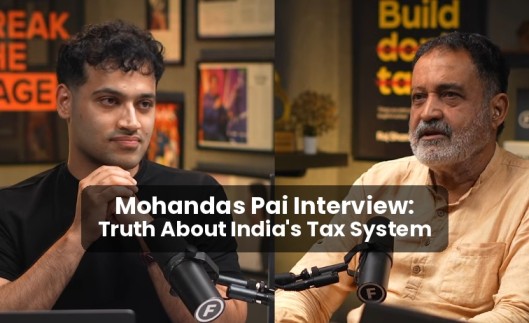
Episode Notes: In this compelling interview on Raj Shamani’s podcast, co-founder and chairman of 3one4 Capital Mohandas Pai dives deep into the realities of India’s tax system, governance, and business landscape. He addresses critical issues such as the challenges honest taxpayers face, bureaucratic inefficiencies, and what it truly takes to build and scale a global startup. Additionally, Pai shares his valuable perspectives on education, philanthropy, and navigating the economic future of the country. (July 23, 2026)
Following is the full transcript of Mohandas Pai’s interview on Figuring Out With Raj Shamani: Truth About India’s Tax System –
Introduction
RAJ SHAMANI: Let’s start with the point where you said we pay taxes. A lot of people pay taxes. A while ago, I was reading something about you that, “I pay my taxes, I get platinum certificate, and they still treat me like shit.” What do you mean by that?
The Reality of Tax Scrutiny and Harassment
MOHANDAS PAI: No, because there’s tax terrorism. I pay taxes. Most years I get refund because I pay more taxes. Then they pick me for scrutiny. Then ask me unnecessary questions. And I give all the information. After 1 or 2 years, they say, okay.
And now I got a latest assessment where they made a— where I had an income of capital gains. They converted the capital gains into regular income and charged more. It’s crazy. I filed for rectification. Then they rectified it and charged some interest. I filed for rectification again. They have not replied. And then one income tax officer, when I filed for rectification, picks up the old one and says there’s nothing wrong with it and passes another order. It’s a mess.
In this country, what happens, the more tax you pay, the more they picked up, more harassment. There are so many crooks in this country who don’t declare income, who don’t pay taxes, and the officers know about it. Every tax officer in every city knows who pays tax, who earns money. They are very smart. And they buy them over. In many cases, they buy them over. Very clear. You ask any chartered accountant, anybody, they know what happens. It’s a racket. And they do whatever it is. And we get stuck. We get stuck.
And that’s why I said, this is lousy. Don’t treat me— treat me with respect. We must respect taxpayers. In the US, they respect you. In the US, we file returns from Infosys, the CFO. And every year we pay tax. And they came after, said, give me this, give me this. And I said, we’ll go in appeal. We’ll go to court. They backed down. They treat you with respect. They reply to you. Here, nobody replies. They take their own time.
There is ₹38 lakh crores of taxes in disputes, more than the tax collection of ₹25-26 lakh crores a year, out of which ₹19 lakh crores is taxes in dispute where the assessee is not available and there are no assets. It’s bogus. And 19 lakh crore, 80% is disputes raised in the last 5 years, whereas Jaitley promised in 2014 that they’ll stop tax terrorism when total amount of tax in dispute was 5 lakh 40,000 crores or something.
RAJ SHAMANI: Now it’s 19.
Broken Promises and Ministerial Accountability
MOHANDAS PAI: Yeah. And where is the promise? So I keep writing articles every year about tax terrorism and nobody cares. Our finance minister doesn’t seem to care. Because it is there in the budget document. In the budget document where she presents, there is a statement showing ₹38 lakh crores.
If I were the Finance Minister, I would call a meeting every 15 days and show me why you did this, what happened, how many appeals have come, and appeals take time, and why it is happening. And if there’s an officer who goes on raising this kind of crazy demands, I’ll put it in his confidential report to say this person is wasting government time and money and harassing people. That’s the way the minister has to do.
He’s a minister. See, the ministers are our representatives. They’re supposed to represent our interests. The tax authorities are tax authorities. They’ll try to extort money. That’s the nature of the beast. That’s their job. Okay. But at least they must follow the law. They don’t follow the law.
RAJ SHAMANI: But why do they take money? You just said that they extort more money out of people who pay taxes, who pay more taxes every year.
MOHANDAS PAI: Because they got a target.
RAJ SHAMANI: Versus?
MOHANDAS PAI: They got a target. Easy, easy. No. They got a target easily.
RAJ SHAMANI: But not from the people who don’t pay taxes. Because everybody knows in the city who pays taxes and who doesn’t.
Corruption Within the System
MOHANDAS PAI: You know it too. You can point out, right? Because, you know, they buy them over. Not everybody is corrupt. Maybe 5-10%. And in the tax department and all tax departments, GST, everybody knows who was doing this.
I was heading a committee for the CBEC, indirect taxes, for technology and all that. So I had the chief commissioners with me. And they were telling me, in the final 2 years of their service, they’re posted to all the ports so they can make some money for retirement. Openly. Shocking.
You import anything in this country, you go through a stevedore, there’ll be some miscellaneous charges, ₹2,000, ₹3,000. That’s the bribe they have to pay. It’s well greased. Remember, in Chennai, there was some problem about somebody who did it. They went after him and fixed him. They must have told him, this is what we’ll do to you. And FM said, I will do it. And nothing happened. We don’t know what she did.
See, the failure is in the ministers because the ministers allow all this to happen. I had a horror story just now. A friend of mine who’s working with government said that there are some 9 sections of the law, income tax, where there’s criminal liability.
We all pay taxes without looking at the law where there’s criminal prosecution. I mean, look at the attitude. They want that power, that feudal power to go after you, to harass you. And nobody has been harassed in the sense gone to jail and all that.
Another case he told me, for ticketless travel, there is a jail sentence. In all these years, only 6 people they have criminally prosecuted. The railway people said, “No, no, we can’t remove, we can’t run the railways if we don’t have this provision. It’ll be inundated, everybody will occupy, they’ll not buy things.” Give me a break.
You have to trust people. In India, 99% of people are honest, they pay taxes, they’re very good. 1% are crooks, the same as any country. You go after them, you know what to do, you know them. Because you are in government, you know, you can’t do anything to them. Their political influence, they pay money off and all that. So this is the perversity. That’s why I made the tweet.
RAJ SHAMANI: But then people like you who are paying honest taxes and things, there are enough of them.
MOHANDAS PAI: Lots of them.
RAJ SHAMANI: Yeah. Aren’t they also politically very well connected?
MOHANDAS PAI: Yeah, because I’m talking to ministers. Our ministers should listen. They say yes, but it doesn’t happen. You understand?
RAJ SHAMANI: Yeah.
The Role of Leadership and Ministerial Responsibility
MOHANDAS PAI: If the person at the top pushes his hand, does it work? Reviews everything and does it for the road. It works. Ashwini Vaishnav reviews everything, the semiconductor policy and all that. It works. The railway projects, it does, it does. So every minister should do that.
And taxes are the most important thing. Because if you become captured by officials who come and tell you, “No, no, if you don’t do this, you know, you’ll not collect tax, people will not take,” and scare you, get scared because you don’t do anything. It is your mistake.
RAJ SHAMANI: Have you been captured ever?
MOHANDAS PAI: Who?
RAJ SHAMANI: You. Have you been captured ever?
Democracy, Representation, and the Promise of Freedom
MOHANDAS PAI: I have the power of knowledge and data on my side. See, I go by data and what is correct. If I say something to you and you have a better argument and tell me I’m wrong, you can say that anytime. And here’s the data, I’ll agree. Because the data is the truth. What do I want? What do you want? We want the truth. We want improvement. We want better days. We want better treatment because that is what we expect.
See, Raj, please understand. This country was liberated by a massive freedom movement. Thousands and thousands of Indians marched on the street against the British insolent might. And they were these ordinary people, poor people. All of them marched. And you’ve seen that. And when Gandhi told them, don’t raise your arm, they marched on the street. The British hit them on the head with the lathi. Many people died. They didn’t raise their arm. They had moral courage. In any movement, not hitting back shows moral courage. They had moral courage.
They sacrificed their life and their future. When Gandhiji asked them to give money, if they had 2 rotis, they gave 1 roti. Pardhanashi woman gave away all their thing, gold and all to him. They all worked for this country. This country became free because of all of them.
And our founding fathers sat down together and said, what kind of a country should we build? They debated and they gave us this great constitution. It’s one of the most liberal constitutions in the world. That’s the promise made to us by founding fathers and the people who fought for freedom. That is our due. We should demand it as our due. And you are to enforce that as political leaders and government. It’s your job to enforce that. You are not my ruler.
In my state, our Deputy Chief Minister made a thing. “Oh, I went to the apartment block. They didn’t vote for me. I’m going to not do anything for them.” I tweeted and said, “Minister, you are a representative, not a ruler. You represent us. You’re not a ruler. You can’t do that, minister. Very wrong. Please withdraw.” You can’t do that, right?
These are our representatives. The democracy— we are a representative democracy. Power belongs to the people of a country. By the constitution, we are given the power to somebody called the government, and we elect people to run the government. And there’s a permanent bureaucracy. The bureaucracy is to execute the policies of the government. And we elect our ripples. The ripple is supposed to listen to us, take our needs and form the government and execute it through this thing. But these people become captured by the bureaucracy.
RAJ SHAMANI: Yeah.
The Problem of Governance and Prosperity
MOHANDAS PAI: And then what do we get? Why can’t you keep Mumbai clean? I came to your office. There’s a bridge there crossing that road thing, railway line. 15 minutes I was stuck because ahead of the bridge some work is going on. Nobody’s working. Police is doing. What a mess. And so much dirt, muck all around the place. Why should there be debris on the road? Why should there be muck on the road? Why can’t the road be clean? They’re spending so much money. It’s corruption at work and nobody cares. Why can’t the ward councillor make it happen? Why can’t those people, ministers, say, I want a clean city? Does cleaning city take too much money or anything? It does not. No, you can clean a city.
RAJ SHAMANI: But it also takes a lot of people to become a part of movement, right?
MOHANDAS PAI: It’s not a movement. You enforce what you’ve got. You are the minister. Or you are the mayor, or you’re the ward councillor. There are people to clean. You go there, inspect, and say, “Please keep it clean.” Come back and tell them we’ll inspect.
RAJ SHAMANI: That’s it.
MOHANDAS PAI: It’s a very simple mechanism. In a house, how do you keep it clean? You go down and make sure it’s clean, right? They should do it for the same ward. There are people to do it. They don’t do it because they’re all interested in contracts, making money. And for them, that might. तो क्या हुआ? I had a chief minister where I complained when I was at Infosys. I said, “Chief Minister.” सर बेंगलुरु में बहुत रोड में पॉटल से। अरे भैया पॉटल से रोड तो है ना? मेरे कांस्टेबल में रोड ही नहीं है। Then I complain sir traffic का problem है बहुत traffic। Traffic का problem कहाँ है? मैं जाता हूँ traffic ही नहीं है।
He gets all this sirens and all and clear the traffic. Because I’ll tell you, Raj, the problem in this country is government of India and the bureaucracy have learnt how to handle poverty. Because we are a poor country. And Nehru’s policies kept us poor because of the license quota raj and all that. I can give you data.
So the bureaucracy lives in luxury as rulers, like the British. They take out taxes, they take care of themselves, like Delhi. They all live in large bungalows. They got cars, sirens, everything. They got their own clubs. Their children go to the best school, everything taken care of. Now I hear that even if the children go overseas, there’s some organization that gives them scholarship. They rigged it. And the rest of us poor people who pay taxes, they give some crumbs and say, okay.
But now India is becoming prosperous. When people become prosperous, they have income, they buy cars, they buy 2 cars, they go for holiday, they want big houses, they complain. They don’t know how to handle prosperity. India’s problem is they don’t know how to handle prosperity.
Bangalore is India’s richest city. $180 billion of GDP for 1.3 crore people, maybe $14,000. We got about 1.2 crore vehicles, 27 lakh cars. We buy 88,000 vehicles per month. The roads are not well done. Roads are behind schedule. Their metro is 5 years behind schedule. Total mismanagement. That’s it. They don’t know what to do. And the bureaucrats can do it.
RAJ SHAMANI: But they don’t.
MOHANDAS PAI: They don’t. For example, your metro. I think the lady officer Bhide did a great job.
RAJ SHAMANI: Yeah.
MOHANDAS PAI: Others tried to do— to take an operation, you need— why can’t the officers do their job? But the job has to be done with the minister’s support. Political support is important. You should not interfere in jobs.
I keep telling my government, which is very corrupt in Karnataka, I said, look, you have become a red card government where there’s a red card, tariff card for every government work to pay bribes. So I told them openly on podcast, every government department approves the card, put up a red board. For this, you must pay this. People will pay by cheque. You also write that how it is distributed. Okay. If that’s what you want, okay. No, no, I’m serious.
RAJ SHAMANI: Okay.
MOHANDAS PAI: But don’t hold up work. They don’t give approval for building for 6 months, 8 months, 9 months. For a birth certificate, they make you run 3 times, 4 times. Why do you harass people? Just put it there, it would not tire if they don’t like a tax. And you take the money, you decide what to do. But don’t harass people. Because the most important asset we have, Raj, is time.
RAJ SHAMANI: Yeah.
MOHANDAS PAI: We got a finite amount of time to live. Do you have time to go stand in the government office and go do and run behind them and everything — come tomorrow, come day after? No. Right? Put the tariff card.
RAJ SHAMANI: True.
Why Mohandas Pai Won’t Enter Politics
MOHANDAS PAI: People tell me, why don’t you come to politics? I tell them, look, a politician should have 5 attributes. One, he should have a hunger for power. I have no hunger for power.
RAJ SHAMANI: Okay.
MOHANDAS PAI: Second, he should have a devious mind. Why? You have to checkmate a lot of people in politics to come up. One person comes up, there are many popular people, you’ve got to checkmate them. You see it happening. Third, you need to love people. I don’t love people. I’m very reclusive. I don’t like people coming to my house, sitting on my head, and politics, asking for this and that, meeting people, smiling at them, doing kichiku and all that. I don’t like that. Then you need perseverance. Yes. Then you need communication skills. Yes.
And I always tell people, in politics, you need people who’ve got a good 20, 25 years. And we are a very young country — 750 million people, 75 crore out of 142, are below the age of 30. And their worldview is very different. They’re all born after ’91 liberalization. They’ve not seen the license quota raj. So for them, Gandhi is irrelevant. Nehru is irrelevant. Indira Gandhi is irrelevant. Rajiv Gandhi is irrelevant. All these things that people talk about, they don’t care. What do they care? I want a good life. I want good jobs. I want to travel overseas, and that’s it. And I love my country. It gives me so much. That’s it. I’m not interested in poverty. I’m not interested in what happened there, this and that. I love my history.
RAJ SHAMANI: Yeah.
MOHANDAS PAI: Because the history makes me believe that this country is unique. It is a unique country. And I don’t like people pissing on me all around the world and pointing out this, that, and all that.
RAJ SHAMANI: True.
MOHANDAS PAI: So that’s what motivates me because we should have a country where young people have a great future. A country where there’s no want. What I call Rama Rajya, an ideal state. The West calls utopian. Where there is justice for everybody. And every young child who is born can meet their dreams.
Jobs, Wages, and Corporate Profitability
RAJ SHAMANI: Do you feel more young people see that there’s a better future in India or worse?
MOHANDAS PAI: Yes. For example, in the last 30 years, we had 2.5 crore babies being born. Last 3, 4 years, I think it’s come to 2.2. And so every year, 2.5 crore people enter the age of 21, out of which maybe 1.6, 1.8 want jobs. The balance will get married or possibly go into agriculture.
And we are producing 1.6, 1.7 crore jobs as per the EPFO. Because in EPFO, you become a member of the EPFO, you get a number linked to Aadhaar, then you pay a subscription. And they produce a report monthly by gender, by total number, by state, by age groups, and by occupation. It’s an enormous amount of data. And the data shows that 1.5, 1.6 crore people get jobs. Some of them drop out. So there are enough jobs in the country. And most of the jobs are in the southern states along with Maharashtra and Gujarat, maybe in the west. And most of the people coming in the workforce are from UP, Bihar, Bengal, Rajasthan, and Madhya Pradesh. So they migrate. Those women don’t migrate so much. Those stay there. So women employment there is lower in the north than the south.
But the problem with India is not more than 20% jobs pay more than ₹50,000. So we need jobs which pay more. Now, what happened in Noida was very clear. You’re getting a minimum wage of ₹11,000-12,000, which is irrational because you’ve not changed it for many years. People want more. And it’s true, they must get more to keep body and soul together.
And corporate profitability is at an all-time high in this country. Pre-tax profits for 2025 was about 15.4-15.5% of GDP, which is very high. So they have enough money. Corporates are making enough money, listed and unlisted. They have to pay people more.
RAJ SHAMANI: Why are they not paying more?
MOHANDAS PAI: They will not pay more because the system is capitalistic, exploitative, because there’s so much of labor. When there’s surplus labor, they don’t pay more. For example, in the IT industry, there are a lot of people who pass out and want jobs. So they don’t pay them more. I’ve been fighting this battle for 12, 13 years. I said, man, you’ve got to pay them more. And they say, we train them, they’re untrained. Yes, they spend a lot of money. All of them, they spend $2, $3 billion training people. And after 3, 4 years, their salaries go up. That’s true. But at least pay them slightly more. Treat them well.
RAJ SHAMANI: You were part of the system, no?
MOHANDAS PAI: Yeah, but I left in 2011 from HR. No, 2006 I stepped down from CFO. 2011 I left Infosys. And till 2 years before that, we were paying more than anybody. Last 2 years, I couldn’t force my way. But I think we should pay more because CEO compensation has shot through the roof in the last 10, 12 years. It’s gone up 4x, 5x. And we had a culture at Infosys that we will not pay more to top people unless we pay more to the bottom and give them the raise first. That’s a good culture.
RAJ SHAMANI: But still there, the culture?
MOHANDAS PAI: Well, it’s gone the other way in the sense that senior people get much more than the juniors. So the compassion that is there has become very much less. So I worry about that and I fight against that. I speak against that.
Islands of Prosperity in a Sea of Poverty
MOHANDAS PAI: Because you see, people must understand, you can’t create islands of prosperity among a sea of poverty. Like Mumbai is. You got beautiful towers, rich people sitting in the towers with great luxury. Like coming here, you got a very nice office building. When you come inside, outside is so filthy, it is dirty. And I came through a road and came down a bridge where I was made to wait 15 minutes because they’re all dug up. It’s so messy. It’s not even clean. We can keep it clean, right? So how long will it go on? Because people staying there will see this luxury and they say, what about me?
RAJ SHAMANI: Yeah.
MOHANDAS PAI: People live in hope. We have stability in society because people live in hope that tomorrow will be better. The hope— we have a responsibility to keep the hope going.
We started Akshaya Patra, 4 of us in 2000. And the premise was very clear. No child should be deprived of education for want of means. We started it with 1,500 kids, went down to 15,000, 30,000. Now they’re feeding 23 lakh kids every single day. And many times we had no money. I gave money, whatever I could. And the option of not feeding a child was never there. We didn’t have money. We collected money, we spent money. We built kitchens and everything. We didn’t have a corpus.
Because I say, for any philanthropy, corpus is a capitalization of misery. Capitalization of misery. Because there’s misery today, instead of creating a corpus and investing money, earning 6-7%, why didn’t you spend the money and remove the misery today? So there’s no misery tomorrow.
The largest philanthropy in India is the Premji Foundation. They must be having 1 lakh 80,000, 2 lakh crore of funds. They may be spending 2-3 thousand crores. It’s outrageous. Why are they not spending? They must spend more money.
RAJ SHAMANI: But why are they not spending?
The Importance of Education and Social Responsibility
MOHANDAS PAI: Yeah, you’ve got to ask them why they’re not spending money. They started a university in Bangalore and it’s been captured by the wokes and the JNU. They started one in Bhopal. They’re starting one in Raipur. I keep telling them that a university in social sciences, which they say they want to produce teachers, is not going to help this country. Because all of them get captured.
See, what we need in this country is primary health, primary education. We must make sure every Indian has access to primary health and education. So every child should have compulsory education till class 12. Class 12, you’re 18. After that, you go to college. Class 12 is mandatory. We made 8th standard mandatory, 10th standard mandatory.
For example, we’ve got 265 million kids in school. Almost every child goes to Class 1. Out of 100 in Class 1 today, if my data is right, about 85 complete Class 10, about 75, 76 pass, and 65, 70 go to Class 11. About 55 or 60 pass Class 12. This should be the latest data based on estimates. And about 27, 28 go to college. There’s so much wastage.
But every child should spend 12 years and the state must support, all of us must support. Every child is important because India is also an aging society. Fertility is coming down. The whole of the South fertility is 1.7. India’s fertility today should be 1.9. Last time they took it, it was 2.2. And UP has come down to 2.4 and Bihar is 2.6, I mean 2.9, right? So in future, we’re not going to have so many children. So every child is valuable. Every child at birth is valuable, is important.
Because see, please remember, Raj, we are lucky because in the OIN lottery, which is what Manish Sabarwal says, I was interviewing him once, he’s a great guy. We were born to parents who gave us a good education. You walk in the street, you see a child on the street, it could have been you. You’re just lucky. And then you got a good education, you succeeded. So you have an obligation that that child on the street also gets a good education. So everybody should get it.
And the Government of India is spending money. They spend ₹7 lakh crores on school education.
RAJ SHAMANI: Okay. Why are they not able to fix it then?
MOHANDAS PAI: They’re not able to fix it because of mismanagement. See, tell me, what’s the difference between a good school and a bad school?
RAJ SHAMANI: Teachers.
MOHANDAS PAI: No, it’s the principal. It’s management. If the headmaster is good, everybody works, everything works. If the principal of a college is good, everything works. If the vice chancellor is good, everything works, right? It’s leadership. Between a good country and a so-so country is the leadership.
So when you have so many children in school, maybe 1.2 crore teachers, 16 lakh, 17 lakh schools, it’s very difficult to manage that. And government mismanages, they don’t care. There’s casteism, they take them away for other work, there are secretaries come and go, they change what they want. There is no consistency.
If you have, for each state, you have the boards, SLC board and others work well, then it’ll work. For example, CBSE works very well. Why can’t the state boards work well? And the state boards can work well if they manage it very well, because they spend a lot of money. The spending on education by the state is about ₹25,000-₹30,000 per year, which is fairly good. But we don’t get the output because there’s no accountability.
In a government school, if the pass percentage is zero at Class 10, nothing happens to the headmaster. There is no penalty. Nothing happens to a secretary. Nothing happens to a minister. Nobody cares.
See, a society is made of people. It’s not made of buildings. It’s not made of business. It’s made of people. A society exists for people. And every child, when a child is born, should have good prospects. And later, how the child does is up to the child. But what society should do is make sure the child grows up in a reasonable way, doesn’t suffer for want of food, can get good school education, and the child is reasonably bright, gets a college education. That’s what we should do in society for every child in the country. That’s our obligation.
And that’s why we started Akshaya Patra. We did it. And 2, 3 generations, he’s been there for 26 years. He’s worked very well. The largest midday meal program in the world with ISKCON Bangalore. And it has worked well.
But I would like every Indian of any means to adopt children and pay for their education. See, there are 9 crore people who pay taxes, file returns. 3 crore pay any tax. If each of the 3 crore adopt a family, pay them ₹4,000-₹5,000 a month, that’s 3 crores more families who get money. And that’s enough for a school education, right?
So there has to be compassion in society. And we must do a bit. We cannot say, “I pay tax, it’s the government’s job.” Yes, it’s the government’s job. That’s all true. They have to do it. Do it. They do a reasonably good job. There’s a lot of mismanagement. It’s not working. So we must do a bit.
The Role of Compassion and Personal Responsibility
RAJ SHAMANI: 2 things on this. One, a lot of people are compassionate, but they don’t know where to put money.
MOHANDAS PAI: It’s very simple. You have a servant at home, sponsor the child’s education. I’m sure many people do. You’ve got a driver, sponsor the child’s education.
RAJ SHAMANI: Many people do that.
MOHANDAS PAI: Yeah, many people. There should be a larger number. Larger number do it. Do it. That’s what I’m saying. An immediate family member you have who is poor, sponsor the education. Do it. See, in every family, in a family, not everybody has done well. Some have been lucky, some have done better, some have not done well. But if you’ve done well, help the people who have not done well.
See, Raj, education is the greatest gift society can give its youth. There’s no other gift greater than education.
RAJ SHAMANI: Yeah.
MOHANDAS PAI: Education is what makes a human being. You understand?
RAJ SHAMANI: Yeah.
MOHANDAS PAI: And you must give education free of cost to everybody who can’t afford it. Who can afford it can go to private school. Whether you go to public school or private school is a choice parents make. But the public school should have good quality. So there’s no discrimination.
Today, many children who are poor go to government schools. If they don’t get a good education, how will they compete when they grow up? The private school children will compete. How will these kids compete?
My mother studied in a government school long ago. She passed away 3 years ago at 92. She got the first rank in her district and she got a government job as a teacher. Because those days, if you’re first, they used to give a job. And there was no food in the house for many, many months. She told me the stories when there was no food to eat. For 2, 3 days at a time and all that. They were poor, but she did well.
And then she married and she brought me up and she walked to school 30 years to save the bus fare for me. I didn’t need it. My father had a car when I was going to school. But those are the people who built it because for them, educating their children was the most important thing in their life because they understood. And it transformed our lives. We did very well, extremely well.
And when we go to school, getting 99 in mathematics was not okay. You have to get 100. See, it’s the mother in the house who brings up the family and the children, right? She used to get up early in the morning and cook for us, send us to school, go to school, come back and cook for us and make our homework and then go to bed.
Even my wife, very well educated. She’s got a commerce degree and a law degree. We got 2 boys and she gave up a job just to look after the boys because she told me that when the child comes home from school at 2 or 3 and then says, “Mama, Mama, I want to talk to you,” the Mama is not there. She’s gone for a job. They get disappointed. So she gave up her career and she looked after the boys. And the boys, my boys are doing very well.
Family, Legacy, and Obligations
And I’ll tell you, Raj, for every person, however accomplished you are, however big you are, you could be the richest man in the world, the greatest leader the world has seen. In the later stage of life, where children are not doing well, all that is of no use for you. But what you’ve got left is your children. Your children should do well. They should be good human beings. They should be settled down. They should be happy. If they turn out to be bums with no future, wandering around and depressed and all that, what are the use of all that you’ve done in your life?
Look at Gandhi. He destroyed his family, right? He destroyed his family. Devdas, you know, got drunk, then he converted, became a Muslim and converted back. And Gandhi wouldn’t help him to go to London to become a solicitor, whereas his father asked him to, made him a solicitor, paid for it. He didn’t do it for his children. Many of his direct children, right? Very wrong. He could have done it. There’s nothing wrong in helping a child.
No nepotism. It’s good he didn’t allow his children to come into politics, unlike Nehru. Who promoted his daughter, and we are stuck with the dynasty now because he made sure that the daughter came, became the Congress president, and then he made sure that she became prime minister and all that, and the family continues. And that is not a good thing to happen in this country. But Gandhi — but you should not destroy your children.
You have an obligation. See, Raj, all of us have obligations. You’re born to your parents, you grow up with them, they take care of you. You must take care of them when they grow old. You have siblings. You must be happy. You have a spouse, maybe. You have children. You must take care of them. And that is life. Life is a journey, right? Life is a journey. You understand this when you grow older.
RAJ SHAMANI: True.
MOHANDAS PAI: Even I too never understood that. I was focused on my career, everything else. Nothing else mattered but achieving career and all that. But these are important things. That’s why as a society, we must make sure our children get a good education, good health, everything is available for them. First principle.
RAJ SHAMANI: True.
MOHANDAS PAI: Because they are the future. What are we building all this India for? For young people. For people like you.
RAJ SHAMANI: True.
MOHANDAS PAI: People like you.
RAJ SHAMANI: If the IT industry was not there in the last 30 years, this would have not existed.
MOHANDAS PAI: Where would the young people have a future in this country, right? If liberalization had not happened in ’91, we had not grown. Where would all this be? So I think society is made of people. Focus should be on people. And we in society should play our role. For example, now, after I left Akshaya Patra in 2020, after that I said, what should I do for the rest of my life? Now I work with somebody to run a DBT program.
RAJ SHAMANI: What program?
The Power of Dharma and Personal Obligation
MOHANDAS PAI: Direct Benefit Transfer program. You see, what is poverty? Poverty is lack of purchasing power. You got purchasing power because you got education. You have purchasing power because you’ve got ancestral wealth or income. You’ve got purchasing power because you’ve got a job. Now I’m born poor. I’ve got no skills, no education, no job. I do daily wages. I don’t have purchasing power. Correct?
So what you do is you give them purchasing power by giving money directly to the bank, like these people are doing today. All the governments are doing today for women, which is, I think, a good thing. And I’ll explain why. And once you get money in the bank and your food is taken care of, now they give you free food, which is very good and all that, then you get security. You’re not fighting for your next meal. Hunger is a terrible thing. You be hungry for 2 days without food, without hope, then you understand the pain of hunger. So hunger is a terrible thing.
So you get security. When you get security, you look after other things, education, health, and all the things. And so many people are broken. They got no security. They don’t know when the next meal is coming from. They got nothing to look forward to. You give them some money and then you help them through an NGO to develop skills, connect to jobs and all that. Then you help them.
So today I sponsor about 200-250 families, doing it for the last 4 years. And my friend from Bangalore, Chris, also is doing something. So we hope it becomes a movement. Like I said, if 3 crore taxpayers adopt 1 or 2 families, give them ₹5,000 a month, that means there’ll be 2 crore people, 2 into 4, 8 crore people. 8 crore people who are poor can come out of poverty in 10 years. Right?
So if you understand this country belongs to you, society belongs to you, people belong to you, you have an obligation. Dharma. That is your dharma. Then you do it. You do it not because you want anybody to respect you or to give you awards. No. You do it because it is your duty.
RAJ SHAMANI: True.
MOHANDAS PAI: Okay.
The “Naukar” Incident: A Lesson in Humiliation and Self-Respect
RAJ SHAMANI: Going back to one of those incidents in your life where I’m switching back to your childhood because it’s important for people to know. When you were quite young, somebody called you naukar, right? Somebody called you servant because you were working there. What was the entire story?
MOHANDAS PAI: I was working in a family firm because a friend of mine asked me after when I finished my CA or sometime, wanted to come and run this leasing company. So I worked there as executive director. He was the MD. We built the company together. So it is my first corporate assignment. It’s not a job. I was the top guy. I had one person report to. That’s fine.
RAJ SHAMANI: Okay.
MOHANDAS PAI: Then they had a family fight because some senior people died and will and all the family fight. So I used to go in for the family. I sit down with them and tell them, try to do something. Then one day one the family member said, “मोहन तू क्यों बात करता है? तू नौकर है.” I said, “नौकर, नौकर, नौकर.” What is नौकर? Didn’t hit me at all. The guy was abusing me saying, “Why the hell are you bothered, man? We are maliks. You are नौकर. You have to listen to us.” I felt humiliated. I’m a rank holder in this country, in CA. Being a rank holder is not easy.
RAJ SHAMANI: Yeah.
MOHANDAS PAI: I’ve got self-respect. I’m working. And I said, oh my God, naukar. Nothing wrong with being a naukar, but I was not a naukar. I didn’t feel like a naukar the way he said it. You should never humiliate anybody.
RAJ SHAMANI: You realized that at that point?
MOHANDAS PAI: Yes.
RAJ SHAMANI: When he said it?
MOHANDAS PAI: Yes.
RAJ SHAMANI: What was going on in your head at that point?
MOHANDAS PAI: I said, look, I’m running the business along with them. I’m creating things for them and they’re calling me and abusing me like this. When it comes to the crunch, I’m just a naukar. I’m a professional. Is there no respect for people?
RAJ SHAMANI: How long did it take you to then step out?
MOHANDAS PAI: Look, Raj, very soon I left that company and all because of the family fight and all that. But Raj, happiness is the delta between expectation and reality.
RAJ SHAMANI: Explain more with that specific—
MOHANDAS PAI: Happiness is the delta between expectation and reality. I expected to be treated well. I expected to be respected. And these people thought I’m just a high naukar and high stuff. Why the hell are you bothered? It’s me. I never thought of it. They treated me like that. Maybe I had high expectations being there. I shouldn’t be there. Correct?
Then I vowed, because when I was— I was a rebel in my college. I vowed I’ll never work for anybody. I’ll not be an employee.
RAJ SHAMANI: When did you do that? How long before you did that?
MOHANDAS PAI: No, ever since college and all, we are rebels. We are rebels, we grew up to be rebels. We had that spirit. I think immediately after emergency, we marched on the street, protested. We fought for revaluation against the university.
RAJ SHAMANI: Yeah.
Joining Infosys: Building Standards and Earning Respect
MOHANDAS PAI: And even in college, we did all the kind of stuff because we are rebels. It’s good to be rebels when you’re young. So I didn’t want— then he said, you run the company. I said, is it worth it? So Murthy and Nandan called me and said, why don’t you join? I said, I want to be a consultant. I don’t want to be an employee. They treated me very well. They respected me. It was a fantastic experience.
Then, 6 months I was there, I produced and worked with Murthy to produce an annual report, which was the best annual report India has seen in disclosure and was sold in the black market in Mumbai and all that. It was very nice. Then one day in October of ’94, he came to my room and said, “Mohan, you’re joining as CFO from tomorrow permanently. You have to come. You can’t be a consultant.” I said, okay. You’re a great guy.
I worked in a company which treated you with respect. I was at the top of the pile. And we used to argue with Murthy and Nandan. We used to argue with Murthy. And Murthy was very strong. He pushed back and we pushed back. We had no fear there. You are the CEO and chairman, founder, chief founder. And he listened and best idea won. And I won many times. Best idea won. People complained against me internally, “You’re listening to him, you’re not listening to us.” He won and that’s great. Because of that we could do great things.
We could set standards, achieve great things, and do everything well. And we wanted to be the best in industry because Murthy told us, “You may not be the biggest, you can be the best. Best depends on you. Biggest depends on many other things.” So we wanted to be the best. We set standards in everything. Every facet of work, hiring people, treating people, stock options, campus, technology, training, education, brand building, investor relations, everything we set standards.
Many of the things in the market that you see in investor relations, we set standards voluntarily much before it became the law. I was a board member of SEBI for 3 years. I headed committees there. I sat on committees there. 20 years I worked with them. Set standards. And India did well. And we’ve had the best corporate governance standard.
I was the only person meeting 300 investors a year in the ’90s till KK Misri came and he was also there. And we both worked together to build this country, build respect for this. We had no respect. They treated you like shit. They looked at financial statements and said, “This is a piece of crap. We don’t trust you.” The India risk premium, which is very high. So we’ve gone through all that, Raj.
And when you go overseas, they look at you and say, “Ah, India,” and all that. I’ve been racistly abused in Frankfurt, in New Zealand, been through all that. It hurts you when you’ve got pride and self-respect. You should not go through that, Raj. I don’t want my son to go through that. I don’t want you young people to go through that. I’m sure my parents would not want me to go through what they went through with the British. No, it’s not a good thing, right? So that family thing is like that.
Reading 2,500 Balance Sheets: The Making of a Financial Mind
RAJ SHAMANI: Even before you joined any of this, when you were young, you were a teenager, you used to read 4,000 balance sheets.
MOHANDAS PAI: I had 2,500-3,000 balance sheets because just interested. See, my father—
RAJ SHAMANI: As a kid, who reads that?
MOHANDAS PAI: See, my father used to get the Hindu newspaper every day from his office in the evening. Morning, we had Indian Express, Union Hindu. I used to read entire page to page in The Hindu. I was curious. Then there’s something called Leo’s News and Notes on the economic page. And it used to talk about company accounts and company performance. I used to just read it like a storybook.
Then you were the shareholder, you used to get annual reports. I used to read it cover to cover. Then I went to the stockbrokers, collected annual reports. I wrote to FT because FT had a service whereby they send all the global reports. Got it. I collected 2,500 reports, read all of them. Improved my knowledge. I used to go to shareholders’ meetings with my wife and question them and all that. Some of them like SSV, Bangalore Leasing, runaway from Bangalore and all that. So a lot of things happened and we learned. So we are rebels. I got hired because I went to the Infosys meeting and asked questions. So I had an interest, just some interest. Some people have some interest for music.
RAJ SHAMANI: But what were you looking for specifically?
MOHANDAS PAI: Just information and growth and how figures work and just like that.
RAJ SHAMANI: But back at that time, was this a norm to be super ambitious and look for information that something will change around, like change your life?
MOHANDAS PAI: No, the idea it’ll change my life was never there. It’s just that it was there and I should read it and I should understand it and take—
RAJ SHAMANI: Which is exciting.
MOHANDAS PAI: Yeah.
RAJ SHAMANI: Nothing else.
MOHANDAS PAI: Because what else was there in life?
RAJ SHAMANI: Nothing.
A Simpler Life: Joy, Curiosity, and the Absence of Distraction
MOHANDAS PAI: There were no expectations. Life was very simple and very quiet. Nothing happened, Raj. The joy was going for the morning show, paying ₹3. The joy was cycling 5 kilometers and playing cricket. The joy was going on a Sunday and playing a cricket game. That was joy for us. Nothing else was there. There was no TV those days. It came later. There was radio. We used to listen to commentary. It was a very different life, Raj. You won’t understand that life. It was very, very different.
The external stimuli was very less those days. Today is completely different. Today you’re inundated with external stimuli. You have to choose. Those days we had no choice. See, democracy is all about choice, ability to choose, and availability of choice. So we have a lot of choices today.
RAJ SHAMANI: Enormous amount.
MOHANDAS PAI: And we have ability to choose also because economically better off. So those were different days, Raj.
RAJ SHAMANI: You said while you were telling me about Infosys, you said there was an India risk premium you had to pay. What do you mean by that?
India’s Cost of Capital and Economic Challenges
MOHANDAS PAI: See, today, if you look at all $4 trillion economies, United States 32-34, China 20, Germany 4.7, Japan 4.2, India is 4. Now it’s come down a lot because rupee has come down. And UK is 3.8 and France must have gone up because of currency. All of them have got a cost of capital of 6 to 8%. India’s cost of capital is 11 to 13%.
What is the cost of capital? Cost of capital is a function of the sovereign debt rate. 10-year bond. 10-year bond in America is 4.5%. India is 6.7% or 6.9%. Japan is maybe 2% or 3%. And UK is 4%, 4.5%. So ours is high because they say we’ve got higher inflation, which we don’t have now. And India’s risk premium for equity. Equity risk premium is 4-4.5%. US is 1%. UK may be 1.5%, but 4.5%.
Why 4.5%? Because one, when you come to India and invest as a foreigner, you want a higher return to make up for the greater risks that you see in India. What are the risks of India? Policy uncertainty. Government will change policy, retrospective effect. We had this indexation for capital gains. They just changed it despite telling people that we’re not going to do it with retrospective impact. The impact was retrospective. They could have said till 31st of March, we’ll accept indexation. That’ll be the carrying cost for the next year.
Instead, I’ve been assured they changed it. They never thought about it till there was pushback. And for property, they gave an option. It’s so silly. The finance minister should have said, I will not change. She promised in parliament she’ll not change. She went back. She didn’t understand. She went back. That’s the problem. She didn’t understand. If she understood, I’m sure she wouldn’t have gone back because she made the commitment.
Policy Uncertainty and Tax Terrorism
So policy uncertainty. Vodafone. In Vodafone, the tax officer taxed the gains, capital gains in India, despite the transfer being taken outside, went to Supreme Court. Supreme Court said, “We understand why you tax, but the law doesn’t provide for that.” So what did Pranab Mukherjee do? In Parliament, he changed the law from 1961, saying there was always the intention. The intention is denoted by the debate in Parliament when the law was introduced. Nobody knew about this. And then you destroy the confidence of people in the tax system. So the whole world’s confidence in India was destroyed because you went retrospective.
So nobody knows what— I was on TV at that time and they asked me, “What do you think of this budget?” I said, “I’ll give 4 out of 10.” He said, “Why?” I said, “He went retrospective.” What is to prevent the government or the politician to amend the law to say, unless you are registered under the law, your marriage is not valid? When you all got married, there’s no registration. If you’re not registered 40 years back, your marriage is not— they can do anything they want. No, it’s arrogance of power. How do you trust people? They destroyed trust. Trust of investors should not be destroyed in the country. And we need policies and the policy stability, that’s not there.
The second thing is tax terrorism. Tax terrorism keeps on going. They pick up MNCs, write all kinds of rubbish, everything. For Infosys, for GST, it’s ₹35,000 crore. “We’re going to levy.” Give me a break. Because they’re all exporters. In one case, I went for income tax assessment. He said, “You’re exporters.” He said, “You’re not exporters. I’m going to charge you as if it’s domestic income.” I said, “Man, we’re exporters. We get dollars. Here’s the data.” “No, I don’t believe that.” What do you do with such people? They threaten you. There are no recourse. Then go to court. Go to Commissioner of Appeal, 2 years. Go to Tribunal, 3 years. Go to High Court for 5, 6 years. Then go to Supreme Court, 10 years.
And even if Supreme Court takes a decision where I have suffered, they don’t follow it up. They never implemented the order till I had to call up the CBDT member and tell him. And my colleague went to High Court and took a contempt petition against them. Then they did it. That’s the kind of people they are. Who cares? We’ve been through all that, Raj.
Judicial Delays and the Cost of Capital
So, tax terrorism. Third thing is courts. Any commercial dispute, 10, 15 years, nobody cares. Recently, the Supreme Court also, in that case for Tiger Global, said that your residence in Mauritius is dependent upon the facts of the case and not the procedure. Because there you get a residence certificate, it’s deemed to be so.
RAJ SHAMANI: They did it.
MOHANDAS PAI: It’s not to be done. Then the government has come out with clarification that before this date, when we had some new process, we are not going to reopen anything. At least they did that. But it happens. And Supreme Court in that telecom case said all the licenses given by government are invalid. Now what happens to the money they gave? They shall pass an order, all the licenses invalid, whatever money you give government, government has to refund. For example, in the customs case in America, Supreme Court said you don’t have the right. Now refund is happening. Nothing about refunds. No consequence.
RAJ SHAMANI: Tariff case, yes.
MOHANDAS PAI: Tariff is customs. So that you see, what do you do? So nobody believes you, nobody trusts you, they want bigger money. So how can you go to $10 trillion, the cost of capital at 11 to 13%? What will happen? The people who got money get bigger returns. Because if you don’t give them return, they will not invest. So consumers pay more money because you’re forced to earn greater returns. You understand? So you can’t grow. So there’s inequality more because providers of capital become richer. The providers of labor don’t get their share. And providers of labour consume, consumption has to go up. Investment is by providers of capital. So there’s got to be a balance.
Our mean return on equity for the Nifty 550 is about 14-15%. Just today, last week, we had a bank, 2.5% return on assets profits. You don’t earn that kind of money in the commodity system. Another bank, 1.95%, very high. Another biggest bank in India, 20% return on equity post-tax. Give me a break, man. That’s outrageous. That means you’re charging more because there’s no competition.
RAJ SHAMANI: One-sided.
Competition, Consumption, and Corporate Profits
MOHANDAS PAI: And when you take away— see, income of people doesn’t grow up at the same pace. When you charge more, with the money you have, you can only buy that much. So growth doesn’t happen because consumption is not there. If you charge less, with the same money people have, you can buy more. People produce more, cost comes down like China did. Chinese bring down the cost of manufacturing every year because of competition and subsidies. So more and more people can afford to buy and they become the largest producer in the world.
In our case, we want greater returns. Your auto companies have got 20-22% operating margin. The biggest car companies got 14-15% operating margin before your royalty. Ford in the best year had 8-9% operating margin, best year. Overseas, they don’t make that much money. We make so much money. Total pre-tax profit in the corporate sector for the year ended 31st of March, 2025 is 15.4%. I published articles. Highest in the world. In America, it’s 11%. Isn’t it good? It’s not good because you’re exploiting a system because of lack of competition. See, there has to be a balance between profitability and consumer benefit.
RAJ SHAMANI: So you said that cost of capital is still the highest in India.
MOHANDAS PAI: Highest in the world.
RAJ SHAMANI: Highest in the world.
MOHANDAS PAI: For economy.
RAJ SHAMANI: In India, it’s highest in the world.
MOHANDAS PAI: Yeah. For the comparative size.
Paying the Price of Lack of Competition
RAJ SHAMANI: And you said we are paying the price since the time of Nehru till today. What did you mean by that?
MOHANDAS PAI: No, no. See, we are paying the price from Nehru is because we don’t have enough competition in this country. We should open up because we have allowed regulators and others to mollycoddle the industry and not have competition. See, today the steel industry was being hit by dumping from China. They put tariffs against them. So they’re making money head over heels now. Why can’t they become efficient? Someone made a statement, I remember, where he said China has an operating margin for steel of 3 to 4%, which is unviable. Here we want 13 to 14%, which they believe is right. You should be competitive, no? Look at Tata Steel earning per tonne of steel. Outrageous, man.
Opportunities for Young Entrepreneurs in India
RAJ SHAMANI: But do you think after knowing all of these things and what’s going on in India today, a young person still has an opportunity to break these cartels and have a fair shot at making wealth, at creating wealth?
MOHANDAS PAI: Well, they have, they have, but they come out with an innovative product, which is much more competitive, much more better, and much more—
RAJ SHAMANI: Regulators, tax terrorism, cost of capital is high, cartel, bunch of things.
MOHANDAS PAI: I mean, you talk to startup founders, there was the angel tax by which they think we all protested, went to government, they changed it 3 times and they messed it up again. They changed it. Prime Minister was concerned. I mean, this is harassment. I want the finance minister to protect us because they’re our representatives.
RAJ SHAMANI: But do you think a young person has an opportunity to create wealth?
MOHANDAS PAI: Of course, because the economy is growing well. The growth, growth. If all this is not there, they will grow faster and make more money. You understand what it is?
RAJ SHAMANI: We’re still growing even after all of these changes.
MOHANDAS PAI: Yeah, that is the beauty of India. We are still growing despite that. We are working. Look, the pain of growing and the pain of business is higher in India than the US. Or in the Western democracies.
RAJ SHAMANI: So does it make sense for a young person to build in India or go outside and invest in the US and Europe?
MOHANDAS PAI: Build in India. Growth in India is high because next 10 years we’ll grow 7-8% per year. That’s fantastic. But then with all of these problems that you just told me, you have to manage it. You have to work it. That’s what we have done. We built Infosys with all these problems.
The License Raj and Bureaucratic Hurdles
RAJ SHAMANI: One of the stories I was very fascinated by — early times before the license raj, like everything India got LPG, right?
MOHANDAS PAI: Even before buying one computer, we had to get an approval from government, pay 175% duty, wait for 1 and 1.5 years to the government, apply to them. And by the time they gave the license, the technology had changed. You say, “I want this machine,” go apply. They go on asking questions. They don’t give it to you.
See, from here you had to go to Delhi, sit in front of them. Even today, I’m telling you, the RBI, I’m telling you, startups, when they go apply to RBI, they don’t reply. Even today, I complained to 3 or 4 governors. They don’t reply. Why they don’t reply? They don’t reply. They’re not obligated to reply. So, when you ask for appointment, they don’t meet. So, what do you do? Go ahead to the Big 4. The Big 4 manage the system. They walk up and down, get you the approval, and charge you a fee.
I took Raghuram Rajan to Bangalore. He came to Bangalore, we showcased some startups and all that. Then he called us to the Reserve Bank. We went to Reserve Bank and they complained to him that when you talk to Reserve Bank, they don’t reply, they do this. Then he asked one of the lady officers, “Madam, why do you do this? What is the problem?” You know what she said? “Sir, these people hire the consultants and they come here and we give them answers. We do everything for them. Then they go charge a big fee. Why should we allow consultants to make money?” That’s the attitude in front of him.
RAJ SHAMANI: What did he say?
The Broken Justice System
MOHANDAS PAI: What will he say? I told him, you must stop all this. That’s why I want in RBI and regulators, you must promise, if you apply today, within so-and-so days, we’ll give you reply. They got it in the consumer thing. They don’t enforce it. Why they don’t enforce it? Because senior people should say, every month sit and have a review. How many people applied? When did the reply go? How many days it took? That’s how you run companies, no? They should run that. Because senior people say, our job is policy, not to execute anything.
Because the Reserve Bank has got multiple functions. They have to manage the currency on behalf of the government. They have to manage monetary policy for which they’ve got autonomy. They’re the bankers to the government. They’re the accountants to the government for whatever banking transactions. And they have to make sure they’re the regulators for the banks. And then they have to monitor the Foreign Exchange Management Act. For which they have to give approvals.
So you have to apply for some approvals, but that is a service. Approval is a service. You have to apply your mind and reply. That is not a regulator. That’s not autonomy. That’s service. Where there’s customer service, you treat them like customers.
I have dealt with the SEC in the United States. When you file and all that, within a few times, they call you, have a meeting, they discuss and everything, and they close it. Here, nothing. You file, nobody calls you, nobody cares. In some of the regulators, when you go reply, अरे तू क्या हमसे बात कर रहा है? दिखाऊंगा तुझे। People have gone and suffered, man. दिखाऊंगा तुझे। Although they talk, we all been beaten up, Raj. Despite that, we have done well.
RAJ SHAMANI: But tell me a few stories from the time before, like from the initial times.
Tax System Abuse and Arbitrary Power
MOHANDAS PAI: See, it is the attitude of the person, not the law. I have gone to government, worked with them to change the law, and many things they have done, they changed. They have been very persistent.
See, at one point of time when we did our ADR, there were no capital gains tax on sale of shares. So in ADR, what happens? You sell in the market, there’s no capital gains tax. So in an ADR, you sell in the US markets. So the banker technically buys the stock from you and places it outside. So we went to government and said, look, there’s no capital gains tax, but if you do an ADR, the banker will be seen as the buyer and then he pays the tax. So why should they be capital, give us waiver. Because the same, you know, they went and made a runaround and all this.
And some tax officer also, some of my friends, they wrote a note, oh, it’ll lead to so much loss of revenue and all that. I went and met a government officer and asked him, very senior man who is now my friend also. He’s sitting down here, putting his leg up there. I was sitting there, putting his leg up here, shaking his leg shoes. Man, we can’t do it. I had this and all, you know, they say you’re going to lose 200 million, 300 million. How can we do it? 200 crores, 300 crores, how can you do it? He’s telling me. I said, it’s the same. He’s not able to understand, not able to do. He doesn’t care. Who cares? They write some rubbish report.
See what happens. The tax officers go to the finance minister and say, if you do this, we’ll not be able to cover revenue. You can’t do it and all the thing. And then they ask for more power. They get more powers. The current finance minister allowed reopening of assessment up to 10 years after it has been reduced to 6 years. And for 2 years, 1 lakh, 2 lakh notices were done and money was made. And then they brought it down back again. Didn’t understand why. Because they would have gone and said, we can’t do it. They’re all crooked. The whole of India is crooked. They don’t pay tax.
And the last 3 years, 72 lakh crores have been collected, direct taxes. I went with one of the parliamentary committees in Bangalore for the new law. And I told them, 72 lakh crores has been collected. You’re giving more powers to them to raid, come to your house and all that. And harass people. Why don’t you put in a process that if you want to raid somebody, you have to go to a court and take an order before you go and show the order when you go to somebody’s house, because intruding upon the privacy. And tomorrow, if you ill-treat them, they can go to the court and say, I was ill-treated, the court will take care of them. No, they don’t want to do that. Oh, we are quasi-judicial. We don’t want to do that.
And then I asked him, so much raids have happened. So much has happened. You’re threatening people, saying so many. How much tax did you collect in the raids? How much was stuck up in disputes? How long did it take to resolve disputes? How many cases went against you in the court? No data. Nobody cares. We did a search some time back with the portal. 70% of the cases against the department, they lose. Nothing happens to the tax officer. Nobody cares. Nobody looks at the data. I think they lose 70%. That means they’re doing wrong.
RAJ SHAMANI: But why are they doing this?
MOHANDAS PAI: Arbitrary power. Some of them want rent-seeking, arbitrary power, no checks and balances.
RAJ SHAMANI: You also spoke about it in one of the podcasts where you said a CA of a political figure told you that keep them happy, something like that. What was that story? Tell me.
MOHANDAS PAI: No, no, no.
RAJ SHAMANI: Keep them happy, keep them in good humor, and then appeal it later.
MOHANDAS PAI: No, no. See, a CA of a political figure, you got to read it. A political figure got raided. They found something and all that. And then the CA went and said, they’re all wrong. We’ll go to court, get a stay. No, he said, no, no, don’t do anything. They all raided. They will come, they will settle it, and we pay them some money and close it. Because if you go to raid and all that, they will do more and they will threaten. It’ll take 10 years. Don’t do it.
RAJ SHAMANI: And “they” means what?
Horror Stories and the Failure of Justice
MOHANDAS PAI: Tax officials. They got no pretext. You see, I’ll tell you, they said we found ₹1,000 crores, ₹2,000 crores. They keep announcing, right? You can check up in the media. What actually happened after they file, go to assessment and file a case? How much have they collected? No data. They don’t. They went to my friend’s house. They wanted to live in his bedroom. He said no. 5 days they went, did nothing. I’m telling you, Raj, there are horror stories in this country.
I don’t want young people to be pushed by the horror story and all this kind of stuff. It’s important to know. But you know, this happened over time. Things are much better today because we got technology for assessment. 99%, 97% of people get it automated immediately and all that. They get refunds. A lot of improvements have happened. But the 1% still is so huge. And the 1% is hurting us because there’s no redressal.
The justice system is broken, Raj, in this country. The greatest failure of Indian democracy is the lack of justice. Whenever a case is filed, within 2 or 3 years, you must get justice. The case goes on and on for 5, 10 years. And then what happens? Why do you go to court? Because there is injustice. And when there’s no justice, the poorest of the poor suffer the most.
The rich man pays a lawyer, goes to the court and stands up, “My Lord,” and he gets relief. Because senior counsel can go to Supreme Court. Now the judge, SJS, CJ has stopped that. They say, in private. They will stand up anytime. They can because the senior counsel, they say, “My Lord, I want this.” They get hearing. What about the rest of us who don’t get hearing? We don’t get it. Where is justice? Justice is broken in this country. Broken.
And why is it broken? Because we don’t have judicial capacity. We got 22 judges for a million population. We need 50 as per the Law Commission. And the US has 100. We need more. And government is the biggest litigant. My friend told me there are 42 lakh cases stuck up in court for cheque bouncing. Why do you want criminal liability for cheque bouncing? Put penalty and finish summary thing. They make it long and he gets captured.
What do you do, Raj? We must set right the justice system to make a better country. We must build judicial capacity, build courts, invest 50 judges per million population, build more prosecution capacity for criminal law, make sure that more prosecutors come and finish it, decide faster and give justice. Half the problem of corruption and all disappear in this country.
And political leaders should give more money for the justice system in every state. In one state where I worked, the chief minister said, “Why don’t you put more money into justice?” Mohan, those judges, I don’t want to give anything to them. They pass cases against government.
The Five Principal Functions of Government
See, Raj, any government has got 5 functions. One is defend the country against external forces. Second, protect life, liberty, and property of people. Third, delivery of justice.
RAJ SHAMANI: Okay.
MOHANDAS PAI: And the 4th is manage the currency. And the 5th, manage foreign affairs. 5 principal functions. In all the principal functions, the Government of India in the last 70 years has succeeded. Protecting borders, yes, they’re protecting borders, is happening. Internal law and security is working, but a lot of improvement has to be there. Correct?
RAJ SHAMANI: Yeah.
MOHANDAS PAI: And then the third thing, delivery of justice, total failure. And then management of currency, yes, they manage it reasonably well. And the fifth thing, foreign affairs. Foreign affairs, they’re managing it well. But you know, justice, justice is the foundation of society. We the people of India do give unto ourselves this Constitution and promise Justice. Where’s the justice?
Shifting Gears: The Corporate and Startup Landscape
RAJ SHAMANI: Okay, let’s— so we have addressed the political part of the country right now. Let’s talk about the corporates. Now that this is the reality of our country, if every—
MOHANDAS PAI: Now, the great country.
RAJ SHAMANI: Yeah, I agree. Okay, so like, there is—
MOHANDAS PAI: Let’s be clear, the great country.
RAJ SHAMANI: There’s growth, there are opportunities, there are enough things going on. We have a young population, we have a lot of things going right, we have a lot of things going wrong. Right now, if young people are watching it for the opportunity, let’s shift the gears for them and build the podcast for them and understand from your Infosys journey. And then we’ll eventually build it towards opportunities, current landscape, your startup investment journey, and all of that.
Okay, first is I actually want to ask you, like, in the beginning, before buying even one computer, you had to go to Delhi and sit in front of babus, in front of politicians, and write an appeal that, “Hey, we want to buy a computer and get it in India.” And they would ask you that, why would an Indian company need it?
MOHANDAS PAI: All that is gone.
RAJ SHAMANI: All that’s gone. Like, why would an Indian company need a computer? So you had to beg in front of them and explain.
MOHANDAS PAI: All that is gone.
RAJ SHAMANI: But how do you feel today when the country takes credit for something for which you had to beg for?
India’s Economic Journey: From Socialism to Growth
MOHANDAS PAI: It’s okay. See, in 1950 when you got freedom, Pandit Nehru in his wisdom brought in socialism and license quota raj because they’re all enamored of the socialism of Russia. They did it. He was a Fabian socialist. He did it. Gandhi ji was opposed to price control. Gandhi said, “This desh mein Sarkar vyapari hai, us desh mein janta bikari hai.” We became bhikkaris.
From 1950 to ’80, we grew at 3.5%, population at 2.5%, per capita income 1% a year. We became poorer in 1980 compared to the rest of the world than 1950. Japan grew, Germany grew, Southeast Asia grew, the world grew. The world grew at a time of 4.5%, Southeast Asia 6.5%.
We opened up in 1980. We grew at 5.5% from ’80 to ’90. Population grew 2.25%, per capita 3.25%, but external debt went up from $20 billion to $80 billion. We are broke.
We opened up in 1991, I think in May. And when Manmohan Singh stood up in Parliament and said, “Nothing can stop the march of an idea whose time has come,” Victor Hugo. And then opened up. And then what are the magic? Magic.
Our GDP grew from $275 billion in ’91 March to $4.1 trillion in 2026, 7.98% a year in dollar terms for 35 years. 5 lakh 32,000 crores to 345 lakh crores, about 11.8% or so CAGR for 35 years. Magic. We’ve grown. Look at that. All because of Indian entrepreneur, despite the pain, despite all kinds of mess and everything else, we’ve still grown.
India’s Growth Trajectory and Future Potential
Now, future. In the last 3 years, we grew around 10%. 11, 10, 9, last 3 years till 2025. I got data. This year we’ll grow at maybe 9, 9.5%. If you continue growing at 10 to 11%, 7% real growth, 4% inflation for the next till 2047, then we will reach about $28 trillion at ₹95 to a dollar. So we have grown in rupees, but not grown in dollars because rupee is weakening. I’ll tell you why rupee is weakening.
So we can grow. And can we do that? Yes, because growth depends on 2 things, consumption and investment. We invest 31% of GDP. Last year we invested ₹1.13 lakh crores, more than $1.1 trillion. We are among the 3 countries who invest more than $1 trillion a year in CapEx. If you read this report, private sector is not there, don’t listen to the rubbish. Look at the National Income Strategy, it’s all there.
So we invest. We’ve got a savings rate of 29%, 2% money comes from outside. So we can continue to invest. We may have to raise the investment rate to 34%. That means savings has to, or we must borrow from outside so we can invest.
The key thing for investment is that the country has the capacity to absorb investment. You want to build more roads, there are not enough contractors, labor to do that. We are learning. We are much better today than earlier.
Consumption is growing at 7-7.5% a year. But consumption to grow, wages should go. That’s where the problem is. Wages are not going up. Consumption should grow. It’s growing at 7%. But consumption is growing more at the top end, not the bottom end, because bottom end salaries and wages, incomes are not going up. At the top end, because of higher corporate profits, stock market returns, and greater, their income is going up. At the bottom, they’re not paying wages, the wages have to grow.
RAJ SHAMANI: Yes.
Technology, AI, and India’s Digital Power
MOHANDAS PAI: Can we absorb the growth and have capacity? I don’t know. But in technology, we’re the 3rd largest digital power in the world. We exported $238 billion of software last year, $320 billion of technology. With AI coming, it’s going to change, but it’ll be positive. I believe it’s positive.
The only thing is we don’t have investment money that’s required. China invested $845 billion, 2014 to ’25. America, $2.32 trillion. India, $270 billion. We need more money to invest. And that is sorting itself out because we have the second largest pool of software engineers in the world, 7.5 million. America has 10 million, out of which 4 million are Indians. 1 million there, 3 million working for them here. So we’ll go to 10 million and we’ll become bigger than America in terms of total number in maybe 3 to 4 years.
So we can grow. The possibilities are there. Everything is there. But to do that, we have to increase investments. We have to increase consumption. So possibilities are bright. At the 80% probability, we’ll reach whatever numbers we want to achieve in the next 10-20 years.
The Challenge of Job Creation and Workforce Shift
Now, what is the challenge for India? The challenge for India is we have to produce good jobs for 1.6 crore people, which no country in the world has ever done in human history. How do you produce jobs which pay ₹50,000 minimum for 1 crore people a year? So we have to grow our economy, we have to grow faster at 9%. So we have to invest more, we have to grow faster, we need better policies, we need the animal spirit in people, we need more money to come in. We’re not investing enough. We don’t have enough capital to invest, to grow at that fast pace because every year incremental growth is huge.
And what is the fundamental challenge of India? We’ve got 550 or 580 million people in the workforce. 43% of our workforce is in agriculture where the income is ₹97,000 per capita income. And about 25% or so, I’m just quoting from memory, is in industry, which is about ₹2,50,000, ₹2,25,000. And the balance, 30%, I think, is in services, which get ₹3,80,000. So we have to move this 43% into industry and services in the next 20 years. It has to come down by 1 or 2% a year till it comes to 10%. China has got only 10 or 15% of population in agriculture. America has got maybe 1%.
So in agriculture, there’s not enough money. But of the 43% in agriculture, which is 60 crore people, you take the families and all that, women are 63%. In COVID, it was 43%. After COVID, it went to 46%. 80 million people came into the workforce in agriculture, which is a shock to many people. But most of them are women because animal husbandry has gone up. We produce 250 million tons of milk and the self-help groups have gone up and the men have left and are coming into construction industry. So more women are coming into workforce, which is also good.
But we have to shift this workforce. So we have to invest in industry. We have to invest in services for which you require growth. The key for all young people is, will India grow at that pace? And now we are in the age of disruption with AI. I believe AI will make us more productive.
Yesterday we did a big conclave on AI in Bangalore. A lot of people are there. There’s positivity and it’ll create more jobs because we will bring in AI to all the global corporations in the next maybe 5, 6 years. So I think the prospects are bright. The challenges are immense. We have to get our act together. And work.
The North-South Divide and Regional Disparities
And then how do we handle the North-South divide? India’s per capita income is ₹2,25,000 or ₹2,30,000 last year. And UP is ₹1,07,000. ₹79,000 is Bihar. UP is 24 crore people. Bihar is 13 crore people. That is about 37 crore people. 37 crore people on 142 crores is how much? About 25%. 26% of our population earn less than 50% of per capita income. So growth has to come there.
Look at the challenges India has. Karnataka’s per capita income is close to ₹4,50,000. The whole of the South is about ₹3,60,000. India is ₹2,25,000. UP is ₹1,07,000. And I think Bengal is ₹1,35,000, ₹1,45,000, much less than India. It’s a disaster.
Now, these are the challenges the Prime Minister has to do. Young people must understand these challenges. There are so many moving parts, so many parts of the country doing well, so many parts of the country not doing well, so many parts prosperous, so many parts taking jobs. So we have to produce the jobs, we have to grow, we have to do many things. We need great leaders. We need Bombay to prosper. Bombay prospers, better infrastructure, better protein, create the capital for us.
So I will tell every young man, dream big, work to achieve big, and you’ll succeed in whatever you do. Work very hard, you’ll succeed because India is growing. The momentum is in our favor. Technology is changing. AI is coming, and we are going to be the leaders in AI globally, despite not having enough capital. So we do well. The best time to be alive, best time. I’m more optimistic today and I have greater prospects today than maybe when I started my career.
The Stagnation of Fresher Salaries
RAJ SHAMANI: See, one thing which is not growing even after you provide jobs, that is the fresher salary. People who start their jobs, their salary, their income is not increasing. Many people argue, many articles argue that what they were earning in 2008, probably they’re earning the same thing today, less in real terms. So why do you think that is happening?
MOHANDAS PAI: That’s because the surplus labor, more and more people are going to colleges, becoming engineers, willing to work. See, today tier 2, tier 3 colleges have becoming the majority of people who come and work. Tier 1 don’t go to IT service companies. Large number of Tier 2 also don’t. They get better salary, they go. So there’s almost infinite supply of young people who want to become engineers and come, right? And they’re all ill-trained. Industry says, I’m spending an equal amount of money, 3 lakhs, 4 lakhs in the first year for training. So—
RAJ SHAMANI: But can they not, let’s say—
MOHANDAS PAI: They should, they should. I would challenge all the CEOs of all the IT service companies to at least raise it to 5 lakhs. At least raise it to 5 lakhs and say we’ll pay minimum of 5 lakhs.
RAJ SHAMANI: Do it.
MOHANDAS PAI: You won’t get a hit. Cut your own salary. You get 10 crores, 20 crores, 30 crores, cut your salary and say do that. The other Murthy would have done if he’s around for the industry. You should do that because you have a social need. You have to lead by example. And this has gone on for too long. That’s why industry, media must write about it. Media must showcase all this. And name them and shame them. That’s the only way to work. Because look, if people don’t move—
RAJ SHAMANI: You name them, name 3 or 4 people who should, 3 or 4 companies who should do it.
MOHANDAS PAI: All the top 5 companies. TCS should do it. Infosys should do it. Wipro should do it. Now they say—
RAJ SHAMANI: You’re an influential man in Infosys. Can’t you—
MOHANDAS PAI: No, no, I’m not influential anywhere except as a citizen. I have a voice. That’s all. Nobody cares.
RAJ SHAMANI: You were, right? You were influential, very influential.
MOHANDAS PAI: I was, but I left in 2011. I pushed for it till 2009, 2010. 2010, 2011, I could not push anymore because of the resistance. Why the resistance? Because they came and told me, oh, we should all work together. We should not raise salaries. We are discussing internally how we should increase our costs. And I told them that, look, let us pay more because we can beat the hell out of competition because earning more money will force them to pay more and reduce their margin. So they will not undercut in the market because they’re all competing on price. That’s what I told them. People must understand. So I think they—
RAJ SHAMANI: But why did you leave?
Life at Infosys and the Decision to Leave
MOHANDAS PAI: I wanted my life back, Raj. Infi was my dream. Raj, I’m so lucky, Raj. God has been so kind to me. When I joined Infosys, I saw the rise of a great country, India, next 25 years. I saw the rise of a great industry, IT. I saw the rise of a great company, and I was the heart of it. I was part of it. I made it work.
I had a great life for 17 years, but it took a heavy toll on me. I had no life. I didn’t see my boys growing up. I didn’t spend enough time with my wife. I’ve been a bad son to my parents. I didn’t spend time with them. I’ve been a bad brother and sister to my brother and sister. I’ve been a bad husband to my wife. I’ve been a bad father to my children. Because I spent so much time building the company, running around 14 hours a day, 12 hours a day, travel and all that. Sole purpose, very driven. We wanted to do it. But I’ve been a good Indian. I built my country. I built this industry. But then I said, I want my life back. I don’t want to be CEO. I want my life back. It took me one year to get out.
RAJ SHAMANI: How was Murthy as a boss?
N. R. Narayana Murthy as a Leader
MOHANDAS PAI: Unbelievable. The best boss you can ever have. Extremely tough man. Unforgiving. Demands performance. Demands performance. Brilliant. You can argue with him for hours. Brilliant. Demand perform. You don’t perform, you don’t exist. Ruthless execution strategy.
RAJ SHAMANI: Give me an example where he was ruthless to you.
MOHANDAS PAI: He was not ruthless to me because I performed.
RAJ SHAMANI: But what was the standard that he set and you felt like this was ruthless? Or you’ve seen it with someone else?
Narayana Murthy’s Work Ethic and Leadership Style
MOHANDAS PAI: No, I was seeing ruthless because I tell you, there are 2 or 3 occasions when we are not meeting our numbers. I promised him in 1994 as a young man, I was young then, that I’ll give you a P&L with 99.5% accuracy at 3 o’clock on the last working day of every month. And I did it. Then you know what? If I don’t go to his room with the P&L at 3:15, he’ll call me and say, “Why is my P&L not there? Are you sleeping?”
And the company became bigger and bigger and bigger. I had to do it. I did it. We made my systems work to 99% accuracy. If you meet your numbers, he’ll have a cup of tea with you, smile, and put it in his bag and disappear. Travel somewhere. Don’t meet your numbers and the numbers are less, he’ll call everybody, make them sit down, work out the numbers, do hard work, do this and all. No forgiveness. Make them cry and make them do it. That’s it. No forgiveness.
And then we had the sexual harassment case, which was hidden earlier. It didn’t come out. Then finally he got to know because the lawyer called him up from US and said, “Your name is there and all that.” It happened when he found out. Within 5 minutes he decided that person has to go. 5 minutes. No forgiveness. And this person was his blue-eyed boy, a high performer. No forgiveness.
RAJ SHAMANI: Out.
MOHANDAS PAI: Then he sent me there to clean up and all that. And I said, we must pay him his salary. He said, no.
RAJ SHAMANI: Out.
MOHANDAS PAI: No, no. Now that I want him back. I said, you know, we must settle him and all the things. He worked so hard. No emotion. Whatever is the law, do it. Lost. He was tough.
RAJ SHAMANI: Was he tough to other people as well?
MOHANDAS PAI: Everybody. I mean, he was fond of his own founders and all that. I mean, there’s some call, but it’s okay. He was a great guy. And you know, he’s a man who welcomed you, could have a conversation, you could discuss. He was brilliant. And every time, you know, we felt bored, we used to go to him and argue with him and fight with him. And for 1 hour, have a nice discussion, go back and felt fulfilled. He’ll never give up. So you talk to him about something, he’ll never give up.
And he was first to come and last to go. He used to come first to the campus, last man to go. And one day in the second or third year, we are doing our annual report and we are behind on schedule. He said, “Mohan, nobody’s going home till we finish it.” So we sat the full night. And then he told me later, he went home at 4 o’clock. I also went home at 4:30 to the house. And in the house, in the first floor of the bedroom, he said, “I couldn’t go up. I slept on the sofa itself, so tired.”
Then he came and said, “Mohan, I can’t do it anymore. Physically, I can’t do it.” But he did it. You should look at the annual report, see it 2 or 3 times, every line, everything. I had to read that same thing, make sure nothing happens. Because, you know, till I stepped down, I had to read all the quarterly reports, everything 2, 3 times, read the annual report line by line, page by page, because somebody will complain to him, “This para should not, comma should not be this,” then, and he’ll call me, “What happened?” No forgiveness. I said, enough is enough. So finished. I mean, I done my bit, closed.
The 996 Work Culture Debate
RAJ SHAMANI: His family office went to people from his investment office, they went to China and they saw 996, right? And you’ve spoken about it. What happened in that trip?
MOHANDAS PAI: Look, Murthy is very clear, not about China, that young people have to work hard. And he says, one generation has to sacrifice so that future generations do well.
RAJ SHAMANI: But what did they see there?
MOHANDAS PAI: Nothing. They work 996, 9 to 9, 6 hours a day, and they build great companies.
RAJ SHAMANI: 6 days a week.
MOHANDAS PAI: Yeah, 6 days a week, and they build great companies. That’s the rule.
RAJ SHAMANI: So what impacted so much that he got radicalized?
MOHANDAS PAI: No, he didn’t get radicalized. He’s always been like that. He’s always been like that. He’s been saying you must work 72 hours, you must work hard, blah, blah, blah. And all that he’s been saying all through, nothing new, except media got attention and all that.
What is he saying? He’s telling you as a young person, when you start a career, for God’s sake, work very hard, spend more time, learn, become competitive, develop your skills, become productive. Later in life, it’ll impact you positively. That’s what he’s saying. He’s not forcing you to do it. There’s a law which gives time. You follow the law. It’s up to you to do it.
In Infosys, many of us worked very hard. 25% of people, when you do timesheets and all that, didn’t put in the regular hours. 25% of people put in more hours. Half of them, you know, in the cafeteria and all, they were spending time. And others did regular hours. That’s it. So the people who worked hard and put in greater efforts always succeeded, always did well. They’re self-motivated. They didn’t require an incentive. They didn’t require a bonus. They worked hard and they did well. That’s how we come up in life.
Look at any sportsman. Why does he succeed? He works hard. Look at any scholar. He works hard. Look at any artist. He works hard. Look at you. Don’t you work 12-14 hours? I speak to media people when they come and say, “Why he said this?” I say, “Look at all of you broadcasters. How many hours do you work? All the anchors, look at the time that is— why do you spend that time? Does anybody pay you more? No. You do it because you want to succeed.”
That’s what he said. He didn’t say it is mandatory. Media said, “Oh, Murthy is making money.” He didn’t say mandatory. He says, “It’s good for you. Don’t do it. Okay, don’t do it. It’s your call.” And many of these lovely guys said, “Oh, why should I work my work life? Okay, we have work life balance.” For us, work was life. Work was life. And we succeeded. If work is not life, will not succeed in life. Life is very tough. Life is very competitive. There is no free meal for anybody, and there is no privilege.
RAJ SHAMANI: I agree.
MOHANDAS PAI: Ha! You know it best. You come up on your own. You know it best. Correct?
RAJ SHAMANI: I agree.
MOHANDAS PAI: And you also, when you have a small team or whatever it is, you know, they have to work. When work has to be delivered, it has to be delivered. Nobody cares.
RAJ SHAMANI: Correct.
MOHANDAS PAI: That’s it.
RAJ SHAMANI: We work 16, 17, 18 hours.
MOHANDAS PAI: Everybody. And you lead by example. That means the leader has to do that. Leader cannot say, “I’m going to work-life balance holiday, you slog.” Nobody will work. The leader has to work. Leader has to demonstrate.
Work-Life Balance: A Personal Choice
RAJ SHAMANI: What do you feel? Should there be work-life balance?
MOHANDAS PAI: See, it’s individualistic. You have to decide what you want to do with your life. You have to work and put in work and be productive. That is no compromise. Over and above that, you decide what you want to do, what you want to achieve, and what you want for your life.
RAJ SHAMANI: Yeah, that’s what we also say.
MOHANDAS PAI: See, the problem today is, Raj, which people don’t understand, they say work-life balance. Many people take the time they left from the house to the office as work. You say, “I left home at 6:30 in the morning, I come home at 8 o’clock, and I spent 12 hours outside the house.” 2 hours going, 2 hours coming, because you stay far away, that is also work. That is not work, man. Work is when you reach the office till the time you leave the office. Not from the time you leave home to come back home. That is travel. Why do you stay so far? You understand?
Most people want to put all their problems on the company and say, “Company owes me everything. Company owes me transport. Company owes me bonus. The company owes me holiday. Company owes me—” Come on, give me a break. Company has to take good care of you, but you have to lead your life the way you want it.
RAJ SHAMANI: We also do something similar. We end up saying this very often, almost every quarter to everybody that, hey, there’s a place for people who want to be very, very chill. There’s a place for people in the company. There is a place for people who want to maintain work-life balance. And then there’s a place for people who are very ambitious are going to be there.
MOHANDAS PAI: And results for everybody will be different. Exactly.
RAJ SHAMANI: The results will be different.
MOHANDAS PAI: Don’t complain in 2 years and 3 years later that this person got more because of this. Exactly. That’s what he’s saying. Don’t complain if things don’t meet your expectation. Performance matters. Yeah. That’s all.
RAJ SHAMANI: We know that it’s tough and it’s hard.
MOHANDAS PAI: Japanese, one generation slogged their butts out to build Japan so children will be better. The Koreans did it. The Germans did it after the war. Every society has done that.
RAJ SHAMANI: Japanese, they still work hard.
MOHANDAS PAI: They still work hard. Too much nowadays. They shouldn’t do it because, you know, unnecessary work. A lot of it is unnecessary. Yeah. They’re doing it. That’s why suffering fertility, you know. I read that 30-35% of youngsters below the age of 35 haven’t even spoken to the opposite gender. How will they produce children? The population is shrinking. When China’s population is shrinking, China’s population shrank by 3 million last year. India will come there by 2035 in the south. All projections say that population are shrinking. Today we got 13 crore people above the age of 60. By 2030 will be 20 crore people out of 145, 146.
Hiring, People, and What Makes High Performers Stand Out
RAJ SHAMANI: See, you know, talking about people and we were talking about people in the company. You were in the HR, you head the HR department, right? You don’t like people, but you were the head of people.
MOHANDAS PAI: No, I like people, but I don’t enjoy being with too many people all the time.
RAJ SHAMANI: But you hired too many people, and you’ve seen a lot of people’s growth, right, in your company. Tell me one thing, and if I’m not wrong, there were about 200,000 people who you ended up hiring.
MOHANDAS PAI: 200,000 people, trained 250,000 people.
RAJ SHAMANI: See, what is the difference between somebody who really succeeded in their career versus somebody who didn’t at the same place, who was both hired as a fresher?
MOHANDAS PAI: Self-motivation. Something within you which drives you.
RAJ SHAMANI: Can you spot it in people?
MOHANDAS PAI: Partially, but it takes time. It happens over time because some are very glib and talk and impress. Some are very quiet, don’t open their mouth. So you have to see. I had a very nice colleague, Vinayak Pai, who used to work with me in finance. That guy was brilliant. He didn’t talk too much. But I used to demand a lot of things, data, gita. He used to slog his butts out. It came to a time when I opened my mouth and started a sentence, he finished it for me. He understood exactly what I wanted, did it. That guy was brilliant. He burnt out, looked burnt out very fast, but you know, he was brilliant.
So the difference between high performance, self-motivation. See, Raj, unless there’s something driving you, motivating you to do great things, you’ll not do great things. You’ll slacken. It’s something within you that pushes you all the time.
RAJ SHAMANI: But what makes those self-motivated people stick to a company at a very basic level?
MOHANDAS PAI: Because the company gives them prospects to grow, to learn, and to do things.
RAJ SHAMANI: But at any time, there’ll be other people actually trying to poach them, but they still stick there.
MOHANDAS PAI: They stick there because they learn. They get opportunity. They get treated well. They feel fulfillment. Till that time comes when the delta between expectation and reality becomes too wide. That is where you must recognize people at the right time. I keep telling people, you can suppress a good person for a year, 2 years, not more. You recognize them. They stand out. If you are the boss, I have a team. You know who is the hard worker, who is not. You want to keep him. One year you will not do it, you’ll play favorites. Second year you can’t do it. Then you say the third day, “This guy is so valuable, at least I am dead.” So you do it, correct?
RAJ SHAMANI: Agree.
MOHANDAS PAI: Ah, it happens. So you can’t suppress him forever. And then they go. Attrition among high performers is the highest after 3 years.
RAJ SHAMANI: Why? Because people not—
Talent, Startups, and Investment Insights
MOHANDAS PAI: Anybody goes outside, they get double the salary. I keep telling my MNC friends, you must hire, poach the top 10% people after 2 years from these IT service companies, pay them double the salary, because then you don’t have to spend on training. You’ll get the best performers. Ask them whether they’re in the top 25% or what is their ranking and poach and pay double. Good for them, the MNCs. Good for these companies because they have to learn to pay better and do better. See, they learn to pay better, they do better, but they have to pay more at the bottom.
RAJ SHAMANI: And then how do you do the conversation? Let’s say somebody who comes to you and be like, hey, I’m getting double the offer outside.
MOHANDAS PAI: I persuade him to stay to say how he’ll do well here. And if I can’t, I tell him, okay, you decide what you want to do for yourself.
RAJ SHAMANI: Even though if you know that this person is a high performer.
MOHANDAS PAI: I wish well for him. I wish well for him.
RAJ SHAMANI: But don’t you then increase your salary double because you know you can bargain?
MOHANDAS PAI: I can’t do more because I’m stuck in a thing, it’s comparative misery. See, India, we work on the theory of comparative misery, Raj. It doesn’t matter what I get so long as somebody doesn’t get more than me. So I give him so much more, everybody gets miserable. So what do I do? I tell him, look, I can only afford this much. Okay, go ahead, be best.
I had so many people who left, who worked with me. They wanted to be CEOs. And Murthy had a fight with me, why are you letting them go? They should stay here. I said, we’re not going to make them CEOs. They want to be CEOs, let them go. It’s okay. So many— Infy has about 250 CEOs, people who became CEOs of small, big, medium companies. 2 of the biggest of the top 5 come from Infy. Cognizant and Tech Mahindra. I’m so happy. Even though the person who runs Infy has come from outside, but it’s okay. So many good people are left. They become CEOs. I see them. I meet them so many places. I’m so happy for them.
Advice for Entrepreneurs on Retaining Talent
RAJ SHAMANI: But don’t you— okay, actually turn it around for entrepreneurs who are watching this. What should they do in their companies?
MOHANDAS PAI: Well, they must make sure— see, first of all, in any organization, 1 or 2% are the critical, brilliant people who keep the company together. You have to identify them and reward them with stock options and decent salary. And you must also not give yourself too high a salary. Then they’ll stick because they know that both of you are aligned. And treat them well, with respect, give them scope to grow. Swallow your pride. When they come and argue with you and they are right, swallow your pride and say, you’re right. Pat him on the back.
Look, Raj, if you’re a good manager, it’s like running a cart with a horse. You put a carrot in front. The horse is there. Push the horse. Horse keeps running. Carrot is still in front. You understood? Yeah. So that’s how we incentivize people. Give them a carrot and do it and make sure at the end of it, they do very well.
We are the largest stock option plan in the industry. In India, a lot of people make money. You know what happened? A lot of people said, I made money and they left. No motivation. It works the other way too, Raj. You make too much money, they leave and say, I got to enjoy my money when the going is good, Raj. So it works both ways. But the happiness says you created so many leaders, you did so well, the people know doing well. You take happiness, joy for this.
RAJ SHAMANI: You do that for 1-2% people. What do you do for the next 10%? Because the other 70%, you’re okay to attract.
MOHANDAS PAI: You have paid them reasonably well. And what we did in Infosys, we had a variable compensation. So they used to come to me and say, I want more, I want more. So we did one, your 100% salary, we gave 50-60% variable in front of it. So it becomes 150%. And the variable depends upon revenue, profitability, achievement. Some people got 105%, some people got 20%. But when they went out, they wanted 30% on 150%. Made it very expensive for others to hire. So you have to have variable compensation, depends on performance, where people can make more money. And many make more money, many don’t make more money. The average works out for the next 10-20%. True. But the CEO compensation should not be absurdly high. That is the key.
RAJ SHAMANI: But today that’s the norm.
MOHANDAS PAI: They must get stock options assigned. They want more money and more stock options. It’s not going to work. Then the entire cost structure goes up. And then how can you tell a person not to leave the company when he’s getting 25% more, you’re not able to give, and your salary is 5x? You can’t, you don’t have the courage to say that.
Leadership by example, very painful. That’s what you got to follow if you want to be a leader. It’s painful. As a leader, you got to work the hardest, come first to office, take the greatest pain, take responsibility. That’s how you get respect. So how many people respect the CEO who gets a fat salary, doesn’t come to office, and has a great life?
RAJ SHAMANI: No, no, obviously not.
MOHANDAS PAI: See, respect for a middle-class person, the greatest asset that you can have, respect. And respect comes when people believe that you’re a good leader. You take the pain. You don’t force people to do things that you don’t want to do.
What Startup Founders Are Doing Wrong
RAJ SHAMANI: True. Coming back to your startup journey, you invest in so many startups. You said casually that almost about 700 people walk in your office asking for investment. Yeah, right. So they send you pitch decks, let’s just say that. So almost 700 pitch decks a month. Tell me one thing, very specific pattern of what they’re doing wrong. No, no, don’t tell me things they’re doing right. Like, what are startup founders doing wrong?
MOHANDAS PAI: First of all, let me— it is for 3one4 Capital. I’m the chairman there. 3one4 Capital has 4 partners: Pranav, Siddharth, Anurag, who’s here, and Nithya. It comes to them, they have a team, they do everything. They got technology to see when they got database of 45,000 companies, they see it and they have everything.
When I used to invest earlier and I used to do it for many people, like Licious, they first came to me 10 years ago and made a pitch. Are we going to have fresh meat and all? I threw them out. What will you do? I will ask questions. They couldn’t answer. I thought they’re not going to come back. They come back after 10 days and answer everything. So I said, okay, 50 lakhs, no document, nothing, 50 lakhs. Check. They raised 2 crores, I gave 50 lakhs. Then every round they came and we gave them money and Pranav got along with them.
So if you look at my view, the people who don’t succeed don’t have a raison d’être for the business. It’s just a pitch deck saying, I’ll do this, I’ll do this, I’ll do this. I’ll start a social platform. I will run this, I will do this with no real merit. Second, they have no technology or managerial capability. And the third thing is they don’t impress you either in that pitch, which has to be concise and impressive, or when you meet them and talk to them, there’s no passion, energy, or thought, or technology. So you make out.
RAJ SHAMANI: Have you put in some money in somebody just out of passion?
MOHANDAS PAI: Yeah.
RAJ SHAMANI: This founder is super passionate. I don’t care.
MOHANDAS PAI: When I used to invest directly, yes. Yushlash, Pranav and Anurag, I think they also done it. They told me they done it for many people. I’ve done it.
RAJ SHAMANI: Who would you have done it for?
MOHANDAS PAI: I’ve done it for Licious.
RAJ SHAMANI: How did you used to—
MOHANDAS PAI: I did it for Rippler, which has done very well. Done it for Capiva.
RAJ SHAMANI: But you were one of the biggest angels at one point of time. Like backers for Byju’s as well, right?
MOHANDAS PAI: Yeah, Byju’s. Byju’s, we gave a check. Passion, energy, that’s all. Byju’s was an unbelievable guy, great entrepreneur. What energy, brilliant guy.
RAJ SHAMANI: What happened?
MOHANDAS PAI: Went wrong. Went wrong because he didn’t have a board. He raised $6 billion. The board was very happy because valuation is going up. They could not control him. Then he went and made some acquisitions and the board, some investors promised to give money. They backed out. He had to go borrow money. He lost respect for them. And then it all went downhill. I tried to help out, didn’t work. Great entrepreneur.
The Byju’s Story: Where It All Went Wrong
RAJ SHAMANI: Did you at any point realize between 2016 to 2022 that I made a wrong decision?
MOHANDAS PAI: For whom?
RAJ SHAMANI: For Byju’s.
MOHANDAS PAI: We had finished investment. We didn’t invest after that.
RAJ SHAMANI: No, but after looking at him and be like, hey, I put my money on the wrong horse.
MOHANDAS PAI: No, we got our money back. We made a lot of money. We sold early and we sold early within 3 years, first tranche. The last tranche, we had 1%. We got more money for the 1% than whatever we sold earlier. We made money. We sold at about a $12 billion valuation. You got out? We got out. Yeah, we did. Because we’re so small, we said we want to be out. Not that it had gone bad by then. But later it went bad and he called me and asked for help and I helped out, tried to bring everybody together. I and Radheshkumar sat down, didn’t work because the fissure was too much. The trust was broken.
RAJ SHAMANI: But do you personally— can you recall a point where you thought maybe this is the point where he started going wrong?
MOHANDAS PAI: Yeah, the point where he went wrong—
RAJ SHAMANI: Like you realized it personally, but you didn’t say it publicly.
MOHANDAS PAI: No, you see, a very big founder of a very big technology company’s family offices wanted to invest in them. Much earlier, in the 3rd or 4th year, they called me and said— I said, what is the opinion? I told them, look, he’s a great entrepreneur, he’s everything, he’s very indisciplined. He’ll not give you financials, he’ll not give you any numbers, he’ll not give you any information. That you’ve got to manage. Otherwise, a great entrepreneur, he can execute, he can do very well. I told them.
The point where I realized when I stepped back is when he told me he’s going to do certain things and he didn’t do it. Once, twice, thrice. Then I said, man, it’s not going to work because you have no intention of keeping your promise and I don’t want to work with you. It’s gone. So he’s living in delusion that things are going to be better and better, but it’s not going to work out because he’s not doing what he promised to do. Because when you promise, when you meet people, they want certain things, you promise, you do it. But he was agreeing but not doing it. And I said, what is the point? There’s nothing I can do. After all, I voluntarily helped him. I had no stake. True. I tried to bring people together, didn’t work.
Sectors to Build In: Where the Opportunities Lie
RAJ SHAMANI: What are the categories today you’re bullish on where young people should build?
MOHANDAS PAI: AI.
RAJ SHAMANI: Apart from AI, because— or maybe just go niche in AI because everybody’s saying AI.
MOHANDAS PAI: See, AI in fintech, AI in health, I think, has got fantastic prospects.
RAJ SHAMANI: AI in fintech meaning what?
MOHANDAS PAI: AI in fintech, AI in health. Because there are great inefficiencies in both. And I think you can do really great work in both of them.
RAJ SHAMANI: Give me a specific pain point that you see. Probably somebody can build on it.
AI in Business: Opportunities and Risks
MOHANDAS PAI: No, I think, for example, in fintech, you look at how they make a, how can you evaluate the potential of an asset to go bad and monitor assets to go bad. So AI can look at a database of all the lending for the past 5 years, look at all the cases that have gone bad today, look at all the data in all the accounts and the information, and look out for signs and patterns which led to the account going bad. Because there are signs and patterns.
For example, when you monitor an account, the credits in the account become lesser and lesser. That means cash flow problems are there. The debits keep increasing, utilization of money keeps going up, delays start building up. So you check up in a portfolio, what are the signs? And you have the radical signs. And then you use AI to monitor accounts, say which are the accounts generating all this. And then you work on that before it blows up so that it can help you out. You can’t do it without this thing.
And I know, I’ll tell you, Vaideya, CEO of IDFC, told me something what he has done. Brilliant man. I was shocked at what he has done individually. He said, “Look, I got 12-14 million consumers. A large number of them don’t pay on time. I have to remind them. I go to a call center and everything. It takes me 30 days to remind. Now I build a chatbot and look at the chatbot. It talks like you. It is intelligent. It does everything like a human being, can’t make out. Now within 2 days, the chatbot talks to everybody. The chatbot is an agent. You can talk to 10 million people, 10 million calls simultaneously. Human beings can’t do that.”
Look at that. Then I met a person who was doing quality control by data vision, by computer vision, and he can do that. He said, “I can use AI to look at all the faults and everything. The AI can do it. On an assembly line, I can do it.” I went to a factory where there are 120 women who are doing all the things. I can replace 100 women. I said, don’t replace them. Train them to do other things. Don’t replace them. But look at the efficiency.
If you look at all aspects of working in financial services, you can bring in AI, use AI to analyze data, do everything, find patterns in a jiffy, and learn so that you can remove the inefficiency and reduce costs dramatically. That means volatility of business can come down and velocity can increase.
RAJ SHAMANI: True.
MOHANDAS PAI: That’s what you’ve got to use.
RAJ SHAMANI: This is an opportunity for every entrepreneur inside their business.
MOHANDAS PAI: Yeah, but inside the business means you need providers who can create the technology.
RAJ SHAMANI: No.
MOHANDAS PAI: How can you— do you think every enterprise can create the technology?
RAJ SHAMANI: No.
MOHANDAS PAI: You need outsiders who come and say, “We got a company, company Vertical Loop or something like that.” Anurag will know that. Where they sat in front of me, look at all the data, database, their database have come, ask some questions and they ask the AI, and they spit out answers. I was shocked. Look, I know data, I understand strategy, and I ask questions. I was shocked that the logic and everything else came out of the database. I was shocked.
That means if I’m the CEO, what is the biggest problem? I don’t get enough data. I got questions to ask, but I don’t get answers. People have to go back and work at it. So I want to interact with the database using AI. We ask the AI, “Tell me, AI, that in the next 1 month, what are the probabilities I’ll reach my numbers based upon whatever inquiries are there?” It’ll work out everything, collect the data and tell me the probability. And I’ll say, “Why is the probability so low or so high? What is going wrong?” It’ll come and give me the data. And I’ll look at my cost structure and say, “Why is the cost going up?” It’ll come and give me that data. It’s amazing what it can do.
But you see, technology should be your servant. You should not be a master. And technology reduces the barriers to flow of information, barriers to analysis, and speeds up your work. See, Raj, you can become 5 times more productive, Raj. You are a brilliant guy. You are a founder. You run this business. Everything is there in your head, everything. But you need data. You need impression.
For example, you’ll have this podcast. Then the podcast, you’ll ask the AI, “Based on this podcast, based on this person, what he has said, which of my audience would like to know in what manner?” It will spit out something. You’ll analyze all that and say, “Is it correct or wrong or whatever it is?” Then ask the AI, “Why did you come to this conclusion?” It said, “The pattern is this pattern, this pattern, this.” This is a thing. But you got to have the brains to ask the question.
RAJ SHAMANI: Before every podcast that we put out, before preparing this research, my AI gets about 350 data points and then it gives me data on that and gives me pattern recognition.
MOHANDAS PAI: Yes. See, and you are able to analyze the pattern, analyze the nuances, and know what to ask. See, that is your brilliance. You can’t reduce what is in your head. You can’t be a dumb guy. Because he gives you something, how do you know it makes sense? You should have looked at it and it makes sense. Correct?
The Dark Side of AI: Security and Existential Risks
MOHANDAS PAI: For example, that Mythos or something is unbelievable. That AI done by Anthropic, Mythos, it’ll go into all your software and find out all the places where the security leaks, man, you’re all exposed. And then suppose a criminal element gets that, they can push it into any financial system, get all the loopholes and go attack. Man, everybody’s naked. It can only happen because of AI.
I’ll tell you, as part of a fintech committee for a major country, I was there, we were talking about AI. Then I asked everybody, “If a criminal network gets hold of quantum computing and uses AI, can they break into the network of all banks?” He said, “In a second.” And all the criminal networks have possibly broken into networks, have got passwords and everything of everything. They can’t break it because of encryption. They can break it now because of the AI and the super speed. The world is scary. Suddenly everybody’s naked.
Can somebody use AI and quantum to break into nuclear codes of countries and take over nuclear network? Man, that question you ask, you shake, you don’t sleep. How do you protect yourself against Maitreya? If they easily take the Mythos or something and go to all the nuke controls of Iran and blow it up, automatically blow up itself, self-actualize, what happens?
RAJ SHAMANI: Yeah. And it is—
MOHANDAS PAI: I don’t know if they’re doing it.
RAJ SHAMANI: And some of it is coming.
MOHANDAS PAI: It’s coming.
RAJ SHAMANI: Something will happen like this.
MOHANDAS PAI: And Mythos will leak. The genie is out of the bag, they’ll leak. Everybody’s scared.
RAJ SHAMANI: Yeah, everybody’s scared. And even the large tech companies with insane data, now they’re incentivizing people to use more AI. So more people are giving, exposing their own data to AI.
MOHANDAS PAI: The danger of AI has not been understood by the corporate sector. It is productive, it’s dangerous. So they must all put up barriers and put up protection and put in cybersecurity to make sure it doesn’t overrun them and doesn’t give access to criminal elements and misuse.
RAJ SHAMANI: Yeah. And even on the smaller scales, like you’re talking about large, smaller scales, everybody’s credit card to banks is going to be out there.
MOHANDAS PAI: Out there. Yes.
RAJ SHAMANI: You’ll be maxed out like this.
MOHANDAS PAI: That’s why, you know, I was in a meeting in Udaipur where they all came, a bank chairman, bank CEO came and gave everybody credit cards. I said, “Don’t give me a high limit. I don’t want a high limit. I’m very scared to use a credit card. I want a credit card with a low limit.” I’m scared, Raj. Raj, I look at my accounts, my personal accounts every day. I get messages, I look at the balances, I reconcile, I look at the monthly accounts. Every month I look at my monthly account, look at all that. Do it.
RAJ SHAMANI: But are you scared because your CFO brain tells you to?
MOHANDAS PAI: Yeah, well, I understand the risk. I understand what could happen. I don’t want a mess to happen.
CFO Framework: Key Data Points Every Entrepreneur Must Track
RAJ SHAMANI: Tell me, as a CFO, because it’s an interesting question, tell me one framework or like 5 or 6 data points which every entrepreneur should know on a monthly basis for sure.
MOHANDAS PAI: Well, first you must get your monthly information on the last working day with 99.5% accuracy.
RAJ SHAMANI: Okay, see, in the e-commerce world, people say— I’m going to challenge you on every point so that people can get on— in the e-commerce world, because there’s so many reconciliation and so many without—
MOHANDAS PAI: Rubbish. It’s all electronic. It’s all rubbish. It’s all electronic.
RAJ SHAMANI: No, other platforms, they don’t give you enough data so soon. You take like 7, 8 days for—
MOHANDAS PAI: You don’t need 7, 8 days. You can work on the system to get it because you can estimate all that with great degree of accuracy based on data. We also estimated. We had 30,000 projects running at the same time. We could estimate.
RAJ SHAMANI: Okay.
MOHANDAS PAI: Don’t give me all that. That’s bullshit. I asked one of the entrepreneurs of one of the digital new age companies, “Why the hell are you announcing results after 45 days?” “No, no, I finish only after 10 days.” You ask your CFO to give it in the last working day, he’ll give it to you, man. Go ask him. Then he said the auditor is saying I can’t do the audit, I can’t do this. You are a new age company. You are worth $10 billion. You are releasing results after 45 days. What shit is that? You should be releasing within 5, 6 days.
HDFC Bank releases within 16 days. SBI within 30 days. Why can’t you release within 15 days or 10 days? Give me a break. HDFC Bank has got nearly 10,000 branches, man. It’s a very complex bank. Infosys does it in one week, ten days. TCS does two lakh seventy thousand crores of revenue, global operation. They do it within eleven, twelve days, audited, done. Why can’t you do it? It can be done. Do it. That’s an excuse.
All the things can be reconciled. For example, every bank using Finacle, they shut down at twelve o’clock on the last working day. By six o’clock, they’re all the trial balance. Everything is done. Everything reconciled. Is there in the system? They know the results. Why do you think they announce total deposits, total lending in 2 days? Remember? Now they’re announcing everything. Where do they get the figures?
RAJ SHAMANI: Okay.
MOHANDAS PAI: And that is one. Okay.
RAJ SHAMANI: One is M&As. Agreed.
MOHANDAS PAI: Okay. You’ve shut me down. Second, the most important thing in a business is 2 things. One is sales projections and one is cost. Okay. Sales projections depend upon the bank of prospects. The probability of success, and where is it, what stage it is. Have you met and has come close to getting an LOI or getting a term sheet or whatever it is for the sales business? So you have to develop a probability chart where you write all the clients, the total business, what you have bid, where is the stage, what is the probability, and all that, that you monitor every 2-3 days to make sure in B2B you’re able to reach your numbers. And when they’re not going to meet your numbers, it becomes evident 10 days before.
Now, in your B2C, you know the number of transactions happening every day and you have budget versus actuals. You know what is the run rate. You know what has to be achieved. You have to monitor every day to make sure. And if it’s running beyond schedule by 1 or 2 days, you’ve got to see what happens because that is on the sales side. That’s the most important thing. That’s the variable that depends on outsiders.
And then on the cost side, you know your total cost of acquisition. You know your costs. You know your budgets and everything. You monitor all the costs by accrual, not by payment. And you make sure that you provision it so that every 10 days, every 1 week, you know all your cost structure, keep an eye on that. And make sure that any one-time cost, like a bonus for the year, like warranty charges, anything else, you monitor it and accrue it throughout. So the accrual things also happen. So you’re able to do that.
So if you were to review it every week or every 10 days, to know what sales are going, your revenues are happening, your cost structure, then you’re on top of it.
Financial Discipline and Business Growth
RAJ SHAMANI: That’s it.
MOHANDAS PAI: And you finish it by month end. For the second of the month, you should know what happened the previous month with rhythm accuracy. Then you see the projection for the next month, see where you succeeded, where you did not succeed, and what needs to be done to review and to put in more efforts and put in more marketing dollars or whatever it is. So next month doesn’t happen. So I tell everybody, you must have an 8-quarter rolling plan projections. 8 quarters.
RAJ SHAMANI: Okay. 8 quarters.
MOHANDAS PAI: 8 quarters.
RAJ SHAMANI: Okay.
MOHANDAS PAI: So first one quarter, when you’re beginning of the quarter, you should have 90-95% accuracy probability, only 5%. Second should be 80-85%, then rest will be 70-80%. So you monitor month by month, finish the quarter. And once you finish the quarter, you see in the next quarter, what are the mistakes that you’ve done by the second month of the quarter and make sure, try to rectify it, become bigger. So next quarter becomes less. And once the quarter is over, you renew the quarterly report everywhere and you try to finish it so that you have a roadmap, because the response time becomes more and more as you become bigger and bigger.
And you have to monitor it and have a mental model in your mind. The moment you have a mental model as a CFO or as a CEO, you know that this thing happened, this thing happened, this rate, this rate, this will be the impact. It comes to you. So by seeing visibly, you know what is happening. You should be able to read it. That intuition you must have. For that, availability of information is required. Some analysis is required. And some systems have to be built in.
RAJ SHAMANI: Interesting.
The Parmalat Lesson and Corporate Fraud
MOHANDAS PAI: Okay. And then you buy balance. I’ll tell you one company, one funny story about balance. You know, Murthy came to my room one day after a NASSCOM meeting and said, “Mohan, how much cash do you have in the bank?” Well, 25,000-30,000 crores. We are a cash-rich company.
RAJ SHAMANI: Okay.
MOHANDAS PAI: I’ll show you it is there. I said, what?
RAJ SHAMANI: Why? No, no.
MOHANDAS PAI: I went to this meeting. People were talking about Parmalat. Parmalat, the Italian company. They had $1.5 billion of bank deposit. Later, the founder said it’s not there. I was shocked. I also read that, but it didn’t occur to me. Then I said, “Are you going to be in office the day after?” He said, yes. I said, “I’ll go to the bank today, withdraw all the cash and come. We’ll bring it to office. Both of us will sit and count.” What else can I say?
Then Satyam happened. And we worked with the regulator to make sure that the auditor rides to the bank, gets the independent fixed deposit receipt. And then we disclose in the quarterly reports, where are the deposits, which bank, how much is there and all that, to improve the system. He did that.
See, and then I told him, it never occurred to me something could go wrong because if the thought of doing wrong doesn’t occur to you, you will not do wrong, Raj. If the thought of doing wrong occurs to you, for example, Satyam, Raju used to have a group of people outside sitting and cooking up the accounts. That’s why you saw that famous cartoon, right? Raju cooking and the CFO and others cutting vegetables. It was happening for long. And the signs were there and the auditor was stupid not to catch it. It happened too much. And they had very great corporate governance leaders who never did anything useful, I guess. And it was a mess. But, you know, it happened. So these things have happened. So we’ve got to be very careful. The thought of doing wrong should not be in your mind.
Corporate Governance and the TCS Controversy
RAJ SHAMANI: You said something very interesting. Auditors should have caught them. I want to take this opportunity to squeeze in a question about systems not catching up. Like recently the TCS incident happened, the controversy. You saw that? Like for 4 years, sexual harassment, forced religious conversion, a bunch of things.
MOHANDAS PAI: It’s a failure of system and process. I went publicly. So it is a failure of system and process. First of all, it’s a remote outpost of the empire, only 5,000 square feet, 150 people. I guess oversight was lax. Point number one. And second point was senior people should have a skip-level meeting with people. It never came out. Okay. And the third thing possibly was they must look at chatter on the web or whatever it is to see what is happening. The oversight was less. But these things happen.
RAJ SHAMANI: No, but if something like this is happening in a company like TCS, what do you think is happening to the small companies where so many other people?
MOHANDAS PAI: All big companies, small companies will have something like this blowing up once in a while. Okay. Because the system processes, oversight, something slips through the crack. It happened in Wipro for the sexual harassment case long back. Now, what should they have done? That’s what. First, the day it happened, they should have immediately announced to everybody, “We have been told about this. Police have come. We’re setting up a team to investigate. We’re supposed to do this. We will make sure things don’t run on.” They should have attended to it. They took four or five days to do it. Then the chairman came and did it. The chairman should not have done it. HR should have done it. They should have seen the process to develop credibility.
Things will go wrong, Raj. Fraud will happen. In the best of cases, something will happen. And it’s unintentional because systems and processes will not catch it. Because systems and processes are there, they don’t stop it. They should.
RAJ SHAMANI: They will give up.
MOHANDAS PAI: And you need good people, Raj. I know a company, I don’t name the company, it’s very close to me, where the CEO took a holiday in a plane and sent the bill to the CFO. The CFO refused to pay. He said, “Personal expense.” Then it went to the chairman and the chairman signed up and said, “Pay.” The CFO said, “I won’t pay. Let it go to the board because the board policy is no personal expenditure.” Look at the CFO. Nice. And that guy was hanged. They went after him. I’m telling you.
RAJ SHAMANI: He was sacked?
MOHANDAS PAI: Well, they did a lot of things to him. That guy was my colleague. Look at that. That comes from here. See, the CFO should walk with a resignation in his pocket at any point of time and stand up for his principles because the only asset he’s got left is the trust and confidence that he has, because he is the guarantor of the fidelity and the financial accuracy of the financial statements.
When Should a Startup Hire a CFO?
RAJ SHAMANI: At what point do you think a startup should hire a CFO?
MOHANDAS PAI: Well, a startup should hire a CFO once it becomes bigger, they’ve got more money, and they can decide what is big.
RAJ SHAMANI: What do you think?
MOHANDAS PAI: Look, there’s no different thing because they know.
RAJ SHAMANI: Or maybe like a very stringent finance process apart from just a founder.
MOHANDAS PAI: No, see, if not a CFO, just a finance guy. I believe every team should have 3 people. A visionary who is a strategist, who is a CEO founder. One who is a hustler, who is a selling guy, a sales guy. And one who is a numbers guy, who is a COO, an operating guy.
RAJ SHAMANI: That’s it from day one.
MOHANDAS PAI: You should have a team. Otherwise, one person should have all the ability, which is very rare. So I think the team is the key. You must first make sure you don’t lose money, don’t blow up money. You always ask questions when you spend. So many people think money is unlimited. I’ve been to some startups where we invested. Then I said, “Why are you blowing up money? Why?” “No, no, no. That venture capitalist told me, you got this money, blow up, then you go for the next round, get valuation.” I’m spending money. I have to grow it. I’m not getting growth. They think pumping money, throwing money, means growth. They’re mixed up.
I want this country to have 1,000 billionaires by 2030. I keep telling every young person, every entrepreneur, your goal in life is to become a billionaire. And don’t ever become an employee in a startup. Don’t dilute money. Don’t blow up money. Work very hard, be frugal and grow. And entrepreneurs should have a large stake. Don’t ever dilute too much and blow up. I keep saying that. That’s the goal in life. So many people have built big companies, built multi-billion dollar companies. Ask them, what is your stake? “I got 2%, 3%.” Man, you screwed up your life. Why did you do that? “What to do? I didn’t know. They told me dilute. I did it. I got valuation.”
RAJ SHAMANI: You seem to be very passionate about—
MOHANDAS PAI: No, look, I want these guys to do well, Raj.
RAJ SHAMANI: I know.
MOHANDAS PAI: I want them to become billionaires. I keep telling everybody, your goal in life is to be a billionaire. Don’t be less than that. Don’t be like me. I never made a billion. I worked for my company. I worked for the country. I worked for everything, sacrificed everything. I got paid very less. We didn’t even fight for salaries. We said, “Okay, we should give other people.” Don’t be like me.
RAJ SHAMANI: Hold equity very strongly.
MOHANDAS PAI: I’m telling you, look, see, I’ll tell you why you must become billionaires to do well, because the power of money is the power to give away. I wish I was a billionaire. I would have given so much. I want to pay so much of money. I want to build hospitals. I want to build schools. My life’s ambition is to build a great university like Stanford. I don’t have the money. If I had money, I would do it. I want to do that. That’s my legacy. I don’t have the money. I worked very hard. I made money for everybody. The day I left, the market fell down 10% as CFO. And it came down by 20,000-25,000 crores. So sometimes I feel I could have done so much.
RAJ SHAMANI: Yeah.
MOHANDAS PAI: I want to build a university like Stanford. It’ll take 30, 40 years, but that dream, because it can pull up the country. See, Raj, we have to invest in the top 0.1% of India to pull up India in innovation, in technology, in scholarship. That is what will pull up India. Today we invest 10 lakh crores at the bottom of the pyramid, 4 lakh crore subsidy by Government of India, 6 lakh crore by the state. My state gives ₹1 lakh crore, Tamil Nadu ₹1 lakh 42,000 crores, Maharashtra ₹80,000 crores, and all that. You can count it out. But do we put ₹50,000 crores in innovation?
RAJ SHAMANI: No.
MOHANDAS PAI: I keep telling them, put ₹50,000 crores every year for the next 5 years into innovation, into startups, into technology. You’ll see India go up and India will become much better off. Our young people become greater entrepreneurs. There’ll be greater technology. Put money into innovation. Put some money.
Karnataka, Tax Devolution, and Delimitation
RAJ SHAMANI: Okay. You were talking about Karnataka. You’ve done 2 tweets which contradict each other. One is you said Karnataka gives more to the centre than it receives, and then you said delimitation is a ticking bomb. It’s going to happen. So if it will happen and the South should accept it, the moment they accept it, it means Karnataka will have less representation.
MOHANDAS PAI: No, no, no. What I said is — see, Karnataka collects more tax than what it gets.
RAJ SHAMANI: Collects.
MOHANDAS PAI: If I’ve got a port, I collect a lot of money on customs. Doesn’t mean it’s for my state. It may go outside, like Bombay. If I’ve got Infosys there, the corporate tax comes collected here, but Infosys has got operations all over, earns money all over, money comes here. State Bank of India in Mumbai pays ₹25,000 crores tax. Doesn’t mean Mumbai only earns that ₹25,000. It’s collected. So we worked out a report in the 16th Finance Commission, to say how much is collected and all that. So the total amount that’s collected actually based on state activity is lesser than what our CM claims. But the fact is Karnataka got a lesser share based on a formula. Arunachal Pradesh gets ₹1,30,000 per person from the central government. Karnataka gets ₹7,000. That’s the injustice.
RAJ SHAMANI: So I get that. So Karnataka gets less.
MOHANDAS PAI: But now in the 16th Finance Commission, the share has been increased to 4.11% from 3.7%. Some things have been done. In the 14th Finance Commission, it was brought down. 15th Finance Commission brought it down. 16th has gone up a little bit.
RAJ SHAMANI: No, my point is this is one side, and then the other side of the story is you said it’s a ticking time bomb, right?
MOHANDAS PAI: What is that?
RAJ SHAMANI: You said it’s a ticking time bomb, right?
Delimitation: A Ticking Time Bomb
MOHANDAS PAI: Yeah. See, delimitation is a ticking time bomb. What does it mean? The Constitution says very clearly every 10 years you have a census and the delimitation to adjust the seat in the Lok Sabha and the state legislature based on population, because we have one person, one vote.
RAJ SHAMANI: Yes.
MOHANDAS PAI: In 1975, I think Indira Gandhi froze it based upon the 1971 census for 30 years. In 2001, when Vajpayee was there, 2002, they postponed it by 20 years, but had delimitation. And in the delimitation, urban India, rural India, it is adjusted. Seats were not increased. Now the 20 years is over. 50 years we have not done it. Now the next census is happening. Based on that, as per the Constitution, we have to reallocate seats. That means the South, which was 25% of India in ’71, has become 20% of India. We’ll get lesser seats. Based on population, North will get more seats.
RAJ SHAMANI: Yes.
MOHANDAS PAI: That’ll happen if we don’t do anything. That’s a ticking time bomb.
RAJ SHAMANI: Okay.
MOHANDAS PAI: But the bigger thing, Raj, which people have not understood— see, in 1971, the total urban area was 21 or 26%. In 2001, it’s 31%. It really happened. Today it’ll be 45-50%. When the census happened, delimitation happened, urban India could be 45-50%. Urban India, semi-urban could be 45-50%. Political power will move from the villages to towns. So towns will become more important. They’ll have political power and more money will come to towns.
The whole area of politics of rural, giving farmers subsidy, subsidy, because they are the voters, will go away. So politics will shift radically. They have not understood that. You understand?
RAJ SHAMANI: Yeah.
MOHANDAS PAI: That is what will happen in the new— this thing, whether it happens on 543 or 850, that is the consequence. So India will be a better country because urbanization is the key to development. Urbanization is concentration of human activity. Concentration of human activity leads to specialization. Specialization leads to higher productivity. That leads to higher income.
We are not an agricultural country. There are 600,000 villages, 25% are vacant. No young person wants to work in agriculture. 70% of farmers I read say that the children, they don’t want to work in agriculture. So we are— and now political power rural areas, urban area pay taxes because shitty life. 10 lakh crores you pump into the rural areas, we get nothing. We get— and our quality of life comes down and we become less productive.
Now that is going to change. That is the biggest change that will happen in India. Whether you do for 543 or 850, urban India will get more. That will transform politics for the next 50 years. That’s the good news. True. None of them understood that. And urban people vote very differently. Where is my road? Where is my power? Where is my traffic? Why you are not demanding? Correct.
RAJ SHAMANI: Infrastructure.
MOHANDAS PAI: Yeah. Quality of life, education.
Starting Over: Mohandas Pai’s Framework for Success
RAJ SHAMANI: Okay, here’s my last question. Okay, so thank you so much, by the way, for spending time and guiding me through economy and country and a lot of other things and Infosys stories. So last question is usually what, what we are trying to do is I want to ask you about a very specific thing, but with a board on. Okay, so I can just bring the board and I’ll ask you.
MOHANDAS PAI: Sure.
RAJ SHAMANI: It’s a very specific— I want you to give me a framework. Work for that. Choose a random number.
MOHANDAS PAI: 53.
RAJ SHAMANI: Okay, so if you had to start your life again today from zero, from here, what will be the exact 1 or 2 steps that you will do to reach number 53, which is half of your life? You have to be half as good as who you are today. What exactly steps would you take to reach that?
MOHANDAS PAI: Like step by step? What?
RAJ SHAMANI: Like if you’re starting from zero again, let’s say you’re 17-year-old again and you know your life well.
MOHANDAS PAI: I’ll become an entrepreneur.
RAJ SHAMANI: What first thing you would do? Think about right now. If you were 17 today, knowing what you know.
MOHANDAS PAI: If I was 17 today, I will do STEM.
RAJ SHAMANI: Okay.
MOHANDAS PAI: I’ll finish engineering, work in the latest technology, and have 2 or 3 other people create a product and become an engineer and have a startup. And I’ll become an entrepreneur.
RAJ SHAMANI: And what specific skill would you want to know?
MOHANDAS PAI: Whatever the latest skill available at that point of time. I don’t know because, okay, today is AI, so I’ll become an AI specialist.
RAJ SHAMANI: But engineering— and why would you specifically choose engineering?
MOHANDAS PAI: Because with STEM, as against social sciences or being a chartered finance person, I can create a company and create a product and sell. Because finance is a derivative. Otherwise, I’ve got to create a lending company or an NBFC or something, which I don’t want to do. But I think the leverage in using new technology innovation is the highest right now. So I will start that with a team of people and I’ll become an entrepreneur.
RAJ SHAMANI: But wouldn’t that STEM— the edge which STEM people had has gone away because now you can do things with AI?
MOHANDAS PAI: It has not gone away because application of AI is more important than the AI itself. AI becomes a platform. It’s like UPI. UPI is a platform. I create a product on top of that. Aadhaar is a platform, is identity. I can do something on top of that. So that’s what I’ll do.
RAJ SHAMANI: So you’ll become an architect?
MOHANDAS PAI: I’ll become an entrepreneur. I’ll not be a manager. I’ll be an entrepreneur. I’ll work for myself. I’ll have a very large stake and I’ll become a billionaire. I’ll become a billionaire. I’ll become a billionaire by 30.
RAJ SHAMANI: Okay. And tell me one shortcut that you would want to take?
MOHANDAS PAI: Shortcut means what?
RAJ SHAMANI: To fast-track your way to become a billionaire.
MOHANDAS PAI: Well, I’ll fast-track my way to a billionaire by identifying investors who can back me, who have got high aspirations, who got connects, and who got visibility, so that their coming into my cap table will enable me to attract money from outside and become a billionaire faster.
RAJ SHAMANI: Give me 3 names. Who are these ideal investors today?
MOHANDAS PAI: Well, today, 3one4 Capital in India.
RAJ SHAMANI: That’s one. Of course you’re going to promote yourself. Okay.
MOHANDAS PAI: And I’ll try to get money from either Zuckerberg, or I’ll get money from Elon Musk. They’ll get me this thing.
RAJ SHAMANI: But they don’t actively invest.
MOHANDAS PAI: Yeah, but the name is important. No, I’ll try to get money.
RAJ SHAMANI: But tell me someone in India whose name would help you in India.
MOHANDAS PAI: Look, maybe I will take it from Kris Gopalakrishnan or Nandan Nilekani. Okay. I mean, it’s a good name, you know, good name.
RAJ SHAMANI: Okay.
MOHANDAS PAI: Arketa Maram, good name, but it’s not going to give me the same thing as Elon Musk at this.
RAJ SHAMANI: Of course not. And third? And third name?
MOHANDAS PAI: Third name, I will, you know, very soon go to a KKR or somebody else who are very, very big. So they are the institutional side because they know how to squeeze the last drop of blood out of that to earn great money for themselves.
RAJ SHAMANI: But then if you get them early on, they’re going to squeeze blood out of you as well.
MOHANDAS PAI: No, I’ll make sure I’ll get about 50-60% of the money. That’s the condition. That means they want more money, they better pay me money to buy.
RAJ SHAMANI: But you’ll not go to another venture like a startup fund. You will go to private equity.
MOHANDAS PAI: Startup fund at the beginning. I need a startup fund at the beginning because I got to build. And to be 3one4 with Pranav and Siddharth, they are the best in the industry today. No, because I see, I’ll tell you, not because I’m the father there, I’m part of it because their culture is to nurture the entrepreneur and help the entrepreneur to grow. It’s a very unique culture that they built up.
If you talk to Anurag, he’ll tell you how many firms have the culture. They’re not bothered about the next valuation, which is important for them, but how to nurture, how to connect, how to get people, how to build systems, how to make sure they use technology and help them. That is a very unique culture that they’ve built up. That is the reason for their success.
One Mistake to Avoid: Think Global, Not Local
RAJ SHAMANI: And then what would be one mistake you would avoid, which you have made in your life?
MOHANDAS PAI: The mistake I would avoid is to make sure I build a product for the globe and not India. Because the globe is $125 trillion GDP.
RAJ SHAMANI: India is $4 trillion. But if you make it for the globe, do you get money here in India?
MOHANDAS PAI: I’ll get money in the beginning, but then I’ll go raise money globally. Elon Musk and Zuckerberg or somebody will be iconic, which is the fund. They’re all global funds. I’ll go sell in America. American dollars, Indian costs. Brilliant.
RAJ SHAMANI: So the goal is only America.
MOHANDAS PAI: That is $34 trillion. There they’ll buy technology, pay me 5 times what I get in India, and I’ll do it early.
RAJ SHAMANI: And if someone’s watching this, just one last thing, that how can they actually identify what America needs today? What products should be built?
MOHANDAS PAI: Well, in deep technology, I think the AI, how it solves— you’ve got to see what is your technology, what problem is it going to— you’ve got to identify the problem, understand that. It’s not very difficult for people who know technology well.
RAJ SHAMANI: Okay. But it’s just understanding of technology won’t solve nothing.
MOHANDAS PAI: You need to understand the problem and then— No, because you know how technology is moving. You know what is happening. Look at all the new things that have come. What did Anthropic do? Anthropic came out of ChatGPT, OpenAI, right? Then what did they do? They did code writing.
Related Posts
- Transcript of Alex Hormozi Interview: The Diary Of A CEO – Jul 20, 2026
- Transcript of Scott Bessent Interview: The Way I Heard It with Mike Rowe
- How To Buy A Used Luxury Car Safely
- Only In America Interview: w/ Indra Nooyi (Transcript)
- FO529 Raj Shamani: w/ Richard Teng – Bitcoin, Crypto & De-dollarisation (Transcript)